The backwards firefly

Aspisoma sp. | Buenos Aires Province, Argentina

The beetle in these photos was another “gift” from my colleagues in Fontezuela, Argentina—brought to me shortly after I found the first gift on my desk during my first week at the station. This is obviously a firefly, but I also recognized it as the same species as (or very close to) one I had photographed in a soybean field during last year’s March visit. I only got off one shot of the one in the soybean field before it took flight, so here are some better views of the species—enhanced by the cleanliness inside the pearly white confines of a styrofoam cooler.

A little closer...

My attempts to identify the species last year were fruitless (though admittedly cursory). This year I tried a different tact—I went to the website Lampyridae de Argentina (which is really just a list of species based on Blackwelder’s Neotropical beetles checklist) and did a Google image search on each genus in the list (combined with the term “Lampyridae”) until I encountered something that looked pretty close in the genus Aspisoma (tribe Photinini) in the Lampyridae photo gallery at PyBio.org (Paraguay Biodiversidad). The page contains excellent dorsal habitat photographs of a number of species in the genus; however, unfortunately the majority of them are labeled simply as Aspisoma sp. (it should not be surprising that the state of lampyrid taxonomy in South America is still far from complete). The individual shown here is a dead ringer for Aspisoma sp. #8, but spp. #51, 52, and 53 cannot be discounted. I sent the photos to cantharoid beetle expert Santiago Zaragosa Caballero, who confirmed the species appeared to be a member of the genus Aspisoma but admitted to not knowing the South American fauna well enough to offer a species ID. Nevertheless, a genus ID is better than nothing, and my thanks to Santiago for his confirmatory ID.

...and finally, the requisite ''face'' shot.

It’s no secret that I love face shots! The above photo, however, was the best I could do for this species due to its highly explanate (flanged) pronotal hood and the typical firefly habit of hunkering down and using their flange to protect their softer underparts when feeling threatened. I call this the “backwards” firefly because everything about it seems opposite to my concept of fireflies in eastern North America—yellow with black markings instead of black with yellow markings and active during the day instead of at night, which I most easily ascribe to its occurrence opposite to the Northern Hemisphere! (wink)

Copyright © Ted C. MacRae 2012

A tortoise beetle gift

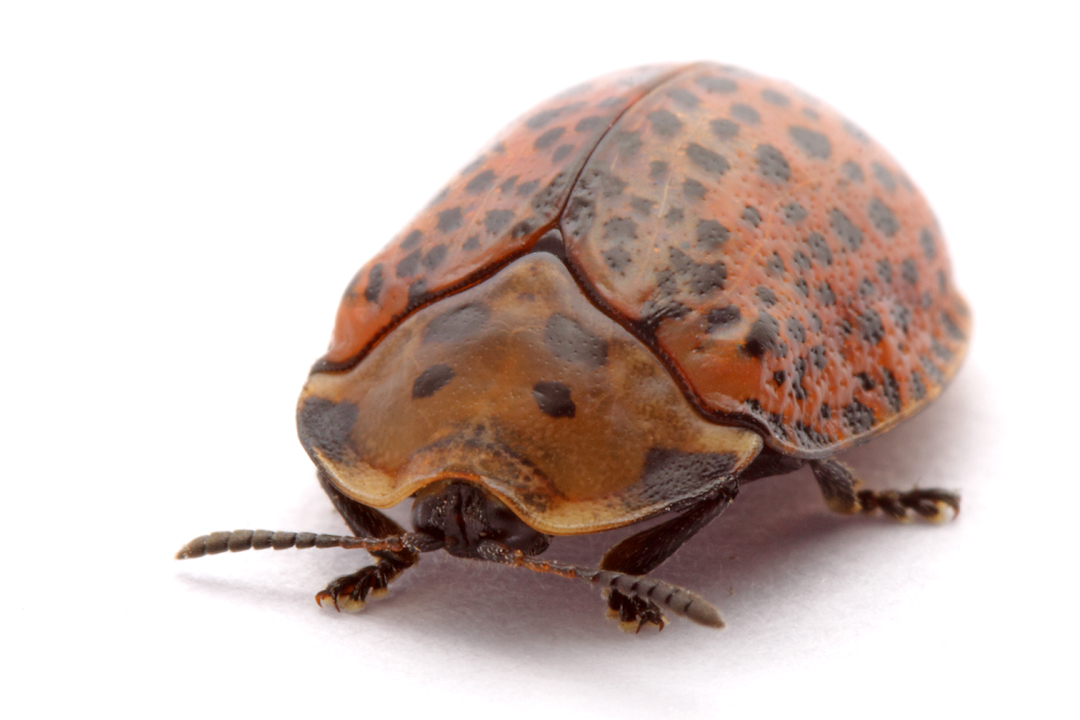
Chelymorpha varians | northwestern Buenos Aires Province, Argentina

A few days after returning from travel through northern Argentina, I found a jar on my desk with this beetle in it. One of my colleagues has seen it in the field while I was away and figured I would be interested in seeing it. Although I’m half-a-world away from home, I immediately thought of our North American species Chelymorpha cassidea when I saw it. Armed with this hunch, I typed “Chelymorpha Argentina” into Google, and the first result that came up was a paper by Hamity & Neder de Román (2008) about the species Chelymorpha varians in Argentina and its potential as a biocontrol agent for the widespread weed Convolvulus arvensis. Included in the paper was a plate showing variability of coloration and maculation in the adults, and my individual was a dead ringer for the species. Still, getting a species ID on the very first hit of the very first search attempt just seemed too easy, so I consulted the wonderfully comprehensive Cassidinae of the world – an interactive manual. This site, too, contained multiple images of Chelymorpha varians showing an extraordinary range of variability in color (from yellow to red) and degree of maculation (from immaculate to heavily maculated). A quick perusal of other species indicated as similar or also occurring in Argentina turned up nothing nearly as similar and convinced me that I had, indeed, arrived at a correct ID.

As the name suggests, markings are highly variable in shape and degree of development.

As indicated in the above cited paper, and like our own C. cassidea, species in the genus Chelymorpha are associated almost exclusively with plants in the genus Convolvulus. I would have preferred to photograph the beetle on foliage of this plant, but not knowing precisely where I might find it I decided to do white box instead. I got some printer paper and was looking for a cardboard box to line the inside with it when I spotted a styrofoam cooler of just the right size.

The scientific name translates literally to ''variable turtle-body''

These are okay white box photos, but I’ve decided if I want to do white box right I need to get a larger flash unit that is a little easier to work with off the camera. Right now I have only the small twin-flash heads from my MT-24EX—their small size makes them difficult to manipulate off the camera, and leaving them attached to their bracket limits the directions in which they can be oriented relative to the subject. As a result, I had to use more heavy-handed post-processing in these photos than I normally like to do in order to get the levels right. Hmm, I have a birthday coming up in about a month…

REFERENCE:

Hamity, V. C. & L. E. Neder de Román. 2008. Aspectos bioecológicos de Chelymorpha varians Blanchard (Coleoptera: Chrysomelidae, Cassidinae) defoliador de convolvuláceas. Idesia 26(2):69–73.

Copyright © Ted C. MacRae 2012

Retrachydes thoracicus – times four!

Disclaimer—these are not great photos!

A few days ago I posted this little quip as my status on Facebook: “Cool! Found a Retrachydes thoracicus thoracicus on the sidewalk outside my hotel!” I chuckled a little as I posted it, knowing that only a select few who read it would know what the heck I was talking about (of course, a right click to select “Search with Google” reveals the answer instantly). Of course, it is a species of longhorned beetle (family Cerambycidae) that apparently is found commonly in South America. I wanted to take some photographs of the beetle to show those who didn’t do the Google search just what it looked like. Unfortunately, the beetle was already somewhat moribund when I found it, and no matter how much I coaxed and prodded it on the stick I placed it on, it just looked… well, dumb. Legs out of position, antennae hanging limply, and the beetle itself laying prostrate on the branch, as if it barely had the strength to hang on (which actually was the case). Shame—it sure is an attractive species, with its densely pubescent and transversely gibbous pronotum (obviously the source of its name) and striking orange-banded antennae. C’est la vie!

Lately I’ve been trying to get a better handle on choosing backgrounds when I photograph insects, no longer content with the often busy and distracting backgrounds that show up in photographs taken completely in situ. It’s often a simple matter to hold the object on which the insect is sitting in front of something that gives the desired background effect, and having this perfectly calm yet strikingly attractive beetle to work with seemed to invite experimentation. I’m also trying to get a better feel for how to use higher ISO settings to make it easier to get these various “non-black” backgrounds while still using flash to get acceptable depth of field with the subject itself. Below are four of the better shots that came out of the session (yes—sadly, these are the “better” ones). I’m loathe to go below 1/160 sec exposure because of motion blur and would like to keep aperture settings quite small, so fairly high ISO settings are required to get the background effects I’m looking for. I think I’ve learned that ISO 1000 is about as high as I can go before the background gets unacceptably noisy—at small sizes the photos look fine, but open them up larger size and you’ll see what I mean. Anyway, ignoring the composition and noise issues, which background do you like best?

ISO 1000, 1/160 sec, f/14 - cloudy sky background

ISO 1600, 1/160 sec, f/14 - pavement background (close)

ISO 1600, 1/160 sec, f/14 - pavement background (more distant)

ISO 1600, 1/160 sec, f/14 - pavement background (foliage)

Copyright © Ted C. MacRae 2012

The most common beetle in Argentina

Astylus atromaculatus | Buenos Aires Province, Argentina

I don’t know if this is truly the case, but Astylus atromaculatus (family Melyridae) is one of only a few beetles in the country that actually has two Spanish common names—”astylus moteado” and “siete de oro” (meaning “spotted astylus” and “seven of gold”, both names referring to black splotches on the elytra). It is also the only beetle that I’ve seen everywhere I’ve been in the country—north and south, soybean fields and cornfields, countryside and city. I have yet to visit a soybean field where I don’t see them, perhaps nibbling on a leaf here and there but mostly just mating, and they can be downright overwhelming in cornfields (see this post with photos of the adults dripping from corn tassels, literally!). For all their ubiquity, however, their economic impact seems more nuisance than substantive. Corn breeders complain about interference during tasseling, and larval feeding on seeds during or just after germination seems to be on the rise due to increased use of conservation tillage, but overall this species seems to be more bark than bite.

Copyright © Ted C. MacRae 2012
Eriopis connexa on soybean in Argentina

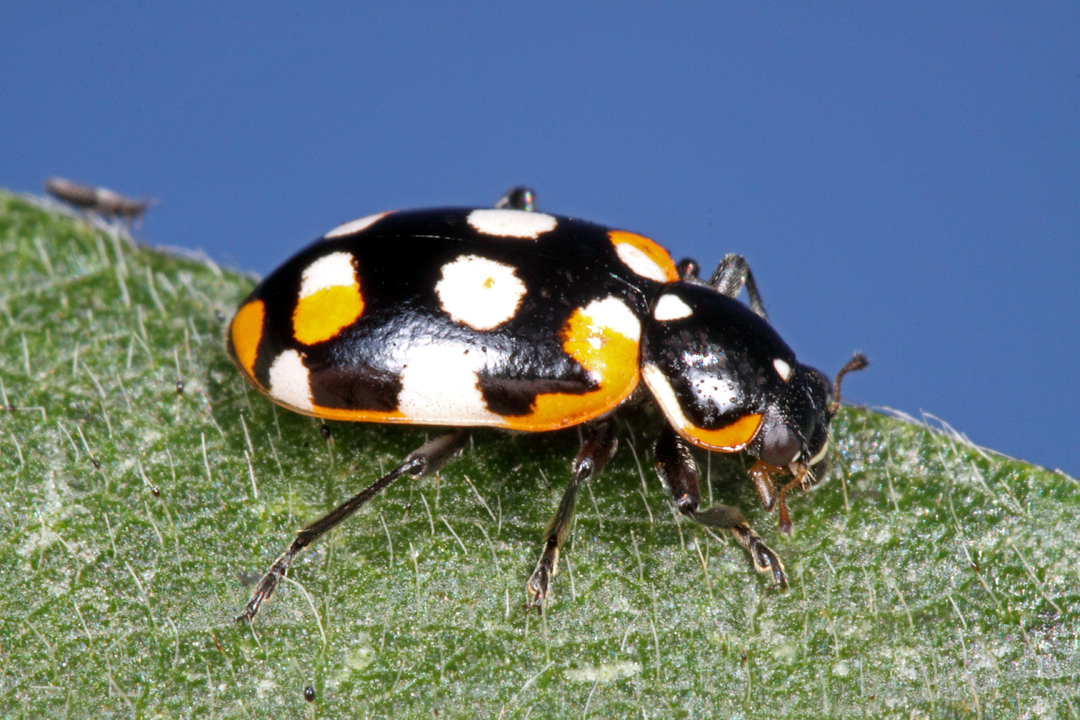
Eriopis connexa adult on soybean | Buenos Aires Province, Argentina

Congratulations to those of you who correctly guessed the identity of the “subject” in ID Challenge #16 as the ladybird beetle Eriopis connexa (family Coccinellidae). This is one of the most common ladybird beetles in Argentina, and during the past few weeks I have seen large numbers of these beetles in the soybean fields that I have been visiting. Coccinellids in Argentina are among the easier the groups to identify to species thanks to the excellent website Coccinellidae of Argentina. Identifying the “meal,” however, proved to be a little more difficult. Most people guessed aphids, a natural choice, but soybean aphids have not yet made it to the soybean fields of South America (thankfully!), so the victims of these predaceous beetles must be something else. There was a clue in the challenge photo that at least one person picked up on (but didn’t make the connection) in the form of small black globs stuck to the hairs of the plant on which the beetle was sitting. These are actually the fecal deposits of the bean thrips, Caliothrips phaseoli (order Thysanoptera, family Thripidae) (which I covered a year ago in A thrips is a thrips…), which for the past two seasons now has built up large populations on soybeans in Argentina. In fact, an adult bean thrips (yes, “thrips” is the correct singular form) can be seen in the above photo (which I did not notice while I was taking the photo). I’ve not yet witnessed these beetles actually feeding on a thrips, but the large numbers of thrips and beetles and near absence of any other suitable prey item makes the association almost a given.

Eriopis connexa larva on soybean | Buenos Aires Province, Argentina

Not only are the adult beetles numerous on the plants, but eggs and larvae as well. Larvae are every bit as brightly colored as the adults, with a color scheme that leaves little doubt regarding their association. In the case of this larva, I watched it roam back and forth across the soybean leaf, pausing momentarily and apparently eating something—thrips eggs I presume.

Congratulations to Mr. Phidippus and Dennis Haines, who tie for the Challenge win with 14 points each, while Gustavo and Dave tie for the final podium spot. Mr. Phidippus, however, easily takes the overall win in BitB Challenge Session #5 with a whopping total of 57 points. Mr. Phidippus—contact me for your loot! Dennis Haines and Tim Eisele take 2nd and 3rd overall honors, and full standings for BitB Challenge Session #5 are shown below.

Commentor IDC#14 SSC#10 IDC#15 Bonus SSC#11 Bonus IDC#16 Total
Mr. Phidippus 11 11 9   12   14 57
Dennis Haines 9 4 2   10 1 14 40
Tim Eisele 8 6 2   13   6 35
Roy 5 6 7   10     28
Mike Baker 7   9       10 26
Dorian Patkus     9   11 4   24
David Winter 3   9       10 22
Gustavo             12 12
HBG Dave             12 12
Marlin 12             12
FlaPack 10             10
Laurie Knight 2       8     10
Doug Yanega         9     9
Brady Richards       4   3   7
John Oliver   6           6
George Sims 2 2 2         6
Richard Waldrep   6         6
Arpad Hervanek 4             4
Roxane Magnus 4             4
dragonflywoman       4     4
Wayne K         4     4
itsybitsybeetle         4     4
fatcatfromvox 2             2
Emily Gooch 1             1
Sean Whipple     1         1
Jon Q             1 1


Copyright © Ted C. MacRae 2012

Chrysobothris viridiceps

Chrysobothris viridiceps on dead branch of Quercus alba | Baxter Co., Arkansas

Despite their general popularity among beetle collectors, jewel beetles (family Buprestidae) have an admittedly deserved reputation for difficult taxonomy. Part of the reason for this is the existence of several highly speciose genera. In North America, for example, nearly half of its described species belong to just three genera—Acmaeodera, Chrysobothris, and Agrilus (the latter, with nearly 3,000 described species and many more awaiting description, being possibly the most speciose animal genus in the world). Identification of species within these genera is difficult enough due to their sheer numbers and is further complicated by the existence a number of “species-groups”—i.e., groups of very closely related species that have only recently become reproductively isolated from each other (likely in response to host partitioning) but have not yet evolved obvious unique morphological characters. Perhaps the most famous of these is the “Chrysobothris femorata species-group.” A dominant component of hardwood forests throughout North America, members of this group have confounded taxonomists, collectors, and foresters alike for many years. Fortunately, the recent revision of the group and formal description of several species by Wellso and Manley (2007) have brought much needed clarity to the group. While problems still remain (C. femorata sensu novo probably still encompasses several undescribed species), most individuals can now be identified with some confidence.

Males and females both exhibit completely divided post-median fasciae

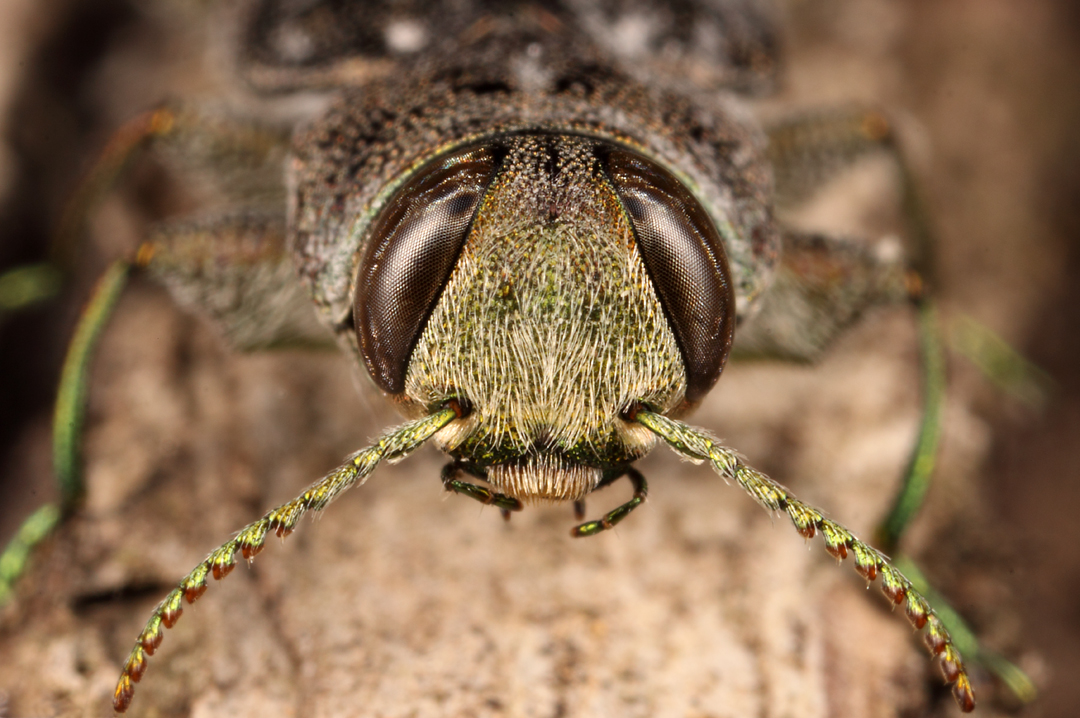
I have previously discussed three of the seven now recognized species occurring broadly in eastern North America—the nominate C. femorata, still regarded as an important pest of ornamental and fruit tree plantings, C. caddo, one of the new species described by Wellso and Manley (2007) and associated with dead hackberry (Celtis spp.), and C. quadriimpressa, mostly associated with dead branches of oak (Quercus spp.). The individuals shown here, photographed on branches of a dead white oak (Quercus alba) in north-central Arkansas this past June, represent a fourth species in the group, Chrysobothris viridiceps. Unlike most members of the C. femorata species-group, C. viridiceps can be readily recognized in the field  due to the uninterrupted costa (raised narrow ridge) that completely bisects the posterior fovea (rounded pit) on each elytron. In all other species this costa is interrupted by the fovea. Moreover, this species is the only one in the group in which the males (easily distinguished from females by the bright green frons, or face) exhibit bicolored antennal segments, with the outer portion of each segment yellow and the remainder bright metallic green. While the species name is Latin for “green face,” this character is useless for species identification, as males of all species in the group exhibit a more or less green face.

Males sport not only the green face for which the species is named, but also distinct yellow areas on the antennal segments

Females are a little more difficult to distinguish in the field because, like those of other species of the group the antennae are more uniformly reddish. Likewise, the face also lacks the green coloration of the male, and although still useful for species identification the differences among females between the different species are more subtle and require microscopic examination. However, as in the male the elytral foveae are completely divided, allowing even females to be recognized relatively easily.

Females tend to be more reddish on the legs, antennae and face

One thing I have noticed about the different members of the C. femorata species-group is the usefulness of host plant association in distinguishing the different species. Of the seven species occurring in my region, I’ve seen C. femorata associated mostly with stressed but still living trees in genera other than oak or hickory (e.g., maple, sycamore, apple, poplar, ash, etc.), C. adelpha associated exclusively with dead hickory (Carya spp.), and C. caddo associated almost exclusively with hackberry (Celtis spp.). The remaining four species are all associated primarily or exclusively with oaks, but even these species often segregate according to branch size, with C. viridiceps occurring mostly on the smallest branches, C. quadriimpressa on somewhat larger branches, C. rugosiceps on very large branches and the upper trunk, and C. shawnee on large trunks and even stumps. Not surprisingly, these size preferences reflect the relative size of the beetles, with C. viridiceps (7–13 mm in length) generally being the smallest of the four species and C. shawnee (9–18 mm in length) the largest.

Okay, now to get photos of C. adelpha, C. rugosiceps and C. shawnee!

REFERENCES:

Wellso, S. G. and G. V. Manley. 2007. A revision of the Chrysobothris femorata (Olivier, 1790) species group from North America, north of Mexico (Coleoptera: Buprestidae). Zootaxa 1652:1–26.

Copyright © Ted C. MacRae 2012

Tiger beetles in southeast Missouri

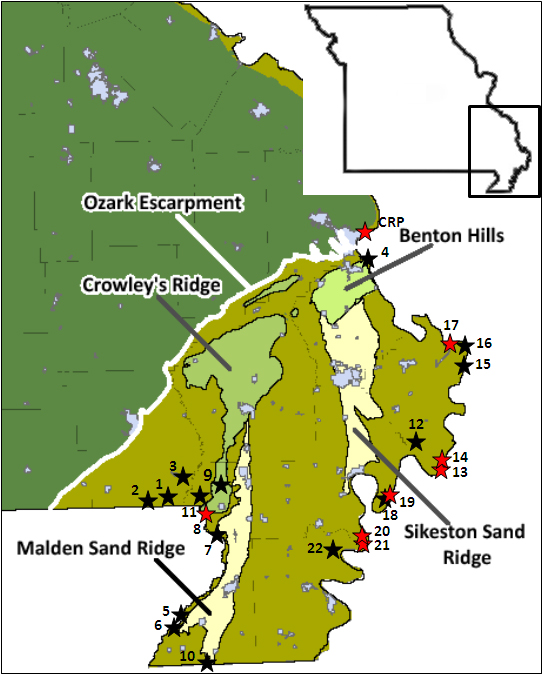
Figure 1. Sites surveyed in southeastern Missouri for Cylindera cursitans during 2007–2010. Site numbers are referenced in Table 1 (CRP = Cape Rock Park), with red stars indicating sites where C. cursitans was observed. Black box on inset map of Missouri denotes main map area (bordering states include AR to the south and TN, KY, and IL to the east).

ResearchBlogging.orgVolume 43(3) of the journal CICINDELA was published a few weeks ago, and I can truly lay more claim to the issue than anybody else (except perhaps Managing Editor Ron Huber). In addition to having one of my photos (a face-on shot of Tetracha carolina) featured on the cover, I was coauthor on the first of two papers included in the issue and lead author on the second. (And to complete my stamp of ownership, I did the final assembly of the issue as the journal’s Layout Editor.) The two included papers each report the results of surveys conducted in the Mississippi Alluvial Plain of southeastern Missouri (also called the “bootheel” in reference to its shape—see Fig. 1) for tiger beetles whose occurrence in that part of the state was previously not well known. In the first, Fothergill et al. (2011) used a novel survey technique that involved searching beneath irrigation polypipe in agricultural fields to find Tetracha carolina (Carolina Metallic Tiger Beetle); while the second paper (MacRae et al. 2011) reports the results of a multi-year survey to characterize the distribution, habitat associations and conservation status of Cylindera cursitans (Ant-like Tiger Beetle). Together with our three papers on Habroscelimorpha circumpicta johnsonii (Saline Spring Tiger Beetle), Dromochorus pruinina (Loamy Ground Tiger Beetle) and Cylindera celeripes (Swift Tiger Beetle)—all published in the past year—these two papers officially complete the battery of publications that describe our survey efforts for the five tiger beetle species considered of potential conservation concern in Missouri when Chris Brown and I began our faunal studies of the group more than ten years ago.

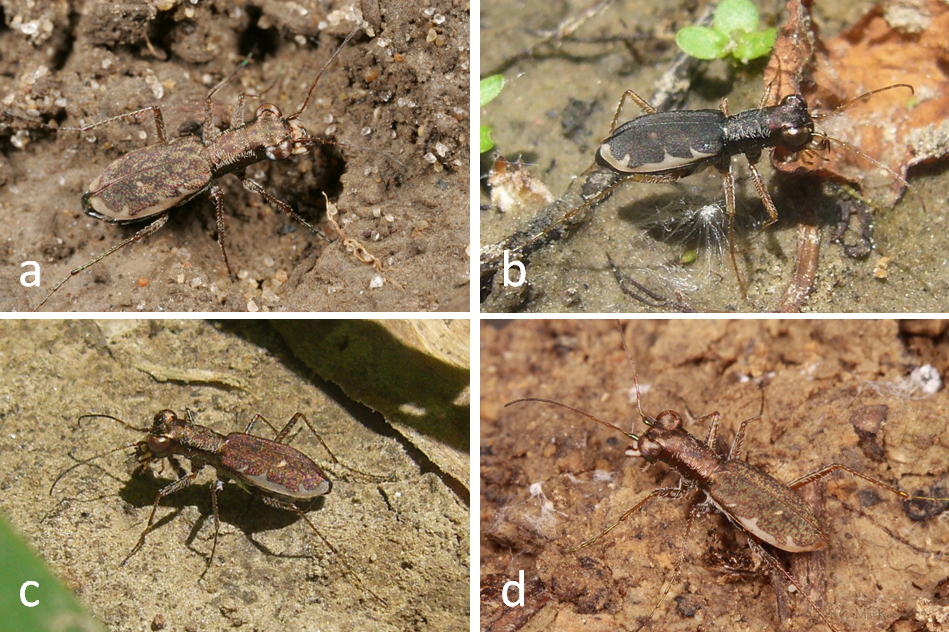
The first three papers clearly painted a rather gloomy picture—H. circumpicta johnsonii is possibly extirpated from saline spring habitats in central Missouri, D. pruinina is limited to a 2.5 mile stretch of roadside habitat in western Missouri, and C. celeripes is restricted to a few patches of critically imperiled loess hill prairie habitat in extreme northwestern Missouri. Happily, prospects for T. carolina and C. cursitans in Missouri are much better. While both are limited in the state to the southeastern lowlands, our surveys indicated that populations are sufficiently robust and widespread in the area to alleviate any concerns about the potential for extirpation. Tetracha carolina in particular was found abundantly in agricultural habitats and appears to have adapted well to the extensive modifications caused by conversion of the cypress-tupelo swamps that formerly covered the region. Cylindera cursitans (Fig. 2) hasn’t shown nearly the same adaptive capability as T. carolina; however, it has nevertheless found suitable refuge in the ribbons of wet, bottomland forest that persist between the Mississippi River and the levee systems that protect the region’s farmland. For a time it seemed that the same habitats along the St. Francois River that bound the western side of the region weren’t suitable for the species, but after much searching (in often tough conditions!) Kent finally managed to locate a population on the Missouri side of the river opposite a known population in Arkansas.

Figure 2. Cylindera cursitans in southeast Missouri: a) New Madrid Co., Girvin Memorial Conservation Area, 6.vii.2007; b-c) Mississippi Co., Dorena Ferry Landing, 6.vii.2008; d) Mississippi Co., Hwy 60 at Mississippi River bridge, 20.vi.2009. Photos by CRB (a) and TCM (b-d).

Both of these species illustrate how healthy populations of insects are able to hide right beneath our noses. Previous to our surveys, records of T. carolina and C. cursitans in southeastern Missouri were scarce (the latter consisting of a single specimen in the Enns Entomology Museum at the University of Missouri in Columbia, and with considerable searching required before the first field population was finally located). In both cases, perceived rarity was a result not of actual rarity, but rather specific habitat requirement or unusual behavior. While I get great satisfaction out of finding populations of “rare” species and increasing our understanding of their habitat requirements, I also can’t help but wonder if they truly are rare and how many populations I might still have missed—populations that I would have found had I searched in a slightly different manner or at a slightly different time.

REFERENCES:

Fothergill, K., C. B. Cross, K. V. Tindall, T. C. MacRae and C. R. Brown. 2011. Tetracha carolina L. (Coleoptera: Cicindelidae) associated with polypipe irrigation systems in southeastern Missouri agricultural lands. CICINDELA 43(3):45–58.

MacRae, T. C., C. R. Brown and K. Fothergill. 2011. Distribution, seasonal occurrence and conservation status of Cylindera (s. str.) cursitans (LeConte) (Coleoptera: Cicindelidae) in Missouri. CICINDELA 43(3):59-74

Copyright © Ted C. MacRae 2012

The World’s Largest Tiger Beetle

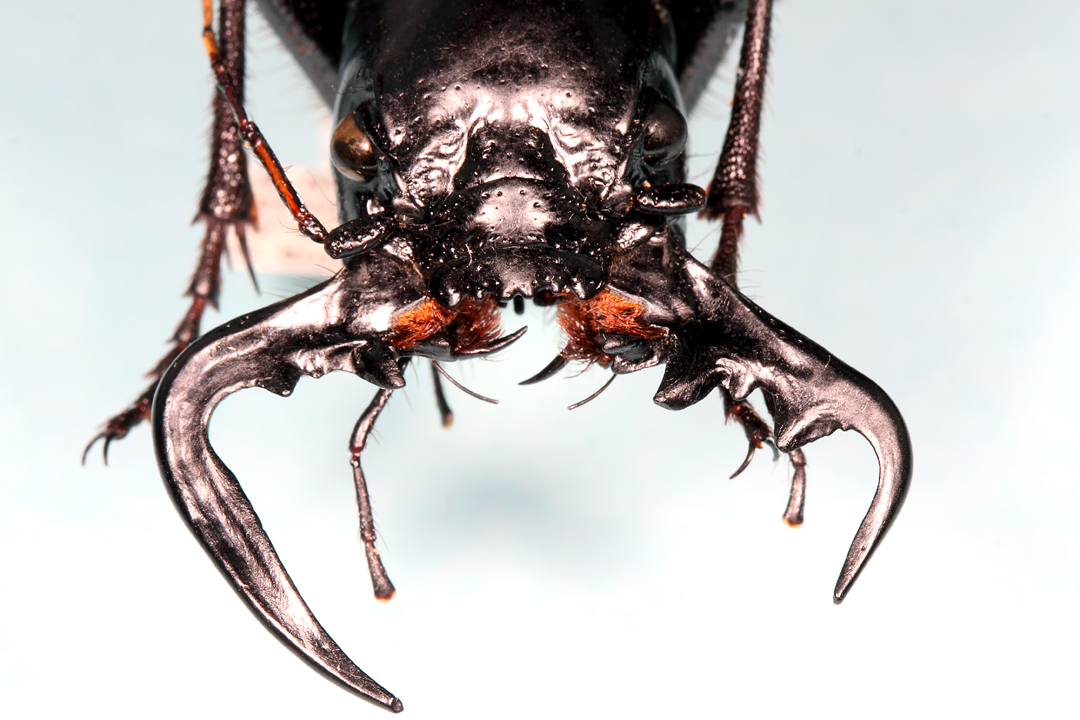
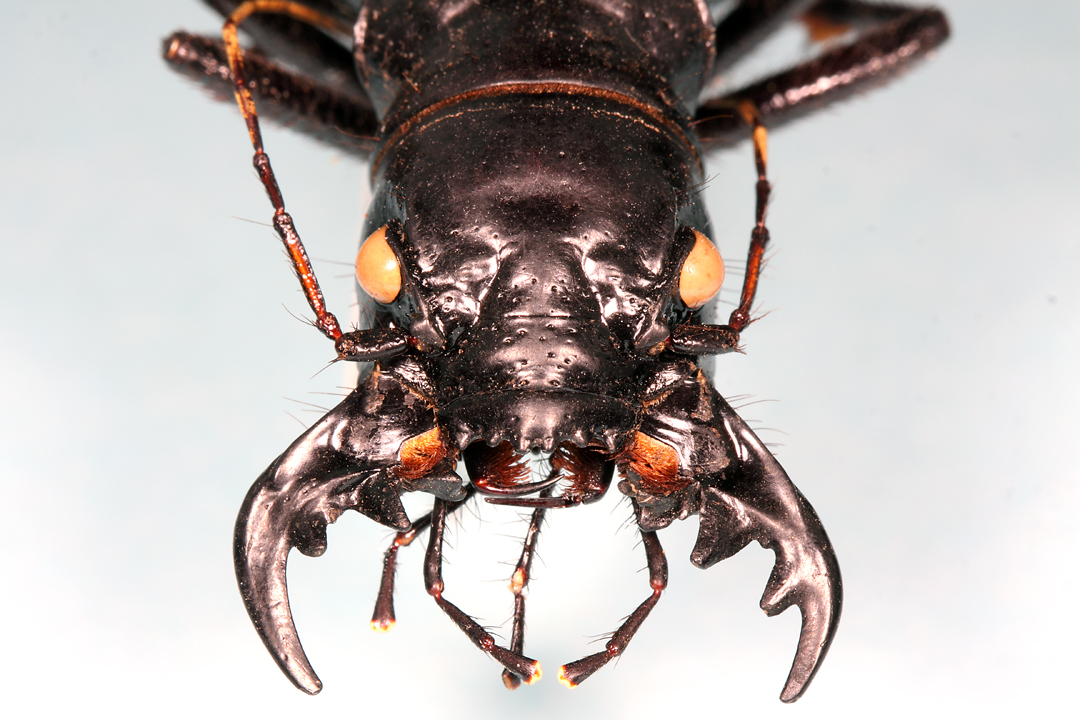
Manticora scabra - male (L) and female (R) | Republic of South Africa

Some of the first residents of my new insect cabinets (see ) are also among the newest specimens in my collection. Not long ago I received a box from world tiger beetle expert David Brzoska, who had carefully chosen male/female pairs of a number of tiger beetle species from his impressive world collection and sent them to me as a surprise gift. Now, us North America-bound collectors are limited to just a few genera, e.g. Cicindela (although increasingly recognized as a cluster of several closely related genera), Tetracha, and if we’re really lucky Amblycheila and Omus (the last being one I still have not seen in the field). In the rest of the world (especially the tropics and subtropics), however, generic diversity is much higher, and coming as they did from South America, Africa, Australia, and southeast Asia most of the specimens in the sending represented new genera for my collection. While I was grateful for them all, the specimens that had me leaping for joy was this fine pair of Manticora scabra, one of the so-called “African Giant Tiger Beetles.”

Males of all Manticora spp. have asymmetrically enlarged mandibles

In the case of these beetles, the term “giant” is no exaggeration. The male specimen (above and left) measures a full 54 mm (that’s more than 2 inches, folks!) from the tip of its grossly enlarged mandible to the tip of its abdomen, and even the female at 47 mm length is substantially larger than my 38-mm long male specimen of North America’s largest tiger beetle, Amblycheila cylindriformis. While enlarged male mandibles are a common feature among many beetle groups, Manticora males feature an unusual asymmetry in the mandibles, with the right mandible always much larger than the left (itself enlarged compared to the female mandibles, and even the latter cannot be considered small).  Apparently the asymmetry represents a trade-off in natural selection—males use their mandibles not only to hunt prey but also hold onto the female pronotum during mating and subsequent mate guarding. There is positive selection pressure for larger mandible size, as males with smaller mandibles are more likely to be dislodged from the female by competing males. However, because of the large size of the species, larger male mandibles are less effective for securing normal prey items that tend to be smaller in size. If both mandibles were enlarged to the point needed to securely grip the female pronotum, the male would be unable to feed adequately, but having only one mandible fully enlarged provides sufficient grip while maintaining an ability by the somewhat smaller left mandible to grip regular prey items. A consequence of the mandibular asymmetry is that males ride “to the left” when coupled with females.

The right mandible is larger than the left mandible.

David identified these individuals as the species M. scabra, occurring throughout much of southern Africa (Botswana, Malawi, Mozambique, Republic of South Africa, Tanzania, Zimbabwe—according to Carabidae of the World). I presume the species epithet refers to the roughened surface of the elytra. There are at least two recent treatments of the genus (Werner 2000, Mares 2003); however, I have access to neither because of the exorbitant cost of these books—$247 and $433, respectively (I find it rather ironic that the recent explosion of book-sized treatments of “large” beetles has resulted in publications priced so high that they are inaccessible to most professional entomologists).

Female mandibles are nonetheless impressive despite their smaller size.

I made a trip to South Africa in 1999 and had hoped to see these beetles for myself, but unfortunately this did not happen. Perhaps part of the problem was my impression of these beetles as nocturnal hunters—the prevailing ‘wisdom’ at the time. My field partners and I made several nighttime forays in the semi-arid bushveldt where we were camping, using flashlights to scan the ground for any large black beetles we could find moving about. We found numerous tyrant ground beetles (family Carabidae, genus Anthia) and a diversity of tok-tokkies (family Tenebrionidae), but no Manticora tiger beetles. Shortly after that trip, Oberprieler & Arndt (2000) published an informative summary of the biology of several Manticora populations in South Africa, their most notable finding being that adults are opportunistic diurnal predators that hunt by smell rather than nocturnal visual hunters. Perhaps someday I’ll have another opportunity to visit South Africa and see Manticora adults in the field, but until that time I’m happy to have these two specimens residing in my cabinet.

My sincerest thanks to David Brzoska for these sending me these fine specimens and for the many additional kindnesses he has extended to me during the past few years.

REFERENCES:

Mares, J. 2003. A Monograph of the Genus Manticora. Taita Publishers, 205 pp.

Oberprieler, R. G. & E. Arndt. 2000. On the biology of Manticora Fabricius (Coleoptera: Carabidae: Cicindelinae), with a description of the larva and taxonomic notes. Tijdschrift voor Entomologie 143:71–89.

Werner, K. 2000. The Tiger Beetles of Africa (Coleoptera, Cicindelidae) Volume I. Taita Publishers, 191 pp.

Copyright © Ted C. MacRae 2012