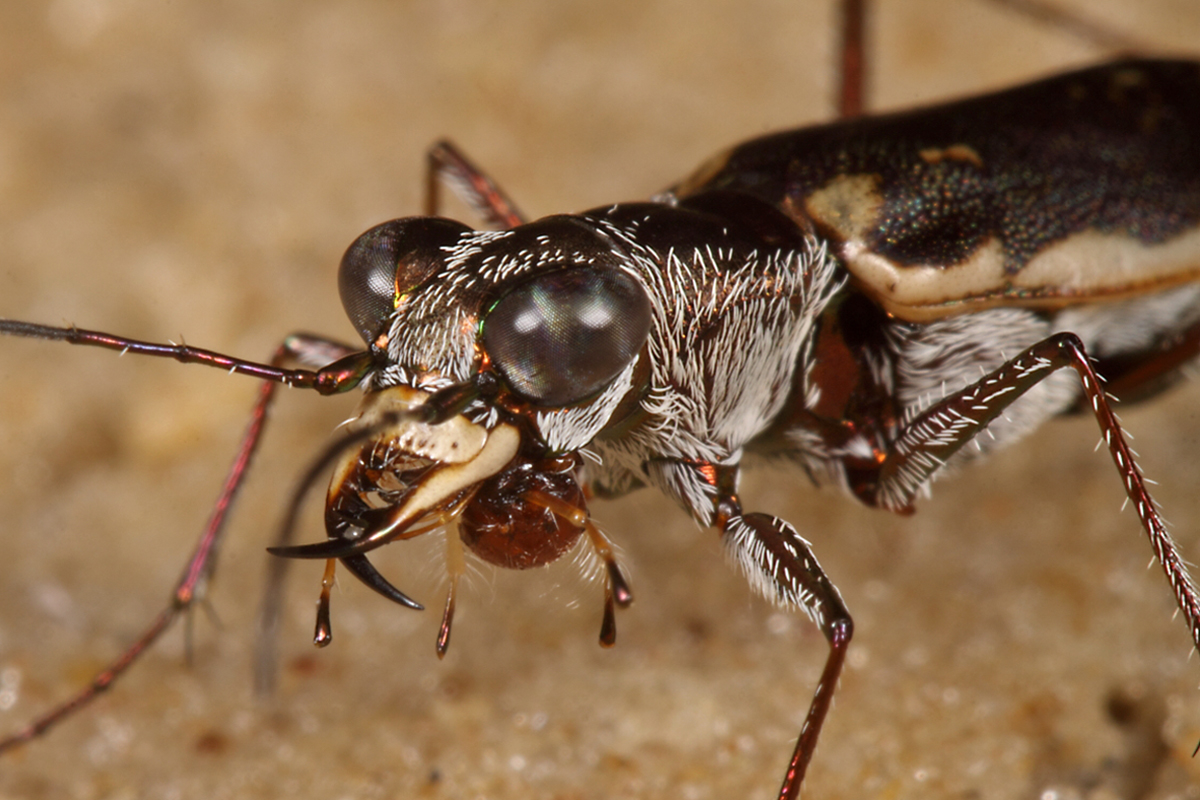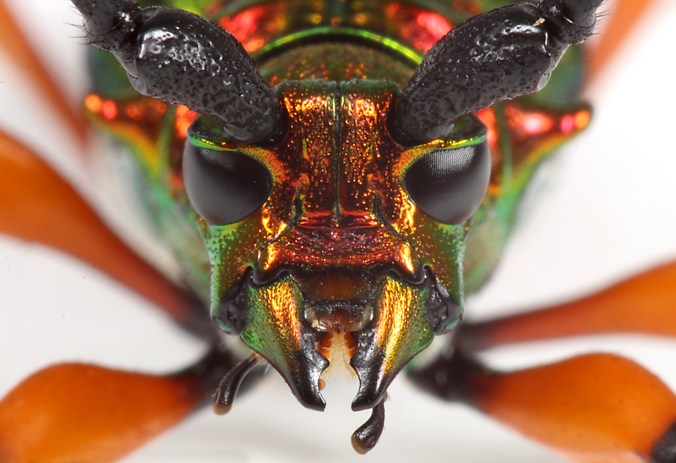
Bumelia borer on white

Plinthocoelium suaveolens suaveolens | Ozark Co., Missouri

Last weekend I visited one of my favorite collecting spots in all of Missouri—Long Bald Glade Natural Area (part of Caney Mountain Conservation Area in Ozark Co.).  Nestled at the eastern edge of the White River Hills in southwestern Missouri, its deeply dissected hills are home to numerous plants and animals that are more typical of the southern Great Plains and which have found refuge in the xeric, thin-soiled calcareous prairies (commonly “cedar glades”) that cover the area’s southern- and western-facing slopes.  These include some rather impressive insects, such as a disjunct population of Cicindelidia obsoleta vulturina, which I just found here last year as the new northeasternmost extent of the population, as well as the marvelously monstrous Microstylum morosum, North America’s largest robber fly and so far known in Missouri only from Long Bald Glade where it was discovered in 2009. 

Another quite striking insect found at Long Bald Glades (though not restricted in Missouri to the White River Hills) is the bumelia borer, Plinthocoelium suaveolens.  This beetle occupied much of my time in July 2009 as I committed to photographing the species in the wild, and it was Long Bald Glade where I finally (if not completely satisfactorily) succeeded in that goal.  This time I was visiting the Glade to look for the earliest individuals of C. obsoleta vulturina and, hopefully, document additional glades within Caney Mountain that might support the beetle.  However, in the back of my mind I was also keeping a lookout for P. suaveolens—this species is primarily active during July and August in Missouri, but I do have records of it as late as September.  As I looked for (and found) tiger beetles, I also checked out each bumelia tree that I passed hoping to see a P. suaveolens adult perched on its lower trunk.  It was not until later in the afternoon that I heard a loud “buzz” approaching from behind and turned to see one of these beauties fly right past me—legs and antennae held outstretched—before landing on a nearby tree.  Now, over the years I’ve learned a few lessons, and one is that you don’t try to take in situ photographs of the first individual you encounter of a prized species.  More often than not it gets away before you even fire the first shot, and you’re left with nothing.  My standard procedure now is to procure the first individual immediately and keep it alive.  If attempts to photograph subsequent individuals are not successful (or none are seen), then at least I have a backup for studio shots (not my first choice, but better than nothing!).  Such was the case with this individual.

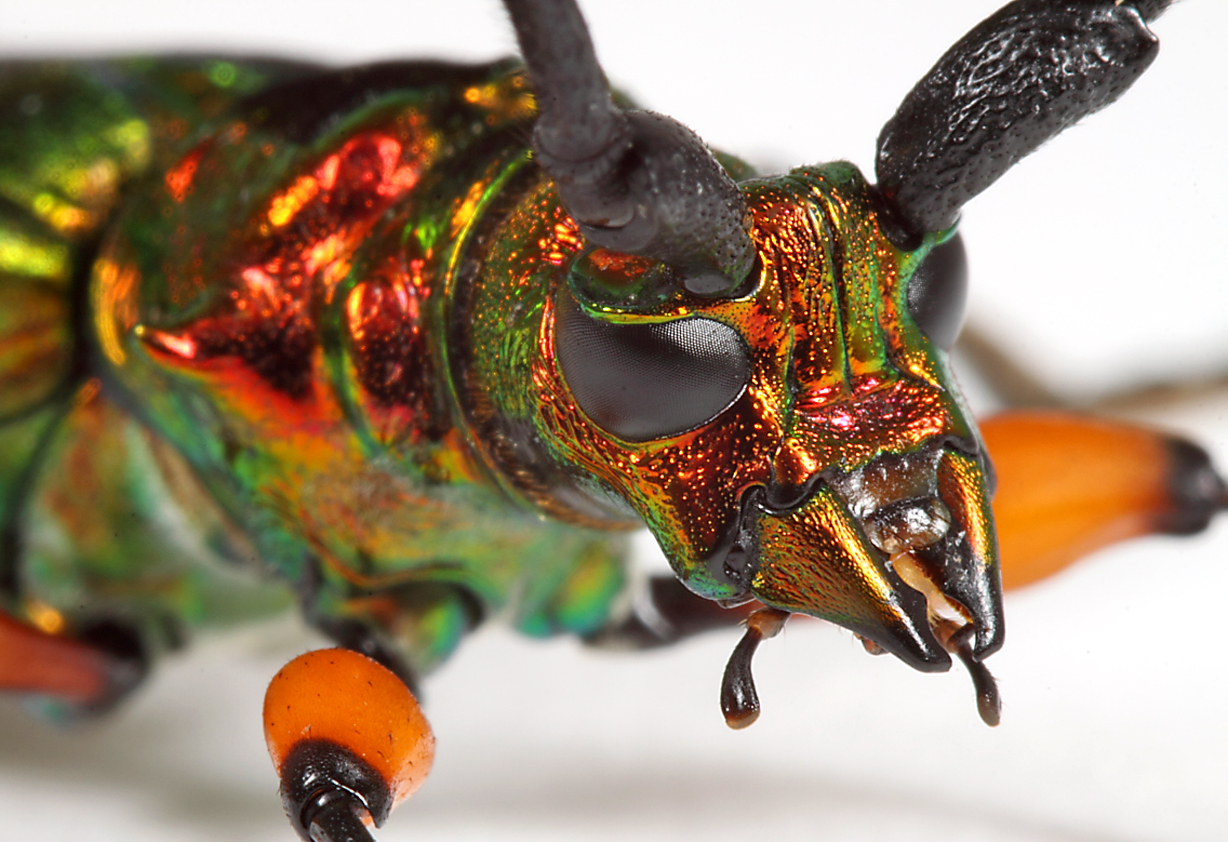
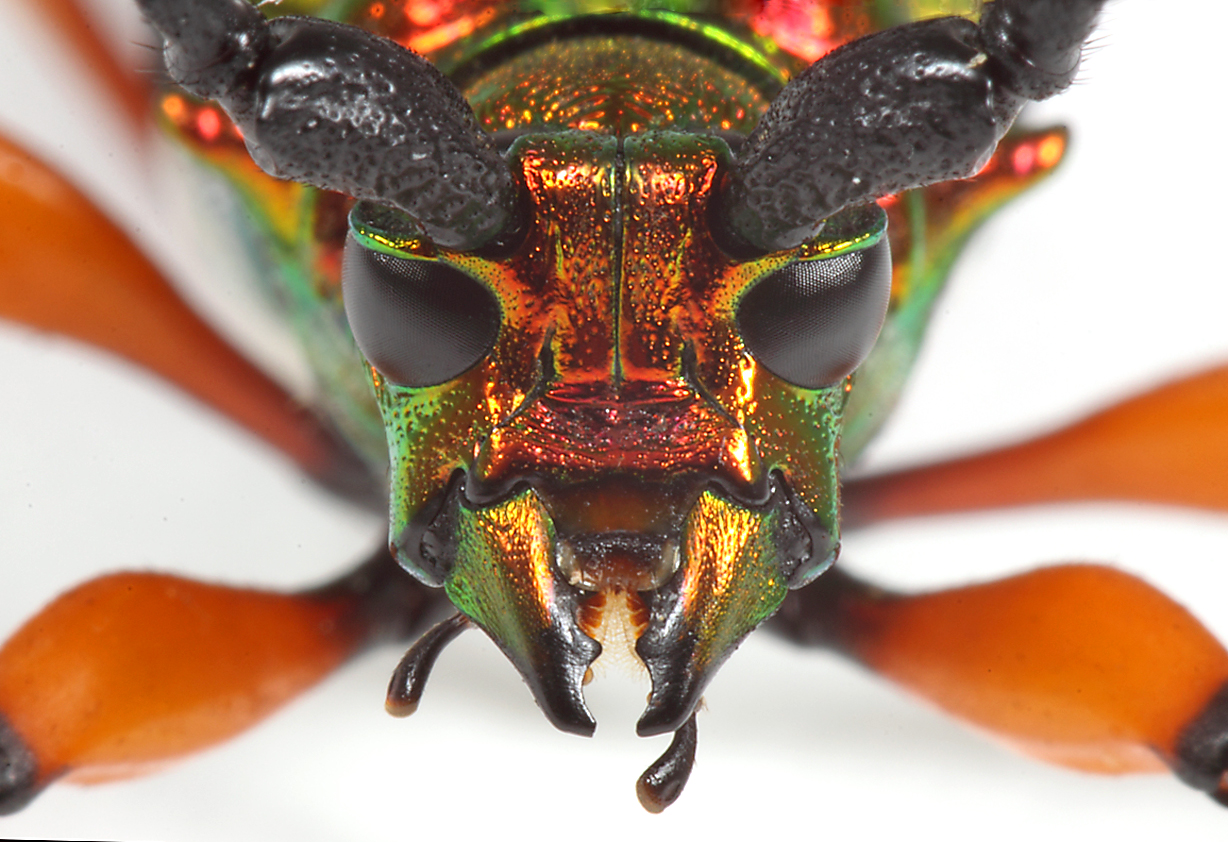
Although I still lack that “perfect” beetle-on-a-branch shot that I hope to eventually get for this species, it seemed a good subject for some white-box photography.  I’ve vacilated between true white-box w/ indirect flash versus getting a white-box effect by using direct, diffused flash with the subject on a white background.  I decided now was the time for a direct comparison of the two techniques.  All of the following photographs were taken with the Canon 100mm macro lens on a Canon 50D body at 160 ISO, 1/200 sec, and f/16.  For the closeups (photos 3 and 5 of each series), 68mm of extension tubes were added.  The photos on the left are true white-box photos, i.e. the flash heads were directed up and away from the subject placed inside a box lined with white tissue (Kim-Wipes laboratory wipers).  The photos on the right mimic the white-box effect by placing the subject on white filter paper, but the flash heads were pointed directly at the subject through my DIY concave diffuser (click on photos for 1200×800 versions):

Indirect flash in white box

Direct flash w/ DIY diffuser
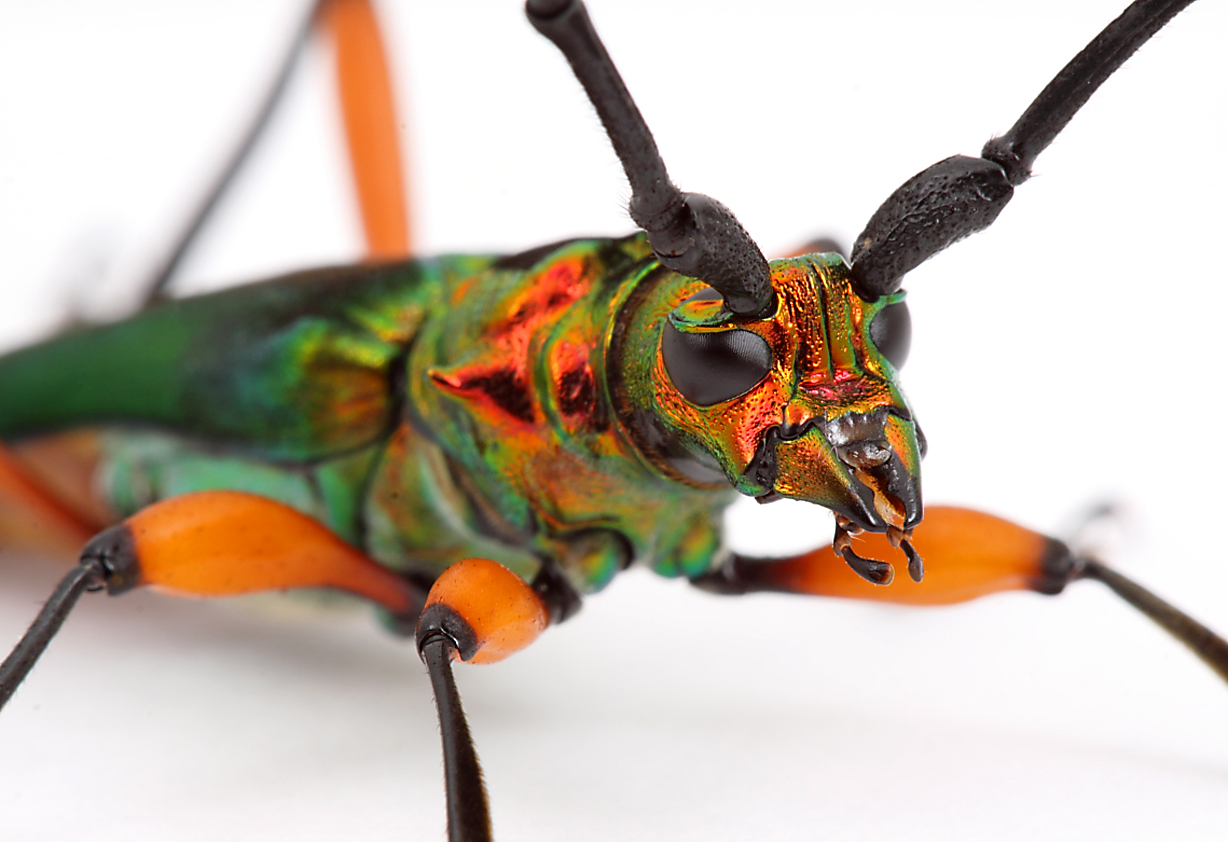
Indirect flash in white box
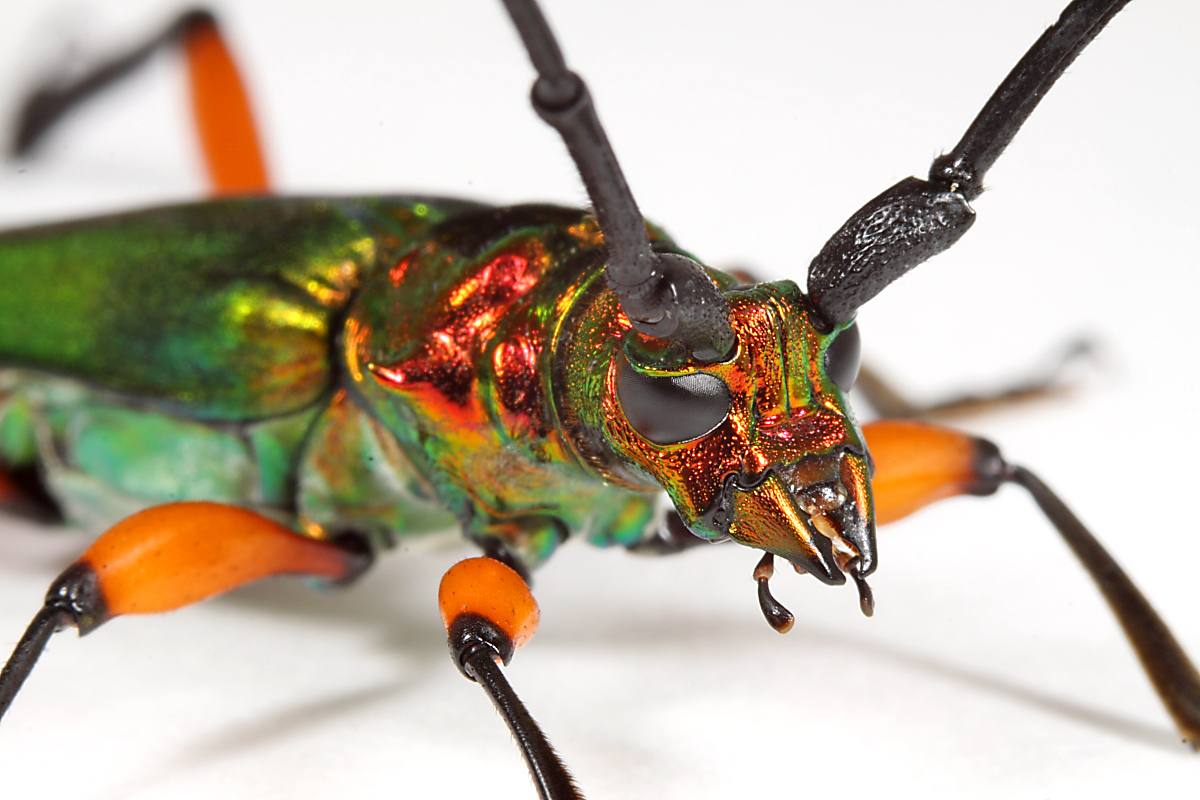
Direct flash w/ DIY diffuser

Indirect flash in white box
Direct flash w/ DIY diffuser

Indirect flash in white box

Direct flash w/ DIY diffuser

Indirect flash in white box
Direct flash w/ DIY diffuser

I must admit, looking at the photos on the camera playback screen I had the impression that I would like the direct-diffuser photos better, but after reviewing them on the computer and applying typical post-processing enhancements (e.g., levels, slight shadow reduction, and unsharp mask), the true white-box photos appear to have benefited from more even lighting, resulting in truer color, less shadowing, and minimal specular highlighting.  Not that the direct-diffuser photos are bad—they’re just not as good as the white-box photos.  I guess what this means is that my DIY diffuser, while a significant improvement over my previous diffusers, still could use some improvement (if ability to create white-box-like results is the ultimate test of a diffuser’s effectiveness).  I’d be interested in knowing your opinions based on these comparisons.

Congratulations to Ben Coulter, who wins yet another Super Crop Challenge and strengthens his lead in the overall standings of the current BitB Challenge Session #4 with 13 points.  Mr. Phidippus also correctly identified the species and takes 2nd place in the challenge with 8 points, keeping him in 2nd place in the overall standings as well.  Morgan Jackson takes 3rd place in the challenge with 7 points, but Roy’s retains 3rd place in the overall standings by way of his 6 points in this challenge.  Congratulations to these top points earners, and thanks to all who played.

Copyright © Ted C. MacRae 2011
Use of extension tubes for better lighting

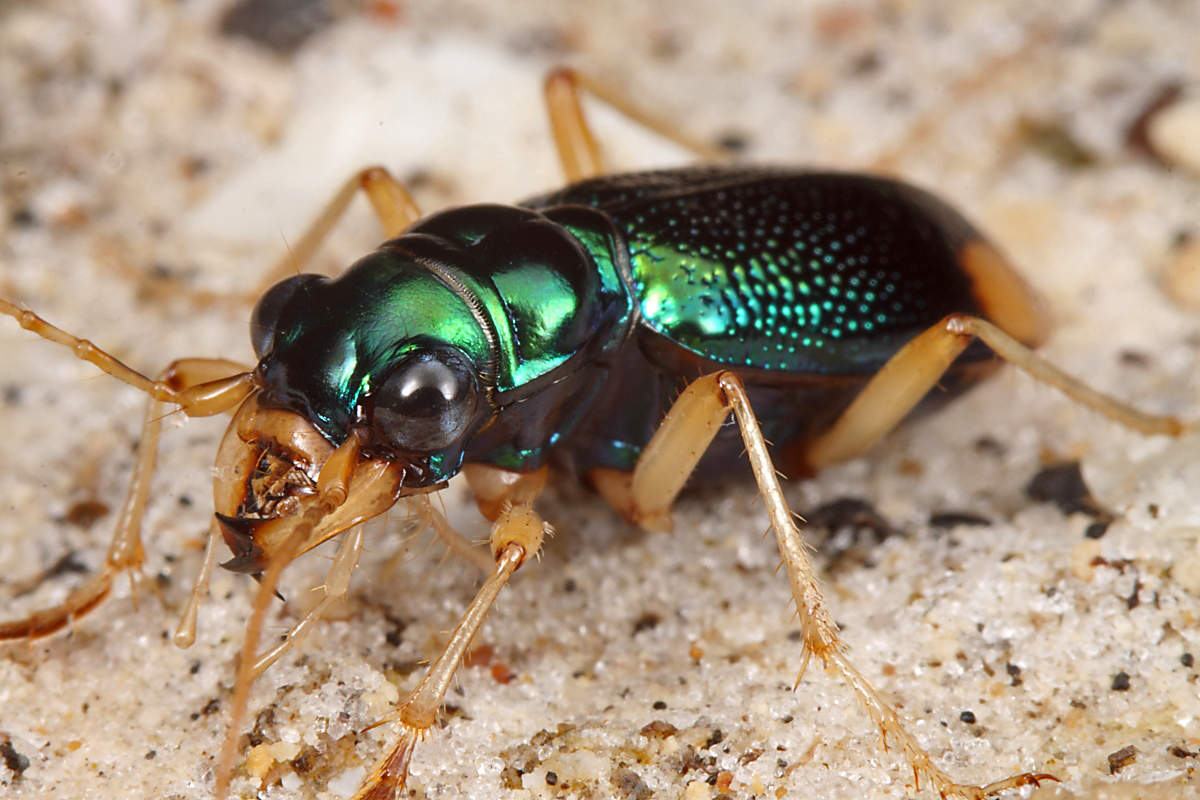
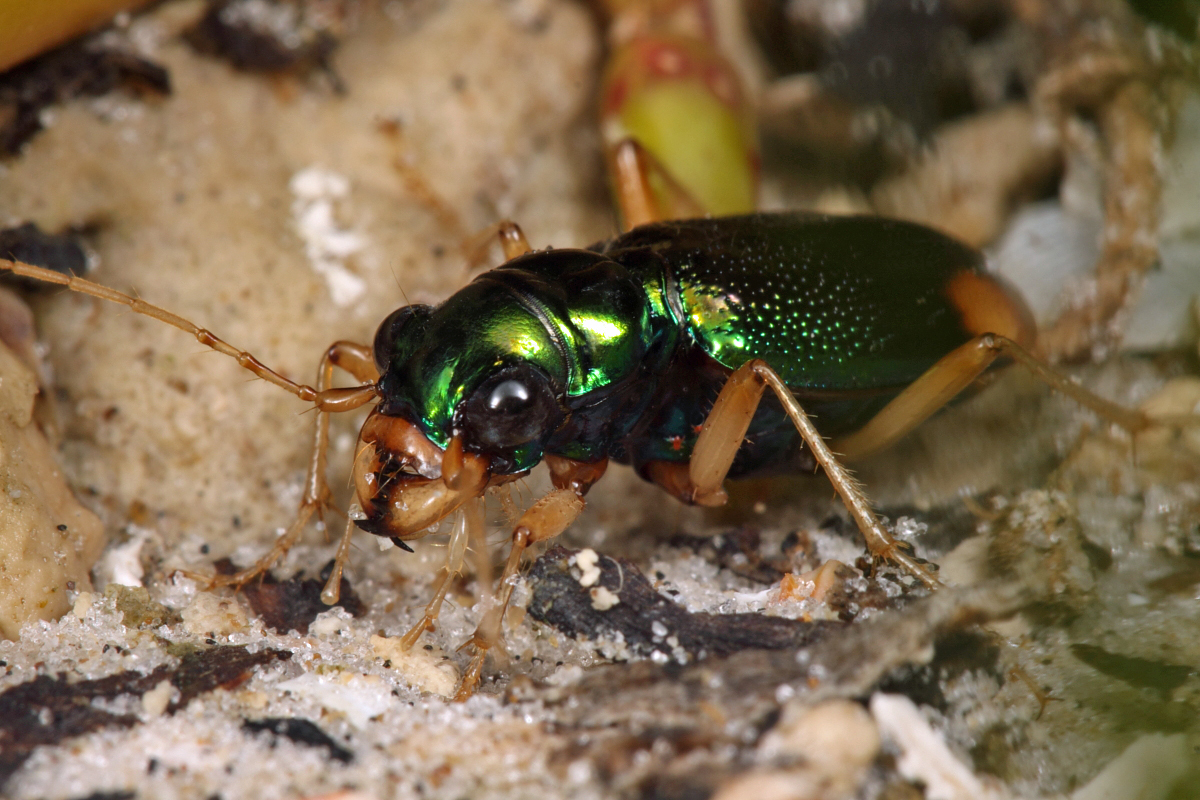
The photos in this post of Tetracha floridana (Florida Metallic Tiger Beetle) illustrate a technique that I have begun using recently to improve the lighting in my full-flash insect macrophotographs—use of extension tubes!  I know this sounds strange, and I actually just stumbled onto it myself when I started using extension tubes in combination with my Canon EF 100mm macro lens.  Okay, I can hear it now: “Why not use the Canon MP-E 65 mm macro lens?”  It’s a good question, as at magnifications above 1X there is no finer lens than the 65mm.  However, the tiger beetles that I spend a lot of time photographing are right in that size range where sometimes I need magnifications below 1x (whole body shots of medium to large species), while other times I need magnifications above 1X (small species and closeups—particularly face shots).  Fortunately, the entire spectrum of magnifications (up to 5X) is covered by these two lenses, but there is, unfortunately, no overlap.  This is where the extension tubes come in—when all 68mm are added the 100mm lens effectively changes from a 1.0X–∞ lens to a 0.7–2.0X lens.  This gives a frame width of 11–33 mm, perfect for nearly all North American tiger beetles (most species range from 6-20 mm, excluding legs and antennae). 

In addition to allowing a more appropriate range of magnifications without the need to switch out lenses, this has one other effect—it moves the lens a little closer to the subject.  That in itself is of no particular benefit, but since I use the front-of-the-lens-mounted Canon MT-24EX dual flash, it also moves the flash a little closer to the subject.  It’s not a huge distance, only about 20 mm, but keep in mind that the flash heads extend forward from the front of the lens (especially with the Kaiser shoes that I use with my diffuser), and the front of the diffuser itself lies at about 60 mm in front of the lens face.  Thus, at 1X the the front of the diffuser sits ~80 mm from the subject with the 100mm lens only, but with 68 mm of extension tubes added it sits only 60 mm from the subject.  The closer the light source is to the subject, the greater the apparent light size, and larger apparent light size results in more even lighting with reduced specular effects.

Tetracha floridana | Pinellas Co., Florida (100mm lens only)

100mm lens + 68mm extension tubes

100mm lens only (slightly cropped)

100mm lens + 68mm extension tubes

The primary disadvantage to doing this is loss of ability to focus to infinity.  Frankly, this is functionality I never used with the 100mm lens, preferring instead the 17-85mm wide-angle lens for more general landscape and habitat photos.  The other downside is that placing the lens closer to the subject can result in greater chance of “spooking” the subject and causing it to flee or behave evasively.  Again, however, my experience is that if a subject can be photographed at 1X with the 100mm lens, it can be photographed at 2X with the 100mm lens + extension tubes.

Has anybody else ever tried this, and if so what was your experience?

Copyright © Ted C. MacRae 2011

Charming Couple revisited

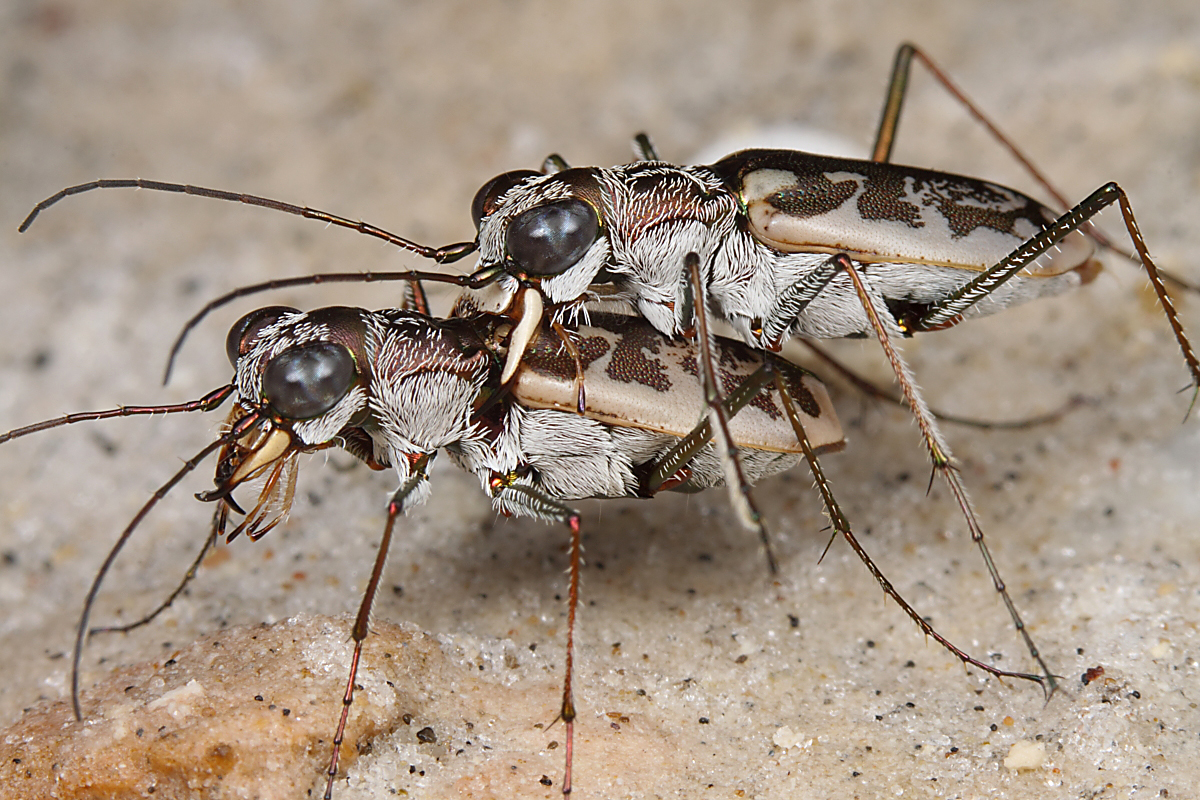
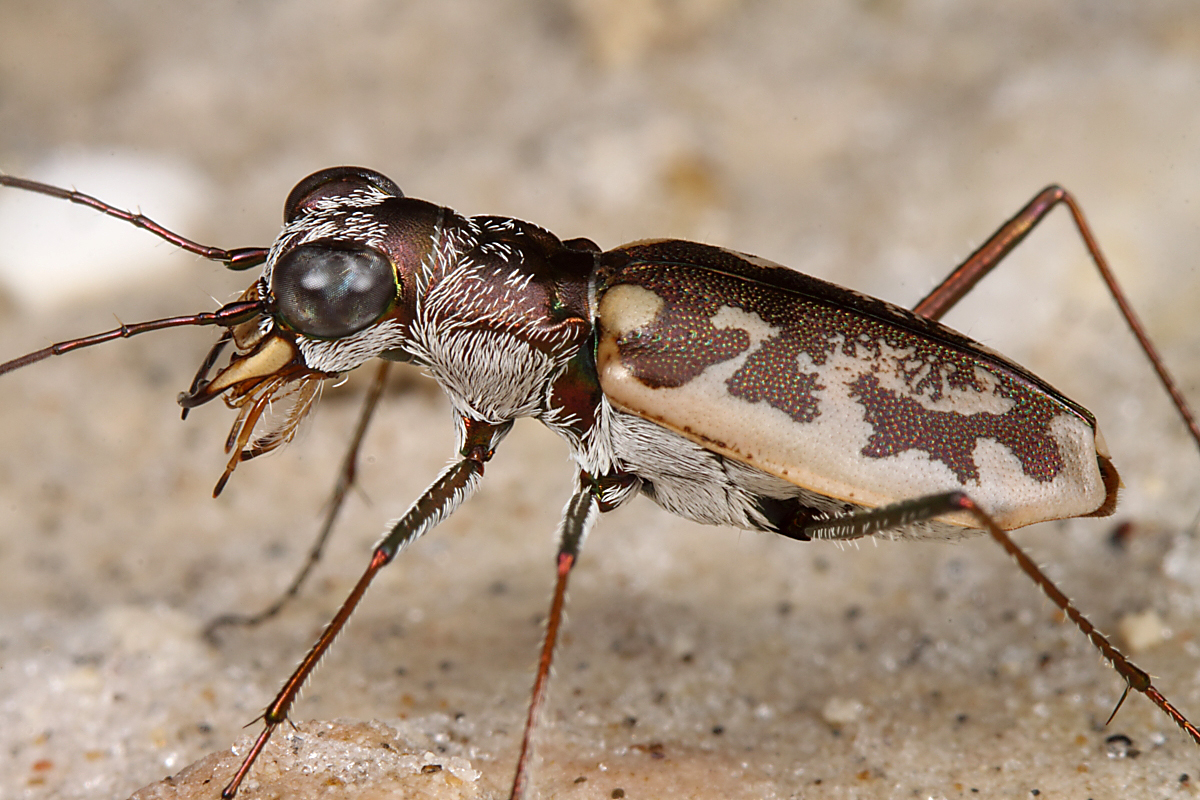
Another view of the of Ellipsoptera hamata lacerata (Gulf Coast Tiger Beetle) that I photographed in a small mangrove marsh in Seminole, Florida. These are actually among the first tiger beetles that I ever tried to photograph at night, and the major learnings involved: 1) figuring out how to turn on the flash lamp and then compose the shot quickly enough before the lamp shut off, and 2) making sure to use the histogram in the field to ensure I’d gotten the proper flash level. My first few attempts all tended to be underexposed because the brightness of the image on the playback screen in the darkness caused me to keep undersetting the flash exposure compensation. I’d not previously gotten in the habit of using the histogram in the field since I do a lot of flash level bracketing, but perhaps this is a tool that will allow me to cut down on that to some degree. Anyway, these are two additional photos that worked out pretty well—I like the first because of the contrast between the bright white mandibles of the male versus the off-white mandibles of the female, and the second (female only after the male bolted) for its nice view of the curiously bent elytral apices that distinguish it from the female of the very similar and (in this area) sympatric E. marginata (Margined Tiger Beetle). Also clearly seen in the second is one of the distinct basolateral grooves on the pronotum that serve to receive the male mandibles during mating (compare to same area on pronotum of male). I was amazed at how easy this mating pair and other individuals of this species were to photograph at night in view of their extreme wariness during the day.

Ellipsoptera hamata lacerata | Seminole, Pinellas Co., Florida

Note curiously bent elytral apices and basolateral pronotal groove for reception of male mandibles.

Copyright © Ted C. MacRae 2011

Gnom, Gnom, Gnom…

I’ve become a big fan of night-time tiger beetle photography since my early August trip to Florida.  Not only does it open up the world of nocturnal species that might go undetected during the day, it also affords the opportunity to see diurnal species engaged in behaviors that are more difficult to photograph during the day.  This female Gulf Beach Tiger Beetle (Ellipsoptera hamata lacerata) came to my blacklight at a coastal salt marsh near Steinhatchee and promptly began munching on a smaller beetle that had also come to the light.  I didn’t get a good enough look at the prey early on to identify it, and by the time I was able to zoom in big with the camera lens the prey had already been macerated to a crunchy pulp.  It was interesting to watch the tiger beetle grasp and chew the prey with its mandibles while manipulating its position with its maxillary parts.


Copyright © Ted C. MacRae 2011

Why I Roamed the Marsh at Night

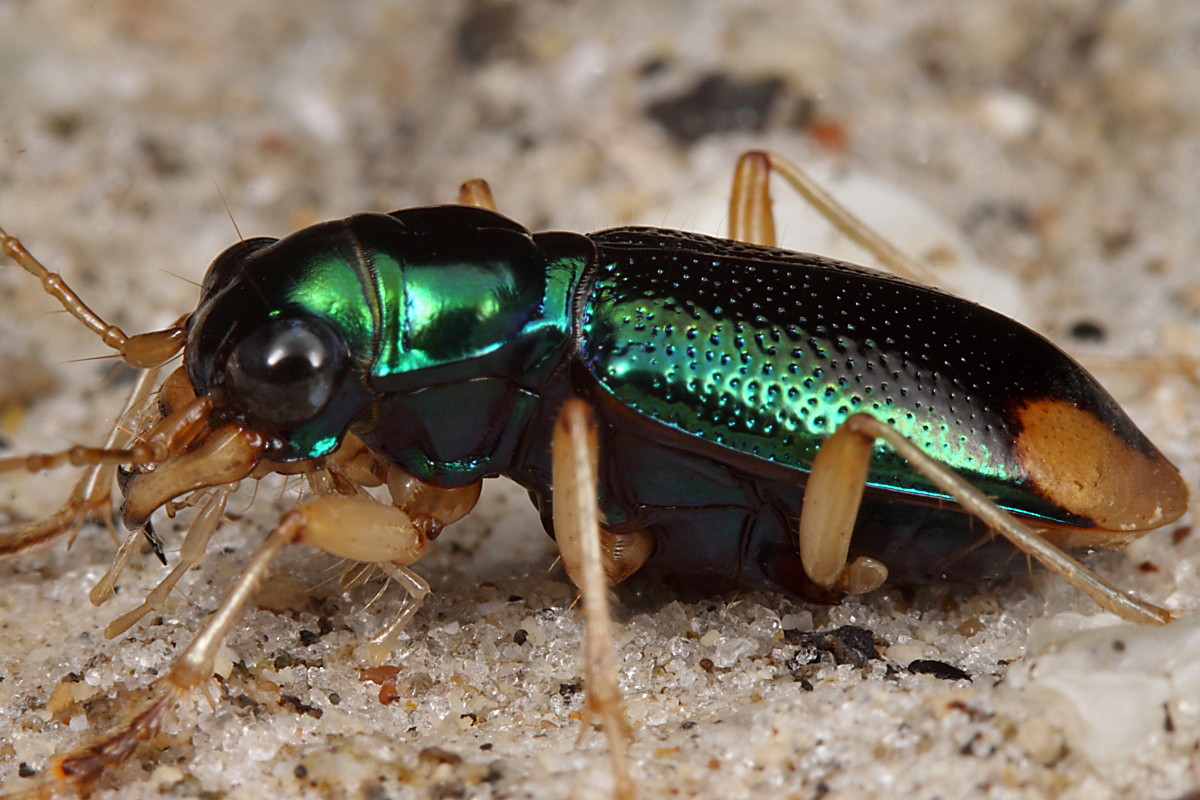
Tetracha floridana (Florida Metallic Tiger Beetle) | Pinellas Co., Florida

For two years I waited.  The narrow strip of coastal scrub and mangrove marsh along the intracoastal waterway behind my sister-in-law’s condominium in Seminole, Florida had been an unexpected surprise during my first visit in August 2009.  Despite its small size and urban surroundings, it proved to be a good spot for tiger beetles, including Ellipsoptera marginata (Margined Tiger Beetle) and the closely related E. hamata lacerata (Gulf Coast Tiger Beetle).  Also living there was a much rarer tiger beetle—the Florida-endemic species Tetracha floridana (Florida Metallic Tiger Beetle), but I did not know this at the time.  In fact, had I not happened upon some larval burrows as I was leaving the preserve and decided to collect a few and rear them to adults, I would still not know they were there.  Only after the two larvae that made it back to St. Louis alive emerged as adults in their rearing container did I realize what I had found.  The reason I had not seen any adults during my visit was simple—they, like all members of the genus to which they belong, are strictly nocturnal!  Nevertheless, I knew I would return sooner or later and have another shot at seeing adults of this species in the wild.

A male, distinguishable by the thick brushy pads on the front tarsi.

And return I did.  My wife and I decided fairly early this year that we wanted to return to Florida for our summer vacation.  She likes the beach and her sister, and the kids like the beach and their aunt.  I don’t like the beach so much (though my sister-in-law is pretty cool), but I love Florida for its diversity of tiger beetle species and their high level of endemism.  During my 2009 trip I managed to find nine species, which, in addition to T. floridana, included also the very rare and potentially threatened Cicindelidia highlandensis (Highlands Tiger Beetle), known only from the Lake Wales Ridge in central Florida, and the (near) endemic Ellipsoptera hirtilabris (Moustached Tiger Beetle).  This year I set my sight on several other endemics—e.g. Cicindelidia floridana (Miami Tiger Beetle)—and near-endemics—e.g. Cicindelidia scabrosa (Scabrous Tiger Beetle).  My searches for these targets would have to wait for a few days, but for T. floridana I had only to wait until nightfall on the day we arrived.  The bleating chorus of tree frogs was my signal, and as the rest of the family retired to their bedrooms I geared up with my collecting fanny pack, camera bag and headlamp and headed out to the marsh.

The species lacks the violaceous reflections found on the elytra of T. carolina.

As I mentioned in my previous post, it was a little unnerving to walk into the marsh surrounded by darkness and greeted by scuttling hordes of sea slaters.  The anticipation of finally seeing T. floridana, however, was more than enough motivation to forge onward while deliberately scanning the ground with my headlamp.  For some amount of time I focused on the more barren areas, which is where I would have expected the adults to occur, but only after I also began scanning some of the sparsely vegetated ground—typically slightly elevated above the moister and more barren areas—did I see the first adult.  Its agile dash into and through the vegetation upon my approach was a little surprising and required more effort than I expected to finally capture it.  Elation!  Finding rare species is always a treat, but it is extra special when you find one where nobody previously knew it existed.  Over the course of the next 1½ hours (as well as the following night and two nights after that) I would see countless adults, giving me comfort that I could collect a reasonable voucher series without causing negative impacts on the population.

A female oviposits in the soil amongst the sparse, salt-tolerant vegetation.

I had hoped to see mating pairs but never did; however, I did find a female in the act of oviposition.  Consistent with the apparent adult preference for sparsely vegetated areas rather than barren ground, the female was nestled amongst the vegetation while she excavated a hole for the egg she would lay.  On the last night that I visited the marsh, I focused my efforts on finding larval burrows, starting in the area where I had seen them two years ago.  I only found a few but succeeded in fishing one 3rd-instar larva out of its burrow.  You see, even though I photographed one two years ago, the larva of this species remains undescribed in the literature.  Since I allowed the two larvae I had collected to complete their development to adulthood, I still lacked preserved specimens that could be used for the basis of a description.  I now had one, but for a formal description it would be better to have at least a few examples.  Remembering that I had seen the female ovipositing amongst vegetation rather than out in the open, I began searching the nearby vegetated areas for burrows.  This approach was met with better success, and from the dozen or so burrows that I was able to find, I succeeded in fishing out two more 3rd-instars.  I already have several preserved larvae of Tetracha virginica (Virginia Metallic Tiger Beetle) and a single T. carolina (Carolina Metallic Tiger Beetle) collected in southeastern Missouri by my good friend Kent Fothergill—this small series of T. floridana now leaves me lacking only the also-undescribed T. impressa (Upland Metallic Tiger Beetle) among the four North American (sensu stricto) species of Tetracha.  I will be anxious to compare the larvae of T. floridana I now have with those of T. carolina and T. virginica in an effort to find species-specific characters.

This male is sporting some very impressive teeth on his mandibles.

Copyright © Ted C. MacRae 2011

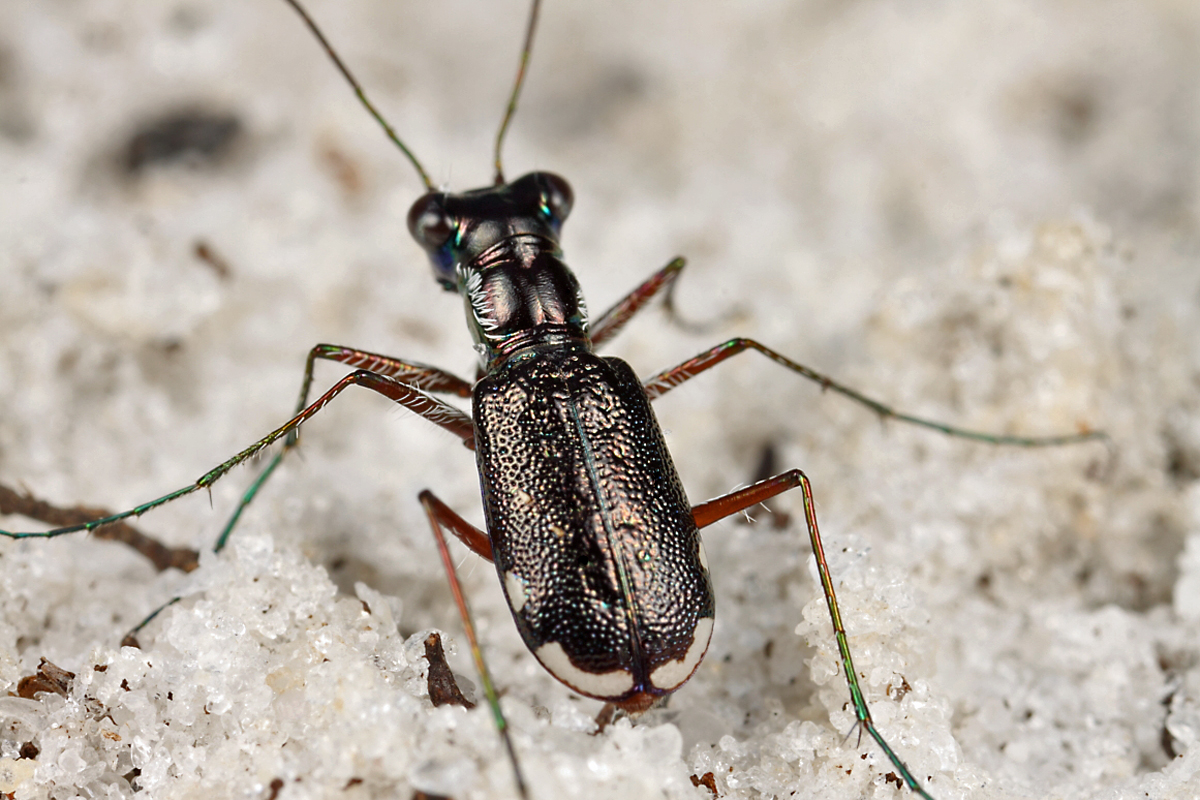
The (almost) Florida-endemic Cicindelidia scabrosa

The recently rediscovered Cicindelidia floridana (Miami Tiger Beetle) may have been the highlight of my 48-hour early August blitz through Florida, but it was by no means the only Florida-endemic that I hoped to find during the trip.  In fact, the day before I saw C. floridana I found the species it was formerly considered a subspecies of, C. scabrosa (Scabrous Tiger Beetle), itself an almost Florida-endemic (its distribution extends just north of the border into extreme southeastern Georgia).  I had word that I might find the species in sand pine scrub habitat along the Gulf Coast around Lower Suwanee National Wildlife Refuge and Cedar Key Scrub State Preserve (Levy Co.).  This area lies very near yet another locality (where I was hoping to find yet another Florida-endemic), further justifying my decision to travel several hours north the day before I was to retrace my route back to the south and then continue on down to Naples to meet up with Dave Brzoska and Chris Wirth for the trip to Miami to see C. floridana.

Cicindelidia scabrosa (Scabrous Tiger Beetle) | Levy Co., Florida

Cicindelidia scabrosa is one of four small, sand-dwelling species with red venters collectively referred to as the abdominalis-species group (Brzoska et al. 2011).  The nominate species, C. abdominalis (Eastern Pinebarrens Tiger Beetle), is the most widespread member of the group, occurring across the Southeastern U.S. Coastal Plain from Maryland and New Jersey to Louisiana (Pearson et al. 2006).  The three remaining species are Florida-endemics (C. floridana and C. highlandensis—Highlands Tiger Beetle) or near endemic (C. scabrosa), presumably evolving during the Pleistocene Epoch (1.8 million to 10,000 years ago) at a time when fluctuating sea levels repeatedly isolated peninsular Florida from the mainland.  I found both C. abdominalis and C. highlandensis during my 2009 trip, so finding C. floridana and C. scabrosa on this trip means that I have now seen all four members of the abdominalis-species group.

Black, sculptured elytra and dense lateral bands of pronotal setae distinguish this species.

There is little doubt about the distinctiveness of C. scabrosa compared to C. abdominalis and C. highlandensis, as neither of the latter two species exhibit the distinctly scabrous elytra or rows of flattened setae on the sides of the pronotum exhibited by C. scabrosa.  The distinction of C. scabrosa from C. floridana, however, is more subtle—C. scabrosa is shiny black and always exhibits a post median marginal spot anterior to the apical lunule, while C. floridana is shiny green and usually lacks the post median marginal spot.  In addition, the legs of C. floridana are somewhat lighter in coloration than those of C. scabrosa.  The difference in coloration is subtle in preserved specimens but obvious in living individuals.  After seeing the C. scabrosa in the field one day and C. floridana the next, my first thought regarding the latter was, “Wow, that’s different!”—a result of the brilliant coppery highlights that are quite evident in living individuals but apparently fade in preserved specimens.

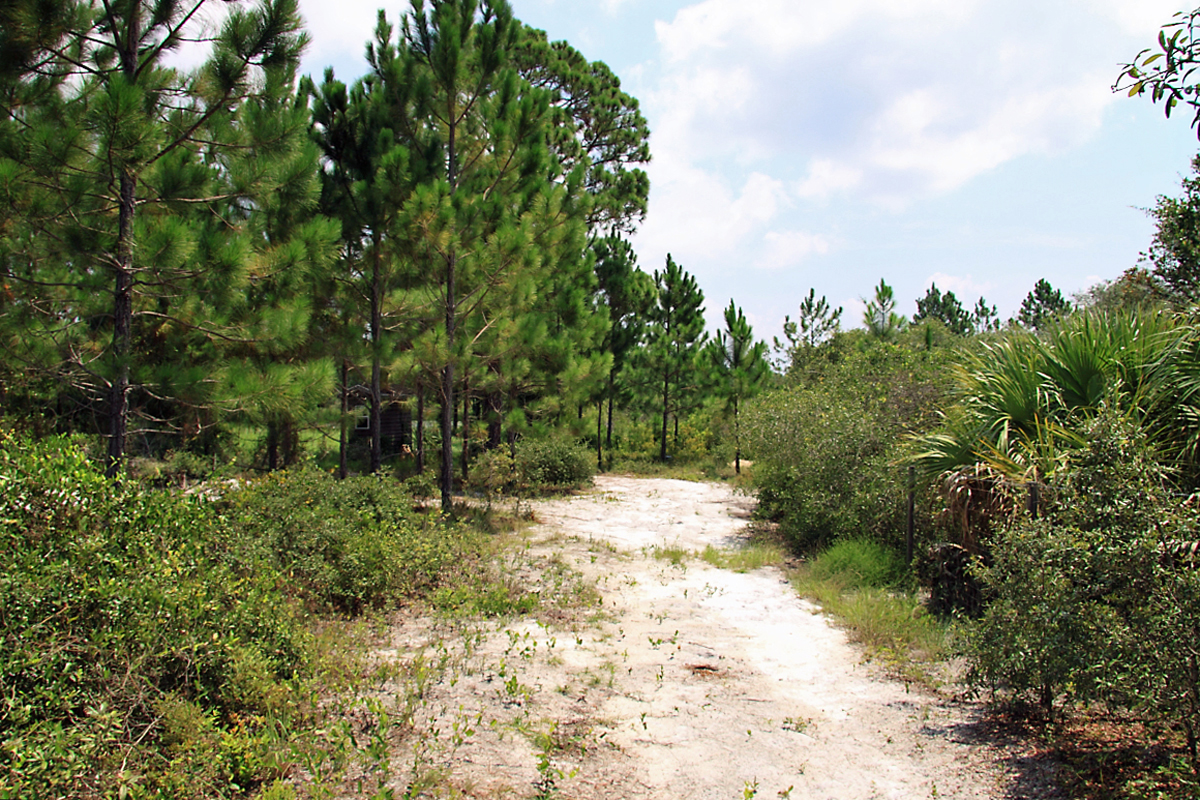
Sand pine scrub, habitat for Cicindelidia scabrosa and Ellipsoptera hirtilabris

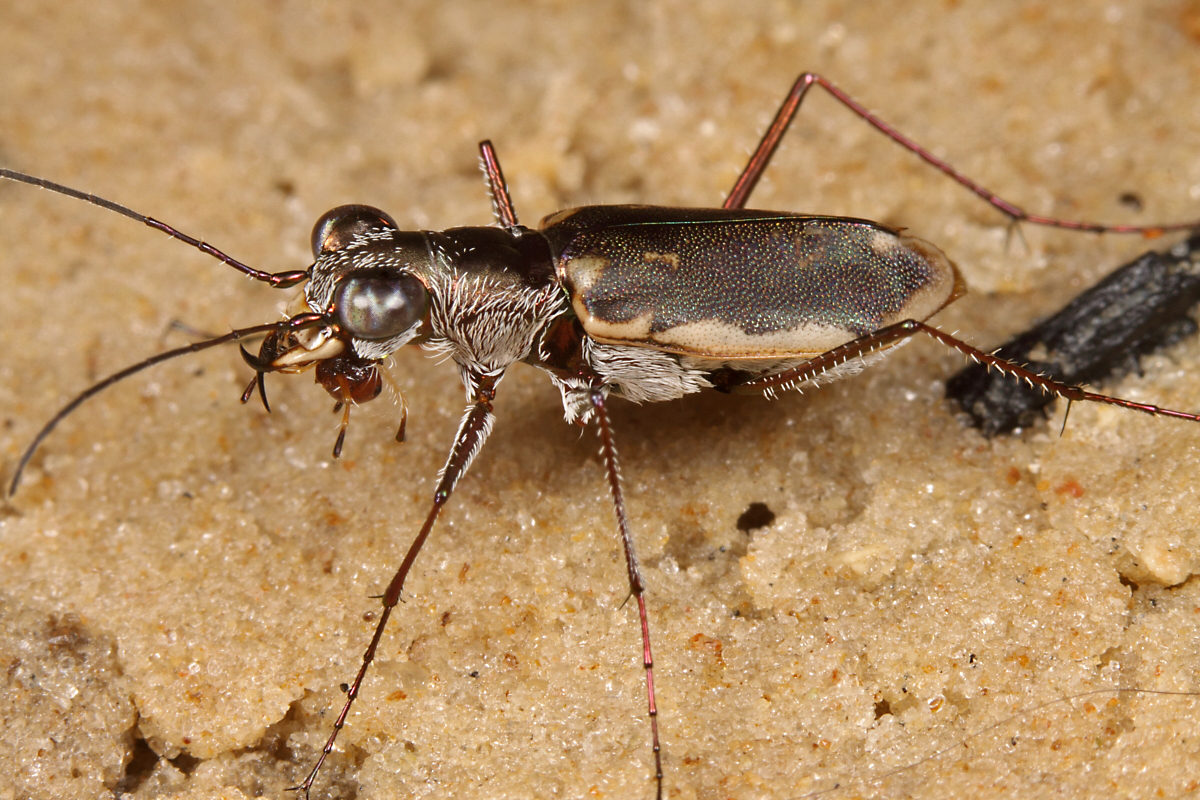
The distinction between C. scabrosa and C. floridana is not limited to subtle morphological characters—included also are differences in habitat, distribution, and seasonal occurrence.  Cicindelidia scabrosa occurs broadly across the Florida peninsula in sand pine scrub, a xeromorphic plant community featuring an open canopy of sand pine (Pinus clausa) growing on well-drained, infertile, sandy soils (Brzoska et al. 2011).  The species is absent, however, from much of south Florida where the wet areas of the Everglades limit availability of suitable habitat.  Cicindelidia floridana, on the other hand, is restricted to a small area of Miami-Dade County and parts of the Keys where pine rockland habitat, a savanna-like forest of Florida slash pine (Pinus elliotti var. densa) and scrub understory, can be found growing on limestone outcrops.  The photos in this post were taken on an open 2-track through sand pine scrub near Cedar Key Scrub State Preserve.  Occurring here in asscociation with C. scabrosa was another (almost) Florida-endemic tiger beetle, Ellipsoptera hirtilabris (Moustached Tiger Beetle), which I have also seen in association with C. abdominalis and C. highlandensis (but not C. floridana).

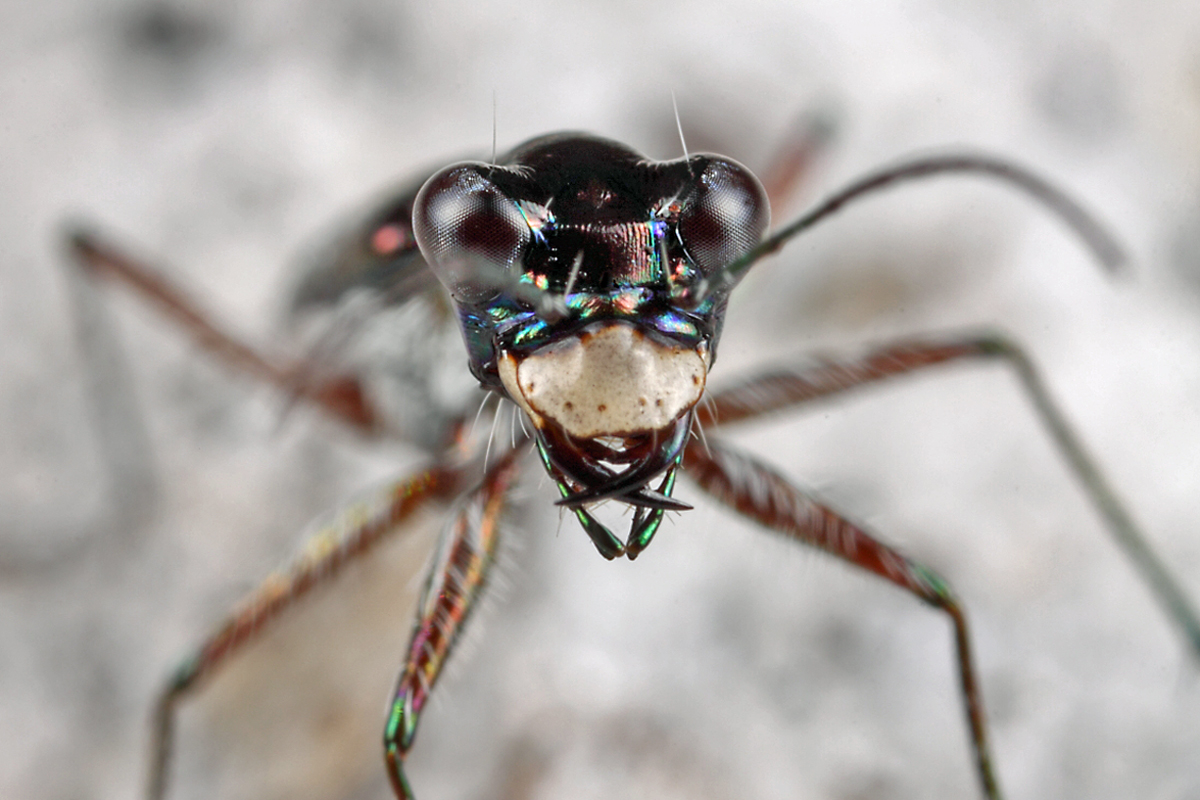
The obligatory face shot!

It is perhaps redundant for me to state that it was extraordinarily hot while I photographed these beetles.  Temperatures were already approaching 90°F when I found the first individuals, and by mid-day when they finally disappeared it was nearly 100°F.  Add to that the mid-summer Florida humidity, and I was about as soaked as I ever get. It’s a photographer’s nightmare—trying to protect expensive gear while scrumming through the sand and sweating profusely, all the while still trying to get the perfect shot!  The beetles were smart enough to call it a day at 12:30 p.m., and I must say I didn’t mind having to get into an air-conditioned car, chug a quart of ice-cold Gatorade, and spend the next several hours not broiling under the hot Florida sun while making the long drive south.

REFERENCES:

Brzoska, D., C. B. Knisley, and J. Slotten.  2011.  Rediscovery of Cicindela scabrosa floridana Cartwright (Coleoptera: Cicindelidae) and its elevation to species level. Insecta Mundi0162:1–7.

Pearson, D. L., C. B. Knisley and C. J. Kazilek. 2006. A Field Guide to the Tiger Beetles of the United States and Canada.Oxford University Press, New York, 227 pp.

Copyright © Ted C. MacRae 2011

Predator or Prey?

Ellipsoptera hamata lacerata | Dixie Co., Florida

Everyone knows that tiger beetles are predators, but look closely at the underside of the head of this female Ellipsoptera hamata lacerata (Gulf Beach Tiger Beetle), photographed in a coastal marsh in Dixie Co., Florida earlier this month.  See the ant head attached by its mandibles to the base of the tiger beetle’s left maxillary palpus?  Detached ant heads latched onto the palp or antenna of a tiger beetle are a fairly common sight—Pearson and Vogler (2001) show the head of an ant attached to the antenna of Eunota togata (Cloaked Tiger Beetle), and Pearson et al. (2006) show one attached to the antennae of Cicindela formosa (Big Sand Tiger Beetle).  I’ve also photographed Cylindera celeripes (Swift Tiger Beetle) with an ant head attached to its antenna.  Pearson and Vogler (2001) and Pearson et al. (2006) both suggest that the ant heads are the result of predation attempts by groups of ants attempting to overpower and kill the tiger beetle, making the ants the predators and the tiger beetles the prey.

Note ant head attached by its mandibles to the base of the tiger beetle's left maxillary palpus.

Although some ants are well known for their predatory horde behavior, I’m not sure I buy this as an explanation for the common occurrence of ant heads attached to tiger beetles.  Tiger beetles themselves often prey on ants, and while I have seen numerous tiger beetles with ant heads attached to them, I have never seen one actually being overpowered by ants (scavenging an already dead tiger beetle, yes—but not overpowering and killing one).  Moreover, the ant heads are nearly always attached to the base of an antenna or palpus—right next to the tiger beetle’s mouth, and almost never on more distal parts of the antennae or other parts of the body.  If the ants were attempting to prey on the tiger beetle, wouldn’t they also (if not even more commonly) be found attached to the tiger beetle’s legs or soft intersegmental membranes?  And how would the ants have come to be decapitated while in the act of attempting to overpower the beetle?  I suggest it is more likely that the ants were prey, latching onto the nearest part of their killer’s body in a last ditch attempt to avoid their inevitable fate.  The antennal and palpal base are about the only tiger beetle body parts that would be within reach of an ant in a tiger beetle’s toothy grasp.  While the rest of the ant was consumed, the head remained because it was firmly attached to the beetle.

I realize that an identification based only on the detached head of an ant may be difficult, but if one is possible it would be appreciated.  The ant head shown in Pearson and Vogler (2001) was identified as Polyergus sp.

REFERENCES:

Pearson, D. L., C. B. Knisley and C. J. Kazilek. 2006. A Field Guide to the Tiger Beetles of the United States and Canada. Oxford University Press, New York, 227 pp.

Pearson, D. L. and A. P. Vogler.  2001. Tiger Beetles: The Evolution, Ecology, and Diversity of the Cicindelids.  Cornell University Press, Ithaca, New York, 333 pp.

Copyright © Ted C. MacRae 2011