BitB Top 10 of 2010

Welcome to the 3rd Annual BitB Top 10, where I pick my 10 (more or less) favorite photographs of the year.  My goal for 2010 was to continue the progress that I began the previous year in my quest to become a bona fide insect macrophotographer.  I’m not in the big leagues yet, but I have gotten more comfortable with using my equipment for in situ field photographs and am gaining a better understanding of lighting and the use of flash.  I also began experimenting with different lighting techniques (e.g. white box) and diffusers and am putting more effort into post-processing techniques to enhance the final appearance of my photographs.  I invite you to judge for yourself how successful I’ve been toward those goals by comparing the following selections with those from 2009 and 2008 – constructive feedback is always welcome:


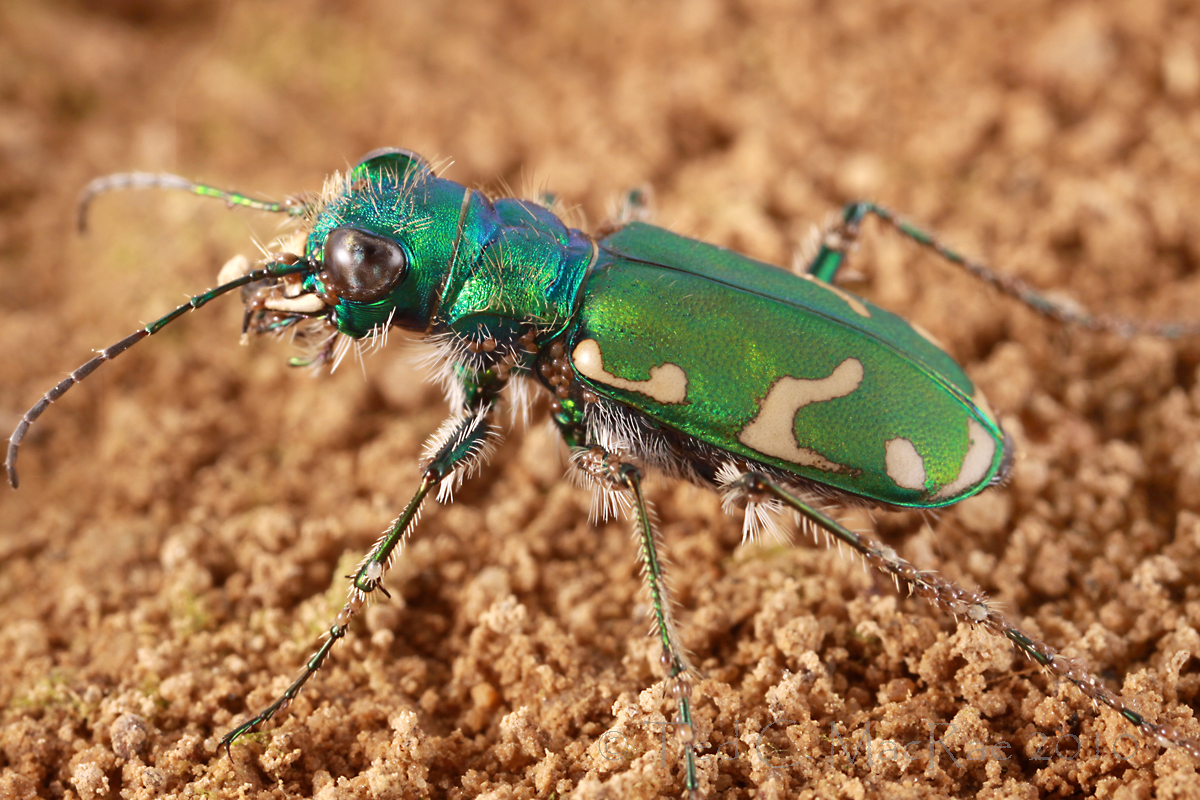
Best Tiger Beetle

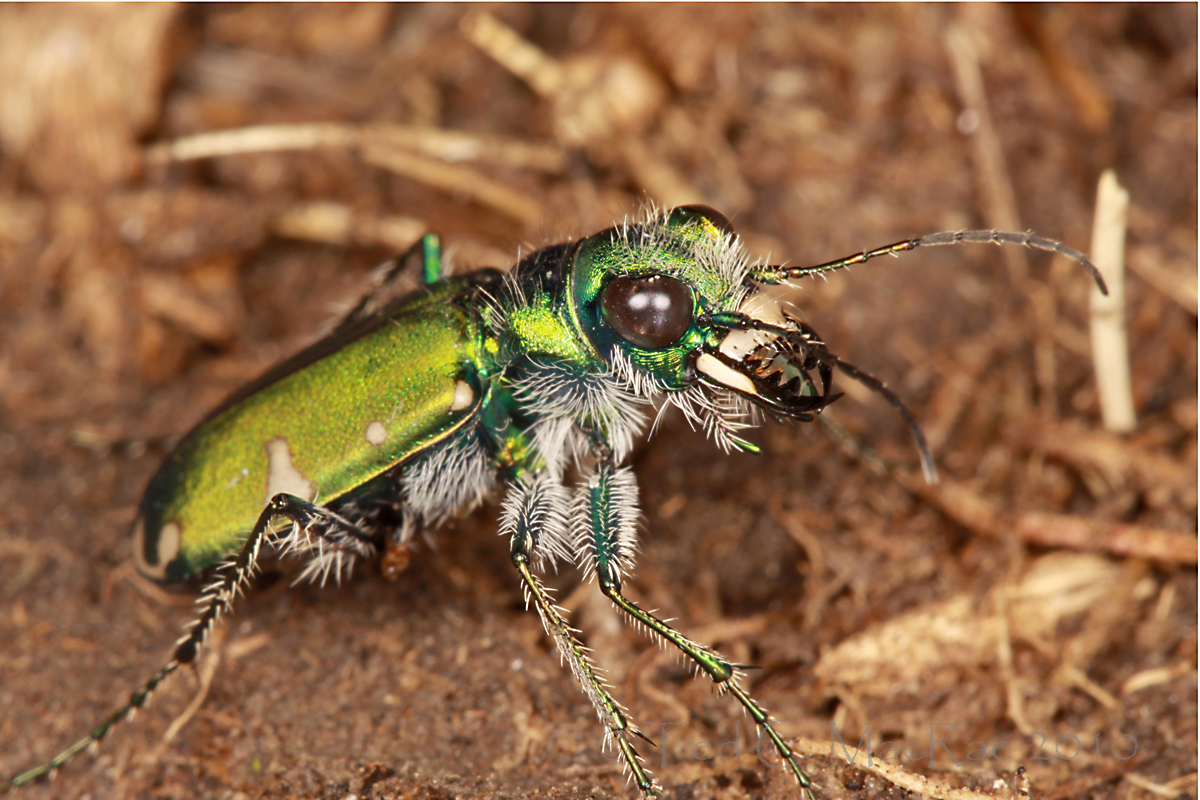
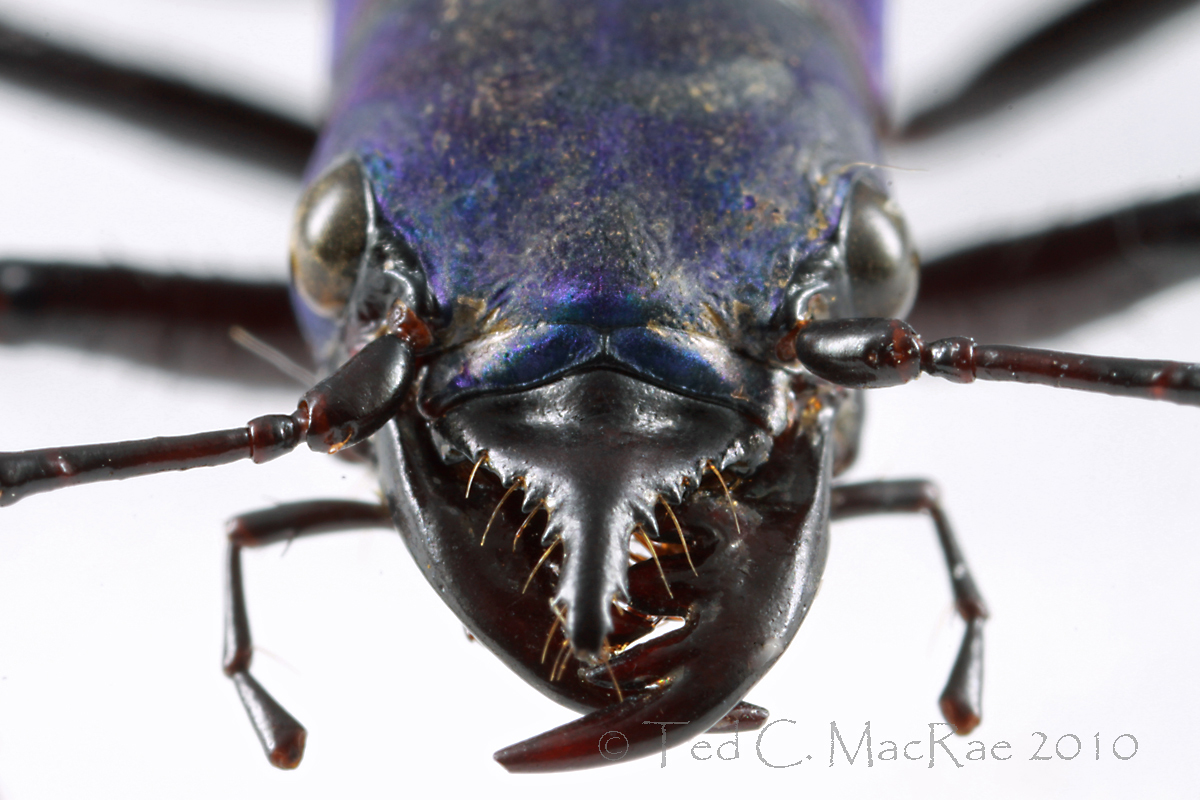
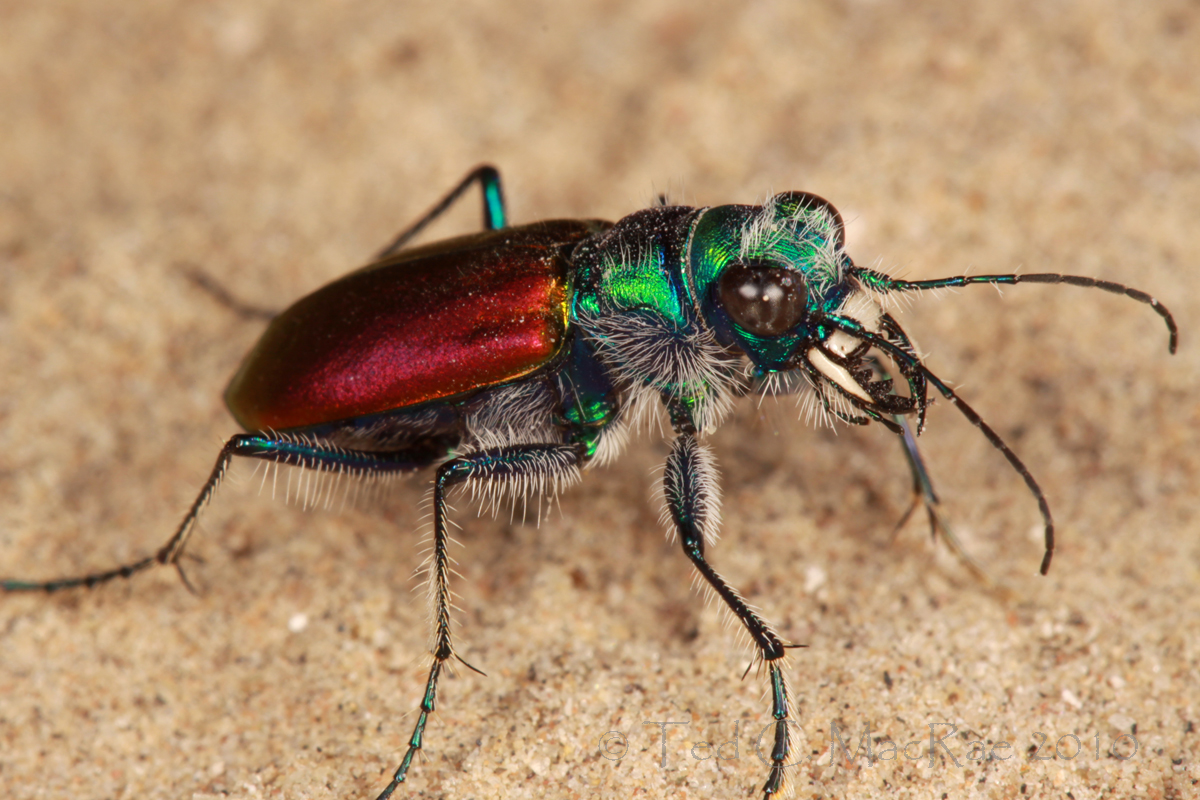
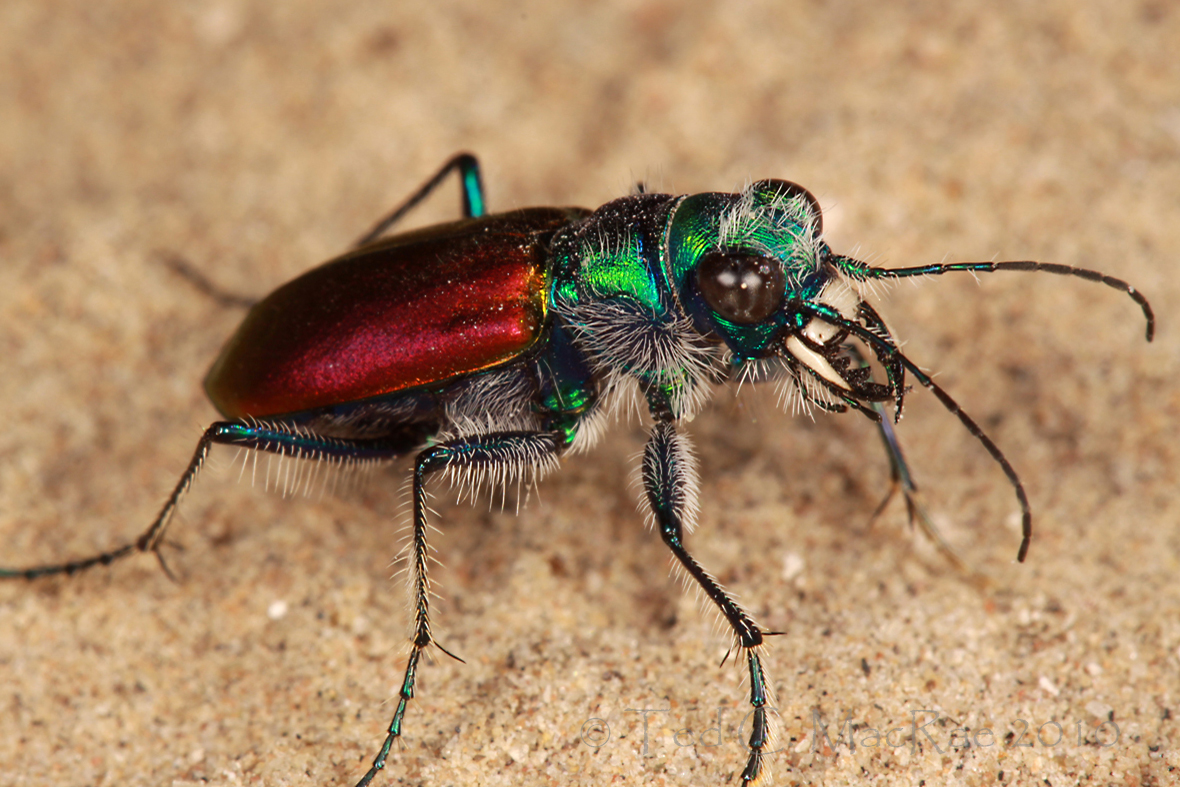
Cicindela denverensis - green claybank tiger beetle

From ID Challenge #1 (posted December 23).  With numerous species photographed during the year and several of these dramatic “face on” shots, this was a hard choice.  I chose this one because of the metallic colors, good focus throughout the face, and evenly blurred “halo” of hair in a relatively uncluttered background.


Best Jewel Beetle

Buprestis rufipes - red-legged buprestis

From Special Delivery (posted July 13).  I didn’t have that many jewel beetles photos to choose from, but this one would have risen to the top no matter how many others I had.  The use of a white box shows off the brilliant (and difficult-to-photograph) metallic colors well, and I like the animated look of the slightly cocked head.


Best Longhorned Beetle

Desmocerus palliatus - elderberry borer

From Desmocerus palliatus – elderberry borer (posted November 18).  I like the mix of colors in this photograph, and even though it’s a straight dorsal view from the top, the partial dark background adds depth to the photo to prevent it from looking “flat.”


Best “Other” Beetle

Enoclerus ichneumoneus - orange-banded checkered beetle

From Orange-banded checkered beetle (posted April 22).  The even gray background compliments the colors of the beetle and highlights its fuzziness.  It was achieved entirely by accident – the trunk of the large, downed hickory tree on which I found this beetle happened to be a couple of feet behind the twig on which it was resting.


Best Non-Beetle Insect

Euhagenia nebraskae - a clearwing moth

From Euhagena nebraskae… again (posted October 21).  I photographed this species once before, but those photos failed to capture the boldness of color and detail of the scales that can be seen in this photo.


Best “Posed” Insect
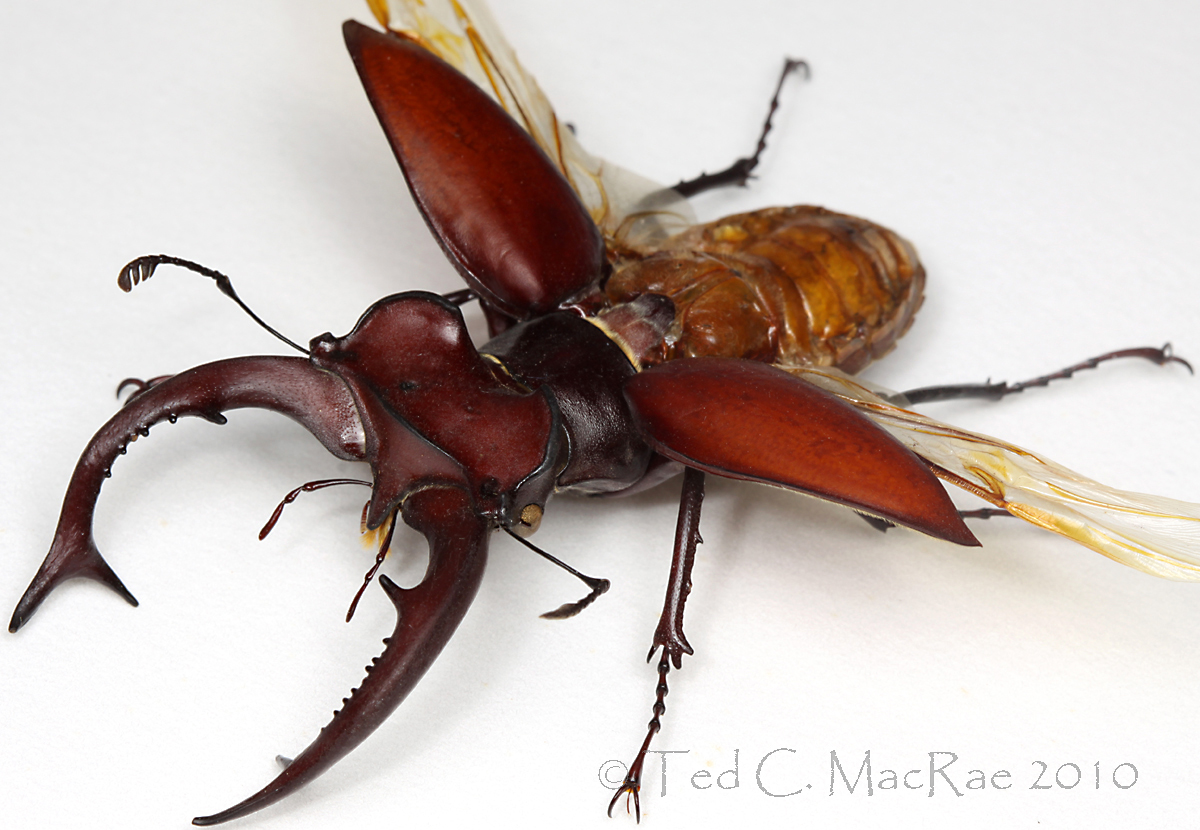
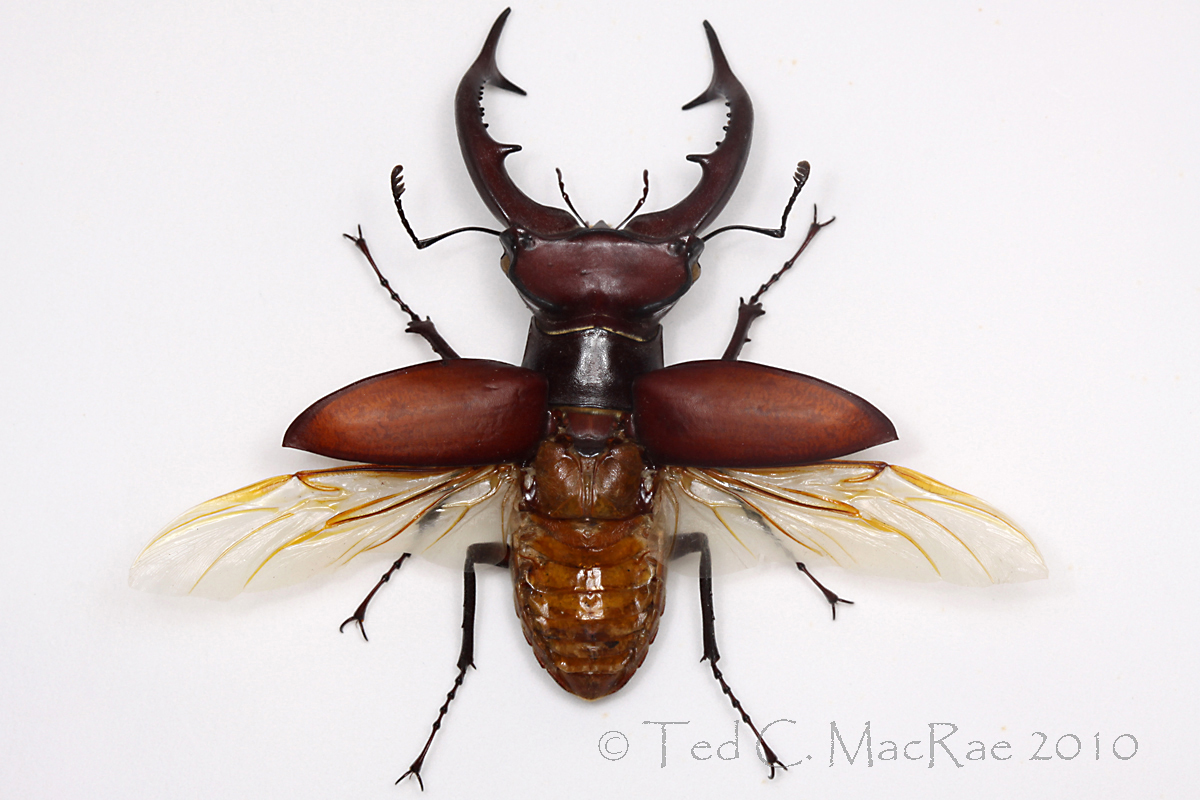
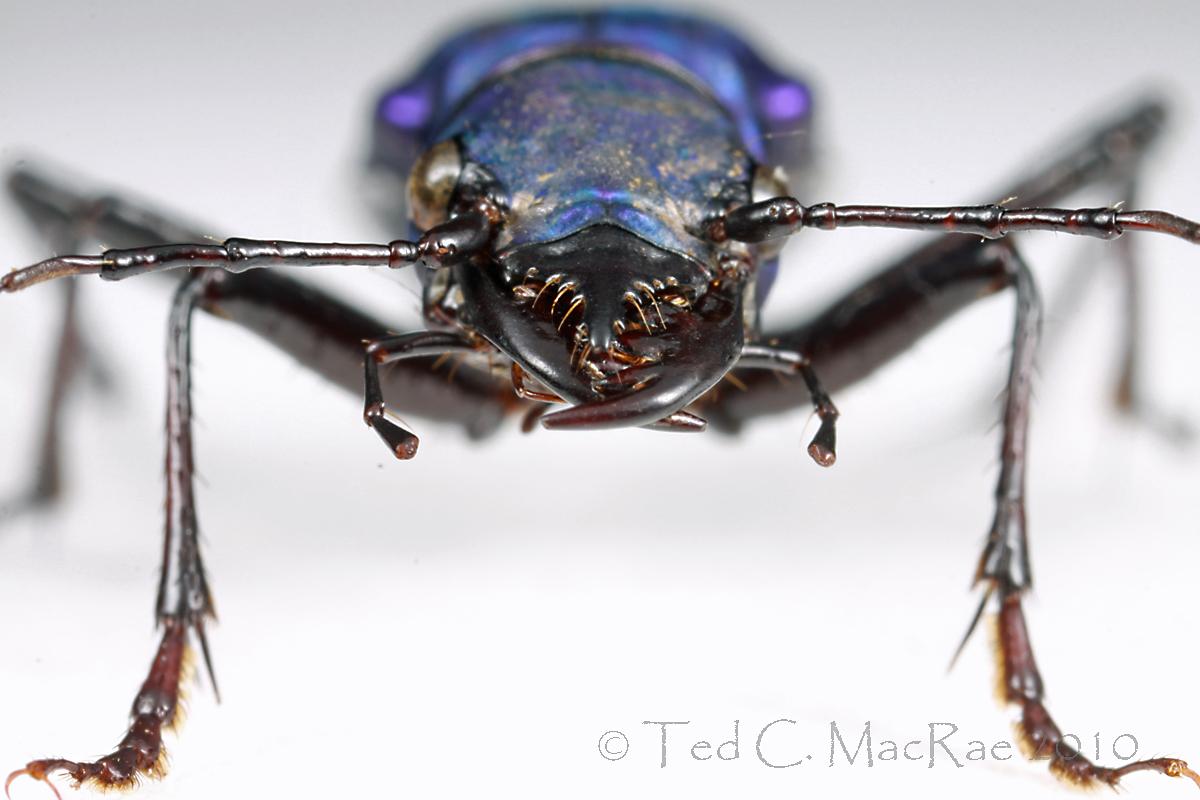
Lucanus elaphus - giant stag beetle

From North America’s largest stag beetle (posted December 30).  I’ve just started experimenting with photographing posed, preserved specimens, and in fact this male giant stag beetle represents only my second attempt.  It’s hard to imagine, however, a more perfect subject than this impressively stunning species.


Best Non-Insect Arthropod

Scolopendra heros - giant desert centipede

From North America’s largest centipede (posted September 7).  Centipedes are notoriously difficult to photograph due to their elongate, narrow form and highly active manner.  The use of a glass bowl and white box allowed me to capture this nicely composed image of North America’s most spectacular centipede species.


Best Wildflower

Hamamelis vernalis - Ozark witch hazel

From Friday Flower – Ozark Witch Hazel (posted March 26).  The bizarre form and striking contrast of colors with the dark background make this my favorite wildflower photograph for the year.


Best Non-Arthropod
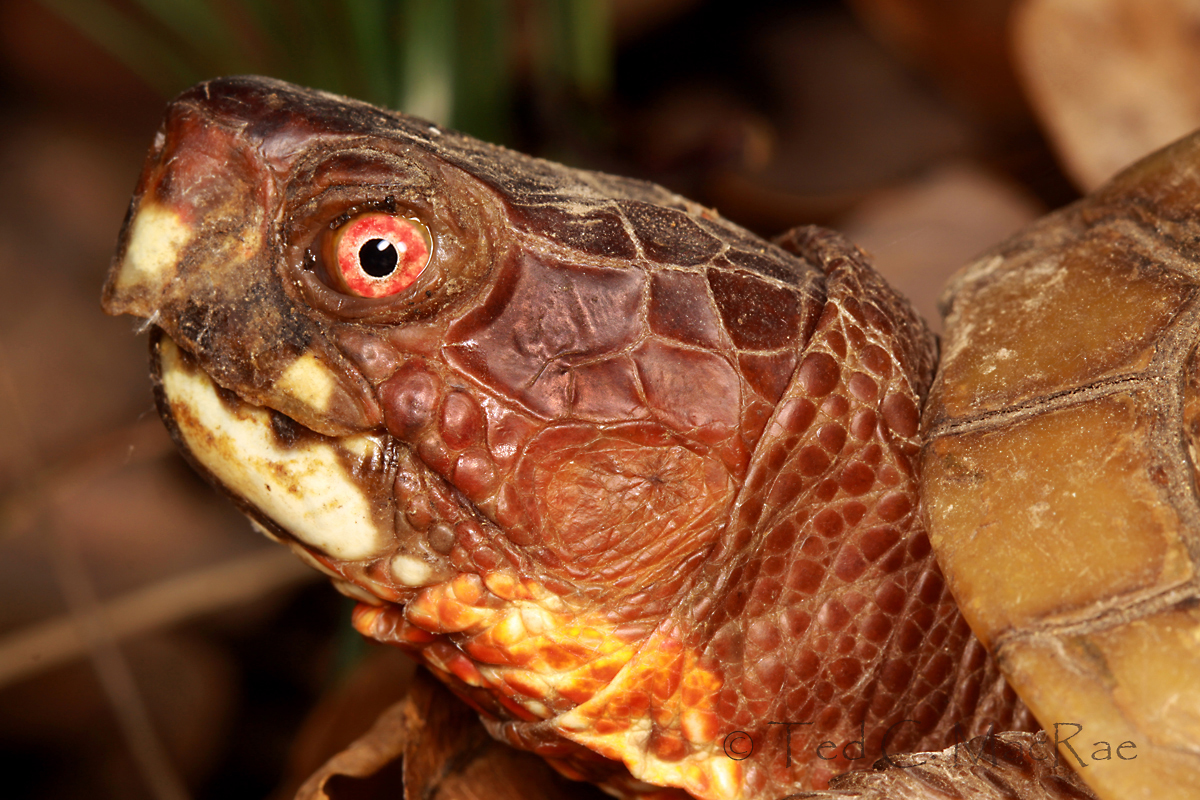
Terrapene carolina triunguis - three-toed box turtle

From Eye of the Turtle (posted December 10).  I had a hard time deciding on this category, but the striking red eye in an otherwise elegantly simple photograph won me over.  It was also one of two BitB posts featured this past year on Freshly Pressed.


Best “Super Macro”

Phidippus apacheanus - a jumping spider

From Jeepers Creepers, where’d ya get those multilayered retinae? (posted October 5).  I’m not anywhere close to Thomas Shahan (yet!), but this super close-up of the diminutive and delightfully colored Phidippus apacheanus is my best jumping spider attempt to date.  A new diffuser system and increasing comfort with using the MP-E lens in the field at higher magnification levels should allow even better photos this coming season.


Copyright © Ted C. MacRae 2011
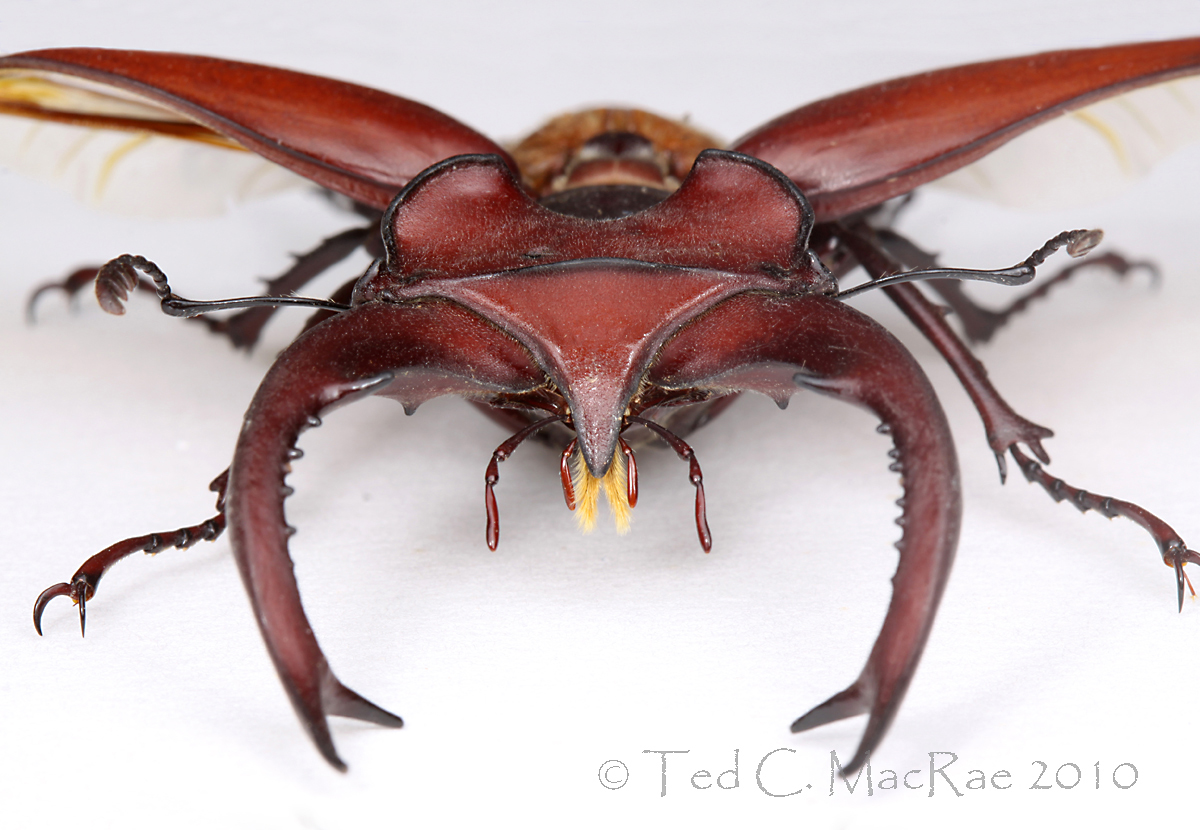
North America’s largest stag beetle


Here is the full-sized photo that provided the image for yesterday’s Super Crop Challenge #3.  The insect in the photo is, of course, a fine example of a male Lucanus elaphus – the giant stag beetle (family Lucanidae).  This striking insect is easily among North America’s most distinctive and recognizable species by virtue of the enormously super-sized mandibles sported by the males.  Its fearsome appearance belies the true nature of this harmless beetle, which spends its days feeding on sap that flows from wounds on the trunks and roots of trees.  Males use their massive mandibles in combat with other males, not for “biting,” but rather as tools to pry and lift their adversaries before dropping them to the ground.  Some marvelous photos of this behavior in a related European species can be seen at Stag Beetles Lucanus cervus Mating Behaviour.

I collected this specimen many years ago at an ultraviolet light (“blacklight”) that I had setup in the pine/oak forests at Pinewoods Lake, Carter Co., in the southeastern Ozarks – one of my favorite 1980’s beetle collecting spots.  This was in my early days of studying beetles, during which time I was actively collecting material as part of my statewide surveys for the families Buprestidae (MacRae 1991) and Cerambycidae (MacRae 1994).  Lucanus elaphus is not a commonly encountered species, especially in the western reaches of its distribution here in Missouri, and I’ll never forget my rabid excitement when I encountered this fine major male at my blacklight sheet.  For many years afterward it remained the only individual that I had ever encountered, until a few years ago when I came across a group of two males and one female feeding on a sap flow in a wet bottomland forest along the Mississippi River in the lowlands of southeastern Missouri.  I encountered another male the following year at a nearby location “rafting” on debris in floodwaters from the nearby river, and two weeks later at that same site I picked up several males and females in a fermenting bait trap.¹  Like most “uncommon” species with broad distribution across the eastern U.S., I suspect that its apparent rarity is an artifact due to habits that make it infrequently encountered rather than being truely scarce.

¹ I have used fermenting bait traps to collect a wide variety of beetles, but especially longhorned beetles.  My recipe is based on that described by Champlain and Knull (1932) – bring 12 oz. dark molasses and 12 oz. beer up to 1 gal. with water, mix well and add a packet of dry baker’s yeast to get the fermentation started.  Hang a 1/2-gallon milk jug with big holes cut in the sides in a tree along the edge of a woods and add ~1 quart of fresh liquid.  It generally takes 2-3 days for the liquid to really start fermenting and become attractive, and it will remain so for about another week or so.  Check traps every 2-3 days by pouring the liquid through a kitchen strainer into another container – reuse or replace as necesssary. Place the collected specimens in vials of water to wash off the molasses residues, and either pin immediately afterward or transfer to 70% ethanol for longer term storage.  Some of the more desireable species I’ve collected in this manner, besides L. elaphus, are Plinthocoelium suaveolens, Purpuricenus axillaris, P. humeralis, P. paraxillaris, Stenocorus cylindricollis, S. shaumii, Sarosesthes fulminans, Stenelytrana emarginata [= Leptura emarginata], and S. gigas [= Leptura gigas].


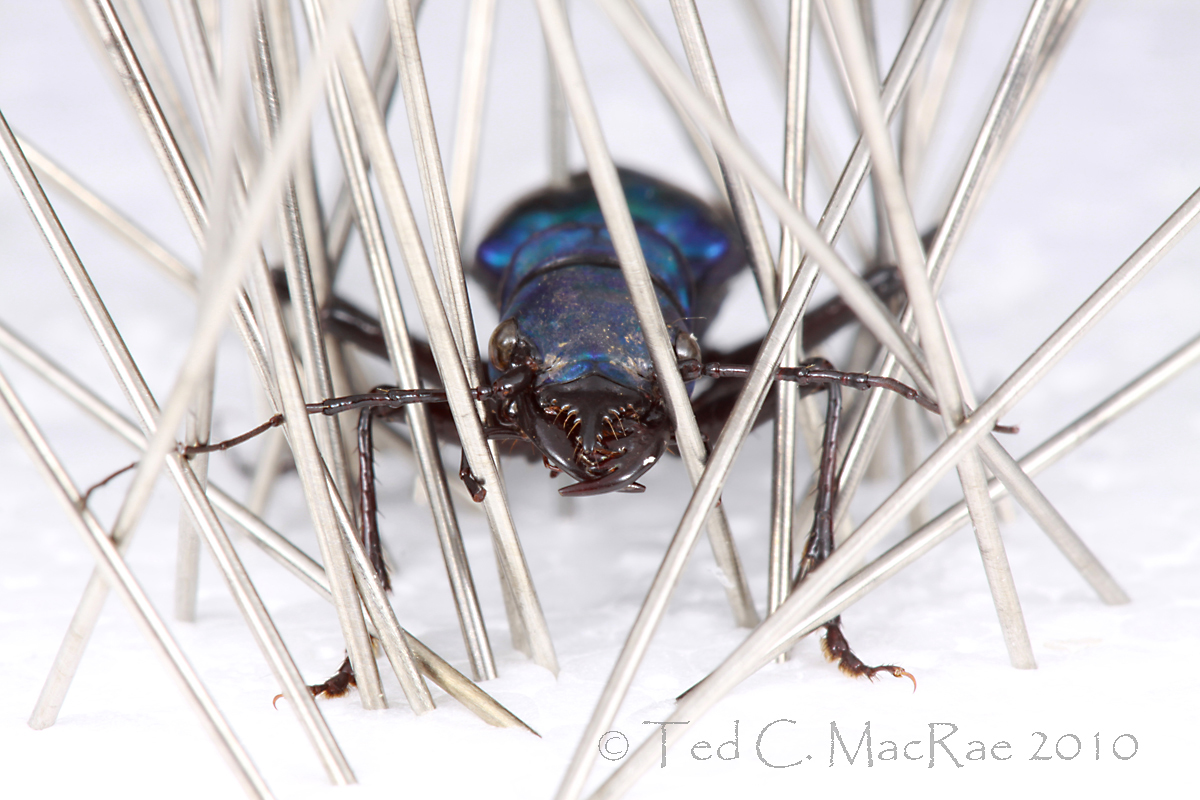
Congratulations to Ben Coulter and Janet Creamer, both of whom correctly identified the species and most of the mouthparts.  Each earned 14 pts and, thus, tied for the win, while JasonC. earned 5 pts. to take the final podium spot.  The pointed structure is the labrum (its shape distinguishing it from other North American species of the genus), and it is flanked on each side by the fuzzy yellow galeae (derived from the maxillae) and the labial palps.  Nobody correctly named the galeae, which seem to be greatly elongated and hairy in stag beetles as a function of their sap feeding behavior.  A portion of the left maxillary palpus can also be seen in the corner of the photograph, but nobody scored those points either.  Brady Richards just missed the podium, but his witty reference to Gene Shalit (if not immediately picked up on by me) earns him an honorable mention.

With points being formally awarded now beginning with the previous competition (ID Challenge #1), I’ll start keeping an overall leaders board, and with wins in both competitions Ben takes a commanding lead in the overalls with 23 pts, followed by Janet Creamer at 14 pts and TGIQ at 8 pts.  I guess I should start thinking of some sort of tangible prize for winners periodically – suggestions welcome.  Stay tuned for another issue of Super Crop Challenge or ID Challenge in the near future.

REFERENCES:

Champlain, A. B. and J. N. Knull.  1932. Fermenting bait traps for trapping Elateridae and Cerambycidae (Coleop.).  Entomological News 43(10):253–257.

MacRae, T. C. 1991. The Buprestidae (Coleoptera) of Missouri.  Insecta Mundi 5(2):101–126.

MacRae, T. C. 1994. Annotated checklist of the longhorned beetles (Coleoptera: Cerambycidae and Disteniidae) known to occur in Missouri. Insecta Mundi 7(4) (1993):223–252.

Copyright © Ted C. MacRae 2010

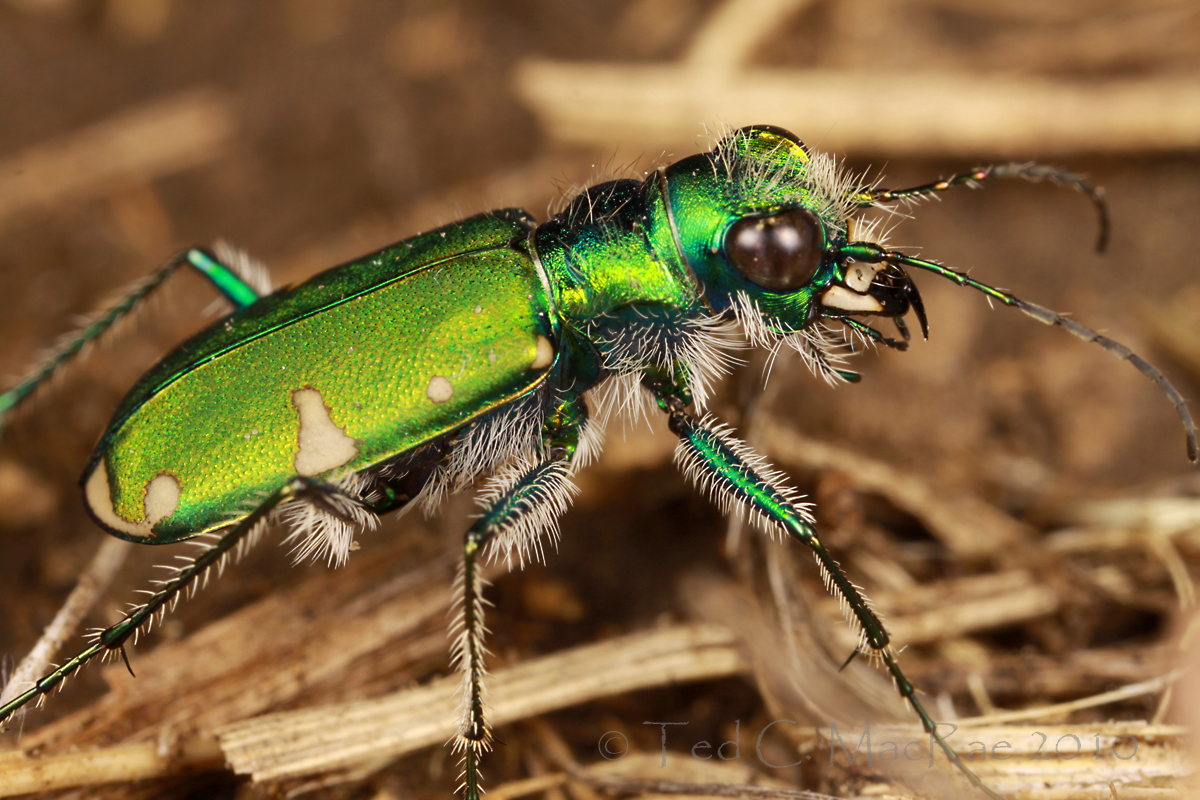
Cicindela denverensis – green claybank tiger beetle

Cicindela denverensis (green claybank tiger beetle) | Sioux Co., Nebraska.

Here are a few more photographs of the insect featured in ID Challenge #1, which is, in fact, Cicindela denverensis (green claybank tiger beetle).  Nearly every commentor got the first 6 points easy enough (2 pts each for order, family, and genus), but only Ben Coulter correctly identified the species.  A bonus point for proper italicization of the binomen (and a favorable ruling on a technicality) gave him 9 points and the win.  Second place goes to TGIQ, who smartly picked up bonuses to earn 8 points and edge the pack.  Charley Eiseman, Christopher Taylor, Delbert La Rue, jason, and Techuser crowd the final podium spot with 7 points each.

Distinguished by its green color, hairy frons, reduced maculations, and grassland occurrence.

Cicindela denverensis occurs in short- and mixed-grass prairie habitats in the central and western Great Plains, especially sites with clay soils.  It can be distinguished from a number of similar-looking species by its uniformly green color, hairy frons, often reduced maculations, and occurrence in grassland habitats.  Cicindela sexguttata is also uniformly green, but the frons in that species is glabrous, and it occurs further east in woodland habitats.  Cicindela decemnotata is also similar, but it usually has broad maculations and a shinier, oily appearance – often with some degree of red tinting.  Some subspecies of C. scutellaris are also green, but only rugifrons bears maculations and can be distinguished by it’s stockier form and Atlantic Coastal Plain distribution. Cicindela denverensis is actually most closely related to C. purpurea (cowpath tiger beetle), C. limbalis (common claybank tiger beetle), and C. splendida (splendid tiger beetle) – especially the latter two.  All three of these species exhibit some degree of purple or red on the pronotum, elytra, and/or legs that distinguish them from C. denverensis in most parts of their range.   There is, in fact, some disagreement about whether C. denverensis, C. limbalis, and C. splendida even represent distinct species, all of which demonstrate a similar preference for clay substrates but segregate into three partially allopatric populations – northern C. limbalis, southern C. splendida, and western C. denverensis.  Hybrid individuals can be encountered in areas where their distributions overlap, and this is especially so in central Nebraska – one of just a few spots where all three species occur together.  Schincariol & Freytag (1991) conceded a close relationship between the three based on morphometric analysis but still considered them distinct based on differences in elytral color, pattern, and percentage maculation and the number of non-sensory setae.  However, a recent phylogenetic analysis based on mitochrondrial DNA sequences strongly supports a single species hypothesis (Woodcock & Knisley 2009).  From an academic perspective, more thorough systematic analyses of the claybank group of tiger beetles would be of great interest (although I suspect many cicindelophiles with strictly philatelic interests will not be happy to see three species sunk into one).

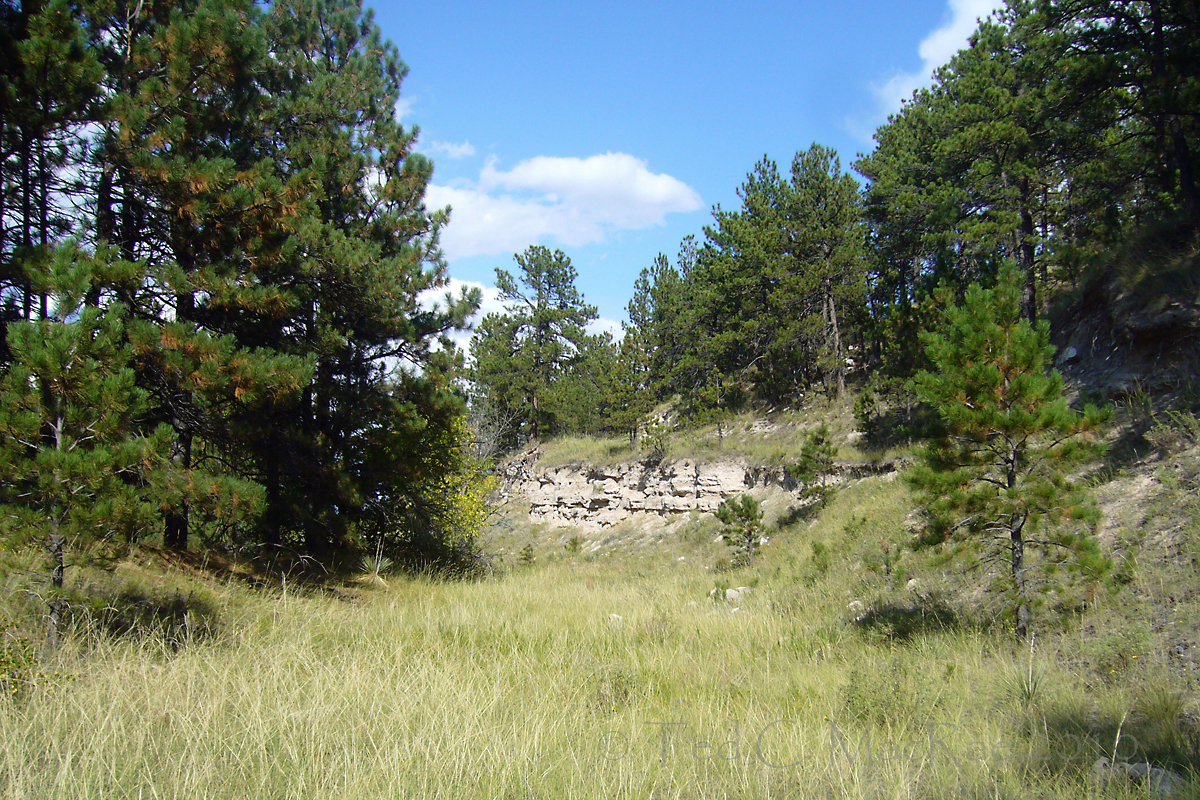
Ponderosa pine mingles with prairie grasses on the Nebraska Pine Ridge escarpment.

The individual in the above photos was found at Monroe Canyon in the Pine Ridge escarpment of western Nebraska (Sioux Co.).  It was the only individual of this species that we saw there and was a bit of a surprise finding because of the generally sandy soils that characterize the spot – perhaps it was a vagrant individual that had found its way into the canyon from the more clay-based shortgrass prairie above.  We’ve seen greater numbers of this species further east in central Nebraska (Sherman Co.) along vertical roadside clay banks. The photograph below is one of those individuals and exhibits somewhat more complete maculations.  Note the sharp bend, or “knee,” on the median maculation that allows the species to be differentiated from C. limbalis (all-green forms of this species can be found at the northern limit of distribution for C. denverensis in North Dakota).  This individual also displays something else of interest – anybody?

Individual with more complete maculations | Sherman Co., Nebraska.

REFERENCES:

Schincariol, L. A. and R. Freitag. 1991. Biological character analysis, classification, and history of the North American Cicindela splendida Hentz group taxa (Coleoptera: Cicindelidae). The Canadian Entomologist 123(6):1327-1353.

Woodcock, R. M. and C. B. Knisley. 2009. Genetic analysis of an unusual population of the problematic tiger beetle group, Cicindela spendida/C. limbalis, from Virginia, USA (Coleoptera: Cicindelidae) using mtDNA. Entomological News 120(4):341-348.

Copyright © Ted C. MacRae 2010

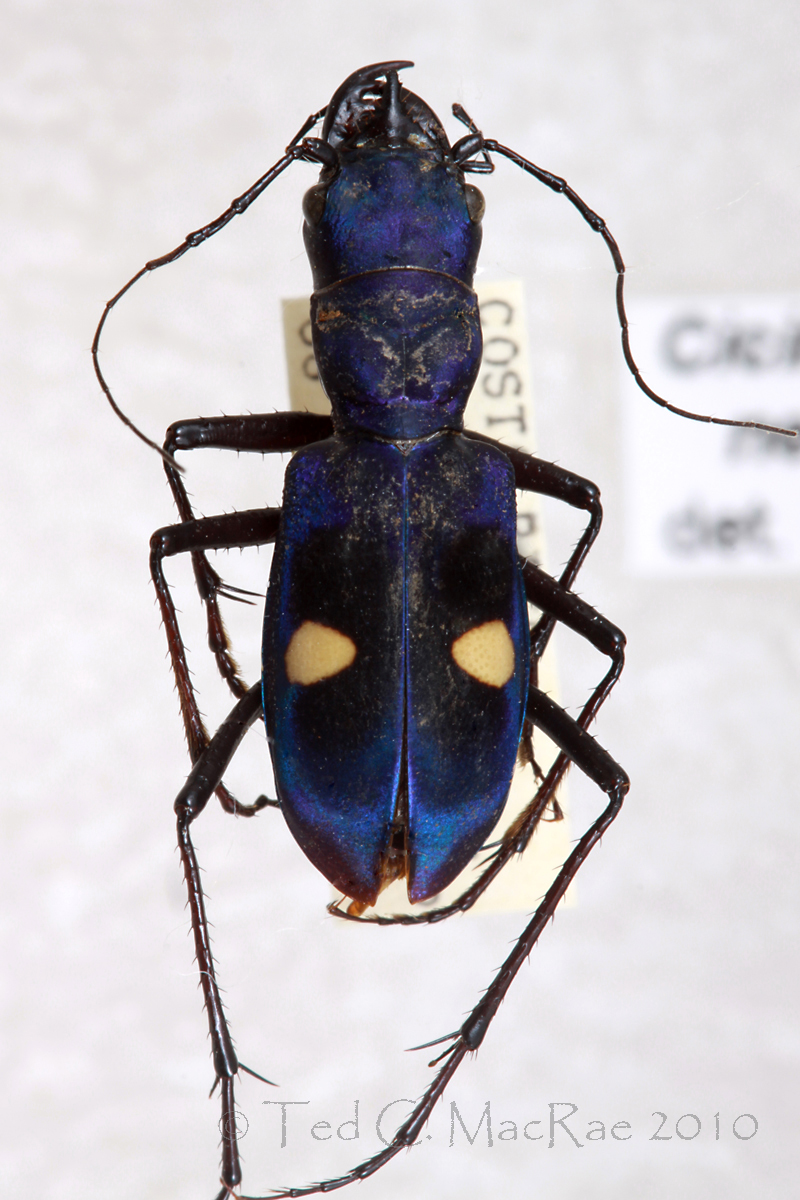
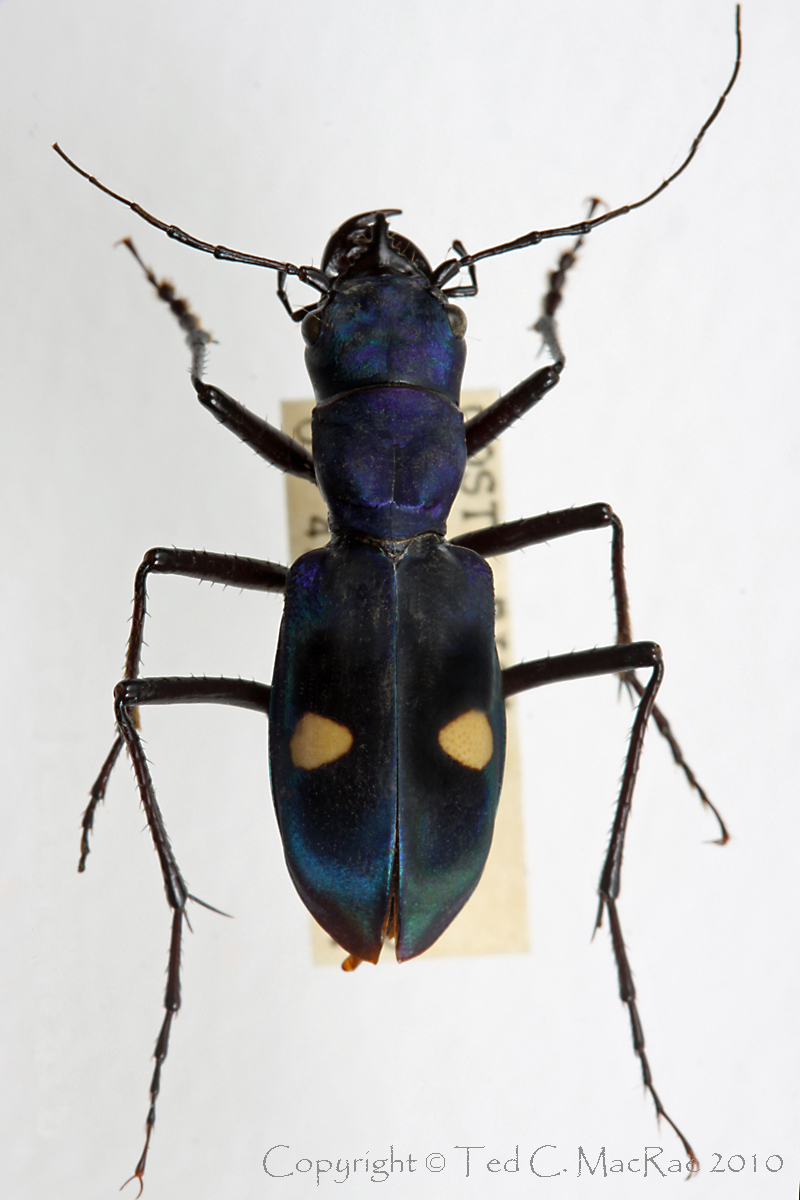
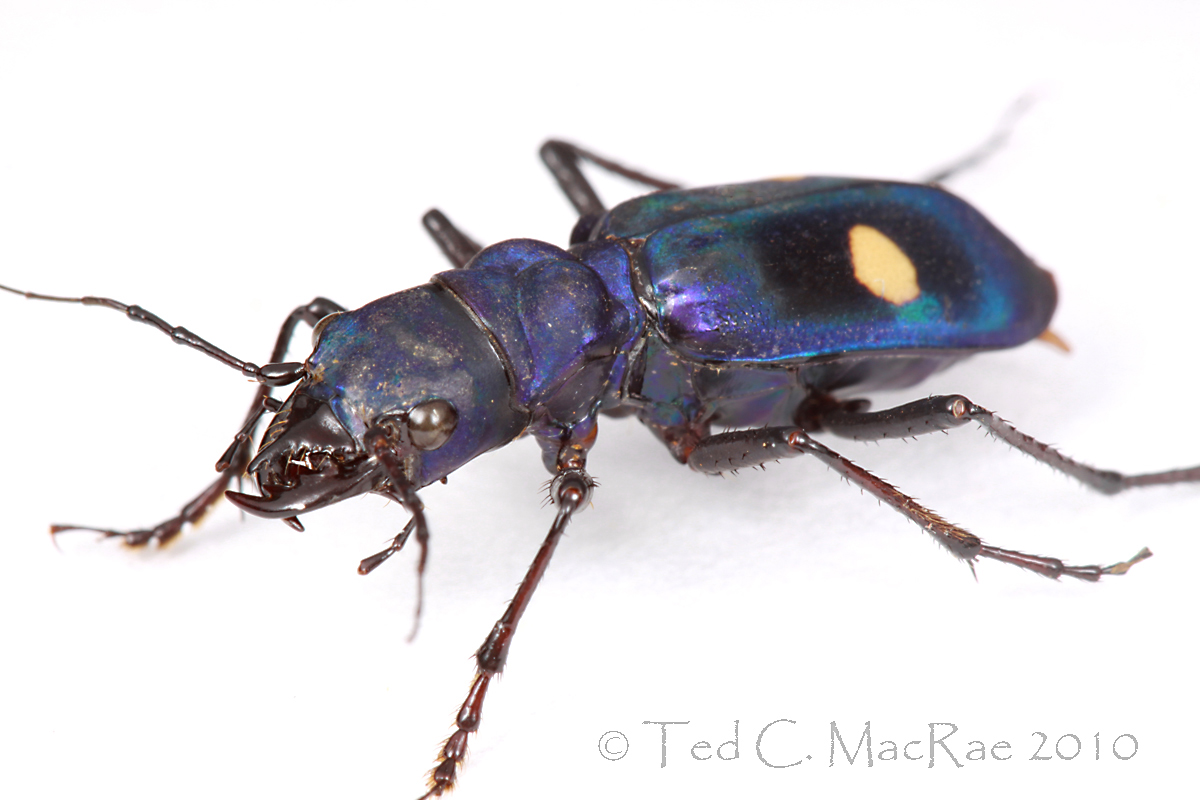
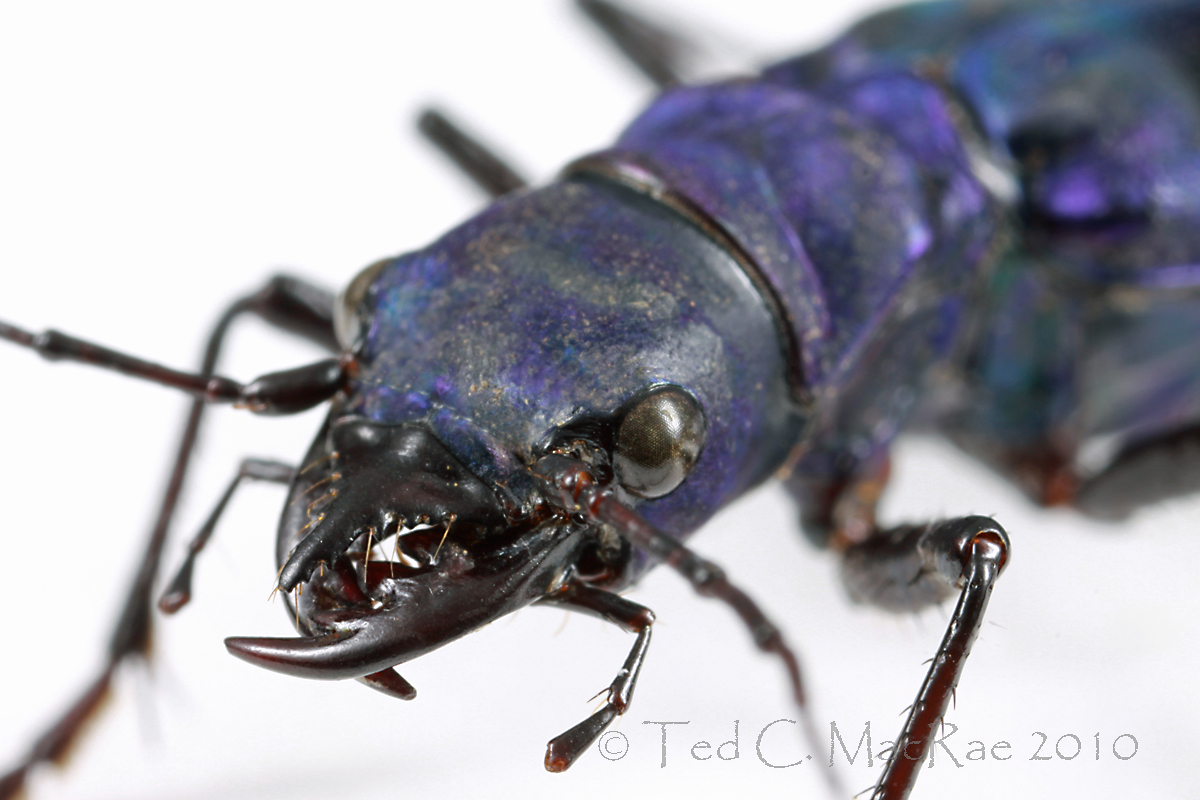
Pseudoxycheila tarsalis – remounted

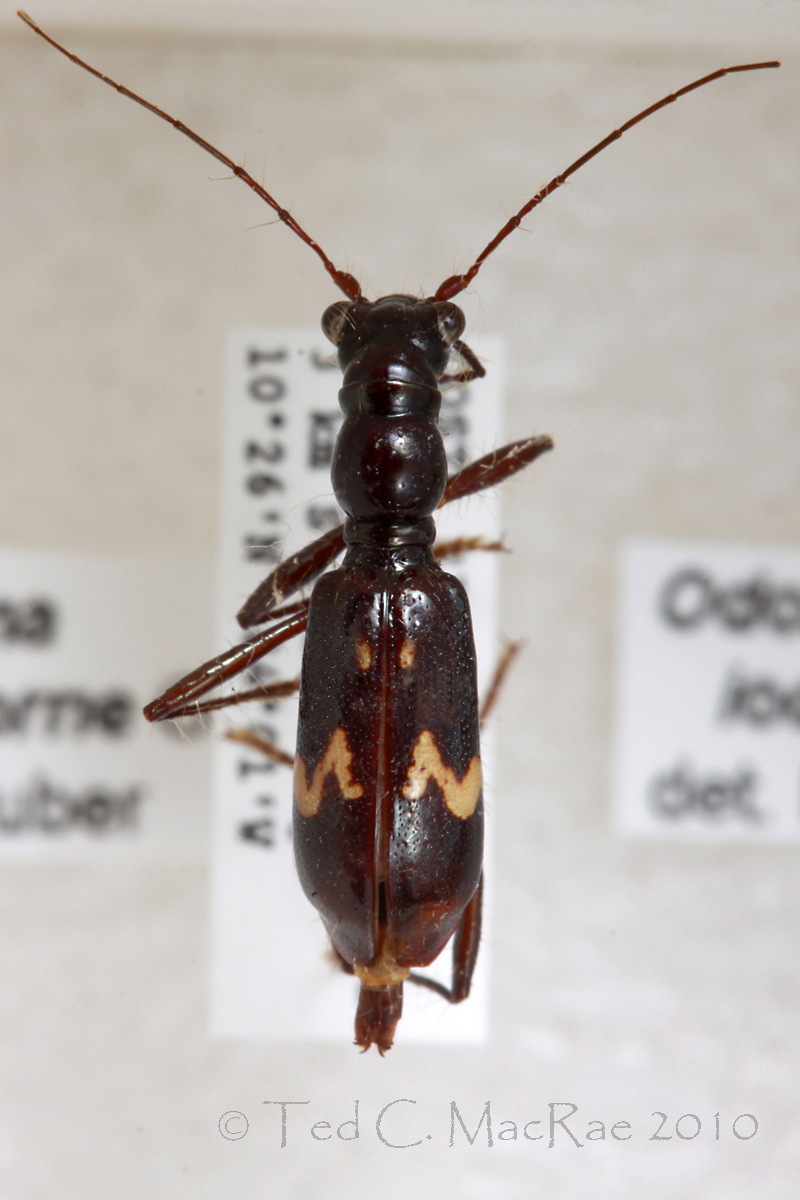
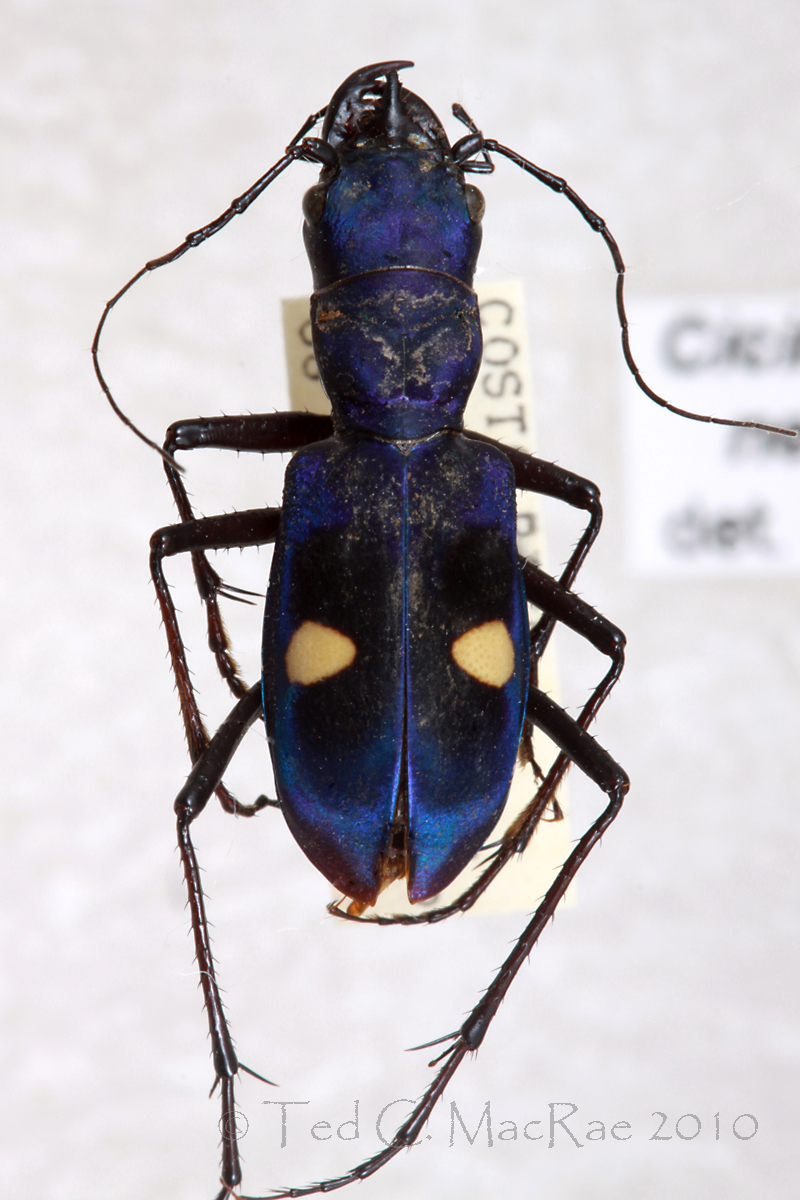
Pseudoxycheila tarsalis (Central American montane tiger beetle) | specimen ex. Costa Rica.

I tend to be a minimalist when it comes to mounting beetles. That is, I mount them so that they take up minimal space – legs tucked neatly and symmetrically against each side of the body and antennae laid straight alongside each elytron. This is important not only for space considerations (always a premium, but especially so in a private collection), but also to minimize the chances of accidental breakage when handling specimens. I must admit that beetles mounted in such manner don’t have quite the visual appeal of beetles mounted in a more relaxed, life-like position, but the ability to pack them tightly in my limited drawer space generally overrides whatever aesthetic desires I may have. Every now and then, however, I come across a specimen that just begs to be mounted life-like due to its striking appearance or impressive structures. Pseudoxycheila tarsalis (Central American montane tiger beetle), which I recently received as a gift from Henry Hespenheide, is one such species.

Remounting a dry, already-mounted beetle is a little trickier than mounting a fresh specimen. The beetle must first be relaxed, and even when relaxed well the beetle is never as pliable as when fresh. This makes it more difficult to get the legs and antennae into the desired position, and there is always a higher risk of breakage while trying to do so. Many different methods for relaxing beetles are available – some better than others, but for a one-off specimen I usually just soak it in very warm tap water. Generally 15-20 minutes will suffice, although large specimens may require more than this. Soaking has the added benefit of softening whatever debris might be caked onto the beetle so that it can be removed more easily. In this case, once the beetle was relaxed I used forceps to hold the specimen by the pin to keep it submerged in the water while “scrubbing” its upper surface with a camel-hair brush. Younger eyes might be able to do this unaided, but I find a binocular dissecting scope at low power to be quite helpful.

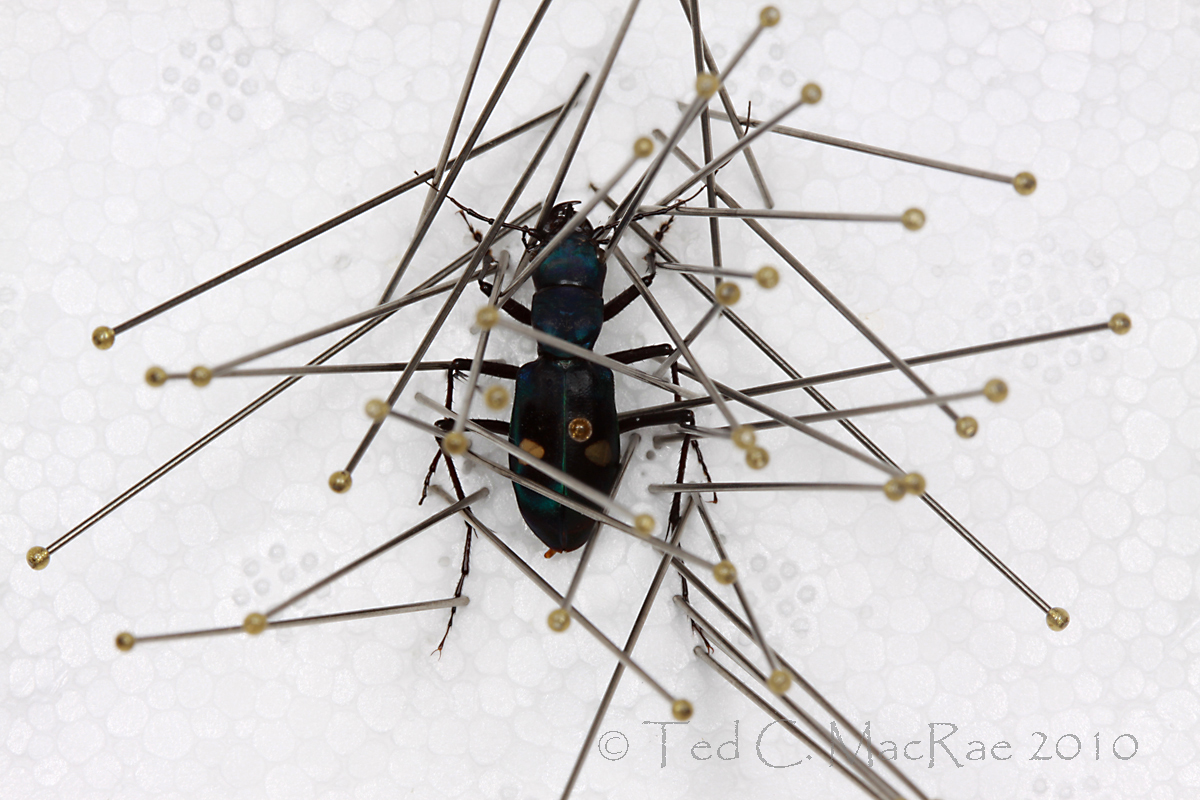
Once clean, I inserted the pin into a styrofoam block for positioning of the body parts. Since this specimen was to be posed in a life-like position, I didn’t insert the pin all the way, but rather left the body up off the styrofoam as it would be in life. Also, my favorite tiger beetle pose is slightly elevated on the front legs, so I inserted the pin at an angle to leave more space under the head than the abdomen. Then it was a matter of using brace pins to hold each body part in the desired position. I work from “sturdy” to “delicate” – i.e., the sturdiest body parts are placed in position first and the most delicate are done last, since positioning the sturdier parts causes tugging and pulling that could break the more delicate parts if they are already braced in position. This usually means bracing the body itself first, then then the legs, and lastly the antennae. Again, my eyes prefer to do this under a scope. While the antennae and tarsi can usually be positioned directly with the brace pins, sturdier body parts may need to be positioned and held in place with fine-tipped forceps in one hand while placing brace pins around them with the other hand. I also work “proximal to distal” with each part – i.e., positioning the part closest to the body first, followed by the more distal portions. There’s no way around it – this kind of work takes practice and patience, and even with all my years of experience I still managed to break off the distal four antennomeres from the left antenna (and failed in my attempt to glue them back on after drying). For this specimen, a total of 42 brace pins were used.

While fresh specimens may take several days (to a week or more for large specimens) to dry, relaxed specimens usually dry much more quickly – overnight was more than adequate for this specimen. Be careful when removing the brace pins! If you grab them too tightly as you pull them out of the styrofoam, you can end up “flicking” a leg or antenna and breaking it – better to grab the pin head loosely and lightly spin it back and forth as you pull up gently until the pin is free. Once all the brace pins are removed, pull up carefully on the main pin as well until you’re sure the tarsal claws aren’t grabbing the styrofoam – if they are, slide a pin or forceps underneath and gently unhook the claws before pulling the pin out any further. Replace the labels and voila – a much more aesthetically pleasing specimen! Is all this effort worth it? You be the judge. Below on the left is the photograph I showed previously for the specimen prior to cleaning and remounting, while on the right is the now clean and nicely mounted specimen.

Before

After

With the beetle in its new life-like position (and scrambling for any chance to get some more practice with my new diffuser setup [photos coming soon, I promise!] as I slide into the depths of this Midwestern winter), I couldn’t resist the urge to take a few studio shots of the remounted beetle “on white.” While photographs of posed, dead beetles may not be to everyone’s liking, they do provide a chance to see detailed views of species that may not be otherwise available. The first photo above and the three below are some of my favorites from the session:

Photo Details: Canon 50D, Canon MT-24EX flash w/ DIY diffuser (photos 1, 7-8: Canon MP-E 65mm 1-5X macro lens, ISO 100, 1/250 sec, f/13; photos 2-6: Canon 100mm macro lens, ISO 100, 1/250 sec, f/16). Typical post-processing (levels, minor cropping, unsharp mask) with digital removal of pin heads and minor debris.

Copyright © Ted C. MacRae 2010

ESA in absentia

Click on image to see larger version.

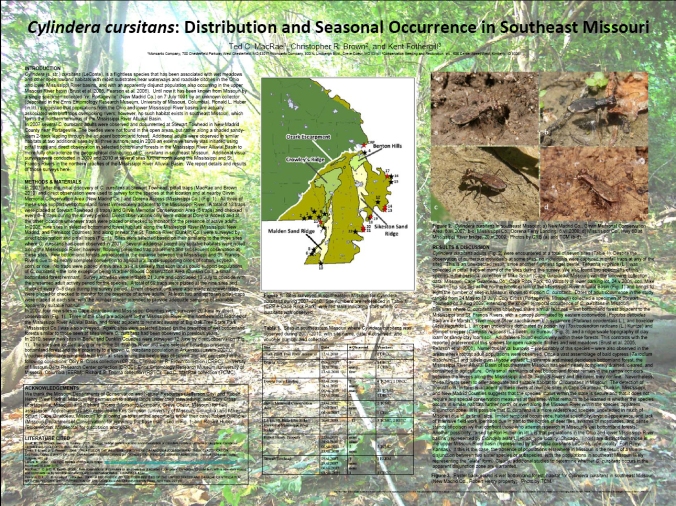
The Entomological Society of America (ESA) held its 58th Annual Meeting earlier this week in San Diego, California. For those of you who were unable to attend, I’ve included a link to a poster that I and coauthors Chris Brown and Kent Fothergill presented, titled Cylindera cursitans: Distribution and Seasonal Occurrence in Southeast Missouri. Okay, I can already see the puzzled faces, as many of you know I was unable to attend myself. In fact, none of the poster authors were in attendance – if Kelly Tindall, Kent’s entomologist-wife, hadn’t attended the meetings the poster would have never seen the light of day.

Despite lead authorship on the poster, I had a minimal role in its preparation.  Kent did much of the dirty work – clipping text and figures from a manuscript on the subject that we recently submitted to the journal CICINDELA, while Chris and I sat back and gave thumbs up and thumbs down opinions on each iteration of Kent’s hard work.  My heartiest congratulations to Kent for producing such a nice piece of work, to both Kent and Chris for putting up with my obsessive nitpicking over every trifling detail as we readied the manuscript for submission, and to Kelly for lugging a poster halfway across the country in the middle of winter when it didn’t even have her name on it.

REFERENCE:

MacRae, T. C., C. R. Brown, and K. Fothergill.  2010. Cylindera cursitans: Distribution and Seasonal Occurrence in Southeast Missouri. Annual Meeting of the Entomological Society of America, San Diego, California, December 12-15, 2010.

Copyright © Ted C. MacRae 2010

A First Class Box of Beetles

Warning: post contains lots of hardcore, beetle-collector geekery!

A nice selection of tiger beetles and buprestid beetles.

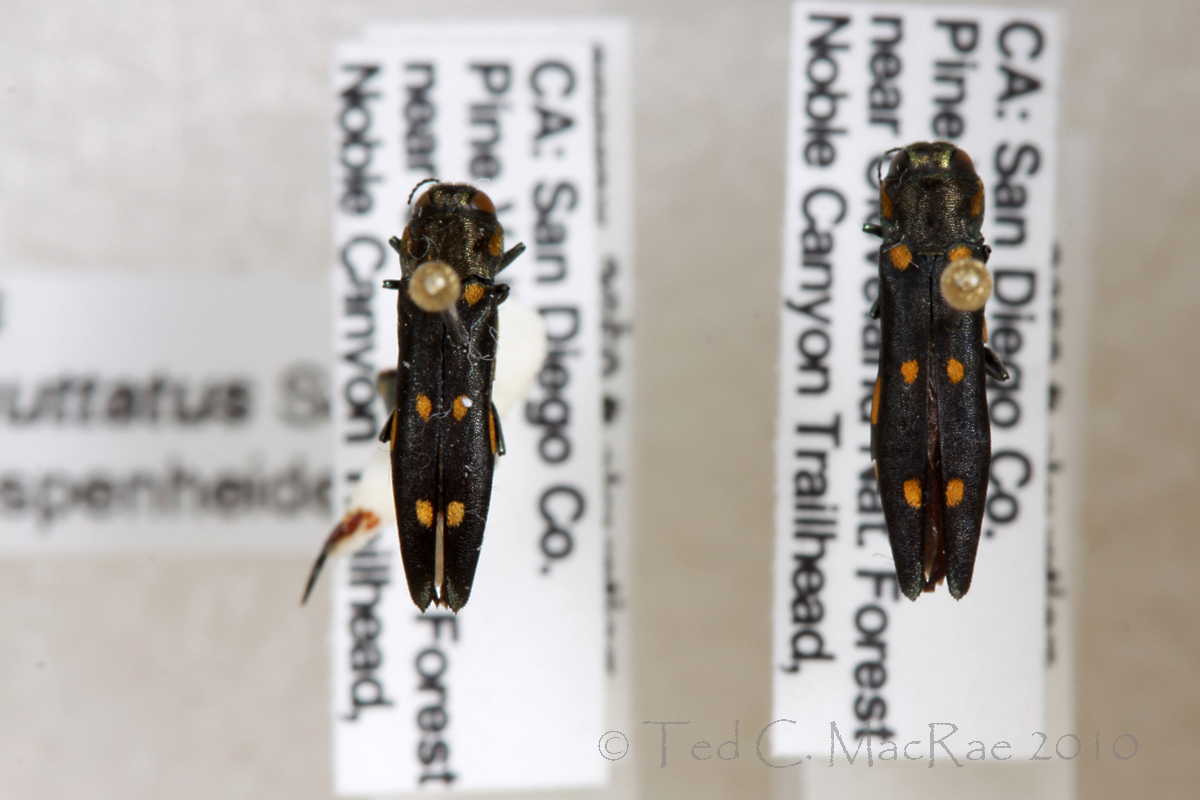
A few weeks ago I got an email from fellow buprestophile Henry Hespenheide (Professor Emeritus, UCLA) asking if I needed any specimens of Agrilus coxalis auroguttatus – recently dubbed the “goldspotted oak borer” after it was discovered damaging oaks in southern California (Coleman & Seybold 2008).  I replied that I did not have this species in my collection and that I would be grateful for any examples he could provide.  Shortly afterwards, I received another message from him saying that he had just placed in the mail a small box with a male/female pair of that species – along with about two dozen tiger beetles for my enjoyment!  Later that week I received the shipment at my office – I couldn’t wait to open it up and see what goodies were inside!

Ctenostoma maculicorne (Chevrolat, 1856)

Opening a box of just received specimens is a little like opening presents on Christmas – you don’t know for sure what’s inside, but you know you’re gonna like it!  This time was no exception, and I delighted as I realized the sending contained a dozen or so tiger beetles from Costa Rica and Nicaragua (a region in which Henry has spent many of his years studying the leaf-mining and twig boring buprestid beetles).  My eyes were immediately drawn to two tiger beetles in particular – specimen #1 in the first row, and specimen #4 in the second row.  Why these particular tiger beetles?  Obviously they are among the more showy specimens in the sending, but more significantly both of them belong to genera not represented in my collection.  The first of these is Ctenostoma maculicorne, representing also a new tribe for my collection (Collyridini, subtribe Ctenostomina).  I’m glad Ron Huber had already identified this specimen, as I probably would’ve only been able to determine the genus.  Beetles in this group are ant mimics, but in a much different manner than our U.S. ant-mimics (Cylindera cursitans and Cylindera celeripes).  Those latter species are found strictly on the ground (as are all U.S. tiger beetle species), while species of Ctenostoma are largely arboreal.  Troy Bartlett at Nature Closeups has some great photographs of another species in this genus seen last January in Brazil (Caraça Natural Park, Minas Gerais) that show just how ant-like these beetles can appear as they crawl about on twigs and branches.

Pseudoxycheila tarsalis Bates, 1869

Despite lacking an identification label, I recognized the second specimen instantly as Pseudoxycheila tarsalis, dubbed by Erwin & Pearson (2008) as the “Central American montane tiger beetle.”  Pseudoxycheila is a rather large Neotropical genus (21 known species), but only P. tarsalis occurs north of South America.  Morgan Jackson at Biodiversity in Focus photographed an individual of this species during his visit to Costa Rica this past summer.  Its brilliant coloration is not only delightful to look at but also apparently aposematic in nature – Schultz and Puchalski (2001) found that benzene-like compounds isolated from the beetle’s pygidial glands are distasteful to humans, adding support to the potential of a Müllerian mimicry association with stinging mutillid wasps in the genus Hoplomutilla, which they resemble.  Note also the curious spine on the frons extending out over the mandibles – maybe it not only grabs its prey with its toothy jaws but also “stabs” it for extra measure (just kidding – though I do wonder about the function of that spine.  I’m not aware of its presence in any other genus of tiger beetles).

I also noted an interesting pair of tiger beetles that looked very different from each other, yet were both identified by Ron Huber as Tetracha ignea.  This species was recently synonymized under the nominotypical form of T. sobrina (Naviaux 2007) – the “ascendent metallic tiger beetle” (Erwin & Pearson 2008), a highly variable species with numerous described subspecies occurring in southern Mexico, Central America, northern South America, and the West Indies.  The specimen on the left has the normal appearance of T. sobrina sobrina, but the specimen on the right looks like it might have suffered some chemical discoloration (a common occurrence among collected tiger beetle specimens).

Update 16 Dec 2010, 12:00pm – I just learned from Henry that the Tetracha specimen on the right (from Nicaragua) was not seen by Ron Huber and, thus, is likely not conspecific with the specimen on the left (T. sobrina from Costa Rica).  That’ll teach me to blindly accept what I see but does not seem right.  Now, time to pull out my copy of Naviaux (2007) and test my abilities to work through a key written in French!

Tetracha sobrina sobrina Dejean, 1831 (L); Tetrach sp. undet. from Guatemala (R).

There are several other interesting species in the sending – some determined (two species each of Oxycheila and Brasiella) and others that I need to look at more closely.  You may note on the bottom row a few specimens of a species of Elaphrus – a genus of true ground beetles that often fool collectors by their strong resemblance to tiger beetles (looks like they fooled Henry, too).  As for the beetles that were the reason for this shipment in the first place, these are shown in the image below.  Agrilus coxalis auroguttatus was recently discovered as the cause of significant mortality in several species of oak trees in San Diego County (Coleman & Seybold 2008), thus joining the introduced Agrilus planipennis (emerald ash borer) and several native Agrilus spp. on the ever-growing list of buprestid beetles achieving economic pest status in North America.  This subspecies, known for many years from southern Arizona (where it is not a pest), is curiously widely disjunct from nominotypical populations in southern Mexico.  Its sudden appearance in southern California has all the hallmarks of being a human-aided introduction, although natural range expansion remains a possibility.

Agrilus coxalis auroguttatus Schaeffer, 1905

My deep appreciation to Henry Hespenheide for gifting me these specimens and for his always enlightening and often entertaining correspondence over the years.

REFERENCES:

Coleman, T. W. and S. J. Seybold.  2008.  Previously unrecorded damage to oak, Quercus spp., in southern California by the goldspotted oak borer, Agrilus coxalis Waterhouse (Coleoptera: Buprestidae).  The Pan-Pacific Entomologist 84:288–300.

Erwin, T. L. and D. L. Pearson. 2008. A Treatise on the Western Hemisphere Caraboidea (Coleoptera). Their classification, distributions, and ways of life. Volume II (Carabidae-Nebriiformes 2-Cicindelitae). Pensoft Series Faunistica 84. Pensoft Publishers, Sofia, 400 pp.

Naviaux R. 2007. Tetracha (Coleoptera, Cicindelidae, Megacephalina): Revision du genre et descriptions de nouveaus taxons. Mémoires de la Société entomologique de France 7:1–197.

Schultz, T. D. and J. Puchalski.  2001.  Chemical defenses in the tiger beetle Pseudoxycheila tarsalis Bates (Carabidae: Cicindelinae).  The Coleopterists Bulletin 55(2):164–166.

Copyright © Ted C. MacRae 2010


Cleaning Tiger Beetles

Cicindela scutellaris scutellaris - the festive tiger beetle

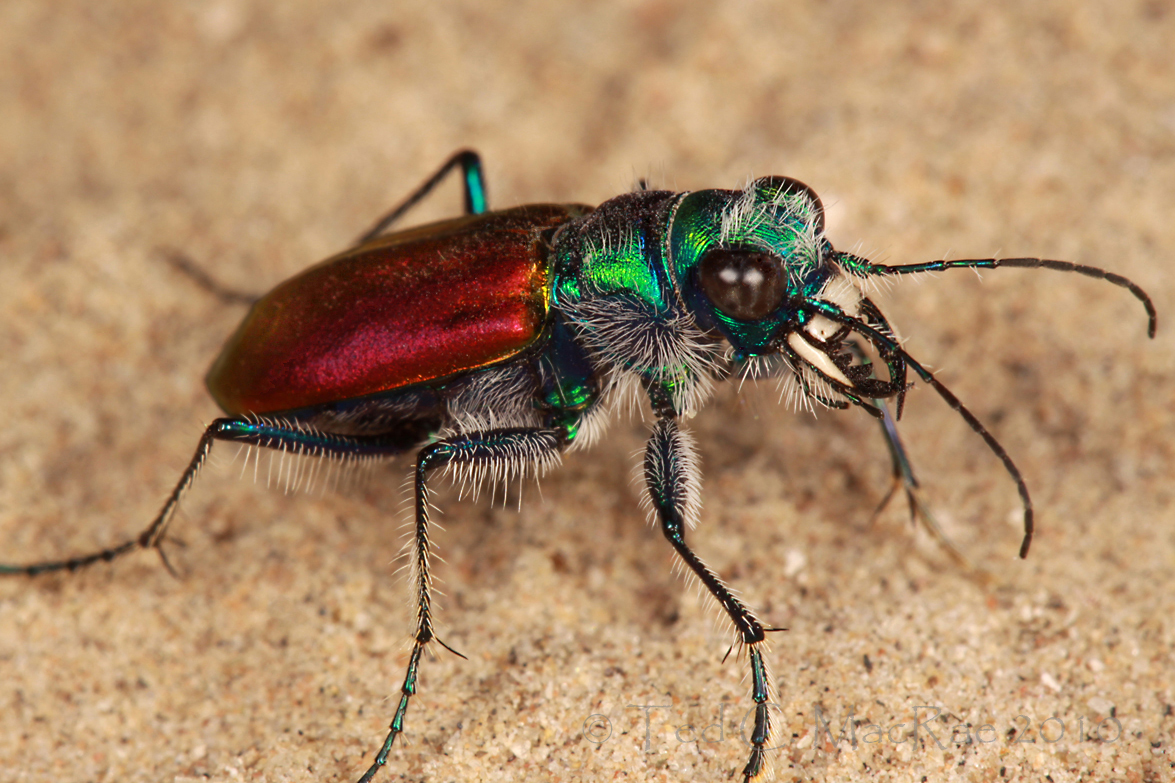
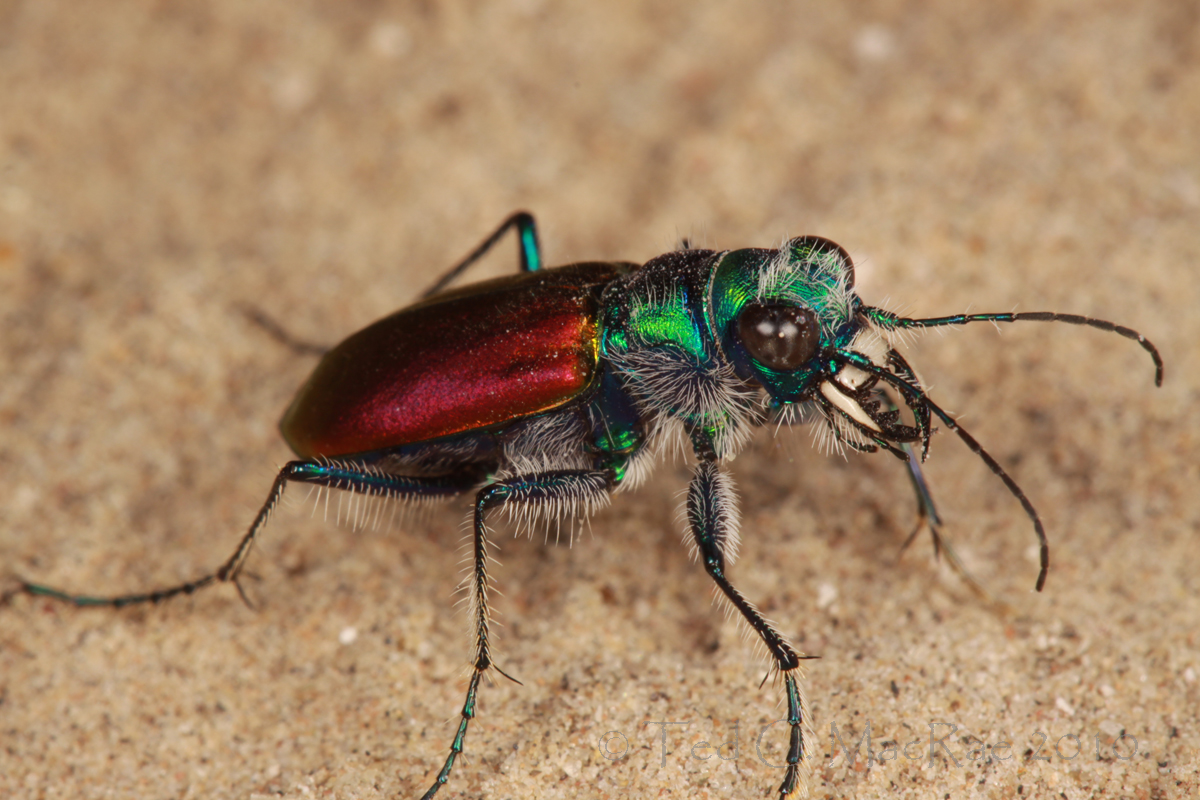
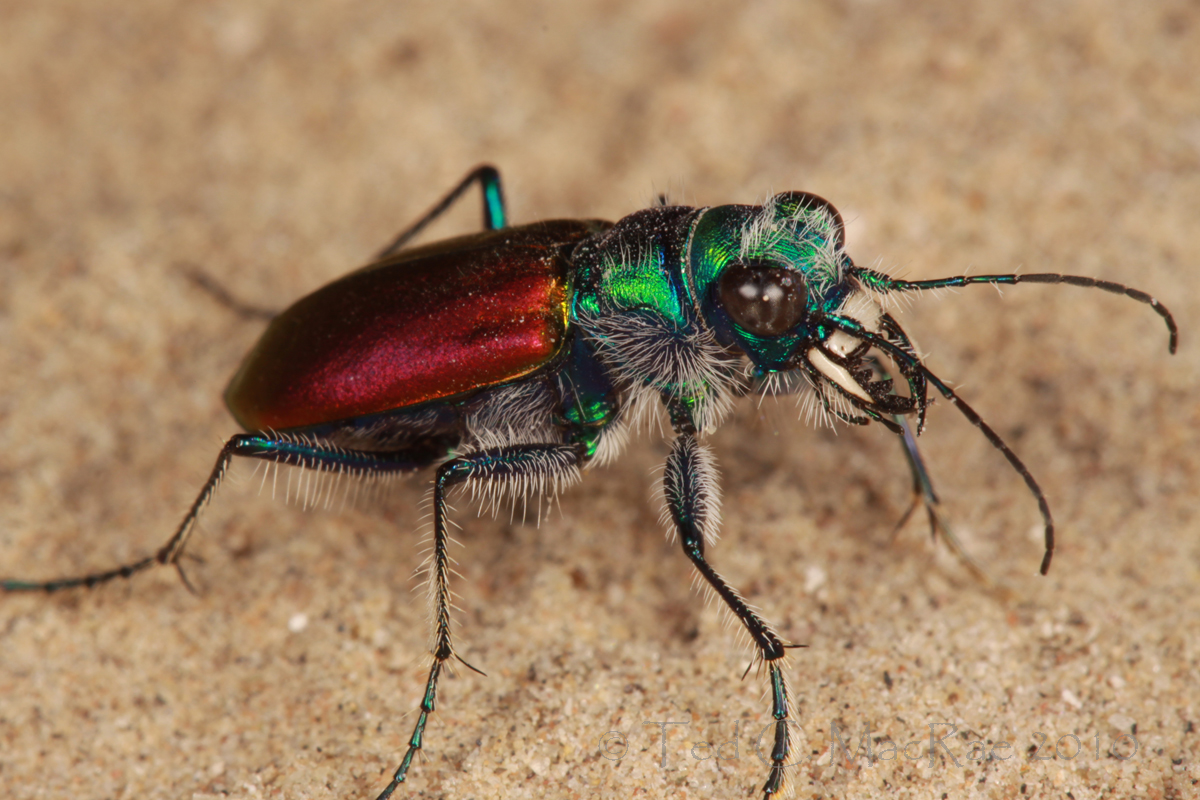
This is Cicindela scutellaris (festive tiger beetle), one of the six species of tiger beetles that we found last September at Monroe Canyon in the Pine Ridge area of northwestern Nebraska.  The red elytra and green head and pronotum are characteristic of nominotypical populations of this species that are found in sandy habitats throughout the Great Plains.  This is your classic tiger beetle in a classic tiger beetle pose; however, photographs such as this are not so easy to come by.  The biggest challenge is the beetle itself – rarely are they so accommodating to allow this nice lateral profile perspective with the head slightly cocked towards the camera while standing up on their front legs.  This posture is seen only when the beetles are warm and active, and warm beetles are skittish beetles that yield lots of not-as-interesting back shots (head directed away from the camera) as they persistently run away from the photographer.  Cooler temperatures make them less skittish and easier to approach from the desired angle, but in this case they often lay flat on the ground trying to absorb heat – flay-laying beetles are not very photogenic either.  With practice and patience, one learns how to “work” an active, skittish subject and get them accustomed to the photographer so that the above perspective can be achieved.

Getting the shot, however, is only half the battle.  Tiger beetles are dirty bugs!  They run around over bare ground and dig in it, often leaving them covered with debris.  This is particularly true for species that frequent sandy habitats.  For those of us who like to photograph wild individuals in their native habitats, debris-covered beetles is something we have to live with.  Or do we…?  The beetle in the above image looks squeaky-clean thanks to some simple digital image processing tools that I used to “clean up” the subject (I use Photoshop Elements 6.0).  Now, I’ve never been one to want to spend a lot of time on post-processing of my photographs.  I’d rather be looking for bugs, photographing them, studying them, and writing about them – time spent on post-processing is time not spent on any of these other activities.  However, I have developed a little routine that I follow for most of my tiger beetle photographs now that cleans them up a bit – some more than others – and doesn’t take too much time.  Maybe some of you will find this useful for your own photographs.¹

¹ Disclaimer:  I am not a Photoshop expert.  I’m not even a photographer.  I’m an entomologist with a camera.  As a result, this post is intended to be not so much an authoritative tutorial on the use of Photoshop as a summary of what I’ve learned in dealing with my own photographs.  Constructive dialogue about these and other techniques is welcome. 

Like it or not, no digital image comes out of the camera ready to use (still perhaps the most perplexing aspect of this whole digital photography thing for me personally).  Almost every image needs some levels adjustment and unsharp mask applied to it, and while others are against it I’m not above doing a little cropping to enhance the final composition of the photograph (hey, it’s difficult enough just getting these guys in the frame, much less positioned exactly where you want them).  These are the basic steps that I follow for almost every photograph, as illustrated in the following sequence (reduced versions used for all photos):

Original photograph before processing.

Slight cropping to enhance composition.

Levels adjusted to brighten photo.

Unsharp mask applied (amount = 80%, radius = 2.0 pixels, threshold = 12 levels).

 Normally I would be done at this point, but there are two things that bother me about this photo: 1) the dark shadow on the distal back portion of the elytra (common with this pose), and 2) the debris scattered about on the eye, mandibles, thorax, and elytra.  To fix the shadow, I used the Magic Wand Tool (set on contiguous) to select the shadowed area of the elytra, then used the Dodge Tool set on Highlights (exposure = 25%) to lighten the shadowed area.  For the debris, I enlarged the photo to 100% and used the Spot Healing Brush Tool to remove most of the sand particles, adjusting the size of the brush to just larger than the size of the individual sand particles.  This works fine for particles surrounded by a uniform background, but it doesn’t work so well for particles along edges (particularly the mandibles).  For this, I used the Clone Stamp Tool (again, with the photograph enlarged to 100%) and carefully “cloned” a clean spot along the edge of the mandible next to the sand particle and then replaced the piece of debris with the cloned piece of the image.  As with the Spot Healing Brush Tool, the pixel size is set to the smallest size needed for the size of the debris particles.  Compare the above image with the finished image below to see the difference.

Finished photo with dark shadows on elytra and sand debris on body removed.

 The biggest improvements can be seen with the eyes, always the focal point of a photo such as this, and the mandibles – both now appearing nice and clean.  Is this cheating?  Have I compromised my ideal of getting an image of a wild individual of this species in its native habitat?  I’d be interested to know your opinion about this.

Photo Details: Canon 50D w/ 100mm macro lens (ISO 100, 1/250 sec, f/16), Canon MT-24EX flash w/ Sto-Fen + GFPuffer diffusers.

Copyright © Ted C. MacRae 2010

Monroe Canyon – A Tiger Beetle “Hot Spot”

Steep, sparsely vegetated, fine sand road cut on the Nebraska Pine Ridge escarpment.

The vast landscape surrounding the Nebraska Pine Ridge boasts two entirely different natural communities – the High Plains shortgrass prairie atop the ridge stretching endlessly to the south, and the eerie, desolate Badlands on the north side of the ridge extending to the Black Hills of South Dakota.  Separating these two distinctive communities is the Pine Ridge escarpment itself – a precipitous 1,400-ft drop whose ponderosa pine forests and sage brushlands are more reminiscent of the Rocky Mountains some distance to the west rather than the Great Plains that surround them.  Instead of hard igneous and metamorphic rocks, however, the Pine Ridge is composed of soft, erodable sand- and siltstones, giving rise to canyons with dramatic white bluffs and escarpments.  One of the more scenic of these is Monroe Canyon, located six miles north of the tiny town of Harrison and part of the Gilbert-Baker State Wildlife Management Area.  I first explored Monroe Canyon two years ago, when Matt Brust took me there after our successful quest to see Cicindela nebraskana (prairie long-lipped tiger beetle) in the prairies above.  The steep, eroded road cuts in Monroe Canyon had become one of Matt’s favorite spots to look for tiger beetles, but on our visit there was not much going on save for single individuals of the ubiquitous sand-loving species Cicindela formosa (big sand tiger beetle) and Cicindela scutellaris (festive tiger beetle).  Still, the fine, deep, sparsely vegetated mixture of sand and silt extending far up the embankment is classic tiger beetle habitat, so when Chris Brown and I returned to the area this past September, we decided to give Monroe Canyon another try.

Of the several sand-associated tiger beetles that I thought we might encounter here, Cicindela lengi (blowout tiger beetle) was the one I was really hoping for.  I had encountered a few scarce individuals of this C. formosa-look alike during my 2008 trip and eventually reared another individual from suspected larvae plucked from their burrows.  My only photographs of this species, however, were taken during my PNS days, and I longed to see them once again through the viewfinder of a proper macro-rig.  The day hadn’t started well, getting skunked at a clay bank site in Crawford on the way to Monroe Canyon (where I resorted to photographing itty bitty little moths), and early indications once we got to Monroe Canyon were that it was going to be slow there as well.  Sporadic sightings of Cicindela purpurea audubonii (Audubon’s tiger beetle) had me yawning, and a lone individual of the remarkably infidel Cicindela ubiquita [= C. punctulata] (punctured tiger beetle) seen close to the roadside did little to boost my enthusiasm.  Still, conditions just seemed “right” and the habitat was extensive enough that it deserved a thorough searching before passing judgement.  I got a little more excited when I encountered a few C. purpurea audubonii black morphs, of which I got my first nice field photographs (you’ll see these in a future post), and then spent some time staking out larval burrows for attempted photographs.  We ended up spending a couple of hours at the site without seeing anything remarkable, but by then it was early afternoon and there was little point in trying to find another locality to search – it was a gorgeous spot on a gorgeous day, and just being out there was almost reward enough.  (I’m guessing by now you see where this is going…)

Cicindela lengi - blowout tiger beetle

As I began my umpteenth pass along the lower stretch of the embankment, I heard Chris call out, “I’ve got it!”  Chris hadn’t previously seen this species, so I fully expected when I walked over to where he was standing that I would find instead the much more common and amazingly similar C. formosa.  However, when I spotted the adult as he pointed to it, there was no doubt – the longer, obliquely straight humeral lunule (shoulder marking), the slightly more cylindrical, parallel-sided body, the more extensive brilliant green marginal highlights on the head and pronotum – it was, indeed, C. lengi!  The close resemblance of C. lengi to C. formosa is not the result of a close relationship, but rather an example of convergent evolution in response to similar habitat.  Cicindela lengi is actually more closely related to C. tranquebarica (oblique-lined tiger beetle) and other species formerly placed in the now defunct subgenus Tribonia.  As the first finder, Chris had first photo honors as well while I stood back, ready with the net should it spook and become uncooperative.  It did make a few short escape flights at first, but as I’ve learned before this species tends to make very short, weak flights before dropping straight down, making it rather easy to follow even on the steep embankment that we found ourselves.  This contrasts with C. formosa, whose long, powerful escape flights and bouncing tumbles upon landing can make them difficult to follow.  Eventually it became accustomed to our presence, and after Chris was satisfied with his photographs it was my turn.  We then we took turns again just to make sure we really got the shots we wanted.

Cicindela lengi - note the obliquely straight humeral lunule and relatively narrow, parallel-sided body.

It’s a good thing we didn’t pull the plug on Monroe Canyon that day, as tiger beetle activity really picked up during the afternoon hours.  Not only did we end up seeing several individuals of C. lengi during the next couple of hours, but also a few individuals of C. formosa and C. scutellaris and a single, seemingly misplaced Cicindela denverensis (green claybank tiger beetle), more fond of clay substrates than sand) – making Monroe Canyon a veritable “hot spot” of tiger beetle diversity.  While Monroe Canyon may not equal Willcox PlayaLaguna del Perro, Salt Plains National Wildlife Refuge, or Florida’s Road to Nowhere, six species is still a respectable amount of diversity by any measure, especially for a dry, upland site (all of the other sites mentioned are lowland saline habitats that owe their tiger beetle diversity at least in part to their broad range of available moisture zones).  After two days in the field, our trip total now stood at ten species, and in retrospect we were lucky to see C. lengi when we did as our subsequent search of the C. lengi spot 4 miles east of Harrison later that day turned up nothing.

Brilliant green highlights contrast spectacularly with the red body and bold white markings.

Copyright © Ted C. MacRae 2010