Kirby’s Tiger Beetle

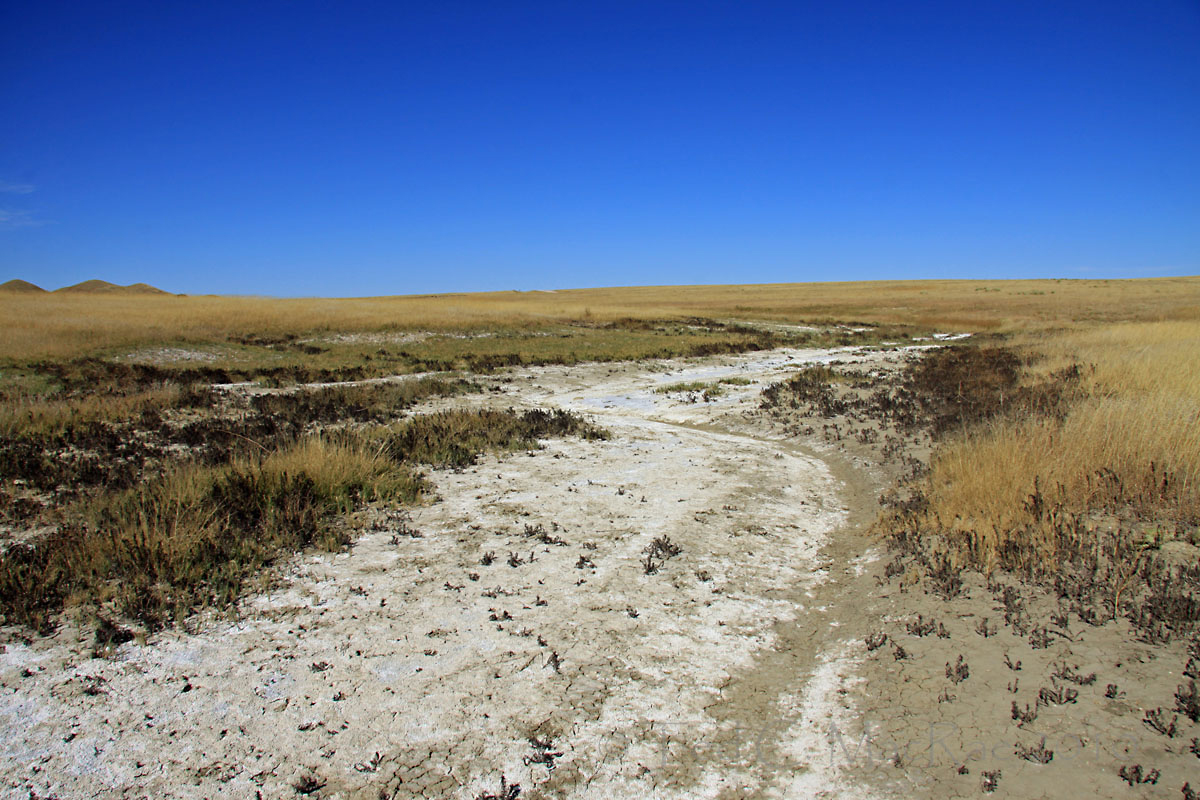
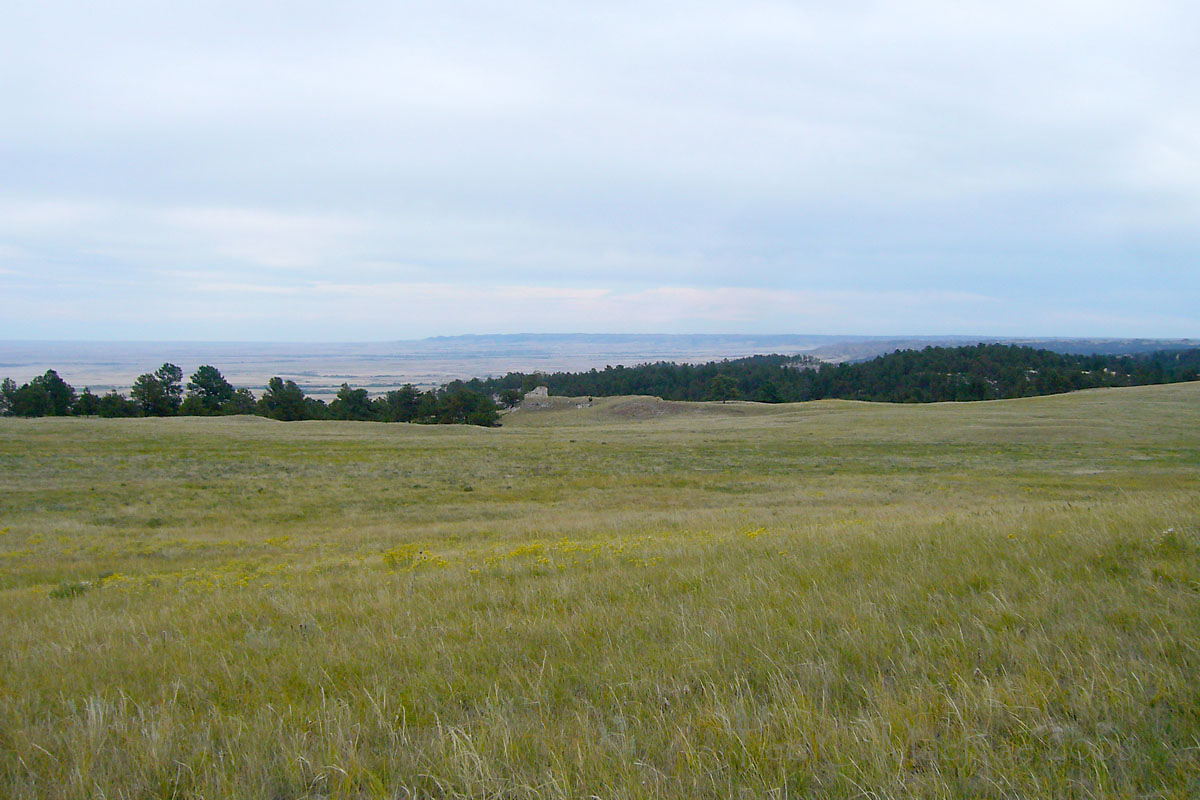
Dry alkaline creek in the Oglala National Grasslands, Sioux Co., Nebraska

At the northern edge of the Pine Ridge in northwestern Nebraska, the land drops precipitously from verdant High Plains to the eerie Badlands below.  The sterile landscape of eroded slopes and irregularly shaped landforms is at once beautiful and harsh.  Short grasses and silver sagebrush seem to be the only plants capable of living here, providing the meagerest of forage for the mule deer and pronghorn antelopes that dot the gently rolling hills.  Dissecting these arid grasslands are a series of seasonally dry alkaline creeks that support a number of tiger beetle species.  The most interesting of these is Cicindela fulgida fulgida (crimson saltflat tiger beetle), a beautifully colored little species that is restricted to wet, alkaline habitats.  It was this species that I and colleagues Chris Brown and Matt Brust wanted to see when we stopped by one such creek after finishing up at the C. pulchra site in South Dakota (and still recovering from “pulchra-fever”).

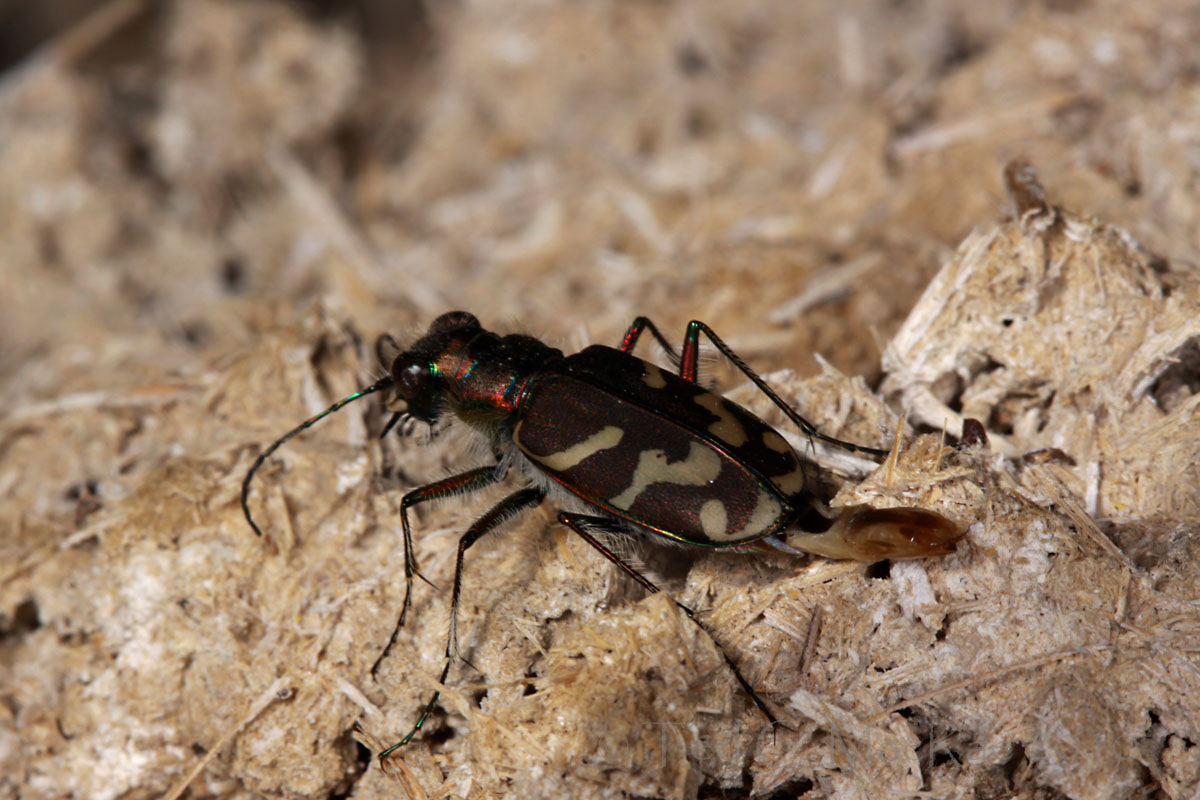
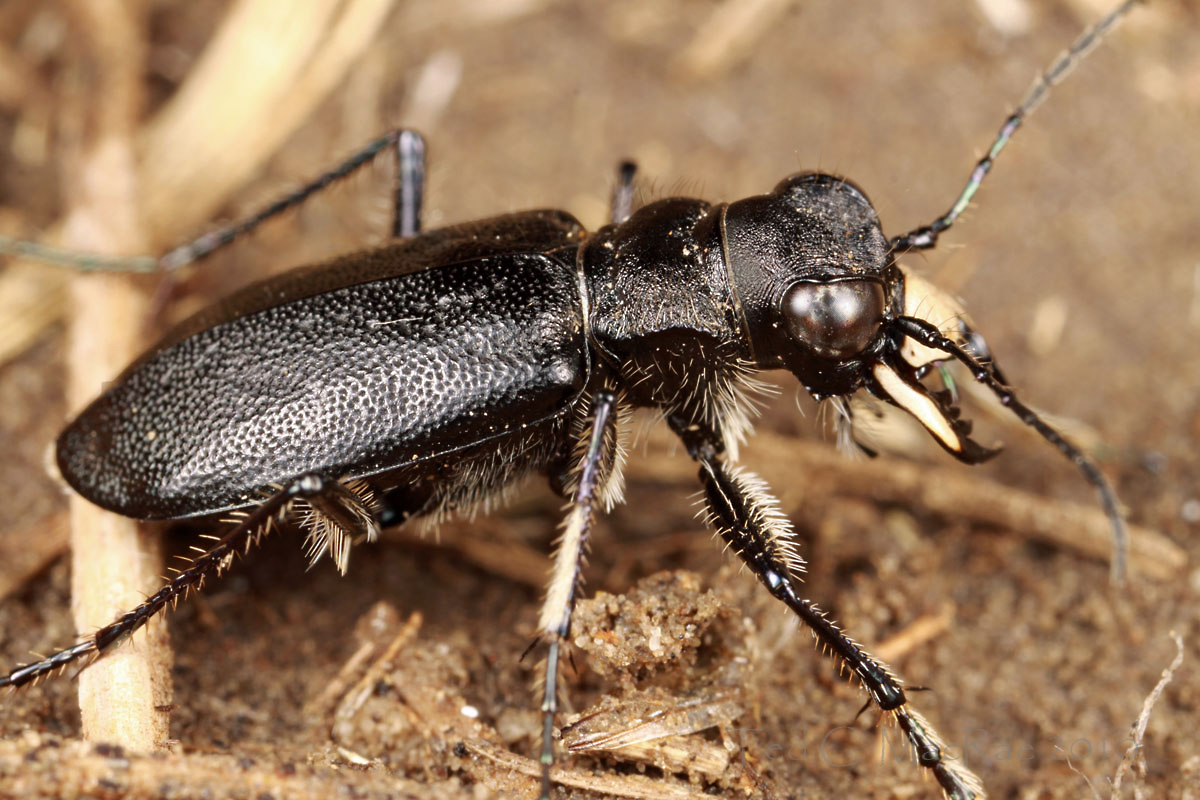
Cicindela tranquebarica kirbyi - Kirby's tiger beetle

I had been to this spot two years before and encountered a small number of C. fulgida along with much higher numbers of C. purpurea audubonii (Audubon’s tiger beetle) and C. tranquebarica kirbyi (Kirby’s tiger beetle).  Our luck wasn’t any better this time, and in fact we would encounter only a single C. fulgida that day.  This was Chris’ first opportunity to photograph this species, while I had already gotten some reasonably good field photos of the species during my 2009 visit to Salt Plains National Wildlife Refuge in northwestern Oklahoma.  As he photographed the individual, I continuing scanning the bright, alkaline barrens.  While I was not finding any C. fulgida, I was seeing a fair number of C. tranquebarica kirbyi, and it occurred to me that I still lacked good field photographs of this species.  I began stalking different individuals, but in the heat of the day I found it impossible to get close enough to any of them to attempt any shots.  It wasn’t until I encountered the individual shown above, apparently dragging something from its rear end, that I was able to close in for some shots.  A closer look revealed the individual to be a male who had somehow gotten his genital capsule pulled out of his abdomen.  Just the thought of how this might have happened makes me cringe.  At any rate, the individual exhibits the relatively broader white maculations that distinguish this Great Plains/Rocky Mountain subspecies from the more eastern nominotypical subspecies.

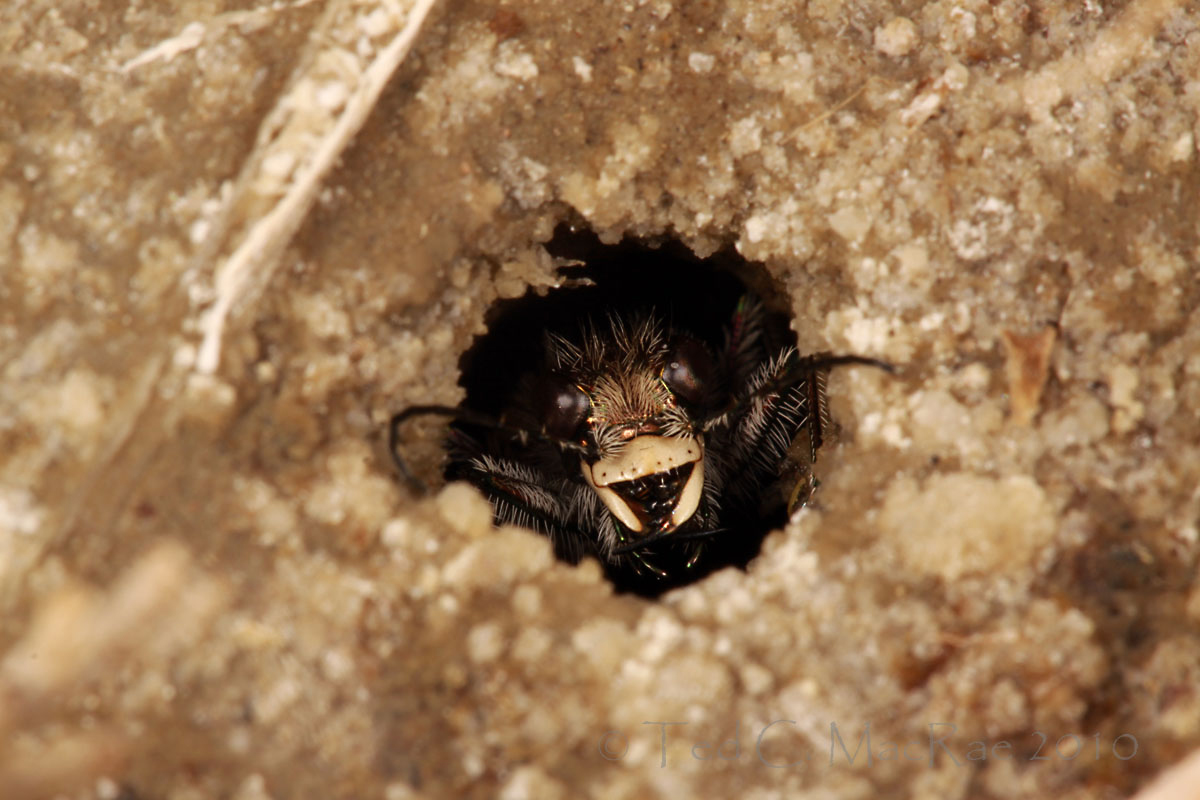
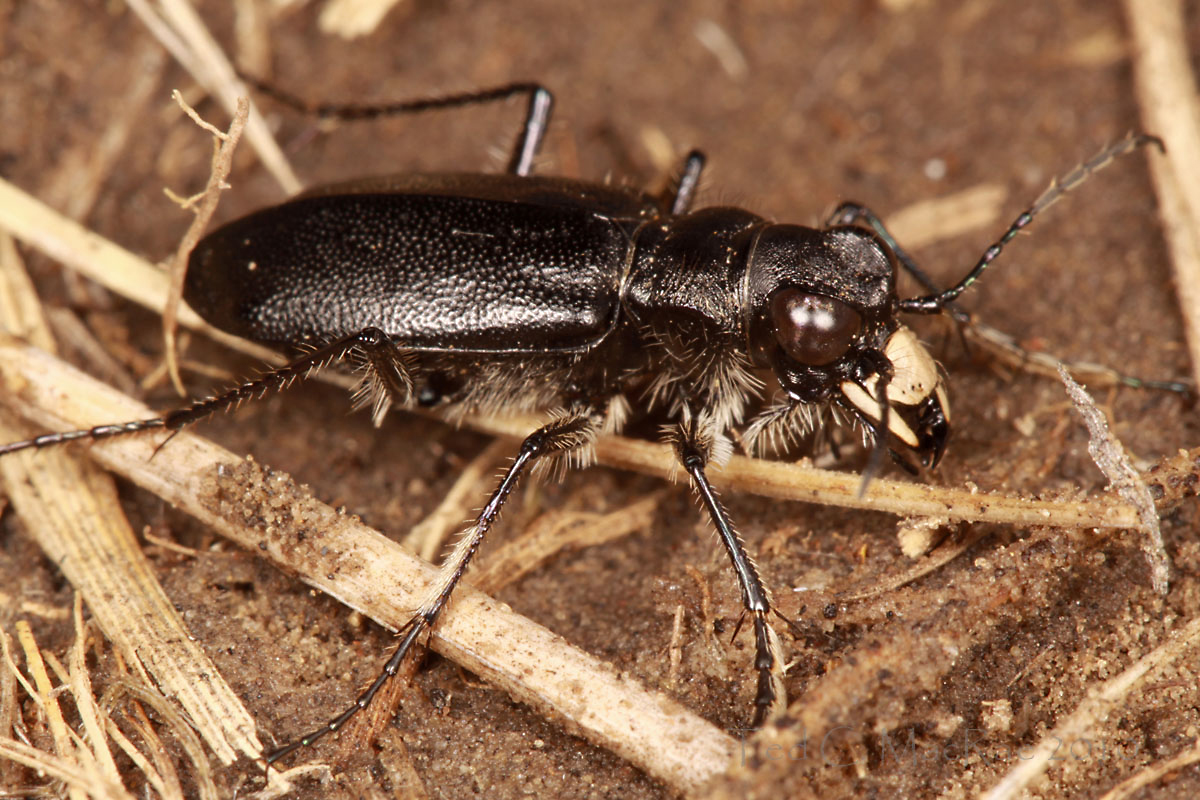
A newly emerged Kirby's tiger beetle sits at the entrance of his burrow.

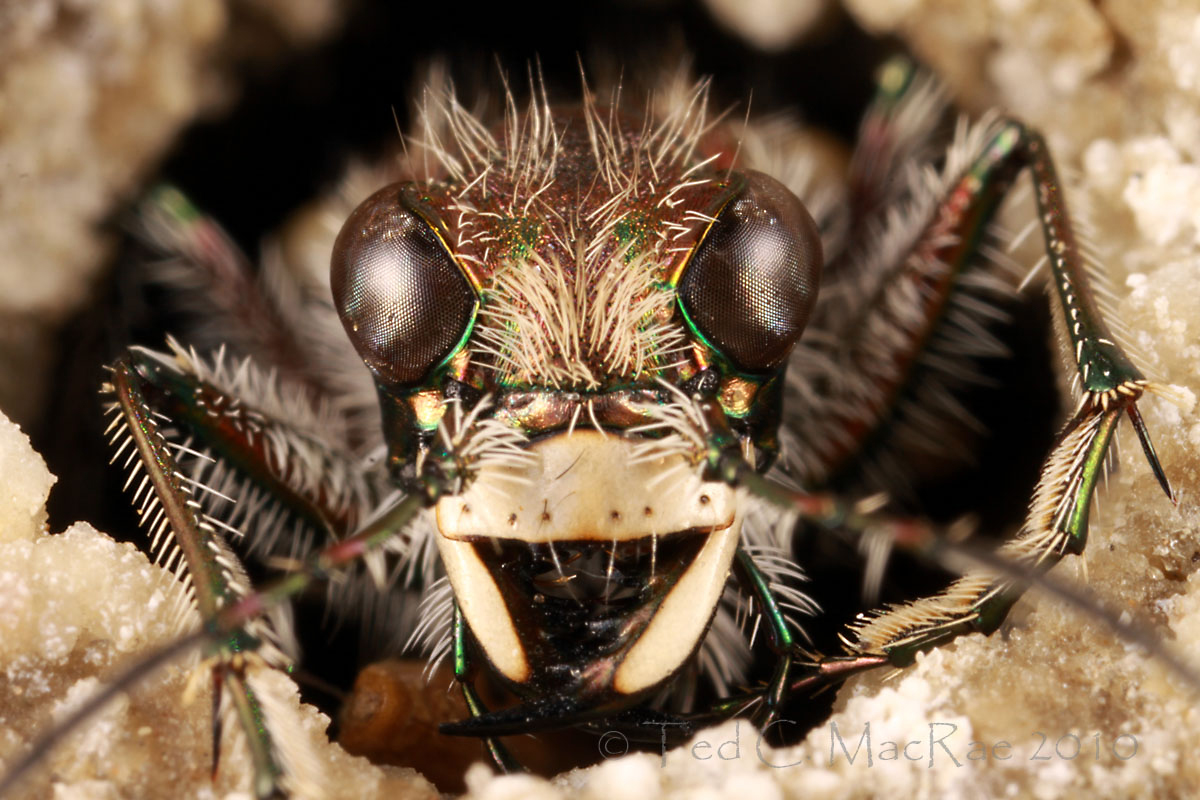
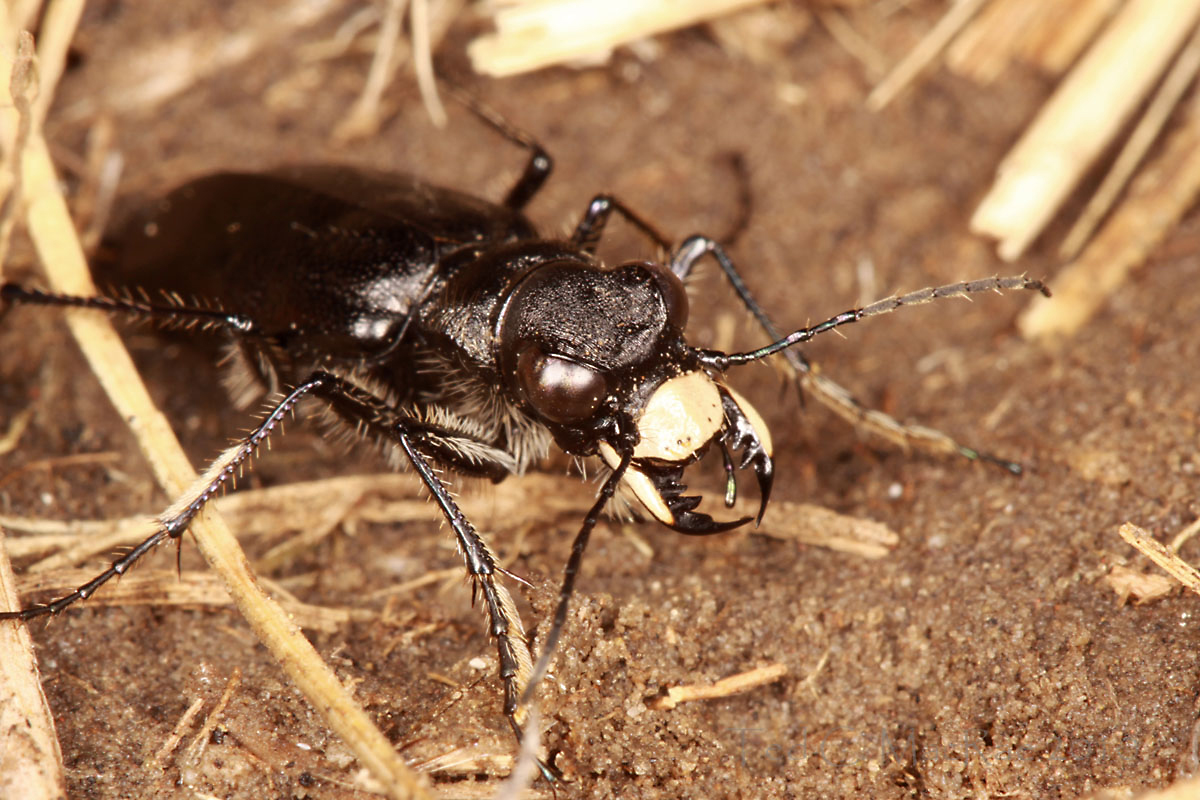
As I continued scanning the soil, I noticed a number of larval burrows of what I took to be this species located up near the edge of the vegetated zone.  One burrow in particular caught my attention – partly because of its slightly larger size and irregular outline, but also because there appeared to be something sitting within it.  A closer look revealed an adult tiger beetle sitting just below the burrow entrance.  Cicindela tranquebarica is a so-called “spring-fall” species that emerges initially in the fall as a sexually immature adult before digging back in for the winter and re-emerging in spring for mating and oviposition.  I thus took this individual to be a newly emerged male that had not yet decided to leave its burrow and burst forth into a life of adulthood.  The opportunity couldn’t be passed up – I took a few photos of him sitting there, then switched out the 100mm lens for the 65mm 1-5X lens.  I had to get real close for this last shot, which caused him to retreat somewhat in his burrow.  However, a knife thrust into the burrow below him, followed by careful twisting until it touched his rear, caused him to return to the burrow entrance and once again pause before embracing his new world.

A male Kirby's tiger beetle prepares to leave his emergence burrow.

Copyright © Ted C. MacRae 2010

Desmocerus palliatus – elderberry borer

Desmocerus palliatus (elderberry borer), Squaw Creek Natl. Wildlife Refuge, Missouri.

Last June I made two trips to the Loess Hills in northwestern Missouri to survey additional sites for Cylindera celeripes (swift tiger beetle), which my colleague Chris Brown and I had discovered in some of the area’s few remaining loess hilltop prairie remnants the previous year. One of these potential new sites was  Squaw Creek National Wildlife Refuge, where a few tiny slivers of hilltop prairie can still be found on the fingers of loess bluffs that border the refuge’s several thousand acres of restored wetlands that famously host large concentrations of snow geese and bald eagles during the fall and spring migrations.  On the first visit, I had arranged to meet with Corey Kudrna, Refuge Operations Specialist, who was kind enough to take several hours out of his day to personally guide me to each of the site’s loess hilltop prairie remnants. 

As we crossed the highway right-of-way at the base of the bluffs on our way to the one of the remnants, we passed through a large patch of common elderberry, Sambucus nigra ssp. canadensis.  Anytime I see patches of this plant, especially in June, I immediately think of Desmocerus palliatus (elderberry borer) – a spectacularly colored longhorned beetle (family Cerambycidae) that breeds exclusively in the living stems and roots of this plant.  It is not a particularly rare species, but for some reason I have not had much success in finding this species.  In my close to three decades of collecting beetles, I had encountered perhaps a half dozen individuals – never more than two at the same time.  Still, when I get the chance to look at elderberry I look for this beetle, and when I did so this time I was delighted to see one within a few moments of entering the patch.  I was ecstatic when I saw another one almost immediately after the first, and I was stunned when I realized that they were all around me!  Good fortune continued on my subsequent visit two weeks later, when I was able to spend a little more time trying to get a good field photograph.  Wind was a problem, the beetles were easily alarmed, and their tendency to rest in the upper reaches of the plant made it difficult to brace myself and the camera while shooting, making this a rather difficult subject to get a good photograph of.  The photo shown here is literally the last of around two dozen that I took and is the only one that I really like.

Many cerambycid beetles are mimics of other more noxious species, mostly ants and wasps.  However, elderberry borers appear to be the exception in that they are themselves noxious.  The cobalt blue and bright orange coloration of the adults screams aposematic (warning) coloration, and it is reasonable to assume that they accumulate in their bodies for defensive purposes the cyanogenic glucosides produced by elderberry plants (Huxel 2000).  Even their movements are those of a chemically protected model – lumbering and clumsy, without the alert evasiveness usually seen with other flower longhorn species.  Presumably this species participates in a Müllerian mimicry complex involving netwinged beetles (family Lycidae, particularly species in the genus Calopteron) and perhaps Pyromorpha dimidiata (orange-patched smoky moth, family Zygaenidae) as well, and it may serve as a Batesian model for the equally colorful but completely innocuous Lycomorpha pholus (black-and-yellow lichen moth, family Arctiidae).

Photo Details: Canon 50D w/ 100mm macro lens (ISO 100, 1/250 sec, f/10), Canon MT-24EX flash w/ Sto-Fen diffusers.

REFERENCE:

Huxel, G. R.  2000.  The effect of the Argentine ant on the threatened valley elderberry longhorn beetle.  Biological Invasions 2:81–85.

Copyright © Ted C. MacRae 2010

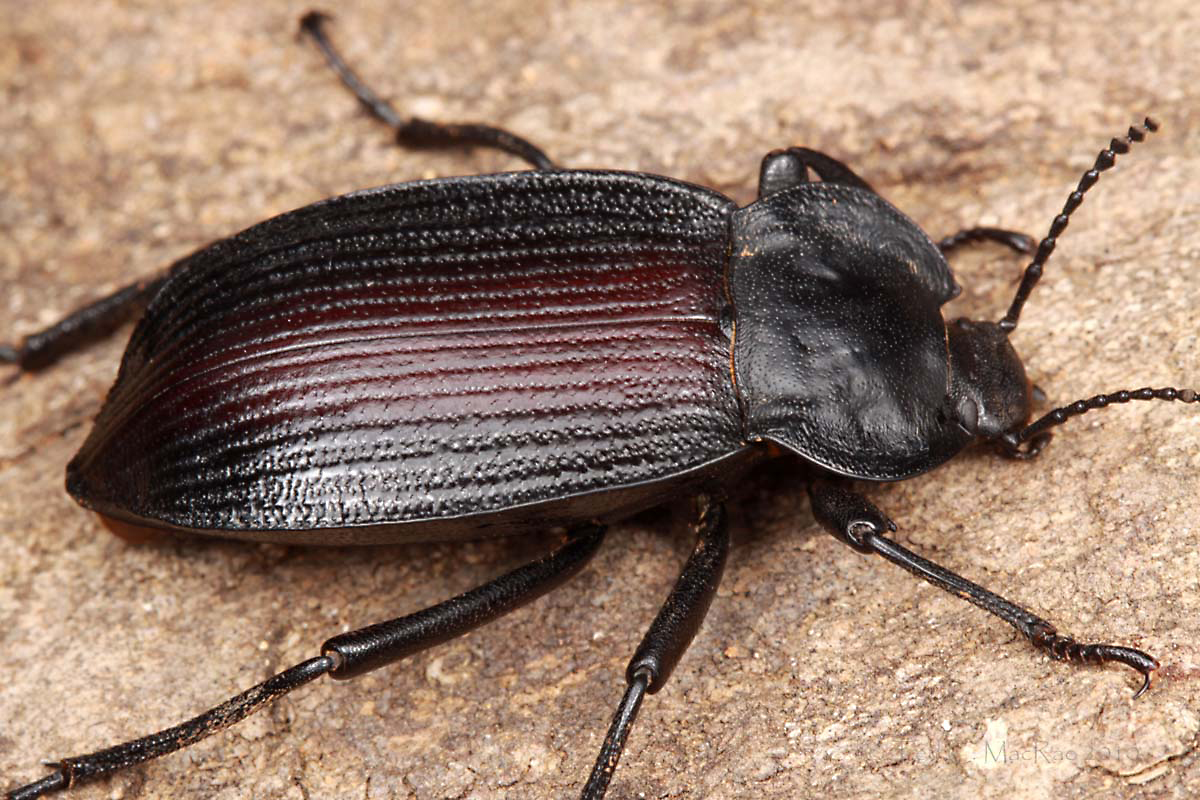
The “best” Eleodes suturalis

Eleodes suturalis - "sutured" clown beetle

Testing with my new diffuser setup¹ continues. I’ve kept this “sutured” clown beetle (Eleodes suturalis) alive since last July as a terrarium-mate with my Great Plains giant tiger beetles (Amblycheila cylindriformis). The first photos I took of it in the terrarium with the old diffusers (Sto-Fen + Puffers) can only be described as “ho-hum.” The next series (with the beetle cleaned up a bit) was taken in a white box with indirect flash and represented a nice improvement over the first shots. Here, the beetle is back in the terrarium on a piece of bark using direct flash and the new diffuser. I think it has the best of both worlds – nicely diffused lighting on a natural substrate (without the need for a white box). Yes, the focus is a bit off in the head area – the beetle was really not very cooperative during the shoot, and I was just interested in seeing how the lighting would look without spending too much time trying to capture the “perfect” shot.

¹ Photos of the diffuser and instructions on how to make it are coming, I promise! I’ve made a few improvements over the prototype by eliminating the tape to hold things together and am just working on the attachment to the MT-24EX flash bracket.

I really hope this diffuser works out for me in the field!

Photo Details: Canon 50D w/ 100mm macro lens (ISO 100, 1/250 sec, f/16), direct Canon MT-24EX flash w/ oversized concave diffuser. Typical post-processing (levels, minor cropping, unsharp mask).

Copyright © Ted C. MacRae 2010

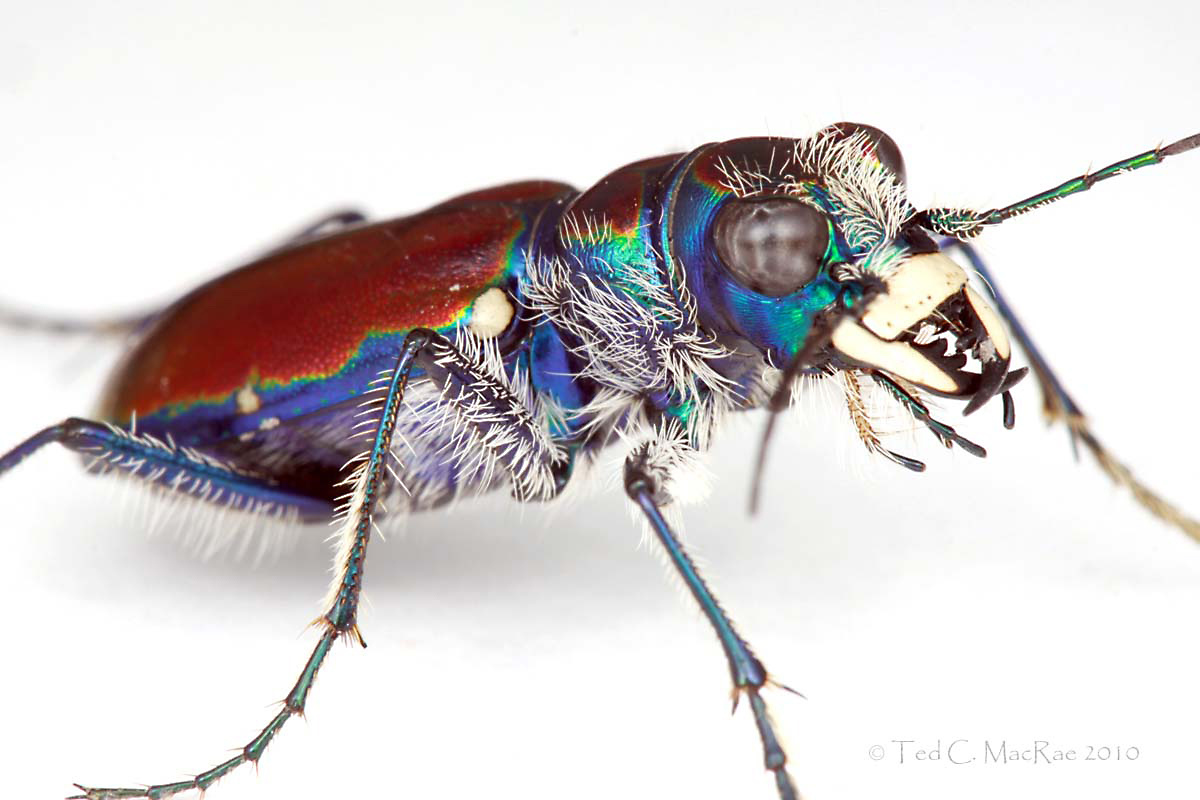
Cicindela pulchra on white

Two more photographs taken with my new diffuser, this time the spectacular Cicindela pulchra (beautiful tiger beetle). Which one do you like better?

Photo Details: Canon 50D w/ 100mm macro lens (ISO 100, 1/250 sec, f/16), Canon MT-24EX flash w/ oversized concave diffuser. Standard post-processing (levels, unsharp mask).

Copyright © Ted C. MacRae 2010

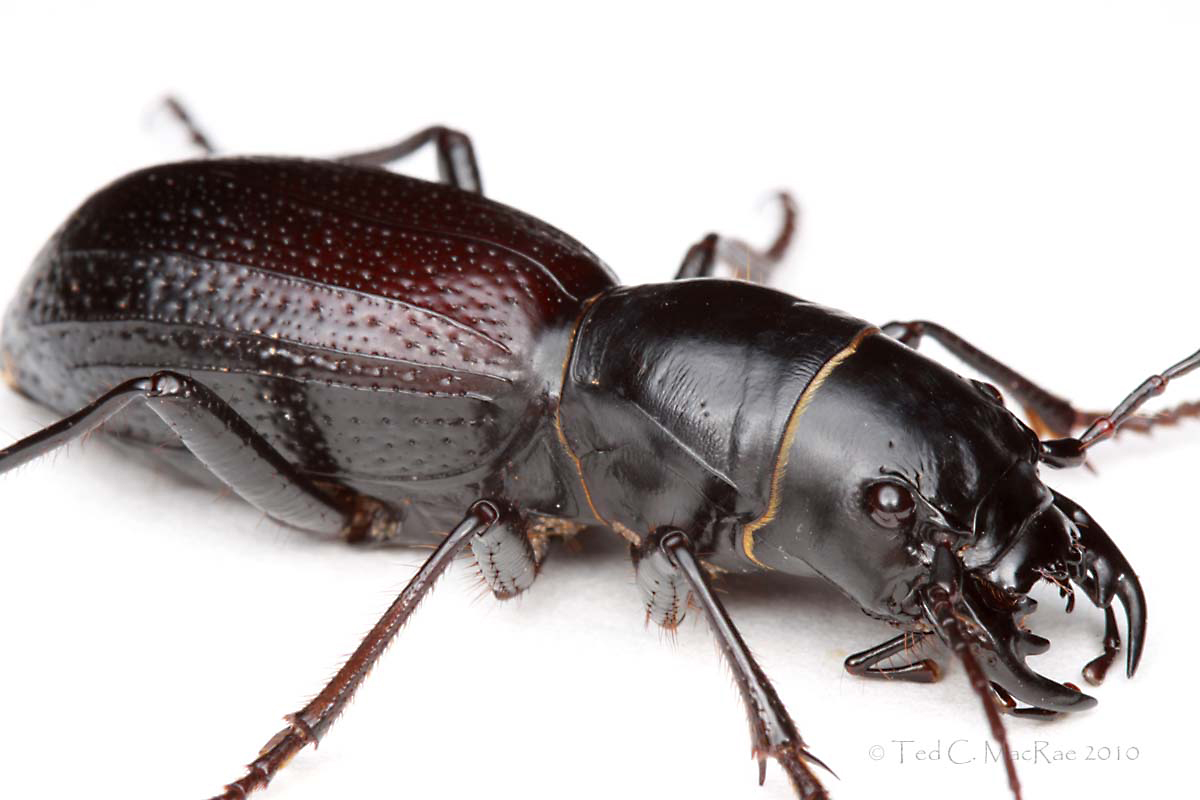
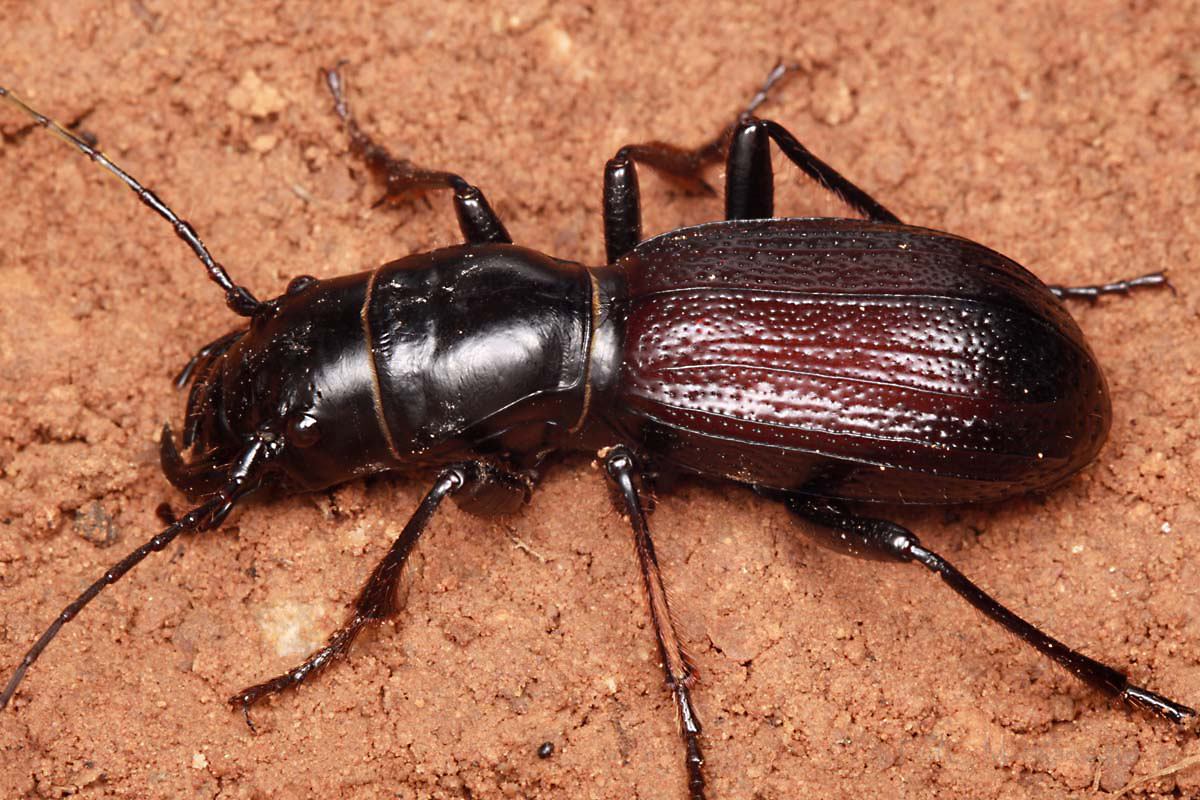
Amblycheila cylindriformis on white

It’s been four months now since I went to the Glass Mountains of northwestern Oklahoma on a hunch to look for Amblycheila cylindriformis (Great Plains giant tiger beetle).  The five adults that I brought back from that night are still alive in a terrarium of native soil, but to this point they have refused to lay eggs.  Despite feeding them regularly with fat Maduca larvae, there is obviously still something they need that I am not providing.  I’ve suspected that perhaps the terrarium that I have them in is too small, and I’ve also noted in the literature that larval burrows are often found clustered near the entrance of mammal burrows.  With this in mind, I combined the native soil from three separate terraria into one larger, deeper terrarium, packed the soil lightly, and used a spoon to create an artificial mammal burrow entrance.  Not long after placing the adults in their new home they began digging at the back of the burrow, eventually creating two separate tunnels leading in opposite directions (and fortunately against the container walls so that I can see inside the tunnels).  I was optimistic at first that finally I had given them what they wanted, but since digging the burrows they’ve just sat in them.  Perhaps they “know” that winter is coming and are just looking to hole up for now, so I suppose I’ll go ahead and place the terrarium in the 10°C incubator with the rest of my larval and adult rearing containers and wait until next spring to see what happens.

In the meantime, I thought I would share these recent photographs of one of them.  I had been wanting to take photographs of this species in a white box, which I have used with a few other species to generate some rather striking photographs (e.g., Gromphadorina portentosa, Buprestis rufipes, Scolopendron heros, Eleodes suturalis). The photographs in this post might look like they were taken in a white box, however, they were not.  I’ve been spending a lot of time lately trying to come up with a diffuser setup that is convenient for field photographs of wild insects in their native habitats.  Kurt’s do-it-yourself concave diffuser and Alex’s tracing paper diffuser work great with the Canon MT-24EX Macro Twin Lite Flash and the Canon MP-E 65mm f/2.8 1-5X Macro Lens, but as I mentioned in a previous post they do not work so well with the Canon EF 100mm f/2.8 Macro USM Lens and its longer working distance… or so I thought!  I’ve come up with a modified version of the concave diffuser that seems to be what I am looking for – it is easy to use, adds virtually no weight to the camera, is completely portable for field use, can be used with both the 65mm and 100mm macro lenses, and – best of all – costs virtually nothing.  The photographs in this post were taken with the first prototype, and now that the basic design and general dimensions seem to work I’ll try to make a more durable version. It’s simply a larger version of the concave diffuser – I found some very thick polypropylene foam that is sturdy enough to hold its shape but flexible enough to curl back and over the top of the flash heads, where the corners are held in place by Velcro. Essentially it forms a large “soft box” type diffuser in front of both flash heads. I cut the bottom inch off of a a 500-mL polypropylene beaker, then cut that in half and cut out all but a quarter inch of the bottom to form a sturdy but transluscent frame to hold the polypropylene foam against the flash head bracket on the front of the lens. Right now the foam is held in place by tape, but hot glue should do a better job, and the diffuser bracket is attached to the flash head bracket with Velcro. The whole rig comes off in a flash and lays mostly flat in the camera bag.

If this diffuser proves successful, it will eliminate the need for the different flash head extender brackets that I was considering.  I really didn’t want to go that route because even the cheapest models are rather costly, and all of them add bulk to the camera and create problems for those who need to switch lenses frequently (such as I do).  Of course, the real test is – does it achieve the desired result?  I’m quite happy with these initial photographs – the lighting is quite even due to the large “apparent” size of the light source, and the annoying double specular highlights that are the hallmark of the MT-24EX are much less apparent (though still slightly discernible).  The closest shots are at 1:1, while those of the entire beetle are between 1:1.5 and 1:2.  They are among the largest beetle species that I have photographed, so the range of magnifications used here pretty much covers the entire range that I typically use with this lens.  Wildflowers often require smaller mags and longer working distances, so it remains to be seen whether this diffuser/lens combination will be useful for them as well. 

All of the photographs in this post were taken with the 100mm macro lens (ISO100, 1/250 sec, F16) and direct MT-24EX macro twin flash using this new diffuser.  The beetle was placed on white filter paper and covered with a clear glass bowl until it settled against the side of it.  Once the beetle was quiet, I gently lifted the bowl and used micro-forceps to gently tug its legs into more appealing positions – surprisingly this did not cause it to become alarmed and try to flee (as long as I didn’t accidentally brush against one of its antennae!).  For the last photograph, I placed the beetle back in its terrarium and used the same techniques to get the beetle in a good position. 

Copyright © Ted C. MacRae 2010

Cicindela nebraskana – Prairie Long-lipped Tiger Beetle

Cicindela nebraskana - the prairie long-lipped tiger beetle

We were only halfway through Day #1 of five days in the field and had already achieved Goal #1 of the trip.  Despite that, it took a few hours before Chris and I were ready to tear ourselves away from our first stop in Fall River Co., South Dakota, where we were treated to the sight of glittering, wine-red adults of Cicindela pulchra bejeweling the charcoal-colored shale slopes.  However, the list of species that we wanted to see over the next several days was long, and eventually our pulchra-fever abated (barely) enough to head south to the Pine Ridge in Sioux Co., Nebraska to look for A-list Species #2 – Cicindela nebraskana.  Sioux Co., Nebraska is the type locality for this species (thus the name), but in reality it is a more western species whose distribution just barely sneaks into the northwestern corner of Nebraska (Pearson et al. 2006, Spomer et al. 2008).  I first saw this species at this very site two years ago, seeing only a handful of individuals and managing one harshly-sunlit, point-and-shoot image of one of them.  To my knowledge, this remains the only known field photograph of this species.

Shortgrass prairie atop the Pine Ridge, Sioux Co., Nebraska (photo taken September 2008).

This time, with a Canon 50D camera and 100mm macro lens in my backpack, I was much better equipped for vastly improved field photographs, but in contrast to the numerous individuals of C. pulchra that we saw earlier in the day, only a single C. nebraskana would turn up after intensive searching by Chris, Matt Brust, and myself in the vast shortgrass prairie sitting at the type locality atop the Pine Ridge.  I didn’t find it – Matt did – and the general rule with rare tigers is to capture the first individual rather than try to photograph it.  If no others are seen, photographing it later in a terrarium of native soil is better than trying to photograph it in the field and risk letting it escape.  Matt gave it to Chris, and at the end of the day when we realized we were not going to see another one, we prepared a terrarium of native soil, taking care to keep the surface as intact as possible so that an accurate replication of the field situation could be created when we photographed it later.

Tiger beetles "hunker down" when fatigued.

Although I prefer actual field photographs, the nice thing about photographing tiger beetles in confinement is… well, they don’t run away!  That’s not to say it is easy.  While they do settle down if left undisturbed for a while, once you start messing with them they quickly become agitated and start running in circles around the terrarium perimeter.  Much finger prodding is necessary to get them away from the edge and into a good spot for photographs, and rarely do they stay put for long.  When they finally do settle down, they tend to “hunker down” in a most unflattering pose (as above) – lacking the appearance of alertness that gives the true field photos their life.

A ferocious pose is struck after judicious prodding of the face and touching of the antennae.

I’m a persistent (syn. stubborn) sort, however, and I’ve learned that I can wear them down and poke and prod them out of their hunker.  Just a light poke at the face will often make them back up and lift their front slightly – poke again and they often open their jaws half-cocked – a light touch on the tip of one antennae and they’ll turn slightly.  With practice and patience, hunkered down beetles can be coaxed into some remarkably aggressive-looking poses.  I like the last of these photos in particular because the oblique, jaws half-cocked pose shows off two nice features of this species – the quite long labrum (upper lip) compared to most other tiger beetle species, and the bright white labrum and mandibles of the males of this species (in females they are partially or completely dark).  The long labrum and jaws give this species a very long-faced appearance that distinguishes it immediately from the black morphs of Cicindela purpurea audubonii that occur with much greater frequency in the same habitats as C. nebraskana.

Photo Details:
1: Canon 50D w/ MP-E 65mm 1-5X macro lens (ISO 100, 1/250 sec, f/13), Canon MT-24EX flash w/ Sto-Fen + GFPuffer diffusers.
2: Panasonic DMC-FX3 (ISO 100, 1/400 sec, f/5.6), natural light.
3-4: Canon 50D w/ 100mm macro lens (ISO 100, 1/250 sec, f/16), Canon MT-24EX flash w/ Sto-Fen + GFPuffer diffusers.
All photos: Typical post-processing (levels, minor cropping, unsharp mask).

REFERENCES:

Pearson, D. L., C. B. Knisley and C. J. Kazilek. 2006. A Field Guide to the Tiger Beetles of the United States and Canada. Oxford University Press, New York, 227 pp.

Spomer, S. M., M. L. Brust, D. C. Backlund and S. Weins.  2008. Tiger Beetles of South Dakota & Nebraska.University of Nebraska, Department of Entomology, Lincoln, 60 pp.

Copyright © Ted C. MacRae 2010

Flash solutions for the beautiful tiger beetle

Canon MP-E 65mm f/2.8 1-5X macro lens (f/13), Canon MT-24EX flash w/ concave diffuser.

Recently I’ve been trying some different lighting and flash diffusion techniques with the Cicindela pulchra adults I brought back from South Dakota (see previous post).  While the beetles themselves are certainly among the most spectacular tiger beetles I’ve ever seen, I’ve been less than impressed with the photographs that I’ve managed to take of them.  Two factors have been largely responsible for this: 1) the smooth, shiny integument of the beetle reflecting the flash to create strong specular highlights, and 2) the colors, though brilliant, are also dark and difficult to bring out without further exacerbating the specular highlights.  Normally, the Sto-Fen+Puffer diffuser combination that I use does a pretty good job at diffusing the flash, but it just can’t handle these beetles.  To deal with this problem, I finally got around to trying out the do-it-yourself concave diffuser that Kurt at Up Close with Nature has been using with stunning results (similar to the tracing paper diffuser used so famously by Alex Wild at Myrmecos).  Photo 1 above and 2-3 below were taken with this diffuser on my Canon MP-E 65mm f/2.8 1-5X Macro Lens, and I’m rather pleased with these initial attempts.  I do need to figure out a better way to attach the diffuser to my Canon MT-24EX Macro Twin Lite Flash.

Canon MP-E 65mm f/2.8 1-5X macro lens (f/13), Canon MT-24EX flash w/ concave diffuser.

Canon MP-E 65mm f/2.8 1-5X macro lens (f/13), Canon MT-24EX flash w/ concave diffuser.

I’d have to say the lighting with this diffuser represents a considerable improvement over the Sto-Fen+Puffer diffusers using the same lens.  Compare especially Photo 3 above and 4 below – both taken with the MP-E 65mm lens at 1:1 and f/13 – Photo 3 was taken using the concave diffuser, while Photo 4 used the Sto-Fen+Puffer diffusers.

Canon MP-E 65mm f/2.8 1-5X macro lens (f/13), Canon MT-24EX flash w/ Sto-Fen+Puffer diffusers.

The problem with the concave diffuser is that it won’t work so well on my Canon EF 100mm f/2.8 Macro USM Lens due to its longer working distance.  I actually use this lens in the field as often as the MP-E 65mm lens, especially for the tiger beetles on which I focus (heh!) – not only do they rarely require more than 1:1 magnification, but they also rarely allow the ultra-close approach needed to use the 65mm lens.  The only solution is to find some way to get the flash heads closer to the subject to increase the apparent size of the light source, but so far I haven’t figured out a satisfactory way to do this.  Some photographers use the stalwart Canon Speedlite 580EX II Flash, equipped either with a do-it-yourself snoot diffuser or mounted on a bracket extender with a small softbox.  However, I am not a photographer, but rather an entomologist with a camera – I need to carry with me a net, vials, and in some cases a beating sheet and hatchet.  Both of the previously mentioned approaches for diffusing 100mm shots add far more bulk to the camera setup than I can accept.  I’ve been looking for extender brackets that will move the MT-24EX flash heads out closer to the subject to increase apparent light size and have found a few.  The Really Right Stuff B85-B Flash Bracket equipped with two FA-EX1 Flash Extenders and an extra Flash Mount looks like it would do the job quite well, but it is still bulkier (and vastly more expensive) than I would like.  The PhotoMed R2-C Dual Point Flash Bracket is a much less bulky and more reasonably priced option; however, the lack of any vertical adjustment capabilities is an insurmountable shortcoming.  Why Canon hasn’t themselves designed a lightweight, low-cost accessory for extending the MT-24EX flash heads out away from the lens is beyond me, and I’ve actually been toying with some ideas on how to do this myself using a couple of Kaiser Adjustable Flash Shoes.

Until I do figure out a solution, at least there is always the white box for any captive-held individuals (and yes, I have considered a small, collapsible white box to bring into the field – I’m not ready to resort to that just yet!):

Canon 100mm macro lens (f/16), Canon MT-24EX flash indirect in white box.

Photo Details: Canon 50D (ISO 100, 1/250 sec). Typical post-processing (levels, minor cropping, unsharp mask).

Copyright Ted C. MacRae 2010

North America’s most beautiful tiger beetle

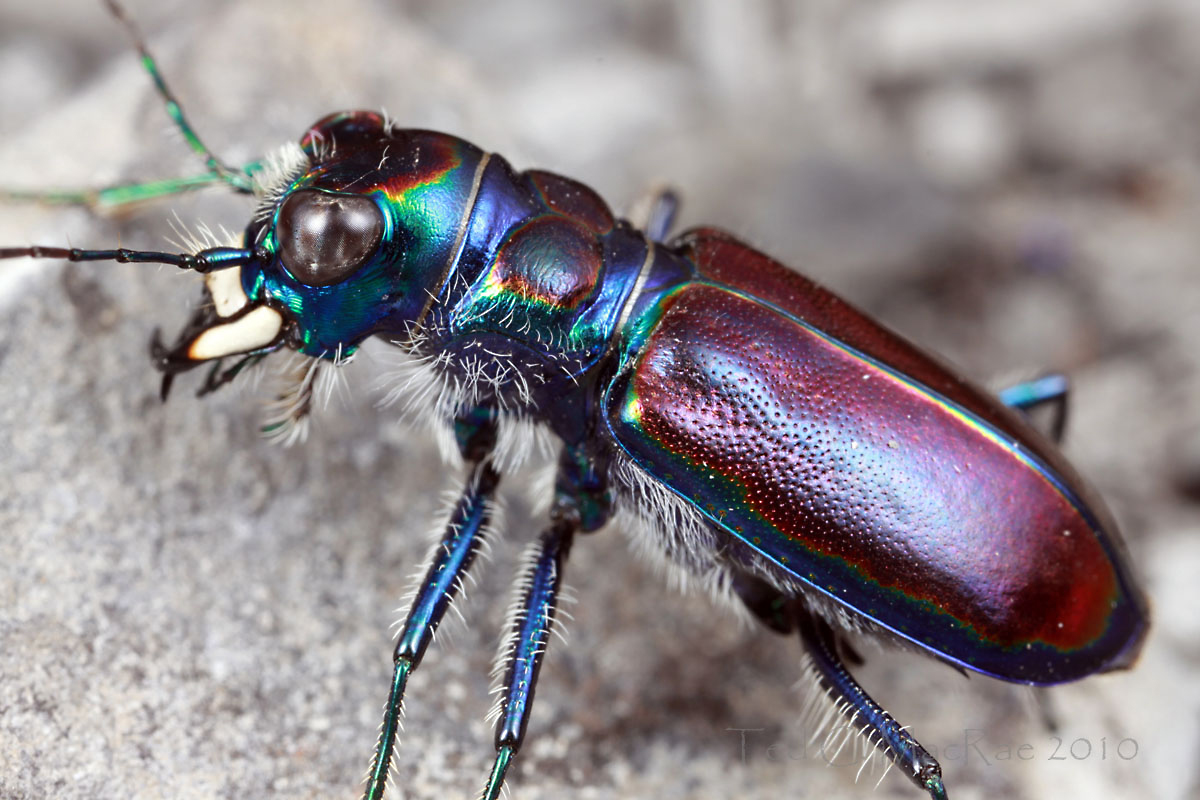
Cicindela pulchra pulchra (beautiful tiger beetle) - Fall River Co., South Dakota.

Five years ago this month, I got my first glimpse of North America’s most beautiful tiger – Cicindela pulchra.  This is not just my opinion – its name, given to it by Father-of-North-American-entomology Thomas Say, literally translates to “beautiful tiger beetle.”  Like Amblycheila cylindriformis, it was a species that I longed to see in the field ever since receiving a single specimen from tiger beetle guru Ron Huber.  That specimen came from the Gypsum Hills of Barber Co. in south-central Kansas – a known “hot spot” for the species.  For years I stared at that spectacular specimen as it sat in my cabinet, and in September 2004 Chris Brown and I finally made our first attempt to see it in the field for ourselves.  Unfortunately, we arrived ahead of the fall rains that seem to trigger emergence of this species, and C. pulchra would not be among the few species that we saw on that trip.  I don’t handle defeat very well, so the very next fall I resolved to try again – this time waiting until early October and also enlisting the assistance of local entomologist “Beetle Bill” Smith for access to better sites than what are available along the roadsides.  That trip was a tremendous success and was detailed in one of my Nature Notes articles (MacRae 2006), but Chris, unfortunately, was unable to join me on that second attempt.  He couldn’t join me last year, either, for my search of the species in the nearby Cimarron Gypsum Hills of northwestern Oklahoma.  Good thing, however, as a turn of the weather left me just cold and wet (although I do remain convinced that the species will eventually be found on those red clay slopes that have so far produced such prizes as Cylindera celeripes, Dromochorus pruinina, and Amblycheila cylindriformis).
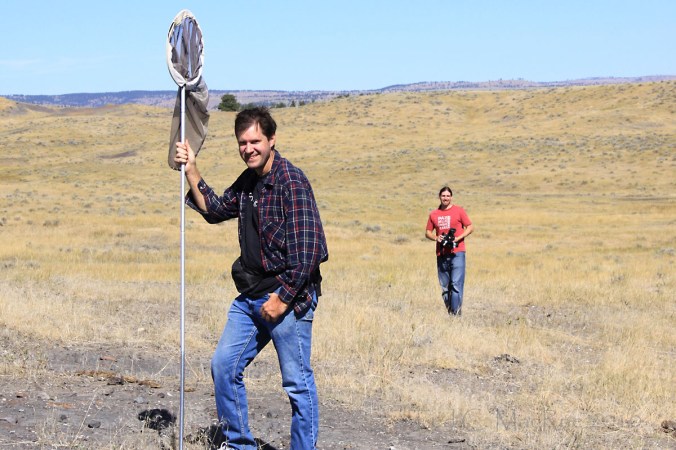
Matt Brust (L) and Chris Brown (R). Matt discovered this site for Cicindela pulchra in 2009.

Fortunately, while I was getting skunked in Oklahoma, Matt Brust was discovering new populations of the species further north in the southwestern corner of South Dakota.  These discoveries were prompted by the initial discovery of the species on Pierre Shale exposures at a single site near the Black Hills (Larsen and Willis 2008).  The soft, dark gray soils of the Pierre Shales are in distinct contrast to red clay exposures with which the species has been typically associated further south, and by scouting a broader area for similar exposures Matt was able to find the species at six new sites during late summer 2009 (Brust 2010).  He found them associated not only with the Pierre Shale but also the Mowry Shale formation (and suspects they may eventually be found on Belle Fourche Shale formations as well).  When I learned of these discoveries, I decided I just had to see them for myself.  I had enjoyed my Fall 2008 trip to northwestern Nebraska and southwestern South Dakota, and the thought of seeing these beetles while spending time in the field with Matt once again seemed the perfect basis for another trip to the area.  It didn’t take much convincing for Chris to agree, thus, C. pulchra became goal #1 of the 2010 Fall Tiger Beetle Trip™.

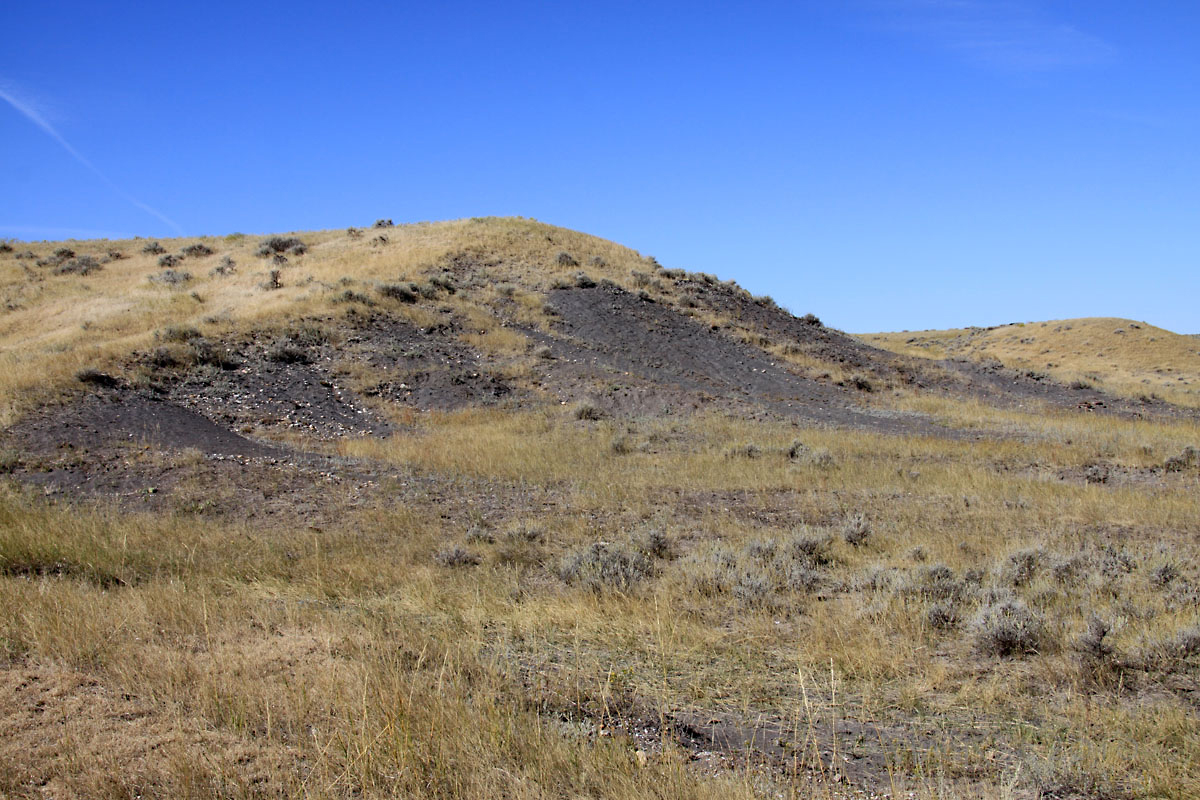
Habitat for Cicindela pulchra in Fall River Co., South Dakota. Adults and larval burrows are found in sparsely vegetated gray shale slopes and open flats beneath.

As we drove to the site that Matt had selected for us to explore, I felt nothing but optimism.  The skies were clear and the temperature was already nearing 70°F.  Matt, however, was hedging his bets – “I hope they’re still out, I’ve never seen them this late!”  Still, I wasn’t worried.  We were two weeks earlier in the season than the 2005 Kansas trip, and the weather was simply spectacular – it just had to be a good tiger beetle day!  My optimism was justified, as within minutes of arriving at the site we saw the first individual.  I collected this one alive as a backup for photographs in the studio should that be the last one we saw, but no such contingencies were necessary – we began seeing individual after individual as we trolled across the barren gray slopes.

Adult male Cicindela pulchra taking in the morning sun.

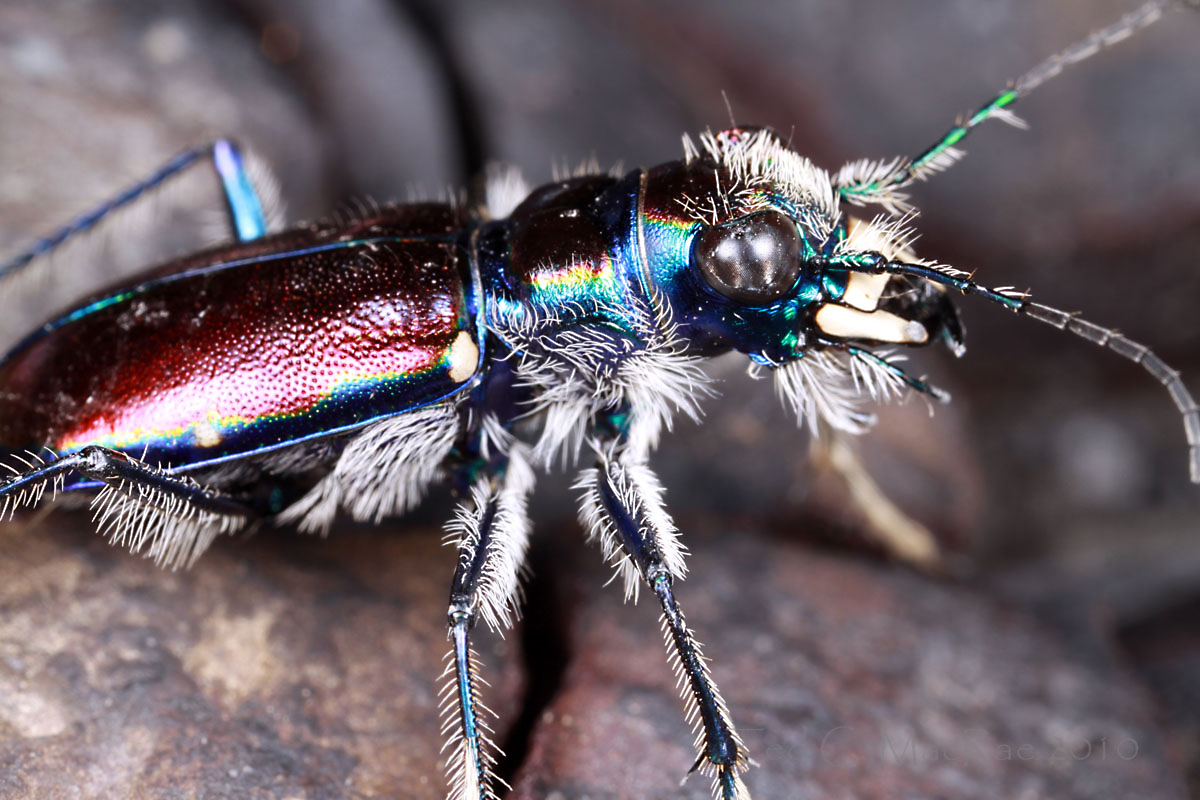
These beetles are simply a marvel to see in the field.  Brilliant dark red with metallic green, blue, and purple borders on the head, thorax, and elytra, this relatively large tiger beetle (certainly among the largest in the genus) can be confused with no other tiger beetle in North America.  Unlike adults of most other species, which exhibit color patterns resembling the texture and hue of the soil substrate on which they occur, C. pulchra adults are obvious and non-cryptic.  It apparently mimics the large, similarly colored velvet ants of the genus Dasymutilla with which they are sympatric – even exhibiting similar behavior when alarmed such as stridulating (creating vibrations by scraping body parts across one another) and giving off defense chemicals (Pearson 1988).  Adults are powerful fliers that can fly long distances when alarmed (Spomer et al. 2008), but in the still relatively cool morning air Chris and I had relatively (emphasis on relatively!) little trouble getting close enough to attempt those coveted field photographs.  This, however, was a double-edged sword – the same cool temperatures that allowed us to get close enough for photographs also caused to the beetles to assume the most non-photogenic poses as they sprawled torpidly on the ground, sometimes hugging it closely in an attempt to conserve heat until incident radiation from the sun warmed them sufficiently to go about the day’s activities.  Once this did happen, we found getting close enough for photographs nearly impossible.  In the 2+ hours that we chased after them, we took many shots but failed to get that “perfect” shot of a brilliant beetle standing tall and alert.

Adult male Cicindela pulchra hugs the ground during the cool morning hours.

Cicindela pulchra is a “spring/fall” species – i.e., sexually immature adults emerge during fall to feed, then return to their burrows to overwinter before emerging again in spring to mate and lay eggs.   Pearson et al. (2006) state the fall period lasts from July to September; however, as I observed in Kansas in 2005 adults can remain active well into October as long as suitable weather prevails.  Larvae hatch shortly after eggs are laid in the spring, but larval burrows can be seen during the entire season since they require 2-3 to complete development.  It was actually the presence of the large larval burrows (see photo below) that alerted Matt to the occurrence of the species at this site.  Several other tiger beetle species are also found here, e.g. C. purpurea (cow path tiger beetle) and C. tranquebarica (oblique-lined tiger beetle); however, these species – and hence their larval burrows – are considerably smaller than C. pulchra.  The only other species of Cicindela in North America that matches C. pulchra in size is C. obsoleta (large grassland tiger beetle), a southwestern species that is not known to range as far north as Nebraska and South Dakota, and the slightly smaller C. formosa (big sand tiger beetle) larval burrow has a distinctive “pitfall trap” with the burrow opening situated horizontally above it (it is also restricted to dry sand rather than clay habitats).  We saw several C. pulchra larval burrows during our visit but no active larvae, and none of my attempts to “fish” them out of their relatively shallow burrows met with success.  I could have tried digging them out, but that is a time-intensive activity, and I decided instead to bring a few live adults back in a terrarium of native soil and see if I could rear the species from egg.
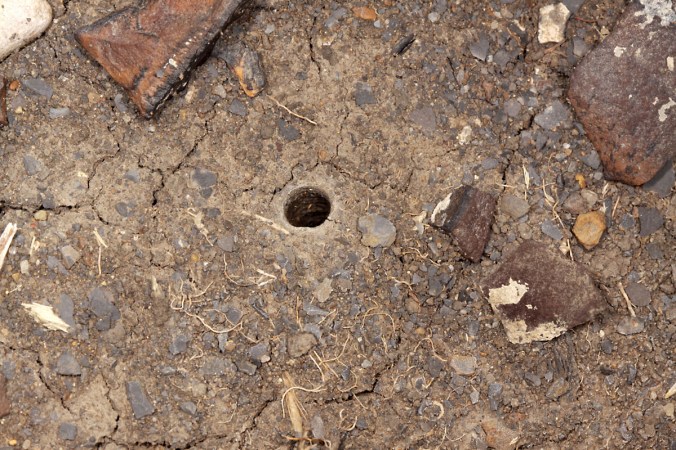
Despite the presence of at least two other tiger beetle species at the site, this can only be that of a 3rd-instar Cicindela pulchra due to its large size.

I had tried persistently during the last hour we were there to get a good field photograph of an active adult beetle standing tall and alert, but the following is the closest I was able to achieve.  Leaving the site without that “perfect” shot was difficult – as Matt put it, we had “pulchra fever”!  Still, there were other tiger beetles – e.g. C. nebraskana (prairie long-lipped tiger beetle) and C. decemnotata (badlands tiger beetle) – that we wanted to find in the limited time we had to explore the region, so I prepared a terrarium for the live adults I was bringing back with me and chalked up our first big success of the trip as we headed towards the shortgrass prairie sitting atop the nearby Nebraska Pine Ridge.

I chased this adult female for some time trying to get a closer photograph, but warming temperatures made this impossible.

In addition to attempting to rear the species,  bringing live adults back with me also gave me more opportunity to photograph them.  In addition to the native crumbly shale soil that I used to fill the terrarium, I placed in it one of the nicely colored, presumably volcanic, rocks that littered the slopes on which the beetles occurred.  The dark color of the rock makes a nice backdrop to really show off the extraordinary colors of this species – especially the bright white labrum and mandibles of the particularly impressive male in the following photograph.  The beetles are all now sound asleep for the winter in a 10°C incubator.  Hopefully, when I move the terrarium back into warm temperatures next spring they will re-emerge, mate, and lay eggs (hmm, photographs of a mating pair would be really nice!).

The all-white labrum and mandibles of this male Cicindela pulchra are displayed nicely in this terrarium photograph.

Photo Details:
Insects: Canon 50D w/ 100mm macro lens (ISO 100, 1/250 sec, f/16), Canon MT-24EX flash w/ Sto-Fen + GFPuffer diffusers.
Habitat: Canon 50D w/ 17-85mm wide-angle lens (ISO 100, 1/160 sec, f/11), natural light.
Matt and Chris: Canon 50D w/ 17-85mm wide-angle lens (ISO 100, 1/250 sec, f/11), natural light.
All photos w/ typical post-processing (levels, minor cropping, unsharp mask).

REFERENCES:

Brust, M. L.  2010. New distribution records for Cicindela pulchra pulchra Say in South Dakota and notes on habitat use and natural history.  Cicindela 42:1–10.

Larsen, K. J. and H. L. Willis.  2008. Range extension into South Dakota for Cicindela pulchra (Coleoptera: Carabidae).  The Coleopterists Bulletin 62(4):480.

MacRae, T. C. 2006. Beetle bits: The “beautiful tiger beetle”. Nature Notes, Journal of the Webster Groves Nature Study Society 78(4):9–12.

Pearson, D. L.  1988. Biology of tiger beetles.  Annual Review of Entomology 33:123–147.

Pearson, D. L., C. B. Knisley and C. J. Kazilek. 2006. A Field Guide to the Tiger Beetles of the United States and Canada. Oxford University Press, New York, 227 pp.

Spomer, S. M., M. L. Brust, D. C. Backlund and S. Weins.  2008. Tiger Beetles of South Dakota & Nebraska.University of Nebraska, Department of Entomology, Lincoln, 60 pp.

Copyright © Ted C. MacRae 2010