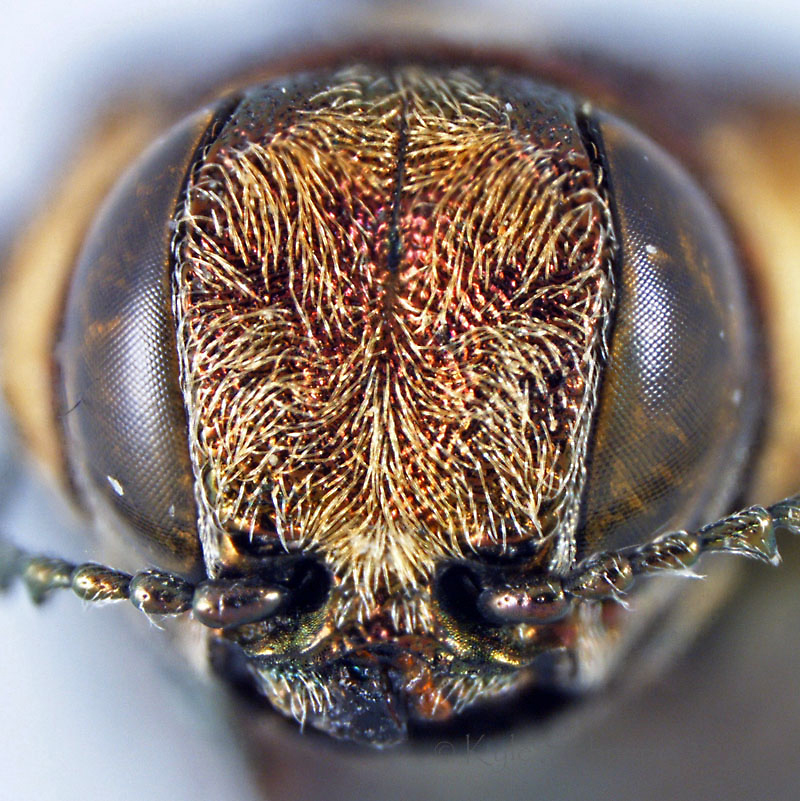
Pseudomethoca simillima – a model for Enoclerus ichneumoneus?

Pseudomethoca simillima (family Mutillidae) - the model?

Enoclerus ichneumoneus (family Cleridae) - the mimic?

Last week, I posted the above photograph of Enoclerus ichneumoneus (orange-banded checkered beetle) and mentioned its possibly mimetic appearance to velvet ants in the family Mutillidae (order Hymenoptera).  By some stroke of serendipity, I encountered a species of Mutillidae the very next day in Missouri’s southeastern lowlands that seems to be a good candidate for one of, if not the, model species that E. ichneumoneus might have evolved to resemble.  Several individuals were encountered as they zigzagged urgently on dry sand deposits along the Mississippi River (where I had hoped, unsuccessfully, to find another locality for our intergrade population of Cicindela scutellaris).  Comparison of the individual in the photo with specimens in my collection (all identified by mutillid expert Kevin Williams, Utah State University) suggests this is Pseudomethoca simillima, and the photo is also a good match with other photographs of the species at BugGuide.  One thing that bothers me with the idea of this being a model for E. ichneumoneus is that I have not seen P. methoca commonly in Missouri (I have only three specimens in my collection), while E. ichneumoneus is one of our most common clerids.  There is another mutillid species in Missouri – Dasymutilla quadriquttata – that also seems to have potential as a model for E. ichneumoneus and that I have encountered much more commonly in the state.  However, D. quadriguttata is somewhat larger than E. ichneumoneus.  At any rate, other than the statement by Mawdsley (1994) that E. ichneumoneus seems to mimic mutillids, I can’t find that any more specific information has been recorded about the possible model(s) for that species.

As a caveat, I shall add that this mutillid was the… most… uncooperative… insect… that I have ever tried to photograph!  They really never stop moving, so you have to track the moving insect through the lens and fire shots when you think you’ve got it centered and focused.  Most of the time you don’t!  Using the Canon 1-5X macro lens for this did not make things any easier.  I tracked this female for quite a while and fired off a number of shots, only to get this one that I thought was fairly decent (and still just missed the focus on the near side of the pronotum).

Speaking of mutillids, I simply must photograph my specimen of Dasymutilla gloriosa (sometimes called the thistledown velvet ant) – you will not believe it!

Photo Details:
Pseudomethoca simillima: Canon MP-E 65 mm 1-5X macro lens on Canon 50D, ISO 100, 1/250 sec, f/14, MT-24EX flash 1/8 power w/ Sto-Fen diffusers. Minimal cropping and post-processing.
Enoclerus ichneumoneus: Canon 100mm macro lens on Canon 50D, ISO 100, 1/250 sec, f/14, MT-24EX flash 1/4 power w/ Sto-Fen diffusers. Minimal cropping and post-processing.

REFERENCE:

Mawdsley, J. R. 1994. Mimicry in Cleridae (Coleoptera).  The Coleopterists Bulletin 48(2):115-125.

Copyright © Ted C. MacRae

Add to FacebookAdd to DiggAdd to Del.icio.usAdd to StumbleuponAdd to RedditAdd to BlinklistAdd to TwitterAdd to TechnoratiAdd to Yahoo BuzzAdd to Newsvine

Email to a friend

Orange-banded checkered beetle

As a student of woodboring beetles for more than a quarter-century now, I’ve had occasion to encounter a goodly number of checkered beetles (family Cleridae) – both in the field and as a result of rearing them from dead wood.  Checkered beetles are not as commonly encountered as other woodboring beetle families such as Buprestidae and Cerambycidae, and they also generally lack the size, diversity, and popularity with coleopterists that those aforementioned beetle families enjoy.  However, despite these shortcomings as a group, checkered beetles are among the most brightly colored and boldly patterned of beetles.  Unlike the beetles with which they often found, checkered beetles are not actually themselves woodboring beetles, but rather predators of such (particularly bark beetles in the weevil subfamily Scolytinae).

This particular species, Enoclerus ichneumoneus, is one of the more conspicuous members of the family in eastern North America.  Although the genus to which it belongs is the largest of the family (32 species in North America north of Mexico), the wide orange band across the middle of the elytra and elongate scutellum make this species distinctive and unlikely to be confused with any other.  I found this individual along the Ozark Trail in southern Missouri on a recently fallen mockernut hickory (Carya alba) – a number of other adult buprestid and cerambycid species were also found on this tree, all of which were mating, searching for mates, or laying eggs within the cracks and fissures on this new-found resource.  In the past I have encountered large numbers of adults of this species on dead willow (Salix caroliniana) from which I later reared an even larger number of a small willow-associated buprestid, Anthaxia viridicornis.  Whether the buprestid larvae served as prey for E. ichneumoneus is difficult to say, but no other potential prey beetle species were reared from the wood.

The bright, distinctive colors exhibited by many checkered beetles might seem to suggest aposematic, or warning, coloration to discourage predation; however, the question of checkered beetle palatability to predators has not been adequately studied (Mawdsley 1994).  The colors and patterns of many species, especially in the genus Enoclerus, seem to mimic species of velvet ants (family Mutillidae) and true ants, but other beetles (e.g. species of Chrysomelidae and Tenebrionidae) and even flies have also been suggested as models.  Still other checkered beetle species seem to be more cryptically than mimetically marked, and there are several tribes whose members seem to be chiefly nocturnal and are thus mostly somber-colored.

Of the 37 genera occurring in North America north of Mexico, I have in my collection representatives of more than 100 species in 23 of those genera.  The majority of that material has been reared from dead wood collected for rearing Buprestidae and Cerambycidae – much of it coming from Texas and Arizona as well as here in Missouri.

Photo Details: Canon 100mm macro lens on Canon 50D, ISO 100, 1/250 sec, f/14, MT-24EX flash 1/4 power w/ Sto-Fen diffusers, photo lightly cropped.

REFERENCE:

Mawdsley, J. R. 1994. Mimicry in Cleridae (Coleoptera).  The Coleopterists Bulletin 48(2):115-125.

Copyright © Ted C. MacRae

Add to FacebookAdd to DiggAdd to Del.icio.usAdd to StumbleuponAdd to RedditAdd to BlinklistAdd to TwitterAdd to TechnoratiAdd to Yahoo BuzzAdd to Newsvine

Email to a friend

Hello World!

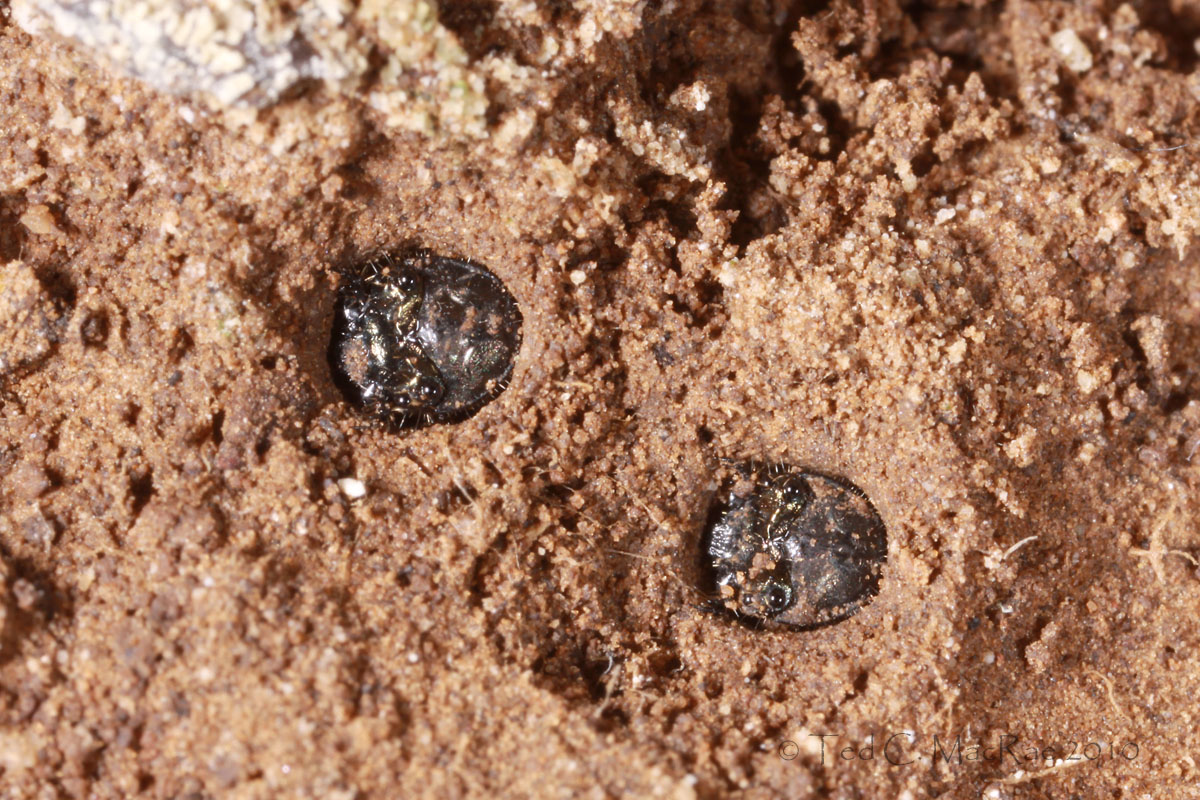
These are two of the Cylindera celeripes (swift tiger beetle) larvae that I’m rearing.  Note: nobody has ever reared this species before!  Nobody has ever even seen its larvae (before now, that is).

These larvae hatched from eggs that were laid by adults I brought back from northwestern Oklahoma last summer.  I placed the adults in a small terrarium of native soil – at first just to see if I could keep them alive, and then to see if I could get them to lay eggs.  The adults lived for about 4 weeks, and a short time later larval burrows started appearing in the soil.  I fed them once or twice a week by placing 2nd instar corn rootworm larvae in the open burrows or dumping Lygus nymphs into the terrarium and letting them catch them naturally.  I wasn’t sure this was working, because as the summer progressed I saw fewer and fewer open burrows.  By October, there were no open burrows, and I feared none had survived.  Nevertheless, I placed the terrarium in a cool (10°C, or 50°F) incubator for the winter and pulled it back out in late March.  Within one week ten larvae had reopened their burrows – I believe all but one of them are 3rd instars, which is the last instar before pupation, and since they have awoken they have fed voraciously on 3rd instar fall armyworm larvae, which I dangle above their burrow.  I love watching them snatch the armyworm from my forceps and drag the hapless prey down into their burrow.  I’ve already preserved examples of the three larval instars and will describe it shortly (although truth be told, the 2nd and 3rd instars are from larvae I found in the field – but that is a post for another day).  However, I’m keeping my fingers crossed for the piece de resistance – successfully rearing the species from egg to adult!

Photo Details: Canon MP-E 65mm 1-5X macro lens on Canon 50D, ISO 100, 1/250 sec, f/13-16, MT-24EX flash 1/8 power w/ Sto-Fen diffusers.

Copyright © Ted C. MacRae 2010

Add to FacebookAdd to DiggAdd to Del.icio.usAdd to StumbleuponAdd to RedditAdd to BlinklistAdd to TwitterAdd to TechnoratiAdd to Yahoo BuzzAdd to Newsvine

Email to a friend

Two ladies from Ontario

What do bugs and snakes/lizards/frogs/turtles have in common? Yes, they’re both ectothermic, but that is the scientist’s answer. Most folks would say they’re just creepy – girls especially! Well, two ladies from Ontario are proving the latter notion wrong by hosting three blog carnivals that cater to these cold-blooded critters: House of Herps, An Inordinate Fondness, and The Moth and Me.

Most people approach their first blog carnival hosting gig with some trepidation, but the Geek in Question at Fall to Climb has embraced the challenge by volunteering to host two blog carnivals simultaneously.  What chutzpah!  Clearly, she was up to the task – for issue #3 of An Inordinate Fondness, she introduces us to technical terms such as OMGSHINY and Coleappetite™ in Discovery Zone, with thirteen stories of beetley discovery. She then shows off her “slammer” talent in House of Herps #5: Slime Poetry – deftly pairing poems with prose.  I would love to see her do this live!

Seabrooke Leckie’s passion for moths is obvious – she is the founder of The Moth and Me and co-author of the soon-to-be-published Peterson Field Guide to Moths of Northeastern North America. Issue #10 of TMaM, Down to the letter, comes home to mama at the Marvelous in Nature – its 24 contributions almost enough to complete the alphabet! Recite your ABCs in lepidopterous fashion with this fine array of contributions.

Copyright © Ted C. MacRae 2010

Add to FacebookAdd to DiggAdd to Del.icio.usAdd to StumbleuponAdd to RedditAdd to BlinklistAdd to TwitterAdd to TechnoratiAdd to Yahoo BuzzAdd to Newsvine

Email to a friend

Josef Knull was wrong!

A few weeks ago I received an email from Kyle Schnepp, an entomology student at Purdue University.  Kyle has taken on the rather ambitious project of developing an illustrated key to the Buprestidae of eastern North America, for which he has been spending the past year acquiring material for photographs.

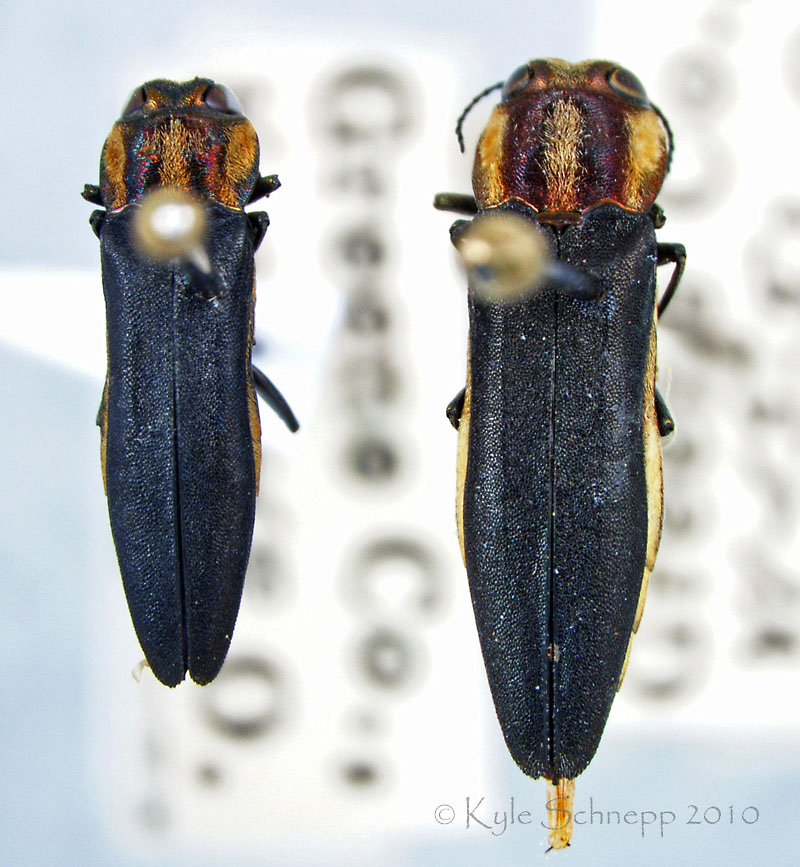
During his examination of specimens in the Field Museum of Natural History, Kyle came across two examples of an extraordinarily rare species of Buprestidae, Agrilus audax Horn.  Although described more than 100 years ago from specimens collected in Texas (Horn 1891), few records have been published in the years since.  Chamberlin (1926) reported the species also from Arizona and Illinois but without further details, causing Fisher (1928), in his revision of the genus (woefully out-of-date now, but still the only comprehensive resource for identifying the North American species), to regard at least the Illinois record as probably erroneous (common for many of Chamberlin’s records).  The first undisputed report of this species from outside of Texas was by Josef Knull (1934), who reported the species emerging from living, wind-thrown branches of slippery elm (Ulmus rubra) collected in western Missouri.  More than half a century would pass before the species would turn up again – first in Oklahoma (Nelson and MacRae 1990) and twice again in Missouri through the efforts of Gayle Nelson and myself (MacRae 1991, MacRae and Nelson 2003). All but one of these specimens were beaten from bur oak (Quercus macrocarpa).
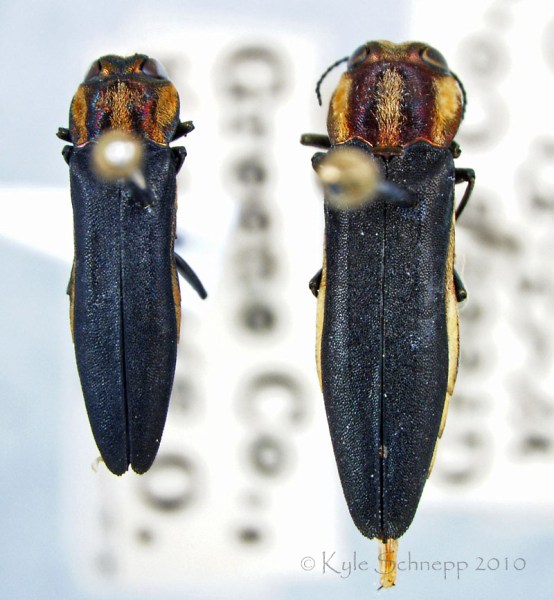
Agrilus audax Horn, 1891 – male (L) and female (R)

While the rarity of this species makes Kyle’s find significant enough, there is an even more significant – and interesting – aspect to his discovery.  Both of the specimens, one male and one female, were collected in Ohio, which is a rather extraordinary geographical range extension. Additionally, the specimens were collected by none other than Josef Knull.  To students of North American Buprestidae, the name Josef Knull is as familiar as Carl Linnaeus, Charles Darwin, or Thomas Say. A Professor of Entomology at The Ohio State University from 1934-1962, Knull published nearly 200 papers on the taxonomy, biology, and distribution of these and other families of beetles (Davidson and Bellamy 2002).  Although he lacked a Ph.D., he was an indefatigable collector and describer of beetles – to his fellow colleagues and students, he was known as “Professor” or “Doctor” as a show of respect.  He spent many of his summers traveling through the southwestern U.S. with his wife Dorothy Knull (herself an entomologist specializing in leafhoppers), and by the time he died in 1975 he had described 233 species and subspecies of beetles (as well as one species of Fulgoridae).  He was, and is, an icon among North American beetle collectors.

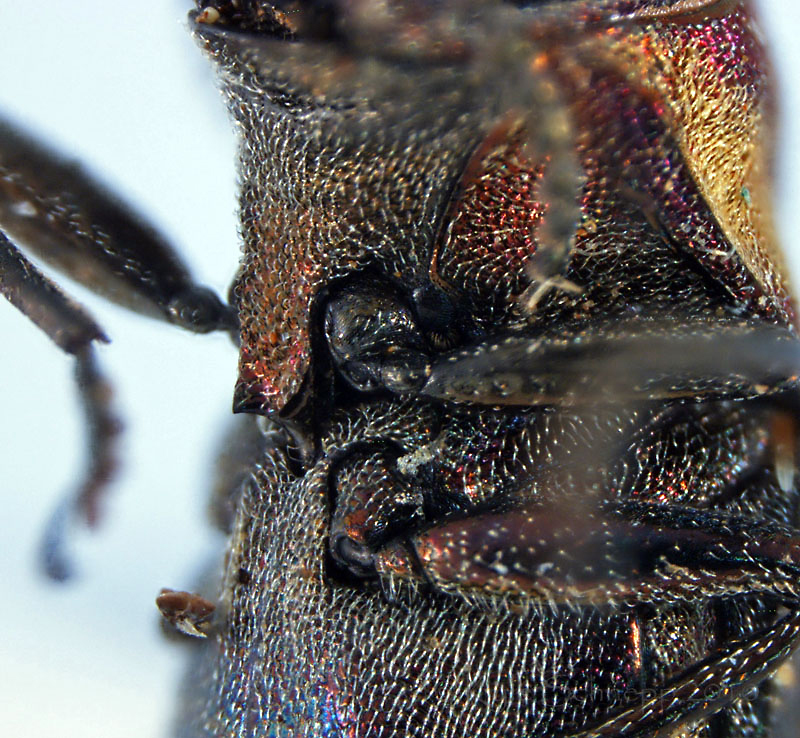
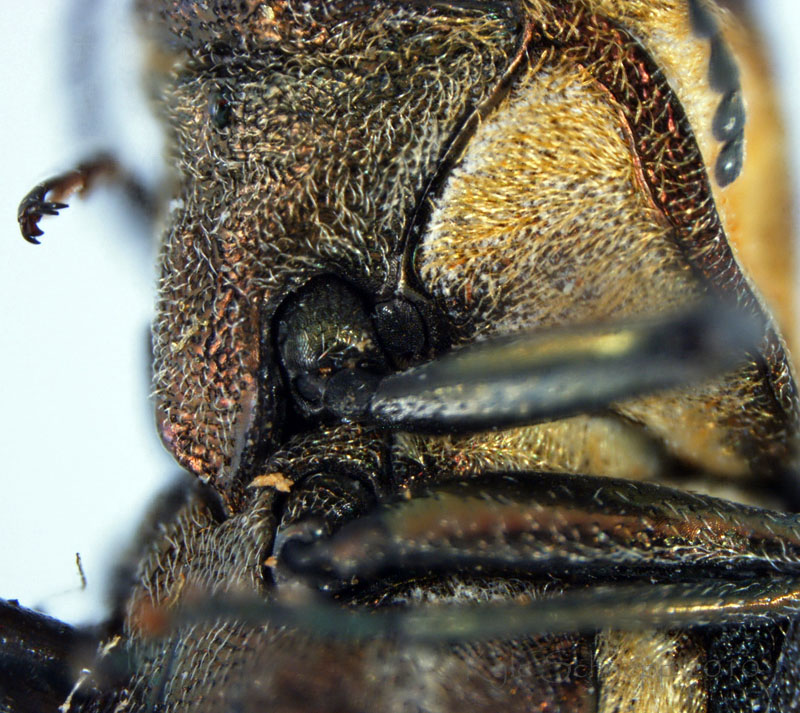
Curiously, Knull did not recognize these specimens for what they were, instead identifying them as the similar and much more widespread species, Agrilus vittaticollis.  Curious, because Knull collected these specimens in 1949 and 1953 – after first reporting the species in Missouri.  Agrilus audax belongs to a small group of species that look very similar to each other by way of their large size and striking coloration – black elytra and a red pronotum with a densely pubescent median channel.  Agrilus vittaticollis is the most common of these (though still not as commonly encountered as many other species in the genus), and the much less common A. benjamini also belongs to this group.  Kyle had sent me the above photo in an attempt to confirm their identity, but true confirmation would require examination of characters of the face and ventral surface.  Kyle quickly took additional photographs of these characters and sent them to me – they are shown below and leave no doubt as to the identity of these specimens.

Agrilus vittaticollis prosternum – note sides bent downward to sharp points.

Agrilus audax prosternum – sides normal, not bent downward to sharp points.

Agrilus audax frons is moderately depressed and uniformly pubescent (deeply depressed & pubescent only on lower half in A. benjamini).

Agrilus audax male sternite – the deep, smooth, elongate depression is diagnostic (A. benjamini males have only an obsolete depression).


Finding a new state record buprestid in Ohio – the land of Knull – based on specimens collected by Knull himself is nothing short of remarkable (almost like proving E. O. Wilson wrong¹). The occurrence of A. audax in Ohio also lends some credibility to Chamberlin’s record of the species in Illinois. Kyle is graciously allowing me to include these new records in a forthcoming publication; my thanks to him for this and also for allowing me to use his fine photographs in this post.  Kyle did also mention that these were the only misidentified specimens he saw in the Knull collection at the Field Museum of Natural History. For those interested in acquiring reprints of Knull’s papers, pdfs of the 50 papers he published in the Ohio Journal of Science may be found at this link.

¹ The title of this post is a play on the title of a recent post by Alex Wild at Myrmecos. No true disrespect is intended to Josef Knull, who’s legacy (with the possible exception of his frustratingly vague label data) is rightfully held in high regard by all who knew him or know of his work.

REFERENCES:

Chamberlin, W. J. 1926. The Buprestidae of North America, exclusive of Mexico, a catalogue including synonymy, bibliography, distribution, type locality and hosts of each species. W. J. Chamberlin, Corvallis.

Davidson, J. M., and C. L. Bellamy.  2002. The entomological contributions of Josef Nissley Knull (1891-1975).  Zootaxa 37:1-24.

Horn, G. H. 1891. The species of Agrilus of Boreal America. Transactions of the American Entomological Society 18:277-366.

Knull, J. N. 1934. Notes on Coleoptera, No. 4. Entomological News 45(10):207-212.

MacRae, T. C. 1991. The Buprestidae (Coleoptera) of Missouri. Insecta Mundi 5(2):101–126.

MacRae, T. C., and G. H. Nelson. 2003. Distributional and biological notes on Buprestidae (Coleoptera) in North and Central America and the West Indies, with validation of one species. The Coleopterists Bulletin 57(1):57–70.

Nelson, G. H., and T. C. MacRae. 1990. Additional notes on the biology and distribution of Buprestidae (Coleoptera) in North America, III. The Coleopterists Bulletin 44(3):349–354.

Copyright © Ted C. MacRae 2010

Add to FacebookAdd to DiggAdd to Del.icio.usAdd to StumbleuponAdd to RedditAdd to BlinklistAdd to TwitterAdd to TechnoratiAdd to Yahoo BuzzAdd to Newsvine

Email to a friend

Mylabris oculatus in South Africa

Mylabris oculata, the CMR bean beetle, is a large, conspicuously-colored beetle in the family Meloidae (blister beetles) that I saw quite commonly during my stay in South Africa.  “CMR” refers to the Cape Mounted Rifle Corps, a police force in the old Cape Colony whose uniforms sported black and yellow bands that resemble the colors of this beetle.

Blister beetles as a whole are, of course, well known for their chemical defenses, primarily cantharidin (the active ingredient in ‘Spanish Fly’, an extract of a European species of blister beetle).  This terpenoid compound is a painful irritant, especially when coming into contact with mucous-lined membranes such as those of the gatrointestinal and urinary tracts.  Blister beetles emit body fluids containing cantharidin from joints on the legs when disturbed, giving any would-be predators a foul-tasting appetizer. As we have so often seen, insects containing such effective defenses are often aposematically colored to advertise the fact, allowing them to brazenly lumber about fully exposed during the day with little to fear.  If there ever was an insect that screamed aposematic, it is M. oculatus with its boldy contrasting black and yellow elytra and hot-orange antennae.

These beetles, however, are more than just a frustration for hungry birds, but also a serious pest of numerous ornamental, fruit and vegetable crops (Picker et al. 2002).  Large numbers of adults congregate on plants and preferentially feed on the flowers.  In the more natural settings where I was encountering these beetles, they were most often seen on flowers of Acacia spp. or (as in the above photo) Dichrostachys cinerea in the family Fabaceae.  To be honest, they became quite a source of frustration for me as well – not because of their distastefulness or pestiferous habits, but because of their role as the model in a mimicry complex.  It was the mimic that I was after, and since mimics tend to be much less common than their models, I had to look at a lot of M. oculatus to find the few specimens of the species I was after. 

Pop quiz: Can anybody name the mimic?

Back to their chemical defenses – I’ve often wondered just how poisonous blister beetles really are, especially to humans.  Here in the U.S., their main importance is as contaminants in alfalfa hay fed to cattle and horses.  Deaths from severely contaminated forage do occur, but this is dependent upon the cantharidin content of the species and their abundance within the hay.  The highest reported cantharidin content for a blister beetle is 5.4% dry weight in Epicauta vittata.  Calculations based on this figure and the lethal dose for a 1000-lb horse indicate that around 100 such beetles would need to be eaten to receive a fatal dose.  This seems to make the claim that a single beetle can kill a human a little far-fetched.  However, M. oculatus are big beetles – more than a full inch in length and bulky.  In this regard, I found an interesting tidbit at the TrekNature website.  Clarke Scholtz is an entomologist at the University of Pretoria, and when asked, “Is it true that their poison can kill a human being?”, he responded:

Yes; they are poisonous enough to kill people – especially a big beetle… The poison is very toxic and actually causes collapsed tissue. It would also depend on the weight of the person, as with any other toxin. The poison of a CMR beetle, that is dried and powdered, is sufficient to kill a 70kg human.

REFERENCE:

Picker, M., C. Griffiths and A. Weaving. 2002. Field Guide to Insects of South Africa. Struik Publishers, Cape Town, 444 pp.

Copyright © Ted C. MacRae 2010

Add to FacebookAdd to DiggAdd to Del.icio.usAdd to StumbleuponAdd to RedditAdd to BlinklistAdd to TwitterAdd to TechnoratiAdd to Yahoo BuzzAdd to Newsvine

Email to a friend

Winter Botany Quiz #6 – answers and a checklist

I thought yesterday’s Winter Botany Quiz #6 would be a fairly difficult, and given the apparent difficulty of my previous quizes (Pismire Puzzle and Tuesday Teaser) I thought I’d give readers a break this week and narrow down the location to the Lake Tahoe area. Despite publishing in the dead of night, it took only 31 minutes for Peter Yeeles to swoop down and correctly name the family, genus, species, and function for the structure pictured. His only lapsus regarded the terminology used for the name of the structure itself, leaving the door open for James Trager to snag some scrap points. The plant is, of course, Cercocarpus ledifolius (curl-leaf mountain mahogany) in the family Rosaceae, and the structures pictured above and in the previous post are the stigmas of the flowers persisting as wind-assisted dispersal structures for the fruit. “Cercocarpus” is, in fact, derived from the Greek words for “tailed” and “fruit”, whose numerous erect hairs give the plant in a silvery sheen late in the growing season.

Why was I interested in this plant? It was one of the few tree species occurring in the Lake Tahoe Basin that I wasn’t able to find for last year’s 3-part series, Trees of Lake Tahoe (including The Pines, The “Other” Conifers, and The Deciduous Trees).  Widespread in the mountainous west (and barely qualifying as a tree), its occurrence in the Tahoe Basin is more sporadic.  Better stands are found outside the basin proper on the dry eastern flank of the Sierra Nevada (Graf 1999), and indeed these plants were photographed at ~6,500 feet on the eastern slopes of Mt. Rose.

My real interest in Cercocarpus, however, is as a favored host plant for species of jewel beetles (family Buprestidae).  About two dozen species of these beetles have been associated with Cercocarpus spp. in North America, nine of which have been confirmed as breeding within dead branches of these plants and five having been associated with no other plant.  I’ve collected a number of these species myself, particularly in the San Gabriel and Santa Rosa Mountains of southern California and the Chisos Moutains of Big Bend National Park in Texas, including Polycesta cazieri, Chrysobothris piuta, and paratype specimens of Acmaeodera rubrocuprea. I thought it might be of interest to any readers who might collect these insects to present a checklist of Buprestidae associated with Cercocarpus in North America (see appendix below).

REFERENCE:

Graf, M. 1999. Plants of the Tahoe Basin. Flowering Plants, Trees, and Ferns. A Photographic Guide. California Native Plant Society Press, Berkeley, 308 pp.

Checklist of North American Buprestidae associated with Cercocarpus

(Bold indicates species that have been reared from Cercocarpus.  An asterisk indicates species that have been associated exclusively with Cercocarpus).
Acmaeodera (s. str.) angelica Fall
Acmaeodera (s. str.) connexa LeConte
Acmaeodera (s. str.) dolorosa dolorosa Fall
Acmaeodera (s. str.) idahoensis Barr
Acmaeodera (s. str.) mariposa mariposa Horn
Acmaeodera (s. str.) mariposa dohrni Horn
Acmaeodera (s. str.) nelsoni Barr
Acmaeodera (s. str.) nexa Fall
Acmaeodera (s. str.) plagiaticauda Horn
Acmaeodera (s. str.) pubiventris lanata Horn
Acmaeodera (s. str.) rubrocuprea Westcott & Nelson*
Acmaeodera (s. str.) vandykei Fall
Acmaeodera (s. str.) variegata LeConte
Acmaeodera (Squamodera) vanduzeei (Van Dyke)
Anthaxia (Haplanthaxia) caseyi sublaevis Van Dyke
Anthaxia (Melanthaxia) porella Barr*
Anthaxia (Melanthaxia) simiola Casey*
Chrysobothris bisinuata Chamberlin*
Chrysobothris mali Horn
Chrysobothris piuta Wickham
Chrysobothris purpureovittata purpureovittata Horn
Chrysobothris purpureovittata cercocarpi Westcott & Nelson*
Dicerca (s. str.) hornii hornii Crotch
Polycesta (Tularensia) californica LeConte
Polycesta (Tularensia) cazieri Barr

Copyright © Ted C. MacRae 2010

Add to FacebookAdd to DiggAdd to Del.icio.usAdd to StumbleuponAdd to RedditAdd to BlinklistAdd to TwitterAdd to TechnoratiAdd to Yahoo BuzzAdd to Newsvine

Email to a friend

New Bug Blogs of note

I try to keep my blogroll useful and relevant – by that I mean that each blog I list has, in a sense, “earned its spot” by offering engaging writing and/or quality photographs on subjects that interest me, and if they go silent or become, well… boring then I remove them. In the past two years, I’ve pretty well explored most of the established blogs dealing with insects and natural history and know what I like, so additions these days tend to be primarily startup blogs. Recommending startups is risky – blogs come and go all the time, and it’s difficult to know if the energy and passion apparent in the first few posts of a blog indicates sustainable creativity or just an ephemeral burst. With that caveat, I’d like to highlight three new blogs that have not only captured my interest, but also seem to have what it takes to sustain that interest for a long time to come.

Chris Grinter is an entomologist at the California Academy of Sciences in San Francisco. He has an interest in microlepidopterans, and his 6-week old blog, called The Skeptical Moth, has featured some rather stunning photographs of these tiny, yet extraordinarly beautiful insects. Moreover, he actually knows something about them – how refreshing it is to see scientific names attached to each photograph and associated discussion that doesn’t sound like a Wikipedia excerpt. As his blog title suggests, he also has a passion for encouraging science education and critical thinking, adding to the general feeling of erudition. There are lots of bug blogs out there, but only a few really good ones – this has the makings of a really good bug blog!

Peter Yeeles has only been blogging since the middle of March, but he is well-known among entomology-blog-circles by his frequent and articulate participation in the comments sections.  Happily, Peter has finally taken the bait and started his own blog, called ptygmatics.  His contributions thus far have been more than engaging and have featured some wonderful photographs of Australian insects (the stalk-eyed flies being far and away my favorite).  Peter has described himself as a “work in progress” entomologist, but I think we are about to witness the emergence of a more substantial entomologist than he is willing to admit. If nothing else, you must see his stalk eyed flies video link.

Heath Blackmon is the newest blogger featured here, and his blog, Coleopterists Corner, in fact has only three posts so far.  Nevertheless, I was impressed by his willingness to jump right into Coleoptera deep phylogeny in his inaugural post, in which he reviewed a recent paper on the subject by Friedrich et al. (2009).  Yea, another beetle lover!  An amateur naturalist for many years, Heath has decided he wants to become a professional coleopterist and is beginning graduate studies this fall (sounds like another back-to-schooler that has won our hearts in recent months).  His first post was followed by a post on how to make a $69 malaise trap.  So he’s also a collector – that’s even better.  The clincher, however, was the photograph he posted in his sidebar of him collecting tiger beetles in Florida – well, this one just has to be a winner!

Copyright © Ted C. MacRae

Add to FacebookAdd to DiggAdd to Del.icio.usAdd to StumbleuponAdd to RedditAdd to BlinklistAdd to TwitterAdd to TechnoratiAdd to Yahoo BuzzAdd to Newsvine

Email to a friend