Halloween ID challenge answer – Argiope trifasciata

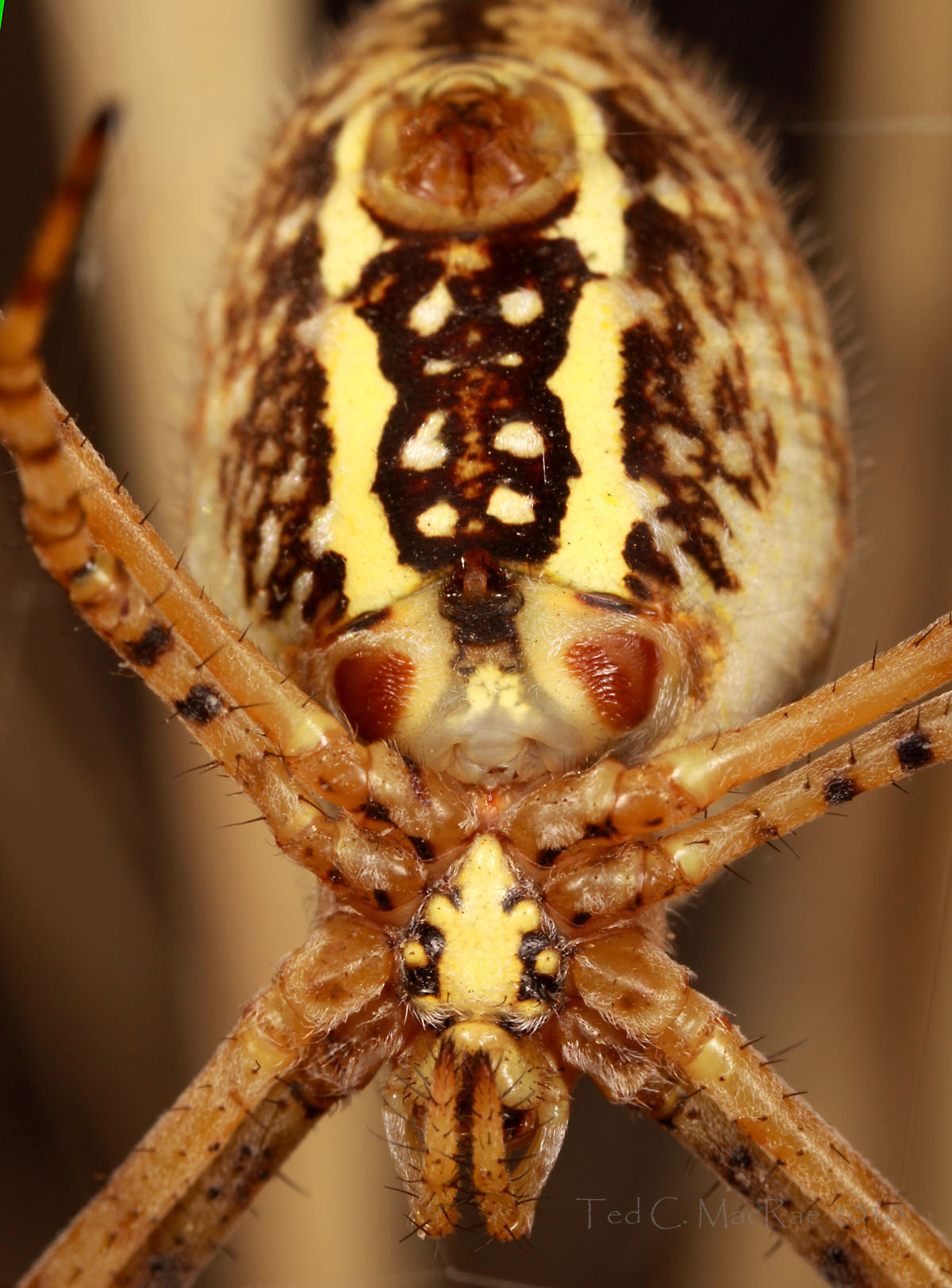
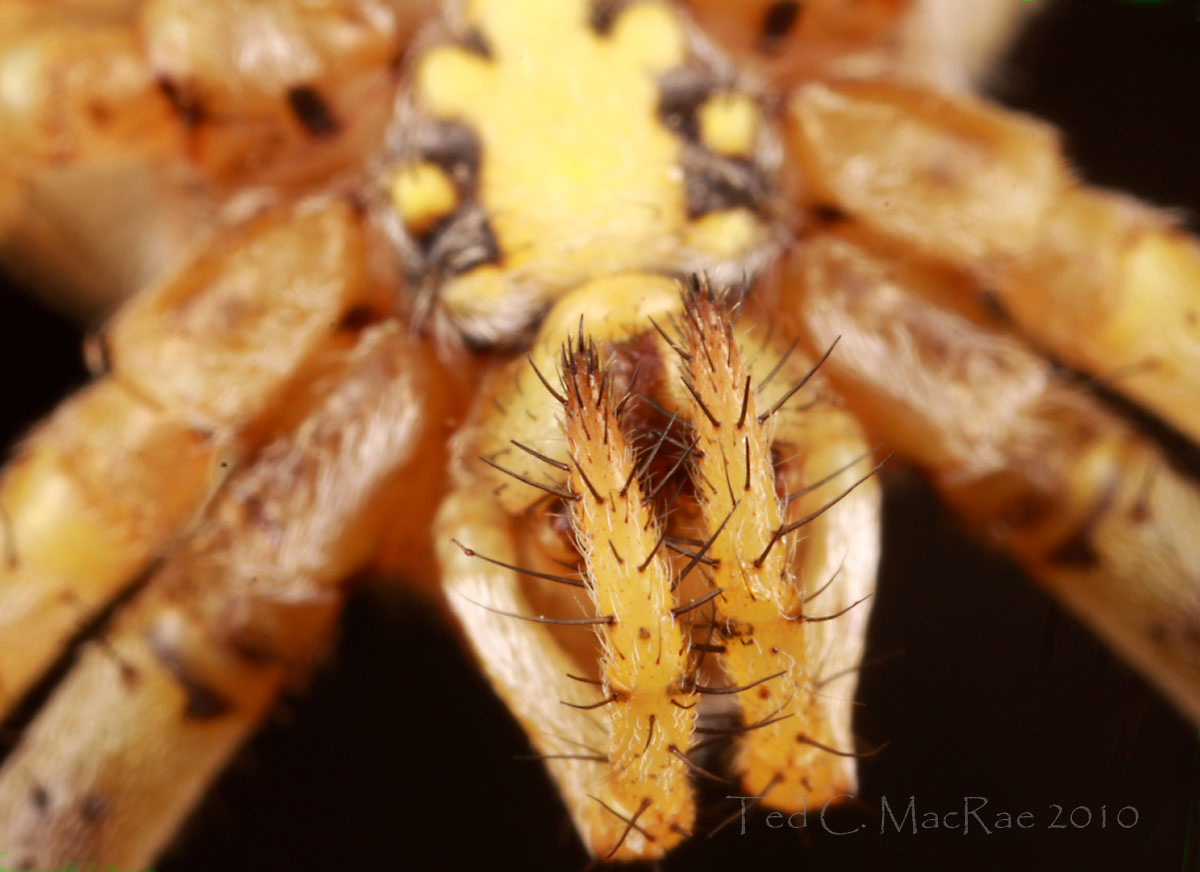
Here is another photo of the spider in the previous post with a closer view of its spiny pedipalps (mouth feeler thingys).  Troy Bartlett and BitB’s own James Trager got it right – the spider is, indeed, Argiope trifasciata, the banded garden spider (a.k.a. banded garden orbweaver, banded argiope, whitebacked garden spider, etc.).   I figured the genus would be easy, but the species might be a little tricky – at least for those in North America who might be tempted to conclude it was the larger A. aurantia (black and yellow garden spider, etc.).  The broken banding on the femora and generally lighter ventral coloration are usually enough to distinguish A. trifasciata from its more conspicuous congener.  Argiope trifasciata is also distinguished as one of the few truly cosmopolitan arthropod species, occurring naturally on all continents except Antarctica.

Both Troy and Dave Walter mentioned the conspicuous stabilimentum (heavy zig-zagging pattern) that Argiope spiders are perhaps best known for and that they often add to the center of their otherwise cryptic webs. Originally thought to possess a web-stabilizing function (hence the name), a variety of alternative explanations have since been proposed.  These include camouflage (to break up the body outline of the spider and make it less visible to predators), web protection (to make the web more visible to birds and prevent them from flying into and damaging it), prey luring (since it reflects ultraviolet light efficiently), thermal protection (by providing a shield against the sun), and a repository for excess silk.   An alternative hypothesis that I had not heard of but mentioned by Dave is that they serve as sponges for accumulating water for the spider to drink.  Webs with stabilimenta are more common and larger in exposed versus sheltered locations, and a recent study by Blackledge and Wenzel (1999) using A. aurantia found that webs with a stabilimentum suffered significantly less damage from birds (45% on average) than those without, but that they also caught fewer insects (34% on average).  The presence or absence of a stabilimentum, however, was not a significant factor in predation of the spiders by birds.  This implies not only a web protective function for the stabilimentum, but that there is an evolutionary trade-off between web protection and foraging success.  These authors concluded that variation in stabilimenta might be accounted for by a cost—benefit trade-off and that the decision by the spider to include a stabilimentum when building a web may be influenced by external factors such as prey density and web exposure.

Specific to A. trifasciata, a less well known but equally interesting aspect of its behavior is the use of web orientation for thermoregulation.   Tolbert (1979), in a study conducted in the southeastern US, found that web orientation was non-random during the hottest part of the summer, when spiders largely occupied east-west oriented webs with their silver/white dorsal surfaces facing south and their dark ventral surfaces facing north, and during October when the situation was reversed.  Orientation of the white/silver dorsal surface towards the sun presumably is done to help lower body temperatures, while orienting the ventral surface of the spider, which changes from silver to black as the spider reaches maturity, would maximize solar radiation for heat gain.  In contrast, Ramirez et al. (2003) found the species in coastal southern California never oriented their webs in a non-random fashion – rather, they always oriented them along an east-to-west axis with the mostly dark ventral surface of their abdomens facing south.  They suggested that dealing with a high heat load is not a significant problem in the predominantly cool environment of coastal southern California and that staying warm is the greater challenge for this mostly fall active species.

I’ll give 6 points to Troy for agreeing with me on everything, 4 to Dave for playing Devil’s advocate with the species and his unique alternative stabilimentum hypothesis, and 2 points to James for agreeing with Troy’s species ID. 🙂

Photo Details: Canon 50D w/ MP-E 65mm 1-5X macro lens (ISO 100, 1/250 sec, f/14), Canon MT-24EX flash w/ Sto-Fen + GFPuffer diffusers. Typical post-processing (levels, minor cropping, unsharp mask).

REFERENCES:

Blackledge, T. A. and J. W. Wenzel. 1999. Do stabilimenta in orb webs attract prey or defend spiders? Behavioral Ecology 10(4):372–376.

Ramirez, M. G., E. A. Wall and M. Medina. 2003. Web orientation of the banded garden spider Argiope trifasciata (Araneae, Araneidae) in a California coastal population. The Journal of Arachnology 31:405–411.

Tolbert, W. W.  1979. Thermal stress of the orb-weaving spider Argiope trifasciata (Araneae).  Oikos 32(3):386–392.

Copyright © Ted C. MacRae 2010

Halloween ID challenge

Class and order are gimmes – can you name the family, genus, and species? Common name? Something significant about its biology or behavior?

Photographed 25.ix.2010 in shortgrass prairie habitat atop the Pine Ridge in Sioux Co., Nebraska.

Photo Details: Canon 50D w/ MP-E 65mm 1-5X macro lens (ISO 100, 1/250 sec, f/11), Canon MT-24EX flash w/ Sto-Fen + GFPuffer diffusers. Typical post-processing (levels, minor cropping, unsharp mask).

Copyright © Ted C. MacRae 2010

Flash solutions for the beautiful tiger beetle

Canon MP-E 65mm f/2.8 1-5X macro lens (f/13), Canon MT-24EX flash w/ concave diffuser.

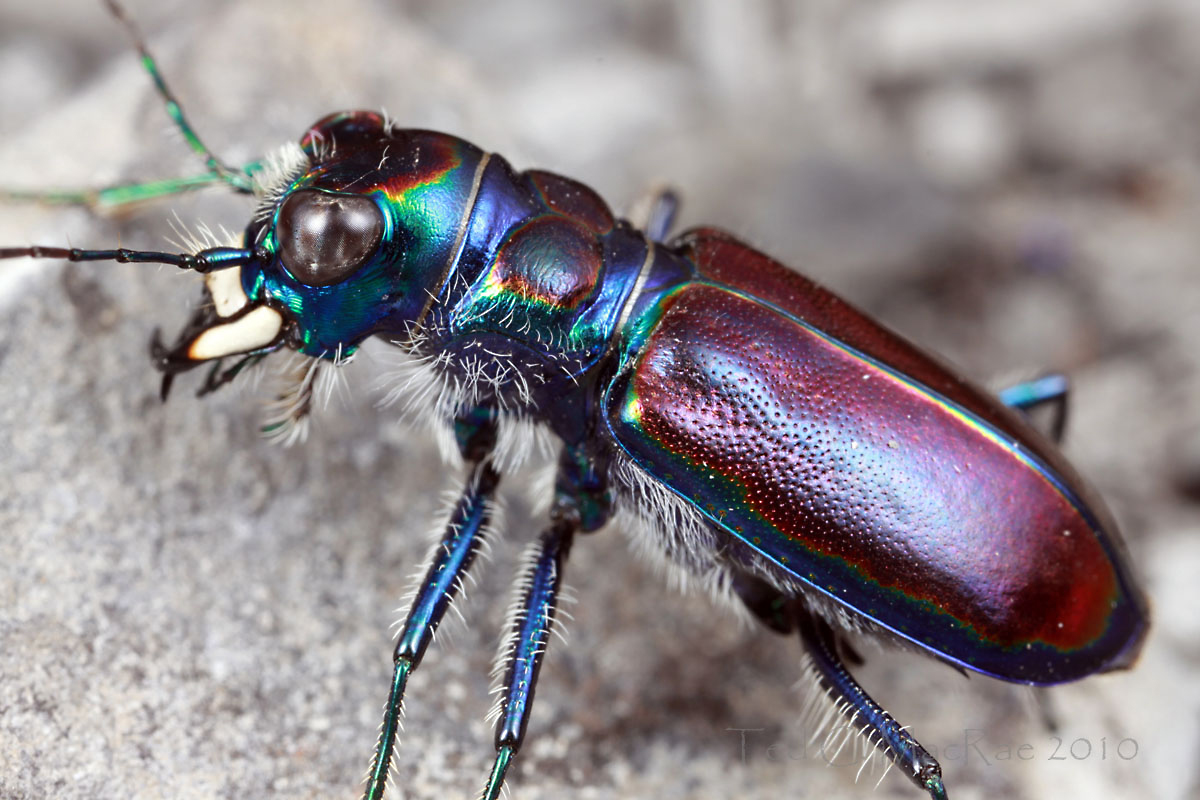
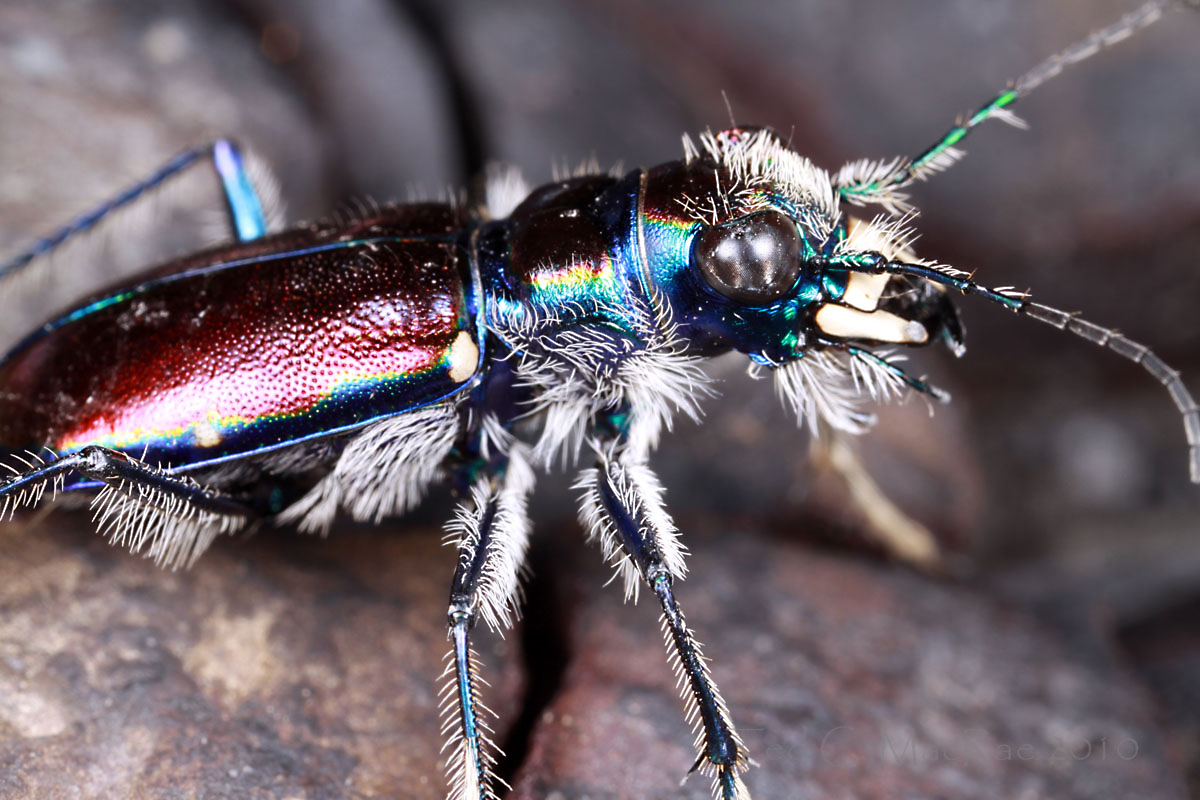
Recently I’ve been trying some different lighting and flash diffusion techniques with the Cicindela pulchra adults I brought back from South Dakota (see previous post).  While the beetles themselves are certainly among the most spectacular tiger beetles I’ve ever seen, I’ve been less than impressed with the photographs that I’ve managed to take of them.  Two factors have been largely responsible for this: 1) the smooth, shiny integument of the beetle reflecting the flash to create strong specular highlights, and 2) the colors, though brilliant, are also dark and difficult to bring out without further exacerbating the specular highlights.  Normally, the Sto-Fen+Puffer diffuser combination that I use does a pretty good job at diffusing the flash, but it just can’t handle these beetles.  To deal with this problem, I finally got around to trying out the do-it-yourself concave diffuser that Kurt at Up Close with Nature has been using with stunning results (similar to the tracing paper diffuser used so famously by Alex Wild at Myrmecos).  Photo 1 above and 2-3 below were taken with this diffuser on my Canon MP-E 65mm f/2.8 1-5X Macro Lens, and I’m rather pleased with these initial attempts.  I do need to figure out a better way to attach the diffuser to my Canon MT-24EX Macro Twin Lite Flash.

Canon MP-E 65mm f/2.8 1-5X macro lens (f/13), Canon MT-24EX flash w/ concave diffuser.

Canon MP-E 65mm f/2.8 1-5X macro lens (f/13), Canon MT-24EX flash w/ concave diffuser.

I’d have to say the lighting with this diffuser represents a considerable improvement over the Sto-Fen+Puffer diffusers using the same lens.  Compare especially Photo 3 above and 4 below – both taken with the MP-E 65mm lens at 1:1 and f/13 – Photo 3 was taken using the concave diffuser, while Photo 4 used the Sto-Fen+Puffer diffusers.

Canon MP-E 65mm f/2.8 1-5X macro lens (f/13), Canon MT-24EX flash w/ Sto-Fen+Puffer diffusers.

The problem with the concave diffuser is that it won’t work so well on my Canon EF 100mm f/2.8 Macro USM Lens due to its longer working distance.  I actually use this lens in the field as often as the MP-E 65mm lens, especially for the tiger beetles on which I focus (heh!) – not only do they rarely require more than 1:1 magnification, but they also rarely allow the ultra-close approach needed to use the 65mm lens.  The only solution is to find some way to get the flash heads closer to the subject to increase the apparent size of the light source, but so far I haven’t figured out a satisfactory way to do this.  Some photographers use the stalwart Canon Speedlite 580EX II Flash, equipped either with a do-it-yourself snoot diffuser or mounted on a bracket extender with a small softbox.  However, I am not a photographer, but rather an entomologist with a camera – I need to carry with me a net, vials, and in some cases a beating sheet and hatchet.  Both of the previously mentioned approaches for diffusing 100mm shots add far more bulk to the camera setup than I can accept.  I’ve been looking for extender brackets that will move the MT-24EX flash heads out closer to the subject to increase apparent light size and have found a few.  The Really Right Stuff B85-B Flash Bracket equipped with two FA-EX1 Flash Extenders and an extra Flash Mount looks like it would do the job quite well, but it is still bulkier (and vastly more expensive) than I would like.  The PhotoMed R2-C Dual Point Flash Bracket is a much less bulky and more reasonably priced option; however, the lack of any vertical adjustment capabilities is an insurmountable shortcoming.  Why Canon hasn’t themselves designed a lightweight, low-cost accessory for extending the MT-24EX flash heads out away from the lens is beyond me, and I’ve actually been toying with some ideas on how to do this myself using a couple of Kaiser Adjustable Flash Shoes.

Until I do figure out a solution, at least there is always the white box for any captive-held individuals (and yes, I have considered a small, collapsible white box to bring into the field – I’m not ready to resort to that just yet!):

Canon 100mm macro lens (f/16), Canon MT-24EX flash indirect in white box.

Photo Details: Canon 50D (ISO 100, 1/250 sec). Typical post-processing (levels, minor cropping, unsharp mask).

Copyright Ted C. MacRae 2010

North America’s most beautiful tiger beetle

Cicindela pulchra pulchra (beautiful tiger beetle) - Fall River Co., South Dakota.

Five years ago this month, I got my first glimpse of North America’s most beautiful tiger – Cicindela pulchra.  This is not just my opinion – its name, given to it by Father-of-North-American-entomology Thomas Say, literally translates to “beautiful tiger beetle.”  Like Amblycheila cylindriformis, it was a species that I longed to see in the field ever since receiving a single specimen from tiger beetle guru Ron Huber.  That specimen came from the Gypsum Hills of Barber Co. in south-central Kansas – a known “hot spot” for the species.  For years I stared at that spectacular specimen as it sat in my cabinet, and in September 2004 Chris Brown and I finally made our first attempt to see it in the field for ourselves.  Unfortunately, we arrived ahead of the fall rains that seem to trigger emergence of this species, and C. pulchra would not be among the few species that we saw on that trip.  I don’t handle defeat very well, so the very next fall I resolved to try again – this time waiting until early October and also enlisting the assistance of local entomologist “Beetle Bill” Smith for access to better sites than what are available along the roadsides.  That trip was a tremendous success and was detailed in one of my Nature Notes articles (MacRae 2006), but Chris, unfortunately, was unable to join me on that second attempt.  He couldn’t join me last year, either, for my search of the species in the nearby Cimarron Gypsum Hills of northwestern Oklahoma.  Good thing, however, as a turn of the weather left me just cold and wet (although I do remain convinced that the species will eventually be found on those red clay slopes that have so far produced such prizes as Cylindera celeripes, Dromochorus pruinina, and Amblycheila cylindriformis).
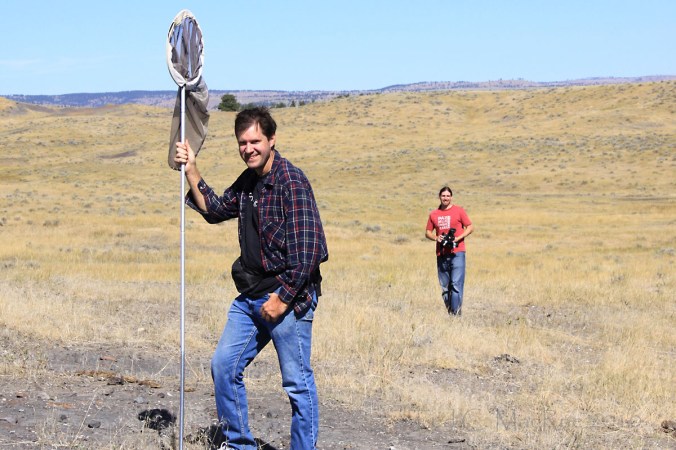
Matt Brust (L) and Chris Brown (R). Matt discovered this site for Cicindela pulchra in 2009.

Fortunately, while I was getting skunked in Oklahoma, Matt Brust was discovering new populations of the species further north in the southwestern corner of South Dakota.  These discoveries were prompted by the initial discovery of the species on Pierre Shale exposures at a single site near the Black Hills (Larsen and Willis 2008).  The soft, dark gray soils of the Pierre Shales are in distinct contrast to red clay exposures with which the species has been typically associated further south, and by scouting a broader area for similar exposures Matt was able to find the species at six new sites during late summer 2009 (Brust 2010).  He found them associated not only with the Pierre Shale but also the Mowry Shale formation (and suspects they may eventually be found on Belle Fourche Shale formations as well).  When I learned of these discoveries, I decided I just had to see them for myself.  I had enjoyed my Fall 2008 trip to northwestern Nebraska and southwestern South Dakota, and the thought of seeing these beetles while spending time in the field with Matt once again seemed the perfect basis for another trip to the area.  It didn’t take much convincing for Chris to agree, thus, C. pulchra became goal #1 of the 2010 Fall Tiger Beetle Trip™.

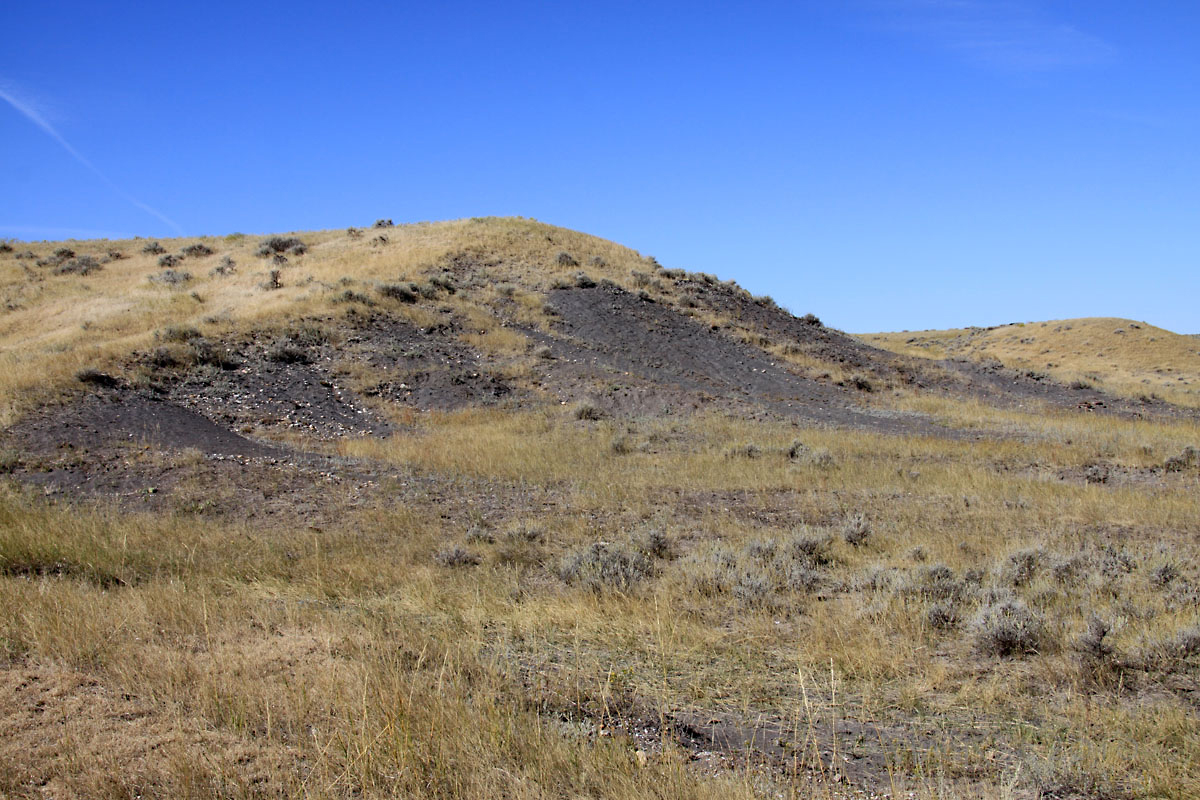
Habitat for Cicindela pulchra in Fall River Co., South Dakota. Adults and larval burrows are found in sparsely vegetated gray shale slopes and open flats beneath.

As we drove to the site that Matt had selected for us to explore, I felt nothing but optimism.  The skies were clear and the temperature was already nearing 70°F.  Matt, however, was hedging his bets – “I hope they’re still out, I’ve never seen them this late!”  Still, I wasn’t worried.  We were two weeks earlier in the season than the 2005 Kansas trip, and the weather was simply spectacular – it just had to be a good tiger beetle day!  My optimism was justified, as within minutes of arriving at the site we saw the first individual.  I collected this one alive as a backup for photographs in the studio should that be the last one we saw, but no such contingencies were necessary – we began seeing individual after individual as we trolled across the barren gray slopes.

Adult male Cicindela pulchra taking in the morning sun.

These beetles are simply a marvel to see in the field.  Brilliant dark red with metallic green, blue, and purple borders on the head, thorax, and elytra, this relatively large tiger beetle (certainly among the largest in the genus) can be confused with no other tiger beetle in North America.  Unlike adults of most other species, which exhibit color patterns resembling the texture and hue of the soil substrate on which they occur, C. pulchra adults are obvious and non-cryptic.  It apparently mimics the large, similarly colored velvet ants of the genus Dasymutilla with which they are sympatric – even exhibiting similar behavior when alarmed such as stridulating (creating vibrations by scraping body parts across one another) and giving off defense chemicals (Pearson 1988).  Adults are powerful fliers that can fly long distances when alarmed (Spomer et al. 2008), but in the still relatively cool morning air Chris and I had relatively (emphasis on relatively!) little trouble getting close enough to attempt those coveted field photographs.  This, however, was a double-edged sword – the same cool temperatures that allowed us to get close enough for photographs also caused to the beetles to assume the most non-photogenic poses as they sprawled torpidly on the ground, sometimes hugging it closely in an attempt to conserve heat until incident radiation from the sun warmed them sufficiently to go about the day’s activities.  Once this did happen, we found getting close enough for photographs nearly impossible.  In the 2+ hours that we chased after them, we took many shots but failed to get that “perfect” shot of a brilliant beetle standing tall and alert.

Adult male Cicindela pulchra hugs the ground during the cool morning hours.

Cicindela pulchra is a “spring/fall” species – i.e., sexually immature adults emerge during fall to feed, then return to their burrows to overwinter before emerging again in spring to mate and lay eggs.   Pearson et al. (2006) state the fall period lasts from July to September; however, as I observed in Kansas in 2005 adults can remain active well into October as long as suitable weather prevails.  Larvae hatch shortly after eggs are laid in the spring, but larval burrows can be seen during the entire season since they require 2-3 to complete development.  It was actually the presence of the large larval burrows (see photo below) that alerted Matt to the occurrence of the species at this site.  Several other tiger beetle species are also found here, e.g. C. purpurea (cow path tiger beetle) and C. tranquebarica (oblique-lined tiger beetle); however, these species – and hence their larval burrows – are considerably smaller than C. pulchra.  The only other species of Cicindela in North America that matches C. pulchra in size is C. obsoleta (large grassland tiger beetle), a southwestern species that is not known to range as far north as Nebraska and South Dakota, and the slightly smaller C. formosa (big sand tiger beetle) larval burrow has a distinctive “pitfall trap” with the burrow opening situated horizontally above it (it is also restricted to dry sand rather than clay habitats).  We saw several C. pulchra larval burrows during our visit but no active larvae, and none of my attempts to “fish” them out of their relatively shallow burrows met with success.  I could have tried digging them out, but that is a time-intensive activity, and I decided instead to bring a few live adults back in a terrarium of native soil and see if I could rear the species from egg.
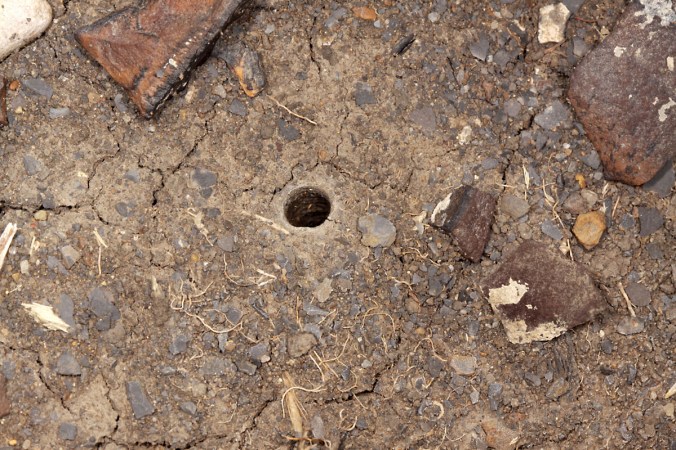
Despite the presence of at least two other tiger beetle species at the site, this can only be that of a 3rd-instar Cicindela pulchra due to its large size.

I had tried persistently during the last hour we were there to get a good field photograph of an active adult beetle standing tall and alert, but the following is the closest I was able to achieve.  Leaving the site without that “perfect” shot was difficult – as Matt put it, we had “pulchra fever”!  Still, there were other tiger beetles – e.g. C. nebraskana (prairie long-lipped tiger beetle) and C. decemnotata (badlands tiger beetle) – that we wanted to find in the limited time we had to explore the region, so I prepared a terrarium for the live adults I was bringing back with me and chalked up our first big success of the trip as we headed towards the shortgrass prairie sitting atop the nearby Nebraska Pine Ridge.

I chased this adult female for some time trying to get a closer photograph, but warming temperatures made this impossible.

In addition to attempting to rear the species,  bringing live adults back with me also gave me more opportunity to photograph them.  In addition to the native crumbly shale soil that I used to fill the terrarium, I placed in it one of the nicely colored, presumably volcanic, rocks that littered the slopes on which the beetles occurred.  The dark color of the rock makes a nice backdrop to really show off the extraordinary colors of this species – especially the bright white labrum and mandibles of the particularly impressive male in the following photograph.  The beetles are all now sound asleep for the winter in a 10°C incubator.  Hopefully, when I move the terrarium back into warm temperatures next spring they will re-emerge, mate, and lay eggs (hmm, photographs of a mating pair would be really nice!).

The all-white labrum and mandibles of this male Cicindela pulchra are displayed nicely in this terrarium photograph.

Photo Details:
Insects: Canon 50D w/ 100mm macro lens (ISO 100, 1/250 sec, f/16), Canon MT-24EX flash w/ Sto-Fen + GFPuffer diffusers.
Habitat: Canon 50D w/ 17-85mm wide-angle lens (ISO 100, 1/160 sec, f/11), natural light.
Matt and Chris: Canon 50D w/ 17-85mm wide-angle lens (ISO 100, 1/250 sec, f/11), natural light.
All photos w/ typical post-processing (levels, minor cropping, unsharp mask).

REFERENCES:

Brust, M. L.  2010. New distribution records for Cicindela pulchra pulchra Say in South Dakota and notes on habitat use and natural history.  Cicindela 42:1–10.

Larsen, K. J. and H. L. Willis.  2008. Range extension into South Dakota for Cicindela pulchra (Coleoptera: Carabidae).  The Coleopterists Bulletin 62(4):480.

MacRae, T. C. 2006. Beetle bits: The “beautiful tiger beetle”. Nature Notes, Journal of the Webster Groves Nature Study Society 78(4):9–12.

Pearson, D. L.  1988. Biology of tiger beetles.  Annual Review of Entomology 33:123–147.

Pearson, D. L., C. B. Knisley and C. J. Kazilek. 2006. A Field Guide to the Tiger Beetles of the United States and Canada. Oxford University Press, New York, 227 pp.

Spomer, S. M., M. L. Brust, D. C. Backlund and S. Weins.  2008. Tiger Beetles of South Dakota & Nebraska.University of Nebraska, Department of Entomology, Lincoln, 60 pp.

Copyright © Ted C. MacRae 2010
Phreaky Phalangid

While searching through shortgrass prairie atop the Pine Ridge in northwestern Nebraska in hopes of finding Cicindela nebraskana (prairie long-lipped tiger beetle), this harvestman caught my eye.  Harvestmen are, of course, arachnids related to spiders, but they lack fangs and poison or silk glands and are placed the separate order Opiliones (Phalangida when I was in school).  Admittedly, I haven’t paid much attention to harvestmen before now, but this one seemed different from any I’d seen before – nearly black with relatively short legs and distinctive orange intersegmental articular membranes at the base of the legs.  Harvestmen are known to employ chemical defenses through special repugnatorial glands that produce phenols, quinones, ketones, and/or alcohols, and this individual seemed to display a clear example of aposematic coloration to warn any potential predators of its distastefulness.

Trachyrhinus favosusAlthough beetles are my focus, I normally try to do my own identifications in other groups as well.  However, some rather persistent searching through the extensive harvestman holdings at BugGuide failed to turn up a good match.  In gestalt it seemed to belong to the family Sclerosomatidae, but even that was just guessing on my part.  So, I did what I’ve done only a few times before and posted the photos to BugGuide’s ID Request.  A day and a half later I had my answer – Trachyrhinus favosus.  BugGuide Contributing Editor V. Belov had sent the photos to harvestman expert Marshal Hedin, who had this to say in response:

Cokendolpher describes males as ‘body ranging from solid black…’ with bases of femora ‘yellow-brown’. The species is also known from western Nebraska. Cool.

I was pleased to learn that these photographs represented a new species for BugGuide and no longer felt bad about not being able to find a good match.  Further, my leanings toward the family Sclerosomatidae had been confirmed.  According the Cokendolpher (1981), T. favosus ranges in a narrow band from North Dakota south to north-central Texas and is active only during fall.  I had intended to try to get an even closer photograph, but after taking the second photograph above I accidentally disturbed the critter and then watched in amazement as it began bouncing up and down vigorously.  This apparently is a defensive behavior that functions to blur the body form.  I watched it bounce and became even more amazed as it began calmly walking away while continuing its vigorous bouncing – quite a spectacle!

Photo Details: Canon 50D w/ MP-E 65mm 1-5X macro lens (ISO 100, 1/250 sec, f/13), Canon MT-24EX flash w/ Sto-Fen + GFPuffer diffusers. Typical post-processing (levels, minor cropping, unsharp mask).

REFERENCE

Cokendolpher, J. C.  1981. Revision of the genus Trachyrhinus Weed (Opiliones, Phalangioidea).  Journal of Arachnology 9:1–18.

Copyright © Ted C. MacRae 2010

Euhagena nebraskae… again

Euhagena nebraskae - male

Earlier this year I showed a photograph of a mating pair of the clearwing moth (family Sesiidae) species, Euhagena nebraskae – seen last year in the Gypsum Hills of south-central Kansas on a cold, early-October day.  It was an okay photograph, made interesting primarily by nicely showing the high degree of sexual dimorphism seen in these moths.  Still, I wasn’t completely happy with the photo, wishing I had gotten a closer photograph of just the male with his highly bipectinate antennae and wispy, white thoracic tufts.  I got my wish on the first day of my recent fall tiger beetle collecting trip, seeing just this single male in the Pine Ridge area of northwestern Nebraska.  Despite the relatively warmer temperatures, he perched cooperatively atop a dried flower head and allowed me to photograph him to my heart’s content.

p.s. this one you really should click on to see the larger version, because the hair-like thoracic scales and flattened marginal scales on the wings are quite remarkable.

Photo Details: Canon 50D w/ 100mm macro lens (ISO 100, 1/250 sec, f/16), Canon MT-24EX flash w/ Sto-Fen + GFPuffer diffusers. Typical post-processing (levels, minor cropping, unsharp mask).

Copyright © Ted C. MacRae 2010

A “leafless” leaf-footed bug

Merocoris distinctus feeding on flower stem of Coreopsis lanceolata.

This is Merocoris distinctus, a true bug in the family Coreidae whose members are usually recognized by their distinctive flattened hind tibiae (and hence the common name, leaf-footed bugs). This diminutive species, however, lacks that character, instead sporting strangely curved hind tibiae along with club-shaped (incrassate) hind femora. It’s a chunky little species – much smaller than the typical leaf-footed bugs seen across North America, and is most often encountered in grassland habitats where it feeds on herbaceous plants such as goldenrod, Solidago spp. (Slater and Baranowski 1978). This individual was seen probing the upper flower stem of lanceleaf tickseed, Coreopsis lanceolata, during May of last year at Shaw Nature Reserve in east-central Missouri. I’m not sure how well the life history of this species is understood, but I did find one interesting record of twelve individuals feeding gregariously on a dead chicken (Engelhardt 1912)! Apparently, feeding on carrion and other extra-phytophagous foods such as bird droppings and dung is a not uncommon practice among the Coreidae and closely related Alydidae (Adler and Wheeler 1984).

I kind of lucked out with this shot – I’d just gotten my new camera two weeks earlier and can’t say I really knew what I was doing at this point. I had first noticed and photographed the bug sitting on top of the flower but totally blew the exposure due to the flower’s bright yellow color.  My clumsy approach also caused the insect to move under the flower, where I watched it settle down and begin feeding before trying another shot. The dorsal surface of this species is mottled gray and brown, allowing the bug to blend in with most backgrounds. The underside of the body, however, is thickly matted with white hair, providing a very nice contrast with the black background that I stumbled upon achieved in this photo to emphasize the distinctive appearance of this often-overlooked insect.

Photo Details: Canon 50D w/ 100mm macro lens (ISO 100, 1/250 sec, f/14), Canon MT-24EX flash (1/4 ratio), undiffused. Typical post-processing (levels, minor cropping, unsharp mask).

REFERENCES:

Adler, P. H. and A. G. Wheeler.  1984. Extra-phytophagous food sources of Hemiptera Heteroptera: Bird droppings, dung, and carrion.  Journal of the Kansas Entomological Society 57(1):21-27.

Engelhardt, G. P. 1912. A hemipteron on carrion.  Journalof the New York Entomological Society 20:294.

Slater, J. A. and R. M. Baranowski. 1978. How to Know the True Bugs. W. C. Brown Company Publishers, 256 pp.

Copyright © Ted C. MacRae 2010

Saltatorial sidetracks

One thing I’ve realized during these past several years of fall collecting is that there are more than just tiger beetles to capture my interest as the field season enters its final days.  The late season floral burst of goldenrods (Solidago spp.) and tall thoroughwort (Eupatorium altissimum) brings forth a multitude of bees, flies, wasps, and soldier beetles.  Megacyllene robiniae, the locust borer (family Cerambycidae), is also a pleasant, if not pedestrian sight on the goldenrod as well, but if one is lucky to find goldenrod near a patch of Amorpha fruticosa (indigo bush), then its larger, more boldly marked and infinitely more exciting congener M. decora (indigo borer) might also be seen.  Nothing, however, seems to match the diversity and abundance during fall of the great order Orthoptera – grasshoppers, katydids, and crickets.  This is particularly true in the Ozark glades and Great Plains grasslands where I’ve spent the majority of my fall collecting time.  Perhaps it is because of their size – for the most part they are relatively large insects compared to the beetles I normally study, or maybe it is their pervasive reliance on sound – singing in the grass, rasping in the trees, snapping their wings in flight.  Bold and conspicuous, they demand attention.

Increasingly, I’m finding these fall hoppers harder and harder to resist, especially grasshoppers of the family Acrididae.  Until now I don’t think I’ve given grasshoppers their due respect – compared to my beetles they always seemed so… primitive.  No horns, no jeweled, metallic sculpturing, no over-sized jaws, no unique morphological specializations of any kind other than enlarged, saltatorial (modified for jumping) hind legs – they sport the quintessential ‘general’ insect body plan (open up any college introductory entomology textbook, and what do you see illustrated in the general morphology chapter… a grasshopper!).  Even their movements seemed to me somehow mechanical and robotic.  I always brushed them off as just basic insects, unrefined and uninteresting.

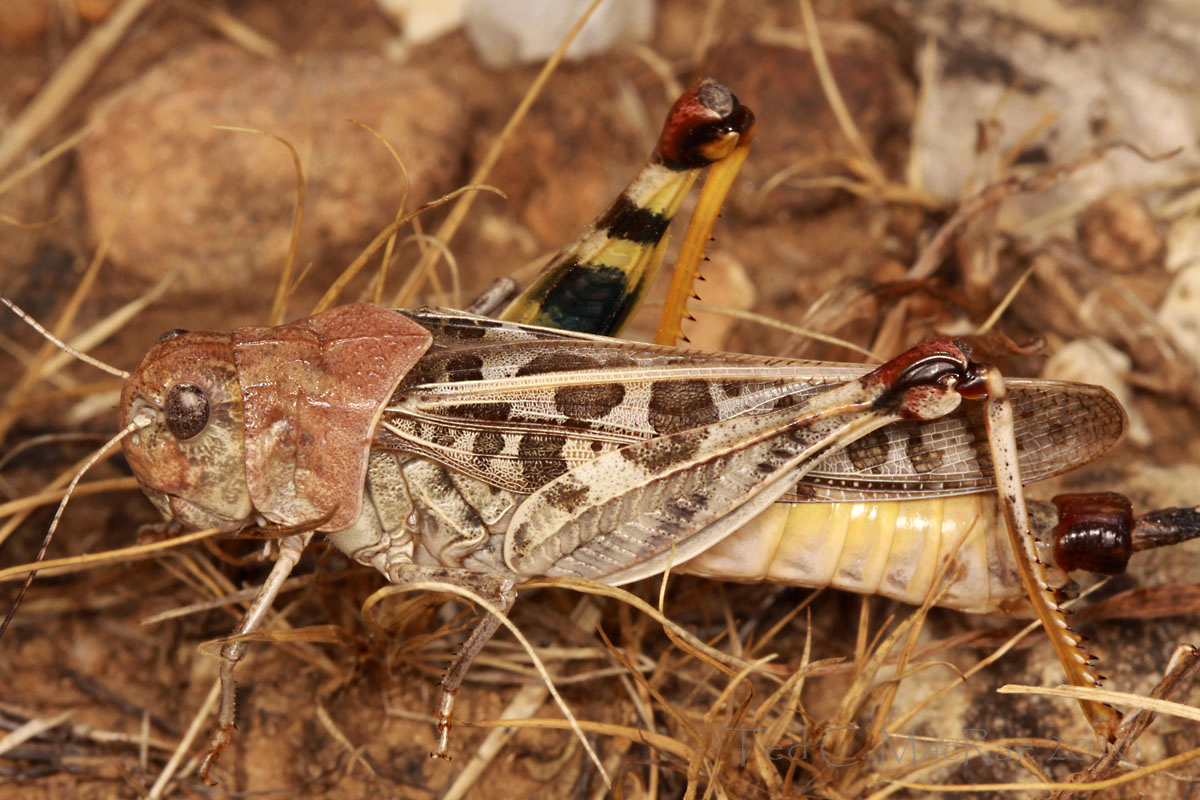
Of course, they are anything but uninteresting – in fact, orthopterans as a whole are among the most popular of insect groups if the number of recently published field guides is any indication.  One of these is The Grasshoppers (Orthoptera: Acrididae and Romaleidae) of Nebraska (2008), authored by Matthew L. Brust and colleagues, and a copy of which I received as a gift from the senior author during my recent collecting trip to Nebraska and surrounding areas.  According to this book, the grasshopper in these photographs is Hippiscus ocelote – the wrinkled grasshopper, a large, handsomely robust species distinguished by the single cut in the pronotum and its surface sculpturing, the orange hind tibia, and the triple-banded and basally blue inner surface of the hind femur.  The species is generally brownish throughout, but this particular individual – seen in the White River Hills of southwestern Missouri in early September – sported a decidedly reddish head and pronotum that contrasted beautifully with its spotted wings and forced me to stop searching for tiger beetles and spend some time photographing it.

There are many reasons why I should not let myself get interested in grasshoppers – they’re big and take up a lot of space (a premium in most private collections such as mine), and by any standard my interests are already spread too thin.  Still, I think it is better to have too many interests than not enough, and a Schmidt box or two full of some of the more interesting grasshoppers that I’ve encountered – properly curated and identified – wouldn’t take too much away from my beetle efforts.  I already have a few specimens of Trimerotropis saxatilis (lichen grasshopper) from Missouri’s igneous glades and the related T. latifasciata (broad-banded grasshopper) from Oklahoma’s Glass Mountains, so a small assortment of other notable species in addition to them couldn’t hurt, right?

Photo Details: Canon 50D w/ 100mm macro lens (ISO 100, 1/250 sec, f/16-f/20), Canon MT-24EX flash (1/2 ratio) w/ Sto-Fen + GFPuffer diffusers. Typical post-processing (levels, minor cropping, unsharp mask).

REFERENCE:

Brust, M. L., W. W. Hoback and R. J. Wright.  2008. The Grasshoppers (Orthoptera: Acrididae and Romaleidae) of Nebraska.  University of Nebraksa-Lincoln Extension, 138 pp.

Copyright © Ted C. MacRae 2010