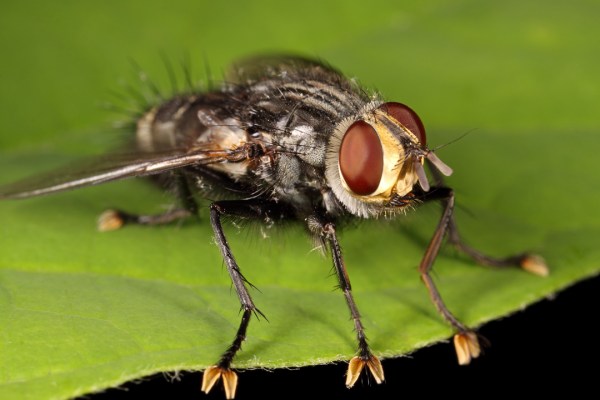
T.G.I.Flyday: Tachinomyia sp.

You would think that somebody with enough patience to photograph tiger beetles would be equally patient with “calyptrate” flies, but for me such is not the case. It’s not that I don’t find them interesting (although, really, what insect group can match the diversity, polytopism, ecological extremism and behavioral charisma of tiger beetles?), but their flighty, frenetic behavior and difficult taxonomy are just a bit too much for me. After all, why invest the time it would take to get a good photograph of something that, in the end will probably be unidentifiable.
IMG_9659_enh_1080x720

Tachinid fly (prob. Tachinomyia sp.) | Wayne Co., Missouri

Last April as I was hiking a woodland trail in Sam A. Baker State Park in southeastern Missouri’s Ozark Highlands, I saw this decent-sized fly bumbling across the trail. I knelt to look at it more closely, and though it tried to flee, it seemed too weak and uncoordinated to take flight. It was in beautiful condition—a perfect specimen, and I surmised that it represented a newly emerged adult that had not yet hardened sufficiently to withstand the rigors of flight. I was fascinated by its distinctive, orange tarsal pads and the white “beard” around its head, and the ability to coax the fly onto a leaf and hold the leave in whatever position I desired was all the enticement I needed to spend a little time with it. Out of the several shots that I took, these two are my favorites.

IMG_9683_enh_1080x720

You got it—the BitB face shot!

Of course, just being able to photograph the fly was only half the battle—there still remained the matter of its identification. It seemed “tachinidish” to me at the time, but a little digging revealed that there are species of Sarcophagidae look very similar to tachinids, the difference being the presence or absence of a visible postscutellum. My photos don’t show this character, and I quickly became overwhelmed when I tried scanning through BugGuide photos for these two families. Nevertheless, I’m a persistent sort, and after winnowing out the numerous unlikely choices I finally settled on not only family Tachinidae, but possibly Tachinomyia sp. (tribe Exoristini). I was tempted to go out on a limb and post the ID here unvetted, but I chickened out and and sent the photos to fly guy Norman Woodley at the Systematic Entomology Lab in Washington, DC. Norm supported my identification and wrote back:

I think it is probably Tachinomyia.  It would be better to have a wing view as well as the hind end to be absolutely positive, but I’m reasonably sure that’s what it is.  It’s a male.  Some species are active in the spring, so that fits with your data as well.

Copyright © Ted C. MacRae 2012
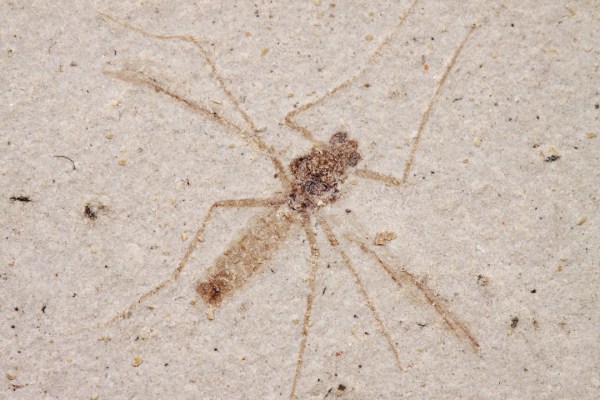
A 50-million-year-old midge

Several of the insect fossils collected from the Green River Formation (45–50 mya) that I am photographing appear to be flies, and specifically members of the “primitive” suborder Nematocera. This is not surprising, as the G.R. Formation of Colorado, Utah, and Wyoming, is composed of shales derived from volcanic ash sediments that were laid down in a system of large, shallow lakes. Most (all?) nematoceran flies are aquatic to some degree in the larval stage, thus the adults are also closely associated with such habitats for mating and egg laying.

Diptera: Chironomidae | USA: Colorado, Garfield, Hwy 139, Douglas Pass

Diptera: Chironomidae | USA: Colorado, Garfield, Hwy 139, Douglas Pass

This particular fossil looked to me a lot like the more elegantly preserved fossil of another fly that I posted a few days ago, which at the time I thought represented a member of the family Mycetophilidae (fungus gnats) or Sciaridae (black-winged fungus gnats). Several knowledgable specialists offered their opinions in comments at this site and at Facebook’s Diptera forum (my thanks to all who offered their opinion), with most settling on Mycetophilidae and Vlad Blagoderov further suggesting subfamily Mycetophilinae. The fossil posted here seemed to me to represent a dorsal view of the same species, but, of course, I’m a coleopterist—so what do I know? Indeed, dipterist Dr. Chris Borkent believes this is actually a species of Chironomidae (common name simply “midges”)—also a nematoceran but differing from Mycetophilidae by their longer front tarsi and longer, relatively narrower wings. Males of the family have thickly plumose (“feathery”) antennae, which are not visible in this specimen and thus suggesting it might be a female. I wouldn’t doubt Chris’ identification  for a second, as he comes from good stock—his father is Art Borkent, a world expert on several families of nematoceran dipterans. Art also agreed after seeing the photo that it looked like a female chironomid midge, so that is what I am going with. Thank you, Chris and Art, for your help in identifying this fossil!

Complete fossil specimen (63 mm x 52 mm maximum each axis).

Copyright © Ted C. MacRae 2012

An elegant Eocene fly

IMG_1864_enh_720x1080

USA: Colorado, Garfield, Hwy 139, Douglas Pass.

Here is one of the more elegantly preserved specimens among the collection of Green River Formation fossil insects that I am photographing. It is obviously a fly (order Diptera), but I don’t agree with the preliminary identification of “Mosquito?” as indicated on its label. Rather, I think it is one of the fungus gnats—also members of the suborder Nematocera and, thus, closely related to mosquitos (family Culicidae), but with distinctly elongate coxae (bases of the legs) and lacking the elongated proboscis that mosquitos use for sucking blood. It’s hard to decide between Mycetophilidae (fungus gnats sensu stricto) or Sciaridae (dark-winged fungus gnats), which differ in whether the eyes meet above the antennae (Sciaridae) or not (Mycetophilidae). However, Borrer & White (1970) mention that species of the former are generally less than 5 mm in length, while the latter range from 5–10 mm. This specimen measures 4.15 mm from the front of the head to the tip of the abdomen, so  maybe that is evidence supporting Sciaridae (although perhaps there were smaller mycetophilids 50 mya than today).

Here is a view of the whole fossil, measuring approximately 50 mm on each side:

IMG_1937_enh_1080x720

REFERENCE:

Borrer, D. J. & R. W. White. 1970. A Field Guide to the Insects of America North of Mexico. Houghton Miffton Company, Boston, 404 pp.

Copyright © Ted C. MacRae 2012
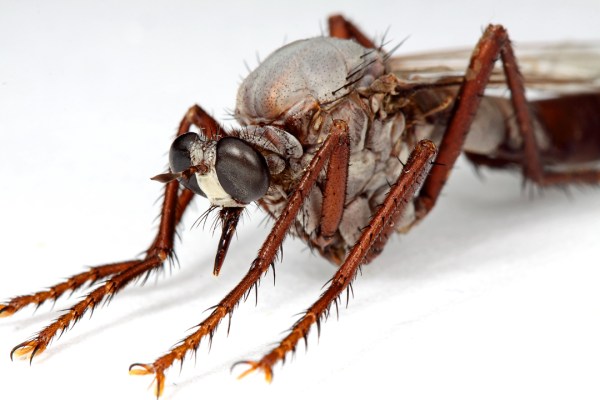
The “Other” Marvelously Monstrous Microstylum

Microstylum galactodes | Brewster Co., Texas

A couple of years ago during the initial testing of my DIY diffuser, I pulled a selection of rather impressive insects from my collection and photographed them on a white background to see how effectively the diffuser worked with different types and sizes of insects. I posted some of those photos for the larger insects in the following weeks, including the tank-like eastern Hercules beetle, the frightful-looking stag beetle, and the downright evil-looking red-eyed devil. There were, however, a number of smaller insects that I had also photographed but whose photos never made it onto these pages as a flush of new photography began the following spring. This is one of them: the robber fly, Microstylum galactodes (order Diptera, family Asilidae). I collected this specimen nearly 20 years ago in western Texas, and until the last few years it was the largest robber fly I had ever seen. That honor now goes to the closely related M. morosum (North America’s largest robber fly), which I have seen in northwest Oklahoma and as a previously unreported occurrence in southwestern Missouri. Still, M. galactodes is an impressive beast, and these photographs of the preserved specimen do little justice to its appearance in life.

The ”beard” (mystax) of Microstylum is confined to the oral margin and composed of stout bristles.

Both species of Microstylum are distinguished by the mystax (dense moustache of bristles on the face) confined to the oral margin and composed chiefly of stout bristles, but M. galactodes may be separated from its larger cousin by the light-colored wings and even, whitish bloom (powdery covering) covering the head and thoracic dorsum (Back 1909). Despite being the relatively commoner species, M. galactodes seems to be a little more specific in habitat preference, most often found in short grass prairies and scrub lands (Beckemeyer & Carlton 2000). Also, even though both species occur broadly in the southcentral to southwestern U.S., M. galactodes seems to have a slight western shift in its distribution compared to M. morosum, extending north only into the western parts of Oklahoma and Kansas (Beckemeyer & Carlton 2000); while M. morosum occurs across these states and eastward into northwestern Arkansas (Warriner 2004) and southwestern Missouri (MacRae unpublished—gotta get that note submitted!

REFERENCES:

Back, E. A. 1909. The robberflies of America, north of Mexico, belonging to the subfamilies Leptograstrinae and Dasypogoninae. Transactions of the American Entomological Society 35:137–400.

Beckemeyer, R. J. & R. E. Carlton.  2000.  Distribution of Microstylum morosum and M. galactodes (Diptera: Asilidae): significant extensions to previously reported ranges.  Entomological News 111(2):84–96.

Warriner, M. D.  2004.  First Arkansas record of the robber fly Microstylum morosum (Diptera: Asilidae).  The Southwestern Naturalist 49(1):83–84.

Copyright © Ted C. MacRae 2012

One-Shot Wednesday—Proctacanthus fulviventris ovipositing

Proctacanthus fulviventris | Dixie Co., Florida

Today I spent the day just south of Florida’s “arm pit” to look for the state’s near-endemic tiger beetle Cicindelidia scabrosa (Scabrous Tiger Beetle). I first found this species last August on a white-sand 2-track through sand pine scrub habitat near Cedar Key Scrub State Preserve (Levy Co.). Although I was happy enough with the photographs that I got that day, the small spot of habitat that I found them in had yielded only a few specimens. My goal this time was to find the species in additional localities  to get a better idea of its precise habitat preferences and obtain a better series of specimens that more fully represents the range of variability exhibited by the species in its pubescence, color and elytral markings. By day’s end I would meet this goal, having found the species at four locations in Levy Co. and further north in Dixie Co. My first stop was actually in Dixie Co. near Lower Suwannee National Wildlife Refuge, where I found good numbers of individuals on a white-sand 2-track through pine scrub. A variety of robber flies (family Asilidae) were also seen along the 2-track, but I resisted the urge to photograph them because of the task at hand. Eventually, however, I came upon a female of this rather large species with her abdomen deeply inserted into the loose sand, surely in the act of oviposition. This was too much to pass up, so I set down the net, took off the backpack, and put the camera together. Unfortunately, in the time it took to do this, the fly had already withdrawn her abdomen and was rapidly “sweeping” the tip of the abdomen back and forth over the hole—I presume to cover and hide it. I snapped this first frame (the little bit of motion blur can be seen at the tip of the abdomen), but then I moved carelessly (not my usual habit) when scooting in for a closer shot. This spooked the fly and caused it to fly off, and I was left with this single image.

As much as I like robber flies, I can’t say that I’m well versed in their taxonomy. However, the large size (25–30 mm in length) and overall gestalt suggested to me that it belonged to the nominate subfamily, and cruising through online photographs eventually led me to Proctacanthus fulviventris. The individual seems to agree well with the description of this species provided by Hine (1911), including the bright yellow beard, black femora and red tibiae, and reddish abdominal terga. If my identification is correct, this species—like C. scabrosa—is also a Florida near-endemic whose distribution extends barely into southern Georgia. It’s dark coloration and light brown wings, combined with its large size, surely make it one of the more impressive-looking robber flies, and I’m sorry that I did not attempt to get more photographs of this species while I had the chance, as I did not see it at any of the other locations that I visited on the day.

Incidentally, by my interpretation the scientific name of this species translates to “yellow-bellied spiny-butt”!

REFERENCE:

Hine, J. S. 1911. Robberflies of the genera Promachus and Proctacanthus. Annals of the Entomological Society of America 4(2):153–172.

Copyright © Ted C. MacRae

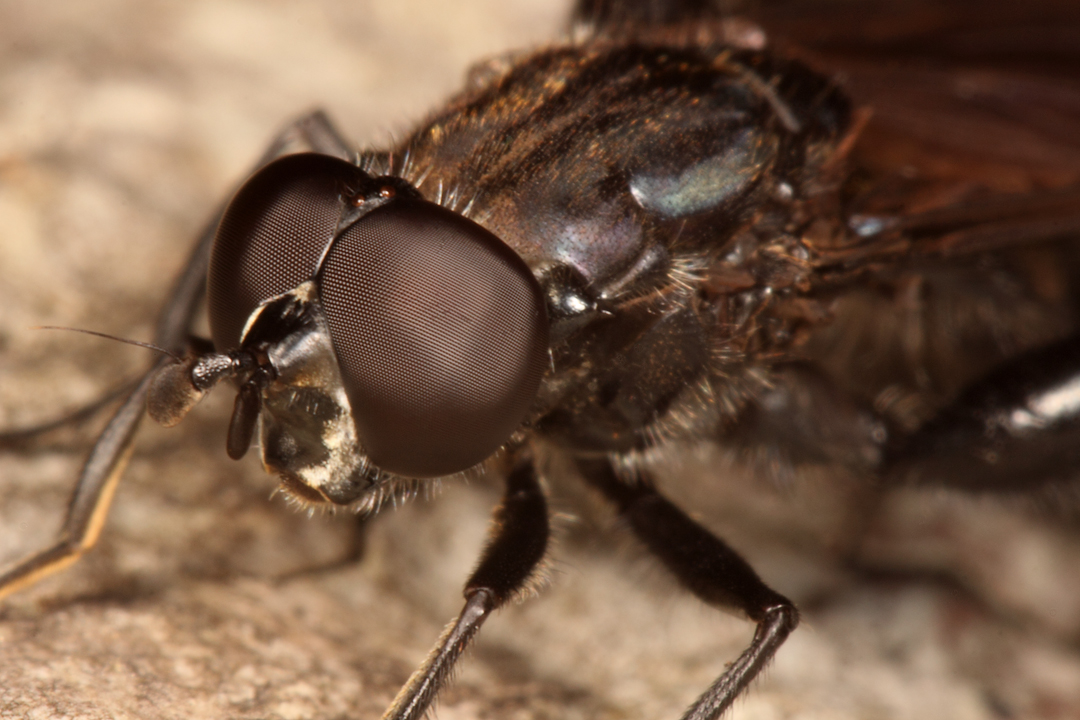
More on Chalcosyrphus

Here are two more photos of the fly I tentatively identified as Chalcosyrphus sp. The first photo shows the all-black coloration with no trace of either steel blue highlights (seen in C. chalybea) or red abdominal markings (seen in C. piger). It also gives a better view of the enlarged and ventrally spinose metafemora. The second photo shows the holoptic (contiguous) eyes that make me think this is a male individual (if, indeed, this is true for syrphids as with tabanids).

I’m hoping that posting these will provide any passing dipterists with the information needed for a firmer ID (and possibly an explanation of the purpose of those intriguingly modified hind legs).

Lateral view showing black abdomen with no trace of red (except what appears to be a parasitic mite).

Do the holoptic eyes identify this as a male?

Copyright © Ted C. MacRae 2012

T.G.I.Flyday – Chalcosyrphus?

When I was an entomology student, I learned that flies in the family Syrphidae are called “hover flies,” due to their habit of hovering in front of flowers, and that the larvae are predators of aphids. As is the case for nearly every other group of insects, I now know that there are exceptions–often many—to the typical rule, and the fly shown in the above photograph is a perfect example of such. Being a beetle-man (and a wood-boring beetle-man, at that), I don’t generally notice flies unless there is something unusual about them. This fly was seen last summer at Sam A. Baker State Park in southeastern Missouri on the trunk of a very large, recently wind-thrown mockernut hickory (Carya alba) tree. I had never seen a fly quite like this before, but everything about it suggested an intimate association with dead wood, including its relatively large, hulking, black form and the way it repeated returned to and landed on the trunk of the dead tree each time I disturbed it. It instantly made me think of robber flies in the subfamily Laphriinae, which includes Andrenosoma fulvicaudum and many species of Laphria that, as larvae, tunnel through dead and decaying wood where they prey upon the larvae of wood-boring beetles. While it was quite obvious that the fly in the photo was not a robber fly, imagine my surprise when I eventually determined it to be a member of the family Syrphidae. For now I’ve provisionally settled on the genus Chalcosyrphus, although it lacks the steely blue cast exhibited by the only all-black species of the genus—C. chalybeus—shown on BugGuide. Another species, C. piger, looks very similar but seems always to have some red on the abdomen, which this individual definitely lacks. Perhaps the related genus Xylota is also a possibility, although the “gestalt” does not seem to quite match that of any shown on BugGuide. Most interesting for me are the distinctly enlarged and toothed metafemora, which along with the correspondingly curved tibiae suggest some predatory function, but the literature that I have seen makes no mention of such, but rather that the adults feed on pollen. My hunch about its association with dead wood does seem to be true, although it now seems the larvae are saprophages rather than predators within the wood, as I first imagined.

Copyright © Ted C. MacRae 2012

One-Shot Wednesday: Upside down bee fly

Bombylius sp. cf. mexicanus | Scott Co., Missouri

This has got to be one of the strangest photos I’ve ever taken. Three weeks ago after visiting Sam A. Baker State Park (and photographing the scorpionfly featured in last week’s One-Shot Wednesday post), my dad and I visited a couple of sand prairie remnants in the Mississippi lowlands of extreme southeastern Missouri. I was hoping to see (and photograph) some individuals of the unique population of Cicindela scutellaris that occurs in that part of the state—apparently disjunct, this populations shows an intergrade of characters typical of subspecies C. s. lecontei to the north and C. s. unicolor to the south. I’ve photographed this population before, but those photographs were taken with a small (though quite good) point-and-shoot camera before I acquired my current dSLR camera setup.

Unfortunately, temperatures were quite cool that day, and no beetles were seen at either of the two locations we visited where I’ve seen good populations in past years. When I don’t find what I’m looking for, I start noticing other things, one of which was this very fresh-looking bee fly (order Diptera, family Bombyliidae) resting on the sandy ground. I’ve not really attempted to photograph many bee flies—they are as skittish and difficult to approach as the tiger beetles I adore but, unlike the latter, not a subject of my research and, thus, harder to justify spending inordinate amounts of time attempting photographs. This one, however, was sitting so nicely on the ground, and with no tiger beetles around to demand my attention I thought I would give it a shot (pun intended!). I carefully assembled my rig and slowly crouched down to attempt a photograph, but before I could get in position the fly spooked and tried to fly away. As it took off, however, it hit a plant and fell to the ground on it’s back. As it laid there,seemingly stunned, I got myself into position and took a quick shot to make sure I had the settings and exposure that I wanted. In that regard, I couldn’t ask for better, but of course what I really wanted was a photograph of the fly right-side up, resting on its feet rather than its back. Just as I was considering what to do next, the fly abruptly righted itself and flew away, leaving me with this single, rather unconventional photograph.

After perusing the bee fly pages at BugGuide, I was fairly certain this was something in the tribe Bombyliini, with the genera Bombylius and Systoechus being the likeliest candidates. Apparently the location of the r-m vein on the wing is an important distinguishing character between these genera, but I wasn’t quite sure about its location on the wing in this photograph. Nevertheless, some of the comments under the different species in these two genera suggested that members of Bombylius tend to be active as adults in the spring, while those of Systoechus tend more towards fall. I sent the photo to dipterist Joel Kitts at University of Guelph for his opinion—he confirmed that it belonged to the genus Bombylius and suggested its appearance was consistent with that of B. mexicanus—many thanks Joel!

Copyright © Ted C. MacRae 2012