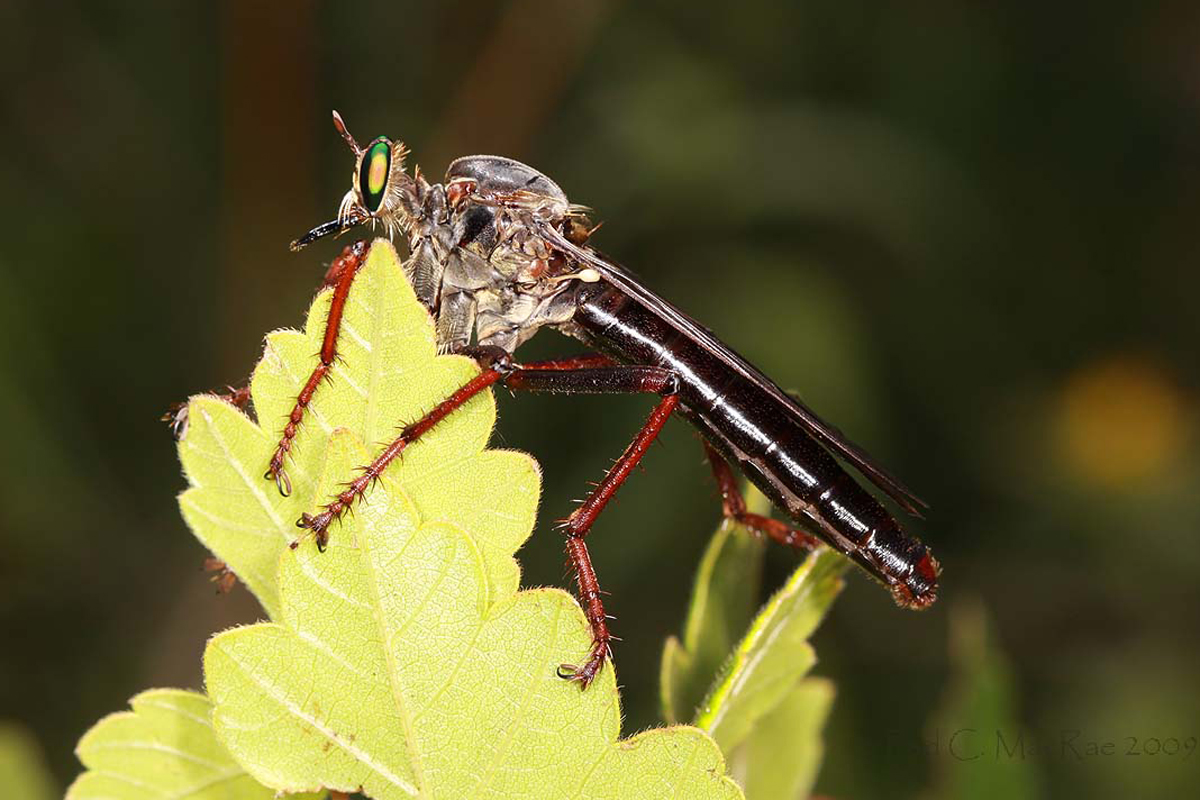
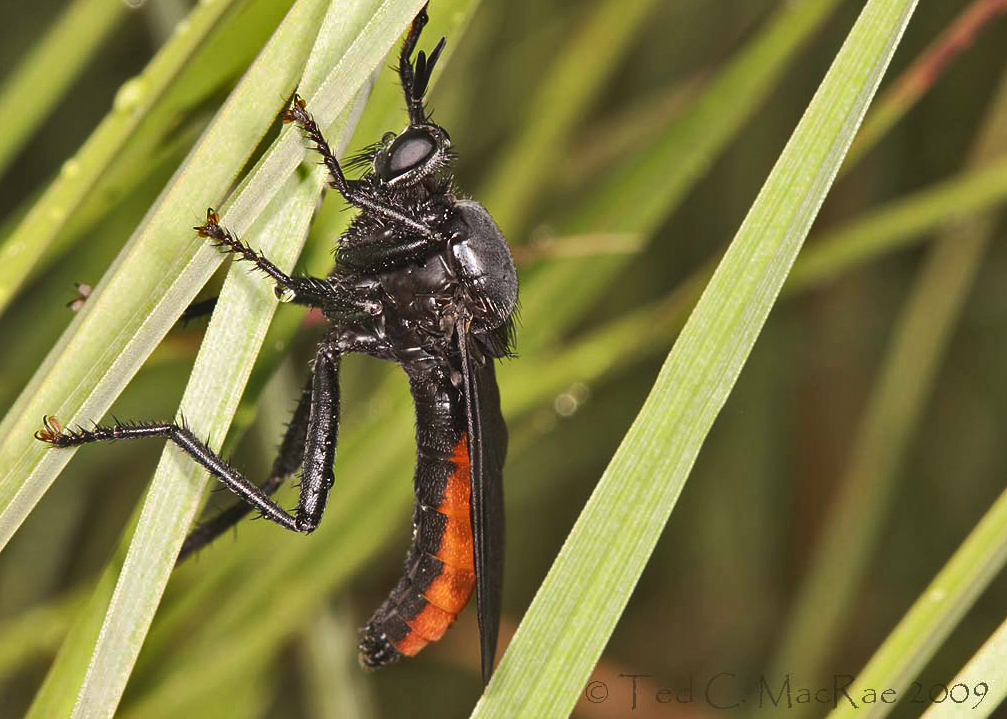
Female Microstylum morosum perched on fragrant sumac (Rhus aromatica)
A few days ago, I featured Promachus hinei, one of the so-called “giant robber flies” and a common inhabitant of the glades and grasslands that dot Missouri’s largely forested landscape. That individual was seen at Long Bald Glade Natural Area in Caney Mountain Conservation Area, one of the many limestone glades that are a prominent feature of extreme southwestern Missouri’s White River Hills, as it snacked on a small carpenter bee (Ceratina sp.) and posed obligingly for a series of super close-up photographs. Promachus and its congeners are impressively large; however, I would see an even larger robber fly that day. I didn’t know what it was at the time, but I knew that never before had I seen such a magnificent fly, with its large, shimmering, emerald eyes, streamlined body almost devoid of setae (hairs), and ludicrously large size. These monsters were actually quite common at the glade, so I failed to appreciate the significance of what I was seeing as I chased one after another – more intent on securing photographs than specimens. This was not an easy task – they were extremely wary, rarely allowing me to approach within 12 feet no matter how cautiously and slowly I moved. Not one to back down from such a challenge (remember, I stalk tiger beetles), I persisted, traversing the rough, rock-strewn terrain amidst clumps of big bluestem (Andropogon gerardii), Indian grass (Sorghastrum nutans), and fragrant sumac (Rhus aromatica) until, at last, I got within striking distance of the impressive female shown in these photos. Taking flight before I felt assured of a good shot, I followed her repeated long, loping escape flights until I was able to get another few shots and she disappeared for good.
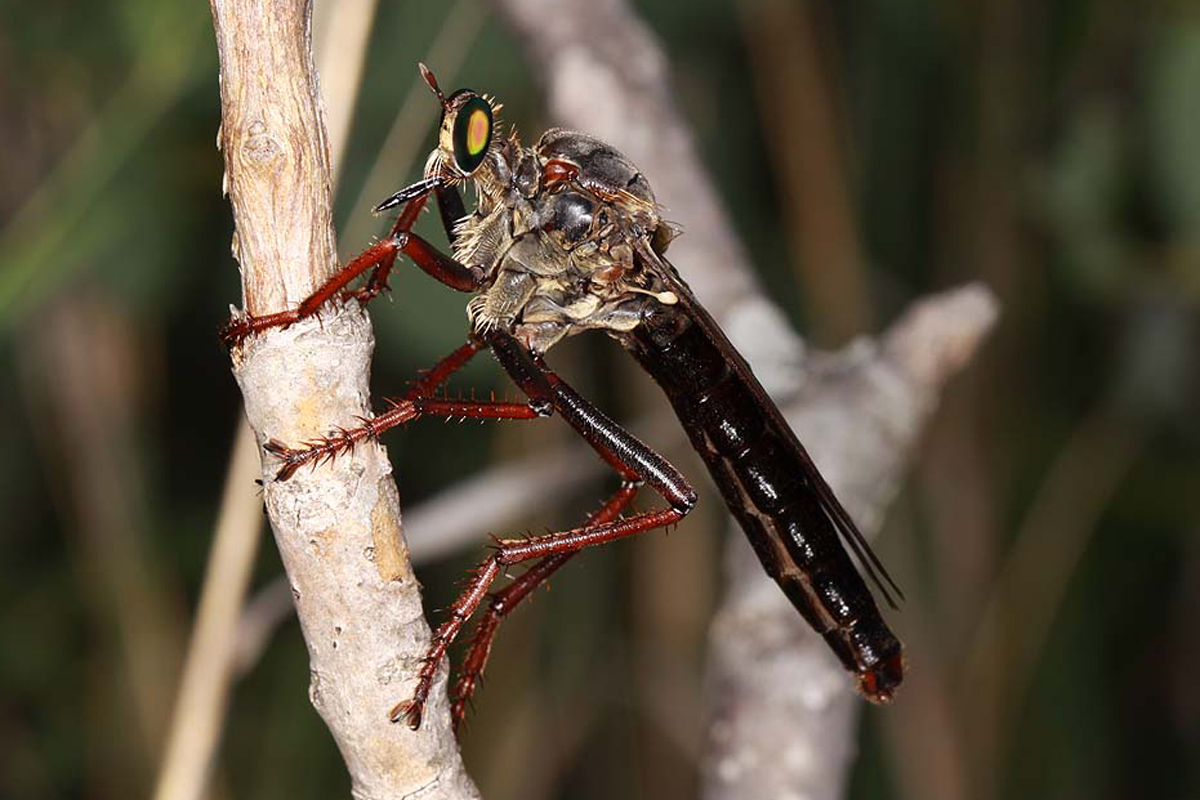
Same individual as in previous photo after flying to another perch.
It didn’t take long after I returned home to figure out what I had seen, as there is really nothing that can be mistaken for Microstylum morosum, North America’s largest robber fly (Back 1909)¹. At 35–40 mm of length, this individual didn’t quite match the astounding 50-mm upper body length for the species (that’s 2 inches, folks!). Nonetheless, it was an impressive beast indeed! It is not surprising that North America’s largest robber fly should be a species of Microstylum, as it is this same genus that contains the world’s largest robber fly – the aptly named M. magnum from Madagascar, with a body length of 60 mm and an almost preposterous wingspan of up to 84 mm (that’s over 3 inches folks!). I don’t know if any flies exist that are larger than this, but certainly none can be more imposing. While I’m happy with the photos that I did obtain, I must confess some disappointment that I wasn’t able to get more than these basic lateral profile shots. Of the several photographs of this species that can be found on the web, this female, photographed by Greg Lavaty of Houston, Texas, is (in my humble opinion) certainly the most stunning.
¹ Puzzled by the use of the prefix “micro” in the genus name – hardly seeming appropriate for such an enormous fly – I asked Eric Fisher (retired, California Department of Food and Agriculture) about the name’s derivation, to which he replied, “The name refers to the quite small ‘stylus’ of the antenna apex; Macquart specifically mentions this character in his 1838 original description of the genus. (This is not a very helpful diagnostic character, as many asilids share this feature…).”
Even more significant than its size, however, was its very occurrence on this glade. Like Ospriocerus abdominalis, which I had seen just a few weeks earlier in the Loess Hills of extreme northwestern Missouri, M. morosum is a denizen of the Great Plains, and also like that species it has until now not been known from Missouri. That’s right – another new state record! Unlike O. abdominalis, however, the Missouri occurrence of M. morosus represents a significant northeastern extension of its known range. The species was long considered a Texas endemic until Beckemeyer and Charlton (2000) confirmed its occurrence in southeastern Arizona and documented significant range extensions into Oklahoma, Kansas, extreme southeastern Colorado, and extreme northeastern New Mexico. Its eastern distributional limit was thought to occur along a north-south line from Douglas County, Kansas to Mayes County, Oklahoma to Brazoria County, Texas; however, Warriner (2004) documented its occurrence some 200 miles east of this line in the blackland prairies of southwestern Arkansas. The occurrence of M. morosum in the White River Hills of Missouri represents yet another significant eastern extension of its known range – Long Bald Glade lies 185 miles NNE of the collection site in Arkansas and 155 miles ENE of the nearest known record in Mayes County, Oklahoma (Locust Grove), making it the easternmost known locality for this species.
As in Arkansas, where the collection site represents one of the highest quality blackland prairie remants in the state, Long Bald Glade represents a high quality remnant of the limestone glades that once occurrred much more extensively within Missouri’s White River Hills. Like the blackland prairie of Arkansas, the limestone glades of the White River Hills have been dramatically reduced since EuroAmerican settlement due to land use conversion, and fire suppression and overgrazing of the remaining tracts have resulted in significant woody encroachment – chiefly by eastern red-cedar (Juniperus virginiana) – and loss of vegetational diversity. This has caused dramatic reductions in populations of the many Great Plains plant and animal species that are found here and nowhere else in the state. Considering the overall distribution of M. morosum, it is unlikely that it occurs more extensively within Missouri than the White River Hills, emphasizing the importance of continued conservation and restoration activities in this unique part of Missouri. However, since the White River Hills extend into northwestern Arkansas, M. morosum may occur in that part of Arkansas as well as the southwestern part of the state.
I thank Eric Fisher and Herschel Raney for confirming the identity of this species and its status as a new record for Missouri.
Photo details: Canon 100mm macro lens on Canon EOS 50D (manual mode), ISO-100, 1/250 sec, f/10-11, MT-24EX flash 1/2 power through diffuser caps.
REFERENCES:
Back, E. A. 1909. The robberflies of America, north of Mexico, belonging to the subfamilies Leptograstrinae and Dasypogoninae. Transactions of the American Entomological Society 35:137–400.
Beckemeyer, R. J. and R. E. Carlton. 2000. Distribution of Microstylum morosum and M. galactoides (Diptera: Asilidae): significant extensions to previously reported ranges. Entomological News 111(2):84–96.
Warriner, M. D. 2004. First Arkansas record of the robber fly Microstylum morosum (Diptera: Asilidae). The Southwestern Naturalist 49(1):83–84.
Copyright © Ted C. MacRae 2009











 Beetles In The Bush