The (almost) Florida-endemic Cicindelidia scabrosa

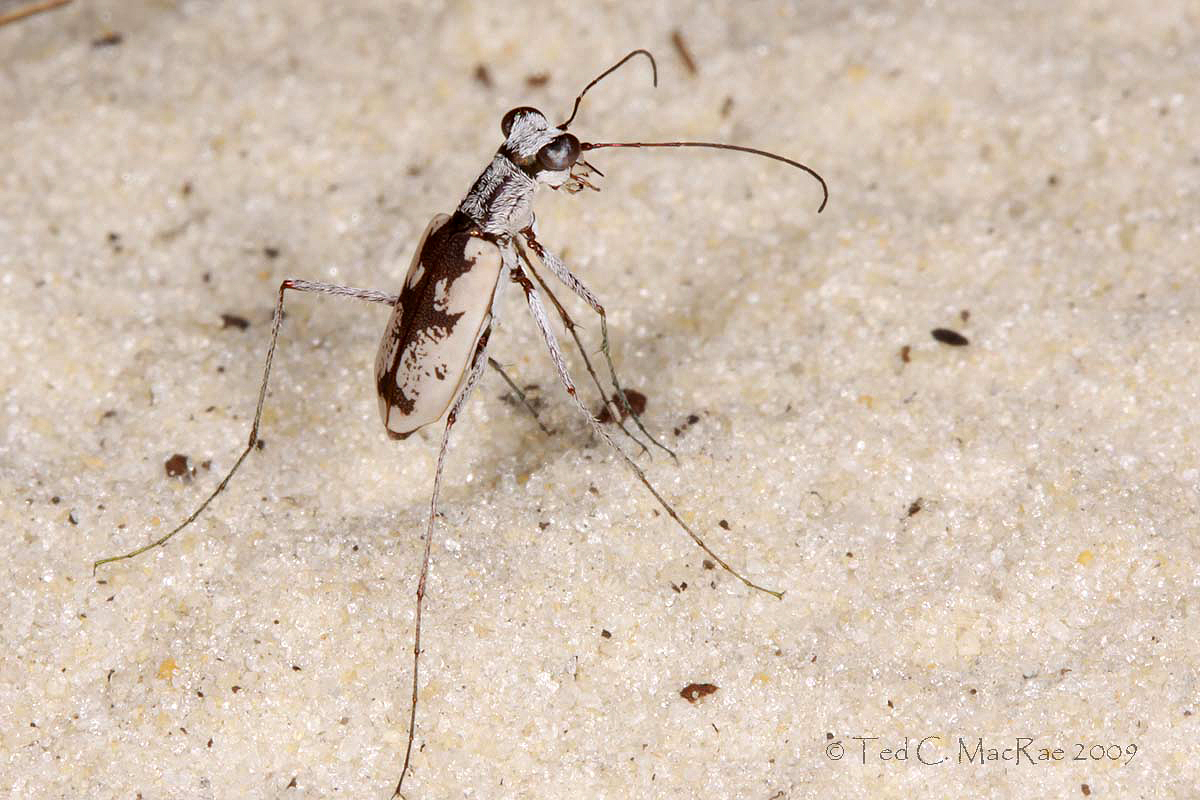
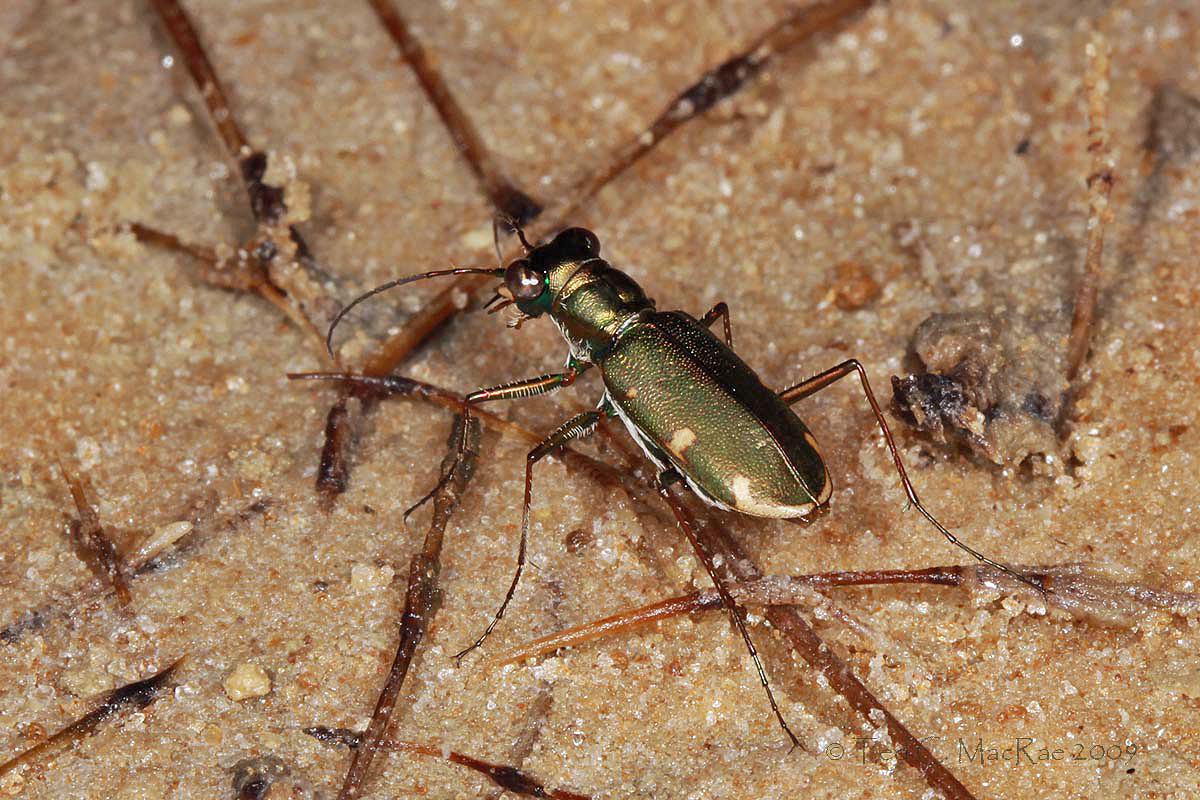
The recently rediscovered Cicindelidia floridana (Miami Tiger Beetle) may have been the highlight of my 48-hour early August blitz through Florida, but it was by no means the only Florida-endemic that I hoped to find during the trip.  In fact, the day before I saw C. floridana I found the species it was formerly considered a subspecies of, C. scabrosa (Scabrous Tiger Beetle), itself an almost Florida-endemic (its distribution extends just north of the border into extreme southeastern Georgia).  I had word that I might find the species in sand pine scrub habitat along the Gulf Coast around Lower Suwanee National Wildlife Refuge and Cedar Key Scrub State Preserve (Levy Co.).  This area lies very near yet another locality (where I was hoping to find yet another Florida-endemic), further justifying my decision to travel several hours north the day before I was to retrace my route back to the south and then continue on down to Naples to meet up with Dave Brzoska and Chris Wirth for the trip to Miami to see C. floridana.

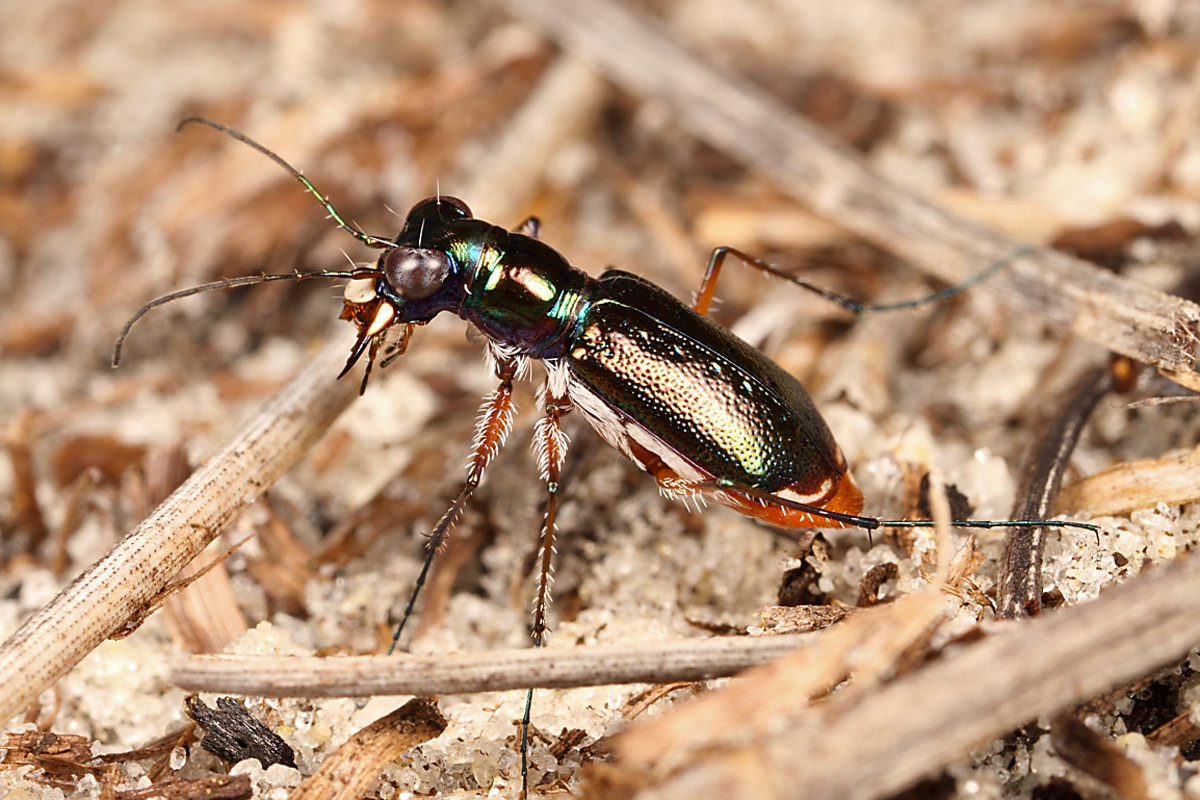
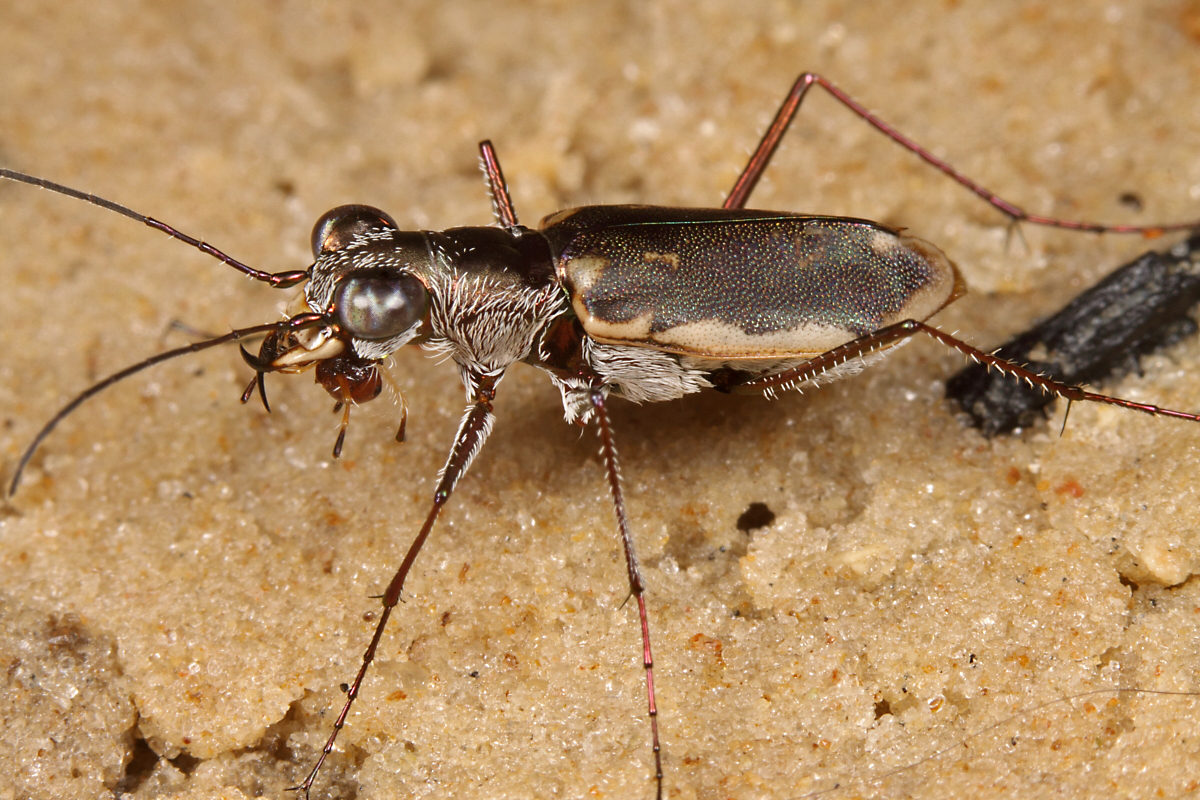
Cicindelidia scabrosa (Scabrous Tiger Beetle) | Levy Co., Florida

Cicindelidia scabrosa is one of four small, sand-dwelling species with red venters collectively referred to as the abdominalis-species group (Brzoska et al. 2011).  The nominate species, C. abdominalis (Eastern Pinebarrens Tiger Beetle), is the most widespread member of the group, occurring across the Southeastern U.S. Coastal Plain from Maryland and New Jersey to Louisiana (Pearson et al. 2006).  The three remaining species are Florida-endemics (C. floridana and C. highlandensis—Highlands Tiger Beetle) or near endemic (C. scabrosa), presumably evolving during the Pleistocene Epoch (1.8 million to 10,000 years ago) at a time when fluctuating sea levels repeatedly isolated peninsular Florida from the mainland.  I found both C. abdominalis and C. highlandensis during my 2009 trip, so finding C. floridana and C. scabrosa on this trip means that I have now seen all four members of the abdominalis-species group.
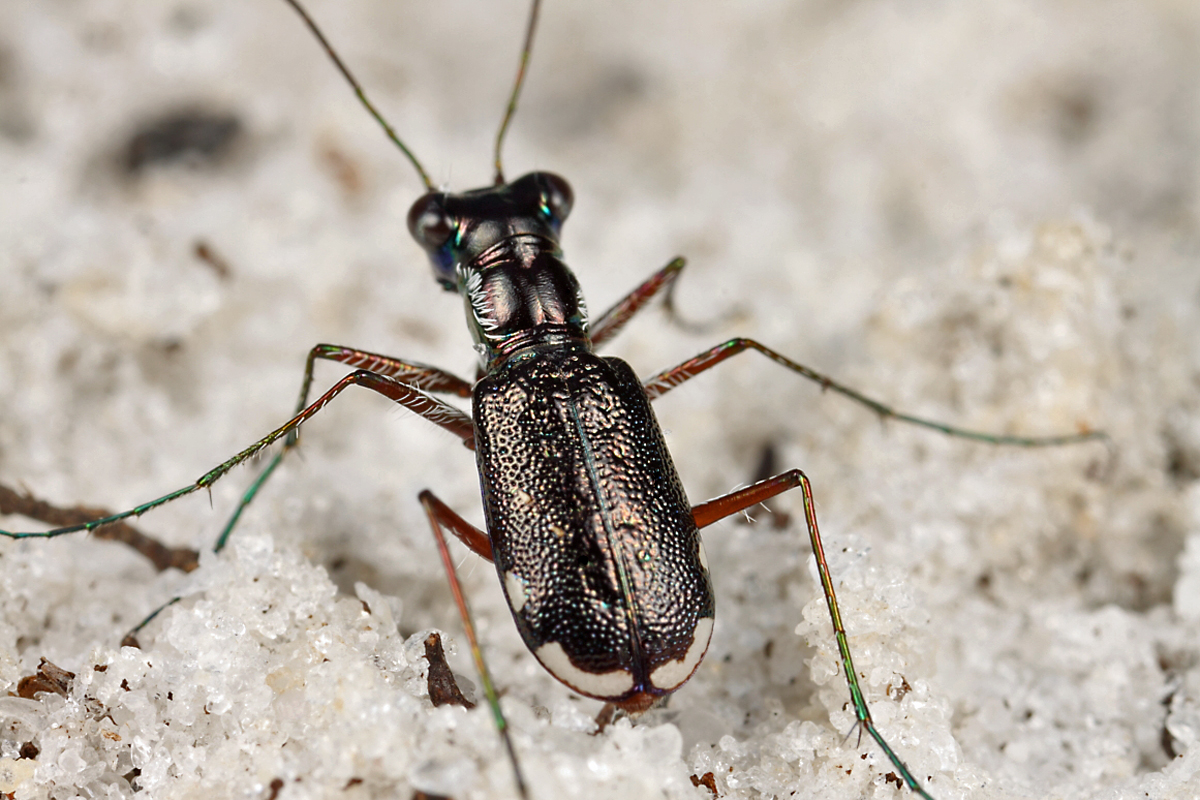
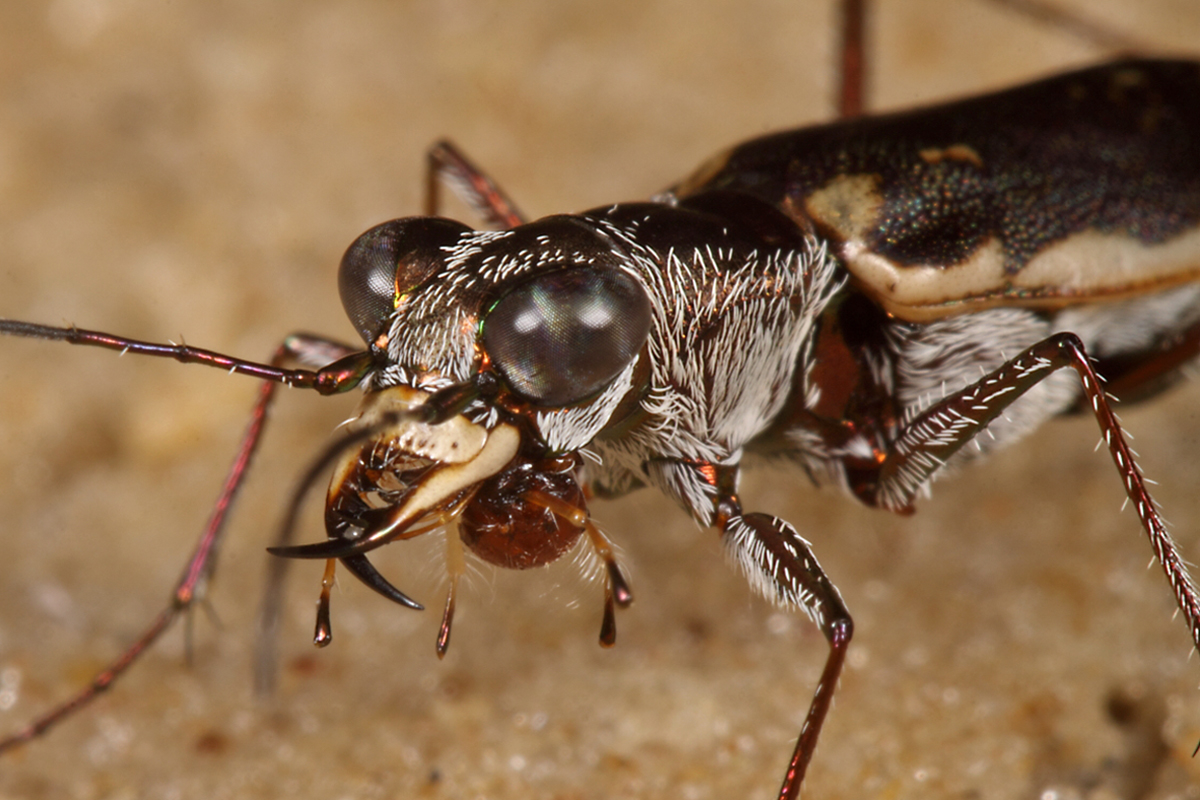
Black, sculptured elytra and dense lateral bands of pronotal setae distinguish this species.

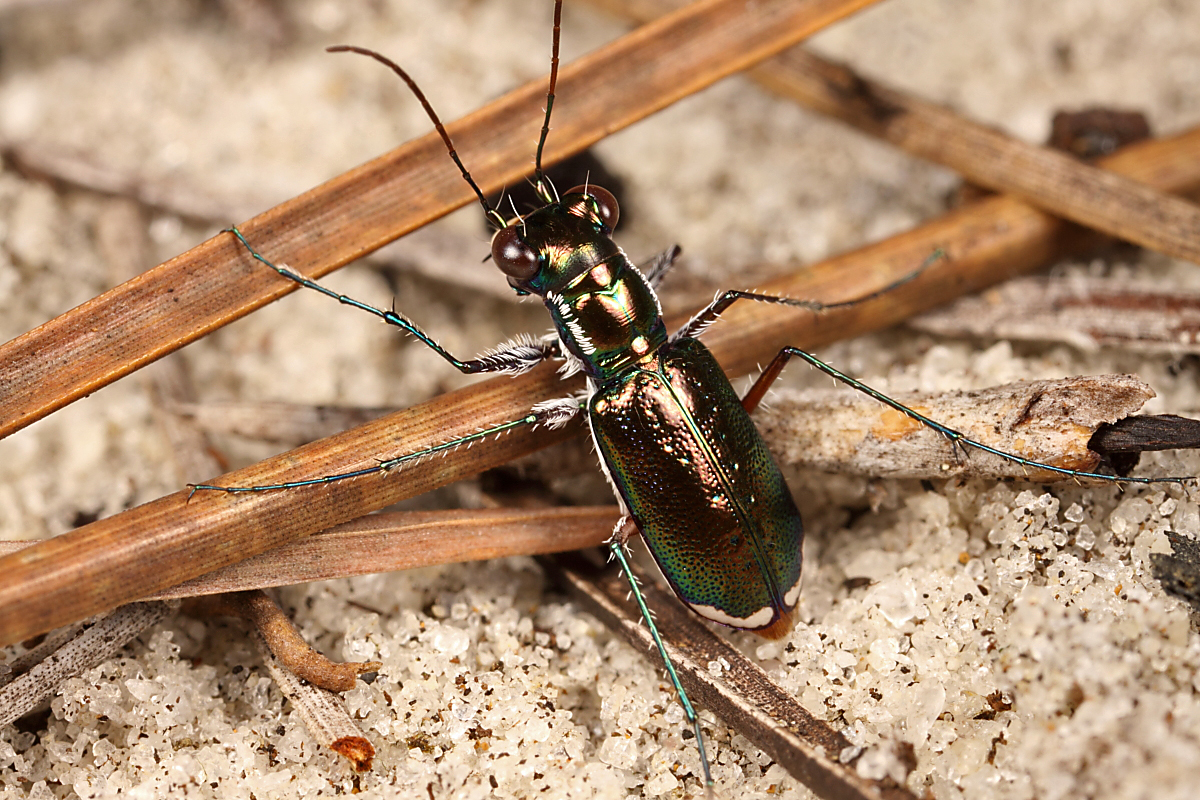
There is little doubt about the distinctiveness of C. scabrosa compared to C. abdominalis and C. highlandensis, as neither of the latter two species exhibit the distinctly scabrous elytra or rows of flattened setae on the sides of the pronotum exhibited by C. scabrosa.  The distinction of C. scabrosa from C. floridana, however, is more subtle—C. scabrosa is shiny black and always exhibits a post median marginal spot anterior to the apical lunule, while C. floridana is shiny green and usually lacks the post median marginal spot.  In addition, the legs of C. floridana are somewhat lighter in coloration than those of C. scabrosa.  The difference in coloration is subtle in preserved specimens but obvious in living individuals.  After seeing the C. scabrosa in the field one day and C. floridana the next, my first thought regarding the latter was, “Wow, that’s different!”—a result of the brilliant coppery highlights that are quite evident in living individuals but apparently fade in preserved specimens.
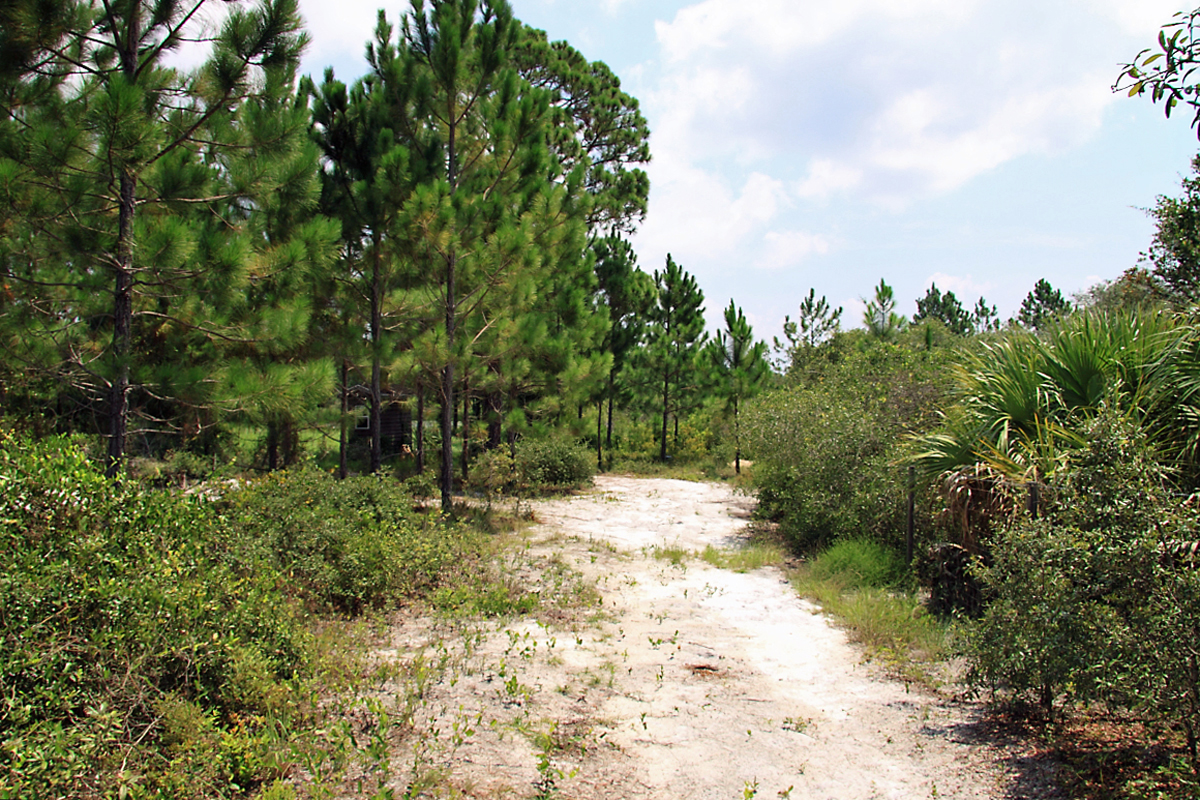
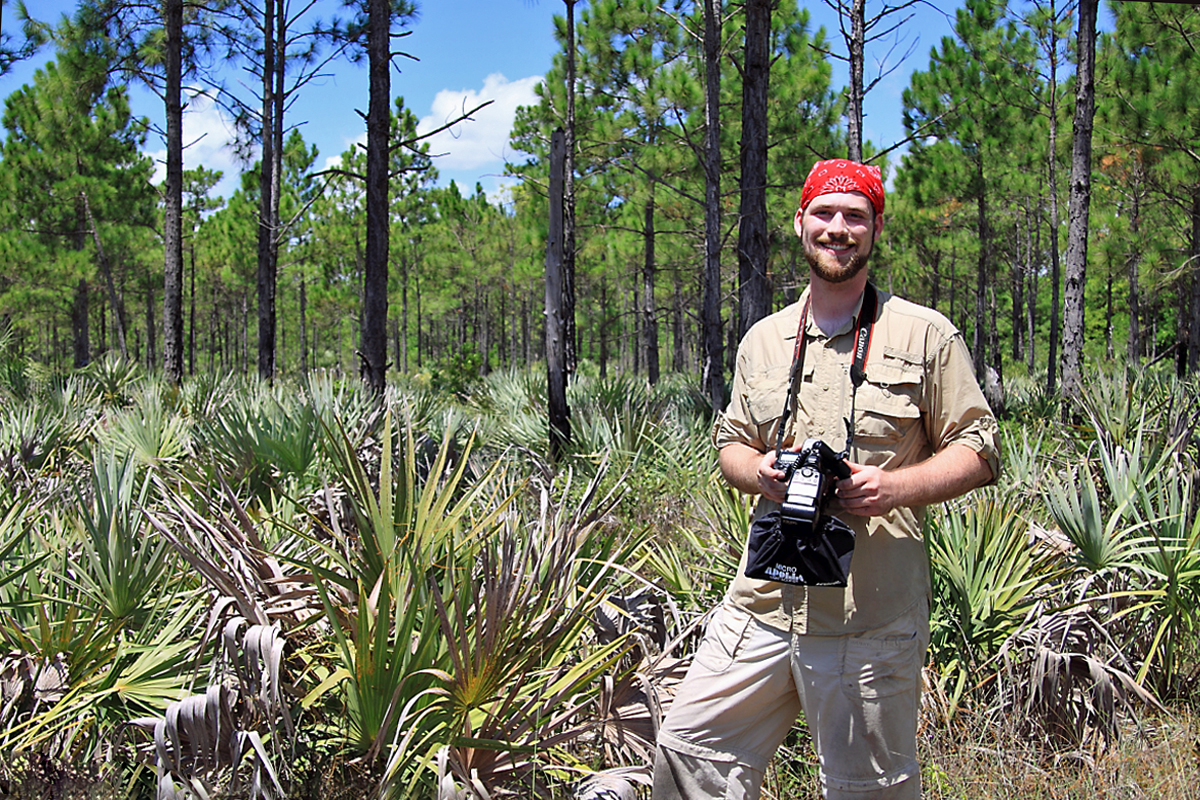
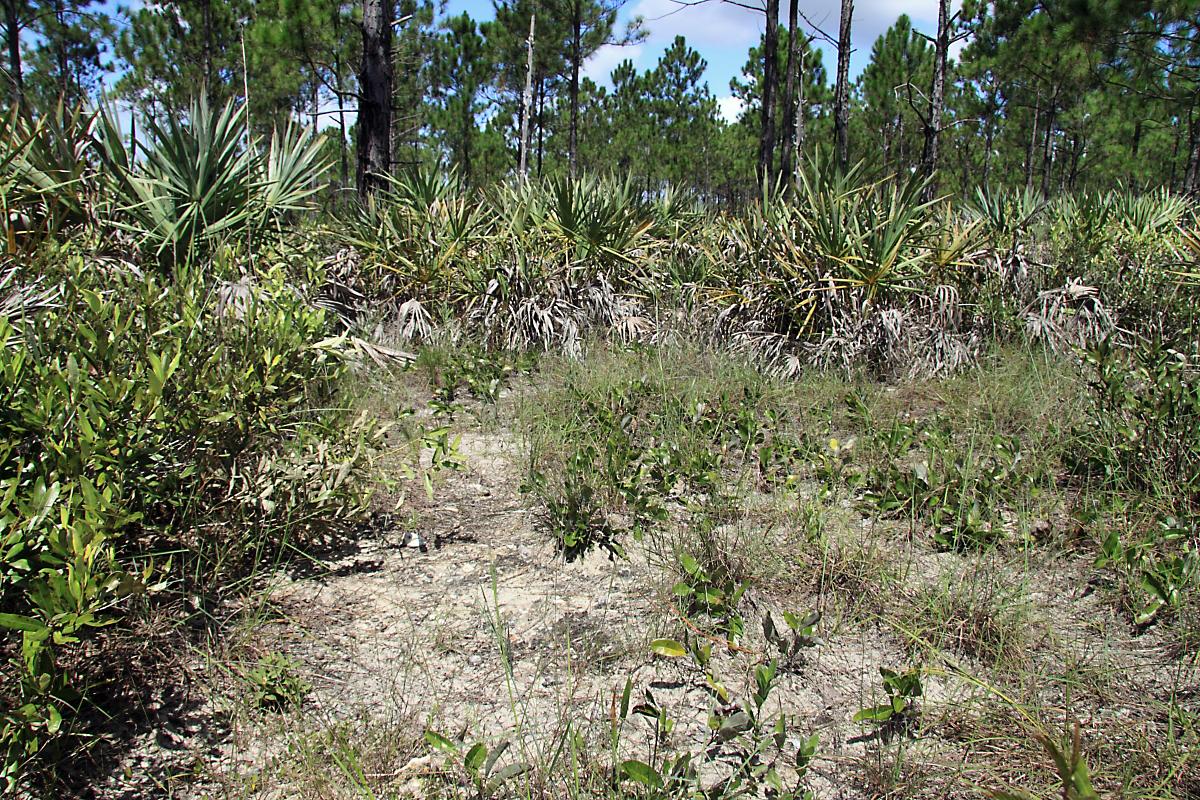
Sand pine scrub, habitat for Cicindelidia scabrosa and Ellipsoptera hirtilabris

The distinction between C. scabrosa and C. floridana is not limited to subtle morphological characters—included also are differences in habitat, distribution, and seasonal occurrence.  Cicindelidia scabrosa occurs broadly across the Florida peninsula in sand pine scrub, a xeromorphic plant community featuring an open canopy of sand pine (Pinus clausa) growing on well-drained, infertile, sandy soils (Brzoska et al. 2011).  The species is absent, however, from much of south Florida where the wet areas of the Everglades limit availability of suitable habitat.  Cicindelidia floridana, on the other hand, is restricted to a small area of Miami-Dade County and parts of the Keys where pine rockland habitat, a savanna-like forest of Florida slash pine (Pinus elliotti var. densa) and scrub understory, can be found growing on limestone outcrops.  The photos in this post were taken on an open 2-track through sand pine scrub near Cedar Key Scrub State Preserve.  Occurring here in asscociation with C. scabrosa was another (almost) Florida-endemic tiger beetle, Ellipsoptera hirtilabris (Moustached Tiger Beetle), which I have also seen in association with C. abdominalis and C. highlandensis (but not C. floridana).
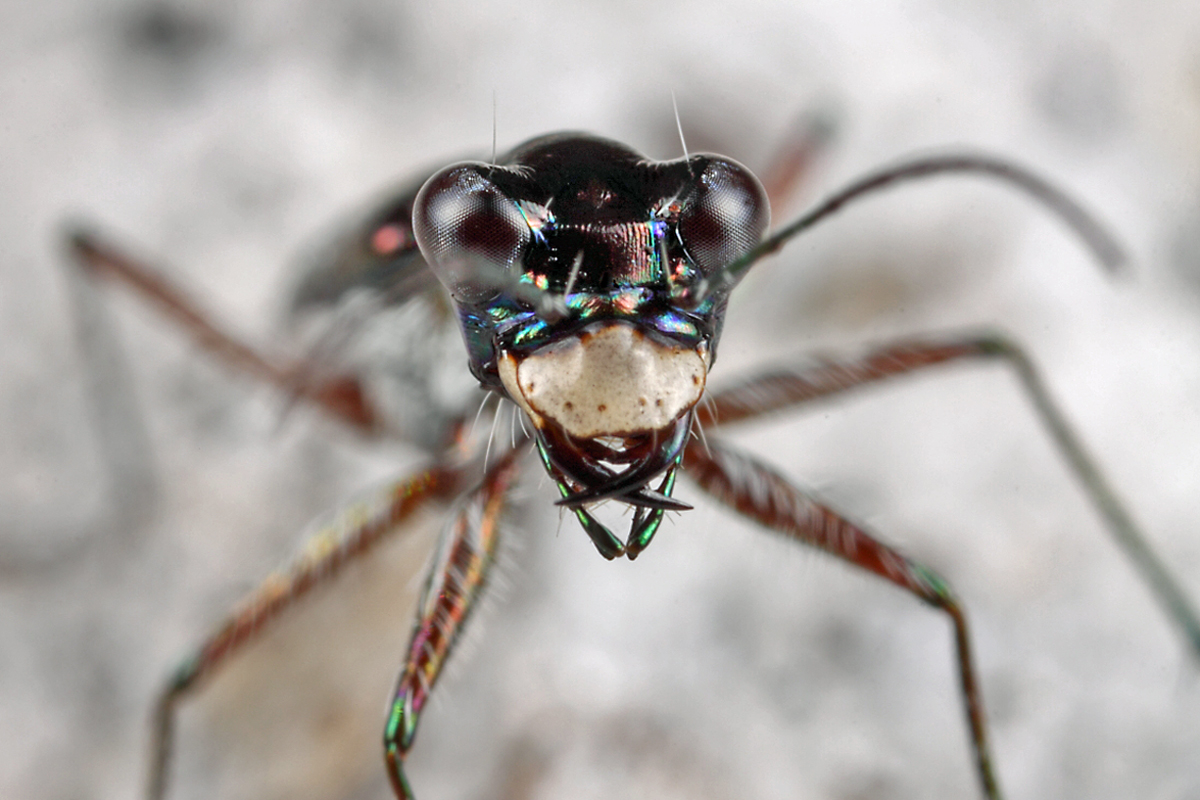
The obligatory face shot!

It is perhaps redundant for me to state that it was extraordinarily hot while I photographed these beetles.  Temperatures were already approaching 90°F when I found the first individuals, and by mid-day when they finally disappeared it was nearly 100°F.  Add to that the mid-summer Florida humidity, and I was about as soaked as I ever get. It’s a photographer’s nightmare—trying to protect expensive gear while scrumming through the sand and sweating profusely, all the while still trying to get the perfect shot!  The beetles were smart enough to call it a day at 12:30 p.m., and I must say I didn’t mind having to get into an air-conditioned car, chug a quart of ice-cold Gatorade, and spend the next several hours not broiling under the hot Florida sun while making the long drive south.

REFERENCES:

Brzoska, D., C. B. Knisley, and J. Slotten.  2011.  Rediscovery of Cicindela scabrosa floridana Cartwright (Coleoptera: Cicindelidae) and its elevation to species level. Insecta Mundi0162:1–7.

Pearson, D. L., C. B. Knisley and C. J. Kazilek. 2006. A Field Guide to the Tiger Beetles of the United States and Canada.Oxford University Press, New York, 227 pp.

Copyright © Ted C. MacRae 2011
Predator or Prey?

Ellipsoptera hamata lacerata | Dixie Co., Florida

Everyone knows that tiger beetles are predators, but look closely at the underside of the head of this female Ellipsoptera hamata lacerata (Gulf Beach Tiger Beetle), photographed in a coastal marsh in Dixie Co., Florida earlier this month.  See the ant head attached by its mandibles to the base of the tiger beetle’s left maxillary palpus?  Detached ant heads latched onto the palp or antenna of a tiger beetle are a fairly common sight—Pearson and Vogler (2001) show the head of an ant attached to the antenna of Eunota togata (Cloaked Tiger Beetle), and Pearson et al. (2006) show one attached to the antennae of Cicindela formosa (Big Sand Tiger Beetle).  I’ve also photographed Cylindera celeripes (Swift Tiger Beetle) with an ant head attached to its antenna.  Pearson and Vogler (2001) and Pearson et al. (2006) both suggest that the ant heads are the result of predation attempts by groups of ants attempting to overpower and kill the tiger beetle, making the ants the predators and the tiger beetles the prey.

Note ant head attached by its mandibles to the base of the tiger beetle's left maxillary palpus.

Although some ants are well known for their predatory horde behavior, I’m not sure I buy this as an explanation for the common occurrence of ant heads attached to tiger beetles.  Tiger beetles themselves often prey on ants, and while I have seen numerous tiger beetles with ant heads attached to them, I have never seen one actually being overpowered by ants (scavenging an already dead tiger beetle, yes—but not overpowering and killing one).  Moreover, the ant heads are nearly always attached to the base of an antenna or palpus—right next to the tiger beetle’s mouth, and almost never on more distal parts of the antennae or other parts of the body.  If the ants were attempting to prey on the tiger beetle, wouldn’t they also (if not even more commonly) be found attached to the tiger beetle’s legs or soft intersegmental membranes?  And how would the ants have come to be decapitated while in the act of attempting to overpower the beetle?  I suggest it is more likely that the ants were prey, latching onto the nearest part of their killer’s body in a last ditch attempt to avoid their inevitable fate.  The antennal and palpal base are about the only tiger beetle body parts that would be within reach of an ant in a tiger beetle’s toothy grasp.  While the rest of the ant was consumed, the head remained because it was firmly attached to the beetle.

I realize that an identification based only on the detached head of an ant may be difficult, but if one is possible it would be appreciated.  The ant head shown in Pearson and Vogler (2001) was identified as Polyergus sp.

REFERENCES:

Pearson, D. L., C. B. Knisley and C. J. Kazilek. 2006. A Field Guide to the Tiger Beetles of the United States and Canada. Oxford University Press, New York, 227 pp.

Pearson, D. L. and A. P. Vogler.  2001. Tiger Beetles: The Evolution, Ecology, and Diversity of the Cicindelids.  Cornell University Press, Ithaca, New York, 333 pp.

Copyright © Ted C. MacRae 2011
Photographing the Newly Rediscovered Cicindelidia floridana

Cicindelidia floridana | Richmond Heights area, Miami-Dade Co., Florida

When Brzoska et al. (2011) announced the rediscovery of Cicindelidia floridana last April (and also provided convincing evidence for considering it a full species), I could hardly contain my excitement. At a time when increasing numbers of species are being reported in decline or going extinct, the news that this small jewel of a beetle had somehow managed to survive in tiny chunks of remnant habitat (completely surrounded by the sprawling metropolis of Miami) after having not been seen for more than half a century and presumed extinct (Pearson et al. 2006) was cause for celebration.  For me, the timing couldn’t have been better as I was already planning a visit to Florida later in the summer to spend a little time with my family and—of course—search for some of Florida’s several endemic tiger beetle species.  The precise locations where C. floridana have been found have not been publicly disclosed (for obvious reasons), but when I contacted lead author Dave Brzoska and told him of my plans to be in Florida this summer and my interest in seeing the beetles, he graciously offered to take me to the sites himself.  Expedition turned to party when Chris Wirth, author of the cicindelocentric blog Cicindela, made arrangements to fly down from Virginia and join Dave and I on our trip.  This would be Chris’ second visit to see the beetles, having been one of the very lucky first few to see it after its rediscovery while assisting second author Barry Knisley on the initial surveys that were conducted.  For me, it was a cicindelophile’s dream come true—a day in the field with Dave (whom I had not seen in more than 25 years), meeting Chris for the first time, and looking for and (hopefully) photographing one of North America’s rarest tiger beetles.

Pine rockland habitat for Cicindelidia floridana.

Adults beetles frequent sparsely vegetated sandy exposures in the palmetto understory.

After a delightful evening looking at meticulously curated specimens in Dave’s astounding collection, the three of us left early the following morning from his home in Naples to make the 2½-hr drive to Miami.  Temperatures in south Florida during early August can soar as the day progresses, and as they do the beetles—already flighty and difficult to observe—become even more so before eventually taking refuge under debris.  We arrived at the first site right at mid-morning, at which time I was allowed to remove my blindfold (just kidding!).  One of the features that distinguishes this species from C. scabrosa is its habitat—south Florida pine rockland as opposed to the more widespread peninsular sand pine scrub habitat frequented by C. scabrosaPine rockland is a fire-adapted community composed of an open canopy of south Florida slash pine (Pinus elliottii var. densa) and a diverse understory of cabbage palm (Sabal palmetto) and other shrubs.  As I readied my camera gear, Dave told me to look for small exposures in the understory and then watch them for any sign of movement.  The adult beetles, despite their brilliant coloration, are among the smallest tiger beetle species and are exceedingly difficult to detect amongst the vegetation and debris covering the soil.  I could have just let Dave look for the beetle first while I tagged along and then let him “show” them to me, but I wanted to find them for myself, so I struck out on my own and started searching.

Shiny green coloration and reduced elytral maculation distinguish this species from C. scabrosa.

It wasn’t long before I heard Dave and Chris call out that they had seen one, and while the temptation was great to go over to where they were and look at what they had already found, I stayed the course and continued searching on my own.  Finally, I saw one!  It was gorgeous and brilliantly colored—much more copperish in appearance than I had expected (Dave later explained that this is something seen better in the live beetles and not so well in preserved specimens).  Deciding how to approach an unfamiliar tiger beetle for photography is always a crap shoot—until one gets a feel for its behavior and the way it reacts to movement it is difficult to know precisely how to approach it.  I had gone ahead and tempted fate by mounting my 65mm macro lens and its very short working distance, so I would need to draw on the entirely of my experience in photographing tiger beetles to figure out how to get close enough to these beetles to photograph them.  I hadn’t even gotten down on my knees yet before the first adult took flight and disappeared before my eyes.  Knowing what to look for now, I continued searching and found another adult after a short time—with the same result!  Beetle after beetle appeared before me on the sparsely vegetated sand openings and then zipped away well before I had the camera in position.  Finally, by about the 10th beetle that I saw I found one that seemed a little more cooperative (or maybe I had just finally learned how to move in on them).  I carefully, slowly layed down on the ground and got the camera in position as the beetle skitted here and there, obliviously feeding on the occasional ant, then located it in the viewfinder and started firing off shot after shot.  The two photos above represent my favorites from that series and well show not only the elytral sculpturing and flattened pronotal setae that distinguish both this species and C. scabrosa from the other members of the group (C. abdominalis and C. highlandensis), but also the bright greenish coloration, reduced elytral maculation, and lighter leg coloration that Brzoska et al. (2011) used as justification for elevation to a full species distinct from C. scabrosa.

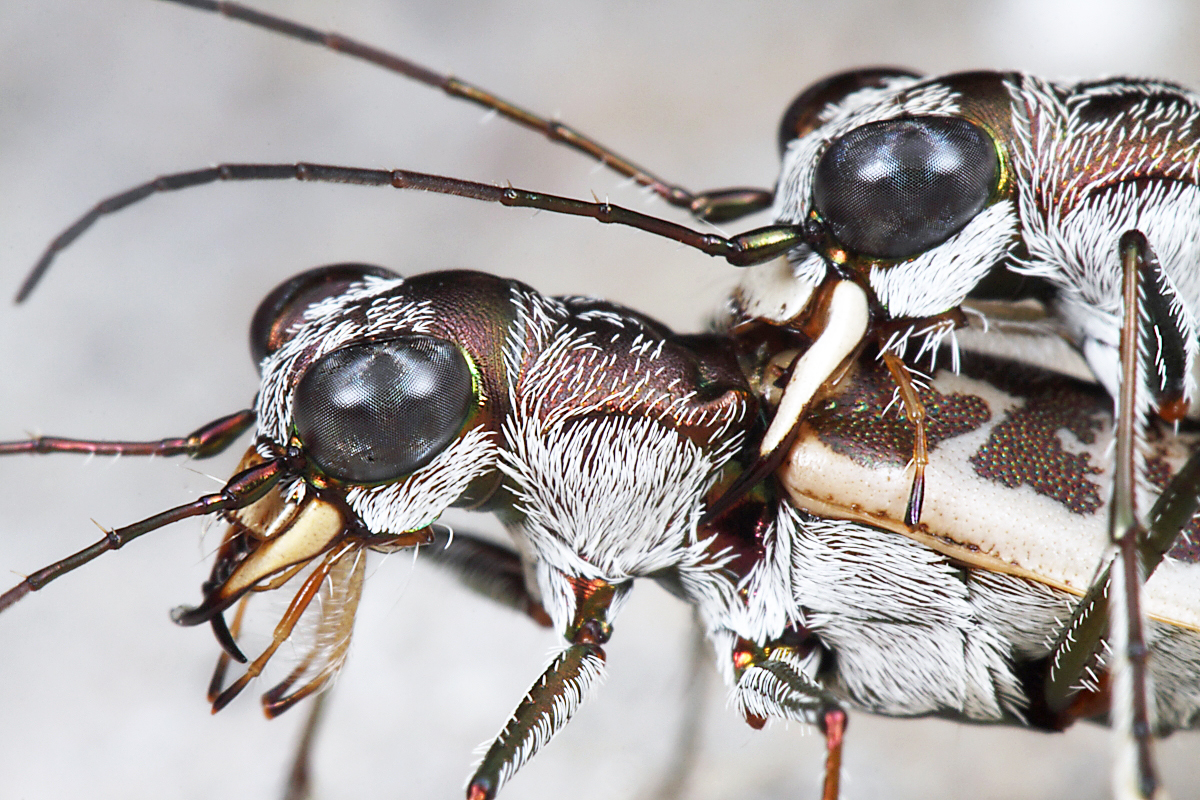
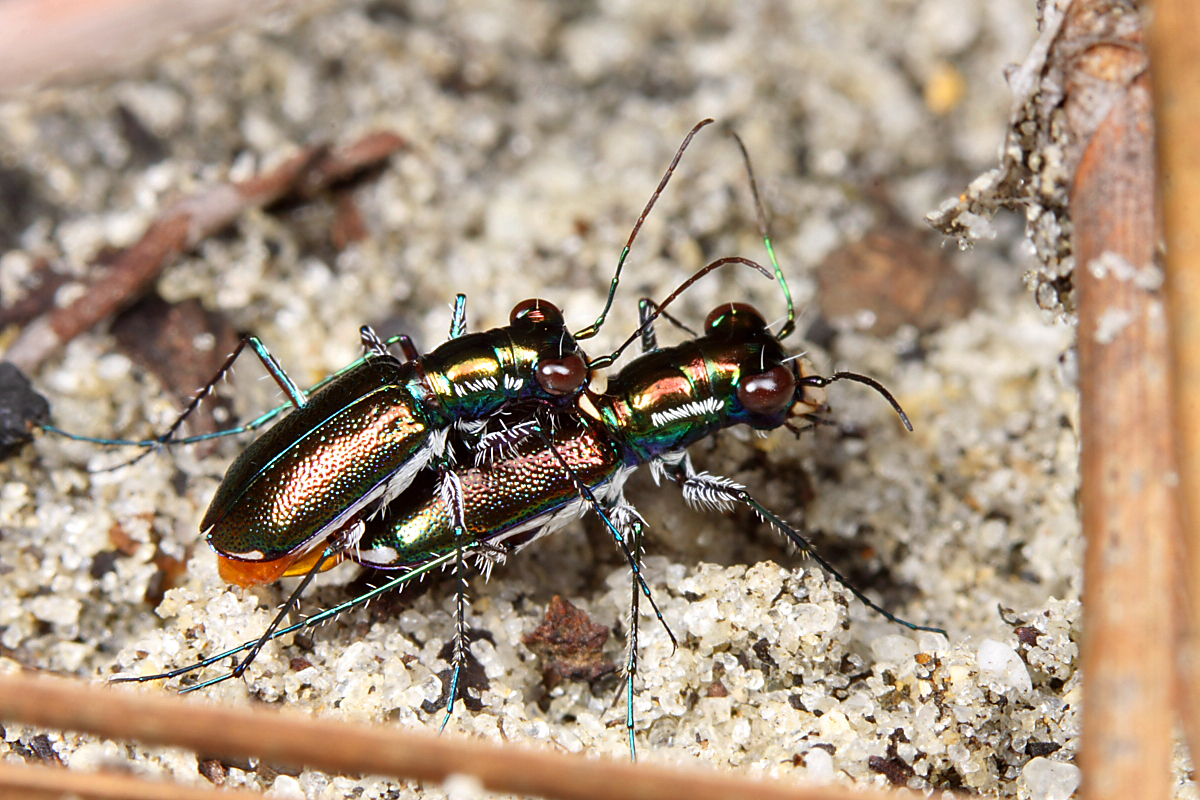
Cicindelidia floridana adults mating.

After failing to get more shots of the next 10 or so adults that I found, I saw a male hop on top of a female and attempt to mate.  I quickly got into position to photograph them, but just as I got them framed they uncoupled and ran their separate ways.  I figured I had probably lost my only chance to photograph a mating pair, but shortly afterwards I encountered another couple that was already engaged.  I saw them before they became disturbed and moved, and as a result I found it relatively (relatively!) easy to get in position and begin photographing without alarming them.  Tiger beetles are often encountered coupled but not actively mating, as the males will often ‘mate guard’ a female for an extended period after mating to prevent other males from mating with her (in many beetles, the last male to mate with a female stands a greater chance of fertizilizing the eggs she lays) (Pearson and Vogler 2001).  This couple, however, was actively engaged as evidenced by the exserted male genitalia firmly penetrating the female genital opening.

Genitalia actively engaged.

I watched the mating pair for a period of time and notice that at times the male held the female more tightly with his front legs, while at other times he held his front legs extended widely out to the sides.  I have seen this same behavior in nearly every tiger beetle species in which I have observed mating pairs and have yet to find or intuit an explanation.  The male has dense, brush-like pads on the undersides of the front tarsi, which presumably are used to aid in grasping the female during mating and may also possibly aid in signaling during courtship.  Perhaps extending the legs to the sides is done at times when the female is not struggling to dislodge the male (itself an interesting subject), allowing them to serve a tactile function to better warn against intruding males.

Sometimes the male held his forelegs against the female...

...while other times the forelegs were extended widely to the sides.

All told we spent about 2½ hours at the site, and I estimate that I saw a total of approximately 30 beetles.  Some may have been the same as those I had seen before, since I tended to focus my searches in three small areas of sandy exposures not too distant from each other.  Chris and Dave each worked separate areas as well, also seeing a good number of beetles and suggesting that the population at this site, despite the limited extent, is quite good.  Puddles of water on the road as we entered the site indicated that the site had received recent rains, which may have been at least partly responsible for the level of adult activity observed. We drove by additional pine rockland remnants in the vicinity before heading back to Naples, some of which are known to contain the beetle and others that still need additional survey to determine the presence of the beetle and its status. With an extent of suitable habitat that is among the smallest of all North American tiger beetles, I suspect that C. floridana will be a good candidate for listing on the Endangered Species List. It will be a second chance for the beetle—and for us to see if we will be able to muster the will to save a species once thought extinct from actually becoming so.

Me with Dave "Dr. Tiger Beetle" Brzoska.

Tiger beetle photographer extraordinaire Chris Wirth.

Congratulations to Ben Coulter, who returns to his winning form and takes this first round in the current BitB Challenge Session (#4) with 14 points. Dave Hubble takes 2nd with 12 points, while Mr. Phidippus and FlaPak tie for the final podium spot with 10 points each.  Nine other participants tested their skills, and if you didn’t play, they’ve all now got the jump on you!

REFERENCES:

Brzoska, D., C. B. Knisley, and J. Slotten.  2011.  Rediscovery of Cicindela scabrosa floridana Cartwright (Coleoptera: Cicindelidae) and its elevation to species level. Insecta Mundi 0162:1–7.

Pearson, D. L., C. B. Knisley and C. J. Kazilek. 2006. A Field Guide to the Tiger Beetles of the United States and Canada.Oxford University Press, New York, 227 pp.

Pearson, D. L. and A. P. Vogler. 2001. Tiger Beetles: The Evolution, Ecology, and Diversity of the Cicindelids.  Cornell University Press, Ithaca, N.Y., xiii + 333 pp.

Copyright © Ted C. MacRae 2011
Tiger Beetle Nocturnal Perching

Ellipsoptera hamata lacerata | "Road to Nowhere" Dixie Co., Florida

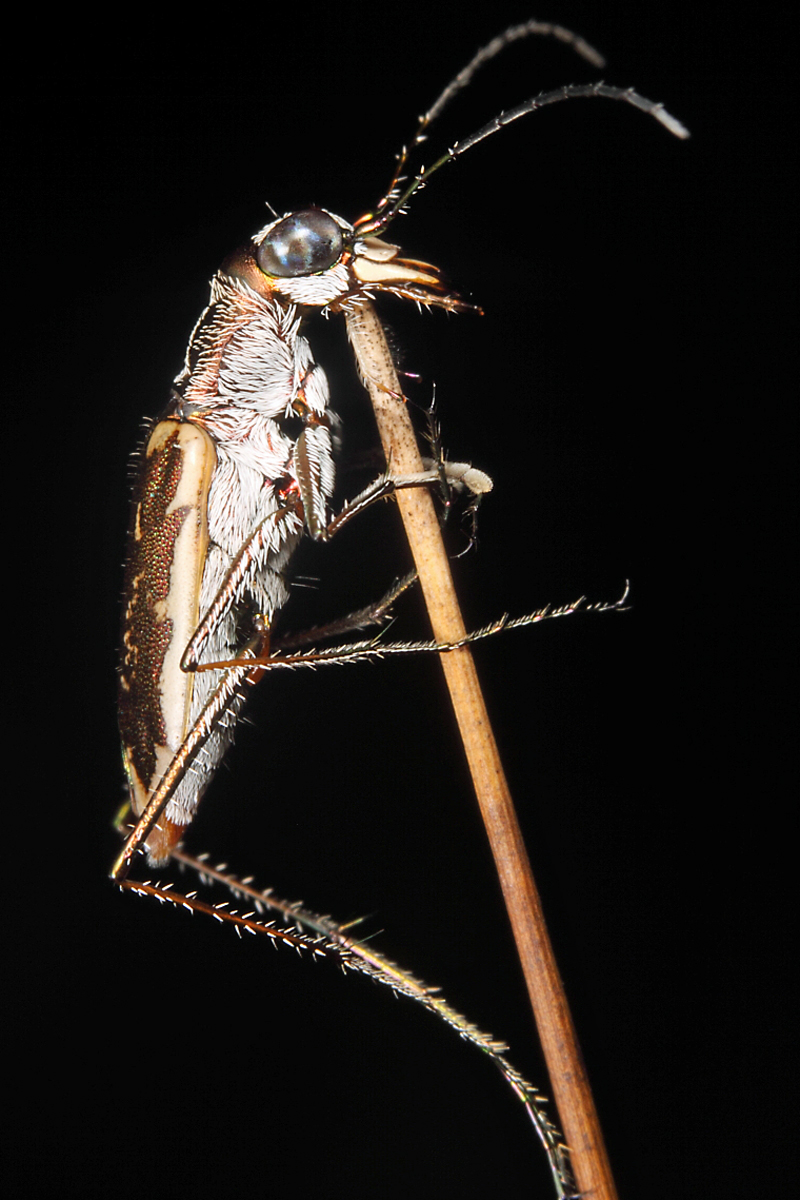
During last week’s 48-hour blitz through Florida, I spent one evening blacklighting at the famed “Road to Nowhere” tiger beetle hot spot and encountered this male individual of Ellipsoptera hamata lacerata¹ clinging to the grass near my light.  A quick search of the surrounding area revealed a number of similarly perched individuals, including a mating pair and all representing the same species.

¹ Males (identified by the brushy pads under the foretarsi) of this species are distinguished from the closely related E. marginata, which co-occurs with E. hamata lacerata along the Gulf coast of Florida, by the lack of a distinct tooth on the underside of the right mandible.

Like many species in this and related tiger beetle genera, E. hamata is diurnal but also highly attracted to lights at night. This is thought to be related to nocturnal dispersion behaviors (Pearson and Vogler 2001) intended to avoid higher daytime predation risks. Nocturnal perching on foliage is also common among diurnally-active species in riparian habitats and seems also to be an adaptation for reducing predation. Pearson and Anderson (1985) noted that perched beetles removed from the grass and placed on the ground were often quickly preyed upon by larger nocturnally-active tiger beetles. At “Road to Nowhere” this might include the slightly larger Habroscelimorpha severa which occurred in enormous numbers alongside this species on the mud flats, or the much larger Tetracha virginica which occurred in fair numbers on the adjacent road.

REFERENCES:

Pearson, D. L. and J. J. Anderson.  1985. Perching heights and nocturnal communal roosts of some tiger beetles (Coleoptera: Cicindelidae) in southeastern Peru.  Biotropica 17(2):126–129.

Pearson, D. L. and A. P. Vogler. 2001. Tiger Beetles: The Evolution, Ecology, and Diversity of the Cicindelids.  Cornell University Press, Ithaca, N.Y., xiii + 333 pp.

Copyright © Ted C. MacRae 2011

Charming Couple

You may have noticed a longer than normal interval since the last post (or not)—the result of a family vacation to Florida.  I’m not much of a beach bum, so while the girls found inordinate pleasure laying on the hot sand and doing absolutely nothing while being baked to a crisp by the almost tropical Florida sun, I took the opportunity to look for some of Florida’s gorgeous and often endemic tiger beetles.  I visited a diversity of habitats to both the north and south of my base near St. Petersburg ranging from white sand beach to salt marsh to oak/pine sand scrub to pine rockland.  I photographed tiger beetles both at night and during the day (laying on the hot sand while being baked to a crisp by the almost tropical Florida sun!).  In total I encountered eleven tiger beetle species—five of them true Florida endemics.  We’re on our way back now, and photos are just now getting downloaded and processed, so I’m not quite ready yet to begin sharing stories in earnest.  Until then, here is a photograph of a mating pair of one of Florida’s classic coastal tiger beetle species, Ellipsoptera hamata lacerata (Gulf Beach Tiger Beetle).

Ellipsoptera hamata lacerata (Gulf Beach Tiger Beetle) | Seminole, Florida

Photo Details: Canon 50D (ISO 160, 1/200 sec, f/16) w/ 100mm macro lens + Kenko DG extension tubes (68 mm), Canon MT-24EX flash w/ DIY oversized concave diffuser. Post-processing to adjust levels and apply unsharp mask.

Copyright © Ted C. MacRae 2011

Monday Moth – Polka-dot Wasp Moth

Syntomeida epilais - polka-dot wasp moth

It’s been a while since I’ve done a Monday Moth post, so I thought I’d feature one of the prettier specimens in my very limited Lepidoptera collection.  This is Syntomeida epilais (polka-dot wasp moth), one of four species in the genus that occurs in the United States.  This particular specimen was collected by me way back in the mid-1980s (I was not quite yet the discriminating beetle collector that I am now) in Everglades National Park (yes, I had a permit).  The bright, contrasting coloration obviously screams aposematism (warning coloration), and in fact the tissues of the adult moths of this species are chock-full of several cardiac glycosides sequestered by the larva from its now preferred food plant, oleander (Nerium oleander).  Add to it their somewhat wasp-like appearance, and there should be no question to any would-be predator that these moths are a bad idea.  Wasp moths are related at the tribal level to another group of wasp-like moths called maidens which are restricted to the Old World.  I featured one of these from South Africa last year in the post, Monday Moth – Simple Maiden (Amata simplex).

If the cardiac gycosides stored in the tissues of this moth aren’t enough to cause gastric distress, trying to digest the higher taxonomic history of this group surely will.  Back in my school days, this moth belonged to the family “Ctenuchidae.”  As best I understand it, this group was later subsumed into the tiger moth family “Arctiidae” – itself later subsumed within the borg of all moth families, the Noctuidae.  In the most recent classification I’ve found, the arctiine moths have been pulled back out of the Noctuidae and combined with the former “Lymantriidae” (propelled to infamy by the gypsy moth) to form the family Erebidae (Lafontaine and Schmidt 2010).  Are you ready to purge yet? It’s still not clear to me whether this latest incarnation represents a consensus monophyletic unit, but it really doesn’t matter – whenever I see wasp moths, maidens, and especially the ctenucha moths that are so common in my area on goldenrod flowers during the fall, “ctenuchid” will still be the first name that comes to my mind.

REFERENCE:

Lafontaine, J. D. and B. C. Schmidt.  2010.  Annotated check list of the Noctuoidea (Insecta, Lepidoptera) of North America north of Mexico.  ZooKeys 40:1–239.  doi: 10.3897/zookeys.40.414

Copyright © Ted C. MacRae 2011


BitB Best of 2009

In my first post of 2009, I looked back at the photographs I had posted during 2008 and picked some of my personal favorites. I hesitated then to call myself a photographer (and still do), but I at least now have suitable equipment to aid in my progress toward that eventual goal. I have learned much over the past six months in my first attempt at serious insect macrophotography (prioritizing in situ field photographs of unmanipulated subjects as a matter of personal choice).  Through this, I’ve come to realize the following skills to be the most important for success:  

  1. Composition
  2. Understanding lighting
  3. Knowing how to use a flash
  4. Knowledge of the subject

I’ll give myself a “A” in the last of these, but in the other areas I still have much to learn. With this caveat, and for the last post of 2009, I offer the following twelve photographs as my final choices for the 2nd Annual “Best of BitB”:  

Best beetle

Cylindera celeripes (swift tiger beetle), Woodward Co., Oklahoma

From Revisiting the Swift Tiger Beetle – Part 1 (June 30).  A decent enough photograph, especially considering that I’d had my camera for about a month when I took it.  However, the discovery of robust populations of this formerly rare and enigmatic species throughout northwestern Oklahoma (and later also in northwestern Missouri) was the most significant find of the 2009 field season, and this photograph is the best capture of that moment.

Best fly

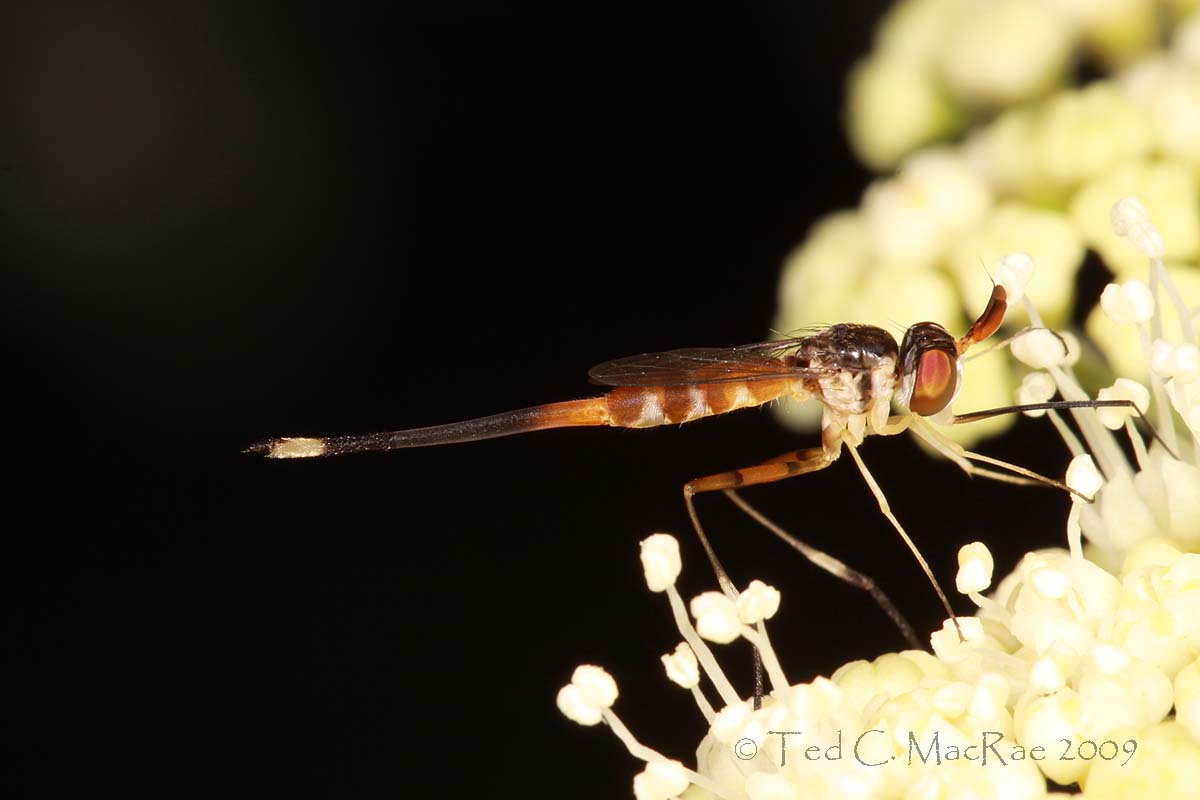
Stylogaster neglecta, a species of thickheaded fly

From Overlooked, needle-bellied, thick-headed fly (Aug 14).  One of my first good “black background” shots.  The white tip of the abdomen compliments the white flower stamens against the background.

Best “true” bug

Beameria venosa, a prairie obligate cicada

From North America’s smallest cicada (Aug 4).  So many different shades of green with white frosting on the bug’s body.  I tried taking this shot in portrait and it just didn’t work—I liked this landscape shot much better.

Best predator

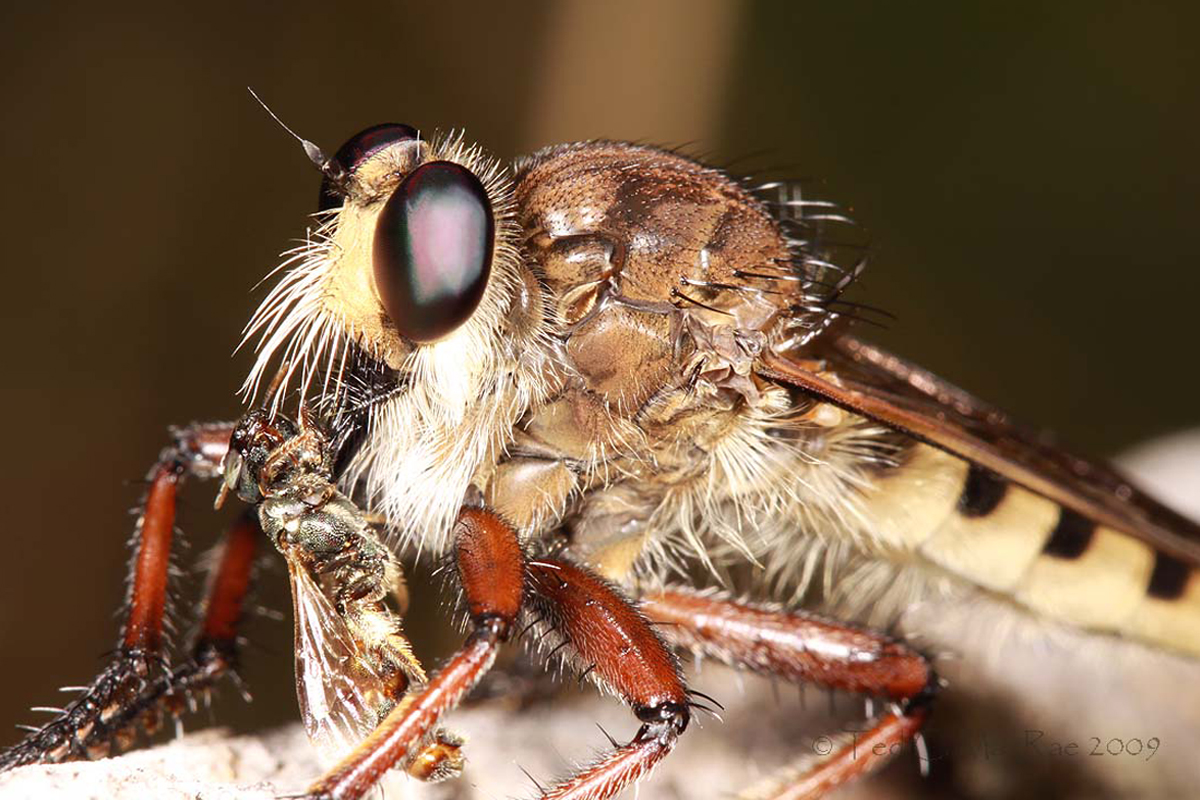
Promachus hinei (Hines giant robber fly) & Ceratina sp. (small carpenter bee) prey

From Prey bee mine (Sept 14).  Robber flies are immensely photogenic, especially those in the genus Promachus due to their prominent “beards.”

Best camoflauge

Dicerca obscura on bark of dead persimmon

From The “obscure” Dicerca (June 19).  Sparkling and gaudy as specimens in a cabinet, the coloration of many jewel beetles actually helps them blend almost perfectly with the bark of their preferred tree hosts.

Best immature insect

Tetracha floridana (Florida metallic tiger beetle) 3rd-instar larva

From Anatomy of a Tiger Beetle Larva (Oct 22).  “Otherwordly” is invariably the first word that comes to mind when someone sees a tiger beetle larva for the first time.  I was lucky enough to get this one in profile with a nice view of its abdominal hump and its curious hooks.

Best arachnid

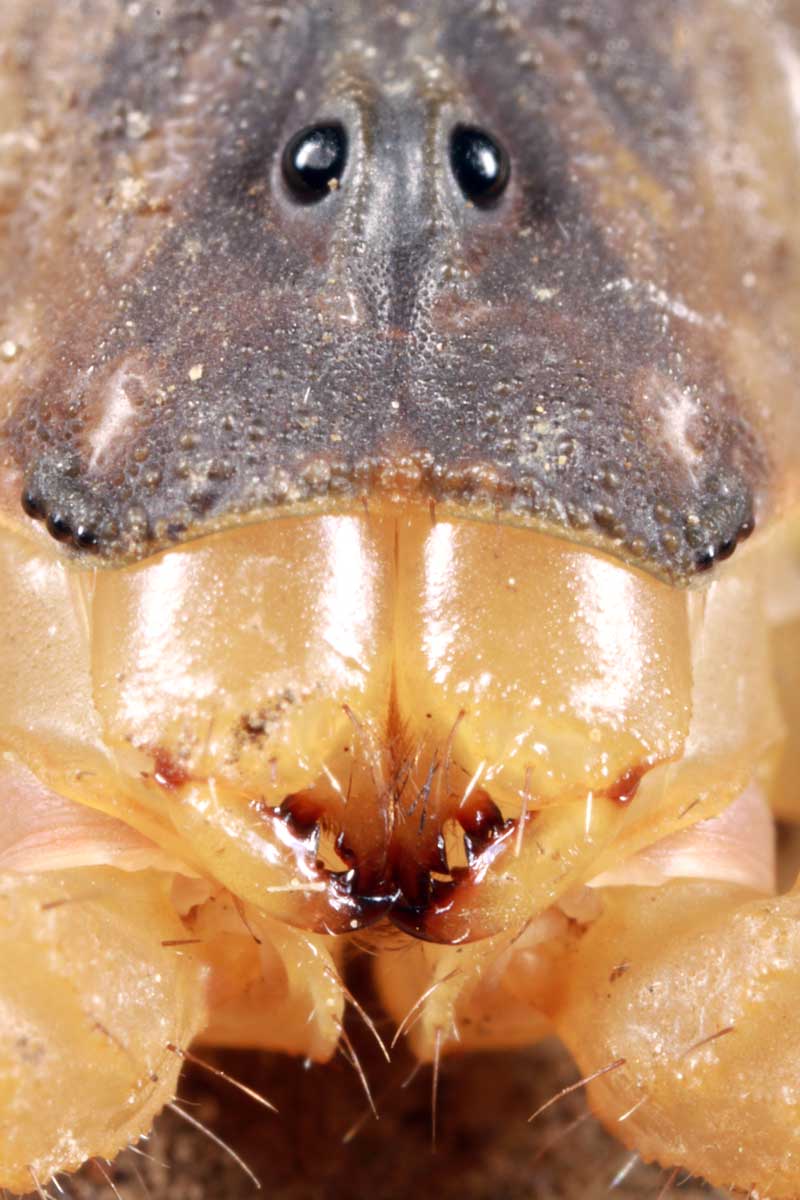
Centruroides vittatus (striped bark scorpion)

From A face only a mother could love (Oct 6).  Despite some minor depth-of-field problems with this photograph, I’m fascinated by its “smile.”

Best reptile

Eastern collared lizard (Crotaphytus collaris collaris) adult male

From North America’s most beautiful lizard (July 10).  A simply spectacular lizard—all I had to do was frame it well and get the flash right.

Best wildflower

Spiranthes magnicamporum (Great Plains ladies

From Great Plains Ladies’-tresses (Dec 7).  Few flowers are as photogenic as orchids, even native terrestrials with minute flowers such as this one.  I like the frosty texture of the lip and the starkness of the white flower on the black background.

Best natural history moment

Thermoregulatory behavior by Ellipsoptera hirtilabris (moustached tiger beetle)

From Tiger Beetles Agree—It’s Hot in Florida! (Dec 18). I chose this photo for the classic “stilting” and “sun-facing” thermoregulatory behaviors exhibited by this tiger beetle on a blistering hot day in Florida.

Best closeup

Megaphasma denticrus (giant walkingstick)

From North America’s longest insect (Aug 21).  I haven’t tried a whole lot of super close-up photographs yet.  I liked the combination of blue and brown colors on the black background.

Best Landscape

Sand Harbor Overlook, Lake Tahoe, Nevada

From Sand Harbor Overlook, Nevada (March 23).   My choice for “best landscape” again comes from Lake Tahoe.  This is not a great photo technically—I was still using a point-and-shoot and had to deal with foreground sun.  However, none of the other photos I took during my March visit to the area captivate me like this one.  I like the mix of colors with the silhouetted appearance of the trees on the point.

Copyright © Ted C. MacRae 2009

Add to FacebookAdd to DiggAdd to Del.icio.usAdd to StumbleuponAdd to RedditAdd to BlinklistAdd to TwitterAdd to TechnoratiAdd to Yahoo BuzzAdd to Newsvine

Email to a friend

Tiger Beetles at Florida’s “Road to Nowhere”

(continued from the previous post, Tiger Beetles Agree—It’s Hot in Florida!)

During the time that I explored the pine sandhill habitat at Withlacoochee State Forest in Citrus County, I kept close watch for any individuals amongst the dozens and dozens of Cicindela abdominalis (Eastern Pinebarrens Tiger Beetle) that I encountered that might exhibit the deeply pitted rather than smooth elytral surface that would identify it as the closely related Florida-endemic, Cicindela scabrosa (Scabrous Tiger Beetle).  However, no such individuals would be seen (my first tiger beetle failure of the trip), and having already spent more than two hours at the site I decided it was time to move on the the “Road to Nowhere.”

"Road to Nowhere," 11.1 mi S Jena on Hwy 361, Dixie Co., Florida

The Road to Nowhere is a tidal marsh (also known as “coastal salt marsh”) near Steinhatchee in Dixie County (11.1 mi S Jena on Hwy 361).  Although I was not aware of it prior to my August visit, this locality has achieved legendary status among tiger beetle enthusiasts because of the great number of species that can be seen there—as many as 6–10 species in the right season.  Being a coastal wetland with moist, saline substrates, these would include such species as Cicindela trifasciata ascendens (Ascendent Tiger Beetle), Habroscelimorpha severa (Saltmarsh Tiger Beetle), the rarely collected H. striga (Elusive Tiger Beetle), and Eunota togata togata (White-cloaked Tiger Beetle), in addition to Ellipsoptera marginata (Margined Tiger Beetle) and E. hamata lacerata (Gulf Beach Tiger Beetle) which I had already found a few days earlier.  As I found the highway leading to the spot and begain to drive its upper reaches, I looked longingly at the barren sand exposures along the sides of the road thinking that C. scabrosa, already known from the area (Choate 2003) must be there.  However, it was well into the afternoon hours by then, and having already failed to find the species at Withlacoochee State Forest, I decided I should press on and see what the Road to Nowhere had to offer.

Cicindela (Cicindelidia) trifasciata ascendens—Ascendent Tiger Beetle

Almost immediately I began seeing tiger beetles.  The first species I saw was C. trifasciata ascendens—rather common on areas of the flats close to the water’s edge.  I recognized them instantly, as I had not only seen this species some years ago in south Texas, but also in southern Missouri as a lone vagrant (Brown and MacRae 2005).  The dark brown dorsal coloration and thin, sinuous, S-shaped middle maculation are diagnostic for the species (Pearson et al. 2006).  While it was by now late afternoon, the heat of the day had not yet begun to subside, and the beetles were extremely active and flighty.  The difficulty in approaching them closely enough for photographs was exacerbated by the wet, muddy substrate and incessant drone of tenacious mosquitoes intent on breaching my invisible shield of DEET.  Eventually, however, and only due to one decidedly more cooperative individual (above), I succeeded in getting a few shots with which I was happy. 

Habroscelimorpha severa—Saltmarsh Tiger Beetle

Far less common than C. trifasciata ascendens, but equally skittish, was the impressive H. severa.  I have also seen this species before in south Texas, though not in great numbers, and its shiny green surface with maculations reduced to small spots at the middle and rear of the elytra are unmistakealbe.  It was the hardest to approach of the species I saw, and the above (only slightly cropped) photograph is as close as I was able to get (it is also the only photograph from the field session that was good enough and close enough to keep).  This species tends to be most active in the morning and again in the evening, so most of my late-day efforts focused on this species—in fact, it was almost too dark to see by the time I finally quit my attempts at photographing the species.  I brought back one live individual and took some “studio” photographs after I returned home, but I’m still not any happier with them than this lone field shot.

Ellipsoptera hamata lacerata—Gulf Beach Tiger Beetle (reduced maculations)

When I first saw the species represented by the individual in the above photograph, I had not a clue as to its identity—the dark elytra with only a marginal band was unlike anything I would have expected to see.  Quickly thumbing through my “bible” (Pearson et al. 2006), I kept stopping at the plate containing Cicindela marginipennis (Cobblestone Tiger Beetle).  I knew this was impossible, as that species is restricted to several disjunct cobblestone habitats further north.  I collected the specimen for a voucher, keeping it alive for studio photographs, but it wasn’t long before I saw another similar-looking individual.  I decided I must be overlooking something, so after getting photographs and collecting the specimen for another voucher I went back through Pearson.  This time I focused only on the species that could possibly occur here, and realized that it was simply E. hamata lacerata with its normally diffuse middle elytral maculations highly reduced (traces of the middle band can be seen in the photograph).

Ellipsoptera marginata—Margined Tiger Beetle

Ellipsoptera marginata was the most abundant species at this location, and on this day I succeeded in getting a nice photograph of a female with her distinctively downbent elytral apices (see closeup photograph in this post).  This species is very similar to E. hamata, with which it co-occurs along the Gulf Coast of peninsular Florida, but can be immediately recognized by the bent elytral apices (female) or distinct tooth on the underside of the right mandible (male).  Both of these species are distinguished from all other species in the genus by the diffuse middle maculation of the elytra. 

At least two additional species occur at this site, one of which (E. togata) I saw but a single individual of and was unable to photograph, and the other (H. striga) which I did not see.  In fact, the Road to Nowhere is apparently “the” spot for finding the latter species, which occurs predominantly at night and is seen primarily by its attraction to ultraviolet lights.  While I would have liked to stay after dark and setup lights to see this species, I had neither the time nor the equipment to do this.  It may, after all, have been too late in the season anyway—since my visit I’ve heard stories from other tiger beetle aficionados who say the whole area can be filled with collectors from all over the country with their blacklights and bucket traps and someone yelling “striga!” every hour or so.  No such scene developed during my visit, so I suspect my visit was on the late side of the season and that the 5 species I did see represents a pretty good day regardless.  The long drive back to St. Petersburg marked the end of my tiger beetle exploits in Florida, at least for this year.

For another tiger beetling experience at Road to Nowhere, read this post by Doug Taron, who visited the site even later in the season (October).  Although he didn’t see as many tiger beetles, he does provide some interesting details regarding the shady origins of this place.

Photo Details: Canon EOS 50D, ISO 100, 1/250 sec.
Habitat: Canon 17-85mm zoom lens (landscape, 66mm), f/9, natural light.
Insects (except E. marginata): Canon 100mm macro lens (manual), f/22–25, MT-24EX flash w/ Sto-Fen diffusers.
E. marginata: Canon MP-E 65mm 1–5X macro lens (manual), f/16, MT-24EX flash w/ Sto-Fen diffusers.

REFERENCES:

Brown, C. R. and T. C. MacRae. 2005.  Occurrence of Cicindela (Cicindelidia) trifasciata ascendens (Coleoptera: Cicindelidae) in Missouri. Cicindela 37(1–2):17–19.

Choate, P. M., Jr. 2003. A Field Guide and Identification Manual for Florida and Eastern U.S. Tiger Beetles.  University Press of Florida, Gainesville, 224 pp.

Pearson, D. L., C. B. Knisley and C. J. Kazilek. 2006. A Field Guide to the Tiger Beetles of the United States and Canada. Oxford University Press, New York, 227 pp.

Copyright © Ted C. MacRae 2009

Add to FacebookAdd to DiggAdd to Del.icio.usAdd to StumbleuponAdd to RedditAdd to BlinklistAdd to TwitterAdd to TechnoratiAdd to Yahoo BuzzAdd to Newsvine

Email to a friend