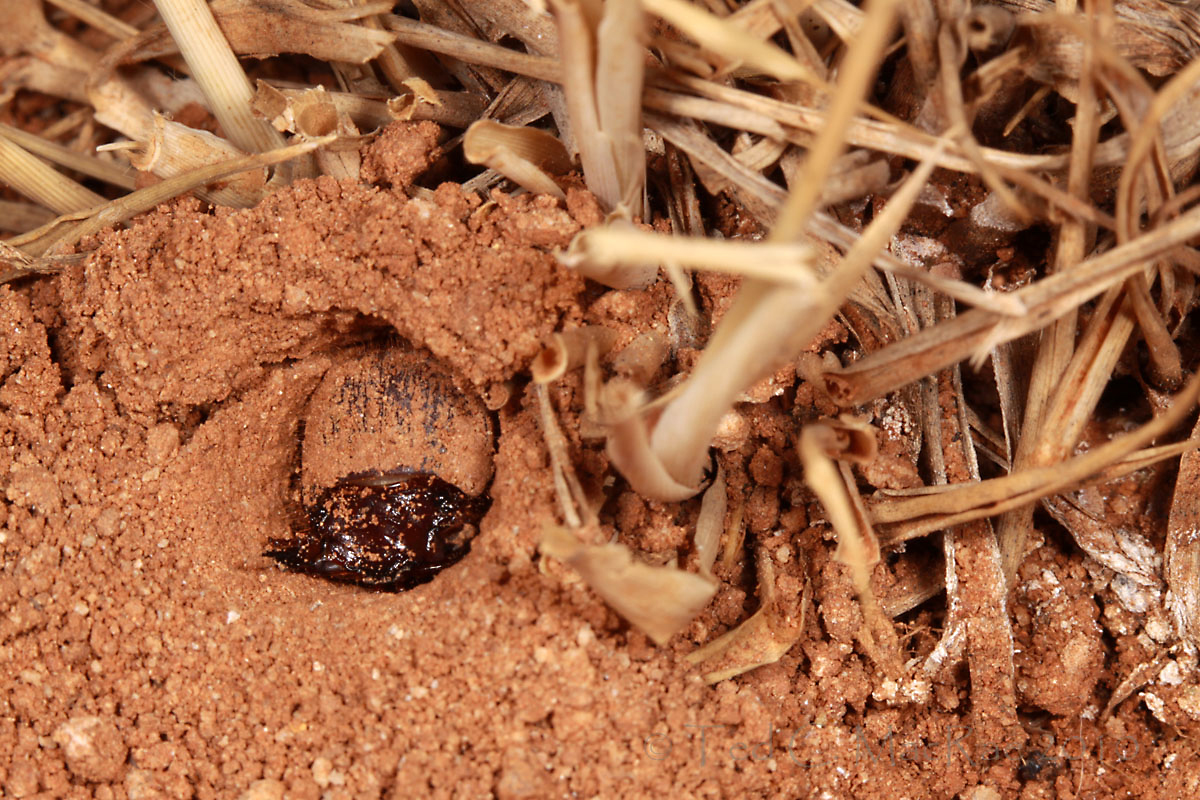
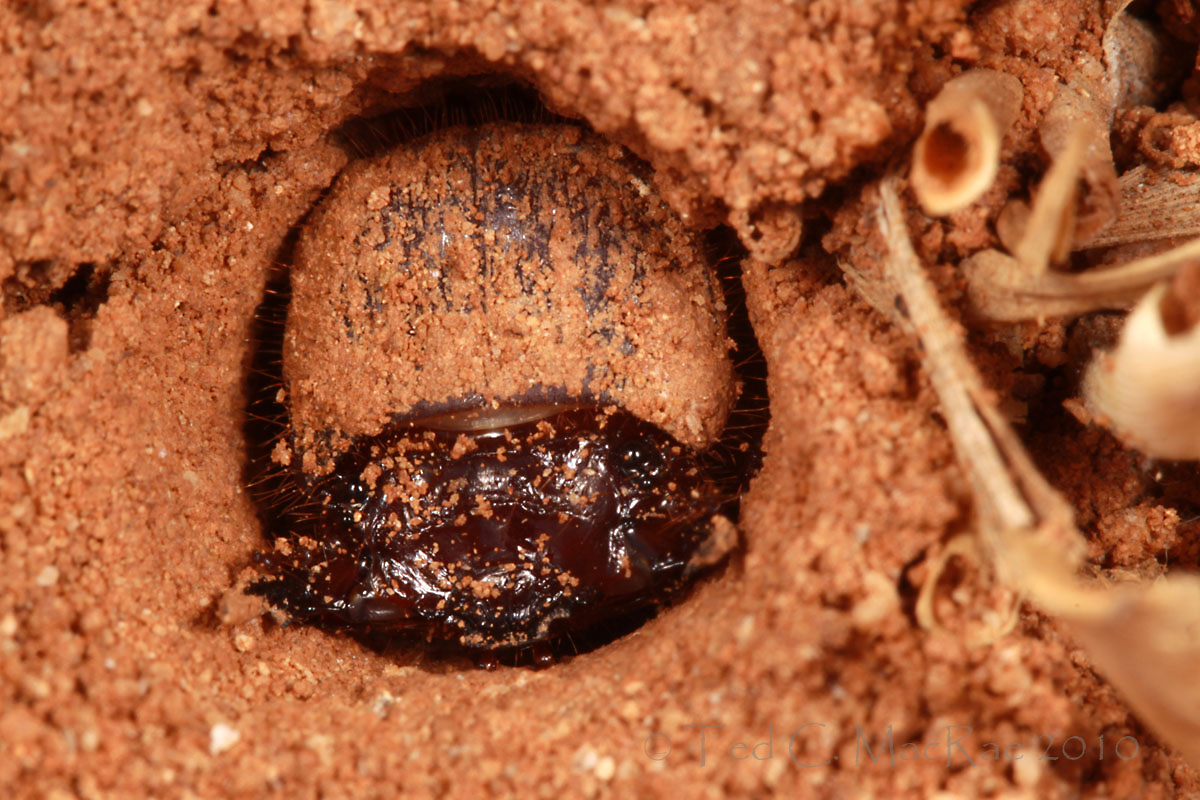
What’s so special about this beetle?

Regular readers of this blog might recognize this as the swift tiger beetle, Cylindera celeripes. This tiny, flightless beetle was once common in the central Great Plains; however, the species has experienced dramatic declines over the past century due to near complete destruction of its preferred prairie habitats.  By the time I first became interested in this species a few years ago, the Flint Hills of Kansas were its last known stronghold.

But that’s not what’s so special about this beetle.

My colleague Chris Brown and I began looking for this species as part of a survey of Missouri tiger beetles.  Although not previously known from the state, historical records from loess hilltop prairie habitats in southwestern Iowa suggested that it might be found in extreme northwestern Missouri at the southern terminus of the Loess Hills landform.  Earlier searches in this part of the state by us and others had turned up empty; however, it was easy to imagine that the beetles had eluded detection due to their small size, cryptic resemblance to ants, and limited temporal occurrence.  In an effort to understand more specifically its habitat preferences and gain a better search image for the species, we visited one of the historical Iowa localities in 2008 and succeeded in finding the species ourselves for the first time.

But that’s not what’s so special about this beetle.

Armed with this experience, Chris and I conducted another dedicated search for this species in Missouri during 2009, targeting the largest and highest quality loess hilltop prairie remnants remaining in the state.  At last, our efforts were rewarded when we found beetles in several loess hilltop prairie remnants in Atchison and Holt Counties.  Their numbers were not high at any of the sites, but the finds nevertheless represented a new state distribution for a species that has only seen contractions to its known range for many years now.

But that’s not what’s so special about this beetle.

A few weeks before finding the beetle in Missouri, I had an opportunity to visit Alabaster Caverns State Park in northwestern Oklahoma, where BugGuide contributor Charles Lewallen had photographed the species in 2003.  I not only succeeded in finding the species at the original locality but determined also that its population there was quite robust.  Indeed, on the same trip I discovered robust populations at several nearby localities, suggesting that the species occurrs commonly throughout the red clay/gypsum hills of northwestern Oklahoma.  Further observations of the species in northwestern Oklahoma last month seem to confirm this.  The beetle in these photographs comes from Alabaster Caverns, but that’s not what’s so special about it.

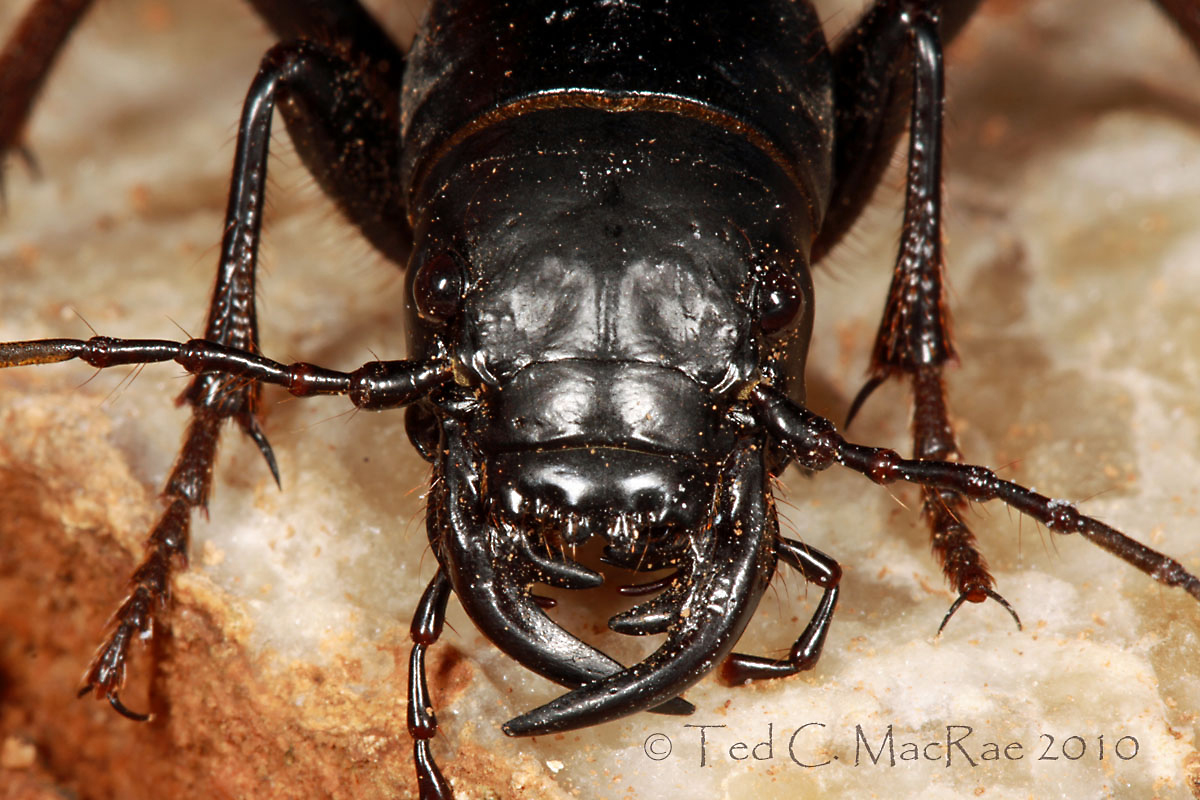
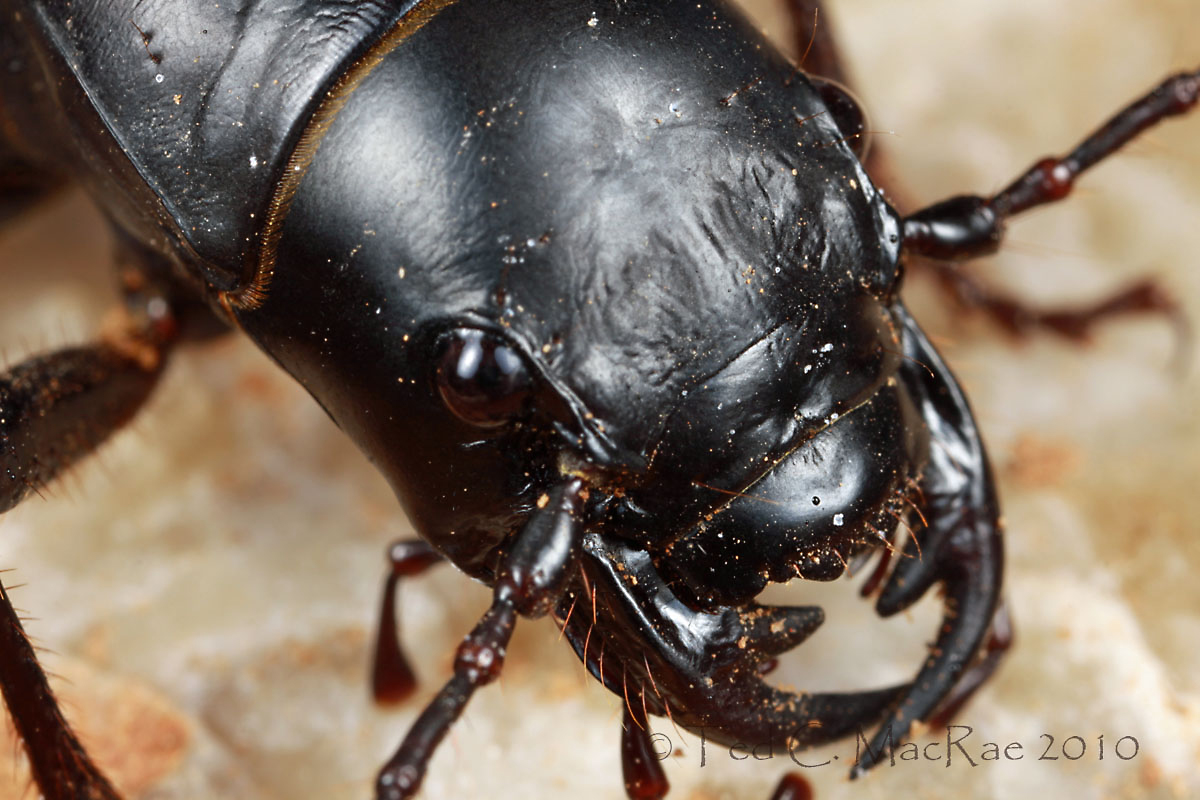
What is so special about it is that it’s the first ever reared individual of this species!  For those of you wondering why this is significant, until now the immature stages of this species have remained completely unknown.  A few contemporary students of the group have tried to rear the species, but the adults are delicate and do not travel well – indeed, my own first attempt to rear the species when I found it in Iowa was not successful.  However, when I found the Alabaster Caverns population, I placed ~12 adults in a small terrarium into which I had placed a chunk of native soil and moistened with water.  The adults survived well in this terrarium over several days of travel, and once back in the lab I kept them alive for several weeks by feeding them small caterpillars and fruit flies.  When larval burrows began to appear I fed them periodically with very small caterpillars and rootworm larvae, inserting them into individual burrows and sealing the burrow entrance to prevent their escape.  Additional prey larvae were inserted into burrow entrances as they were reopened, and the soil in the terrarium was moistened whenever its surface became quite dry.  By late October, all of the burrows had become inactive, and I wasn’t sure if the larvae had died or were just overwintering.  Nevertheless, I placed the terrarium in a cool (10°C) incubator, where it remained until this past March when I pulled it out of the incubator and returned it to warmer temperatures.  Within days, larval burrows reappeared, and I knew then that I had a decent chance of rearing the species to adulthood.  In early July, the beetle in these photographs emerged from its burrow – the first ever reared swift tiger beetle!  Several more adults emerged during the following 2-3 weeks.

While this rearing was in progress, I managed to find larvae of this species on a return trip to Alabaster Caverns last October.  Both 2nd- and 3rd-instar larvae were collected and preserved to go along with the preserved 1st-instar larva that I had extracted from the rearing container when larvae first began to appear.  While these preserved specimens are all that I need to complete a manuscript describing the larval instars, having reared the species completely from egg to adult as well will provide a most gratifying conclusion for that manuscript.

Copyright © Ted C. MacRae 2010

Add to FacebookAdd to DiggAdd to Del.icio.usAdd to StumbleuponAdd to RedditAdd to BlinklistAdd to TwitterAdd to TechnoratiAdd to Yahoo BuzzAdd to Newsvine

Email to a friend

What’s more difficult to see…

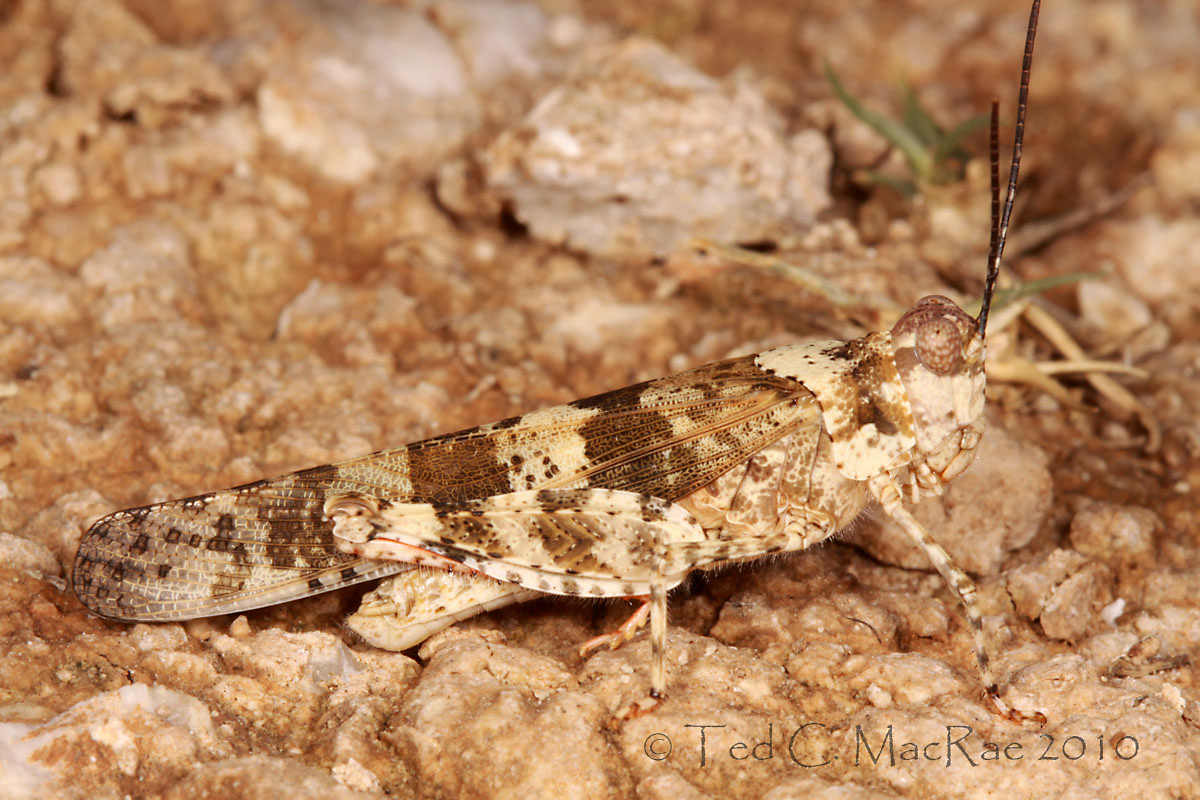
…than a Trimerotropis latifasciata (broad-banded grasshopper) adult on lichen-encrusted clay exposures?


Answer: A T. latifasciata nymph on lichen-encrusted clay exposures.


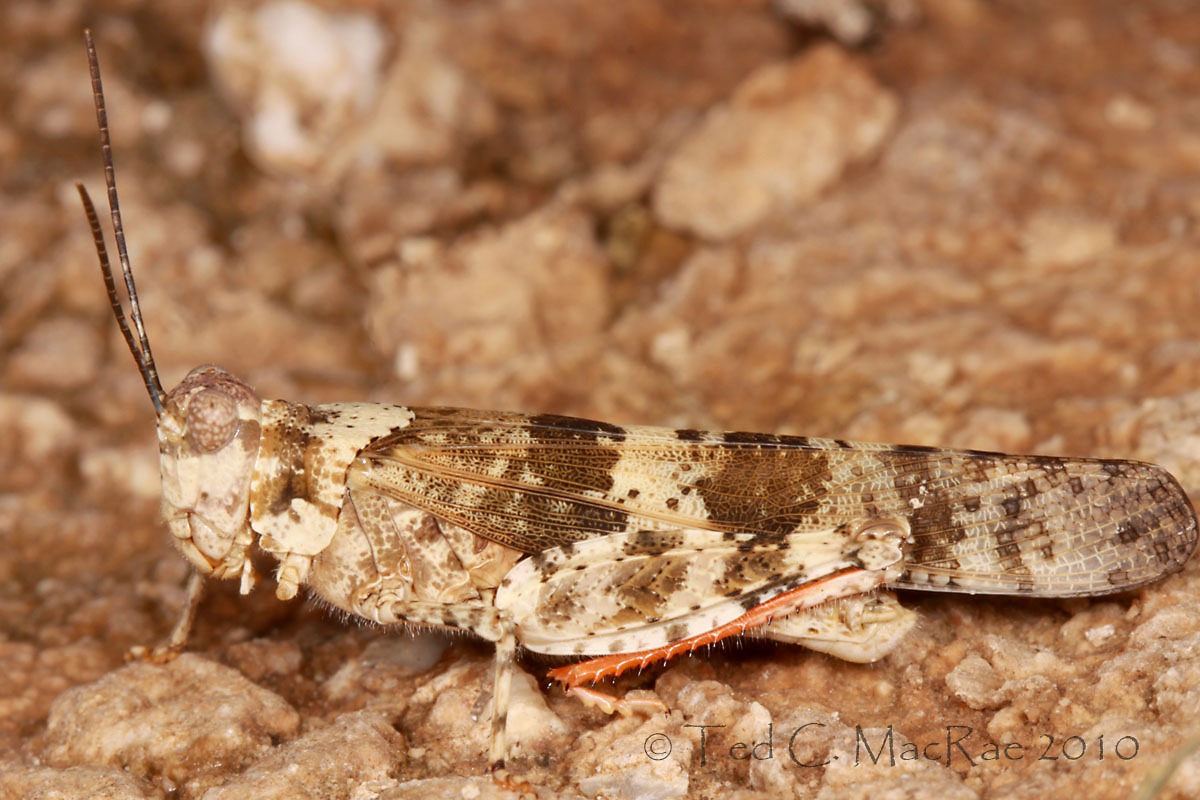
My thanks to David J. Ferguson for confirming my initial ID as a species of Trimerotropis and provisionally placing these individuals as T. latifasciata.  Of course, I’m not at all an expert in grasshopper identification, but I recognized these individuals, found atop the red, flat-topped mesa of Gloss Mountain State Park in northwestern Oklahoma, for their great similarity to T. saxatilis (lichen grasshopper), a striking, more greenish species (at least here in Missouri) that I had hoped to but did not see during my visit to Lichen Glade Natural Area back in late May (it may have been too early in the season for them).  At first I thought these individuals might represent that species, considering the abundance of lichens that encrusted the clay exposures atop the mesa.  However, according to David the red hind tibia (seen in the photo below of a different adult – sans left front leg), longer wings, occurrence on clay (rather than rock or sand), and location in the Great Plains make T. latifasciata the most tenable choice.

Like T. saxatilis and other species of the genus, T. latifasciata provides a marvelous example of the use of camouflage (i.e., blending in with surroundings) – a form of crypsis – to avoid detection by predators.  Finding this species only strengthens my desire to find (and photograph) T. saxatilis – speckled green, white and black – amidst the green lichens that encrust the red igneous outcroppings of the St. Francois Mountains some 100 miles south of St. Louis.

Photo Details: Canon 50D w/ 100mm macro lens, (ISO 100, 1/250 sec, f/18-20, Canon MT-24EX flash (1/4 ratio) w/ Sto-Fen diffusers, and typical post-processing (levels, minor cropping, unsharp mask).

Copyright © Ted C. MacRae 2010

Add to FacebookAdd to DiggAdd to Del.icio.usAdd to StumbleuponAdd to RedditAdd to BlinklistAdd to TwitterAdd to TechnoratiAdd to Yahoo BuzzAdd to Newsvine

Email to a friend

The marvelously monstrous Microstylum morosum

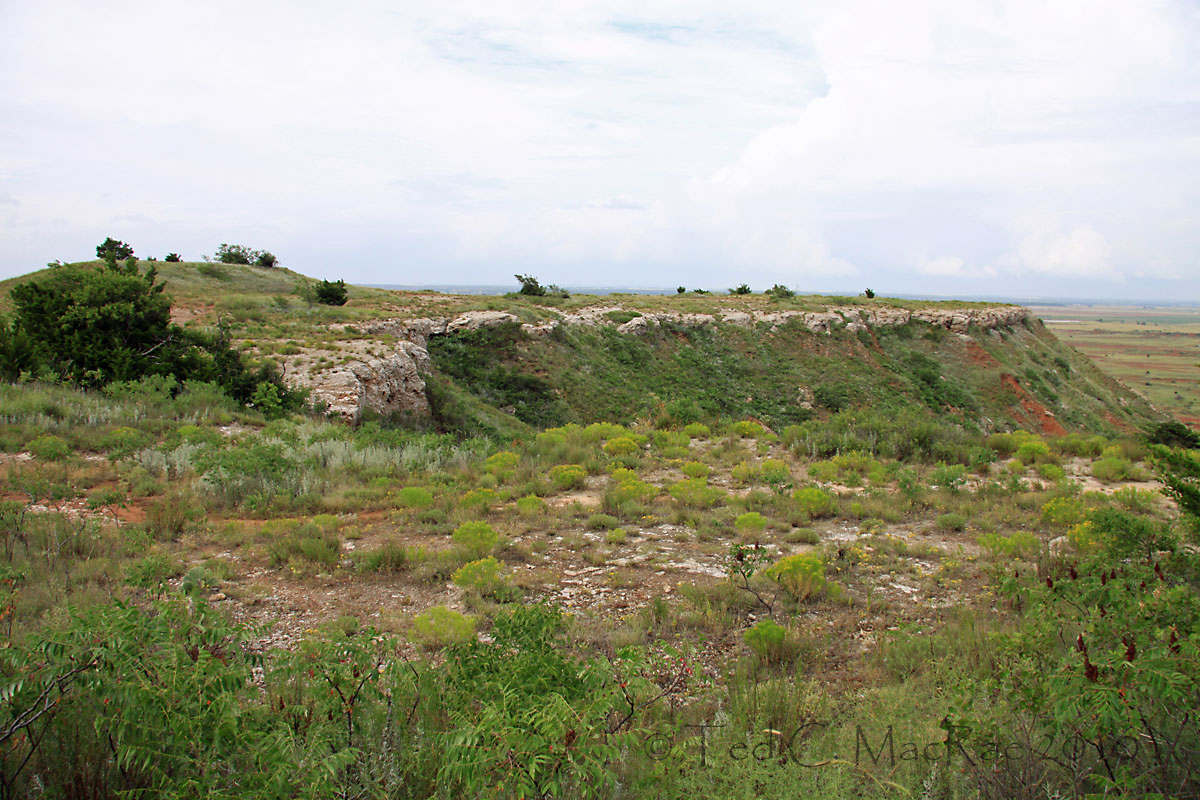
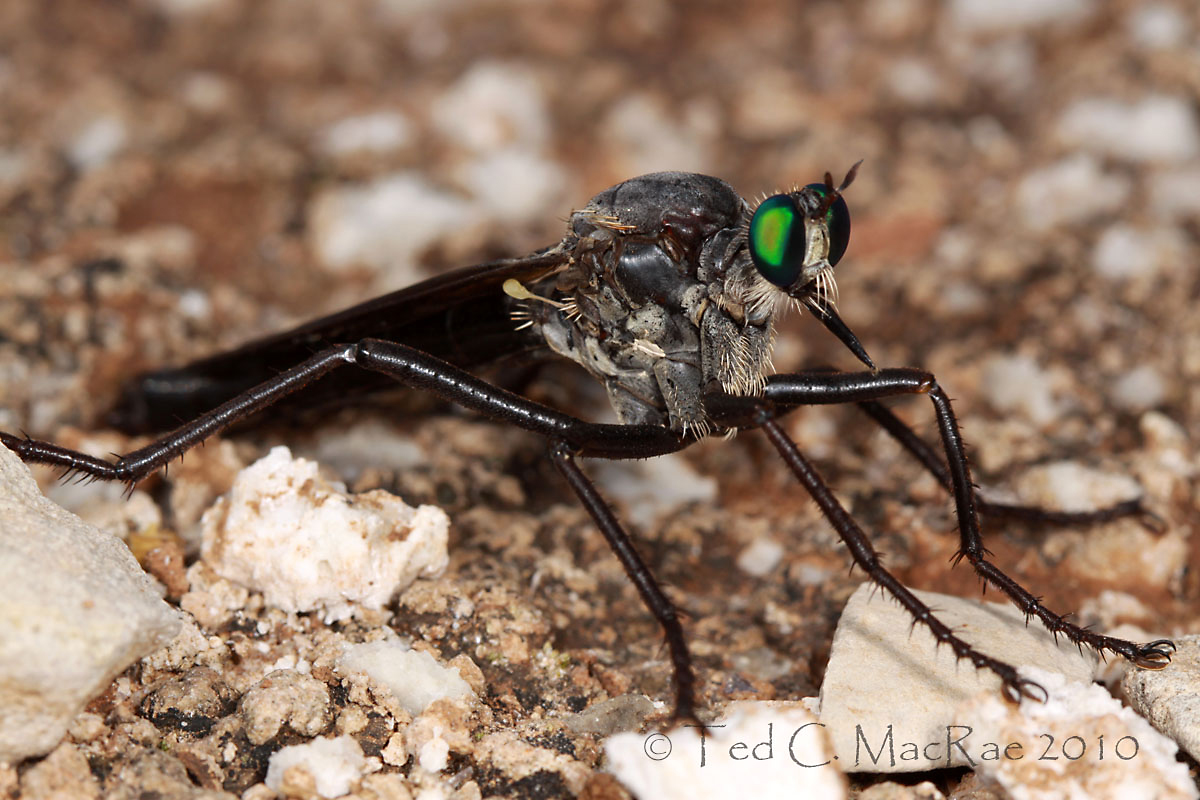
A few weeks ago, while waiting to begin my nocturnal hunt for the Great Plains giant tiger beetle (Amblycheila cylindriformis) in northwestern Oklahoma, I spent the daytime atop one of the red flat-topped mesas that meander through the area in nearby Gloss Mountain State Park.  Although my trip was all about seeing this giant of a tiger beetle in the wild for the first time (I could hardly wait for dusk to begin my search), I found enough splendid insects of other types atop the mesa to occupy my interest until that time.  One of these was the still-robust population of the Swift Tiger Beetle (Cylindera celeripes) that I discovered last summer and delighted in photographing yet again, while another was North America’s largest robber flyMicrostylum morosum!  I had just finished photographing one of the tiger beetles near the edge of the mesa when I turned and saw one of these impressively large flies sitting calmly on the ground nearby.

I first encountered this species last year in southwestern Missouri (a new state record!), so there was no question about its identity.  I also remembered how skittish they were and how difficult it was to get even the two mediocre photographs that I included in the resultant post.  Expecting the same, I kept my eye on the ground-sitter while preparing the camera and approached it with extreme caution.  To my surprise, it showed no sign of being alarmed or wanting to take flight.  I crouched down low and marveled at its monstrous impressiveness as I took frame after ever closer frame – eventually zeroing in on the head and its stunningly magnificent emerald-green eyes.

Satisfied that somewhere in the dozen and a half frames that I shot was at least one or two winners, I sat up and probed towards it with my finger to see how quickly it took flight.  It just sat there tenaciously until my touch caused it to finally take wing.  Winds were gusty atop the mesa, which may have accounted for its cooperativeness.  Standing up, I noted a few scattered eastern redcedars (Juniperus virginiana) in the mixed-grass prairie at the highest point of the mesa.  I recalled that robber flies are fond of “hilltopping” – a mating strategy whereby males fly to the highest point in their immediate landscape to defend a small territory or perch that provides a good vantage for spotting females and competing males (see Hilltopping by Eric Eaton at Bug Eric for a good discussion about this) – and my own experience with this species in Missouri and the way it tended to perch in the trees scattered across the upper part of the rocky, dolomite glade where I found them.  I wandered up to the redcedars, and as soon as I came close enough to one of them I saw another individual take flight – looking like some super-sized mosquito with it’s long legs spread wide as it clumsily flew to another tree.  As it turned out, I saw a number of individuals and mating pairs perching and flying among the trees on top of the mesa, each more spectacular than the previous.

Until recently, Microstylum morosum was considered a Texas-endemic.  However, Beckemeyer and Carlton (2000) documented this species to be much more broadly distributed in the southern Great Plains (from Texas up into Oklahoma and Kansas and west into New Mexico, Arizona, and Colorado), and Warriner (2004) recorded it shortly afterwards in Arkansas.  Although the species apparently occurs throughout Oklahoma (Beckemeyer and Carlton recorded from 13 counties across the state), my observation of it in Major County does seem to represent a new county record for the species.  There is another U.S. species in the genus, M. galactodes, and it has also been recorded from Oklahoma (the closest record is in nearby Woodward County).  However, it is easily distinguished by its generally smaller size, milky white wing membranes, reddish-brown body, and head and thoracic dorsum evenly covered with whitish pruinescence, while M. morosum has the wings and body black to brown and thoracic pruinescence restricted to the lateral margins (Beckemeyer and Carlton 2000).  I’m not sure I would have recognized that species for what it was had I seen it, but if it is anywhere near as impressive as M. morosum then I hope I have the fortune to find it someday as well.

Photo Details:
Landscape: Canon 50D w/ 17-85mm wide-angle lens (17mm), ISO 100, 1/100 sec, f/10, ambient light. Typical post-processing (levels, unsharp mask).
Insects: Canon 50D w/ 100mm macro lens, ISO 100, 1/250 sec, f/10 (photo 1), f/18 (photo 2), Canon MT-24EX flash (1/4 ratio) w/ Sto-Fen diffusers. Typical post-processing (levels, minor cropping, unsharp mask).

REFERENCES:

Beckemeyer, R. J. and R. E. Carlton.  2000. Distribution of Microstylum morosum and M. galactoides (Diptera: Asilidae): significant extensions to previously reported ranges.  Entomological News 111(2):84–96.

Warriner, M. D.  2004. First Arkansas record of the robber fly Microstylum morosum (Diptera: Asilidae).  The Southwestern Naturalist 49(1):83–84.

Copyright © Ted C. MacRae 2010

Add to FacebookAdd to DiggAdd to Del.icio.usAdd to StumbleuponAdd to RedditAdd to BlinklistAdd to TwitterAdd to TechnoratiAdd to Yahoo BuzzAdd to Newsvine

Email to a friend

Hunting the Great Plains giant tiger beetle

In the early 1980s, I was a young, green entomologist, fresh out of school with a budding interest in beetle taxonomy, a zeal for collecting, and a desire to meet other like-minded individuals. Among the first collectors I had the good fortune to meet was Ron Huber, one of the country’s leading tiger beetle experts and co-founder of the journal CICINDELA (now 42 years as co-editor). Although my interests had by then already begun narrowing to woodboring beetles, I liked tiger beetles well enough and managed to secure from him a single specimen of what Erwin and Pearson (2008) would later dub the “Great Plains giant tiger beetle,” Amblycheila cylindriformis – the largest tiger beetle in North America. I don’t remember what prompted Ron to part with this spectacular specimen – perhaps it was the lone Proserpinus gaurae (Lepidoptera: Sphingidae) adult that I possessed, which I had reared from a field-collected larva around that time, or maybe Ron had such a nice series of the species that making the day of a young collector was in itself reward enough. While clearly a tiger beetle, it was still so different by virtue of its enormous size (the species ranges from 25-38 mm in length), somber coloration, small eyes, and strictly nocturnal habit. For much of the past 25 years, that specimen has sat in my cabinet amongst a small assortment of other, mostly mundane tiger beetles that I had opportunistically taken on my woodboring beetle-focused collecting trips. While I longed to someday see the species for myself, to do that would mean making a special trip out to the Great Plains – woodboring beetle desert that it is – during the middle of summer and stumbling through the prairie in the dark with a flashlight. Such an effort always seemed too great for the sole purpose of finding a single species, and not even a woodboring beetle at that.
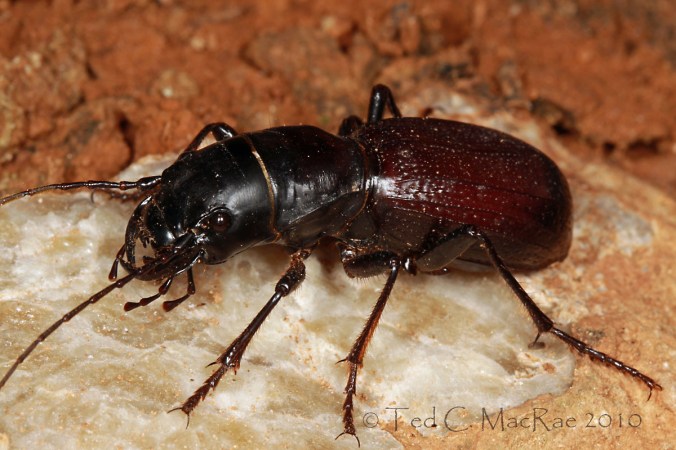
Interests evolve, however, and while I still consider woodboring beetles to be my primary interest, tiger beetles have increasingly occupied my attention over the past several years. Contrary to woodboring beetles, the Great Plains are a mecca for tiger beetle diversity, and in recent years I’ve made a number of trips to Nebraska, Kansas, South Dakota, and Oklahoma specifically to look for them. Such was the case in June of last year when I went to the Glass Mountains in northwestern Oklahoma on a hunch and found Cylindera celeripes, Dromochorus pruinina, and a large tiger beetle larva that I just recently concluded must represent A. cylindriformis. I had been rearing the larva for a year by the time I figured out its identity, and when I did I sudden found myself facing a “perfect storm” – an upcoming holiday weekend, adults presumably in peak adult activity, and I knew exactly where to look for them. Impulsively, I decided to use my July 4th weekend to make the 525-mile drive from St. Louis to the Glass Mountains – this would give me 2 nights to look for them and still allow me to make it back to work on Tuesday morning. Anything else I could find during the day would be icing on the cake, but even if I found nothing, the chance to see A. cylindriformis in the wild seemed worth the gamble.
I made it to Joplin, Missouri near the Oklahoma border by midnight on Friday but awoke to threatening skies the next morning. The threat of rain became a promise as I drove further west, and by the time I arrived in Enid, Oklahoma – just 30 miles from the Glass Mountains – it was raining heavily. I stopped at a coffee shop to access Wi-Fi, and checking the radar showed a line of storms moving up through Texas and western Oklahoma into Kansas – sitting right over the Glass Mountains! The forecast gave no reason for optimism, with a 50% chance of thunderstorms through the weekend. Smartly, I had recorded the locality of the Huber-specimen – collected in northwestern Kansas – and checked the forecast for that area, but it was even worse (50% chance of thunderstorms through Sunday and 80% Sunday night). Clearly this was not good, but I had made the drive and was determined to make something happen. I decided the best thing to do would be to just continue driving west – however far that was – until I got past the storm system and see what was around – wherever that might be. I gassed up amidst a gusty, torrential downpour and headed west out of town. As I drove, the rain lightened up and eventually ceased. The roads were wet, but at least it wasn’t raining, and when I arrived at the Glass Mountains even the roads seemed to be drying. Winds were still strong, but the clouds had broken somewhat, allowing brief periods of sun to further dry things out, and what followed was a most fascinating day on top of one of the Glass Mountain mesas (highlights include C. celeripes, D. pruinina, Microstylus morosus, Trichodes sp. – look for these in future posts). As dusk approached I searched the grasslands below hoping to see a rattlesnake or two – I had seen a western pygmy rattlesnake here last year, and western diamondbacks are also in the area, but I saw none.

Of course, all this was really just passing time – waiting for nightfall and hoping the rain continued to hold off so I could begin searching the prairie down below for A. cylindriformis. It had sprinkled once or twice during the day, and I couldn’t tell if the darkening western sky was truly rain or the just the coming dusk. At 9pm, with darkness fast approaching, I set out with my headlamp and made a beeline for the native prairie habitat on the lower talus slopes where I had last year collected the larva and observed additional larval burrows that I took to be the same species. I must admit that the thought of walking alone through the prairie at night in western diamondback rattlesnake habitat made me more than a little nervous, and I kept just as much an eye out for them as I did the tiger beetles that I was looking for. As the night wore on, my hopes began to dim – I had searched for almost an hour and had covered most of the area where I had seen larval burrows last year. With no sign of the beetle, the negative thoughts started to enter my head – did I make this drive for nothing? How sure was I that the larva really represented Amblycheila? Did I have the right search image? I mean, they’re huge black beetles – they should be easy to spot, right? Oh great, I made all this fuss on my blog about looking for the species – how embarrassing to have to say, “Uhm, well, I didn’t find it.” Just as I began wrapping back around the bottom of the talus slope, there it was – no doubt about it! I just watched it for a while and noted that it moved with some urgency, but it was not the speedy, jerking walk of ‘regular’ tiger beetles – rather, it was more lumbering, seeming to pick each foot up rather high, like a cat with rubber bands on its feet (how would I know about that?). There seemed little risk of it escaping me, so I got out the camera and began following it to take photographs – no way! While it may have lacked the speed of other tiger beetles, it also lacked their propensity to occasionally pause long enough to allow a shot or two. Add the darkness, fear of rattlesnakes, and constant bumping of the flash unit on my headlamp, and it was soon apparent that getting good field photographs was going to be a low percentage proposition. I resigned myself to taking photographs later in a terrarium (several shown here) and spend my time in the field more productively looking for additional individuals.
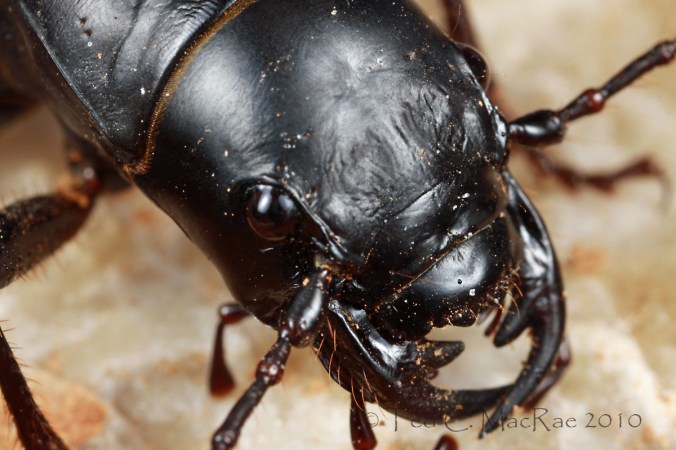
Finding the first individual did wonders for my motivation, and though still nervous about the potential for rattlesnakes I continued searching an ever-widening swath of the talus slope and adjacent areas. Another hour passed, and I had searched not only the native prairie below the talus slopes, but clay exposures on adjacent somewhat altered habitat. Again, the negative thoughts started creeping back into my mind – am I really gonna walk away from here with a single individual? I can say I found it, but that was a long drive for one beetle! I continued searching along an adjacent drainage ditch, and by 11:30pm I conceded that my victory was small and walked back to the truck to get a container to fill with native soil for a terrarium. Though it was a bit of a walk back up to the talus slope where I had seen the larval burrows, I wanted to take soil from that area specifically to give myself the best shot at obtaining eggs from my single (hopefully female) individual for an attempt at rearing more specimens from larvae. As I approached the exact spot where I had collected last year’s larva, I saw another, even larger adult! I don’t know which was greater – my excitement at finding such a large individual, or my relief in knowing that I would not go home with only one. Of course, with the second individual came a new shot of motivation, so once again I scanned across the talus slopes, and during the next half hour I found two more very near to where I had found the second one. By then it was past midnight, so I set about the business of digging soil for the terrarium. I finished the job (getting stung something terrible by three red, big-headed ants that had crawled up my pant leg while I was digging), took one last sweep across the immediate area, and turned to walk back to the truck when I saw the biggest one of all – I later determined it to be a male measuring 35 mm in length (that’s just about an inch and a half, folks!). With five individuals now, the urgency to find more was gone, and I decided I’d done what I needed to do and should get into town and find a hotel room. As I walked back to the truck, rain began to fall – lightly at first but ever increasing. Once back at the truck it was raining persistently enough that I could only hurriedly take some quick photographs of the beetles in their terrarium as in situ documentation of the momentous occasion!
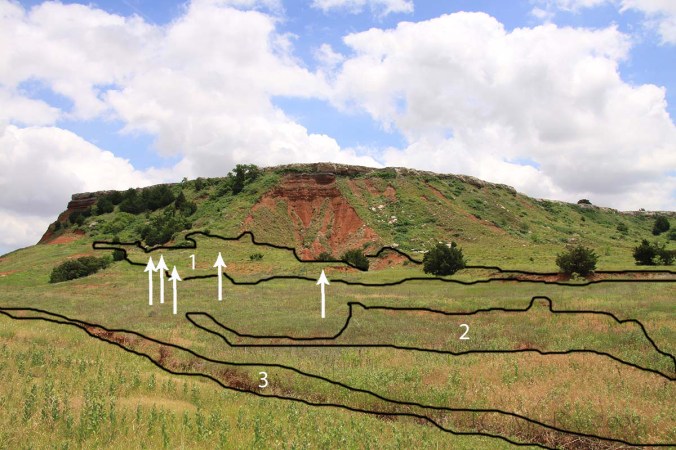
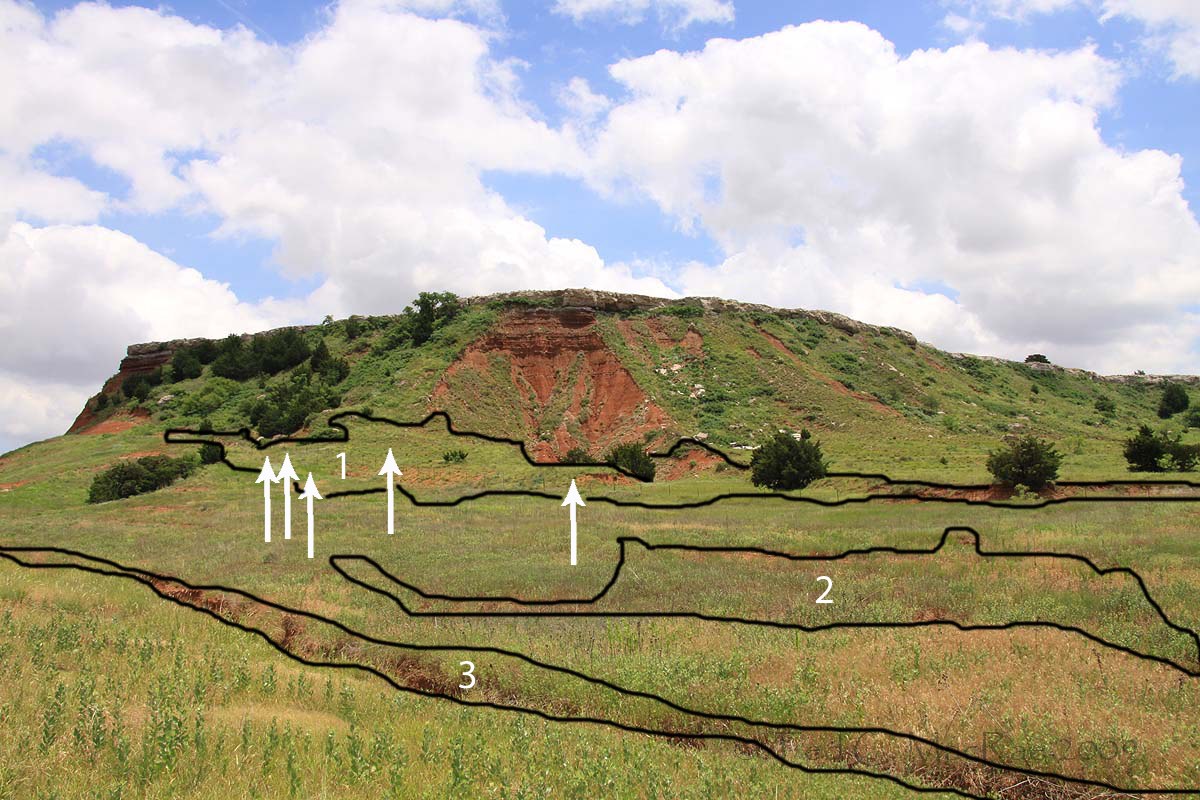
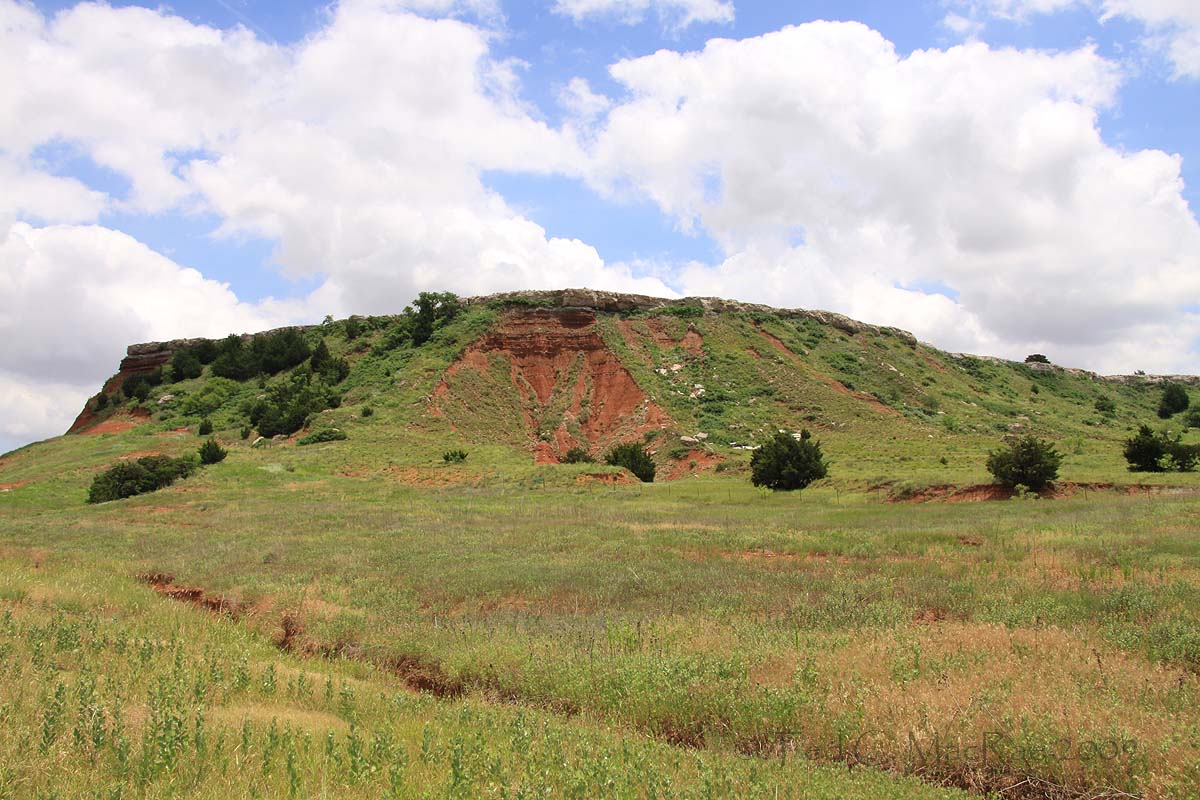
Occurrence of Amblycheila cylindriformis. White arrows indicate where adults were found, all of which were on red clay/gypsum exposures on lower talus slopes in native prairie habitat. No adults were seen in clay/gypsum exposures further below the slopes in either native (zone 1) or altered prairie (zone 2) or further down in roadside drainages (zone 3).

Although I had accomplished my main goal, I looked forward to the opportunity the next day to search for C. celeripes at other nearby sites to better understand the extent of the area’s population.  Sadly, the rain that had held off for nine hours before returning just after midnight was back for good, with radar the next morning showing a broad swath of rain extending across the entire western part of Oklahoma and north into Kansas.  There wasn’t much for me to do but savor the previous day’s experience while I made the 525-mile drive back east.  This may represent a significant record for the species – Vaurie (1955) in her review of the genus did not see any specimens from Oklahoma (although she did examine a few specimens from adjacent areas of Kansas), and Drew and Van Cleave (1962) reported only a single specimen from the state in nearby Woodward County.  Significant record or not, it was an experience that I’ll not soon forget.

Photo Details: Canon 50D (ISO 100, 1/250 sec), Canon MT-24EX flash.
Photos 1-3: Canon 100mm macro lens (f/14-20), flash 1/4 power w/ Sto-Fen diffusers.
Photo 4: Canon MP-E 65mm 1-5X macro lens (f/14), flash 1/8 power w/ Sto-Fen + Gary Fong Puffer diffusers.
Post-processing: levels, unsharp mask, slight cropping on photo 1.
Note to self: clean specimens with moist brush to remove dirt before photographing them!

REFERENCES:

Drew, W. A. and H. W. Van Cleave.  1962. The tiger beetles of Oklahoma (Cicindelidae). Proceedings of the Oklahoma Academy of Science 42:101–122.

Erwin, T. L. and D. L. Pearson. 2008. A Treatise on the Western Hemisphere Caraboidea (Coleoptera). Their classification, distributions, and ways of life. Volume II (Carabidae-Nebriiformes 2-Cicindelitae). Pensoft Series Faunistica 84. Pensoft Publishers, Sofia, 400 pp.

Vaurie, P. 1955. A review of the North American genus Amblycheila (Coleoptera, Cicindelidae). American Museum Novitates 1724:1–26.

Copyright © Ted C. MacRae 2010

Add to FacebookAdd to DiggAdd to Del.icio.usAdd to StumbleuponAdd to RedditAdd to BlinklistAdd to TwitterAdd to TechnoratiAdd to Yahoo BuzzAdd to Newsvine

Email to a friend

The Power of Impulse

Glass Mountains, Oklahoma

Since figuring out a couple weeks that I had the larva of North America’s largest tiger beetle (Amblycheila cylindriformis, or Great Plains giant tiger beetle) in a rearing tub in the lab, I haven’t been able to think about anything except how cool it would be to go back out to the Glass Mountains in northwest Oklahoma (where I collected the larva last June) and look for the adults.  I have every reason not to do this trip – I just spent a long weekend up in northwest Missouri on follow up surveys for our newly discovered population of Cylindera celeripes (swift tiger beetle) (my second such trip in the past three weeks¹), and in a mere week and a half I leave for a 2-week trip to France.  Bills need to be paid, the grass needs cutting, and (as of today) a broken spoke needs to be repaired.  My collecting trips are normally planned far in advance – their timing and frequency part of a delicate balance between the goals I set for the season and the responsibilities that go along with having a job and a family.

¹ More on this in an upcoming post.

But for Amblycheila, it’s now or never – at least for this season, and the thought of waiting until next year before I can take my first valid shot at finding this species in the wild (and perhaps a previously unrecorded population, at that²) is just too unbearable.  So here I am, halfway to the Glass Mountains on as impulsive a trip as I’ve taken in a long time, hoping that my hunch pays off and I’ll find the strikingly large adults of A. cylindriformis lumbering below the flat-topped mesas in the mixed grass prairie where a little more than a year ago I was collecting its enormous larva. It’s a drive-collect-drive trip, and if successful I won’t be the first person to photograph them, even well, but it will nevertheless fulfill my longtime desire to locate this species in the wild and see it with my own eyes – a far more gratifying experience than looking at the lone dead specimen acquired long ago through trade that sits in my cabinet. Wish me luck!

² Drew and Van Cleave (1962) saw only a single specimen from the state in neighboring Woodward Co., although this is now a rather old reference.

REFERENCES:

Drew, W. A. and H. W. Van Cleave.  1962. The tiger beetles of Oklahoma (Cicindelidae).  Proceedings of the Oklahoma Academy of Science 42:101–122.

Copyright © Ted C. MacRae 2010

Add to FacebookAdd to DiggAdd to Del.icio.usAdd to StumbleuponAdd to RedditAdd to BlinklistAdd to TwitterAdd to TechnoratiAdd to Yahoo BuzzAdd to Newsvine

Email to a friend

North America’s largest tiger beetle (I think!)

The generous among us might call it serendipity, while the rest of us would just call it luck.  By whatever name, I had it in spades in June last year when I made my first visit to the Glass Mountains of northwestern Oklahoma.  My original plan was to go to Tallgrass Prairie Preserve in eastern Oklahoma at the end of what proved to be a resoundingly successful day at Alabaster Caverns State Park.  However, soaking rains moved into the area and continued rumbling eastward across the plains towards the preserve, forcing a quick change of itinerary.  I decided to wait it out in the state’s western reaches, a “hunch” telling me that the red clay/gypsum hills in nearby Major County might be a fruitful place for hunting tiger beetles.  Sunny skies the next morning were a good sign, and my hunch was rewarded later that day when I discovered a previously unknown (and fortunately robust) population of the rare Cylindera celeripes (swift tiger beetle), making not just the day but the entire trip more successful than I could have ever imagined.  Icing on the cake came when I found decent numbers of the more secure but nevertheless uncommon Dromochorus pruinina (frosted dromo tiger beetle) also in the area.

Another find I made that day that I’ve mentioned on occasion but not talked about at length was a single, rather large tiger beetle larva.  I found several burrows at the base of a talus slope at the edge of a small ravine where many adult C. celeripes were scurrying, and though I tried with many, out of only one did I manage to “fish” its occupant with a blade of grass.  I didn’t know which species it represented, but its large size and occurrence in clay soil brought to mind two species – Cicindela pulchra (beautiful tiger beetle) and C. obsoleta (large grassland tiger beetle).  Both of these Great Plains species reach their eastern limit of distribution in this part of Oklahoma (Pearson et al. 2006), and their status as the largest species of the genus (and its former subgenera) in North America seemed to make them the leading candidates for this enormous larva.  There was one other possibility – Amblycheila cylindriformis (Great Plains giant tiger beetle), another Great Plains species at its eastern limit in western Oklahoma and (as the common name implies) the largest tiger beetle in all of North America.  However, to consider that species seemed too much wishful thinking.  From my understanding, larvae of that elusive species reach an incredible 45 mm in length and dig burrows  on steep slopes or at the mouths of rodent burrows that extend vertically to depths of up to 1.5 m or more (Brust et al. 2005).  Surely I could not have so casually stumbled upon such a grand grub!

I placed the larva in a terrarium of native soil and brought it back with me, and for one year now I have waited – feeding it a regular diet of the fat noctuid caterpillars that we rear so abundantly in our lab.  For a full year, I’ve watched it nab caterpillar after caterpillar, disappearing mysteriously for days on end, and just as mysteriously reappearing at the top of its burrow.  I knew getting a closer look at it would help in my attempts to determine its identity, but every time I approached with a camera it dodged down into its burrow and beat my patience.  Sometimes I would see it sitting about a centimeter below the burrow entrance – just waiting for a caterpillar to crawl by but refusing to expose itself to the lens.  I gradually decided it was likely C. pulchra, as I had seen that species in similar habitat not too far north in Barber County, Kansas.  So strong was my suspicion that I even made another trip out to the Glass Mountains in October of last year, expecting to see the fall-active adults bejeweling the exposed flats below the red clay slopes, their wine-red elytra and purple-margined bodies all aglitter under the crisp, autumn sun.  No such sight was beheld, however – my hopes dashed by the season’s sudden cold and wet turn, and with the terrarium containing the larva by then tucked away in a cool incubator for a winter’s rest, it would be several months before I would see the larva once again sitting at the top of its burrow.

In late March I pulled the terrarium out of the incubator, and within a week the larva reopened its burrow.  I fed it a few times, and then one day I saw that it had dug a new, larger  burrow – measuring a full 10 mm in diameter!  This seemed extraordinarily large for any species of Cicindela, so I resolved once again to photograph it and determine its identity.  For days I stalked it, keeping the terrarium just outside my office door where I could keep an eye on it, yet every time I approached within two feet or so it would drop down out of sight.  I decided to stop feeding it – perhaps hunger would overwhelm its patience and prompt it to return to the top of its burrow more quickly after retreating.  That seemed to work, as one day the larva came back up after only a few minutes – and I was ready!  Already  in position, I flashed off multiple shots as soon as it reappeared, moving slowly and deliberately between shots to avoid spooking it again, and managed to get a nice series from varying distances.  As a testament to its enormous size, all of the photos shown here were taken with the standard 100mm macro lens (1X maximum) – not the 65mm 1-5X beast that I needed for these shots of the super-tiny C. celeripes.

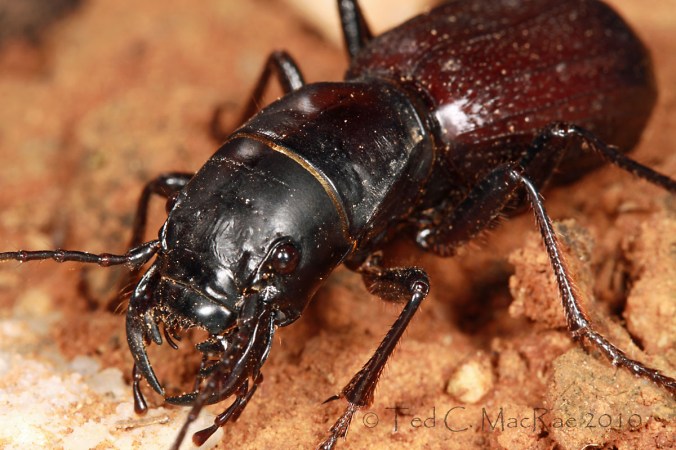
Thinking that the larva likely represented C. pulchra, I compared the photos to this photo taken by Matt Brust of a 3rd-instar larva of C. pulchra and immediately noted the differently shaped pronotum of my larva and its distinctly projecting anterolateral angles.  Compare to C. pulchra, in which the angles are in line with the median part of the anterior margin – it is clearly not that species.  It isn’t C. obsoleta either, as that species has the anterolateral angles of the pronotum even less projecting than C. pulchra (Drew and Van Cleave 1962).  Apparently I needed to rethink my assumption that it belonged to Cicindela or its close relatives – none that occur in Oklahoma are simply large enough!  Tetracha virginica is large enough, but I knew it wasn’t that species since it lacked the white margined pronotum distinctive of species in that genus (as can be seen in this post on the larva of Tetracha florida).  That left only A. cylindriformis, distinguishable from all other tiger beetle genera occurring in Oklahoma by the second (lower) pair of eyes distinctly smaller than the first (Hamilton 1925, Drew and Van Cleave 1962, Pearson et al. 2006) – clearly seen in the third photo above.  Matt Brust has also photographed the larva of A. cylindriformis – it’s not a close shot of the head and pronotum, but in general aspect my larva seems to match it well enough.

All that is left is to actually succeed in rearing this larva to adulthood.  These beasts may require up to three to four years to develop (Brust et al. 2005), although this is likely influenced by latitude and prey abundance.  I suspect it was a second instar larva when I collected it, and that it dug its new burrow this spring after molting to the third (and final) instar.  Hopefully by keeping it in a nice, warm growth chamber and feeding it generously with fat caterpillars, I can minimize the time to pupation and perhaps see the adult sometime later this summer.  If/when that happens, you can be sure to see a follow up to this post.

Photo Details: Canon 50D (ISO 100, 1/250 sec, f/16-18), Canon 100mm macro lens, Canon MT-24EX flash (1/4 ratio) w/ Sto-Fen diffusers. Post-processing: contrast and unsharp mask (no cropping).

REFERENCES:

Brust, M. L., S. M. Spomer and W. W. Hoback.  2005. Tiger Beetles of Nebraska.  University of Nebraska at Kearney.  http://www.unk.edu (Version 5APR2005).

Drew, W. A. and H. W. Van Cleave.  1962. The tiger beetles of Oklahoma (Cicindelidae).  Proceedings of the Oklahoma Academy of Science 42:101–122.

Hamilton, C. C.  1925. Studies on the morphology, taxonomy, and ecology of the larvae of Holarctic tiger beetles (family Cicindelidae).  Proceedings of the U.S. National Museum 65 (Art. 17):1–87.

Pearson, D. L., C. B. Knisley and C. J. Kazilek. 2006. A Field Guide to the Tiger Beetles of the United States and Canada. Oxford University Press, New York, 227 pp.

Copyright © Ted C. MacRae 2010

Add to FacebookAdd to DiggAdd to Del.icio.usAdd to StumbleuponAdd to RedditAdd to BlinklistAdd to TwitterAdd to TechnoratiAdd to Yahoo BuzzAdd to Newsvine

Email to a friend

Tuesday Tarantula


One of my destinations on my annual fall tiger beetle collecting trip last October was The Glass Mountains in northwestern Oklahoma. Rising from the red Permian beds of the central Great Plains, the Glass Mountains are a series of mesas and buttes capped by thick layers of the sparkling, glass-like crystal selenite. It is still common to see them referred to as the “Gloss” Mountains, the result of a transcription error by a mapmaker back in the late 1800s, and although the soils that comprise the formations are very old (laid down as sedimentary deposits during the Permian Era some 250 million years ago), the landscape itself is relatively young – a result of erosion by glacial outwash from the Rocky Mountains during the past 1 million years.

Of course, I was not here to study crystals or geology, but to look for tiger beetles! It was at this spot that earlier in the year (June) I had discovered a new population of Cylindera celeripes (Swift Tiger Beetle), a rarely-collected flightless species that has declined worrisomely during the past century, and another seldom-collected flightless species, Dromochorus pruinina (Frosted Dromo Tiger Beetle), was also a good find. Neither of these species were my reason for being here in October, however, since by then adults of both have long disappeared. Instead, I was hoping that the large, unidentified larvae that I had seen in their burrows at this site back in June would be out as adults. Their great size suggested two possibilities – Cicindela obsoleta (Large Grassland Tiger Beetle) or C. pulchra (Beautiful Tiger Beetle), either of which would be a great find. Alas, overcast skies and a cold, biting wind made whatever tiger beetles were there – lovers of sun and warmth that they are – remain secreted within their protected haunts. I still have a shot at finding out what they are – I successfully extracted two larvae from their burrows and fed them well in the laboratory with fat fall armyworm larvae before putting them to sleep for the winter in a 10°C (50°F) incubator.  If all goes well, I’ll wake them up this spring and finish them out to adulthood this year.

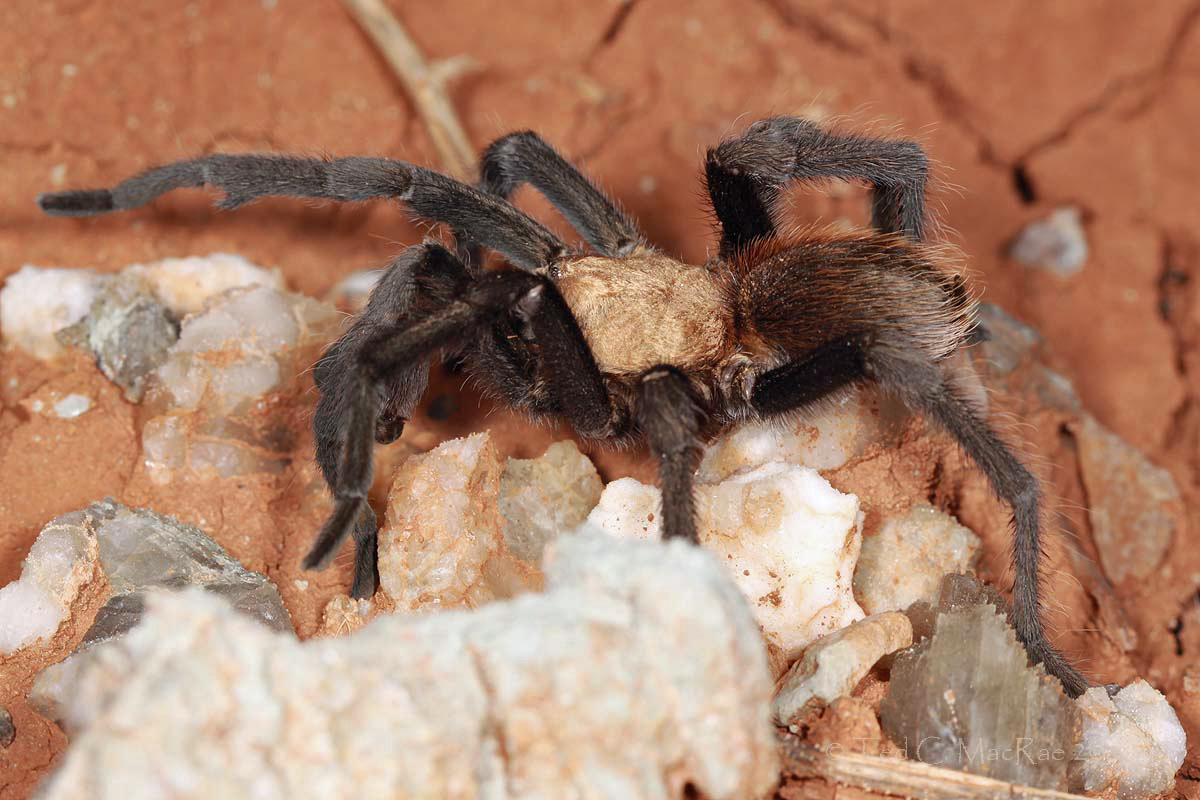
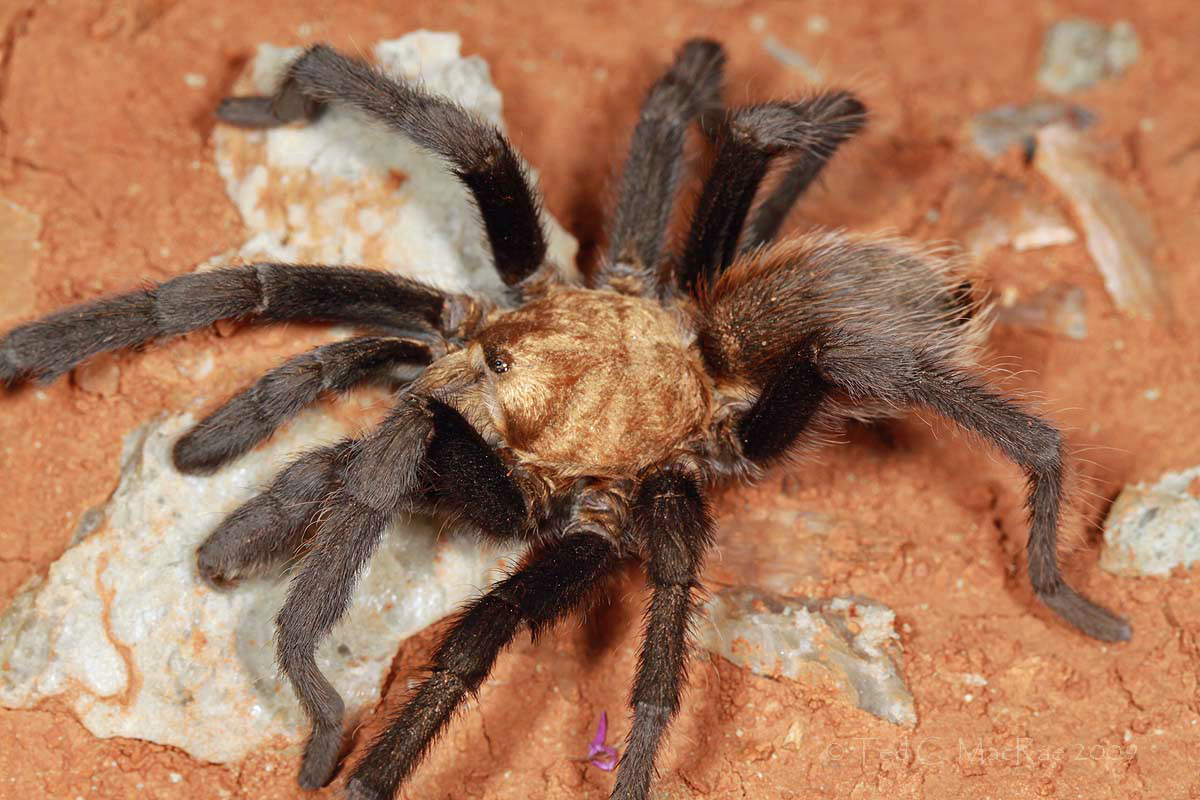
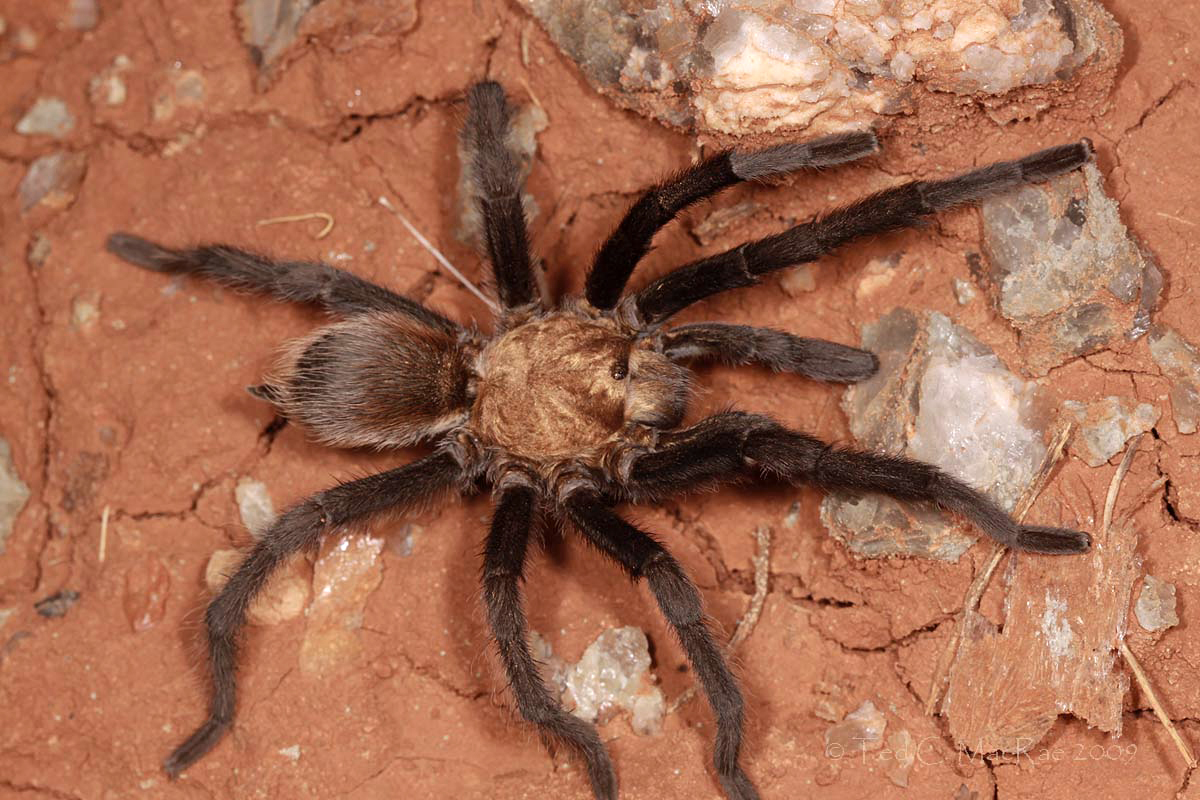
There were a few consolation prizes on the day, one of which was this large, lumbering male tarantula seen slowly making its way down the red clay slopes. For all their charisma and noteriety, it’s interesting to note that the taxonomy of U.S. tarantulas (almost all of which belong to the genus Aphonopelma) is rather poorly known – some 50 species have been described, but many of the descriptions are inadequately based on limited material (or even single specimens) and often rely upon variable, highly artificial characters (Prentice 1997). Brown or black species with no distinctive coloration (such as this one) seem to present the greatest challenge; however, the internet seems to have concluded that the only tarantula present in Oklahoma is Aphonopelma hentzi.


This spider can be distinguished as a mature male by way of the tibial hooks that can be seen on the undersides of the front pair of walking legs in the first photo.  Female and immature tarantulas normally stay in their burrows during the day and come out at night to hunt, but wanderlust strikes the adult males during late summer and fall, during which time they’ve been documented traveling as far as 1.3 km over a period of 2-3 weeks (Janowski-Bell and Horner 1999) – presumably in search of females with which to mate.  It is only after the male’s final molt that wanderlust sets in and the tibial hooks appear, which are said to function in holding the female (and her fangs!) at a safe distance during copulation.


It may seem hard to believe, given its large size and slow movement, but I found this spider exceedinly difficult to photograph compared to the tiger beetles that I have spent much more time with. I’m not used to photographing subjects with a 4-5 inch leg spread, which made it difficult for me to judge working distance and get a handle on proper settings and positions for the flash units. Once I did get that under control, I found the tarantula’s incessant desire to keep moving maddeningly frustrating. Tiger beetles, as active and flighty as they are, nevertheless eventually sit still long enough to allow at least a shot or two before bolting, but this tarantula… just… never… stopped… moving! I can’t tell you how many shots I discarded because it’s legs were splayed awkwardly in multiple directions. Eventually, however, I got enough shots that I felt there should be at least a few good ones among them, and those are the ones I share here.


Most male tarantulas will die within a few weeks or months of their final molt. Still, that doesn’t deter me from scooping them up whenever I find them and bringing them home to enjoy as pets for whatever time they have left. My daughters probably like tarantulas best of any of the critters that I bring home – I never have to ask “Has anybody fed ‘Hairy’?” (and props to awesome wife for enduring something most ‘normal’ wives couldn’t even begin to contemplate).

REFERENCE:

Janowski-Bell, M. E. and N. V. Horner.  1999.  Movement of the male brown tarantula, Aphonopelma Hentzi (Araneae, Theraphosidae), using radio telemetry.  The Journal of Arachnology 27:503–512.

Prentice, T. R. 1997. Theraphosidae of the Mojave Desert west and north of the Colorado River (Araneae, Mygalomorphae, Theraphosidae). The Journal of Arachnology 25:137–176.

Copyright © Ted C. MacRae 2010

Add to FacebookAdd to DiggAdd to Del.icio.usAdd to StumbleuponAdd to RedditAdd to BlinklistAdd to TwitterAdd to TechnoratiAdd to Yahoo BuzzAdd to Newsvine

Email to a friend

Euhagena nebraskae in Kansas

Gypsum Hills region of south-central Kansas (Barber Co.)

One of my favorite destinations for insect collecting is the Gypsum Hills region in Barber County of south-central Kansas.  I first went there in May 1986 after seeing a diverse selection of more typically Texan Buprestidae that J. Richard Heitzman, an iconic lepidopterist in the Kansas City area and author of Butterflies & Moths of Missouri, had collected there on soapberry (Sapindus saponaria).  I had my own success with Buprestidae as well during that trip, but in recent years I have returned to Barber County several times during the fall to look for one of North America’s most beautiful tiger beetles, Cicindela pulchra (Beautiful Tiger Beetle).  This species had been recorded in the area by the well-known cicindelophiles Ron Huber and Dave Brzoska, who suggested that I look in the red clay hills just west of Medicine Lodge.  My first trip to look for this beetle in 2004 was unsuccessful, and I suspect the early September timing of my trip may have been a tad too early.  I returned again in 2005, this time in early October and also enlisting the help of local entomologist “Beetle Bill” Smith, who knew of a population on private land near his home in Hardtner (south of Medicine Lodge).  Although at first it looked like success might again elude me, in the end I saw a robust population of these spectacular beetles and published an account of that marvelous experience (MacRae 2006).

As with so many of the things that I have seen over the years, they came before my interest in photography, and I now find myself wanting to re-find some of the more spectacular insects that I’ve previously found so that I can properly photograph them.  Such is the case with C. pulchra, so in October of last year I returned to Barber County in hopes of seeing this species armed not only with an aerial net, but also a Canon 50D.  Sadly, this would not come to pass – the same sudden cold snap that dashed my hopes of finding this species in nearby Woodward/Major Counties, Oklahoma would keep any tiger beetle activity to a bare minimum the following day in Barber County as well.  Despite bright sunny skies, I would see only two tiger beetles the entire day, both representing the dreadfully ubiquitous Cicindela punctulata (Punctured Tiger Beetle).  Not all insect activity, however, was squelched, and after scanning the red soils for an hour or so without seeing the object of my desire I began to notice some of these other not-so-temperature-finicky species.  One of the more magnificent of these is shown in the photo below — Euhagena nebraskae in the family Sesiidae (cess-EYE-id-ee) (formerly Aegeriidae).

Euhagena nebraskae

Euhagena nebraskae (Lepidoptera: Sesiidae)

Although I wasn’t sure of the species at first, I recognized it immediately as a clearwing moth.  I had an interest in this family of moths for a time in my early days as a field entomologist with the Missouri Department of Agriculture.  Many species are important pests of woody plants in orchard and ornamental landscapes, and it was during that time that synthetic pheromones became widely used for monitoring purposes.  I often walked around with a pheromone tag pinned to my bag to attract the male moths — it was fun watching people seeing these moths “buzzing” me and thinking I was under attack by the wasps that they so effectively mimic (despite my calmness in these situations, I still found it hard to actually grab one from the air with my hand – so convincing is their mimicry).

Euhagena nebraskae is one of two species in the genus in North America, both of which develop as larvae in the roots of plants in the evening primrose family (Onagraceae) (Eichlin and Duckworth 1988).  In fact, I had seen its congener — E. emphytiformis — many times in the 1980s in pheromone traps that I used to place in the glades of Jefferson County just south of St. Louis, where it presumably breeds in one or both of two Oenetherea species growing there (O. gaura and O. macrocarpa).  Euhagena nebraskae is a more western species that does not occur in Missouri, occurring instead across the Great Plains west to California and from southern Alberta and Saskatchewan south to Mexico.  It is likely that many entomologists never see this species, as adults are active only during late fall.  Thus, its perception as an uncommon species may be an artifact of its late seasonality. 

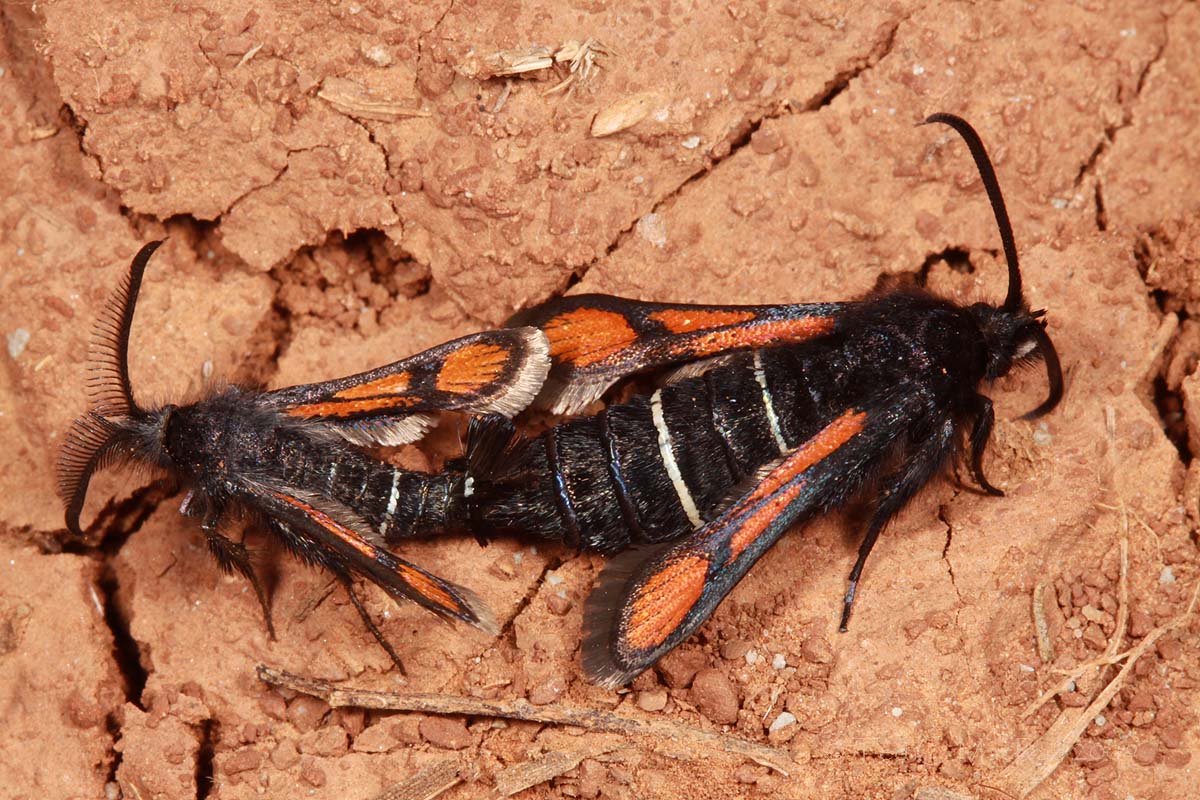
I thought it odd that nearly every individual that I saw was sitting on the ground rather than perched higher on a plant.  At first I wondered if the cold temperatures were a reason for this, perhaps causing the moths to seek out the ground as a source of radiant heat.  This seems doubtful, however, since females always seemed to be “calling” – their tufted abdominal tips raised in the air with the scales spread apart, apparently releasing pheromone.  I was fortunate to find this mating pair, which shows nicely the rather high degree of sexual dimorphism seen in these moths.  Note the much more highly bipectinate antennae of the male (pectinate = resembling a comb, bipectinate = ‘teeth’ on both sides of the main stem) versus the simple antennae of the female — males use their antennae for detecting female pheromones, and the bipectinate form presumably provides greater surface area for placement of sensory pores. Note also the male’s smaller size, “hairier” head and thorax, and greater amount of white coloration on the abdomen and wings.  Engelhardt (1946) supposed that the excessive hairiness of adult Euhagena species was an adaptation to their late-season emergence (principally during October and sometimes as late as November), a time when frosty nights prevail in their high-elevation haunts.    

REFERENCES:    

Eichlin, T. D. and W. D. Duckworth. 1988. The Moths of America North of Mexico, Fascicle 5.1, Sesiodea: Sesiidae. Wedge Entomological Research Foundation, Washington, 176 pp.

Engelhardt, G. P. 1946.  The North American clear-wing moths of the family Aegeriidae. Bulletin of the United States National Museum 190:1-222.

MacRae, T. C. 2006. Beetle bits: The “beautiful tiger beetle”. Nature Notes, Journal of the Webster Groves Nature Study Society 78(4):9–12.

Copyright © Ted C. MacRae 2010

Add to FacebookAdd to DiggAdd to Del.icio.usAdd to StumbleuponAdd to RedditAdd to BlinklistAdd to TwitterAdd to TechnoratiAdd to Yahoo BuzzAdd to Newsvine

Email to a friend