Anatomy of a Tiger Beetle Larva

My first experience looking for tiger beetles in Florida had gone well.  Despite its small size and urban surroundings, the narrow strip of coastal scrub and saltwater marsh along the intracoastal waterway behind my sister-in-law’s condominium boasted a robust population of what I took to be a single tiger beetle species.  The specimens I collected and photographs I took would later reveal that two co-occurring and closely related species were present: Ellipsoptera marginata (Margined Tiger Beetle) and E. hamata lacerata (Gulf Beach Tiger Beetle).  I had spent close to two hours under the August sun observing and photographing the beetles before I decided that I had given the preserve a thorough enough look.

IMG_1077_1200x800_crp

As I was heading back, I noticed a little bit of high ground alongside a red mangrove thicket and went over to give it a look.  As I approached I saw something I hadn’t yet seen that day – tiger beetle larval burrows.  Larval burrows, especially larger ones such as these were, are unmistakeable – almost perfectly circular (slightly cut out on one edge) and smoothly beveled around the perimeter.  There were a number of burrows clustered on the small bit of high, dry ground, and my first thought was that their inhabitants represented the same (what I thought was a single) species that I had encountered so commonly that day as adults.  I then reasoned, however, that more likely they represented another species whose adults are active later in the season – perhaps one of the so-called “spring/fall” species whose larvae typically reach maturity during the heat of summer.  The size of the burrows (~5mm dia) suggested they were inhabited by 3rd instar larvae (the final instar before pupation), in which case it may be possible to rear a few to adulthood – if I could get at them. I tried fishing (Pearson and Vogler 2001) a few holes with a grass blade but didn’t get any bites, so I decided to watch for awhile and see if any of the larvae, believing the danger of my approach had passed, would reappear at the tops of their burrows.  Waiting for tiger beetle larvae to appear is a crap shoot – maybe they’re active, and maybe they’re not, and crouching in the stifling summer air of a coastal marsh in Florida is not an easy thing to do for very long.  Fortunately my wait was short, as within a few minutes I saw one re-appear at the top its burrow.  I slowly got out my knife and moved to place the tip on the soil about 1″ from the burrow at a 45° angle for an attempted tunnel block (Pearson and Vogler 2001), but it spooked and dropped back down into its burrow before I could get then knife in place.  No matter, I knew it was in there now and that it would likely reappear if I could muster the patience.  I positioned the knife and waited – crouched under the baking Florida sun, until when it did re-appear I plunged the knife into the soil with authority.  It was a good jab – I had blocked its retreat without injuring it, and a quick flip of the knife popped out the soil plug and exposed the startled larva, flipping vigorously in a vain attempt to escape before settling down amidst its unfamiliar, exposed surroundings.

IMG_1083_1200x800_enh

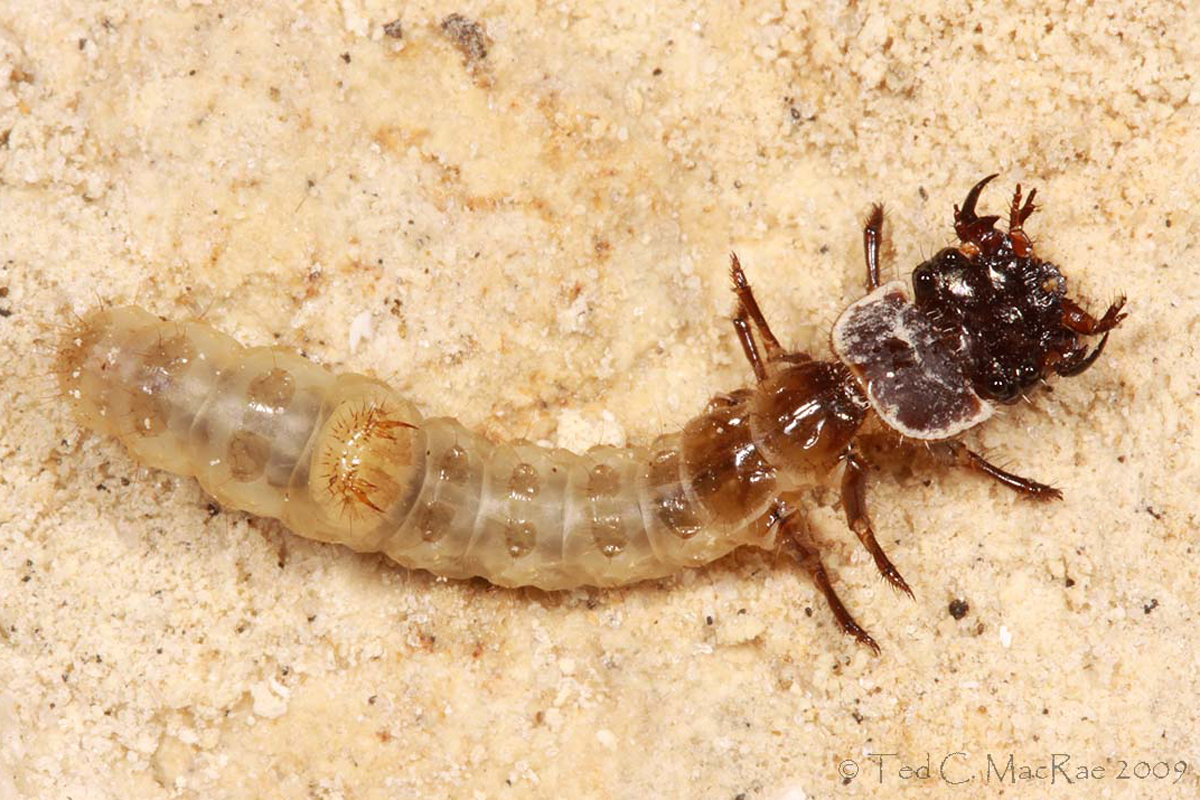
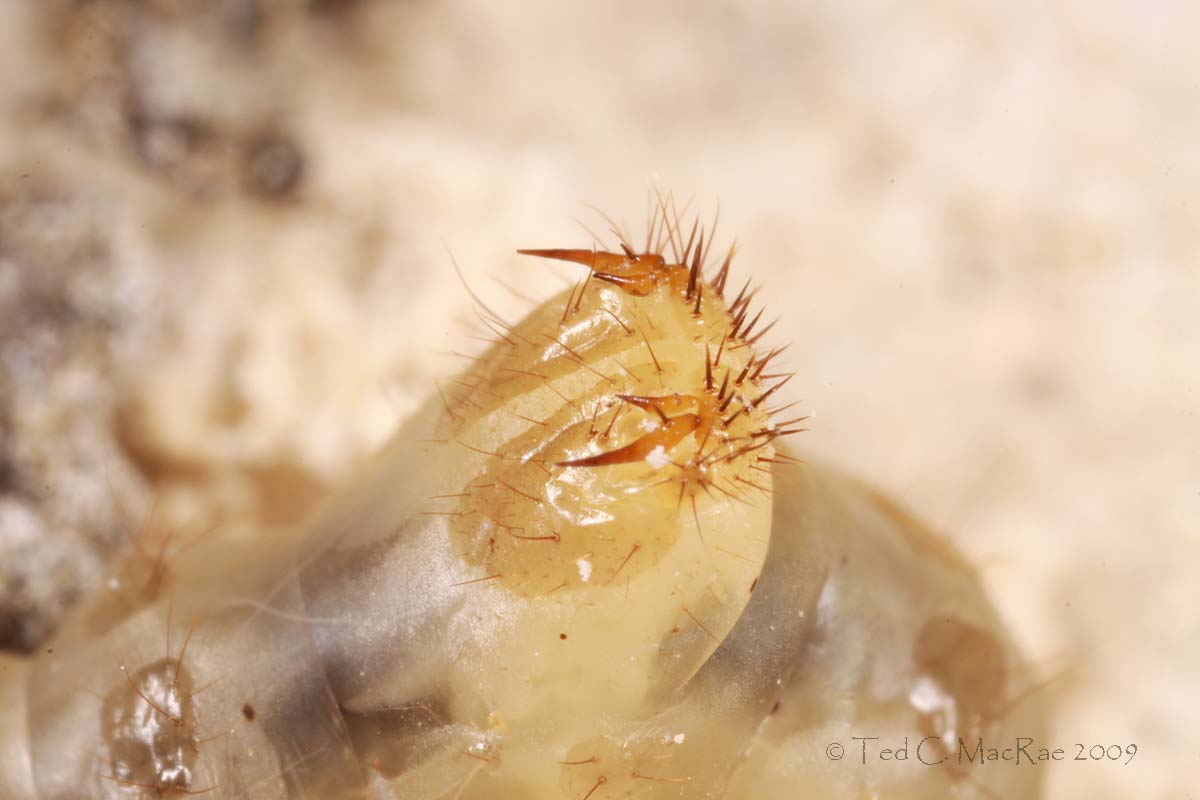
For those of you who have never seen a tiger beetle larva, they are among the most other-wordly creatures one can imagine.  The large, heavily sclerotized head bears two long, sickle-shaped, upward-pointing mandibles and up to three pair of highly-acute eyes whose arrangement on each side conveys the image of a “face” with congenital birth defects.  The top of the head is flattened to lie flush with the surrounding soil as the larva sits at the top of its burrow, and huge, powerful mandibular muscles fill the cranial cavity.  The remainder of the body – long, narrow, and cylindrical – hangs from the head at a 90° angle down into the burrow and is unremarkably grub-like, save for a curious hump on the dorsal side of the 5th abdominal segment.  Close examination of the hump reveals an intricate pattern of forward-facing hooks and spines that function in anchoring the larva against the side of its burrow to prevent struggling prey from dislodging it.  The life of a tiger beetle larva is a life of waiting – unlike the adults who run down their prey, the larvae sit in their burrows and wait for prey to come to within lunge’s reach.  While the eyes of most grub-like insects detect little more than light and dark, those of tiger beetle larvae are densely packed with photoreceptors that permit detailed focusing and depth perception for detecting whether potential prey has ventured close enough to their burrow (Pearson et al. 2006).  When that happens, they strike with lightning speed, plunge their mandibles into their prey, and drag it down into the depths of their burrow where it is summarily dispatched with a few bites of their powerful mandibles.  Larvae consume they prey in a manner similar to that of adults in that they chew but don’t swallow their prey. Rather, they secrete digestive secretions containing proteolytic enzymes that begin digesting the prey extra-orally as they chew.  The resulting bolus is masticated and its liquid components sucked out until nothing but a dry wad of indigestable chitin remains, which is spat out of the burrow (Pearson and Vogler 2001).

IMG_1081_1200x800

Looking at this strange insect, it occurred to me that I had not yet attempted macrophotographs of a tiger beetle larva out of its burrow, and this would be a good opportunity to get more practice with my Canon MP-E 65 mm macro lens – a lens with incredible magnification capabilities, but one that is also a bit of a temperamental beast to use hand-held in the field.  The subject was unusually cooperative, perhaps too stunned by its sudden predicament to know what to do, and as I took the photographs I focused in particular on characters of the head and dorsal hump (often useful in identifying tiger beetle larvae, at least to genus).  Time was growing short once I finished taking photographs, so I placed the larva in a vial and returned the following day to extract a chunk of native soil to place in a rearing container, managing to collect two more larvae as well (unfortunately, one became instant “prey” for the other.  Note to self: when placing multiple tiger beetle larvae in a container of soil, seal the artificial burrows into which you place each one!).  I paid little further attention to the photographs, other than to transfer them onto my computer and add metadata upon my return to St. Louis.  I didn’t know what species the larvae represented, but I assumed they were something in the genus Cicindela or one of its several former subgenera.  However, had I studied the photos and considered the locality and habitat, I would have realized that my assumption was incorrect¹.  That realization would come in surprise fashion two months later when the two adults emerged within a few days of each other…

¹ Ten points to whoever can use this information to arrive at an identification before my next post 🙂

IMG_1072_1200x800_enh

Photo details:
All photos: Canon EOS 50D, manual mode, ISO-100, 1/250 sec, MT-24EX flash w/ diffuser caps.
Photo 1: Canon 100mm macro lens, f/22, 1/4 power flash (photo slightly cropped).
Photos 2-4: Canon MP-E 65mm 1-5X macro lens f/16, 1/8 power flash.

REFERENCES:

Pearson, D. L., C. B. Knisley and C. J. Kazilek. 2006. A Field Guide to the Tiger Beetles of the United States and Canada. Oxford University Press, New York, 227 pp.

Pearson, D. L. and A. P. Vogler.  2001. Tiger Beetles: The Evolution, Ecology, and Diversity of the Cicindelids.  Cornell University Press, Ithaca, New York, 333 pp.

Copyright © Ted C. MacRae 2009.

Add to FacebookAdd to NewsvineAdd to DiggAdd to Del.icio.usAdd to StumbleuponAdd to RedditAdd to BlinklistAdd to TwitterAdd to TechnoratiAdd to Furl

North America’s most beautiful longhorned beetle

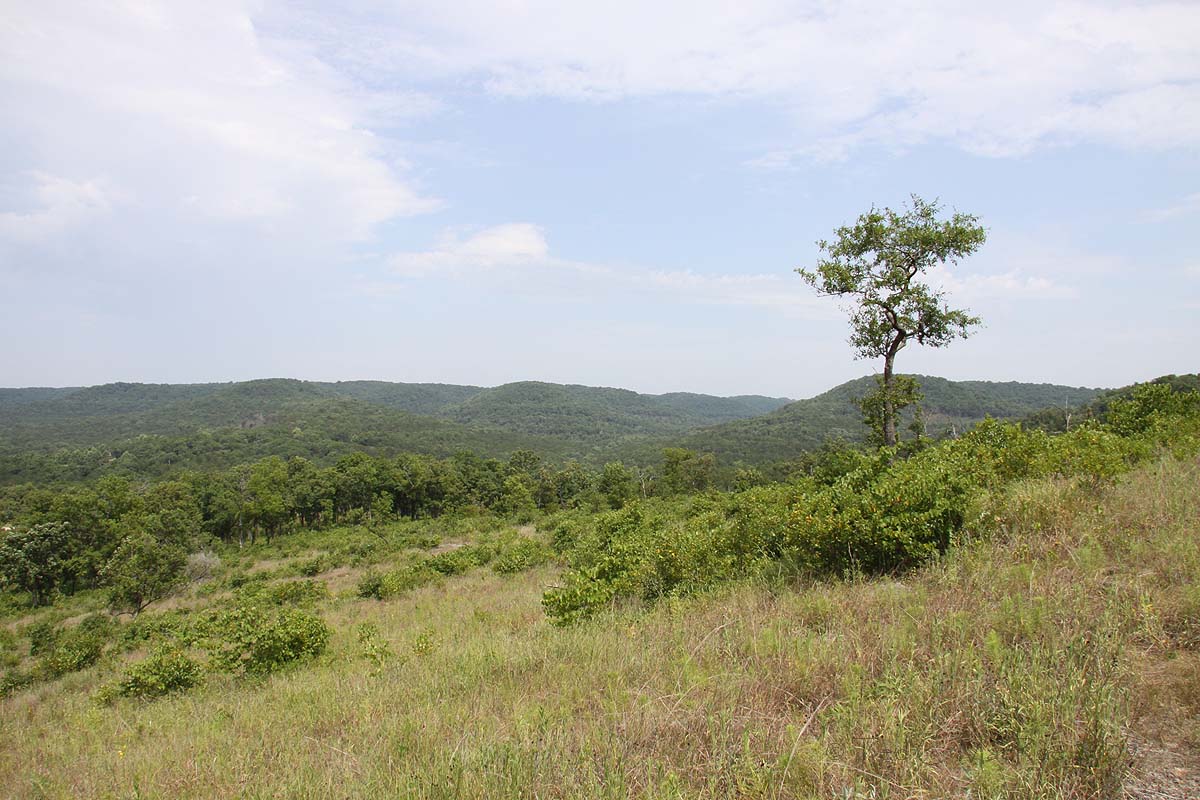
I’ve written a few posts in recent weeks highlighting some of the more interesting finds encountered during two visits this past July to the White River Hills region of extreme southwestern Missouri. It’s a land of extremes, with deeply dissected layers of limestone/dolomite bedrock supporting xeric glades, dry woodlands and riparian watercourses. The hilltop glades (“balds”), in particular, feature prominently in the region’s natural and cultural history and are the most extensive system of such habitat in Missouri. They support a number of plants and animals more characteristic of the grasslands of the south-central U.S., such as the recently featured Megaphasma denticrus and Microstylus morosum, North America’s longest insect and largest robber fly, respectively. Sadly, the glades in this region are much reduced in size and quality compared to their pre-settlement occurrence, primarily due to overgrazing and suppression of fire. These anthropogenic forces have combined to reduce overall vegetational diversity and accelerate encroachment by woody species (chiefly eastern red-cedar, Juniperus virginiana). Nevertheless, there still remain several high quality glade remnants in the area, and the public agencies charged with their conservation are increasingly utilizing mechanical removal of woody growth, controlled burns, and managed grazing in an effort to simulate the natural forces that mediated this landscape for thousands of years.

IMG_0871_1200x800

Chute Ridge Glade, Roaring River State Park, Barry Co., Missouri

My reason for returning to the White River Hills this year was simple—find and photograph the magnificent longhorned beetle, Plinthocoelium suaveolens (family Cerambycidae). This species, occurring across the southern U.S. from Florida and Georgia west to New Mexico and Arizona, is truly one of North America’s most beautiful longhorned beetles due to its large size, brilliant iridescent green coloration, and super-elongate wildly-contrasting orange and black legs.  Until recently, this species was known in Missouri only from sporadic records across the southern part of the state (MacRae 1994). I knew of its association with gum bumelia (Sideroxylon lanuginosum [= Bumelia lanuginosa], also called gum bully and woolly buckthorn), which was first noted by Missouri’s first State Entomologist, C. V. Riley (1880) and later discussed in detail by Linsley and Hurd (1959) and Turnbow and Hovore (1979); however, my repeated searches over the years whenever I encoutered this plant came up empty.  A few years ago, Chris Brown and I were conducting a survey of tiger beetles in the White River Hills and noted the relatively common occurrence of bumelia on these glades.  Bumelia, like P. suaveolens, is one of only a few North American representatives of a largely tropical group, and it is one of the few woody species naturally adapted to the xeric conditions found on these glades.  Recalling the association of P. suaveolens with this plant, and also recalling that adults could be attracted to fermenting baits of the type described by Champlain and Knull (1932), we placed fermenting bait traps on several glades in the area and succeeded in trapping a number of individuals during the month of July.  When I began searching the bumelia trees at these glades, I found adults perching on the lower trunks of several trees. It was the first time I’d seen live individuals of this species in Missouri.  At the time I was not a photographer, and that experience became one of the many moments that I would later look back upon and think, “If only I’d taken a picture of that!”  Thus, at the end of June this year, having successfully found Cylindera celeripes in Missouri on the first day of a planned 3-week search, my attention immediately turned to the new goal of finding P. suaveolens and photographing it on its host plant.

IMG_0929_1200x800

Sideroxylon lanuginosum (gum bumelia) at Blackjack Knob, Taney Co., Missouri

I knew this wouldn’t be easy—the beetles were not abundant when I had last observed them, and those that I did find were quite wary to my approach.  Getting within striking distance with a net was one thing; doing so with a camera and macro lens would be another thing entirely.  In my first trip to the area (early July), I went to Chute Ridge Glade, a magnificently restored glade in Roaring River State Park where I had seen the greatest number of individuals before.  I was full of optimism on that first day as I zigzagged across the rough terrain from one bumelia tree to the next, but my optimism began to wane as I cautiously approached each tree and saw nothing.  Within an hour, I’d looked at every bumelia tree I could find on the glade and not even seen a beetle, much less attempted a photograph.  It would take a 2-hour drive along twisting back roads to reach the other sizeable glade complex where I had seen beetles before (Blackjack Knob in Taney County), and another hour of searching on several dozen trees would again yield nothing.  By now I was feeling rather frustrated—the day’s oppressive heat and humidity had taken its toll, and my 4.5-hour drive from St. Louis was looling like it would be for naught.  I had noted that the bumelia flowers were almost but not quite open yet—perhaps it was too early in the season still?  
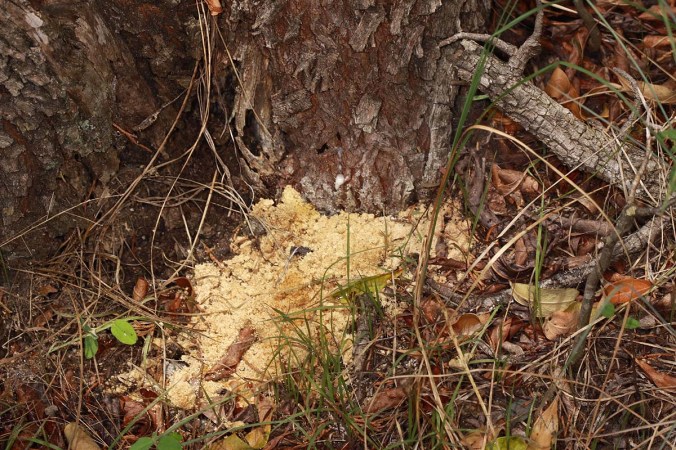
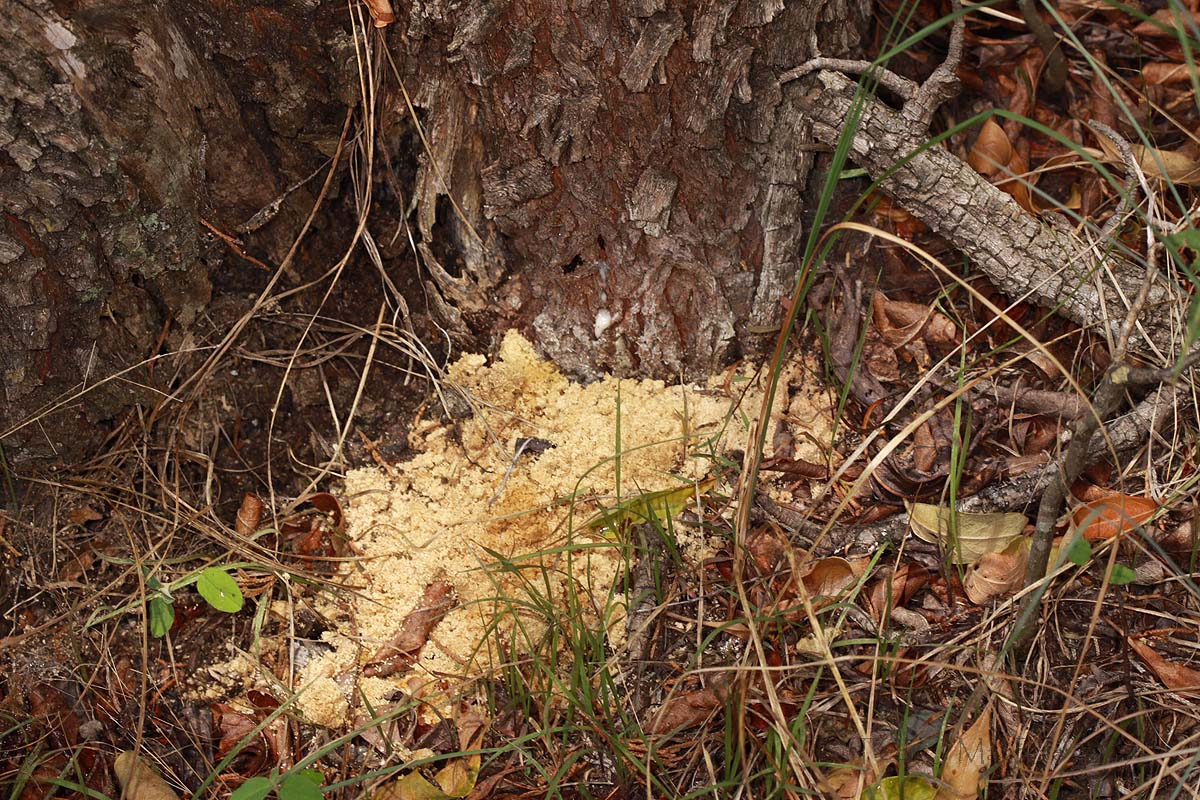
Plinthocoelium suaveolens larval frass pile at the base of living Sideroxylon lanuginosa

Plinthocoelium suaveolens larval frass pile at trunk base of living Sideroxylon lanuginosum

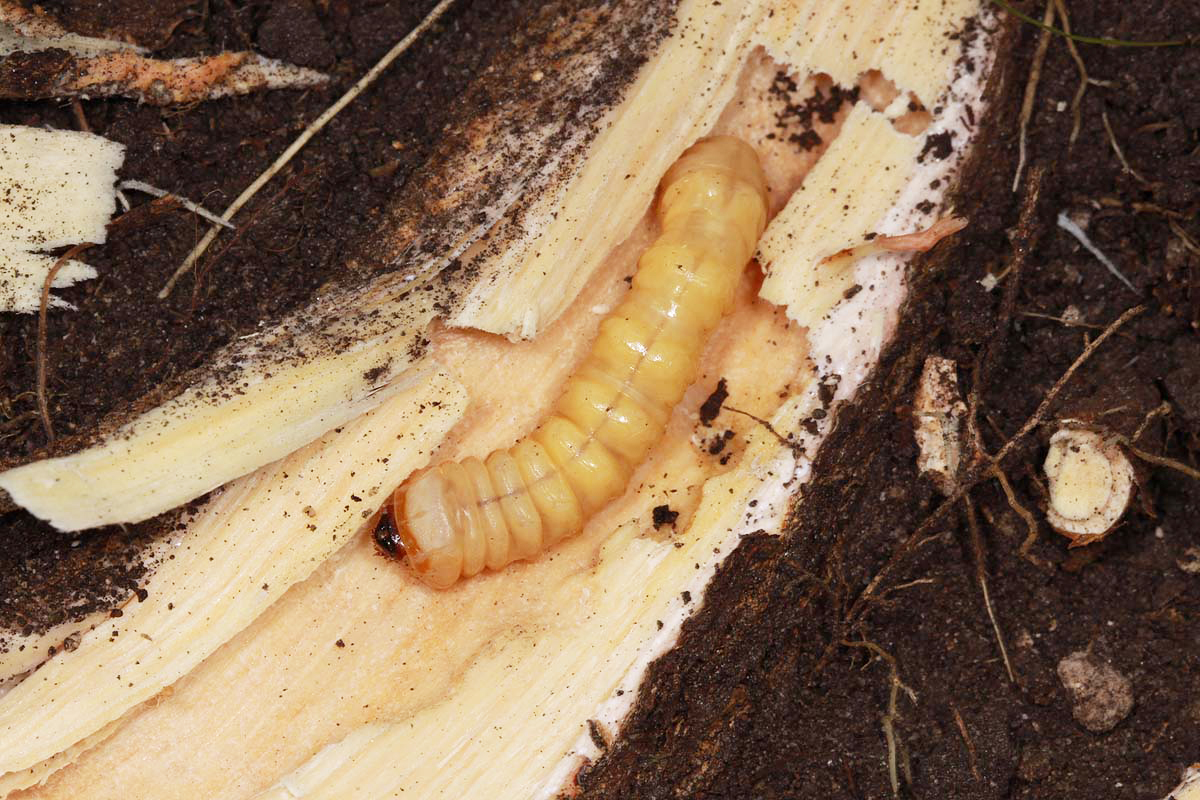
The remnant glades at Blackjack Knob are more extensive than those at Chute Ridge, so many more trees still awaited examination—if I could only muster the energy!  I trudged back to the truck, guzzled a nice, cold Powerade, and started off in another direction.  I looked at a number of trees and still had seen no sign of the beetle, but on one particular tree I noticed an enormous pile of sawdust on the ground at the base of the tree.  I looked at it more closely and saw that it had the rough, granular texture so characteristic of longhorned beetle larvae that like to keep their galleries clean, and its bright, moist  color suggested that it was being ejected by a larva tunneling through living wood.  I looked up into the tree above the pile to find where it was coming from but could find no ejection hole.  I checked the base of the trunk itself and still couldn’t find anything.  Then I started poking into the pile and felt a root.  Further poking revealed a soft spot on the root, and I immediately knew that I had found a P. suaveolens larval gallery—no other cerambycid species is known to bore in roots of living Sideroxylon, especially one as large as this based on the size of the frass pile.  I hurried back to the truck and grabbed my hatchet, returned to the tree, and scraped away the soil above the root to find an obvious ejection hole a few inches away from the base of the trunk.  I started chipped into the root at the ejection hole and found a large, clean gallery extending down the center of the root away from the trunk.  About 18” away from the trunk I found it—a large, creamy-white cerambycid larva.

Plinthocoelium suavelones larva in root of living Sideroxylon lanuginosa

Plinthocoelium suaveolens larva in root of living Sideroxylon lanuginosum

Plinthocoelium suavelones larva in root of living Sideroxylon lanuginosa

Plinthocoelium suaveolens larva in root of living Sideroxylon lanuginosum

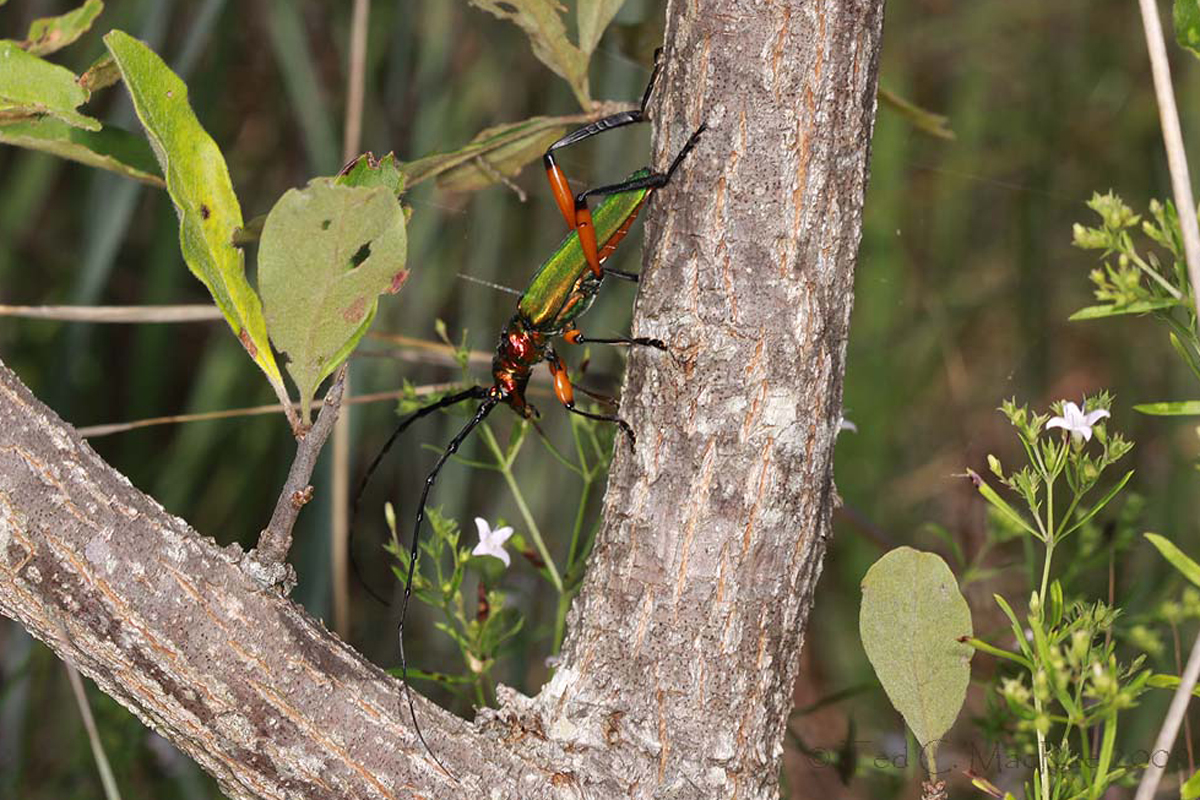
Finding a P. suaveolens larva was gratifying, but it wasn’t what I had come here to do, which was photograph the adult. After placing the larva live in a vial for preservation later on (dropping into scalding water to “fix” the proteins and prevent discoloration when stored in 70% ethanol), I continued searching the trees for adults.  I found one tree on which the flowers were just barely beginning to open and collected a few of the pedestrian species of scarabs that are attracted to bumelia flowers in droves when fully open (e.g. Cotinis nitidus and Trigonopeltastes delta)—for the record.  There was still no sign of adult Plinthocoelium, and I was on the verge of calling it a day when I approached another tree and saw it!  I froze, then slowly geared up with the camera and started stalking slowly towards it.  It was not in a very convenient location, down low on the trunk and partially screened by foreground vegetation.  I got close enough to start attempting some shots—not ideally composed, but just to ensure that I had something before I tried to get any closer.  After the third shot, however, it became alarmed and started to flee, and I had no choice but to capture it for a “studio backup.”  That taste of success gave me the motivation to resume my search, but no additional beetles were seen before a dropping sun put an end to the day.

Plinthocoelium suaveolens on lower trunk of living Sideroxylon lanuginosum

Plinthocoelium suaveolens on lower trunk of living Sideroxylon lanuginosum

Not entirely satisfied with the shots that I’d gotten, I returned to Blackjack Knob the following day and also searched some of the extensive habitat at nearby Hercules Glades Wilderness.  I wouldn’t see another beetle the entire day, although encountering a nice series of Cicindela rufiventris (red-bellied tiger beetle) was some consolation for suffering the day’s oppressive heat and humidity.  I still had the live beetle, so I placed my hopes on getting better photographs of the beetle in confinement after returning home.  That would not come to pass—the beetle refused to sit obligingly on the stick I placed in the large screen cage, and instead clung to the cage itself.  For days I watched it, giving it honey-water for sustenance and waiting for an opportunity to photograph it on the stick on which it refused to sit.  It became clear to me that studio photographs, at least in the manner I was attempting, would not be possible.  Not entirely satisfied with having seen only a single beetle on my trip, and thinking that I may have been too early based on the flowering phenology of the bumelia host trees, I did what any dedicated entomologist would do—I made a second trip to the area two weeks later!

I didn’t mess with Chute Ridge Glade this time, instead making a beeline for Blackjack Knob right away.  Unfortunately, the weather was uncooperatively drizzley (I would have preferred hot and humid to rain!).  Nevertheless, daughter Madison and I made our way to the glades and began inspecting the trees that I had just examined two weeks earlier.  I noted immediately that the bumelias were now in full flower, and it wasn’t long before I saw the first adult flying into these flowers.  Exciting for sure, and this was a good sign to see an active adult despite the drizzly weather, but the situation of the beetle on a high branch left no possibility for photographs (and only with a rather acrobatic swing of my fully extended net handle amidst a jumble of dead branches was I able to capture it).  This same scenario would replay several times over the next two hours before rain finally drove us back to the car.  In total, we saw half a dozen active adults, but in each case they were seen flying to flowers on high branches and could not be photographed.  Despite that disappointment, I’ll never forget the spectacularity of seeing these beetles in flight—shimmering green and bold orange, with legs and antennae spread wide in all directions.  I was also fortunate to find another tree with a fresh frass pile at its base indicating an active larva.  This time, I cut the tree some inches above the ground and extracted the trunk base and root intact for transplanting into a large soil box upon my return home.  The appearance of new frass on the soil surface afterwards confirmed that I had gotten the root containing the larva and that it had survived the extraction and transplanting.  Hopefully I will be able to successfully rear this individual to adulthood.

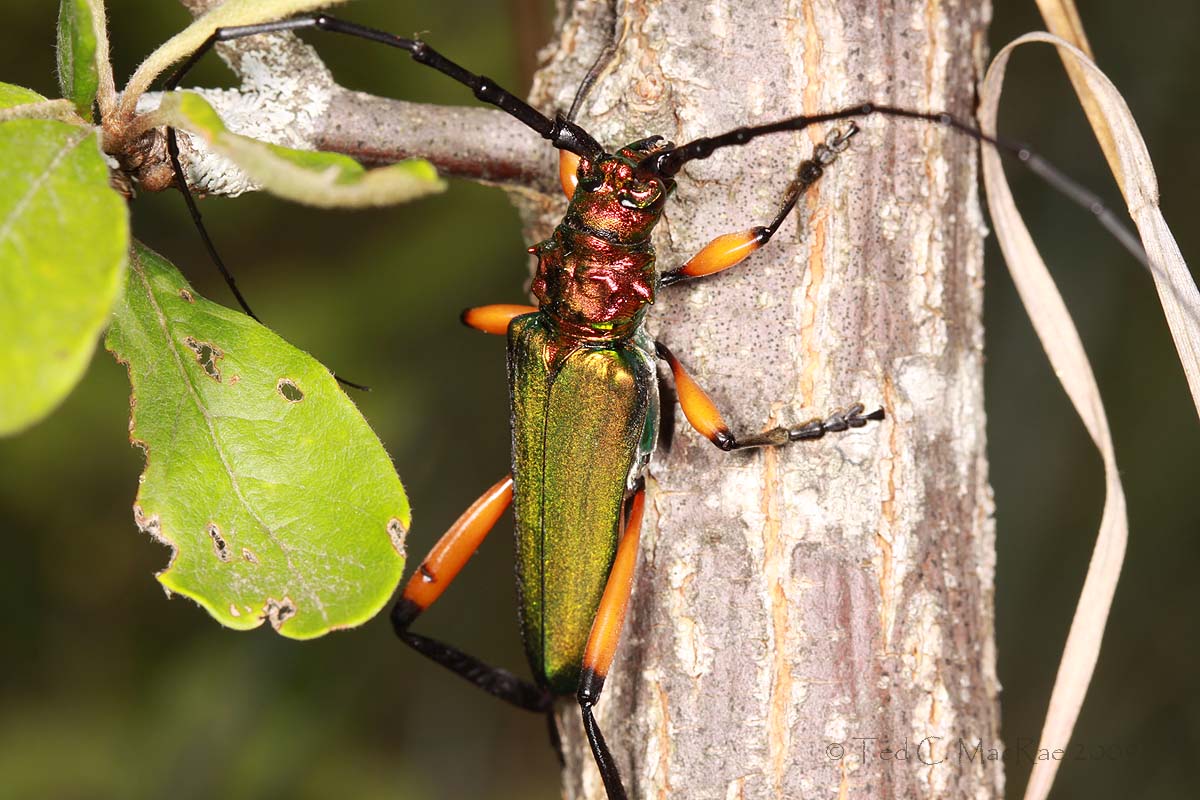
Despite the rain, we then went back to Hercules Glades Wilderness to see if luck would follow suite there as it had at Blackjack Knob.  It didn’t, as rain continued to doggedly pursue us, but the day was not a total loss as daughter and I got in a nice 7-mile hike through some of Missouri’s most ruggedly scenic terrain and were rewarded with the sighting of a western pygmy rattlesnake.  The next day was sunny, much to our delight, and I considered going back to Blackjack Knob where we had seen a good number of adults the previous day.  In the end, I decided I’d played that card and rather than continue trying for photographs I’d rather see if the beetle could be found at another glade complex further to the east at Long Bald Glade Natural Area in Caney Mountain Conservation Area.  Things didn’t look promising, as I found bumelia trees occurring only sporadically across the main glade complex—with no sign of the beetles.  Nevertheless, we enjoyed the day and spent a bit of time chasing after some enormous robber flies that later proved to be Microstylum morosum, a new record for Missouri and a significant northeastern range extension.  I thought that would be the highlight of the day, but as we were heading back to the car I spotted a small glade relict on the other side of the road.  It was overgrown and encroached, apparently not receiving the same management attention as the glades in the main complex. Regardless, I went over to check it out and immediately spotted several bumelia trees amongst the red-cedars, and within minutes I saw a beetle—low on the trunk of a very small bumelia tree!  Once again I froze, then slowly geared up with the camera and began my ultra-cautious approach (remember, this was only my second photo chance after a combined four days in the field).  Like last time, I took one shot while still some distance away, then moved in for closer attempts.  Unlike last time, there was no bothersome vegetation cluttering the view, and when I moved in for closeups the beetle turned around, crawled up the trunk a short distance, and then paused.  I snapped off a small series of shots while it sat there, and then suddenly it became alarmed and flew away.  Though still not perfect, these photographs were better than the previous ones I had obtained (check out the pronotal armature in the last photo!), and the finding of this species at Long Bald Glades also represented a new county record.

Plinthocoelium suaveolens on trunk of living Sideroxylon lanuginosum

Plinthocoelium suaveolens on trunk of living Sideroxylon lanuginosum

Plinthocoelium suaveolens on trunk of living Sideroxylon lanuginosum

Plinthocoelium suaveolens on trunk of living Sideroxylon lanuginosum

Missouri populations are assignable to the nominotypical subspecies (southeastern U.S.), which is distinguished from subspecies plicatum (Texas, New Mexico, Arizona, and northern Mexico) by the bronze or cupreous tints and weak transverse rugae on the pronotum (Linsley 1964).  The distributional ranges of the two subspecies intermingle in northeastern Texas.

Photo details:
All photos: Canon 100mm macro lens on Canon EOS 50D
Photo 1 (Chute Ridge Glade): normal mode, ISO-400, 1/250 sec, f/16, natural light.
Photo 2 (Sideroxylon lanuginosum): landscape mode, ISO-100, 1/160 sec, f/6.3, natural light.
Photos 3 (P. suaveolens larval frass pile), 6—8 (P. suaveolens adult): manual mode, ISO-100, 1/250 sec, f/9-11, MT-24EX flash 1/2 power through diffuser caps (photo 7 slightly cropped).
Photos 4—5 (P. suaveolens larva): manual mode, ISO-100, 1/60 sec, f/14 (closeup f/25), MT-24EX flash 1/2 power through diffuser caps.

REFERENCES:

Champlain, A. B. and J. N. Knull.  1932.  Fermenting bait traps for trapping Elateridae and Cerambycidae (Coleop.).  Entomological News 43(10):253–257.

Linsley, E. G. 1964.  The Cerambycidae of North America. Part V. Taxonomy and classification of the subfamily Cerambycinae, tribes Callichromini through Ancylocerini.  University of California Publicatons in Entomology, 22:1—197, 60 figs., 1 pl.

Linsley, E. G. and P. D. Hurd, Jr.  1959.  The larval habits of Plinthocoelium suaveolens plicatum (LeConte).  Bulletin of the Southern California Academy of Sciences 58(1):27–33.

MacRae, T. C. 1994. Annotated checklist of the longhorned beetles (Coleoptera: Cerambycidae and Disteniidae) known to occur in Missouri. Insecta Mundi 7(4) (1993):223–252.

MacRae, T. C. and M. E. Rice. 2007. Distributional and biological observations on North American Cerambycidae (Coleoptera). The Coleopterists Bulletin 61(2): 227–263.

Riley, C. V.  1880.  Food habits of the longicorn beetles or wood borers.  The American Entomologist 3(10):237–239.

Turnbow, R. H. Jr. and F. T. Hovore.  1979.  Notes on Cerambycidae from the southeastern U. S.  Entomological News 90(5):219–229.

Copyright © Ted C. MacRae 2009

Add to FacebookAdd to NewsvineAdd to DiggAdd to Del.icio.usAdd to StumbleuponAdd to RedditAdd to BlinklistAdd to TwitterAdd to TechnoratiAdd to Furl

Do the Doodlebug Flip

I’ve been on a doodlebug kick ever since I finally figured out how to find the little buggers on my trip down to southeast Missouri.  I even found one in one of the tiger beetle terraria that I setup with native soil brought back from that trip, so I’ll get the chance to try to rear one out.  Shortly after finding those first antlion larvae, I traveled to Rock Island, Illinois to attend the Second Illinois Hill Prairie Conference as a panelist for the insects discussion group.  During a field trip to a nearby hilltop prairie, I spotted a pit in a bed of sawdust that had the unmistakeable look of an antlion pit.  I can’t say that I’ve ever seen an antlion pit in anything but sand, so I dug up the larva to confirm that that was, indeed, what it was.  The larval pit site must have been selected by the adult female who laid the egg, so apparently the loose sawdust had the appropriate texture to induce oviposition.  The larva was fat and happy, suggesting it was feeding well in its sawdust pit.

Antlions flick sand with their head and elongated mandibles to create the pit, and they also flick it on prey that has fallen in their pit to thwart their escape.  Watch how this one also use its head flicking ability to right itself in a most humerous manner after being flipped over:

Copyright © Ted C. MacRae 2009

Add to FacebookAdd to NewsvineAdd to DiggAdd to Del.icio.usAdd to StumbleuponAdd to RedditAdd to BlinklistAdd to Ma.gnoliaAdd to TechnoratiAdd to Furl

Tiger Beetle Rearing

I recently found an interesting website called Tiger Beetle Rearing.  This website by doctoral candidate Rodger Gwiazdowski in the Joseph S. Elkinton lab, University of Massachusetts, Amherst contains a wealth of information and photographs covering equipment, techniques, and methods for rearing tiger beetles from egg to adult, with a primary focus on rearing endangered and threatened species of tiger beetles for conservation and re-release into the wild.  The lab has reared a number of tiger beetle species but is particularly interested in the Puritan tiger beetle (Cicindela puritana), threatened in the northeastern U.S.  After the first year of rearing, 90 2nd and 3rd instar C. puritana larvae were obtained and, as of the last update, were overwintering in individual tubes.  You’ll need to register with the site with a username and password to access the site, but this is accomplished quickly and easily.

Welcome to the Hotel Cicindela!

Welcome to the Hotel Cicindela!

I found this website of great interest as I begin my own efforts at rearing these beetles in the laboratory.  My primary interest is in rearing larvae that I collect in the field to adulthood – adults are much more easily identified than larvae (indeed, the larvae of many species remain undescribed), and rearing field-collected larvae is one way to get around the often limited temporal occurrence that many tiger beetle species exhibit as adults.  My operation isn’t nearly as sophisticated as the one developed in the Elkinton lab, but then I’m just a working stiff trying to do this (and a million other things) on the side. Despite this, I have had my first success, rearing to adulthood a larva I collected during the summer last year (see my post It’s a girl!).  In addition, I currently have a number of larvae collected last fall in Nebraska and South Dakota, which I put in terraria of native soil and kept in a cold incubator during the winter.  I pulled them out earlier this spring, and soon afterwards a number of larvae opened up their burrows and have been feasting on fall armyworm and corn earworm caterpillars every 2-3 days or so.  The larvae were collected from a variety of habitats and soil types, including sand, alkaline seeps, and red clay banks, so I’m hopeful that the ensuing adults will represent a variety of interesting species – perhaps some that I did not encounter in the field during that trip.

Cicindela_scutellaris_rearing_P1020931_2Beyond this, however, I am also interested in trying my hand at cross-breeding experiments – particularly with Missouri’s unique population of Cicindela scutellaris (festive tiger beetle).  I’ll need to wait until fall for this, however, since adults that are active in the field right now are sexually mature and have presumably already mated.  In the fall, a new generation of sexually-immature adults will emerge and feed for a time before burrowing back in for the winter and re-emerging the following spring ready to mate.  I would like to cross individuals from southeastern Missouri – representing an intergrade between the northern subspecies lecontei and the southern subspecies unicolor – with individuals from the northern part of the state that are clearly assignable to subspecies lecontei.  If possible, I would also like to obtain individuals from even further south that are clearly assignable to subspecies unicolor and cross them with both the southern and northern Missouri populations.  These crossing experiments may provide some insight into which of the subspecies the intergrade population is more closely related to, and it will be interesting to see how closely the progeny from the lecontei x unicolor cross resemble individuals from the intergrade population and the range of variation that they exhibit.  I should mention that Matt Brust (Chadron State College, Nebraska) has done a number of these inter-subspecific crosses with C. scutellaris, with some very interesting results among the progeny.

What I can do right now is work on techniques to make sure I can get females to lay eggs and then rear the larvae all the way through to adulthood.  For this, I brought back 9-10 live individuals from two localities of the intergrade population encountered on my recent trip to the southeastern lowlands.  Adults imbibing moisture from polymer gelI put equal numbers of males and females from each locality into separate terraria – each filled with native soil and a hydrophilic polymer gel made of anionic polyacrylamide. The beetles, who normally obtain moisture from their food or by “chewing” moist soil, chew instead on the gel. This eliminates the need to maintain a water dish or cotton batting that must be changed daily in order to prevent the growth of mold and bacteria. A few of the adults in each terrarium died shortly afterwards, possibly a result of stress or dehydration during transport (the photo right shows how eagerly they imbibed moisture from the polymer gel after being placed in the terrarium), but the remainder have lived for four weeks now and have been digging burrows and feeding whenever food is offered.  According to Matt Brust, C. scutellaris does not lay eggs on the surface of the soil (as does C. celeripes), but rather lays them about 1.5 to 2 inches below the surface.  It takes 2-3 weeks before the eggs start hatching, so I am expecting to see larval burrows appearing anytime now.  Matt tells me the key to getting eggs is to feed the adults “big-time” – thus, I have been offering fat, juicy fall armyworm or corn earworm larvae to the adults whenever they are out of their burrows.  Watch this entertaining video of one adult having lunch:

Copyright © Ted C. MacRae 2009

Add to FacebookAdd to NewsvineAdd to DiggAdd to Del.icio.usAdd to StumbleuponAdd to RedditAdd to BlinklistAdd to Ma.gnoliaAdd to TechnoratiAdd to Furl

Now you see me…

Myrmeleon_sp_P1020915_2

…now you don’t!
Myrmeleon_sp_P1020914_2

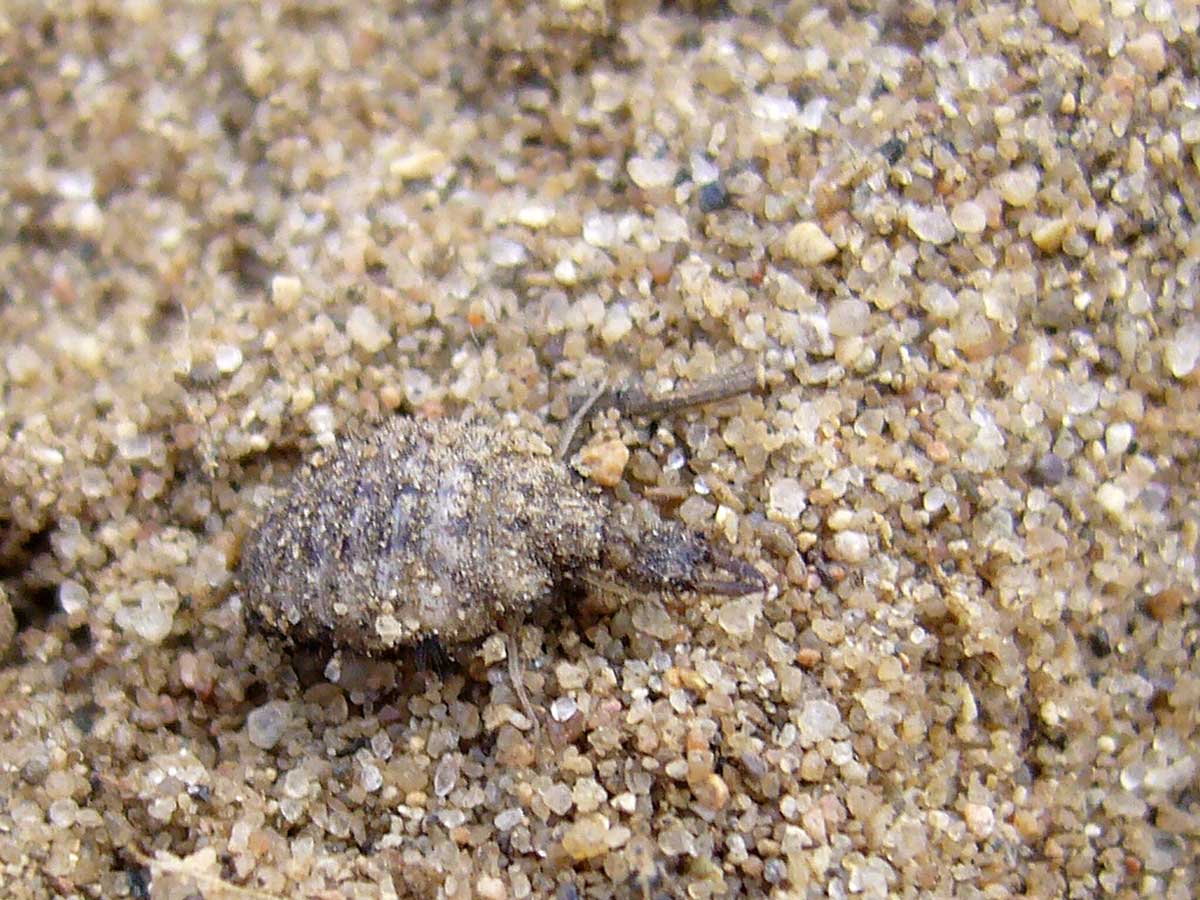
In a previous post, I lamented the fact that I had never actually seen a live antlion larva, or doodlebug (family Myrmeleontidae). Lovers of sand, I’ve seen their famous pitfall traps many times, especially in recent years as I’ve searched sand habitats for my beloved tiger beetles. Occasionally, I’ve stopped to jab my knife under a pit, give it a quick flip, and search the freshly turned sand for the maker of the pit – never seeing anything. It never bothered me much either – there were always beetles to catch!  Two weeks ago I returned to the sand prairies of southeastern Missouri to look for additional sites for Cicindela scutellaris (festive tiger beetle), and as we searched one particular site on the Sikeston Sand Ridge I once again saw the characteristic funnel-shaped pits amongst sparse vegetation in the sandy soil.  I decided this time I needed to give it a good effort – how can any self-respecting entomologist accept not having ever seen a live doodlebug?  As I’d done many times before, I kneeled down, gently put the tip of the knife about an inch away from the edge of the pit, and then jabbed its full length assertively into the sand and under the burrow and flipped it over.  Like previous times, I studied the turned sand and saw nothing.  I stirred the sand gently with the tip of the knife and studied it again – nothing.  I tried another burrow – again, nothing.  I decided right then and there that I was doing something wrong – I could not simply be picking ’empty’ pits.  I continued staring at the turned sand, and then I saw movement – I looked closer, and it seemed as though the sand itself was moving.  At last I made out its outline – I had finally succeeded in finding a doodlebug!  I dug up another burrow, and knowing what I was looking for this time I had no problem quickly locating the little creature.  I watched it as it lay motionless – perfectly camouflaged by its color and with sand grains sticking to its body, and chuckled as it buried itself almost instantly with a quick, backwards shuffle into the sand. Who knows how many doodlebugs I’d successfully dug up in the past, completely overlooking them as they lay disguised and motionless in the sand.

More than 100 species of antlions, representing at least 19 genera, live in the Nearctic Region, although much of this diversity occurs in the southwestern U.S. and Mexico.  Despite the commonly drawn association between antlions and pitfall traps, in North America only those in the genus Myrmeleon actually exhibit this behavior.  This larva dug a pit and so must represent a species of Myrmeleon – perhaps M. immaculatus, a common species in North America and one whose adult I observed last fall on a nearby sand prairie remnant.  Species in other genera have free-living larvae that hide under objects or roam underneath the sand, from where emerge briefly to hunt for prey.

For those interested in learning more about antlions, Mark Swanson has an excellent website called The Antlion Pit.

REFERENCE:

Swanson, M.  1996. The Antlion Pit: A Doodlebug Anthology. http://www.antlionpit.com/

Copyright © Ted C. MacRae 2009

Add to FacebookAdd to NewsvineAdd to DiggAdd to Del.icio.usAdd to StumbleuponAdd to RedditAdd to BlinklistAdd to Ma.gnoliaAdd to TechnoratiAdd to Furl

Body Invaders

In keeping with the parasitic theme I established in my last two posts, I happened upon this brief video promotion for a National Geographic special called In the Womb: Extreme Animals which will air this Sunday (May 10). The video features the offspring of a parasitic wasp (Cotesia glomerata) that has injected her eggs into a caterpillar — and now they’re ready to emerge! It’s a fascinating study of parasitoid-host relationships, filmed incredibly from inside the caterpillar! Watch the whole video for the wicked, surprising ending.

Viewing tips: after beginning play, click on “HQ” in the lower right corner to view the video in high quality. Or, click on the video itself to be taken to YouTube, where you have the option to watch the video in HQ and in full screen mode (2nd button from the lower right corner). You will be amazed!

Vodpod videos no longer available.

more about “Body Invaders“, posted with vodpod

Tip of the hat to Adrian, who posted this yesterday (but I really did find it on my own).

Copyright © Ted C. MacRae 2009

Add to FacebookAdd to NewsvineAdd to DiggAdd to Del.icio.usAdd to StumbleuponAdd to RedditAdd to BlinklistAdd to Ma.gnoliaAdd to TechnoratiAdd to Furl

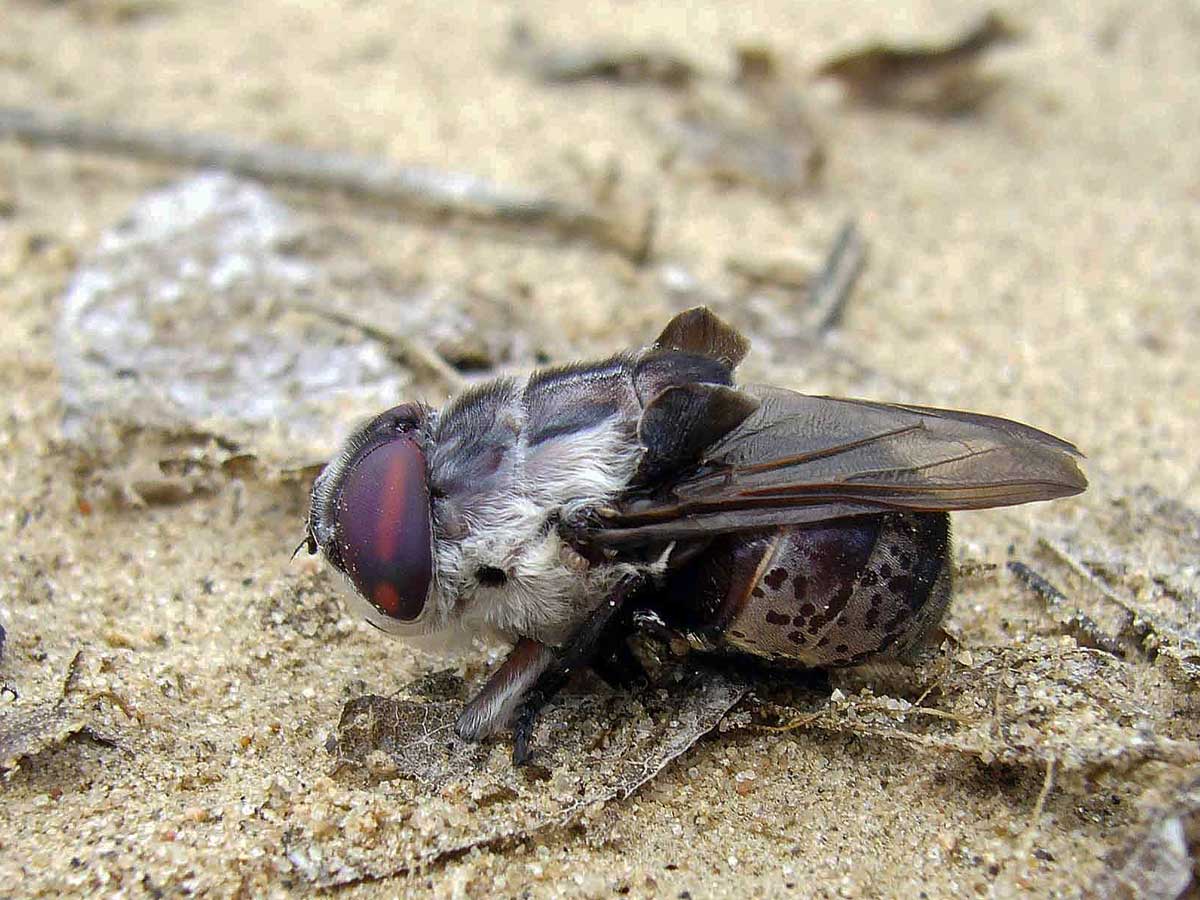
Newly emerged rabbit bot fly

Cuterebra buccata_P1020896_2

First things first – congratulations to Mark Deering (Sophia Sachs Butterfly House, right here in St. Louis) and Rod Rood (Washington State University) for correctly identifying yesterday’s “What the heck?” as the cast puparium of an oestrid bot fly.  Mark eventually staked his claim on the genus Cuterebra, and Rod as well included this genus in his short list.  They are more astute naturalists than I – had I not found the newly emerged adult right next to it, I doubt that I would have known or figured out what it was.  Thanks also to the many other people who played the game – most were united in thinking it was some kind of insect, with many noting its distinctly abdominal appearance.  It seems, at least among my readers, that shed insect cuticle is a more popular quiz subject than plants.

Cuterebra buccata_P1020891_2I encountered this individual on open sandy ground while searching for my beloved  southeastern Missouri festive tiger beetles.  When I first saw the adult, it was on its back on the ground, feebly waving a couple of legs in the air.  I at first thought it was some kind of clumsy beetle but realized what it was as I approached it.  Clearly the fly was in distress, and I thought it odd that the puparium was laying on the ground next to it.  Bot flies in the genus Cuterebra have among the most deliciously gruesome of all insect life histories.  The ultra short-lived adults (lacking even functional mouthparts) lay their eggs near rodent and lagomorph burrow entrances, with the different species showing a fair degree of host specificity (Catts 1982).  When the fly larva hatches, it migrates to the host and enters the animal’s body through a natural orifice or break in the skin.  It then finds a subcutaneous location to feed, creating a cyst-like structure within a swelling of subcutaneous tissue and with a hole at the skin surface to allow respiration.  Once mature, the larva exits and drops from the host and burrows into the ground for pupation. We could find no emergence hole nearby, so perhaps the puparium was exposed by rain prior to emerging and suffered some desiccation, or perhaps the adult had gotten stuck in the tough puparium and pulled it to the surface as it emerged – burning its limited energy reserves in the process. At any rate, it is rather unusual to find these things emerging with the pupal case.

Cuterebra buccata_P1020894_2Cuterebra spp. are known collectively as New World skin bot flies (formerly family Cuterebridae, but now classified as a subfamily of Oestridae).  I suspected this was the rabbit bot fly (C. buccata) due to its general appearance – notably the red bands in the eyes, which is a characteristic of rabbit-infesting species.  However, the genus is diverse, with 34 recognized North American species – seven of which belong to the rabbit-infesting group (Sabrosky 1986).  I don’t have a copy of Sabrosky’s revision, and my efforts to locate it electronically turned up only retail listings for $70 or more.  That’s serious coin for someone who really needs to stay focused on his beetles, so I sent these photographs to bot fly specialist Jeff Boettner at the University of Massachusetts.  Jeff confirmed that it is indeed a Cuterebra rabbit bot and will confirm a species identity after checking his collection.

Jeff also sent the following note and interesting link:

Speaking of red eyed bots…there is one on Bugguide that a woman from NM posted. It is Cuterebra mirabilis and it may be the rarest photo on BugGuide. It’s only known from 2 previous specimens (also from NM). Its the largest of the rabbit bots. Much darker than yours.

Jeff notes that “mirabilis” in Latin means “extraordinary” – a truly appropriate name for this beautiful insect. Even though I am a devout coleopterist, I must confess – cuterebrids rock!

REFERENCES:

Catts, E. P.  1982.  Biology of New World bot flies: Cuterebridae.  Annual Review of Entomology 27:313-338.

Sabrosky, C. W. 1986. North American species of Cuterebra, the rabbit and rodent bot flies (Diptera: Cuterebridae). Entomological Society of America Thomas Say Foundation Monograph, College Park, Maryland, 240 pp.

Copyright © Ted C. MacRae 2009

Add to FacebookAdd to NewsvineAdd to DiggAdd to Del.icio.usAdd to StumbleuponAdd to RedditAdd to BlinklistAdd to Ma.gnoliaAdd to TechnoratiAdd to Furl

Wednesday “What the heck?”

p1020893_2

This might be the hardest nature quiz ever – I don’t think I would’ve ever figured out what this was had I not found what I did next to it.  I found it on my recent trip to look for Cicindela scutellaris (festive tiger beetle) in southeastern Missouri. Of course, now knowing what it is, the image does seem to provide enough clues about its identity – perhaps some crack naturalist will figure it out.

I’ll provide the answer with additional photos tomorrow.

Copyright © Ted C. MacRae 2009

Add to FacebookAdd to NewsvineAdd to DiggAdd to Del.icio.usAdd to StumbleuponAdd to RedditAdd to BlinklistAdd to Ma.gnoliaAdd to TechnoratiAdd to Furl