Answers to ID Challenge #5 – Artrópodes em casca de árvore morta

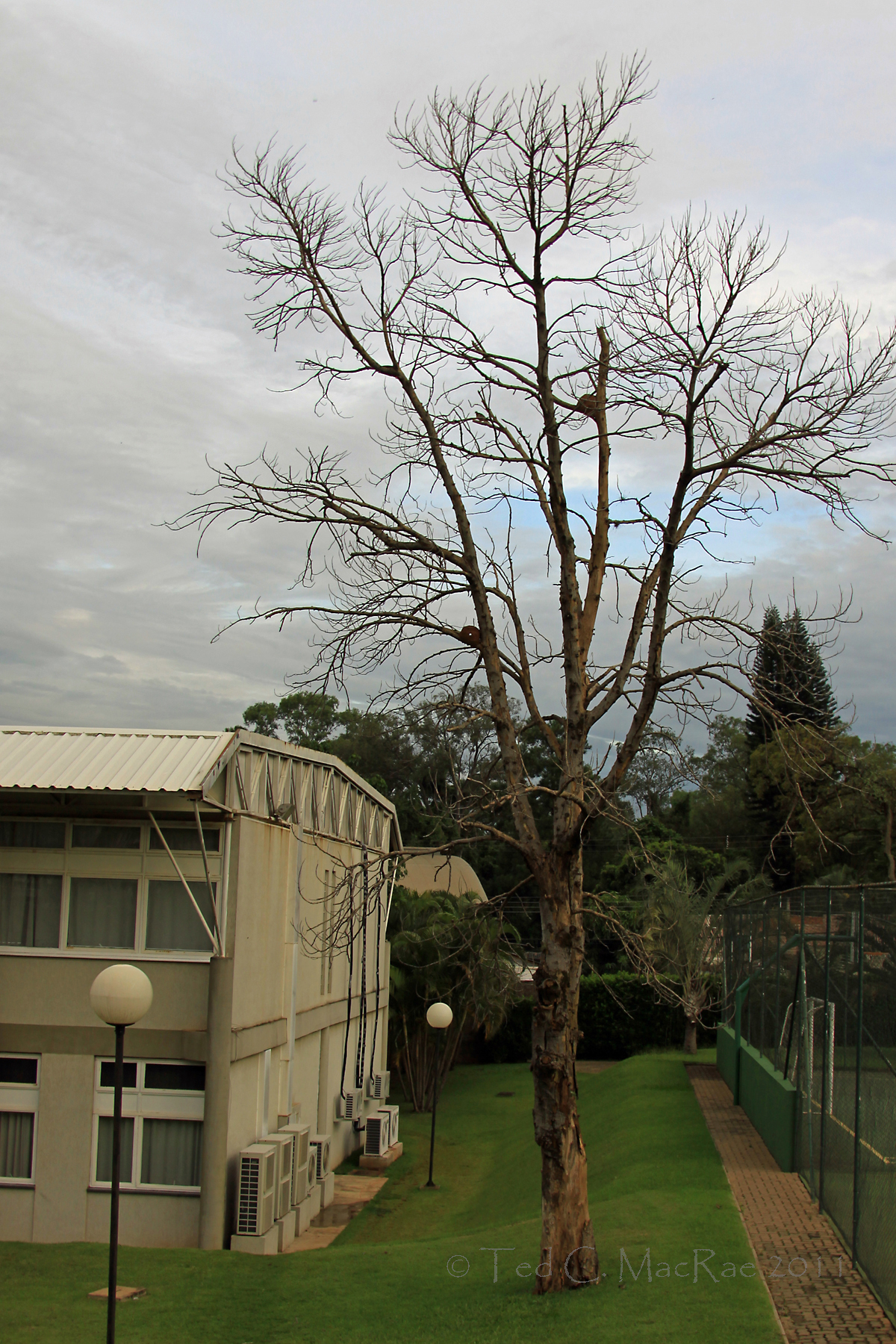
Dead tree in Campinas, Brazil

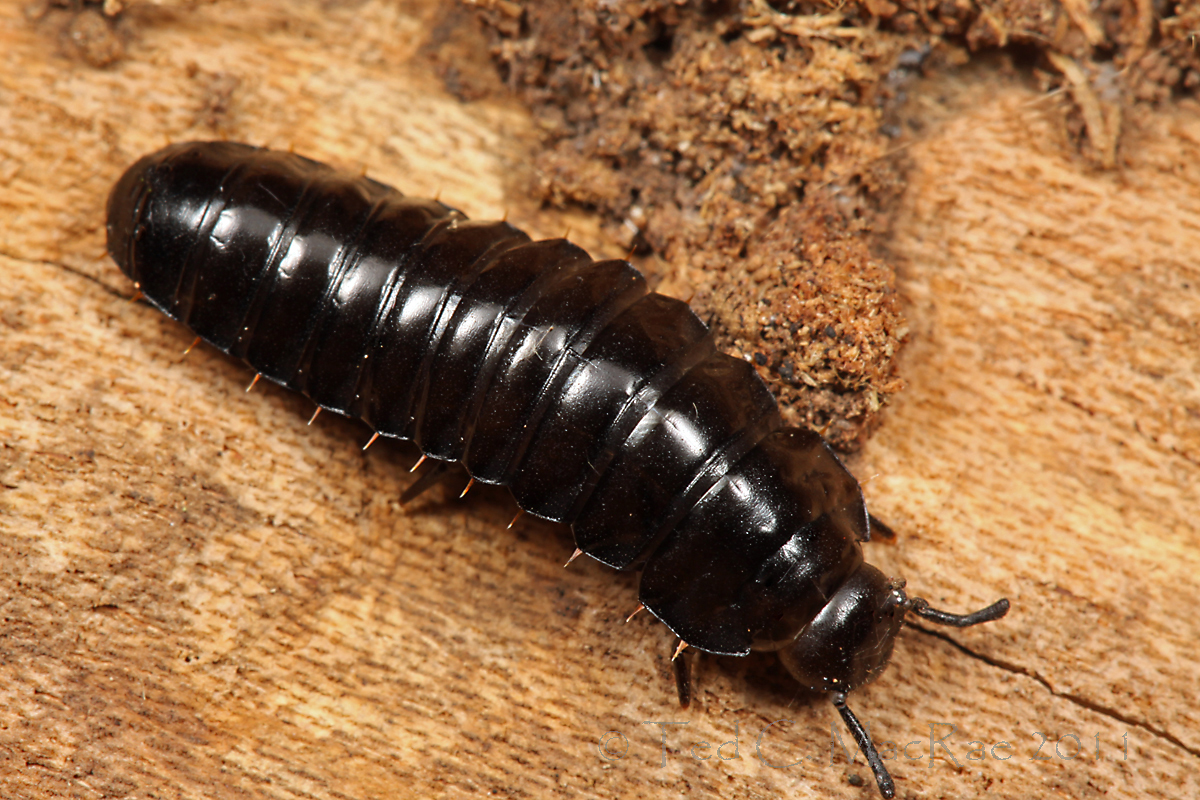
After checking into my hotel in Campinas, Brazil I couldn’t wait to start exploring the grounds to see what insect life I might be able to find.  Almost immediately, I encountered this dead tree in back of the hotel.  To a beetle collector, a dead tree is an irresistible draw – especially one that is still standing and with loosely hanging bark, as in this one.  I approached the tree, gave it a look up and down the trunk to see if any beetles or other insects might be found on the outer surface of the bark, and when none were seen began carefully peeling sections of the bark away from the trunk.  Out from beneath the first section darted a small, black lizard – it reminded me in general form of our North American fence lizards (genus Sceloporus), but honestly it darted so fast up the trunk that I didn’t get a good look at it (much less even the chance to attempt a photograph).  Peeling the bark further away from the wood revealed a goodly number of what I took to be beetle larvae, although they were unlike anything I’d ever seen before.  They were fairly good-sized – about 25mm in length, and although there are a number of beetle families whose larvae may be encountered under the bark of dead trees, there aren’t many with larvae of this size.

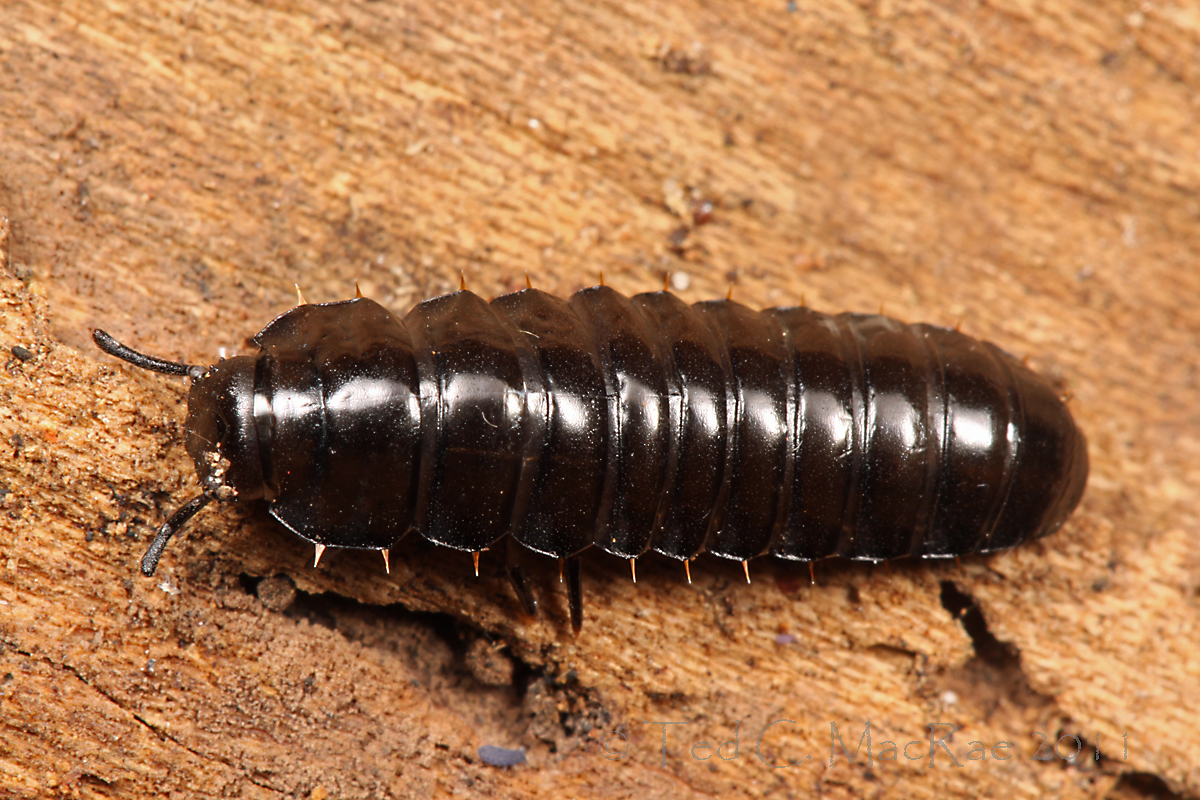
Coleopteran larva (Tenebrionidae?) under bark of dead tree.

Despite their odd appearance, their basic gestalt suggested to me that they might be something in the family Tenebrionidae (darkling beetles).  Sadly, the state of beetle larval taxonomy is far from complete, especially in the tropics, and given the extraordinary diversity of the order as a whole I knew it could be difficult to impossible to identify them.  This task was further complicated by the fact that I did not collect any voucher specimens.¹

¹ Insect collecting permits are required in Brazil and are exceedingly difficult to obtain.  Although enforcement is lax, a few unlucky foreigners have been caught and suffered tremendous inconvenience at the hands of notoriously unsympathetic authorities.  This being a business trip, I had no desire to tempt fate for the sake of a few larvae in a group I don’t even study.

Despite a millipede-like appearance, six legs and loose cluster of ocelli indicate its true identity.

After consulting all of the print and online resources at my disposal and failing to find a convincing match at even the family level, I began to second guess not only whether these were tenebrionids, but larvae or even beetles.  I’m not aware of any tenebrionids with larviform adult females, but such are common in the Lampyroidea.  That didn’t seem to fit, however, as the latter tend to be much more flattened and armored in appearance, and the round head is really unlike the elongate and narrow head so often seen in that group.  The actually began to wonder if it was even a beetle – most xylophagous beetle larvae are light-colored and rarely so heavily sclerotized, and the antennae are unlike the typical 3-segmented antennae seen with most xylophagous beetle larvae.  In fact, the antennae and the shape of the head actually reminded me of a millipede, but the obvious presence of six legs (and no more) made this untenable (even though 1st instar millipedes are hexapod, the large size of these individuals precludes them from being 1st instar anything).  Eventually, I could only conclude that they were coleopteran – possibly a larviform adult, but more likely larval.  As a last resort I sent photos to Antonio Santos-Silva, a coleopterist at the University of São Paulo.  Although he specializes in Cerambycidae, I reasoned this might be a fairly common species since I had found good numbers on a single tree in an urban area near São Paulo, and as such it might be something he would recognize.  Antonio quickly replied saying that he agreed it was the larva of a species of Tenebrionidae, with an appearance similar to the larvae of Goniodera ampliata (a member of the Lagriinae, formerly considered a separate family).  I’ve not been able to find photos of the larva of Goniadera or related genera, but these do bear a striking (if more glabrous) resemblance to these presumed tenebrionid larvae from Australia.  Until a more convincing opinion is forthcoming, Tenebrionidae seems to be the consensus.

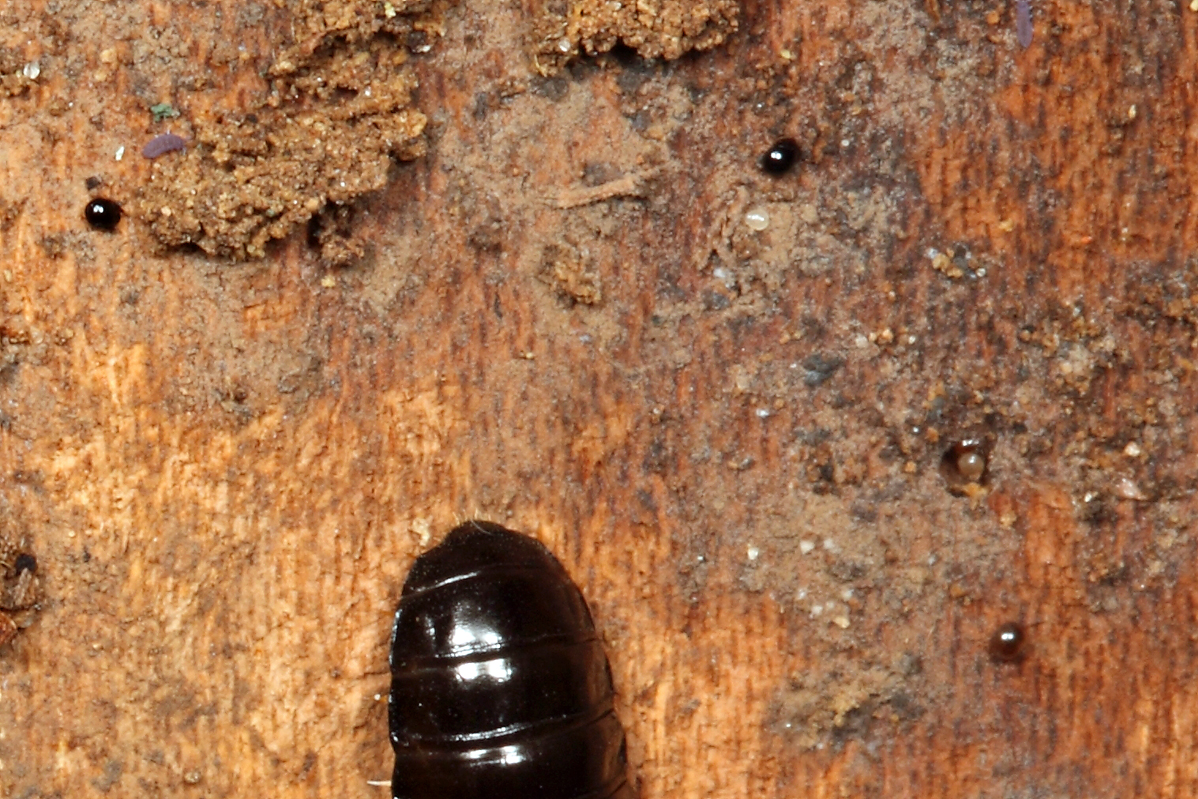
Polyxenid millipedes and two types of Collembola (several Poduromorpha and one Entomobryomorpha)

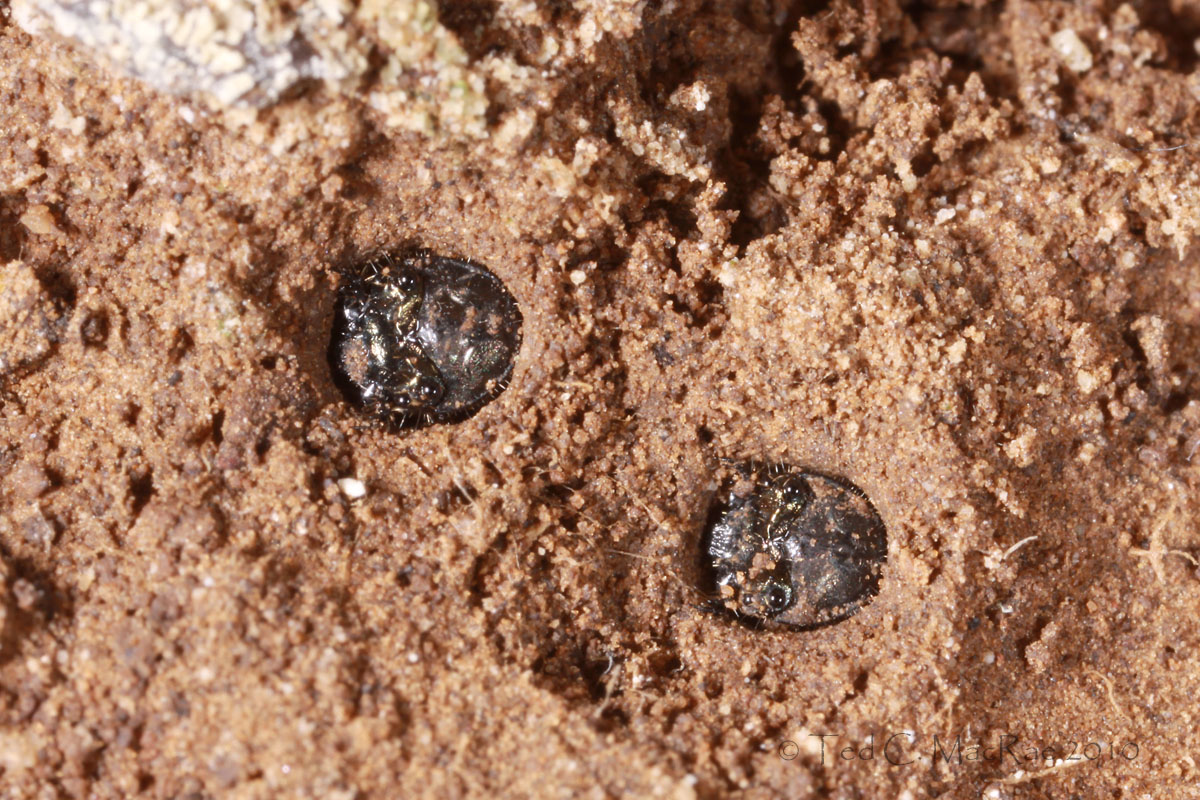
Three tiny adult coleopterans (family?) surround a large larval coleopteran

Although nobody zeroed in on Tenebrionidae for this challenge (#5 in the ID Challenge series), I must say that I enjoyed the diversity of opinion about what it might represent.  Moreover, congratulations to those who ‘took nothing for granted’ and noted the presence of several other organisms in the photo – this is where the big points were to be earned, and several participants successfully ID’d what I take to be a number of poduromorph collembolans, a single entomobryomorph collembolan, a central cluster of polyxenid millipedes, and several indistinct but clearly coleopteran adults (see super crops above).  David Hubble got the most correct answers to earn 15 points and the win in this inaugural post of BitB Challenge Season #2, while Dave and Troy Bartlett earned 13 and 10 points, respectively, to complete the podium.  Seven other participants got in on the fun and earned some points – I hope you’ll join the fun next time, too!

Copyright © Ted C. MacRae 2011

Diversity in Tiger Beetle Larval Burrows

One of the fascinating aspects of tiger beetle study is their often high degree of fidelity for specific habitats.  Some species prefer wet habitats, while others frequent the drier uplands.  Some like sand while others need clay.  Differences in salinity, vegetational cover, and even slope dictate what species might be expected to occur in a given habitat, thus, the diversity of tiger beetle species one encounters is directly proportional to the diversity of habitats explored.  Unfortunately, tiger beetles can be rather ephemeral in their occurrence as adults.  Despite a life cycle that requires at least one year (and may take 2-3 years or even more), adults are often present for only for a few short weeks.  Even during the time that adults are present, they often hide if conditions aren’t right (too cold, too hot, too wet, too early, too late, etc., etc.  Add to that their marvelous evasive capabilities, and it’s a wonder I ever see or catch any at all!).  The study of tiger beetles is not, however, entirely dependent upon the adults.  The presence of larval burrows in an area is also useful information, and through understanding of the species that might occur in an area and their habitat preferences, it is possible to identify – at least tentatively – the species that might be living in them.

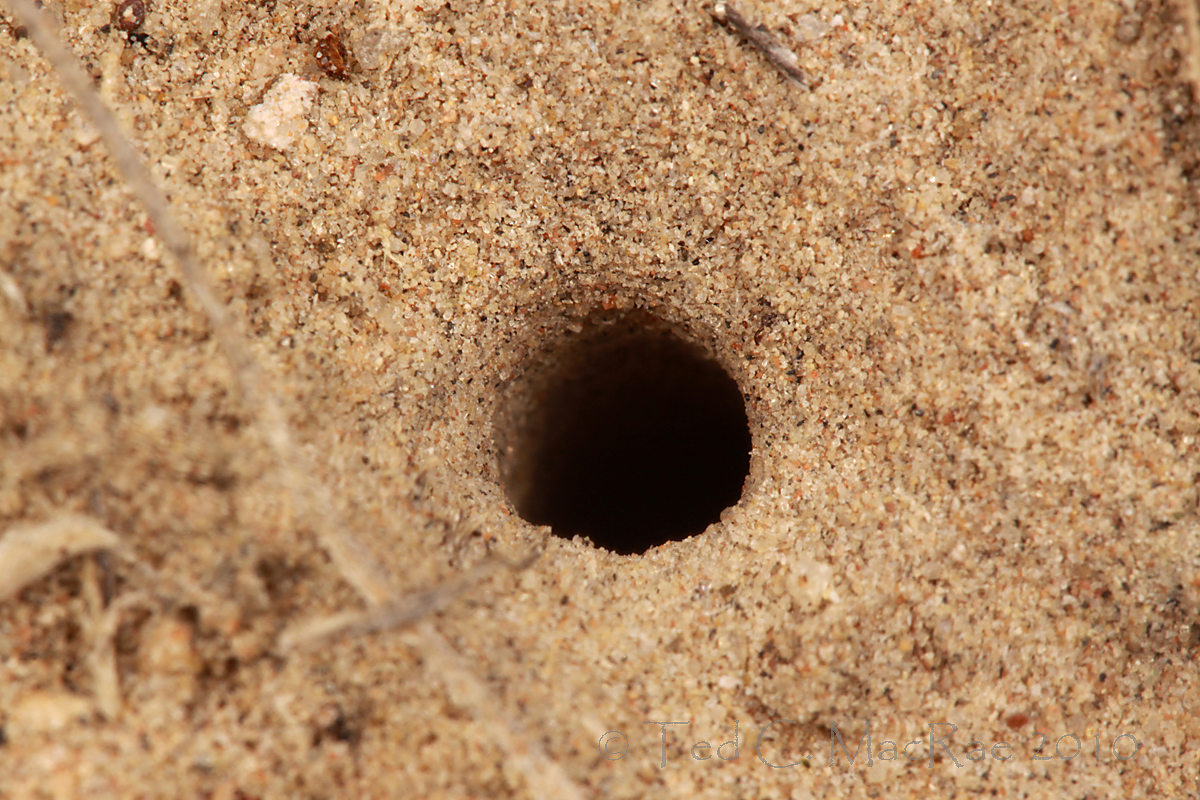
Cicindela lengi? (sandy tiger beetle) - Sioux Co., Nebraska

To the uninitiated, tiger beetle burrows might seem nothing more than a simple hole in the ground – anything could have made it.  However, with experience one becomes able to distinguish tiger beetle larval burrows almost instantly from burrows made by other ground-burrowing organisms.  The most common type of burrow is recognized by a combination of characters – almost perfectly circular except for a slight flattening on one side that gives the burrow a faint D-shape, and with the edge smoothly beveled.  This is your classic tiger beetle burrow and, for most U.S. species of Cicindela and related genera, averages ~5-6mm in diameter for 3rd instar larvae (tiger beetle burrows are most often observed at 3rd instar, since it is this final instar in which the larva spends the majority of its time and the burrow becomes most noticable).  The above burrow is one such burrow, found at Monroe Canyon in northwestern Nebraska last September.  While a number of species are known from the area, there are only a few that make their burrows in deep dry sands such as those that occur at this site.  We can eliminate Cicindela formosa (big sand tiger beetle) for reasons discussed below, and we can also dismiss Cicindela limbata (sand blow tiger beetle) because the habitat is not the barren, wind-shaped sand blow habitat that the species prefers.  This leaves two possibilities – Cicindela scutellaris (festive tiger beetle), a common and widespread inhabitant of sand habitats throughout the Great Plains, and Cicindela lengi (sandy tiger beetle), a much more localized resident of sand habitats with more western distribution.  The burrow likely represents the latter, since adults of this species have been found with greater frequency than C. scutellaris on the very fine-grained sands that occur in this part of Nebraska.  My confidence in this ID is bolstered by the fact that a larva I collected in the area from just such a burrow successfully finished its development and emerged a few months later as an adult C. lengi.

Cicindela pulchra pulchra (beautiful tiger beetle) - Fall River Co., South Dakota

Sometimes size alone is enough to indicate the species responsible for a burrow.  The above burrow was encountered last September in southwestern South Dakota on a clay/shale embankment in sage/shortgrass prairie.  A number of tiger beetle species fond of clay were observed at the site, including the two generalist species Cicindela tranquebarica (oblique-lined tiger beetle) and Cicindela purpurea audubonii (Audubon’s tiger beetle).  However, at ~8 mm in diameter the burrow is too large to have been made by either of these species.  The only tiger beetle in the area capable of making a burrow this size is Cicindela pulchra (beautiful tiger beetle), and in fact this burrow was found at one of several sites recently discovered by Matt Brust for this species in South Dakota.  Note again the classic shape – slightly flattened along the bottom side (the flattening accommodates the mandibles of the larval head – tiger beetle larvae always orient themselves in one position when sitting at the burrow entrance).

Cylindera celeripes (swift tiger beetle) - Woodward Co., Oklahoma

Just as large size was diagnostic for the previous burrow, the small size of the above burrow was also diagnostic.  This burrow, found at Alabaster Caverns in northwestern Oklahoma in October, 2009, measured only 3-4mm in diameter and can only have been made by Cylindera celeripes (swift tiger beetle).  This provisional ID was suggested by the fact that adults of the species had been observed abundantly in the lichen-encrusted clay exposures of this shortgrass prairie the previous June.  This photo, in fact, represents the first-ever discovery of the larval burrow of this species, and the identity of the species was confirmed when the larva collected from this and neighboring burrows and placed in rearing containers in the lab later emerged as adults.  I have found very similar-sized burrows in bottomland forest habitats in southeastern Missouri where the closely related species Cylindera cursitans has been seen.  The burrows are identical in size and shape, but the drastic difference in habitat is enough to distinguish the species that made them.

Cicindela formosa formosa (big sand tiger beetle) - Sioux Co., Nebraska

Not all tiger beetles utilize the simple hole-in-the-ground style of burrow, but rather incorporate some rather unique engineering features that make specific identification much easier.  This burrow can only be made by Cicindela formosa (big sand tiger beetle), a common resident of a variety of dry sand habitats throughout the Great Plains and eastern U.S.  The burrow entrance is on the large size for U.S. Cicindela (~6mm in diameter), and rather than opening flush on the ground it is directed horizontally and opens into a pit that is excavated to one side and underneath the burrow entrance.  No other U.S. tiger beetle makes a burrow quite like this (although I have noted Cicindela limbalis (common claybank tiger beetle) burrows on steep clay banks with a similar but much less distinct excavation on their lower side).  The pit apparently functions as a trap for potential prey, and since I have most often encountered burrows of this species in areas with some slope, I suspect the pit may help the larva capture its prey by preventing the prey from tumbling down the slope at the first sign of trouble.

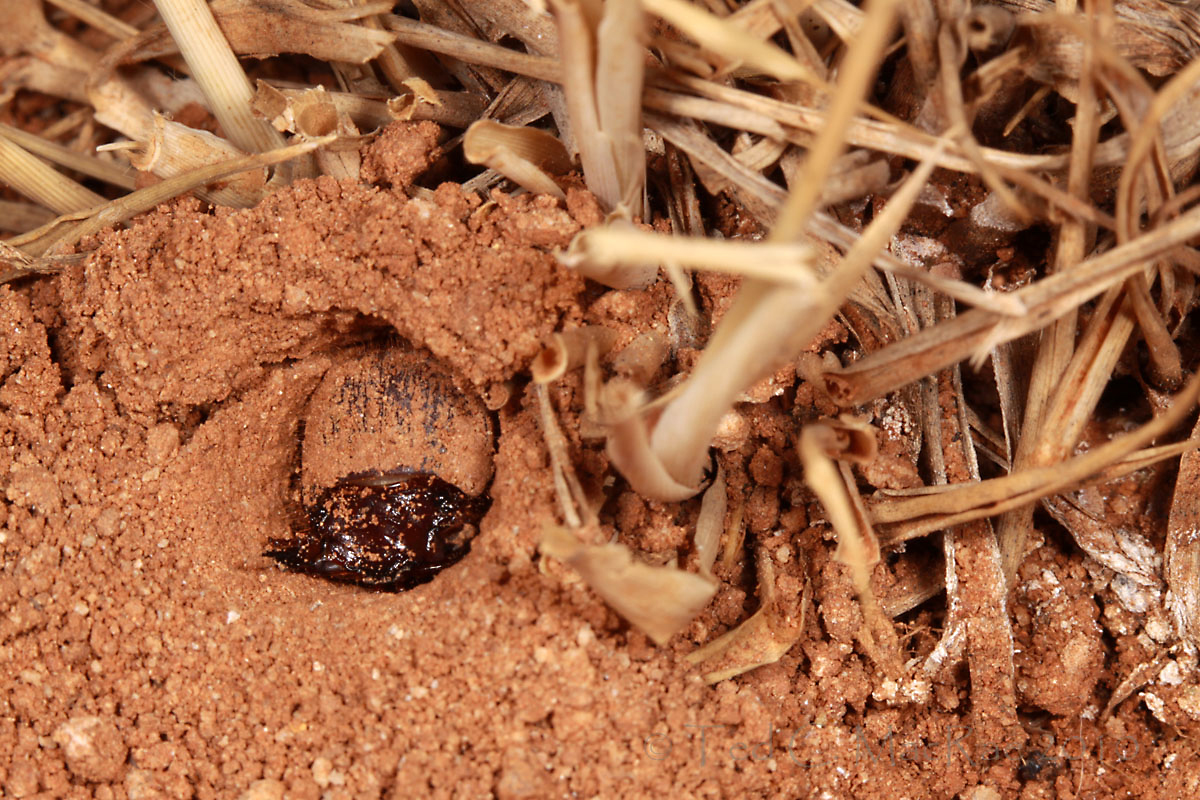
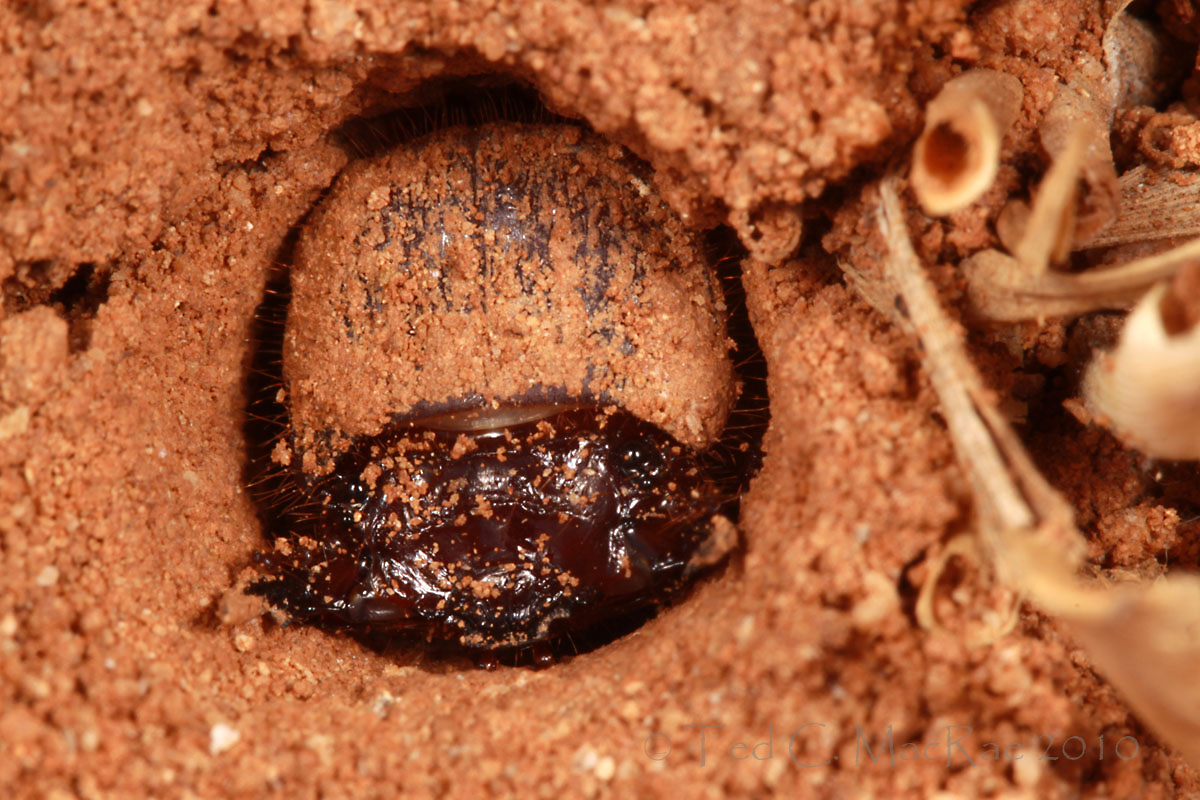
Cicindela formosa 3rd instar larvae - Sioux Co., Nebraska

This is a different burrow by the same species, also at Monroe Canyon last September, that shows a 3rd instar larva sitting at the burrow entrance.  The sickle-shaped mandibles are resting against the slightly flattened lower edge of the burrow entrance, while the round pronotum fills the rest of the entrance profile.  The upper pair of eyes can be seen above the mandibles, but the lower pair (between the upper pair and the mandibles) are not visible in this photo due to the downward-facing angle of the burrow entrance.  I waited for quite some time with camera in position in hopes that I could photograph the larva, and when it did return to the burrow entrance I had time enough to fire off just a couple of shots before it retreated once again to safety in the depths of its burrow.

Cicindela fulgida fulgida (crimson salt flat tiger beetle) - Sioux Co., Nebraska

This unusual-looking burrow was found in a dry clay saline creek bed in the Badlands of northwestern Nebraska last September.  The turret structure is unique, but the nearly perfectly round and smoothly beveled burrow entrance identify it, nevertheless, as that of a tiger beetle larva.  These burrows can only be made by Cicindela fulgida (crimson salt flat tiger beetle).  There are several other saline-tolerant tiger beetles species in Nebraska, but most such as Ellipsoptera nevadica knausii (Knaus’ tiger beetle), Eunota togata (cloaked tiger beetle), and Habroscelimorpha circumpicta johnsonii (Johnson’s tiger beetle) require much more moisture than was found in this bone-dry creek bad.  I’ve found two other much more widely distributed clay-associated species – Cicindela tranquebarica and Cicindela purpurea audubonii – at this and other sites where I’ve seen C. fulgida; however, the larvae of those species do not utilize this unique turret-shaped structure for their burrows.  The turret is thought to have a cooling function for the larva during the heat of summer by raising it above the hottest layer of air against the white salt-encrusted ground and by aiding in the dissipation of heat from the larval burrow.  I wanted to photograph the larva sitting at the burrow entrance and spent quite a bit of time stalking out this and nearby burrows for a chance to do so.  Alas, however, on this day the larvae had greater patience than I!
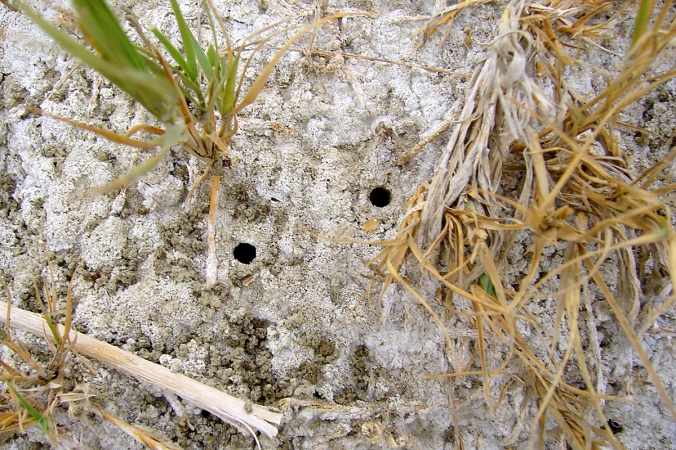
Cicindela tranquebarica kirbyi (Kirby's tiger beetle) adult & larval burrows - Sioux Co., Nebraska

The above burrow entrances were photographed in September 2008 at the same dry saline creek bed in Sioux Co., Nebraska.  I mentioned above that Cicindela tranquebarica kirbyi and Cicindela purpurea audubonii both occurred commonly at this site along with Cicindela fulgida; however, these burrows likely represent the former.  That species seems to be found more consistently in high saline environments than the latter, which in this case probably have their larval burrows in the more normal clay soil further away from the creek bed.  During that 2008 trip, I did collect larvae from burrows like these in several similar, high saline habitats in Nebraska, South Dakota, and Oklahoma, and in each case adults of C. tranquebarica kirbyi were what emerged.  I have also reared this species from larvae collected on clay banks and wet sand habitats – in all cases, the burrows are a tad larger than those I have seen for other species in the genus that I have reared, such as Cicindela limbalis and Cicindela repanda (common shore tiger beetle) – logical since adults of C. tranquebarica tend to be a little more robust than these other species (but smaller than Cicindela pulchra and Cicindela obsoleta vulturina (prairie tiger beetle)).  In the above photo, I believe the the upper-right burrow is that of a larva, while the the lower-left one is that of an emerged adult – note the not-perfectly-circular opening and more ragged edge to the burrow.  In fact, the latter burrow looks very much like the adult emergence burrow that I saw at this very location last September, in which the still unemerged adult was seen sitting!  Granular chunks of soil can be seen scattered about the latter burrow, but I believe these were actually tossed by the larva rather than the adult as a result of burrow excavation – the amount of soil an adult would need to remove to re-open its burrow for emergence would probably be far less than what can be seen in this photo.  I did not search the surrounding grasslands for larval burrows, but if I had done so, it is likely that I would have found similar burrows that belonged to the larvae of Cicindela purpurea audubonii – the only other tiger beetle that we have seen in this inhospitable place!

Copyright © Ted C. MacRae 2011

Rearing the Prairie Tiger Beetle (Cicindela obsoleta vulturina)

A Prairie Tiger Beetle larva peers up from its burrow in rocky soil of a dolomite glade in the White River Hills of southwestern Missouri. The head of this 3rd-instar larvae is about the size of a pencil eraser.

I had so looked forward to the long Memorial Day weekend collecting trip – time of season and the weather were perfect, and it had been several years since I’d made a late spring swing through the woodlands, glades, and prairies of western Missouri. But after two fruitless days of searching for nearly non-existent beetles at Ha Ha Tonka State Park, Lichen Glade Natural Area, and Penn-Sylvania Prairie, I was faced with a choice: return home disappointed or try something completely different in an attempt to salvage the weekend.  I chose the latter.

A 3rd-instar Prairie Tiger Beetle larva extracted from its burrow. Total length is ~30mm.

What could be more different than the White River Hills of southwestern Missouri?  The deeply dissected dolomite bedrocks supporting xeric, calcareous glades, dry woodlands and riparian watercourses couldn’t be more different than the gentle, acidic sandstone terrain of those more northerly locations.  Its hilltop glades (“balds”) are the most extensive such system in Missouri, and I’ve already featured several charismatic insects from my travels last summer to this part of Missouri, including Megaphasma denticrus (North America’s longest insect), Microstylus morosum (North America’s largest robber fly), and Plinthocoelium suaveolens (North America’s most beautiful longhorned beetle).  One insect that I also wanted to feature from that area but that eluded me during last fall’s cold and wet collecting trip is the Prairie Tiger Beetle – Cicindela obsoleta vulturina.  This impressive species is highly localized in Missouri, occurring no further north and east than the White River Hills.  Moreover, the populations in this part of the state and across the border in Arkansas are highly disjunct from the species’ main population in the southern Great Plains.  Like a number of other plants and animals, the Missouri/Arkansas disjunct may represent a relict from the hypsithermal maximum of several thousand years ago, finding refuge in these rocky hills after cooling temperatures and increasing moisture caused the grasslands of today’s west to retreat from their former eastern extent.

The ''business end'' - four eyes and two enormous mandibles. The metallic purple pronotum is covered with soil.

Despite its restricted occurrence in Missouri, the species is apparently secure and occurs commonly on the many dolomite glades that are found in the area. I have records from a number of localities in the White River Hills, but the best populations I’ve seen occur at Blackjack Knob in Taney County.  Of course, I would have absolutely no chance of seeing the adults during this Memorial Day weekend – adults don’t come out until late summer rains trigger emergence in late August and early September.  It was not, however, the adults that I was after, for I had seen larvae of what I believed must be this species in their burrows during one of my visits to this location last summer.  Although I have collected several other species of tiger beetles in the area, I reasoned these larvae must represent C. obsoleta vulturina due to their rather large size (this species is one of the largest in the genus in North America) and because they lacked the white bordering of the pronotum typical of species in the genus Tetracha – the only other genus occurring in Missouri with species as large as this.  I had tried to extract some of the larvae for an attempt at rearing, but neither of the two techniques I tried (“fishing” and “jabbing”) had worked.  Fishing involves inserting a thin grass stem into the burrow and yanking out the larva when it bites the stem; however, I found the burrows of this species to angle and turn due to the rocky soil rather than go straight down for a clear shot.  Jabbing involves placing the tip of a knife at a 45° angle about 1″ from the edge of an active burrow, waiting for the larva to return to the top of the burrow, and jabbing the knife into the soil to block the larva’s retreat – a quick flip of the knife exposes the larvae, but in this case jabbing did not work because I always ended up hitting a rock and missing the larva before it ducked back down in the burrow.

Hooks on the abdominal hump of a 3rd-instar Prairie Tiger Beetle larva prevent it from being pulled out of its burrow by struggling prey.

I returned to the site where I had seen larval burrows last year and once again found them.  I tried fishing a few, though I knew this would be futile, then jabbing – again with no success, and then had an idea.  I went to the truck and retrieved a small trowel that I use to dig soil for filling rearing containers, then found an active burrow (larva sitting at the top, though dropping upon my approach) and got in position using the trowel as I would the knife.  I held the trowel firmly with both hands and placed my body behind it so I could use all my weight to force the trowel into the soil and past the rocks when the larva returned to the top of the burrow – worked like a charm!  After taking photographs of the first larva that I successfully extracted, I set to the business of collecting nearly a dozen more over the next couple of hours.  I then filled several containers with soil (using rocks in the larger one to create “compartments” to keep the larvae separated), poked “starter burrows” in the soil, and one at a time placed the extracted larvae in the burrows and sealed them in by pushing/sliding my finger over the hole.  I’ve found this is necessary to prevent the larvae from crawling right back out and digging a new burrow somewhere else – not a problem if there is only one larva in the container (although I prefer they use the starter burrows that I place at the edge of the container so that I can see them in their burrows to help keep track of what they are doing); however, in containers with more than one larva they will often encounter each other and fight, resulting in some mortality.  Larvae sealed in starter burrows eventually dig it open again but generally continue excavating it for their new burrow.  One larva was not placed in a rearing container – it was kept in a vial for the trip home, where it was dispatched and preserved in alcohol as a larval voucher specimen.

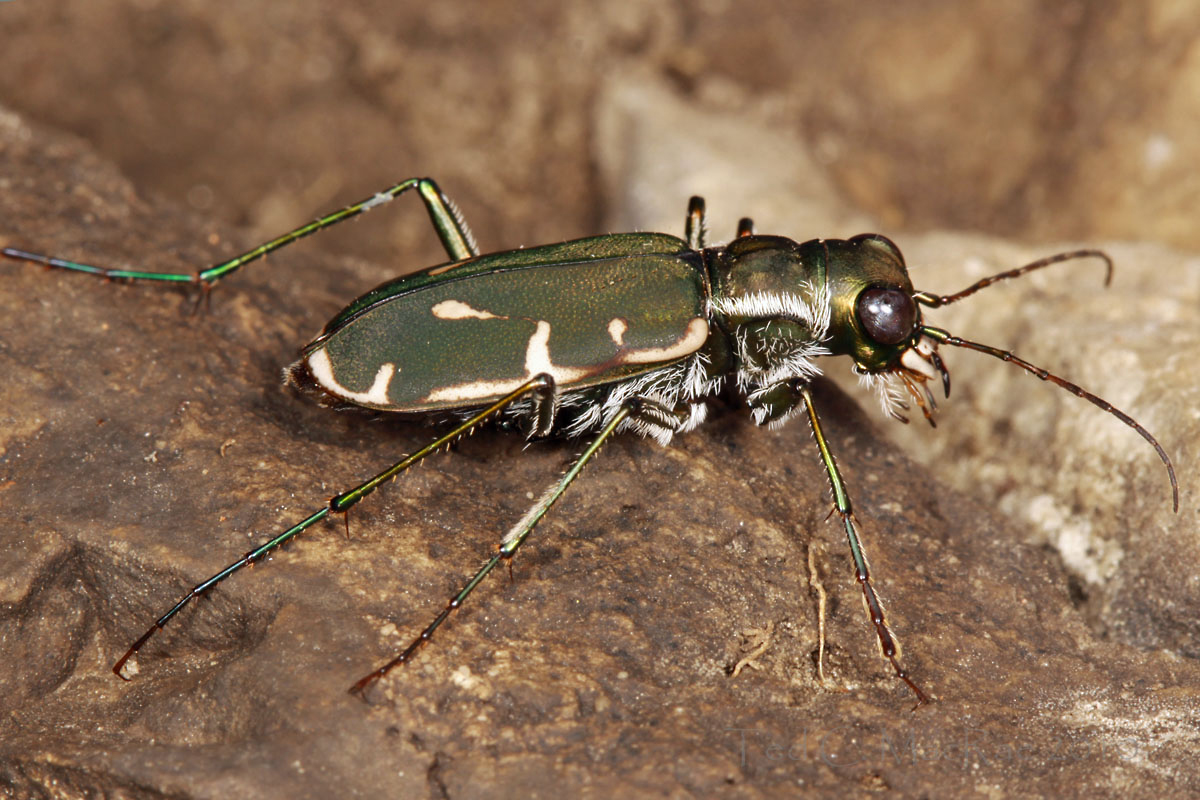
This male adult Prairie Tiger Beetle (emerged 10 weeks after collecting the larva) shows the dark olive-green coloration and semi-complete markings typical of the MO/AR disjunct population.

After returning to St. Louis, I placed the rearing containers in a growth chamber and monitored larval activity 2-3 times per week.  Whenever a burrow was opened, I would place a fall armyworm, corn earworm, or tobacco hornworm larva in the burrow and seal it shut.  Some burrows would be re-opened almost immediately and, thus, fed again, while others stayed sealed for longer periods of time.  Tap water was added to the container whenever the soil surface became quite dry – generally once per week, and by late July nearly all of the burrows were sealed and inactive. If these larvae did, indeed, represent C. obsoleta vulturina, then this would be the time they would be pupating.  On August 15 I had my answer, when I checked the containers to find the above male had emerged, and the next day two more adults emerged as well (including the female shown below).

This female adult Prairie Tiger Beetle emerged the same day as the male and shows slightly brighter green coloration.

I put the emerged adults together in the largest rearing container, and within minutes the male and one of the females were coupled. I’ve kept them fed with small caterpillars and rootworm larvae, and numerous oviposition holes were eventually observed on the surface of the soil in the container. In a few weeks, I’ll place this container in a cold incubator for the winter and then watch next spring to see if larvae hatch and begin forming burrows. If so, it will be a chance to see if I can rear the species completely from egg to adult and preserve examples of the younger larval instars.

Photo Details: Canon 50D (ISO 100, 1/250 sec) w/ Canon MT-24EX flash w/ Sto-Fen + GFPuffer diffusers. Typical post-processing (levels, minor cropping, unsharp mask).
Photos 1-2, 5-6: 100mm macro lens (f/14-f/16).
Photos 3-4: 65mm MP-E 1-5X macro lens (f/14).

Edit 9/10/10, 6:30 pm: I checked the terrarium today and discovered 24 brand new 1st-instar larval burrows dotting the soil surface.  They are quite large already, almost as big as 3rd-instar burrows of the diminutive Cylindera celeripes.  I guess I’m surprised to see larvae hatching already, as I expected they would overwinter as eggs and hatch in the spring.  Now that I think about it, however, hatching in the fall makes sense, as this gives them an opportunity to feed some before winter sets in and also allows them to burrow for more protection from freezing temperatures.  I’ve dumped a bunch of 2nd-3rd instar Lygus nymphs into the terrarium for their first meal.

Copyright © Ted C. MacRae 2010

North America’s largest tiger beetle (I think!)

The generous among us might call it serendipity, while the rest of us would just call it luck.  By whatever name, I had it in spades in June last year when I made my first visit to the Glass Mountains of northwestern Oklahoma.  My original plan was to go to Tallgrass Prairie Preserve in eastern Oklahoma at the end of what proved to be a resoundingly successful day at Alabaster Caverns State Park.  However, soaking rains moved into the area and continued rumbling eastward across the plains towards the preserve, forcing a quick change of itinerary.  I decided to wait it out in the state’s western reaches, a “hunch” telling me that the red clay/gypsum hills in nearby Major County might be a fruitful place for hunting tiger beetles.  Sunny skies the next morning were a good sign, and my hunch was rewarded later that day when I discovered a previously unknown (and fortunately robust) population of the rare Cylindera celeripes (swift tiger beetle), making not just the day but the entire trip more successful than I could have ever imagined.  Icing on the cake came when I found decent numbers of the more secure but nevertheless uncommon Dromochorus pruinina (frosted dromo tiger beetle) also in the area.

Another find I made that day that I’ve mentioned on occasion but not talked about at length was a single, rather large tiger beetle larva.  I found several burrows at the base of a talus slope at the edge of a small ravine where many adult C. celeripes were scurrying, and though I tried with many, out of only one did I manage to “fish” its occupant with a blade of grass.  I didn’t know which species it represented, but its large size and occurrence in clay soil brought to mind two species – Cicindela pulchra (beautiful tiger beetle) and C. obsoleta (large grassland tiger beetle).  Both of these Great Plains species reach their eastern limit of distribution in this part of Oklahoma (Pearson et al. 2006), and their status as the largest species of the genus (and its former subgenera) in North America seemed to make them the leading candidates for this enormous larva.  There was one other possibility – Amblycheila cylindriformis (Great Plains giant tiger beetle), another Great Plains species at its eastern limit in western Oklahoma and (as the common name implies) the largest tiger beetle in all of North America.  However, to consider that species seemed too much wishful thinking.  From my understanding, larvae of that elusive species reach an incredible 45 mm in length and dig burrows  on steep slopes or at the mouths of rodent burrows that extend vertically to depths of up to 1.5 m or more (Brust et al. 2005).  Surely I could not have so casually stumbled upon such a grand grub!

I placed the larva in a terrarium of native soil and brought it back with me, and for one year now I have waited – feeding it a regular diet of the fat noctuid caterpillars that we rear so abundantly in our lab.  For a full year, I’ve watched it nab caterpillar after caterpillar, disappearing mysteriously for days on end, and just as mysteriously reappearing at the top of its burrow.  I knew getting a closer look at it would help in my attempts to determine its identity, but every time I approached with a camera it dodged down into its burrow and beat my patience.  Sometimes I would see it sitting about a centimeter below the burrow entrance – just waiting for a caterpillar to crawl by but refusing to expose itself to the lens.  I gradually decided it was likely C. pulchra, as I had seen that species in similar habitat not too far north in Barber County, Kansas.  So strong was my suspicion that I even made another trip out to the Glass Mountains in October of last year, expecting to see the fall-active adults bejeweling the exposed flats below the red clay slopes, their wine-red elytra and purple-margined bodies all aglitter under the crisp, autumn sun.  No such sight was beheld, however – my hopes dashed by the season’s sudden cold and wet turn, and with the terrarium containing the larva by then tucked away in a cool incubator for a winter’s rest, it would be several months before I would see the larva once again sitting at the top of its burrow.

In late March I pulled the terrarium out of the incubator, and within a week the larva reopened its burrow.  I fed it a few times, and then one day I saw that it had dug a new, larger  burrow – measuring a full 10 mm in diameter!  This seemed extraordinarily large for any species of Cicindela, so I resolved once again to photograph it and determine its identity.  For days I stalked it, keeping the terrarium just outside my office door where I could keep an eye on it, yet every time I approached within two feet or so it would drop down out of sight.  I decided to stop feeding it – perhaps hunger would overwhelm its patience and prompt it to return to the top of its burrow more quickly after retreating.  That seemed to work, as one day the larva came back up after only a few minutes – and I was ready!  Already  in position, I flashed off multiple shots as soon as it reappeared, moving slowly and deliberately between shots to avoid spooking it again, and managed to get a nice series from varying distances.  As a testament to its enormous size, all of the photos shown here were taken with the standard 100mm macro lens (1X maximum) – not the 65mm 1-5X beast that I needed for these shots of the super-tiny C. celeripes.

Thinking that the larva likely represented C. pulchra, I compared the photos to this photo taken by Matt Brust of a 3rd-instar larva of C. pulchra and immediately noted the differently shaped pronotum of my larva and its distinctly projecting anterolateral angles.  Compare to C. pulchra, in which the angles are in line with the median part of the anterior margin – it is clearly not that species.  It isn’t C. obsoleta either, as that species has the anterolateral angles of the pronotum even less projecting than C. pulchra (Drew and Van Cleave 1962).  Apparently I needed to rethink my assumption that it belonged to Cicindela or its close relatives – none that occur in Oklahoma are simply large enough!  Tetracha virginica is large enough, but I knew it wasn’t that species since it lacked the white margined pronotum distinctive of species in that genus (as can be seen in this post on the larva of Tetracha florida).  That left only A. cylindriformis, distinguishable from all other tiger beetle genera occurring in Oklahoma by the second (lower) pair of eyes distinctly smaller than the first (Hamilton 1925, Drew and Van Cleave 1962, Pearson et al. 2006) – clearly seen in the third photo above.  Matt Brust has also photographed the larva of A. cylindriformis – it’s not a close shot of the head and pronotum, but in general aspect my larva seems to match it well enough.

All that is left is to actually succeed in rearing this larva to adulthood.  These beasts may require up to three to four years to develop (Brust et al. 2005), although this is likely influenced by latitude and prey abundance.  I suspect it was a second instar larva when I collected it, and that it dug its new burrow this spring after molting to the third (and final) instar.  Hopefully by keeping it in a nice, warm growth chamber and feeding it generously with fat caterpillars, I can minimize the time to pupation and perhaps see the adult sometime later this summer.  If/when that happens, you can be sure to see a follow up to this post.

Photo Details: Canon 50D (ISO 100, 1/250 sec, f/16-18), Canon 100mm macro lens, Canon MT-24EX flash (1/4 ratio) w/ Sto-Fen diffusers. Post-processing: contrast and unsharp mask (no cropping).

REFERENCES:

Brust, M. L., S. M. Spomer and W. W. Hoback.  2005. Tiger Beetles of Nebraska.  University of Nebraska at Kearney.  http://www.unk.edu (Version 5APR2005).

Drew, W. A. and H. W. Van Cleave.  1962. The tiger beetles of Oklahoma (Cicindelidae).  Proceedings of the Oklahoma Academy of Science 42:101–122.

Hamilton, C. C.  1925. Studies on the morphology, taxonomy, and ecology of the larvae of Holarctic tiger beetles (family Cicindelidae).  Proceedings of the U.S. National Museum 65 (Art. 17):1–87.

Pearson, D. L., C. B. Knisley and C. J. Kazilek. 2006. A Field Guide to the Tiger Beetles of the United States and Canada. Oxford University Press, New York, 227 pp.

Copyright © Ted C. MacRae 2010

Add to FacebookAdd to DiggAdd to Del.icio.usAdd to StumbleuponAdd to RedditAdd to BlinklistAdd to TwitterAdd to TechnoratiAdd to Yahoo BuzzAdd to Newsvine

Email to a friend

Cylindera celeripes Larva Revealed

In a recent post, I provided the first ever glimpse of the previously unknown larva of Cylindera celeripes, or swift tiger beetle.  This little-known flightless species is among the tiniest in North America (adults measure only 8 or 9 mm in length), and so far nobody has succeeded in rearing the species in the lab, or even finding its larva.  As the photographs in that post showed, I am reasonably close to accomplishing that first goal, having successfully obtained a number of eggs from field-collected adults placed in a terrarium of native soil. I fed the subsequent larvae a diet of small rootworm larvae and Lygus nymphs before putting them to sleep for the winter in a cold incubator, and the larvae resumed activity when I pulled them out of the incubator 2 months ago. Since then, they have feasted heavily on small noctuid larvae that we rear in our lab, and now most of the dozen or so larvae have sealed their burrows – I presume for pupation before (hopefully) emerging as adults in the next few weeks.

Cylindera celeripes 3rd instar larva - USA: Oklahoma, Woodward Co.

There is more to the story, however.  I had brought the adults back home in June 2009 from a population I found at Alabaster Caverns State Park in northwestern Oklahoma.  This was a reasonably robust population – news enough for a species that has not been seen in good numbers for many years now, and my discovery of equally healthy populations at several other locations in the general area gives new hope for the long-term prospects of a species that some regard as a potential candidate for listing as an endangered species. It also gave me hope that I might be able to find the larva were I to return to the area in the fall.  I also had a hunch that Cicindela pulchra (beautiful tiger beetle) could be found in the area, based on some very large larvae I found during that June trip, so in early October I made a quick return to northwestern Oklahoma to search for these two species.  While it was too cold and wet to have any hope of finding Cicindela pulchra adults (I still think the species is there), it did not prevent me from realizing my other goal.  May I present one of the first ever field-collected larvae of Cylindera celeripes!

Cylindera celeripes 3rd instar larva - closeup of hump on 5th abdominal segment with hooks to aid in securing the larva in its burrow

I found the larvae at Alabaster Caverns where I had found the adults earlier in June, and although the larval burrows were very small (only 2 to 3 mm in diameter), I knew what they were immediately when I saw them.  As I had observed for the adults, burrows tended to be near the edges of barren patches of soil in proximity to vegetation and not out in the middle of the barren areas.  This makes sense, considering where it would be more likely for prey to be encountered.  Because the weather was cold and gray, I didn’t see (or expect to see) larvae actively sitting at the tops of their burrows, so I began “fishing” to see if I could yank a few from their burrows.  I fished quite a few burrows for the first half hour or so, but none of my attempts were successful.  I began wondering if the larvae were even active at all or if they had already entered hibernation for the upcoming winter.  While I was fishing, I noticed that the burrows all seemed rather shallow – only about 6” or so (most tiger beetles, having larger larvae, dig burrows that are much deeper). This gave me an idea.  I went back to the truck and retrieved a small spade that I carry in case… well, I’d never actually used it before.  Anyway, I inserted a grass stem into a burrow and sunk the spade into the ground right next to it, making sure I got the spade at least as deep as the grass blade.  I then removed the spade and sunk it into the ground on the other side of the burrow, then pried until the entire chunk of soil came up intact.  With the bottom of the soil chunk exposed, I used my knife to carefully remove slivers of soil until I found the end of the grass stem that I had inserted into the burrow.  Carefully removing the soil in this area revealed the larva in a side chamber at the bottom of the burrow.  Success!  I took many photos of that larva right then and there, and over the next hour or so collected several more larvae, all but one of which I presumed were 3rd instars.  I packed each larva in its own small vial of native soil for the trip home, and although I have been attempting to rear them out for confirmation of their identity, there is little doubt that they do indeed represent this species.

Cylindera celeripes 3rd instar larva - that grotesquely beautiful head!

The photographs I’m showing here are not those first field photographs that I took when I first discovered the larvae.  Looking at those photographs after I returned home, I was dissatisfied with the amount of soil and debris that covered the larvae – especially their grotesquely unique head and pronotum.  Instead, I removed one of the larvae from its rearing tube and gave it a “bath” – brushing it with a fine camel-hair brush in a shallow dish of water – to clean it up for the photographs shown here.  After the photo shoot, I sacrificed this larva for the collection – it will be the basis for a formal description of the larva of this species (along with examples of the 1st and 2nd instars that I had sacrificed from my rearing, not yet confident that I would succeed in getting any of the others to 3rd instar).  The only thing I am waiting on before preparing that description is to see whether I actually succeed in rearing this species from egg to adult – stay tuned!

Photo Details: Canon 50D (ISO 100, 1/250 sec, f/13-16). Canon MP-E 65mm 1-5X macro lens, MT-24EX flash (1/8 power) w/ Sto-Fen diffusers. Typical post-processing (levels, unsharp mask).

Copyright © Ted C. MacRae 2010

Add to FacebookAdd to DiggAdd to Del.icio.usAdd to StumbleuponAdd to RedditAdd to BlinklistAdd to TwitterAdd to TechnoratiAdd to Yahoo BuzzAdd to Newsvine

Email to a friend

Hello World!

These are two of the Cylindera celeripes (swift tiger beetle) larvae that I’m rearing.  Note: nobody has ever reared this species before!  Nobody has ever even seen its larvae (before now, that is).

These larvae hatched from eggs that were laid by adults I brought back from northwestern Oklahoma last summer.  I placed the adults in a small terrarium of native soil – at first just to see if I could keep them alive, and then to see if I could get them to lay eggs.  The adults lived for about 4 weeks, and a short time later larval burrows started appearing in the soil.  I fed them once or twice a week by placing 2nd instar corn rootworm larvae in the open burrows or dumping Lygus nymphs into the terrarium and letting them catch them naturally.  I wasn’t sure this was working, because as the summer progressed I saw fewer and fewer open burrows.  By October, there were no open burrows, and I feared none had survived.  Nevertheless, I placed the terrarium in a cool (10°C, or 50°F) incubator for the winter and pulled it back out in late March.  Within one week ten larvae had reopened their burrows – I believe all but one of them are 3rd instars, which is the last instar before pupation, and since they have awoken they have fed voraciously on 3rd instar fall armyworm larvae, which I dangle above their burrow.  I love watching them snatch the armyworm from my forceps and drag the hapless prey down into their burrow.  I’ve already preserved examples of the three larval instars and will describe it shortly (although truth be told, the 2nd and 3rd instars are from larvae I found in the field – but that is a post for another day).  However, I’m keeping my fingers crossed for the piece de resistance – successfully rearing the species from egg to adult!

Photo Details: Canon MP-E 65mm 1-5X macro lens on Canon 50D, ISO 100, 1/250 sec, f/13-16, MT-24EX flash 1/8 power w/ Sto-Fen diffusers.

Copyright © Ted C. MacRae 2010

Add to FacebookAdd to DiggAdd to Del.icio.usAdd to StumbleuponAdd to RedditAdd to BlinklistAdd to TwitterAdd to TechnoratiAdd to Yahoo BuzzAdd to Newsvine

Email to a friend

Lampetis drummondi larva?

Back in February, I learned that Mark Volkovitsh (Zoological Institute, Russian Academy of Science, St. Petersburg) would be visiting Chuck Bellamy (California Department of Food and Agriculture) in Sacramento the very week that I was planning to be in Lake Tahoe. Chuck and Mark are two of the worlds leading specialists in Buprestidae, or jewel beetles, and have worked together on a number of projects dealing with the taxonomy and systematics of buprestid beetles. Mark, in particular, has focused on describing the larval forms of buprestids (“white wormy things,” as my wife calls them) and using larval morphology to supplement adult morphology in phylogenetic analyses. I’m not anywhere near being in their league in terms of authority in the family – a comparative dabbler, really – but for some reason they’ve both seen fit to accept me into the fraternity. I’ve been fortunate to spend time in the field with each of them, as well as visit them at their respective institutions.  When I learned of Mark’s coincident visit, I couldn’t resist the chance to make the 2-hour drive from Lake Tahoe to Sacramento and spend the day with Mark and Chuck at the CDFA and discuss things buprestological.  The wife and kids were fine with that, since her brother also lives in Sacramento, and it would be a chance for them to do some sight-seeing before we all got together for dinner.  Upon arriving at CDFA, I also met Andy Cline, a nitidulid specialist at the CDFA (re-met actually, turns out we’d met some years back), and the four of us went out for an animated lunch at a nearby restaurant over some of the most delicious barbeque that I’ve ever tasted.

L-R: Mark Volkovitsh (Russia), Chuck Bellamy (CDFA), me, Andy Cline (CDFA)

After lunch, I was most interested in discussing with Mark some buprestid larvae that I had collected in Big Bend, Texas in 2004. My colleague Chris Brown and I were hiking a low desert trail west of Rio Grande Village when we encountered a large, uprooted Goodding willow (Salix gooddingii) tree laying on the river bank. Wilting leaves were present on some of its branches, suggesting that the half-dead had been washed to its current location by the river during a recent flood. At the base of the trunk where the main roots projected, I noticed what appeared to be frass (the sawdust that wood boring beetle larvae eject after eating it – that’s right, grub poop!) under the edge of the bark at the live/dead wood interface. I used my knife to cut away some of the bark and immediately encountered a huge buprestid larvae. Its enormous size is matched only by a few desert southwest species: Polycesta deserticola, which breeds commonly in oak and is known from willow, but breeds only in dead, dry branches; and Gyascutus planicosta, whose larvae are restricted to the living roots of Atriplex and a few other asteraceous shrubs.  Clearly, it could not be either of these species.  The only other desert southwest buprestids large enough to produce a larva this large (~50 mm) are Lampetis drummondii and L. webbii. However, the larvae of both of these species are unknown, as is basic information regarding what hosts they utilize for larval development. Lampetis webbii is quite rare, but L. drummondii is, in fact, one of the most conspicuous and commonly encountered buprestid species in the desert southwest – that fact that its larva has remained unknown suggests that it utilizes living wood, probably feeding below the soil line.  Thus, I immediately began to suspect that the larva might represent this species – a truly exciting development. 

As I continued digging into the wood, I encountered a second, somewhat smaller larva in a neaby gallery, and further digging revealed another clue about its identity in the form of fragments of a dead adult beetle – all brilliant blue/green in color (identical to the color of L. drummondi), and the largest (the base of an elytron, or wing cover) showing the same pattern of punctation exhibited by L. drummondi adults. I placed the two larvae individually in vials with pieces of the host wood; however, I knew there was little chance that either larva, requiring living tissue upon which to feed, would complete its development once removed from its host gallery.  They did survive for a time after my return to St. Louis, but when the largest larva became lethargic, I decided to go ahead and preserve them.  I sent the photograph below (taken by Chris) of the living larvae to Mark, who confirmed that it did indeed appear to be a species of Lampetis, based on its large size and the narrowly V-shaped furcus on the pronotal shield (typical for members of the tribe to which Lampetis belongs). 

Buprestid larva (prob. Lampetis drummondi) under bark of Salix gooddingii at trunk base - Big Bend National Park, Texas. Photo by Christopher R. Brown.

Considering the complete lack of published information on the larval biology of Lampetis drummondi and the several lines of evidence that these larvae, in fact, represent that species, it would be worthwhile to publish a description of the larva.  However, formal description requires dissection, and I did not know how to do this.  Mark, on the other hand, has dissected literally hundreds of buprestid larvae, including representatives of nearly every genus for which larvae are known.  He is the buprestid larva expert, and what a thrill it was for me to learn how to do this from the Master himself, using the larger of these two probable Lampetis larvae as the subject.  While we were dissecting the larva, we compared its features to those published for the European species Lampetis argentata (Danilevsky 1980) – the only member of the genus for which the larva is known – and confirmed their similarity and the larva’s likely close relationship to that species.  Coincidentally, the larva of L. argentata develops in living roots of saxaul (Haloxylon) – a genus of large shrubs/small trees (family Amaranthaceae) that grows in the deserts of Central Asia.  It thus appears that Lampetis species may, as a general rule, utilize living wood below the soil line for larval development, explaining why the larva of only one (now two) of the nearly 300 species in the genus worldwide has been found.

REFERENCES:

Danilevsky, M. L. 1980. Opisanie zlatki Lapmetis [sic] argentata (Coleoptera, Buprestidae) – vreditelya saksaula [Description of the larva of Lapmetis [sic] argentata (Coleoptera, Buprestidae) – the pest of HaloxylonZoologicheskii Zhurnal 59:791–793.

Copyright © Ted C. MacRae 2010

Add to FacebookAdd to DiggAdd to Del.icio.usAdd to StumbleuponAdd to RedditAdd to BlinklistAdd to TwitterAdd to TechnoratiAdd to Yahoo BuzzAdd to Newsvine

Email to a friend

BitB Best of 2009

In my first post of 2009, I looked back at the photographs I had posted during 2008 and picked some of my personal favorites. I hesitated then to call myself a photographer (and still do), but I at least now have suitable equipment to aid in my progress toward that eventual goal. I have learned much over the past six months in my first attempt at serious insect macrophotography (prioritizing in situ field photographs of unmanipulated subjects as a matter of personal choice).  Through this, I’ve come to realize the following skills to be the most important for success:  

  1. Composition
  2. Understanding lighting
  3. Knowing how to use a flash
  4. Knowledge of the subject

I’ll give myself a “A” in the last of these, but in the other areas I still have much to learn. With this caveat, and for the last post of 2009, I offer the following twelve photographs as my final choices for the 2nd Annual “Best of BitB”:  

Best beetle

Cylindera celeripes (swift tiger beetle), Woodward Co., Oklahoma

From Revisiting the Swift Tiger Beetle – Part 1 (June 30).  A decent enough photograph, especially considering that I’d had my camera for about a month when I took it.  However, the discovery of robust populations of this formerly rare and enigmatic species throughout northwestern Oklahoma (and later also in northwestern Missouri) was the most significant find of the 2009 field season, and this photograph is the best capture of that moment.

Best fly

Stylogaster neglecta, a species of thickheaded fly

From Overlooked, needle-bellied, thick-headed fly (Aug 14).  One of my first good “black background” shots.  The white tip of the abdomen compliments the white flower stamens against the background.

Best “true” bug

Beameria venosa, a prairie obligate cicada

From North America’s smallest cicada (Aug 4).  So many different shades of green with white frosting on the bug’s body.  I tried taking this shot in portrait and it just didn’t work—I liked this landscape shot much better.

Best predator

Promachus hinei (Hines giant robber fly) & Ceratina sp. (small carpenter bee) prey

From Prey bee mine (Sept 14).  Robber flies are immensely photogenic, especially those in the genus Promachus due to their prominent “beards.”

Best camoflauge

Dicerca obscura on bark of dead persimmon

From The “obscure” Dicerca (June 19).  Sparkling and gaudy as specimens in a cabinet, the coloration of many jewel beetles actually helps them blend almost perfectly with the bark of their preferred tree hosts.

Best immature insect

Tetracha floridana (Florida metallic tiger beetle) 3rd-instar larva

From Anatomy of a Tiger Beetle Larva (Oct 22).  “Otherwordly” is invariably the first word that comes to mind when someone sees a tiger beetle larva for the first time.  I was lucky enough to get this one in profile with a nice view of its abdominal hump and its curious hooks.

Best arachnid

Centruroides vittatus (striped bark scorpion)

From A face only a mother could love (Oct 6).  Despite some minor depth-of-field problems with this photograph, I’m fascinated by its “smile.”

Best reptile

Eastern collared lizard (Crotaphytus collaris collaris) adult male

From North America’s most beautiful lizard (July 10).  A simply spectacular lizard—all I had to do was frame it well and get the flash right.

Best wildflower

Spiranthes magnicamporum (Great Plains ladies

From Great Plains Ladies’-tresses (Dec 7).  Few flowers are as photogenic as orchids, even native terrestrials with minute flowers such as this one.  I like the frosty texture of the lip and the starkness of the white flower on the black background.

Best natural history moment

Thermoregulatory behavior by Ellipsoptera hirtilabris (moustached tiger beetle)

From Tiger Beetles Agree—It’s Hot in Florida! (Dec 18). I chose this photo for the classic “stilting” and “sun-facing” thermoregulatory behaviors exhibited by this tiger beetle on a blistering hot day in Florida.

Best closeup

Megaphasma denticrus (giant walkingstick)

From North America’s longest insect (Aug 21).  I haven’t tried a whole lot of super close-up photographs yet.  I liked the combination of blue and brown colors on the black background.

Best Landscape

Sand Harbor Overlook, Lake Tahoe, Nevada

From Sand Harbor Overlook, Nevada (March 23).   My choice for “best landscape” again comes from Lake Tahoe.  This is not a great photo technically—I was still using a point-and-shoot and had to deal with foreground sun.  However, none of the other photos I took during my March visit to the area captivate me like this one.  I like the mix of colors with the silhouetted appearance of the trees on the point.

Copyright © Ted C. MacRae 2009

Add to FacebookAdd to DiggAdd to Del.icio.usAdd to StumbleuponAdd to RedditAdd to BlinklistAdd to TwitterAdd to TechnoratiAdd to Yahoo BuzzAdd to Newsvine

Email to a friend