
First things first – congratulations to Mark Deering (Sophia Sachs Butterfly House, right here in St. Louis) and Rod Rood (Washington State University) for correctly identifying yesterday’s “What the heck?” as the cast puparium of an oestrid bot fly. Mark eventually staked his claim on the genus Cuterebra, and Rod as well included this genus in his short list. They are more astute naturalists than I – had I not found the newly emerged adult right next to it, I doubt that I would have known or figured out what it was. Thanks also to the many other people who played the game – most were united in thinking it was some kind of insect, with many noting its distinctly abdominal appearance. It seems, at least among my readers, that shed insect cuticle is a more popular quiz subject than plants.
 I encountered this individual on open sandy ground while searching for my beloved southeastern Missouri festive tiger beetles. When I first saw the adult, it was on its back on the ground, feebly waving a couple of legs in the air. I at first thought it was some kind of clumsy beetle but realized what it was as I approached it. Clearly the fly was in distress, and I thought it odd that the puparium was laying on the ground next to it. Bot flies in the genus Cuterebra have among the most deliciously gruesome of all insect life histories. The ultra short-lived adults (lacking even functional mouthparts) lay their eggs near rodent and lagomorph burrow entrances, with the different species showing a fair degree of host specificity (Catts 1982). When the fly larva hatches, it migrates to the host and enters the animal’s body through a natural orifice or break in the skin. It then finds a subcutaneous location to feed, creating a cyst-like structure within a swelling of subcutaneous tissue and with a hole at the skin surface to allow respiration. Once mature, the larva exits and drops from the host and burrows into the ground for pupation. We could find no emergence hole nearby, so perhaps the puparium was exposed by rain prior to emerging and suffered some desiccation, or perhaps the adult had gotten stuck in the tough puparium and pulled it to the surface as it emerged – burning its limited energy reserves in the process. At any rate, it is rather unusual to find these things emerging with the pupal case.
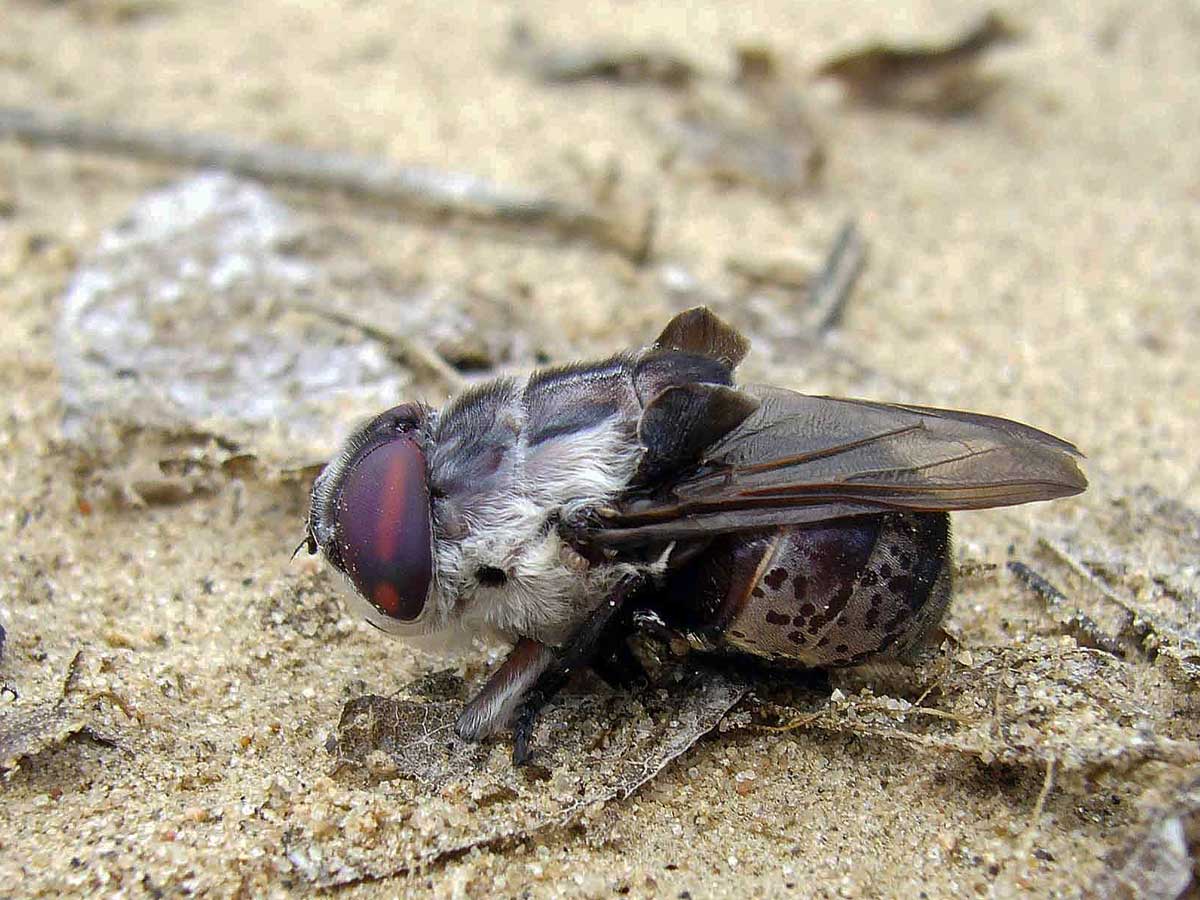 Cuterebra spp. are known collectively as New World skin bot flies (formerly family Cuterebridae, but now classified as a subfamily of Oestridae). I suspected this was the rabbit bot fly (C. buccata) due to its general appearance – notably the red bands in the eyes, which is a characteristic of rabbit-infesting species. However, the genus is diverse, with 34 recognized North American species – seven of which belong to the rabbit-infesting group (Sabrosky 1986). I don’t have a copy of Sabrosky’s revision, and my efforts to locate it electronically turned up only retail listings for $70 or more. That’s serious coin for someone who really needs to stay focused on his beetles, so I sent these photographs to bot fly specialist Jeff Boettner at the University of Massachusetts. Jeff confirmed that it is indeed a Cuterebra rabbit bot and will confirm a species identity after checking his collection.
Jeff also sent the following note and interesting link:
Speaking of red eyed bots…there is one on Bugguide that a woman from NM posted. It is Cuterebra mirabilis and it may be the rarest photo on BugGuide. It’s only known from 2 previous specimens (also from NM). Its the largest of the rabbit bots. Much darker than yours.
Jeff notes that “mirabilis” in Latin means “extraordinary” – a truly appropriate name for this beautiful insect. Even though I am a devout coleopterist, I must confess – cuterebrids rock!
REFERENCES:
Catts, E. P. 1982. Biology of New World bot flies: Cuterebridae. Annual Review of Entomology 27:313-338.
Sabrosky, C. W. 1986. North American species of Cuterebra, the rabbit and rodent bot flies (Diptera: Cuterebridae). Entomological Society of America Thomas Say Foundation Monograph, College Park, Maryland, 240 pp.
Copyright © Ted C. MacRae 2009




 Beetles In The Bush