With my queue of specimen identifications now clear, I can turn my attention to another major backlog that I haven’t been able to give proper attention recently—exchanges. For those of you not into insect collecting, exchanging is something that most collectors eventually end up doing, especially if the goal is to build a taxonomic reference collection within one’s chosen group that has broad representation of species and higher taxa from multiple geographical regions. Truthfully, I don’t do nearly as much exchanging as some collectors I know. It’s not that I don’t want to, but simply a matter of time—receiving and incorporating shipments while preparing and sending out returns is not as quick and easy as it might seem, not to mention the time involved in mining and corresponding with prospective exchange partners. I wish I could do more, but since I can’t I deal with it by limiting myself almost exclusively to exchanging Buprestidae (although I’ve been known to do a tiger beetle exchange or two). I focus on Buprestidae because that is my primary group of taxonomic interest.

Buprestidae received in exchange from Stanislav Prepsl, Czech Republic
These photos show some of the Buprestidae I received this past year, this particular box coming from Stanislav Prepsl in the Czech Republic. This is the first time that I’ve exchanged with Stan, and I must say I am impressed with the quality and taxonomic diversity of his buprestid holdings. In this exchange, I received 73 species, most of which are represented by a male/female pair and four represented by paratype specimens. These are all Old World species, and while a few are from the well-known fauna of Europe most were collected in countries seldom visited by (or even off limits to) American collectors such as the former USSR, Iran, Pakistan, Kurdistan, Turkey, etc. There are a nice few species also from Namibia, Kenya and Ethiopia. In return, I sent to Stan more than 100 species of Buprestidae from mostly the southwestern U.S. and Mexico where I have done a large part of my collecting. Stan was less demanding about receiving both one male and one female for each species, thus the larger number of species I was able to send him for approximately equal numbers of specimens.
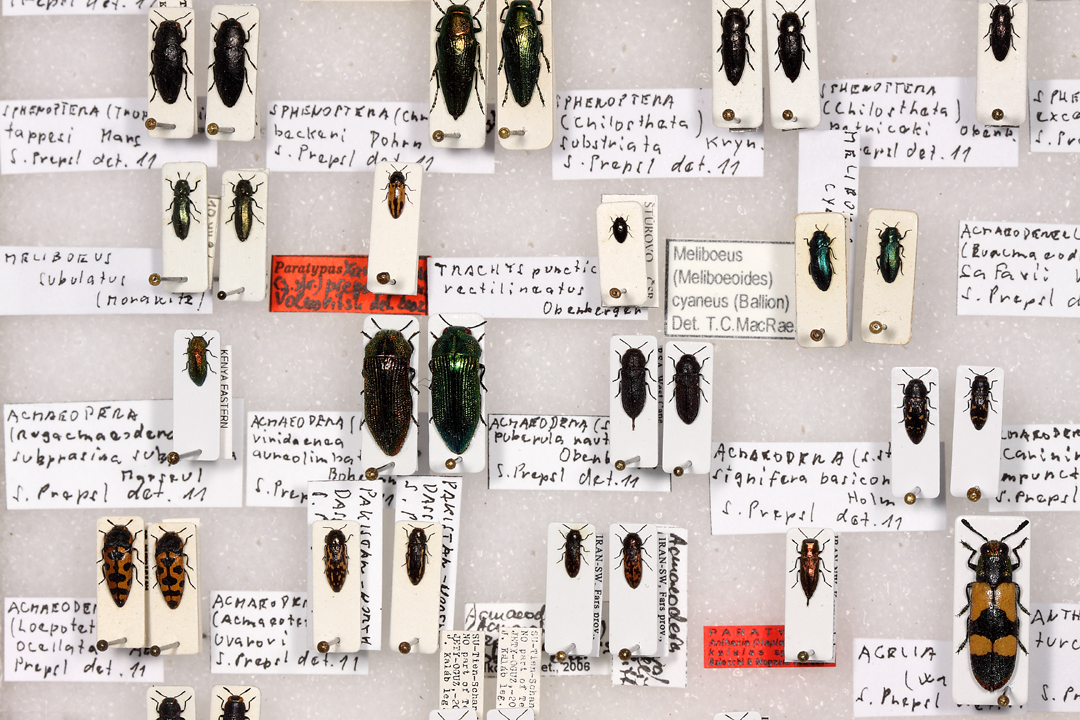
Close-up view of lower left corner of box
Some collectors avoid Buprestidae because of their taxonomic difficulty and the overwhelming numbers of small, difficult-to-identify species. I think this is exactly why I like the group, and though many of the species are small they are certainly no less beautiful than their larger, flashier, more ostentatious brethren. I include this close-up view (you might recognize the specimen in the lower right corner as the previously featured Agelia lordi) to show the meticulous preparation of the specimens included in the shipment—an example of a well-curated collection by someone who knows what they are doing. Incidentally, the cards on which the specimens are mounted are standard fare among European collectors, and although as an American I prefer direct pinning of larger specimens and mounting smaller specimens on points versus cards, I’ve come to appreciate the exacting care with which some Europeans practice this card-mounting technique.
It’ll take me a few hours of dedicated attention to move all of these specimens into the main collection—not only must their proper placement be determined, but there is usually a lot of reshuffling of specimens within and amongst unit trays whenever such a large number of specimens is incorporated into it. With 15,000 described species and counting, this sending of Buprestidae represents only a modest increase (0.5%) in my representation of species; however, it adds representation from geographical areas that previously had virtually no representation in my collection at all. I hope Stan is as pleased with the material that I sent to him as I am with this material, and I look forward to the opportunity to exchange again with him in the near future.
Copyright © Ted C. MacRae 2012




 Beetles In The Bush