Rediscovery of Cicindela scabrosa floridana

ResearchBlogging.orgIn refreshing contrast to the more usually heard reports of declining and extinct species, a new paper by Dave Brzoska, Barry Knisley, and Jeffrey Slotten (Brzoska et al. 2011) announces the rediscovery of a tiger beetle previously regarded as probably extinct.  Cicindela scabrosa floridana was described from a series of unusually greenish specimens collected in Miami, Florida in 1934; however, no additional specimens turned up in the following 70+ years despite dedicated efforts in the late 1980s and early 1990s by Brzoska, Knisley, and Ron Huber to locate and search areas around the presumed type locality.  This paucity of specimens and occurrence of the type locality in highly urbanized Miami had caused most contemporary tiger beetle researchers to presume that the population had fallen victim to the ceaseless sprawl of urbanization and its attendant habitat destruction.  However, in September of 2007, co-author Jeff Slotten, working with David Fine, rediscovered a population of individuals matching the type series while surveying butterflies in pine rockland habitat in the Richmond Heights area of Miami.  Subsequent surveys of pine rockland habitat in surrounding areas revealed populations of the beetle at three sites – all in the Richmond Heights area. 

Source: Brzoska et al. (2011)

Cicindela scabrosa floridana was originally described by Cartwright (1939) as a variety of the broadly distributed southeastern U.S. species C. abdominalis.  In describing the closely related C. highlandensis (endemic to the Lake Wales Ridge of central Florida), Choate (1984) also elevated the peninsular Florida-endemic C. scabrosa (previously considered a subspecies of C. abdominalis) to full species status and treated floridana as a subspecies of scabrosa, apparently due to the similarity of their elytral sculpturing, occurrence in both of dense flattened setae on the pronotum, and their allopatric distributions.  The new availability of additional specimens of floridana, however, has allowed more detail comparisons of this form with scabrosa.   In addition to the markedly greener elytra, the great majority of floridana lack post-median marginal spots – found consistently in scabrosa, and the apical lunule is generally thinner in floridana than in scabrosa.  Moreover, no floridana were found to exhibit the vestigial middle band that scabrosa often exhibits, and the leg color of floridana also is lighter and more yellow than most scabrosa specimens.  Differences in habitat, distribution and seasonality were also noted – scabrosa occurs in sand pine scrub habitat throughout most of peninsular Florida north of Miami from late spring to mid-summer, while floridana occurs only in pine rockland habitats in southern Florida with adults active well into October.  These consistent differences in morphology, distribution, habitat, and seasonality led Brzoska et al. to elevate floridana to full species status.  According to the most recent classifications of North American and Western Hemisphere tiger beetles (Pearson et al. 2006, Erwin and Pearson 2008), the new name would be Cicindela (Cicindelidia) floridana.  However, Brzoska et al. follow the classification initially proposed by Rivalier (1954) and followed by Weisner (1992) in regarding Cicindelidia as a full genus, resulting in the new combination Cicindelidia floridana.  The character differences identified by Brzoska et al. are illustrated with detailed photographs and presented in a key to allow recognition of the now four species in the abdominalis group.

The rediscovery of a rare species thought to be extinct is always cause for celebration.  However, there is much work still to be done before prospects for the long-term survival of C. floridana can be considered secure.  Many potential scrub and pine rockland sites throughout Miami-Dade, Broward, and Palm Beach Counties were identified and surveyed after the initial discovery of C. floridana in the Richmond Heights area.  Unfortunately, to date the beetle has been found only at three sites in the Richmond Heights area.  This suggests that C. floridana populations are small, highly localized, and greatly restricted in distribution, making the species a likely candidate for listing as endangered by the U. S. Fish and Wildlife Service.   To their credit, the authors have not revealed the precise locations of these sites, which will hopefully reduce the temptation by those with more philatelic tendencies to undercut ongoing studies of the distribution, abundance, biology, and habitat of C. floridana.  These studies will be critical in the development of effective conservation strategies to ensure that this highly vulnerable representative of Florida’s natural heritage does not, once again, become regarded as extinct.

REFERENCES:

Brzoska, D., C. B. Knisley, and J. Slotten.  2011.  Rediscovery of Cicindela scabrosa floridana Cartwright (Coleoptera: Cicindelidae) and its elevation to species level. Insecta Mundi 0162:1–7.

Cartwright, O. L. 1939. Eleven new American Coleoptera (Scarabaeidae, Cicindelidae). Annals of the Entomological Society of America 32: 353–364.

Choate, P. M. 1984. A new species of Cicindela Linnaeus (Coleoptera: Cicindelidae) from Florida, and elevation of C. abdominalis scabrosa Schaupp to species level. Entomological News 95:73–82.

Erwin, T. L. and D. L. Pearson. 2008. A Treatise on the Western Hemisphere Caraboidea (Coleoptera). Their classification, distributions, and ways of life. Volume II (Carabidae-Nebriiformes 2-Cicindelitae). Pensoft Series Faunistica 84. Pensoft Publishers, Sofia, 400 pp.

Pearson, D. L., C. B. Knisley and C. J. Kazilek. 2006. A Field Guide to the Tiger Beetles of the United States and Canada. Oxford University Press, New York, 227 pp.

Rivalier, E. 1954. Démembrement du genre Cicindela Linne, II. Faune americaine. Revue Francaise d’Entomologie 21:249–268.

Wiesner, J. 1992. Checklist of the Tiger Beetles of the World. Verlag Erna Bauer; Keltern. 364 pp.

Copyright © Ted C. MacRae 2011
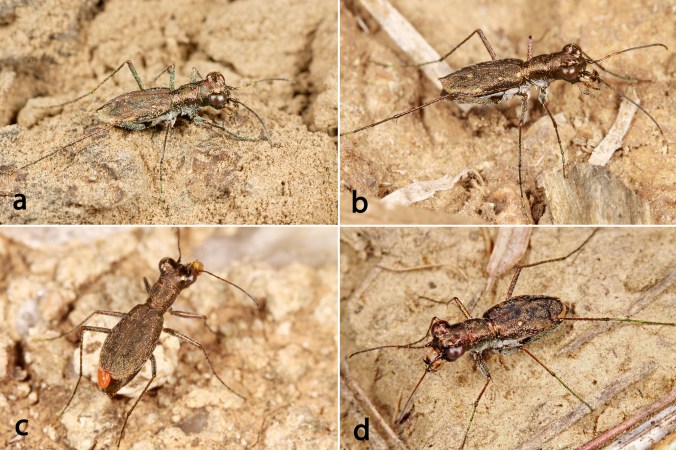
Cylindera celeripes – Fig. 1

One of the plates from our recently submitted manuscript on Cylindera celeripes (swift tiger beetle).¹  For the record, this is my first official attempt at assembling a plate in Photoshop for electronic submission – I sure hope I get quicker at this!

Fig. 1. Cylindera celeripes (LeConte) adults at: a) Hitchcock Nature Center, Pottawattamie Co., Iowa (13.vii.2008); b) Alabaster Caverns State Park, Woodward Co., Oklahoma (10.vi.2009); c) same locality as “b”, note parasite (possibly Hymenoptera: Dryinidae) protruding from abdomen and ant head attached to right antenna; d) Brickyard Hill Natural Area, Atchison Co., Missouri (27.vi.2009). Photos by C.R.Brown (a) and T.C.MacRae (b-d).

¹ “Historical and contemporary occurrence of Cylindera (s. str.) celeripes (LeConte) (Coleoptera: Carabidae: Cicindelitae) and implications for its conservation” – submitted to Journal of Insect Conservation.

Copyright Ted C. MacRae 2011

Bichos Argentinos #10 – Friday Formicine

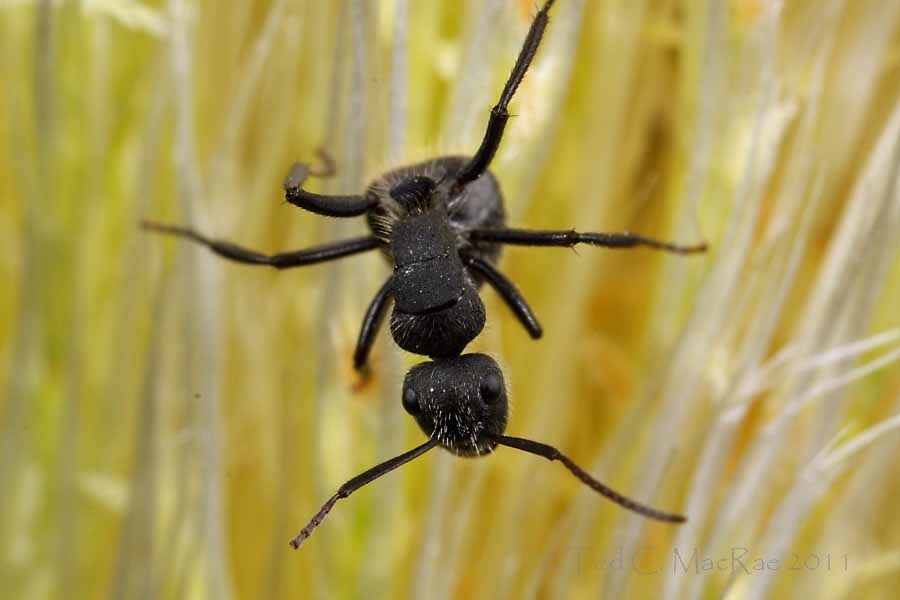
One of the insects I saw abundantly during my visit last month to La Reserva Ecológica Costanera Sur (Buenos Aires, Argentina) was this species of black ant that looks well enough like one of our typical North American species. They were quite common, seen on virtually every plant that I examined closely. I made a few feeble attempts at photographs in the early part of the day, but desire faded quickly in the face of their frenetic behavior and occurrence in exclusively tough-to-photograph situations.  I mean, they’re just ants!¹ Around midday I noticed that many of the flower heads of the pampas grass clumps in the area had at least one ant perched in this interesting head-down, abdomen-curled forward position – I tried to capture the situation, but even this best of the bunch turned out, well… boring!

¹ Just kidding Alex and James!

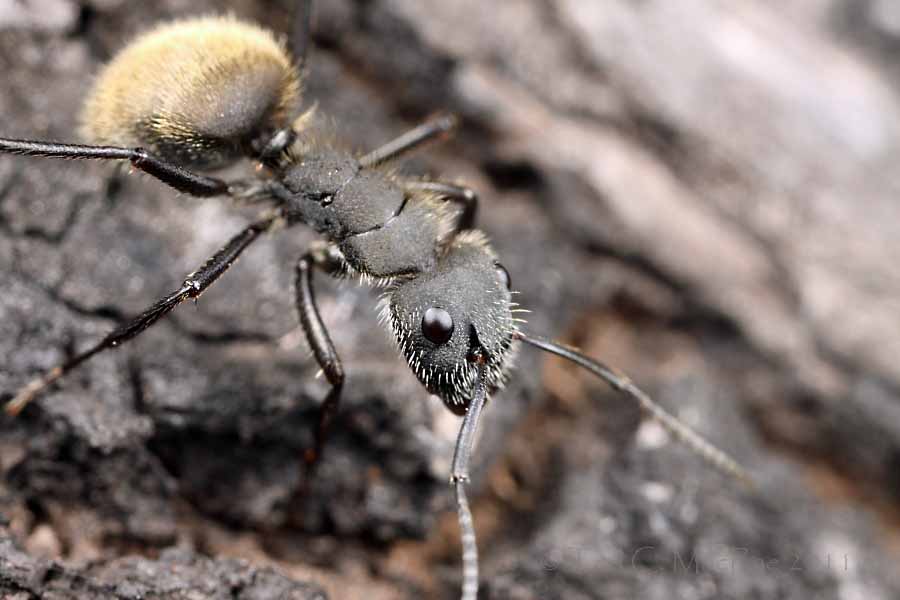
Finally, late in the day, I saw one crawling on the trunk of a recently fire-killed tree that I was inspecting in (futile) hopes of encountering adult jewel beetles or longhorned beetles that would have been attracted to this newly available resource.  This was the easy-to-photograph situation I was waiting for, and the dark color of the charred bark brought out nicely the hairs on the body despite both ant and bark being nearly the same color.

I’m a beetle guy, and normally I would be happy to just call this Formica nigra and move on.  Whatever possessed me to even begin the process of trying to identify this particular ant is beyond me (maybe I’ve actually learned something after a couple of years of reading Myrmecos!).  It had the look of our North American Camponotus, so I entered “Camponotus Argentina” into Google Images and found this photo of Camponotus mus, taken by our friend Alex in nearby Santa Fe, Argentina, near the top of the very first page.  Now, I realize that closely (and even distantly) related species can look quite similar (especially to the untrained eye), but everything about this ant looks right – the bulbous-abdomen, the shape of the thorax, the matt black color, and the velvety yellowish pilosity of the abdomen. A little searching on the name reveals this species to be quite abundant in Argentina, where it goes by the common names “hormiga de madera” (wood ant) and, not surprisingly, “hormiga carpintera” (carpenter ant). Alex? James? Did I get it right?

Copyright © Ted C. MacRae 2011

Bichos Argentinos #9 – Membracido

Enchenopa? sp. | Buenos Aires, Argentina

This treehopper that I photographed at La Reserva Ecológica Costanera Sur strongly resembles our North American species of Campylenchia due to the brown elytra and lack of any yellow markings on the pronotal crest.  However, the rounded lower margin of the frons (more apparent in the full-sized version of this photo) eliminates this genus as a possibility and suggests instead the closely related Enchenopa

I sent this and another photo to Andy Hamilton (Canadian National Collection of Insects, Arachnids and Nematodes) for his opinion.  Andy claims to be a hack when it comes to Neotropical Membracidae (focusing more on world Cercopidae and Holarctic Cicadellidae), but he is a much better hack than I!  In his reply, he mentions that a lot of work is still needed on tropical species and genera, and in fact none of our North American species of Enchenopa actually resemble the type-species from Brazil (Membracis monoceros).  Most of what we now consider Enchenopa will likely be referable back to the genus Membracis (type genus of the family), but where the species in the above photo will eventually fall remains anyone’s guess.

Copyright © Ted C. MacRae 2011

The Pan-Pacific Entomologist

It’s official – I am the new Managing Editor of The Pan-Pacific Entomologist (PPE).  Managing editor of a widely known entomology journal is a role that I have long thought I would like to do, and hopefully my five years as the journal’s Coleoptera Subject Editor have prepared me well for assuming this role and its attendant challenges. 

I can’t think of a better journal to start with.  Published by the Pacific Coast Entomological Society, PPE was formally adopted as its official journal at the Society’s 95th meeting on September 13, 1924.  Browsing through the minutes of those early meetings reads like a “Who’s Who?” of some of the early 20th century’s most recognized entomologists: E. C. Van Dyke, E. P. Van Duzee, V. M. Tanner, E. O. Essig, E. G. Linsley, R. Blackwelder, R. Usinger, and F. E. Blaisdell, Sr., just to name a few.  I am honored and excited to carry on a tradition begun so many years ago by such well-known pioneers of North American entomology.

I now face two orders of business.  First, we are looking for somebody to take on the now vacant role of Coleoptera Subject Editor.  If you have expertise in the Coleoptera and an interest in serving as Subject Editor for manuscripts dealing with this order, please contact me.  Second, please consider submitting your manuscript to The Pan-Pacific Entomologist for publication.   Manuscripts dealing with any aspect of the biosystematics of insects and their relatives  are desired.  Further details are given below from the Society website:

The Pan-Pacific Entomologist (ISSN 0031-0603) is published quarterly (January, April, July and October) by the Pacific Coast Entomological Society, in cooperation with the California Academy of Sciences. The journal serves as a refereed publication outlet and accepts manuscripts on all aspects of the biosystematics of insects and closely related arthropods, especially articles dealing with their taxonomy, biology, behavior, ecology, life history, biogeography and distribution. Membership in the Pacific Coast Entomological Society includes subscription to The Pan-Pacific Entomologist, and Society Proceedings typically appear in the October issue of each volume. The Contents of Recent Volumes are posted here on the Pacific Coast Entomological Society’s website, as is the journal’s Information for Contributors (PDF).

Copyright © Ted C. MacRae 2011

Agelia lordi (Walker)

Aegilia lordi (Walker) | Kenya

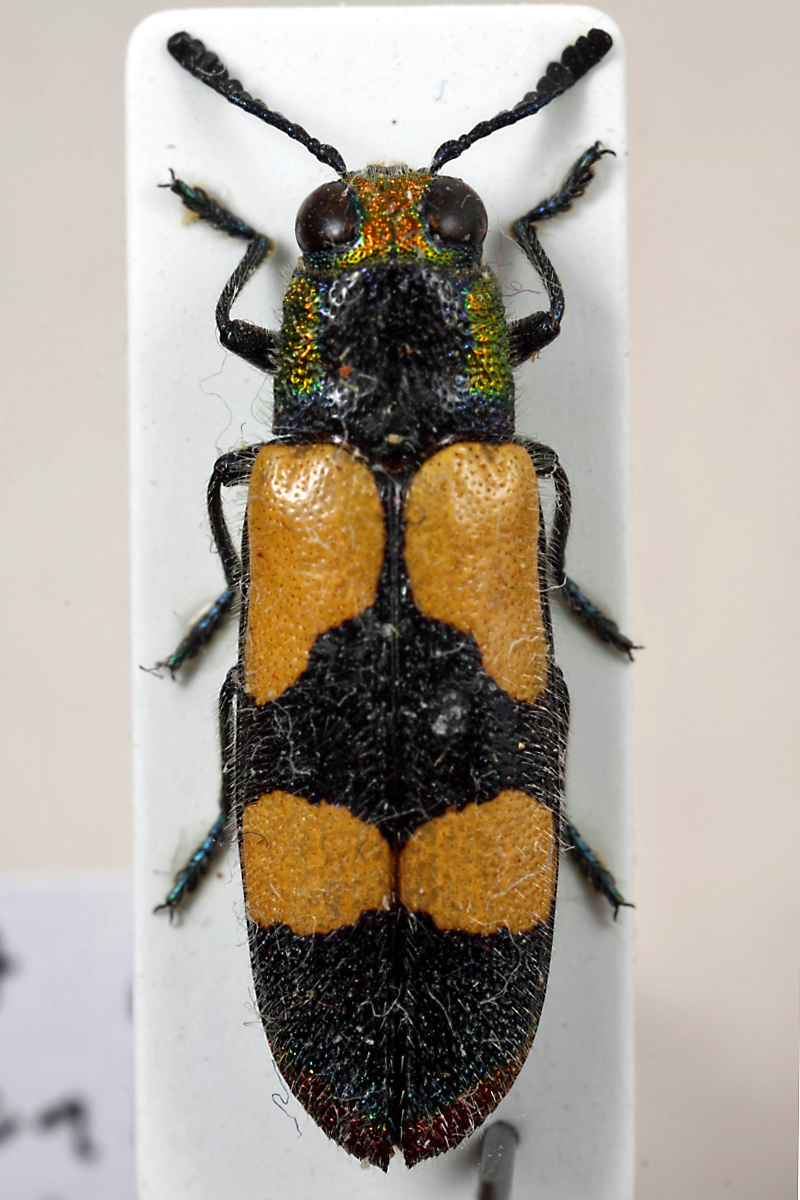
This pretty little beetle is Agelia lordi (Walker), a member of the jewel beetle family Buprestidae. I received this meticulously curated specimen – collected in Kenya – in a recent exchange with Stanislav Prepsl (Czech Republic). The species is found in Sub-Saharan east Africa and is the smallest of the nine recognized Agelia species. Two other species occur in eastern and southern Africa, including Agelia petalii (Gory) which I collected in South Africa (see Buppies in the bush(veld)), while the remaining six are found on the Indian subcontinent. The presence of two distinct and geographically isolated population centers, along with some seemingly common differences in the included species, begs the question of whether they may perhaps be subgenerically distinct. Gussmann (2002), however, regarded most of these differences to be simply a matter of degree and insufficient to warrant subgeneric separation.

Males of A. lordi are easily recognized by the orange-brown color of the last 2-3 sterna, in sharp contrast to the mostly strongly metallic integument of the rest of the ventral surface (females and both sexes of all other species have all sterna concolorous). The metallic reflections on the head, pronotal sides, and elytral apices – along with size – further distinguish A. lordi from other African species.

As is typical with so many tropical insects, little is known about the biology and lifestyle of species of Agelia. The bold, contrasting coloration of especially the African species would seem to make them conspicuous to predation, but this seems to be the result of a mimetic association with noxious species of blister beetles (family Meloidae) in the genus Mylabris. I saw one of these (see Mylabris oculatus in South Africa) in association with A. petalii during my 1999 visit to South Africa, and the resemblance was so strong that I had do a double-take every time I saw one to determine whether it was Agelia or Mylabris.

REFERENCE:

Gussmann, S. M. V. 2002. Revision of the genus Agelia Laporte and Gory (Coleoptera: Buprestidae). Annals of the Transvaal Museum 39:23–55.

Copyright © Ted C. MacRae 2011

Au Bon Marché


Earlier this week a colleague in my lab presented me with this delightful print featuring beetle imagery.  A mutual acquaintance had encountered it while going through some items that had been in storage for many years, thought of me, and asked her to give it to me.  She couldn’t tell me anything more about its origins, but its whimsical, turn-of-the-century look and apparent age immediately captivated me.

I had originally intended to simply post this scan, say “Isn’t this cute?”, and leave it at that.  However, my compulsive side took over and before long I found myself in full bore Google search mode.  My initial desire was simply to translate the French text – the beetles were easy enough (1 _ Giant Borer.  2 _ Blister Beetle.  3 _ Rhinocerus Griffin¹) – but the title “Au Bon Marché” gave me a bit of trouble.  The translators I was using continually turned up results related to “cheap” and “inexpensive”, which just didn’t make sense. Eventually I figured out that it was a store name – specifically the oldest department store in Paris (dating from 1852). A bit more searching revealed it to be one of many trade cards lithographed for the store during the late 19th and early 20th centuries, presumably for promotional purposes.  Nowadays these cards seem to be popular collector’s items, especially in France.  Alas, I was not able to find an image of this specific card among the several hundred other Au Bon Marché trade card images I perused across the web – if anyone knows anything more about the history and use of these cards or about this card in particular, please do let me know.

¹ Apparently the scarab beetle version of a griffin, the mythological creature with the body of a lion and the head and wings of an eagle – wise and powerful characters who spent a good deal of time seeking out and guarding gold and treasures.

Considering its century or more of age, the print is in remarkably good condition. There is just a small amount of staining and glue residue on the backside of the mounting board – perhaps it was part of a treasured scrap book in days long gone. A glass frame should do a nice job of preserving it for another several decades or so.

Copyright © Ted C. MacRae 2011
Bichos Argentinos #8 – “Mosca de la Carne”


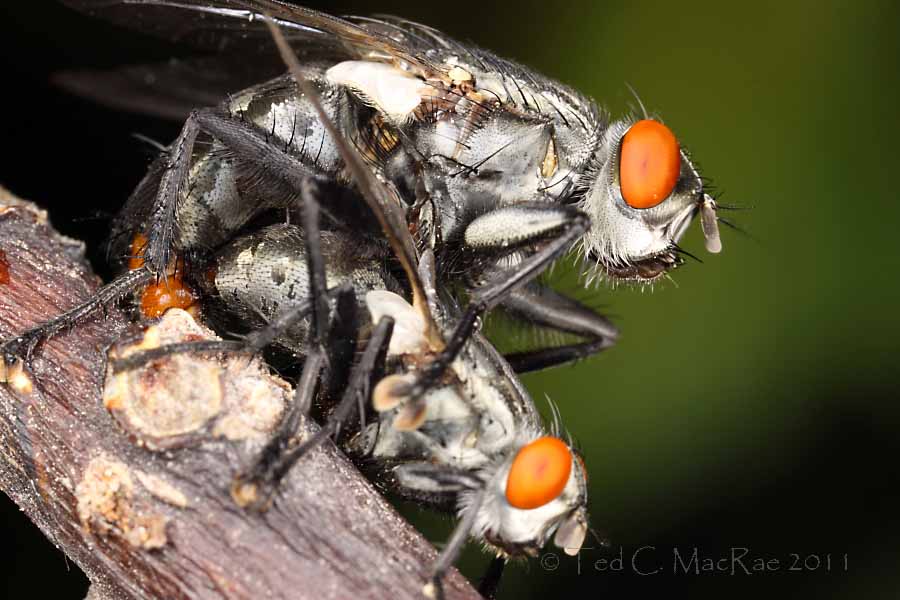
Here is the full-sized photo from which the “super-crop” featured in Super Crop Challenge #4 was taken.  As many of you guessed, this is a higher fly (order Diptera, suborder Brachycera) in the family Sarcophagidae, with the photo crop showing frontal portion of the head and its associated structures.  While dubbed “flesh flies” due to the necrophagic habits of a few of its included species, sarcophagids actually display diverse life histories that include a wide variety of coprophagous and parasitic species (Mulieri et al. 2010).  The fly was one of the many insects I photographed in early March in Buenos Aires, Argentina at La Reserva Ecológica Costanera Sur, where it was found perched on dead wood (I found several individuals of apparently the same species perched on dead wood as well – whether this is significant or chance I don’t know).


The presence of a ptilinal fissure and lunule and a dorsal seam on the antennal pedicel identify this as one of the calyptrate “muscoid” (schizopheran to be more correct) flies.  Within that group, my determination as a member of the family Sarcophagidae is based on its fairly large size, dull gray coloration with three longitudinal black strips on the mesonotum, notopleuron with two strong and two small setae (Calliphoridae have only two setae), and meron with a row of setae (lacking in Muscidae and related families).  Admittedly these characters aren’t visible in the cropped photo that I presented, so guessing the proper family was a bit of a crap shoot.  As noted by (de Carvalho and de Mello-Patiu 2008), species determination of sarcophagid flies is complicated by their fairly uniform chaetotaxy and lack of useful external characters, leaving male genitalia as the only reliable characters for identification.  No suitable key for identifying Neotropical genera yet exists and the elaboration of one will be very difficult without analysis of the male terminalia.  Dr. Luciano Patitucci (Consejo Nacional de Investigaciones Científicas y Técnicas, Buenos Aires, Argentina) suggested this is perhaps a species of Sarcophaga; however, in a recent faunal study of Sarcophagidae at the reserve, two species – Tricharaea (Sarcophagula) occidua and Oxysarcodexia varia – comprised nearly 90% of the flesh flies encountered (Mariluis et al. 2007).

A single individual is shown in the first two photos, while this mating pair was seen a little later.  Although they seem to represent the same species, I can’t be certain of this, and the photo itself is not the greatest due to the female (bottom) being slightly off-focus.  Nevertheless, I had to show it, because – really – who can resist photographs of fly nookie?! 

REFERENCES:

de Carvalho, C. J. B. and C. A. de Mello-Patiu.  2008.  Key to the adults of the most common forensic species of Diptera in South America.  Revista Brasileiro de Entomologia 52(3):390–406.

Mariluis, J. C., J. A. Schnack, P. R. Mulieri and J. P. Torretta. 2007. The Sarcophagidae (Diptera) of the coastline of Buenos Aires City, Argentina. Journal of the Kansas Entomological Society 80(3):243–251.

Mulieri, P. B., J. C. Mariluis and L. D. Patitucci.  2010.  Review of the Sarcophaginae (Diptera: Sarcophagidae) of Buenos Aires Province (Argentina), with a key and description of a new species.  Zootaxa 2575:1–37.

Addendum:

This challenge concludes the 2nd BitB challenge session, with a record 17 participants in this final challenge.  For a while it looked like HBG Dave would become our newest champion, but Session #1 champ Ben Coulter swooped in, flogged us with terminology (all of it correct and undeniable), and won two of the last three challenges to edge out Dave and, once again, take the overall victory. Make no mistake – Ben knows how to play this game!  Morgan Jackson took second in this challenge and claimed the final spot on the overall podium, while Troy Barlett and newcomer Heath Blackmon tied for third.  Other strong contenders during Session #2 included JasonC and Tim Eisele.  Ben – contact me to claim your loot (and your loot from session #1 is in the mail).

Here is the final points tally for Session #2:

Place Commentor BB#10 IDC#5 Bonus
3/7
IDC#6 IDC#7 SCC#4 Total
1 Ben Coulter       10   41 51
2 HBG Dave   13 2 4 8 17 44
3 Morgan Jackson   2     4 29 35
4 Troy Bartlett 2 10 2     20 34
5 JasonC   8   4   18 30
6 Tim Eisele 1 8   6 6 8 29
7           20 20
8 TGIQ   2       17 19
9 Christopher Taylor   2       15 17
10 Dave Hubble   15         15
11 James Trager  1 1 2     9 13
12 Gunnar           12 12
13
        1 9 10
14
Dennis Haines 
          9 9
15 Max Barclay       3   5 8
            8 8
17 Charley Eiseman   6         6
18 biozcw           5 5
19 Brady Richards       4     4
  Henry         4   4
21 John Oliver     2       2
 
Mike
          2 2
23 Christy Bills       1     1
  Tucker Lancaster       1     1

Copyright © Ted C. MacRae 2011