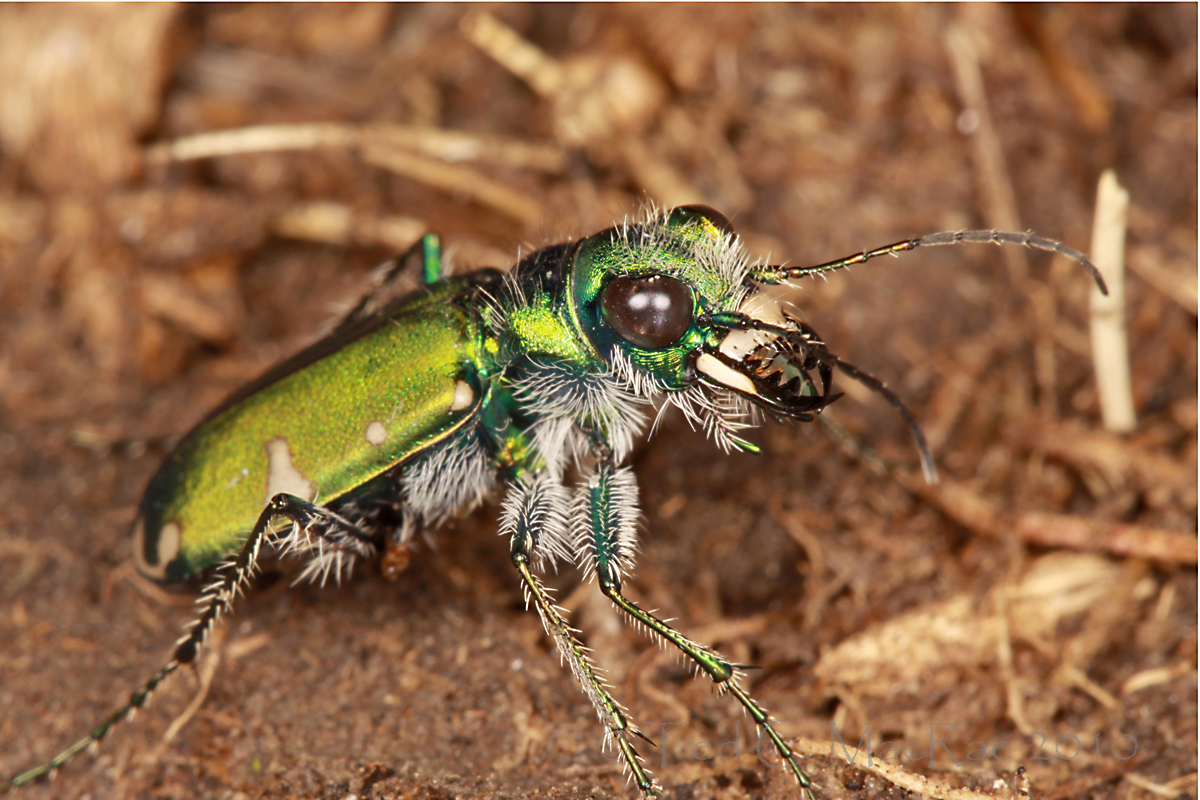
Cicindela denverensis – green claybank tiger beetle

Cicindela denverensis (green claybank tiger beetle) | Sioux Co., Nebraska.

Here are a few more photographs of the insect featured in ID Challenge #1, which is, in fact, Cicindela denverensis (green claybank tiger beetle).  Nearly every commentor got the first 6 points easy enough (2 pts each for order, family, and genus), but only Ben Coulter correctly identified the species.  A bonus point for proper italicization of the binomen (and a favorable ruling on a technicality) gave him 9 points and the win.  Second place goes to TGIQ, who smartly picked up bonuses to earn 8 points and edge the pack.  Charley Eiseman, Christopher Taylor, Delbert La Rue, jason, and Techuser crowd the final podium spot with 7 points each.
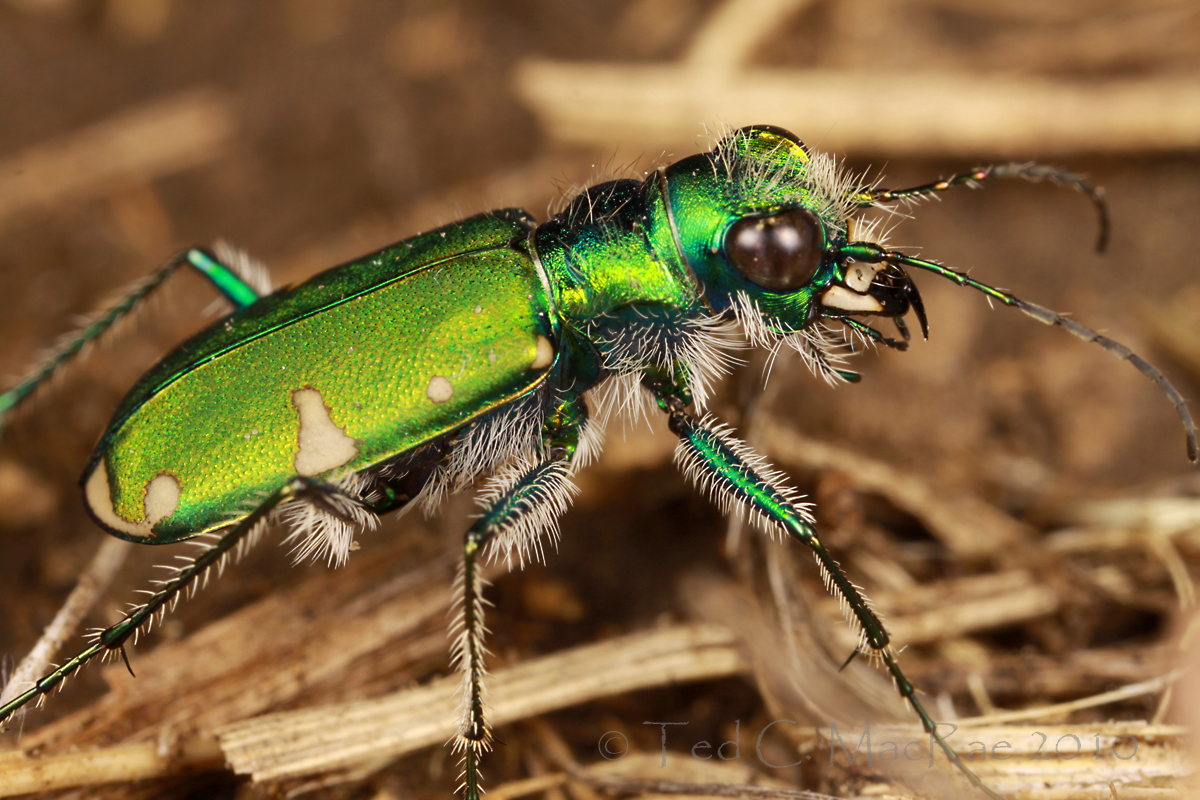
Distinguished by its green color, hairy frons, reduced maculations, and grassland occurrence.

Cicindela denverensis occurs in short- and mixed-grass prairie habitats in the central and western Great Plains, especially sites with clay soils.  It can be distinguished from a number of similar-looking species by its uniformly green color, hairy frons, often reduced maculations, and occurrence in grassland habitats.  Cicindela sexguttata is also uniformly green, but the frons in that species is glabrous, and it occurs further east in woodland habitats.  Cicindela decemnotata is also similar, but it usually has broad maculations and a shinier, oily appearance – often with some degree of red tinting.  Some subspecies of C. scutellaris are also green, but only rugifrons bears maculations and can be distinguished by it’s stockier form and Atlantic Coastal Plain distribution. Cicindela denverensis is actually most closely related to C. purpurea (cowpath tiger beetle), C. limbalis (common claybank tiger beetle), and C. splendida (splendid tiger beetle) – especially the latter two.  All three of these species exhibit some degree of purple or red on the pronotum, elytra, and/or legs that distinguish them from C. denverensis in most parts of their range.   There is, in fact, some disagreement about whether C. denverensis, C. limbalis, and C. splendida even represent distinct species, all of which demonstrate a similar preference for clay substrates but segregate into three partially allopatric populations – northern C. limbalis, southern C. splendida, and western C. denverensis.  Hybrid individuals can be encountered in areas where their distributions overlap, and this is especially so in central Nebraska – one of just a few spots where all three species occur together.  Schincariol & Freytag (1991) conceded a close relationship between the three based on morphometric analysis but still considered them distinct based on differences in elytral color, pattern, and percentage maculation and the number of non-sensory setae.  However, a recent phylogenetic analysis based on mitochrondrial DNA sequences strongly supports a single species hypothesis (Woodcock & Knisley 2009).  From an academic perspective, more thorough systematic analyses of the claybank group of tiger beetles would be of great interest (although I suspect many cicindelophiles with strictly philatelic interests will not be happy to see three species sunk into one).
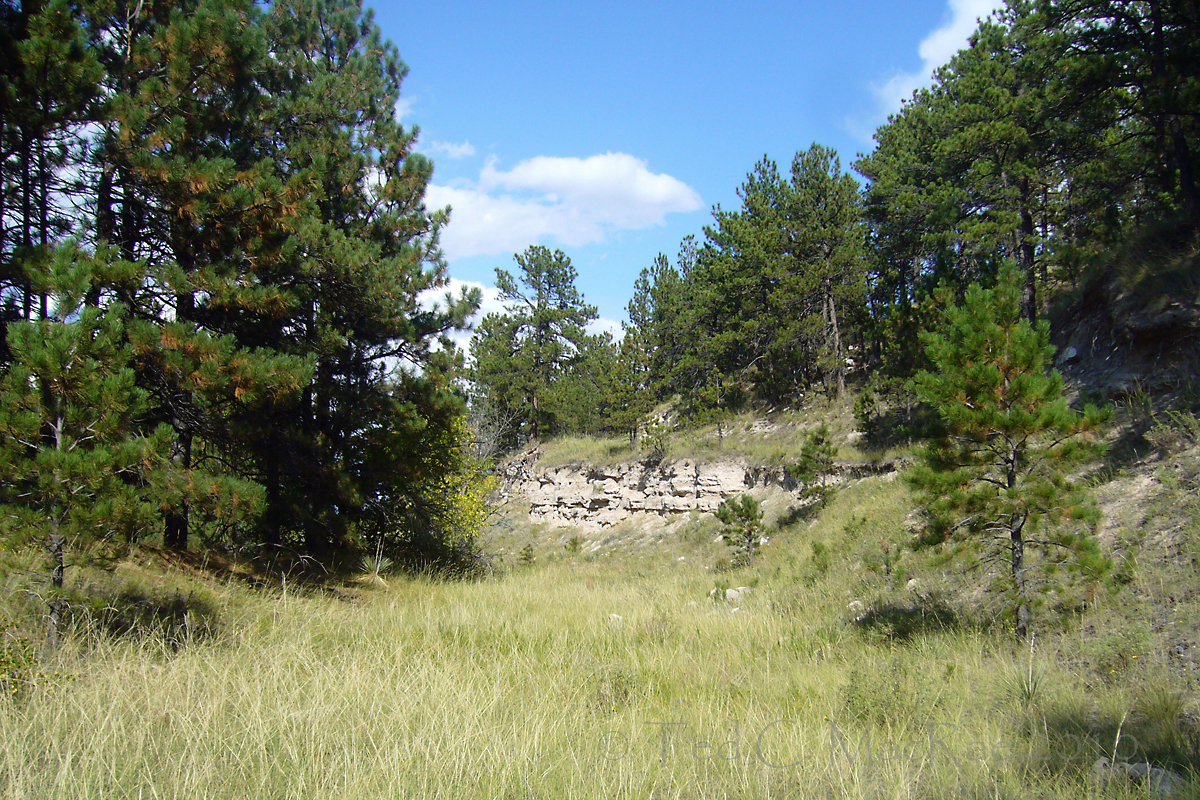
Ponderosa pine mingles with prairie grasses on the Nebraska Pine Ridge escarpment.

The individual in the above photos was found at Monroe Canyon in the Pine Ridge escarpment of western Nebraska (Sioux Co.).  It was the only individual of this species that we saw there and was a bit of a surprise finding because of the generally sandy soils that characterize the spot – perhaps it was a vagrant individual that had found its way into the canyon from the more clay-based shortgrass prairie above.  We’ve seen greater numbers of this species further east in central Nebraska (Sherman Co.) along vertical roadside clay banks. The photograph below is one of those individuals and exhibits somewhat more complete maculations.  Note the sharp bend, or “knee,” on the median maculation that allows the species to be differentiated from C. limbalis (all-green forms of this species can be found at the northern limit of distribution for C. denverensis in North Dakota).  This individual also displays something else of interest – anybody?
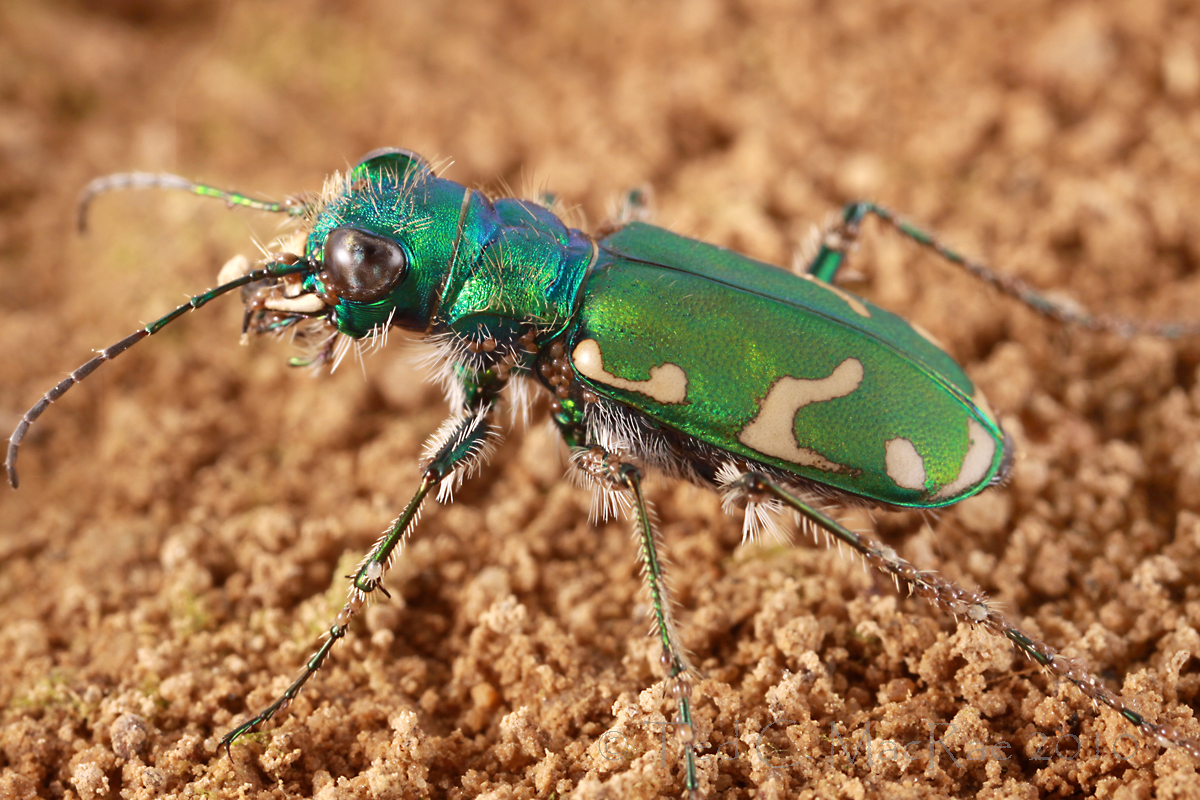
Individual with more complete maculations | Sherman Co., Nebraska.

REFERENCES:

Schincariol, L. A. and R. Freitag. 1991. Biological character analysis, classification, and history of the North American Cicindela splendida Hentz group taxa (Coleoptera: Cicindelidae). The Canadian Entomologist 123(6):1327-1353.

Woodcock, R. M. and C. B. Knisley. 2009. Genetic analysis of an unusual population of the problematic tiger beetle group, Cicindela spendida/C. limbalis, from Virginia, USA (Coleoptera: Cicindelidae) using mtDNA. Entomological News 120(4):341-348.

Copyright © Ted C. MacRae 2010

ID Challenge #1

Okay, this isn’t really the first ID challenge I’ve had on this site, but the first in a series that is formally named such.  I’ll be offering these up occasionally to fill the void left by the suspension of Alex’s Monday Night Mystery series (okay, not really a void – we still have a wealth of serial quizzes to choose from, including Crypsis Challenges by Troy, Monday Mimic by Mike,  by Chris, Genius of the Press by the other Chris, Electron Challenge by macromite, and my own !).  This series will feature classic identification challenges, with points awarded for correctly naming the order, family, genus, and species.  Points are not mutually exclusive – you don’t have to be first, you just have to be correct.  That being the case, I’ll turn on comment moderation during the answer phase so that all have equal opportunity to participate.  I also give bonus points for providing additional diagnostic information, comments on taxonomic status, or even wrong answers if they somehow make me chuckle.  I’ll give this a day or so – starting… right… now.

Update 12/24/10: answer posted here.

Copyright © Ted C. MacRae 2010
Pseudoxycheila tarsalis – remounted

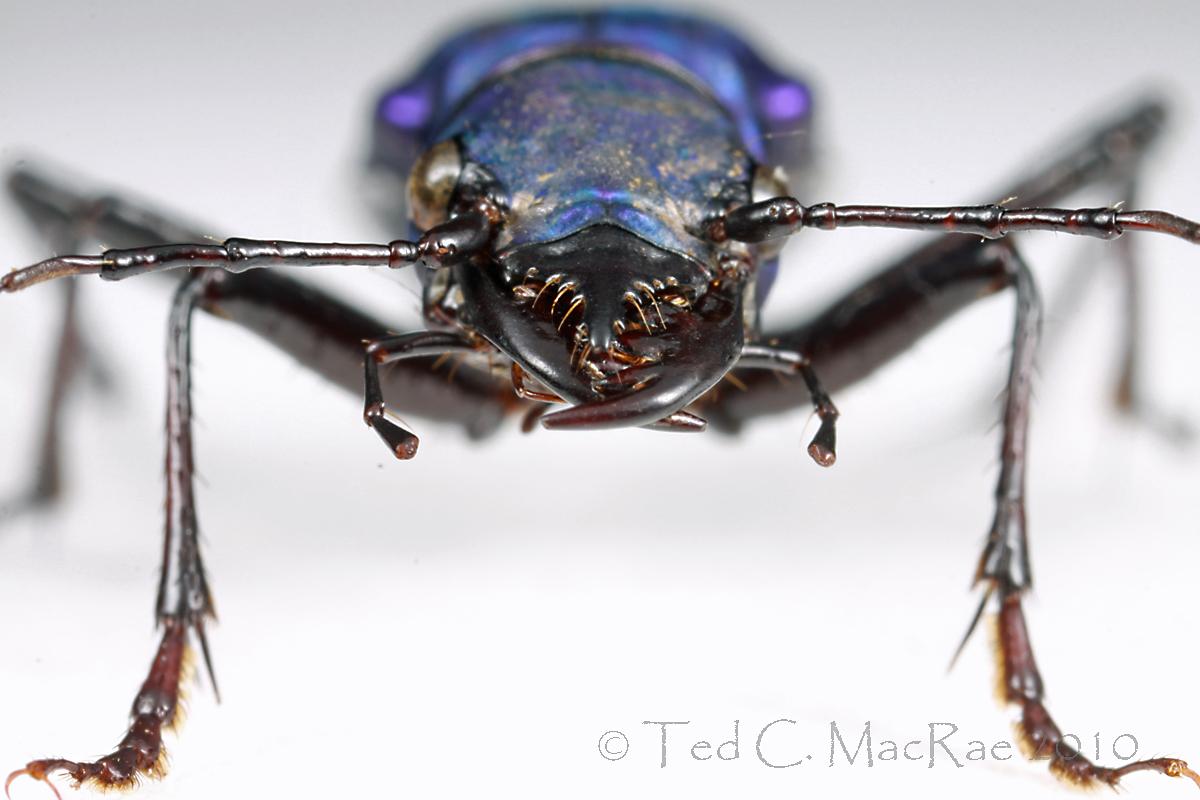
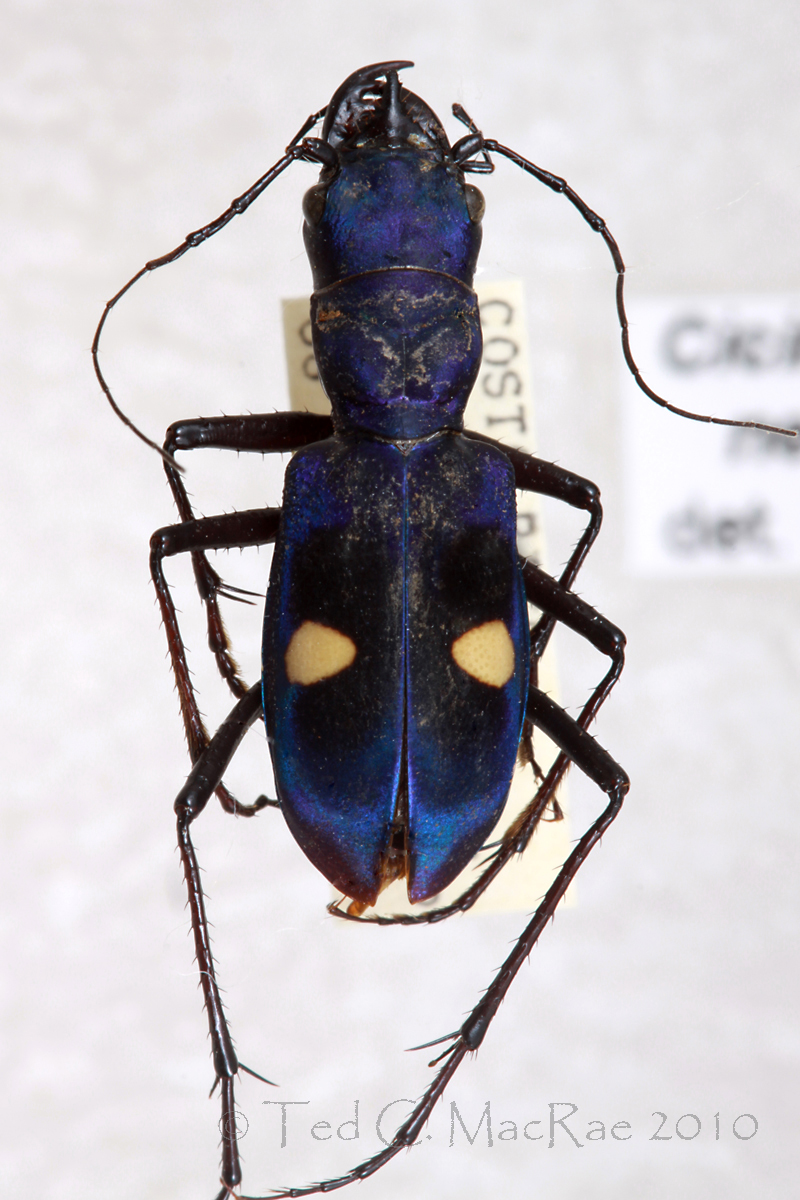
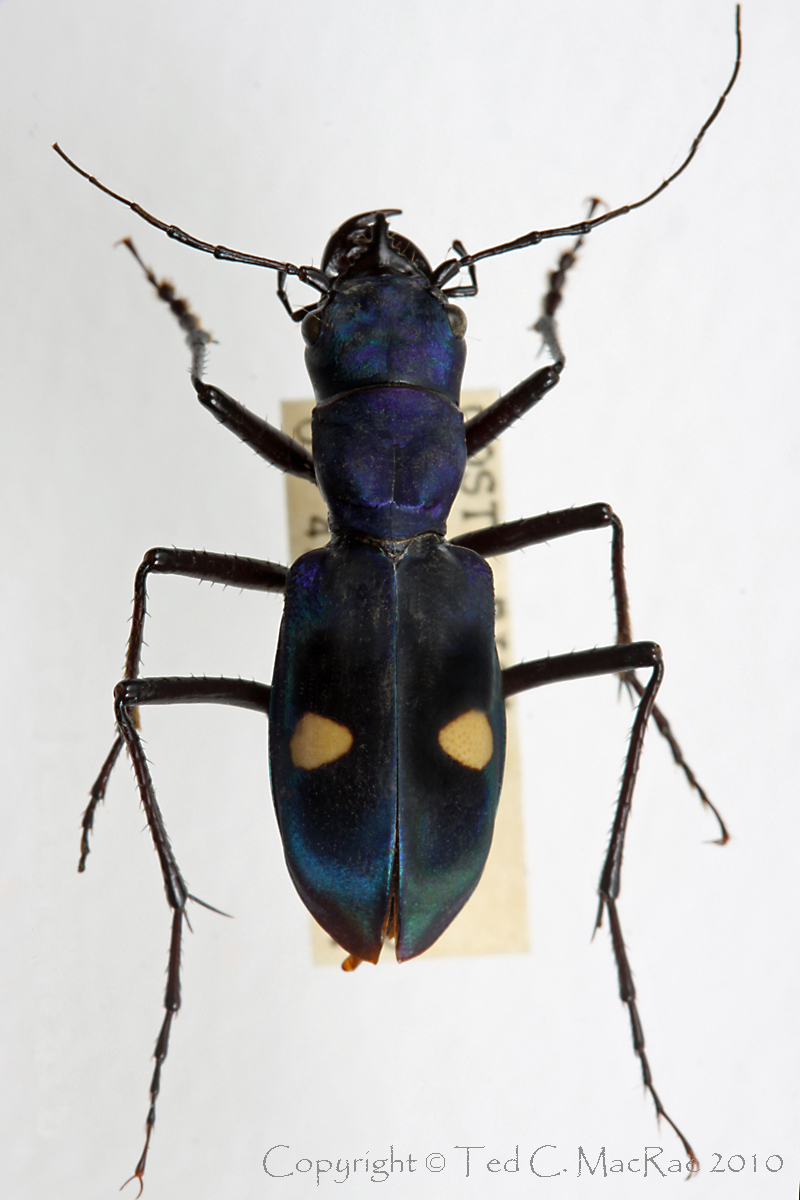
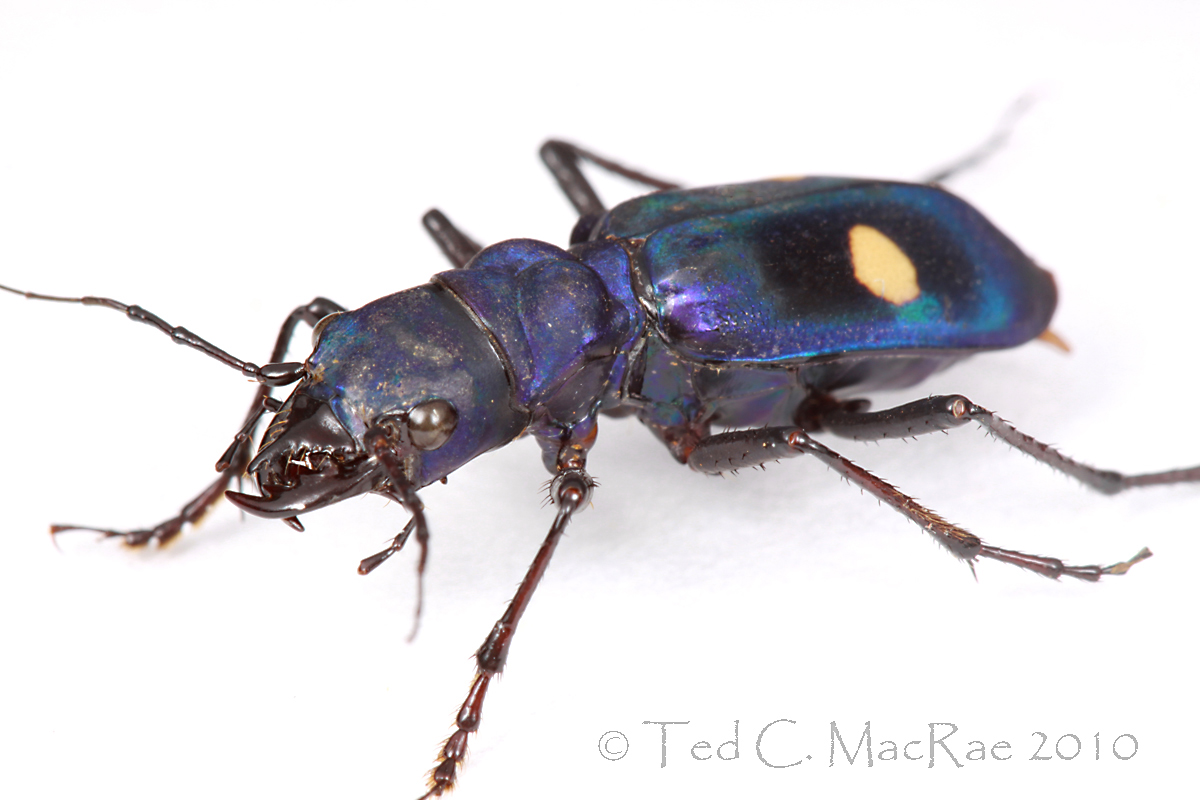
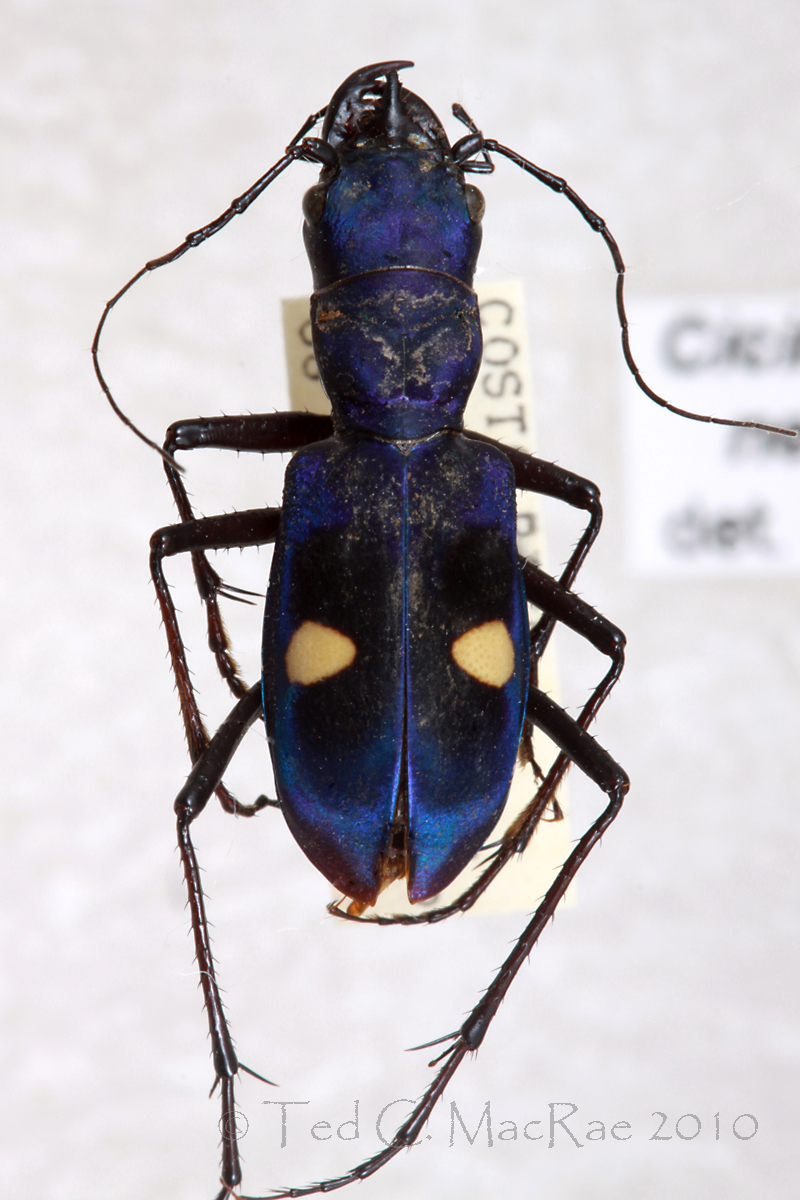
Pseudoxycheila tarsalis (Central American montane tiger beetle) | specimen ex. Costa Rica.

I tend to be a minimalist when it comes to mounting beetles. That is, I mount them so that they take up minimal space – legs tucked neatly and symmetrically against each side of the body and antennae laid straight alongside each elytron. This is important not only for space considerations (always a premium, but especially so in a private collection), but also to minimize the chances of accidental breakage when handling specimens. I must admit that beetles mounted in such manner don’t have quite the visual appeal of beetles mounted in a more relaxed, life-like position, but the ability to pack them tightly in my limited drawer space generally overrides whatever aesthetic desires I may have. Every now and then, however, I come across a specimen that just begs to be mounted life-like due to its striking appearance or impressive structures. Pseudoxycheila tarsalis (Central American montane tiger beetle), which I recently received as a gift from Henry Hespenheide, is one such species.

Remounting a dry, already-mounted beetle is a little trickier than mounting a fresh specimen. The beetle must first be relaxed, and even when relaxed well the beetle is never as pliable as when fresh. This makes it more difficult to get the legs and antennae into the desired position, and there is always a higher risk of breakage while trying to do so. Many different methods for relaxing beetles are available – some better than others, but for a one-off specimen I usually just soak it in very warm tap water. Generally 15-20 minutes will suffice, although large specimens may require more than this. Soaking has the added benefit of softening whatever debris might be caked onto the beetle so that it can be removed more easily. In this case, once the beetle was relaxed I used forceps to hold the specimen by the pin to keep it submerged in the water while “scrubbing” its upper surface with a camel-hair brush. Younger eyes might be able to do this unaided, but I find a binocular dissecting scope at low power to be quite helpful.

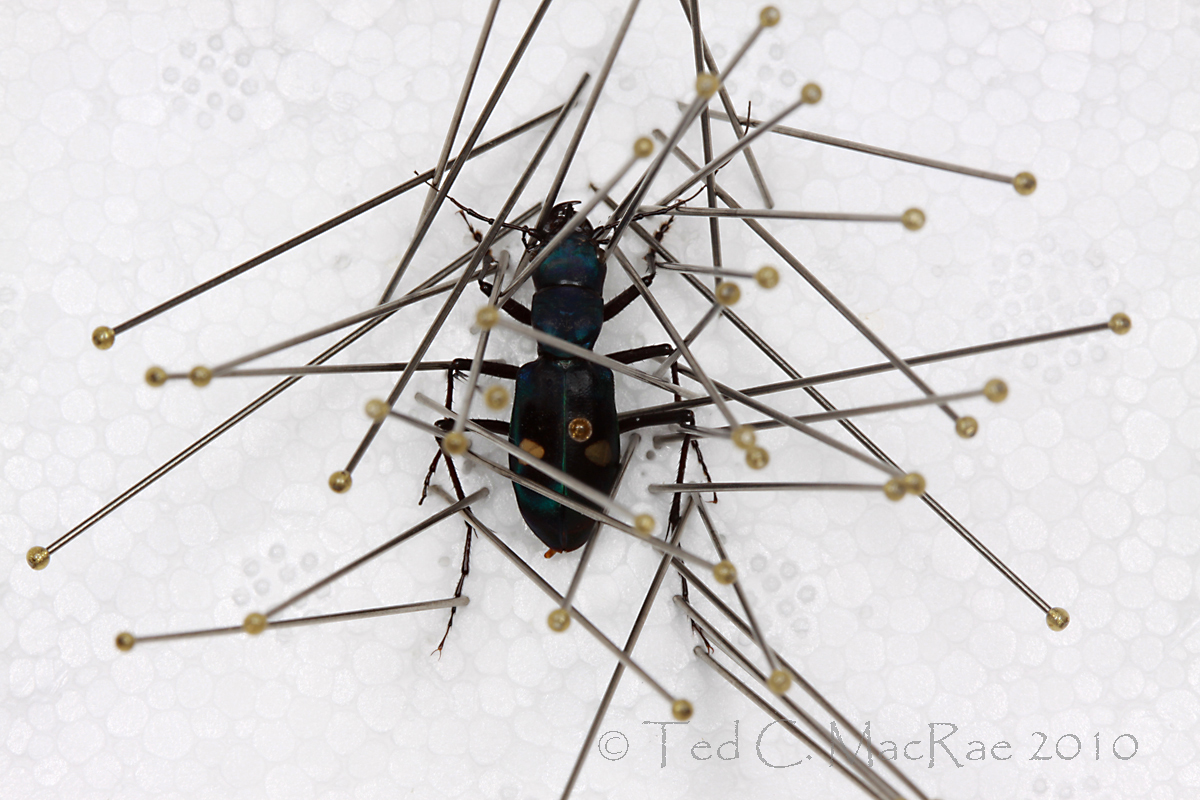
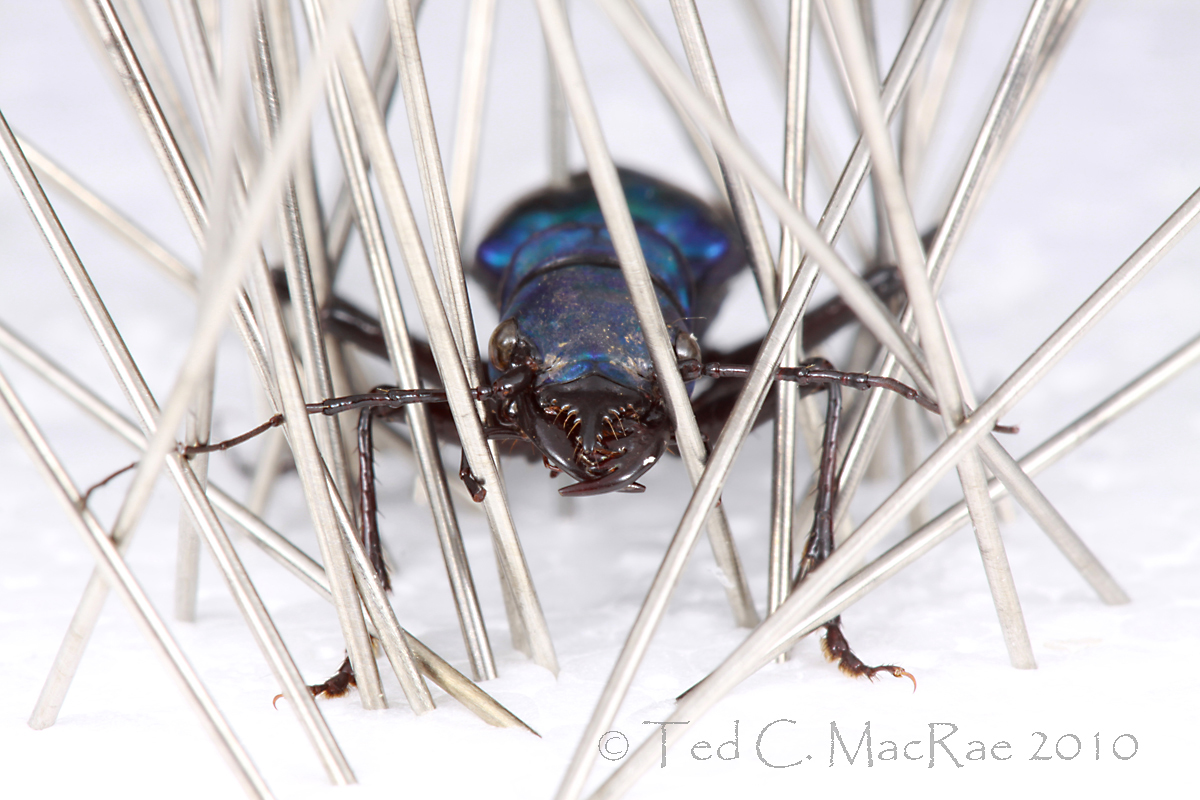
Once clean, I inserted the pin into a styrofoam block for positioning of the body parts. Since this specimen was to be posed in a life-like position, I didn’t insert the pin all the way, but rather left the body up off the styrofoam as it would be in life. Also, my favorite tiger beetle pose is slightly elevated on the front legs, so I inserted the pin at an angle to leave more space under the head than the abdomen. Then it was a matter of using brace pins to hold each body part in the desired position. I work from “sturdy” to “delicate” – i.e., the sturdiest body parts are placed in position first and the most delicate are done last, since positioning the sturdier parts causes tugging and pulling that could break the more delicate parts if they are already braced in position. This usually means bracing the body itself first, then then the legs, and lastly the antennae. Again, my eyes prefer to do this under a scope. While the antennae and tarsi can usually be positioned directly with the brace pins, sturdier body parts may need to be positioned and held in place with fine-tipped forceps in one hand while placing brace pins around them with the other hand. I also work “proximal to distal” with each part – i.e., positioning the part closest to the body first, followed by the more distal portions. There’s no way around it – this kind of work takes practice and patience, and even with all my years of experience I still managed to break off the distal four antennomeres from the left antenna (and failed in my attempt to glue them back on after drying). For this specimen, a total of 42 brace pins were used.

While fresh specimens may take several days (to a week or more for large specimens) to dry, relaxed specimens usually dry much more quickly – overnight was more than adequate for this specimen. Be careful when removing the brace pins! If you grab them too tightly as you pull them out of the styrofoam, you can end up “flicking” a leg or antenna and breaking it – better to grab the pin head loosely and lightly spin it back and forth as you pull up gently until the pin is free. Once all the brace pins are removed, pull up carefully on the main pin as well until you’re sure the tarsal claws aren’t grabbing the styrofoam – if they are, slide a pin or forceps underneath and gently unhook the claws before pulling the pin out any further. Replace the labels and voila – a much more aesthetically pleasing specimen! Is all this effort worth it? You be the judge. Below on the left is the photograph I showed previously for the specimen prior to cleaning and remounting, while on the right is the now clean and nicely mounted specimen.

Before

After

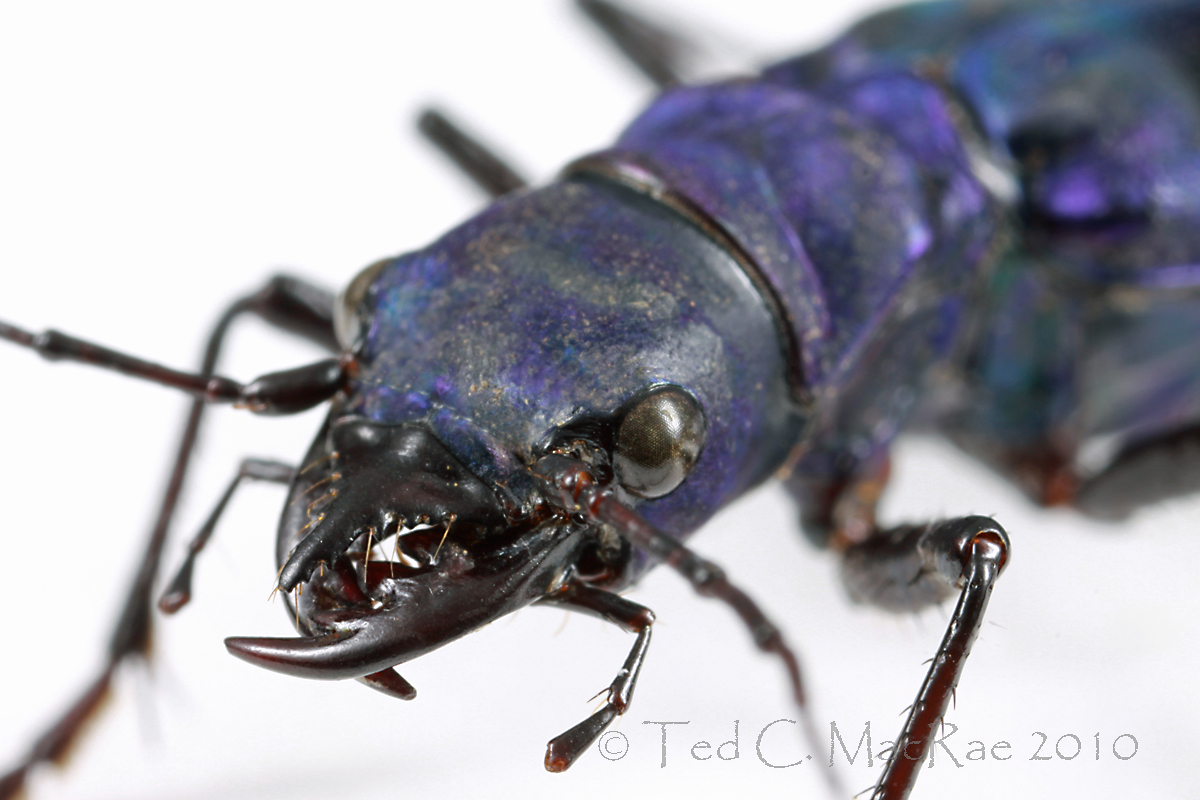
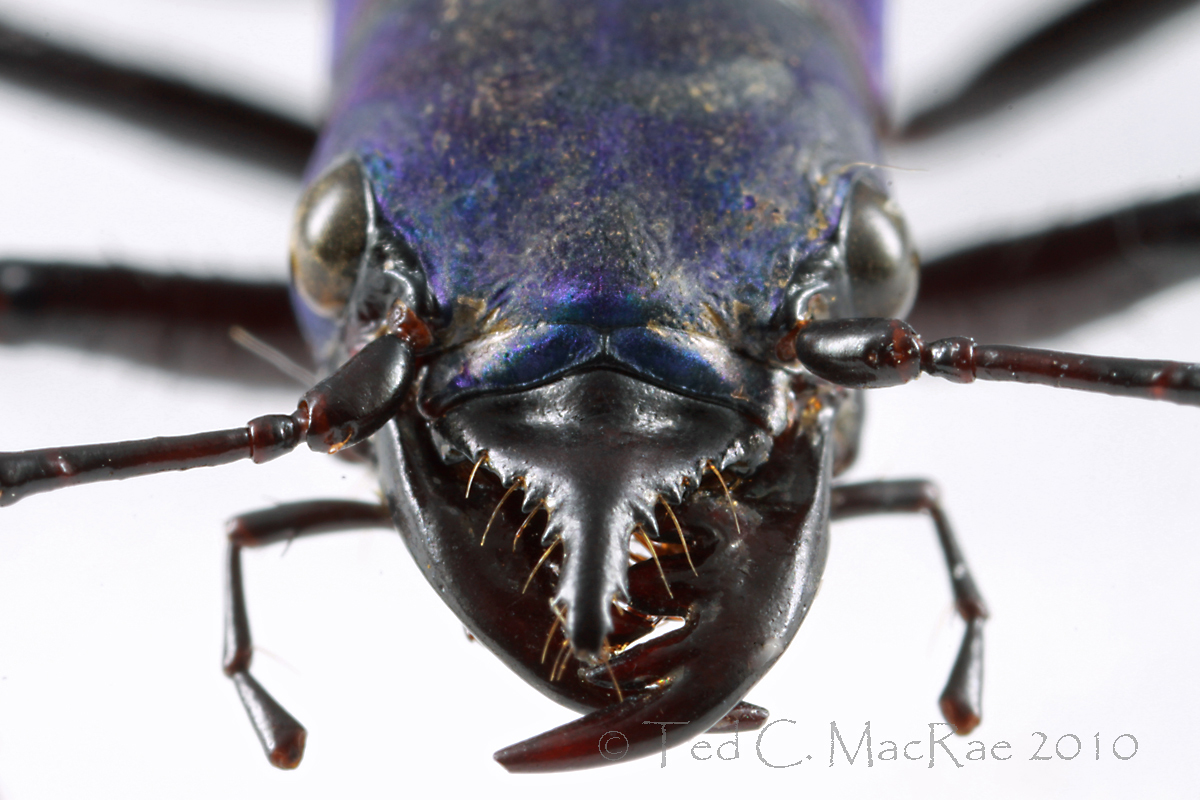
With the beetle in its new life-like position (and scrambling for any chance to get some more practice with my new diffuser setup [photos coming soon, I promise!] as I slide into the depths of this Midwestern winter), I couldn’t resist the urge to take a few studio shots of the remounted beetle “on white.” While photographs of posed, dead beetles may not be to everyone’s liking, they do provide a chance to see detailed views of species that may not be otherwise available. The first photo above and the three below are some of my favorites from the session:

Photo Details: Canon 50D, Canon MT-24EX flash w/ DIY diffuser (photos 1, 7-8: Canon MP-E 65mm 1-5X macro lens, ISO 100, 1/250 sec, f/13; photos 2-6: Canon 100mm macro lens, ISO 100, 1/250 sec, f/16). Typical post-processing (levels, minor cropping, unsharp mask) with digital removal of pin heads and minor debris.

Copyright © Ted C. MacRae 2010
AIF #11, HoH #12

An Inordinate Fondness #11 – Kindergarten Kunstkammer is hot off the press, and you MUST read it! Adrian Thysse, the polymath behind The Bug Whisperer (as well as Voyages Around My Camera, A Natural Evolution, and Antoni van Leeuwenhoek Centraal), adopts an appropriately Renaissance theme to this latest AIF issue.  It seems that one “Theodosius Macraeinius” spilled his gift box of beetles in Ferrante Imperato’s private museum (“Kunstkammer”) before properly curating its rare contents and needs help from the readers to locate and “pin” them. Intrigued? Take a look for yourself and see if you can find each of the 12 rare beauties – successfully pinning them brings up a delightful post about the beetle and the particulars of its “collection.” Bravo, Adrian!

One month older than AIF is House of Herps, which celebrates The First Anniversary Edition at the home site.  To celebrate, the home site has undergone a design change and introduces two new badges to go with the original one – for some reason I feel partial to this one.  This month’s contributors bring to 52 the total number of contributors that have participated in the inaugural year of HoH, sharing their pictures, experiences and knowledge about the world’s amphibians and reptiles.  If this carnival has accomplished anything, I hope it has been to stimulate interest in these ancient animals (it certainly has in me) and to highlight their increasingly tenuous circumstances in the face of human pressures.  Join me in making HoH’s second year as successful as its first.

Copyright © Ted C. MacRae 2010

ESA in absentia

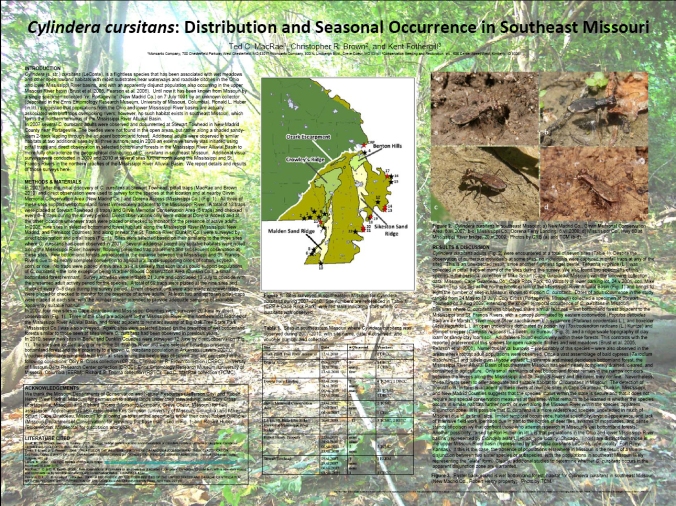
Click on image to see larger version.

The Entomological Society of America (ESA) held its 58th Annual Meeting earlier this week in San Diego, California. For those of you who were unable to attend, I’ve included a link to a poster that I and coauthors Chris Brown and Kent Fothergill presented, titled Cylindera cursitans: Distribution and Seasonal Occurrence in Southeast Missouri. Okay, I can already see the puzzled faces, as many of you know I was unable to attend myself. In fact, none of the poster authors were in attendance – if Kelly Tindall, Kent’s entomologist-wife, hadn’t attended the meetings the poster would have never seen the light of day.

Despite lead authorship on the poster, I had a minimal role in its preparation.  Kent did much of the dirty work – clipping text and figures from a manuscript on the subject that we recently submitted to the journal CICINDELA, while Chris and I sat back and gave thumbs up and thumbs down opinions on each iteration of Kent’s hard work.  My heartiest congratulations to Kent for producing such a nice piece of work, to both Kent and Chris for putting up with my obsessive nitpicking over every trifling detail as we readied the manuscript for submission, and to Kelly for lugging a poster halfway across the country in the middle of winter when it didn’t even have her name on it.

REFERENCE:

MacRae, T. C., C. R. Brown, and K. Fothergill.  2010. Cylindera cursitans: Distribution and Seasonal Occurrence in Southeast Missouri. Annual Meeting of the Entomological Society of America, San Diego, California, December 12-15, 2010.

Copyright © Ted C. MacRae 2010

A First Class Box of Beetles

Warning: post contains lots of hardcore, beetle-collector geekery!

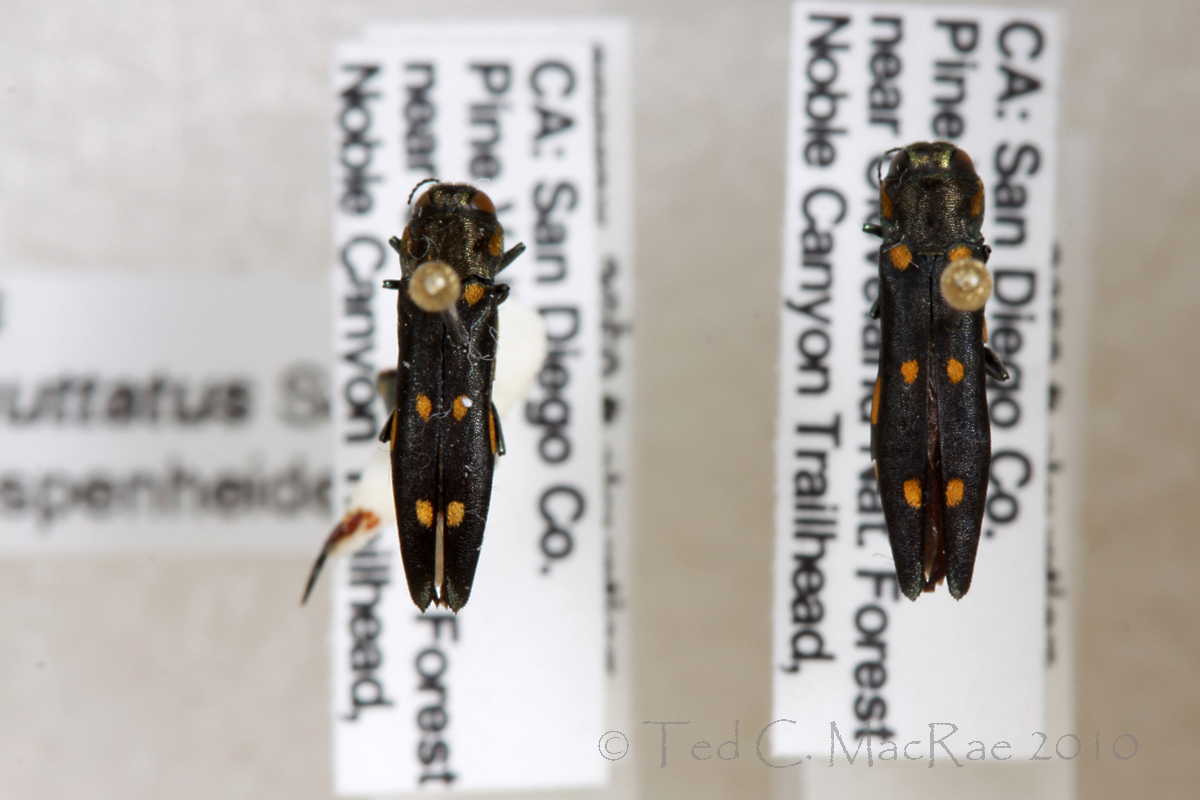
A nice selection of tiger beetles and buprestid beetles.

A few weeks ago I got an email from fellow buprestophile Henry Hespenheide (Professor Emeritus, UCLA) asking if I needed any specimens of Agrilus coxalis auroguttatus – recently dubbed the “goldspotted oak borer” after it was discovered damaging oaks in southern California (Coleman & Seybold 2008).  I replied that I did not have this species in my collection and that I would be grateful for any examples he could provide.  Shortly afterwards, I received another message from him saying that he had just placed in the mail a small box with a male/female pair of that species – along with about two dozen tiger beetles for my enjoyment!  Later that week I received the shipment at my office – I couldn’t wait to open it up and see what goodies were inside!

Ctenostoma maculicorne (Chevrolat, 1856)

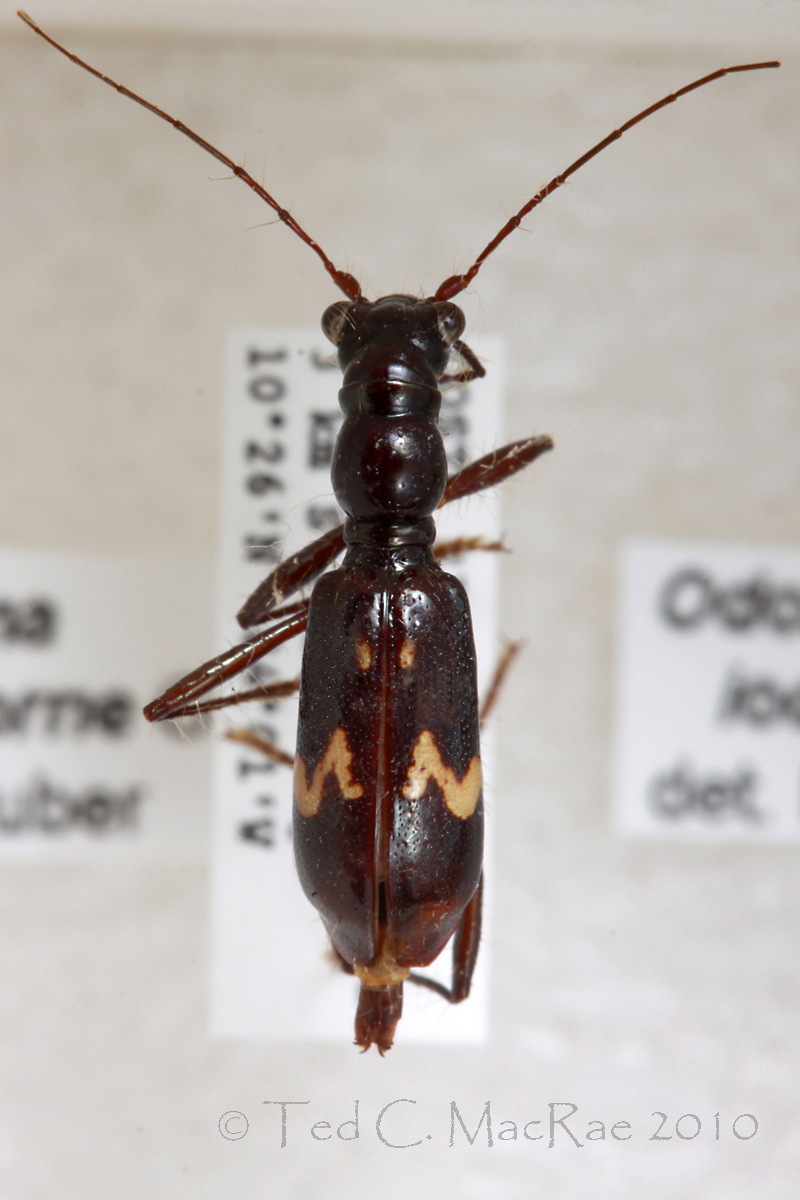
Opening a box of just received specimens is a little like opening presents on Christmas – you don’t know for sure what’s inside, but you know you’re gonna like it!  This time was no exception, and I delighted as I realized the sending contained a dozen or so tiger beetles from Costa Rica and Nicaragua (a region in which Henry has spent many of his years studying the leaf-mining and twig boring buprestid beetles).  My eyes were immediately drawn to two tiger beetles in particular – specimen #1 in the first row, and specimen #4 in the second row.  Why these particular tiger beetles?  Obviously they are among the more showy specimens in the sending, but more significantly both of them belong to genera not represented in my collection.  The first of these is Ctenostoma maculicorne, representing also a new tribe for my collection (Collyridini, subtribe Ctenostomina).  I’m glad Ron Huber had already identified this specimen, as I probably would’ve only been able to determine the genus.  Beetles in this group are ant mimics, but in a much different manner than our U.S. ant-mimics (Cylindera cursitans and Cylindera celeripes).  Those latter species are found strictly on the ground (as are all U.S. tiger beetle species), while species of Ctenostoma are largely arboreal.  Troy Bartlett at Nature Closeups has some great photographs of another species in this genus seen last January in Brazil (Caraça Natural Park, Minas Gerais) that show just how ant-like these beetles can appear as they crawl about on twigs and branches.

Pseudoxycheila tarsalis Bates, 1869

Despite lacking an identification label, I recognized the second specimen instantly as Pseudoxycheila tarsalis, dubbed by Erwin & Pearson (2008) as the “Central American montane tiger beetle.”  Pseudoxycheila is a rather large Neotropical genus (21 known species), but only P. tarsalis occurs north of South America.  Morgan Jackson at Biodiversity in Focus photographed an individual of this species during his visit to Costa Rica this past summer.  Its brilliant coloration is not only delightful to look at but also apparently aposematic in nature – Schultz and Puchalski (2001) found that benzene-like compounds isolated from the beetle’s pygidial glands are distasteful to humans, adding support to the potential of a Müllerian mimicry association with stinging mutillid wasps in the genus Hoplomutilla, which they resemble.  Note also the curious spine on the frons extending out over the mandibles – maybe it not only grabs its prey with its toothy jaws but also “stabs” it for extra measure (just kidding – though I do wonder about the function of that spine.  I’m not aware of its presence in any other genus of tiger beetles).

I also noted an interesting pair of tiger beetles that looked very different from each other, yet were both identified by Ron Huber as Tetracha ignea.  This species was recently synonymized under the nominotypical form of T. sobrina (Naviaux 2007) – the “ascendent metallic tiger beetle” (Erwin & Pearson 2008), a highly variable species with numerous described subspecies occurring in southern Mexico, Central America, northern South America, and the West Indies.  The specimen on the left has the normal appearance of T. sobrina sobrina, but the specimen on the right looks like it might have suffered some chemical discoloration (a common occurrence among collected tiger beetle specimens).

Update 16 Dec 2010, 12:00pm – I just learned from Henry that the Tetracha specimen on the right (from Nicaragua) was not seen by Ron Huber and, thus, is likely not conspecific with the specimen on the left (T. sobrina from Costa Rica).  That’ll teach me to blindly accept what I see but does not seem right.  Now, time to pull out my copy of Naviaux (2007) and test my abilities to work through a key written in French!

Tetracha sobrina sobrina Dejean, 1831 (L); Tetrach sp. undet. from Guatemala (R).

There are several other interesting species in the sending – some determined (two species each of Oxycheila and Brasiella) and others that I need to look at more closely.  You may note on the bottom row a few specimens of a species of Elaphrus – a genus of true ground beetles that often fool collectors by their strong resemblance to tiger beetles (looks like they fooled Henry, too).  As for the beetles that were the reason for this shipment in the first place, these are shown in the image below.  Agrilus coxalis auroguttatus was recently discovered as the cause of significant mortality in several species of oak trees in San Diego County (Coleman & Seybold 2008), thus joining the introduced Agrilus planipennis (emerald ash borer) and several native Agrilus spp. on the ever-growing list of buprestid beetles achieving economic pest status in North America.  This subspecies, known for many years from southern Arizona (where it is not a pest), is curiously widely disjunct from nominotypical populations in southern Mexico.  Its sudden appearance in southern California has all the hallmarks of being a human-aided introduction, although natural range expansion remains a possibility.

Agrilus coxalis auroguttatus Schaeffer, 1905

My deep appreciation to Henry Hespenheide for gifting me these specimens and for his always enlightening and often entertaining correspondence over the years.

REFERENCES:

Coleman, T. W. and S. J. Seybold.  2008.  Previously unrecorded damage to oak, Quercus spp., in southern California by the goldspotted oak borer, Agrilus coxalis Waterhouse (Coleoptera: Buprestidae).  The Pan-Pacific Entomologist 84:288–300.

Erwin, T. L. and D. L. Pearson. 2008. A Treatise on the Western Hemisphere Caraboidea (Coleoptera). Their classification, distributions, and ways of life. Volume II (Carabidae-Nebriiformes 2-Cicindelitae). Pensoft Series Faunistica 84. Pensoft Publishers, Sofia, 400 pp.

Naviaux R. 2007. Tetracha (Coleoptera, Cicindelidae, Megacephalina): Revision du genre et descriptions de nouveaus taxons. Mémoires de la Société entomologique de France 7:1–197.

Schultz, T. D. and J. Puchalski.  2001.  Chemical defenses in the tiger beetle Pseudoxycheila tarsalis Bates (Carabidae: Cicindelinae).  The Coleopterists Bulletin 55(2):164–166.

Copyright © Ted C. MacRae 2010


Monroe Canyon – A Tiger Beetle “Hot Spot”

Steep, sparsely vegetated, fine sand road cut on the Nebraska Pine Ridge escarpment.

The vast landscape surrounding the Nebraska Pine Ridge boasts two entirely different natural communities – the High Plains shortgrass prairie atop the ridge stretching endlessly to the south, and the eerie, desolate Badlands on the north side of the ridge extending to the Black Hills of South Dakota.  Separating these two distinctive communities is the Pine Ridge escarpment itself – a precipitous 1,400-ft drop whose ponderosa pine forests and sage brushlands are more reminiscent of the Rocky Mountains some distance to the west rather than the Great Plains that surround them.  Instead of hard igneous and metamorphic rocks, however, the Pine Ridge is composed of soft, erodable sand- and siltstones, giving rise to canyons with dramatic white bluffs and escarpments.  One of the more scenic of these is Monroe Canyon, located six miles north of the tiny town of Harrison and part of the Gilbert-Baker State Wildlife Management Area.  I first explored Monroe Canyon two years ago, when Matt Brust took me there after our successful quest to see Cicindela nebraskana (prairie long-lipped tiger beetle) in the prairies above.  The steep, eroded road cuts in Monroe Canyon had become one of Matt’s favorite spots to look for tiger beetles, but on our visit there was not much going on save for single individuals of the ubiquitous sand-loving species Cicindela formosa (big sand tiger beetle) and Cicindela scutellaris (festive tiger beetle).  Still, the fine, deep, sparsely vegetated mixture of sand and silt extending far up the embankment is classic tiger beetle habitat, so when Chris Brown and I returned to the area this past September, we decided to give Monroe Canyon another try.

Of the several sand-associated tiger beetles that I thought we might encounter here, Cicindela lengi (blowout tiger beetle) was the one I was really hoping for.  I had encountered a few scarce individuals of this C. formosa-look alike during my 2008 trip and eventually reared another individual from suspected larvae plucked from their burrows.  My only photographs of this species, however, were taken during my PNS days, and I longed to see them once again through the viewfinder of a proper macro-rig.  The day hadn’t started well, getting skunked at a clay bank site in Crawford on the way to Monroe Canyon (where I resorted to photographing itty bitty little moths), and early indications once we got to Monroe Canyon were that it was going to be slow there as well.  Sporadic sightings of Cicindela purpurea audubonii (Audubon’s tiger beetle) had me yawning, and a lone individual of the remarkably infidel Cicindela ubiquita [= C. punctulata] (punctured tiger beetle) seen close to the roadside did little to boost my enthusiasm.  Still, conditions just seemed “right” and the habitat was extensive enough that it deserved a thorough searching before passing judgement.  I got a little more excited when I encountered a few C. purpurea audubonii black morphs, of which I got my first nice field photographs (you’ll see these in a future post), and then spent some time staking out larval burrows for attempted photographs.  We ended up spending a couple of hours at the site without seeing anything remarkable, but by then it was early afternoon and there was little point in trying to find another locality to search – it was a gorgeous spot on a gorgeous day, and just being out there was almost reward enough.  (I’m guessing by now you see where this is going…)

Cicindela lengi - blowout tiger beetle

As I began my umpteenth pass along the lower stretch of the embankment, I heard Chris call out, “I’ve got it!”  Chris hadn’t previously seen this species, so I fully expected when I walked over to where he was standing that I would find instead the much more common and amazingly similar C. formosa.  However, when I spotted the adult as he pointed to it, there was no doubt – the longer, obliquely straight humeral lunule (shoulder marking), the slightly more cylindrical, parallel-sided body, the more extensive brilliant green marginal highlights on the head and pronotum – it was, indeed, C. lengi!  The close resemblance of C. lengi to C. formosa is not the result of a close relationship, but rather an example of convergent evolution in response to similar habitat.  Cicindela lengi is actually more closely related to C. tranquebarica (oblique-lined tiger beetle) and other species formerly placed in the now defunct subgenus Tribonia.  As the first finder, Chris had first photo honors as well while I stood back, ready with the net should it spook and become uncooperative.  It did make a few short escape flights at first, but as I’ve learned before this species tends to make very short, weak flights before dropping straight down, making it rather easy to follow even on the steep embankment that we found ourselves.  This contrasts with C. formosa, whose long, powerful escape flights and bouncing tumbles upon landing can make them difficult to follow.  Eventually it became accustomed to our presence, and after Chris was satisfied with his photographs it was my turn.  We then we took turns again just to make sure we really got the shots we wanted.

Cicindela lengi - note the obliquely straight humeral lunule and relatively narrow, parallel-sided body.

It’s a good thing we didn’t pull the plug on Monroe Canyon that day, as tiger beetle activity really picked up during the afternoon hours.  Not only did we end up seeing several individuals of C. lengi during the next couple of hours, but also a few individuals of C. formosa and C. scutellaris and a single, seemingly misplaced Cicindela denverensis (green claybank tiger beetle), more fond of clay substrates than sand) – making Monroe Canyon a veritable “hot spot” of tiger beetle diversity.  While Monroe Canyon may not equal Willcox PlayaLaguna del Perro, Salt Plains National Wildlife Refuge, or Florida’s Road to Nowhere, six species is still a respectable amount of diversity by any measure, especially for a dry, upland site (all of the other sites mentioned are lowland saline habitats that owe their tiger beetle diversity at least in part to their broad range of available moisture zones).  After two days in the field, our trip total now stood at ten species, and in retrospect we were lucky to see C. lengi when we did as our subsequent search of the C. lengi spot 4 miles east of Harrison later that day turned up nothing.

Brilliant green highlights contrast spectacularly with the red body and bold white markings.

Copyright © Ted C. MacRae 2010

Tiny little slivers of life

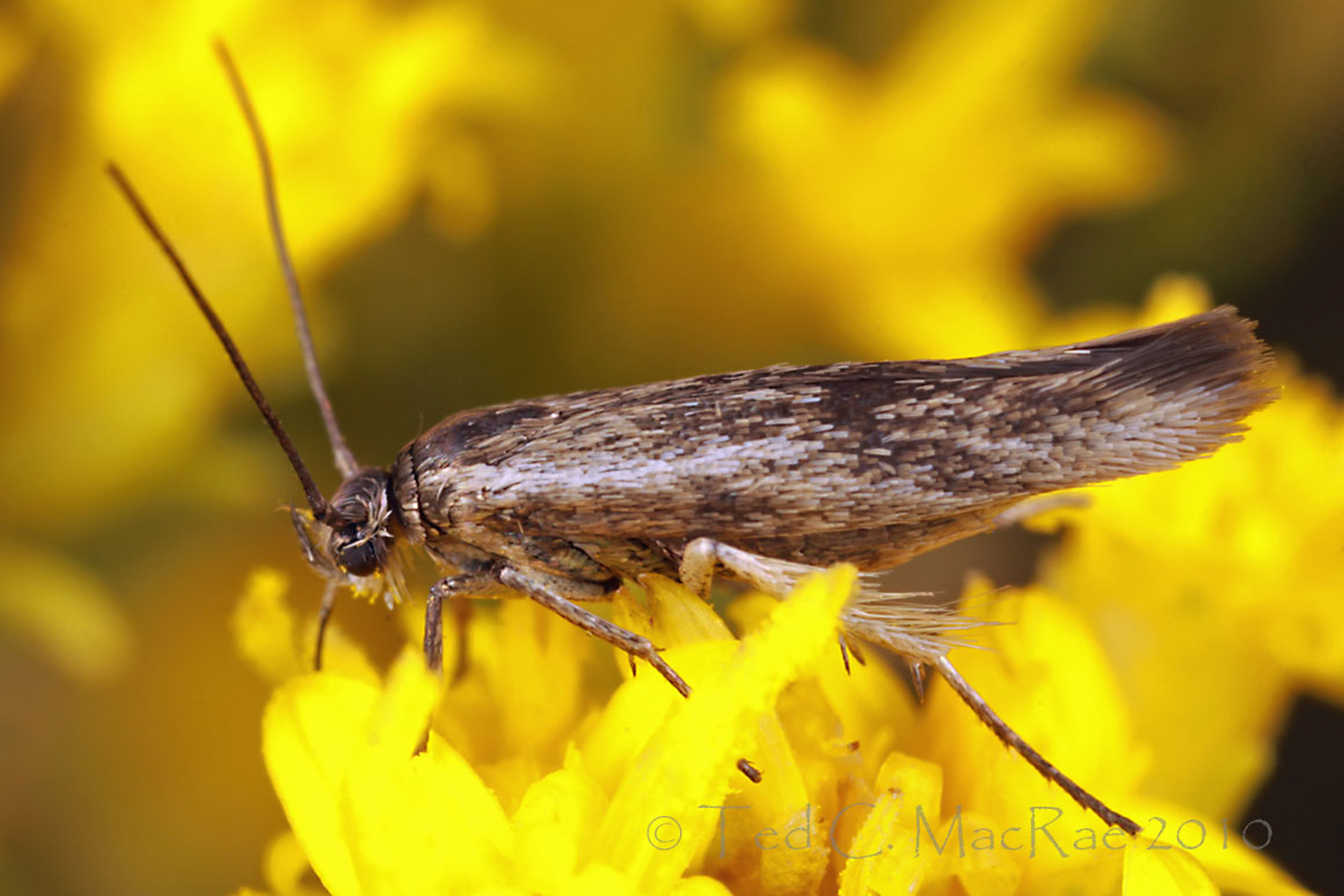
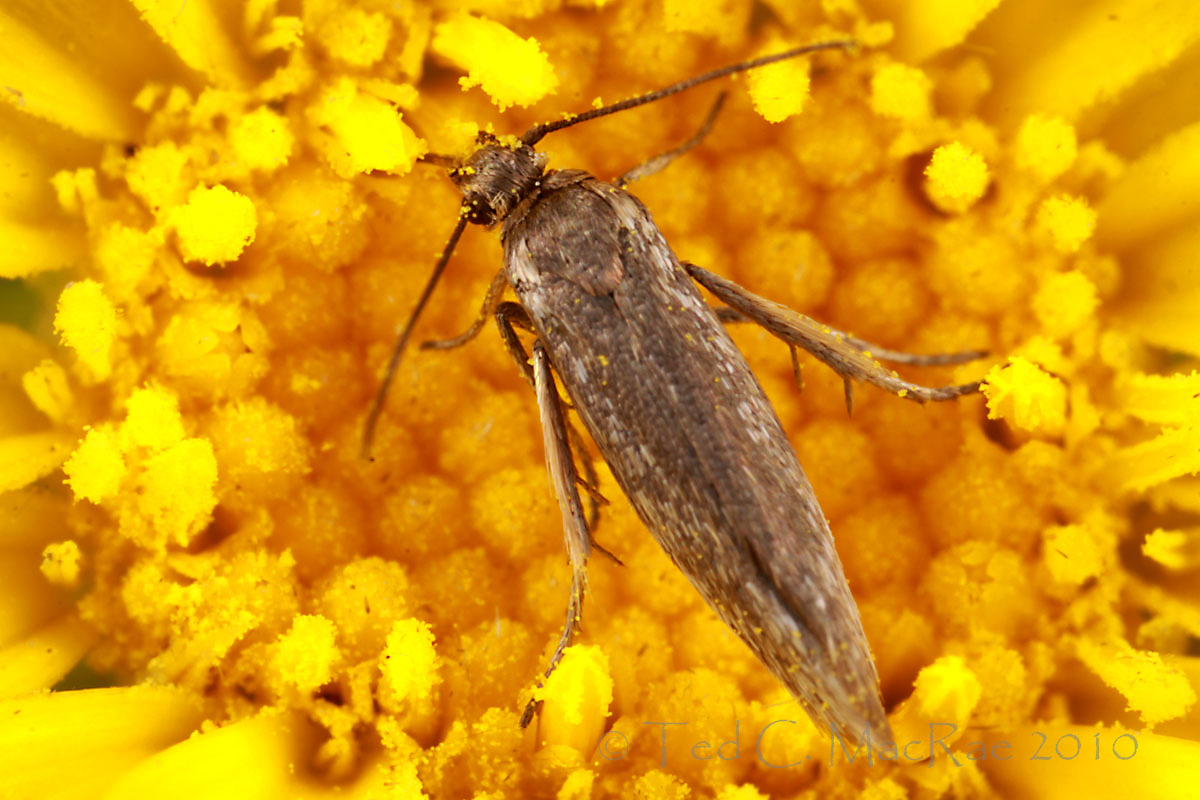
Day 1 of the 2010 Fall Tiger Beetle Trip™ had been an unqualified success.  Not only did we achieve our top goal of the trip – seeing good numbers of the recently discovered South Dakota population of Cicindela pulchra (beautiful tiger beetle), but we also saw C. nebraskana (prairie long-lipped tiger beetle) and a variety of other interesting insects in the nearby Nebraska Pine Ridge.  For Day 2, our destination was Monroe Canyon on the north face of the Pine Ridge escarpment, but on the way there we decided to check out some roadside clay banks in the town of Crawford.  Despite their appearance as perfect tiger beetle habitat, all we saw was a single individual of the normally ubiquitous C. purpurea audubonii (Audubon’s tiger beetle).  The area looked quite dry, and in fact there was little insect life of any kind present… or so I thought.  As I stood there looking out onto the embankment while deciding my next move, I glanced down at a nearby composit shrub with small yellow flowers.  These are often attractive to a variety of beetles (Crossidius longhorned beetles would be nice!), but I saw none.  I started to move on, but before I did I noticed some tiny little slivers of life moving about on the flowers.  Kneeling down to take a closer look, I saw that they were moths – in fact, they were some of the smallest moths that I had ever seen, and the shrub was covered with them.  Now, I may pride myself on my broad-based entomology knowledge, but when it comes to microlepidopterans there is a decided gap in that knowledge.  I really had no idea what they might be, but for some reason the combination of their unknown identity and tiny size became for me an irresistible photographic challenge (made truly challenging by the unrelenting prairie wind).  I’m fortunate that Chris also became distracted photographing something – any other collecting partner surely would have grown impatient waiting for me to finally be satisfied I’d gotten some good shots.

As far as I can tell, these moths represent something in the genus Scythris or perhaps Neoscythris.  These are the so-called flower moths, placed either in the family Scythrididae (Microleps.org and Moth Photographers Group) or subfamily Scythridinae of the Xylorictidae (BugGuide.net and Tree of Life).  According to Microleps.org, the life histories of relatively few scythridid species have been determined – the few that have showing a preference for feeding (usually internally, e.g., as leaf miners) on members of the Asteraceae.  There are images of several species of Scythrididae at the aforementioned sites; however, it’s a large group, and the individuals in these photos don’t appear to match any of the illustrated species.  Perhaps Chris Grinter or some other microlepidopterophile will chance upon this post and either confirm or further elucidate the identity of these individuals. 

Photo Details: Canon 50D w/ MP-E 65mm 1-5X macro lens (ISO 100, 1/250 sec, f/13), Canon MT-24EX flash w/ Sto-Fen + GFPuffer diffusers. Typical post-processing (levels, minor cropping, unsharp mask).

Copyright © Ted C. MacRae 2010