Bon appétit!

I collected this larva in northwest Nebraska during last year’s Fall Tiger Beetle Trip.  I collected an adult Cicindela lengi (blowout tiger beetle) at the spot – a species that greatly resembles but is much less common than the ubiquitous C. formosa (big sand tiger beetle – see my post Cicindela lengi vs. Cicindela formosa for a comparison of the two species).  Before finally finding that adult, however, I had fished out several larvae from the site in the hopes that they represented that uncommon species (see how I did this in my post Goin’ fishin’).  After collecting the larvae and placing them in a small terrarium with native sandy soil, they burrowed in but then closed up shop – I wasn’t sure whether they had survived or not.  In early December I put the terrarium in a 10°C incubator for the winter and brought it back out earlier this month.  Yesterday, happily, this larva and one other opened up their burrows again, so with any luck I’ll feed them well and they’ll complete their development.  While I do hope they represent C. lengi, other possibilities include C. scutellaris (festive tiger beetle), which would not be exciting, and C. nebraskana (prairie long-lipped tiger beetle), which would be VERY exciting.  One species I do not have to worry about it being is C. formosa, as the larvae of that species make very unique excavations in the sand with the burrow opening directed towards the excavation (I don’t believe I’ve posted photos of that here, yet – I’ll have to do so soon).

In the meantime, here is a closeup of the larva in the video prior to feeding. Those of you who have ever reared or photographed tiger beetle larvae will know just how easily “spooked” these larvae can be – any sudden movement will cause the larva to “drop” into its burrow and sit there for awhile. As a result, it was a real challenge to go through the whole process of taking first the photos and then the video while feeding it without causing it to drop.

cicindela_sp_larva_p1020936

Coming soon – lunchtime for adults!

Copyright © Ted C. MacRae 2009

Add to FacebookAdd to NewsvineAdd to DiggAdd to Del.icio.usAdd to StumbleuponAdd to RedditAdd to BlinklistAdd to Ma.gnoliaAdd to TechnoratiAdd to Furl

I Brake for Dung Beetles!

A few days ago I learned of a new campaign by The WILD Foundation called “Make a Big Impact with Small Change.” Founded in 1974, WILD seeks to protect intact wilderness areas and the wildlife and people who depend upon them. Their new campaign pays homage to dung beetles – usually overlooked by conservationists in favor of the so-called “charismatic megafauna,” but who nevertheless provide an important ecological service by tirelessly processing megafaunal dung. From the WILD website:

Here at The WILD Foundation, we realize that it is not just those large, charismatic animals that inspire conservation – it is often the small, typically unnoticed and vastly under-appreciated ones that inspire us the most….and that are an indispensible part of the ecosystem!

As a way of generating support for their work, WILD is giving away bumper stickers like the one pictured above. I have got to have one of these bumper stickers! It is the best entomology bumper sticker I’ve seen since “I fear no weevil!” The WILD website also features this amusing little video that shows some dung beetles in action:

Vodpod videos no longer available.

more about “I Brake for Dung Beetles!“, posted with vodpod

The website doesn’t provide any clues as to the species of dung beetle or where it was recorded, but judging by its large size I’m guessing that it might have been recorded in Africa, perhaps representing a species of the genus Scarabaeus.  My most memorable dung beetle experiences occurred in Africa, which is blessed with a dizzying diversity of “dungers.”  Following is an excerpt from an article I wrote that appeared in the December 2008 issue of the SCARABS Newsletter, in which I discussed some of these marvelous beetles:

Chafers were not the only scarabs I encountered in abundance at Borakalalo [National Park], and I’ll give you one guess as to what other scarab group I encountered in abundance at this mammal game reserve. That’s right, dung beetles. Never before have I seen such an abundance and diversity of dung beetles in one spot, but then again, never before have I seen such an abundance of dung!  The ground was littered with the stuff – antelope such as gemsbok  and impala, warthogs, giraffes, and a host of other mammals thrive in the protected confines of the park, and the seasonally dry climate allows their dung to dry quickly and accumulate rather than breaking down and disappearing. It did, however, take a few days before I became aware of the area’s dung beetle diversity. Prior to our arrival in the park, the weather had been dry for some time, and so it remained for the first few days we were there. I collected a smattering of different dung beetles during that time, but it seemed like they should be more abundant considering the abundance of available resource. Our third day in the park was interrupted by heavy thundershowers that moved through during the afternoon. The next morning, as we arose and begin wandering away from the camp, the air seemed literally abuzz with dung beetles. They were flying everywhere and crawling all over the ground, frantically rolling and fighting over the reconstituted pieces of dung. Big, black scarabaeines proper such as Kheper clericus (Boheman) and Scarabaeus galenus Westwood (Photo 4), the small metallic

scarabaeus-galenus_1

Photo 4: Scarabaeus galenus (Westwood).

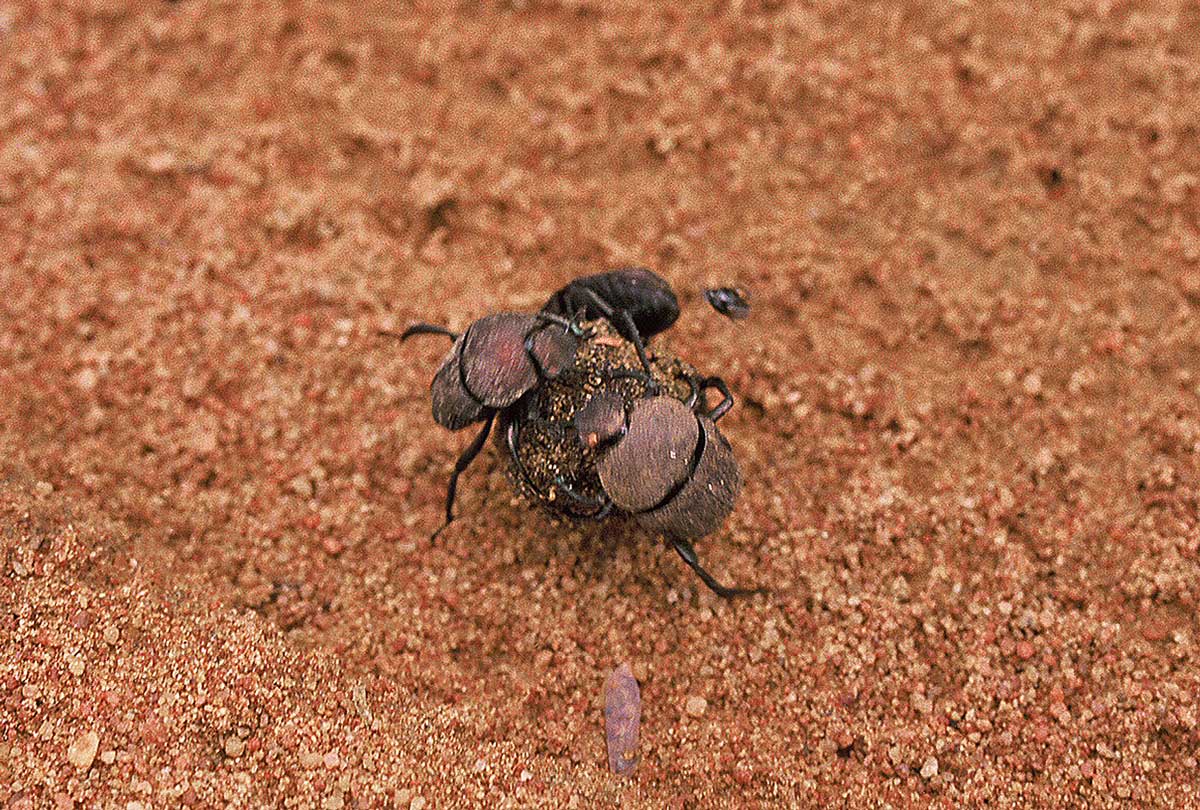
Phalops ardea Klug, the attractive green iridescent species Garetta nitens (Olivier) and Gymnopleurus virens Erichson, their darkened relative Allogymnopleurus thalassinum (Klug) (Photo 5),
Photo 5: Allogymnopleurus thalassinum (Klug) individuals fighting over a mammal dung ball.

Photo 5: Allogymnopleurus thalassinum (Klug) individuals fighting over a mammal dung ball.

and the tiny little Sisyphus costatus (Thunberg),  standing tall on its elongated hind legs while pushing dung with its forward pairs of legs (opposite of what I’ve seen in any other dung beetle), all made their sudden appearance. I spent some time  watching one S. galenus individual excavating a burrow for the prized piece of poop it had snatched (Photo 6).
Photo 6: Scarabaeus galenus (Westwood) excavating a burrow.

Photo 6: Scarabaeus galenus (Westwood) excavating a burrow.

The most impressive dunger that I saw, however, was the enormous, flattened Pachylomera femoralis Kirby (Photo 7).
Photo 7: Pachylomera femorata Kirby.

Photo 7: Pachylomera femorata Kirby.

Looking like flying Tonka trucks and sounding like diesel engines from real trucks, their low-pitched, rumbling buzz filled the air as they searched among the freshly moistened turds. So loud was the noise caused by the beating of their wings that several times I ducked thinking one was about to collide with me. This sudden dunger super-diversity continued into the night, as Anachalcos convexus Boheman, Catharsius sp., Copris elphenor Klug, Metacatharsius sp., Pedaria sp., Scarabaeus goryi (Laporte), three species of Onitis, Caccobius ferrugineus (Fåhraeus), Digitonthophagus gazella (Fabricius), and nearly a dozen species of Onthophagus flew to our ultraviolet light-illuminated sheet.

REFERENCE:

MacRae, T. C. 2008. Dungers and chafers: A trip to South Africa. SCARABS 34:1-9.

Copyright © Ted C. MacRae 2009

Add to FacebookAdd to NewsvineAdd to DiggAdd to Del.icio.usAdd to StumbleuponAdd to RedditAdd to BlinklistAdd to Ma.gnoliaAdd to TechnoratiAdd to Furl

Library expansion

p1020873_3

If there is anything that I love as much as beetles, it’s books! Pulling a handsome, leatherbound volume from its location on the shelf and smelling the aging paper while leafing through its pages quickens my pulse the way no electonic reprint ever can. That is not to say I don’t appreciate the convenience and increasing accessability of digital literature – especially with regards to searchability and the growing body of older, previously unobtainable works that can be downloaded and printed at will. Still, whenever I have a choice between pulling a real entomology journal from my shelf or accessing its electronic version on CD or online, I will opt for the real thing.

p1020884_3Over the years, I’ve had the opportunity to obtain complete series of several journals key to my studies. The first, and most important of these, was The Coleopterists Bulletin. About 15 years ago I was able to purchase a nearly complete set of this journal previously owned by cicindelid icon Norman Rumpp. His set contained a few recent volumes overlapping with my own set, started in the early 1980’s, and dating back to all but the earliest of years. When I acquired the Rumpp set, I set about purchasing the missing volumes from the available stores of back issues still offered by The Coleopterists Society. However, a few of the earliest numbers were simply not available, so I borrowed copies of these from my good friend Gayle Nelson, carefully made 2-sided copies of each, and trimmed the papers to match the size of the originals. I then took the entire combined set of issues – Rumpp originals and Nelson photocopies – to the bindery and had them bound in antique burgundy, just as one would expect to see them in a university library. In the years since then, I have begun binding my other journal series as time and funds permit. Not only do these bound volumes look attractive, but they are eminently more functional – standing upright on their own and remaining nicely organized through heavy use.

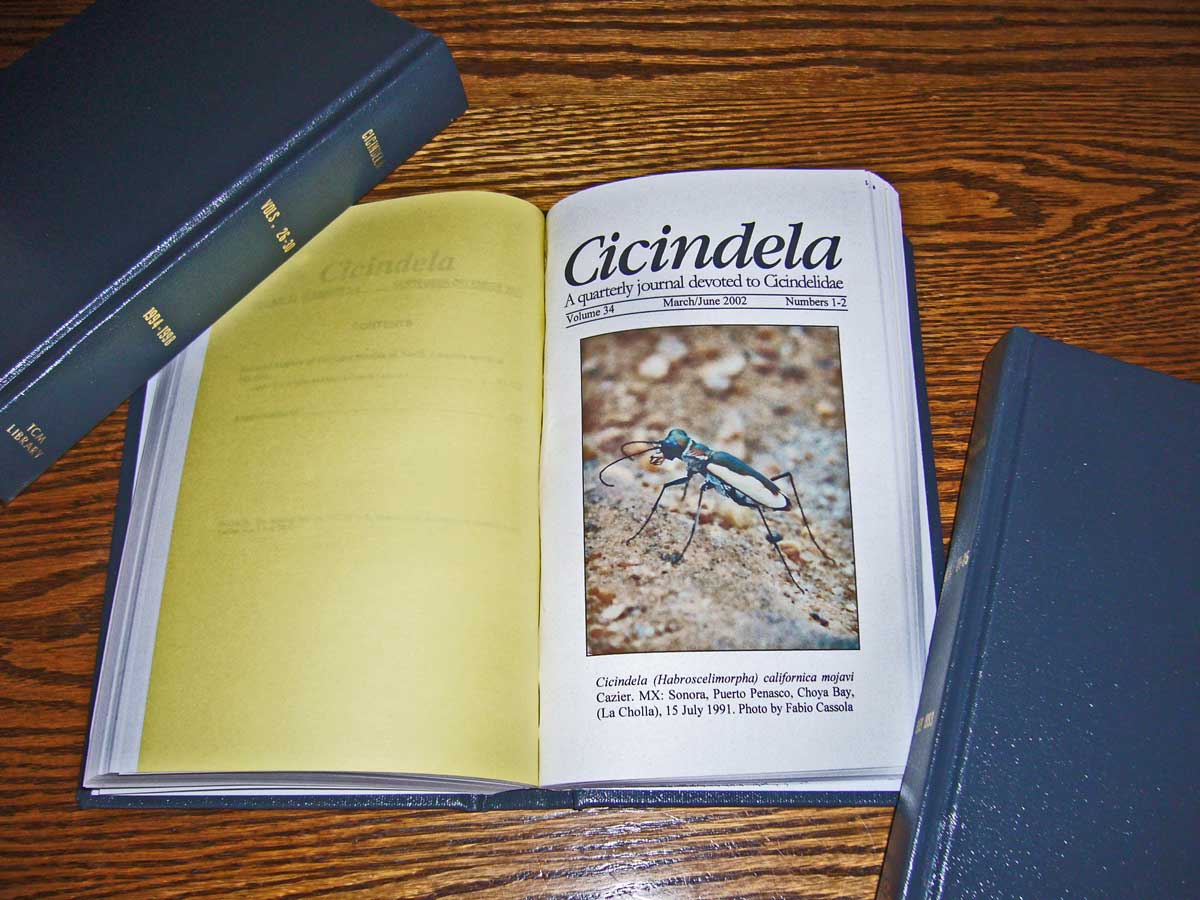
p1020870_3This week I placed my newest complete journal series on the bookshelf – the exclusively tiger beetle-focused journal, Cicindela. I’ve actually had the complete set for awhile now, purchased last year when editor Ron Huber had a limited number of complete sets reprinted. Being a more recent convert to tiger beetles, I hadn’t started my series of Cicindela until around 2000, although I did obtain some older volumes from the library of the late Prof. Wilbur R. Enns, kindly given to me upon his passing in 2003 by his close friend Prof. Ben Putler. Ron made all of the remaining volumes of this fine journal available to me to complete my set, and I’ve finally gotten the set bound – all 40 volumes dating back to 1969.

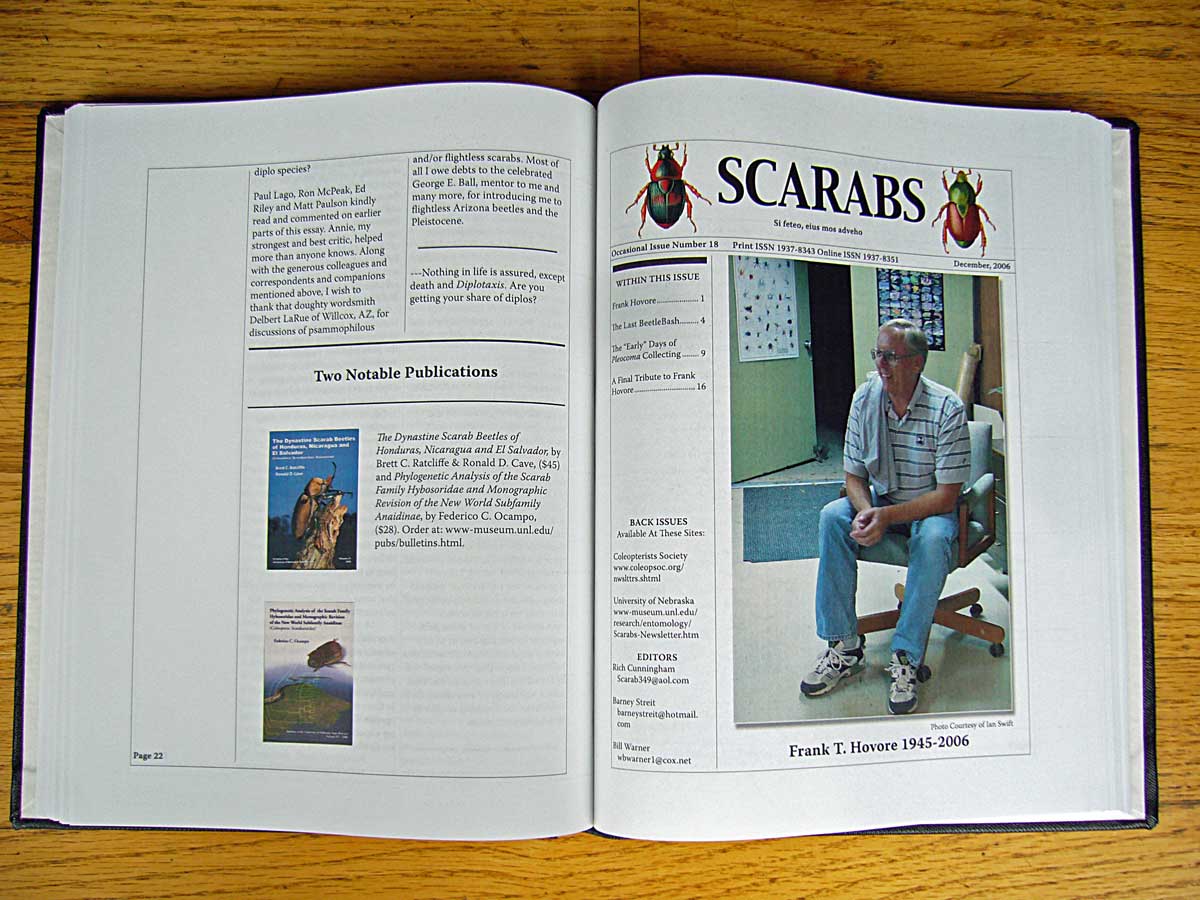
While I was taking journal volumes to the bindery, I took advantage of the opportunity to bind a complete set of the SCARABS Newsletter. In keeping with the times, SCARABS is a completely virtual publication – all issues are created, distributed, and archived electronically, with the end user free to print a copy for themselves or not. p1020880_3I chose to print, again carefully generating 2-sided printed of each issue on a color laser printer, and had them bound in “volumes” of appropriate thickness. The example shown here is the “Frank T. Hovore” issue, produced as a memorial to one of our time’s most enthusiastic collector of beetles. Frank, known among scarab circles as “Mr. Pleocoma” for his dedication to rain beetles, died of a heart attack in 2006 while on a collecting trip to a remote part of Ecuador. There is something ironically satisfying about having a complete, bound set of a modern, electronic periodical.

Other complete sets that I have bound in my library include Insecta Mundi (vols. 1-18, subsequent volumes electronic only), Jewel Beetles (vols. 1-11), Consortium Coleopterorum (vols. 1-4), and Michigan/Great Lakes Entomologist (vols. 1-40). Also, while not complete, I have the last 21 volumes of The Pan-Pacific Entomologist, nicely bound in forest green.  Oh, and look at the first photograph again – the book on the right side of the photo is an original copy of Catalogue of the described Coleoptera of the United States, published by Frederick Ernst Melsheimer in 1853. It is the oldest book in my library – received as a gift from the family of the late Marshall Magner, a long-time member of our local Webster Groves Nature Study Society, upon his passing in 2005.

Copyright © Ted C. MacRae 2009

Add to FacebookAdd to NewsvineAdd to DiggAdd to Del.icio.usAdd to StumbleuponAdd to RedditAdd to BlinklistAdd to TwitterAdd to TechnoratiAdd to Furl

An extendable handle for insect nets

For many years, my standard insect collecting gear has been a beating sheet and a short-handled aerial net (see small photo at right in “The Author” or the full-sized version under About). From the deciduous forests of the Ozark Highlands to the tropical bushveld of South Africa, these two pieces of equipment have been all that I’ve needed to collect the woodboring beetles that have dominated my interests. The beating sheet is, of course, an absolute necessity for anyone interested in jewel beetles (family Buprestidae), longhorned beetles (family Cerambycidae), and the many other insects that tend to be found on tree branches. Woodboring beetles are most frequently, but not exclusively, found on dead branches of their host trees, but regardless of whether the branches are alive or dead, the concept for collecting beetles off of them is the same – a beating sheet is held underneath the branch, and the branch is given a decisive whack with a stick of some kind. This dislodges any beetles that may be foraging or resting on the branch and causes them to drop onto the sheet, where they can be spotted easily and picked off before (hopefully) they escape. For my “stick” I like to use the handle of an aerial net, as the net itself is quite handy to have in case I stumble upon some of the many flower-feeding species or for more general collecting (my inability to focus exclusively on any one taxon is by now well documented). Using a net handle as a beating stick, unfortunately, forces one to compromise on the length of the handle – the handle must be relatively short (no more than 3′ long) to be effective as a beating stick, but such a short handle severely limits reach when the net is being used.  This problem has become even more apparent during the past few years as I have become increasingly interested in tiger beetles (family Cicindelidae).  There is no way around it – you need a long-handled net to have any hope of collecting tiger beetles, and the longer the better (ideally about 6′).  Thus my quandary – I needed a short-handled net to best collect woodboring beetles, but a long-handled net to best collect tiger beetles.

Enter the extendable handle for insect nets, available from BioQuip Products.  This ingenious net handle consists of two telescoping aluminum tubes with a clutch-lock device.  When fully collapsed the handle measures only 36″ in length – perfect for use as a beating stick and when extra length is not needed.  When a longer net handle is needed, however, a quick turn of the clutch-lock frees the inner section, allowing the handle to be extended to nearly 6′ in length – perfect for those fast-moving tiger beetles. Once extended, another quick twist of the clutch-lock secures the handle in place, and that Cicindela is mine!  To cap it all off, the handle is fully compatible with standard insect net rings and bags, including the red “T” knob for ring attachment. It was almost as if the handle had been designed specifically for my purposes.

I purchased mine at the beginning of the last field season. While the design seemed a perfect solution for my short handle-long handle quandary, I wasn’t convinced it would be able to withstand the rigors of field use. Specifically, I questioned whether the inner section would remain firmly seated within the outer section after a few slams of the net against the ground with the handle fully extended (for example, when using the ‘slap’ method for those tiger beetles I hadn’t yet figured out). I expected that repeated flexing of the handle would eventually cause the joint to fail and the handle to lose its rigidity. I also wondered how quickly and easily the handle would extend – especially after seeing some wear and tear. Any difficulty in this regard would quickly negate the convenience offered by an extendable handle.

I was immediately impressed with this handle upon its very first use, and after one full season of heavy use, it appears my concerns about its durability were unfounded. Weighing only 12 oz, it is extremely lightweight and easy to carry, and I am also pleased at how easily the handle extends and collapses – the clutch-lock disengages completely with a single twist, and the inner section slides into and out of the outer section smoothly and quickly. The true test of its durability, however, came during last year’s annual fall tiger beetle trip – a test that it passed with flying colors. I really put the net handle to hard use, and despite repeatedly slapping the net ring against the ground with the handle fully extended, the joint remained solid and rigid. I was able to swing the net with just as much assertion at the end of the trip as at the beginning.

Even during those times when I wasn’t carrying a beating sheet, I found myself routinely preferring to carry the extendable handled-net rather than the long-handled net. It was easier to carry and use when a short handle was sufficient, yet it could be extended quickly and easily when the extra length was needed. At $22.95, I consider its cost to be rather modest compared to the convenience and versatility it offers. For those of you who need a long-handled net but don’t want to wield a long handle all the time (and for the one or two other people in the world who use their net handle as a beating stick), this is the handle for you.

Copyright © Ted C. MacRae 2009

Add to FacebookAdd to NewsvineAdd to DiggAdd to Del.icio.usAdd to StumbleuponAdd to RedditAdd to BlinklistAdd to Ma.gnoliaAdd to TechnoratiAdd to Furl

Coral Pink Sand Dunes tiger beetle – range map

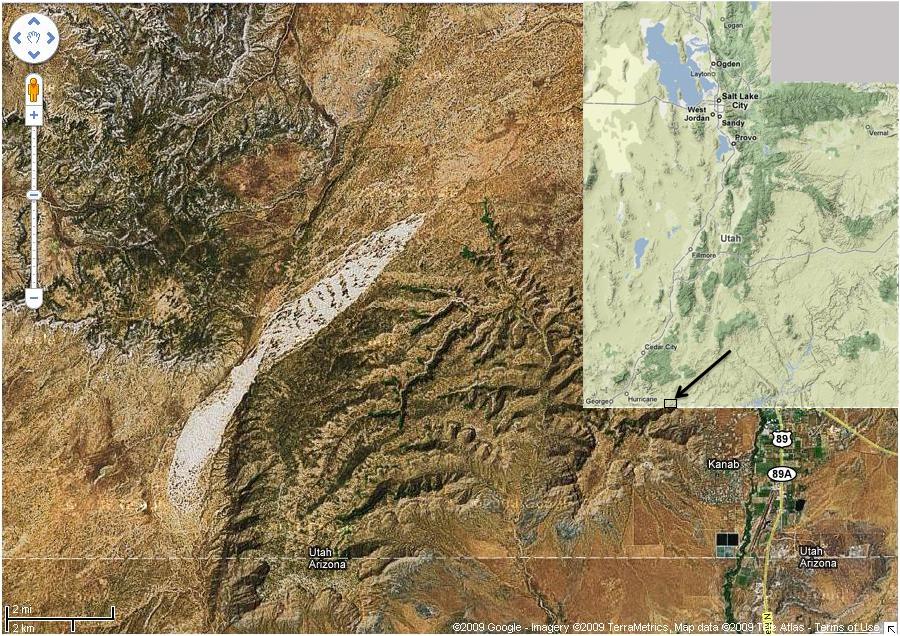
Those of you on RSS feed might be interested in revisiting my previous post, Coral Pink Sand Dunes tiger beetle on ARKive.  I’ve added a Google screen shot to the post that shows a visual perspective of the entire range of Cicindela albissima within a tiny inset of the state of Utah.  The image provides a sobering reminder of just how vanishingly small the range of this species is.  If we, as a society, cannot take the steps required to ensure the survival of a beautiful little species such as this one – living on only the tiniest sliver of the lands under our stewardship, it speaks ill of our ability to do so for other species with much greater habitat requirements.

Copyright © Ted C. MacRae 2009

Add to FacebookAdd to NewsvineAdd to DiggAdd to Del.icio.usAdd to StumbleuponAdd to RedditAdd to BlinklistAdd to Ma.gnoliaAdd to TechnoratiAdd to Furl

Coral Pink Sand Dunes tiger beetle on ARKive

I’ve been meaning to write about ARKive for awhile now. ARKive is a unique collection of videos, images and fact-files assembled from among the world’s very best wildlife videographers and photographers in an attempt to create a centralized digital library of life on Earth. Their short to mid-term priority is the completion of audio-visual profiles for the 16,300-plus species on The IUCN Red List of Threatened Species, before moving on to profiling all species that have ever been filmed or photographed. With backing from many of the world’s leading conservation organizations, ARKive hopes to “promote public understanding and appreciation of the world’s biodiversity and the need for its conservation, through the power of wildlife imagery.”

With tiger beetle season almost now upon us, it seems appropriate to highlight the media collection that ARKive has assembled for one of North America’s most spectacularly beautiful and critically imperiled tiger beetles, Cicindela albissima (Coral Pink Sand Dune tiger beetle). This amazing species is not only stunning in appearance, with its nearly pure white elytra, but has perhaps the most restricted habitat of any tiger beetle species in North America – the entire population being restricted to 400 hectares within coral-pink-sand-dunes_3Utah’s Coral Pink Sand Dunes State Park and the adjacent Bureau of Land Management (BLM) dune management area (Pearson et al. 2006). The Google screen shot at right shows the entire range of this species as a light pink swath (inset shown on larger map of the state of Utah).  Regarded initially as a subspecies of the widespread C. limbata (sandy tiger beetle), recent molecular studies showed this beetle to be only distantly related to that species and, thus, deserving of full species status (Morgan et al. 2000).

Unfortunately, the beetle’s highly restricted habitat continues to be adversely affected by ongoing, recreational off-road vehicle use, especially in the interdunal swales used by the larvae. Impacts occur not only by direct run-over mortality, but also through disruption of normal adult and larval activity, damage to vegetation, reduction of arthropod prey of C. albissima, and mixing of the upper soil layer which increases desiccation of the larval microhabitat (Knisley and Hill 2001). The species was nominated for federal protection under the Endangered Species Act in 1996 (when it was still considered a subspecies of C. limbata), and two years later a Conservation Agreement between BLM, U.S. Fish and Wildlife Service, Utah Department of Parks and Recreation and Kane County was established in an effort to protect the critically sensitive habitats in which this species lives. Despite these conservation measures, ongoing monitoring and research within the protected areas has documented a continuing decline in the population, suggesting that these areas may not be of sufficient size to enable the population to increase, and off-road vehicle use continues outside of the protected areas (U.S. Department of Interior, Fish and Wildlife Service (FWS) 2008). While still only a candidate for federal listing as an endangered or threatened species, the FWS now considers the magnitude of the threat from off-road vehicles, in view of these recent findings, to be high and imminent. As a result, the FWS has increased the priority of the species’ candidacy from 8 to 2 (1 being the highest priority a candidate species can receive).

While I would dearly have loved to embed one of ARKive’s extraordinary videos or photographs of C. albissima within this post, copyright considerations do not allow that.  What I can do is provide hyperlinks directly to the site, and I encourage everyone to visit ARKive and see their images of this gorgeous species.

Photos by Christine Breton: adult beetle, dorsal view, adult beetle, adults mating, habitat

Videos by Ganglion Films: overview, adults mating, adult burrowing in sand, OHVs threatening protected habit.

In addition to the ARKive images, Chris Wirth, author of the blog Cicindela, has taken photographs of this species and presents stunning examples of both the larva and the adult in his post Cicindela albissima (Re-post). I myself am making plans to visit Coral Pink Sand Dunes – perhaps this season – to find and photograph this species for myself. When I succeed, rest assured those photographs will appear on this site.

REFERENCES:

Knisley, C. B., and J. M. Hill. 2001. Biology and conservation of the Coral Pink Sand Dunes tiger beetle, Cicindela limbata albissima Rumpp. Unpublished report.

Morgan, M., C. B. Knisley and A. Vogler. 2000. New taxonomic status of the endangered tiger beetle Cicindela limbata albissima (Coleoptera: Cicindelidae): evidence from mtDNA. Annals of the Entomological Society of America 93(5):1108-1115.

Pearson, D. L., C. B. Knisley and C. J. Kazilek. 2006. A Field Guide to the Tiger Beetles of the United States and Canada. Oxford University Press, New York, 227 pp.

U.S. Department of Interior, Fish and Wildlife Service. 2008. 50 CFR Part 17. Endangered and threatened wildlife and plants; review of native species that are candidates for listing as endangered or threatened; annual notice of findings on resubmitted petitions; annual description of progress on listing actions; proposed rule. Federal Register 73(238) (December 10, 2008):75176-75244.

Copyright © Ted C. MacRae 2009

Add to FacebookAdd to NewsvineAdd to DiggAdd to Del.icio.usAdd to StumbleuponAdd to RedditAdd to BlinklistAdd to Ma.gnoliaAdd to TechnoratiAdd to Furl

Tiger Beetle Safari

In looking back at my posts over the past few weeks, I realized that it has been far too long since I’ve actually talked about beetles.  Perhaps “Petals In The Bush” would be a better name for this blog!  I still have some botanical thoughts to get off my chest before the insect season starts in earnest, but until then, and in anticipation of the upcoming summer’s hunts, I offer this fun, light-hearted introduction to collecting and keeping tiger beetles by Peter Schriemer.  Pay particular attention to the method he uses to capture these elusive little creatures:

Tiger Beetles are my favorite type of beetle! Entomologist John Acorn got me hooked on these little guys. They live across the country in various habitats, so you may not need to travel far to go on a Tiger Beetle Safari of your own!

Vodpod videos no longer available.

more about “Tiger Beetle Safari“, posted with vodpod

Capturing tiger beetle adults can a little (lot) more difficult than implied by this video. Adults have excellent eyesight, and many species are extremely wary. It takes practice, patience, and lots of second chances. The collecting method shown in the video is what I refer to as the “stalk and slap” method – the beetle is slowly stalked until within net reach, and the net bag is slapped over the beetle.  This method works well enough, but it has its limitations.  If there are any gaps between the ground and the net rim, the beetle will quickly dart through them and fly away.  This is easy to prevent on sandy and soft clay substrates, as the net rim can be sealed against the ground by kneeling quickly on each side of the rim to embed it slightly and using the hands to hold up the net bag and locate the beetle.  Still, there are a few things I don’t like about this method – the beetle may hide against the inside of the rim and be difficult to locate, and once found it may be difficult to grab the beetle through the net if it is against the ground (don’t even try lifting the rim and reaching under – the beetle will zip out and be gone).  This method can also be taxing on the legs, as each attempted capture involves kneeling and standing back up (getting harder and harder for these 50+ year old knees to do).

The major limitation of the slap method, however, is that it doesn’t really work on hard, uneven surfaces. Many species are found in glades and other habitats with exposed rock substrates. In these types of habitats, the net rim simply cannot be clamped tightly enough to eliminate the gaps (not to mention the added difficulties in kneeling on these surfaces).  Because of this, I have adopted a technique that I call the “tap and swipe” method.  Here again, the beetle is stalked until within net reach (made easier with a longer handle), but rather than slapping the net bag over the beetle, the rim of the net is tapped against the ground next to the beetle and then assertively swiped sideways to catch the beetle just as it starts flying.  A quick 180° flip of the net rim closes the opening to prevent the beetle from escaping, and it is easily seen in the hanging net bag, where it can be grabbed from outside the net bag with one hand to secure it before reaching into the net bag with the other hand.  With a little practice, one eventually learns to reach down into the open net bag and grab the beetle while preventing it from flying up and out.  All of this can be done while standing, so it’s easier on the knees.

The tap method does require more knowledge about the beetle’s escape behavior in order to anticipate how quickly and in which direction the beetle will fly – some species delay take off just slightly, thus requiring a slight “pause” between the tap and the swipe. However, once their behavior is learned I have found this method to be more consistently successful than the slap method – even on soft substrates.  For species that I haven’t encountered in the field before, I use the slap method at first (if I can) until I have a feel for their escape behavior. If I can’t, I use the tap method and hope for the best!

Copyright © Ted C. MacRae 2009

Add to FacebookAdd to NewsvineAdd to DiggAdd to Del.icio.usAdd to StumbleuponAdd to RedditAdd to BlinklistAdd to Ma.gnoliaAdd to TechnoratiAdd to Furl

Expanding blogroll

I’m still looking for the correct answers to Winter botany quiz #2.  Several commentors have correctly identified the plant family for one of the three plants and gotten close with the second (it’s not a true Liliaceae), and Doug properly surmised that the photos were indeed taken in South Africa (specifically, in Limpopo Province near the Matlaba River in the vicinity of the Waterberg Range).  With the additional clues I’ve given in the comments to that post, I still think generic and even specific identifications are possible for #1 and #2, while for #3 an ID at any level may prove to be quite a challenge.

While we wait for those answers, I thought I would feature some of the recent additions to my ever-expanding blogroll.  Some of these blogs seem to be already well-known, but only recently have I stumbled onto them myself.  Others I think may not be so widely known, but should be.  All struck a chord with me for some reason, whether it be their entomology-related subject matter, focus on life or nature in my beloved Ozarks, or the brilliance of their writing or photography.  I encourage you to pay them a visit and see what they have to offer.

Botany
Several new links in this section are worth mention. A Neotropical Savanna is an excellent weblog by Mary Farmer about her experiences with plants in Panama (and occasionally their insect associates). Closer to home, Get Your Botany On! features contributions by a consortium of astute botanists, one of which is Missouri-based Justin Thomas.  Justin also writes his own blog – The Vasculum – his exquisite and informative writings are reminiscent of those found on my long-time personal favorite, Ozark Highlands of Missouri (by the ever-eloquent Allison Vaughn).

Insects & Invertebrates
The number of links in this section has grown tremendously in recent weeks.  Bug Eric is one of the newest of these on my list, but its author – Eric Eaton, of Kaufman Field Guide to Insects of North America fame, has been around the bug scene for a long time.  Bug Shutterbug! is the work of Kolby Kirk, whose just published book, Insects & Spiders of Nicaragua, showcases some of his extraordinary photography. Coleop-Terra is written in German, but author Robert Perger’s beautiful beetle photographs can be understood in any language. For regular lessons about the insects around us and their impact on humankind, visit Debbie’s Insects Blog by Debbie Hadley, and orthopteroid specialist Ed Baker keeps us updated on activities from “across the pond” at Invertebrate Diaries (Ed also recently hosted Circus of the Spineless Issue 36). Shelly Cox has joined our growing ranks of Missouri entomologists, posting insect photos on MObugs while she prepares a field guide to the common insects of my beloved home state. Sections, a relatively new blog by British entomologist Laurence Livermore, contains enough information in each post to satisfy even the most erudite among us, and some spectacular captive insects can be seen at SIAM Insect-Zoo & Museum. Rounding out this section, weirdbuglady gives a refreshing view of entomology from an unconventional (and sometimes delightfully immature) perspective.

Missouri & My Beloved Ozarks
This section features a second blog by Shelly Cox – Explore Missouri, which features non-insect nature photos from our beautiful state, while Beau thoughtfully chronicles life in rural Missouri with Fox Haven Journal.

Nature & Conservation
I added Brewster’s linnet . com because of a series of posts about a recent trip to the lower Rio Grande Valley of south Texas. Lindsay and Scott bill Through Handlens and Binoculars as a blog about “Botany… Birds… Butterflies…”, but its subject matter is, in reality, even more diverse (including this recent, informative post about gray tree frogs). I suspect Tom Arbour’s Ohio Nature Blog needs no introduction, considering his current post contains 30 comments as of the time of this writing!

Nature Photography
Some strong photography blogs are joined by Voyages Around My Camera, which features stunning photography by Adrian Thysse (who also authors Evolving Complexity).

Uncategoricalizable
Finally, I’ve added this completely new section specifically for Maggie’s quirky, vexing, and truly unique giroofasaurus-vexed. Nuff said!

Copyright © Ted C. MacRae 2009

Add to FacebookAdd to NewsvineAdd to DiggAdd to Del.icio.usAdd to StumbleuponAdd to RedditAdd to BlinklistAdd to Ma.gnoliaAdd to TechnoratiAdd to Furl