An extendable handle for insect nets

For many years, my standard insect collecting gear has been a beating sheet and a short-handled aerial net (see small photo at right in “The Author” or the full-sized version under About). From the deciduous forests of the Ozark Highlands to the tropical bushveld of South Africa, these two pieces of equipment have been all that I’ve needed to collect the woodboring beetles that have dominated my interests. The beating sheet is, of course, an absolute necessity for anyone interested in jewel beetles (family Buprestidae), longhorned beetles (family Cerambycidae), and the many other insects that tend to be found on tree branches. Woodboring beetles are most frequently, but not exclusively, found on dead branches of their host trees, but regardless of whether the branches are alive or dead, the concept for collecting beetles off of them is the same – a beating sheet is held underneath the branch, and the branch is given a decisive whack with a stick of some kind. This dislodges any beetles that may be foraging or resting on the branch and causes them to drop onto the sheet, where they can be spotted easily and picked off before (hopefully) they escape. For my “stick” I like to use the handle of an aerial net, as the net itself is quite handy to have in case I stumble upon some of the many flower-feeding species or for more general collecting (my inability to focus exclusively on any one taxon is by now well documented). Using a net handle as a beating stick, unfortunately, forces one to compromise on the length of the handle – the handle must be relatively short (no more than 3′ long) to be effective as a beating stick, but such a short handle severely limits reach when the net is being used.  This problem has become even more apparent during the past few years as I have become increasingly interested in tiger beetles (family Cicindelidae).  There is no way around it – you need a long-handled net to have any hope of collecting tiger beetles, and the longer the better (ideally about 6′).  Thus my quandary – I needed a short-handled net to best collect woodboring beetles, but a long-handled net to best collect tiger beetles.

Enter the extendable handle for insect nets, available from BioQuip Products.  This ingenious net handle consists of two telescoping aluminum tubes with a clutch-lock device.  When fully collapsed the handle measures only 36″ in length – perfect for use as a beating stick and when extra length is not needed.  When a longer net handle is needed, however, a quick turn of the clutch-lock frees the inner section, allowing the handle to be extended to nearly 6′ in length – perfect for those fast-moving tiger beetles. Once extended, another quick twist of the clutch-lock secures the handle in place, and that Cicindela is mine!  To cap it all off, the handle is fully compatible with standard insect net rings and bags, including the red “T” knob for ring attachment. It was almost as if the handle had been designed specifically for my purposes.

I purchased mine at the beginning of the last field season. While the design seemed a perfect solution for my short handle-long handle quandary, I wasn’t convinced it would be able to withstand the rigors of field use. Specifically, I questioned whether the inner section would remain firmly seated within the outer section after a few slams of the net against the ground with the handle fully extended (for example, when using the ‘slap’ method for those tiger beetles I hadn’t yet figured out). I expected that repeated flexing of the handle would eventually cause the joint to fail and the handle to lose its rigidity. I also wondered how quickly and easily the handle would extend – especially after seeing some wear and tear. Any difficulty in this regard would quickly negate the convenience offered by an extendable handle.

I was immediately impressed with this handle upon its very first use, and after one full season of heavy use, it appears my concerns about its durability were unfounded. Weighing only 12 oz, it is extremely lightweight and easy to carry, and I am also pleased at how easily the handle extends and collapses – the clutch-lock disengages completely with a single twist, and the inner section slides into and out of the outer section smoothly and quickly. The true test of its durability, however, came during last year’s annual fall tiger beetle trip – a test that it passed with flying colors. I really put the net handle to hard use, and despite repeatedly slapping the net ring against the ground with the handle fully extended, the joint remained solid and rigid. I was able to swing the net with just as much assertion at the end of the trip as at the beginning.

Even during those times when I wasn’t carrying a beating sheet, I found myself routinely preferring to carry the extendable handled-net rather than the long-handled net. It was easier to carry and use when a short handle was sufficient, yet it could be extended quickly and easily when the extra length was needed. At $22.95, I consider its cost to be rather modest compared to the convenience and versatility it offers. For those of you who need a long-handled net but don’t want to wield a long handle all the time (and for the one or two other people in the world who use their net handle as a beating stick), this is the handle for you.

Copyright © Ted C. MacRae 2009

Add to FacebookAdd to NewsvineAdd to DiggAdd to Del.icio.usAdd to StumbleuponAdd to RedditAdd to BlinklistAdd to Ma.gnoliaAdd to TechnoratiAdd to Furl

Coral Pink Sand Dunes tiger beetle – range map

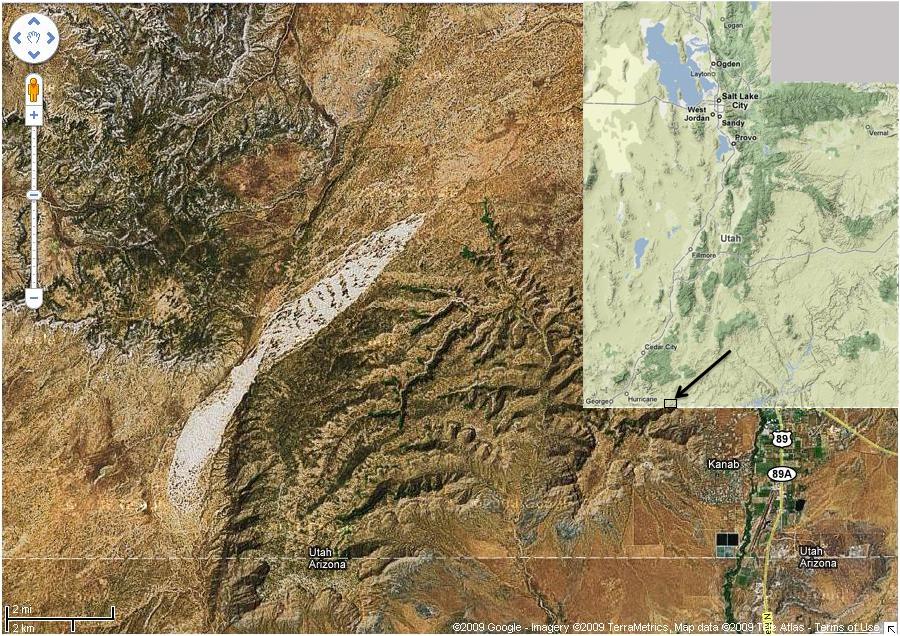
Those of you on RSS feed might be interested in revisiting my previous post, Coral Pink Sand Dunes tiger beetle on ARKive.  I’ve added a Google screen shot to the post that shows a visual perspective of the entire range of Cicindela albissima within a tiny inset of the state of Utah.  The image provides a sobering reminder of just how vanishingly small the range of this species is.  If we, as a society, cannot take the steps required to ensure the survival of a beautiful little species such as this one – living on only the tiniest sliver of the lands under our stewardship, it speaks ill of our ability to do so for other species with much greater habitat requirements.

Copyright © Ted C. MacRae 2009

Add to FacebookAdd to NewsvineAdd to DiggAdd to Del.icio.usAdd to StumbleuponAdd to RedditAdd to BlinklistAdd to Ma.gnoliaAdd to TechnoratiAdd to Furl

Coral Pink Sand Dunes tiger beetle on ARKive

I’ve been meaning to write about ARKive for awhile now. ARKive is a unique collection of videos, images and fact-files assembled from among the world’s very best wildlife videographers and photographers in an attempt to create a centralized digital library of life on Earth. Their short to mid-term priority is the completion of audio-visual profiles for the 16,300-plus species on The IUCN Red List of Threatened Species, before moving on to profiling all species that have ever been filmed or photographed. With backing from many of the world’s leading conservation organizations, ARKive hopes to “promote public understanding and appreciation of the world’s biodiversity and the need for its conservation, through the power of wildlife imagery.”

With tiger beetle season almost now upon us, it seems appropriate to highlight the media collection that ARKive has assembled for one of North America’s most spectacularly beautiful and critically imperiled tiger beetles, Cicindela albissima (Coral Pink Sand Dune tiger beetle). This amazing species is not only stunning in appearance, with its nearly pure white elytra, but has perhaps the most restricted habitat of any tiger beetle species in North America – the entire population being restricted to 400 hectares within coral-pink-sand-dunes_3Utah’s Coral Pink Sand Dunes State Park and the adjacent Bureau of Land Management (BLM) dune management area (Pearson et al. 2006). The Google screen shot at right shows the entire range of this species as a light pink swath (inset shown on larger map of the state of Utah).  Regarded initially as a subspecies of the widespread C. limbata (sandy tiger beetle), recent molecular studies showed this beetle to be only distantly related to that species and, thus, deserving of full species status (Morgan et al. 2000).

Unfortunately, the beetle’s highly restricted habitat continues to be adversely affected by ongoing, recreational off-road vehicle use, especially in the interdunal swales used by the larvae. Impacts occur not only by direct run-over mortality, but also through disruption of normal adult and larval activity, damage to vegetation, reduction of arthropod prey of C. albissima, and mixing of the upper soil layer which increases desiccation of the larval microhabitat (Knisley and Hill 2001). The species was nominated for federal protection under the Endangered Species Act in 1996 (when it was still considered a subspecies of C. limbata), and two years later a Conservation Agreement between BLM, U.S. Fish and Wildlife Service, Utah Department of Parks and Recreation and Kane County was established in an effort to protect the critically sensitive habitats in which this species lives. Despite these conservation measures, ongoing monitoring and research within the protected areas has documented a continuing decline in the population, suggesting that these areas may not be of sufficient size to enable the population to increase, and off-road vehicle use continues outside of the protected areas (U.S. Department of Interior, Fish and Wildlife Service (FWS) 2008). While still only a candidate for federal listing as an endangered or threatened species, the FWS now considers the magnitude of the threat from off-road vehicles, in view of these recent findings, to be high and imminent. As a result, the FWS has increased the priority of the species’ candidacy from 8 to 2 (1 being the highest priority a candidate species can receive).

While I would dearly have loved to embed one of ARKive’s extraordinary videos or photographs of C. albissima within this post, copyright considerations do not allow that.  What I can do is provide hyperlinks directly to the site, and I encourage everyone to visit ARKive and see their images of this gorgeous species.

Photos by Christine Breton: adult beetle, dorsal view, adult beetle, adults mating, habitat

Videos by Ganglion Films: overview, adults mating, adult burrowing in sand, OHVs threatening protected habit.

In addition to the ARKive images, Chris Wirth, author of the blog Cicindela, has taken photographs of this species and presents stunning examples of both the larva and the adult in his post Cicindela albissima (Re-post). I myself am making plans to visit Coral Pink Sand Dunes – perhaps this season – to find and photograph this species for myself. When I succeed, rest assured those photographs will appear on this site.

REFERENCES:

Knisley, C. B., and J. M. Hill. 2001. Biology and conservation of the Coral Pink Sand Dunes tiger beetle, Cicindela limbata albissima Rumpp. Unpublished report.

Morgan, M., C. B. Knisley and A. Vogler. 2000. New taxonomic status of the endangered tiger beetle Cicindela limbata albissima (Coleoptera: Cicindelidae): evidence from mtDNA. Annals of the Entomological Society of America 93(5):1108-1115.

Pearson, D. L., C. B. Knisley and C. J. Kazilek. 2006. A Field Guide to the Tiger Beetles of the United States and Canada. Oxford University Press, New York, 227 pp.

U.S. Department of Interior, Fish and Wildlife Service. 2008. 50 CFR Part 17. Endangered and threatened wildlife and plants; review of native species that are candidates for listing as endangered or threatened; annual notice of findings on resubmitted petitions; annual description of progress on listing actions; proposed rule. Federal Register 73(238) (December 10, 2008):75176-75244.

Copyright © Ted C. MacRae 2009

Add to FacebookAdd to NewsvineAdd to DiggAdd to Del.icio.usAdd to StumbleuponAdd to RedditAdd to BlinklistAdd to Ma.gnoliaAdd to TechnoratiAdd to Furl

Tiger Beetle Safari

In looking back at my posts over the past few weeks, I realized that it has been far too long since I’ve actually talked about beetles.  Perhaps “Petals In The Bush” would be a better name for this blog!  I still have some botanical thoughts to get off my chest before the insect season starts in earnest, but until then, and in anticipation of the upcoming summer’s hunts, I offer this fun, light-hearted introduction to collecting and keeping tiger beetles by Peter Schriemer.  Pay particular attention to the method he uses to capture these elusive little creatures:

Tiger Beetles are my favorite type of beetle! Entomologist John Acorn got me hooked on these little guys. They live across the country in various habitats, so you may not need to travel far to go on a Tiger Beetle Safari of your own!

Vodpod videos no longer available.

more about “Tiger Beetle Safari“, posted with vodpod

Capturing tiger beetle adults can a little (lot) more difficult than implied by this video. Adults have excellent eyesight, and many species are extremely wary. It takes practice, patience, and lots of second chances. The collecting method shown in the video is what I refer to as the “stalk and slap” method – the beetle is slowly stalked until within net reach, and the net bag is slapped over the beetle.  This method works well enough, but it has its limitations.  If there are any gaps between the ground and the net rim, the beetle will quickly dart through them and fly away.  This is easy to prevent on sandy and soft clay substrates, as the net rim can be sealed against the ground by kneeling quickly on each side of the rim to embed it slightly and using the hands to hold up the net bag and locate the beetle.  Still, there are a few things I don’t like about this method – the beetle may hide against the inside of the rim and be difficult to locate, and once found it may be difficult to grab the beetle through the net if it is against the ground (don’t even try lifting the rim and reaching under – the beetle will zip out and be gone).  This method can also be taxing on the legs, as each attempted capture involves kneeling and standing back up (getting harder and harder for these 50+ year old knees to do).

The major limitation of the slap method, however, is that it doesn’t really work on hard, uneven surfaces. Many species are found in glades and other habitats with exposed rock substrates. In these types of habitats, the net rim simply cannot be clamped tightly enough to eliminate the gaps (not to mention the added difficulties in kneeling on these surfaces).  Because of this, I have adopted a technique that I call the “tap and swipe” method.  Here again, the beetle is stalked until within net reach (made easier with a longer handle), but rather than slapping the net bag over the beetle, the rim of the net is tapped against the ground next to the beetle and then assertively swiped sideways to catch the beetle just as it starts flying.  A quick 180° flip of the net rim closes the opening to prevent the beetle from escaping, and it is easily seen in the hanging net bag, where it can be grabbed from outside the net bag with one hand to secure it before reaching into the net bag with the other hand.  With a little practice, one eventually learns to reach down into the open net bag and grab the beetle while preventing it from flying up and out.  All of this can be done while standing, so it’s easier on the knees.

The tap method does require more knowledge about the beetle’s escape behavior in order to anticipate how quickly and in which direction the beetle will fly – some species delay take off just slightly, thus requiring a slight “pause” between the tap and the swipe. However, once their behavior is learned I have found this method to be more consistently successful than the slap method – even on soft substrates.  For species that I haven’t encountered in the field before, I use the slap method at first (if I can) until I have a feel for their escape behavior. If I can’t, I use the tap method and hope for the best!

Copyright © Ted C. MacRae 2009

Add to FacebookAdd to NewsvineAdd to DiggAdd to Del.icio.usAdd to StumbleuponAdd to RedditAdd to BlinklistAdd to Ma.gnoliaAdd to TechnoratiAdd to Furl

Expanding blogroll

I’m still looking for the correct answers to Winter botany quiz #2.  Several commentors have correctly identified the plant family for one of the three plants and gotten close with the second (it’s not a true Liliaceae), and Doug properly surmised that the photos were indeed taken in South Africa (specifically, in Limpopo Province near the Matlaba River in the vicinity of the Waterberg Range).  With the additional clues I’ve given in the comments to that post, I still think generic and even specific identifications are possible for #1 and #2, while for #3 an ID at any level may prove to be quite a challenge.

While we wait for those answers, I thought I would feature some of the recent additions to my ever-expanding blogroll.  Some of these blogs seem to be already well-known, but only recently have I stumbled onto them myself.  Others I think may not be so widely known, but should be.  All struck a chord with me for some reason, whether it be their entomology-related subject matter, focus on life or nature in my beloved Ozarks, or the brilliance of their writing or photography.  I encourage you to pay them a visit and see what they have to offer.

Botany
Several new links in this section are worth mention. A Neotropical Savanna is an excellent weblog by Mary Farmer about her experiences with plants in Panama (and occasionally their insect associates). Closer to home, Get Your Botany On! features contributions by a consortium of astute botanists, one of which is Missouri-based Justin Thomas.  Justin also writes his own blog – The Vasculum – his exquisite and informative writings are reminiscent of those found on my long-time personal favorite, Ozark Highlands of Missouri (by the ever-eloquent Allison Vaughn).

Insects & Invertebrates
The number of links in this section has grown tremendously in recent weeks.  Bug Eric is one of the newest of these on my list, but its author – Eric Eaton, of Kaufman Field Guide to Insects of North America fame, has been around the bug scene for a long time.  Bug Shutterbug! is the work of Kolby Kirk, whose just published book, Insects & Spiders of Nicaragua, showcases some of his extraordinary photography. Coleop-Terra is written in German, but author Robert Perger’s beautiful beetle photographs can be understood in any language. For regular lessons about the insects around us and their impact on humankind, visit Debbie’s Insects Blog by Debbie Hadley, and orthopteroid specialist Ed Baker keeps us updated on activities from “across the pond” at Invertebrate Diaries (Ed also recently hosted Circus of the Spineless Issue 36). Shelly Cox has joined our growing ranks of Missouri entomologists, posting insect photos on MObugs while she prepares a field guide to the common insects of my beloved home state. Sections, a relatively new blog by British entomologist Laurence Livermore, contains enough information in each post to satisfy even the most erudite among us, and some spectacular captive insects can be seen at SIAM Insect-Zoo & Museum. Rounding out this section, weirdbuglady gives a refreshing view of entomology from an unconventional (and sometimes delightfully immature) perspective.

Missouri & My Beloved Ozarks
This section features a second blog by Shelly Cox – Explore Missouri, which features non-insect nature photos from our beautiful state, while Beau thoughtfully chronicles life in rural Missouri with Fox Haven Journal.

Nature & Conservation
I added Brewster’s linnet . com because of a series of posts about a recent trip to the lower Rio Grande Valley of south Texas. Lindsay and Scott bill Through Handlens and Binoculars as a blog about “Botany… Birds… Butterflies…”, but its subject matter is, in reality, even more diverse (including this recent, informative post about gray tree frogs). I suspect Tom Arbour’s Ohio Nature Blog needs no introduction, considering his current post contains 30 comments as of the time of this writing!

Nature Photography
Some strong photography blogs are joined by Voyages Around My Camera, which features stunning photography by Adrian Thysse (who also authors Evolving Complexity).

Uncategoricalizable
Finally, I’ve added this completely new section specifically for Maggie’s quirky, vexing, and truly unique giroofasaurus-vexed. Nuff said!

Copyright © Ted C. MacRae 2009

Add to FacebookAdd to NewsvineAdd to DiggAdd to Del.icio.usAdd to StumbleuponAdd to RedditAdd to BlinklistAdd to Ma.gnoliaAdd to TechnoratiAdd to Furl

Magodo – giant twig wilter

petascelis-remipes

In previous posts, I have highlighted some of the insects I observed on a trip to South Africa in November-December 1999.  All of the photos I have shown to this point were taken at Borakalalo National Park in North West Province or at the Geelhoutbos farm of Susan Strauss below the Waterberg Range in the formerly Northern, now Limpopo Province.  Both of these locations are deep inside the bushveld, providing ample opportunity to observe an incredible diversity of insect life.  This is not to say that insects, even spectacular ones, cannot be found in more urban areas.  During the weekend between those two mini-expeditions, I stayed with my friend and colleague, Chuck Bellamy, at his home in Pretoria, a beautiful city with lovely architecture, elegant gardens… and some very impressive bugs!  The bug in this photo was found on a tree in a shrubby enclave, and at well over 35 mm in length it is easily the largest leaf-footed bug (order Hemiptera, family Coreidae) that I have ever seen.  Its chunky build, velvety black coloration with thin yellow lines along the sides and down the center of the thorax, and greatly enlarged hind femora quickly led me to a provisional identification of a male Petascelis remipes, or giant twig wilter.  This ID was confirmed by my friend and colleague Harry Brailovsky, an entomologist at UNAM (Universidad Nacional Autónoma de México) and world expert on Coreidae (and who, incidentally, just recently published a review of this Afrotropical genus – Brailovsky 2008).

According to Picker et al. (2002), these insects are found on plants in the genus Combretum.  Like most species in the family, they have scent (“stink”) glands that provide defensive capabilities. Adults are gregarious and bold, walking towards intruders with antennae vibrating when disturbed, and they are apparently capable of squirting their defensive secretions for some distance.  The nymphs are black as well but futher advertise their noxiousness with warning coloration of red spots on a whitish background. Interestingly, and despite their powerful chemical defenses, this species is considered a delicacy in parts of Mozambique where it is known as Magodo.  In a post called Insects for Dinner (in a blog with the eerily similar title, Beating about the Bush), Bart Wursten of Gorongosa National Park in Mozambique describes how local folk burn small patches of the grassland in which these insects are found to smoke them out and catch them.  The Magodo hunters kill the bugs by breaking off the head and removing the scent glands, which releases a very strong almond-like smell.  In doing this, the locals are able to catch considerable quantities of the bugs, which they eat with supper.

Lest you believe such practices are an anomaly, van Huis (2003) has compiled a list of about 250 insect species used as food in sub-Saharan Africa.  Lepidoptera, Orthoptera and Coleoptera represented the bulk (78%) of species eaten, with Isoptera, Hemiptera, Hymenoptera, Diptera and Odonota making up the rest.  Several examples of toxic insects and the traditional methods used to remove the poisons were given.  It was noted that whether or not insects are eaten depends not only on taste and nutritional value, but also on customs and ethnic preferences or prohibitions.  I’m not one to shy away from the thought of eating insects – after all, shrimp are just bugs that live in water, and insects rank far lower in ‘slime factor’ than many other invertebrates (e.g., oysters) that enjoy great popularity in our culture.  I’ve eaten roasted beet armyworm (Spodoptera exigua) pupae and munched on chocolate covered ants, but that’s kid stuff – the armyworms tasted like the soy sauce in which they were roasted, and the ants tasted like, well… chocolate.  I did once eat a softshelled crab (alive!), and I actually hope to one day taste the enormous grub of the giant metallic ceiba borer, Euchroma gigantea, eaten by indigenous cultures in Central and South America.   Still, I think I’d need a lot of faith in my chef’s scent gland removal prowess before I started scarfing Magodo down like popcorn.

What insects have you eaten?

REFERENCES:

Brailovsky, H.  2008. Notes on the genus Petascelis Signoret and description of one new species (Hemiptera: Heteroptera: Coreidae: Coreinae: Petascelini).  Zootaxa 1749:18–26.

Picker, M., C. Griffiths and A. Weaving. 2002. Field Guide to Insects of South Africa. Struik Publishers, Cape Town, 444 pp.

van Huis, A. 2003. Insects as food in sub-Saharan Africa. Insect Science and Its Application 23(3):163-185.

Copyright © Ted C. MacRae 2009

Add to FacebookAdd to NewsvineAdd to DiggAdd to Del.icio.usAdd to StumbleuponAdd to RedditAdd to BlinklistAdd to Ma.gnoliaAdd to TechnoratiAdd to Furl

Illinois Butterfly Monitoring Network

For those of you who plan to be in the Chicago area on Saturday, March 7th, perhaps you’ll be interested in attending the 2009 Illinois Butterfly Monitoring Network Annual Indoor Workshop. I’ll be giving a talk entitled, “From Hilltops to Swamps: Insects in Missouri’s Rarest Prairies,” in which I’ll focus on the natural history and some associated insects in two of Missouri’s most critically imperiled natural communities – the loess hilltop prairies in the northwestern corner of the state, and the sand prairies of the southeastern lowlands. How a beetle guy ended up being invited to talk to a butterfly group is still a little confusing to me, but apparently IBMN Director, Doug Taron (author of Gossamer Tapestry) put in a good word for me.

The Illinois Butterfly Monitoring Network (IBMN) is a citizen scientist program monitoring the health of butterfly populations throughout northeastern and central Illinois.

The IBMN was initiated in 1987 by The Nature Conservancy to explore the effects of habitat management on invertebrates. From 7 sites in the Chicagoland area in its first year, the program has expanded greatly and is now monitoring more than 100 sites throughout Illinois.  Butterflies are ideal “indicator organisms” with which to monitor the effects of prescribed burning and other management techniques, since many species are restricted to intact prairie and savanna remnants by narrow habitat requirements.  The fact that they are relatively easy to identify allows them to be monitored in a cost effective manner with the help of dedicated amateurs.  Much the same can be said for tiger beetles (which will – surprise! – be featured prominently my talk).

The workshop will be held Saturday, March 7, 2009, 9:30 AM until 3:00 PM at the Gail Borden Public Library, 270 North Grove Avenue, Elgin (directions).  Registration is required, contact Mel Manner at (847) 464-4426 or by email.

Copyright © Ted C. MacRae 2009

Add to FacebookAdd to NewsvineAdd to DiggAdd to Del.icio.usAdd to StumbleuponAdd to RedditAdd to BlinklistAdd to Ma.gnoliaAdd to TechnoratiAdd to Furl

Ship-timber beetle

Atractocerus brevicornis

One of the more unusual, and enigmatic, beetles that I encountered in South Africa was this beetle in the pantropical genus Atractocerus.  Placed in the family Lymexylidae (ship-timber beetles), species in this genus look less like beetles than they do large flying ants or strange damselflies due to their highly reduced elytra that expose their greatly elongated abdomen and leave the hind wings uncovered.  The hind wings also are unusual in that they are held fan-like in repose rather than folded as in most other beetles.  Atractocerus brevicornis is the only species in the genus found in Africa (Scholtz & Holm 1985).

Adults are attracted to light at night, as was this individual that came to our ultraviolet light at Geelhoutbos farm below the Waterberg Range in Limpopo Province. Nothing is known about the biology of Atractocerus, but larvae of other genera are reported to bore into hardwoods and palm stems (Picker et al. 2002). Larvae of the genera Lymexylon and Melittomma are believed to form symbiotic associations with ambrosia fungi that grow on the walls of their galleries (Young, 2002).  Adult females deposit fungal spores in a sticky matrix when they lay their eggs, and the hatching larvae carry the spores into wood on their bodies.  The large eyes of Atractocerus, however, suggest a predatory lifestyle. The common name of the family originates from a northern European species that has in the past been a destructive pest of ship timbers.

Atractocerus species are rarely encountered and therefore, not well studied. Their evolutionary history is still unknown; however, the oldest known lymexylid fossil is a very primitive member of the genus Atractocerus preserved in 100 myo Burmese amber (Grimwold & Engel 2005). Thus, the lineage containing these beetles had already appeared by the mid-Cretaceous and may have originated as early as the Jurassic, a fact that has earned them the moniker “living fossils.” These beetles were once thought to be among the most primitive of all Coleoptera – their simple wing venation, almost undifferentiated antennae and tarsi, and naked abdomen being likened to a supposed neuropteran common ancestor. Most authors now consider the family to be most closely related to the cucujiform groups Cleroidea and Cucujoidea (Wheeler 1986, Young 2002), although some have placed it in the Elateriformia near the Lampyridae based on wing venation. Scholtz and Holm (1985) accepted a cucujiform placement but related the group to the Styopidae (twisted-winged parasites), apparently due to the similarity of their highly reduced forwings.  At the same time, they acknowledged the many morphological and behavioral differences between the two groups, the latter itself being the subject of much evolutionary debate due to disagreement about whether the reduced forwings of male stylopids are truly homologous to the elytra of Coleoptera (some have even suggested homology with the halteres of Diptera that were switched from the metathorax to the mesothorax as a result of homeotic mutation). Most authors now place this latter group in the separate order Strepsiptera.

REFERENCES:

Grimaldi, D. and M. S. Engel. 2005. Evolution of the Insects. Cambridge University Press, New York, xv + 755 pp.

Picker, M., C. Griffiths and A. Weaving. 2002. Field Guide to Insects of South Africa. Struik Publishers, Cape Town, 444 pp.

Scholtz, C. H. and E. Holm (eds.). 1985. Insects of Southern Africa. Butterworths, Durbin, South Africa, 502 pp.

Wheeler, Q. D. 1986. Revision of the genera of Lymexylidae (Coleoptera: Cucujiformia). Bulletin of the American Museum of Natural History 183:113-210.

Young, D. K.  2002. 71. Lymexylidae Fleming 1821, pp. 261-262.  In: R. H. Arnett and M. C. Thomas [eds.], American Beetles, Volume 2, Polyphaga: Scarabaeoidea Through Curculionoidea, CRC Press, Boca Raton,880 pp.

Copyright © Ted C. MacRae 2009

Add to FacebookAdd to NewsvineAdd to DiggAdd to Del.icio.usAdd to StumbleuponAdd to RedditAdd to BlinklistAdd to Ma.gnoliaAdd to TechnoratiAdd to Furl