What’s bugging you?

It’s not often that I use this forum to write about other blogs. There are so many to choose from – good ones – that it’s hard to know where to start.  Besides, I’d rather use the limited time I have to write doing so about bugs. Given this, it might seem remarkable that I’m going to write about a blog that – as of now – has only three postings. The writer of this new blog, however, is no ordinary writer, and I expect his blog will prove to be no ordinary blog.

Dr. Arthur V. Evans hardly needs introduction in the world of entomology. His prowess as a collector of insects – especially Scarabaeidae – is legendary, but it is his talent for writing that has earned him his true renown.  While his list of research papers is impressive enough, his books are what set him apart from the rest of us.  Blending depth of knowledge with humor and a passion for his subject, Dr. Evans’ books have been equally embraced by professional entomologists and the general public alike.  His field guides (Field Guide to Beetles of California, Field Guide to Insects of North America, and Introduction to California Beetles) have helped to introduce the fabulous world of insects to nature lovers across the country, and the breathtakingly beautiful An Inordinate Fondness for Beetles (coauthored with my friend and colleague, Dr. Charles L. Bellamy) has become a staple on coffee tables around the world.  His latest book, What’s Bugging You?, is a charming collection of essays that have appeared over the years as a column in the Richmond Times-Dispatch.  It is also the name of his new blog, and this excerpt from its very first post suggests it will live up to the reputation of its author:

As I bent down to inspect the corpse a panicked wave of blow flies buzzed up past my face. Their tiny wings churned the air to propel their brassy green bodies out of harm’s way. But within minutes they were back. For scavengers like blow flies, life is short and the aroma of decaying flesh promising food, mates, and egg laying sites is just too much to ignore.

Dr. Evans is an artist, and words are his palette.

If you like insects, you will love What’s Bugging You? Check it out, bookmark it, and be prepared to enjoy what results when love of insects meets truly gifted writing.

Copyright © Ted C. MacRae 2009

Add to FacebookAdd to NewsvineAdd to DiggAdd to Del.icio.usAdd to StumbleuponAdd to RedditAdd to BlinklistAdd to Ma.gnoliaAdd to TechnoratiAdd to Furl

Tragidion confusion

Back in October, I discussed a recent review of the cerambycid genus Tragidion, authored by Ian Swift and Ann Ray and published in the online journal Zootaxa.  These gorgeous beetles mimic the so-called “tarantula hawks” (a group of large, predatory wasps in the family Pompilidae) and have been difficult to identify due to poorly-defined species limits, wide range of geographic variation, unusually high sexual dimorphism, and apparent potential for hybridization in areas of geographic overlap. Swift and Ray (2008) recognized seven North American and four Mexican species, including two newly described species and another raised from synonymy. It was an excellent work that provided much needed clarity based on examination of types and included detailed descriptions and dorsal habitus photographs of all species and separate keys to males and females to facilitate their identification. Unfortunately, my summary caused some confusion regarding species that occur in the deserts of southern Arizona, southern New Mexico and western Texas. In this post, I’ll clarify that confusion and provide details for distinguishing these species.

Formerly, it was thought that two species of Tragidion inhabited this region, with populations exhibiting smooth elytra and breeding in dead stalks of Agave and Yucca (Agavaceae) representing T. armatum and those exhibiting ribbed elytra and breeding in dead branches of a variety of woody plants representing T. annulatum. This concept dates back to the landmark monograph of the Cerambycidae of North America by Linsley (1962). Swift and Ray (2008) noted that Linsley’s concept of T. annulatum was based on an erroneously labeled type specimen, and that true T. annulatum referred to populations in California and Baja California (for which other names – now suppressed – were being used). This left the AZ/NM/TX populations attributed to T. annulatum without a name. The previously suppressed name T. densiventre was found to refer to populations inhabiting lowland habitats and breeding in Prosopis and Acacia (Fabaceae), but those occurring in montane habitats and breeding in Quercus (Fagaceae) represented an as yet undescribed species, for which the name T. deceptum was given. I included Swift and Ray’s figure of T. deceptum in my post – but mistakenly included the male of T. densiventre alongside the female of T. deceptum!

This error may never had been noticed, had it not been for the discriminating eyes of BugGuide contributor, Margarethe Brummermann. Margarethe is currently collecting photographs for a field guide to Arizona beetles and had photographed a male and female of a “ribbed” species in Montosa Canyon. Using the illustration of T. deceptum” in my post, Margarethe concluded her specimens represented T. deceptum and asked me to confirm her ID. When I told her the specimens represented T. densiventre, her confusion was understandable (given that her male appeared identical to the T. deceptum” male in my post). Further query on her part prompted me to do a little digging, and I discovered my error. The figure in my post has since been corrected – both that figure and a figure from Swift and Ray (2008) showing the male and female of T. densiventre are included below, along with additional information to allow their identification.

tragidion_densiventre

Tragidion densiventre Casey, 1912

Tragidion densiventre was formerly synonymized under T. auripenne (a rare species known from the four corners region of northern Arizona, southern Utah, southwestern Colorado, and northwestern New Mexico). Males of T. densiventre can be distinguished by their longer antennae, tawny-tan elytra and distinctly red-brown head, legs, and scape, while females have shorter antennae and the elytra red-orange. Both males and females of this species are distinguished from T. deceptum by their five elytral costae that curve inward toward the suture and extend to near the elytral apices, as well as their relatively narrower basal black band. Females of this species may be further distinguished from T. deceptum by their all black (or nearly so) antennae. Tragidion densiventre is found predominantly in xeric lowland desert habitats in Arizona, New Mexico, and west Texas (as well as northern Mexico). Larvae have been recorded developing in dead Prosopis glandulosa and Acacia greggii, and adults have been observed aggregating on sap oozing from stems of Baccharis sarothroides (Asteraceae) and flowers of larval host plants. Although the biology of this species has not been described in detail, it is likely that the observations of Cope (1984) for T. auripenne refer to this species. This is the classic T.annulatum” commonly observed in the desert southwest.

Tragidion deceptum

Tragidion deceptum Swift & Ray, 2008

Tragidion deceptum superficially resembles T. densiventre due to its ribbed elytra; however, it is actually more closely related to the Mexican species T. carinatum. Like T. densiventre, the males exhibit longer antennae and tawny-tan elytra, while females have shorter antennae and orange-red elytra. However, the head, legs and scape of males are black, as in females of the species, rather than red-brown as in males of T. densiventre. Females exhibit distinctly annulated antennae, in contrast to the all black antennae of T. densiventre. Both males and females are distinguished from T. densiventre by the elytral costae – only four rather than five, not incurved towards the suture and extending only to the apical one-third of the elytra. In addition, the basal black band is very broad – exceeding the scutellum by 2 × its length. This species is similarly distributed across the desert southwest as T. densiventre but occurs in more montane habitats, where it breeds in recently dead branches of several species of Quercus. Like T. densiventre, adults are often found feeding and aggregating on Baccharis sarothroides, and in a few lower canyons bordering desert habitats in the Huachuca Mountains of southeastern Arizona this species and T. densiventre have been collected feeding alongside each other on the same Baccharis plants. Tragidion deceptum is one of several species in the genus (along with T. coquus in eastern North America) that have been collected using fermenting molasses traps (more on this in a future post).

REFERENCES:

Cope, J. 1986. Notes on the ecology of western Cerambycidae. The Coleopterists Bulletin, 38:27–36.

Linsley, E. G. 1962. The Cerambycidae of North America. Part III. Taxonomy and classification of the subfamily Cerambycinae, tribes Opsimini through Megaderini. University of California Publicatons in Entomology, 20:1-188, 56 figs.

Swift, I. and A. M. Ray. 2008. A review of the genus Tragidion Audinet-Serville, 1834 (Coleoptera: Cerambycidae: Cerambycinae: Trachyderini). Zootaxa, 1892:1-25.

Copyright © Ted C. MacRae 2009

Add to FacebookAdd to NewsvineAdd to DiggAdd to Del.icio.usAdd to StumbleuponAdd to RedditAdd to BlinklistAdd to Ma.gnoliaAdd to TechnoratiAdd to Furl

Done with dung, meat please!

ResearchBlogging.orgNo feces for this species.” “Carnivorous dung beetle shuns dung and decapitates millipede.” “Little dung beetle is big chopper.” “Dung beetle mistakes millipede for dung.” These were some of the clever headlines that I had to compete with in coming up with my own opener for a remarkable beetle that titillated the science blogosphere last week. At the risk of being redundant, I’d like to revisit that beetle and offer a few (hopefully novel) thoughts of my own. I can say that I have a unique and special treat for those willing to read further.

First the background. Deltochilum valgum is a so-called “dung beetle” in the family Scarabaeidae that lives in the lowland rain forests of Peru. As suggested by its common name, it belongs to a group of beetles that are well known for their dung feeding habits. Over 5,000 species of dung beetles are known throughout the world, all of which carve out balls of dung and bury them as provisions for larval development – or so it was thought.  As reported by Trond Larsen of Princeton University and colleagues in Biology Letters, D. valgum has apparently abandoned its ancestral dung ball-rolling behavior in favor of a predatory lifestyle. Its prey – millipedes! Moreover, the species exhibits several distinct morphological traits that appear to have evolved as a direct result of their predatory behavior. Adult beetles were repeatedly observed killing and eating millipedes, and their disdain for dung was rather conclusively demonstrated by an exhaustive, year-long trapping program in which pit-traps were baited with a variety of bait types known to attract dung beetles (e.g., various kinds of dung, carrion, fungus and fruit) – and millipedes.  In all, over 100,000 dung beetles representing 132 species were trapped (what a nice collection!), 35 of which were found to scavenge on dead millipedes, but only five of these dared tackle live millipedes.  Of these, only D. valgum ignored all other foods – it only came to traps baited with live millipedes.

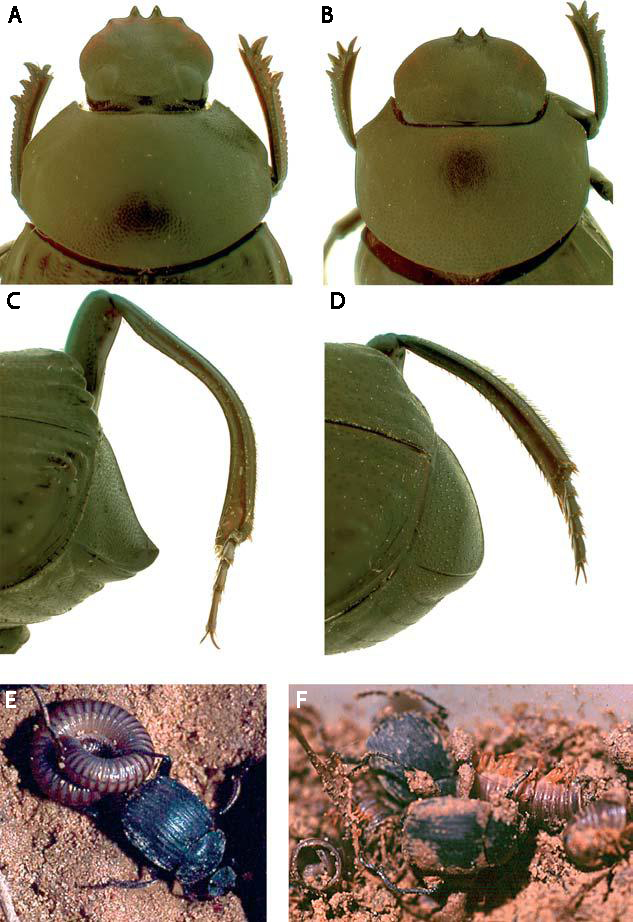
Larsen et al. determined that adults of D. valgum are opportunistic hunters and were much more likely to attack injured millipedes than healthy ones, even those weighing 14 times as much as the beetle.  Ball rolling behavior was never observed by D. valgum.  Most dung beetles have wide, shovel-shaped heads used to scoop and mold dung balls, but D. valgum has a much narrower head with sharp “teeth” on its clypeus (Fig. 1A vs. 1B).  The teeth apparently aid in killing the millipede by piercing the ventral surface behind the head and prying upwards (decapitating it), and the narrow, elongate head facilitates insertion into the millipede body for feeding.  Further, the hind tibia are elongate and curved, which are used to “grip” millipedes by holding them up against the dorsally reflexed pygidium (Fig. 1C vs. 1D).  This allows the beetle to drag its coiled up victim with one hind leg while walking forward on the other five (Fig. 1E).  Once killed, the beetles proceeded to break their prey into pieces and consume their meaty innards, leaving the disarticulated millipede exoskeletons licked clean (Fig. 1F).  One of these “attack” episodes was filmed (using infrared lighting so as not to affect their nocturnal behavior) and can be seen in this BBC News video.

Deltochilum valgum

Figure 1. (a) Dorsal view of D. valgum head. Sharp clypeal teeth and angled clypeus act as a lever to disarticulate millipede. Narrow, elongate head permits feeding inside millipede; (b) dorsal view of Deltochilum peruanum head, lacking characters described in (a), head used to mould dung balls; (c) lateral view of D. valgum pygidium and hind tibia. Dorsally reflexed pygidial lip is used to support millipede during transport. Elongate, strongly curved hind tibia is used to grip millipede. (d ) Lateral view of D. peruanum pygidium and hind tibia, lacking characters described in (c), hind tibia used for rolling dung balls. (e, f ). Predation strategy by D. valgum. (e) Dragging live, coiled millipede with one hind leg, walking forwards; ( f ) feeding on killed millipede with head inside
segments; disarticulated empty millipede pieces nearby.
Credit: Larsen et al. (2009).

Much has been made about this remarkable shift from coprophagy to predation, which Larsen et al. speculate was driven by competition for limited resources with the many other dung beetle species that occur in the Peruvian rainforests. In fact, adult dung beetles are known to feed on a variety of resources besides dung, as exemplified by the range of baits used in their survey. Thus, my first thought after reading the coverage was actually a question: “Has this species abandoned dung provisioning completely as a reproductive strategy?” Everything I had read focused exclusively (quite understandably) on the bizarre feeding habits of the adults, but there was no mention of what the species’ larval provisioning strategies were. Wanting more information about this, I contacted Trond Larsen, who graciously sent me a PDF of the paper. Unfortunately (though not a criticism of the paper), no further insight about this was found in the paper either. Indeed, in all of the observations recorded by Larsen et al., millipedes killed by D. valgum were consumed entirely by the adults, and no mention was made of how or whether millipedes were utilized for larval provisioning. I wondered if D. valgum had truly abandoned dung provisioning for larval development (a remarkable adaptive switch), or if in fact the species might still utilize the strategy for reproduction (perhaps having specialized on a dung type not included in their survey), while also exploiting millipede predation as adults for a nutritional advantage. I asked Trond about this, to which he replied with this juicy tidbit (I told you I had a special treat!):

Yes, I would very much like to know what the reproductive/nesting behavior of D. valgum is. My best guess is that they also use millipedes as a larval food source, but as you say, we haven’t observed that behavior yet. I have observed other generalist dung beetle species rolling balls out of dead millipedes, presumably to bury for the larvae, so I certainly think it would be an adequate food source. Many dung beetle species use carrion for their larvae.

I am quite confident that D. valgum does not use any kind of dung. I have sampled these dung beetle communities very thoroughly, with many dung types and other bait types, and also with passive flight intercept traps that catch all beetles. Every dung beetle species that feeds on dung is at least sometimes attracted to human dung (this is not the case in African savannahs though, but is in neotropical forests – that is a whole different story). There are still a small handful of species we catch in flight intercept traps that we don’t know what they eat, although some of these mysteries have recently been solved – many of them live in leaf-cutter ant nests for example.

While predation of millipedes by a dung beetle is itself a fascinating observation, demonstrating the abandonment of dung provisioning in favor of captured prey for larval development would be a truly remarkable example of an ecological transition to exploit a dramatically atypical niche. I hope Trond (or anybody for that matter) actually succeeds in observing millipede/prey utilization for larval provisioning by this species.

Many thanks to Trond Larsen for his delightful correspondence.

SOURCE:
Larsen, T. H., A. Lopera, A. Forsyth and F. Génier. 2009. From coprophagy to predation: a dung beetle that kills millipedes. Biology Letters DOI: 10.1098/rsbl.2008.0654.

Copyright © Ted C. MacRae 2009

Add to FacebookAdd to NewsvineAdd to DiggAdd to Del.icio.usAdd to StumbleuponAdd to RedditAdd to BlinklistAdd to Ma.gnoliaAdd to TechnoratiAdd to Furl

Christmas in January

One of the ironies about collecting insects is that the winter months can be just as busy as the summer months, sometimes more so. Despite the lack of insect activity during these short, cold days, I actually find myself at times a little overwhelmed with the amount of “work” I’ve set myself up to do.  There are specimens to mount, label, curate, and incorporate into the main collection.  Data from the just concluded field season need to be assembled and summarized so that reports and manuscripts can be written.  Applications for collecting permits need to be submitted, which can only be done once plans for the upcoming season have been formulated.  The fact that entomology is also my profession only exacerbates the situation.  Not that I’m complaining!  I love the fact (and sometimes still have a hard time believing) that I actually get paid to play with bugs, which affords me the opportunity to study them as I wish in my free time.

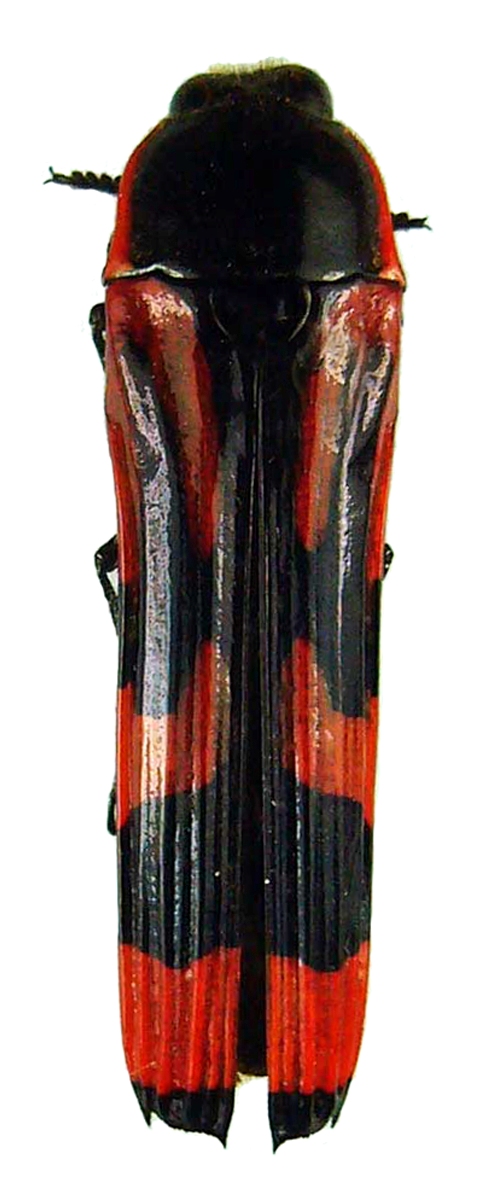
hiperantha-interrogationis-cruentata_dorsal_21Hiperantha interrogationis cruentata (ventral)In addition to these winter tasks for my own collection, I’ve also for a number of years now taken on the task of identifying material for other collectors.  While this may seem very nice of me, I can’t honestly claim that my motives are completely altruistic.  Doing this has given me the chance to develop relationships with a great many entomologists, specializing in taxa both within and outside my sphere of interest.  Often, material sent to me contains specimens that represent new distributional or host plant records, providing fodder for my own research.  Less frequently but more exciting, such material will contain species that I haven’t yet encountered on my own.  In most cases, the sender will be gracious enough to let me keep an example or two for my collection.  Such is the case with this gorgeous buprestid beetle, Hiperantha interrogationis, which was included in a recent shipment to me as a “gift” from long time friend and expert cerambycid specialist Dan Heffern.  This Neotropical representative of the tribe Stigmoderini (which also contains the Australasian genera Calodema and Metaxymorpha, featured in this recent post) not only represents a new species for my collection, but a new genus as well (reminding me of the old adage, “some of the best collecting is in other people’s collections” – or something like that).  Measuring right at 25mm in length, this spectacularly beautiful specimen is a welcome addition to my collection!

Hiperantha interrogationis is the only member of this otherwise South American genus to occur as far north as Central America and Mexico (Bellamy 2008).  This particular specimen was collected in Jalisco, and as such represents the subspecies cruentata, occupying the northernmost portion (Colima, Durango, Jalisco, and Nayarit) of the distributional range of the species (Bellamy & Westcott 2000).  Hiperantha interrogationis cruentata is distinguished from nominotypical populations by having all of the dorsal color pattern in red (nominate H. interrogationis exhibit some yellow markings) and the median longitudinal vittae of the elytra widely interrupted, thereby resulting in the formation of a distinctly transverse postmedian band. The apical transverse band of the elytra is also usually much wider in this subspecies than in the nominate form.

In a familiar refrain, not much is known about H. interrogationis other than distributional records.  Adults have most often been encountered on flowers of tropical trees, but larval hosts are completely unknown.  Manley (1985) published observations on the feeding behavior of adults on flowers of “Niguito”, Muntingia calabura (Elaeocarpaceae) near Guayaquil, Ecuador.  The adults were observed to be rather strong, high fliers that hovered over flowers in the tops of the trees before alighting, often on the terminal flower of a high branch.  Adults were observed consuming the petals of the flowers but were never observed feeding on the foliage.  After consuming all the petals of a flower, a process that required around 20-30 minutes, the adults moved off to adjacent foliage to groom themselves or rest.  No adults were observed on flowers of any other plant species in this area, but Bellamy & Westcott (2000) later recorded both subspecies on flowers of Acacia angustissima (Fabaceae) and the nominate subspecies on flowers of Chilopsis linearis (Bignoniaceae).

My sincere thanks to Dan Heffern for giving me his single specimen of this gorgeous species.

REFERENCES:

Bellamy, C. L.  2008. World catalogue and bibliography of the jewel beetles (Coleoptera: Buprestoidea),  Volume 2: Chrysochroinae: Sphenopterini through Buprestinae: Stigmoderini.  Pensoft Series Faunistica 77: 632-1260.

Bellamy, C. L. and R. L. Westcott.  2000. The genus Hiperantha: subgenera, type species, unavailable names and the Mexican fauna (Coleoptera: Buprestidae).  Folia Heyrovskyana 8(1):25-34.

Manley, G. V.  1985. Notes on the biology of Hyperantha interrogationis Klug (Coleoptera: Buprestidae).  The Coleopterists Bulletin 39(1):16-17.

Copyright © Ted C. MacRae 2009

Add to FacebookAdd to NewsvineAdd to DiggAdd to Del.icio.usAdd to StumbleuponAdd to RedditAdd to BlinklistAdd to Ma.gnoliaAdd to TechnoratiAdd to Furl

Lions in South Africa

Joerie, Joerie, botter en brood,
as ek jou kry, slaat ek jou dood.

Doodlebugs, joerie, shunties, toritos—these are but a few of the many colloquial names given to amusing little creatures that many people know simply as antlions (or translation of such) (Swanson 1996).   Larvae of winged insects resembling (but unrelated to) dragonflies, they are best known for their habit of digging smooth-sided, cone-shaped pits in sandy soils and concealing themselves under the sand at the bottom.  There, they lay in wait for some small, unsuspecting creature—often an ant—to fall into the pit.  When that happens, the hidden antlion bursts forth, using its oversized, sickle-shaped mandibles to “flick” sand at the prey to keep it sliding towards the bottom of the hole.  Once it is within reach, the antlion grabs the prey using those same, deadly mandibles (how delightfully morbid!).  So otherworldly is their appearance and behavior that, in addition to inspiring children’s charms, they have served as an unmistakable model for the “Ceti eels” featured in Star Trek: The Wrath of Khan!1  Adults of this group, on the other hand, have inspired far less imagination in nomenclature and culture, to the point that even their common name “antlion lacewing” is merely a reference back to their unusual larvae.  Even the scientific name of the family—Myrmeleontidae—has failed to garner complete adherence, with “Myrmeleonidae” (who needs the “t”?) and “Myrmelionidae” (perhaps from English-speakers focused on the English spelling of “lion” rather than the Latin spelling of “leo”) still appearing in popular and even scientific literature.

1 Sadly (and ironically), actor Ricardo Montalban, who played the villain Khan Noonien Singh in that movie (reprising a character he played 15 years earlier during the debut season of the Star Trek television series), died just eight days ago at the age of 88. I must confess that I am a life-long Star Trek fan (though not a “Trekkie”), and “Wrath” was certainly among my favorite of the movies, due in large part to Montalban’s steely, venomous portrayal of Kahn. My favorite line occurs as Kahn is about to put a Ceti eel in Chekov’s ear, explaining how they wrap themselves around the victim’s cerebral cortex. He then says, “Later, as they [pauses deliciously] grow…”

myrmeleontidae-larval-pitI’ve seen antlion pits on several occasions (especially in recent years as I’ve spent more time in open sand habitats searching for my beloved tiger beetles).  However, the pit pictured here—encountered at Borakalalo National Park in South Africa’s North West Province, was the first I’d ever seen in which there was actually an ant inside the pit.  The ant was dead, presumably having already been sucked dry by the joerie. I didn’t know it at the time, but southern Africa is a major evolutionary center for antlion lacewings and some of their striking relatives such as spoonwinged and threadwinged lacewings (family Nemopteridae) and silky lacewings (family Psychopsidae) (Grimaldi & Engel 2005).  Relatively few of South Africa’s antlions, however, actually dig pits—a habit restricted to species in the genera Hagenomyia, Cueta, and the cosmopolitan Myrmeleon (Scholtz & Holm 1985).  Rather, the majority of species have free-living larvae that hide under objects or roam under deep sand from where they emerge to hunt other insects.

Palpares lentusThis adult antlion lacewing came to an ultraviolet light at our encampment on the Geelhoutbos farm near the Waterberg Range (Limpopo Province). Its tremendous size and distinctly patterned wings placed it in the tribe Palparini, of which the genus Palpares is the most diverse. These are the true giants of the family, with forewing lengths that can reach 75 mm (that’s 3 inches, folks!) and both wings bearing conspicuous patterns of black and yellow markings (the yellow doesn’t show well in this photograph due to illumination by the ultraviolet light).  The larvae, understandably, are also quite large, and have even been observed to capture ground resting grasshoppers (Capinera 2008).  I sent this photograph to Dr. Mervyn Mansell, an expert on African Myrmeleontidae, who kindly identified the individual as a female Palpares lentus, endemic to northern South Africa and Zimbabwe. When queried for more information regarding its biology, Dr. Mansell responded:

We know nothing about P. lentus, except for distribution records. Nothing is known about its larva or biology, although the larvae of all Palpares and related genera are obviously large, and live freely in sand well concealed and almost impossible to find.

Palpares lentus is one of 42 species of Palparini in southern Africa—half of all known species in the tribe.  Nearly two-thirds of them are endemic to “open” biomes in the dry western parts of the subregion (Mansell & Erasmus 2002).  This high level of endemism results from the occurrence of large tracts of sand and exposed soil that are conducive to the large sand-dwelling larvae.  Eastern parts of the subregion containing forest or thicket biomes are not as favored by antlion lacewings, and consequently the diversity of species in these areas is much lower.  Because of their great size, palparine adults are especially vulnerable to predation, with the result that they have evolved elaborately patterned wings to enhance their camouflage—apparently an adaptation to the dappled shade provided by the fine-leafed plants found in these biomes.  While many species in the tribe are diurnal, a few in the related genus Palparellus pulchellus and P. ulrike are known to be attracted to light, spending the day resting concealed amongst vegetation. The attraction of this individual to our ultraviolet light suggests Palpares lentus has similar habits.

Everything you want to know about antlions can be found at Mark Swanson’s excellent website, The Antlion Pit. For information specific to Africa, Mervyn Mansell has assembled a checklist of The Antlions (Neuroptera: Myrmeleontidae) of South Africa, and a nice summary of antlions in Kruger National Park by Dave Rushworth can be found at Destination Kruger Park. I thank Dr. Mansell for his identification of Palpares lentus.

REFERENCES:

Capinera, J. L. (ed.).  2008. Encyclopedia of Entomology, 2nd Edition. Springer, Dordrecht, The Netherlands. 4346 pp.

Grimaldi, D. and M. S. Engel. 2005. Evolution of the Insects. Cambridge University Press, New York, xv + 755 pp.

Mansell, M. W. and B. F. N. Erasmus. 2002. Southern African biomes and the evolution of Palparini (Insecta: Neuroptera: Myrmeleontidae). Acta Zoologica Academiae Scientiarum Hungaricae 48 (Suppl. 2):175–184.

Scholtz, C. H. and E. Holm (eds.). 1985. Insects of Southern Africa. Butterworths, Durbin, South Africa, 502 pp.

Swanson, M.  1996. The Antlion Pit: A Doodlebug Anthology. http://www.antlionpit.com/

Welcome new insect/invertebrate enthusiasts

Some of you may have noticed my greatly expanded (and categorized) sidebar links listings.  I’d like to welcome the following insect & invertebrate-focused sites, all of which offer unique perspectives on the fascinatingly diverse world of spineless creatures.  Rather than write my own descriptions, I’ve decided to let the authors say it in their own words by using the descriptions they submitted to Nature Blog Network.  I hope my readers will take the opportunity to visit each of these sites and explore their offerings.  I also hope my new blogroll members will take the opportunity to visit the sites that have long been listed here, not just those under “Insects & Invertebrates” but in other categories as well.  Their listings may have never been formally acknowledged, but they are well-deserved nonetheless.

A Bug’s Eye View. The seen and unseen beauty of the Earth at our feet.

Amphidrome. An aspiring researcher’s musings on freshwater ecology, biogeography, invasion biology, and phylogenetics — plus monstrous waterfall-climbing shrimp.

Backyard Arthropod Project. Documenting just the arthropods I can find on our property (a 9-acre parcel in Michigan’s Upper Peninsula, with a somewhat drafty old farm house). This restriction does not limit the number of subjects nearly as much as one might think.

Butterflies of Singapore. Photo blog on nature and entophiles macro entophiles photography. Borneo in pictures. Photo of interesting places and landmark in Sabah and Sarawak. Photo of exotic and rare Borneo wildlife and plants.

Larval Images. Images (and often discussion & latest science) of larval forms. No politics and no direct developers here.

Moth Mania. This blog is solely about moth sightings in Singapore.

Nature’s Place. The place of nature in the spiritual life, using essay and photographs to illustrate, inform, engage and entertain.

Urban Dragon Hunters. The search to document dragonflies, damselflies, and other insects in urban areas and around the world.

RWS Photo Blog. Celebrating Nature’s Flying Jewels – Butterflies. Useful information on butterfly photography, early stages, conservation and biodiversity in Singapore and the region.

The observant among you will also note the new “Evolution & Systematics” category, where long time stalwarts Catalogue of Organisms and Evolving Complexity are joined by new blogroll members Afarensis, Greg Laden’s Blog, John Hawks Weblog and Pharyngula (to indulge my armchair systematic, evolutionary and paleoanthropological  interests), and Voyages Around My Camera joins my list of esteemed nature/insect photographers as well.

The “buzzard signal fly”

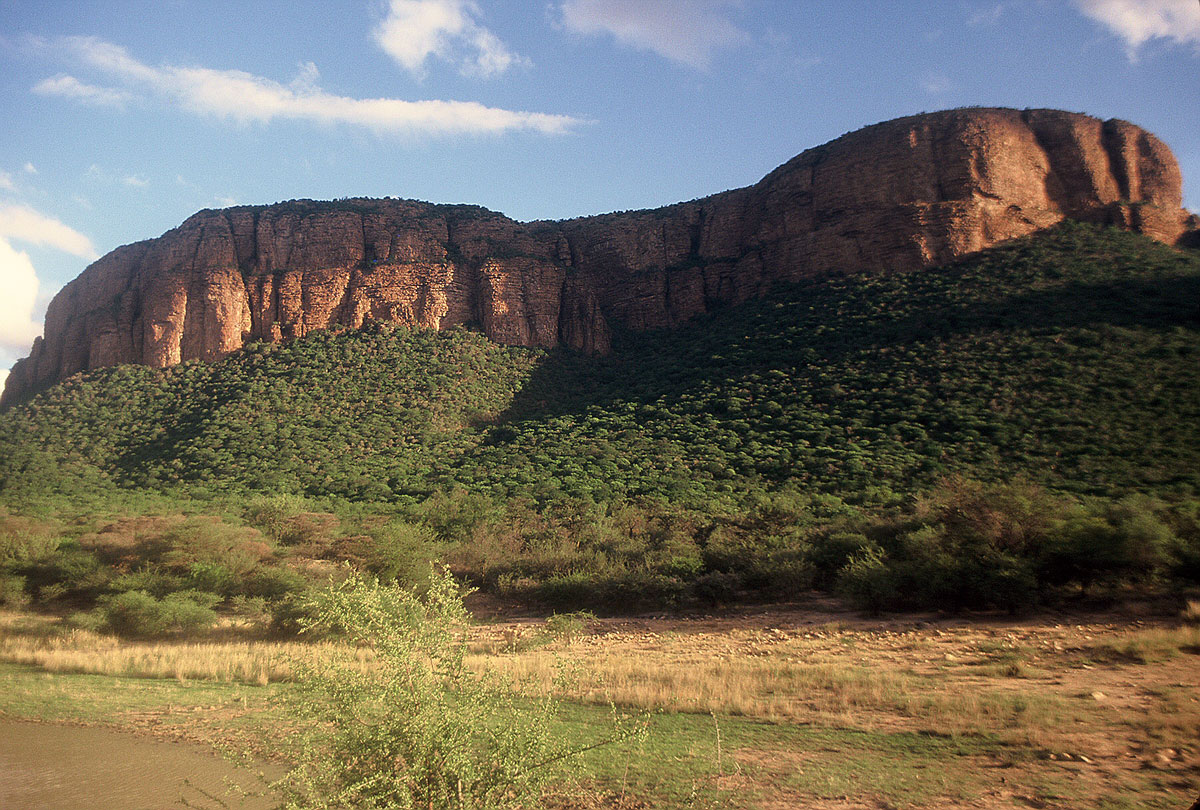
Waterberg RangeDuring our time at Geelhoutbos farm in South Africa’s Northern (now Limpopo) Province, we spent most of our time in the foothills below a magnificent north-facing escarpment of the Waterberg Mountain Range. We were here to collect Buprestidae (including the magnificent Evides, featured previously in this post), and it was in the low bushveld woodland where the greatest diversity of buprestids would be found. Many of the buprestids we encountered were associated with the acacias that abundantly dotted the landscape – especially the iconic “umbrella thorn” (Acacia tortilis) and “sweet thorn” (Acacia karoo), providing sustenance for everything from bitsy beetles (including our beloved buprestids) to giant giraffes. Still, I kept eyeing the mountains, yearning to clamber up on top of the billion year old massif for no other reason than because it was there. Chuck had the good sense to stay down below amongst the acacias and buprestids while I spent an afternoon winding my way up the escarpment in the company of our hostess, Susan Strauss. I didn’t collect many buprestids during that trek, and if success is measured solely by numbers of buprestids collected then Chuck won. But if success also includes the chance to see spectacularly endless vistas from an otherworldly landscape on a once in a lifetime trip, then I didn’t do too badly.

Bromophila caffra

While I didn’t see many buprestids during that afternoon, I did see a few other insects interesting enough to attract my attention and maybe an attempt at a photo. This stunning fly was one of those insects. Even though it exceeded a full inch in length, it still wasn’t the largest fly I had ever seen. However, with its black body, metallic blue wings and large, round, wax-red head it was certainly among the most impressive. A quick scan through my recently acquired Field Guide to Insects of South Africa (Picker et al. 2002) has at last identified this fly as Bromophila caffra. It is a member of the family Platystomatidae, commonly known as signal flies and part of the great superfamily Tephritoidea of fruit fly fame (i.e., true fruit flies – not “the” fruit fly which belongs to the family Drosophilidae and which are more properly called vinegar flies).

Signal flies are interesting on several fronts, firstly because of their catholic tastes – Sivinski (1999) records rotting tree trunks, bulbs, roots and fruit, dried flowers and dead grass stems, dung and fungus as breeding sites, and notes – gruesomely – that mass graves dug in World War II sometimes produced huge numbers of the species Platystoma lugubre. It is some of the Australasian species, however, that have truly made a name for this family. In the tropical rainforests of Guinea and Queensland, males of many species exhibit modifications of their heads that are used in agonistic interactions with sexual rivals. These vary from broadening of the face into a surface used to push against the face of another male, to extremely well-developed stalk eyes used to gauge rival male’s size and strength in face to face combat.

But what about Bromophila caffra? Aside from being one of the most recognizable of flies in Africa, it’s sluggish disposition and apparent noxiousness were obvious even to early naturalists. Marshall (1902) noted the similarity of its coloration (black body, blue wings, red or yellow head) to that of two Pompilus spp. and one sphecid wasp with which it occurred sympatrically. Regarding its habits, he also noted:

The Bromophila fly is very plentiful; it is the most sluggish fly known to me, and settles about on trees and bushes in a very conspicuous manner. It ejects a yellow liquid from the mouth when handled, and was refused when offered to my baboons and Cercopithecus monkey.

Andrew Whittington, commenting on a photo of this species posted on DipteraInfo.com, provides further clues that seem to confirm the noxious qualities of this species, explaining not only its striking color and brazen habits but also the ease with which I obtained the above photograph:

Our knowledge of larval habits is very rudimentary. There appears to be an association with the roots of Terminalia trees (Combretaceae), from which the larvae sequester various toxic compounds (probably cyclic triterpenes) possibly for defense. This may render the adults toxic too, as a defense against predation – not a thoroughly tested hypothesis.
Adults are slow moving and ponderous … and photogenic!

I find it surprising that a large, strikingly distinctive, abundant insect such as Bromophila caffra should lack a common name, but it appears this is the case. None was given in Field Guide to Insects of South Africa, nor amongst the several South African wildlife and dipteran websites which I encountered featuring photos of this insect. In thinking about what common name Bromophila caffra could have, I can’t help but draw comparisons between this insect and the turkey vulture (Cathartes aura), or “buzzard,” of North America (despite their belonging to entirely separate phyla). Both species are among the larger members of their respective orders and make their living eating repulsive foodstuffs. Hulking black with naked, red, plastic-like heads, most predators regard them as too vile and noxious to bother with, leaving them free to pass their lives in unmolested disdain. With this in mind, I hereby propose “buzzard signal fly” as the official common name for this insect 😉

Additional photographs of Bromophila caffra can be seen at Joan Young’s fine blog, South African Photographs, and at Biodiversty Explorer, the web of life in Southern Africa. This is the fifth in a series of posts covering a natural history excursion to South Africa in November/December 1999. Click on “South Africa” under “Tags” to see links and summaries for other posts in this series.

REFERENCES:

Marshall, G. A. K. 1902. Five year’s observations and experiments (1896-1901) on the bionomics of South African insects, chiefly directed to the investigation of mimicry and warning colours. Transactions of the Entomological Society of London, 1902:287-584.

Picker, M., C. Griffiths and A. Weaving. 2002. Field Guide to Insects of South Africa. Struik Publishers, Cape Town, 444 pp.

Sivinski, J. 1999. Breeding habits and sex in families closely related to Tephritidae: Opportunities for comparative studies of the evolution of fruit fly behavior, pp. 23-39. In: M. Aluja and A. L. Norrbom [eds.], Fruit Flies (Tephritidae): Phylogeny and Evolution of Behavior, CRC Press, Boca Raton, 984 pp.

Tyrant ground beetles

I return to my Afrikaans theme with a distinctive group of ground beetles (family Carabidae) called tyrant ground beetles or spotted ground beetles (tribe Anthiini). I think I prefer the former. This tribe is largely restricted to Africa and is especially diverse and abundant in the arid, sandy Karoo and Kalahari regions of southern Africa (Scholtz & Holm 1985). These beetles are large, powerful predators that rely on speed and agility for capturing prey, and since they are also flightless these characteristics come in handy for avoiding becoming prey themselves. Failing that, they employ chemical defense in the form of secretions from a pygidial gland located in the area of the ninth abdominal segment. The chemical cocktail within these secretions contains concentrated organic acids or quinone that can be squirted at potential predators in a strong jet. This is an effective deterrent to small mammalian and avian predators, and I suppose a careless beetle collector might also regret handling these beetles without due respect. These defensive spray capabilities give rise to another common name for the group, “oogpister” – an Afrikaner word that literally translates to (ahem) “eye pisser.”

Anthia (s. str.) thoracicaDuring my time in Africa, Chuck Bellamy and I were primarily focused on collecting buprestids. However, we still couldn’t resist hanging an ultraviolet light in front of a sheet and searching the ground with flashlights at night to see what diversity of other African insects we might encounter. Truth be told, one of the non-buprestid groups that I’d really hoped to encounter was a near relative of these beetles – the so-called “monster tiger beetles” of the genus Manticora (family Cicindelidae1). We never did see any monsters, but we did encounter several species of anthiine ground beetles around our encampment at Geelhoutbos farm near the Waterberg Range in Limpopo Provice. Anthia (s. str.) thoracica, the giant African ground beetle (above), was the most impressive of these. Click on the photo to see a larger version – only then will it begin to convey how truly appropriate such a common name is for this species. It is certainly the largest ground beetle that I have ever seen – a full 50 mm in length! That’s 2 inches, folks! This species is easily recognized by the depressed lateral expansions of the pronotum covered with dense white/yellow pubescence, and the slightly smaller male that I caught exhibits more elongated mandibles (though not so incredibly as in Manticora) and marvelous lobes extending backward from the pronotum.

1 Increasingly placed within the Carabidae as subfamily Cicindelinae on the basis of molecular phylogenetic analysis, along with Paussinae and Rhysodinae (e.g., Beutel et al. 2008).

Anthia (Termophilum) omoplataIn addition to true Anthia, we saw two species of the subgenus Anthia (Termophilum)2. The species shown right is A. (T.) omoplata3, with the common name “two-spotted ground beetle” (Picker et al. 2002). It was almost as large as its giant brother above, measuring 47 mm in length. Of this species, I only saw this one individual, but I did also find two individuals of a related species, T. fornasinii. Unfortunately I was unable to photograph the latter species, which is equally large but with the elytral white markings limited to a thin marginal band and the surface of the elytra bearing strong longitudinal intervals – a handsome beast, indeed! Picker et al. (2002) mention T. homoplatum being a diurnal hunter, but we found all of our anthiines active nocturnally.

2 Treated variously in the literature as either a full genus or as a subgenus of Anthia. I follow Carabidae of the World, in which it is given subgeneric status. The name is often cited as “Thermophilum” in the literature, but this is an incorrect subsequent spelling according to Alexandre Anischenko (in litt.), coordinator/editor of Carabidae of the World.

3 Usually cited as “homoplatum” or “homoplata” in the literature, but this is an incorrect subsequent spelling (Anischenko in litt.).

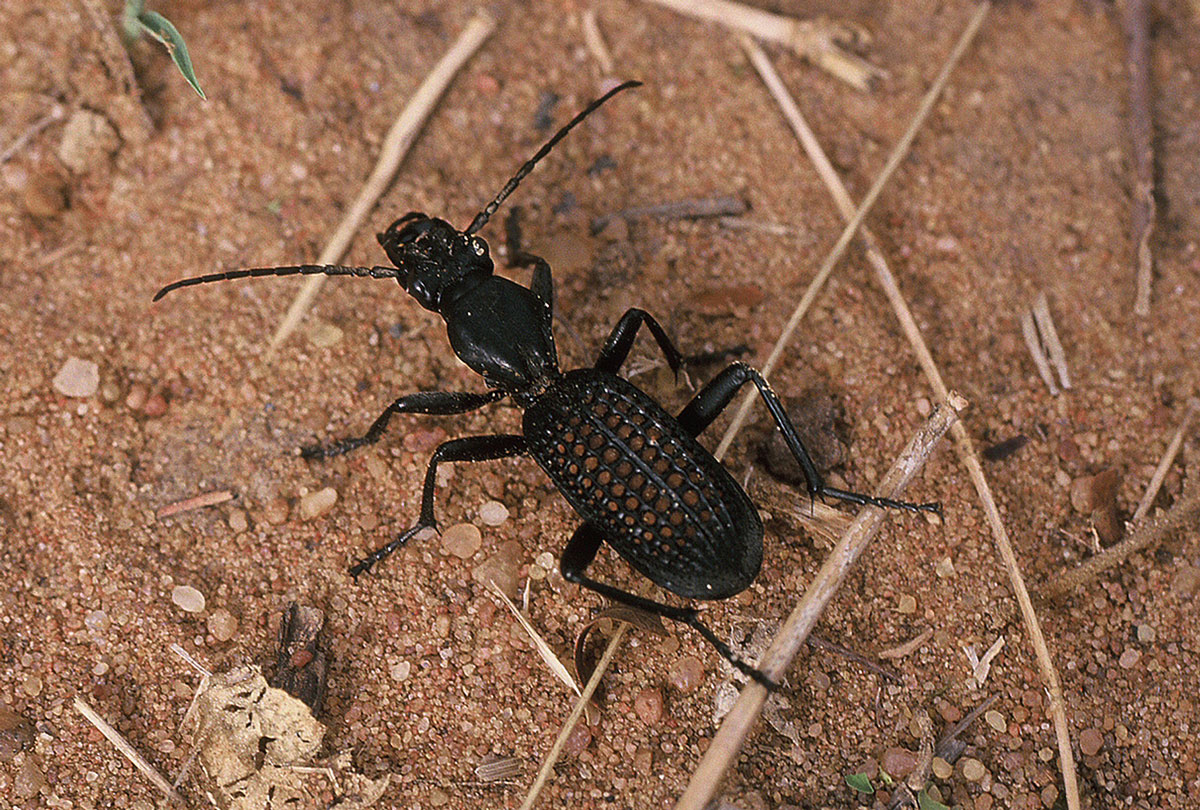
cypholoba-alveolataA second genus in the tribe is Cypholoba, represented here by C. alveolata. As far as I can tell it lacks a common name, which is not surprising since it is somewhat smaller than the Anthia species mentioned above. Still, my two specimens measure 38 and 35 mm in length – not puny by any standard. There can be no doubt as to the origin of the specific epithet of this species’ scientific name, with its marvelously alveolate elytra. I don’t think I’ve seen such an extraordinary example of this type of surface sculpturing on a beetle of this size, making the species every bit as spectacular as the larger anthiines.

A truly fascinating aspect of Africa’s tyrant ground beetles is their role as models in Batesian mimicry systems. That these beetles should serve as models is not at all surprising due to their chemical defensive capabilities and obviously aposematic coloration. What is surprising is the mimic – juveniles of the lizard species, Eremias lugubris, in what is believed to be the first reported case of a terrestrial vertebrate mimicking an invertebrate (Huey & Pianka 1977). The juveniles not only copy (roughly) the black and white coloration of anthiine beetles but also mimic their rapid, skitty movements – foraging actively with “jerky” motions and arched backs. Their tails remain somber colored, however, allowing them to blend into the sand. These adaptations combine to give the harmless little lizard the size, color, profile, and gait of the beetles. As the lizards reach adulthood (and their greater size makes them less prone to predation), they take on a more typical cryptic coloration and move in a slower, more deliberately lizard-like manner. This mimicry association effectively reduces predation of the juveniles by potential predators, who quickly learn to avoid the noxious, and more frequently encountered, anthiine models.

REFERENCES:

Beutela, R. G., I. Riberab and O. R. P. Bininda-Emonds. 2008. A genus-level supertree of Adephaga (Coleoptera). Organisms, Diversity & Evolution, 7:255–269.

Huey, R. B. and B. R. Pianka. 1977. Natural selection for juvenile lizards mimicking noxious beetles. Science, 195 (4274):201-203.

Picker, M., C. Griffiths and A. Weaving. 2002. Field Guide to Insects of South Africa. Struik Publishers, Cape Town, 444 pp.

Scholtz, C. H. and E. Holm (eds.). 1985. Insects of Southern Africa. Butterworths, Durbin, 502 pp.