A flower visiting jewel beetle that is not an Acmaeodera

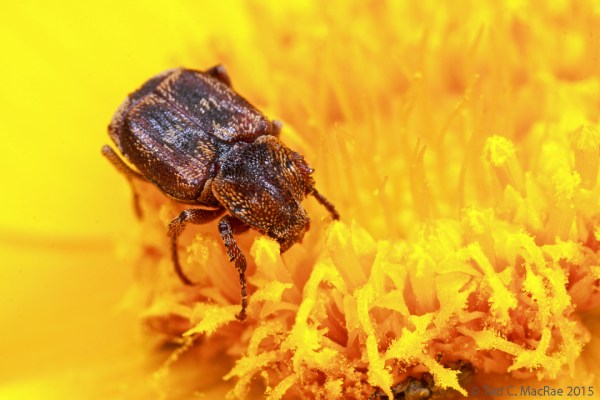
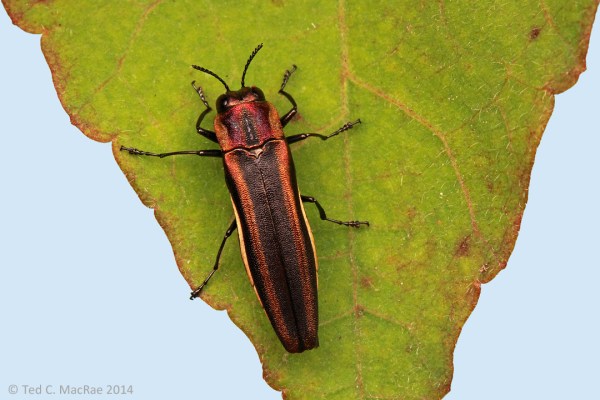
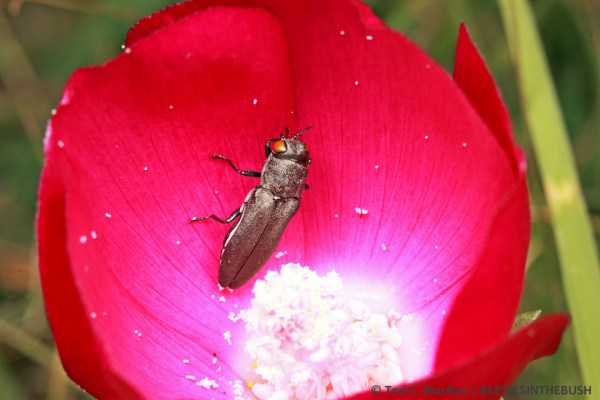
Agrilus muticus

Agrilus muticus LeConte, 1858 | Alabaster Caverns State Park, Woodward Co., Oklahoma

In North America, jewel beetles (family Buprestidae) routinely associated with flowers usually belong to the genus Acmaeodera. Often black with yellow and/or red elytral markings (e.g., A. immaculata, A. macra, A. ornataA. neglecta, A. tubulus, etc.), these beetles are especially diverse in western North America and bear a striking resemblance to stinging bees and wasps (maintaining the charade even during flight by holding their fused elytra together above the abdomen). A few other less speciose genera (e.g., Anthaxia and Agrilaxia) also regularly visit flowers, but for the most part outside of these genera encounters on flowers are at best incidental.

Agrilus muticus

Adults are associated almost exclusively with flowers of winecup (Callirhoe involucrata).

Of course, exceptions are the rule in biology, and in the genus Agrilus there are few species that are found almost exclusively on flowers. One of these, Agrilus muticus occurs in Texas, Oklahoma, and Kansas and has been found only in the flowers of winecup, Callirhoe involucrata (Fisher 1928). The species is fairly routinely encountered wherever these plants are found in bloom, and I have observed adults in these flowers on numerous occasions feeding on the petals and mating (and see this BugGuide photo of group sex!). While winecup can be presumed to be the larval host, it has never been reared from this (or any other) plant, and in fact I am not aware of anything beyond descriptions and catalogue listings that have been published for the species. I suspect the larvae tunnel within the stem base or main roots of living winecup plants (and, thus, making them more difficult to rear than species associated more typically with dead wood).

Only one other North American Agrilus has been documented routinely visiting flowers. Agrilus blandus is frequently encountered on flowers of Eriogonum, and these plants have also been confirmed as larval hosts (Nelson & Westcott 1976). None of the remaining species of Agrilus in North American are known to routinely visit flowers, and in fact the vast majority of them are associated with woody rather than herbaceous plants. The latter include A. concinnus, which breeds in the base of living Hibiscus (MacRae 2006), and A. malvastri, which is usually found on Sphaeralcea (Fisher 1928), although whether that plant also serves as the larval host remains unconfirmed. It is interesting that most of these non-woody plant hosts (CallirhoeHibiscus and Sphaeralcea, but not Eriogonum) all belong to the same plant family—Malvaceae. Plants in this family also serve as known or suspected larval hosts for several species of jewel beetles in the genus Paragrilus—a close relative of the genus Agrilus. Again, these beetles are normally found on the foliage and not on the flowers.

REFERENCE:

MacRae, T. C. 2006. Distributional and biological notes on North American Buprestidae (Coleoptera), with comments on variation in Anthaxia (Haplanthaxia) viridicornis (Say) and A. (H.) viridfrons Gory. The Pan-Pacific Entomologist 82(2):166–199 [pdf].

Nelson, G. H. & R. L. Westcott. 1976. Notes on the distribution, synonymy, and biology of Buprestidae (Coleoptera) of North America. The Coleopterists Bulletin 30(3):273–284 [pdf].

Fisher, W. S.  1928. A revision of the North American species of buprestid beetles belonging to the genus AgrilusU. S. National Museum 145, 347 pp. [Smithsonian Libraries].

© Ted C. MacRae 2015

Redux: Now you see me…

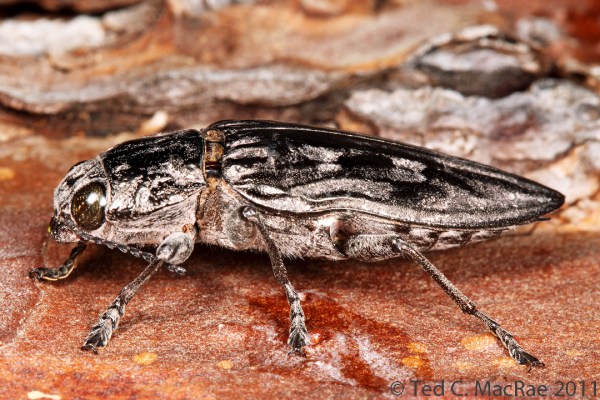
Chalcophora virginiensis

Chalcophora virginiensis (Drury, 1770) | vic. Calico Rock, Arkansas

…now you don’t!

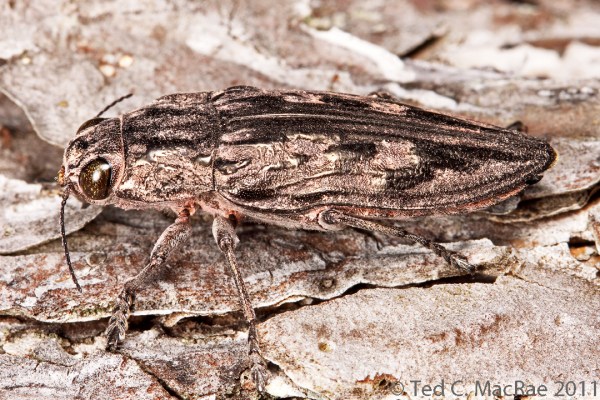
Chalcophora virginiensis

Chalcophora virginiensis (Drury, 1770) | vic. Calico Rock, Arkansas

Chalcophora virginiensis (Drury, 1770) is the largest jewel beetle (family Buprestidae) in eastern North America. This beetle is also known as the “sculptured pine borer”, and its easy to see why—its hyper-sculptured, shiny metallic body glitters like a jewel in the sunlight! This feature is typical of many species in the family and, in fact, is the source of the family’s other common name—metallic wood boring beetles.

Such dramatic sculpturing and coloration makes cabinets of jewel beetle specimens among the most beautiful in any museum, and for those who have only seen these beetles as pinned specimens in cabinets it can be hard to imagine what purpose such appearance serves. In its native habitat, however, on native host plants, the reason becomes clear. Rather than conspicuous and easily seen, such coloration actually helps the beetle to blend in with its environment and become almost invisible. Measuring well over an inch in length and possessing no other way of defending itself by biting, stinging, or even just tasting bad, these beetles would be a more than healthy snack for almost any avian or reptilian predator, and going about their activities during the day right under the noses of all these visually based predators makes finding mates and oviposition sites an even riskier proposition. For them, the best way to beat a visual predator is to become… invisible! The two photos above show just how dramatic a difference the substrate plays in allowing these beetles to practice their disappearing act. Land on the trunk of a dead or dying pine tree, its aged bark flaked and graying, and the sculpturing and coloration are a perfect match. Land, however, on a healthy tree, its resin-filled bark bright and full of color, and it suddenly becomes a sitting duck. It’s in the beetle’s best interest to be good at telling the difference between thrifty and unhealthy trees, which they do by “smelling” volatile chemicals emitted by trees under stress.

Those interested in more information on this species and its close relatives may wish to consult the recent review of the genus in North America by Maier & Ivie (2014) (see my review of this excellent paper here).

REFERENCE:

Maier, C. A. & M. A. Ivie. 2013. Reevaluation of Chalcophora angulicollis (LeConte) and Chalcophora virginiensis (Drury) with a review and key to the North American species of Chalcophora Dejean (Coleoptera: Buprestidae). The Coleopterists Bulletin 67(4):457–469 [abstract].

© Ted C. MacRae 2015

Spring beetles on Coreopsis flowers

Abby Lee, Ryan Fairbanks, Stephen Penn atop a rhyolite glades

The WGNSS Entomology Group takes in the view of rhyolite glades from atop Hughes Mountain.

Each spring the Entomology Group of the Webster Groves Nature Study Society takes a field trip to one of the many natural areas outside of the St. Louis area. This year the destination was Hughes Mountain Natural Area, about 75 miles SSW of St. Louis in Washington Co. I especially looked forward to going there this spring, as my last visit to the area was close to 20 years ago. Despite the long absence, I vividly recalled the spectacular vistas from atop the mountain of rhyolite and the diversity of unique plants and insects in the igneous glades that flanked its slopes. When we arrived, we found the glades ablaze with spring wildflowers in full bloom, the most prominent of which was lance-leaved coreopsis (Coreopsis lanceolata). As one of the so-called “yellow composites”, coreopsis is a favored source of pollen and nectar for a variety of insects, including beetles and especially the jewel beetles that I find so interesting.

Acmaeodera neglecta

Acmaeodera neglecta Fall, 1899

Species in the genus Acmaeodera are incredibly diverse in the southwestern U.S. (nearly half of the ~150 species/subspecies known from the U.S. occur in Arizona), where they are usually encountered on a variety of flowers. It is my opinion that the adult beetles mimic small bees, especially in flight by virtue of their fused elytra that do not separate during flight as in most other beetles and thus results in a profile resembling that of a small sweat bee (family Halictidae). The diversity of Acmaeodera drops off considerably in the eastern U.S., with only three species occurring broadly in the area. Missouri is a bit luckier than most eastern states, as two additional species found primarily in the south-central U.S. also occur here (MacRae 1991). One of these is Acmaeodera neglecta Fall, 1899. This tiny species (adults measure only 4–6 mm in length) is very similar to the much more common and widespread A. tubulus (Fabricius, 1801) (see photos here), and in fact its resemblance to that species is so great that it remained unreported from Missouri until Nelson (1987) recognized it among material that I had collected and sent to him during my early collecting days. Acmaeodera neglecta can be distinguished from A. tubulus by the elytra with slightly larger punctures and duller surface and the spots usually longitudinally coalesced into an irregular “C”-shaped marking on each side. I find this species most often in glade habitats.

Acmaeodera ornata

Acmaeodera ornata (Fabricius, 1775)

Acmaeodera ornata (Fabricius, 1775) is more widespread than A. neglecta (although not nearly so commonly encountered as A. tubulus). This handsome species is distinctly larger than A. tubulus and A. neglecta, usually around 8-11 mm in length, and has a broader, more flattened appearance with a distinct triangular depression on the pronotum. The elytra have a bluish cast rather than the bronzy sheen of A. tubulus and A. neglecta, and the spots on the elytra are smaller, more numerous, and more of a creamy rather than yellow color. No other species in the eastern U.S. can be confused with it, although there is a very similar species (A. ornatoides Barr, 1972) that occurs in Oklahoma and Texas. I have encountered this species numerous times on a variety of flowers in Missouri but have never managed to rear it, and in fact larval hosts remain unknown with the exception of one very old (and unreliable) report of the species breeding in hickory (Carya) and black-locust (Robinia).

Valgus canaliculatus

Valgus canaliculatus (Olivier, 1789)

As a general rule, beetles in the family Scarabaeidae don’t visit flowers—species in the subfamily Cetoniinae being a significant exception. This tiny representative of the subfamily, Valgus canaliculatus (Olivier, 1789), is no larger than the Acmaeodera neglecta adult above by length, although the body is broader and strongly flattened. This species is a representative of the tribe Valgini, one of only two tribes in the family that possess dorsal and ventral scale-like setae (the unrelated tribe Hopliini, or monkey beetles, being the other) (Jameson & Swoboda 2005). It has been suggested that the setae might play a role in crysis or adaptive coloration, and even more interesting is the association of most New World species with termites. Eggs are laid in termite galleries and the larvae feed on the wood within the galleries, but it remains unclear whether the termophily is obligatory or the beetles are simply taking advantage of the stable environment and accessible food source offered by termite colonies. Like other species in the subfamily, the adults are fond of flowers; however, only male valgines visit flowers, using specially modified, brush-like mouthparts to lap up nectar. As far as has been determined, the males do not feed on pollen.

Valgus canaliculatus

Note the flattened, scale-like setae covering both the dorsal and ventral surfaces as well as the legs.

REFERENCES:

Fall, H. C.  1899. Synonpsis of the species of Acmaeodera of America, north of Mexico. Journal of the New York Entomological Society 7(1):1–37 [pdf].

Jameson, M. L. & K. A. Swoboda. 2005. Synopsis of scarab beetle tribe Valgini (Coleoptera: Scarabaeidae: Cetoniinae) in the New World. Annals of the Entomological Society of America 98(5):658–672 [pdf].

MacRae, T. C. 1991. The Buprestidae (Coleoptera) of Missouri. Insecta Mundi5(2):101–126 [pdf].

Nelson, G. H. 1987. Additional notes on the biology and distribution of Buprestidae (Coleoptera) in North America, II.   The Coleopterists Bulletin 41(1):57–65 [pdf].

© Ted C. MacRae 2015

Buprestidae type specimens at Fundación Miguel Lillo, Argentina

During my most recent visit to Argentina this past February and March, I had the chance to go behind the scenes and visit the entomology collection at Fundación Miguel Lillo, Instituto de Entomología, Tucumán. It’s always a treat to visit any entomology collection—public or private—at any location. When the collection has holdings of Buprestidae, so much the better. Much to my delight, however, this collection not only had holdings of Buprestidae (not surprisingly representing primarily Argentine species), but also a small collection of type specimens designated by Antonio Cobos Sanchez (1922–1998). Cobos was one of the 20th century’s most prolific students of Buprestidae, with publications in the family spanning the period from 1949–1990 (coincidentally, 1990 being the year of my very first buprestid publication!). I was graciously allowed to photograph these specimens, some of which present interesting nomenclatural situations that are worthy of comment. These are presented below with my notes.

Jose xx & Ted MacRae

Looking at the insect collection at Fundación Miguel Lillo, Argentina.


Sufamily POLYCESTINAE

Tribe TYNDARINI

Tylauchenia golbachi Cobos, 1993 (currently placed in Oocypetes)

Tylauchenia golbachi Cobos, 1993. The species was moved to the genus Ocypetes.

Lapsus calami or mislabeled type specimen? Cobos (1973) described Tylauchenia golbachi from Argentina (now placed in the genus Ocypetes), stating the type locality as “6 kms. N. de Belén, 1.240 m. alt., Catamarca, Argentina (Willink, Terán y Stange coll., con trampa de Malaise, 1-15-I-1970…)”. The specimen above bears the holotype label, but the locality label clearly shows that it was collected in Tucumán rather than Catamarca and that the collector’s name is Guanuco rather than the above stated names. Interestingly, in the same publication Cobos gives the allotype female collection data as “San Pedro de Colalao, Tucumán, Argentina (Coll. Guanuco, 9-III-1949)”. At first I thought this might actually be the allotype rather than the holotype; however, 1) the specimen clearly bears a holotype label, and 2) it is also clearly a male based on the dissected genitalia preserved on the label below the specimen. There are two possible explanations, both of which make it difficult to determine what is the true type locality: 1) the holotype and allotype specimens are correctly labeled, but Cobos simply transposed their label data in his publication describing the species, making Tucumán the true type locality, or 2) the holotype and allotype locality labels were switched at some point and the true type locality is Catamarca, as stated in the publication in which the species is described. This latter possibility is more serious, as in addition to the doubts it generates regarding the type locality it also raises concern about the integrity of the holotype specimen. The latter explanation, however, seems less likely, as it is more difficult to imagine a scenario where only the locality label but not the others was switched than to imagine a transposition of label data in the publication. Sadly, at this point, there seems no easy way to determine which of the two explanations is correct.

Subfamily CHRYSOCHROINAE

Tribe DICERCINI
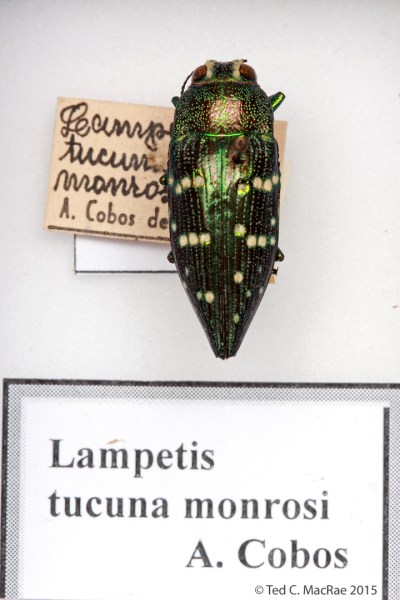
Lampetis tucumana monrosi Cobos (nomen nudum?)

Lampetis tucumana “monrosi” Cobos (ms name?)

A manuscript name? Cobos never actually proposed a subspecies “monrosi” for Lampetis tucumana (Guérin-Méneville & Percheron, 1835) (the name on the separate box label is misspelled). He did use the name for two other buprestid taxa: Tetragonoschema monrosi Cobos, 1949—now regarded as a synonym of T. argentiniense (Obenberger, 1915), and Anthaxia monrosi Cobos, 1972—now placed in the genus Agrilaxia. The holotype label on the specimen clearly states “Lampetis tucumana monrosi” in Cobos’ handwriting, so one can only presume that Cobos had identified this specimen as representing a distinct subspecies but never followed through and actually described it.

Ectinogonia (Pseudolampetis) fasciata metallica Cobos, 1969

Psiloptera (Pseudolampetis) fasciata metallica Cobos, 1969. Pseudolampetis was later considered a subgenus of Ectinogonia but is now regarded as a full genus.

Oh, what a tangled web we weave! Cobos (1969) originally described this taxon as a subspecies of Psiloptera (Pseudolampetisfasciata Kerremans, 1919. Moore (1986) moved Pseudolampetis to a subgenus of Ectinogonia, which resulted in two taxa in the latter genus bearing the name “metallica“—Ectinogonia (Pseudolampetisfasciata metallica (Cobos, 1969) and Ectinogonia metallica Fairmaire, 1856—the latter now considered a synonym of E. speciosa (Germain, 1856). In taxonomic nomenclature, two taxa in the same genus cannot bear the same name—a situation known as homonymy. In such cases, the older name has priority and the younger name, in this case Cobos’, must be replaced. This was done by Bellamy (2006), who proposed the new name moorei for this subspecies, resulting in the name Ectinogonia (Pseudolampetis) fasciata moorei Bellamy, 2006. To bring some level of absurdity to the situation, the subgenus Pseudolampetis was subsequently raised to full genus rank, being listed as such in the recent world catalogue (Bellamy 2008), and since Cobos’ name was not originally proposed within the genus Ectinogonia it no longer competes with Germain’s name in that genus. As a result, there is no homonymy and Cobos’ original name must once again stand as Pseudolampetis fasciata metallica (Cobos, 1969), while Bellamy’s replacement name must be regarded as unnecessary. This fact seems to have been overlooked when Pseudolampetis was raised to genus rank, as Cobos’ taxon is still listed in the world catalogue as “Pseudolampetis fasciata moorei (Bellamy, 2006)”! This situation is a perfect example of just how complicated these situations can be to identify, track, and update. The type locality for the unique female is given as “Chagual, 1.200 metros de altitud, Rio Marañón, en el Perú, VIII-1953 (B. Fernández leg.)”.

Subfamily BUPRESTINAE

Tribe STIGMODERINI

Conognatha rufiventris weyrauchi Cobos, 1969

Conognatha rufiventris weyrauchi Cobos, 1969. The taxon is now considered a synonym of Conognatha abdominalis Waterhouse, 1912.

Insufficient grounds. Cobos (1969) regarded this specimen from Peru as subspecifically distinct from Conognatha rufiventris Waterhouse, 1912 from Brazil based on a suite of subtle character differences and named the taxon Conognatha rufiventris weyrauchi in honor of Prof. W. Weyrauch, who made made the holotype specimen available to him for study. Moore & Lander (2010) considered that the taxon did not represent C. rufiventris, but rather was a uniquely colored specimen of Conognatha abdominalis Waterhouse, 1912. The holotype is a male with the type locality given as “del Valle de Chatichamayo, a 1.200 m., en Peru (J. Schuiike leg.)”.

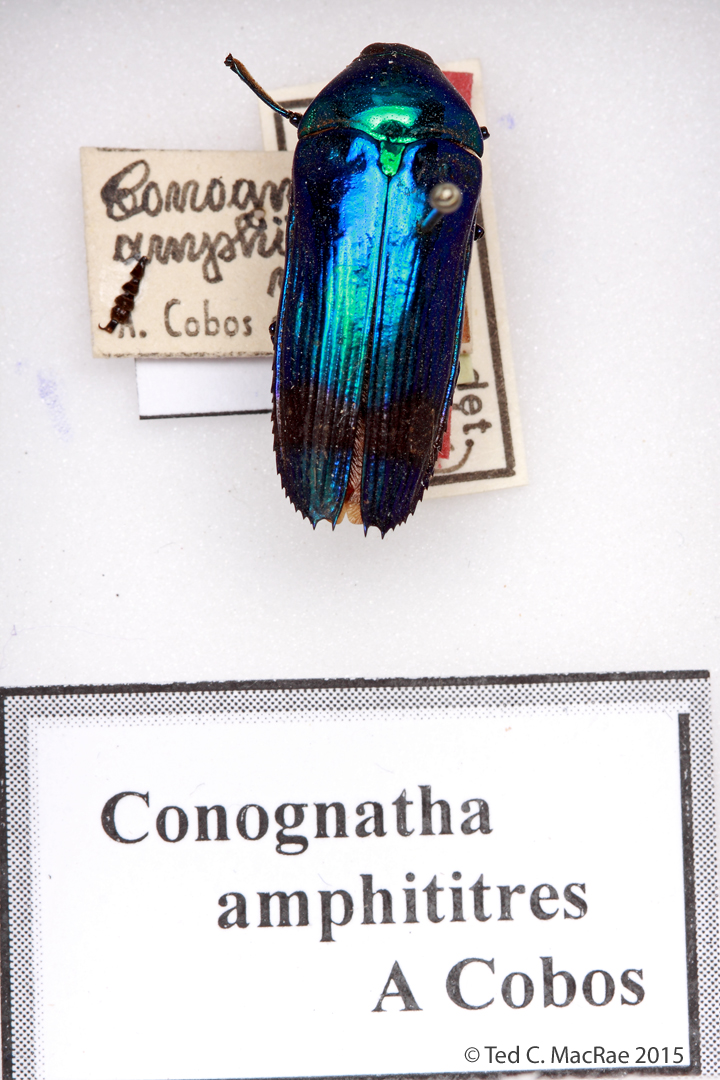
Conognatha amphititres Cobos, 1958 (syn. of Buprestis amoena Kirby, 1818; currently placed in Conognatha)

Conognatha amoena amphititres Cobos, 1958. The taxon is now considered a synonym of C. amoena (Kirby, 1818).

Insufficient grounds—part II. Cobos (1958) regarded this specimen from Brazil as subspecifically distinct from C. amoena (Kirby, 1818—originally described in the genus Buprestis) based on subtle characters and gave it the name Conognatha amoena amphititres (no etymology was given for the subspecies name). Moore & Lander (2006) regarded these differences as insufficient for subspecies status and placed the taxon as a synonym of the parent species. The holotype is thought to be a female with the type locality given as “Rio de Janeiro (Brasil)”.

Tribe CHRYSOBOTHRINI
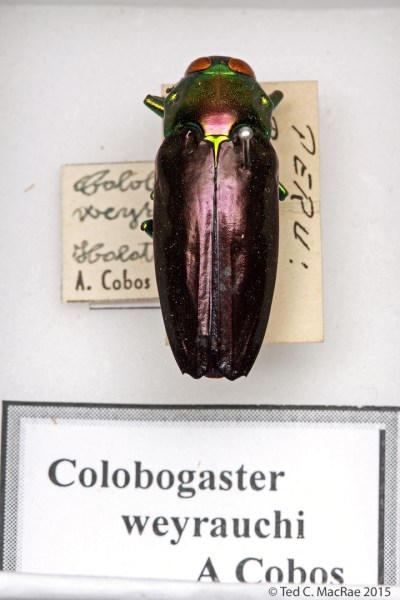
Colobogaster weyrauchi Cobos, 1966

Colobogaster weyrauchi Cobos, 1966

Cobos (1966) described Colobogaster weyrauchi from Peru and named it after the collector, relating it to the widespread Colobogaster cyanitarsis Gory & Laporte, 1837. The type locality was given as “Pucallpá, 200 m. alt., Perú (W. Weyrauch coll. I-1948)”.

Subfamily AGRILINAE

Tribe CORAEBINI

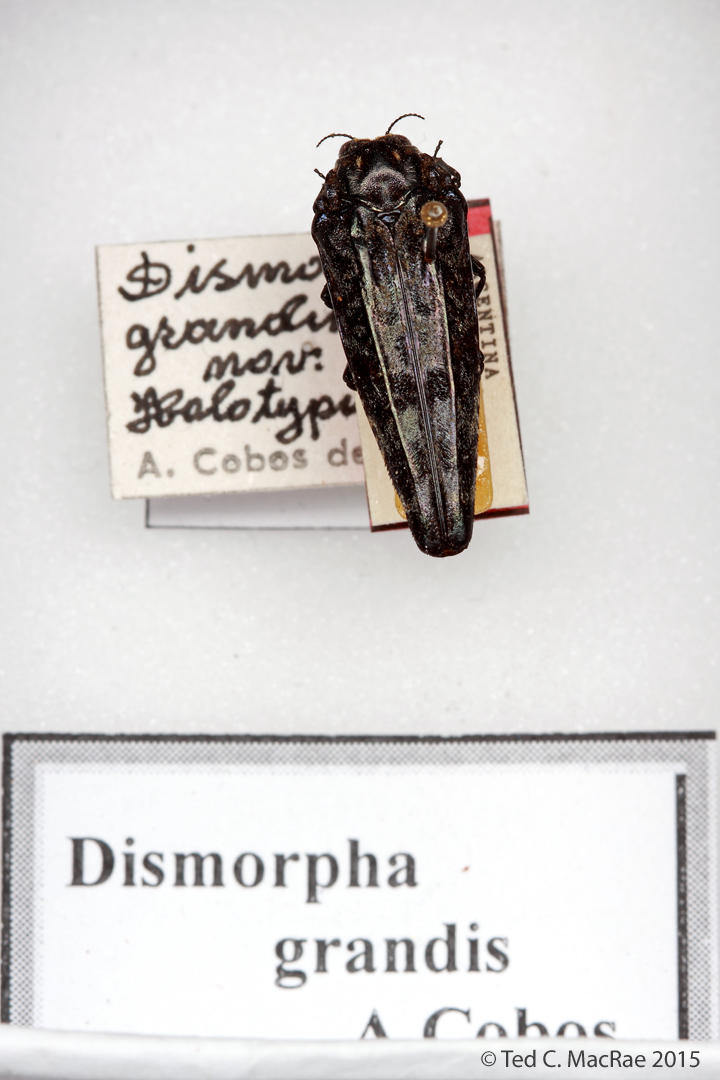
Dismorpha grandis Cobos, 1990

Dismorpha grandis Cobos, 1990

Cobos (1990) described Dismorpha grandis from Argentina in his very last buprestid publication, stating that the species had the appearance of an enormous D. irrorata (Gory & Laporte, 1839) (thus, the name “grandis“). The holotype is a male with the type locality given as “Bemberg, Misiones, Argentina (Exp. Hayward-Willink-Golbach: 12-29-I-1945)”.

Tribe AGRILINI
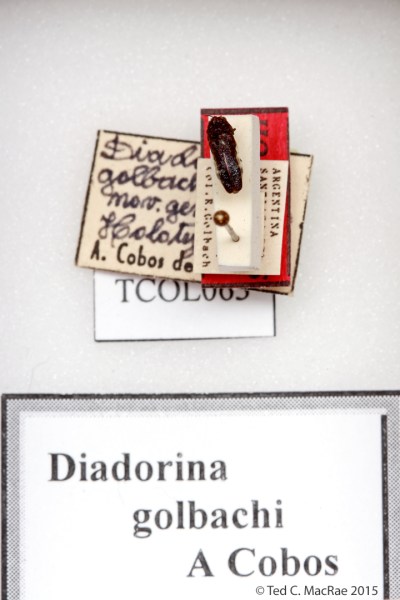
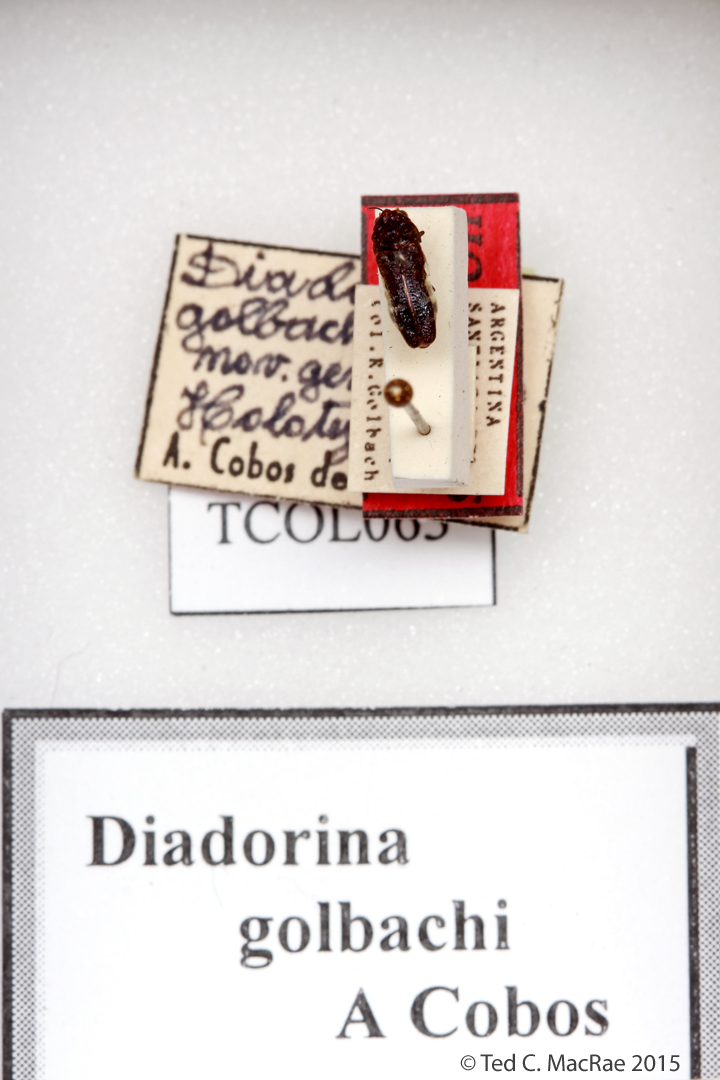
Diadorina golbachi Cobos, 1974 (monotypic)

Diadorina golbachi Cobos, 1974 (monotypic)

Cobos (1974) described Diadorina golbachi from Argentina as the only member (and thus the type species) of the new genus Diadorina (the genus is still regarded as monotypic), naming it in honor of the collector. The holotype specimen is a female with the type locality given as “La Tigres, Santiago del Estero, Argentina (R. Golbaeh coll. 11-16-1-1970)”.

Tribe TRACHEINI

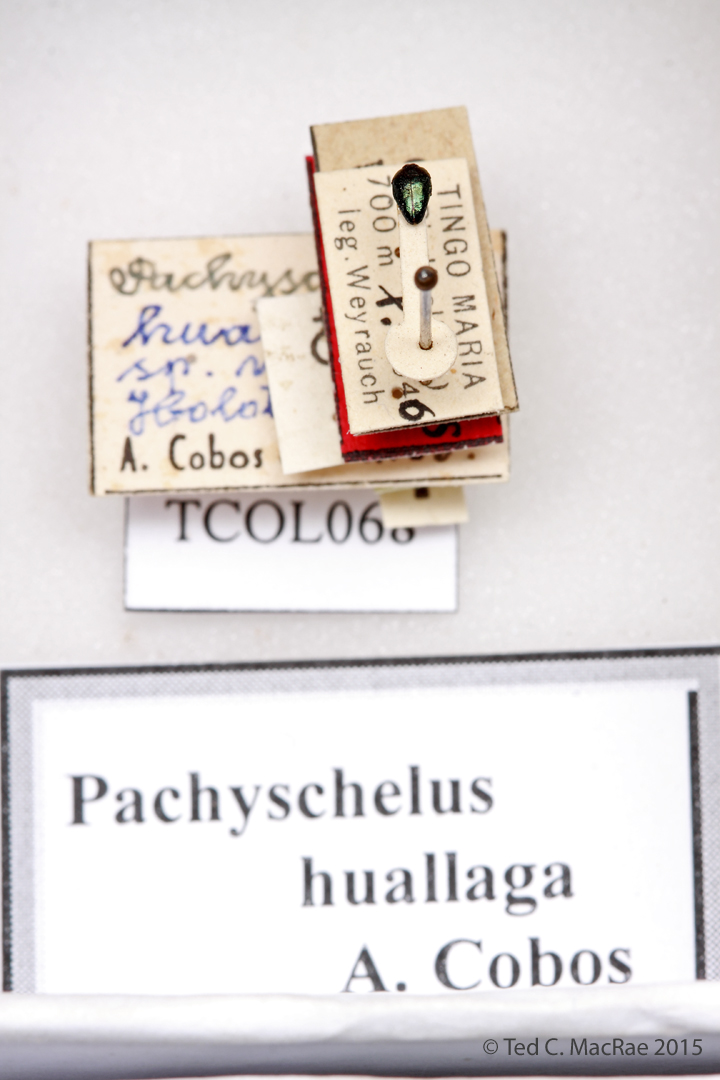
Pachyshelus huallaga Cobos 1969 (correct spelling is huallagus)

Pachyshelus huallaga Cobos, 1969

Cobos (1969) described and named this species after the river at the type locality in Peru. He related it to Pachyschelus atratus Kerremans, 1896 from Brazil and northern Argentina, stating that it differed by its distinct and less brilliant coloration and other features. Since the genus name is considered masculine, the correct species name is “Pachyschelus huallagus Cobos, 1969″. The unique holotype is a female with the type locality given as “Tingo María, Rio Huallaga, 700 metros de altitud, Peru, X-1946 (W. Weyrauch leg.)”.

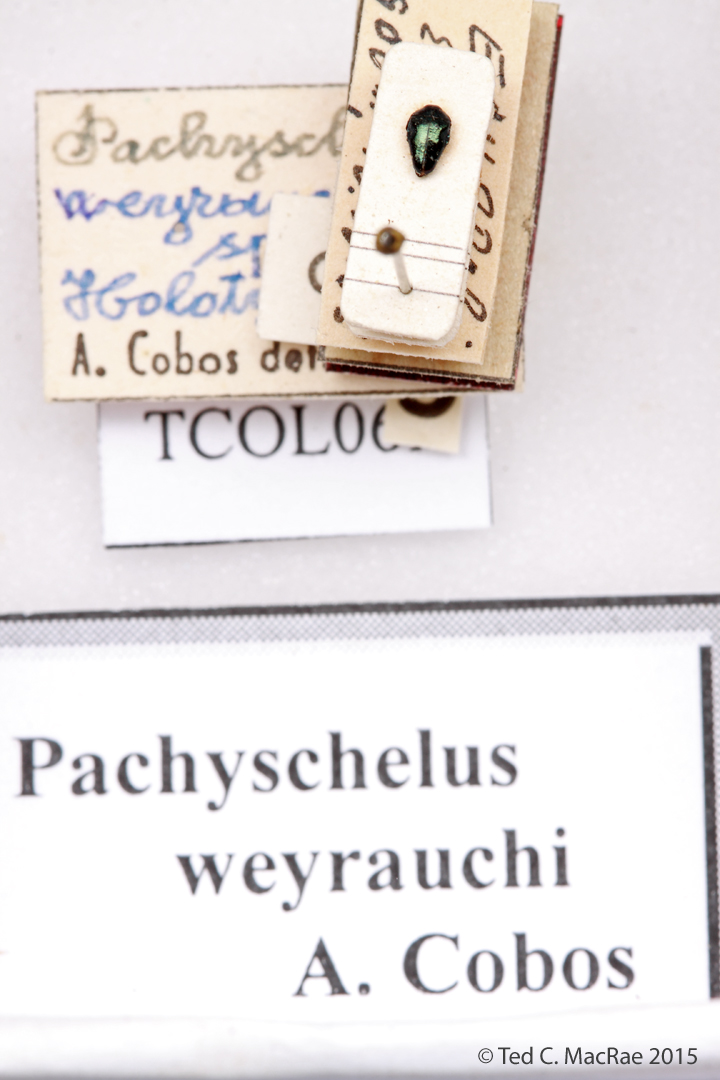
Pachyschelus weyrauchi Cobos, 1959

Pachyschelus weyrauchi Cobos, 1969

Cobos (1969) described Pachyschelus weyrauchi from Ecuador and named it in honor of its collector. He related the unique male to Pachyschelus aeneicollis (Kirsch, 1873) from Peru and Bolivia, citing differences in coloration, body shape, and surface sculpture. The type locality was given as “El Puyo, 900 metros de altitud, Ecuador, 10-IV-1958 (W. Weyrauch leg.)”.

There are two additional Buprestidae type specimens in the collection (Colobogaster pizarroi Cobos, 1966 and Hylaeogena cognathoides Cobos, 1969), but they are in another drawer that we did not find immediately and, thus, I did not have a chance to photograph them. My apologies!

REFERENCES:

Bellamy, C. L. 2006. Nomenclatural notes and corrections in Buprestidae (Coleoptera). The Pan-Pacific Entomologist 81(3/4):145–158 [pdf].

Bellamy, C. L. 2008. A World Catalogue and Bibliography of the Jewel Beetles (Coleoptera: Buprestoidea). Volume 2: Chrysochroinae: Sphenopterini through Buprestinae: Stigmoderini. Pensoft Series Faunistica No. 77, pp. 626–1260, Pensoft Publishers, Sofia-Moscow [details & links].

Cobos, A. 1966. Notas sobre Bupréstidos neotropicales. XV: Tres especies nuevas de Colobogaster Sol. (Coleoptera). EOS, Revista Española de Entomología 41(2-3):205–214 [pdf].

Cobos, A. 1969. Notas sobre Bupréstidos neotropicales XVII. Especies y subespecies nuevas (Coleoptera). EOS, Revista Española de Entomología 44(1968):19–43 [pdf].

Cobos, A. 1958. Tercera nota sobre Bupréstidos (Ins. Coleoptera) neotropicales descripciónes y rectificaciónes diversas. Acta Zoologica Lilloana 15:83–102 [pdf].

Cobos, A. 1973. Revisión del género Tylauchenia Burm., y afines (Coleoptera, Buprestidae). Archivos del Instituto de Aclimatacion 18:147–173 [pdf].

Cobos, A. 1974. Notas sobre Bupréstidos neotropicales, XIX. El género Amorphosternus H. Deyrolle y afines. Archivos de Instituto de Aclimatación 19:65–81 [pdf].

Cobos, A. 1990. Revisión del género Dismorpha Gistel (Coleoptera, Buprestidae). Revista Brasileira de Entomología 34(3):539–559 [pdf].

Moore Rodriguez, T. 1986. Contribución al conocimiento de los Buprestidos neotropicales (Coleoptera: Buprestidae). Revista Chilena de Entomología 13:21–29 [BioStor].

Moore Rodriguez, T. & T. Lander. 2010. Revision du genre Conognatha. Edition Magellanes 24:1–172 [introduction and generic discussion in French and Spanish; keys to species in English, French and Spanish] [order information].

© Ted C. MacRae 2015
Best of BitB 2014

Welcome to the 7th Annual “Best of BitB”, where I pick my favorite photographs from the past year. Before I do this, however, let me briefly recap the year 2014. The trend of increasing travel each year continued, with more days spent on the road than in any prior year. Travel for work over the past few years has settled into a familiar routine—touring soybean fields in Argentina in late February and early March, working in my own field trials at (previously three, now four) sites in Illinois and Tennessee from late May through late September, touring more soybean fields at sites across the southeastern U.S. during mid-September, returning to Argentina in October to finalize plans for field trials in the upcoming season, and—finally—attending/presenting at the Entomological Society of America (ESA) Meetings (this year in Portland, Oregon). This heavy travel load makes scheduling my own insect collecting trips a bit tricky, but I’m a persistent sort! In late May I traveled to Tennessee and Georgia with fellow buprestophile Joshua Basham and lab mate Nadeer Youseff to collect several rare jewel beetles, then in late June I collected prionids and jewel beetles in Colorado, New Mexico, and Oklahoma with Jeff Huether. In addition to these longer trips, I also managed to take advantage of my work travel to check out interesting natural habitats along the way to and from my field sites. I continue to give the occasional entomology seminar as well, speaking in March at “Day of Insects” in Ames, Iowa and here in St. Louis to the Entomology Natural History Group of the Webster Groves Nature Study Society in April and the Missouri Master Naturalists Confluence Chapter in December. On top of all this, I still managed to vacation with my family in Lake Tahoe during March and in Cabo San Lucas, Mexico during late July.

I say all this to highlight the fact that after all these years I still consider myself an entomologist with a camera rather than a bona fide insect photographer. The reason for this is that the science of entomology itself remains my primary focus—photography is simply one of the tools that I have come to use in my pursuit of the discipline. I don’t mean to imply that I don’t continue to work on my photography style and technique—because I do. But my style and technique are not goals in of themselves; rather, they are means to an end—that end being my entomological studies. With that said, I present my favorite BitB photographs from 2014. As in previous years, my photos are largely hand-held, in situ field shots that are intended to tell a natural history story in a (hopefully) aesthetic manner. Links to original posts are provided for each photo selection, and I welcome any comments you may have regarding which (if any) is your favorite and why—such feedback will be helpful for me as I continue to hone my craft. If you’re interested, here are my previous years’ picks for 2008, 2009, 2010, 2011, 2012 and 2013. Once again, thank you for your readership, and I hope to see you in 2015!


Paraselenis tersa? female guarding her eggs | Cordoba Prov., Argentina

Paraselenis tersa (Boheman, 1854) | Cordoba Prov., Argentina

From Tortoise beetles on the job (posted April 20). This photograph of a tortoise beetle female over her egg mass illustrates maternal guarding behavior—rare in insects. The perfect lateral profile shot and clean, blue sky background also give the photo a pleasing aesthetic quality.


Who likes mole crickets?

Scapteriscus borellii Giglio-Tos, 1894 | Emanuel Co., Georgia

From Who likes mole crickets? (posted June 6). This has to be the most comical expression ever on the face of an insect!


Chrysobothris orono Frost, 1920 | South Cumberland State Park, Tennessee

Chrysobothris orono Frost, 1920 | South Cumberland State Park, Grundy Co., Tennessee

From Chrysobothris orono in Tennessee (posted July 29). I found this rare jewel beetle for the first time this year with the help of Josh Basham and Nadeer Youseff. The beetle itself is beautiful enough, but photographing it on a pine root with a presumed adult emergence hole adds considerable natural history interest to the photo. Rock substrate behind the root adds a pleasingly blurred background.


Buprestis (Stereosa) salisburyensis Herbst, 1801 | South Cumberland State Park, Tennessee.

Buprestis (Stereosa) salisburyensis Herbst, 1801 | South Cumberland State Park, Tennessee.

From The Buprestis tree (posted August 10). This was another of several jewel beetles that I found for the first time after more than three decades of collecting this group. I like the value contrast in this photo from the striking, metallic colors of the beetle against the nicely blurred cinnamon-colored pine bark of the tree on which it is sitting.


A "super moon" watches over a parasitized hornworm caterpillar.

A “super moon” watches over a parasitized hornworm caterpillar.

From A time of reckoning (posted August 13). I fully admit this is a composite photograph. Nevertheless, it is a faithful recreation of a true sight, and I don’t consider the use of composite techniques to overcome equipment shortcomings to be unethical. There is a haunting symmetry between the blood red moon—considered by some as a sign of the second coming—and the sad, parasitized caterpillar waiting for its inevitable demise.


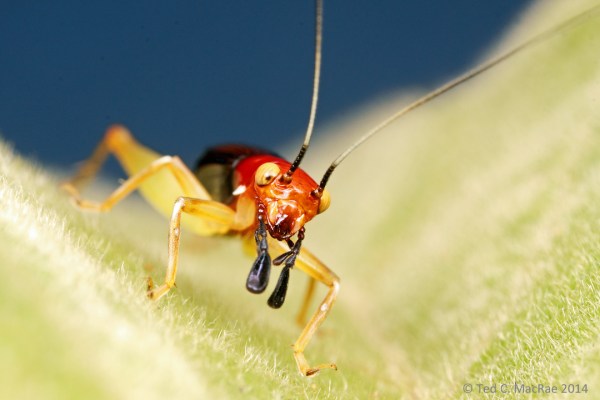
The greatly expanded palps are thought to mimic beetle mandibles or spider pedipalps.

Phyllopalpus pulchellus Uhler, 1864 | Hickman Co., Kentucky

From My, what busy palps you have! (posted September 2). I’ve become quite fond of insect photos with the subject “peering” at me, the photographer”, from some unusual vantage point. The “pupils” in the eyes of this red-headed bush cricket give the insect an almost quizzical look.


Acmaeodera immaculata Horn, 1881 | vic. Vogel Canyon, Otero Co., Colorado.

Acmaeodera immaculata Horn, 1878 | vic. Vogel Canyon, Otero Co., Colorado.

From Sunset beetles (posted September 30). Taking photos of insects at sunset is a challenging and ephemeral experience—one has only a few minutes to take advantage of the unusual and serene colors it offers, while at the same time trying to determine the best camera and flash settings to use in the rapidly fading light. Of the several that I’ve tried, this one is my favorite because of the softly complimentary colors of the beetle, the flower upon which it is sitting, and the dying orange sky behind it. If I had to choose, I would probably pick this one as my favorite of the year because of the unusual and serene colors.


Megacyllene decora (Olivier, 1795) | Stoddard Co., Missouri

Megacyllene decora (Olivier, 1795) | Stoddard Co., Missouri

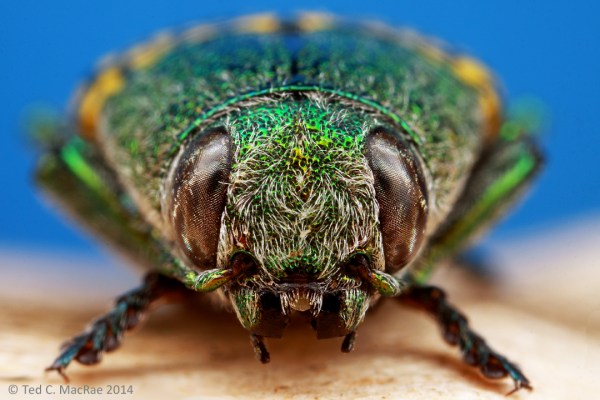
From Amorpha borer on goldenrod (posted October 5). I featured this very same species in Best of BitB 2012 but can’t resist choosing this second attempt at photographing the spectacularly beautiful adult—this time on goldenrod. As with the previous version this is a true in situ field photograph, hand held and using the left-hand technique to achieve precise composition against a clear blue sky—difficult to do with an insect of this size and using a 100-mm lens, but well worth the effort.


Buprestis (Knulliobuprestis) confluenta Say, 1823 | Woods Co., Oklahoma

Buprestis (Knulliobuprestis) confluenta Say, 1823 | Woods Co., Oklahoma

From A Buprestis hat-trick! (posted October 14). I didn’t take near as many of the classic “frontal portraits” this year, but this one of a jewel beetle that had eluded me for more than 30 years until this past June is perhaps my favorite of them all.


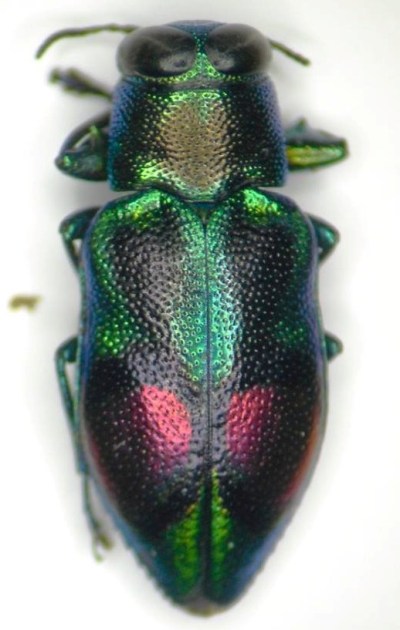
Agrilus concinnus  Horn, 1891 | Stoddard Co., Missouri

Agrilus concinnus Horn, 1891 | Stoddard Co., Missouri

From North America’s Most Beautiful Agrilus Jewel Beetle (posted October 19). There was a time when this beetle was considered one of North America’s rarest species of jewel beetle. Several years worth of hunting by me and others revealed this beetle’s association with mallow and its unusually late adult activity period—the two combining to make this beetle “seem” rare. This year I succeeded in photographing the spectacular adult beetle.


Cacama valvata female ovipositing

Cacama valvata (Uhler, 1888) | Vogel Canyon, Otero Co., Colorado

From Scorching plains, screaming cactus (posted December 5). Insect photos are always better when they also show some aspect of the subject’s natural history. I was lucky to find this female cactus dodger cicada in the act of ovipositing into the dry stem of cholla cactus—in a position where I could get a perfect lateral profile with a clean, blue sky background.


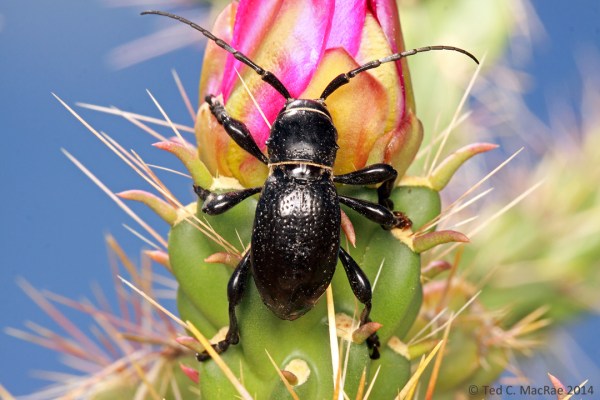
Moneilema armatum LeConte, 1853 | Vogel Canyon, Otero Co., Colorado

Moneilema armatum LeConte, 1853 | Vogel Canyon, Otero Co., Colorado

From Cactus beetle redux (posted December 20). Cactus beetles can be difficult to photograph, but sometimes they cooperate by nicely posing on a pleasing pink flower bud with a blue sky in the background and the cactus spines forming a nice, fuzzy “halo” around the jet black beetle. There were surprisingly few cactus spines impaled in the control unit of my flash after this photo session.


I hope you’ve enjoyed this 2014 version of “Best of BitB” and look forward to seeing everyone in 2015.

Copyright © Ted C. MacRae 2015
Two endemic Jamaican jewel beetles: one known, one not?

I recently received a batch of jewel beetles from Enrico Ruzzier of Italy. It was an impressive sending (as is any sending of jewel beetles!) collected from diverse parts of the world, but what really caught my eye were two specimens he had collected earlier this year in Jamaica—both representing species in the genus Chrysobothris. Most members of this genus are moderate-sized in relation to other species in the family, but at only 5 and 6 mm in length the two specimens I received are downright tiny. They also are extraordinarily pretty compared to most species in the genus by virtue of their striking patterns of metallic green, red, and blue to violaceous colors! Even more interesting, however, was their West Indian provenance. This “biodiversity hotspot” enjoys not only high species diversity but also high species endemism as a result of the 7,000+ islands that comprise it. This is especially true for Jamaica, where my records indicate that 64% of the known jewel beetle fauna (16 of 25 species) occurs nowhere else.

One of the specimens was easily identifiable as Chrysobothris quadrimaculata (Fabricius, 1776) because of the transverse green, violaceous, and reddish-cupreous bands on the pronotum and metallic green “cross” on the elytra separating four large violaceous spots, each with a reddish-cupreous central area (Fisher 1925). This species has so far been found only in Jamaica and appears to be uncommon in collections. As far as I can tell, the only illustration of the species is a 224-year old drawing appearing in Olivier (1790)¹. Considering this and the extraordinary beauty of this little beetle, it seems appropriate to post a photo here (sent to me by Enrico in his initial query regarding its identity).

¹ This early landmark taxonomic publication is occasionally offered for sale by rare book dealers at asking prices that run in the thousands of dollars! Fortunately, the National Library of France has made a pdf of the book available for free download.

Chrysobothris quadrimaculata (Fabricius, 1776)

Chrysobothris quadrimaculata (Fabricius, 1776). Photo by Enrico Ruzzier.

The second specimen, even smaller but no less pretty than the first, has defied all attempts at identification. It does not key out in Fisher (1925) and clearly differs from the four species and one subspecies known to occur in Jamaica (all of which are endemic). Further comparison with descriptions of all known West Indian species also fails to turn up a match. Considering this and the fact that many West Indian Chrysobothris seem to be quite rare in general (Maier & Ivie 2012), I would not be surprised if this specimen turns out to represent yet another (and as yet undescribed) endemic species for Jamaica. I am hopeful (although not optimistic) that posting a photo here (also provided by Enrico Ruzzier) will prompt those with West Indian material in their collections to examine their holdings and see if any additional specimens can be located.

Chrysobothris n. sp. ex Jamaica

Chrysobothris n. sp.? Photo by Enrico Ruzzier.

REFERENCES:

Fisher, W. S. 1925. A revision of the West Indian Coleoptera of the family Buprestidae. Proceedings of The United States National Museum 65:1–207 [BioDiversity Heritage Library, BioStor].

Maier, C. A. & M. A. Ivie. 2013. New species and records of Chrysobothris Eschscholtz (Coleoptera: Buprestidae) from Montserrat, Saba, and Anguilla, with a key to the Chrysobothris thoracica species-group in the West Indies. The Coleopterists Bulletin 67(2):81–88 [BioOne].

Olivier, A. G. 1790. Entomologie, ou histoire naturelle des insectes, avec leurs caractères génériques et spécifiques, leur description, leur synonymie, et leur figure enluminée. Coléoptères. Tome 2, genera 9–34 (32. Bupreste), pp. 1–485, 63 plates, Baudouin, Paris [Bibliothèque nationale de France].

© Ted C. MacRae 2014

First internet image of Phaenops piniedulis

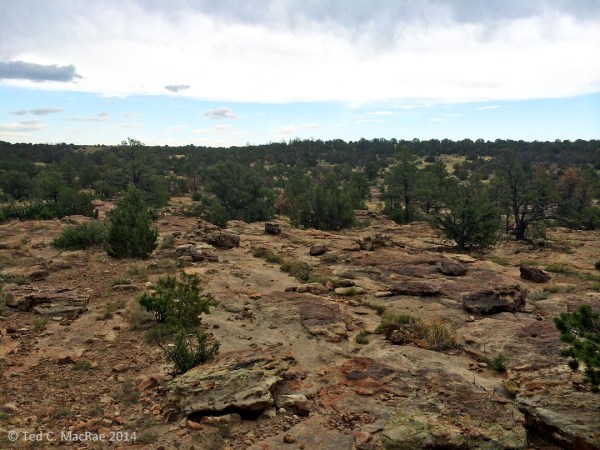
During last June’s collecting trip through the western Great Plains, we stopped at an interesting spot in northeastern New Mexico near the small town of Mills (Harding Co.). Mills itself sits smack dab in the middle of expansive shortgrass prairie; however, a few miles to the west the flat terrain gives way to a rugged, boulder-strewn sandstone canyon harboring oak-pine-juniper woodland. Welcome to Mills Canyon, which descends almost 1,000 feet to the Canadian River below.

Oak/juniper woodland at Mills Canyon, habitat for Prionus heroicus.

Oak-pine-juniper woodland near Mills Rim Campground, Harding Co., New Mexico.

Our quarry for the trip was longhorned beetles in the genus Prionus, especially those associated with grasslands in the central U.S., and while searching the area for suitable grassland-Prionus habitat we chanced upon this spot. Though not the grasslands we were searching for, the area looked interesting enough that we decided to stop and do a little beating. We were immediately rewarded with several interesting finds and decided to come back the next day when we had more time to spend. That was a good decision, as apparently the timing was perfect and we collected perhaps a dozen or more species of jewel and longhorned beetles.

Phaenops piniedulis on Pinus sp. | Mills Rim Campground, Harding Co., New Mexico.

Phaenops piniedulis on Pinus edulis  | Mills Rim Campground, Harding Co., New Mexico.

Perhaps the most interesting of the day’s catch was a single individual representing the jewel beetle Phaenops piniedulis. Though widespread across the southwestern U.S. (records exist from Arizona, California, Colorado, Nevada, New Mexico, Oregon, Utah, and Texas), it is nevertheless only rarely encountered, often no more than a few individuals at a time. As the name suggests, the species was originally associated with pinyon pine (Pinus edulis) (Burke 1908), although it has also been reared from California foothills pine (P. sabiniana), Jeffrey pine (P. jeffreyi), and single-leaf pinyon (P. monophylla) (MacRae & Nelson 2003). The species is distinguished from other several other North American species in the genus by the large yellow maculations that cover more than 50% of the elytral surface (Sloop 1937). These beetles are closely related to the so-called “fire beetles” of the genus Melanophila, the latter famous for their attraction to the smoldering and even still-burning wood of forest fires. However, Phaenops lack the large heat-sensing pores found on the metathorax of Melanophila and, thus, do not exhibit such behavior.

The photo above is not a true field photo, as I encountered the beetle on my beating sheet after whacking a dead pinyon pine branch. Rather than risking escape, I popped it into a vial for safekeeping and later that evening (when it was cooler) placed it on a pinyon twig for photographs. Even then it was still rather active, and the photo shown here is really the only decent photograph I obtained of the beetle. This turns out to be a rather significant photo, for as far as I can tell it is the only photograph of the species—live or dead—to be found on the internet!

REFERENCES:

Burke, H. 1908. A new buprestid enemy of Pinus edulisProceedings of the Entomological Society of Washington 9(1–4):117–118 [Google Books].

MacRae, T. C. & G. H. Nelson. 2003. Distributional and biological notes on Buprestidae (Coleoptera) in North and Central America and the West Indies, with validation of one species. The Coleopterists Bulletin 57(1):57–70 [pdf].

Sloop, K. D. 1937. A revision of the North American buprestid beetles belonging to the genus Melanophila (Coleoptera, Buprestidae). University of California Publications in Entomology 7(1):1–19.

© Ted C. MacRae 2014

I got Thomas Shahan to image my Chrysochroa corbetti!

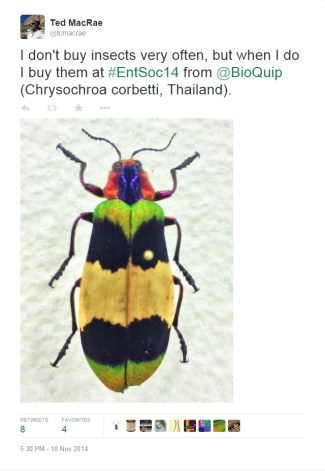
Chrysochroa-corbetti-TwitterThose who follow me on Twitter know that I attended Entomology 2014 last month in Portland, Oregon. As with other scientific conferences, live tweeting of the talks and associated events was all the rage. I may not have been the most prolific “tweeter”, but I did do my share, and one of my tweets involved a rather spectacular preserved specimen of the jewel beetle, Chrysochroa corbetti. The quick iPhone snapshot attached to the tweet was sufficient to prove that the beetle is pure eye candy, but still it did not do full justice to its stunning beauty:

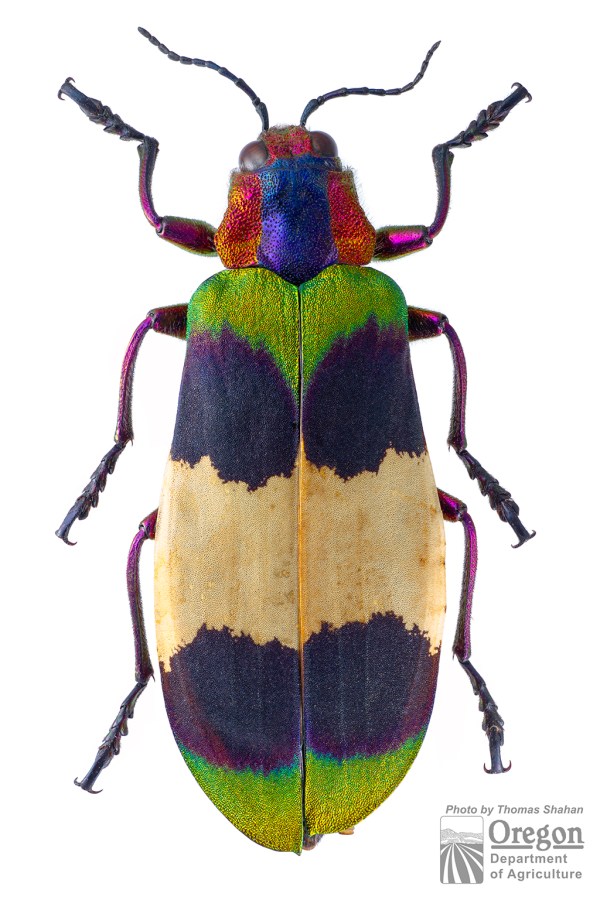
Fortunately, while I was at the meetings I ran into Thomas Shahan—already an icon among insect macrophotographers for his seemingly impossible portraits of jumping spiders, tiger beetles, and other insects. I had planned to spend a couple of days in Salem after the meetings to visit my friend and longtime buprestophile Rick Westcott. As it happens, Thomas is currently a Digital Imaging Specialist at the Oregon Department of Agriculture where Rick spent his entire career as an entomologist. When I showed my specimen to Thomas, he kindly agreed to make some focus-stacked images of the specimen using his lab’s photographic setup. I think you can now agree that this is one of the most spectacular jewel beetles around, and I think you’ll also agree that these images by Thomas are perhaps the most stunning of this oft-photographed species. Be sure to check out the last photo—a 10× close-up of the dorsal elytral detail at the interface between the green and blue areas. Simply stunning!

Chrysochroa (Chroodema) corbetti (Kerremans, 1893) | Thailand

Chrysochroa (Chroodema) corbetti (Kerremans, 1893) | Thailand

Chrysochroa corbetti lateral view

Chrysochroa corbetti lateral view

Chrysochroa corbetti ventral view

Chrysochroa corbetti ventral v

Chrysochroa corbetti dorsal elytral detail (10X)

Chrysochroa corbetti dorsal elytral detail (10X)

© Ted C. MacRae 2014