La Reserva Ecologica Costanera Sur

Reserva Ecológica Costanera Sur, Buenos Aires, Argentina.

I spent this past weekend in Buenos Aires, Argentina before embarking on a one-week whirlwind tour to visit field sites in several other parts of the country.  It was supposed to be a short rest stop, but I can do nothing of the sort when there are exotic lands to explore.  Despite its rank as the fourth largest city in South America and the location of my hotel in the heart of downtown, only a short walk was needed to arrive at Reserva Ecológica Costanera Sur, a 350-hectare park located on the banks of the Rio de la Plata.  Originating as a debris field from construction during the 1970s, sedimentation and subsequent revegetation have created a naturalistic setting reminiscent of the original wet Pampas grasslands that occurred in the area.

A system of levees with trails courses through the wet grasslands.

Coursing through the area is a system of levees topped with gravel walking/biking trails that have become flanked with woody vegetation.  Native species such as ceibo (Erythrina crista-galli) and palo borracho (Chorisia speciosa) are common, although exotics such as Canary palms (above photo) have also become established.  In total, more than 11 km of trails are available, and having as much time as I desired on Sunday to explore the area, I walked every one of them once (and some twice) for a total hike of close to 15 km (not counting my morning walk to the area and then back to my hotel during late afternoon).  I wouldn’t say the area was teeming with insects, and those that I did encounter are not too dissimilar from those I am more familiar with in North America.  However, this is the southern Neotropics, so just about everything I encountered was something I had not seen before.  I went photography-crazy, snapping more than 250 shots on the day (and keeping about 100).
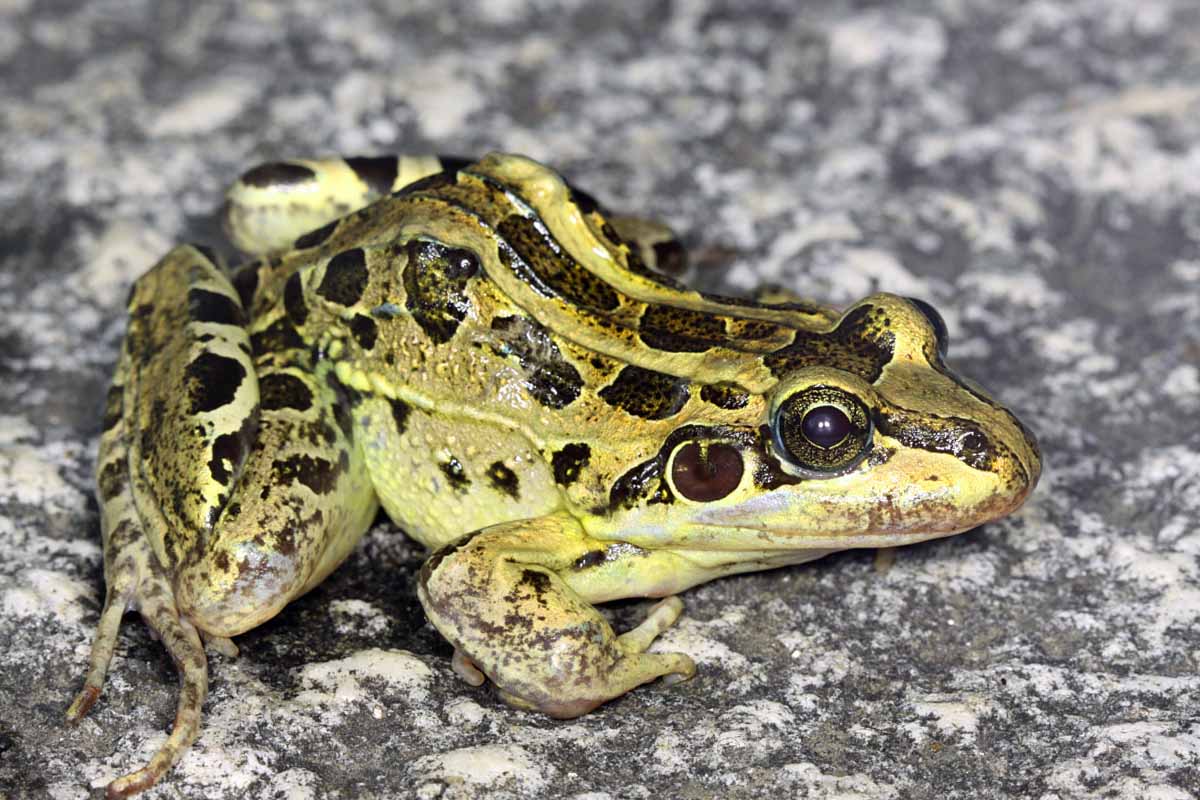
Leptodactylus ocellatus (rana criolla).

This frog was the first thing I encountered, even before walking through the Reserve gates.  Using the galleries at this fan site I believe it to represent Leptodactylus ocellatus (rana criolla, or “Creole frog”).  He was a sad sight when I first saw him – dry and dusty on the sidewalk outside of the Reserve.  I passed him by at first thinking he must be dead, then came back when my conscious started complaining, only to find him still alive.  I bathed him in water from my bottle, which perked him up rather quickly (not to mention making him much more photogenic!).  After a few photos, he revived sufficiently to jump off the stone wall bordering the Reserve into the grassy marsh.  I had done my good deed for the day.

Leptodactylus ocellatus (rana criolla) - my attempt at a natural light closeup.

Parabuteo unicinctus unicinctus (Gavilán Mixto) (I think!).

Also just before entering the Reserve gates, I scared up this hawk who flew a short distance ahead and landed on a post facing me.  Now, I have never once in my life attempted to photograph a bird, and with my longest lens being only my 100mm macro I’m ill-equipped for such even if I wanted to.  However, the hawk did not fly too quickly as I cautiously re-approached, and when I was within range I decided to give it a try.  I carefully crouched to ready my equipment and then cautiously rose to take a shot, and right then the hawk decided to take off.  Not a great shot, of course, but not bad either – especially for a first bird shot ever, and good enough to give me some amount of confidence in my ID as Parabuteo unicinctus (Gavilán Mixto, or “Mixed Hawk” – known in the U.S. as Harris’ Hawk).

Riodina lysippoides (Danzarina Chica)

Insect activity was rather light for the first couple hours after I arrived, but as the day began to heat up so did the number and diversity of the insects that I encountered.  While I waited for activity to pick up, I saw this pretty little butterfly that seemed surely a type of metalmark (family Riodinidae) and that I later identified as Riodina lysippoides (Danzarina Chica, or “Smaller Dancer”).  Shortly after taking this photo, I encountered another photographer who was obviously after insects.  I approached him and introduced myself to see what he was looking for, and it was butterflies.  I showed him my photo, but he did not know the name of the butterfly, only commenting that it was “bastante común” (common enough).  I’m confident in my ID, but this North American beetle collector won’t be too embarrassed if one of you lepidopterists needs to provide a correction.  I did see one other photographer that day as well, presumably after birds based on the yard-long lens he was carrying, but I did not talk to him.  Otherwise, I got plenty of strange looks from the hordes of walkers, runners, bikers, and picnickers that had come out to enjoy this Carnival weekend Sunday!

Copyright © Ted C. MacRae 2011


Rain Over Campinas, Brazil

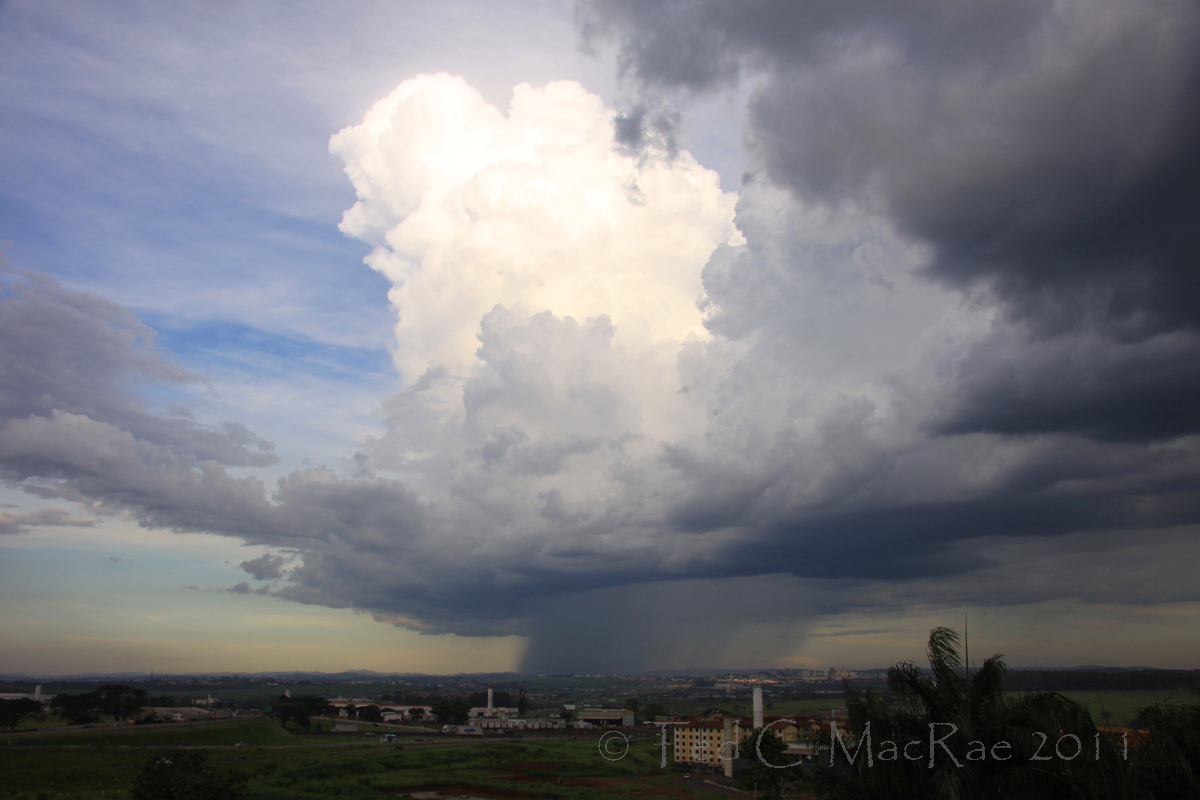
It has rained every day in Campinas, Brazil since I arrived here earlier this week.  Clear morning skies give way to towering cumulus clouds as the heat and humidity build, releasing their torrents by mid afternoon.  Today brought a small respite from this pattern, with the day staying sunny and only scattered thunder showers moving across the landscape by early evening.  This view from my hotel room shows one such shower directly over the city of Campinas.

Copyright © Ted C. MacRae 2011

Calm waters, frenzied beetles

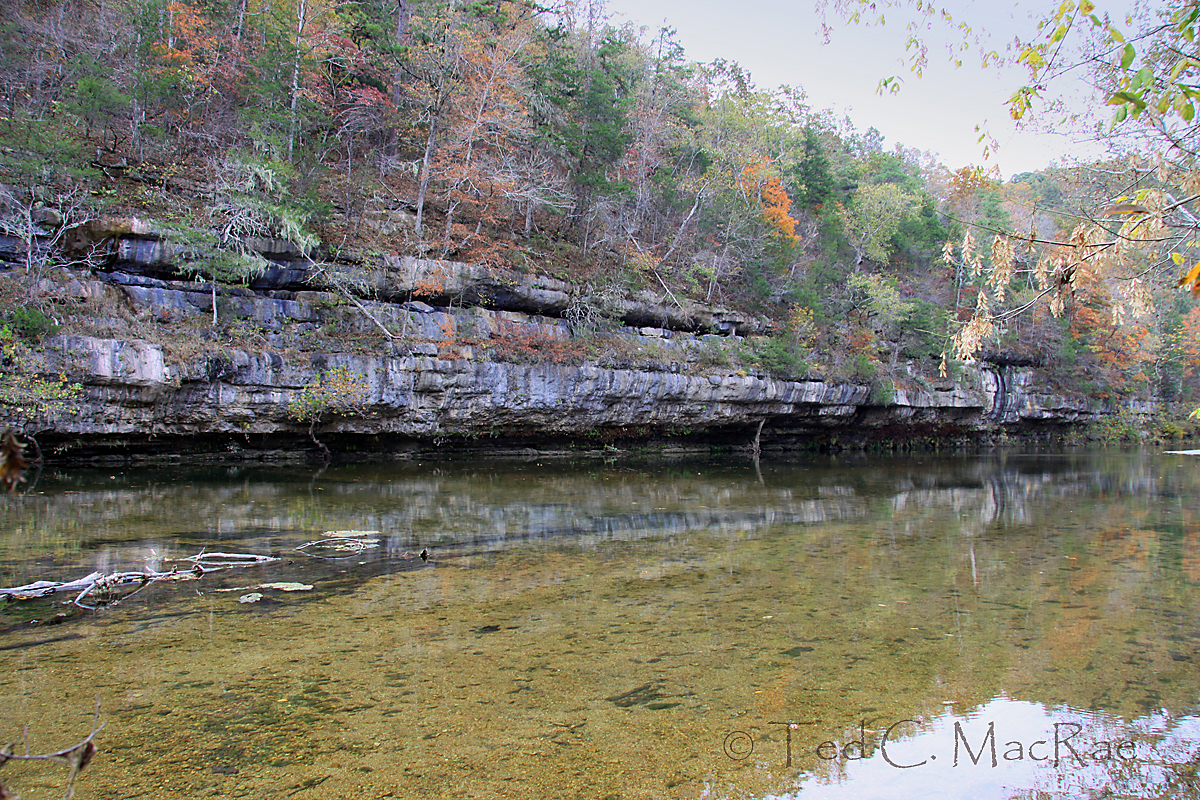
North Fork River - Ozark Co., Missouri

The North Fork River in south-central Missouri, like most Ozark rivers and streams, flows clear and cold over gravelled bottoms. Sustained year-round by the numerous seeps and springs that result from the region’s unique Karst geology, it meanders through a mix of forest and woodland alongside massive bluffs of half-a-billion-year-old dolomite. While small rapids can be found where gravel bars approach the bluffs, for the most part the shallow waters course lazily and idyllically south toward the White River in northern Arkansas.

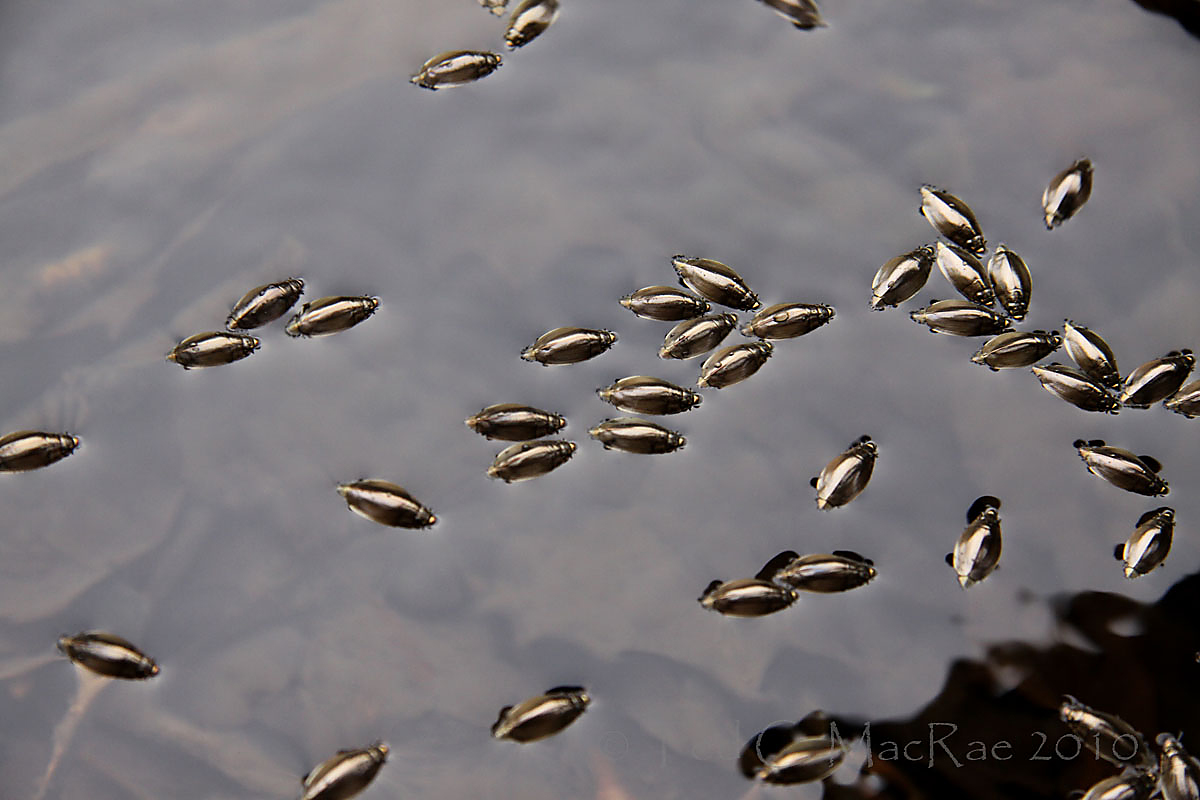
Dineutus sp. (poss. discolor, per Brady Richards)

Lazy waters are the domain of whirligig beetles (family Gyrinidae).  We encountered this ‘raft’ of beetles in a sheltered pool near the shore of the North Fork River while hiking the Ozark Trail last October.  These frenzied little beetles live almost exclusively on the surface of the water, where they feed on organisms or scavenge debris in their famously and erratically conspicuous aggregations.  Such behavior might make them seem vulnerable to predation, but in actuality the reverse is true.  Beetles in rafts benefit from the increased number of eyes that can better scan the environment for potential threats than can individual beetles (Vulinec and Miller 1989), and the larger the raft the more efficiently this occurs.  There is also evidence that the appearance of the rafts themselves is a signal to warn potential predators (primarily fish) of the noxious chemicals produced in the beetles’ paired pygidial glands (Ivarsson et al. 1996), despite the decidedly non-aposematic coloration of the beetles themselves.

Photo Details: Canon 50D w/ 17-85mm zoom lens, natural light. Photo 1 – 17mm, ISO 100, 1/25 sec, f/5.6; photo 2 – 85mm, ISO 500, 1/160 sec, f/5.6. Typical post-processing (levels, minor cropping, unsharp mask).

REFERENCES:

Ivarsson, P., B.-I. Henrikson and J. A. E. Stenson.  1996.  Volatile substances in the pygidial secretion of gyrinid beetles (Coleoptera: Gyrinidae).  Chemoecology 7(4):191–193.

Vulinec, K. and M. C. Miller. 1989. Aggregation and Predator Avoidance in Whirligig Beetles (Coleoptera: Gyrinidae). Journal of the New York Entomological Society 97(4):438–447.

Copyright © Ted C. MacRae 2011

The 12 Years of Christmas

This post first appeared on Beetles in the Bush on Christmas Day 2008. Two years have passed, but the sentiment remains stronger than ever. I reprint it here as BitB‘s single evergreen post. Merry Christmas!

p1020457_2

Merry Christmas - from our backyard to yours!

They came from completely different backgrounds. She had grown up in a middle class family, her father an educated professional, her mother a professional homemaker – “Ward and June”, as their now-grown children jokingly call them. He grew up on welfare, the family breaking up while he was still in elementary school. She was a popular student – cheerleader, debate team, gymnastics. He was the introverted science nerd, invisible to the popular, living quietly with his books. Religion was an important part of her life, growing up Catholic and remaining devoted to the church. He grew up Catholic but knew even as a child that religion would not provide the answers he was looking for, eventually finding a private spirituality in the Creation itself.

Despite these separate paths they found each other and fell in love, and despite their different lives they both wanted the same thing – a family. Such a simple desire, however, would prove to be difficult to achieve. When fertility drugs didn’t work, they turned to adoption. The first match failed. So did the second. They understood completely how the birth mothers could change their minds, but that didn’t ease their pain or calm their fears. Ultimately, they looked to Russia, a new democracy with old attitudes about orphans. In the fall of their 6th year of marriage, they learned that little Anastasia was waiting for them. They traveled to Russia before Christmas and became a family after New Years. In between, they visited little Anastasia every day – one hour at a time – and experienced the joy of being a parent, a feeling they had feared would ever elude them. On Christmas Day, they could not see little Anastasia, but in a small, gray apartment on the outskirts of Moscow, they celebrated her coming with their gracious host family. Ten days later, their family was born, and twelve months later they celebrated their first Christmas together at home.

Christmas meant little to me for much of my life. Yes, it was a time to relax and enjoy the company of family and friends, and the presents were nice. But my own approach to spirituality has little in common with traditional reflections of the season. Tonight, as I watched 12-year old Mollie Anastasia laughing with her cousins, hugging her nanny and papa, and teasing her uncle and his partner, I thought back to those cold, snowy days in Russia when my heart became warm for the first time. I recalled our second trip to Russia six years later, when she and little Madison Irina each met their sister for the first time. On this Christmas Day, as I have done for 12 years now, I thought about how lucky we are to have these two beautiful little girls that are unquestionably our own. Christmas means a lot to me now, and that is a gift that not even five golden rings could beat.

Copyright © Ted C. MacRae 2010

Monroe Canyon – A Tiger Beetle “Hot Spot”

Steep, sparsely vegetated, fine sand road cut on the Nebraska Pine Ridge escarpment.

The vast landscape surrounding the Nebraska Pine Ridge boasts two entirely different natural communities – the High Plains shortgrass prairie atop the ridge stretching endlessly to the south, and the eerie, desolate Badlands on the north side of the ridge extending to the Black Hills of South Dakota.  Separating these two distinctive communities is the Pine Ridge escarpment itself – a precipitous 1,400-ft drop whose ponderosa pine forests and sage brushlands are more reminiscent of the Rocky Mountains some distance to the west rather than the Great Plains that surround them.  Instead of hard igneous and metamorphic rocks, however, the Pine Ridge is composed of soft, erodable sand- and siltstones, giving rise to canyons with dramatic white bluffs and escarpments.  One of the more scenic of these is Monroe Canyon, located six miles north of the tiny town of Harrison and part of the Gilbert-Baker State Wildlife Management Area.  I first explored Monroe Canyon two years ago, when Matt Brust took me there after our successful quest to see Cicindela nebraskana (prairie long-lipped tiger beetle) in the prairies above.  The steep, eroded road cuts in Monroe Canyon had become one of Matt’s favorite spots to look for tiger beetles, but on our visit there was not much going on save for single individuals of the ubiquitous sand-loving species Cicindela formosa (big sand tiger beetle) and Cicindela scutellaris (festive tiger beetle).  Still, the fine, deep, sparsely vegetated mixture of sand and silt extending far up the embankment is classic tiger beetle habitat, so when Chris Brown and I returned to the area this past September, we decided to give Monroe Canyon another try.

Of the several sand-associated tiger beetles that I thought we might encounter here, Cicindela lengi (blowout tiger beetle) was the one I was really hoping for.  I had encountered a few scarce individuals of this C. formosa-look alike during my 2008 trip and eventually reared another individual from suspected larvae plucked from their burrows.  My only photographs of this species, however, were taken during my PNS days, and I longed to see them once again through the viewfinder of a proper macro-rig.  The day hadn’t started well, getting skunked at a clay bank site in Crawford on the way to Monroe Canyon (where I resorted to photographing itty bitty little moths), and early indications once we got to Monroe Canyon were that it was going to be slow there as well.  Sporadic sightings of Cicindela purpurea audubonii (Audubon’s tiger beetle) had me yawning, and a lone individual of the remarkably infidel Cicindela ubiquita [= C. punctulata] (punctured tiger beetle) seen close to the roadside did little to boost my enthusiasm.  Still, conditions just seemed “right” and the habitat was extensive enough that it deserved a thorough searching before passing judgement.  I got a little more excited when I encountered a few C. purpurea audubonii black morphs, of which I got my first nice field photographs (you’ll see these in a future post), and then spent some time staking out larval burrows for attempted photographs.  We ended up spending a couple of hours at the site without seeing anything remarkable, but by then it was early afternoon and there was little point in trying to find another locality to search – it was a gorgeous spot on a gorgeous day, and just being out there was almost reward enough.  (I’m guessing by now you see where this is going…)

Cicindela lengi - blowout tiger beetle

As I began my umpteenth pass along the lower stretch of the embankment, I heard Chris call out, “I’ve got it!”  Chris hadn’t previously seen this species, so I fully expected when I walked over to where he was standing that I would find instead the much more common and amazingly similar C. formosa.  However, when I spotted the adult as he pointed to it, there was no doubt – the longer, obliquely straight humeral lunule (shoulder marking), the slightly more cylindrical, parallel-sided body, the more extensive brilliant green marginal highlights on the head and pronotum – it was, indeed, C. lengi!  The close resemblance of C. lengi to C. formosa is not the result of a close relationship, but rather an example of convergent evolution in response to similar habitat.  Cicindela lengi is actually more closely related to C. tranquebarica (oblique-lined tiger beetle) and other species formerly placed in the now defunct subgenus Tribonia.  As the first finder, Chris had first photo honors as well while I stood back, ready with the net should it spook and become uncooperative.  It did make a few short escape flights at first, but as I’ve learned before this species tends to make very short, weak flights before dropping straight down, making it rather easy to follow even on the steep embankment that we found ourselves.  This contrasts with C. formosa, whose long, powerful escape flights and bouncing tumbles upon landing can make them difficult to follow.  Eventually it became accustomed to our presence, and after Chris was satisfied with his photographs it was my turn.  We then we took turns again just to make sure we really got the shots we wanted.

Cicindela lengi - note the obliquely straight humeral lunule and relatively narrow, parallel-sided body.

It’s a good thing we didn’t pull the plug on Monroe Canyon that day, as tiger beetle activity really picked up during the afternoon hours.  Not only did we end up seeing several individuals of C. lengi during the next couple of hours, but also a few individuals of C. formosa and C. scutellaris and a single, seemingly misplaced Cicindela denverensis (green claybank tiger beetle), more fond of clay substrates than sand) – making Monroe Canyon a veritable “hot spot” of tiger beetle diversity.  While Monroe Canyon may not equal Willcox PlayaLaguna del Perro, Salt Plains National Wildlife Refuge, or Florida’s Road to Nowhere, six species is still a respectable amount of diversity by any measure, especially for a dry, upland site (all of the other sites mentioned are lowland saline habitats that owe their tiger beetle diversity at least in part to their broad range of available moisture zones).  After two days in the field, our trip total now stood at ten species, and in retrospect we were lucky to see C. lengi when we did as our subsequent search of the C. lengi spot 4 miles east of Harrison later that day turned up nothing.

Brilliant green highlights contrast spectacularly with the red body and bold white markings.

Copyright © Ted C. MacRae 2010

Rejoicing the end of summer

Russet browns of big bluestem (Andropogon gerardii) and Indian grass (Sorgastrum nutans) blend with still-green foliage in early autumn at White River Balds Natural Area in southwestern Missouri.

Last week I awoke to refreshingly cool temperatures for the first time in a long time – a brutal heat wave that had gripped the Midwest for some time had finally (if only briefly) passed. Missouri typically experiences substantial heat and humidity during the height of summer, a result of warm, moisture-laden air sweeping up from the Gulf of Mexico and over our mid-continental position.  The first cool snap in mid-August, however, usually marks the beginning of the end of protracted heat. High temps may return (and usually do), but they are intermittent and the writing is on the wall – summer’s end is near, and fall is on its way! For most of my life, the coming of fall has always been something to which I looked forward eagerly – it really is my favorite time of year.  I don’t just love fall, I adooore it!!!  As a result, I sometimes forget that not everyone shares my feelings, so when I mentioned to a colleague last week how excited I was that fall was on the way, I was a little surprised by her less-than-pleased reaction. Kids I can understand –  fall means a return to school and the end of fun and sun and no responsibilities.  However, for most adults, fall does not entail as dramatic a paradigm shift – we get up and go to work everyday regardless of the season. Indeed, to my colleague, fall was not dreaded so much for what it is but what it portends – winter! I convinced myself that if she was as interested in natural history as I, surely she would appreciate fall as a time of transition in the natural world.  This logic proved faulty, however, when just a few days later one of my favorite entomologist/natural historian bloggers voiced a similar lamentation.

Xeric calcareous prairie (''cedar glade'') in southwestern Missouri - habitat for Cicindela obsoleta vulturina.

That the charms of fall are not immediately apparent to everyone is beyond me.  Who in middle America doesn’t rejoice the end of long, sweltering days as they cede to the cool days of fall?  Who dreads the crisp, clean, autumn air and its pungent, earthy aromas?  Who doesn’t marvel as they watch the landscape morph from summer’s monotonous shades of green – its forests becoming a riot of red, orange, and yellow, its grasslands a shifting mosaic of tawny, amber, and gold, and in all places shadows cast long and sharp by a cool yellow sun riding low in a deep blue sky?  For the natural historian, fall offers even more than just these sensory gifts – it’s not the end of the season, but rather part of a repeating continuum that includes birth, growth, senescence and quiescence.  Plants that have not yet flowered begin to do so in earnest, while those that have shift energy reserves into developing seeds.  The spring wildflowers may be long gone, but only now do the delicate blooms of Great Plains Ladies’-tresses orchids rise up on their tiny spires.  Grasses also, anonymous during the summer, now reach their zenith – some with seed heads as exquisite as any summer flower.  Insects and other animals step up activity, hastily harvesting fall’s bounty to provision nests or fatten their stores in preparation for the long, winter months ahead.

Gypsum Hills in south-central Kansas. Habitat for Cicindela pulchra.

For myself, it is tiger beetles that are fall’s main attraction.  Yes, tiger beetles are out during spring and summer as well, but there is something special about the fall tiger beetle fauna.  Glittering green, wine red, and vivid white, a number of tiger beetles make a brief appearance in the fall after having spent the summer as larvae, hidden in the ground while feeding on hapless insects that chanced too close to their burrows, until late summer rains triggered pupation and transformation to adulthood.  As the rest of the nature prepares for sleep, these gorgeous beetles take their first, tentative steps into the autumn world for a brief session of feeding and play before winter chases them back underground for the winter.  Every fall for the past several years now, I have looked forward to the annual fall tiger beetle trip to see some of the different species and the unique landscapes which harbor them.  From the “cedar glades” of Missouri’s Ozark Highlands and Gypsum Hills of south-central Kansas, to the Sandhills of central Nebraska and Black Hills of South Dakota, I’ve acquired an even greater passion for a season that I already loved.  I’ll never forget the first time I saw Cicindela pulchra (beautiful tiger beetle) flashing iridescently across the barren red clay.  I still remember the excitement of seeing my first C. obsoleta vulturina launching itself powerfully from amongst the clumps of big bluestem. I recall my amazement at my first encounter with C. limbata (sandy tiger beetle) as it danced across deep sand blows, undaunted by scouring 30 mph winds.  No doubt I have many equally vivid memories awaiting me in the future, as I intend to keep the annual fall tiger beetle trip a long-standing tradition.  For this year, I’m hoping that C. pulchra and a few other species will reward a late-September drive to the Nebraska and South Dakota Badlands.  Whether they do is almost irrelevant – I love fall, and the chance to see new localities during my favorite time of year will be reward enough.

Copyright © Ted C. MacRae 2010

The marvelously monstrous Microstylum morosum

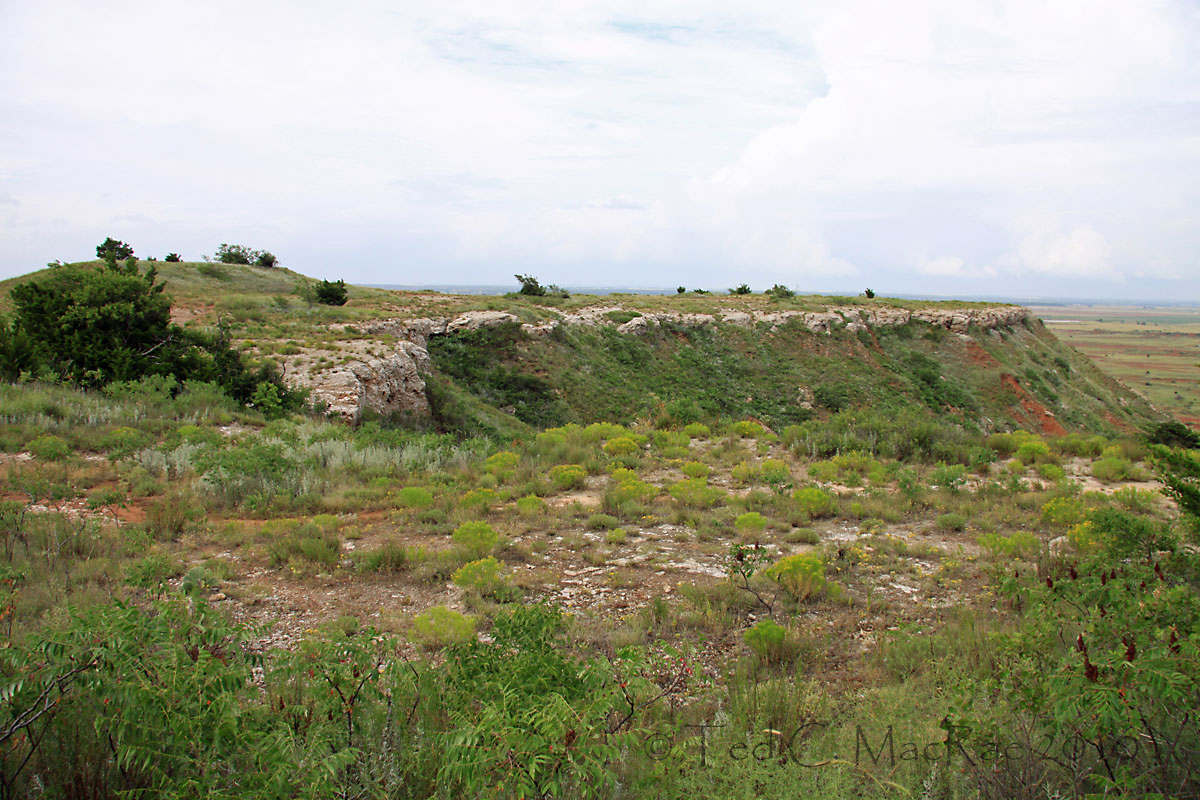
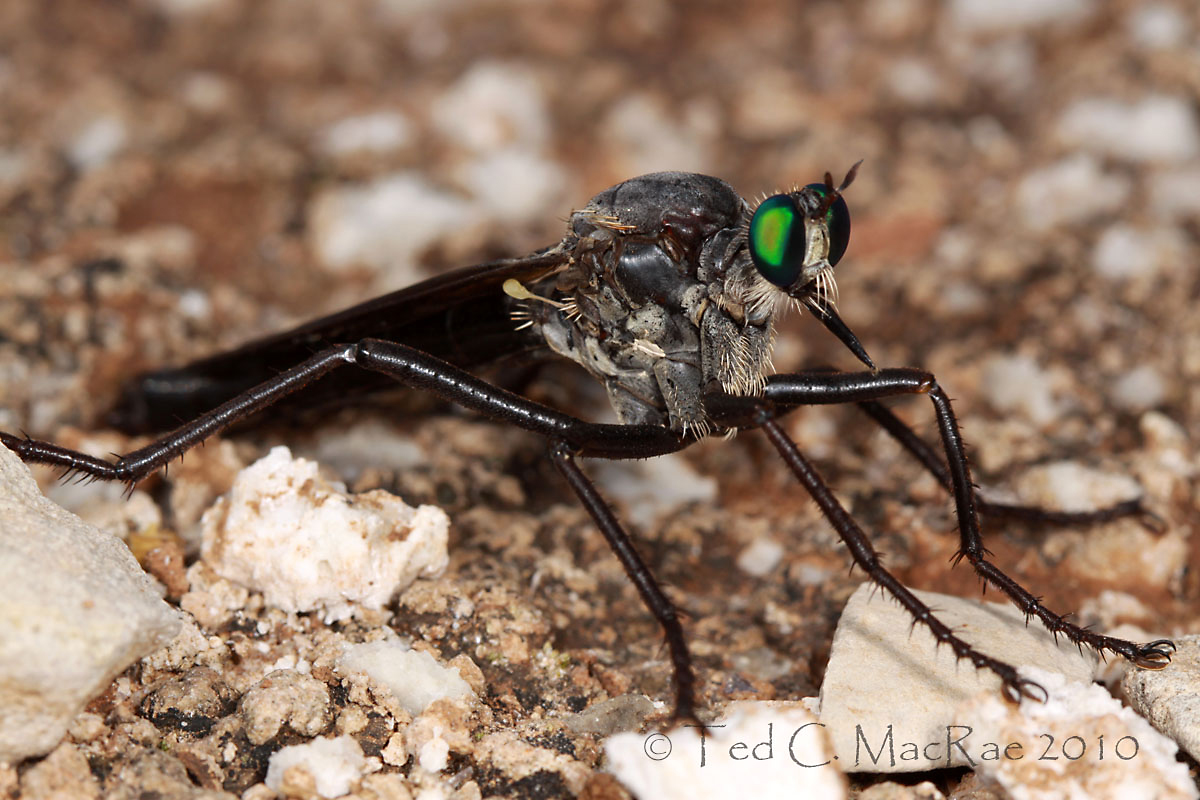
A few weeks ago, while waiting to begin my nocturnal hunt for the Great Plains giant tiger beetle (Amblycheila cylindriformis) in northwestern Oklahoma, I spent the daytime atop one of the red flat-topped mesas that meander through the area in nearby Gloss Mountain State Park.  Although my trip was all about seeing this giant of a tiger beetle in the wild for the first time (I could hardly wait for dusk to begin my search), I found enough splendid insects of other types atop the mesa to occupy my interest until that time.  One of these was the still-robust population of the Swift Tiger Beetle (Cylindera celeripes) that I discovered last summer and delighted in photographing yet again, while another was North America’s largest robber flyMicrostylum morosum!  I had just finished photographing one of the tiger beetles near the edge of the mesa when I turned and saw one of these impressively large flies sitting calmly on the ground nearby.

I first encountered this species last year in southwestern Missouri (a new state record!), so there was no question about its identity.  I also remembered how skittish they were and how difficult it was to get even the two mediocre photographs that I included in the resultant post.  Expecting the same, I kept my eye on the ground-sitter while preparing the camera and approached it with extreme caution.  To my surprise, it showed no sign of being alarmed or wanting to take flight.  I crouched down low and marveled at its monstrous impressiveness as I took frame after ever closer frame – eventually zeroing in on the head and its stunningly magnificent emerald-green eyes.

Satisfied that somewhere in the dozen and a half frames that I shot was at least one or two winners, I sat up and probed towards it with my finger to see how quickly it took flight.  It just sat there tenaciously until my touch caused it to finally take wing.  Winds were gusty atop the mesa, which may have accounted for its cooperativeness.  Standing up, I noted a few scattered eastern redcedars (Juniperus virginiana) in the mixed-grass prairie at the highest point of the mesa.  I recalled that robber flies are fond of “hilltopping” – a mating strategy whereby males fly to the highest point in their immediate landscape to defend a small territory or perch that provides a good vantage for spotting females and competing males (see Hilltopping by Eric Eaton at Bug Eric for a good discussion about this) – and my own experience with this species in Missouri and the way it tended to perch in the trees scattered across the upper part of the rocky, dolomite glade where I found them.  I wandered up to the redcedars, and as soon as I came close enough to one of them I saw another individual take flight – looking like some super-sized mosquito with it’s long legs spread wide as it clumsily flew to another tree.  As it turned out, I saw a number of individuals and mating pairs perching and flying among the trees on top of the mesa, each more spectacular than the previous.

Until recently, Microstylum morosum was considered a Texas-endemic.  However, Beckemeyer and Carlton (2000) documented this species to be much more broadly distributed in the southern Great Plains (from Texas up into Oklahoma and Kansas and west into New Mexico, Arizona, and Colorado), and Warriner (2004) recorded it shortly afterwards in Arkansas.  Although the species apparently occurs throughout Oklahoma (Beckemeyer and Carlton recorded from 13 counties across the state), my observation of it in Major County does seem to represent a new county record for the species.  There is another U.S. species in the genus, M. galactodes, and it has also been recorded from Oklahoma (the closest record is in nearby Woodward County).  However, it is easily distinguished by its generally smaller size, milky white wing membranes, reddish-brown body, and head and thoracic dorsum evenly covered with whitish pruinescence, while M. morosum has the wings and body black to brown and thoracic pruinescence restricted to the lateral margins (Beckemeyer and Carlton 2000).  I’m not sure I would have recognized that species for what it was had I seen it, but if it is anywhere near as impressive as M. morosum then I hope I have the fortune to find it someday as well.

Photo Details:
Landscape: Canon 50D w/ 17-85mm wide-angle lens (17mm), ISO 100, 1/100 sec, f/10, ambient light. Typical post-processing (levels, unsharp mask).
Insects: Canon 50D w/ 100mm macro lens, ISO 100, 1/250 sec, f/10 (photo 1), f/18 (photo 2), Canon MT-24EX flash (1/4 ratio) w/ Sto-Fen diffusers. Typical post-processing (levels, minor cropping, unsharp mask).

REFERENCES:

Beckemeyer, R. J. and R. E. Carlton.  2000. Distribution of Microstylum morosum and M. galactoides (Diptera: Asilidae): significant extensions to previously reported ranges.  Entomological News 111(2):84–96.

Warriner, M. D.  2004. First Arkansas record of the robber fly Microstylum morosum (Diptera: Asilidae).  The Southwestern Naturalist 49(1):83–84.

Copyright © Ted C. MacRae 2010

Add to FacebookAdd to DiggAdd to Del.icio.usAdd to StumbleuponAdd to RedditAdd to BlinklistAdd to TwitterAdd to TechnoratiAdd to Yahoo BuzzAdd to Newsvine

Email to a friend