Retrachydes thoracicus – times four!

Disclaimer—these are not great photos!

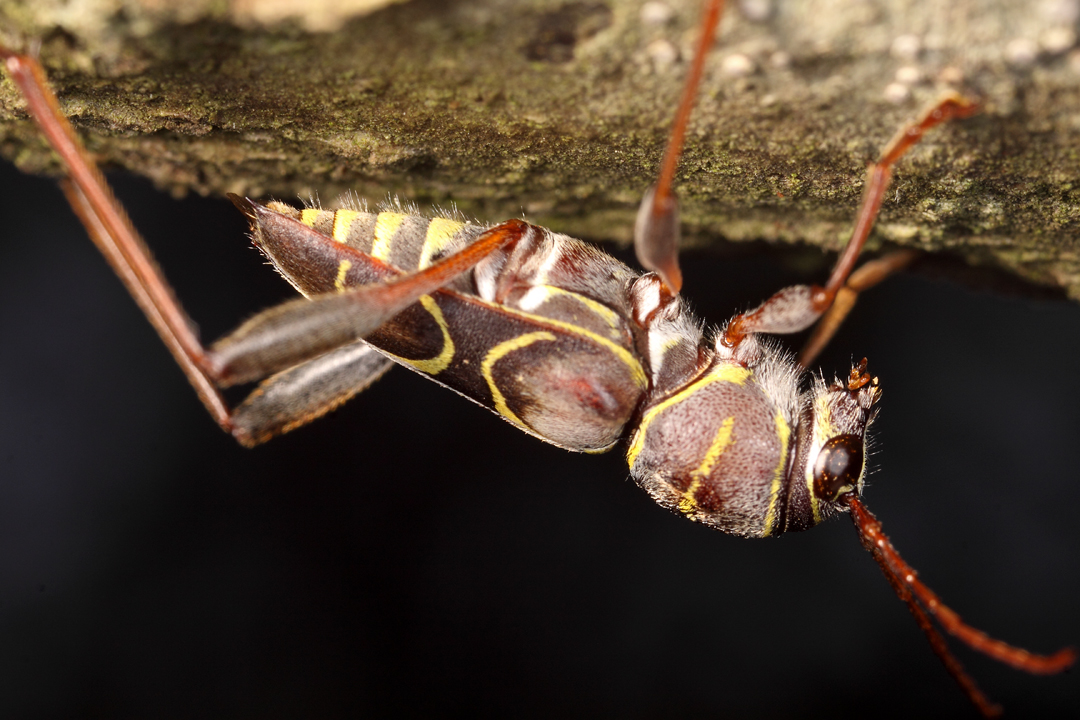
A few days ago I posted this little quip as my status on Facebook: “Cool! Found a Retrachydes thoracicus thoracicus on the sidewalk outside my hotel!” I chuckled a little as I posted it, knowing that only a select few who read it would know what the heck I was talking about (of course, a right click to select “Search with Google” reveals the answer instantly). Of course, it is a species of longhorned beetle (family Cerambycidae) that apparently is found commonly in South America. I wanted to take some photographs of the beetle to show those who didn’t do the Google search just what it looked like. Unfortunately, the beetle was already somewhat moribund when I found it, and no matter how much I coaxed and prodded it on the stick I placed it on, it just looked… well, dumb. Legs out of position, antennae hanging limply, and the beetle itself laying prostrate on the branch, as if it barely had the strength to hang on (which actually was the case). Shame—it sure is an attractive species, with its densely pubescent and transversely gibbous pronotum (obviously the source of its name) and striking orange-banded antennae. C’est la vie!

Lately I’ve been trying to get a better handle on choosing backgrounds when I photograph insects, no longer content with the often busy and distracting backgrounds that show up in photographs taken completely in situ. It’s often a simple matter to hold the object on which the insect is sitting in front of something that gives the desired background effect, and having this perfectly calm yet strikingly attractive beetle to work with seemed to invite experimentation. I’m also trying to get a better feel for how to use higher ISO settings to make it easier to get these various “non-black” backgrounds while still using flash to get acceptable depth of field with the subject itself. Below are four of the better shots that came out of the session (yes—sadly, these are the “better” ones). I’m loathe to go below 1/160 sec exposure because of motion blur and would like to keep aperture settings quite small, so fairly high ISO settings are required to get the background effects I’m looking for. I think I’ve learned that ISO 1000 is about as high as I can go before the background gets unacceptably noisy—at small sizes the photos look fine, but open them up larger size and you’ll see what I mean. Anyway, ignoring the composition and noise issues, which background do you like best?

ISO 1000, 1/160 sec, f/14 - cloudy sky background

ISO 1600, 1/160 sec, f/14 - pavement background (close)

ISO 1600, 1/160 sec, f/14 - pavement background (more distant)

ISO 1600, 1/160 sec, f/14 - pavement background (foliage)

Copyright © Ted C. MacRae 2012

The most common beetle in Argentina

Astylus atromaculatus | Buenos Aires Province, Argentina

I don’t know if this is truly the case, but Astylus atromaculatus (family Melyridae) is one of only a few beetles in the country that actually has two Spanish common names—”astylus moteado” and “siete de oro” (meaning “spotted astylus” and “seven of gold”, both names referring to black splotches on the elytra). It is also the only beetle that I’ve seen everywhere I’ve been in the country—north and south, soybean fields and cornfields, countryside and city. I have yet to visit a soybean field where I don’t see them, perhaps nibbling on a leaf here and there but mostly just mating, and they can be downright overwhelming in cornfields (see this post with photos of the adults dripping from corn tassels, literally!). For all their ubiquity, however, their economic impact seems more nuisance than substantive. Corn breeders complain about interference during tasseling, and larval feeding on seeds during or just after germination seems to be on the rise due to increased use of conservation tillage, but overall this species seems to be more bark than bite.

Copyright © Ted C. MacRae 2012

Memories of summer – Neoclytus scutellaris

Neoclytus scutellaris | 9 July 2011, Wayne Co., Missouri

During the short, cold days of winter it’s nice to take a break from the curatorial activities that dominate the season and look back on some of the insects seen during the previous summer. This is Neoclytus scutellaris, a longhorned beetle associated almost exlusively with dead/dying oaks in the eastern U.S. The species is sometimes confused with the very similar N. mucronatus but is distinguished by the transverse yellow band on the pronotum and its host (the latter being associated with hickory and hackberry).

Copyright © Ted C. MacRae 2011

Something for Adrian

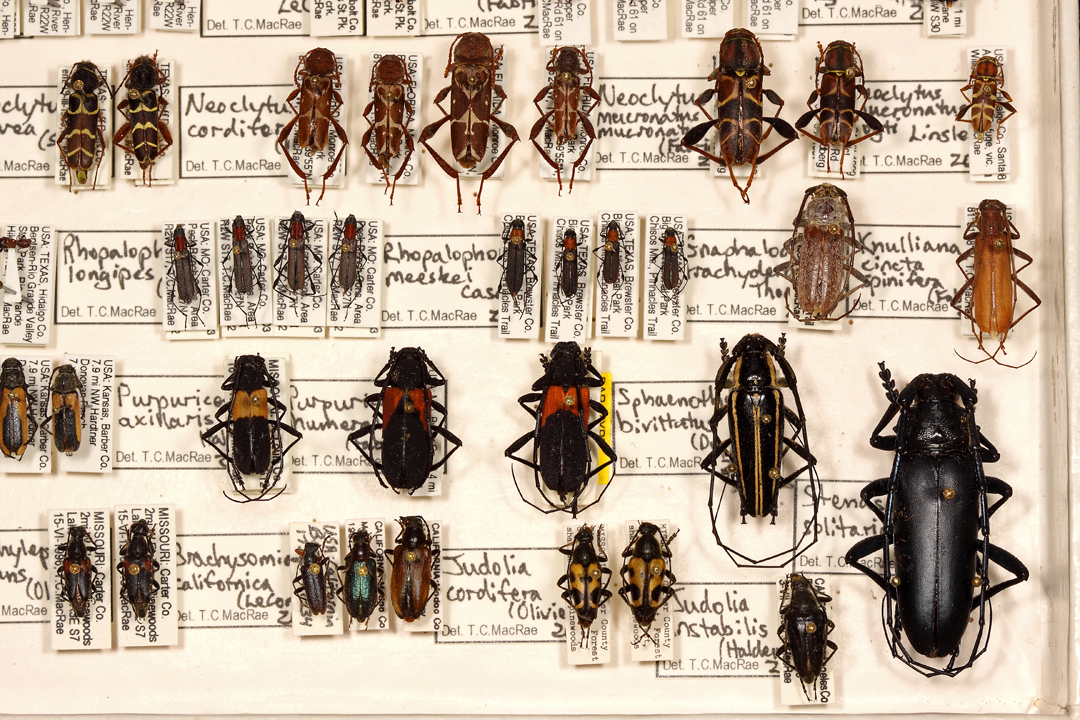
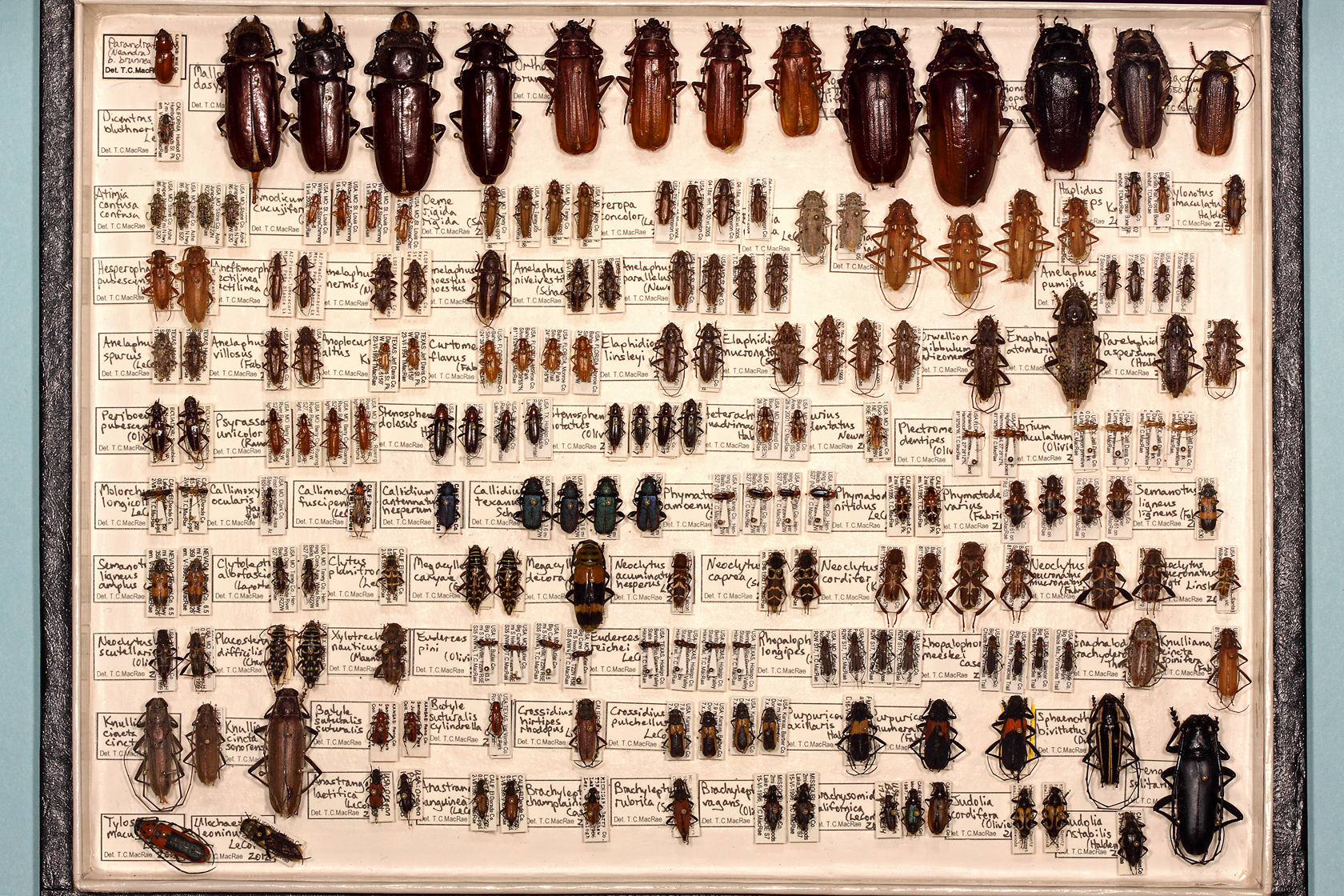
Miscellaneous North American Cerambycidae - click for larger version (1680 x 1120).

In a comment on my  post, Adrian Thysse asked to see hi-res images of specimen drawers from my own collection. Like any good North American entomologist, Adrian was a little bothered by the card-mounting technique used by the sender of the specimen box featured in that post and wanted to see what a nice collection of properly pinned specimens might look like. It’s actually not the first time he’s made this request—back when I first moved this blog to WordPress (more than three years ago) he did so when I put up my Collection page featuring a photo of my “Oh wow!” insect drawer. I’ve thought about doing this ever since he first made this request, but the problem, or at least my problem, with photographing specimen drawers from my main collection is a combination of large drawer size (reducing the size of the specimens in an image of the drawer) and long series of a relatively small number of species in the same genus or closely related genera (making the drawer contents look rather uniform in appearance). I suppose some might still be interested in seeing drawers from a “working collection” such as mine, but I just never had enough motivation to start pulling out drawers and taking photos.

Adrian is in luck, however, as I just happened to be putting together a shipment of miscellaneous North American Cerambycidae for a collector in Europe (to whom I’ve owed insects for longer than I like to admit). The box I’m using for the shipment is smaller than a normal collection drawer and is packed with close to 100 species of this diverse beetle family. There might be a specimen here and there that was collected by someone else, but the vast majority were collected, mounted, labeled, and identified by me. I show this as an example of my curatorial technique, and as a bonus the above image is linked to a fairly large version (1680 x 1120) for those who might be interested in getting a really close look at the specimens and their labels. Here also are closer looks at the specimens in the bottom left and bottom right corners, respectively:

Hmm, is that a wasp at the bottom?

What species is that without the ''normal'' ID label?

Copyright © Ted C. MacRae 2012

Best of BitB 2011

Welcome to the 4th Annual BitB Top 10, where I get to pick my 10 (more or less) favorite photographs of the year. As an insect macrophotographer I still feel like a relative newcomer, although with three seasons under my belt fewer and fewer people seem to be buying it anymore. Granted I’ve learned a lot during that time, but the learning curve is still looking rather steep. I don’t mind—that’s the fun part! With that said, I present a baker’s dozen of my favorite photographs featured here during 2011. I hope they reflect the learnings I’ve had the past year and maybe show some progress over previous years (2009, 2008 and 2010).

One more thing—I’m including a special bonus for the first time in this year’s edition. Each of the photos shown below is linked to a 1680×1120 version that may be freely downloaded for use as wallpaper, printing in calendars, or any other use (as long as it’s personal and non-profit). It’s my way of saying thanks for your readership and support.


From  (posted 8 Jan). I’ve done limited photography with prepared rather than live specimens. However, the recreated aggressive-defensive posture of this greater arid-land katydid (Neobarrettia spinosa)—or “red-eyed devil”—was too striking to pass up. A clean background allows every spine and tooth to be seen with terrifying clarity.


From  (posted 6 Feb). I had never seen a cactus fly until I encountered this Nerius sp. I’m especially fond of the bizzarely-shaped head and un-fly-like spines on the front legs.


From  (posted 17 Feb). This photo of a fungus weevil, Phaenithon semigriseus, is one of the first where I nailed the focus right on the eye at such a magnitude of closeup (~3X) and also got the composition I was looking for. I didn’t notice at the time, but the beetle seems to be “smiling.”


From  (posted 28 Mar). One of the field techniques I’ve been practicing this year is actually holding the plant with the subject in one hand, resting the camera on my wrist and controlling it with the other hand, and manipulating the position of the plant to achieve a desired composition. It’s a difficult technique to master, but the results are worth it. The jumping spider, Euophrys sutrix, represents one of my earliest successful attempts with this technique.


From  (posted 30 Mar). This South American tree fruit weevil looks like it is sitting quite calmly on a branch. In reality, it never stopped crawling while I attempted to photograph it. Crawling subjects are not only difficult to focus on but also almost always have a “bum” leg. I achieved this photo by tracking the beetle through the lens and firing shots as soon as the center focus point flashed, playing a numbers game to ensure that I got at least one with all the legs nicely positioned. I’d have been even happier with this photo if I had not clipped the antennal tip.


From  (posted 4 May). Face shots of predatory insects are hard to resist, and in this one of the fiery searcher beetle, Calosoma scrutator, the angle of the subject to the lighting was perfect for showing off every ridge and tooth in its impressive mandibles.


From  (posted 10 May). I’ve taken plenty of lateral profile shots of tiger beetles, but I like this slightly panned out one especially because of the sense of scale and landscape created by the inclusion of the plantlets and the view over the small rise.


From  (posted 18 May). I found these Edessa meditabunda stink bug eggs on the underside of a soybean leaf in Argentina almost ready to hatch. The developing eye spots in each egg gives the photo a “cute” factor rarely seen in such super close-ups.


From  (posted 15 July). Some of my favorite insect photos are not only those that show the bug in all its glory, but also tell a story about its natural history. This nymphal lichen grasshopper, Trimerotropis saxatilis, is almost invisible when sitting on the lichens that cover the sandstone exposures in its preferred glade habitat. 


From  (posted 23 Aug). I know this is the second beetle face shot I’ve included in the final selections, but it was while photographing this rare Florida metallic tiger beetle, Tetracha floridana, in the middle of the night that I discovered the use of extension tubes to improve the quality of flash lighting (decreased lens to subject distance results in greater apparent light size). This is perhaps one of the best illuminated direct flash photographs that I’ve taken, and I also like the symmetry of the composition.


From  (posted 17 Sep). The three-cornered alfalfa hopper (Spissistilus festinus) is a common pest of alfalfa and soybean in the U.S. However, despite its abundance, I’ve never noticed the bizarre zig-zag pattern of the eyes until I took this photo. Even though both the insect and the background are green, there is sufficient value contrast to create a pleasing composition. Bumping up the ISO and a lower FEC setting prevented overblowing the light greens—easy to do with full flash macrophotography.


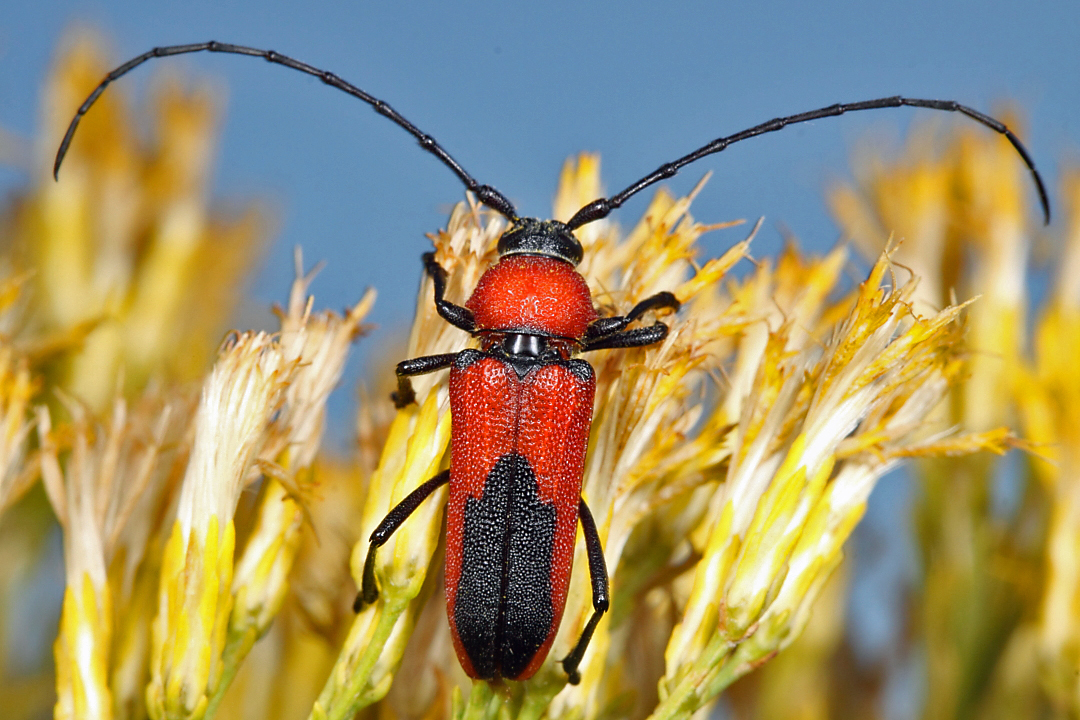
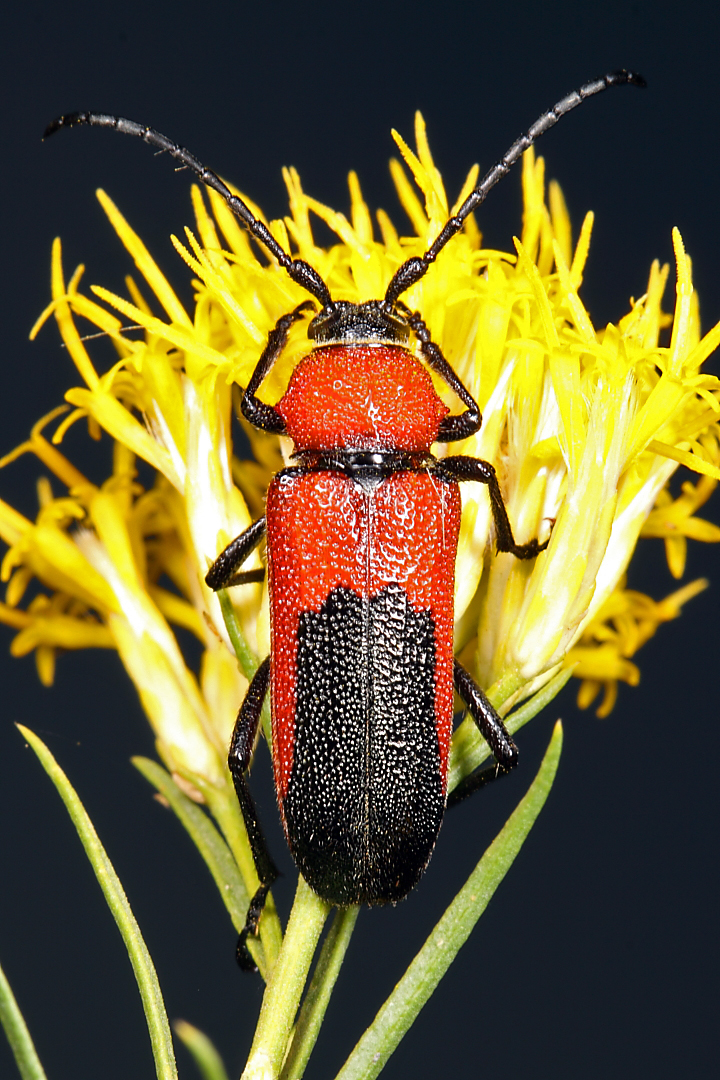
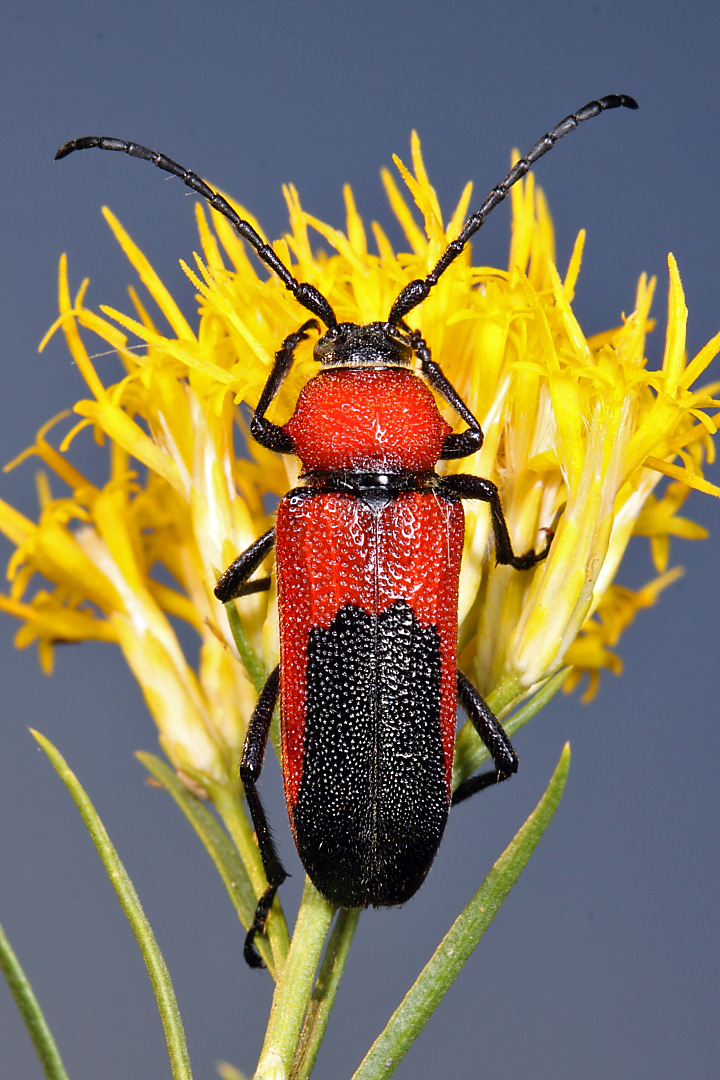
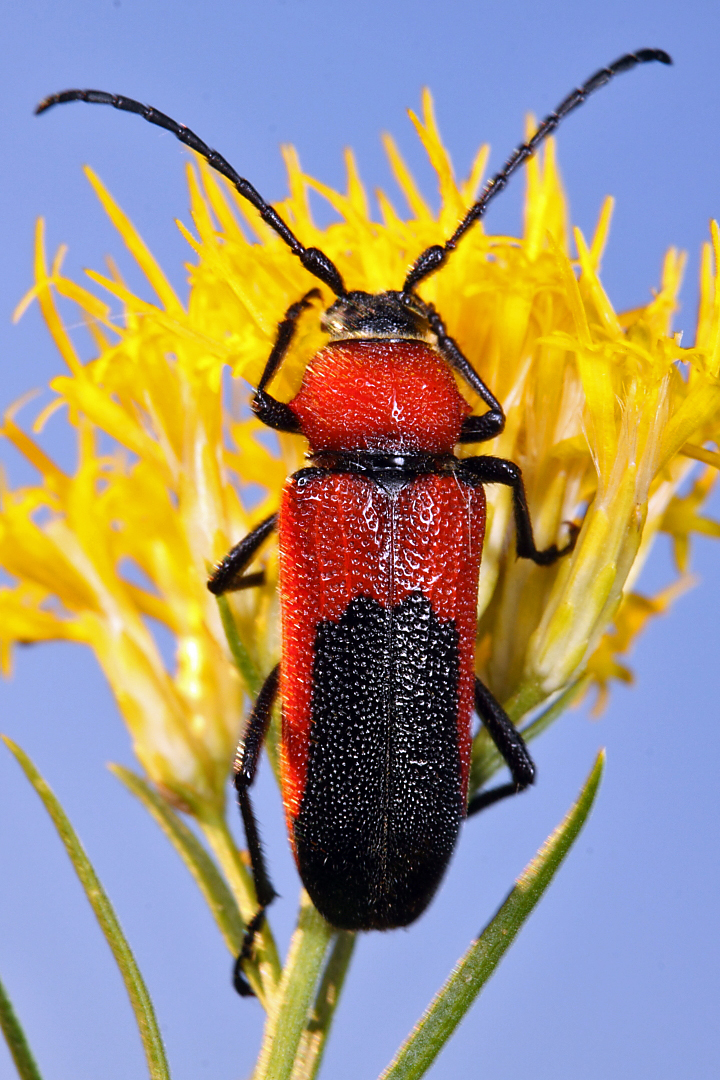
From  (posted 4 Oct). This longhorned beetle had settled in for the night on its Ericamera nauseosa host plant, allowing me to use higher ISO and lower shutter speed settings with a hand-held camera to achieve this very pleasing blue sky background, while retaining the sharpness of detail of the subject that comes from full-flash illumination. The blue sky background provides a more pleasing contrast with the colors of this particular beetle and flowers than the black background that is more typically seen with full-flash macrophotography.


From  (19 Dec). An uncommon underside view of these purple tree fungus (Trichaptum biforme) caps and use of flash illumination allows the colors to literally glow against the bright green lichens also growing on the tree. Keeping aperture at a moderate setting allows blurring of the caps further back, adding three-dimensionality to the photo and preventing it from looking ‘flat.’


Well, there you have it, and I hope you’ve enjoyed my selections. Please do tell me if you have a favorite among theses (and if there were other photos posted during 2011 that you think deserved making the final selections).

Copyright © Ted C. MacRae 2011

A Brazilian longhorned beetle – Oxymerus aculeatus

Oxymerus aculeatus aculeatus | January 2011 | nr. Campinas, São Paulo, Brazil

I was going through photographs from my visit to Brazil this past January and came across this forgotten photo of a longhorned beetle taken near Campinas in São Paulo.  Although I didn’t recognize the genus immediately, I was rather sure it belonged to the great tribe Trachyderini, generally characterized by medium to large-sized, brightly colored, diurnal (active during the day) species.  Knowing this it didn’t take me long to identify the species as Oxymerus aculeatus, occurring from Nicaragua and the West Indies south to Bolivia and Uruguay and, thus, the most widely distributed of the ten species in this exclusively Neotropical genus. As is typical with such widespread species, a few subspecies have also been described—this one should be the nominate subspecies, widely distributed throughout central, eastern, and southeastern Brazil (Hingrid et al 2010).

Like most other members of the family Cerambycidae, O. aculeatus is presumed to utilize dead or dying wood for larval development, but little else is known regarding its habits and host plants. Members of the tribe are often found frequenting flowers, although this and a few other individuals were encountered resting on the underside of foliage on an unidentified tree. The Florida Department of Agriculture & Consumer Services has become concerned about the possible establishment of this species in the U.S. after two recent collections of the West Indian subspecies in south Florida (Thomas 2006). Whether it goes on to have any economic impact remains to be seen, but if recent history with other wood boring beetles is any indication (e.g., Asian longhorned beetle, Anoplophora glabripennis; emerald ash borer, Agrilus planipennis; etc.) the concern may be warranted.

REFERENCE:

Hingrid Y. S. Q., J. P. Botero R. and M. L. Monné. 2010. Insecta, Coleoptera, Cerambycidae, Cerambycinae, Trachyderini: New state and country records from South America. Checklist 6(3):364–376.

Thomas, M. C. 2006. Another Neotropical longhorn beetle (Coleoptera: Cerambycidae) apparently new to the mainland of Florida. UF/IFAS Pest Alert (website accessed 7 Nov 2011).

Copyright © Ted C. MacRae 2011
Isn’t she splendid?!

Cicindela splendida | Bald Hill Glade Natural Area, Ripley Co., Missouri

This gorgeous female Cicindela splendida emerged recently from one of my rearing containers.  She was one of several 3rd instar larvae that I collected this past June from their burrows in a dolomite glade in southeastern Missouri.  I had suspected they might represent this species because of the bright, metallic sheen on their heads and decided to rear them out to find out for sure.  Rearing tiger beetles is fun and easy—all you have to do is fill a container with native soil, make a “starter” burrow¹ and drop them in. In this case, I also partially sunk a native rock into the soil in the center of the container, something I have started doing recently as it gives the emerged adult an elevated and more visually appealing surface on which to perch than the soil should I desire to take photographs.

¹ Larvae will dig new burrows on their own, but starter burrows allow you to place the burrow where you want it.  They are essential if more than one larva is introduced to the container, as wandering larvae will fight when they encounter each other. I like to start the burrow in a corner of the container (a pencil works great for this) and push down to the bottom of the container so I can see into the burrow from outside to monitor the larva as it develops.  After introducing the larva to its burrow, I push the soil around the entrance to seal it lightly to keep the larva from immediately crawling back out.  The larva will eventually reopen the burrow but generally accepts it, digging it out further to its liking and shaping the entrance to precisely fit the size and shape of its head.

Reared from 3rd instar larva, burrow in sparsely vegetated clay exposure of dolomite glade.

With tiger beetle rearing, feeding time is fun time! Our lab rears insects for testing in abundance, and there are always leftovers. Really just about any insect that can be pulled into the burrow will be acceptable as prey, but lepidopteran caterpillars are my favorite. I use mostly early instar tobacco hornworm larvae, choosing the size as appropriate for the size of the tiger beetle larva—the big ones (e.g. 3rd instar Tetracha) can handle caterpillars 35-40 mm in length and 6-8 mm in diameter, while neonates must be used for the smallest ones (e.g. 1st instar Cylindera celeripes and C. cursitans). I find it endlessly entertaining to sneak up on the larva sitting at the entrance of its burrow, slowly position a caterpillar above the burrow entrance with forceps, and dangle it to entice the tiger beetle larva to lurch out, grab the caterpillar, and drag it down into its burrow—all in a split second! If the larva drops down from the burrow entrance during my approach I just drop the caterpillar into the burrow (though this isn’t nearly as much fun).

Copyright © Ted C. MacRae 2011

Crossidius coralinus fulgidus

Crossidius coralinus fulgidus | Uintah Co., Utah

Tiger beetles may have been the primary focus of last week’s 9-day, 10-state, 4,700-mile collecting trip; however, they were not the only beetles I was hoping to see. Longhorned beetles (family Cerambycidae) of the genus Crossidius are unusual in the family because of their fall rather than spring/summer adult activity period, and they just happen to occur in dizzying variety throughout the Great Basin and surrounding mountainous areas. Larvae of all species are presumed to feed on the roots of perennial, shrubby, fall-blooming composites, primarily in the genera Chrysothamnus, Ericameria, Gutierezzia, and Haplopappus (Linsley and Chemsak 1961), with the adult activity period undoubtedly timed to allow congregation and mating on the late-season blooms of their host plants.  Only 13 species are currently recognized, but these are further divided into 37 subspecies and innumerable locally distinct populations.  Not having spent much time in the mountain west during the fall, this group has till now been poorly represented in my collection.

The species shown here, Crossidius coralinus fulgidus, was among the first of many that we encountered during our trip.¹  This population was seen near Vernal in northeastern Utah.  It was late in the day and the adults had settled for the night onto the flowers of their host plant, Ericamera nauseosa.  Flower-visiting longhorned beetles are notoriously frustrating subjects to photograph, as their constant movement and long legs and antennae make focus and composition difficult.  These beetles had essentially ceased activity, allowing me to carefully compose and focus the shot, and the low sun in the western sky provided a bright blue eastern sky to use as a colorfully contrasting background.  The photo above (the very long antennae identify it as a male) was taken hand-held with my Canon 100mm macro lens at ISO 400 and 1/60 sec to allow exposure of the sky and flash at an aperture of f/16 to illuminate the subject and achieve good depth of field.  My only criticism of this photo is the small amount of blur seen in the distal antennal segments.

¹ “We” refers to myself and Jeff Huether from Geneva, NY. Jeff is primarily interested in Meloidae but like me also has an interest in Cerambycidae. I was fortunate to have Jeff with me on this trip, as he has collected extensively throughout the Great Basin region and encountered nearly all of North America’s named species and subspecies of Crossidius. It is only because of his prior experience with this group that I was able to find this and several others that we saw during the trip.

ISO 100, 1/200 sec

ISO 400, 1/200 sec

ISO 400, 1/60 sec

Because the beetles were so calm, I spent some time with this female individual trying different settings to see their effect on background color, subject illumination, and detail.  All were taken hand-held using the same lens at f/16, with the left photo also using my “typical” settings of ISO 100 and 1/200 sec.  The background is very dark (in post-processing I might choose to make it black)—good for some subjects but not this one, and although the focus is good the lighting is rather harsh (I had to decrease highlights in post-processing much more than I normally like).  The center photo was taken with ISO increased to 400 and results in a much more pleasing, if still not very natural-looking sky background.  Focus remains good and the shorter flash duration needed reduces the amount of highlighting that needs post-processing adjustment.  Overall I like this photo the best except that the sky is not true in color.  The right photo is also at ISO 400 but uses a slower shutter speed (1/60 sec).  The sky in this photo is the most natural-looking, and as might be expected problems with flash highlights are minimal—it almost looks like a natural light photograph.  However, some amount of motion blur can be detected, especially in the antennae.  Perhaps intermediate shutter speeds (e.g. 1/120 sec) or slightly higher ISO might effectively deal with this while still allowing the truest colors.  What do you think?

REFERENCE:

Linsley, E. G. and J. A. Chemsak.  1961.  A distributional and taxonomic study of the genus Crossidius (Coleoptera, Cerambycidae).  Miscellaneous Publications of the Entomological Society of America 3(2):26–64, 3 color plates.

Copyright © Ted C. MacRae 2011