One-shot Wednesday: Hawk moths suck!

Hyles lineata nectaring at flowers of Ericameria nauseosa | San Juan Co., Utah

Hyles lineata nectaring at flowers of Ericameria nauseosa | San Juan Co., Utah

I admit it—I give short shrift to Lepidoptera compared to other groups of insects. This is not because I don’t think they deserve attention; they are a stunning group with an amazing suite of adaptations to life on earth. It’s just that they already receive a lot of attention from others, while so many other equally amazing groups of insects remain almost completely unknown and under-appreciated due to the sole fact that they are smaller and less conspicuous. I’m not anti-Lepidoptera; I’m just pro-other Insecta. Every now and then, however, I must give Lepidoptera their due, and since today is Wednesday it’s a good day to feature a hawk moth that I got but a single photograph of on my late August Great Basin collecting trip.

Hyles lineata is not a particularly rare insect—in fact, it is one of the most common and widespread species of hawk moth (family Sphingidae) in North America. What is hard to come by, however, is a good shot of an adult nectaring at a flower. While such shots abound, most feature busy backgrounds and blurred wings. My photo is no different. However, I am a coleopterist, and when I took this shot there were also longhorned beetles present on the same flowers—it could be considered remarkable that I even diverted my attention long enough to attempt a shot. Of course, hawk moths are amazing creatures that have independently arrived at the same flight abilities and feeding habits as the equally amazing but taxonomically distant hummingbirds with their ability to hover motionless while sipping nectar and beating their wings at blinding frequencies. With little time to practice and even less to optimize settings, I’m amazed that I even got an adequate photograph before the moth zipped off to another bush. Yes, hawk moths suck, and that is amazing!

Copyright © Ted C. MacRae 2013

Hooray for iStock—I finally have an ID for my photo

I was all set to make a “One-Shot Wednesday” post today, but sometimes big news strikes and plans must change. The news today was in the form of a random tweet by Alex Wild:

iStock-caption_Wild-20131120

The link in the tweet led me to the following photo on iStock by Getty:

bedbug has captured worm

I was stunned—the photo depicted a scene almost identical to one that I had photographed back in September while visiting soybean fields in Louisiana. For two months I sat on the photo with no idea what I was looking at, but now thanks to Alex I have my answer! Compare the above photo with mine below, and you’ll see that everything matches perfectly—I had photographed a “bedbug” that had captured a “worm”!

Podisus maculiventris preying on Chrysodeixis includens larva

bedbug captures a worm

I considered myself to be fortunate, because there was not just one but two different subjects in the photo, and both of them matched perfectly with the subjects shown in the iStock photo. Gotta love the internet—nowadays names for even the most hard-to-identify bugs are just a click away if you know where to look!

</snark>

Of course, the aggressor in both photos is not a “bedbug” [sic for “bed bug”] (order Hemiptera, family Cimicidae) but a stink bug (family Pentatomidae), specifically Podisus maculiventris, or “spined soldier bug”—perhaps the most common predatory stink bug in North Amerca and ranging from Mexico and parts of the West Indies north through the U.S. into Canada. It is a well-known predator of crop pests and, as such, has been imported to several other countries as part of classical biological control efforts. As for the “worm,” in my photo it is a late-instar larva of Chrysodeixis includens, or “soybean looper, and while I haven’t been able to identify the exact species in the iStock photo it is definitely a lepidopteran caterpillar that appears to related to if not in the same family as the soybean looper (Noctuidae). Now, I concede that “worm” is sometimes used for lepidopteran larvae, but one must also concede that in it’s broadest sense “worm” can refer to members of several disparate phyla such as Nematoda (roundworms), Platyhelminthes (flatworms), or Annelida (segmented worms).

This case, of course, just screams for application of the Taxonomy Fail Index (TFI), which scales the amount of error in a taxonomic identification in absolute time against the error of misidentifying a human with a chimpanzee—our closest taxonomic relative. For example, when TFI = 1 the error is of the same magnitude as mistaking a human for a chimp, while  TFI > 1 is a more egregious error and TFI < 1 a more forgivable one. In the case shown here, one must go back to the common ancestor that eventually gave rise to all of the worm phyla and noctuid moths (~937.5 mya). In addition, since there are two subjects in the photo, one must also go back to the divergence of the main hemipteran groups that contain bed bugs and stink bugs (mid-Triassic, ~227.5 mya). This results a whopping 1.165 billion total years of divergence between the identifications assigned to the subjects in the iStock photo and their actual identity. Assuming that chimps and humans diverged approximately 7.5 mya, this gives a TFI for the iStock photo of 155! I haven’t searched thoroughly to determine whether this is a record for the highest TFI in a single photo, but surely it is a strong contender!

Copyright © Ted C. MacRae 2013

Twig tethered to a twig

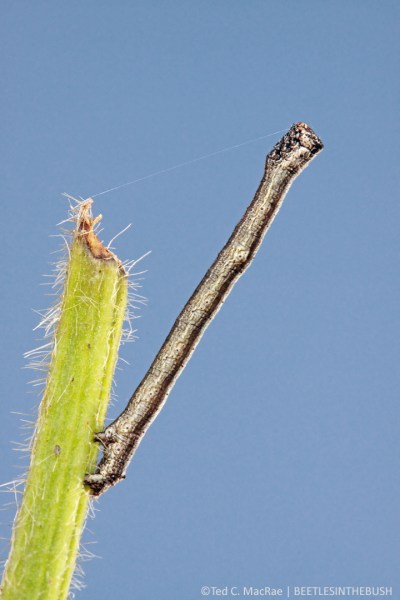
Geometrid larva (subfamily Ennominae?) | Plymouth, North Carolina

Geometrid larva (subfamily Ennominae?) | Plymouth, North Carolina

In September I visited soybean field trials across the southeastern U.S. It’s a trip I’ve done every year for the past I don’t know how many years and one that I enjoy immensely due to the opportunities it gives me to see the country, kick the dirt with academic cooperators, sample the local cuisine… and photograph insects. New for me this year was the Carolinas, and in a soybean field in Plymouth, North Carolina I encountered this geometrid larva on the stub of a soybean leaf petiole. Geometrid larvae are known variously as inchworms, cankerworms, spanworms, measuring worms, loopers, etc., depending on the species. Most of the common names refer to the same thing that the family name does—the larval method of locomotion whereby the caterpillar—possessing legs only at the two extremes of its body—”inches” its way along as if measuring the ground it walks on (Geometridae is derived from the Latin geometra, or “earth-measurer”). The resemblance of the larvae of many species to dead twig stumps is nothing short of remarkable, and had it not been for the contrasting coloration I may never have noticed the larva in the first place. I also did not notice until looking at it through the macro lens of my camera the tether attached by the larva to the tip of the twig—invisible to the naked eye but providing energy-saving stabilization for the larva to hold its cryptic position.

I’ve not encountered a geometrid larva in soybeans before, and my impression has been that they are largely deciduous tree feeders (perhaps due to the periodic occurrence in my area of outbreak species such as fall cankerworm). In trying to determine the species, I found no geometrids covered in the Higley & Boethel (1994) handbook on U.S. pests, and when I consulted the Turnipseed & Kogan (1976) and Kogan (1987) global reviews of soybean pests I found reference only to a few minor pests in India and southeast Asia. Hmm, time for BugGuide. Of course, lepidopteran larvae are not nearly as well represented as the adults, but it seemed most similar to species of the subfamily Ennominae, so I turned to Google and searched on “Ennominae soybean.” This turned up Passoa (1983), who reported larvae of Anacamptodes herse as pests of soybean in Honduras (and mentioned references to several other geometrid species associated with soybean in Brazil). Back to BugGuide, where I found the genus Anacamptodes listed as a synonym of Iridopsis, but the species I. herse was not among the list of species represented in the guide. Checking the link provided at the site to a revision of the genus by Rindge (1966) revealed that I. herse is strictly a Central American species. Perhaps another, North American species of the genus also favors soybean, which led me to Wagner (2005) who mentions soybean as a favored food plant for I. humilis. However, the contrasting purple-brown/yellow-green coloration and relatively thickened body of that species are quite unlike this individual. I don’t have Wagner’s book (only his smaller one on caterpillars of eastern forests—no match in there, either), so it may be that my only remaining option is to post the photo at BugGuide and hope that David Wagner encounters it (actually I should get David’s book anyway)¹.

¹ Update 10/5/13 11:30 am CDT—or hope that Brigette Zacharczenko runs into the post via Facebook and offers to pass it along to Dave during their lab meeting on Monday.

REFERENCES:

Higley, L. G. & D. J. Boethel [eds.]. 1994. Handbook of Soybean Insect Pests. The Entomological Society of America, Lanham, Maryland, 136 pp. [sample pages].

Kogan, M. 1987. Ecology and management of soybean arthropods. Annual Review of Entomology 32:507–538 [pdf].

Passoa, S. 1983. Immature stages of Anacamptodes herse (Schaus) (Geometridae) on soybean in Honduras. Journal of The Lepidopterists’ Society 37(3):217–223 [pdf].

Rindge, F. H. 1966. A revision of the moth genus Anacamptodes (Lepidoptera, Geometridae) (1966). Bulletin of the America Museum of Natural History 132(3):174–244 [pdf].

Turnipseed, S. G. & M. Kogan. 1976. Soybean entomology. Annual Review of Entomology 21:247–282 [pdf].

Wagner, D. L. 2005. Caterpillars of Eastern North America: A Guide to Identification and Natural History . Princeton University Press, Princeton, New Jersey, 496 pp. [Google eBook].

Copyright © Ted C. MacRae 2013

Dainty, delicate, little fairies

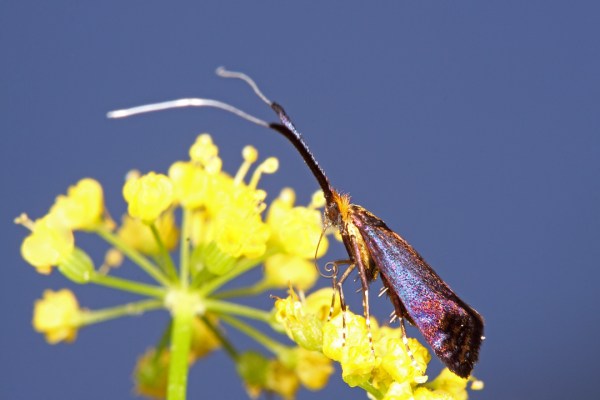
Adela caeruleella | Wayne Co., Missouri

Ever since I saw Chris Grinter’s beautiful photographs, I have wanted to see (and possibly photograph) the tiny little moths known as fairy moths (family Adelidae, formerly considered a subfamily of Incurvariidae). These dainty, delicate, little moths are characterized by their unusually long antennae—especially the males, which can have their antennae up to three times the length of the forewings. This past April I got my wish as my father and I hiked the Shut-ins Trail at Sam A. Baker State Park in Missouri’s southeastern Ozark Highlands.

Females have the antennae ”only” twice as long as the forewings…

Chris was fortunate to see a number of individuals representing at least two species, presumably all males (based on the extraordinary length of their antennae) that were engaged in some rather interesting territorial behaviors. I, on the other hand, saw only this single individual (presumably a female) who seemed content enough to calmly nectar the golden Alexander, Zizia aurea (Apiaceae), flowers on which I found it. This was fine by me, as the dense woodland setting where I saw it wasn’t very conducive to photographing the moth. I wanted a clean, bright background to highlight the moths dark metallic luster, so I snipped the flower (carefully!) on which the moth was nectaring and held it up to the small patch of bright blue sky visible from the trail to take these photos.

…and the basal half distinctly thickened.

I presume this individual represents the species Adela caerueleella based on comparison with online photos. According to Powell (1969) this species is widespread across the eastern U.S. and has been recorded on flowers of American bittersweet, Celastrus scandens (Celastraceae). Microleps.org notes the species is most frequently found along deciduous forest trails and shows a preference for flowers of black snakeroot, Sanicula marilandica (Apiaceae). My late April observation is consistent with the April and May activity period noted by Powell (1969) and late May period for central Illinois noted by Microleps.org.

REFERENCE:

Powell, J. A. 1969. A synopsis of Nearctic adelid moths, with descriptions of new species (Incurvariidae). Journal of the Lepidopterists’ Society 23:211–240.

Copyright © Ted C. MacRae 2012

It’s a Mayfly…It’s a Moth…It’s Thyridopteryx

Mississippi River @ Hwy 62 bridge

One of the nice things about the study of insects is the endless opportunity for discovery. It could be a new species, or it might just be something already known but not yet seen personally. I’ve been collecting insects most of my life, and although much of it has been done in far away places the bulk has occurred in my home state of Missouri. Despite my long experience in this state, this past summer I had the opportunity to experience collecting within the state in a way that I’ve not yet done before—blacklighting up and down the length of the Mississippi River regularly during the months of July through September. Each time, I would arrive at the selected spot in the early evening while there was still daylight and search the (hopefully sandy) beaches for evidence of several tiger beetle species that might occur in such habitat. Then, as the sky turned aglow from the setting sun, I would setup the blacklights and wait for the appearance of those particular tiger beetles that are attracted to such.

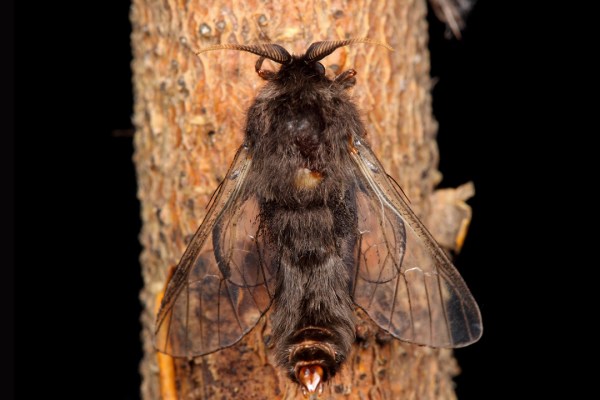
Thyridopteryx ephemeraeformis | Mississippi Co., Missouri

Expectedly, beetles were seen at only some sites, and numbers and diversity generally decreased as summer approached its end. By early September beetles were no longer showing up even though the habitat seemed good (I guess that’s why they call them “summer” species). Still, on this particular night, the lights setup at the Hwy 62 bridge in far southeastern Missouri were attracting a variety of other insects, so I kept them on to see what might come in. I had nothing else to do. At some point, I noticed a strange insect that seemed like a cross between a mayfly and a moth, and then another…and another. Although I had never seen one of these in person before, I knew exactly what they were—male bagworms! Bagworms (order Lepidoptera, family Psychidae), of course, are extraordinarily common in Missouri, and the sight of dozens or even hundreds of their silken/twig bags attached to ornamental evergreen shrubs in the neighborhood where I lived as a kid remains vivid. I can remember “popping” the larvae inside to see their innards ooze out from the tip of the bag (I know—I’m not proud of it) and even cut open a few of the bags to see the larvae inside (that is, once the less sadistic and more scientifically curious side of me took over). Despite all of this, I had never seen an adult bagworm—male or female—until this night.

Dorsal view

Obviously, these are males because they have wings—females remain wingless into adulthood and, in fact, never even leave the bag in which they’ve spent their entire lives. Bagworm males are distinctive in that their wings are virtually devoid of any scales, and I surmise that the generic name of the most common species in eastern North America—Thyridopteryx ephemeraeformis—is derived from the Greek thyris (window) and the Latin ptera (wing) in reference to this. I was fascinated by the strange appearance of these moths and even more fascinated by the curious manner in which the males held out the tip of their abdomen when at rest; reminiscent of a female releasing sex pheromone. This can’t be true, because it is the females that call from their bags to attract the males, and since the females remain within their bag, the male must insert his abdomen through the tip of the bag and all the way to the top where he can reach the female genital opening. Thus, the male abdomen is highly extensible and prehensile—I guess the males can’t keep an abdomen with that much stretching capacity still for very long.

Two males

Based on gestalt, I presumed these represented T. ephemeraeformis since it is such a common and widespread species, but it’s not always wise to presume, especially in a relatively more southern location. The Moth Photographers Group lists five species in this genus in North America, two of which (T. alcora and T. meadii) seem to be southwestern in distribution. Of the remaining three, T. ephaemeraeformis is the only one I could find any photos or information beyond simple listings (the Moth Photographers Group lists no distribution records for T. rileyi or T. davidsoni), so I asked my lepidopterist friend Phil Koenig for his opinion. Phil informed me that T. ephemeraeformis has been recorded in Missouri 285 times in 49 counties, while T. rileyi is known from the state based only very old literature records and T. davidsoni not at all. Thus, the odds are definitely favor these males representing T. ephemeraeformis. Late summer is apparently the prime period of adult bagworm activity. I’ve not done much blacklighting late in the season because most of the beetles on which I’ve focused over the years and that are attracted to blacklights are active more during spring and early summer. This could explain why I’ve not until now seen male bagworms despite their commonness in Missouri.

Copyright © Ted C. MacRae 2012

Frustrating Emerald

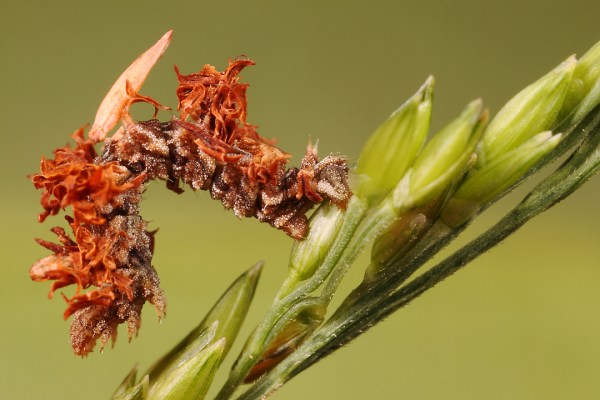
After years in the field looking for insects, one develops an eye not only for recognizing insects but also recognizing when something doesn’t look quite right. That happened to me early this past September at a spot along the Mississippi River in southeast Missouri where I had stopped during late afternoon to look for diurnal species of tiger beetles and then man a blacklight in the evening for nocturnal ones. It was still daylight as I walked along the edge of rank growth bordering the upper banks when a small, reddish “cluster” on a seed head in a stand of tall grasses caught my eye. I didn’t know what it was when I saw it, but I knew it was something ‘out of place.’ My first, cursory thought was that somehow the spent anthers of the now-seeding grass had gotten caught in a tangle, but I must have still had doubts because I looked closer anyway. Just then the “cluster” moved, and I then recognized what I was dealing with—an Emerald moth (Synchlora sp.) caterpillar. Caterpillars in this genus are remarkable for their habit of adorning their bodies with bits of the plants upon which they feed. I am, however, a beetle man and thus admit to being completely unaware of their existence until last summer when Alex Wild featured one of these as a Monday Night Mystery. I wondered then, “Why haven’t I seen one of these before?”, and now I know why—because they are extremely well camouflaged!

Synchlora sp. | Mississippi Co., Missouri

Realizing what I had, all efforts to look for tiger beetles were suspended (I hadn’t seen anything after ~30 minutes of looking anyway), and I broke out the 65mm lens to get the most of this small but remarkable looking insect. I took more than 50 shots, trying different backgrounds, angling the grass stem in different positions, and hoping with each shot that I had captured the larva in full profile, completely in focus, and in the midst of that magical loop. I was sure I had that “perfect” shot when I got home and anxiously fired up the computer to get a better look at the photos. My optimism began to drop, however, as I scanned through each successive photo and continued to not encounter that one photo that would cause me to say “Yes!” Exposure? Check. Composition? Check. Lighting? Check. Focus? Er… crap! The problem was pervasive throughout the entire set, and in the end, I have only this one photo that comes anywhere close to what I had envisioned while I was taking the photos. It’s a shame, because I love everything else about this photo. The cause of the problem is the very thing that makes the larva so remarkable—its adornments. The spent anthers project off the larva in all directions, adding considerable dimensionality to the subject and surpassing the depth-of-field capabilities of my lens. If the subject was in focus the forward projecting anthers were not, and if the anthers were in focus the subject was not. If I had realized in the field what was going on, I would have not gotten in so tight and cropped as appropriate during post-processing. Live and learn!

Although 12 species of Synchlora are found in North America, only one—Synchlora aerata (Wavy-lined Emerald)—is widespread in the eastern U.S. However, a number of other species are found in the southeastern U.S., and for all intents and purposes the Mississippi Lowlands of southeastern Missouri  are the south (culturally as well as biogeographically!). As a result, a generic ID is the best that can be done for this larva.

Copyright © Ted C. MacRae 2012

Wasp Wednesday—Not!

In early September, the agricultural landscape in the central U.S. awakens from its monotonous cloak of summer green and turns ablaze with a hundred shades of yellow, gold, and tawny. The “fall composites” as they are commonly called, a dazzling diversity of mostly yellow-flowered herbaceous plants in the family Asteraceae, are one of the chief contributors to this explosion of color, and among them none contribute more than goldenrod (Solidago sp.). Occupying nearly every fence row, drainage ditch, and fallow field, the bright yellow fronds of tiny flowers are not only pleasing to the eyes of humans, but a smorgasbord of pollen for all manner of flower-feeding insects. Bees, flies, wasps, beetles, and moths all flock to the bounty in numbers rarely seen during the dog days of summer. Spiders, ambush bugs, mantids, and other predators take up residence amongst the flowers as well—not to feed on the flowers, but rather the abundance of flower-feeding insects upon which they will prey. It is rare to find a goldenrod plant without at least a few insects upon it.

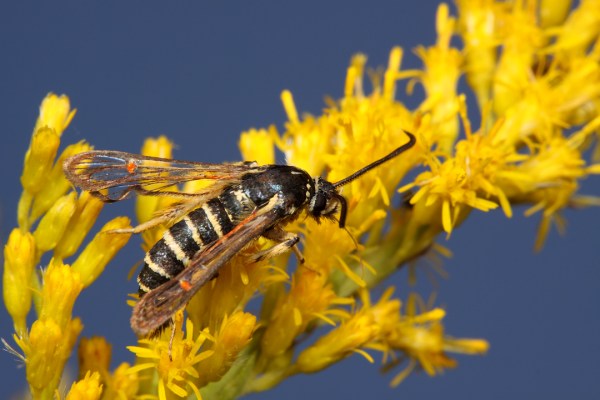
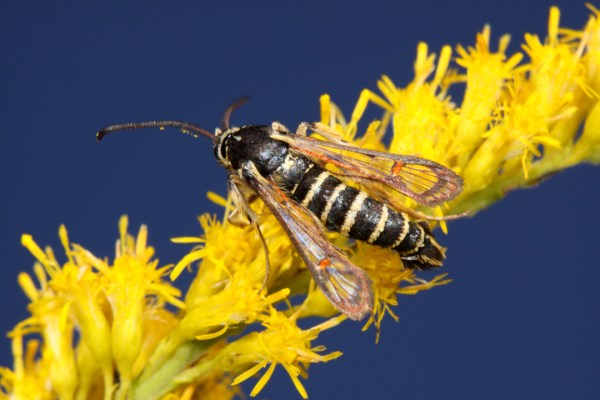
Synanthedon decipiens (oak gall borer) on Solidago sp. | Mississippi Co., Missouri

My favorite goldenrod insects are, of course, the longhorned beetles of the genus Megacyllene, and at least here in Missouri there are none finer than Megacyllene decora (see A classic fall ‘bycid). However, I keep an eye out for other insects as well, and when I first saw this “wasp” sitting on a flower head I had to do a bit of a double take—”something” just didn’t seem quite right about it. A little lean forward was all that was needed to confirm that this was indeed no wasp, but rather a clearwing moth (order Lepidoptera, family Sesiidae)¹. To my mind, of the many insects that try to mimic wasps, none do so more effectively than members of this family. From the elongate body to the yellow abdominal banding and narrow transparent wings, everything about this moth says “wasp”—well, almost everything or I wouldn’t have done a double take to begin with.

¹ I hope Eric Eaton, author of Bug Eric and its Wasp Wednesday series, will forgive my use of his title for this post.

Apparently a male, these moths use pheromones to locate females for mating.

I actually did a fair bit of work with this group in my early years with the Department of Agriculture. Females of most (all?) species emit species-specific pheromone blends that males can detect at incredibly low volumes (only a few molecules are needed to elicit a response by the male antenna). Components of these pheromones have been synthesized, and since a number of species have economic importance in landscape and nursery settings (larvae of most species are borers of woody or perennial plants), these synthetic pheromone blends are commonly employed in traps for survey and detection (e.g., Snow et al. 1985). I conducted surveys for several years during the mid 1980’s in east-central Missouri using these traps and, thus, developed a good eye for distinguishing these moths in flight from the wasps that they so effectively mimic. In fact, I used to keep a pheromone tag on my waist bag, which resulted in male moths frequently flying up to me and “searching” for the female. I never tired of seeing the faces of nursery growers—first showing concern as they were convinced I was under attack by a wasp, and then shock as I calmly reached out and grabbed the “wasp” in mid-flight with my bare hand! (And to be perfectly honest, it took me a while before I could bring myself to start grabbing them out of the air!) I even had one nursery grower continue insisting it was a wasp and could sting even after I had caught it (“Naw, them things sting—I seen ’em!)

The moth in these photos seems to best match Synanthdedon decipiens, widely distributed east of the Rockies and inhabiting the woody galls of cynipid wasps on oaks. In Georgia adults of this species exhibit a bimodal pattern of seasonal occurrence suggestive of two generations per year (Snow et al. 1985), so this September-occurring male might represent a second Missouri generation as well.

REFERENCES:

Snow, J. W., T. D. Eichlin & J. H. Tumlinson. 1985. Seasonal captures of clearwing moths (Sesiidae) in traps baited with various formulations of 3,13-0ctadecadienyl acetate and alcohol. Journal of Agricultural Research 2(1):73–84.

Copyright © Ted C. MacRae 2012

Inchworm, Inchworm, Oh So Small

Soybean looper (Chrysodeixis includens) | 3rd-instar larva

Okay, I know this is not a real “inchworm” (generally restricted to caterpillars in the family Geometridae), but this young larva of a soybean looper (Chrysodeixis includens, family Noctuidae) is just too cute to not have an equally cute name. I believe it is an early 3rd instar, based on its small size (~7mm in length), lightly colored head capsule, and distinct bristles around the head and on the body—1st instars have a black head capsule, while 2nd instars have a light brown head capsule, and in both the bristles on the body are smaller and not as distinct.

This larva hatched from an egg laid on soybean by a laboratory-reared adult.

Copyright © Ted C. MacRae 2012