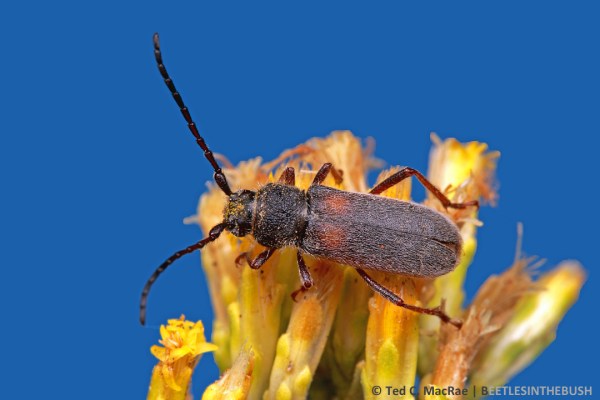
A Crossidius hirtipes subspecies blend zone…

…or, “There’s something fishy going on here!”

After a day in the vicinity of Yearington, Nevada  looking for (and eventually finding) a population of Crossidius hirtipes longhorned beetles assignable to subspecies “rubrescens“, field mate Jeff Huether and I dropped a little further south to look for two additional subspecies—C. h. immaculipennis and C. h. macswaini. Like C. h. rubrescens, populations assignable to these two subspecies are also restricted to a small area in west-central Nevada. Chemsak & Linsley (1959) described C. h. immaculipennis from specimens collected 10 miles north of Smith (Lyon Co.) and two years later (Linsley & Chemsak 1961) described C. h. macswaini from 19 miles SE of Wellington (Douglas Co.). We were still under the smoke plum from the now 9-day old Rim Fire in the nearby Sierra Nevada, which came and went during much of the day (top photo) and eventually settled in to create some amazing sunset landscapes (bottom photo).

19 mi S of Wellington, Toiyabe National Forest, Nevada.

Rim Fire smoke moves in and out of the area | 19 mi S of Wellington, Toiyabe National Forest, Nevada.

As had happened the day before with C. h. rubrescens, success did not come quickly or easily. We first searched for the type locality of C. h. immaculipennis, but many parts of the area have been converted to agriculture, and in the precise area 10 miles north of Smith we found only vast fields of dark green, irrigated alfalfa and not the rabbitbrush chaparral habitat required by these beetles. We did a little searching in surrounding areas and eventually found one rather nice-looking patch of ground with healthy stands of Chrysothamnus viscidiflorus in full bloom. Mindful of the previous day’s experience with finding the beetles often ensconced down within the inflorescences—especially as cooler temperatures set in, we took care to carefully inspect the blossoms in case the cool morning temperatures were inhibiting the beetles from coming back up for the day. Alas, we saw no beetles despite spending a considerable amount of time searching.

Crossidius hirtipes immaculipennis (male) | 6.3 mi W of Wellington, Nevada.

Crossidius hirtipes immaculipennis (male) | 6.3 mi W of Wellington, Nevada.

Rather than beat a dead horse, we decided to drive a short distance south and west to the town of Wellington, where a fellow cerambycid collector had found the subspecies a few years earlier. He had provided us with some detailed notes on the specific localities where he found the beetles, and these proved to be of great help as we passed through endless, seemingly acceptable chaparral habitat trying to decide exactly where we should stop and invest more time to look for the beetle. We stopped at one of the sites indicated in the notes and immediately found a beetle on one of the first plants we checked, and eventually after a gap in finding any more we found an area where good numbers of the plants were supporting decent numbers of the beetles. Chemsak & Linsley (1959) distinguished C. h. immaculipennis by its reddish legs, pale color, and complete lack of elytral markings in the male, exemplified by the male shown in the photo above.

Crossidius hirtipes macswainei? (female) | 6.3 mi W of Wellington, Nevada.

Crossidius hirtipes macswainei? (female) | 6.3 mi W of Wellington, Nevada.

As we searched the plants and found more and more individuals, I noticed an occasional adult that seemed to be a little more yellowish than reddish and with distinct sutural maculae. I didn’t think much about it then, chalking it up to individual variability, but after returning home and having a chance to look at the specimens more closely I was surprised to determine that these few beetles actually are a better fit for the second subspecies we planned to search for that day—C. h. macswainei. We had found both subspecies at the same site and didn’t even realize it. Okay, I know what you’re thinking… subspecies must exhibit allopatric geographic distributions (cannot occur together at the same place and time). It is, thus, tempting to declare that the two “subspecies” are actually not distinct, but rather represent distinctive extremes of individual variation in a single interbreeding population. However, one must also consider the possibility that the two subspecies represent reproductively isolated populations and, thus, qualify as distinct species. I’m not qualified to make that judgement, but I will note that most of the individuals encountered were assignable to C. h. immaculipennis  and the rest to C. h. macswainei, but that no “intergrades” were found.

Crossidius hirtipes macswainei (male) | 19 mi S of Wellington, Nevada.

Crossidius hirtipes rhodopus? (male) | 19 mi S of Wellington, Nevada.

After collecting adequate series from W of Wellington, we traveled further south of town to the type locality of C. h. macswainei (not knowing we already had it!). The holotype and most of the paratypes were collected 19 miles S of Wellington (Linsley & Chemsak 1961), but a number of paratypes had also been collected 14 miles south of town, so we stopped there first in an unsuccessful bid to find the subspecies before moving on to the type locality a few miles further south. Within a few minutes of arriving, I found the individual shown in the photo immediately above, presumed that I had found the subspecies we were looking for, and popped it into a vial alive as a photo backup if we did not find any other individuals with which I could attempt field photographs. Ironically, that is exactly what happened—despite Jeff and I scouring every plant we could find in about a 1-mile stretch along each side of the road, we never found another beetle. Later that evening I took the above individual out of its vial for photographs, but it never really “perked up” to look fully natural, resulting in “bum” antennae that give away the staged nature of the photograph. Again, it was not until I got back home and could look at the specimen closely before I realized that it did not at all fit the description of C. h. macswainei, but instead seemed to be a good match for the subspecies C. h. rhodopus, known from only a short distance further south but—until now, at least—apparently restricted to the Mono Basin in east-central California (see this post for more details about this subspecies). Jeff has since reported to me that some of the beetles he collected at the “C. h. rubrescens” locality (see this post) also are a match for C. h. macswainei, adding yet another wrinkle to those that resulted from this day’s collecting. Such inconsistencies with the published literature may tempt some to scrap all of Linsley & Chemsak’s subspecies, but considering that those two authors examined more than 12,000 specimens during the course of their studies such a reaction would be both premature and presumptuous. What is needed is more study—more specimens from more localities, hopefully augmented with DNA sequence analysis. For the latter goal we did our part, dropping a specimen or two from every locality in which we found beetles into ethanol for just such purpose. Until such studies are done, I prefer to withhold judgement about whether C. hirtipes is comprised of one highly polytopic population, several subspecifically distinct populations, or perhaps even multiple distinct species.
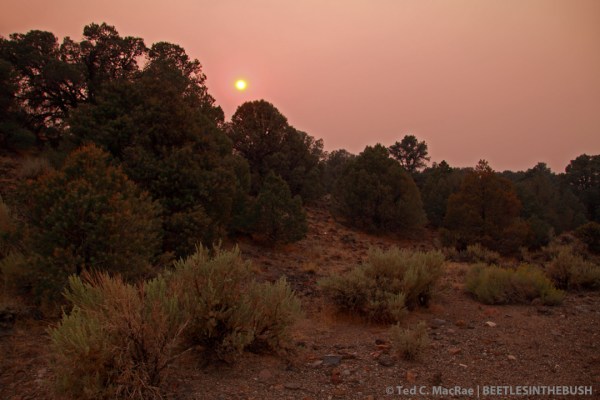
14 mi SE of Wellington, Toiyabe National Forest, Nevada.

Evening haze creates a spectacular sunset | 14 mi SE of Wellington, Toiyabe National Forest, Nevada.

Even though we found only a single beetle at the second locality, our persistence in searching until the day ran out was rewarded by a most spectacular sunset caused by thick haze from the nearby Rim Fire in California. It would also be our last day in Nevada before dropping south into California and spending the next several days in successful bids for C. coralinus monoensisC. c. caeruleipennisC. h. nubilus, and C. h. rhodopus.

REFERENCE:

Chemsak, J. A. & E. G. Linsley. 1959. Some new species and subspecies of Crossidius from western North America. Journal of the Kansas Entomological Society 32(4):176–183.

Linsley, E. G. & J. A. Chemsak. 1961. A distributional and taxonomic study of the genus Crossidius (Coleoptera, Cerambycidae). Miscellaneous Publications of the Entomological Society of America 3(2):25–64 + 3 color plates.

Copyright © Ted C. MacRae 2014

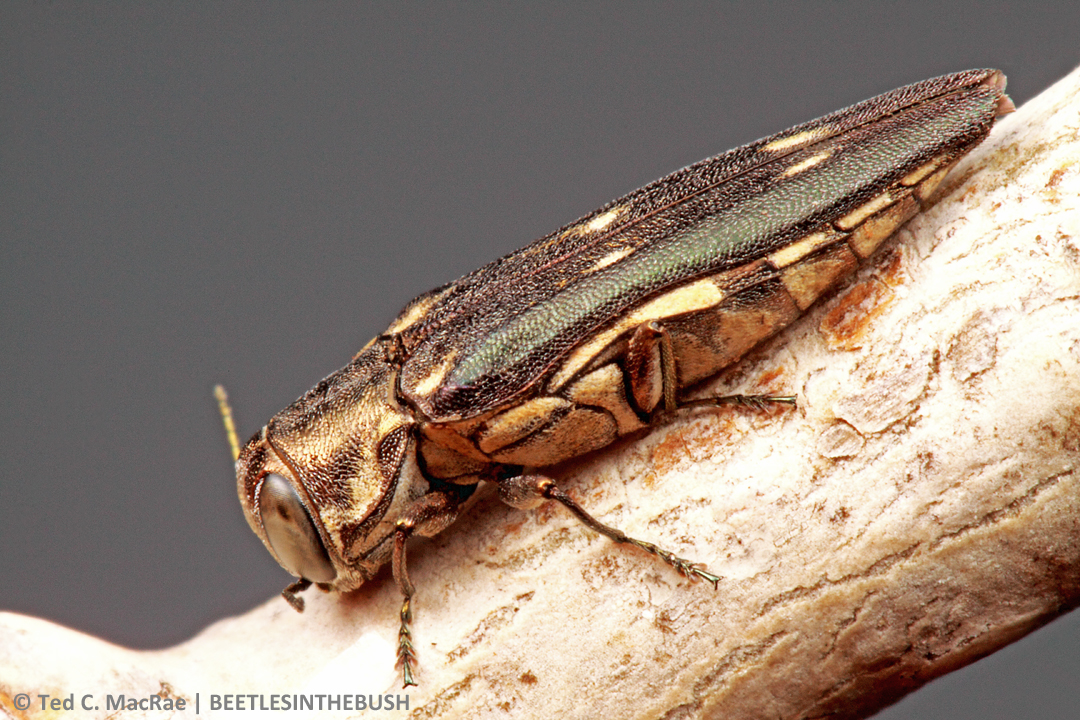
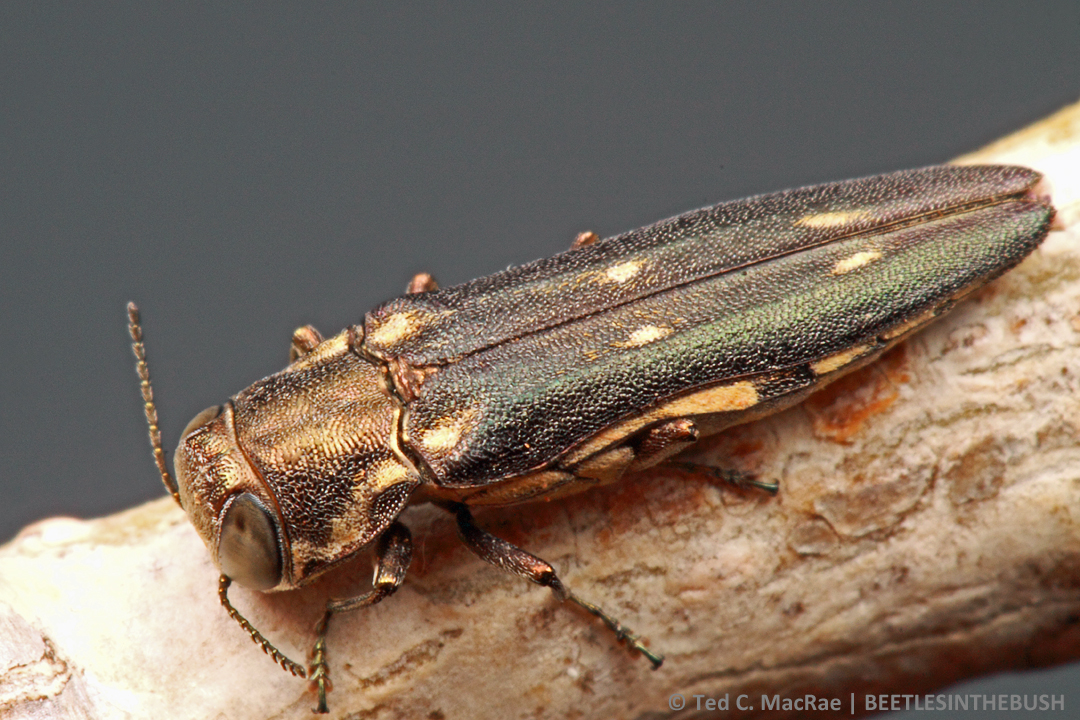
Introducing Acmaeodera chuckbellamyi

Acmaeodera chuckbellamyi MacRae, 2014 | Atascosa Mountains, Arizona

Acmaeodera chuckbellamyi MacRae, 2014 | Holotype female (scale bar = 1 mm) (MacRae 2014: Fig. 1).

Of the many entomology journals I subscribe to, there are few that I await with as much anticipation as The Coleopterists Bulletin. Focusing exclusively on the largest order of life on earth, it’s a quarterly dose of elytral ecstasy that no beetle enthusiast should be without. I awaited the March 2014 issue, however, with special anticipation, as this was the issue that would honor my late friend and colleague, Chuck Bellamy. Last week, the issue arrived in my mailbox, and it did not disappoint!

The issue begins with an In Memorium, spearheaded by fellow buprestophile Rick Westcott and containing contributions and photos from many of Chuck’s contemporaries (including me) (Westcott et al. 2014). This is followed by an especially touching remembrance of Chuck by his longtime friend Art Evans (with whom Chuck co-authored An Inordinate Fondness for Beetles), after which come 11 scientific papers with descriptions of new beetle taxa named in Chuck’s honor. These include nine new species of jewel beetles (family Buprestidae) from Mexico, Central America, China, Kenya, Europe, Peru, and Arizona, a new seed beetle (family Bruchidae) from Mexico, and two new checkered beetles (family Cleridae) from Mexico. For my part, I described one of the jewel beetles, a member of the genus Acmaeodera known from but a single specimen¹ collected in southeastern Arizona which I dedicated to Chuck with the name “Acmaeodera chuckbellamyi MacRae, 2014″. Last but not least, the Fall family provides some remembrances of Chuck and his association with BioQuip Products, Inc.

¹ It is generally not advisable to describe a new species based on a single specimen. However, in this case multiple attempts to recollect the species were unsuccessful, and eventually the type locality was significantly altered in 2009 by the Murphy Fire. It is possible (and indeed likely) that the species still exists in similar nearby habitats (especially further south in Mexico), but the circumstances mentioned above make it unlikely that additional material will become available for the foreseeable future. In such cases, it is, in my opinion, better to name the species so that it can be made available to the broader scientific community.

In all, 12 new beetle taxa are named in Chuck’s honor, bringing the total number of patronyms honoring him to six genus-group names and 31 species-group names—a fitting legacy and testament to the breadth of his impact in the taxonomic community. The issue can be found online at BioOne—abstracts are freely available, but membership in The Coleopterists Society is required to access full-text and pdfs. For those who are not society members, I offer below pdf versions of the two papers that I authored or co-authored.

REFERENCES:

Westcott, R. L., S. Bílý, A. R. Cline, S. D. Gaimari, H. Hespenheide, T. C. MacRae, M. G. Volkovitsh, S. G. Wellso & G. Williams. 2014. In Memoriam: Charles Lawrence Bellamy (1951–2013). The Coleopterists Bulletin 68(1):1–13 [pdf].

MacRae, T. C. 2014. Acmaeodera chuckbellamyi MacRae (Coleoptera: Buprestidae: Acmaeoderini), a new species from Arizona, USA. The Coleopterists Bulletin 68(1):50–52 [pdf].

© Ted C. MacRae 2014

Tiger beetles in Argentina’s Chaco forest

The day after I photographed Brasiella argentata on the mud/san banks of the Rio Paraná in Corrientes, Argentina, I decided to drive westward into the heart of Chaco Province. The destination: Chaco National Park, where some of the best remaining examples of the original “Gran Chaco” remain. Once covering nearly a million square kilometers in northern Argentina, Paraguay and Bolivia, this distinctive ecoregion has been largely converted to a vast, hot sea of cotton fields and mesquite fence-rows. A unique plant community in the Gran Chaco is the quebracho forest that takes its name from quebracho colorado chaqueño (Schinopsis balansae)—a tall, massively-trunked tree (related to, of all things, poison ivy!) with beautiful red wood that has been logged relentlessly wherever it occurs. Chaco National Forest is unique for the largely intact example of this forest it preserves and the mature quebracho trees that it contains.

Odontocheila chrysis | Chaco National Park, Argentina

Odontocheila chrysis (Fabricius, 1801) | Chaco National Park, Argentina

Insect life was not abundant as I walked the dark forest path. The lateness of the season (early April) and long-enduring drought occurring in the region had taken their toll, and I was content to see just about anything. At one point, a flash of movement caught my eye, and as I scanned the forest floor in the area where I had seen it, the familiar silhouette of a Golden Forest Tiger Beetle—Odontocheila chrysis (Fabricius, 1801)—became visible. I was already familiar with this species, having seen fairly good numbers of them at another location further east during my first visit to the area 12 years earlier. Long-legged and fast-flying, this tiger beetle occurs throughout much of South America, where it lives in more shaded areas of forest clear-cuts, secondary forests, savannas, and open scrublands (Erwin & Pearson 2008). The ground-dwelling adults are known to congregate along paths and at large openings on the forest floor, and indeed I had seen them in their greatest numbers on a shaded dirt road around the margins of a temporary mud puddle. When disturbed, the wary adults fly up from the forest floor to land in adjacent bare area of substrate or on the leaves of understory plants.

Superposition eyes are adapted to the dark forest environment in which this species lives.

Superposition eyes are an adaptation to the dark forest environment where this species lives.

I faced a bit of a quandary when I saw this individual—do I collect it as a voucher and studio photograph backup, or do I go ahead and try to get the much more desirable in situ photograph of an unconfined adult in its native habitat. Considering that I had already collected a sufficient number during my earlier trip, I opted for the latter. I am fortunate that I got these two quite acceptable photographs before the adult flashed away in the blink of an eye right after I took the second shot, because I never saw another one the rest of the day or even the trip.  

An interesting feature of O. chrysis is its superposition eyes. In such eyes, each rhabdom (light sensitive unit) in the compound eye receives light through many ommatidial facets. This is in contrast to apposition compound eyes, where each rhabdom receives light from only a single facet. Superposition eyes are designed to increase photon capture, which is an advantage in the dark forest habitats where this beetle prefers to live (Brännström 1999).

Brasiella argentata | Chaco National Park, Argentina

Brasiella argentata (Fabricius, 1801) | Chaco National Park, Argentina

Shortly after photographing O. chrysis, I came upon a small opening where the path was a little wider and sunnier and the soil a little sandier and drier. Immediately I saw the small, zippy flits of the same tiger beetle species I had photographed the previous day on the banks of the Rio Paraná—Brasiella argentata. I could not find in the literature whether this species has superposition or apposition compound eyes, but considering that the species occur in great numbers on sunny river banks and that the few individuals I saw in the forest were in a sunny opening, I’m betting it’s the latter.

I couldn’t help but make another attempt to photograph this species, considering the difficulty I’d had the previous day (and that I wasn’t completely satisfied with any of the photos that I had obtained). More good fortune, despite there being only a few individuals to work with, as I managed to get the above photograph, which I consider far better than any that I already had. These beetles, too, quickly disappeared, and I never saw them again, but knowing I had the photos that I wanted made that okay.

Habitat for Odontocheila chrysis and Brasiella argentata

Quebracho forest habitat for Odontocheila chrysis and Brasiella argentata.

REFERENCES:

Brännström, P. A. 1999. Visual ecology of insect superposition eyes. Unpublished Ph.D. Dissertation, Lund University, 142 pp. [abstract].

Erwin, T. L. & D. L. Pearson. 2008. A Treatise on the Western Hemisphere Caraboidea (Coleoptera). Their classification, distributions, and ways of life. Volume II (Carabidae-Nebriiformes 2-Cicindelitae). Pensoft Series Faunistica 84. Pensoft Publishers, Sofia, 400 pp. [Amazon descriptionbook review].

© Ted C. MacRae 2014

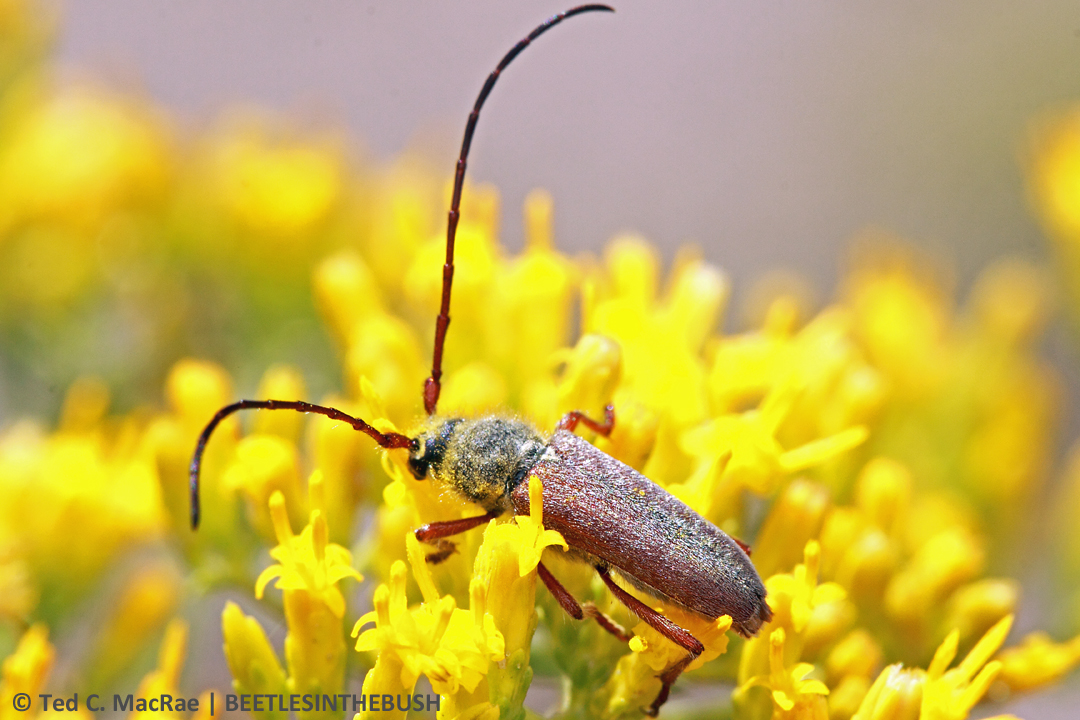
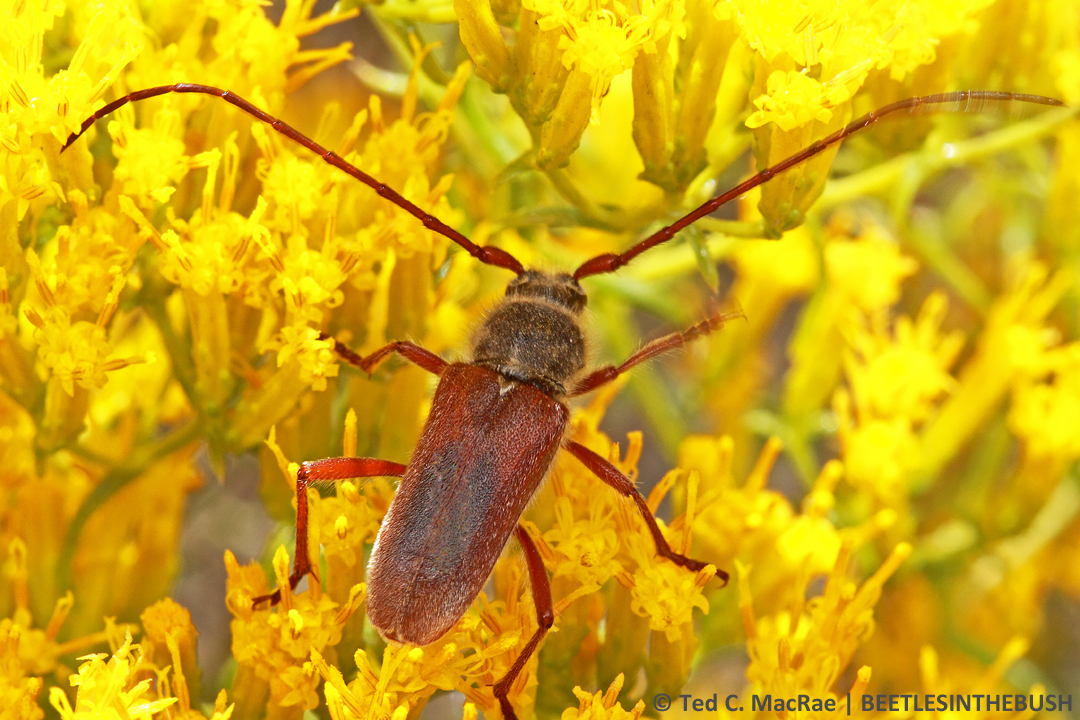
Crossidius hirtipes rhodopus in Adobe Valley, California

Crossidius hirtipes rhodopus | Adobe Valley, Mono Co., California

Crossidius hirtipes rhodopus Linsley, 1955 | Adobe Valley, Mono Co., California

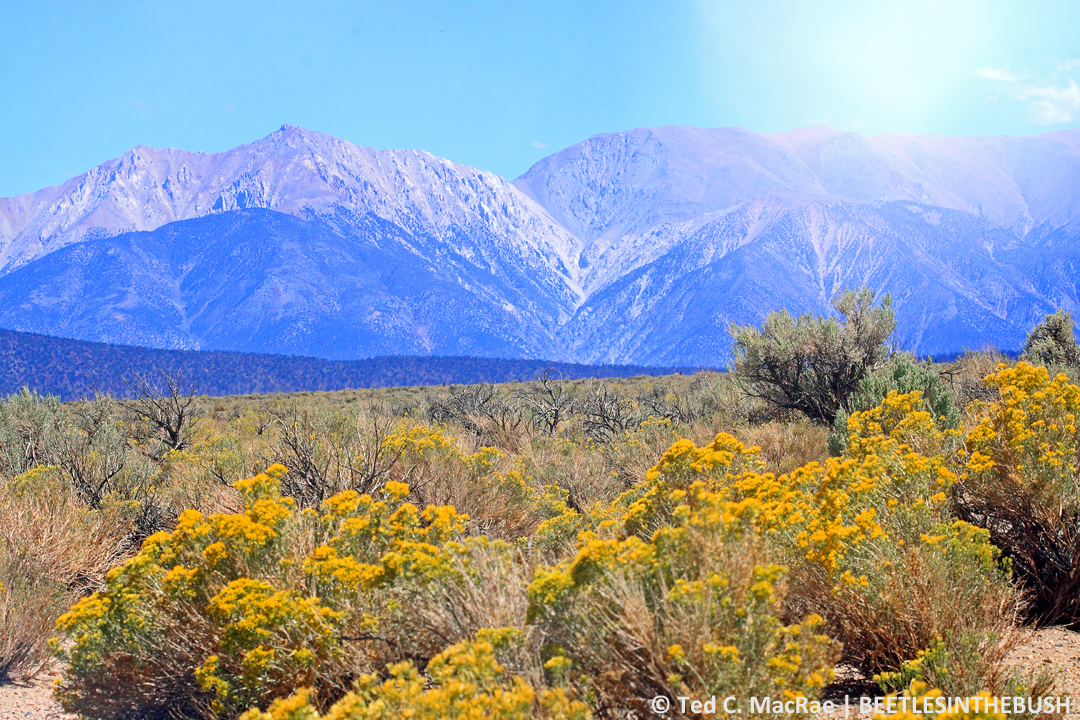
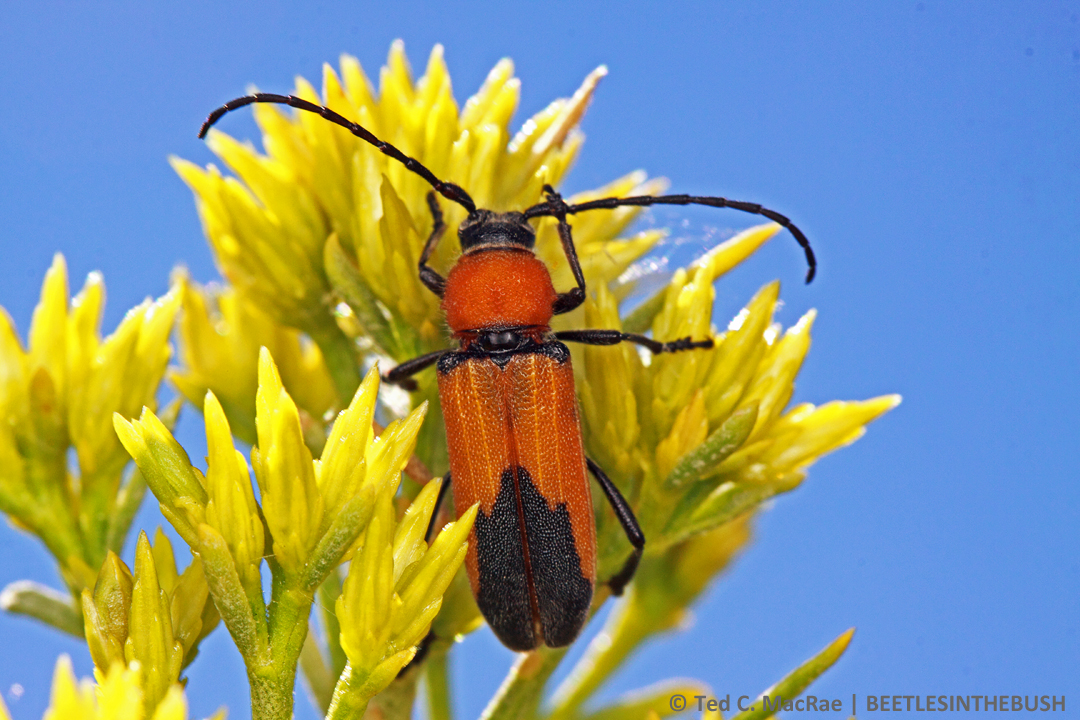
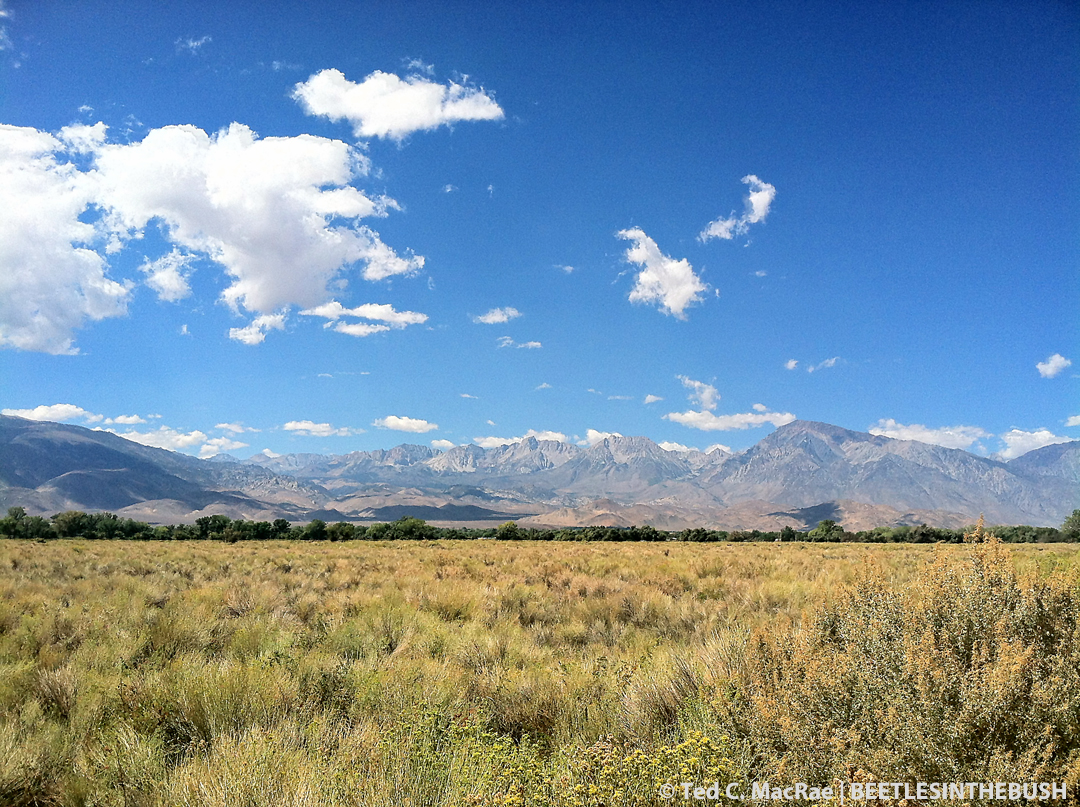
On Day 7 of last August’s Great Basin Collecting Trip, we left Bishop and headed back north to the Mono Basin to look for Crossidius hirtipes rhodopus, a distinctive reddish subspecies known only from the Mono Basin. I’d seen this beetle before—almost 20 years ago during one of several trips to the type locality of Nanularia monoensis (described by my late friend Chuck Bellamy in his 1987 revision of the genus), so we drove south of Mono Lake on Hwy 120 through Adobe Valley on our way to the Benton Range where I last saw them. Of course, C. h. rhodopus occurs more broadly in the Mono Basin than just the Benton Range, and as we drove through the valley we saw robust stands of the beetle’s host plant, yellow rabbitbrush (Chrysothamnus viscidiflorus), in full bloom stretching across the floor of the valley to the towering White Mountains in the distance. Impatience can sometimes be a virtue, and in this case our decision to stop and check the plants rather than waiting until we got to the Benton Range paid off—not only were the beetles out in force, allowing us to photograph and collect to our heart’s content, but we saw only a few beetles on but a single flowering plant during our subsequent visit to the Benton Range. Apparently the rains that had caused such a profusion of bloom in the Adobe Valley had not graced the Benton Range, resulting in the driest conditions I have seen during my several visits there.

This subspecies is one of the more darkly colored subspecies

This subspecies is one of the more darkly colored subspecies

Crossidius h. rhodopus is among the most distinctive of all the C. hirtipes subspecies due to its dark reddish-brown coloration. It closely resembles C. h. nubilus, which we had seen the day before at its only known locality further south at Westgaard Pass between the White and Inyo Mountains, but it is not as dark as that subspecies and lacks the extensive clouding of black on the apical portions of the elytra. The red-brown legs and brown antennae becoming darker at the tip further characterize C. h. rhodopus, originally described as a full species (Linsley 1955) but later regarded as a subspecies of the widely distributed and highly polytopic C. hirtipes LeConte, 1854 (Linsley & Chemsak 1961).

Yellow rabbitbrush (Chrysothamnus viscidiflorus) abounds in the valley, as the White Mountains loom in the background.

Yellow rabbitbrush (Chrysothamnus viscidiflorus) abounds below the magnificent White Mountains.

Those who are unfamiliar with the Mono Basin are missing one of California’s greatest natural treasures. A closed, internal-drainage basin bordered to the west by the massive Sierra Nevada Mountains (with Yosemite National Park lying just over the peaks), to the east by the Cowtrack Mountain, to the north by the Bodie Hills, and to the South by the north ridge of the Long Valley, the eerily beautiful Mono Lake is its most prominent feature. Do not, however, neglect other areas of the basin, which offer their own uniquely dramatic beauty. Adobe Valley, stretching south of the lake towards the White Mountains and famous for the wild mustang that live there, is one such area.

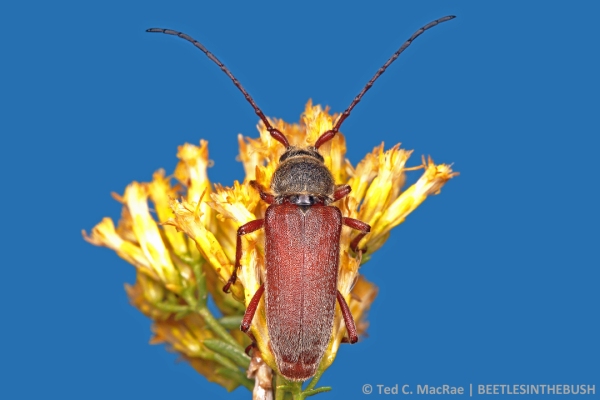
A handsome male rests on yellow rabbitbrush flowers (studio shot).

A robustly handsome female perches a terminal flower cluster of yellow rabbitbrush (studio shot).

REFERENCES:

Linsley, E. G. 1955. Notes and descriptions of some species of Crossidius. The Pan-Pacific Entomologist 31(2):63–66.

Linsley, E. G. & J. A. Chemsak. 1961. A distributional and taxonomic study of the genus Crossidius (Coleoptera, Cerambycidae). Miscellaneous Publications of the Entomological Society of America 3(2):25–64 + 3 color plates.

© Ted C. MacRae 2014

The sublimely beautiful Crossidius coralinus caeruleipennis

Crossidius coralinus caeruleipennis | Inyo Co. nr. Bishop, California

Crossidius coralinus caeruleipennis | Owens Valley nr. Bishop, California

Before driving up into the White Mountains to look for Crossidius hirtipes nubilus and see the grotesquely beautiful trees at Ancient Bristlecone Pine Forest, we made a short two-mile drive north of our hotel in Bishop, California to try our hand with a C. coralinus subspecies that I referred tangentially in my previous postC. c. caeruleipennis. This has to be among the most beautiful subspecies that I’ve seen yet of what must be considered one of North America’s most attractive species of longhorned beetle. In contrast to the other “orange” subspecies, C. c. monoensis, which we had collected the previous day but that I did not even recognize as C. coralinus because of its color and very small size, I knew exactly what I was looking for on this day as we began to scan the gray rabbitbrush (Ericameria nauseosa) plants that stretched out across the Owens Valley sage grassland as far as the eye could see. At first we were worried that we might be a little late, as most of the plants appeared to be somewhat past peak bloom, but it wasn’t long before we found the first individual sitting atop a flower cluster, and then another, and another...

Males are completely orange.

Males are solid, sublimely orange with strikingly contrasting black legs and antennae.

Crossidius c. caeruleipennis is immediately distinguishable from C. c. temprans (and most of the other C. coralinus ssp. that we collected on the trip further north in Nevada and east in Utah and Colorado) by its bright orange rather than dark red coloration. The subspecies is restricted to the Owens Valley of eastern California and greatly resembles another of the orange subspecies that we collected on the trip, C. c. monoensis. That subspecies is found just a short distance north in the Mono Basin, though at much higher elevations, and is easily distinguished from C. c. caeruleipennis by its smaller average size, by having the black markings of the elytra more expanded apically in females and at least present in males, and by the presence of black bands along the apical and basal margins of the pronotum (Linsley & Chemsak 1961).

Females have a distinct apical blue-black marking on the elytra

Females are distinguished by the apical blue-black marking on the elytra and their shorter antennae.

As it turned out, the beetle was as abundant as any we had seen on the trip to that point. Not that it didn’t require some effort to collect them—they were still rather sparsely distributed among the plants and definitely showed preference for plants that were not as far past peak bloom. However, the habitat was extensive—we could have wandered freely for hours on end without looking at the same plant twice (although that did not stop me from re-checking a few plants that were in peak bloom and seemed to be especially favored). The males were simply gorgeous—a bright, creamy orange that sadly takes on a dull quality in preserved specimens and with long black legs and antennae. The females are no dogs either, less strikingly orange due to the blue-black apical markings on the elytra, but certainly more robust than the males in a subspecies that is already one of the larger of the species. Temperatures climbed rapidly at this relatively southern and lower elevation locality compared to most of the others that we visited during the trip, so the beetles became quite active very quickly after we began to see them. I had only a short window of time in which to attempt field photographs, and while I’m not completely satisfied with the ones that I show here, they were the best that I could manage and still get the blue sky background that I desire for “beetles on flowers” photographs.

Sage grassland and gray rabbitbrush dominate the Owens Valley where C. coralinus caeruleipennis is found.

Gray rabbitbrush dominates the Owens Valley sage grassland where C. coralinus caeruleipennis occurs.

REFERENCE:

Linsley, E. G. & J. A. Chemsak. 1961. A distributional and taxonomic study of the genus Crossidius (Coleoptera, Cerambycidae). Miscellaneous Publications of the Entomological Society of America 3(2):25–64 + 3 color plates.

Copyright © Ted C. MacRae 2014

Clouded beetles amidst spectacular scenery

“Westerly from Westgard Pass is a view equaled in few parts of America. In the middle distance, a dozen miles away and nearly a mile below, lies the fertile Owens Valley, extending at right angles north and south over a hundred miles, and on the farther side, distant a score of miles, tower the snow-clad Sierras, with serrated crests and symmetric domes and peaks outlined against the sky at an approximate height of two and one-half miles vertical above the level of the ocean, and extending north and south far as the eye can see. The vision is rich reward for a journey of a thousand leagues.”—A. L. Westgard, March 1915

View of Westgard Pass from higher up in the White Mountains near Ancient Bristlecone Pine Forest.

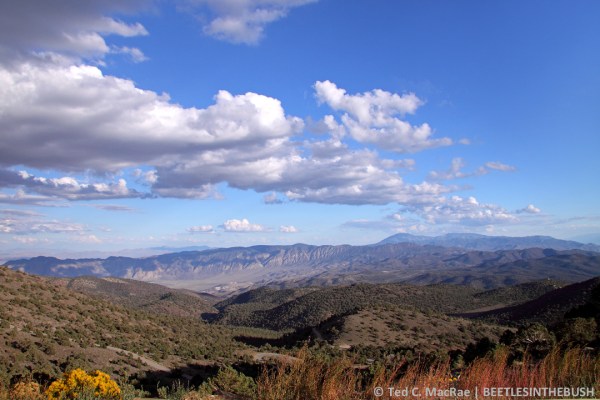
View to Westgard Pass from higher up in the White Mountains near Ancient Bristlecone Pine Forest.

After a morning spent searching for Crossidius coralinus caeruleipennis (perhaps the most sublimely beautiful of the subspecies) in the high desert sage of the wide open Owens Valley floor near Bishop, California, we made the short drive south to Big Pine, turned sharply left, and began the slow, twisting ascent through a narrow gap between the White Mountains to the north and the Inyo Mountains to the south. Eventually reaching an elevation of 7,313 ft,  Westgard Pass serves as access to Earth’s oldest living things! and, in doing so, provides some of the most striking scenery in the entire Basin and Range Province of eastern California.

Westgard Pass, Inyo Co., California.

Chrysothamnus viscidiflorus (small plants with yellow flowers) host Crossidius hirtipes nubilus adults.

Field mate Jeff Huether and I no doubt wanted to see the grotesquely beautiful trees growing in Ancient Bristlecone Pine Forest and were happy to enjoy the magnificent scenery along the way, but our trek to Westgard Pass had also a strictly entomological purpose—to search for Crossidius hirtipes nubilus, among the most uniquely colored and geographically restricted of the C. hirtipes subspecies. Approaching the summit, the narrow, rocky gorge opened up to a broad expanse of pinyon/juniper woodland, and nestled among the ubiquitous sage we found the plant we were looking for—yellow rabbitbrush (Chrysothamnus viscidiflorus) in full bloom.

Crossidius hirtipes nubilus (male) on flowers of Chrysothamnus viscidiflorus.

Crossidius hirtipes nubilus (male) on flowers of Chrysothamnus viscidiflorus (field photo).

It took a while, however, before we found the beetles that we were looking for. Robust gray rabbitbrush (Ericameria nauseosa) plants in full bloom conspicuously dominated the roadsides and demanded our initial attentions, but our only reward was the widespread Crossidius ater. Not even a single Crossidius coralinus specimen could be claimed as consolation. Still, we knew the real quarry was further back from the roadsides, on the much smaller and less conspicuous yellow rabbitbrush that serves as an adult host for Crossidius hirtipes and most of its subspecies. Once we turned our attentions to these smaller plants we found the first adult fairly quickly, but precious few were seen considering the many plants that we examined until we finally zeroed in on one area just south of the summit where the beetles seemed to occur with slightly greater frequency. While not numerous, we eventually found enough beetles for us to declare, “Let’s go see the bristlecone pines!”

In addition to their longer antennae, males are distinguished by xxx.

In addition to longer antennae, males are distinguished by less extensive clouding (studio photo).

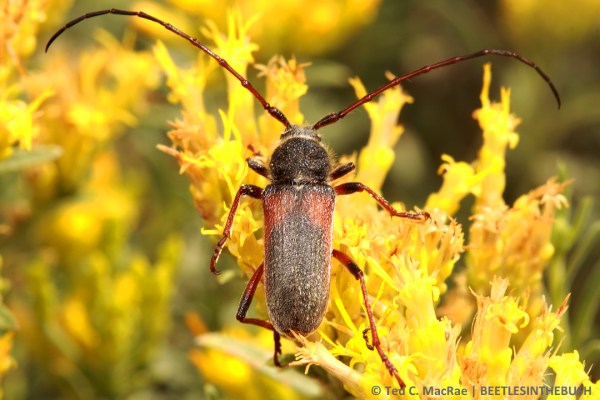
This subspecies is among the most distinctive of all the C. hirtipes subspecies due to the combination of dark reddish-brown coloration and extreme, dark clouded area of the elytra (Linsley & Chemsak 1961). It most closely resembles C. h. rhodopus, which occurs further north in the Mono Basin, but that subspecies is not as dark and lacks the extensive clouding of black on the apical portions of the elytra.

Females have the elytral markings xxx.

Females have the markings greatly expanded to almost completely cover the elytra (studio photo).

The dark clouding actually represents an expansion of the dark stripe found along the suture of the elytra of many C. hirtipes subspecies, most of which exhibit sexual dimorphism in the degree to which this stripe is developed. In some subspecies the stripe is present in the females but absent in the males, while in others the stripe is present in both but more fully developed in the female. In C. h. nubilus the sutural stripe reaches an extreme state of development, covering much of the apical two-thirds of the elytra in the male and being so greatly expanded in females that almost the entire elytra are covered except for two small subbasal patches revealing the ground color of the elytra.

REFERENCES:

Linsley, E. G. & J. A. Chemsak. 1961. A distributional and taxonomic study of the genus Crossidius (Coleoptera, Cerambycidae). Miscellaneous Publications of the Entomological Society of America 3(2):25–64 + 3 color plates.

Copyright © Ted C. MacRae 2014
What was that insect?

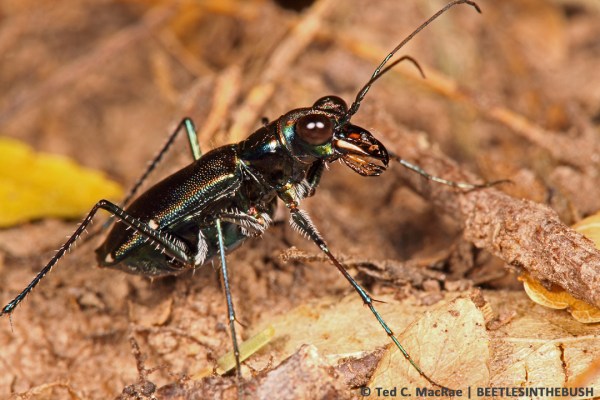
Yesterday I posted an identification challenge of a different sort. The main subject in the photo was a jewel beetle (family Buprestidae), but there was also another insect in the photo—a small parasitic wasp sitting on the branch below the beetle. Some of you saw it—Charley Eiseman was the first and correctly guessed it was a member of the family Encyrtidae, earning 5 pts, and Wikispecies editor gets 5 pts for further identifying it as a member of the genus Metaphycus. Honestly, I took several shots of the beetle and never saw the wasp until I examined the photograph during processing. I’m not certain, but I think the small object next to the wasp could be a scale insect (family Coccidae), which are known hosts of Metaphycus spp.

Of course, there is still the jewel beetle, and it wouldn’t be fair for me to award points for the wasp but not the beetle. Heath gets 5 pts for first identifying the beetle in the genus Agrilus; however, nobody was able to identify the species as A. granulatus—commonly associated with cottonwood and poplar (Populus spp.) across North America. Since Charley was the only person to mention both the beetle and the wasp, I’m going to give him a tie-breaking bonus point and declare him the challenge winner.

Populations of A. granulatus have been assigned to several subspecies—the beetle shown here (photographed June 2013 at Beaver Dunes, Oklahoma) represents the nominate form—restricted to the U.S. east of the Rocky Mountains, where it breeds in native eastern cottonwoods (P. deltoides) and introduced Lombardy poplars (P. nigra var. ‘Italica’). Agrilus granulatus is often confused in collections with A. quadriguttatus, but that species is associated with willow (Salix spp.) and can be further distinguished by the less dense pubescence of the lower face not obscuring the surface; the pronotum with the lateral margins evenly rounded and not strongly sinuate at the base, the median channel less distinct, and the lateral depressions scarcely pubescent; and the elytra more gradually narrowed posteriorly with the tips more acutely rounded and more coarsely serrulate and the pubescent spots less distinct (Fisher 1928).

Here are a few more photographs of the jewel beetle (without the wasp):

Agrilus granulatus granulatus on Populus deltoides | Beaver Dunes, Oklahoma

Agrilus granulatus granulatus on Populus deltoides | Beaver Dunes, Oklahoma

Agrilus granulatus granulatus on Populus deltoides | Beaver Dunes, Oklahoma

Agrilus granulatus granulatus on Populus deltoides | Beaver Dunes, Oklahoma

Agrilus granulatus granulatus on Populus deltoides | Beaver Dunes, Oklahoma

Agrilus granulatus granulatus on Populus deltoides | Beaver Dunes, Oklahoma

REFERENCE:

Fisher, W. S.  1928. A revision of the North American species of buprestid beetles belonging to the genus Agrilus.  U. S. National Museum 145, 347 pp.

Copyright © Ted C. MacRae 2014