A bid for OpenLab

I’m going to do something I’ve not yet done before—ask for your support.  OpenLab is an annual compilation of the year’s best science-blog writing, as determined by a panel of judges, and the closing date for submissions for 2009 is December 1st—this coming Tuesday.  I’ve vacilated about whether to throw my hat into this ring—the world of science blogs is a crowded place with many erudite writers, and although science is my profession, the science that I write about is purely avocational.  Whether my particular brand of science writing can compete with that of the true academicians that seem to dominate the competition remains to be seen.  Nevertheless, I am willing to put my ego on the line and give it a shot.  If you have seen anything in the past year (since December 1, 2008) here at Beetles in the Bush that you consider exemplary, please consider submitting it.  Feel free to search the sidebar archives (“Taxa,” “Tags” or “Life History”), browse the site Contents, or select from the following list of my own personal favorites (arranged chronologically):

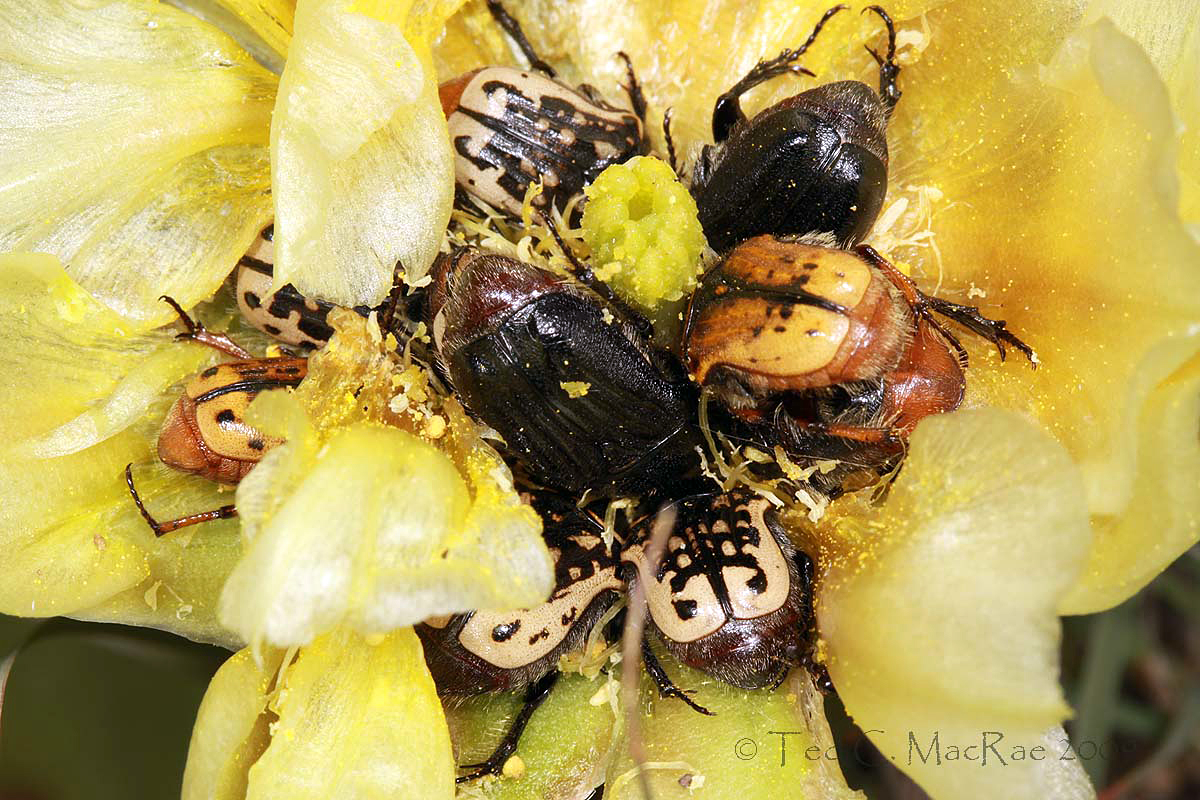
So I don’t get accused of asking but not giving, I leave you with this photograph of a group of Kern’s flower scarabs (Euphoria kernii, family Scarabaeidae) congregated in the flower of large-root prickly pear cactus (Opuntia macrorhiza, family Cactaceae).  Photographed this past June at Four Canyon Preserve in northwestern Oklahoma, this common, extremely variable species (ranging from all black to black and white to black and yellow to nearly all yellow) can be found throughout the southern Great Plains, where it congregates tightly in flowers of Opuntia , pricklypoppy (Argemone spp., family Papaveraceae), thistle (Cirsium spp., family Asteraceae), and yucca (Yucca spp., family Liliaceae).

Photo details: Canon 100mm f/2.4 macro lens on Canon 50D (manual mode), ISO-100, 1/250 sec, f/16, diffused MT-24EX flash.

Copyright © Ted C. MacRae 2009

Add to FacebookAdd to NewsvineAdd to DiggAdd to Del.icio.usAdd to StumbleuponAdd to RedditAdd to BlinklistAdd to TwitterAdd to TechnoratiAdd to Furl

Do you know what time it is?

I’ll give you a few hints:

  • It’s fall.
  • I haven’t collected bugs for a few weeks.
  • A new crop of tiger beetles has emerged from their burrows.

What time is it?

IT’S TIME FOR THE ANNUAL FALL TIGER BEETLE TRIP!

 I don’t think there is any trip during the year that I look forward to more than this one. Hunting for insects is fun no matter what, but it is particularly enjoyable when the sweltering days of summer give way to the cool days of fall – crisp air, pungent, earthy aromas, shadows long and sharp, and skies so blue above a golden, tawny, morphing landscape. How I adore fall, and how I thrill at any chance to travel across the fall landscape chasing after gorgeous tiger beetles that have spent the spring and summer as larvae, hidden in their unseen burrows, growing fat on the few hapless insects that chanced too close to their burrow, until the rains of late summer and early fall trigger their transformation to adulthood – glittering jewels that emerge out into the autumn world for a brief session of dining and play before winter forces them back into their burrows for the long wait to spring.

This year’s edition is somewhat abbreviated – little more than a long weekend due to a combination of job and family responsibilities. Still, five days is a little better than four (and a lot better than none) and is long enough for me to play a hunch that I’ve had ever since I returned from the Red Hills of northwestern Oklahoma this past June. You’ll recall that I had some rather amazing luck on that trip, discovering a robust population of the very rare Cylindera celeripes (Swift Tiger Beetle) and a slight western range extension of the seldom seen Dromochorus pruinina (Frosted Dromo Tiger Beetle). While I was exploring that landscape, the habitat reminded me of another tiger beetle – Cicindela pulchra (Beautiful Tiger Beetle), a glorious species – brilliant purple with glassy wine-red elytra – that I had seen in 2005 in the nearby Gypsum Hills of south-central Kansas. I don’t know if that species occurs in the Red Hills of northwestern Oklahoma or not, but my impression is that the area has not been very well explored. If a species as rare as C. celeripes can be found there, perhaps C. pulchra will occur there as well. The enormous tiger beetle larvae that I saw in their burrows in the Gloss Mountains during June gives me further reason to believe there may now be some impressive adult activity in the area.

Should I not succeed in finding C. pulchra, it will nevertheless be a glorious, though frenetic trip. On Friday I’ll drive 525 miles from St. Louis to the Gloss Mountains, where I’ll explore during the early part of Saturday and then finish the day at Alabaster Caverns State Park. Sunday’s itinerary depends upon whether I succeed at finding C. pulchra in the Gloss Mountains – if I do, I’ll head on over to Salt Plains National Wildlife Refuge to photograph some of the fall tiger beetles that were not out during my June trip (hopefully including Eunota togata globicollis, or Alkali Tiger Beetle). If I don’t find C. pulchra in the Gloss Mountains, I’ll explore the Red Hills of Barber Co. Kansas, where I’ve seen this insect in the past and attempt to find and photograph it there, then move on to Salt Plains on Monday. I’m really hoping my C. pulchra hunch plays out, because if it does that gives me an extra day to shoot back east to my beloved White River Hills in southwestern Missouri and photograph its small, disjunct population of Cicindela obsoleta vulturina (Prairie Tiger Beetle) – the largest member of the genus in North America. Regardless of how events play out, I’ll need to blast back to St. Louis on Tuesday, work a couple of days, then leave town again for my niece’s wedding in New York (congratulations Shannon and Tamer).

While I’m gone, you can click on the interactive map to see where I’m going, or you can catch up on several newly issued Blog Carnivals (I’ve been a busy submitter this past month):

  • Circus of the Spineless. With discussion that is restricted to the 95% of life forms that do NOT have vertebrae, CotS #42 is up at Quiche Moraine.  For my part, I have proposed a replacement name for a rather ‘ubiquitous’ species of tiger beetle.
  • Berry Go Round.  After a brief summer vacation, botanical discussions resume with BGR #20 at Further Thoughts.  My contributions cover zygomorphic flowers with oily rewards, a very ungentianlike gentian, and plant-insect relationships.
  • Carnival of Evolution.  From Darwin to Drift to Deleterious Mutation, find it all at CoE #16 hosted by Pleiotropy.  I’ve added a little ‘perspective’ to the discovery of new species.

No longer just a contributor, at the end of this month I will host my first Blog Carnival in the form of Berry Go Round #21.  I know,  it’s strange that a bug dude is jumping into the Carnival hosting pool with a botanical carnival, but duty calls!  Submissions are due to me by Oct. 27, with a scheduled issue date of Oct. 30.  If you’ve never contributed to a Blog Carnival before, it’s a great way to get exposure for your blog and possibly find other blogs of interest.

Copyright © Ted C. MacRae 2009

Add to FacebookAdd to NewsvineAdd to DiggAdd to Del.icio.usAdd to StumbleuponAdd to RedditAdd to BlinklistAdd to TwitterAdd to TechnoratiAdd to Furl

A bit of housekeeping

I hope you’ll forgive the lack of pretty bug pictures and witty prose in today’s post – I have a few updates and adminstrative issues that I’d like to take care of.

Circus of the Spineless
This notice is a few days late, but Circus of the Spineless # 43 is up at Wanderin’ Weeta.  Susannah has done a great job of assembling blog posts on a diversity of invertebrates from anemones to annelids, bryozoans to barnacles, decapods to gastropods, and of course – insects.  In the latter group, all of the major orders are covered (including beetles by some guy that likes tiger beetles).

Expanded Blogroll
It has been quite a while since I last made mention of new additions to my ever-expanding blogroll.  I’m trying to maintain a fairly comprehensive list of blogs that either focus primarily on insects or feature compelling natural history discussions, and it seems that almost every week I find another one that either began recently or somehow escaped my earlier attention.  A few of these more recent additions deserve special mention for their interesting subjects, superior writing, quality photographic content, etc.

Rate My Posts
WordPress has a new widget that allows readers to rate the quality of posts.  I thought I would open myself up to this potential for praise or criticism and have activated this feature on this blog (and also my other blog, Bikes Bugs and Bones).  It’s a little jickery in that the “comments” link must be clicked in order to see the rating widget, which appears at the bottom of the post as 5 blank stars.  It’s a typical rating scale, with 1 star being the worst and 5 stars being the best.  I know a lot of readers don’t like to leave comments (although I heartily encourage them), but perhaps you would be willing to provide feedback in the form of a rating.  The ratings are completely anonymous – no IP addresses are recorded by the rating widget, so there is no way for me to know who voted or how.  Over time, as ratings accumulate for posts, I will be able to see what kinds of posts people really like (and which they really don’t).  This can be your way to contribute to the future direction of this blog!

  • 5 Stars = Excellent – use this for my very best pieces.
  • 4 Stars = Very Good – you really liked it, maybe just minor criticisms.
  • 3 Stars = Average – not bad, not great, it did the job.
  • 2 Stars = Fair – not one of my better pieces, a bad day perhaps.
  • 1 Star = Poor – well, let’s just hope I don’t get too many of these.

Editorial Duties
One of my long term goals is to be Managing Editor for an entomological journal.  Despite the volunteer nature of such a position, it’s not one that somebody can just walk into – dues must be paid.  I got a foot in the door a few years ago when I began serving as Coleoptera Subject Editor for The Pan-Pacific Entomologist, the journal of the Pacific Coast Entomological Society (we would welcome your manuscript dealing with western entomology in any aspect).  It has been an enjoyable experience, and I guess I’m doing a decent job since I was invited this summer to join the editorial team of the online journal Zootaxa.  This “mega-journal for zoological taxonomists in the world” has quickly become the leading journal for new taxa and taxonomic or nomenclatural acts, based on the coverage and indexing of Zoological Record since 2004.  This is possible only because of its team of 141 editors that cover the entire breadth of animal taxa – 17 of which (including me) handle the vast insect order Coleoptera.  Ever the glutton for punishment, I’ve also just accepted an invitation by the Webster Groves Nature Study Society to take over editorship of their monthly newsletter, Nature Notes.  I suppose the combination of these three editorial positions will let me know if I really want to pursue full editorship of a major journal at some point!

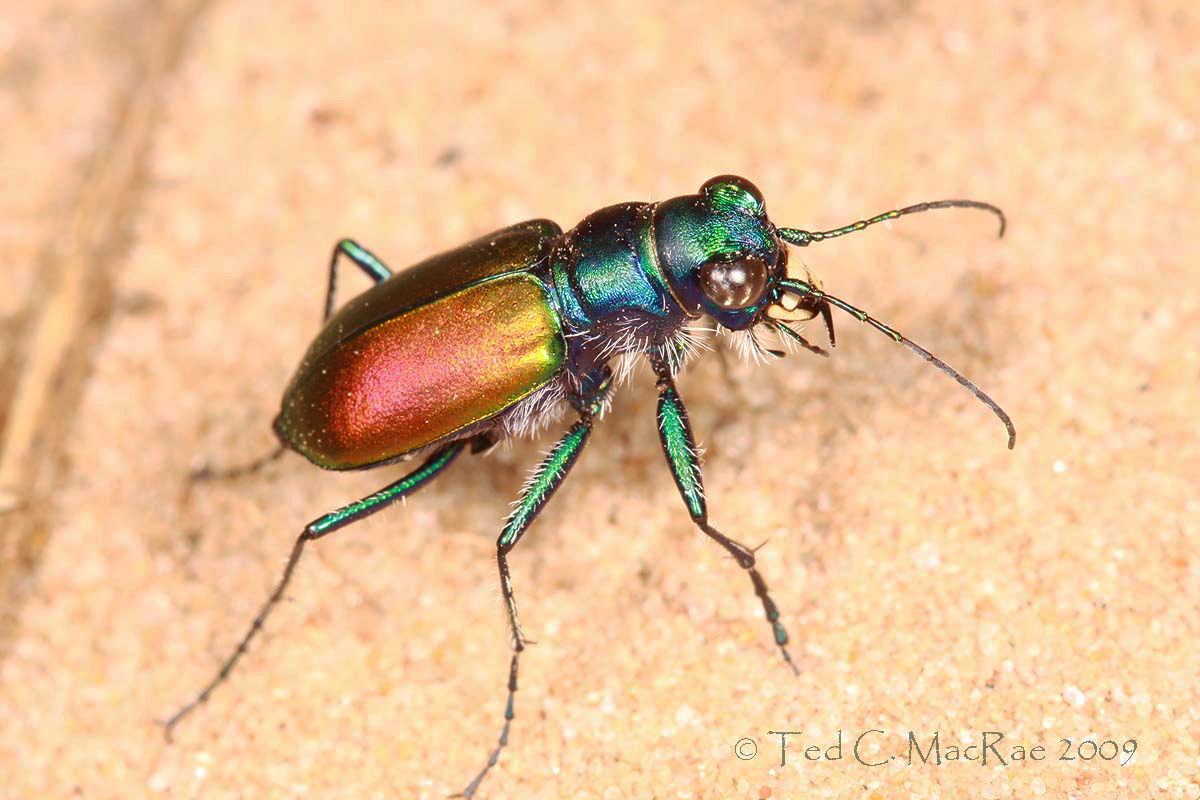
Okay, I can’t leave you without any kind of photograph – here are a couple of shots of Cicindela scutellaris, or festive tiger beetle. This male individual represents the stunningly beautiful nominotypical subspecies occupying the western part of the species’ range – it was photographed on sand exposures in shinnery oak shrubland habitat at Packsaddle Wildlife Management Area in extreme northwestern Oklahoma this past June.

IMG_0540_1200x800_enh

IMG_0547_1200x800

Photo details: Canon 100mm macro lens on Canon EOS 50D (manual mode), ISO-100, 1/250 sec, f/14-16, MT-24EX flash 1/4 power through diffuser caps.

Copyright © Ted C. MacRae

Add to FacebookAdd to NewsvineAdd to DiggAdd to Del.icio.usAdd to StumbleuponAdd to RedditAdd to BlinklistAdd to Ma.gnoliaAdd to TechnoratiAdd to Furl

The ubiquitous tiger beetle

Cicindela ubiquita

Cicindela ubiquita - ubiquitous tiger beetle

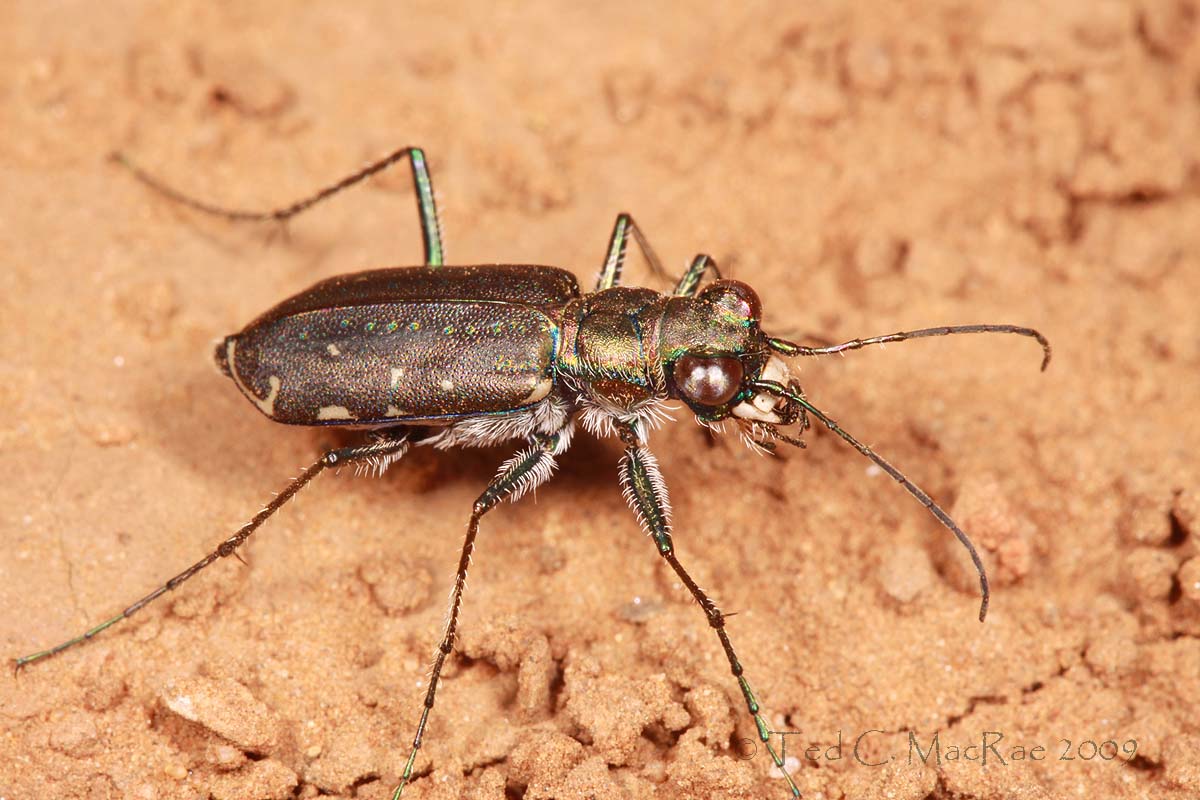
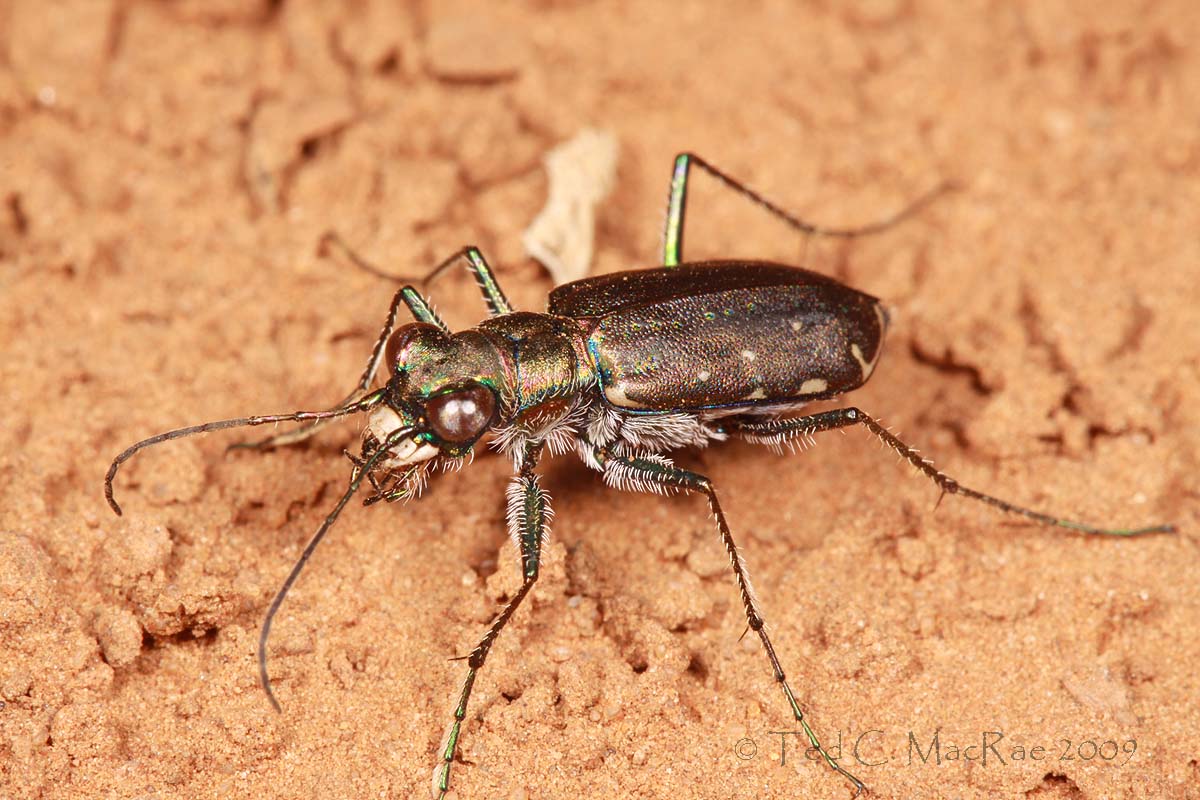
Back in early June as I began my exploration of The Nature Conservancy’s Four Canyon Preserve in northwestern Oklahoma, one of the very first insect species that I encountered was Cicindela ubiquita¹ (the ubiquitous tiger beetle).  This ubiquitous species is restricted to nearly the entire North American continent and is found only in just about any habitat you can imagine.  It seems to especially favor wet or dry areas in lowland or upland habitats with little or lots of vegetation.  At Four Canyon Preserve, it showed a distinct preference for dry upland sand and clay sites and wet bottomland sand sites.  I did not find it in wet bottomland clay sites – probably because no such habitat exists within the preserve.

¹ Originally described as Cicindela punctulata (punctured tiger beetle) by Olivier (1790).  This name has been accepted by virtually all subsequent authors and is still used in such recent works as Freitag (1999), Pearson et al. (2006), and Erwin and Pearson (2008).

IMG_0371_1200x800I had seen this species previously in Missouri on just about every collecting trip I’ve ever taken within that state.  Populations in Missouri seem to look exactly like the population here at Four Canyon Preserve but favor other habitats, including lawns, soybean fields, any dirt road, gravel parking lots, and cement sidewalks (although I have so far failed to find larval burrows in the latter, suggesting a greater level of habitat selectivity during the larval stage).  Based on examination of specimens in both my collection and that of the Enns Entomology Museum at the University of Missouri-Columbia, I can’t seem to find any county in Missouri where this beetle does not occur.

IMG_0372_1200x800An interesting feature of this species is that its adult activity period seems to exclude the winter months.  Thus far, I have only succeeded in finding active adults during those months when temperatures routinely surpass the freezing point (April through November).  It also apparently has been unable to colonize the Pacific Coast of North America – the reasons for this extreme selectivity will remain unclear until further research can be done.

Despite the common usage of the name Cicindela punctulata for this species, the following quotes are offered to support my contention that the valid name of this species should be Cicindela ubiquita:

The ubiquitous Cicindela (Cicindelidia) punctulata battling ants. — somatochlora.

This species and C. repanda are the most common and ubiquitous in the state. — Graves (1963).

C. punctulata punculata is almost ubiquitous in Colorado. — J. P. Schmidt

Notes: Abundant statewide; ubiquitous… — Mike Reese

this same pond were the ubiquitous C. repanda Dejean and C. punctulata Olivier. — Charlton and Kopper (2000).

Photo details: Canon 100mm macro lens on Canon EOS 50D, ISO 100, 1/250 sec, f/16, MT-24EX flash 1/4 power through diffuser caps.

REFERENCES:

Charlton, R. E. and B. J. Kopper.  2000.  An unexpected range extension for Cicindela trifasciata F. (Coleoptera: Carabidae: Cicindelinae).  The Coleopterists Bulletin 54(2):266-268.

Erwin, T. L. and D. L. Pearson. 2008. A Treatise on the Western Hemisphere Caraboidea (Coleoptera). Their classification, distributions, and ways of life. Volume II (Carabidae-Nebriiformes 2-Cicindelitae). Pensoft Series Faunistica 84. Pensoft Publishers, Sofia, 400 pp.

Freitag, R.  1999.  Catalogue of the tiger beetles of Canada and the United States.  National Research Council Canada, Ottawa, Ontario, 195 pp.

Graves, R. C.  1963.  The Cicindelidae of Michigan (Coleoptera).  American Midland Naturalist 69(2):492-507.

Olivier, G. A.  1790.  Entomologie ou histoire naturelle des insectos.  Paris, 2, 1-32.

Pearson, D. L., C. B. Knisley and C. J. Kazilek. 2006. A Field Guide to the Tiger Beetles of the United States and Canada. Oxford University Press, New York, 227 pp.

Copyright © Ted C. MacRae 2009

Add to FacebookAdd to NewsvineAdd to DiggAdd to Del.icio.usAdd to StumbleuponAdd to RedditAdd to BlinklistAdd to Ma.gnoliaAdd to TechnoratiAdd to Furl

Friday flower – Krameria lanceolata

Photo details: Canon 100mm macro lens on Canon EOS 50D, ISO 100, 1/250 sec, f/9, MT-24EX flash 1/4 power w/ diffuser caps.

Photo details: Canon 100mm macro lens on Canon EOS 50D, ISO 100, 1/250 sec, f/9, MT-24EX flash 1/4 power w/ diffuser caps.

I encountered few insects this past June on the dry slopes of sand shinnery oak shrubland that just makes it into the northwestern corner of Oklahoma’s Four Canyon Preserve – insect population levels were still depressed from the wildfire that swept through the area in April of last year.  Plant life, however, was diverse and abundant, including this most unusual plant – Krameria lanceolata (many common names, including trailing krameria, trailing ratany [sometimes spelled “rhatany”], Texan ratany, prairie sandbur, sandspur, etc.).  A dicot in the monogeneric family Krameraceae, plants in this genus share several unusual traits, the most obvious being their distinctly orchid-like, zygomorphic flowers (i.e., capable of division into symmetrical halves by only one longitudinal plane passing through the axis).  The resemblance to orchids is strictly superficial – they are most closely related to plants in the family Zygophyllaceae.

Orchids, of course, are monocots with trimerous flowers that only appear to be five-petaled because of the three petal-like sepals and the third true petal being modified into a “lip” onto which pollinating bees land.  Krameria flowers also appear five-petaled with a lip, but in this case it is the five sepals that form the “petals,” while the five true petals are modified into a lip (three fused petals) and two lateral upright “flags” called elaiphores.  These eliaphores play a central role in Krameria‘s unusual pollination biology, whose flowers produce not nectar, but fatty oils as rewards for their visitors – female bees of the genus Centris (Anthophoridae) (Simpson and Neff 1977).  The bees collect the oils from the modified external surfaces of the eliaphores, pollinating the flower in the process, and mix the oils with pollen to feed their larvae.  Although the Krameria plants are wholly dependent upon Centris bees to effect their pollination, the relationship is not mutually exclusive – Centris bees utilize other oil-producing plants as well.

All species of Krameria examined to date are obligate semiparasites, forming haustoria on the roots of a broad range of host plants.  Of the 18 species currently known in the genus, five occur in the U.S., with K. lanceolata the most widespread (Kansas and Colorado south to Arizona, New Mexico, and Texas and east to Georgia and Florida) (Austin and Honeychurch 2004). It is distinguished from the other U.S. species by its herbaceous, prostrate form.

Update 8/10/09: Mike Arduser, my hymenopterist friend who visited Four Canyon Preserve with me, wrote the following in response to my query about collecting bees from these flowers:

Yes, collected several off Krameria at Four Canyons and at Packsaddle – all were the same species, and I’m trying to remember the name as I’m writing this (all notes and material are at home) –  it was Centris lanosa. They are best found by listening, as they have a distinctive buzz as they move from flower to flower at ground level (difficult to see there).

REFERENCES:

Austin, D. F. and P. N. Honychurch.  2004.  Florida ethnobotany. CRC Press, Boca Raton, Florida. 909 pp.

Simpson, B. B. and J. L. Neff. 1977. Krameria, free-fatty acids and oil-collecting bees. Nature 267: 150-151.

Copyright © Ted C. MacRae

Add to FacebookAdd to NewsvineAdd to DiggAdd to Del.icio.usAdd to StumbleuponAdd to RedditAdd to BlinklistAdd to Ma.gnoliaAdd to TechnoratiAdd to Furl

Western hognose snake

Another herp interlude…

IMG_0655_1200x800
Photo details: Canon 100mm macro lens on Canon EOS 50D, ISO 100, 1/250 sec, f/14, MT-24EX flash 1/4 power w/ diffuser caps.

During my visit to Salt Plains National Wildlife Refuge in northwestern Oklahoma this past June, tiger beetles were not the only wildlife subjects I encountered.  Near the edge of one of the alkaline flats along Sandpiper Trail was this hognose snake.  This is the second hognose snake that I’ve encountered in as many years, the first being a member of a rare, disjunct population of the dusty hognose snake (Heterodon nasicus gloydi) in one of southeastern Missouri’s critically imperiled sand prairie habitats.  There are two species of hognose snake in Oklahoma – eastern (H. platirhinos) and western (H. nasicus).  I presume this individual to be the western due to its strongly upturned rostral (snout), which is only moderately upturned in the eastern species, and black-checkered ventral coloration.  Surprisingly, in checking the Salt Plains reptile species list for confirmation on its identity, I noted that no confirmed sightings of either the eastern or western hognose snake have been recorded at the refuge.  I have since done my good deed to reptile science by submitting this and another photograph I took of the individual to the refuge biologist.  Ted MacRae – entomologist and discoverer of new reptile records!  Western hognose snakes are further classified into three subspecies, two of which – dusty and nominotypical – occur in Oklahoma (the third occurs in Mexico). However, the distinctions between the two U.S. subspecies are subtle¹ and not apparent in this photograph, preventing further classification.

¹ Some authors consider the dusty and western hognose snakes to be separate species, while others have regarded their differences too subtle to warrant even subspecific distinction.

Hognose snakes are famous for their well-choreographed sequence of defensive displays. Their first act is to rear up cobra-like and strike out with their mouth open while hissing (unfortunately, neither of the hognoses I’ve encountered entertained me in this manner).  If the threat continues, they then turn over and writh violently in mock agony before finally rolling over on their backs and playing dead (thanatosis).  Last year’s hognose snake didn’t do this either, insisting instead on continually trying to burrow into the loose sand.  As can be seen from the photograph above, however, playing dead is exactly what this individual did.  With the mouth agape and the tongue protruding, it’s a convincing display of lifelessness.  Amusingly though, whenever the snake was righted it immediately turned over on its back again – not such a good imitation of being dead!  Presumably the snakes predators are as bad at noticing that detail as are the snakes themselves.  As I continued to pester this individual, trying to get him to stick out his tongue further for a better photograph, he eventually started ejecting blood from the lacrymal glands and emitting musk from the cloaca – what better to emphasize a death display than blood and an offensive smell!

Western hognose snakes are classified as a species of ”least concern” on the IUCN Red List of Threatened Species and aren’t listed as a species of concern on the Oklahoma Natural Heritage Inventory database.  Nevertheless, as with many other reptiles and amphibians, populations are declining throughout much of their former range.  This is likely due to the combined effects of urbanization, reduction of habitat, predation by feral dogs and cats, and overcollection for sale to the pet trade.

Copyright © Ted C. MacRae 2009

Add to FacebookAdd to NewsvineAdd to DiggAdd to Del.icio.usAdd to StumbleuponAdd to RedditAdd to BlinklistAdd to Ma.gnoliaAdd to TechnoratiAdd to Furl

Salt Plains National Wildlife Refuge

IMG_0687_1200x800

I’ve written quite a few posts about my June trip to northwestern Oklahoma. Four days at the ruggedly scenic Four Canyon Preserve and nearby Packsaddle Wildlife Management Area yielded a few interesting jewel beetles (though not many tiger beetles), but the followed two days in the red clay/gypsum hills just north of there were as successful a two-day period as I’ve ever had, with new localities for Cylindera celeripes (swift tiger beetle) and true field photographs of Dromochorus pruinina (frosted dromo tiger beetle¹). The next day was spent at nearby Salt Plains National Wildlife Refuge, just east of the red clay hills in Alfalfa Co. Salt Plains is best known for its Selenite Crystal Dig Area, where an estimated 30,000 annual visitors dig for Oklahoma’s State Crystal with its unique hour glass-shaped inclusion (the only known site where these crystals are found). A dominant feature of the refuge, however, is its 10,000 acre saline flat – left behind by the vast Permian seas that once covered the interior of the continent and the largest such salt flat in the Great Plains.  It was this feature that drew my interest.

¹ Common names according to Erwin and Pearson (2008).

IMG_0689_1200x800

I first visited Salt Plains a few years ago when fieldmate Chris Brown and I were near the end of a rather unproductive (yet still enjoyable) fall tiger beetle trip to the nearby Gypsum Hills of south-central Kansas (Cicindela pulchra had eluded us – for the time being!).  We noted the refuge on the map and decided to take a look – becoming instantly enamoured with the diversity of tiger beetles seen running on its barren, salt-encrusted mud flats.  I returned the following fall with long-time fieldmate Rich Thoma and Hardtner, KS resident “Beetle Bill” Smith, who introduced us to the refuge biologist so we could get permits to do some proper collecting.  Most of the tiger beetles we saw were widespread and familiar to me – Cicindela species proper such as C. formosa formosa (big sand tiger beetle), C. tranquebarica (oblique-lined tiger beetle), C. punctulata (punctured tiger beetle), and C. repanda (bronzed tiger beetle), but it was the creamy white Eunota togata globicollis (alkali tiger beetle) that had me swiping my net for the next hour or two.  Sadly, those were in my pre-photographer days, so I have no visual record of that species other than the pinned specimens in my collection.

My visit during this trip was completely unplanned.  After the mid-week’s thunderstorms chased me back to this part of the state, I thought this would be a nice contrast to the red clay/gypsum hills where I saw C. celeripes and D. pruinina.  In addition, the selection of tiger beetles active on the saline flats during this summer trip would likely be quite different from the fall/spring species I had seen on my previous two visits.  Trouble was, the unplanned nature of the visit also meant that I didn’t have a permit, but I was prepared to limit my activities to only photography in case I was unable to convince the refuge staff to renew my prior permit.  That eventuality was unnecessary, however, as the refuge biologist located my permit in a gray, dusty file cabinet and graciously typed up a new permit for me – good until next summer!  With that, I was off to SandPiper Trail and seven hours of stalking, netting, and photographing.  Some familiar faces were there again – C. formosa, C. repanda, C. punctulata, and C. tranquebarica (as they are almost everywhere), but I also encountered three beautiful species that I had not seen there before (one of which I had never seen previously).  Like E. togata, each of these species is an alkaline habitat specialist that makes its living only in these harsh, saline environments. They were not the easiest species to photograph, easily alarmed in the heat of the day, but the vast open spaces allowed me to follow their escape flights with relative ease, and one-by-one they gradually became accustomed to my presence and eventually allowed me to get at least one or two good shots.

Ellipsoptera nevadica knausii - Knaus' tiger beetle

Ellipsoptera nevadica knausii - Knaus' tiger beetle

Habroscelimorpha circumpicta johnsonii - Johnson's tiger beetle

Habroscelimorpha circumpicta johnsonii - Johnson's tiger beetle

Cicindela fulgida fulgida - crimson saltflat tiger beetle

Cicindela fulgida fulgida - crimson saltflat tiger beetle

Along with E. togata globicollis, these species bring the total number of species that I’ve observed at Salt Plains to eight – quite a hyperdiversity given the very small portion of the refuge that I’ve explored during my three visits.  Willis (1967) has observed as many as 11 species in a single habitat, and while this may seem to violate the principle of competitive exclusion (limiting the number of species that can occupy a given niche), careful observation reveals small but distinct partitionings of this harsh environment by the different species.  For example, C. fulgida was seen in the drier, more vegetated fringes around the flats, E. nevadica knausii was observed in moist, open areas near the water’s edge, and H. circumpicta johnsonii was more generally free ranging across the open salt surfaces.  Temporal separation combines with spatial separation to further subdivide the habitat – the latter two species occur as adults during summer, while E. togata globicollis and C. fulgida adult occurrence is primarily during spring and fall (the individual I saw was likely a stragler).  I have noted the same phenomenon with species occurring in clay habitats here in Missouri, with as many as six species seen at a single highway intersection in the White River Hills a few years ago.

Photo details:
Landscapes: Canon 17-85mm zoom lens on Canon EOS 50D (landscape mode), ISO 100, 1/50-60 sec, f/7.1-6.3, natural light.
Beetles: Canon 100mm macro lens on Canon EOS 50D (manual mode), ISO 100, 1/250 sec, f/14, MT-24EX flash 1/4 power w/ diffuser caps.

REFERENCES:

Erwin, T. L. and D. L. Pearson. 2008. A Treatise on the Western Hemisphere Caraboidea (Coleoptera). Their classification, distributions, and ways of life. Volume II (Carabidae-Nebriiformes 2-Cicindelitae). Pensoft Series Faunistica 84. Pensoft Publishers, Sofia, 400 pp.

Willis, H. L.  1967.  Bionomics and zoogeography of tiger beetles of saline habitats in the central United States (Coleoptera: Cicindelidae).  The University of Kansas Science Bulletin 47(5):145-313.

Copyright © Ted C. MacRae 2009

Add to FacebookAdd to NewsvineAdd to DiggAdd to Del.icio.usAdd to StumbleuponAdd to RedditAdd to BlinklistAdd to Ma.gnoliaAdd to TechnoratiAdd to Furl

Oklahoma is for lovers

A few rather risqué photos from my June trip to northwestern Oklahoma.

Eleodes suturalis (family Tenebrionidae) - June 6, 2009 at Four Canyon Preserve, Ellis Co., Oklahoma

Eleodes suturalis (family Tenebrionidae) - June 6, 2009 at Four Canyon Preserve, Ellis Co., Oklahoma

Chrysobothris ignicollis (family Buprestidae) - June 6, 2009 at Four Canyon Preserve, Ellis Co., Oklahoma

Chrysobothris ignicollis (family Buprestidae) - June 6, 2009 at Four Canyon Preserve, Ellis Co., Oklahoma

Ellipsoptera nevadica knausii ("family" Cicindelidae) - June 12, 2009 at Salt Plain National Wildlife Refuge, Alfalfa Co., Oklahoma

Ellipsoptera nevadica knausii ("family" Cicindelidae) - June 12, 2009 at Salt Plain National Wildlife Refuge, Alfalfa Co., Oklahoma

Photo details:
Eleodes suturalis: Canon 100mm macro lens on Canon EOS 50D, ISO 100, 1/250 sec, f/13, MT-24EX flash 1/4 power through diffuser caps.
Chrysobothris ignicollis: Canon 65mm 1-5x macro lens on Canon EOS 50D, ISO 100, 1/250 sec, f/13, MT-24EX flash 1/8 power through diffuser caps.
Ellipsoptera nevadica knausii: Canon 100mm macro lens on Canon EOS 50D, ISO 100, 1/250 sec, f/14, MT-24EX flash 1/4 power through diffuser caps.

Copyright © Ted C. MacRae 2009

Add to FacebookAdd to NewsvineAdd to DiggAdd to Del.icio.usAdd to StumbleuponAdd to RedditAdd to BlinklistAdd to Ma.gnoliaAdd to TechnoratiAdd to Furl