Western Diamondback Rattlesnake

Western Diamondback Rattlesnake (Crotalus atrox) | Gloss Mountains, Major Co., Oklahoma

Western Diamondback Rattlesnake (Crotalus atrox) | Gloss Mountains, Major Co., Oklahoma

I’m always delighted to see snakes, even venomous species, and whenever my collecting takes me west I know my chances of seeing snakes are good. My first stop during the current collecting trip was the Gloss Mountains of northwestern Oklahoma, and although I have visited this place several times since “discovering” it in June 2009, I have seen only a single snake during all of my previous visits—a charming little Western Pygmy Rattlesnake (Sistrurus miliarius streckeri). I’m a little surprised by this, as the habitat looks perfect for the one snake that truly don’t look forward to encountering—the Prairie Rattlesnake (Crotalus viridis). As I roam the surrounding mixed grass prairies (by both day and night) I am ever on the watch for these terrifyingly aggressive snakes, having learned my lesson with this species a few years ago in South Dakota’s Black Hills. I spent two days in the area during this trip, and I still have not seen one, but I did see a young (just over 2 feet in length) Western Diamondback Rattlesnake (Crotalus atrox)—my first for this species. Although he was lying in an eroded ravine in the red clay talus slopes and partially hidden by an overhanging clump of grass, the diamond pattern immediately drew my eye as something out of the ordinary, and I was able to move the grasses aside (with my net handle!) and get this shot before he even flinched. After the first flash he started getting agitated, and I was only able to get two more (not as good) shots before he’d had enough and began retreating into the thicker grass above the ravine—rattle buzzing vigorously as he left. Comparatively speaking, he was one of the most docile rattlesnakes I’ve encountered, but since this is the only Western Diamondback I’ve seen I don’t know if that is a hallmark of the species or more due to his young age.

Copyright © Ted C. MacRae 2013

How to collect larvae of Amblycheila cylindriformis

Amblycheila cylindriformis larval burrow | Major Co., Oklahoma

Amblycheila cylindriformis larval burrow | Major Co., Oklahoma

Step 1. Go to your favorite grassland habitat in the western half of the Great Plains anywhere from Texas north to South Dakota and look for barren soil amongst the vegetation. Clay banks near streams or in ravines and even vertical clay bluff faces are also good (although I have not myself observed the latter). “My” spot is in the Glass Mountains of northwestern Oklahoma, where talus slopes in mixed-grass prairie beneath flat-topped mesas and the ravines that cut through them provide just enough slope for this species’ liking.

Burrow diameter of ~8mm identifies this as a 3rd instar larva.

Burrow diameter of ~8mm identifies this as a 3rd instar larva.

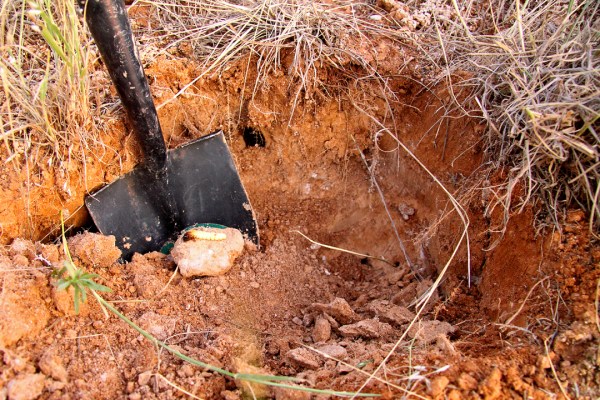
Step 2. Look for large, almost perfectly round burrow entrances that go straight down from the surface. By large, I mean approximately 6–8 mm in diameter—as large a burrow as any tiger beetle in North America will make. Many other insects create burrows, but tiger beetle burrows are generally recognizable by their almost perfectly circular shape and clean, beveled edge. Look closely, and the burrow will be seen to actually be slightly D-shaped to match the shape of the tiger beetle larva’s head—the large, sickle-shaped, upward-facing jaws resting against the flat part of the D. In the case of this species, they tend to be found in clusters of several burrows in close proximity to each other. The burrow in these photos was found at the upper edge of a drainage ravine on the upper part of the talus slopes (see diagram in this post).

Dig around the burrow, carefully excavating along the grass stem, until the larva is reached.

Dig around the burrow, carefully excavating along the grass stem, until the larva is reached.

Step 3. Try this first—chew the end of a long, narrow grass stem (frayed and sticky will be easier for the larva to grab hold of) and stick it down the burrow until it hits bottom, tap lightly a few times to entice a bite, then yank (and I mean yank!) the stem out. With luck, the larva will come flying out of the burrow and land somewhere on the ground in front of you. (By the way, if you have never done this, you are missing one of the greatest treats that insect collecting has to offer. If you have done it, you owe it to yourself to show this to somebody else who has not ever seen it—their shocked reaction at the sight of the flying larva is beyond priceless!) Larvae are not always in the mood to bite, however, so if the so-called “fishing” technique does not work then you will have to dig. Stick the grass stem back down the burrow and begin excavating around the burrow, carefully prying away the soil adjacent to the burrow to prevent it from falling into and obscuring the burrow. Keep excavating as you follow the grass stem down until, at least, you reach the larva. In the photo above you can see in the lower right-center area the burrow with the grass stem protruding from it and the larva placed on a clump of soil in front of the shovel (for sense of scale). It seems I had an easy time of it with this larva, as literature sources report larval burrows extending down to depths of a meter or more.

Amblycheila cylindriformis 3rd instar larva.

Amblycheila cylindriformis 3rd instar larva.

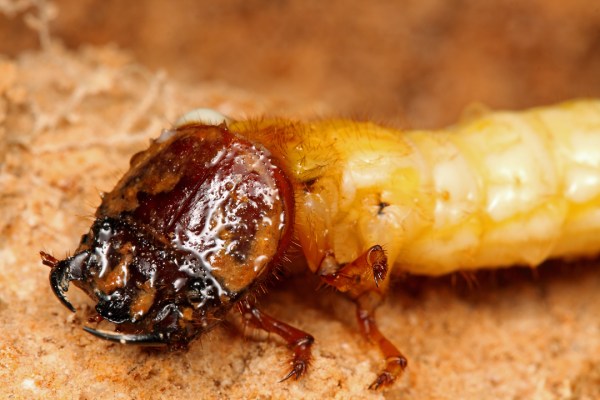
Step 4. Behold the beast! There is nothing more that can be said—these larvae are ginormous! This particular larva measured a full 62 mm from the tips of its mandibles to the tip of its abdomen—that’s 2½ inches! No other tiger beetle larva in North America reaches this size, except perhaps the related A. hoversoni (South Texas Giant Tiger Beetle).

The distinctly smaller 2nd pair of eyes confirm this is not Tetracha or Cicindela (sensu lato)...

The distinctly smaller 2nd pair of eyes confirm this is not Tetracha or Cicindela (sensu lato)…

Step 5. If size alone isn’t enough, you can confirm that the larvae does indeed belong to the genus Amblycheila by looking at its eyes—their are two pairs, and the 1st pair (closest to the mandibles) are distinctly larger than the 2nd pair. This isn’t clearly visible in the photo above because I doused the larva with water to remove the mud and dirt that encrusted it upon removal from its burrow.

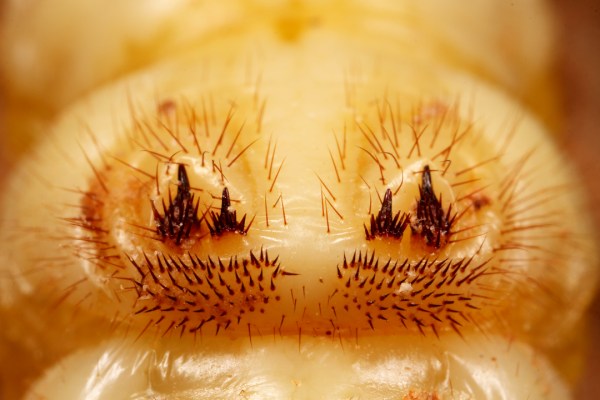
...and the well-separated hooks on the 5th abdominal segment confirm it is Amblycheila.

…and the distinctly separated hooks on the 5th abdominal segment confirm it is Amblycheila.

Step 6. Another way to distinguish larvae of the genus Amblycheila is by looking at the hooks on the hump of the 5th abdominal segment, best done with a hand lens (or, even better, with an MP-E65 lens!). All tiger beetle larvae have several pairs of large hooks that the larva uses to brace itself against the wall of its burrow when capturing prey to prevent the struggling prey from pulling the tiger beetle larva out of its burrow. Larvae in the genus Omus, restricted to the Pacific region of North America, have three pairs of hooks (referred to as the outer, middle, and inner hooks), while all other North American tiger beetle genera have two (having lost the outer pair). In Amblycheila and Tetracha the hooks are simple and thornlike, while larvae of all other North American genera have much longer middle hooks that are curved and sickle-shaped (e.g., Cylindera celeripes in this post). Amblycheila larvae can be distinguished from Tetracha larvae by the middle and inner hooks on each side being distinctly separated rather than touching at the base (e.g., Tetracha floridana in this post). There is also a cluster of short, stout hairs around the base of each hook in Amblycheila that is missing in Tetracha (e.g., Tetracha virginica in this post).

The numerous stout setae are also characteristic of the genus.

The numerous stout setae are also characteristic of the genus.

Step 7. Lastly, don’t forget to look at the hump in lateral profile—it is as alien a structure as any in the insect world. In the case of Amblycheila larvae, the bed of hairs posterior to the hooks is comprised of much shorter, stouter, and more densely placed hairs than larvae of Tetracha.

Copyright © Ted C. MacRae 2013

Black olives with legs

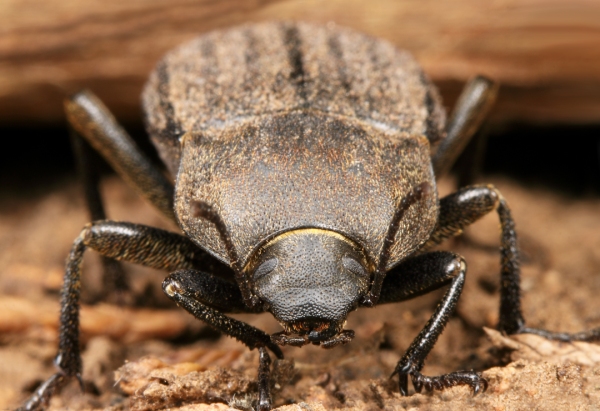
While searching the open red-cedar woodland at Oklahoma’s Wichita Mountains National Wildlife Refuge back in September, I rather regularly encountered these darkling beetles (family Tenebrionidae) that I recognized as the species Eleodes tricostata. I really wanted to photograph the first several that I found, but I soon abandoned this idea because they just… wouldn’t… stop… crawling! Not that I’m impatient and couldn’t wait one out if I put my mind to it, but what I was really after was more photos of the beautifully black Cicindelidia obsoleta vulturina (Prairie Tiger Beetle) population that I had just found there. It would take most of the afternoon before I finally got the nice, closeup photos of the tiger beetle that I wanted, and as I started to leave the site I found yet another of these darkling beetles… just sitting there! The beetle didn’t move at all as I took first a few lateral profiles, then moved around to the front for the face shots that I so love, and finally back to the side for even more profiles. I was even able to remove the stick that the beetle had siddled up against to improve the composition of the profile shot and then place it behind the beetle as a backdrop in the frontal shot. Another lesson in why it pays not to waste too much time with uncooperative subjects when others are available.

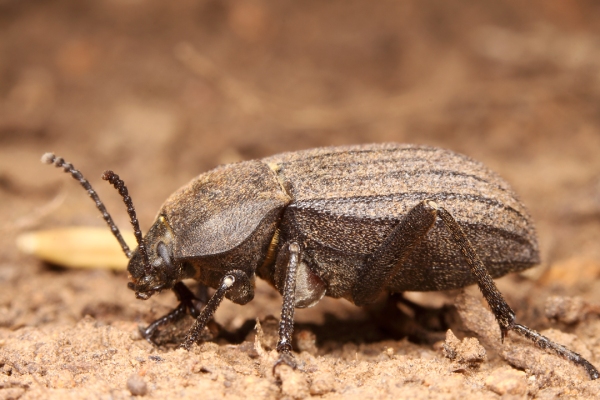
I already knew about this species because I have encountered it several times before in my travels across the western states, but most memorably during my first visit to the Great Plains back in 1986 when I saw large numbers of this species and the related E. suturalis crossing the highway in front of us during the early evening hours in south-central Kansas. I’d never seen such en masse movement by large beetles, and although I’ve seen both of these species numerous times since I’ve not seen another such migration. Eleodes is the largest genus in the family in North America but occurs exclusively in the western states. Famous for their skunk-like head-stand when disturbed, Triplehorn et al. (2009) note the genus name is derived from Greek and means “olive-like.” This is certainly the case for most of the other members of the genus—mostly black and shiny, the larger species resemble “black olives with legs”; however, this species has not quite such aspect. Rather, its dull color, depressed fusiform shape and elytra with distinct, tuberculate costae (Triplehorn et al. 2009, Bernett 2008) make it immediately recognizable amongst the dozens of congeners that are likely to be found co-occurring with it in the different parts of its wide range.

Not quite a head stand, but he wants to do it.

Although the normal range of this species covers the Great Plains from Canada to Mexico, its eastern limit of distribution is still incompletely known. There are some historical records from western and central Iowa, but it was only recently that Maxwell & Young (1998) reported the species for the first time from east of the Mississippi River in Wisconsin. Seeing this report made me wonder if I might be able to find the species in Missouri also; however, those authors noted that the Wisconsin population was encountered exclusively in open habitats with exposed soil surfaces and sandy soil in close proximity to shrub and tree cover. No such habitat exists in western Missouri, and although tiny remnants of sand prairie  habitat remain in the southeastern lowlands of the state they lack significant shrub and tree cover and are instead vegetated primarily by grasses and forbs.

REFERENCES:

Bernett, A. 2008. The genus Eleodes Eschscholtz (Coleoptera: Tenebrionidae) of eastern Colorado. Journal of the Kansas Entomological Society 81(4):377-391.

Maxwell, J. A. & D. K. Young. 1998. A significant eastern range extension for Eleodes tricostatus (Say) (Coleoptera: Tenebrionidae). The Coleopterists Bulletin 52(1):90–92.

Triplehorn, C. A., D. B. Thomas, and E. G. Riley. 2009. The genus Eleodes Eschscholtz (Coleoptera: Tenebrionidae) in Texas. The Coleopterists Bulletin 63(4):413-437.

Copyright © Ted C. MacRae 2012

Why are this beetle’s elytra outstretched?

Toposcopus wrightii on dead branch Juniperus virginiana | Major Co., Oklahoma

I’ve puzzled over the beetle in the above photo since I first saw it back in September on Day 2 of this year’s Annual Fall Tiger Beetle Trip. I encountered it on a dead branch of eastern red-cedar (Juniperus virginiana) on top of the main mesa at Gloss Mountain State Park in northwestern Oklahoma. At about 8 mm in length, it immediately struck me as possibly something in the family Ripiphoridae (wedge-shaped beetles). Still, the full-length elytra covering the abdomen made me doubt that identification, so I collected the specimen to get a better look at it when I returned home. Later that same day, while scanning the base of another mesa across the highway from the park at night, I came upon another individual that seemed to represent the same species—this time on a dead branch of fragrant sumac (Rhus aromatica). That individual is seen in the photo below, and two things are immediately apparent: 1) the beetle is a female in the act of oviposition, and 2) it is holding its elytra outstretched in a most curious way.

Another female oviposits on a dead branch of Rhus aromatica.

A quick browse through BugGuide’s ripiphorid images quickly showed a likely match with the genus Toposcopus, and consulting the original description of both the genus and its only included species—T. wrightii (LeConte 1868) showed agreement with the key diagnostic character (eyes divided into two lobes connected by a slender line of smooth, non-faceted corneous membrane). These two females differ from the male by their much less flabellate antennae (presumably the male uses these organs to detect female-emitted pheromones). LeConte described this species from New Mexico, and Rivnay (1929) also saw specimens from Texas and Arizona when he reviewed the North and Central American species of the family. Although the species is listed on Don Arnold’s Checklist of the Coleoptera of Oklahoma, the listing seems to be based only on the presence of specimens in the Oklahoma State University insect collection, while published records of its occurrence in the state are, as far as I can tell, still lacking. This species, thus, seems to be, along with Acmaeodera macra and Chrysobothris octocola (both family Buprestidae), an example of a typically southwestern U.S. species whose distribution extends northeast into the Red Hills Region of northwestern Oklahoma. Considering that Cylindera celeripes (Swift Tiger Beetle) and Amblycheila cylindriformis (Great Plains Giant Tiger Beetle) also have only recently been discovered in this area, it would seem that this part of the state is still undersampled and has the potential to yield additional interesting southwestern U.S. species.

Why is this female holding her elytra outstretched while ovipositing?

Regarding the outstretched elytra, I’ve not seen this type of behavior before with a beetle in the act of oviposition. While several groups of insects in other orders may hold their forewings outstretched as part of threat displays, I’ve not seen a beetle hold its elytra outstretched for any reason at all other than flight and don’t recall seeing such behavior mentioned in the literature either. Thus, I’m at a loss to explain why the beetle is doing this. If you have any ideas I would love to hear them.

One thing that I enjoy immensely about 19th Century taxonomic literature is the rich, often effusive prose that frequently accompanies the descriptive portions of the text. (I also lament that such colorful writings are nearly universally frowned upon my modern editors. Perhaps as taxonomy advances more fully into electronic-only publishing the concerns about space will dissipate and taxonomic authors will no longer be constrained to such sterile, uniform, precisely formatted writings.) The naming of this species provides an especially colorful example of the embellishments permitted to 19th Century authors:

I desire in the name of this beautiful and interesting addition to our fauna, to commemorate the ability of Gen. W. W. Wright, the Chief Engineer and Commander of the Survey in which the species in the present memoir were collected. His attention to the comfort and safety of the party while traveling through a hostile Indian country will not soon be forgotten by any of his companions; while the skill with which the more difficult portions of the route were examined, and the labors of his assistants directed to the most easy methods of surmounting the difficulties, will commend itself to every admirer of correct engineering.

John L. LeConte is widely regarded as the father of North American coleopterology. I don’t think there is anybody from the 19th Century, save perhaps Charles Darwin, that I would have more liked to meet.

REFERENCES: 

LeConte, J. L. 1868. New Coleoptera collected on the survey for the extension of the Union Pacific Railway, E. D. from Kansas to Fort Craig, New Mexico. Transactions of the American Entomological Society 2:49–59.

Rivnay, E. 1929. Revision of the Rhipiphoridae of North and Central America (Coleoptera). Memoirs of the American Entomological Society 6:1–67, 3 plates.

Copyright © Ted C. MacRae 2012

Consolation Crossidius

Rewind back to Day 2 of this year’s Annual Fall Tiger Beetle Trip at Gloss Mountain State Park in northwestern Oklahoma—these were actually the first non-Missouri beetles that I photographed on the trip. Crossidius pulchellus is a longhorned beetle (family Cerambycidae) that occurs commonly on flowers of broom snakeweed (Gutierrezia sarothrae) and relatives throughout the Great Plains and southern Rocky Mountains.

Crossidius pulchellus on flowers of Gutierrezia sarothrae | Major Co., Oklahoma. The dense vestiture (covering of hairs) of the beetles is made more conspicuous by backlighting the beetles with the sun.

I find it rather ironic that Crossidius pulchellus was the first western beetle that I encountered, since my original plans for this year’s late-season trip centered on looking specifically for longhorned beetles in the genus Crossidius (see last year’s Crossidius coralinus fulgidus for an extraordinarily beautiful representative of this genus). Unlike the vast majority of the family that develop as larvae in dead wood, species in this diverse, exclusively western North American genus bore through the roots living, perennial shrubs belonging to the genera Gutierrezia, Chrysothamnus/Ericameria, and Haplopappus (family Asteraceae)—the “goldenrods” of the west, they bloom in widespread, yellow-flowered profusion as summer turns to fall. A wide variety of insects are attracted to these blooms, most of which—bees, flies, wasps, moths, etc.—are opportunistic pollinators. Crossidius beetles, however, are intimately associated with the plants, seemingly spending their entire, brief adult lives either perched, feeding, or mating upon the flowers. Even at night, rather than leaving the plants to search for protected hiding spots, they simply bury themselves deeper amongst the flowers and await the next morning’s first, warming rays of sunlight.

Sampling the diversity of Crossidius that springs forth each year across the west requires carefully timed travel to multiple localities spread widely across rough terrain. As longhorned beetles go, the genus exhibits an astounding level of polytopism (geographically-based variation) that in many respects resembles that exhibited by North American tiger beetles. This has resulted in the description of a relatively large number of species, most of which can be further divided into numerous recognizable subspecies and even local morphs. The discontinuous distribution of their host plants across the broken western topography and resulting isolation of local populations have contributed to this variability, further complicated by hybridization among species occurring together in a given locality (Linsley & Chemsak 1961). I got a taste of the diversity of these beetles during last year’s fall tiger beetle trip as I looped through Colorado, Idaho, and Utah. Although my plans to look for them this year didn’t work out, my appetite remains whetted. There is always next year!

REFERENCE:

Linsley, E. G. & J. A. Chemsak. 1961. A distributional and taxonomic study of the genus Crossidius (Coleoptera, Cerambycidae). Miscellaneous Publications of the Entomological Society of America 3(2):26–64, 3 color plates.

An uncommon fall-active Acmaeodera

During last week’s visit to Alabaster Caverns State Park in northeastern Oklahoma (Woodward Co.), I saw a fair number of jewel beetles (family Buprestidae) representing a then-unidentified species of Acmaeodera. All of the individuals that I saw were visiting flowers of Heterotheca stenophylla (family Asteraceae), and had it not been fall I wouldn’t have thought much about it. However, fall activity is unusual among North American jewel beetles, particularly in the genus Acmaeodera. An occasional straggler from earlier in the season is one thing, but the numbers seen (perhaps close to two dozen) over the course of a couple hours left no doubt in my mind that these were newly active adults. In North America, most species of Acmaeodera are active during the spring and early summer months, during which time they visit a wide variety of flowers (but especially asteraceous species) to feed on pollen. They can also be found in late summer in southeast Arizona, but in that area nearly all jewel beetles (and a large number of other insect groups as well) occur in synchrony with the monsoonal season that begins in July. Only in southern Texas (and further south in México) have I seen truly fall-active jewel beetles, including several species of Acmaeodera.

This actually was not the first time I had seen this species during fall in Oklahoma. Last year I made a brief stop at Gloss Mountain State Park (about 30 miles southeast of Alabaster Caverns in Major Co.) on my way back from a late September collecting trip to Colorado/Utah/Idaho (still convinced that the Beautiful Tiger Beetle, Cicindela pulchra, might be there). Then, as now, I found more than a handful of adults (also visiting flowers of H. stenophylla), suggesting this was true fall activity and causing me to think, “Hmm, that’s weird.” I was pressed for time, however, and didn’t even grab my camera bag for the short hour or so that I had to look around, and once I returned home I quickly resumed my routine and forgot about trying to identify the beetles.
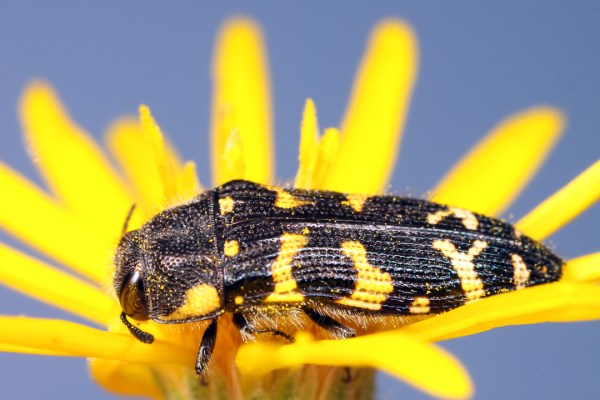
Acmaeodera macra | Woodward Co., Oklahoma

Returning home after this year’s trip I was not so inclined to forget, and when I mentioned it to my friend Chuck Bellamy he suggested that it might be the fall-active species, Acmaeodera macra (MCZ type specimen). Immediately I knew this was correct, as I had actually seen this species once before—a single specimen that I collected nearly 30 years ago  in south Texas at Bentsen-Rio Grandy Valley State Park on a Helianthus annuus flower (MacRae 2006). I don’t know why I didn’t think of that species when I saw it this time, other than perhaps I was still under the impression that this uncommonly encountered species was limited to the Rio Grande Valley and adjacent areas as stated by Vogt (1949) and Westcott et al. (1979). Recently, however, Westcott (2001) provided the first records of this species from outside of Texas—from Oklahoma!—and later recorded it also from Nuevo León, México (Westcott 2008).¹

¹ Nelson et al. (2008), in their North American catalogue of Buprestidae, also list Arizona in the distribution of this species. However, I am unaware of any supporting references for its occurrence there, and the catalogue is known to be frustratingly rife with errors and omissions. 
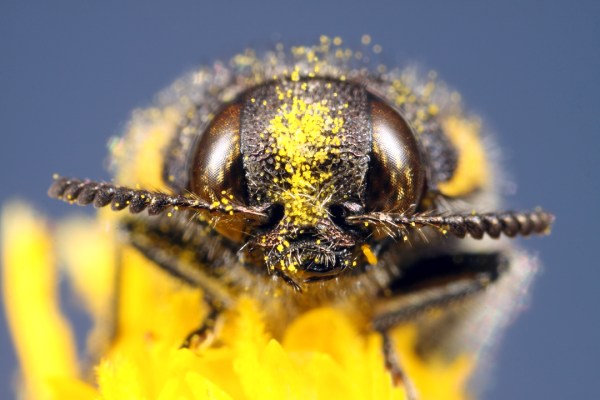
Bathed in pollen!

The Oklahoma records for this species given by Westcott (2001) include localities in Blaine, Cleveland, Greer, and Oklahoma Counties (with the latter taken on Grindelia sp., presumably flowers). Interestingly, with the exception of Greer Co. all of these counties lie along the Blaine Escarpment that separates the Gypsum Hills and Red Hills physiographic regions, and the two additional counties that I have now recorded for the species in Oklahoma (Major and Woodward) lie further to the north along this escarpment as well. With these new records, Alabaster Caverns now becomes the northernmost known outpost for A. macra. However, since Woodward Co. lies along the northern tier of counties in Oklahoma and the Blaine Escarpment extends further into south-central Kansas, it is possible that an even more northern outpost might eventually be found for the species. Little is known about the biology of this species—the only host records are for adults and include my sunflower record (MacRae 2006), Vogt’s (1949) mention of the species’ preference for “composite flowers” and records of adults on Acacia berlandieri and visiting flowers of Verbesina encelioides (Westcott et al. 1979). It’s anybody’s guess as to what the larval host is, but my guess is that in Oklahoma it’s restricted to vertical walls and talus slopes, since I never saw individuals outside of these specific situations despite the widespread occurrence of its H. stenophylla flower host.

REFERENCES:

MacRae, T. C. 2006. Distributional and biological notes on North American Buprestidae (Coleoptera), with comments on variation in Anthaxia (Haplanthaxia) viridicornis (Say) and A. (H.) viridfrons Gory. The Pan-Pacific Entomologist 82(2):166–199.

Nelson, G. H., G. C. Walters, Jr., R. D. Haines, & C. L. Bellamy.  2008.  A Catalogue and Bibliography of the Buprestoidea of American North of Mexico.  Coleopterists Society Special Publication No. 4, The Coleopterists Society, North Potomac, Maryland, 274 pp.

Vogt, G. H. 1949. A biologically annotated list of the Buprestidae of the Lower Rio Grande Valley, Texas. Annals of the Entomological Society of America 42(2): 192–202.

Westcott, R. L. 2001.  An interspecific hybrid in the genus Acmaeodera Eschscholta, a taxonomic note on Chrysobothris kelloggi Knull, and new distribution and host records for United States and Canadian species in these and other genera (Coleoptera: Buprestidae).  Jewel Beetles, 10:76-81.

Westcott, R. L., W. F. Barr, G. H. Nelson, & D. S. Verity.  1979.  Distributional and biological notes notes on North and Central American species of Acmaeodera (Coleoptera: Buprestidae).  The Coleopterists Bulletin, 33(2):169-181.

Copyright © Ted C. MacRae 2012

Dressed in black

The first three days of this year’s Fall Tiger Beetle Trip had been fun, and finding a new state record jewel beetle and an unusual seasonal activity record for another were definitely icing on the cake. Still, tiger beetles (at least adults) had been notably absent, with my hunch that Cicindela pulchra (Beautiful Tiger Beetle) might occur in the Red Hills of northwestern Oklahoma not playing out. My next goal was to go down to northern Texas and look for Cicindelidia politula (Limestone Tiger Beetle)—a species I have not yet encountered in the field. When I saw that the route south took me through the Wichita Mountains of southwestern Oklahoma, I recalled seeing this photo of Cicindelidia obsoleta vulturina (Prairie Tiger Beetle) on BugGuide taken in these very mountains during the fall. I have seen on many occasions the greenish Missouri / Arkansas disjunct population of this subspecies, but I had not yet seen the main population and its decidedly black individuals, so this became my quarry for Day 4 of the trip. I had nothing more to go on for a locality than “Wichita Mountains NWR” and a sense of its habitat preferences based on my own experience with the MO/AR disjuncts, so after arriving at the refuge I began to look for access to a 2-track leading to higher, unforested ground (reminiscent of the dolomite glades of southwestern Missouri). I quickly found a parking lot with a 2-track leading from it, so I pulled off, geared up, and set out on what I figured was surely a wild goose chase. The track looked good, but no beetles were seen, and after walking about a half-mile I happened to look up and see this not too far ahead:

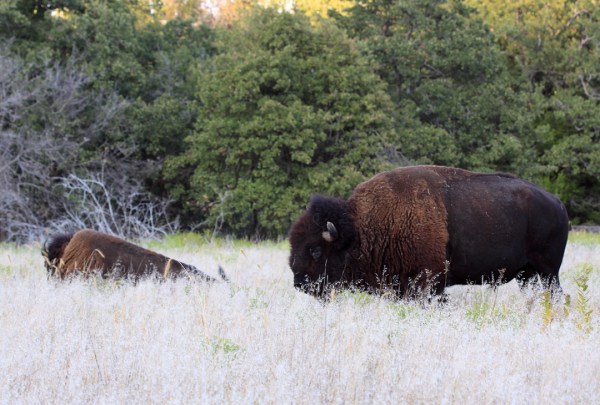
American bison | Wichita Mountains National Wildlife Refuge, Oklahoma

Call me chicken, but bison can and will charge without warning. Even though they seemed unconcerned by my presence, I wasn’t with anybody that I knew I could outrun 🙂 and decided that a cautious, tip-toeing retreat would the best course of action (even taking the above photo—uncropped, I might add—made me nervous). What now? I was quickly back at the car and not sure what to do next when I saw a foot path leading into a cedar woods, behind which the land rose up to treeless heights. I decided that might be a good place to explore—as long as I didn’t run into any bison along the way! As I was hiking through the woodland—an open, obviously long ago planted grove of eastern red cedar (Juniperus virginiana)—I passed by a small opening and almost by instinct veered into the opening to have a look. As soon as I stepped into the opening I saw the unmistakable escape flight of two large tiger beetles—what the…?! No doubt about it, they were C. o. vulturina, and they had been hanging out by a fairly fresh bovid chip (bison or cow, I don’t know). (I have seen this behavior also with the MO/AR disjuncts.) I watched them land and decided which one I would try to photograph. I guess I picked right, because the following photo was among the first few that I got:

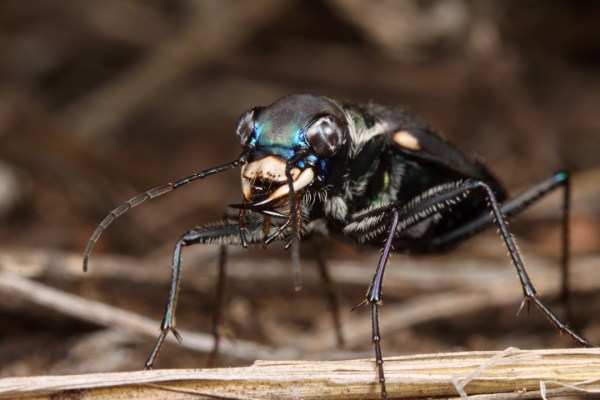
Cicindelidia obsoleta vulturina (prairie tiger beetle) | Wichita Mountains National Wildlife Refuge, Oklahoma

Despite the jet-black dorsal surface (which contrasts with the green to greenish-black to bronzy dorsal surface of the MO/AR disjuncts), these were colorful beetles with gorgeous metallic blue genae (cheeks) and intense violaceous tibia (lower legs). This first individual was quite cooperative (usually it’s the tenth or more beetle that I try to photograph that actually allows me to do so), so I spent a bit of time trying to coax it back to the bovid chip from which it flew. Eventually I succeeded in this and took a few more photos, the following of which I liked the best:

Shade seeking next to a bovid chip.

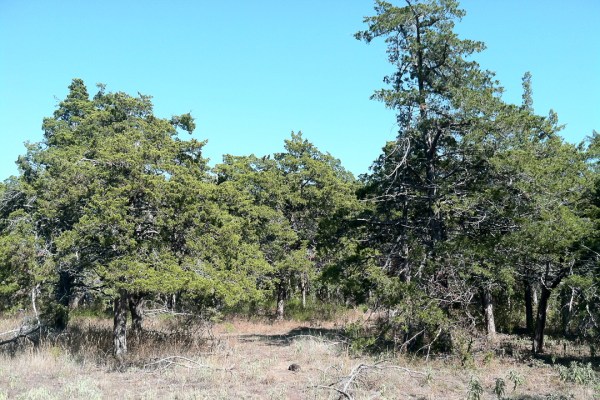
I’m still a bit puzzled about the habitat in which I found these beetles. I would have considered it an anomaly had I not seen two beetles at the same time and then subsequently seen a mating pair in almost the exact same spot. Prairie tiger beetles are known for their preference of open grassland habitats rather than woodlands, and indeed I saw more individuals back along the 2-track that I had abandoned earlier (once I got the courage to stray down it again later in the day). The photo below shows almost the entirety of the opening where I found the beetles, with the bovid chip located on the ground in the lower center of the photo:

An unusually wooded habitat for Cicindelidia obsoleta vulturina.

Seeing these two individuals in the small woodland opening gave me greater optimism that I would be able to find more on the grassy higher slopes above the cedar grove. I crossed the creek and climbed to the top of the first ridge, passing through what seemed to be ideal habitat for the beetle but seeing none. Although igneous in origin, the rocky landscape reminded me very much of the dolomite glades that lace through the White River Hills of southwestern Missouri and that harbour robust populations of this beetle (but occurring nowhere else in the state).

Rocky grasslands extend towards Mt. Scott.

After posting one of these landscape photos on my Facebook page, I got a comment from Thomas Shahan saying he had been to the area recently and seen a “dark Cicindela” atop nearby Elk Mountain. Low and behold, the beetle in the photo that he included was none other than this subspecies, so at least now I know they do occur in this more expected habitat despite my not having seen them on this day.

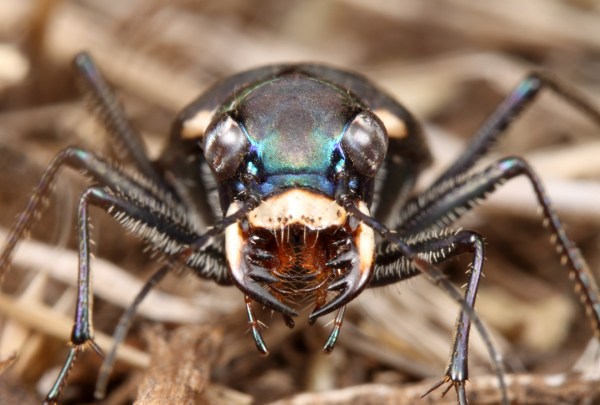
Failing to find the beetle on higher ground, and wanting to try for even closer photographs, I returned to “the opening” and immediately found another individual to photograph. A female, she may (or may not) have been the partner to the male I photographed earlier, but at any rate she was not nearly as cooperative. I chased her back and forth through the opening for about a half-hour before I finally got close enough to get a shot (my use of tube extensions required that I get even closer than before). As typically happens, however, she gradually became more and more accustomed to my presence, and eventually I was able to get a few photos with the beetle in fairly relaxed, candid poses. The following are my favorites:

A less trusting individual relunctantly allows herself to be photographed.

She looks angry, but in reality I caught her mandibles half open in the midst of chewing movements.

After photographing these individuals, I returned to the car and decided to wander (tentatively) down the 2-track that I had to abandon earlier in the day. This time I fouund the beetles easily, seeing perhaps half a dozen individuals in just the first quarter-mile. My wanderings, however, were once again cut short when I came around a tree bank and saw those same two bison, much closer to the road this time. I really wanted to get a better photograph than the one above, but common sense at first prevented me from getting any closer. I studied the two magnificent behemoths looking for any sign of annoyance, and seeing none I began to creep ever so tiny a bit closer. Eventually my heart rose too high in my throat to approach any closer, and I snapped the following photo and began a hasty, horse-eyed retreat—not even knowing for sure if the shot was good but feeling a little too proud of myself and my stupidity courage!

A little too close for comfort!

Copyright © Ted C. MacRae 2012
9th Annual Fall Tiger Beetle Trip: Day 3.2

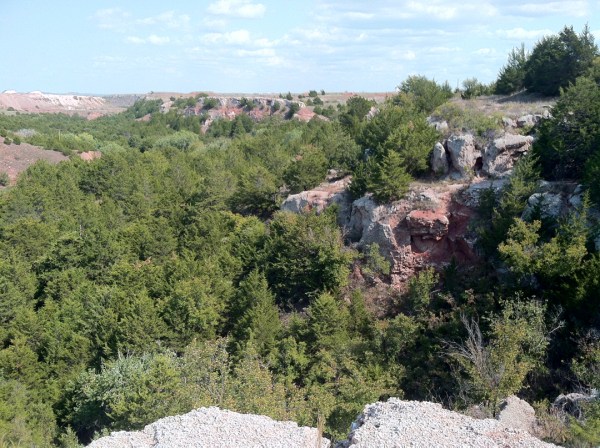
My plan to retrieve beetle-infested wood in Oklahoma’s Glass Mountains has morphed from a quick stop to an all-morning affair, and by the time I loaded up the bundles it was well past noon. Fortunately, my next planned stop—Alabaster Caverns State Park—was only about a 90-minute drive, meaning I would still have plenty of time to give the area a good look. Unlike the Glass Mountains, with its gypsum-capped, flat-topped mesas rising above the surrounding landscape, Alabaster Caverns is level ground fissured by deep, rugged canyons that have eroded through the gypsum cap into the soft, underlying red clay. Nevertheless, both sites are part of the same Gypsum/Red Hills geological formation, so their associated flora and entomofauna are also similar. It was during my original visit to Alabaster Caverns back in 2009 that I found robust populations of Cylindera celeripes (Swift Tiger Beetle), and in October of the following year I discovered its previously unknown larva. My originally intent in coming here this time was to look for Cicindela pulchra (Beautiful Tiger Beetle), but since I had failed to find this species in the Glass Mountains I had little optimism that I would find it here as well. Still, it’s a beautiful park and I was anxious to see some of the canyon areas that I had not explored on previous visits, after which my trip would take a turn to the south.

Alabaster Caverns State Park, Woodward Co., Oklahoma

As I expected, no amount of searching on the flats above showed any evidence of C. pulchra, and I saw pretty much the same assortment of beetles visiting the yellow-flowered Heterotheca stenophylla (stiffleaf false goldenaster) and Gutierezzia sarothrae (broom snakeweed) blooming in profusion that I had seen on Day 2 at Gloss Mountains State Park. Since I had neglected to photograph the gray blister beetle (family Meloidae, genus Epicauta) that I was seeing so commonly the day before, I decided I should go ahead and take advantage of the opportunity while I had it. As I mentioned in my Day 2 post, these beetles were seen almost exclusively on Gutierezzia, and shown below are two of the better photos that I ended up with.

Epicauta sp. | Alabaster Caverns State Park, Woodward Co., Oklahoma

Mouthparts at 3X—love that pollen!

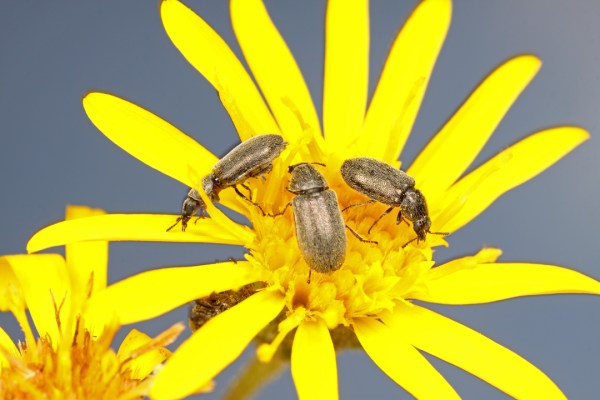
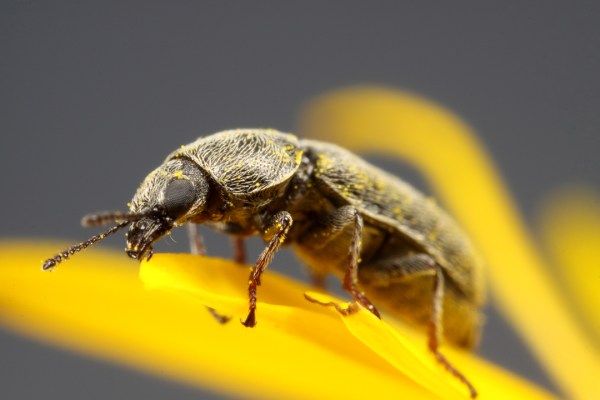
Another species that I saw very commonly were tiny little beetles feeding exclusively on the Heterotheca flowers. Measuring less than 5mm in length, a majority of flowers had at least one of these small gray beetles, and sometimes as many as four or five. Just based on appearance I suspected they represented something in or related to the soft-winged flower beetles (family Melyridae), and in fact they are a dead ringer for the species Listrus senilis(compare to these photos of the MCZ type specimen). This species seems to occur abundantly throughout the Great Plains (Mawdsley 1999) as far south as Texas (BugGuide). The small size of these beetles made them much more difficult to photograph, so my ‘keeper’ rate was lower than for the Epicauta beetle, but a few turned out okay:

Listrus senilis on Heterotheca stenophylla | Alabaster Caverns State Park, Woodward Co., Oklahoma

Listrus senilis at 5X—another pollen lover!

The most significant find of the day, however, was also the most unexpected—I saw numerous individuals of an Acmaeodera jewel beetle feeding on the Heterotheca flowers. Why is this so unexpected? Because throughout most of North America members of the genus Acmaeodera are almost exclusively active as adults during spring and early summer. Those occurring in southeastern Arizona are found more during July and August, a result of the summer monsoon season, but truly fall-active species are limited to a few occurring in the Lower Rio Grande Valley of south Texas. When I saw the first one I presumed it was a late season straggler, but then I saw another, and another. It was clear by their numbers that now is their activity period. I do not know what species they represent, but I took numerous photos and will post them once I have made an identification. It remains to be seen whether this is an unusual habit for a known species (more likely) or a previously unknown species (less likely, though new species of Acmaoeodera continue to be discovered routinely in the U.S.)—stay tuned!

REFERENCE:

Mawdsley, J. R. 1999. Redescription and notes on the biology of Amecocerus senilis (LeConte) (Coleoptera: Melyridae: Dasytinae). Journal of the New York Entomological Society 107(1):68-72.

Copyright © Ted C. MacRae 2012