Shooting 8X hand-held in the field

Just to prove it can be done, here is an uncropped photograph of the seed weevil Althaeus hibisci (or the closely related A. folkertsi) (order Coleoptera, family Chrysomelidae, subfamily Bruchinae). Adults of these species measure only 1.5–2.5 mm in length (Kingsolver 2004), yet this individual almost completely fills the frame:

Althaeus hibisci/folkertsi on Hibiscus moscheutos lasiocarpus | Route 66 State Park, St. Louis Co., Missouri

I achieved 8X magnification by stacking 68 mm of extension tubes under my Canon MP-E 65mm 1–5X macro lens and extending the bellows of the lens out to its maximum. Shooting 8X is not for the timid—the small subject to lens distance complicates lighting (full flash required), and even finding the subject in the viewfinder can be next to impossible. However, doing it hand-held in the field requires more than just courage and patience—good bracing techniques to minimize movement by and between the camera and the subject are essential. Here is how I do it:

  • I sit down, prop my knees up, and rest the camera in the crotch between my knees (the camera quickly becomes very heavy since it’s being held by only one hand—see next bullet) while positioning it near my face. If possible, I lean back against something as well to provide even more stability, although this is often not possible depending on field conditions.
  • I hold the leaf or flower supporting the subject in my left hand. Subjects this small are rarely going anywhere (or if they are skittish then I use the same slow, deliberate techniques that I use with larger skittish insects), so it is possible to hold the leaf or flower and position the subject right in front of the lens. Hand holding the subject’s support also affords the ability to micro-adjust the position and angle of the subject for optimum composition or to adjust for movement by the subject (easier than trying to track it by moving the lens). In this case of the photo featured here, I detached the leaf with the beetle from the plant (use small scissors to snip the leaf petiole, as this avoids the “jolt” that happens if you try to pick the leaf and which usually results in the subject fleeing). In other cases, I leave the leaf attached and carefully “pull” it towards me to hold it steady.
  • I look through the viewfinder and brace my left wrist (yes, the same hand that is holding the subject) on the underside of the lens, then slowly move the subject towards the lens with my fingers until I see movement and can micro-adjust for proper focus. Bracing your wrist against the lens is key—it is nearly impossible to hold the subject steady in front of the lens without bracing your wrist against it. In effect, this “fixes” the subject to the lens. Also, before I begin looking for the subject through the viewfinder I study its position on the leaf and look for “landmarks” that I can recognize when looking through the viewfinder to minimize the time needed to find the subject (the more time you spend looking for the subject, the greater the chance it will move or flee). Again, the subject to lens distance is very small, but with practice you’ll get a feel for precisely how far from the lens you need to place the subject.
  • I hold my breath and micro-adjust the subject position to nail the focus (usually on the eye) and then fire a shot. If it takes too long to get the focus I exhale and try again, as body shake will only get worse once it starts. Important: After taking the first shot, do not move the hand holding the subject as you look at the image preview and/or histogram—the first shot rarely has the settings precisely where you need them, and keeping the subject in place prevents a lot of re-searching after making the needed setting adjustments with the right hand.

Other than lighting, nailing the focus is the most difficult aspect of shooting hand-held at such high magnifications. The more relaxed and stable you can keep the rest of your body, the less hand movement you’ll experience while holding the subject and the greater chance you have of hitting the focus. Again, a fully extended MP-E lens on 68 mm of extension tubes becomes very heavy very quickly when held in one hand (even when resting on your knees), so expect your forearm muscles to give out quickly until you have a chance to strengthen them through practice.

I use these same techniques to some degree at lower magnifications as well—certainly for anything above 2X. I’m interested in doing a lot more 8X photography, however, because there is a whole world of tiny insects that are not being photographed due to their very small size. These insects are no less fascinating and beautiful than their larger, more oft photographed brethren.

Finally, you might be asking why I don’t just carry a tripod or collect subjects and bring them back to the studio for more controlled conditions. There are many photographers who advocate the use of tripods, but I’m not one of them. I am first and foremost an entomologist, and when I’m in the field I’m generally already carrying at least a net and other equipment for collecting insects. There are opportunity costs involved if I also try to lug a heavy tripod with me. What’s that? I could leave it in the car and then go get it when I need it? Honestly, I would pass on a lot of shots if I had to go back to the car to get something for it. The same goes for studio photography—there are many shots I would simply pass on if getting them meant that I needed to collect subjects, keep them in good condition for the duration of the trip (which might be days or more), and then setup in a studio. Moreover, there are many shots—specifically regarding behavior—that would be impossible with collected subjects. But really, it has mostly to do with what I want to be and portray as an insect photographer, and that is somebody who has the ability to photograph unconfined subjects exhibiting natural behaviors in their native habitats. Having the ability to shoot 8X hand-held in the field if I want to gives me more options and makes me a better photographer.

Do you have any special bracing or stabilizing techniques that you use for high-mag hand-held macrophotography? If so I’d love to hear about them.

REFERENCE:

Kingsolver, J. M. 2004. Handbook of the Bruchidae of the United States and Canada. U.S. Department of Agriculture, Technical Bulletin 1912, 2 volumes, 536 pp.
 
Copyright © Ted C. MacRae 2012

Very cozy tigers!

In my post Very wary tigers!, I spoke of the frustrations of trying to photograph tiger beetles when conditions of temperature and terrain conspire to make them too wary to approach. This is a common feature of tiger beetle photography in general, but the problem seems to reach its zenith with the “wet sand beach” species—most species inhabiting these habitats tend to be “summer species” active during the hottest part of the season, and their habitats tend to be virtually devoid of any vegetative cover that can be used to the photographer’s advantage. A blazing sun on hot, open sand is not conducive to photographing anything! Still I try, and on that particular day I did manage a few relatively distant photographs of two species, Cicindela repanda (Bronzed Tiger Beetle) and C. hirticollis shelfordi (Shelford’s Hairy-necked Tiger Beetle) but none at all of a third species that was present on the beach, Ellipsoptera cuprascens (Coppery Tiger Beetle).

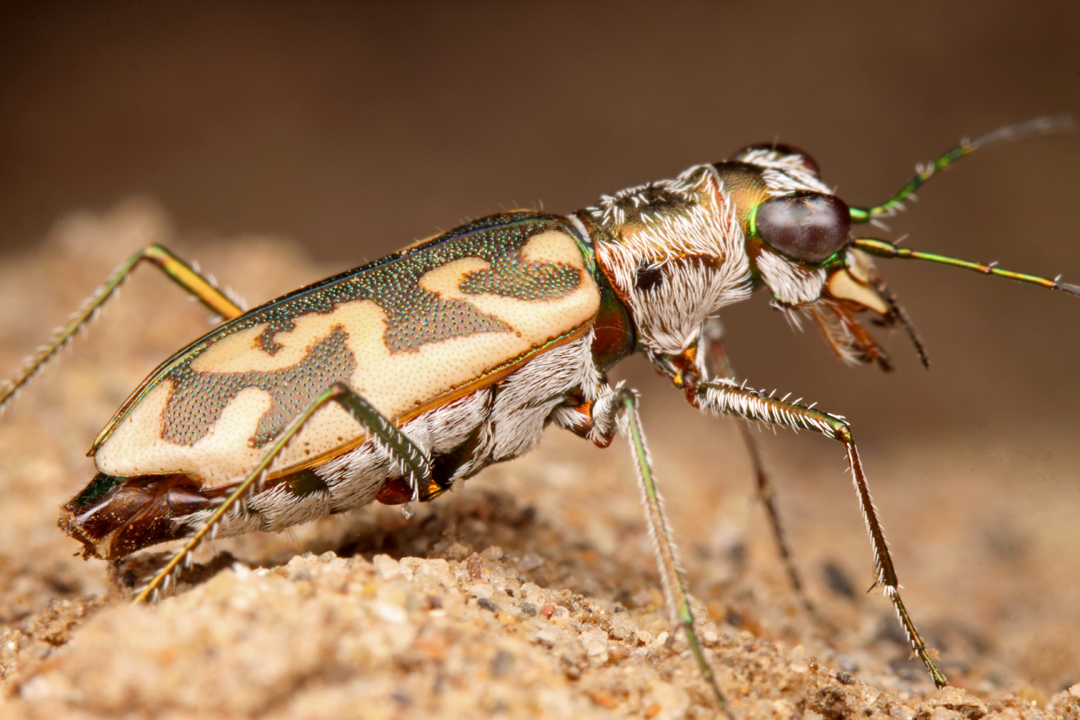
Ellipsoptera cuprascens (Coppery Tiger Beetle) | New Madrid Co., Missouri

Well, there is always more than one way to skin a cat (or a tiger), and as can be seen in these photographs I took a different approach to that latter species that allowed me to obtain several quite decent photographs of both males and females. Not long after that frustrating day at Cape Rock Park, I found myself again in southeastern Missouri with an opportunity to do some night collecting. It may not be widely known, but certain species of tiger beetles are also active at night and can actually be attracted to ultraviolet (UV) lights. This is particularly true of species in the genus Ellipsoptera, which as a group seem to depend almost exclusively on coastal and fluviatile sand habitats. I have used UV lights in the past to attract nocturnally active species of tiger beetles for photography (see Return to Nowhere), and since I had seen E. cuprascens a few years ago at Steward Towhead in New Madrid County I thought this might be a good spot to try again for photographs of that species.

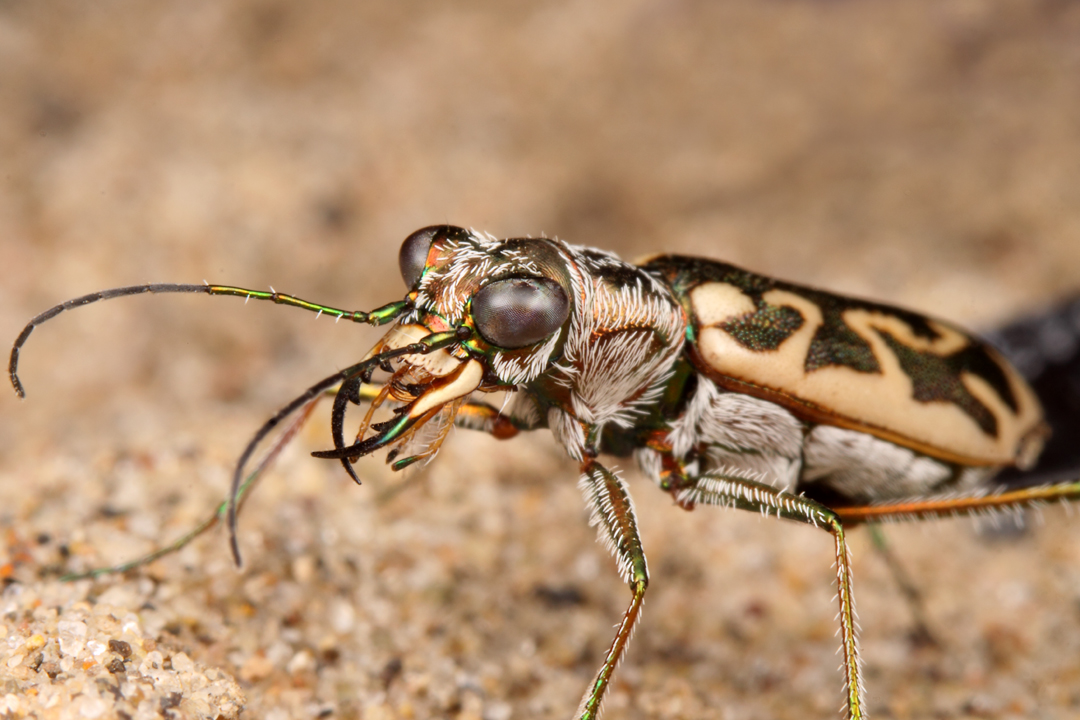
The relatively coarsely and densely punctate elytra distinguish E. cuprascens from E. macra.

“Might be a good spot” turns out to be quite the understatement, as I have never seen E. cuprascens in such numbers as I did that night! Seeing the species common at the sheet guarantees that individuals will also be found milling around on the ground in the immediate vicinity of the sheet, and unlike during the heat of the day when their bodies shift to thermal overdrive, adults at night are much easier to approach due to the cooler temperatures and the distraction of abundant, easily captured prey sitting transfixed in their UV light-induced stupor. Of course, night photography brings its own set of challenges, primarily (for me) the need to use the camera flash head lamps for focusing—I often find myself repeatedly aborting a shot because the lamps turned off automatically before I had a chance to find the subject and compose the shot to my satisfaction. Still, this is a minor inconvenience compared to the exasperation of subjects blasting across the hot sand when your approach comes within 12 feet!

Males mandibles are modified for grasping the female pronotum during mating.

Ellipsoptera cuprascens is very closely related to E. macra (Sandy Stream Tiger Beetle—see The last tiger beetle), which it resembles greatly and whose ranges overlap here in Missouri (although the latter is far less commonly encountered than the former). The photos in this post show the relatively coarser and denser punctures on the elytra that distinguish E. cuprascens from E. macra, as well as their somewhat shinier surface and distinctly more coppery color. The rounded elytral apices of the female (middle photo) also serve to distinguish the species from E. macra, in which species the elytra of the females come to a point at the suture (Pearson et al. 2006). Note also the sexual dimorphism in the labrum and mandibles of the female (first photo) and male (last photo), with the mandibles relatively longer and slightly curved and the labrum shorter in the latter. Presumably this is related to the use of the mandibles by the males in grasping the female pronotum during mating—the longer, curved mandibles are shaped to precisely fit the contour of the female’s pronotum, while the shorter labrum allows the mandibles to gain better purchase farther down on the side of the female’s pronotum (Pearson and Vogler 2001).

REFERENCE:

Pearson, D. L., C. B. Knisley and C. J. Kazilek. 2006. A Field Guide to the Tiger Beetles of the United States and Canada. Oxford University Press, New York, 227 pp.

Pearson, D. L. and A. P. Vogler.  2001. Tiger Beetles: The Evolution, Ecology, and Diversity of the Cicindelids.  Cornell University Press, Ithaca, New York, 333 pp.

Copyright © Ted C. MacRae 2012

Very wary tigers!

In late July I found a new tiger beetle site in southeastern Missouri—a small sandbar along the Mississippi River near Cape Rock Park on the north side of Cape Girardeau. I originally went to the park to look for Cylindera cursitans (Antlike Tiger Beetle), two specimens of which my friend and colleague Kent Fothergill had found in the collection of a local lepidopterist (MacRae et al. 2012). I thoroughly searched the areas that looked suitable for that species, but to no avail. I did, however, spot the sandbar down by the river and knew immediately that it had good potential for several species typically found in such habitats. Even before hiking down the rocky embankment I figured I would see Cicindela repanda (Bronze Tiger Beetle)—dreadfully common along almost every waterway in the state. What I was really hoping to see, however, were some of the more specialty species found only in wet sand habitats along the big rivers of the state—the Missouri and mighty Mississippi.

”Stilting” and ”sun-facing” by Cicindela hirticollis shelfordi | Cape Girardeau Co., Missouri

Predictably, C. repanda was present and abundant, but it wasn’t long before I spotted some individuals that looked just a little bit different—stockier and with the white markings a little more distinct. A closer look confirmed that these were C. hirticollis shelfordi (Shelford’s Hairy-necked Tiger Beetle). It had been a while since I’d seen this species, and it occurred to me that the only photos I had of it were taken with my point-and-shoot prior to getting my dSLR setup. I then realized also that I didn’t even have good photographs of C. repanda—I’ve been so focused on photographing rare and unusual species over the past few years that I’ve completely neglected photographing our state’s most common resident.

Sand bar habitat along the Mississippi River | Cape Girardeau Co., Missouri.

Over the years, I’ve learned a number of tricks that have allowed me to be fairly successful at approaching tiger beetles closely for photography—working a population to find that one slightly more cooperative individual, and then working that one individual until it becomes accustomed to my presence, perhaps allowing it to “hide” under debris before carefully removing its cover or even “trapping” it in a relatively confined area until it settles down enough to allow photographs. But nothing, not a single thing I tried, worked on this day. As it was through much of July and early August, temperatures were extreme—already well into the 90s despite my mid-morning arrival. Combined with the wide open spaces and a blazing hot sun, the beetles were already extremely active and very wary. The sandbar itself offered little help in corralling the beetles—stark, barren, devoid of any debris or other potential shelters that could be used to my advantage. Stubbornness prevented me from accepting this fact, so I spent the good part of two hours slowly stalking each beetle that looked like it might cooperate, only to have it fly before I could even get down on all fours or, once I did, run incessantly to the point that it was almost impossible to settle it in the frame—much less compose a decent closeup shot. Eventually I decided that the only way I was going to get a beetle standing still in the frame with any degree of closeness was to approach it from the front and try to catch it in one of its intermittent “stilting/sun facing” poses—a thermoregulatory behavior that tiger beetles employ when the sun heats the soil surface to temperatures that would be lethal for many other insects. The first shot in this post is the best of that type that I could manage (although I like its composition very much—I just wish I’d been able to get some closer shots as well).

The ”C”-shaped humeral lunule identifies this individual as Cicindela repanda.

As suggested above, C. repanda and C. hirticollis are quite similar in appearance, and at least in Missouri the latter is always found in association with the former, though only in wet sand habitats along the big rivers and not nearly in the same numbers as C. repanda. Until one develops a feeling based on “gestalt” it can be difficult to pick out individuals of C. hirticollis amongst the commoner C. repanda. I’ve already mentioned their slightly huskier build and somewhat bolder white markings, and C. hirticollis also tends to exhibit a slightly more coppery cast to the body. The surest character to use, however, is the “G”-shaped humeral lunule, which is the white marking on the “shoulders” of the elytra just behind the pronotum. The posterior portion of this marking is nearly transverse and usually angles sharply anteriorly on its inner edge. By contrast, in C. repanda this marking is always “C”-shaped and never curls forward on its inner edge. These characters can be compared in the lateral profile photos of the two species above and below (though not as closely as I would like).

The ”G”-shaped humeral lunule identifies this individual as Cicindela hirticollis.

I should mention that there was one other big river specialty species present on the sandbar—Ellipsoptera cuprascens (Coppery Tiger Beetle). I saw only a few individuals of this species and couldn’t get close enough to one of them to even fire off a single shot. For this species, however, I still had one more trick up my sleeve that allowed me to photograph it to my heart’s content (no, not capturing one and confining it in a terrarium!)…

REFERENCE:

MacRae, T. C., C. R. Brown and K. Fothergill. 2011. Distribution, seasonal occurrence and conservation status of Cylindera (s. str.) cursitans (LeConte) (Coleoptera: Cicindelidae) in Missouri.  CICINDELA 43(3):59–74.

Copyright © Ted C. MacRae 2012

A non-black background is better… often!

In my previous post, A black background is better… sometimes, I came to the defense of the oft-maligned pitch black background. Some macrophotographers studiously avoid black backgrounds (BBs), claiming that they look ‘unnatural’. However, as I discussed in my previous post, there are situations—primarily with light-colored or translucent subjects or those that are seen only at night—where BB can be aesthetically pleasing or more consistent with the subject’s natural history (or both, as in the case of the subject of my last post). On  the other hand I do agree that BBs are overused, showing up in many photos where a non-black background would have been a better choice. The reason for this is simple—BBs are easy! All one must do is ensure that the area behind the subject is clear of light-reflecting objects. While this is certainly preferable over cluttered backgrounds with random leaves, branches, grass stems, etc. that distract from the subject, a BB may nevertheless not be the most aesthetically pleasing  choice for the photo (I am guilty of this myself). Non-black backgrounds, on the other hand, require more forethought, not only about what color to use and how to achieve it, but also regarding camera and flash settings which can be a bit trickier due to the fact that both background and subject must be properly exposed.

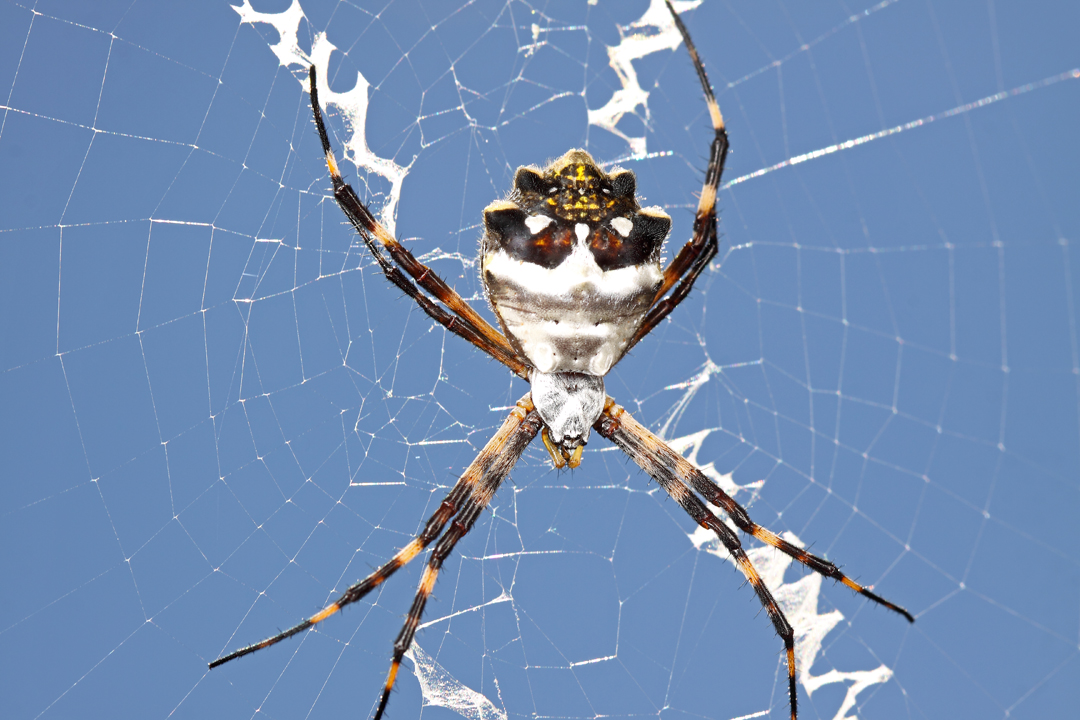
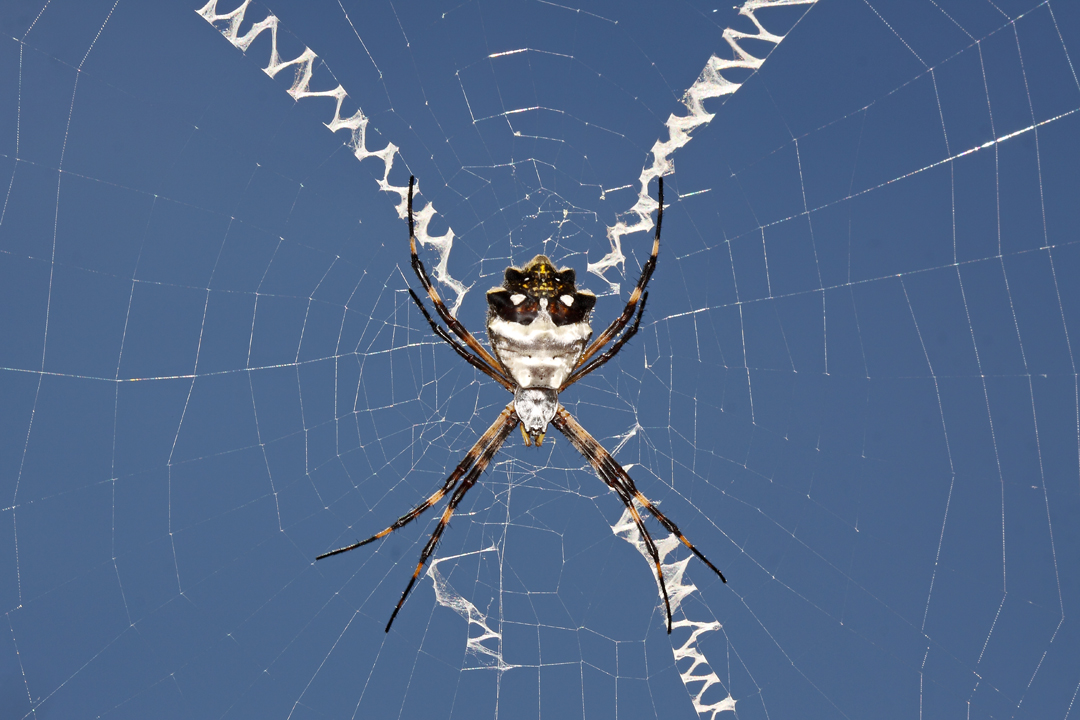
Argiope argentata (silvery argiope) | Santa Fe Province, Argentina

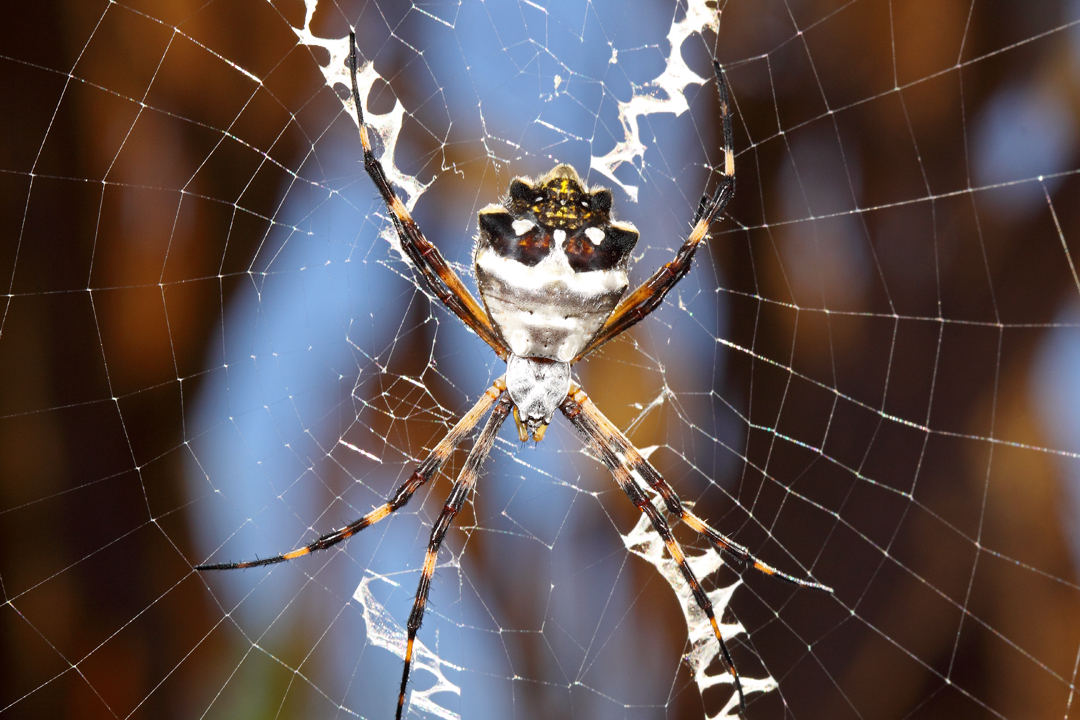
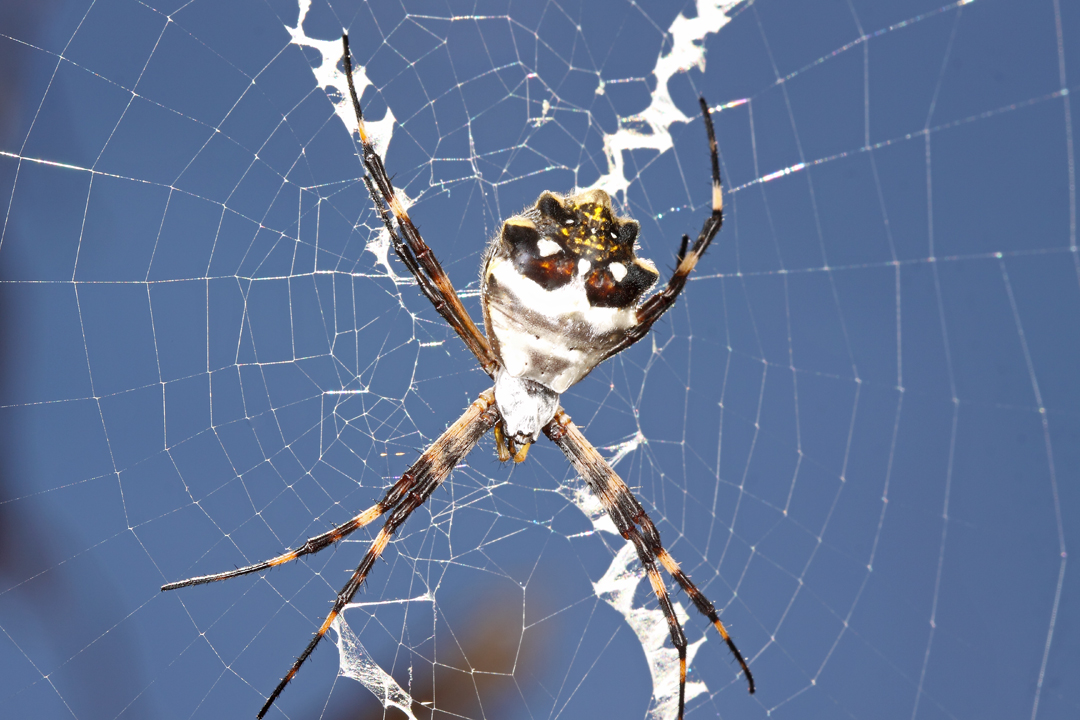
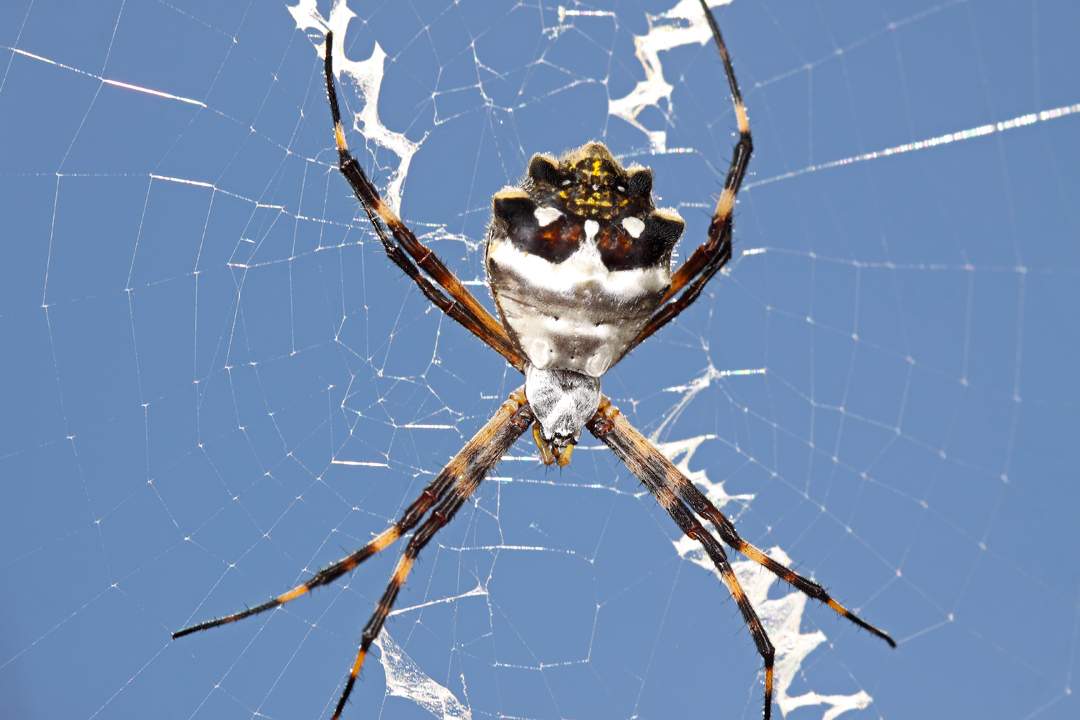
Choice of background to a large degree reflects the style of the photographer. Some may choose a particular color based purely on aesthetics, but as an in situ macrophotographer I prefer backgrounds that are consistent with the natural history of the subject—diffuse green for subjects typically seen on foliage, gray or brown for those typically found crawling on trunks and branches, and sky blue for those found out in the open (e.g., perched atop flowers). Each of these backgrounds requires different technique, and this large orb weaver, Argiope argentata (silvery argiope), which I encountered in a corn field near Villa Cañas (Santa Fe Province, Argentina) back in April, is an example of the latter. In contrast to the strictly nocturnal orb weaver (Eriophora ravilla) in my previous post, this species and its congeners are commonly seen suspended on their webs in broad daylight. BB worked well with E. ravilla, but it would not be a good choice for A. argentata due to the large amount of dark coloring on the subject. More importantly, it contradicts this spider’s diurnal nature. I could have used natural light, but the sun was shining on the other side of the spider. However, this actually made it easier to achieve the blue sky background while illuminating the subject with flash. The large size of the spider (the body alone measured ~35 mm in length) put a lot of distance between the subject and the lens, which allowed the use of a larger aperture (f/10) with still acceptable depth-of-field. With a bright sky and the sun nearly behind the spider, I was able to keep a low sensitivity setting (ISO 100) to prevent graininess and a fast shutter speed (1/250 sec) to prevent motion blur. The slightly larger aperture was all that was needed to achieve a natural blue sky color in the background. More difficult was actually clearing the background between the spider and the sky, as the web was slung low amongst the tall corn plants. The series of photos below (click to enlarge) shows the results of my earlier attempts to photograph the spider; at first not thinking about the distracting corn plants, and then trying to avoid them by angling myself lower relative to the spider, which ultimately resulted in a bad angle on the spider:

I finally decided to just break over the offending corn plants (above the ears!) to clear the background and give me the angle that I preferred. After that I was able to snap away to my heart’s content. Here is a closer view of the spider:

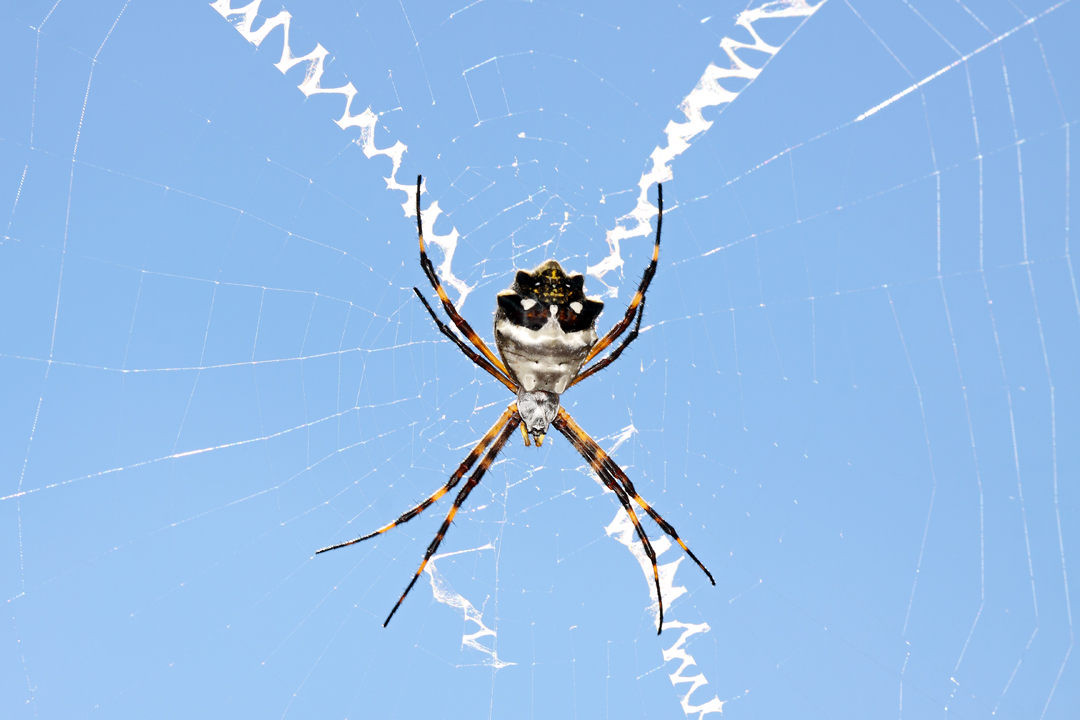
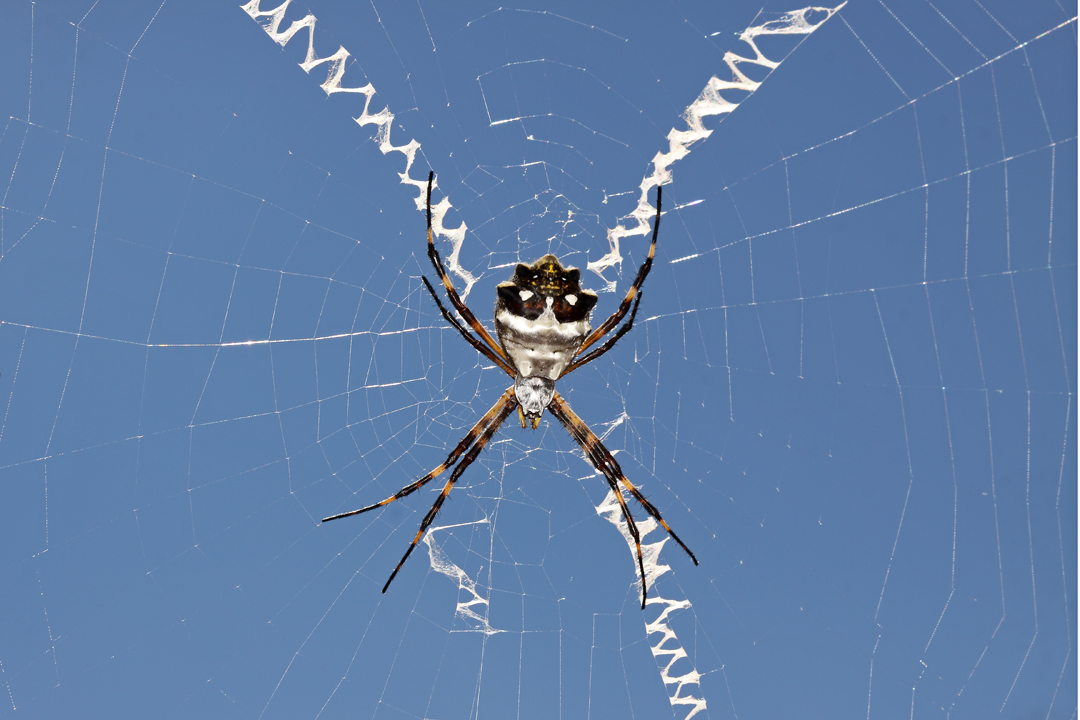
Lastly, I show the following series of photos to demonstrate the dramatic effect that aperture can have on a blue sky background. If you have a bright sky and don’t need a lot of DOF (e.g., you have a large subject-to-lens distance or a small subject lying within a narrow plane), adjusting the aperture up or down is a great way to achieve the precise color of blue desired. Larger apertures (lower f values) will result in a paler blue color, while smaller apertures (higher f values) create a deeper blue. In the photos below (click to enlarge), flash and camera settings are the same as those mentioned above except aperture: f/10 (left), f/13 (center) and f/16 (right).

Copyright © Ted C. MacRae 2012

A black background is better… sometimes

Eriophora ravilla (a tropical orb weaver) | Pinellas Co., Florida

If there is one subject that causes more disagreement among macrophotographers, it is the pitch black background. Granted, black backgrounds are common—almost ubiquitous in macrophotography, since they are easily created by using full flash illumination and ensuring that nothing lies behind the subject close enough to reflect the light from the flash. Detractors, however, claim that it gives subjects an ‘unnatural’ look, as they are rarely seen this way in nature. This may be true, but I still believe that for some subjects the black background simply cannot be beat for its aesthetics, even if the subject is not normally seen in this manner. Take, for example, the Great Plains ladies’-tresses orchid—nothing but a pitch black background could better showcase the delicate, white blossom and its almost crystalline lower lip!

That said, however, there are some subjects for which a pitch black background actually can be considered a ‘normal’ background. This tropical orb weaver spider (Eriophora ravilla) is one example. Unlike many other members of the family Araneidae (orb weavers), species in this genus are strictly nocturnal and not seen hanging on a web during daylight hours. Hiding in a curled leaf during the day, they emerge at night and build a large web (up to 1 meter wide), only to consume it by morning and return to their hiding place until the next evening. My nephew Jack and daughter Madison and I first saw this spider during our nighttime foray into the intertidal mangrove marsh behind my sister-in-law’s condominium in Seminole, Florida last month while discovering rare, endemic beetles and their larvae. Knowing that it would likely build its web in the same place on subsequent evenings, I went out a few nights later with my camera and took a few shots.

Some claim that black backgrounds are undesirable for even nocturnal subjects; that there is nothing ‘natural’ about an artificial, narrow beam of light illuminating a single subject at night since no animal other than a person with a flashlight would see something like this. This contention seems a little strained, as one could take such a stance on illumination of any kind. Technically speaking even colors don’t actually exist, so the rendering of subject images on camera film/sensor, whether by natural or artificial illumination,  is itself biased towards human sensibilities. Regardless, the sight of an eerily glowing spider hanging in the blackness strikes a familiar chord with anyone who has wandered the bush by night. A black background not only recreates that human experience, but also emphasizes the subject’s (in this case strictly) nocturnal nature with stark elegance.

At first I took this spider to represent the very common barn spider, Neosona crucifera—widespread across North America. However, after noting the dark femora and yellow “shoulders” of the abdomen I began to rethink that ID. Fortunately, I took one photo of the ventral side (not shown) that shows well the color pattern diagnostic for the circum-Caribbean species E. ravilla.

Copyright © Ted C. MacRae

And the winner is…

Okay, time to fess up on which of my photos was selected for the 2013 ESA World of Insects Calendar, but before I do let me say that getting readers’ comments on which one they thought was selected proved to be a very interesting exercise. The final tally is as follows (I gave ½ a vote for mentions of a photo as a second choice):

1. Trimerotropis saxatilis nymph – 4½ votes
2. Crossidius coralinus fulgidus – 3½ votes
3. Tetracha floridana – 3 votes
4. Buprestis rufipes – 2 votes
4. Edessa meditabunda eggs – 2 votes
6. Megaphasma denticrus – 1 vote

My personal favorites were Buprestis rufipes, Crossidius coralinus fulgidus and Tetracha floridana, with the second having what I thought was the best “calendar appeal.” I also thought the Trimerotropis saxatilis was strong for its natural history back story. It thus comes as no surprise that these were the top four vote-getters among those who commented.

The two photos that did not receive any votes are interesting—Spissistilus festinus, because the post containing that photo is one of the Top 5 posts on this blog (based on page views); and Cicindela formosa generosa, because that was the photo selected by ESA for their 2013 Calendar! I went back and forth on whether to include the photo in the final selections, but it won out over some others I was considering because of its composition—not many tiger beetle closeups contain as much scale and depth. I guess that’s what ESA like about it as well, but whatever the reason it seems I need to develop a better sense of what photo judges are looking for.

Since nobody guessed the correct photo, I’m going to give all who commented 5 “participation” points, and those of you who used italics with scientific names will get an additional 2 bonus points. Brady Richards maintains his spot atop the overalls in BitB Challenge Session #6 with 66 points, but Mr. Phidippus‘ 58 points moves him into second place over Sam Heads with 54 points.

For those who did not vote for this photo (or, everybody!), maybe access to this 1680×1120 version of the photo (click to enlarge) will help change your minds.

Cicindela formosa generosa (Coleoptera: Carabidae: Cicindelinae) – eastern big sand tiger beetle

Copyright © Ted C. MacRae 2012

2013 ESA World of Insects Calendar Selection

Today I received word from Richard Levine at the Entomological Society of America that one of my photos had been selected for the 2013 version of their famed World of Insects Calendar!

Excuse me for a moment please… (pumps fist, stirs the pot, does a very bad moon walk…)

Okay, I’m back. Honestly, this is an honor that I did not expect—at least not yet. Historically dominated by such giants in the world of insect macrophotography as Piotr Naskrecki,  Thomas Myers, and others, competition for ESA’s World of Insects Calendar is fierce. Last year more than 500 photographs were submitted for 13 slots (12 months and an introductory page) by 98 photographers from around the world. I was one of those photographers, though not selected (no surprise as I was a first-time submitter). However, I took great pleasure in seeing fellow bug blogger Adrian Thysse nab two of the 2012 slots, and I increased my resolve to try again for next year with a selection of eight mostly newer photographs.

At the suggestion of Dave Stone, I present each of those photos below along with a short description of why I submitted it. However, I’m not going to tell you which photo ultimately was selected—I thought it might be fun to see which photo you think was selected and why. As added incentive for guessing, I’m going to award 10 BitB Challenge points to each person who correctly picks the selected photograph. BitB Challenge Session #6 is coming down to the wire, so this could have a big impact on the overall standings.

The 2013 Calendar will become available for sale later this year (probably October) at the ESA website—last year’s version cost only $12 (discounted to $8 for ESA members, and free for those attending the annual meeting [which I will be attending this year]).


Megaphasma denticrus (Phasmida: Diapheromeridae) – giant walkingstick

From North America’s longest insect (21 Aug 2009).  This is one of my earlier super-closeup attempts. I liked the combination of blue and brown colors on the black background.


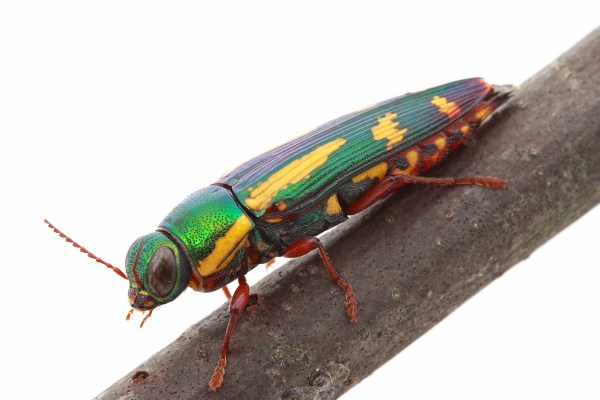
Buprestis rufipes (Coleoptera: Buprestidae) – redbellied Buprestis

From Special Delivery (13 July 2010).  The use of a white box shows off the brilliant (and difficult-to-photograph) metallic colors well, and I like the animated look of the slightly cocked head.


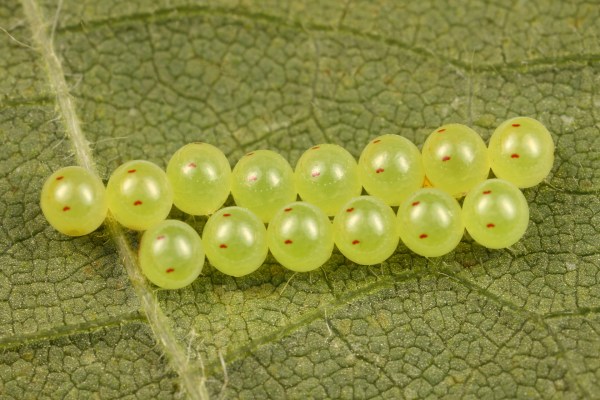
Edessa meditabunda (Hemiptera: Pentatomidae) – alquiche chico

From  (18 May 2011). I found these Edessa meditabunda stink bug eggs on the underside of a soybean leaf in Argentina almost ready to hatch. The developing eye spots in each egg gives the photo a “cute” factor rarely seen in such super close-ups.


Cicindela formosa generosa (Coleoptera: Carabidae: Cicindelinae) – eastern big sand tiger beetle

From  (10 May 2011). I like this slightly panned out view because of the sense of scale and landscape created by the inclusion of the plantlets and the view over the small rise.


Trimerotropis saxatilis (Orthoptera: Acrididae) – lichen grasshopper

From  (15 July 2011). Some of my favorite insect photos are not only those that show the bug in all its glory, but also tell a story about its natural history. This nymph is almost invisible when sitting on the lichens that cover the sandstone exposures in its preferred glade habitat. 


Tetracha floridana (Coleoptera: Carabidae: Cicindelinae) – Florida metallic tiger beetle

From  (23 August 2011). I used extension tubes to improve the quality of flash lighting (decreased lens to subject distance results in greater apparent light size), and I like the symmetry of the composition.


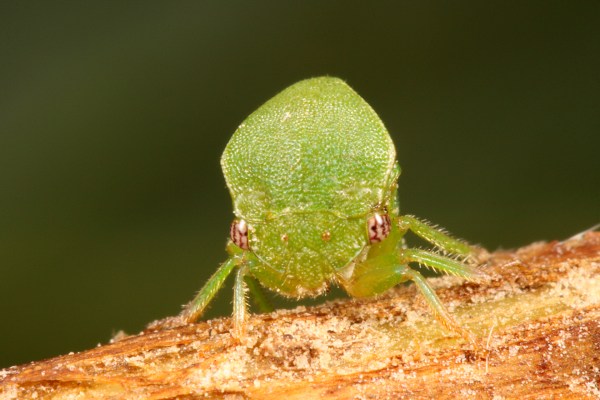
Spissistilus festinus (Hemiptera: Membracidae) – threecornered alfalfa hopper

From  (17 September 2011). Even though both the insect and the background are green, there is sufficient value contrast to create a pleasing composition, punctuated by the bizarre zig-zag pattern of the eyes.


Crossidius coralinus fulgidus (Coleoptera: Cerambycidae) – a rabbitbrush longhorned beetle

From  (4 October 2011). The blue sky background provides a pleasing contrast with the colors of this particular beetle and flowers.

Copyright © Ted C. MacRae 2012

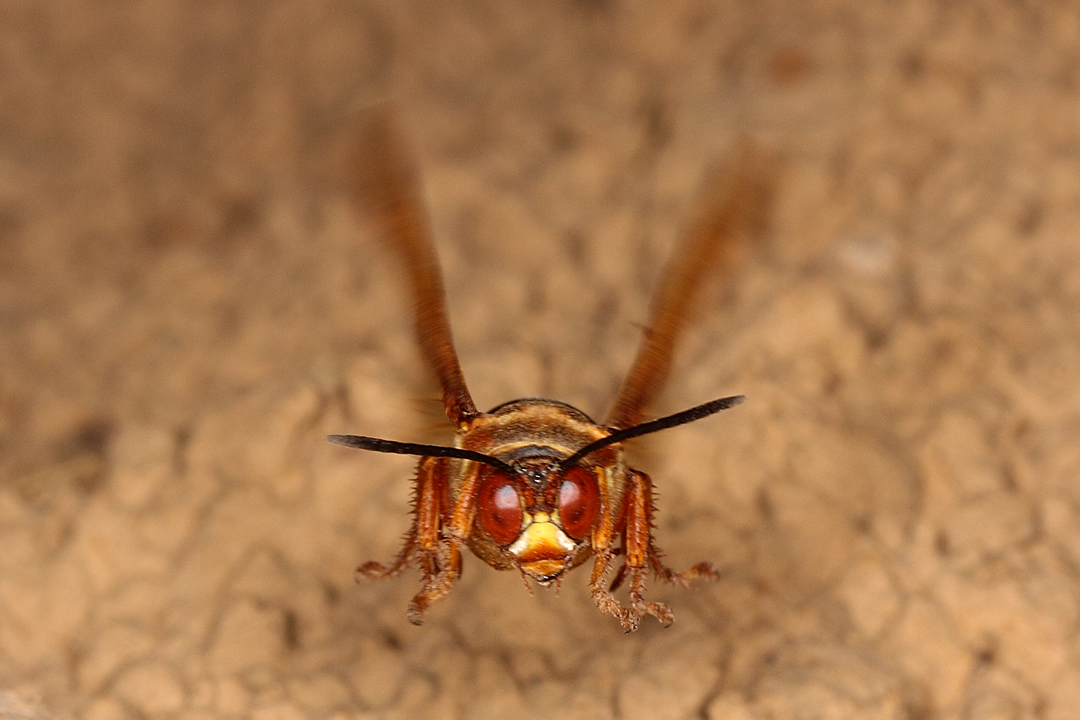
Cicada killer on the fly

An eastern cicada killer (Sphecius speciosus) searches for her burrow | Jacksonville, Illinois.

I don’t normally spend much time trying to photograph insects in flight. To really do it right requires some rather specialized equipment, including very high-speed flash, and a bucketload of patience and skill. John Abbott exemplifies those whose great talent has produced stunning photographs of insects in mid-flight. That’s not to say that it can’t be done “on the fly,” so to speak, and even a hack like me can get lucky every now and then.

Earlier today I found a rather large number of eastern cicada killers (Sphecius speciosus) in a ball field in Jacksonville, Illinois. These impressive wasps are the largest wasp in eastern North America and have the rather gruesome habit of paralyzing cicadas with their sting, and then dragging them down into their burrows to be eaten alive by their grubs. I’ve recently become interested in solitary wasps (for reasons to be discussed later) and decided to see if I could get some decent photographs. I got a few I like (more on this later), but my favorite is this total luck-out shot of a wasp face-on in mid-flight. As I watched them, I noticed that each wasp spent a fair amount of time trying to identify its burrow amongst the dozen or more that were clustered along one side of the field. Occasionally they would land and search about a bit on foot, then take wing again to continue their search. I decided the best way to get a shot of one on the wing would be to watch for a wasp to arrive and begin its search. When I spotted one I would slowly close distance so I could be ready to get down on my elbows as soon as it landed (closing distance without spooking the wasp was not easy). I had just my center focal point set and autofocus turned on (normally I don’t use autofocus) and had already worked out a good flash exposure compensation setting. As soon as I got on my elbows, I would quickly frame the wasp and repeatedly trigger the autofocus as I got even closer, and when the wasp took flight I took the shot. This was still a crap shoot—I ended up with lots of out-of-focus and out-of-frame photos. Nevertheless, a few turned out fairly decent, one of which was this single, perfectly head-on and well-focused photo (though admittedly somewhat cropped).

Too bad I didn’t collect any of the wasps—at $49 each I could’ve made enough cash to buy that flash bracket I’ve been eyeing!

Copyright © Ted C. MacRae 2012