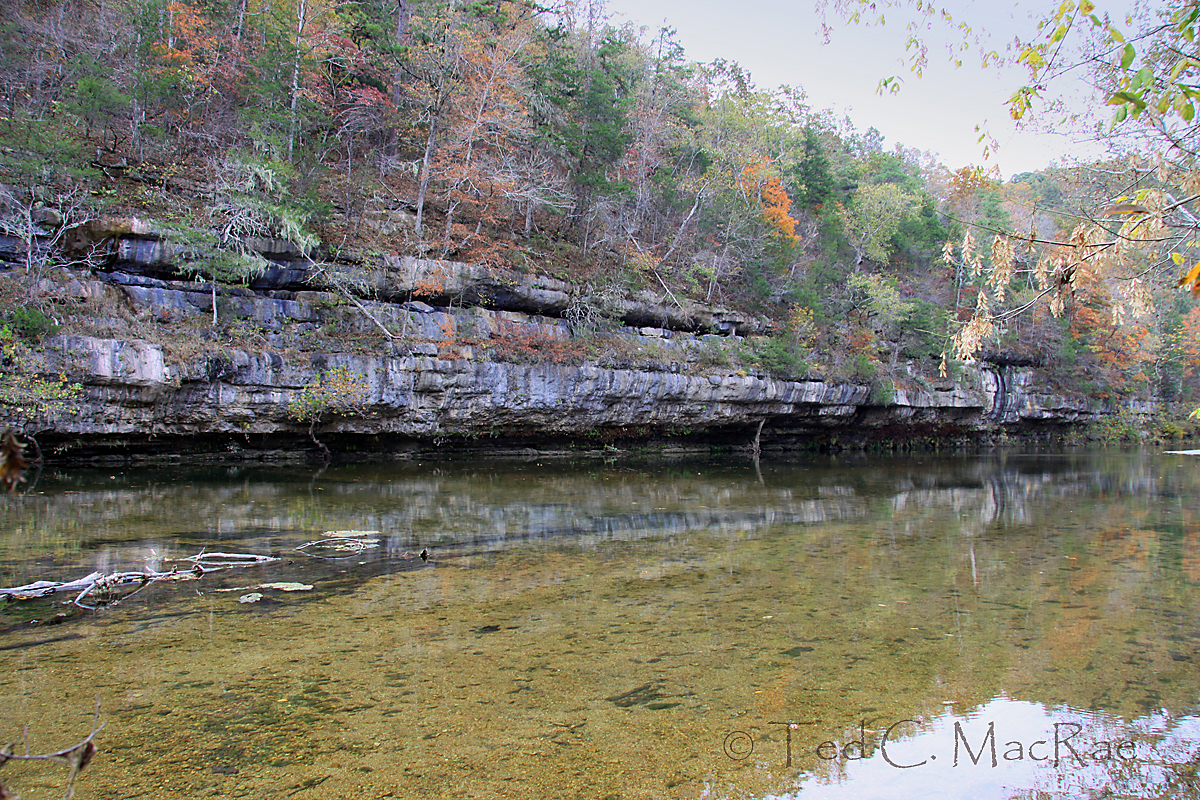
Calm waters, frenzied beetles

North Fork River - Ozark Co., Missouri

The North Fork River in south-central Missouri, like most Ozark rivers and streams, flows clear and cold over gravelled bottoms. Sustained year-round by the numerous seeps and springs that result from the region’s unique Karst geology, it meanders through a mix of forest and woodland alongside massive bluffs of half-a-billion-year-old dolomite. While small rapids can be found where gravel bars approach the bluffs, for the most part the shallow waters course lazily and idyllically south toward the White River in northern Arkansas.

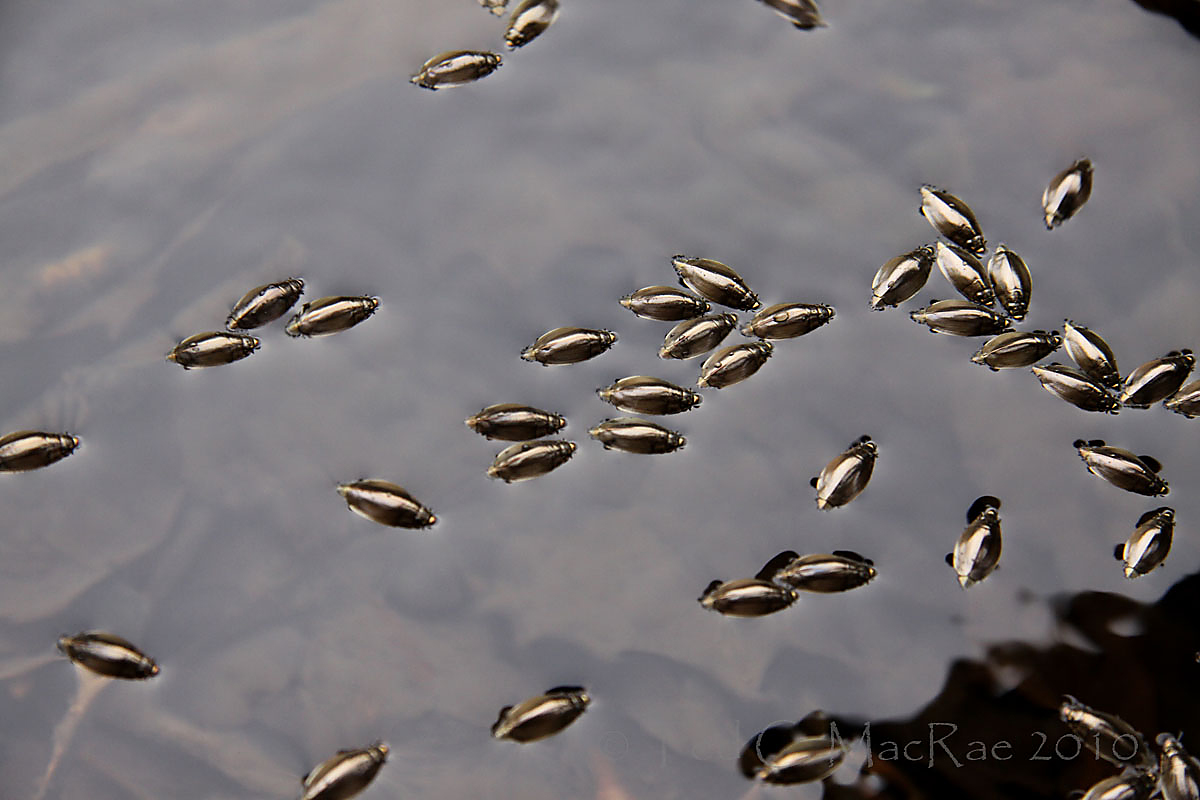
Dineutus sp. (poss. discolor, per Brady Richards)

Lazy waters are the domain of whirligig beetles (family Gyrinidae).  We encountered this ‘raft’ of beetles in a sheltered pool near the shore of the North Fork River while hiking the Ozark Trail last October.  These frenzied little beetles live almost exclusively on the surface of the water, where they feed on organisms or scavenge debris in their famously and erratically conspicuous aggregations.  Such behavior might make them seem vulnerable to predation, but in actuality the reverse is true.  Beetles in rafts benefit from the increased number of eyes that can better scan the environment for potential threats than can individual beetles (Vulinec and Miller 1989), and the larger the raft the more efficiently this occurs.  There is also evidence that the appearance of the rafts themselves is a signal to warn potential predators (primarily fish) of the noxious chemicals produced in the beetles’ paired pygidial glands (Ivarsson et al. 1996), despite the decidedly non-aposematic coloration of the beetles themselves.

Photo Details: Canon 50D w/ 17-85mm zoom lens, natural light. Photo 1 – 17mm, ISO 100, 1/25 sec, f/5.6; photo 2 – 85mm, ISO 500, 1/160 sec, f/5.6. Typical post-processing (levels, minor cropping, unsharp mask).

REFERENCES:

Ivarsson, P., B.-I. Henrikson and J. A. E. Stenson.  1996.  Volatile substances in the pygidial secretion of gyrinid beetles (Coleoptera: Gyrinidae).  Chemoecology 7(4):191–193.

Vulinec, K. and M. C. Miller. 1989. Aggregation and Predator Avoidance in Whirligig Beetles (Coleoptera: Gyrinidae). Journal of the New York Entomological Society 97(4):438–447.

Copyright © Ted C. MacRae 2011

Red-eyed Devil

In June 1994, I made my first insect collecting trip to Big Bend National Park.  Both of my previous visits to Texas had been to the Lower Rio Grande Valley, so I was anxious to see what beetle treasures awaited me in this huge chunk of western Texas.  For three days I sampled the astounding diversity of beetles found in the park’s low desert scrub, oak/juniper woodlands, and high pine forests, and on the final day I decided to visit the sotol grasslands – a transitional habitat between the desert and woodlands in the Chisos Mountains foothills.  Sotol (Dasylirion wheeleri) is the host plant of jewel beetles in the genus Thrincopyge – exquisitely beautiful beetles of metallic blue or green and vivid yellow.  Larvae bore through the plant’s dried flower stalks, while adults wedge themselves in the base of this agave-like plant, hidden from view by the plant’s long, strap-like, saw-toothed leaves.  I had not yet seen these beetles for myself, so I began searching the through the plants – carefully prying apart the wicked leaves in hopes of seeing adults peering up from the base, and then using my foot-long forceps to extract them.  It’s a painful process, as no amount of care completely prevents the plant’s stout, recurved spines from impaling and ripping forearm flesh while trying to grab and pull out the beetles! 

While prying apart the leaves of one particular plant, I was startled by one of the most imposing-looking insects that I have ever seen as it jumped up on top of the foliage and assumed this decidedly aggressive posture.  Although I recognized it as some type of katydid, it was unlike any I’d seen before – large and robust, vivid green and yellow with flashing red eyes, its short spotted hind wings outstretched, spiny forelegs held high, and huge jaws spread wide open.  Her long dagger-like ovipositor only added to her impressiveness.  So spectacularly terrifying was its threat display that I couldn’t resist the opportunity to collect it for eventual mounting in life-like position.  I felt a little silly being scared of a katydid but nevertheless took great care to avoid getting my fingers anywhere near those jaws as I gingerly corraled it into a jar. 

Neobarrettia spinosa is also known as the greater arid-land katydid or spiny bush katydid, but I prefer the name that has been coined by some – “red-eyed devil”!  This species belongs to a small genus of primitive katydids largely restricted to northern Mexico, with only two species extending north into the south-central and southwestern U.S.  The black front edge of the pronotum and (in life) red eyes identify this individual as N. spinosa (N. victoria, also occurring in Texas, has the pronotal front edge green and the eyes pale).  Unlike most katydids, which have adopted omnivorous or hervivorous feeding habits, species of Neobarrettia and their subfamilial relatives are pure carnivores capable of capturing and consuming prey as large as themselves.  Its bulging eyes, elongate and heavily spined forelegs, and massively robust mandibles on a large head (presumably for enlarged mandibular musculature) clearly represent adaptations for predation (Cohn 1965).

The painting above from Cohn’s revision of the genus shows the true colors of a living female and its threat display.  I collected this specimen before the days of the internet or my own interest in photography, so I had nothing but my memory to guide me as I tried to recreate the threat display during mounting.  I got it mostly right but missed on a few details – the wings should have been placed more vertically, and the insect also rears back more on its hind legs to display the brightly colored cephalic portion of its abdominal venter.  I could try to relax and remount the specimen, but given its fragility and the fact that doing so would do little to make it any more imposing, I think the pose I have it in now is just fine.

This turned out to be a more difficult ID Challenge than I anticipated, but a record number of participants played along anyway.  Dave wins this challenge with 11 pts on the basis of a correct identification and entertaining logic to accompany it.  Ben Coulter was the only other person to correctly identify the genus and species, earning 9 pts for 2nd place, while BitB’s own James Trager and TGIQ share the final podium spot with 5 pts each.  Ben continues to dominate the overall competition with 32 pts now, but the battle for 2nd place has really heated up – Janet Creamer (14 pts) and TGIQ (13 pts) have the edge, but Dave (11 pts), James Trager (11 pts), and Christopher Taylor (10 pts) are all within easy striking distance.

REFERENCE:

Cohn, T. J. 1965. The arid-land katydids of the North American genus Neobarrettia (Orthoptera: Tettigoniidae): their systematics and a reconstruction of their history.  Miscellaneous Publications of the University of Michigan Museum of Zoology 126:1-179.

Copyright © Ted C. MacRae 2011

Litaneutria minor – agile ground mantid

Litaneutria minor - agile ground mantid

Have you ever seen a mantid that lives exclusively on the ground?  Most mantids are ambush predators, hiding amongst the bushes while patiently waiting for unsuspecting prey to happen within striking range.  However, a few small groups of mantids have adopted a different strategy – running down their prey!  One such group is the ground mantids, represented in the U.S. by two genera – Litaneutria and Yersiniops.  These small mantids, cryptically colored brown or gray, occur in desert and grassland habitats across the western U.S.  This particular individual was seen in the expansive shortgrass prairie atop the Pine Ridge in northwestern Nebraska.  The rounded eyes and brown coloration identify it as as a member of the genus Litaneutria (the tops of the eyes are pointed in Yersiniops, giving them a “horned” appearance, and they tend to be more gray).  Two species of Litaneutria are found in the U.S. – this one, L. minor, occurring broadly throughout the Great Plains and western U.S. into southwestern Canada (it is Canada’s only native mantid), while a second species, L. obscura, is restricted to the desert southwest.¹  Several common names have been applied to L. minor, including lesser ground mantid, minor ground mantid, and agile ground mantid.  While the first two represent more precise literal translations of the scientific name, I like the latter which well describes the ability of these mantids to hop over rocks and dart swiftly through sparse prairie vegetation in pursuit of prey or to evade predators (and inexperienced collectors!).  Despite its small size (total length less than 1.5″), the presence of wings – albeit small – indicate this is an adult. All females of this species are brachypterous (short-winged), but most males are as well.  However, males apparently have a small spot at the base of the forewings, which seems lacking in this individual, and a smoother pronotum – also not readily apparent in this individual, so I’m guessing that this is an adult female. 

¹ BugGuide and many other web sources list five additional U.S. species in the genus (including L. borealis, described from northwestern Nebraska).  However, Vickery and Kevan (1983) note that these were all synonymized under L. minor by Hebard in 1935 (sorry – I couldn’t find that reference).

“Mantid” vs. “mantis” vs. “praying mantis.”  It has become common to use the terms “mantid” and “mantis” (or even “praying mantis”) interchangeably.  However, in its strictest sense the term “mantis” is most properly applied to species of the genus Mantis – of which Mantis religiosa – the European mantid or praying mantis, introduced to the U.S. in the late 19th century (either accidentally on a shipment of nursery plants or deliberately for pest control – depending on the source) is the most widely recognized.  The term “mantid” refers to any species in the suborder Mantodea as a whole.

Carnivorous cockroaches!  When I was in college back in the late 1970s, mantids and most other “orthopteroid” insects had long been considered suborders of a single order, the Orthoptera.  Around that time began a great dismantling of the Orthoptera, pared down to only the grasshoppers, crickets, and katydids while the other former suborders (mantids, walkingsticks, cockroaches, etc.) were raised to full order status.  The walkingsticks (Phasmida), grylloblattids (Grylloblattodea), and gladiators (Mantophasmatodea) all continue to enjoy their elevated status (Tree of Life Web Project 2003); however, a close relationship has been established between the mantids, cockroaches, and termites² (Kristensen 1991), resulting in the sinking of all three former orders into a single order, the Dictyoptera (Tree of Life Web Project 2002) (and not to be confused with the lycid beetle genus Dictyoptera).  Mantids, thus, can be considered derived cockroaches with morphological specializations for predation!

² Long accorded an order of their own – the Isoptera, recent molecular phylogenetic studies have placed termites not only with the cockroaches, but within them (Ware et al. 2008).  Just as mantids can be considered cockroaches that evolved as predators, termites can be considered cockroaches that evolved to eat wood (with the help of cellulose-digesting gut symbionts)!

Photo Details: Canon 50D w/ MP-E 65mm 1-5X macro lens (ISO 100, 1/250 sec, f/13), Canon MT-24EX flash w/ Sto-Fen + GFPuffer diffusers. Typical post-processing (levels, minor cropping, unsharp mask).

REFERENCES:

Kristensen, N. P. 1991. Phylogeny of extant hexapods. Pp. 125–140 in Insects of Australia: A Textbook for Students and Research Workers. Volume I and II. Second Edition. I. D. Naumann, P. B. Carne, J. F. Lawrence, E. S. Nielsen, J. P. Spradberry, R. W. Taylor, M. J. Whitten and M. J. Littlejohn eds. Carlton, Victoria, Melbourne University Press.

Tree of Life Web Project. 2002. Dictyoptera. Version 01 January 2002 (temporary). http://tolweb.org/Dictyoptera/8253/2002.01.01 in The Tree of Life Web Project, http://tolweb.org/

Tree of Life Web Project. 2003. Neoptera. Version 01 January 2003 (under construction). http://tolweb.org/Neoptera/8267/2003.01.01 in The Tree of Life Web Project, http://tolweb.org/

Vickery, V. R. and D. K. M. Kevan. 1983. A monograph of the orthopteroid insects of Canada and adjacent regions. Lyman Entomological Museum and Research Laboratory Memoir 13:216–237.

Ware, J. L., J. Litman, K.-D. Klass, and L. A. Spearman. 2008. Relationships among the major lineages of Dictyoptera: the effect of outgroup selection on dictyopteran tree topology. Systematic Entomology 33(3):429–450.

Copyright © Ted C. MacRae 2010
Desmocerus palliatus – elderberry borer

Desmocerus palliatus (elderberry borer), Squaw Creek Natl. Wildlife Refuge, Missouri.

Last June I made two trips to the Loess Hills in northwestern Missouri to survey additional sites for Cylindera celeripes (swift tiger beetle), which my colleague Chris Brown and I had discovered in some of the area’s few remaining loess hilltop prairie remnants the previous year. One of these potential new sites was  Squaw Creek National Wildlife Refuge, where a few tiny slivers of hilltop prairie can still be found on the fingers of loess bluffs that border the refuge’s several thousand acres of restored wetlands that famously host large concentrations of snow geese and bald eagles during the fall and spring migrations.  On the first visit, I had arranged to meet with Corey Kudrna, Refuge Operations Specialist, who was kind enough to take several hours out of his day to personally guide me to each of the site’s loess hilltop prairie remnants. 

As we crossed the highway right-of-way at the base of the bluffs on our way to the one of the remnants, we passed through a large patch of common elderberry, Sambucus nigra ssp. canadensis.  Anytime I see patches of this plant, especially in June, I immediately think of Desmocerus palliatus (elderberry borer) – a spectacularly colored longhorned beetle (family Cerambycidae) that breeds exclusively in the living stems and roots of this plant.  It is not a particularly rare species, but for some reason I have not had much success in finding this species.  In my close to three decades of collecting beetles, I had encountered perhaps a half dozen individuals – never more than two at the same time.  Still, when I get the chance to look at elderberry I look for this beetle, and when I did so this time I was delighted to see one within a few moments of entering the patch.  I was ecstatic when I saw another one almost immediately after the first, and I was stunned when I realized that they were all around me!  Good fortune continued on my subsequent visit two weeks later, when I was able to spend a little more time trying to get a good field photograph.  Wind was a problem, the beetles were easily alarmed, and their tendency to rest in the upper reaches of the plant made it difficult to brace myself and the camera while shooting, making this a rather difficult subject to get a good photograph of.  The photo shown here is literally the last of around two dozen that I took and is the only one that I really like.

Many cerambycid beetles are mimics of other more noxious species, mostly ants and wasps.  However, elderberry borers appear to be the exception in that they are themselves noxious.  The cobalt blue and bright orange coloration of the adults screams aposematic (warning) coloration, and it is reasonable to assume that they accumulate in their bodies for defensive purposes the cyanogenic glucosides produced by elderberry plants (Huxel 2000).  Even their movements are those of a chemically protected model – lumbering and clumsy, without the alert evasiveness usually seen with other flower longhorn species.  Presumably this species participates in a Müllerian mimicry complex involving netwinged beetles (family Lycidae, particularly species in the genus Calopteron) and perhaps Pyromorpha dimidiata (orange-patched smoky moth, family Zygaenidae) as well, and it may serve as a Batesian model for the equally colorful but completely innocuous Lycomorpha pholus (black-and-yellow lichen moth, family Arctiidae).

Photo Details: Canon 50D w/ 100mm macro lens (ISO 100, 1/250 sec, f/10), Canon MT-24EX flash w/ Sto-Fen diffusers.

REFERENCE:

Huxel, G. R.  2000.  The effect of the Argentine ant on the threatened valley elderberry longhorn beetle.  Biological Invasions 2:81–85.

Copyright © Ted C. MacRae 2010

Halloween ID challenge answer – Argiope trifasciata

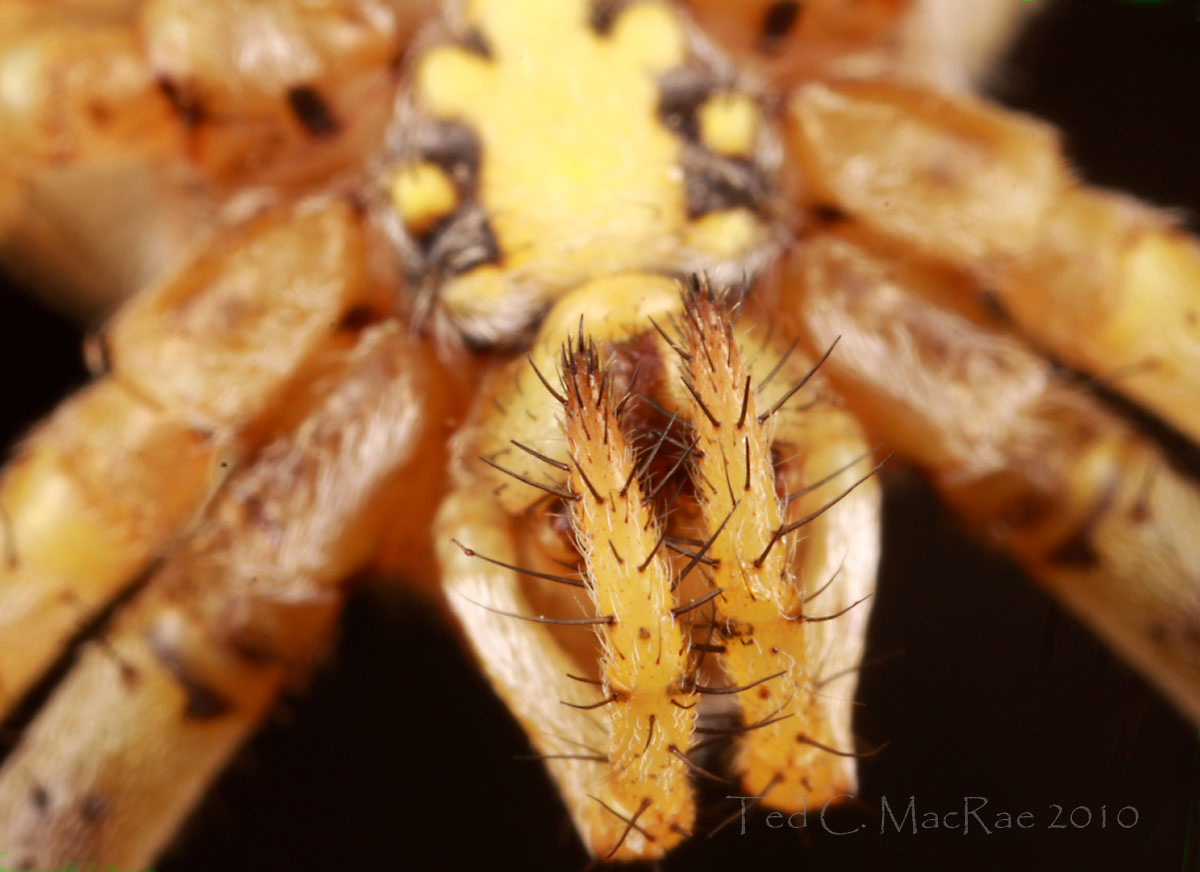
Here is another photo of the spider in the previous post with a closer view of its spiny pedipalps (mouth feeler thingys).  Troy Bartlett and BitB’s own James Trager got it right – the spider is, indeed, Argiope trifasciata, the banded garden spider (a.k.a. banded garden orbweaver, banded argiope, whitebacked garden spider, etc.).   I figured the genus would be easy, but the species might be a little tricky – at least for those in North America who might be tempted to conclude it was the larger A. aurantia (black and yellow garden spider, etc.).  The broken banding on the femora and generally lighter ventral coloration are usually enough to distinguish A. trifasciata from its more conspicuous congener.  Argiope trifasciata is also distinguished as one of the few truly cosmopolitan arthropod species, occurring naturally on all continents except Antarctica.

Both Troy and Dave Walter mentioned the conspicuous stabilimentum (heavy zig-zagging pattern) that Argiope spiders are perhaps best known for and that they often add to the center of their otherwise cryptic webs. Originally thought to possess a web-stabilizing function (hence the name), a variety of alternative explanations have since been proposed.  These include camouflage (to break up the body outline of the spider and make it less visible to predators), web protection (to make the web more visible to birds and prevent them from flying into and damaging it), prey luring (since it reflects ultraviolet light efficiently), thermal protection (by providing a shield against the sun), and a repository for excess silk.   An alternative hypothesis that I had not heard of but mentioned by Dave is that they serve as sponges for accumulating water for the spider to drink.  Webs with stabilimenta are more common and larger in exposed versus sheltered locations, and a recent study by Blackledge and Wenzel (1999) using A. aurantia found that webs with a stabilimentum suffered significantly less damage from birds (45% on average) than those without, but that they also caught fewer insects (34% on average).  The presence or absence of a stabilimentum, however, was not a significant factor in predation of the spiders by birds.  This implies not only a web protective function for the stabilimentum, but that there is an evolutionary trade-off between web protection and foraging success.  These authors concluded that variation in stabilimenta might be accounted for by a cost—benefit trade-off and that the decision by the spider to include a stabilimentum when building a web may be influenced by external factors such as prey density and web exposure.

Specific to A. trifasciata, a less well known but equally interesting aspect of its behavior is the use of web orientation for thermoregulation.   Tolbert (1979), in a study conducted in the southeastern US, found that web orientation was non-random during the hottest part of the summer, when spiders largely occupied east-west oriented webs with their silver/white dorsal surfaces facing south and their dark ventral surfaces facing north, and during October when the situation was reversed.  Orientation of the white/silver dorsal surface towards the sun presumably is done to help lower body temperatures, while orienting the ventral surface of the spider, which changes from silver to black as the spider reaches maturity, would maximize solar radiation for heat gain.  In contrast, Ramirez et al. (2003) found the species in coastal southern California never oriented their webs in a non-random fashion – rather, they always oriented them along an east-to-west axis with the mostly dark ventral surface of their abdomens facing south.  They suggested that dealing with a high heat load is not a significant problem in the predominantly cool environment of coastal southern California and that staying warm is the greater challenge for this mostly fall active species.

I’ll give 6 points to Troy for agreeing with me on everything, 4 to Dave for playing Devil’s advocate with the species and his unique alternative stabilimentum hypothesis, and 2 points to James for agreeing with Troy’s species ID. 🙂

Photo Details: Canon 50D w/ MP-E 65mm 1-5X macro lens (ISO 100, 1/250 sec, f/14), Canon MT-24EX flash w/ Sto-Fen + GFPuffer diffusers. Typical post-processing (levels, minor cropping, unsharp mask).

REFERENCES:

Blackledge, T. A. and J. W. Wenzel. 1999. Do stabilimenta in orb webs attract prey or defend spiders? Behavioral Ecology 10(4):372–376.

Ramirez, M. G., E. A. Wall and M. Medina. 2003. Web orientation of the banded garden spider Argiope trifasciata (Araneae, Araneidae) in a California coastal population. The Journal of Arachnology 31:405–411.

Tolbert, W. W.  1979. Thermal stress of the orb-weaving spider Argiope trifasciata (Araneae).  Oikos 32(3):386–392.

Copyright © Ted C. MacRae 2010

Phreaky Phalangid

While searching through shortgrass prairie atop the Pine Ridge in northwestern Nebraska in hopes of finding Cicindela nebraskana (prairie long-lipped tiger beetle), this harvestman caught my eye.  Harvestmen are, of course, arachnids related to spiders, but they lack fangs and poison or silk glands and are placed the separate order Opiliones (Phalangida when I was in school).  Admittedly, I haven’t paid much attention to harvestmen before now, but this one seemed different from any I’d seen before – nearly black with relatively short legs and distinctive orange intersegmental articular membranes at the base of the legs.  Harvestmen are known to employ chemical defenses through special repugnatorial glands that produce phenols, quinones, ketones, and/or alcohols, and this individual seemed to display a clear example of aposematic coloration to warn any potential predators of its distastefulness.

Trachyrhinus favosusAlthough beetles are my focus, I normally try to do my own identifications in other groups as well.  However, some rather persistent searching through the extensive harvestman holdings at BugGuide failed to turn up a good match.  In gestalt it seemed to belong to the family Sclerosomatidae, but even that was just guessing on my part.  So, I did what I’ve done only a few times before and posted the photos to BugGuide’s ID Request.  A day and a half later I had my answer – Trachyrhinus favosus.  BugGuide Contributing Editor V. Belov had sent the photos to harvestman expert Marshal Hedin, who had this to say in response:

Cokendolpher describes males as ‘body ranging from solid black…’ with bases of femora ‘yellow-brown’. The species is also known from western Nebraska. Cool.

I was pleased to learn that these photographs represented a new species for BugGuide and no longer felt bad about not being able to find a good match.  Further, my leanings toward the family Sclerosomatidae had been confirmed.  According the Cokendolpher (1981), T. favosus ranges in a narrow band from North Dakota south to north-central Texas and is active only during fall.  I had intended to try to get an even closer photograph, but after taking the second photograph above I accidentally disturbed the critter and then watched in amazement as it began bouncing up and down vigorously.  This apparently is a defensive behavior that functions to blur the body form.  I watched it bounce and became even more amazed as it began calmly walking away while continuing its vigorous bouncing – quite a spectacle!

Photo Details: Canon 50D w/ MP-E 65mm 1-5X macro lens (ISO 100, 1/250 sec, f/13), Canon MT-24EX flash w/ Sto-Fen + GFPuffer diffusers. Typical post-processing (levels, minor cropping, unsharp mask).

REFERENCE

Cokendolpher, J. C.  1981. Revision of the genus Trachyrhinus Weed (Opiliones, Phalangioidea).  Journal of Arachnology 9:1–18.

Copyright © Ted C. MacRae 2010
North America’s largest centipede

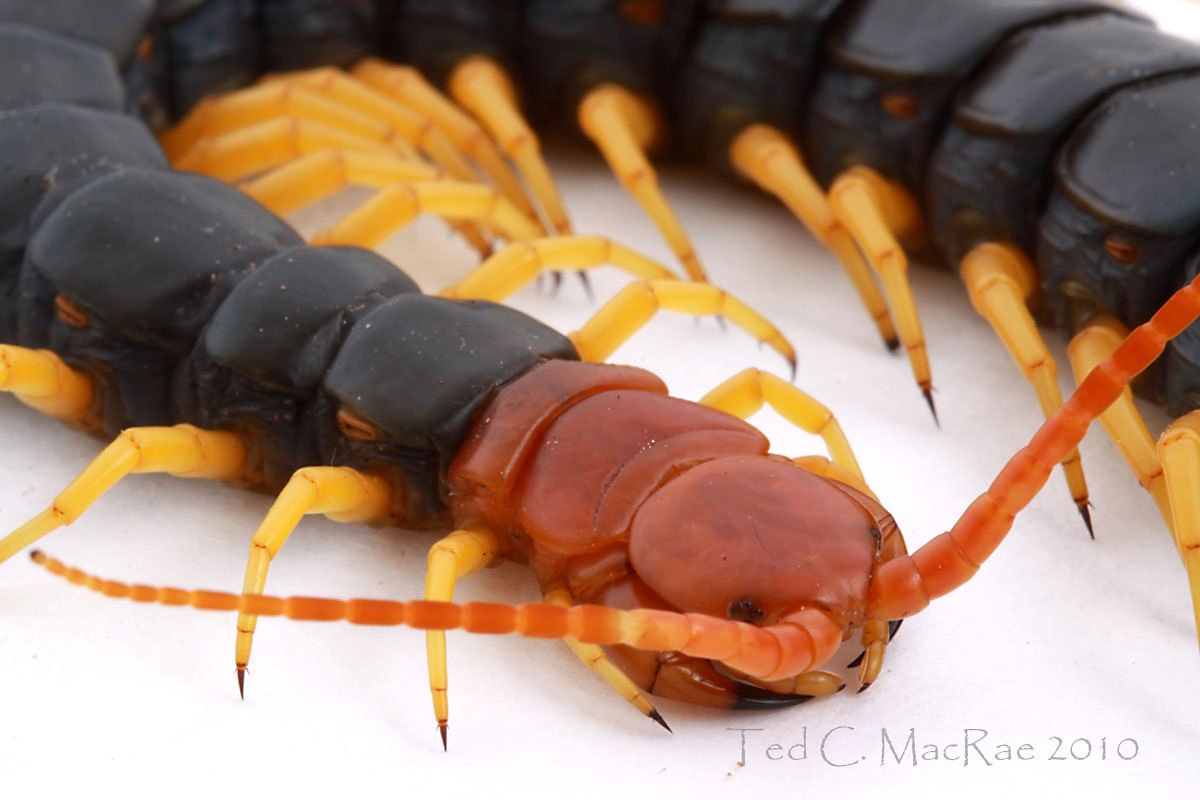
As I prowled the remote mixed-grass prairie of northwestern Oklahoma in the middle of the night, an enormous, serpentine figure emerged frenetically from a clump of grass and clambered up the banks of the draw I was exploring.  Although I was still hoping for my first glimpse of the Great Plains giant tiger beetle, I was keeping a watchful eye out for anything that moved within the illuminated tunnel of my headlamp due to the potential for encountering prairie rattlesnakes (perhaps the most aggressive of North America’s species).  This was clearly no snake, but at up to 8″, Scolopendra heros (giant desert centipede) easily matches some smaller snakes in length.  Also called the giant Sonoran centipede and the giant North American centipede, it is North America’s largest representative of this class of arthropods (although consider its South American relative, S. gigantea – the Peruvian or Amazonian giant centipede, whose lengths of up to 12″ make it the largest centipede in the world).

Although I had never before seen this species alive, I recognized it instantly for what it was.  Many years ago I was scouting the extreme southwest corner of Missouri for stands of soapberry (Sapindus saponaria), a small tree that just sneaks inside Missouri at the northeasternmost limit of its distribution, in hopes of finding dead branches that might be infested with jewel beetles normally found in Texas.  I had heard that these centipedes also reach their northeastern extent in southwestern Missouri, and just a few miles from the Arkansas and Oklahoma borders I found a road-killed specimen.  I stood there dejected looking at it – too flattened to even try to salvage for the record.

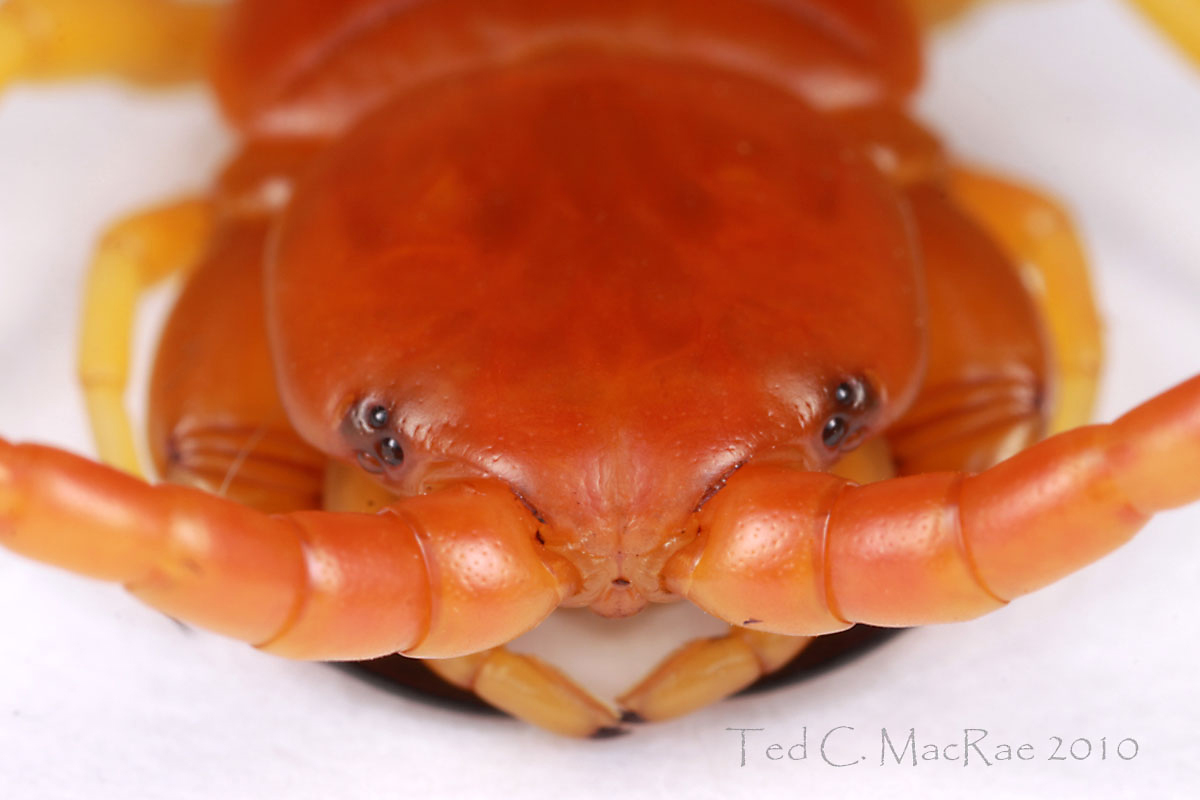
Centipedes, of course, comprise the class Chilopoda, which is divided into four orders.  The giant centipedes (21 species native to North America) are placed in the order Scolopendromorpha, distinguished by having 21 or 23 pairs of legs and (usually) four small, individual ocelli on each side of the head (best seen in bottom photo).  The three other orders of centipedes either lack eyes (Geophilomorpha) or possess compound eyes (Scutigeromorpha and Lithobiomorpha).  These latter two orders also have only 15 pairs of legs (shouldn’t they thus be called “quindecipedes”?).  Among the scolopendromorphs, S. heros is easily distinguished by its very large size and distinctive coloration.  This coloration varies greatly across its range, resulting in the designation of three (likely taxonomically meaningless) subspecies.  This individual would be considered S. h. castaneiceps (red-headed centipede) due to its black trunk with the head and first few trunk segments red and the legs yellow.  As we have noted before, such striking coloration of black and yellow or red nearly always indicates an aposematic or warning function for a species possessing effective antipredatory capabilities – in this case a toxic and very painful bite.

The individual in these photographs is not the first one I saw that night, but the second.  I had no container on hand to hold the first one and not even any forceps with which to handle it – I had to watch in frustration as it clambered up the side of the draw and disappear into the darkness of the night.  Only after I returned to the truck to retrieve a small, plastic terrarium (to fill with dirt for the giant tiger beetles that I now possessed) did I luck into seeing a second individual, which I coaxed carefully into the container.  It almost escaped me yet again – I left the container on the kitchen table when I returned home, only to find the container knocked onto the floor the next morning and the lid askew.  I figured the centipede was long gone and hoped that whichever of our three cats that knocked the container off the table didn’t experience its painful bite.  That evening, I noticed all three cats sitting in a semi-circle, staring at a paper shredder kept up against the wall in the kitchen.  I knew immediately what had so captured their interest and peeked behind the shredder to see the centipede pressed up against the wall. The centipede had lost one of its terminal legs but seemed otherwise none the worse for wear – its terrarium now sits safely in my cat-free office, and every few days it enjoys a nice, fat Manduca larva for lunch.

There are a number of online “fact sheets” on this species, mostly regarding care in captivity for this uncommon but desirable species.  I highly recommend this one by Jeffrey K. Barnes of the University of Arkansas for its comprehensiveness and science-focus.

Photo Details: Canon 50D (ISO 100, 1/250 sec) w/ Canon MT-24EX flash in white box.
Photos 1-2: Canon 100mm macro lens (f22), indirect flash.
Photo 3: Canon MP-E 65mm 1-5X macro lens (f/13), direct flash w/ Sto-Fen + GFPuffer diffusers.
Post-processing: levels, minor cropping, unsharp mask.

Copyright © Ted C. MacRae 2010

What’s more difficult to see…

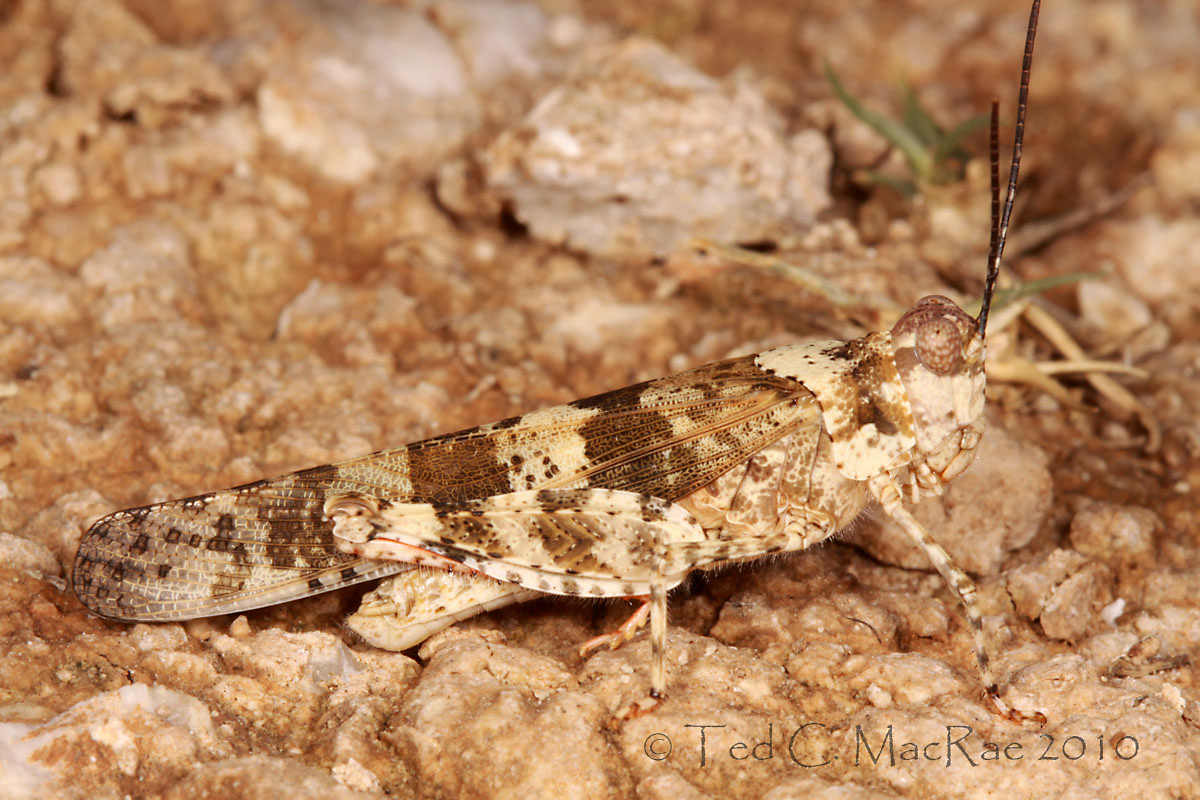
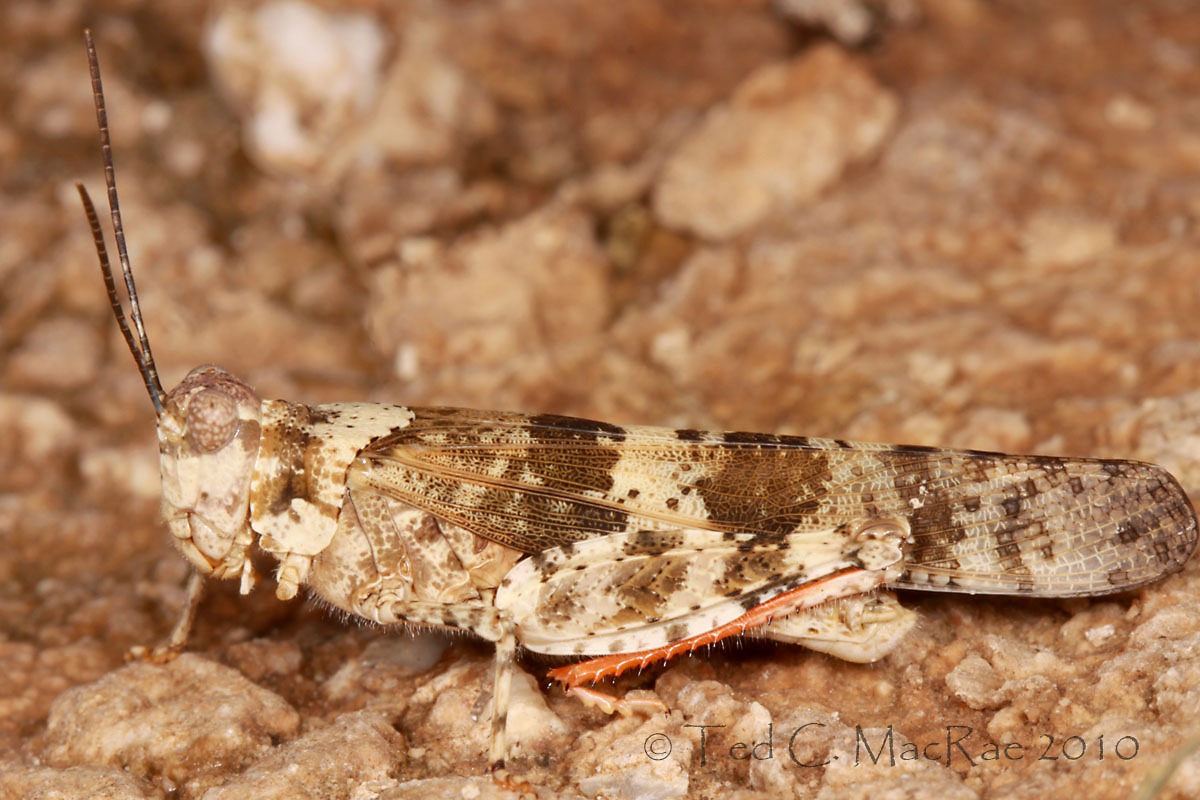
…than a Trimerotropis latifasciata (broad-banded grasshopper) adult on lichen-encrusted clay exposures?


Answer: A T. latifasciata nymph on lichen-encrusted clay exposures.


My thanks to David J. Ferguson for confirming my initial ID as a species of Trimerotropis and provisionally placing these individuals as T. latifasciata.  Of course, I’m not at all an expert in grasshopper identification, but I recognized these individuals, found atop the red, flat-topped mesa of Gloss Mountain State Park in northwestern Oklahoma, for their great similarity to T. saxatilis (lichen grasshopper), a striking, more greenish species (at least here in Missouri) that I had hoped to but did not see during my visit to Lichen Glade Natural Area back in late May (it may have been too early in the season for them).  At first I thought these individuals might represent that species, considering the abundance of lichens that encrusted the clay exposures atop the mesa.  However, according to David the red hind tibia (seen in the photo below of a different adult – sans left front leg), longer wings, occurrence on clay (rather than rock or sand), and location in the Great Plains make T. latifasciata the most tenable choice.

Like T. saxatilis and other species of the genus, T. latifasciata provides a marvelous example of the use of camouflage (i.e., blending in with surroundings) – a form of crypsis – to avoid detection by predators.  Finding this species only strengthens my desire to find (and photograph) T. saxatilis – speckled green, white and black – amidst the green lichens that encrust the red igneous outcroppings of the St. Francois Mountains some 100 miles south of St. Louis.

Photo Details: Canon 50D w/ 100mm macro lens, (ISO 100, 1/250 sec, f/18-20, Canon MT-24EX flash (1/4 ratio) w/ Sto-Fen diffusers, and typical post-processing (levels, minor cropping, unsharp mask).

Copyright © Ted C. MacRae 2010

Add to FacebookAdd to DiggAdd to Del.icio.usAdd to StumbleuponAdd to RedditAdd to BlinklistAdd to TwitterAdd to TechnoratiAdd to Yahoo BuzzAdd to Newsvine

Email to a friend