Stag and “stagette” beetle

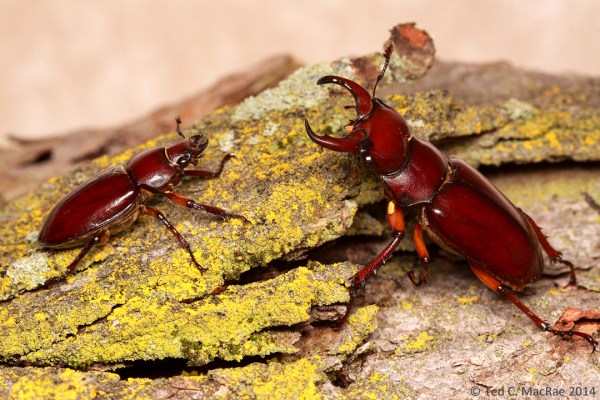
Lucanus capreolus, female (L) and male (R) | Fort Defiance Park, Illinois

Lucanus capreolus, female (L) and male (R) | Fort Defiance Park, Illinois

Last month I posted some photos of the very “stag beetle-ish” looking longhorned beetle, Parandra polita. Chestnut brown in color with large, forward projecting mandibles, this member of the longhorned beetle subfamily Parandrinae looks almost nothing like longhorned beetles in other subfamilies but very much like a small species of stag beetle (family Lucanidae). If it weren’t for the straight rather than elbowed antennae, even experienced coleopterists might be fooled by its appearance. The beetle had been attracted to an ultraviolet light setup in wet bottomland forest at the southern tip of Illinois where the Mississippi and Ohio Rivers meet. Perhaps not coincidentally, several true stag beetles representing both males and females of the species Lucanus capreolus were attracted to the lights that night as well.
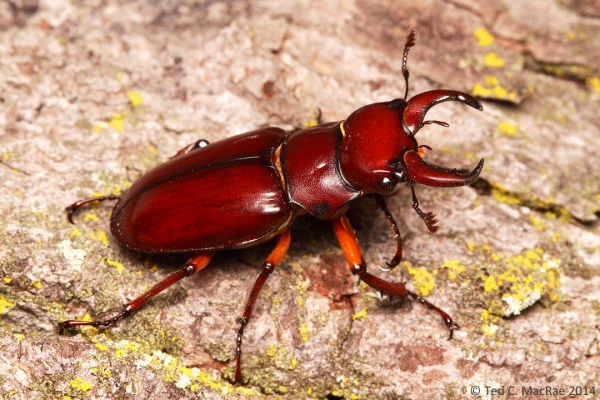
Males are distinctive by their large, sickle-shaped mandibles.

Males are distinctive by their large, sickle-shaped mandibles.

The genus Lucanus contains the largest stag beetles in North America—the most desirable of the handful of species it contains being L. elaphus (North America’s largest stag beetle) due to the male’s outrageously enlarged mandibles and the species’ general scarcity. Lucanus capreolus nearly matches L. elaphus in size and has an equally broad distribution across eastern North America, but it seems to be a more common species and has the male mandibles only moderately (though still distinctly) larger than the female. Despite its more routine occurrence, I rarely see more than a few individuals at a time, and they are almost always all males. This night, however, I was fortunate to encounter not only males but several females as well. I’ve previously photographed the female of this species (Diminishing Stag Beetle), but this was my first chance to photograph both male and female together.

Females have much smaller mandibles (but are still capable of delivering a painful 'nip').

Females have much smaller mandibles (but are still capable of delivering a painful ‘nip’).

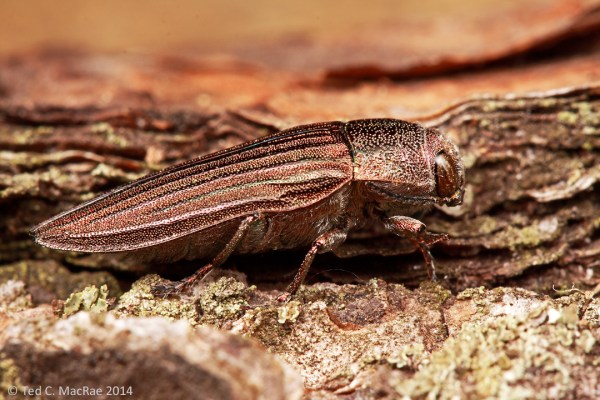
While male L. elaphus are undeniably distinct, I frequently see confusion about how to distinguish male L. capreolus from L. placidus (the third eastern North American species of the genus, occurring more sporadically than L. capreolus), and separating females of all three species can be even more confusing. Male L. elaphus are readily identified by their greatly elongated and multi-toothed mandibles, but a suite of characters may need to be employed for females and non-elaphus males. The best character to use for L. capreolus are the distinctly bicolored femora that are yellowish at the base; however, color can be variable and some individuals will exhibit the more uniform chestnut-brown color typical of L. elaphusLucanus placidus, on the other hand, is usually distinctly darker in color than either of the other two species. Surface sculpture of the elytra and pronotum also offer useful characters. The elytra of L. capreolus and L. elaphus are rather smooth, while in L. placidus they are more distinctly punctate/rugose. The pronotum of both L. capreolus and L. placidus, however, is usually distinctly punctate compared to the relatively smooth pronotum of L. elaphus. The shape of the labrum (projection between the mandibles) is also usually distinctive and is not influenced by gender like the mandibles. In L. elaphus the labrum is rather pointed, while in L. capreolus and L. placidus it is more blunt (indeed, in L. placidus the labrum can almost be described as quadrate, or “squared”). Lastly, the number of teeth on the inner margin of the mandibles is usually diagnostic for females of the three species—L. capreolus possessing one tooth, L. placidus possessing two, and L. elaphus possessing more than two.

Unlike in most insect groups, males rather than females.

Unlike most insect groups, male stag beetles rather than females are generally larger.

© Ted C. MacRae 2014
The Buprestis tree

After collecting Chrysobothris seminole at the type locality in Georgia and Chrysobothris orono the following day at South Cumberland State Park in Tennessee, I thought my trip last May with fellow buprestophiles Josh Basham and Nadeer Youseff was a complete success. I had collected two species of jewel beetles (family Buprestidae) that I had never collected before—not an easy thing for me to do in the eastern U.S. now after three decades of collecting, but little did I know that I would go on to collect three additional such species that same day. We had only seen two C. orono individuals after a fair bit of searching on the exposed roots of the Virginia pines (Pinus virginiana) growing along the blufftops, but I’ve learned to be tenacious and not give up too quickly when searching for rare species.

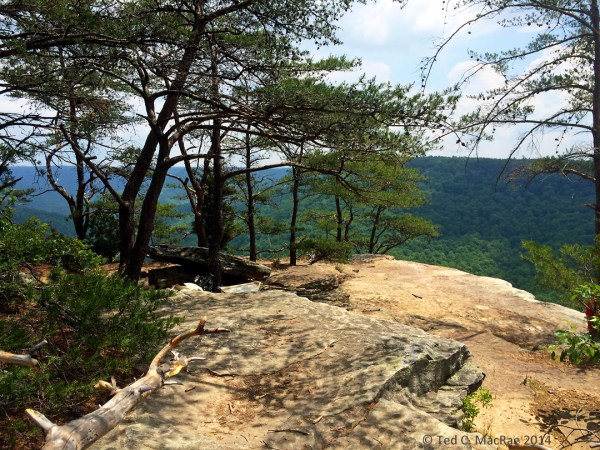
Virginia pine (Pinus viriginiana) on bluff tops | South Cumberland State Park

Virginia pine (Pinus viriginiana) on bluff tops | South Cumberland State Park, Tennessee.

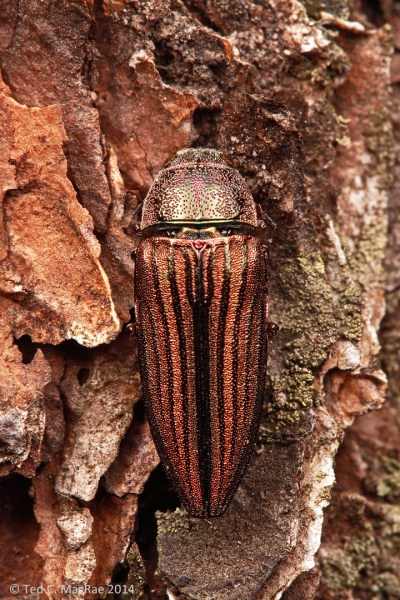
During my searches, I gave a lot of attention to one particular tree at the far end of the bluff—though it was alive and not showing any outward signs of distress, there was just something about it that made me think, “that’s a buprestid tree.” I don’t know if it was the sparsely limbed crown, the relatively smooth trunk with one side fully exposed to the sun, or just its lonely position at the edge of the bluff away from other trees (regretfully, I did not photograph the tree). At any rate, I checked it over every time I wandered down to that end of the bluff. During one of my inspections, I mentioned to Josh that I thought this tree looked good for buprestids, and as I did my eyes suddenly noticed a large individual in the genus Buprestis sitting on the trunk right in front of me. I grabbed it and yelled out to Josh what I’d found—I recognized it as a member of the subgenus Cypriacis but wasn’t sure about the species. Josh came over to take a look and immediately recognized it as B. strata. He mentioned that this was one of several other species besides C. orono that he and Nadeer have found before at this site. I told Josh that this was yet another species I’d never collected before (although I do have a specimen in my collection received in trade). The photos below were taken later that evening in the safety of the studio with the beetle on a piece of Virginia pine bark. This species is recognizable as a member of the subgenus Cypriacis by the elytra with alternate intervals depressed and heavily punctate, giving the beetle a strongly ribbed appearance—there are a few other species in this subgenus in northern and western North America.

Buprestis (Cypriacis) striata  | South Cumberland State Park, Tennessee

Buprestis (Cypriacis) striata | South Cumberland State Park, Tennessee

Buprestis (Cypriacis) striata  | South Cumberland State Park, Tennessee

Buprestis (Cypriacis) striata | South Cumberland State Park, Tennessee

Buprestis (Cypriacis) striata  | South Cumberland State Park, Tennessee

Buprestis (Cypriacis) striata | South Cumberland State Park, Tennessee

This find fueled another hour or so of continued searching of the pines, now not only for C. orono, but also for B. striata. As we continued to search, I queried Josh about the other species he had collected here. One that he mentioned that got my attention was Buprestis salisburyensis. I mentioned that not only had I never collected that species either, but that I’d never even seen it. Eventually I asked him what it looked like, and he went on to describe what sounded to me like an incredibly beautiful species—brilliant, metallic blue-green with bright red around the edges of the elytra. As he described the species, I began walking back towards the tree, and immediately I saw one sitting on the rock at the base of the tree. I yelled out, “There’s one!”, crept up slowly, and clamped my net over it (all of which was probably unnecessary—most Buprestis species are rather clumsy and easy to capture, unlike the comparatively zippy Chrysobothris). The photos shown here, like those of B. striata, were also taken later that evening indoors—even though I had found the beetle sitting on the rocks at the base of the tree I thought it would look more natural on Virginia pine bark. I also photographed the beetle on a needle clump, as this and other members of the subgenus Stereosa (recognizable by the large punctures of the elytra) have been beaten from needles of young. healthy pines (Helfer 1941). This makes perfect sense to me, given their coloration which could actually serve a cryptic function.

Buprestis (Stereosa) salisburyensis | South Cumberland State Park, Tennessee.

Buprestis (Stereosa) salisburyensis | South Cumberland State Park, Tennessee.

Buprestis (Stereosa) salisburyensis | South Cumberland State Park, Tennessee.

Buprestis (Stereosa) salisburyensis | South Cumberland State Park, Tennessee.

Buprestis (Stereosa) salisburyensis | South Cumberland State Park, Tennessee.

Buprestis (Stereosa) salisburyensis | South Cumberland State Park, Tennessee.

I mentioned a third species that I collected for the first time that day—after finishing at South Cumberland State Park, Josh took me to a spot where he had collected North America’s only coraebine buprestid, Eupristocerus cogitans. This species breeds in alder, and there was a sickly clump of alder trees next to a small lake. I looked at the tree, stuck my beating sheet under a branch and gave it a whack—there sat two individuals! I moved the sheet under another branch, gave it a whack, and there sat two more individuals! In my excitement of having collected this species for the first time (and my zeal to get even more), I completely forgot about making sure the vial I placed them in was not charged with ethyl acetate so that I could take photos later on. When I finally realized my mistake it was too late—the specimens were dead. I suppose I could have placed one on a branch and photographed it anyway, but with live individuals of Chrysobothris oronoBuprestis striata, and B. salisburyensis already in queue for photographs I opted to hope for a second chance someday.

REFERENCE:

Helfer, J. R. 1941. A revision of the genus Buprestis of North America north of Mexico (Coleoptera, Buprestidae). Entomologica Americana 21(3):123–199.

© Ted C. MacRae 2014

Chrysobothris orono in Tennessee

Virginia pine on bluff tops | South Cumberland State Park, Tennessee

Virginia pine on bluff tops | South Cumberland State Park, Tennessee

Some years ago, I sent a list of 47 species of Buprestidae for which I had records of occurrence in Tennessee to Joshua Basham, who had recently become interested in the family and wanted to develop a checklist for the state. One of the species on that list—Chrysobothris orono Frost, 1920—caught Josh’s attention, not only because it is a beautiful and very uncommonly encountered species, but also because of the dubious nature of the lone Tennessee record for the species. Knull (1930) recorded a specimen in his collection from ‘‘Fresno Co., Tennessee’’ without further information. However, there is no such county in the state (or any other state in the country outside of California), and Josh was also unaware of any town by that or a similar name in the state.

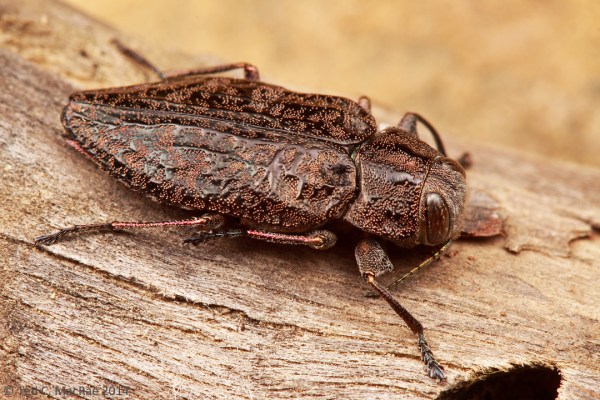
Chrysobothris orono Frost, 1920 | South Cumberland State Park, Tennessee

Chrysobothris orono Frost, 1920 | South Cumberland State Park, Tennessee

A few years later, in 2012, Josh and colleague Nadeer Youssef succeeded in finding C. orono in Tennessee at South Cumberland State Park—just one hour east of their facility in McMinnville! They collected nearly two dozen specimens from late May to late July during that and the following year, all associated with exposed roots of Virginia pine (Pinus virginiana) growing on the edges of high bluff tops. This was a significant find because it confirmed the occurrence of the species in the state, which heretofore had only been recorded from a handful of states/provinces along the eastern seaboard and around the Great Lakes. Moreover, they found a carcass of an individual that died while emerging from its host, confirming Virginia pine as a larval host. Until then, red pine (P. resinosa) was the only confirmed larval host for the species (Wilson 1969) [Paiero et al. (2012) did also record the species as reared from jack pine, P. banksiana; however, I am unaware of the source of that record]. Both the confirmed state and larval host records were documented in our recent joint paper (MacRae & Basham 2013).

Rarely collected, this species has been reared from several species of pine.

Rarely collected, this species has been reared from several species of pine.

I was especially interested in news of this species being collected in Tennessee, as it was a species I myself had never encountered (having in my collection only a single specimen received in trade). Josh and I had been looking for an opportunity to get out into the field together, so in late May this year I met up with him and Nadeer in McMinnville to look first for Chrysobothris seminole at the type locality in Georgia and then C. orono at South Cumberland State Park in Tennessee. We were a little concerned about the timing of the trip, considering this year’s late spring and that our visit would be on the early side of the dates of occurrence recorded at the site. Nevertheless, Lady Luck shone down upon us, and within minutes of arriving at the site we saw the first beetle. Josh saw it just as it flew from an exposed root and watched it land on a nearby rock. I had hoped to get in situ field photographs of the species, but protocol for the first encounter with any rare, flighty species is to collect the specimen live as a studio backup in the event that I am unsuccessful with field photographs. Josh graciously allowed me to collect and keep this first specimen, and Nadeer saw another individual which he netted in flight shortly afterwards.

Chrysobothris orono was only one of several very cool buprestid species collected on this day...

Chrysobothris orono was only one of several very cool buprestid species collected on this day…

Alas, these would be the only individuals we would see, so I would have to be content with the photos shown here that were taken later that night on a Virginia pine root with an emergence hole.¹ In addition to C. dentipes (see subtext below), we also encountered two other very nice species of Buprestidae at the site. However, discussion and photos of these will be saved for a future post…

¹ It is possible that the emergence hole is that of Chrysobothris dentipes (Germar, 1824), which we also found associated with exposed pine roots at this locality. However, the size of the hole does seem to match the slightly larger C. orono.

The author catches his first ever Chrysobothris orono (photo by Joshua Basham).

The author catching Chrysobothris orono (photo by Joshua Basham).

REFERENCES:

Knull, J. N. 1934. Notes on Coleoptera, No. 4. Entomological News 45(10):207–212 [BioStor].

MacRae, T. C. & J. P. Basham. 2013. Distributional, biological, and nomenclatural notes on Buprestidae (Coleoptera) occurring in the U.S. and Canada. The Pan-Pacific Entomologist 89(3):125–142 [pdf].

Paiero, S. M., M. D. Jackson, A. Jewiss-Gaines, T. Kimoto, B. D. Gill & S. A. Marshall. 2012. Field Guide to the Jewel Beetles (Coleoptera: Buprestidae) of Northeastern North America. Canadian Food Inspection Agency. 411 pp. [pdf].

Wilson, L. F. 1969. Life history, habits and damage of Chrysobothris orono (Col., Buprestidae) on red pine in Michigan. The Canadian Entomologist 101(3):291–298 [abstract].

© Ted C. MacRae 2014

When is a stag beetle not a stag beetle?

A: When it’s a longhorned beetle!

Parandra (Tavandra) polita

Parandra (Tavandra) polita | Alexander Co., Illinois

Last week I traveled to northwestern Tennessee to visit research plots, and on the way back I took the opportunity to stop by Fort Defiance Park near Cairo, Illinois. Fort Defiance represents the southernmost tip of Illinois, lying at the confluence of the Ohio and Mississippi Rivers, and on previous visits I had thought that the wet bottomland forest remnants present there looked like promising habitat for the ant-like tiger beetle (Cylindera cursitans). The type locality of a synonym (Cicindela alata) is in northern Illinois, but the type specimens are considered to have been introduced and, to my knowledge, no bona fide records of the species are known from the southern part of the state. I have taken the species nearby on the Missouri side of the Mississippi River (MacRae et al. 2011), so I thought the chances were good of finding it here as well. And find it I did—in good numbers! Success already in hand, I decided to stick around for nightfall and set up some blacklights to see what other beetles might be attracted from the surrounding forests.

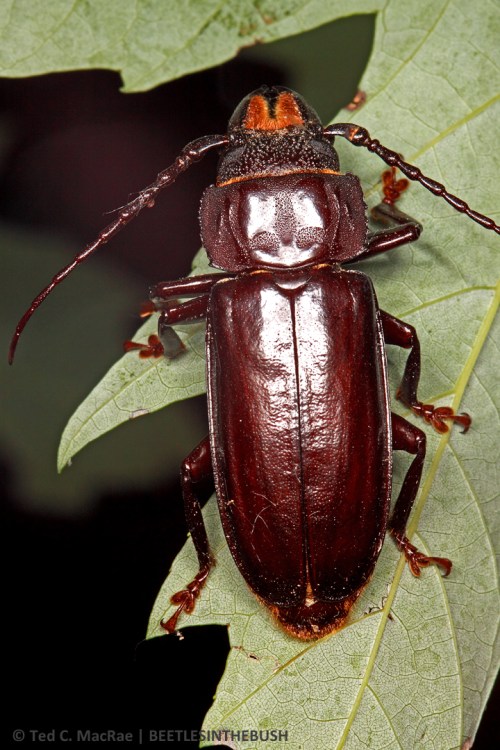
Parandra (Tavandra) polita

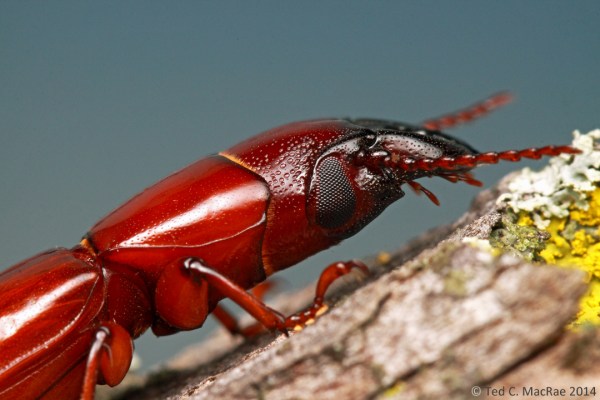
The color and shape of the body and prominent jaws give the appearance of a small stag beetle.

Sadly, not much of interest was coming to the lights. Temperatures and humidity were good, but a waxing moon with clear skies didn’t help. Worse, the sheets were inundated with caddisflies—always a predictable consequence when blacklighting near large rivers but especially annoying because of their habit of flying into your face (and up nostrils, down shirts, in ears…) when checking the sheet for other insects. A few longhorned beetles did show up, as did some male and female reddish-brown stag beetles (Lucanus capreolus), and later a single coppery tiger beetle (Ellipsoptera cuprascens) also made an appearance. By 10 pm, however, I had decided enough was enough and went to one of the sheets to begin taking it down. As I did, I noticed a reddish-brown, large-mandibled beetle sitting on the sheet that, for all intents and purposes, looked like a small stag beetle. I wasn’t fooled, however, as I knew exactly what this beetle was—I had previously seen this species in the form of two individuals at a blacklight in southern Missouri very near to my current location (although it was 28 years ago!). It was Parandra polita, an usual longhorned beetle belonging to the archaic subfamily Parandrinae, and those specimens (MacRae 1994) plus another collected more recently a few miles north—also at a blacklight in wet bottomland forest along the Mississippi River (McDowell & MacRae 2009)—to date represent the only known occurrences of this uncommon species in Missouri.

Parandra (Tavandra) polita

The entire rather than emarginate eyes distinguish this species from Neandra brunnea,

Linsley (1962) noted the tenebrionid (darkling beetle)-like appearance of beetles in this genus. Perhaps the glabrous, parallel-sided body recalls the appearance of some darkling beetles, but I have always thought these beetles looked more like stag beetles because of the reddish-brown coloration and, notably, fairly large, forward-projecting mandibles that even show the same type of size dimorphism as stag beetles—larger in “major” males, smaller in females and “minor” males. Parandrines differ from most other subfamilies of longhorned beetles by having the antennae short and equal-segmented and the tarsi distinctly pentamerous with slender, padless segments. Another small subfamily of longhorned beetles, the Spondylidinae, shares these characters, but parandrines are easily distinguished from them by several characters including the margined pronotum—also a most lucanid-like character.

Parandra (Tavandra) polita

Parandra polita also has the mandibles contiguous at the base and a narrower, more flattened body.

Although Parandrines are reasonably diverse in South America and Africa, North America boasts only four taxa, with P. polita and Neandra brunnea being the only two occurring in the eastern part of the continent. Annoyingly, I have collected just as few specimens of the latter as the former, despite the fact that N. brunnea is considered to be the most commonly encountered of all four North American taxa. The specimens were all taken in Japanese beetle traps that I ran while working for the Missouri Department of Agriculture in the 1980s, so I have never actually seen a live individual of that species. Parandra polita and N. brunnea are, however, fairly easy to distinguish, as the former has the mandibles triangular and contiguous at the base while in the latter they are sickle-shaped and well separated at the base. The former also has the eyes entire on the inner margin while the latter has them distinctly emarginate, and in basic gestalt P. polita has a narrower, more flattened body than N. brunnea.

A frontal portrait of this beetle was featured a few days ago in ID Challenge #23. A few people were fooled by its lucanid- and even cucujid-like appearance, but Stephen, Harry Zirlin, Nikola Rahme, Jon Quist, and Ben Coulter all correctly guessed this species. By virtue of being first, Stephen rises above the 5-way tie to get the win. However, I should note that Harry was the first to actually provide names for each of the four requested taxa (as did Jon and Ben subsequently), so he could make a valid claim for the win. Also, nfldkings and froglady made really nice comments about my blog and the featured photo, so I award them with honorable mentions!

REFERENCES:

Linsley, E. G. 1962. The Cerambycidae of North America. Part II. Taxonomy and classification of the Parandrinae, Prioninae, Spndylinae, and Aseminae. University of California Publications in Entomology 19:1–102, 1 plate [OCLC WorldCat].

MacRae, T. C. 1994. Annotated checklist of the longhorned beetles (Coleoptera: Cerambycidae and Disteniidae) known to occur in Missouri. Insecta Mundi 7(4) (1993):223–252 [pdf].

MacRae, T. C., C. R. Brown & K. Fothergill. 2011. Distribution, seasonal occurrence and conservation status of Cylindera (s. str.) cursitans (LeConte) (Coleoptera: Cicindelidae) in Missouri.  CICINDELA 43(3):59–74 [pdf].

McDowell, W. T. & T. C. MacRae. 2009. First record of Typocerus deceptus Knull, 1929 (Coleoptera: Cerambycidae) in Missouri, with notes on additional species from the state. The Pan-Pacific Entomologist 84(4) (2008):341-343 [pdf].

© Ted C. MacRae 2014

One-shot Wednesday: Mallodon dasystomus

Mallodon dasystomus | southeast Missouri (Mississippi Co.)

Mallodon dasystomus | southeast Missouri (Mississippi Co.)

Today’s (slightly belated) edition of “One-shot Wednesday” features a beetle that I saw just about this time last year while blacklighting along the Mississippi River in the southeastern lowlands of Missouri. Mallodon dasystomus¹ is a prionid longhorned beetle (family Cerambycidae, subfamily Prioninae) that is sometimes called the “hardwood stump borer”. It is perhaps one of the most widely distributed members of its group, occurring across the southern tier of the U.S. down through Mexico and Central America as far as northern South America.

¹ Until recently the specific epithet was consistently misspelled in most of the literature as “dasytomus“. A closer look at the Greek root words dasus (δασύς), meaning “hairy”, and stoma (στόμα), meaning “mouth”, shows the misspelling to be nonsensical. I, myself, am guilty of using the wrong spelling in my checklist of Missouri longhorned beetles (MacRae 1994), although I can claim to have been “going with the flow”.

Despite the beetle’s wide geographical range, I searched for it both eagerly and unsuccessfully during the 1980s as I was gathering data for my checklist of Missouri longhorned beetles (MacRae 1994). I eventually published that checklist and included the species on the basis of a few specimens seen in other collections, but I never encountered it for myself until some years later during a visit to Cave Creek Canyon in southeast Arizona. As noted by Linsley et al. (1961), this species is common there and is associated with large, partially dead Arizona sycamores (Platanus wrightii). Although nearly 20 years ago, I still recall seeing the large beetles crawling high up on the trunks and sitting in their emergence holes with only their massively-mandibled heads protruding as they tantalizingly waved their antennae about.

That experience would directly lead to my eventually finding this species for myself in Missouri. Shortly after returning to the state in the mid-90s, I was driving along a road in the state’s southeastern lowlands when I passed a very large, half-dead American sycamore (Platanus occidentalis). Even at a speed of 40 mph I could see the large emergence holes that immediately reminded me of what I had seen in Arizona, so I hit the brakes, made a quick U-turn, and came back to look at the tree a little more closely. I was convinced the holes were made by this species, and my hunch was proven when I eventually found several beetle carcasses on the ground around the base of the tree. I returned the following weekend with a chainsaw, cut several one-cubic-foot sections of wood from the dead portion of the massive tree’s trunk (with landowner permission), and eventually reared a nice series of adults from the wood. Having uncovered the association of this species with sycamore in the state, I was able to find the species also in several other locations in southeastern Missouri, but I have not managed to find the species in any areas north of the southeastern lowlands in Missouri despite the common occurrence of the host tree.

The beetle in the above photograph landed on the foliage of a large silver maple (Acer saccharinum) next to the ultraviolet light I had setup in wet bottomland forest along the Mississippi River, and wanting to ensure that I got at least one in situ photo of the beetle that is where I shot it. I did try to move it to the trunk of a large, dead sycamore nearby for a more realistically representative photo of how these beetles are usually encountered, but the beetle became quite agitated when I moved it and my considerable patience was never rewarded. I popped it into a vial in hopes of photographs the next morning, but conditions were not to the beetle’s liking and it expired before I had another chance to photograph it. Just the other night I setup a blacklight in a spot not too far from where I saw this beetle in hopes of getting another chance to photograph it. That effort was not successful, but I did find a longhorned beetle species that I had not seen in nearly 30 years! I was successful in photographing that species but (please excuse the teaser) will save those photos for a future post.

REFERENCES:

Linsley, E. G., J. N. Knull & M. Statham. 1961. A List of Cerambycidae from the Chiricahua Mountain Area, Cochise County, Arizona (Coleoptera). American Museum Novitates 2050:1–34 [full text, pdf].

MacRae, T. C. 1994. Annotated checklist of the longhorned beetles (Coleoptera: Cerambycidae and Disteniidae) known to occur in Missouri. Insecta Mundi 7(4) (1993):223–252 [pdf].

© Ted C. MacRae 2014

Why I went to Georgia

Call me biased, but for my money few groups of beetles can match the maddening combination of beauty and difficult taxonomy of jewel beetles (family Buprestidae) (I can already hear the protestations of weevil and scarab workers). In the case of jewel beetles, much of the difficulty is due to a propensity for hyperdiverse genera. For example, in North and Central America more than half of the nearly 2,000 described species belong to just three genera—AcmaeoderaChrysobothris, and Agrilus. It’s enough to make many a casual coleopterist throw their hands in the air and ship their specimens off to “specialists” for identification. This is, strangely, for me part of their attraction. Any reasonably serious effort to study jewel beetles over a period of time is sure to uncover a wealth of new data, from previously unknown hosts associations and distributions to the alpha taxonomist’s raison d’être—new species!

Chrysobothris seminole

Chrysobothris seminole on its host, Chrysoma pauciflosculosa.

One of the more problematic jewel beetle groups is the “Chrysobothris femorata species-group”. For many years, these abundant and conspicuous members of forest and landscape ecosystems have confounded collectors, foresters, and extension entomologists alike. A recent revision of the group by Stan Wellso and Gary Manley (Wellso & Manley 2007) has done much to improve the situation through the description of several new species and clarification of the hosts, distributions, and identifying characters of previously known species. I have benefited more than many from their work, since during the 25 years leading up to that work I had collected large numbers of specimens assignable to this group and was fortunate to have this material examined by Stan and Gary and included in the type series of most of the new species they described. Having in my collection series of nearly all of the known species in this group greatly facilitates identification of specimens received for identification and the recognition of any new species that might come my way. Notice, however, that I said “nearly” all of the known species—there were two species described in that work that I did not have examples of; C. seminole from Georgia and Florida and C. mescalero from New Mexico and west Texas. Happily, I can now say that only C. mescalero is still missing from my collection.

Chrysomoa pausiflosculosa

Chrysomoa pausiflosculosa (woody goldenrod) | Emanuel Co., Georgia.

Chrysobothris seminole is unique in the group by its association not with deciduous hardwood trees, but rather the stems and root crowns of living woody goldenrod (Chrysomoa pauciflosculosa), a member of the aster family (Asteraceae). This plant is not a true goldenrod (genus Solidago), although they are in the same family, but is named such for the profusion of yellow inflorescences that appear during fall and resemble those of goldenrod. However, unlike goldenrod, woody goldenrod is a perennial plant with a woody root crown and stems from which new growth emerges each year. Woody goldenrod is restricted to coastal dunes and sand scrub habitats in the U.S. southeastern coastal plain, although the beetle itself has only been found in a few locations in Florida and southeastern Georgia. The beetle was first collected in numbers by Roy Morris and Edwin Donaldson, who reared adults from woody goldenrod root crowns they had collected in an effort to rear adults of another wood-boring beetle; this one in the family Cerambycidae and also undescribed and restricted to woody goldenrod. That beetle was recently described as Crossidius grahami Morris & Wappes, 2013.

Chrysobothris seminole

Adults are found primarily on lower stems of living plants.

In late May of this year, I made the 13½-hour drive from St. Louis to Emanuel Co., Georgia to visit the type locality of C. seminole and try my hand at finding this species. Along the way I met up with two excellent beetle collectors in Tennessee; Joshua Basham and Nadeer Youssef. Josh and Nadeer are among the few people who have succeeded in collecting this species, having visited the type locality during the previous two years and managing to collect a small series of adults. Their experience proved to be invaluable, as we saw only three individuals during our two days in the area. Josh saw the first soon after we arrived at the type locality and was kind enough to let me see it in situ on its host plant and make the collection, and Nadeer was equally kind to give me the third individual we saw. Our consensus was that a combination of early timing and lack of rain was the reason for their scarcity, and to hedge our bets we collected a number of plants that showed evidence of buprestid (as well as cerambycid) larval workings in the lower stems and root crowns to attempt rearing additional specimens. Because of their scarcity, I kept the adults alive and photographed them later that night in a more secure “studio” setting, and while this species has been photographed before I do believe that the photographs presented here are the only photos of live individuals.

Sand scrub habitat | Emanuel Co., Georgia.

Sand scrub habitat | Emanuel Co., Georgia.

In addition to its unique host plant association and restricted distribution, C. seminole can be distinguished from other members of the C. femorata species-group by both sexes having the frons and clypeus uniformly brown (in most other species of the group the frons and clypeus are variously colored, often brightly so in males of the species). The one other species with both males and females also exhbiting a uniformly brown frons and clypeus is C. mescalero (now the only species still lacking in my collection), which Wellso & Manley (2007) distinguished from C. seminole by having three distinct elytral costae (C. seminole has two indistinct costae), its indistinct elytral foveae (in C. seminole the foveae are distinct), and its southwestern distribution and association with oaks. I suppose now I’ll have to start making plans for a June/July visit to sand dune habitats in New Mexico and west Texas sometime in the near future.

REFERENCES:

Morris, R. F., II & J. E. Wappes. 2013. Description of a new Crossidius LeConte (Coleoptera: Cerambycidae: Cerambycinae: Trachyderini) from southern Georgia with comments on its biology and unusual distribution. Insecta Mundi 0304:1–7 [pdf].

Wellso, S. G. & G. V. Manley. 2007. A revision of the Chrysobothris femorata (Olivier, 1790) species group from North America, north of Mexico (Coleoptera: Buprestidae). Zootaxa 1652:1–26 [abstract].

© Ted C. MacRae 2014

Who likes mole crickets?

Who likes mole crickets?

Who likes mole crickets?

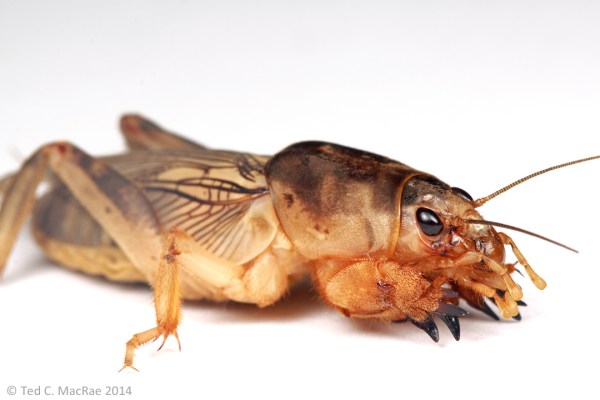
Scapteriscus borellii

I do!

On a recent collecting trip to southeastern Georgia, we spent the night in Swainsboro. We found a hotel and went to the restaurant across the street for dinner. It was dark by the time we got back to the hotel, and since it was a rather warm, muggy night we did what any entomologist worth his salt would do on such a night—creep around the parking lot and building perimeter checking the lights for insects. Late May is still a tad early for checking lights, but among the small assortment of insects we did find were these slim, active insects known as mole crickets (family Gryllotalpidae). Not true crickets, though related, and certainly not moles, these odd-looking critters are immediately distinguishable by their mole-like, fossorial (digging) front legs—a remarkable example of convergence between members of two completely separate animal phyla.

Scapteriscus borellii (southern mole cricket) | Emanuel Co., Georgia.

Scapteriscus borellii (southern mole cricket) | Emanuel Co., Georgia.

Rather than fiddle with them out in the parking lot, I decided to bring them inside for studio photographs on a clean, white background. The widely separated tibial dactyls (literally, “shin fingers”) of the digging feet identify them as Scapteriscus borellii, or southern mole cricket. Despite their name they are an exotic insect, having originally come from much further south (southern South America) and arriving in the U.S. early in the 20th century. While true crickets jump, mole crickets run—and fast! They also, however, have the comical tendency to play dead for a moment when disturbed before bolting to safety. I was able to use this behavior to my advantage while taking photographs—every time he began running, all I had to do was cover him up with a bottle cap. After only a few seconds I was able to remove the cap and take a shot or two before he got the nerve to try to bolt again.

© Ted C. MacRae 2014

Mrs. Monday Jumper

Phidippus princeps female | Howell Co., Missouri

Phidippus princeps female | Howell Co., Missouri

In my previous post, Monday Jumper, I featured a photo of a strikingly colored jumping spider (family Salticidae) that apparently represents an adult male Phidippus princeps. Far too skittish to attempt photographing in the field, I placed him in a vial and photographed him later in the hotel room but still only got one photo that was good enough to post. Shortly after gathering him up, I came across another jumping spider that proved far more cooperative for field shots. This was no doubt due in large part to the fact that she had just captured a fat, juicy caterpillar. I find predaceous insects to be far less skittish when they are involved in the act of consuming prey. This not only makes them easier to approach and photograph, but also adds a desirable natural history element to photos that is sometimes missing in “portrait-only” photographs.

Somber coloration, large abdomen, and small carapace contrast distinctly with the male

Somber coloration, large abdomen, and small carapace contrast distinctly with the male

I say “she” because of the classic female characters exhibited—relatively large and rounded abdomen (males tend to have a smaller and more tapered abdomen), smaller carapace, somber coloration, and absence of a “boxing glove” aspect to the pedipalps. Like the male I had just collected, she was on the foliage of an oak sapling, and as I began taking photographs I noticed in the preview screen the brilliant, metallic blue chelicerae that are a hallmark of the large salticid genus Phidippus. I had also presumed the male I had just collected belonged to this same genus based on gestalt, but I could have never imagined that the two individuals actually represented male and female of the very same species. Such appears to be the case, however, as a thorough perusal of the salticid galleries at BugGuide leads me to believe that the individual featured here is the adult female of Phidippus princeps.

Check out those metallic blue chelicerae!

Check out those metallic blue chelicerae!

These photos still may not approach the technical and aesthetic perfection exhibited by master salticid portraitist Thomas Shahan, but I think they do represent an improvement over my first attempt at photographing a feeding female. The first two photos are fine, but the third suffers from the focus being a little too “deep”, which seems to be my most frequent macrophotography mistake on higher mag shots. If you have any tips on how to overcome this particular problem I am all ears!

© Ted C. MacRae 2014