Red-eyed poop!

I was looking at some of my older files and ran across these photographs taken in early 2011 in Campinas (São Paulo state), Brazil. They’re not my best photos from a compositional and technical perspective, as I was still on the steep part of the learning curve with the Canon MP-E 65mm macro lens. This lens is no doubt powerful and allows amazingly close-up photographs, but it is rather a beast to learn in the field, especially hand-held. I could quibble endlessly about missed focus and suboptimal composition with these shots, and that is probably why they never made it to the front of the line for being posted. Nevertheless, they still depict some interesting natural history by one of nature’s most famous natural history poster children—the treehoppers (order Hemiptera; family Membracidae).

An adult next to a cast nymphal exuvia.

Bolbonota sp. (Hemiptera: Membracidae), upper right | Campinas, São Paulo, Brazil. Note cast exuvia.

The treehoppers shown in these photos were found on a low shrub in a municipal park and are all that I could manage before my clumsy, unpracticed molestations caused the few adults and nymphs present in the aggregation to disperse. The dark coloration of the adult and its globular form, corrugated pronotal surface, and lack of any horns identify the species as a member of the genus Bolbonota in the New World tribe Membracini (another similar genus, Bolbonotoides, occurs as a single species in Mexico). Species identification, however, is much more difficult, as there are at least a dozen species recorded from Brazil and perhaps many more awaiting description. We have a similar though slightly more elongate species here in eastern North America, Tylopelta americana. I don’t know if this is a specific character or not, but I don’t recall seeing any members of this genus with smoldering red eyes—it gives them an almost devilish appearance, especially the blackish adults (see last photo)!

Bolbonota sp. late-instar nymphs clustered together.

Bolbonota and similar genera are often cited by evolutionists as examples of insects that mimic seeds. I can see such a resemblance if I force myself, but honestly I don’t really buy it. To me they seem to bear an uncanny resemblance to the chlamisine leaf beetles which are thought to mimic caterpillar frass. As with the beetles they resemble, frass-mimicry seems to make much more sense than seed-mimicry, especially given their preference for positioning themselves along the stems of the plants on which they feed (when was the last time you saw seeds of a plant randomly distributed along its stems?). Another thought I’ve had is that this is not an example of mimicry at all, but merely an accidental consequence of the heavy, corrugated body form they have adopted, which likely also affords them a reasonable amount of protection from predation. Confounding both of these theories, however, are the radically different appearance and form of the adults versus the nymphs, and indeed even between the different nymphal instars (see early- and late-instar nymphs in photo below). The later instars seem perfectly colored for mimicking unopened leaf buds, but why they would start out dark in early instars before turning mottled/streaked-white as they mature, only to revert back to dark when reaching adulthood, is a mystery to me. If my thoughts are anywhere close to the truth, it would be a remarkable case of different life stages mimicking the products of two different taxonomic kingdoms (plant parts as nymphs, animal poop as adults)!

Bolbonota sp. nymphs tended by Camponotus sp. | Campinas, São Paulo, Brazil.

An ant (presumably Camponotus sp.) tends a first-instar nymph alongside a later instar.

Of course, if either/both of these lines of defense fail then there are the ant associates that often protect treehoppers and other sap-sucking, aggregating insect species in exchange for the sweet, sugary honeydew that such insects exude as a result of their sap-feeding habits. I presume this ant belongs to the genus Camponotus, perhaps C. rufipes or C. crassus which are both commonly encountered treehopper associates in southern Brazil. I have written previously about ant-treehopper mutualism in the stunningly-marked nymphs of another treehopper, Guayaquila xiphias, and its ant-associate C. crassus in Brazil Bugs #15 – Formiga-membracídeos mutualismo (a post that has become one of this blog’s most popular all-time). Maybe this post will never match that one in popularity, but I do find the third photo shown here remarkable in that is shows no less than five elements of this treehopper’s natural history (early-instar nymph, late-instar nymph, cast nymphal exuvia, partial adult, and an ant-associate) within a single frame (shot by a person still on the steep portion of the MP-E 65mm learning curve!).

Copyright © Ted C. MacRae 2013

Hooray for iStock—I finally have an ID for my photo

I was all set to make a “One-Shot Wednesday” post today, but sometimes big news strikes and plans must change. The news today was in the form of a random tweet by Alex Wild:

iStock-caption_Wild-20131120

The link in the tweet led me to the following photo on iStock by Getty:

bedbug has captured worm

I was stunned—the photo depicted a scene almost identical to one that I had photographed back in September while visiting soybean fields in Louisiana. For two months I sat on the photo with no idea what I was looking at, but now thanks to Alex I have my answer! Compare the above photo with mine below, and you’ll see that everything matches perfectly—I had photographed a “bedbug” that had captured a “worm”!

Podisus maculiventris preying on Chrysodeixis includens larva

bedbug captures a worm

I considered myself to be fortunate, because there was not just one but two different subjects in the photo, and both of them matched perfectly with the subjects shown in the iStock photo. Gotta love the internet—nowadays names for even the most hard-to-identify bugs are just a click away if you know where to look!

</snark>

Of course, the aggressor in both photos is not a “bedbug” [sic for “bed bug”] (order Hemiptera, family Cimicidae) but a stink bug (family Pentatomidae), specifically Podisus maculiventris, or “spined soldier bug”—perhaps the most common predatory stink bug in North Amerca and ranging from Mexico and parts of the West Indies north through the U.S. into Canada. It is a well-known predator of crop pests and, as such, has been imported to several other countries as part of classical biological control efforts. As for the “worm,” in my photo it is a late-instar larva of Chrysodeixis includens, or “soybean looper, and while I haven’t been able to identify the exact species in the iStock photo it is definitely a lepidopteran caterpillar that appears to related to if not in the same family as the soybean looper (Noctuidae). Now, I concede that “worm” is sometimes used for lepidopteran larvae, but one must also concede that in it’s broadest sense “worm” can refer to members of several disparate phyla such as Nematoda (roundworms), Platyhelminthes (flatworms), or Annelida (segmented worms).

This case, of course, just screams for application of the Taxonomy Fail Index (TFI), which scales the amount of error in a taxonomic identification in absolute time against the error of misidentifying a human with a chimpanzee—our closest taxonomic relative. For example, when TFI = 1 the error is of the same magnitude as mistaking a human for a chimp, while  TFI > 1 is a more egregious error and TFI < 1 a more forgivable one. In the case shown here, one must go back to the common ancestor that eventually gave rise to all of the worm phyla and noctuid moths (~937.5 mya). In addition, since there are two subjects in the photo, one must also go back to the divergence of the main hemipteran groups that contain bed bugs and stink bugs (mid-Triassic, ~227.5 mya). This results a whopping 1.165 billion total years of divergence between the identifications assigned to the subjects in the iStock photo and their actual identity. Assuming that chimps and humans diverged approximately 7.5 mya, this gives a TFI for the iStock photo of 155! I haven’t searched thoroughly to determine whether this is a record for the highest TFI in a single photo, but surely it is a strong contender!

Copyright © Ted C. MacRae 2013

The “Dagger Butt Weevil”

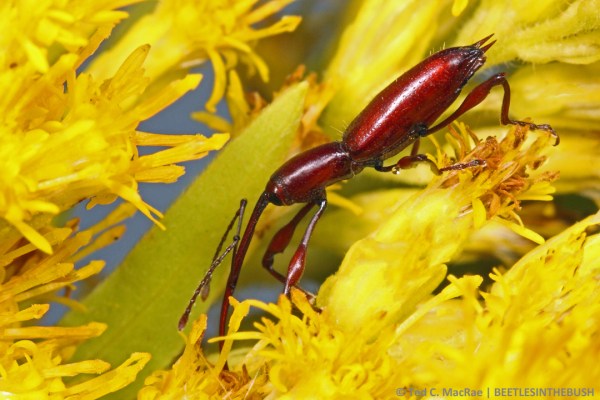
In April 2012 I spent some time in northern Argentina collecting insects, and while collecting was not that great (late in the season after a protracted drought) I saw enough of interest to make it a worthwhile effort. Among the insects that I saw were two species of weevil (family Curculionidae)—one being Eurhinus c.f. adonis () and the other this one, also kindly identified by Charles O’Brien as Erodiscus obidensis (Monte 1944). Both of them were found on flowers of Solidago chilensis growing along the roadside near La Escondida in Chaco Province; however, the two weevils are almost complete opposites in terms of coloration and body form—E. adonis brilliant metallic green and robust chunky, and E. obidensis chestnut-colored and elongate slender.

Erodiscus obidensis (Monte) | Chaco Province, Argentina | Apr 2012

Erodiscus obidensis (Monte) | Chaco Province, Argentina | Apr 2012

An obvious feature of E. obidensis are its two stout spines located at the apices of the elytra. I presume that these serve a defensive purpose to protect them against potential avian or reptilian predators. However, if elytral spines are all that is needed for such then why are these structures not found widely across the order Coleoptera—certainly the potential is there, as many beetles exhibit very small spines at the elytral apices. With enough selection pressure one can easily imagine that larger spines would be selected for. Either the spines also/instead serve some other purpose, or development of spines is more energetically expensive than I am imagining.

What purpose those daggers?

What purpose those daggers?

Compared to most of the insects that I have featured on this blog, I wasn’t able to find much information on this species. It was originally described as Atenistes attenuatus var. obidensis from Óbidos in the Brazilian state of Pará (Monte 1944) and is listed as such in the Blackwelder (1947) catalogue. However, my weevil literature is sparse compared to the other beetle groups with which I am more familiar, and I found nothing else in searches on the web as well. It apparently is already known from Argentina, as it is listed at the website Curculionidae de Argentina (but without any photos). As far as I could tell, these are the first photos of the species to be posted to the web, at least with the associated name. Since so little seems to be known about this weevil, I take it upon myself to give it a common name, and I can’t think of a more amusing and fun-to-say name than the “dagger butt weevil” in reference to its distinctive apical spines.

REFERENCES:

Blackwelder, R. E. 1947. Checklist of the coleopterous insects of Mexico, Central America, the West Indies, and South America. Part 5. Bulletin of the U. S. National Museum 185:765–925 [pdf].

Monte, O. 1944. Sobre coleópteros Otidocephalinae. Revista Entomologia, Rio de Janeiro 15(3):318–320 [abstract].

Copyright © Ted C. MacRae 2013

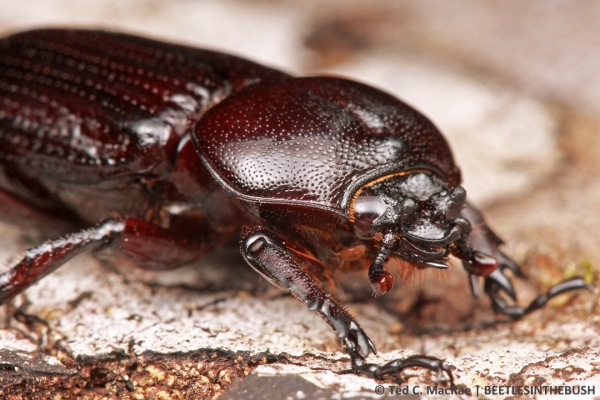
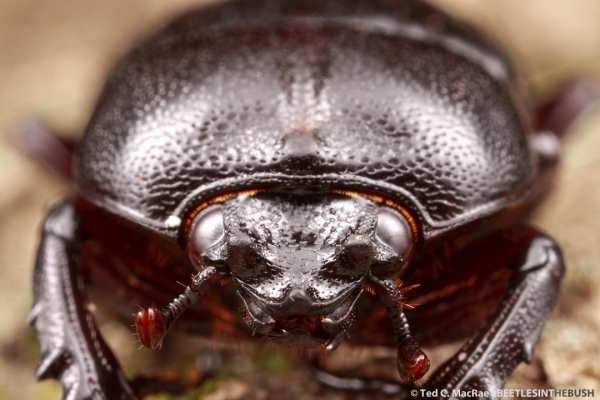
Sunday scarab: Phileurus valgus

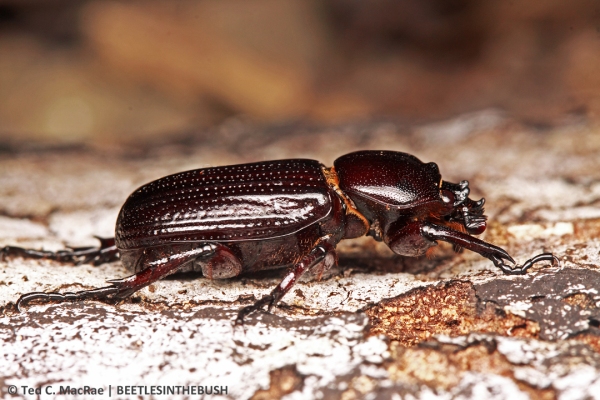
Phileurus valgus (Linnaeus) | Otter Slough Conservation Area, Stoddard Co., Missouri

Phileurus valgus (Linnaeus) | Otter Slough Conservation Area, Stoddard Co., Missouri

Few beetles enjoy more popularity than the scarabs (family Scarabaeidae)¹, and within that group certainly the members of the subfamily Dynastinae are the most popular of all due to their often enormous size and presence of highly developed horns on the head and pronotum. The largest beetles in the U.S. (at least, by weight)—the Hercules beetles, genus Dynastes—belong to this subfamily, and in the tropical regions of the New World members of the genus Megasoma (literally meaning “giant body”) are among the heaviest-bodied beetles in the world (ironically, the title spot goes to members of the genus Goliathus in the subfamily Cetoniinae). Of course, almost without exception in the insect world exceptions apply, and not all dynastine scarabs are large, heavy-bodied beetles. In fact, members of the genus Cyclocephala are often mistaken for May beetles (subfamily Melolonthinae), while members of the genus represented by the species featured in this post—Phileurus—are sometimes mistaken for smallish “bess beetles” (Odontotaenius disjunctus) in the family Passalidae due to their flattened and parallel-sided body.

¹ Except maybe tiger beetles, jewel beetles, and longhorned beetles (wink!).

This species resembles and is sometimes mistaken for the common "bess bug."

This species resembles and is sometimes mistaken for the common “bess bug.”

Phileurus is a primarily Neotropical genus, with only two species ranging north into the United States and one, P. valgus, occurring broadly in the eastern United States. Despite its broad distribution, P. valgus seems to be more common in the southern part of the country and has been recorded under bark of decaying wood and attracted to lights. Saylor (1948) notes that Richter reared a specimen from a larvae collected in a cavity of a dead basswood (Tilia sp.) tree, and adults have also been reared from larvae collected in a blackjack oak (Quercus marilandica) snag (Taber & Fleenor 2005). The individual featured here was one of several that I found under the lower trunk bark of a large, standing, dead pin oak (Q. palustris) tree growing in a wet, bottomland forest in the Mississippi Alluvial Plain of extreme southeastern Missouri. I have seen this species from time to time over the years—never abundantly—but these are the first that I have seen in a situation other than being attracted to lights. The bark was quite loose and covered wood that was soft and well-decayed, and three adults were found embedded within a granular frass-filled gallery directly beneath the bark. One can presume that larvae could also have been found within the wood had I done a little digging.

The head of this species is adorned with three small cephalic tubercles.

The head of this species is adorned with three small cephalic and one pronotal tubercles.

Taber & Fleenor (2005) also note that adults of this species possess structures known to be used by other beetles for sound production, but they did not say whether they have heard this beetle making sounds. I have never heard sounds from these beetles when handling them, either. This contrasts with true bess beetles, which stridulate to make a “kissing” sound when handled.

REFERENCES:

Saylor, L. W. 1948. Synoptic revision of the United States scarab beetles of the subfamily Dynastinae, No. 4: Tribes Oryctini (part), Dynastini, and Phileurini. Journal of the Washington Academy of Sciences 38(5):176–183.

Taber, S. W. & S. B. Fleenor. 2005. Invertebrates of Central Texas Wetlands. Texas Tech University Press, Lubbock, 322 pp. [preview].

Copyright © Ted C. MacRae 2013

Fire ant winged reproductives: male and female

While in Austin at the Entomological Society of America meetings, I had the chance to tour The University of Texas at Austin’s Brackenridge Field Laboratory.  Located on 82 acres of land bordering the Colorado River, the station supports studies in biodiversity, ecosystem change and natural history. A major focus of research at the station involves efforts to establish biological control agents for control of imported fire ant (Solenopsis invicta) using entomopathogens and parasitoids (e.g. phorid flies in the genus Pseudacteon). This research relies on maintaining cultures of fire ants to support rearing of the phorid fly. While time was limited and I did not have much opportunity to photograph either the ant or the fly, I did manage to quickly sneak in a shot or two of some winged reproductives that were removed from the teaming formicid mass in a rearing tray and placed on a table top for all to see (and when I say “a shot or two” I mean it. I had the chance only for one shot of the female and two of the male as they crawled crazily about and the tour leader quickly tried to move us on). I’m sure Alex Wild has all stages/forms of this species covered in spades, but the sexually dimorphic winged reproductives were new for me, and perhaps some readers of this blog as well.

Solenopsis invicta winged reproductives: male (top), female (bottom).

Solenopsis invicta winged reproductives: male (top), female (bottom).

Copyright © Ted C. MacRae 2013
The Darwin Beetle

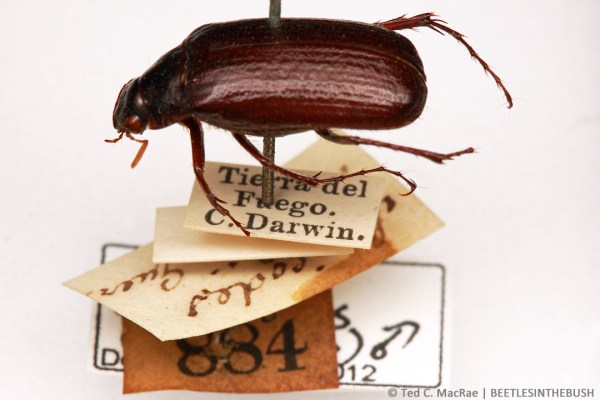
Like most modern biologists, Charles Darwin ranks high on my short list of intellectual/entomological heroes. Actually, with all due respect to others on the list—Carl Linnaeus, Alfred Russell Wallace, John Lawrence LeConte, and others, Darwin sits at #1. His theory of evolution, offered more than 150 years ago to a powerfully skeptical world, continues to provide the basic framework for modern biology (as Theodosius Dobzhansky said in his 1973 paper in American Biology Teacher, “Nothing in biology makes sense except in the light of evolution”). Thus, when Max Barclay recently posted on Facebook a photograph of a beetle collected by Charles Darwin himself, it reminded me that I have yet to visit Down House in Kent (the home of Charles Darwin) or to see anything personally touched by the man whose legacy I revere more than any other. Little did I know that Max did not post the photo from The Natural History Museum in London, but from Austin, Texas where he and I were each arriving for the annual meetings of the Entomological Society of America. When I commented on his post how I would love to see a beetle collected by Darwin someday, Max replied that he had the specimen with him and that he would bring it to the meetings for me to see (and I quote, “Most fun it has had since it flew to 22-year-old Charles Darwin’s gas lamp in Tierra Del Fuego in December 1832”). Can you imagine my anticipation?! True to his word, Max found me at the opening reception, came up from behind me, and placed  the plastic, see-through box housing the specimen on the table in front of me. I recognized it instantly, but still seeing “C. Darwin” on the label almost felt like I’d just met the man himself. I asked Max if it was okay to open the box, to which he agreed, and I even dared to grab the pin head and re-position the specimen for photographs. Call me crazy, but it was as spiritual an experience as I’ve had since, well… “Mrs. Ples” stood before me!

At any rate, here is the “Darwin Beetle,” followed by proof that I really got to hold it!

Sericoides glacialis (Fabricius), collected at Tierro del Fuego in 1832 by Charles Darwin.

Scarab beetle collected at Tierro del Fuego in 1832 by Charles Darwin. Identified as Sericoides glacialis (Fabricius) by Andrew B. T. Smith in 2012 after standing for many years as ‘Sericodes Reichii Guer.’

Holding the ''Darwin Beetle''

Holding the ”Darwin Beetle”

Copyright © Ted C. MacRae 2013

Midget male meloid mates with mega mama

Pyrota bilineata on flowers of Chrysothamnus viscidflorus | San Juan Co., Utah

Pyrota bilineata on flowers of Chrysothamnus viscidflorus | San Juan Co., Utah

While looking for longhorned beetles in the genus Crossidius on flowers of yellow rabbitbrush (Chrysothamnus viscidiflorus) in southern Utah, I encountered one particular plant with numerous blister beetles (family Meloidae) on its blossoms. The orange color, two black pronotal spots, and distinctive black and white longitudinal elytral stripes leave no doubt as to its identity—Pyrota bilineata, but for good measure I sent a photo to my field mate for the trip, Jeff Huether, who confirmed its identity. I had seen singletons of this species at a few previous localities during the trip, so I was intrigued by the large numbers of individuals congregated on this single plant. As I looked at them, I saw one individual that appeared to have something stuck to the tip of its abdomen. I peered closer to get a better look and, to my surprise, discovered that it was actually a male in the act of mating. The male was tiny, only one-third the size of the female, representing about as extreme a size difference in mating insects as I’ve ever seen.

Pyrota bilineata on flowers of Chrysothamnus viscidflorus | San Juan Co., Utah

A tiny male mates with the ginormous female.

Many species of blister beetles exhibit tremendous size variability, and a unique aspect of some species’ mating behavior is the cantharidin-packed spermatophore produced by males and transferred to females during mating. (Cantharidin is a toxic defensive compound that serves as a very effective deterrent to predation.) The spermatophores are energetically “expensive” to produce and are transferred to females during relatively short-lived mating aggregations. Mating in some species may take up to 24–48 hours, thus reducing the opportunities for multiple matings, and as a result males of long-mated species end up investing rather heavily in a limited number of females compared to males that mate more often. These features lead to size assortative mating (Alcock & Hanley 1987), with males showing a preference for larger females (that are presumably more fecund) and females preferring larger males to maximize the amount of cantharidin that they receive or to ensure receipt of a spermatophore large enough to fertilize their full complement of eggs. Medium-sized individuals, likewise, would choose the largest of the remaining individuals, leaving the smallest individuals to mate among themselves. Alcock & Hanley (1987) also note, however, that not all species of blister beetles exhibit size assortative mating, even though they form large mating aggregations and individuals vary greatly in size. I have not seen any reference to size assortative mating in Pyrota bilineata; however, this example seems to suggest that the behavior is not practiced by this species. This could be due to shorter mating times (leading to more opportunities for mating) or a range of variation in body size that is not sufficient to consistently favor the behavior.

REFERENCE:

Alcock, J. & N. F. Hadley. 1987. Assortative Mating by Size: A Comparison of Two Meloid Beetles (Coleoptera: Meloidae). Journal of the Kansas Entomological Society 60(1):41–50 [preview].

Copyright © Ted C. MacRae 2013
One-shot Wednesday: The “other” hibiscus jewel beetle

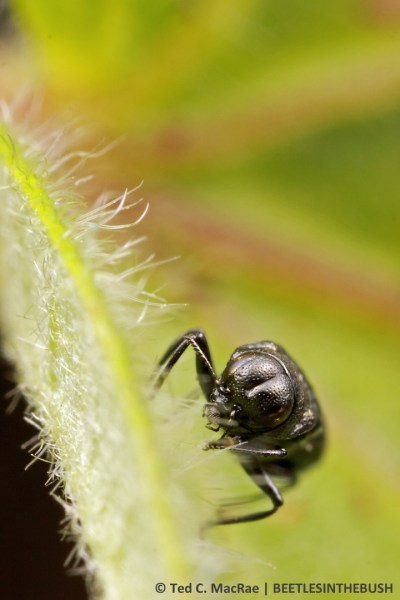
Paragrilus tenuis | Stoddard Co., Missouri

Paragrilus tenuis (LeConte) | Stoddard Co., Missouri

This past summer I visited Otter Slough Conservation Area in southeast Missouri in an effort to find and photograph the stunningly beautiful Agrilus concinnus Horn, or “hibiscus jewel beetle” (MacRae 2004). I was not successful in that quest, but I did manage to snap a single photo of another jewel beetle also associated exclusively with hibiscus, Paragrilus tenuis (LeConte). This species belongs to a much smaller genus of mostly Neotropical jewel beetles that resemble the related and much more speciose genus Agrilus but differ significantly by their antennae being received in grooves along the sides of the pronotum and, for the most part, their association as larvae with stems of living, herbaceous plants rather than dead branches and twigs of deciduous trees. Only four species of Paragrilus occur in the U.S. (Hespenheide 2002), and of these only Ptenuis is known to occur in the eastern U.S. where it has been reported breeding in Hibiscus moscheutos (including ssp. lasiocarpos). I have also collected adults on H. laevis (MacRae 2006), but to my knowledge it has not yet been reared from that plant.

These tiny little beetles (~ 5 mm in length) are normally seen resting on the terminal leaves of their host plants, but they are extremely wary and quick to take flight. As a result, photographing them in situ with a short macro lens in the heat of the day is rather challenging, especially when they are not numerous. I only saw perhaps half a dozen individuals during the visit, and the photo shown here represents the only shot that I even managed to fire off. While I would have liked to have gotten a dorsal view of the beetle, this single shot is nevertheless well-focused and a rather interesting composition.

REFERENCES:

Hespenheide, H. A. 2002. A review of North and Central American Paragrilus Saunders, 1871 (Coleoptera: Buprestidae: Agrilinae). Zootaxa 43:1–28 [pdf].

MacRae, T. C. 2004. Beetle bits: Hunting the elusive “hibiscus jewel beetle”. Nature Notes, Journal of the Webster Groves Nature Study Society 76(5):4–5 [pdf].

MacRae, T. C. 2006. Distributional and biological notes on North American Buprestidae (Coleoptera), with comments on variation in Anthaxia (Haplanthaxiaviridicornis (Say) and A. (H.) viridfrons Gory. The Pan-Pacific Entomologist 82(2):166–199 [pdf].

Copyright © Ted C. MacRae 2013