North America’s most “extreme” jewel beetle

When Chuck Bellamy passed away two years ago, he left behind a remarkable legacy of study on the family Buprestidae (jewel beetles) that includes not only his insect collection—surely one of the best in the world in terms of representation of genera and species in the family—but also his extensive library of primary literature. Both of these assets, built over a period of decades, are now housed in the California State Collection of Arthropods at the CDFA Plant Pest Diagnostics Laboratory in Sacramento, California. Chuck, however, was not just a jewel beetle collector and taxonomist—he was also a skilled photographer, focusing (pun intended) largely, though not exclusively, on his beloved jewel beetles. Digital cameras were still far in the future when Chuck began photographing these beetles, and as a result the bulk of his photographic legacy exists in the form of 35mm slides. I was the fortunate recipient of his slide collection, numbering in the thousands, and have been slowly scanning his slides into digital format with the goal to eventually make them available to the larger community of buprestid workers. Some of his best photos were published in a memorial issue of The Coleopterists Bulletin (2014, volume 68, number 1), and I featured a few additional photos in this post shortly before the publication of that issue. There remain slides, however, of many additional species, a large number of which surely represent the only field photographs of live adults. As I convert his slides to digital format, I hope to share some of the more interesting here.

For the first of these featured species, I can think of no better one than Lepismadora algodones. This tiny little jewel beetle is the only representative of the genus, which was not even known until 1986 when it was discovered by Mimi & Rob Velten in the Algodones Sand Hills of southeastern California. The species and genus were described the following year (Velten & Bellamy 1987), making Lepismadora the most recently discovered new genus of jewel beetle in the U.S. The recentness of its discovery is remarkable, since southern California in general and the Algodones Sand Dunes in particular were thought to have been relatively well collected at the time of the beetle’s discovery. Also remarkable is the distant relationship of this monotypic genus to any other North American species; its closest known relative being the genus Eudiadora—known only from Argentina (Bellamy 1991).
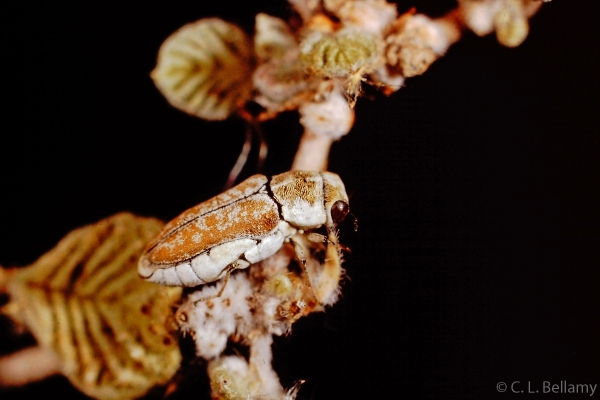
Lepismadora algodones

Lepismadora algodones Velten, in Velten & Bellamy, 1987 (Coleoptera: Buprestidae)

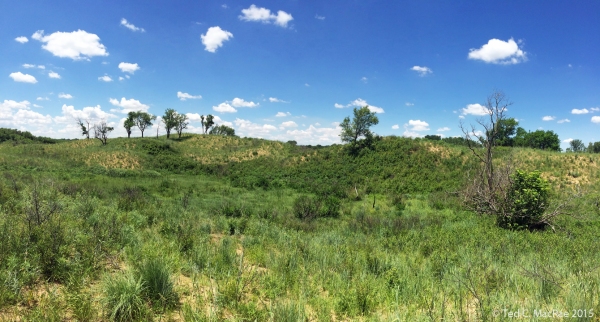
Even more remarkable, however, are its highly localized distribution and extreme habitat. The entire type series (one male holotype and 159 paratypes) and all individuals collected since its description have been found only in a single old canal on the west side of the Algodones dunes. Summer temperatures in the dunes routinely reach in excess of 110°F and are even higher in the depressed canal where the beetles are found. Astoundingly, the adults are active only during the hottest hours of the day (ca. 10 a.m. to 2 p.m.), during which time they can be found on the flowers and foliage of fanleaf crinklematTiquilia plicata (Boraginaceae). The reason for the beetle’s highly restricted distribution is a mystery, as the plant on which the beetles are found is rather widespread across the southwestern U.S. and northwestern Mexico. A final mystery is the still unknown larval host plant—it could be T. plicata, but it could just as likely be something completely different.

Algodones Dunes

Old canal on the west side of Algodones Sand Hills, type locality of Lepismadora algodones.

I moved to California a few years after the species was described and, of course, soon set out to find it for myself. I had driven to southern California from my home in Sacramento to meet the late Gayle Nelson (another important mentor of mine), who told me where to find the beetle and what the host plant looked like but also warned me about the extreme heat I would encounter. His advice was to hike the canal until I had half a bottle of water, then turn around and hike back. Mindful of his advice, I arrived at the dunes the next day around mid-morning, filled my water bottle and hydrated myself as much as I could, and climbed down into the canal. The heat was overpowering—more so down in the canal and far beyond anything I had ever experienced to that point, and after quickly recognizing the host plants I began tapping their tiny, prostrate branches over my beating sheet and looking for the beetles. I went as far as I could down the canal, perhaps 200 yards, before I had to turn around, but I had not yet seen any beetles and was starting to lose hope. I continued to tap host plants on the way back, though by then not really expecting to see anything. About halfway back I saw something laying on the ground a short distance ahead. As I approached I saw it was a small plastic vial with a white cap, and when I picked it up I saw inside a dried out T. plicata twig and a dead adult beetle—unmistakably L. algodones! While excited to have found the species, it was at the same time a bit unsatisfying for the specimen to be one that somebody else had collected before me and then lost (for all I know, it could have been Chuck Bellamy, considering that the beetle was apparently intended to be kept alive, possibly for photography!). I slipped the vial into my pocket, started tapping branches again, and found three additional adults in the immediate vicinity of where I had found the vial (and doing much to soothe my dissatisfaction with the first specimen). Those would be the only specimens that I would find that day, though I would succeed in finding another individual on a subsequent visit two years later.

REFERENCES:

Bellamy, C. L. 1991. A revision of the genus Eudiadora Obenberger (Coleoptera: Buprestidae). Proceedings of the Entomological Society of Washington 93(2):409-419 [Biodiversity Heritage Library].

Velten, R. K. & C. L. Bellamy. 1987. A new genus and species of Coroebini Bedel from southern California with a discussion of its relationships in the tribe (Coleoptera, Buprestidae). The Coleopterists Bulletin 41(1):185–192 [pdf].

© Ted C. MacRae 2015
Insect Identifications and Etiquette

I’ve been a student of insects for most of my life, and of the many aspects of entomology that interest me, field collecting and identification remain the most enjoyable. My interest in beetles first began to gel during my days at the university (despite a thesis project focused on leafhoppers), and early in my career I settled on wood-boring beetles (principally Buprestidae and Cerambycidae) as the taxa that most interested me. To say that species identification of these beetles can be difficult is an understatement, but I was fortunate to have been helped by a number of individuals—well-established coleopterists—who freely shared their time and expertise with me during my early years and pointed me in the right direction as I began to learn the craft. Some of the more influential include colleagues that have since passed (e.g., Gayle Nelson, John Chemsak, Chuck Bellamy, and Frank Hovore) and those that, thankfully, continue with us (e.g., Rick Westcott and Henry Hespenheide).

It has been a little more than 30 years now since I began studying these beetles, and due in great part to the help I received early on and the motivation that it inspired within me, I have gained a certain amount of proficiency in their identification as well. Not surprisingly, I too regularly receive requests from people looking for help with identifications. I rarely turn down such requests (in fact, I don’t think I have ever turned one down)—it not only helps my own research but also, occasionally, allows me to fill a gap or two in my collection. More importantly, however, it is my duty—I benefited greatly from those who shared their expertise with me, so it’s only fair that I continue by their example.

As common a practice as this is among collectors, it seems odd that there are few written guidelines on the etiquette of requesting and providing identifications. Note that this is something different than borrowing specimens for study, which has its own set of expectations and responsibilities. As someone who has both requested and received requests for specimen identifications for a long time now, I have my own thoughts about reasonable expectations in this regard. Perhaps you, too, will find these thoughts useful the next time you contemplate asking somebody to identify your specimens (or accepting a request to do so).

Guidelines for requesting identifications

  1. Always ask permission to send specimens before doing so. ‘Nuff said.
  2. When you do send specimens, read  and follow the guidelines suggested to avoid creating additional work for the identifier who must repair specimens damaged in shipment.
  3. Leave extra room in the specimen box. While tightly packed specimens minimize shipment size and can reduce cost, it also increases risk of damage during shipment due to ‘bumping’ or during removal from the box for ID. More importantly, it allows little or no room for the addition of identification labels to specimens. Additionally, many identifiers find it helpful to remove all of the specimens from a box and group them by related taxa to facilitate identification. The reassembled specimens may require more space than they did in their original arrangement.
  4. Send the entire available series of specimens. A common practice among those sending specimens for ID is to hold back specimens from a series and send only one or a few examples. Whether this is to, again, minimize the size of the shipment, confirm a provisional ID, or safeguard specimens perceived as desirable, it nevertheless prevents the identifier from having access to the range of data and variability represented in the series. This is important if the series contains 1) multiple species, 2) previously undocumented distributions or ecological data, or 3) unusual morphological variants. An exception to this is when very long series of specimens are available and sending the entire series would be unwieldy and/or unnecessary. In this case, the identifier should be informed that only a partial series of specimens was sent.
  5. Allow retentions. It doesn’t happen often, but sometimes individuals have balked at my requests to retain specimens that proved useful for my studies. This is poor etiquette, as it shows little respect for the value of the service being provided by the person making the identifications. More common is to allow retention of examples from a series, but not singletons. This also, in my opinion, is poor etiquette. I remember one of my early sendings to Gayle Nelson that contained a single specimen of Agrilus audax, a very rare North American buprestid known by only a handful of specimens. Not surprisingly, Gayle did not have this species in his collection, and while I, too, was a student of the group I didn’t hesitate to give this specimen Gayle—established and well-respected expert of the family that he was. To this day the species remains unrepresented in my collection, yet I have never second guessed that decision due to the value of what I gained in his respect and mentorship in the years since. Most identifiers are both humble and sparing in their requests for retentions.¹
  6. Allow time for identifications. Individuals with expertise in a given group are generally few in number, and those willing to provide identifications may be fewer still. As a result, they usually have a number of boxes on hand at any one time awaiting identification. Get an idea from them at the start of how long they expect it will be before they can complete the task. If the projected timeline passes and you don’t hear back from them, an inquiry is fine, but be polite and understanding.

¹ A corollary to this asking for specimens in exchange for specimens retained. An exchange involves two parties sending each other specimens that mutually benefit each other’s collections. Identifications are a service provided by one party that benefit the requester. To suggest an exchange as ‘payment’ for retained specimens ignores the value of the service being provided by the identifier

Guidelines for providing identifications

  1. Once specimens are received, protect them from damage as you would your own collection. Maintain them in a protective cabinet or check them regularly to ensure that dermestid pests do not gain a toehold.
  2. Provide the identifications in as timely a manner as possible. This is not always easy, especially for those willing to accept a large number of requests and who may find themselves inundated with boxes awaiting identification. If you cannot provide identifications relatively quickly, be honest with the requestor regarding how long you expect the identifications to take. If it does take longer, provide an update to the requestor and give them the option to have the specimens returned or confirm that they are okay with the delay.
  3. Add your identification label with your name and date (year) to at least the first specimen in the series. Even better is if you can add a small, pre-printed ID label to every specimen in the series, but this can be difficult if the number of specimens and/or diversity of species is large. If there are specimens with prior identifications that you disagree with, turn the prior ID label upside-down, replace through an existing pin hole, and add your ID label. I disagree with the practice of folding prior ID labels—not only could I be wrong, but this unnecessarily damages something with historical value, especially if new pin holes are added to the label. Always place your ID label below any existing labels (i.e., label order should reflect their sequence of placement—oldest labels nearest the specimen and newest labels furthest away).
  4. Keep retentions to a minimum. I generally ask to retain specimens only when they significantly improve the representation in my collection or provide significant new data—i.e., un- or under-represented species, undocumented distributions or ecological data, etc. The bar for singletons is even higher—usually only if they are completely absent from my collection (with ~65% of U.S. Buprestidae now represented in my collection, this is an increasingly uncommon occurrence).
  5. Following #4, provide an accounting of retained specimens. Minimally, a list of species and their number should be given, and my preference is to provide label data as well (especially if requested). I once sent a batch of beetles (in a family in which I do not specialize) to an expert for identification, and when I received them back it was obvious that a number of specimens had been retained (perhaps 1/3 of the total number). When I wrote to the identifier and asked for an accounting (remember, I was only asking for an accounting—I did not have a problem with the retentions themselves), I received a rather terse reply from the individual stating that he did not ‘have time’ to provide this. Needless to say, this level of dismissiveness was not appreciated, and I have since found another more agreeable researcher with expertise in that family to send specimens for identification.
  6. When you are ready to return the specimens, read  and follow it’s suggested guidelines to avoid causing damage to the specimens whose care you were entrusted.

Again, these guidelines are written from the perspective of a private individual sending and receiving specimens for identification. Scientists at institutions may have additional or differing guidelines on this subject, but in any case these guidelines should be communicated to and understood by individuals requesting identifications before any material is sent.

If you have additional suggestions or comments on how these guidelines can be improved I would appreciate hearing them.

© Ted C. MacRae 2015

A suitable ode to Warren Knaus

Last June Jeff Huether and I made a trip out to a system of sand the dunes just south of Medora, Kansas. These dunes have been a popular historical collecting site since the late 1800s, when Warren Knaus first called attention to the area as “an interesting and profitable” locality for collecting insects (Knaus 1897). Knaus was a newspaper publisher in McPherson County, Kansas from 1886–1938, but his true passion was collecting beetles—an activity that took him throughout the Great Plains and Desert Southwest for nearly 50 years and earned him stature as one of Kansas’ most highly regarded coleopterists (Dean 1938). Despite his travels, Knaus remained enamored with the sand hills near his home and eventually published an annotated account of the rarer and more interesting beetles that he had encountered there over the years (Knaus 1926). One of the beetles mentioned in that paper was a “new species of Strigodermella…taken by sweeping in 1923 and 1925″. Those specimens soon became the type series for Strigodermella knausi (now Strigoderma knausi), named such by its describer (Brown 1925) in honor of its collector.

"Medora" Dunes

Sand Hills State Park, in southcentral Kansas | a.k.a. “Medora” Dunes

I suppose it is only fitting, then, that one of the first beetles that we encountered that day was this species. Actually, we couldn’t have missed them if we tried, they were so numerous! At first I assumed they were Strigoderma pygmaea, a species I had seen only once many years ago in Florida. Fortunately, we were in the company of Mary Liz Jameson, Associate Professor of Entomology at Wichita State University and an expert on scarab beetles. Mary Liz informed us of the beetle’s true identity, noting its rarity and relatively restricted distribution and that this was the type locality for the species.

Strigoderma knausi

Strigoderma knausi males were abundant on low vegetation | Sand Hills State Park, Kansas

At first the beetles were merely bycatch in our sweep nets as we looked for more ‘interesting’ beetles (i.e., jewel beetles for me, blister beetles for Jeff, and longhorned beetles for both of us). I tend to have trouble remaining so singularly focused, however, especially when the jewel and longhorned beetles aren’t out in numbers, and before long I found myself observing, and eventually photographing, these diminutive little scarabs. They were especially abundant at the south edge of the dunes, where they were hanging out on grasses and other low vegetation. A closer look revealed that almost every individual was perched in a rather characteristic pose, clinging to the vegetation with the middle and hind legs but extending them so that the beetle was nearly horizontal with the front legs held free and the segments of the antennal club spread widely apart. One can only presume that these were all males and that they were adopting this pose in an attempt to “smell” sex pheromones emitted by the unseen females. Mary Liz mentioned that the females are very rarely seen, and indeed among the nearly 100 specimens examined by Bader (1992) in his revision of the genus was but a single female.

Strigoderma knausi

Almost every individual clung to the vegetation with the front legs free and antennae spread open.

Bader (1992) notes that S. knausi has been taken by sweeping grasses and cotton and taken by light traps in Kansas and Oklahoma with a few records from northern Texas. I mentioned earlier the resemblance of this species to S. pygmaea (Fabricius, 1798), which, like S. knausi, also seems to prefer sandy habitats and can be taken at lights or by sweeping low vegetation (Bader 1992). That species, however, occurs more broadly across the southeastern U.S., being especially common in Florida and along the Atlantic coast as far north as Long Island, New York. The two species can be distinguished by, among other characters, the presence (S. knausi) or absence (S. pygmaea) of a median sulcus (furrow) on the front part of the pronotum (easily seen in the second photo above).

REFERENCES:

Bader, A. M. 1992. A review of the North and Central American Strigoderma (Coleoptera: Scarabaeidae). Transactions of the American Entomological Society 118(3):269–330 [JSTOR].

Brown, W. J. 1925. A new species of StrigodermellaBulletin of the Brooklyn Entomological Society 20:200–201.

Dean, G. A. 1938. Warren Knaus. Journal of the Kansas Entomological Society 11(1):1–3 [JSTOR].

Knaus, W. 1897. Collecting notes on Kansas Coleoptera. Transactions of the Annual Meetings of the Kansas Academy of Science 16:197–199 [JSTOR].

Knaus, W. 1926. The Coleoptera of the Sandhill Region of Medora, Reno County, Kansas. Entomological News 37(8):262–266 [Biostor].

© Ted C. MacRae 2015

The best species name ever!

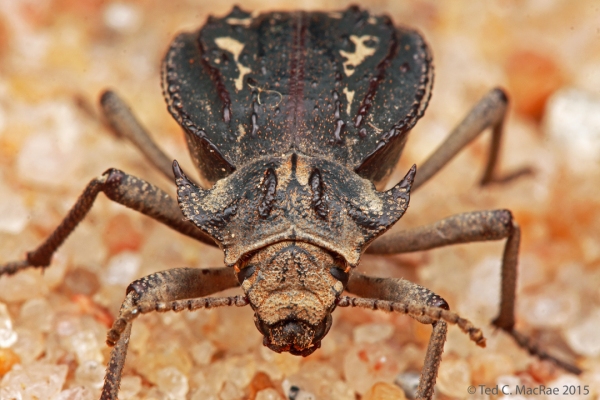
Entomoderes satanicus

Entomoderes satanicus | Ruta Nacional 20 @ km 367, San Luis Province, Argentina

This past February while traveling to see research plots in Argentina, I had the pleasure of accompanying colleague and scarab expert Federico Ocampo to San Juan Province in west-central Argentina to see some of the endemic scarabs that live in the sand dunes that dot the region. Along the way we made a quick stop at a sandy spot along Ruta Nacional 20 in San Luis Province to see what was out and about. Several interesting insects were seen, but one of the most impressive was this marvelously armoured darkling beetle (family Tenebrionidae) belonging to the genus Entomoderes—also endemic with nine species ranging from southern Bolivia to central Argentina (Flores & Roig-Juñent 1997).

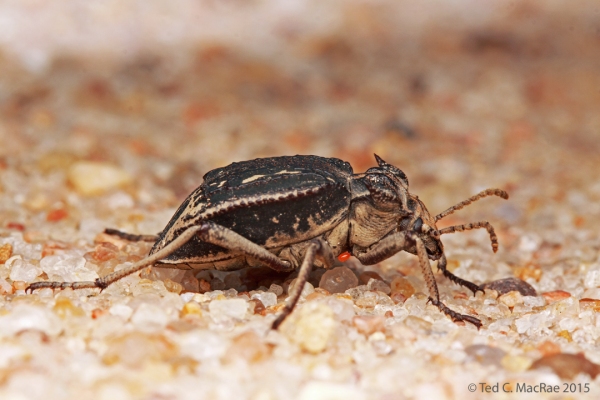
Entomoderes satanicus

Stout spines and a heavily sclerotized body surely provide effective anti-predation defense…

The stout, backwards-directed lateral spines on the pronotum are as evil as any I’ve ever seen, perhaps being the the reason behind the most awesome species epithet I have ever encountered—satanicus! Actually, there was some question about whether it represented this species or another in the genus with an almost equally awesome name—draco! I wasn’t able to access the more recent, paywall-protected revision by Flores & Roig-Juñent (1997); however, a relatively recent prior work (Peña 1990) seems to confirm its identity as the former by the presence of distinct raised costae on each elytron between the lateral keel and sutural margin confirm.

Entomoderes satanicus

…but not from tiny enemies (note parasitic mite on the venter behind the right procoxa).

Surely the sharp, stout spines and heavily sclerotized, ridged body provide effective protection from vertebrate predators and perhaps also help to minimize loss of water, since all of the species are found strictly in arid habitats (Peña 1990). I did not collect the specimen, but many such heavily sclerotized darkling beetles can be difficult to nearly impossible to pin by normal means (I have actually used a hammer to help in the case of one species I collected in South Africa. Seriously!), and I’m sure this one would have been no different. For all its armoured protection, however, there still remain chinks—note the tiny, bright red, parasitic mite on the ventor behind the right procoxa in the last photo.

REFERENCE:

Flores, G. E. & S. Roig-Juñent. 1997. Systematic revision of the Neotropical genus Entomoderes Solier (Coleoptera: Tenebrionidae). Insect Systematics & Evolution 28(2):141–162 [abstract].

Peña, L. E. 1990. El género Entomoderes Solier (Coleoptera: Tenebrionidae). Boletin del Museo Nacional de Historia Natural Textos sobre patrimonio natural de Chile 37:253–259 [ISSUU].

© Ted C. MacRae 2015

Spring beetles on Coreopsis flowers

Abby Lee, Ryan Fairbanks, Stephen Penn atop a rhyolite glades

The WGNSS Entomology Group takes in the view of rhyolite glades from atop Hughes Mountain.

Each spring the Entomology Group of the Webster Groves Nature Study Society takes a field trip to one of the many natural areas outside of the St. Louis area. This year the destination was Hughes Mountain Natural Area, about 75 miles SSW of St. Louis in Washington Co. I especially looked forward to going there this spring, as my last visit to the area was close to 20 years ago. Despite the long absence, I vividly recalled the spectacular vistas from atop the mountain of rhyolite and the diversity of unique plants and insects in the igneous glades that flanked its slopes. When we arrived, we found the glades ablaze with spring wildflowers in full bloom, the most prominent of which was lance-leaved coreopsis (Coreopsis lanceolata). As one of the so-called “yellow composites”, coreopsis is a favored source of pollen and nectar for a variety of insects, including beetles and especially the jewel beetles that I find so interesting.

Acmaeodera neglecta

Acmaeodera neglecta Fall, 1899

Species in the genus Acmaeodera are incredibly diverse in the southwestern U.S. (nearly half of the ~150 species/subspecies known from the U.S. occur in Arizona), where they are usually encountered on a variety of flowers. It is my opinion that the adult beetles mimic small bees, especially in flight by virtue of their fused elytra that do not separate during flight as in most other beetles and thus results in a profile resembling that of a small sweat bee (family Halictidae). The diversity of Acmaeodera drops off considerably in the eastern U.S., with only three species occurring broadly in the area. Missouri is a bit luckier than most eastern states, as two additional species found primarily in the south-central U.S. also occur here (MacRae 1991). One of these is Acmaeodera neglecta Fall, 1899. This tiny species (adults measure only 4–6 mm in length) is very similar to the much more common and widespread A. tubulus (Fabricius, 1801) (see photos here), and in fact its resemblance to that species is so great that it remained unreported from Missouri until Nelson (1987) recognized it among material that I had collected and sent to him during my early collecting days. Acmaeodera neglecta can be distinguished from A. tubulus by the elytra with slightly larger punctures and duller surface and the spots usually longitudinally coalesced into an irregular “C”-shaped marking on each side. I find this species most often in glade habitats.

Acmaeodera ornata

Acmaeodera ornata (Fabricius, 1775)

Acmaeodera ornata (Fabricius, 1775) is more widespread than A. neglecta (although not nearly so commonly encountered as A. tubulus). This handsome species is distinctly larger than A. tubulus and A. neglecta, usually around 8-11 mm in length, and has a broader, more flattened appearance with a distinct triangular depression on the pronotum. The elytra have a bluish cast rather than the bronzy sheen of A. tubulus and A. neglecta, and the spots on the elytra are smaller, more numerous, and more of a creamy rather than yellow color. No other species in the eastern U.S. can be confused with it, although there is a very similar species (A. ornatoides Barr, 1972) that occurs in Oklahoma and Texas. I have encountered this species numerous times on a variety of flowers in Missouri but have never managed to rear it, and in fact larval hosts remain unknown with the exception of one very old (and unreliable) report of the species breeding in hickory (Carya) and black-locust (Robinia).

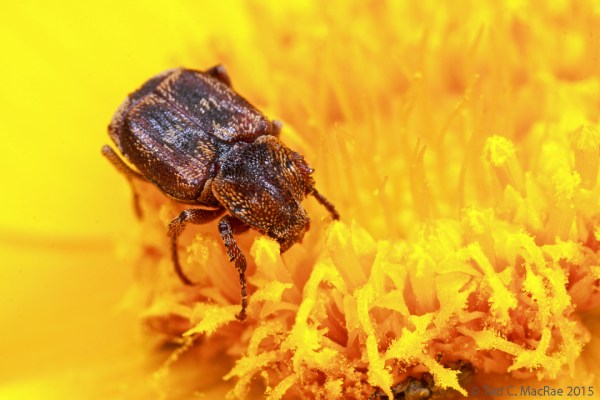
Valgus canaliculatus

Valgus canaliculatus (Olivier, 1789)

As a general rule, beetles in the family Scarabaeidae don’t visit flowers—species in the subfamily Cetoniinae being a significant exception. This tiny representative of the subfamily, Valgus canaliculatus (Olivier, 1789), is no larger than the Acmaeodera neglecta adult above by length, although the body is broader and strongly flattened. This species is a representative of the tribe Valgini, one of only two tribes in the family that possess dorsal and ventral scale-like setae (the unrelated tribe Hopliini, or monkey beetles, being the other) (Jameson & Swoboda 2005). It has been suggested that the setae might play a role in crysis or adaptive coloration, and even more interesting is the association of most New World species with termites. Eggs are laid in termite galleries and the larvae feed on the wood within the galleries, but it remains unclear whether the termophily is obligatory or the beetles are simply taking advantage of the stable environment and accessible food source offered by termite colonies. Like other species in the subfamily, the adults are fond of flowers; however, only male valgines visit flowers, using specially modified, brush-like mouthparts to lap up nectar. As far as has been determined, the males do not feed on pollen.

Valgus canaliculatus

Note the flattened, scale-like setae covering both the dorsal and ventral surfaces as well as the legs.

REFERENCES:

Fall, H. C.  1899. Synonpsis of the species of Acmaeodera of America, north of Mexico. Journal of the New York Entomological Society 7(1):1–37 [pdf].

Jameson, M. L. & K. A. Swoboda. 2005. Synopsis of scarab beetle tribe Valgini (Coleoptera: Scarabaeidae: Cetoniinae) in the New World. Annals of the Entomological Society of America 98(5):658–672 [pdf].

MacRae, T. C. 1991. The Buprestidae (Coleoptera) of Missouri. Insecta Mundi5(2):101–126 [pdf].

Nelson, G. H. 1987. Additional notes on the biology and distribution of Buprestidae (Coleoptera) in North America, II.   The Coleopterists Bulletin 41(1):57–65 [pdf].

© Ted C. MacRae 2015

Cover Photo—The Coleopterists Bulletin 69(1)

cso69-1co14.indd

The March 2015 issue of The Coleopterists Bulletin (vol. 69, no. 1) is out now (I got mine yesterday), and while I’m always happy to see the latest issue of this journal in my mailbox I am especially pleased with this one because it features my photograph of an adult female Crossidius coralinus fulgidus on flowers of gray rabbitbrush (Ericameria nauseosa). I photographed this beetle in September 2011 near Vernal, Utah at the beginning of a trip with Jeff Huether to find and photograph endemic sand dune tiger beetles across the western U.S. We had just visited the dunes near Maybell, Colorado and were on our way to Idaho to visit the St. Anthony and Bruneau Sand Dune systems before dropping south to Coral Pink Sand Dunes in Utah and the Great Sand Dunes in Colorado. I was still a “Crossidius virgin” at that point—my first real Crossidius collecting trip would not come until two years later when Jeff and I visited the Great Basin and surrounding areas in a dedicated effort to find as many species/subspecies of Crossidius as possible (we succeeded in finding 12 of 14 targeted taxa). Having never seen C. coralinus before, you can imagine my excitement at seeing the spectacularly colored adults sitting atop flowers of their rabbitbrush host plants. I am especially fond of this photo, however, because it actually represents one of my earliest attempts to combine a natural blue sky background with a flash-illuminated subject—a technique I had learned from John Abbott just a few weeks earlier at the inaugural BugShot Workshop in Gray Summit, Missouri (just 15 miles from my home). I didn’t quite get the shade of blue I was looking for in this particular shot, but it’s close enough and the subject depth-of-field couldn’t be better. I have worked a lot on this technique since then and now consider blue sky background as part of my signature style.

This is the third issue of The Coleopterists Bulletin to feature one of my photographs on the cover. The first was the June 2013 issue (vol. 67, no. 2), which featured a beautiful, metallic green weevil, Eurhinus cf. adonis (2nd photo) that I photographed on flowers of Chilean goldenrod (Solidago chilensis) in northern Argentina, and the very next issue (September 2013, vol. 67, no. 3) featured my photograph of Chrysobothris octocola on dead mesquite (Prosopis glandulosa) in western Oklahoma (and a new state record).

If you’re not one already, consider becoming a member of The Coleopterists Society (I’ve been one for 33 years now!). Their flagship journal, The Coleopterists Bulletin, is your one-stop shop for all things beetley—a quarterly fix of pure elytral ecstacy! In addition to the latest issues of the journal, your membership also gives you online access to archives of past issues via JSTOR and BioOne.

© Ted C. MacRae

Buprestidae type specimens at Fundación Miguel Lillo, Argentina

During my most recent visit to Argentina this past February and March, I had the chance to go behind the scenes and visit the entomology collection at Fundación Miguel Lillo, Instituto de Entomología, Tucumán. It’s always a treat to visit any entomology collection—public or private—at any location. When the collection has holdings of Buprestidae, so much the better. Much to my delight, however, this collection not only had holdings of Buprestidae (not surprisingly representing primarily Argentine species), but also a small collection of type specimens designated by Antonio Cobos Sanchez (1922–1998). Cobos was one of the 20th century’s most prolific students of Buprestidae, with publications in the family spanning the period from 1949–1990 (coincidentally, 1990 being the year of my very first buprestid publication!). I was graciously allowed to photograph these specimens, some of which present interesting nomenclatural situations that are worthy of comment. These are presented below with my notes.

Jose xx & Ted MacRae

Looking at the insect collection at Fundación Miguel Lillo, Argentina.


Sufamily POLYCESTINAE

Tribe TYNDARINI

Tylauchenia golbachi Cobos, 1993 (currently placed in Oocypetes)

Tylauchenia golbachi Cobos, 1993. The species was moved to the genus Ocypetes.

Lapsus calami or mislabeled type specimen? Cobos (1973) described Tylauchenia golbachi from Argentina (now placed in the genus Ocypetes), stating the type locality as “6 kms. N. de Belén, 1.240 m. alt., Catamarca, Argentina (Willink, Terán y Stange coll., con trampa de Malaise, 1-15-I-1970…)”. The specimen above bears the holotype label, but the locality label clearly shows that it was collected in Tucumán rather than Catamarca and that the collector’s name is Guanuco rather than the above stated names. Interestingly, in the same publication Cobos gives the allotype female collection data as “San Pedro de Colalao, Tucumán, Argentina (Coll. Guanuco, 9-III-1949)”. At first I thought this might actually be the allotype rather than the holotype; however, 1) the specimen clearly bears a holotype label, and 2) it is also clearly a male based on the dissected genitalia preserved on the label below the specimen. There are two possible explanations, both of which make it difficult to determine what is the true type locality: 1) the holotype and allotype specimens are correctly labeled, but Cobos simply transposed their label data in his publication describing the species, making Tucumán the true type locality, or 2) the holotype and allotype locality labels were switched at some point and the true type locality is Catamarca, as stated in the publication in which the species is described. This latter possibility is more serious, as in addition to the doubts it generates regarding the type locality it also raises concern about the integrity of the holotype specimen. The latter explanation, however, seems less likely, as it is more difficult to imagine a scenario where only the locality label but not the others was switched than to imagine a transposition of label data in the publication. Sadly, at this point, there seems no easy way to determine which of the two explanations is correct.

Subfamily CHRYSOCHROINAE

Tribe DICERCINI

Lampetis tucumana monrosi Cobos (nomen nudum?)

Lampetis tucumana “monrosi” Cobos (ms name?)

A manuscript name? Cobos never actually proposed a subspecies “monrosi” for Lampetis tucumana (Guérin-Méneville & Percheron, 1835) (the name on the separate box label is misspelled). He did use the name for two other buprestid taxa: Tetragonoschema monrosi Cobos, 1949—now regarded as a synonym of T. argentiniense (Obenberger, 1915), and Anthaxia monrosi Cobos, 1972—now placed in the genus Agrilaxia. The holotype label on the specimen clearly states “Lampetis tucumana monrosi” in Cobos’ handwriting, so one can only presume that Cobos had identified this specimen as representing a distinct subspecies but never followed through and actually described it.

Ectinogonia (Pseudolampetis) fasciata metallica Cobos, 1969

Psiloptera (Pseudolampetis) fasciata metallica Cobos, 1969. Pseudolampetis was later considered a subgenus of Ectinogonia but is now regarded as a full genus.

Oh, what a tangled web we weave! Cobos (1969) originally described this taxon as a subspecies of Psiloptera (Pseudolampetisfasciata Kerremans, 1919. Moore (1986) moved Pseudolampetis to a subgenus of Ectinogonia, which resulted in two taxa in the latter genus bearing the name “metallica“—Ectinogonia (Pseudolampetisfasciata metallica (Cobos, 1969) and Ectinogonia metallica Fairmaire, 1856—the latter now considered a synonym of E. speciosa (Germain, 1856). In taxonomic nomenclature, two taxa in the same genus cannot bear the same name—a situation known as homonymy. In such cases, the older name has priority and the younger name, in this case Cobos’, must be replaced. This was done by Bellamy (2006), who proposed the new name moorei for this subspecies, resulting in the name Ectinogonia (Pseudolampetis) fasciata moorei Bellamy, 2006. To bring some level of absurdity to the situation, the subgenus Pseudolampetis was subsequently raised to full genus rank, being listed as such in the recent world catalogue (Bellamy 2008), and since Cobos’ name was not originally proposed within the genus Ectinogonia it no longer competes with Germain’s name in that genus. As a result, there is no homonymy and Cobos’ original name must once again stand as Pseudolampetis fasciata metallica (Cobos, 1969), while Bellamy’s replacement name must be regarded as unnecessary. This fact seems to have been overlooked when Pseudolampetis was raised to genus rank, as Cobos’ taxon is still listed in the world catalogue as “Pseudolampetis fasciata moorei (Bellamy, 2006)”! This situation is a perfect example of just how complicated these situations can be to identify, track, and update. The type locality for the unique female is given as “Chagual, 1.200 metros de altitud, Rio Marañón, en el Perú, VIII-1953 (B. Fernández leg.)”.

Subfamily BUPRESTINAE

Tribe STIGMODERINI

Conognatha rufiventris weyrauchi Cobos, 1969

Conognatha rufiventris weyrauchi Cobos, 1969. The taxon is now considered a synonym of Conognatha abdominalis Waterhouse, 1912.

Insufficient grounds. Cobos (1969) regarded this specimen from Peru as subspecifically distinct from Conognatha rufiventris Waterhouse, 1912 from Brazil based on a suite of subtle character differences and named the taxon Conognatha rufiventris weyrauchi in honor of Prof. W. Weyrauch, who made made the holotype specimen available to him for study. Moore & Lander (2010) considered that the taxon did not represent C. rufiventris, but rather was a uniquely colored specimen of Conognatha abdominalis Waterhouse, 1912. The holotype is a male with the type locality given as “del Valle de Chatichamayo, a 1.200 m., en Peru (J. Schuiike leg.)”.

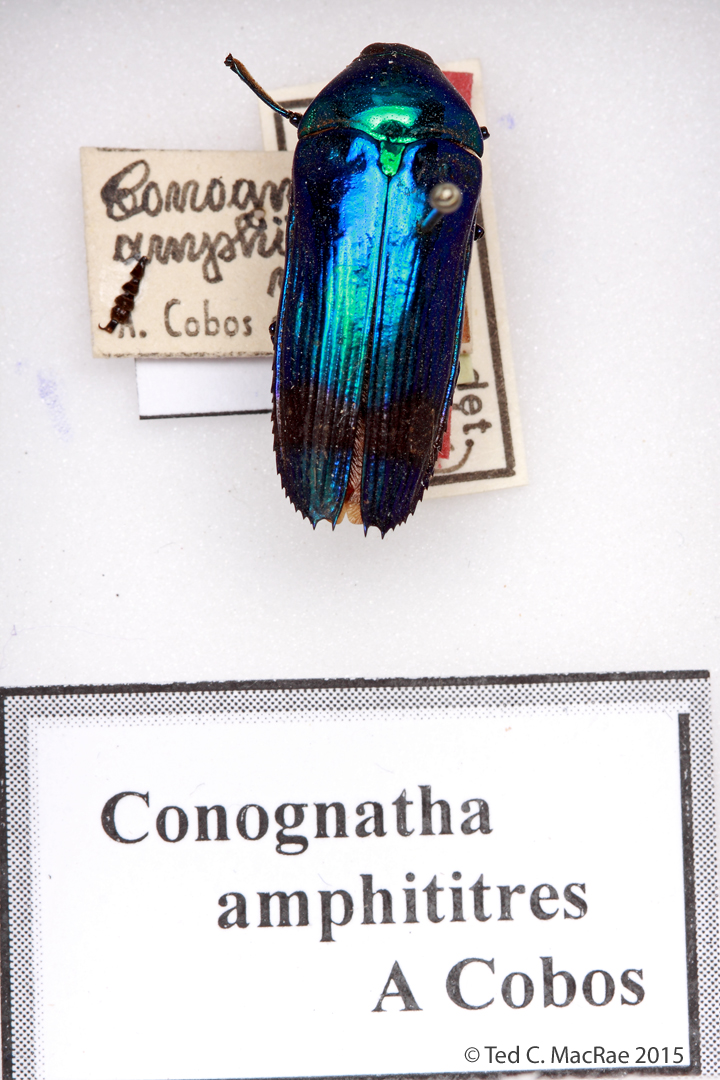
Conognatha amphititres Cobos, 1958 (syn. of Buprestis amoena Kirby, 1818; currently placed in Conognatha)

Conognatha amoena amphititres Cobos, 1958. The taxon is now considered a synonym of C. amoena (Kirby, 1818).

Insufficient grounds—part II. Cobos (1958) regarded this specimen from Brazil as subspecifically distinct from C. amoena (Kirby, 1818—originally described in the genus Buprestis) based on subtle characters and gave it the name Conognatha amoena amphititres (no etymology was given for the subspecies name). Moore & Lander (2006) regarded these differences as insufficient for subspecies status and placed the taxon as a synonym of the parent species. The holotype is thought to be a female with the type locality given as “Rio de Janeiro (Brasil)”.

Tribe CHRYSOBOTHRINI

Colobogaster weyrauchi Cobos, 1966

Colobogaster weyrauchi Cobos, 1966

Cobos (1966) described Colobogaster weyrauchi from Peru and named it after the collector, relating it to the widespread Colobogaster cyanitarsis Gory & Laporte, 1837. The type locality was given as “Pucallpá, 200 m. alt., Perú (W. Weyrauch coll. I-1948)”.

Subfamily AGRILINAE

Tribe CORAEBINI

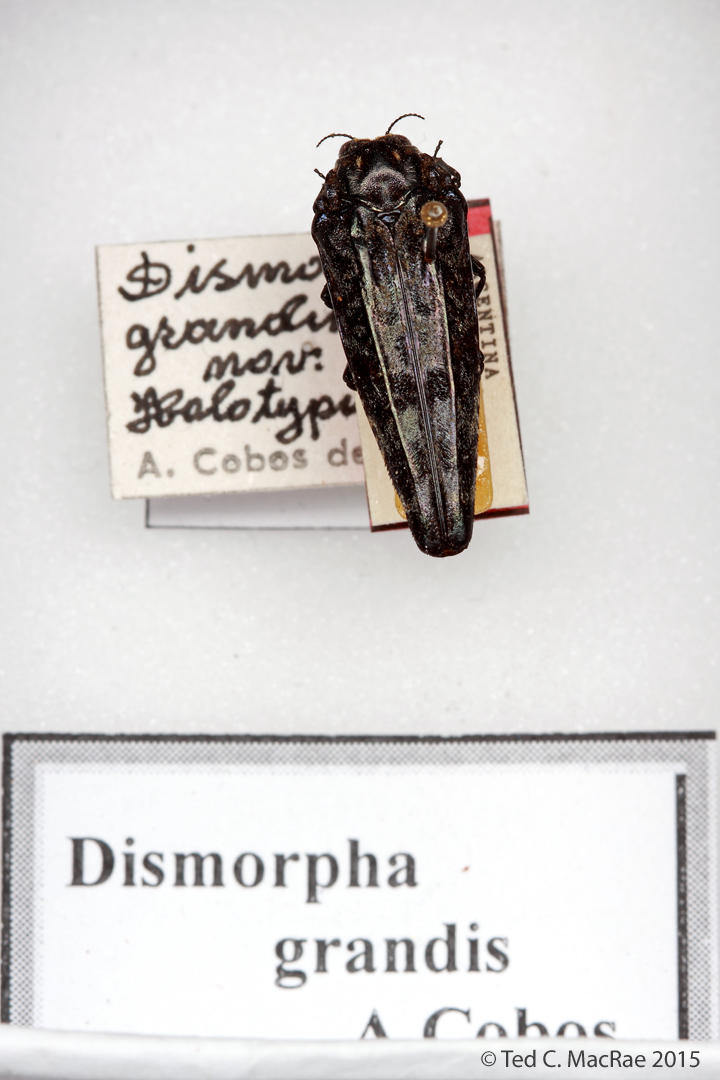
Dismorpha grandis Cobos, 1990

Dismorpha grandis Cobos, 1990

Cobos (1990) described Dismorpha grandis from Argentina in his very last buprestid publication, stating that the species had the appearance of an enormous D. irrorata (Gory & Laporte, 1839) (thus, the name “grandis“). The holotype is a male with the type locality given as “Bemberg, Misiones, Argentina (Exp. Hayward-Willink-Golbach: 12-29-I-1945)”.

Tribe AGRILINI

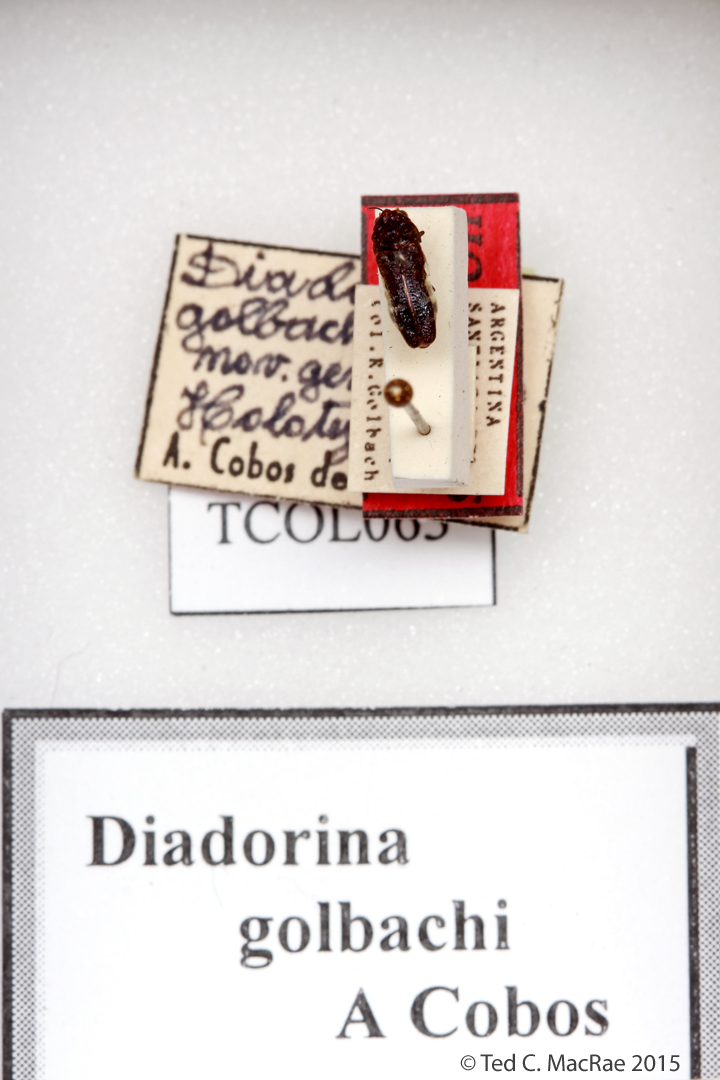
Diadorina golbachi Cobos, 1974 (monotypic)

Diadorina golbachi Cobos, 1974 (monotypic)

Cobos (1974) described Diadorina golbachi from Argentina as the only member (and thus the type species) of the new genus Diadorina (the genus is still regarded as monotypic), naming it in honor of the collector. The holotype specimen is a female with the type locality given as “La Tigres, Santiago del Estero, Argentina (R. Golbaeh coll. 11-16-1-1970)”.

Tribe TRACHEINI

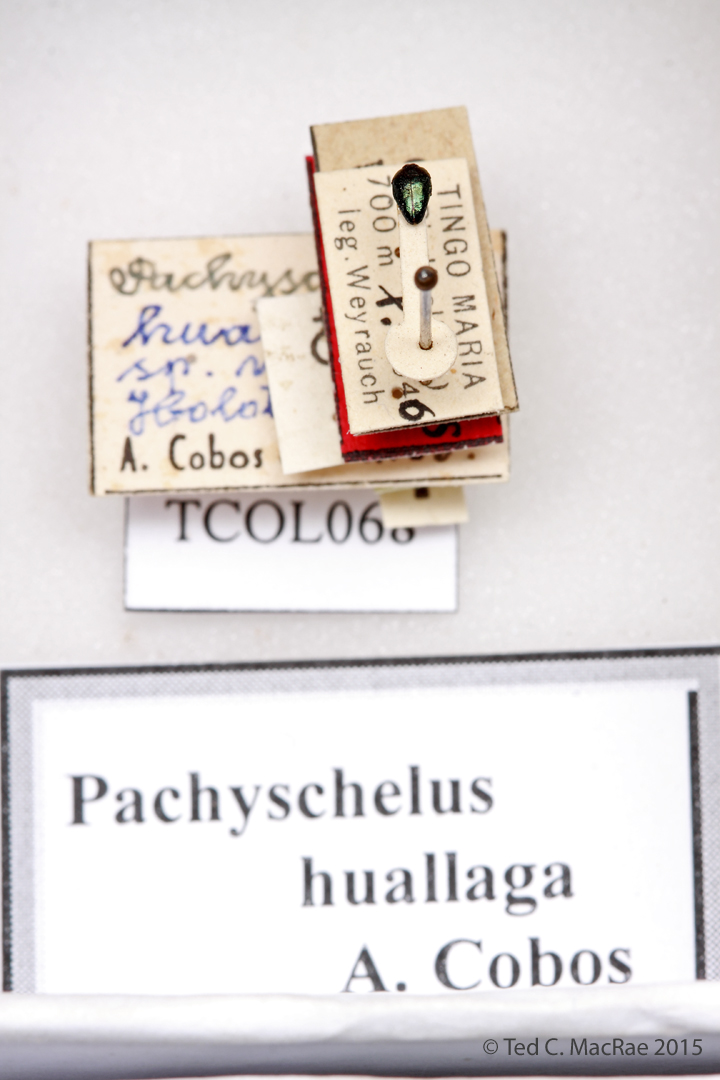
Pachyshelus huallaga Cobos 1969 (correct spelling is huallagus)

Pachyshelus huallaga Cobos, 1969

Cobos (1969) described and named this species after the river at the type locality in Peru. He related it to Pachyschelus atratus Kerremans, 1896 from Brazil and northern Argentina, stating that it differed by its distinct and less brilliant coloration and other features. Since the genus name is considered masculine, the correct species name is “Pachyschelus huallagus Cobos, 1969″. The unique holotype is a female with the type locality given as “Tingo María, Rio Huallaga, 700 metros de altitud, Peru, X-1946 (W. Weyrauch leg.)”.

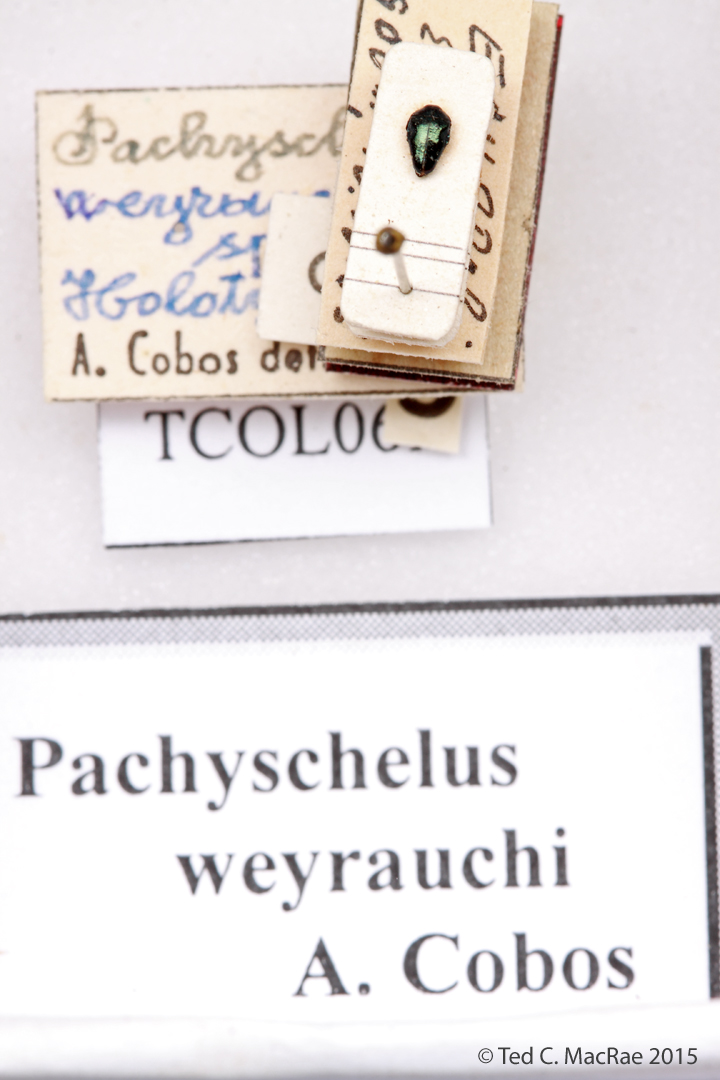
Pachyschelus weyrauchi Cobos, 1959

Pachyschelus weyrauchi Cobos, 1969

Cobos (1969) described Pachyschelus weyrauchi from Ecuador and named it in honor of its collector. He related the unique male to Pachyschelus aeneicollis (Kirsch, 1873) from Peru and Bolivia, citing differences in coloration, body shape, and surface sculpture. The type locality was given as “El Puyo, 900 metros de altitud, Ecuador, 10-IV-1958 (W. Weyrauch leg.)”.

There are two additional Buprestidae type specimens in the collection (Colobogaster pizarroi Cobos, 1966 and Hylaeogena cognathoides Cobos, 1969), but they are in another drawer that we did not find immediately and, thus, I did not have a chance to photograph them. My apologies!

REFERENCES:

Bellamy, C. L. 2006. Nomenclatural notes and corrections in Buprestidae (Coleoptera). The Pan-Pacific Entomologist 81(3/4):145–158 [pdf].

Bellamy, C. L. 2008. A World Catalogue and Bibliography of the Jewel Beetles (Coleoptera: Buprestoidea). Volume 2: Chrysochroinae: Sphenopterini through Buprestinae: Stigmoderini. Pensoft Series Faunistica No. 77, pp. 626–1260, Pensoft Publishers, Sofia-Moscow [details & links].

Cobos, A. 1966. Notas sobre Bupréstidos neotropicales. XV: Tres especies nuevas de Colobogaster Sol. (Coleoptera). EOS, Revista Española de Entomología 41(2-3):205–214 [pdf].

Cobos, A. 1969. Notas sobre Bupréstidos neotropicales XVII. Especies y subespecies nuevas (Coleoptera). EOS, Revista Española de Entomología 44(1968):19–43 [pdf].

Cobos, A. 1958. Tercera nota sobre Bupréstidos (Ins. Coleoptera) neotropicales descripciónes y rectificaciónes diversas. Acta Zoologica Lilloana 15:83–102 [pdf].

Cobos, A. 1973. Revisión del género Tylauchenia Burm., y afines (Coleoptera, Buprestidae). Archivos del Instituto de Aclimatacion 18:147–173 [pdf].

Cobos, A. 1974. Notas sobre Bupréstidos neotropicales, XIX. El género Amorphosternus H. Deyrolle y afines. Archivos de Instituto de Aclimatación 19:65–81 [pdf].

Cobos, A. 1990. Revisión del género Dismorpha Gistel (Coleoptera, Buprestidae). Revista Brasileira de Entomología 34(3):539–559 [pdf].

Moore Rodriguez, T. 1986. Contribución al conocimiento de los Buprestidos neotropicales (Coleoptera: Buprestidae). Revista Chilena de Entomología 13:21–29 [BioStor].

Moore Rodriguez, T. & T. Lander. 2010. Revision du genre Conognatha. Edition Magellanes 24:1–172 [introduction and generic discussion in French and Spanish; keys to species in English, French and Spanish] [order information].

© Ted C. MacRae 2015

Two endemic Jamaican jewel beetles: one known, one not?

I recently received a batch of jewel beetles from Enrico Ruzzier of Italy. It was an impressive sending (as is any sending of jewel beetles!) collected from diverse parts of the world, but what really caught my eye were two specimens he had collected earlier this year in Jamaica—both representing species in the genus Chrysobothris. Most members of this genus are moderate-sized in relation to other species in the family, but at only 5 and 6 mm in length the two specimens I received are downright tiny. They also are extraordinarily pretty compared to most species in the genus by virtue of their striking patterns of metallic green, red, and blue to violaceous colors! Even more interesting, however, was their West Indian provenance. This “biodiversity hotspot” enjoys not only high species diversity but also high species endemism as a result of the 7,000+ islands that comprise it. This is especially true for Jamaica, where my records indicate that 64% of the known jewel beetle fauna (16 of 25 species) occurs nowhere else.

One of the specimens was easily identifiable as Chrysobothris quadrimaculata (Fabricius, 1776) because of the transverse green, violaceous, and reddish-cupreous bands on the pronotum and metallic green “cross” on the elytra separating four large violaceous spots, each with a reddish-cupreous central area (Fisher 1925). This species has so far been found only in Jamaica and appears to be uncommon in collections. As far as I can tell, the only illustration of the species is a 224-year old drawing appearing in Olivier (1790)¹. Considering this and the extraordinary beauty of this little beetle, it seems appropriate to post a photo here (sent to me by Enrico in his initial query regarding its identity).

¹ This early landmark taxonomic publication is occasionally offered for sale by rare book dealers at asking prices that run in the thousands of dollars! Fortunately, the National Library of France has made a pdf of the book available for free download.

Chrysobothris quadrimaculata (Fabricius, 1776)

Chrysobothris quadrimaculata (Fabricius, 1776). Photo by Enrico Ruzzier.

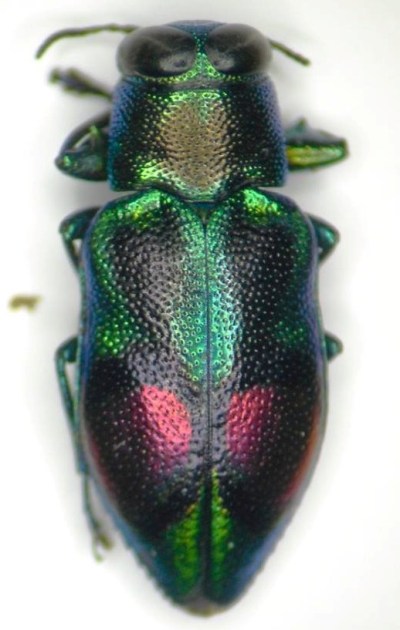
The second specimen, even smaller but no less pretty than the first, has defied all attempts at identification. It does not key out in Fisher (1925) and clearly differs from the four species and one subspecies known to occur in Jamaica (all of which are endemic). Further comparison with descriptions of all known West Indian species also fails to turn up a match. Considering this and the fact that many West Indian Chrysobothris seem to be quite rare in general (Maier & Ivie 2012), I would not be surprised if this specimen turns out to represent yet another (and as yet undescribed) endemic species for Jamaica. I am hopeful (although not optimistic) that posting a photo here (also provided by Enrico Ruzzier) will prompt those with West Indian material in their collections to examine their holdings and see if any additional specimens can be located.

Chrysobothris n. sp. ex Jamaica

Chrysobothris n. sp.? Photo by Enrico Ruzzier.

REFERENCES:

Fisher, W. S. 1925. A revision of the West Indian Coleoptera of the family Buprestidae. Proceedings of The United States National Museum 65:1–207 [BioDiversity Heritage Library, BioStor].

Maier, C. A. & M. A. Ivie. 2013. New species and records of Chrysobothris Eschscholtz (Coleoptera: Buprestidae) from Montserrat, Saba, and Anguilla, with a key to the Chrysobothris thoracica species-group in the West Indies. The Coleopterists Bulletin 67(2):81–88 [BioOne].

Olivier, A. G. 1790. Entomologie, ou histoire naturelle des insectes, avec leurs caractères génériques et spécifiques, leur description, leur synonymie, et leur figure enluminée. Coléoptères. Tome 2, genera 9–34 (32. Bupreste), pp. 1–485, 63 plates, Baudouin, Paris [Bibliothèque nationale de France].

© Ted C. MacRae 2014