Quick Guide to Armyworms on Soybean

Throughout the soybean growing areas of the southern U.S. and South America, lepidopteran caterpillars are the most important pest complex affecting the crop. Millions of pounds of insecticides are sprayed on the crop each year in an effort to minimize their impact—a practice that is not always successful and entails significant exposure risks to the environment and farm workers alike. A variety of lepidopteran species occur in soybeans, and proper identification is essential to ensure adequate control and avoiding unnecessary applications. While the most important and commonly encountered species are velvetbean caterpillar (Anticarsia gemmatalis) and soybean looper (Chrysodeixis includens), others include soybean podworms (Helicoverpa zea in the U.S.; H. gelotopoeon and—now—H. armigera in Brazil and Argentina), sunflower looper (Rachiplusia nu), bean shoot moth (Crocidosema aporema), and armyworms of the genus Spodoptera. The last group contains several species that can affect soybean, and while they have traditionally been considered minor pests of the crop a number of species have increased in importance during the past few years.

I have been conducting soybean field trials in both the U.S. and South America for many years now and have had an opportunity to photograph most of the species known to occur on soybean in these regions. Identification of armyworm larvae can be rather difficult due to their similarity of appearance, lack of distinctive morphological differences (e.g. number of prolegs), and intraspecific variability in coloration. Conclusive identification is not always possible, especially with younger larvae; however, the different species do exhibit subtle characters that can usually allow for fairly reliable identification of large larvae. Considering the dearth of direct comparative resources—either in print or online—I offer this quick guide to the six armyworm species that I’ve encountered in soybean.

Spodoptera frugiperda (fall armyworm) | Jerseyville, Illinois

Spodoptera frugiperda (fall armyworm) | Jerseyville, Illinois

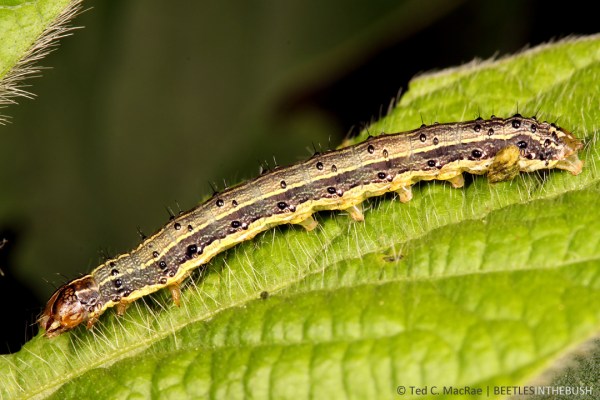
Spodoptera frugiperda (fall armyworm). This is not the most important armyworm pest of soybean, in contrast to its great importance in other crops such as corn and cotton. It is, however, the most widely distributed of the species, occurring in both the southern U.S. and throughout soybean growing areas of Brazil and Argentina. When problems do occur on soybean they are usually a result of larvae moving from grassy weeds to small soybean plants in late-planted or double-crop fields. Larvae can damage all stages of soybean, from seedlings (cutting them off at ground level) to later stages by feeding primarily on foliage and even pods. Larvae are somewhat variable in coloration but are distinctive among armyworms by virtue of the pinaculae (sclerotized tubercles) visible over the dorsum, each bearing a single stout seta. Four pinaculae are present on each of the abdominal segments, with those on the eighth abdominal segment forming a square, and larvae also exhibit a pronounced inverted, white, Y-shaped mark on the head.


Spodoptera exigua (beet armyworm) | Stoneville, Mississippi

Spodoptera exigua (beet armyworm) | Stoneville, Mississippi

Spodoptera exigua (beet armyworm). This species is better known as a pest of vegetables but will occasionally damage soybean in the southern U.S. In soybean larvae prefer to feed on foliage of seedling plants but will, if present during reproductive stages, also feed on blossoms and small pods. Late-instar larvae can be rather variable in appearance, but most tend to be green above and pinkish or yellowish below with a white stripe along the side. Larvae can be confused with Spodoptera eridania (southern armyworm) because of a dark spot that might be present on the side, but in southern armyworm the spot is on the first abdominal segment while in beet armyworm (when present) it is on the mesothorax.


Spodoptera ornithogalli (yellowstriped armyworm) | Jerseyville, Illinois

Spodoptera ornithogalli (yellow-striped armyworm) | Jerseyville, Illinois

Spodoptera ornithogalli (yellow-striped armyworm). This species is widely distributed throughout North and South America, but its status as an occasional pest of soybean is limited practically to the southeastern U.S. It is often encountered in soybean in low numbers but can reach pest status in double-crop fields with small plants that have been planted after wheat (similar to fall armyworm). Compared to other species in the genus the larvae are rather uniform in appearance, exhibiting paired, black, triangular spots along the back of each abdominal segment with thin to prominent yellow stripes running lengthwise adjacent to and not interrupted by the spots. Larvae oftentimes have an almost black velvety appearance with distinctly contrasting bright yellow stripes.
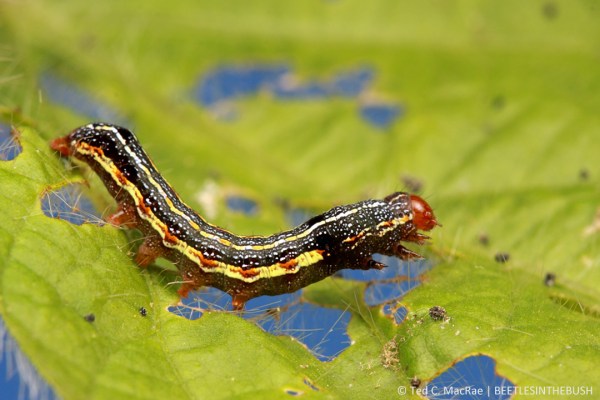

Spodoptera eridania (southern armyworm) | Jerseyville, Illinois
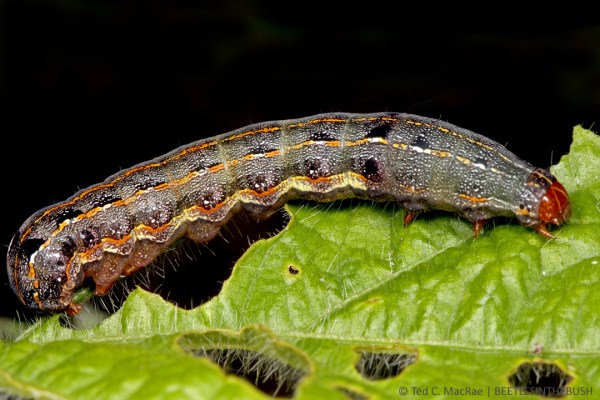
Spodoptera eridania (southern armyworm) | Jerseyville, Illinois

Spodoptera eridania (southern armyworm) | Union City, Tennessee

Spodoptera eridania (southern armyworm) | Union City, Tennessee

Spodoptera eridania (southern armyworm). This species is, like fall armyworm, widely distributed from the southern U.S. through Brazil and Argentina. In the U.S. it occurs only sporadically on soybean, usually causing “hot spots” of damage by groups of many larvae hatching from a single egg mass and skeletonizing the nearby foliage before dispersing as they grow larger. In Brazil and Argentina this species has emerged during recent years as one of the most important armyworm pests of soybean, especially in regions where cotton is also grown. Larvae can be somewhat variable in appearance and, in South America, can be easily confused with those of the black armyworm (S. cosmioides), both of which often exhibit prominent black markings on first and eighth abdominal segments and a subspiracular light-colored line along the length of the thorax and abdomen. Southern armyworm, however, rarely exhibits an additional black marking on top of the mesothoracic segment. Additionally, when the subspiracular line is present it is interrupted by the black marking on the first abdominal segment and is less distinct in front of the spot than behind, and if the line is not present then the black spots on top of the first abdominal segment are larger than those on top of the eighth abdominal segment.


Spodoptera cosmioides (black armyworm) | Acevedo (Buenos Aires Prov.), Argentina
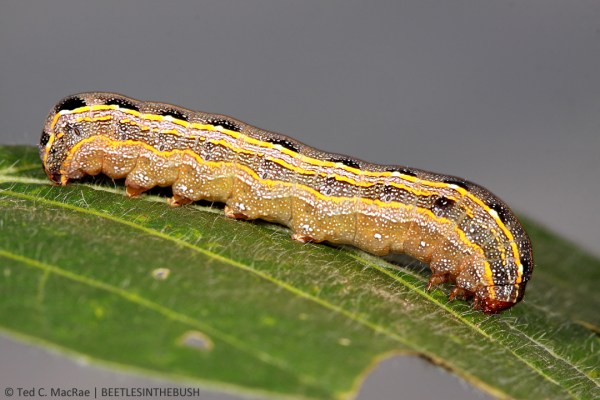
Spodoptera cosmioides (black armyworm) | Acevedo (Buenos Aires Prov.), Argentina

Spodoptera cosmioides (black armyworm) | Chaco Prov., Argentina

Spodoptera cosmioides (black armyworm) | Saenz Peña (Chaco Prov.), Argentina
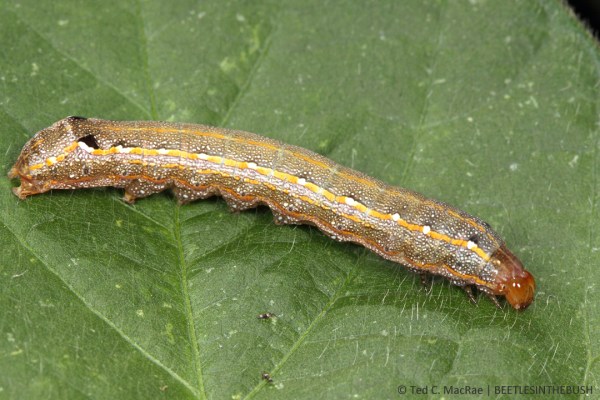
Spodoptera cosmioides (black armyworm) | Acevedo (Buenos Aires Prov.), Argentina

Spodoptera cosmioides (black armyworm) | Acevedo (Buenos Aires Prov.), Argentina

Spodoptera cosmioides (black armyworm). No accepted English common name exists for this strictly South American species that was previously considered a synonym of the North and Central American species Spodoptera latifascia. In Brazil it has been referred to by such names as “lagarta preta” (black caterpillar) and “lagarta da vagem” (pod caterpillar). The latter name has also been applied to other soybean pests, including southern armyworm, so to me “black armyworm” seems the most appropriate English name to adopt. Like southern armyworm, this species is a sometimes pest of cotton and in recent years has become increasingly important in soybean throughout Brazil and northern Argentina. Larvae often resemble and can be easily confused with those of southern armyworm; however, there is almost always a dark spot on top of the mesothoracic segment that is lacking in southern armyworm. Additionally, the light-colored subspiracular line, when present, is not interrupted by the black spot on the first abdominal segment and is equally distinct in front of and behind the spot. When the line is not present the black spots on top of the first abdominal segment are smaller than than those on top of the eighth abdominal segment.


Spodoptera albula

Spodoptera albula (gray-streaked armyworm) | Saenz Peña (Chaco Prov.), Argentina

Spodoptera albula (unbarred or gray-streaked armyworm). While known to occur in extreme southern U.S., this species has been cited as a pest of soybean only in Brazil, although its importance has not matched that of southern or black armyworm. Like most armyworms it is polyphagous, but this species seems to prefer amaranth (Amaranthus spp.). Larvae of this species can be distinguished from other South American armyworms that feed on soybean by the trapezoidal black marking on the mesothorax (usually semicircular to slightly trapezoidal in black armyworm), the black marking on the first abdominal segment not larger than that on the sixth abdominal segment, both of which are smaller than those on the seventh and eight abdominal segments, the white-only rather than white and orange dorsolateral stripe, and the triangular black markings on the abdominal segments each with a small white spot in the middle or at the apex of the marking.

Copyright © Ted C. MacRae 2013

GBCT Beetle #3—Crossidius coralinus temprans

On Day 2 of our late August Great Basin Collecting Trip (GBCT), we headed east from Reno towards Fallon (Churchill Co.) and surrounding areas of western Nevada. Our quarry on this day was one of the spectacular Crossidius coralinus subspecies—in this case C. c. temprans. This subspecies was described by Linsley & Chemsak (1961) from large series of specimens collected in Lassen Co., California, but also mentioned were specimens from several locations in west-central Nevada. This material was not included in the type series because of the disjunct distribution but was otherwise not distinguished from the temprans populations, and for us the drive to Churchill Co. was much more feasible logistically than Lassen Co.

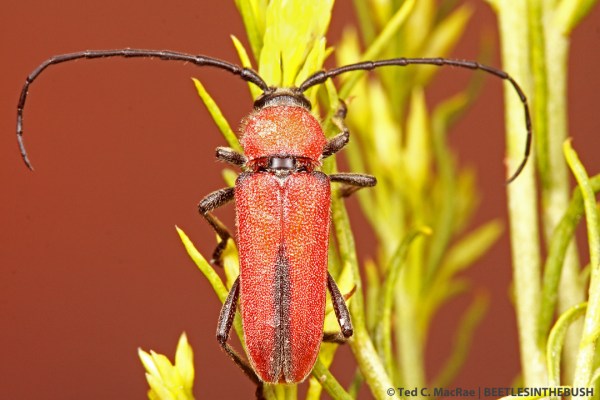
Crossidius coralinus temprans (female) | Churchill Co., Nevada

Crossidius coralinus temprans (female) | Churchill Co., Nevada

The female in the photo above is the first individual I encountered at the first stop we made to look for them—a swale about 12 miles west of Fallon in which we noted thick stands of gray rabbitbrush (Chrysothamnus nauseosus) in the early stages of flowering. It was still fairly early in the day, and though we scoured the area thoroughly only a few individuals were seen. The female exhibits some of the main characteristics that set this subspecies apart from the other red/black coralinus subspecies, including the faint bluish overtones, the deep red color, the relatively fine but dense elytral punctation, and its smaller average size. Females in particular exhibit a uniform, broadly expanded black pattern on the elytra that extends along the suture to at least the basal third of the elytra and also possess broadly black humeri connected by a black basal band.

A male from Churchill Co. shows reduction of elytral markings relative to females.

A male, also from Churchill Co., shows reduced elytral markings compared to females.

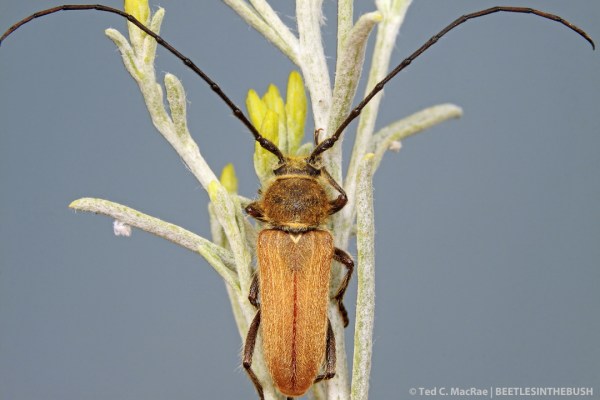
We had better luck finding individuals in the area 10–15 miles south of Fallon. I’m not sure whether this was due to actual greater abundance or the fact that it was now late morning and temperatures had warmed since our first stop. Nevertheless, we found a mating pair on one of the plants that I had hoped to photograph, but the female got skittish and took flight. Normally when one partner flees the other one does as well, but for some reason the male stayed put—nicely perched on top of the plant—and allowed me to take some photographs. Because I had already disturbed the female, I was pretty sure any attempted handling of the plant to position it with the sky in the background would cause the male to flee as well, so I photographed it as it sat—messy background and all. Still, the male shows the typical characters for males of the subspecies, in particular the faintly bluish dark pattern that is slightly expanded laterally and tapers anteriorly along the suture to the basal one-third of the elytra.

Lateral profile of the male shows a hint of black at the elytral base.

Lateral profile of the male (same individual as above) shows a narrow black band at the base of the elytra.

This lateral shot of the same male was taken, in part, to get an angle that allowed for a cleaner background, but it also more clearly shows the very narrow black band at the base of the elytra that connects the humeri, though the black markings are not as broad as in the female. After photographing this male, we found a spot near Carson Lake where the rabbitbrush was common not just along the road, but in the adjacent rangelands and along dikes adjacent to the wetlands surrounding the lake. There we found pretty good numbers of adults and worked the area for a couple of hours until we had adequate series.

This male from Pershing Co., Nevada has the elytral marking reduced to a narrow sutural stripe.

This male from Pershing Co., Nevada has the elytral markings reduced to a narrow sutural stripe.

Another reason for going east on this day was to take a shot at C. hirtipes bechteli, a subspecies known from only a few localities along the I-80 corridor in north-central Nevada. The westernmost locations were close to Lovelock—a 90-minute drive from where we were, so when we finished up in the area around Fallon we headed towards Lovelock. We knew finding this subspecies was a long shot, since all of the records in Linsley & Chemsak (1961) were from mid- to late September, but since making the effort didn’t impact our ability to arrive at the first planned stop the next day at a decent hour we had nothing to loose by looking for it. We found one of the localities, but the plants at this relatively higher altitude site were still in the earliest stages of bloom, and we didn’t see any adults within about a half-mile stretch of roadside. The effort, however, was not for naught (I love saying that!), as the lateness of the hour and a heavy blanket of smoke from the nearby Rim Fire created a most beautiful blood red sky. Before the day slipped away completely, we stopped at a spot closer to Lovelock to see if we could find a C. coralinus temprans adult to photograph against this unusual backdrop and were immediately rewarded with the fine male shown in the photograph above. Sitting against this marvelous background, the male shows a much reduced black elytral marking that is sometimes the case with males of this subspecies. I hurriedly took as many shots as I could (getting that one photo that I really like is, for me, still a numbers game), but the conditions were fleeting and within a short time it became too dark to take any more.

REFERENCE:

Linsley, E. G. & J. A. Chemsak. 1961. A distributional and taxonomic study of the genus Crossidius (Coleoptera, Cerambycidae). Miscellaneous Publications of the Entomological Society of America 3(2):25–64 + 3 color plates.

Copyright © Ted C. MacRae

Cover Photo—The Coleopterists Bulletin 67(3)

cso67-3co14.inddI hope you’ll all take note of the cover photo on the September 2013 issue of The Coleopterists Bulletin (vol. 67, no. 3), which just arrived in my mailbox. It features the adult jewel beetle, Chrysobothris octocola, that I found in September of last year at Gloss Mountains State Park (Woodward Co., Oklahoma) on a dead branch of mesquite (Prosopis glandulosa). That was a significant find, as it proved to be a new state record for Oklahoma. This is the second straight issue of the journal to feature one of my photos (the  featured the beautiful, metallic green weevil, Eurhinus cf. adonis, which I photographed in Argentina on flowers of Chilean goldenrod (Solidago chilensis).

Ironically, there are no articles in this issue about jewel beetles, but there are two articles covering my other main group of interest, the longhorned beetles, including a generic revision of Prionacalus by Antonio Santos-Silva and colleagues and a preliminary checklist of the Cerambycidae and Disteniidae of Alabama by Brian Holt. The Prionacalus revision appears to be everything we have come to expect from a modern taxonomic revision, complete with detailed taxonomic history and descriptions, key to species, and all species figured by line drawings and high quality photographs (including many of the primary types). Like most taxonomic works, it suffers from a lack of associated natural history information—not a fault of the authors, as such information is almost always lacking for all but the commonest of species in the Neotropics. The situation is a little better for Nearctic species, and the Holt checklist, happily, includes basic host plant associations for most of the species found within the state. I’ll be busily updating my database of distributional and host plant records for North American Cerambycidae from this work over the next week.

If you are not already a member of The Coleopterists Society, consider becoming a member. Not only is The Coleopterists Bulletin included with your membership, but you will also gain online access to archival and recent issues of the journal via JSTOR and BioOne.

REFERENCES:

Holt, B. D. 2013. A preliminary checklist of the Cerambycidae and Disteniidae (Coleoptera) of Alabama. The Coleopterists Bulletin 67(3):241–256 [abstract & references].

Santos-Silva, A., Z. Komiya & E. H. Nearns. 2013. Revision of the genus Prionacalus (Coleoptera: Cerambycidae: Prioninae: Prionini). The Coleopterists Bulletin 67(3):201–240 [abstract & references].

Copyright © Ted C. MacRae 2013

GBCT Beetle #1: Crossidius hirtipes immaculatus

In my recent Great Basin Collecting Trip (GBCT) overview, I provided some general comments about the longhorned beetles in the genus Crossidius that were the focus of the trip and, in many cases, photographs of the habitats in which the beetles were found. I didn’t show many photos of the beetles themselves, however, and such will be the focus of a series of posts intended to provide a little more detail about the individual taxa that we encountered. I was fortunate to obtain photographs of every species and subspecies that we found and, thus, will include these in the posts as well. Many of the images are bona fide, in situ field photographs—i.e., the beetles were photographed in their native habitat on the host plants on which they were encountered (although in most cases the plant part on which the beetle was resting was detached from the plant and hand-held to control the background). Some beetles were too active to photograph at the time they were encountered, in which case they were confined with their host and photographed that evening after they had settled down—either with a natural background or in front of blue-colored fabric intended to simulate a sky background. I believe in full disclosure when it comes to nature photography and will indicate if photos are anything other than in situ field photographs.

Crossidius hirtipes immaculatus (male) | Davis Creek Park, Washoe Co., Nevada

Crossidius hirtipes immaculatus (male) | Davis Creek Park, Washoe Co., Nevada

No need, however, for such disclosures in this first post of the series, as these images are true field photographs of Crossidius hirtipes immaculatus—the first longhorned beetle that we encountered on the trip. One of 16 currently recognized subspecies of C. hirtipes, populations assignable to this taxon are rather widely distributed from eastern Oregon to east-central California across northern Nevada (Linsley & Chemsak 1961). We found good numbers of these beetles in west-central Nevada at Davis Creek Regional Park (Washoe Co.) on flower heads of what I believe to be Chrysothamnus viscidiflorus. According to Linsley & Chemsak (1961), this subspecies differs from the nominotypical subspecies (the latter occurring further north in Oregon and Washington) by its paler coloration and (as the subspecies epithet indicates) reduced maculations of the elytra. In males the elytra are often completely immaculate (above), while in females the maculae are reduced to a narrow sutural stripe (below). A similar subspecies, C. h. setosus, occurs at the western edge of the distribution of C. h. immaculatus in east-central California (Nevada Co.) but is distinguished by the presence of short, dark, bristle-like hairs interspersed with longer hairs on the antennal scape—these are lacking in C. h. immaculatus.

Crossidius hirtipes immaculatus (female) | Davis Creek Park, Washoe Co., Nevada

Crossidius h. immaculatus (female) | Davis Creek Park, Washoe Co., Nevada

In addition to C. viscidiflorus were healthy stands of Ericameria nauseosa, but as was the case with nearly all subsequent C. hirtipes encounters adults were found almost exclusively on flower heads of the former. This contrasts somewhat with published information that suggests the species breeds as larvae in the roots only of C. viscidiflorus but readily feeds as adults on flowers of E. nauseosa. We saw several dozen individuals at this site, but only a small handful were found on E. nauseosa. We also noted the early exit of the adults, which started disappearing after ~5 pm local time. We suspect they crawl down to the base of the plant to spend the night hiding among debris, although we were unable to find any adults on the lower stems or around the base of the plants despite careful searches.

REFERENCE:

Linsley, E. G. & J. A. Chemsak. 1961. A distributional and taxonomic study of the genus Crossidius (Coleoptera, Cerambycidae). Miscellaneous Publications of the Entomological Society of America 3(2):25–64 + 3 color plates.

Copyright © Ted C. MacRae 2013
Arizona collectors: Have you seen this beetle?

Placoschema dimorpha (male) | lower Madera Canyon, Arizona

Placoschema dimorpha (male) | lower Madera Canyon, Arizona

If you are a collector of beetles in Arizona, you should be on the lookout for longhorned beetles (family Cerambycidae) resembling the specimen in the above photos. Determined as Placoschema dimorpha Chemsak & Hovore, in Eya 2010 by Jeff Huether, the specimen was collected by Jeff’s son Mark Huether on 15 July 2013 as they roadside collected longhorned beetles and scarabs in lower Madera Canyon (Pima Co.). They were searching mainly on Baccharis, although there were very few flowers open at the time. It is not known what plant the specimen was collected from, but Jeff notes that it was collected around 2 pm in the heat of the day.

Placoschema dimorpha was described from just a handful of specimens (3 males and 4 females), all in Mexico, and is the only member of the genus. As a result, the above collection represents the first record of both the genus and the species in the U.S. New U.S. records for popularly collected groups like longhorned beetles are always noteworthy, and in this case its occurrence in southeast Arizona—well scrutinized for decades by legions of beetle collectors—is all the more remarkable. Perhaps its tiny size (the above specimen measures only ~10 mm) and somber coloration—unusual for the tribe Trachyderini with its mostly large and colorful members—have somehow contributed to it being overlooked until now. Others might be quick to cite climate change and recent expansion of its range northward into the U.S. as a possible explanation; however, it should be noted that the type specimens, despite being few in number, were collected from a rather large area across central and northern Mexico in the states of Chihuahua, Durango, Hidalgo, and Mexico.

While this specimen agrees very well with the original description of P. dimorpha, it does differ from the male paratype figured in that work in that the lateral margins of the elytra are red only in the basal half rather than completely to the apex. As the species name implies, females are colored differently, with the elytra entirely reddish or at most a darker fascia (may be incomplete) across the apical three-fourths.

My sincere thanks to Jeffrey Huether for allowing me to photograph this specimen and present these notes in advance of more formal documentation in peer-reviewed literature.

REFERENCE:

Eya, B. K. 2010. New Mexican and Central American genera and species of Trachyderini (Coleoptera, Cerambycidae, Cerambycinae). Les cahiers Magellanes 108:1–21.

Copyright © Ted C. MacRae 2013
An interesting flightless May beetle

I suppose you are an entomologist?

Not quite so ambitious as that, sir. I should like to put my eyes on the individual entitled to that name. No man can be truly called an entomologist, sir; the subject is too vast for any single human intelligence to grasp.

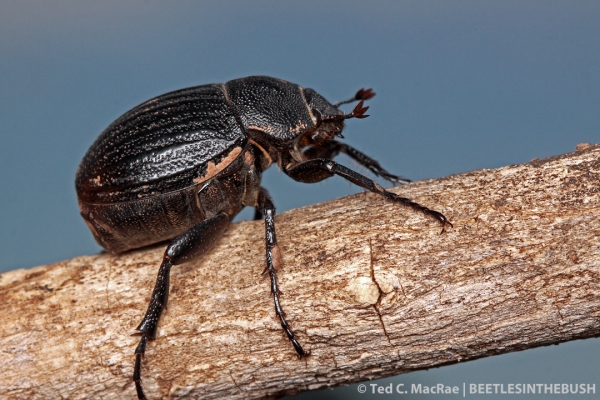
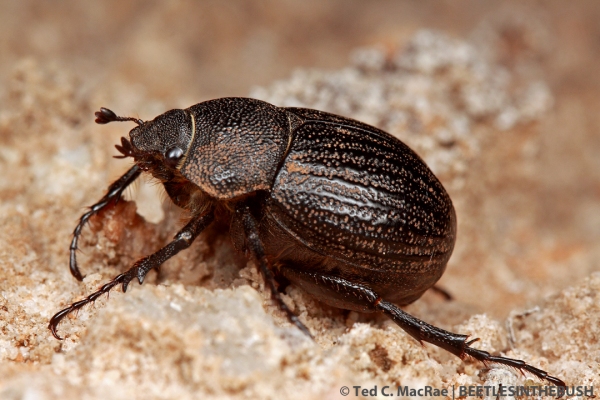
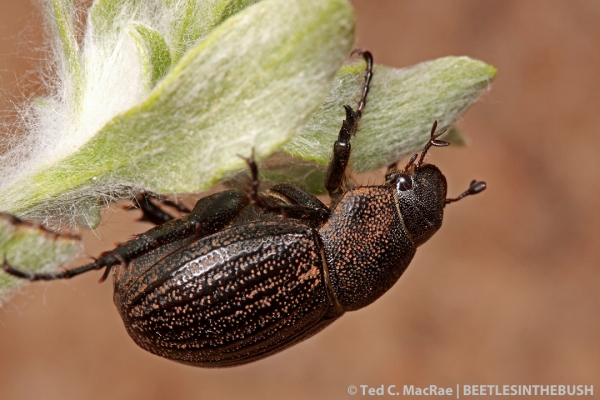
Phyllophaga cribrosa | Gloss Mountain State Park, Major Co., Oklahoma

Phyllophaga cribrosa | Alabaster Cavern State Park, Woodward Co., Oklahoma

I suppose the above quote from The Poet at the Breakfast Table, by Oliver Wendell Holmes, Sr., applies just as well to those who would call themselves coleopterists, for restricting oneself to the study of beetles diminishes by scarcely more than half the known diversity of all insects. I still dare to call myself a coleopterist, but I’m the first to admit that while there are a few groups of beetles that I know very well, there are many more that I know only superficially and some that befuddle me completely. An example of the latter is May beetles (family Scarabaeidae, genus Phyllophaga). With more than 400 species in North America (Ratcliffe & Jameson 2010), it is one of the most speciose genera in our fauna. Not surprisingly, species identifications can be very difficult, oftentimes relying on examination of male and female genitalia.

xxx

The flightless adults are most often found on the ground or low vegetation.

Not all species of Phyllophaga, however, are difficult to identify. The species shown here—P. cribrosa—is rather easily recognized within the genus by its oval, convex shape, shining black coloration, cribrose (perforated like a sieve) surface, 10-segmented antennae, and flightless nature. The resemblance to certain darkling beetles (family Tenebrionidae) is striking, although I suspect this may be a result of convergent adaptation to dry habitats rather than mimicry (Kaufman & Eaton 2007). While most species of Phyllophaga are nocturnal and capable of flight, adults of P. cribrosa are flightless and can be found crawling on the ground and clinging to low vegetation during the day. I found these beetles this past June at several locations in northwestern Oklahoma.

xxx

The distinct elytral furrows distinguish P. cribrosa from closely related species.

There are at least two other closely related species in the genus (i.e., P. epigaea and P. zavalana) that resemble P. cribrosa; however, both of these species are restricted to Texas, and they lack the distinct longitudinal elytral furrows exhibited by P. cribrosa. The species is said to be an occasionally serious pest of crops (Luginbill & Painter 1953), although I suspect that in most cases this results from new plantings of crops in former grasslands because of the limited dispersal abilities of the beetles.

REFERENCES:

Eaton, E. R. & K. Kaufman. 2007. Kaufman Field Guide to Insects of North America. Houghton Mifflin Harcourt, 391 pp.

Luginbill, P., Sr. & H. R. Painter. 1953. May beetles of the United States and Canada. U.S. Department of Agriculture Technical Bulletin 1060, 102 pp,

Ratcliffe, B. C. & M. L. Jameson (eds.). 2010. Generic Guide to New World Scarab Beetles (available at: http://www-museum.unl.edu/research/entomology /Guide/index4.htm).

Copyright © Ted C. MacRae 2013
The one that got away!

It was disappointing to reach Black Mesa, the furthest west destination for my June collecting trip through northwestern Oklahoma, only to discover that the whole region was dry as a bone. I spent an hour or so sweeping yellow roadside composites and got a few Typocerus confluens—a reasonably uncommon longhorned beetle, and another hour’s worth of beating oaks and junipers in the area produced a grand total of three Chrysobothris ignicollis, a very common jewel beetle associated with junipers in the southern Great Plains. This in glaring contrast to the veritable smörgåsbord of jewel and longhorned beetles I had encountered earlier in the week at Beaver Dunes, Alabaster Caverns, and Gloss Mountain State Parks. I had planned to spend at least a full day in the Black Mesa area—maybe two if the collecting was good, but as it was I couldn’t justify spending even another minute in the area. Unable to resist the siren call of more productive areas back to the east, I decided to cut my losses and return to those areas to close out the week. It was still early afternoon, and if I left immediately I would arrive back at Beaver Dunes (from where I had left just the previous evening) with at least a few hours to pad my series and perhaps even find something new.

Oberea oculaticollis Say 1824 | Beaver Dunes State Park, Beaver Co., Oklahoma

Oberea oculaticollis Say 1824 | Beaver Dunes State Park, Beaver Co., Oklahoma

One area I wanted to take another look at was the small lake near the campground. I had beaten a few willow-feeding Agrilus spp. from the black willow (Salix nigra) and Poecilonota cyanipes from the cottonwoods (Populus deltoides) surrounding the reservoir. I desired better series of what I had collected the previous day, so I retraced my steps and beat most of the same trees I had beaten before. While I did quite well with P. cyanipes on the cottonwoods, again only a few Agrilus were beaten from the willows. I had nearly completed the circuit around the lake when I walked up to a small willow sapling that I had not sampled the previous day, gave it a whack over my sheet, and onto the sheet fell a nice longhorned beetle that I didn’t immediately recognize. At first I thought it was a species of Mecas due to the dense covering of gray pubescense, but the long and narrow form seemed much more agreeable with the genus Oberea. At any rate, seeing that it was something new for me I placed it back on a willow branch and began taking photos of it.

The dark integument and dense, grayish pubescence distinguish this species.

The dark integument and dense, grayish pubescence distinguish this species.

It was late in the day, and the beetle was unusually calm and cooperative and allowed me to take a number of shots, from which I have selected a few to show here. Once I had my fill of photographs, I slipped it into a vial for safe-keeping while I disassembled and stowed my camera equipment, and after I was finished I pulled out the vial with one hand and reached for my bottle dropper of ethyl acetate with the other. I have a technique to unscrew both the vial and the bottle with the fingers of the hand that is holding them, lifting both caps simultaneously, dropping a few drops of ethyl acetate into the vial, and again simultaneously placing both caps back in place and screwing them shut. This minimizes the time the cap is off the vial while the insect is in it, thus minimizing the chance of the insect escaping during the process. In this case, however, as I was trying to do this a dog-pecker gnat flew right at my eye, and I instinctively swiped at it with my left hand—the one holding the vial with the beetle in it! Of course, the cap was off, and the beetle when sailing out of the vial and immediately took flight. All I could do is just stand there dumbfounded at my stupidity. I did go back and beat the same sapling (and every other willow tree) on my way back in a last ditch effort to recollect the species, but fortune was not with me at this time.

This adult on black willow (Salix nigra) is the first indication of its host plant.

This adult on black willow (Salix nigra) is the first indication of its host plant.

Once I returned home and had a chance to examine the photos more carefully, I learned that I had photographed Oberea oculaticollis Say 1824, a longhorned beetle distributed in central North America from Manitoba to Texas and distinguished, not surprisingly, by its dark integument and dense, grayish pubescence (Chemsak & Linsley 1995). Not only have I never before encountered this species, but it is also completely lacking in my collection. As far as I can tell, no host information has been recorded for this species, so my collection of an adult on willow might be the first clue as to its host plant. Without a voucher specimen, however, I am reluctant to publish the record and will have to keep this spot in mind for possible future collection of the species.

REFERENCE:

Linsley, E. G. & J. A. Chemsak.  1995. The Cerambycidae of North America. Part VII, No. 2: Taxonomy and classification of the subfamily Lamiinae, tribes Acanthocinini through Hemilophini. University of California Publications in Entomology 114:1–292.

Copyright © Ted C. MacRae 2013

“Rare jewel beetles discovered in Mexico by team of scientists!”

I hope you’ll excuse the hyperbolic title, but such has been my impression with some of the headlines I’ve seen recently in the popular media regarding newly described insect taxa in various parts of the world. The “discovery” of new species in far away, tropical lands sounds exciting and ground-breaking to many people, who envision teams of scientists wearing pith helmets and cargo shorts machete-slashing their way through miles of virgin forest before stumbling into a secret biodiversity hot-spot, their weeks of toil and sweat finally paying off by becoming the first white men to lay eyes upon a bounty of strange, exotic, never-before-seen creatures. In reality, new species of insects are not at all hard to find—in fact, depending on where you go it can be downright easy. Admittedly the chances are greater in the tropics, where many areas remain little explored, but even in well-studied North America new species turn up regularly. This includes popularly collected beetles in the very well-studied eastern U.S., where I’ve already described one new jewel beetle (family Buprestidae) and one new longhorned beetle (family Cerambycidae) from right here in my home state of Missouri (MacRae 2000, 2003) and am in the process of describing another new jewel beetle. No, finding new species is easy—recognizing them as such is the hard part. That’s not to say that new species cannot be recognized when first encountered, but I suspect that a majority of new insect species aren’t actually “discovered” until they’ve been brought back from the field, curated, and sat in a cabinet for years or decades—unrecognized for what they really are due to resemblance to known species until somebody comes along and examines them more critically.

Such is the case with two jewel beetle species that Chuck Bellamy and I describe in a paper just published in The Pan-Pacific Entomologist (MacRae & Bellamy 2013). I joined Chuck on several trips to Mexico in 1992 and again from 2004–2006 to explore the tropical thorn woodlands in the southern states of Oaxaca, Puebla, Guerrero and Michoacán. Jewel beetle diversity is high in these still relatively intact woodlands, with a number of new species already having been described from the area in recent years, and all-told we collected well over 100 species. At least a dozen or more of these look to be new, and considering that the Mexican jewel beetle fauna as a whole includes more than 800 known species the actual number could greatly exceed 1,000. The two described in this most recent paper resemble the common, widespread species Actenodes calcaratus. This big, beautiful jewel occurs from the southwestern U.S. through Mexico and Central America to northern South America, developing as larvae in dead wood of a variety of fabaceous hosts. We collected several of what we thought was this species during our trips, but a number of subtle but consistent differences in punctation and surface sculpturing emerged as we began comparing them more critically against A. calcaratus from other locations. The coup de grâce, however, was the coloration of the male face—normal bronze in A. calcaratus (Fig. 5) and similar to the female (Fig. 6), but flash-green in male A. scabrosus (Fig. 2) and green-violaceous in male A. michoacanus (Fig. 8). It’s quite remarkable that both of these species differ from their more widespread relative by subtle morphological characters but such striking sexually dimorphic facial coloration, and we subsequently found a similar situation with another species in the genus (A. undulatus) that otherwise bears little resemblance to A. calcaratus.

Figs. 1–9. Actenodes spp. 1–3. Actenodes scabrosus. 1–2. Male holotype. 1. Dorsal habitus. 2. Frontal view. 3. Female paratype (Guerrero). 4–6. A. calcaratus. 4–5. Male (MEXICO, Guerrero, Hwy 95, 5 km S Milpillas, 7.vii.1992, "big dead tree", G. H. Nelson [FSCA]). 4. Dorsal habitus. 5. Frontal view. 6. Female (MEXICO, Hwy 95, 2 km S Milpillas, 6.vii.1992, on Acacia farnesiana, G. H. Nelson [FSCA]), frontal view. 7–9. A. michoacanus. 7–8. Male holotype. 7. Dorsal view. 8. Frontal view. 9. Female paratype, frontal view. All scale bars = 5 mm.

Figs. 1–9. Actenodes spp. 1–3. Actenodes scabrosus. 1–2. Male holotype. 1. Dorsal habitus. 2. Frontal view. 3. Female paratype (Guerrero). 4–6. A. calcaratus. 4–5. Male (MEXICO, Guerrero, Hwy 95, 5 km S Milpillas, 7.vii.1992, “big dead tree”, G. H. Nelson [FSCA]). 4. Dorsal habitus. 5. Frontal view. 6. Female (MEXICO, Hwy 95, 2 km S Milpillas, 6.vii.1992, on Acacia farnesiana, G. H. Nelson [FSCA]), frontal view. 7–9. A. michoacanus. 7–8. Male holotype. 7. Dorsal view. 8. Frontal view. 9. Female paratype, frontal view. All scale bars = 5 mm.

In the case of both of these new species, the first specimens were actually collected more than 40 years ago but remained “hidden” among specimens of A. calcaratus until we examined the collections containing them more closely. While it might seem that the striking male facial coloration both of these species exhibit should have resulted in their quick recognition as undescribed species, even seemingly obvious characters such as this can be overlooked when an otherwise great resemblance to a common, widespread species prevents their critical examination.

REFERENCES:

MacRae, T. C. 2000. Review of the genus Purpuricenus Dejean (Coleoptera: Cerambycidae) in North America. The Pan-Pacific Entomologist 76(3):137–169.

MacRae, T. C. 2003. Agrilus (s. str.) betulanigrae MacRae (Coleoptera: Buprestidae: Agrilini), a new species from North America, with comments on subgeneric placement and a key to the otiosus species-group in North America. Zootaxa 380:1–9.

MacRae, T. C. & C. L. Bellamy. 2013. Two new species of Actenodes Dejean (Coleoptera: Buprestidae) from southern Mexico, with distributional and biological notes on Buprestidae from Mexico and Central America. The Pan-Pacific Entomologist 89(2):102–119.

Copyright © Ted C. MacRae 2013