Beetle Collecting 101: Dress for Success

For most of the nearly 3 decades that I’ve been collecting insects, beetles have been my primary interest – first longhorned beetles, then jewel beetles, and now more recently tiger beetles (each taxon an addition, not a replacement!). During that time, I’ve learned a thing or two about the art of collecting – some of which I’ve figured out for myself, much more a result of my good fortune to have spent time in the field with the likes of Gayle NelsonChuck Bellamy, and a number of other learned entomologists.  In view of this, I thought there might be interest in an occasional post on some aspect of my approach to collecting beetles. With that, I introduce my new series, “Beetle Collecting 101,” and since it all starts in the field, this first installment will consider my basic outfit for field collecting. Although my focus is beetles (and specific groups of beetles at that), this basic outfit is widely applicable across most insect groups. There are a number of additional items that I can and do bring into the field with me at various times depending on location and season or for specific collecting techniques (e.g., beating, blacklighting, pitfall/bait trapping, etc.) that won’t be covered here – these additional items could be covered in future posts if this post indicates sufficient interest. Other future post ideas I had include rearing, specimen processing (everything from pinning and labeling to batch processing and storage methods), and collection organization/curation. Comments and suggestions welcome.

Beetle Collecting 101: Dress for Success
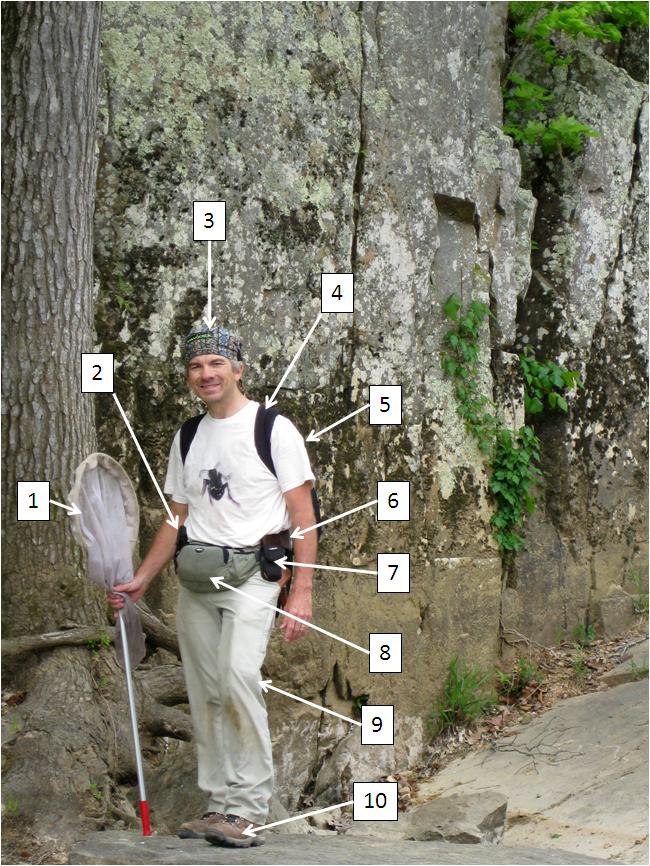
A well-dressed entomologist. Photo by Rich Thoma.

Beyond the needed equipment, the primary considerations for my field outfit are lightweight, comfortable, and protective.  I can spend hours away from the truck in extreme conditions or rugged terrain (or both!), so I want clothing that stays comfortable no matter how much I exert myself.  It is also tempting to carry more equipment than is necessary – this only adds weight and limits the ground that can be covered.

  1. Insect net – duh!  This is an absolute necessity for nearly all but the purely flightless species.  I highly recommend an extendable net handle – I keep mine collapsed (3′ length) for normal use and extend it out to 6′ when stalking tiger beetles or other wary, flighty species.  The collapsed net handle is also a good length and weight to serve as a beating stick when I am carrying a beating sheet (not shown).  I use an aerial net bag, since I don’t do much sweeping anymore – match the bag to your interests.  Of the three common ring diameters for aerial nets, I find the 15″ to be more effective than the 12″, while the 18″ is a little unwieldy.  Green fabric is said to be not as visible to insects as white, thereby allowing closer approach before they attempt to flee, but I do not have any experience with this.  I have collected quite a lot of beetles with my white net bag and appreciate the ability to see the contrast of the insect inside the bag when attempting to remove it.
  2. Hunting knife.  If you’re interested in wood-boring beetles, you’ll want to be able to slice into dead branches suspected of harboring insects.  I like the classic folding Buck Knives Ranger and attach it to the strap of my waist pack (#8) rather than my belt so that it will move with the pack when I swing the pack around backside.
  3. Hat.  If the sun doesn’t bother you, the flies will.  Wear something light and comfortable that will absorb sweat – I like my 2-decades old Mombosok for this (and because I be stylin’!), but those with greater sun sensitivity (or who live in tropical environments) might do better with a brimmed hat.
  4. Backpack.  Before my camera carrying days, this was a Camelbak hydration pack with a good-sized but not overly large water reservoir and zippered pouches with newspaper for placing host plant samples for pressing.  A backpack isn’t really necessary for short forays or mild conditions but is essential for hiking longer distances in hot/dry climates where there is real risk of dehydration.  Many regard backpacks as uncomfortable; however, I find slinging water containers attached to the waist equally annoying and also cumbersome to deal with when crouching or laying.  These days, however, I carry full camera gear in my backpack (camera body, multiple lenses, extension tubes, flash unit).  This adds weight, but it only took a day or two during my first field trip to get used to it.  I still use the camera pack for carrying water, as the front compartment has room for two water bottles or a Camelbak bladder, and my pack also contains a separate zippered compartment where I can still place plant samples for pressing.
  5. Lightweight t-shirt.  I used to wear buttoned fishing shirts over an undershirt, thinking the undershirt would keep perspiration off my skin, while the pockets on the outer shirt would come in handy for holding small items.  In reality, things fall out of the front pockets, and both under- and outer layers would become soaked with sweat.  Now I wear simple 100% cotton t-shirts – artfully emblazoned with an image of Cicindela ancosisconensis by Kirk Betts at The Wild Edge (and leaving no doubt to curious onlookers as to what I am up to).  I find these simple  shirts to be the most comfortable in the most extreme conditions.
  6. Hand axe.  Again, if you’re interested in beetles that live in wood, an axe will be handy for chopping into wood too large or hard to sample with a hunting knife.  Smaller is better (to limit weight), and rather than using a leather holster (which will become soaked with sweat and stretched out), I simply slip the handle under the strap of my waist pack and let the head of the axe rest on the strap to hold it in place.
  7. GPS Unit.  You do record GPS coordinates for your specimens, don’t you?!  I just got a new one for my birthday (Garmin Oregon 450t) with computer download capabilities – no more manual transcribing of data!  Again, I attach it to my waist pack strap rather than my belt.
  8. Waist pack.  I use the very compact Eagle Creek Wayside, with two zippered pouches and an unzippered side pouch to hold all my vials and small tools.  I’ve tried a number of different methods for holding these items – they fall out of shirt pockets whenever you bend over, are not readily accessible when in a backpack, and do not stay organized in a non-compartmented pack.  I have developed a system of vials that serve as both killing bottles and storage containers (this alone could be the subject of another post) – 4-dram vials for most specimens and 8-dram for larger ones.  This waist pack holds 8 small and 6 large vials in the front pouch – with the two sizes kept separate by a divider.  Being able to carry numerous vials allows me to segregate insects by host plant or ecological association, and most importantly, vials in this pouch stay organized so I can easily find the proper vial when I need it.  The larger rear pouch is roomy enough to hold two small olive bottles (for the occasional behemoths or blacklighting), forceps, aspirator, and miscellaneous other items – or, if I’m in the mood to collect wood for rearing (also could be the subject of another post), pruning shears, small folding saw, twine, flagging tape, and permanent marker.  A small side pouch is perfect for keeping a hand lens and an eye dropper bottle of ethyl acetate killing agent at the ready.  Also, the pack easily swings around to my backside when I need to crouch or lay prostrate (e.g., when photographing tiger beetles).
  9. Lightweight polyester/cotton outdoor pants.  I’m fond of the Columbia line of products, but whatever brand you choose, make sure they are lightweight, have a relaxed fit (to allow crouching) and dry quickly (no denim jeans for me!).  The last thing I want is chafing from sweat-soaked pants – yikes!  (Let’s just say lesson learned the hard way).
  10. Hiking boots.  Again, lightweight and comfortable are key, and because of the sometimes rugged terrain I traverse I like mid-ankle support so I can watch for bugs instead of constantly watching my feet.  The lighter the boot, the longer you’ll be able to hike with comfort, and leather uppers will provide greater protection from thorns.

I hope you’ve found some useful tips here.  If you have your own techniques or experiences with field outfits, I’d love to hear them.  Also, if you have subjects that you would like covered in future issues of “Beetle Collecting 101,” please do let me know.

Copyright © Ted C. MacRae 2010

Add to FacebookAdd to DiggAdd to Del.icio.usAdd to StumbleuponAdd to RedditAdd to BlinklistAdd to TwitterAdd to TechnoratiAdd to Yahoo BuzzAdd to Newsvine

Email to a friend

Hello World!

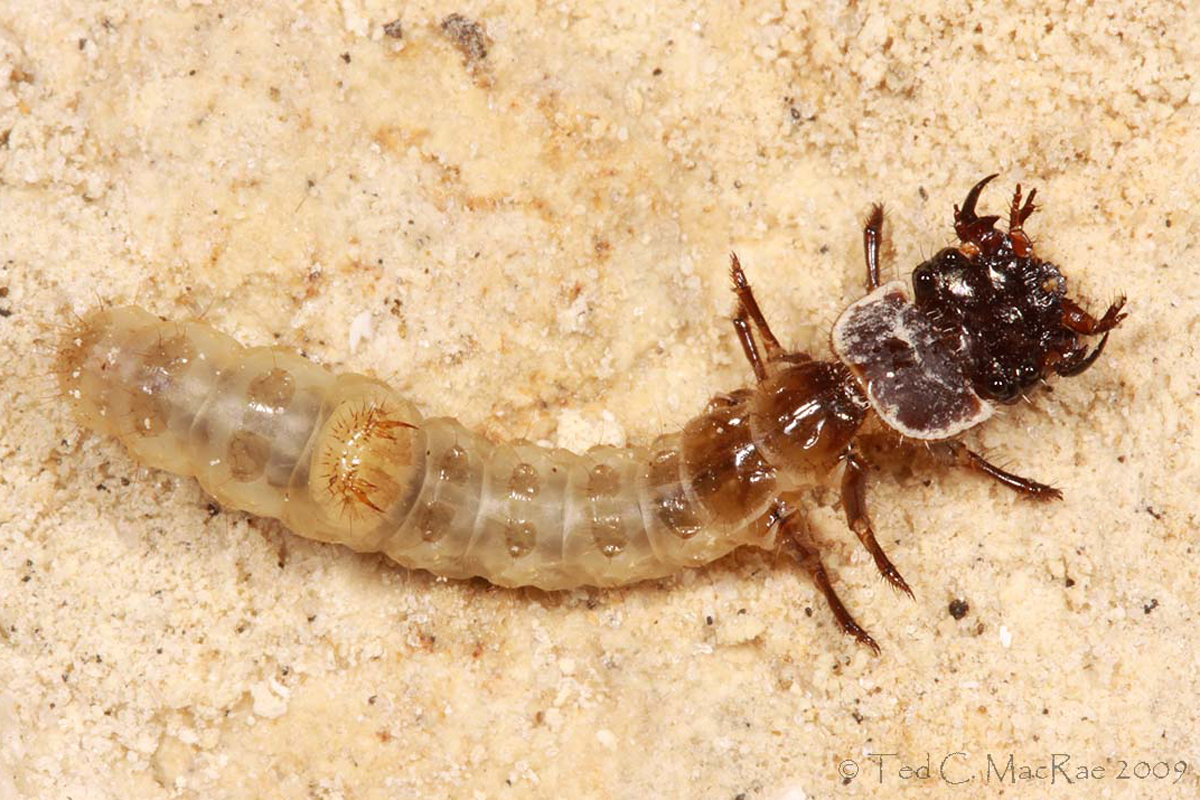
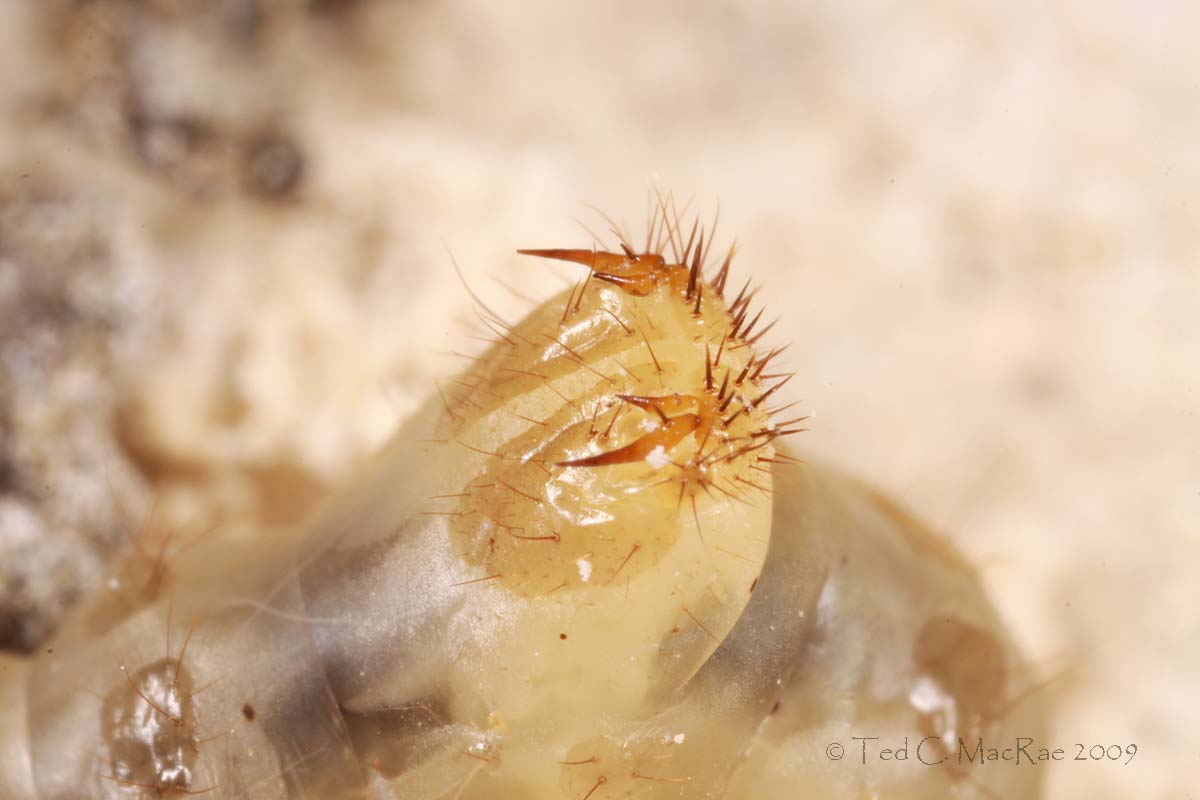
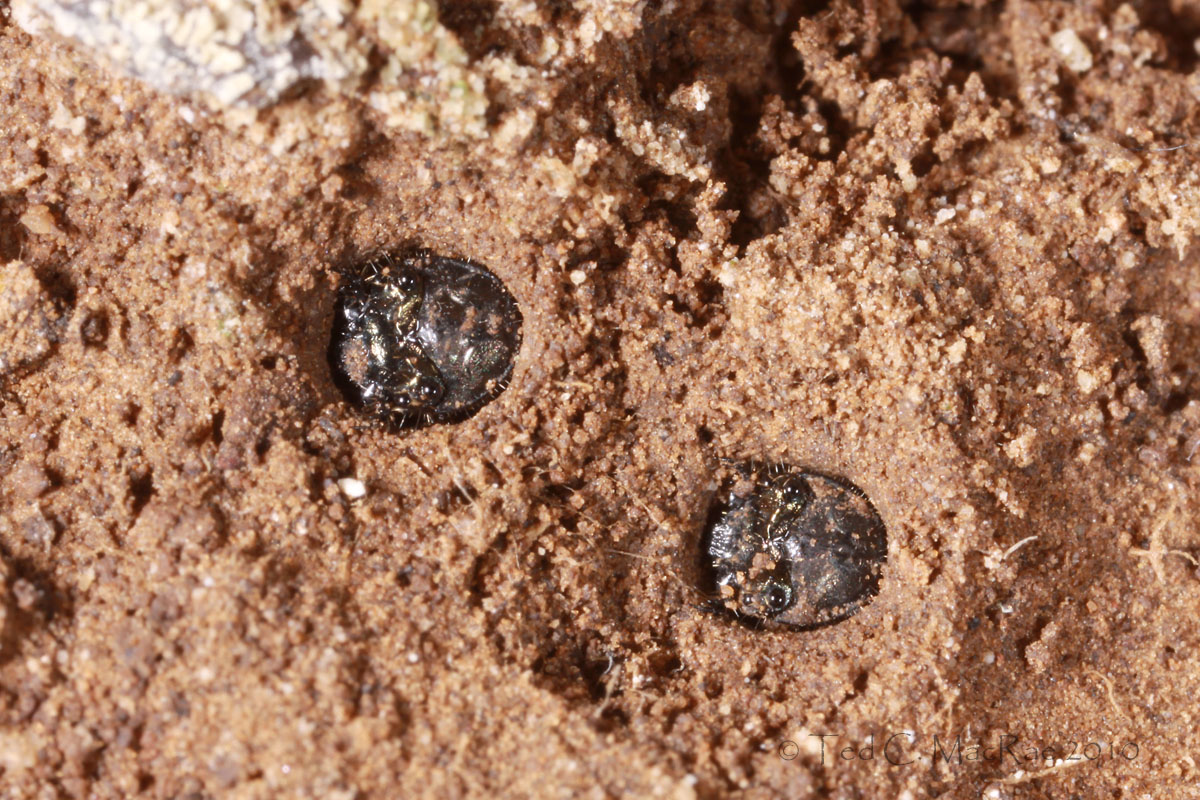
These are two of the Cylindera celeripes (swift tiger beetle) larvae that I’m rearing.  Note: nobody has ever reared this species before!  Nobody has ever even seen its larvae (before now, that is).

These larvae hatched from eggs that were laid by adults I brought back from northwestern Oklahoma last summer.  I placed the adults in a small terrarium of native soil – at first just to see if I could keep them alive, and then to see if I could get them to lay eggs.  The adults lived for about 4 weeks, and a short time later larval burrows started appearing in the soil.  I fed them once or twice a week by placing 2nd instar corn rootworm larvae in the open burrows or dumping Lygus nymphs into the terrarium and letting them catch them naturally.  I wasn’t sure this was working, because as the summer progressed I saw fewer and fewer open burrows.  By October, there were no open burrows, and I feared none had survived.  Nevertheless, I placed the terrarium in a cool (10°C, or 50°F) incubator for the winter and pulled it back out in late March.  Within one week ten larvae had reopened their burrows – I believe all but one of them are 3rd instars, which is the last instar before pupation, and since they have awoken they have fed voraciously on 3rd instar fall armyworm larvae, which I dangle above their burrow.  I love watching them snatch the armyworm from my forceps and drag the hapless prey down into their burrow.  I’ve already preserved examples of the three larval instars and will describe it shortly (although truth be told, the 2nd and 3rd instars are from larvae I found in the field – but that is a post for another day).  However, I’m keeping my fingers crossed for the piece de resistance – successfully rearing the species from egg to adult!

Photo Details: Canon MP-E 65mm 1-5X macro lens on Canon 50D, ISO 100, 1/250 sec, f/13-16, MT-24EX flash 1/8 power w/ Sto-Fen diffusers.

Copyright © Ted C. MacRae 2010

Add to FacebookAdd to DiggAdd to Del.icio.usAdd to StumbleuponAdd to RedditAdd to BlinklistAdd to TwitterAdd to TechnoratiAdd to Yahoo BuzzAdd to Newsvine

Email to a friend

The “New” Gromphadorina portentosa

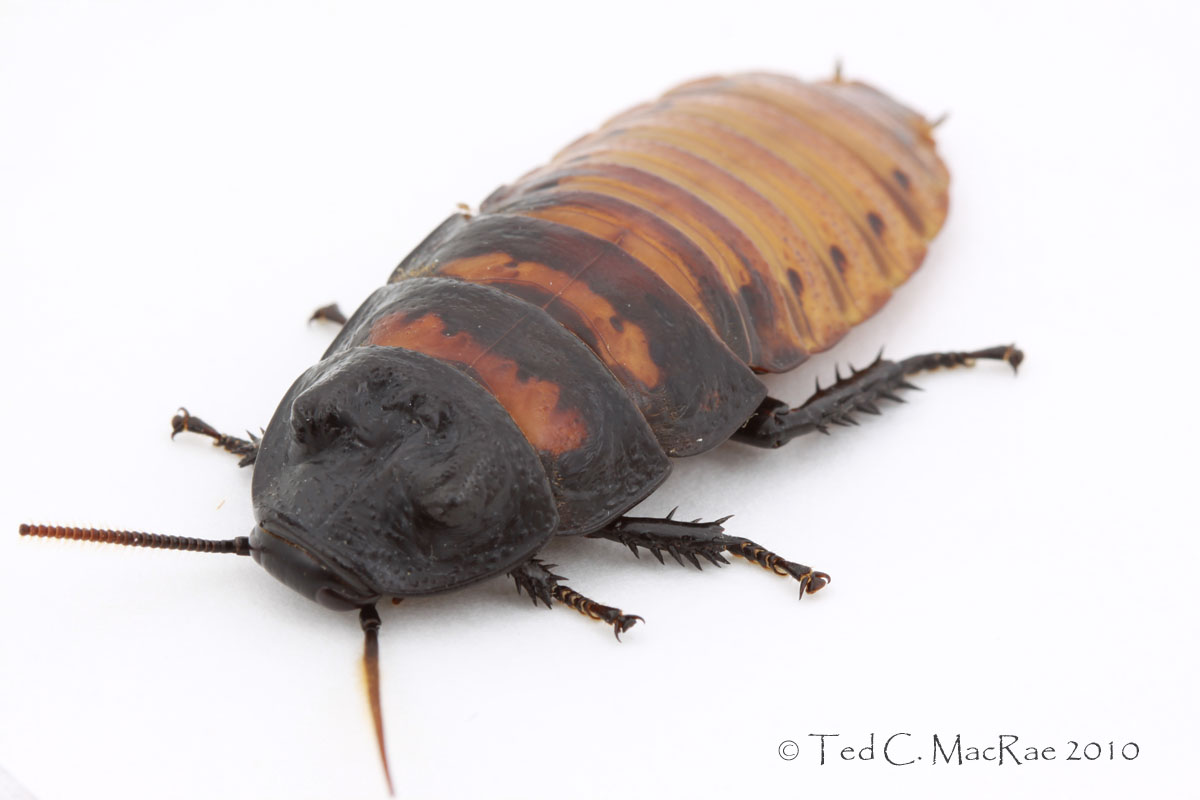
I don’t pretend to be a photography guru – I’m learning, and though I still have much to learn I’m happy with my progress so far.  The photographs I posted earlier this week of Gromphadorina portentosa, the Madagascan hissing cockroach, were the results of my first attempt at photographing insects in a white box, and I was reasonably happy with the results.  However, a commentor suggested the photographs could benefit from increased contrast – and he was right!  I admit that I haven’t focused much on post-processing so far, as I’m still in a rather steep part of the whole insect macrophotography learning curve thing. I have played around with the different enhancement tools in Photoshop Elements, but for some reason I don’t find them all that intuitive, and just playing around with them hasn’t helped me understand how they work or the best way to use them.  The Photoshop online help site wasn’t much help either – in fact, it was all gibberish to me!  I started to wonder if maybe I just lacked some basic talent when it came to understanding post-processing.

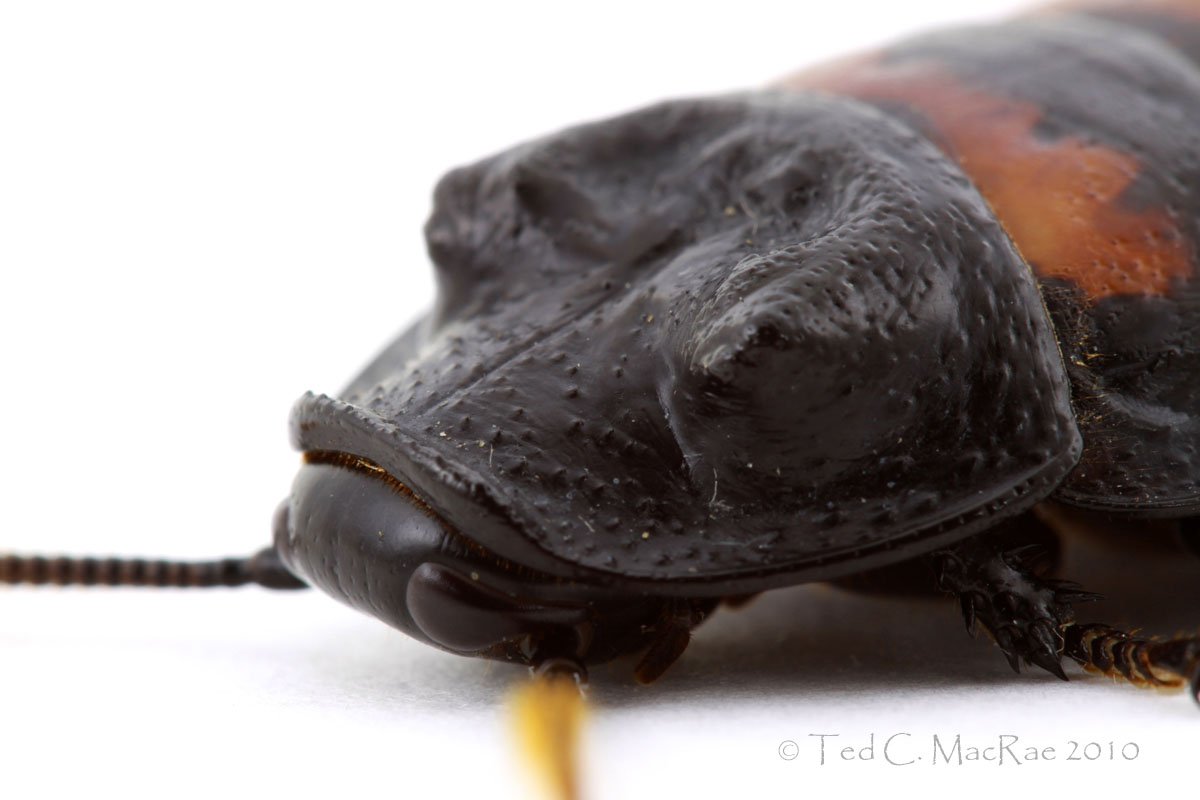
Fortunately, the commentor provided a link to an excellent article at EarthBound Light called The 1-2-3 of Photoshop Levels.  That article opened up for me a whole new world of understanding!  It explained that Levels is a better alternative for optimizing photos that Brightness and Contrast, and it did it in plain English!  I actually understood it!  Well, my appetite whetted, I started browsing other articles at the site and found the object of my desire: a clear explanation of the seemingly misnomored “Unsharp Mask” in an article called Behind the Unsharp Mask: The Secret World of Sharpening.  I read it excitedly, just waiting for it to become unintelligibly technical, but it was as clearly written as the previous, and for the first time ever I actually felt like I understood the basics of how to use Unsharp Mask.  Well, I couldn’t wait to take my newfound knowledge and apply it to my photos of the already spectacular Gromphadorina portentosa to see if I could make them really pop. The following comparison shows the original photo of the male (size reduced to 1200×800) and the optimized photo adjusted for levels, color, and sharpness (also slightly cropped). What do you think?

Original photo

Optimized photo

Here are paired comparisons of the other photos I included in the original post with their optimized versions (click to see enlarged versions). I would be most interested in hearing any specific comments you might have about these optimizations.

Original

Optimized

Original

Optimized

Original

Optimized

Original

Optimized

Copyright © Ted C. MacRae 2010

Add to FacebookAdd to DiggAdd to Del.icio.usAdd to StumbleuponAdd to RedditAdd to BlinklistAdd to TwitterAdd to TechnoratiAdd to Yahoo BuzzAdd to Newsvine

Email to a friend

Gromphadorina portentosa

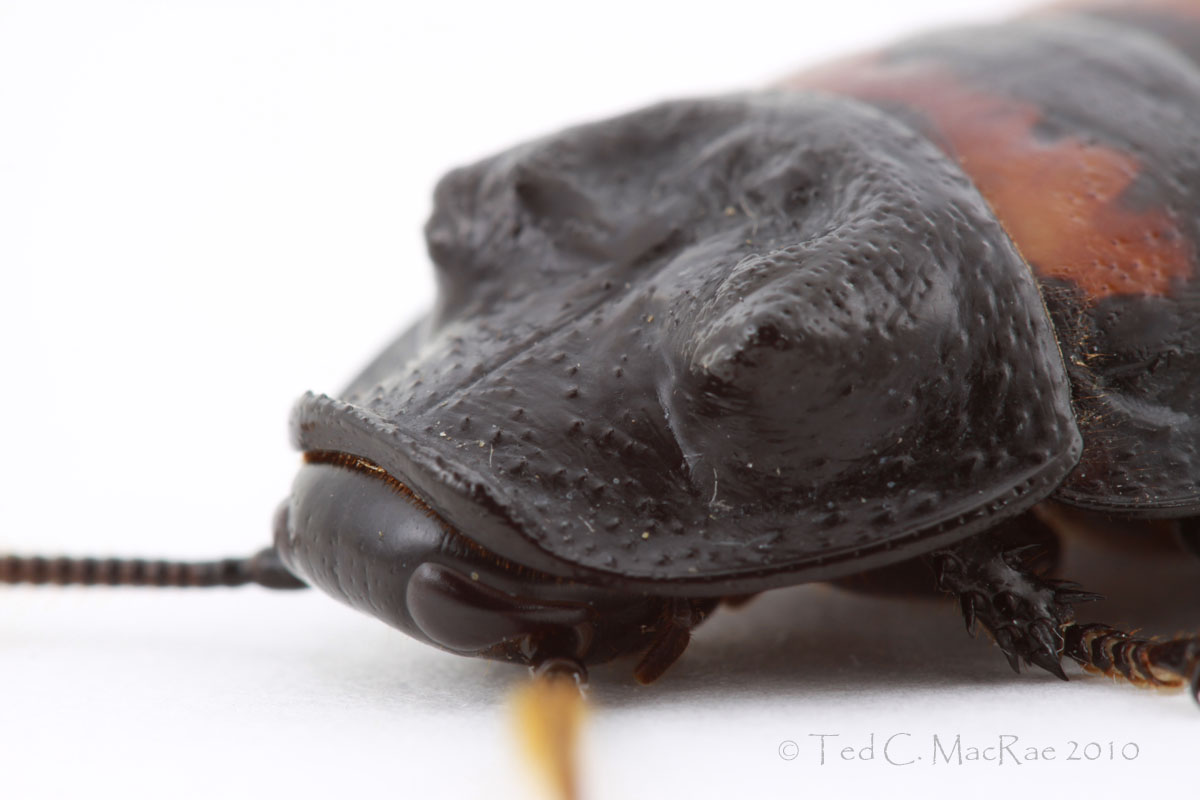
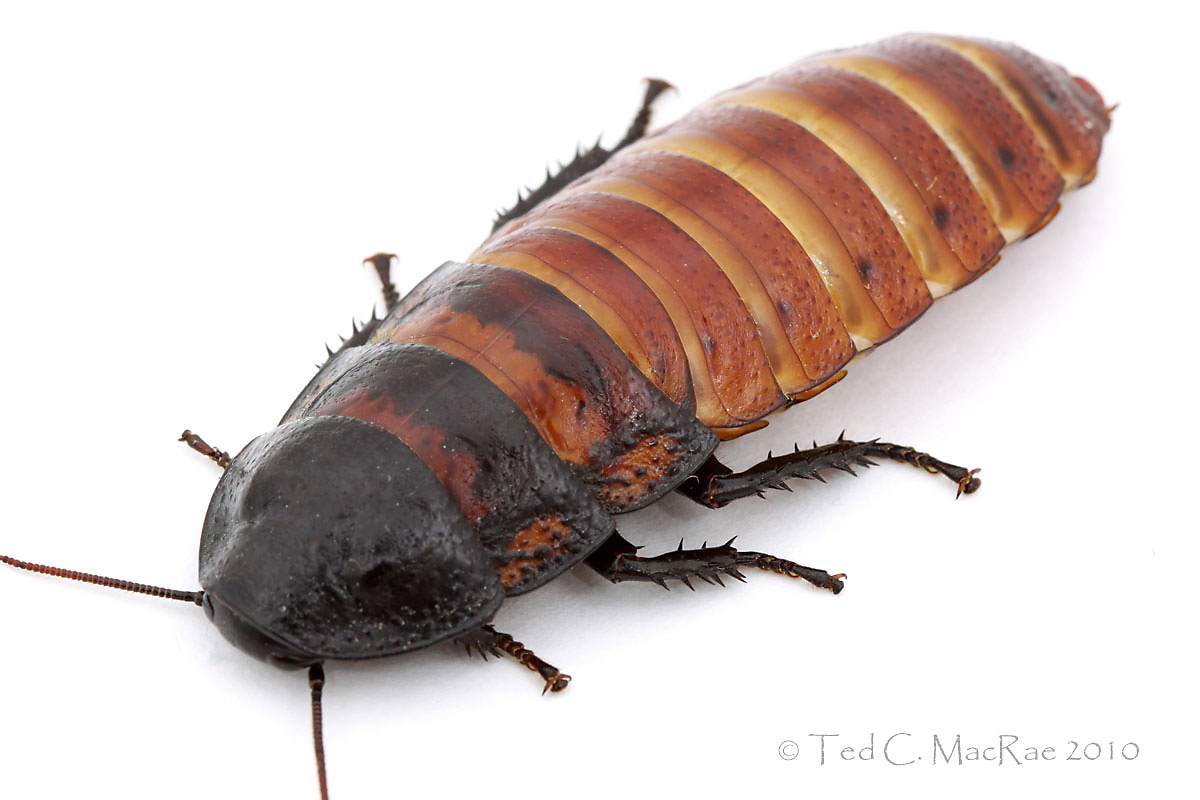
I found myself with a few spare moments this weekend, so I decided to finally put together a white box and see what I could do with it.  And what better subject for a white box maiden voyage than Gromphadorina portentosa, the Madagascan hissing cockroach.  Grotesquely beautiful, it also presents a challenging subject for flash-based macrophotography because of its hard, shiny exoskeleton that produces strong specular highlights with all but the most highly diffuse of light sources.  It was also the only live subject I had on hand at the moment, other than a few larval noctuids – not nearly as impressive as these behemoths!  There were some early glitches – the enormous size of these insects made for long working distances, with the result that my box was almost too small!  However, placing the subjects at the back of the box allowed the camera lens and flash units to sneak just inside the front drape, and the closer shots went more smoothly.  I’m quite happy with the results – at least as a first attempt, and I think the method shows even more promise for some preserved specimen photographs that I am planning.

The males, of course, have “horns” on the pronotum, but one thing I had never noticed before is the well-developed lip at its anterior edge.  This is certainly an adaptation to the “shoving” matches that males engage in with each other frequently.  This face-on shot shows him for the formidible opponent that he is!

Sexual dimorphism is fairly evident in this species, as least compared to your average cockroach.  Like most insects, females tend to be a little larger, especially when they are gravid as the one below appears to be.  In my colony I note that they also tend to be more uniformly dark in color than the males, although that is not quite so evident with this particular female.

The big difference is, of course, the weakly developed pronotal protuberances.  Females don’t engage in the shoving matches that males do, so there is no need for the heavily armed pronotum.  Nevertheless, small pronotal humps are still found in the adult females.  Note also the lack of a well-developed lip on the anterior edge of the female pronotum.

Photo Details: Canon 100mm macro lens on Canon 50D, ISO 100, 1/200 sec, f/8-11, indirect MT-24EX flash in white box.

Copyright © Ted C. MacRae 2010

Add to FacebookAdd to DiggAdd to Del.icio.usAdd to StumbleuponAdd to RedditAdd to BlinklistAdd to TwitterAdd to TechnoratiAdd to Yahoo BuzzAdd to Newsvine

Email to a friend

Lampetis drummondi larva?

Back in February, I learned that Mark Volkovitsh (Zoological Institute, Russian Academy of Science, St. Petersburg) would be visiting Chuck Bellamy (California Department of Food and Agriculture) in Sacramento the very week that I was planning to be in Lake Tahoe. Chuck and Mark are two of the worlds leading specialists in Buprestidae, or jewel beetles, and have worked together on a number of projects dealing with the taxonomy and systematics of buprestid beetles. Mark, in particular, has focused on describing the larval forms of buprestids (“white wormy things,” as my wife calls them) and using larval morphology to supplement adult morphology in phylogenetic analyses. I’m not anywhere near being in their league in terms of authority in the family – a comparative dabbler, really – but for some reason they’ve both seen fit to accept me into the fraternity. I’ve been fortunate to spend time in the field with each of them, as well as visit them at their respective institutions.  When I learned of Mark’s coincident visit, I couldn’t resist the chance to make the 2-hour drive from Lake Tahoe to Sacramento and spend the day with Mark and Chuck at the CDFA and discuss things buprestological.  The wife and kids were fine with that, since her brother also lives in Sacramento, and it would be a chance for them to do some sight-seeing before we all got together for dinner.  Upon arriving at CDFA, I also met Andy Cline, a nitidulid specialist at the CDFA (re-met actually, turns out we’d met some years back), and the four of us went out for an animated lunch at a nearby restaurant over some of the most delicious barbeque that I’ve ever tasted.

L-R: Mark Volkovitsh (Russia), Chuck Bellamy (CDFA), me, Andy Cline (CDFA)

After lunch, I was most interested in discussing with Mark some buprestid larvae that I had collected in Big Bend, Texas in 2004. My colleague Chris Brown and I were hiking a low desert trail west of Rio Grande Village when we encountered a large, uprooted Goodding willow (Salix gooddingii) tree laying on the river bank. Wilting leaves were present on some of its branches, suggesting that the half-dead had been washed to its current location by the river during a recent flood. At the base of the trunk where the main roots projected, I noticed what appeared to be frass (the sawdust that wood boring beetle larvae eject after eating it – that’s right, grub poop!) under the edge of the bark at the live/dead wood interface. I used my knife to cut away some of the bark and immediately encountered a huge buprestid larvae. Its enormous size is matched only by a few desert southwest species: Polycesta deserticola, which breeds commonly in oak and is known from willow, but breeds only in dead, dry branches; and Gyascutus planicosta, whose larvae are restricted to the living roots of Atriplex and a few other asteraceous shrubs.  Clearly, it could not be either of these species.  The only other desert southwest buprestids large enough to produce a larva this large (~50 mm) are Lampetis drummondii and L. webbii. However, the larvae of both of these species are unknown, as is basic information regarding what hosts they utilize for larval development. Lampetis webbii is quite rare, but L. drummondii is, in fact, one of the most conspicuous and commonly encountered buprestid species in the desert southwest – that fact that its larva has remained unknown suggests that it utilizes living wood, probably feeding below the soil line.  Thus, I immediately began to suspect that the larva might represent this species – a truly exciting development. 

As I continued digging into the wood, I encountered a second, somewhat smaller larva in a neaby gallery, and further digging revealed another clue about its identity in the form of fragments of a dead adult beetle – all brilliant blue/green in color (identical to the color of L. drummondi), and the largest (the base of an elytron, or wing cover) showing the same pattern of punctation exhibited by L. drummondi adults. I placed the two larvae individually in vials with pieces of the host wood; however, I knew there was little chance that either larva, requiring living tissue upon which to feed, would complete its development once removed from its host gallery.  They did survive for a time after my return to St. Louis, but when the largest larva became lethargic, I decided to go ahead and preserve them.  I sent the photograph below (taken by Chris) of the living larvae to Mark, who confirmed that it did indeed appear to be a species of Lampetis, based on its large size and the narrowly V-shaped furcus on the pronotal shield (typical for members of the tribe to which Lampetis belongs). 

Buprestid larva (prob. Lampetis drummondi) under bark of Salix gooddingii at trunk base - Big Bend National Park, Texas. Photo by Christopher R. Brown.

Considering the complete lack of published information on the larval biology of Lampetis drummondi and the several lines of evidence that these larvae, in fact, represent that species, it would be worthwhile to publish a description of the larva.  However, formal description requires dissection, and I did not know how to do this.  Mark, on the other hand, has dissected literally hundreds of buprestid larvae, including representatives of nearly every genus for which larvae are known.  He is the buprestid larva expert, and what a thrill it was for me to learn how to do this from the Master himself, using the larger of these two probable Lampetis larvae as the subject.  While we were dissecting the larva, we compared its features to those published for the European species Lampetis argentata (Danilevsky 1980) – the only member of the genus for which the larva is known – and confirmed their similarity and the larva’s likely close relationship to that species.  Coincidentally, the larva of L. argentata develops in living roots of saxaul (Haloxylon) – a genus of large shrubs/small trees (family Amaranthaceae) that grows in the deserts of Central Asia.  It thus appears that Lampetis species may, as a general rule, utilize living wood below the soil line for larval development, explaining why the larva of only one (now two) of the nearly 300 species in the genus worldwide has been found.

REFERENCES:

Danilevsky, M. L. 1980. Opisanie zlatki Lapmetis [sic] argentata (Coleoptera, Buprestidae) – vreditelya saksaula [Description of the larva of Lapmetis [sic] argentata (Coleoptera, Buprestidae) – the pest of HaloxylonZoologicheskii Zhurnal 59:791–793.

Copyright © Ted C. MacRae 2010

Add to FacebookAdd to DiggAdd to Del.icio.usAdd to StumbleuponAdd to RedditAdd to BlinklistAdd to TwitterAdd to TechnoratiAdd to Yahoo BuzzAdd to Newsvine

Email to a friend

A matter of diffusion

In my Best of 2009 post, I mentioned four skills that, to me, seemed to be crucial for becoming a successful insect macrophotographer: 1) composition, 2) understanding lighting, 3) knowing how to use a flash, and 4) knowledge of the subject.  Of these, I’m most comfortable with the last – three decades of insect study have given me the chance to observe a tremendous diversity of insects in a variety of situations and habitats.  Many species are located only through understanding of their haunts and habits, and the ability to capture them relies upon successful approach techniques.  Collecting insects has been excellent preparation for photographing them.  I’m also reasonably satisfied with my compositional skills – at least in this early stage of my development as a photographer.  I don’t expect to win any photo competitions (yet), especially since my intent as a photographer is at least as much for scientific documentation as it is for artistic expression, but I’m satisfied that I’m on the right track and developing the eye I’ll need to make good progress.

What I’m not satisfied with yet are the middle two – understanding lighting and knowing how to use a flash.  Let’s face it, I was starting from square one here.  My only prior experience with insect photography were middlin’ attempts in the mid-1980’s using an Olympus OM-10 body, a Zuiko 50mm lens (maximum magnification 1:2), and natural light only.  I quickly lost interest (too distracting for the collecting), picking it back up only for my 1999 trip to South Africa.  Fast forward to May 2009 and my acquisition of a bona fide insect macrophotography setup, complete with Canon’s 100mm f/2.4 and 65mm 1-5X macro lenses and their MT-24EX macro twin flash.  Talk about giving a Ferrari to someone who had just received their learner’s permit!  I like a good challenge, however, and spent the rest of 2009 with camera in hand on several memorable field trips – shooting lots of frames, deleting many on the spot and more when I saw them on the computer, and occasionally stumbling onto a pretty good one.

While I still have much to learn, one thing I did realize is that lighting remains a challenge even with a decent setup such as mine.  The MT-24Ex flash unit, in particular, while seemingly the flash of choice among Canon-using amateur insect macrophotographers, produces a very harsh light.  The capabilities and shortcomings of this flash unit have been reviewed in great detail by several insect macrophotographers much more knowledgeable than I (e.g., Alex Wild, Dalantech, Kurt, etc.), so I simply refer you to their websites if you’re interested rather than try to summarize here.  However, the one thing they all emphasize with this flash unit is the need for diffusers.  Diffusing light is easy; a simple sheet of tracing paper will do.  However, diffusing light in a manner that is equally effective with both the 65mm and 100mm lenses (with their shorter and longer working distances, respectively) and also convenient for field-use is hard.  For most of the 2009 season, I tried using Sto-Fen Omni-Bounce Diffusers, and while they were marginally better than no diffusers at all, the results were still not satisfying.  More recently, I’ve been experimenting with the Gary Fong Puffers, which Dalantech has modified for use with the MT-24EX.  I hadn’t yet committed to constructing the diffusers as described and conducting controlled comparisons between the Puffers and Sto-Fens, but my initial tinkering with the Puffers has me impressed.  Below are two photos of Cicindela splendida (the aptly-named Splendid Tiger Beetle) – the first (which some of you may remember from this post) was taken in the field using the Sto-Fen diffusers and the 65mm lens (1X)…

…while the second was taken recently of this same beetle (in captivity on native soil) using the Puffers attached to the Sto-Fens and the 100mm lens (at slightly less than 1X).

Both photos have been cleaned up a bit with post-processing; however, neither has been altered dramatically.  While not a true one-to-one comparison due to different venues (field versus captivity) and lenses (65mm versus 100mm), the second photo is clearly superior to the first, with softer lighting resulting in richer colors and far fewer specular highlights on the insect body.   I had to bump the lighting up considerably for the second photo, since the Puffer combined with the Sto-Fens cut the light levels quite a bit, yet still the photo lacks any of the harshness and washed appearance of the first photo.  The use of the 100mm lens in the second photo also should have presented a greater challenge for the lighting due to the increased working distance (~8 inches, compared to only 2-3 inches for the 65mm lens).  I’m really quite pleased with the results of this initial experiment – enough to the point that I’ve ordered the necessary materials and am ready to dive into construction of my own set of “Dalantech-Puffers.”

Copyright © Ted C. MacRae 2010
Add to FacebookAdd to DiggAdd to Del.icio.usAdd to StumbleuponAdd to RedditAdd to BlinklistAdd to TwitterAdd to TechnoratiAdd to Yahoo BuzzAdd to Newsvine

Email to a friend

Anatomy of a Tiger Beetle Larva

My first experience looking for tiger beetles in Florida had gone well.  Despite its small size and urban surroundings, the narrow strip of coastal scrub and saltwater marsh along the intracoastal waterway behind my sister-in-law’s condominium boasted a robust population of what I took to be a single tiger beetle species.  The specimens I collected and photographs I took would later reveal that two co-occurring and closely related species were present: Ellipsoptera marginata (Margined Tiger Beetle) and E. hamata lacerata (Gulf Beach Tiger Beetle).  I had spent close to two hours under the August sun observing and photographing the beetles before I decided that I had given the preserve a thorough enough look.

IMG_1077_1200x800_crp

As I was heading back, I noticed a little bit of high ground alongside a red mangrove thicket and went over to give it a look.  As I approached I saw something I hadn’t yet seen that day – tiger beetle larval burrows.  Larval burrows, especially larger ones such as these were, are unmistakeable – almost perfectly circular (slightly cut out on one edge) and smoothly beveled around the perimeter.  There were a number of burrows clustered on the small bit of high, dry ground, and my first thought was that their inhabitants represented the same (what I thought was a single) species that I had encountered so commonly that day as adults.  I then reasoned, however, that more likely they represented another species whose adults are active later in the season – perhaps one of the so-called “spring/fall” species whose larvae typically reach maturity during the heat of summer.  The size of the burrows (~5mm dia) suggested they were inhabited by 3rd instar larvae (the final instar before pupation), in which case it may be possible to rear a few to adulthood – if I could get at them. I tried fishing (Pearson and Vogler 2001) a few holes with a grass blade but didn’t get any bites, so I decided to watch for awhile and see if any of the larvae, believing the danger of my approach had passed, would reappear at the tops of their burrows.  Waiting for tiger beetle larvae to appear is a crap shoot – maybe they’re active, and maybe they’re not, and crouching in the stifling summer air of a coastal marsh in Florida is not an easy thing to do for very long.  Fortunately my wait was short, as within a few minutes I saw one re-appear at the top its burrow.  I slowly got out my knife and moved to place the tip on the soil about 1″ from the burrow at a 45° angle for an attempted tunnel block (Pearson and Vogler 2001), but it spooked and dropped back down into its burrow before I could get then knife in place.  No matter, I knew it was in there now and that it would likely reappear if I could muster the patience.  I positioned the knife and waited – crouched under the baking Florida sun, until when it did re-appear I plunged the knife into the soil with authority.  It was a good jab – I had blocked its retreat without injuring it, and a quick flip of the knife popped out the soil plug and exposed the startled larva, flipping vigorously in a vain attempt to escape before settling down amidst its unfamiliar, exposed surroundings.

IMG_1083_1200x800_enh

For those of you who have never seen a tiger beetle larva, they are among the most other-wordly creatures one can imagine.  The large, heavily sclerotized head bears two long, sickle-shaped, upward-pointing mandibles and up to three pair of highly-acute eyes whose arrangement on each side conveys the image of a “face” with congenital birth defects.  The top of the head is flattened to lie flush with the surrounding soil as the larva sits at the top of its burrow, and huge, powerful mandibular muscles fill the cranial cavity.  The remainder of the body – long, narrow, and cylindrical – hangs from the head at a 90° angle down into the burrow and is unremarkably grub-like, save for a curious hump on the dorsal side of the 5th abdominal segment.  Close examination of the hump reveals an intricate pattern of forward-facing hooks and spines that function in anchoring the larva against the side of its burrow to prevent struggling prey from dislodging it.  The life of a tiger beetle larva is a life of waiting – unlike the adults who run down their prey, the larvae sit in their burrows and wait for prey to come to within lunge’s reach.  While the eyes of most grub-like insects detect little more than light and dark, those of tiger beetle larvae are densely packed with photoreceptors that permit detailed focusing and depth perception for detecting whether potential prey has ventured close enough to their burrow (Pearson et al. 2006).  When that happens, they strike with lightning speed, plunge their mandibles into their prey, and drag it down into the depths of their burrow where it is summarily dispatched with a few bites of their powerful mandibles.  Larvae consume they prey in a manner similar to that of adults in that they chew but don’t swallow their prey. Rather, they secrete digestive secretions containing proteolytic enzymes that begin digesting the prey extra-orally as they chew.  The resulting bolus is masticated and its liquid components sucked out until nothing but a dry wad of indigestable chitin remains, which is spat out of the burrow (Pearson and Vogler 2001).

IMG_1081_1200x800

Looking at this strange insect, it occurred to me that I had not yet attempted macrophotographs of a tiger beetle larva out of its burrow, and this would be a good opportunity to get more practice with my Canon MP-E 65 mm macro lens – a lens with incredible magnification capabilities, but one that is also a bit of a temperamental beast to use hand-held in the field.  The subject was unusually cooperative, perhaps too stunned by its sudden predicament to know what to do, and as I took the photographs I focused in particular on characters of the head and dorsal hump (often useful in identifying tiger beetle larvae, at least to genus).  Time was growing short once I finished taking photographs, so I placed the larva in a vial and returned the following day to extract a chunk of native soil to place in a rearing container, managing to collect two more larvae as well (unfortunately, one became instant “prey” for the other.  Note to self: when placing multiple tiger beetle larvae in a container of soil, seal the artificial burrows into which you place each one!).  I paid little further attention to the photographs, other than to transfer them onto my computer and add metadata upon my return to St. Louis.  I didn’t know what species the larvae represented, but I assumed they were something in the genus Cicindela or one of its several former subgenera.  However, had I studied the photos and considered the locality and habitat, I would have realized that my assumption was incorrect¹.  That realization would come in surprise fashion two months later when the two adults emerged within a few days of each other…

¹ Ten points to whoever can use this information to arrive at an identification before my next post 🙂

IMG_1072_1200x800_enh

Photo details:
All photos: Canon EOS 50D, manual mode, ISO-100, 1/250 sec, MT-24EX flash w/ diffuser caps.
Photo 1: Canon 100mm macro lens, f/22, 1/4 power flash (photo slightly cropped).
Photos 2-4: Canon MP-E 65mm 1-5X macro lens f/16, 1/8 power flash.

REFERENCES:

Pearson, D. L., C. B. Knisley and C. J. Kazilek. 2006. A Field Guide to the Tiger Beetles of the United States and Canada. Oxford University Press, New York, 227 pp.

Pearson, D. L. and A. P. Vogler.  2001. Tiger Beetles: The Evolution, Ecology, and Diversity of the Cicindelids.  Cornell University Press, Ithaca, New York, 333 pp.

Copyright © Ted C. MacRae 2009.

Add to FacebookAdd to NewsvineAdd to DiggAdd to Del.icio.usAdd to StumbleuponAdd to RedditAdd to BlinklistAdd to TwitterAdd to TechnoratiAdd to Furl

Third time’s a charm!

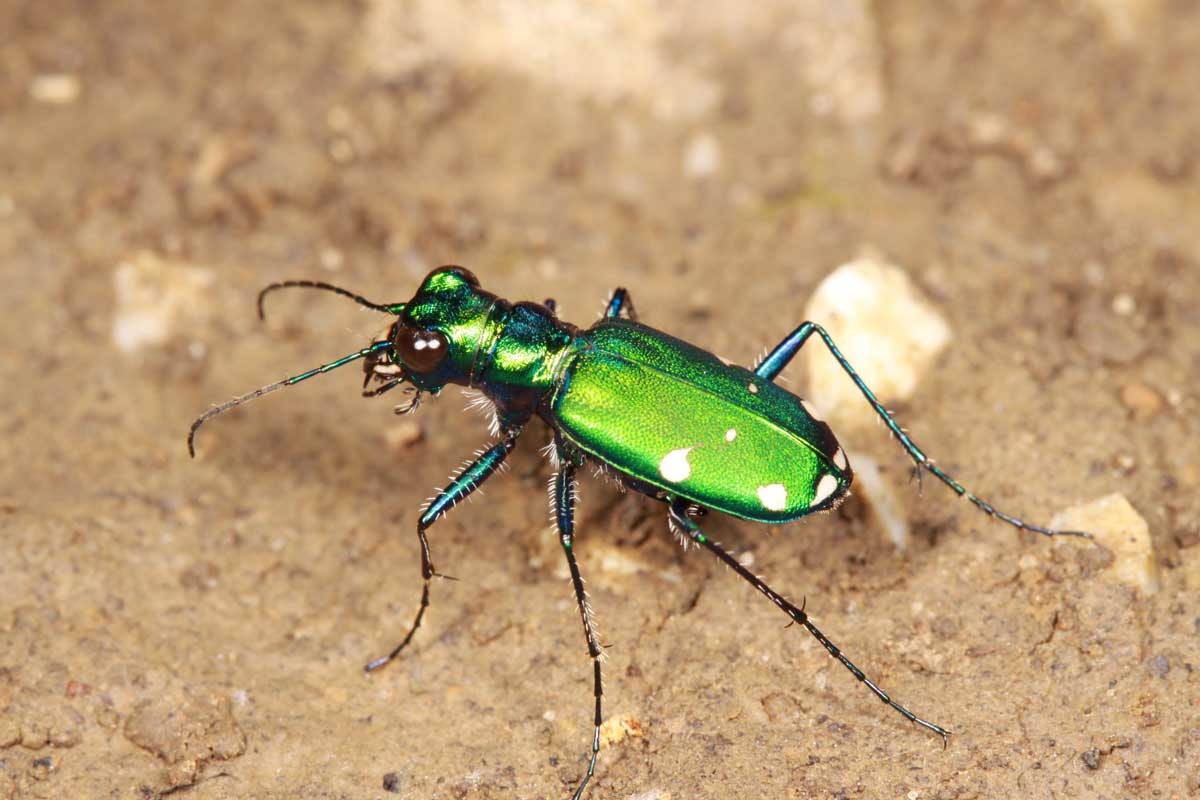
This post may seem like déjà vu to some of you, as it is my third featuring our common woodland tiger beetle species, Cicindela sexguttata (six-spotted tiger beetle). However, this post is as much a photography lesson as it is insect post, and when I say photography lesson I mean for myself – I’m not yet anywhere near the point where I feel qualified to dole out photography advice to others.

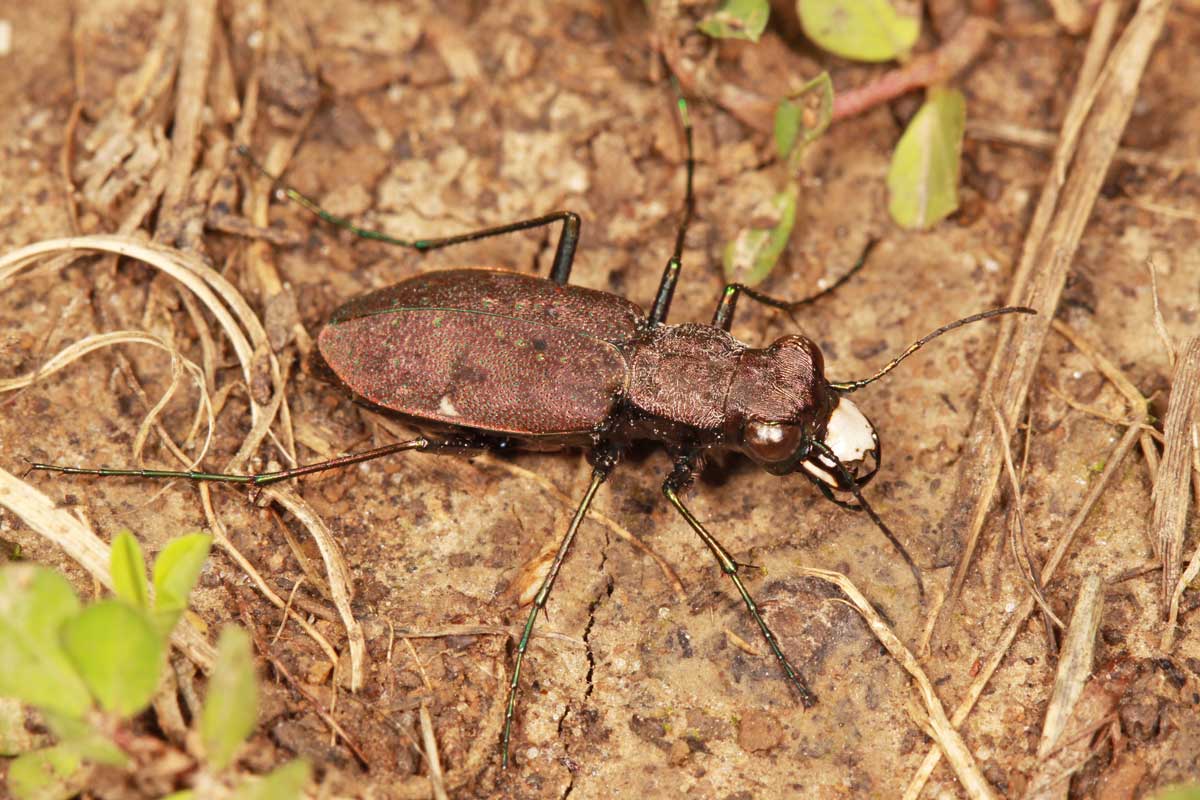
The last weekend of May, I returned to nearby Shaw Nature Reserve in hopes of photographing Cicindela unipunctata (one-spotted tiger beetle). This large, nearly flightless species has been recorded broadly across the eastern U.S. but is not encountered all that commonly. It is among the few species that seem to prefer more shaded woodland habitats (Pearson et al. 2006); however, its ecology is still not well understood. I had hoped to find it during my first outing with the new camera setup, but it was not to be and I had to settle for C. sexguttata as the first tiger beetle subject for my camera’s maiden voyage.   On this return visit, I arrived at the preserve shortly before noon and proceeded to walk back and forth along the trails where my colleague, Chris Brown, had noted healthy populations last year and one individual just three weeks ago.  For four hours, I gazed intently at the path in front of me in hopes of seeing the beetle – usually blending well with the ground because of its dull brown upper surface and noticed only because of its clumsy manner of running when disturbed.  All to no avail.  Of course, our old friend C. sexguttata was still present in good numbers, and since I wasn’t completely happy with the results of my first photo shoot of this species with the new camera I decided to try it again.

My main criticism of the initial photographs of this species was the harshness of the lighting.  I suspected that diffusers of some type would give a better result, so for this outing I covered the flash heads with small plastic diffuser caps that I had purchased with the flash unit.  The following series of photographs compare the results with and without the diffuser caps.  The photos have been left unenhanced but are reduced from their original size to 1200×800 pixels.  All of the photographs were taken using a Canon EF 100mm macro lens on a Canon EOS 50D, ISO 100, exposure 1/250 sec, and MT-24EX twin flash unit.  Click on the photos to see the enlarged version after reading the discussion of each.

Flash 1/4 power without diffuser caps, f/20

Flash 1/4 power without diffuser caps, f/20

This first photo is from the first session, during which I ran the flash unit at 1/4 power without diffuser caps.  The conditions were rather bright, and it required a relatively high f-stop (f/20) to get the exposure right.  This resulted in very good depth of field, but as you can see the lighting is rather harsh with bright highlights due to the brilliant, metallic coloration of the beetle.

1/8 power flash w/ diffuser caps

Flash 1/8 power flash with diffuser caps, f/10

In this photograph, I reduced the flash power to 1/8 and used the diffuser caps.  This softened the light considerably and removed much of the harsh highlighting.  However, I had to open up the aperature to f/10 in order to get good exposure, and as a result the depth of field really suffered.  Apparently the diffuser caps also reduce the amount of light from the flash, which combined with reducing the power to 1/8 substantially lowered the light levels.

Flash 1/4 power, w/ diffuser caps, f/13

Flash 1/4 power with diffuser caps, f/13

I then increased the flash back up to 1/4 power but kept the diffuser caps in place.  This allowed me to increase the f-stop to f/13, which resulted in much better depth of field.  Since this photograph was taken in fairly bright conditions, this suggests that I might want to go up to 1/2 power flash in lower light situations if I want to maintain a higher f-stop.  I am very happy with this photograph – the lighting is even with no harshness, and virtually the entire beetle from foreground to background is in focus.  A little post-processing might still be helpful for reducing the shadows a bit, but otherwise I think this is a pretty good standard to shoot for with my future tiger beetle photographs.

Photo details: Canon EF 100mm macro lens on a Canon EOS 50D, ISO 100, 1/250 sec, f/13, MT-24EX flash 1/8 power with diffuser caps

Cicindela unipunctata - flash 1/8 power with diffuser caps, f/13

As the saying goes, patience rewards those who wait, and a short time before I needed to leave, I finally saw the first C. unipunctata.  I was lucky enough to see it on the path without first disturbing it and was able to slowly crouch down into position and roll off a series of photos from this angle.  The photo I share here seemed to be the best of the series, but as I tried to shift to get a different view the little bugger began to bolt.  I blocked his escape with my hands until he seemed to settle down and then looked for him in the viewfinder, but I couldn’t find him – he had bolted as soon as I took my eye off of him, never to be seen again.  It amazes me how a relatively large beetle such as this – flightless even – can disappear completely amongst the vegetation.  Nevertheless, I accomplished my goal of getting at least one good photograph of this species, and you can be sure that I’ll be back to try for more.

I know there are several quite capable insect macrophotographers out there that occasionally read this blog – I encourage any comments or feedback that you might have on the techniques I have discussed here.

Copyright © Ted C. MacRae 2009

REFERENCE:

Pearson, D. L., C. B. Knisley and C. J. Kazilek. 2006. A Field Guide to the Tiger Beetles of the United States and Canada. Oxford University Press, New York, 227 pp.

Add to FacebookAdd to NewsvineAdd to DiggAdd to Del.icio.usAdd to StumbleuponAdd to RedditAdd to BlinklistAdd to Ma.gnoliaAdd to TechnoratiAdd to Furl