The “black bringer of light”

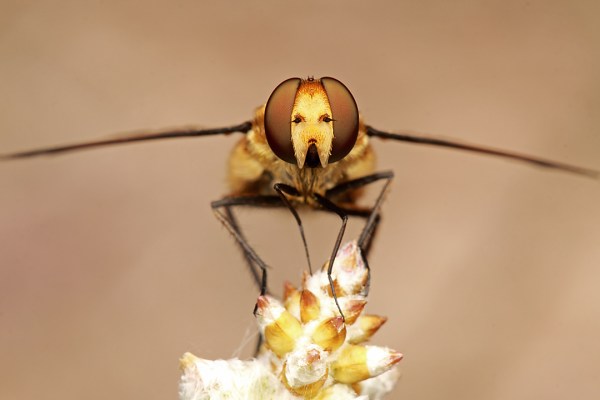
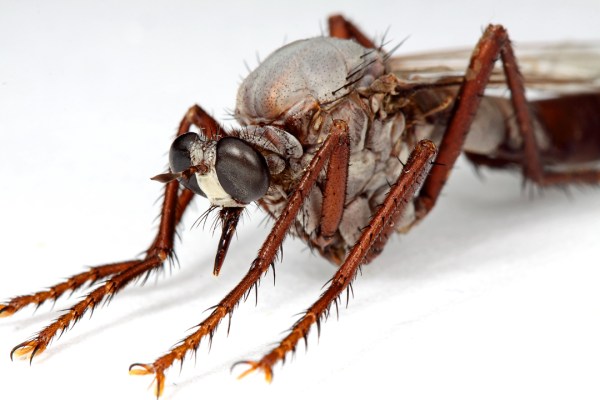
During last year’s Fall Tiger Beetle Collecting Trip, I spent a day visiting cemeteries in the Post Oak Savannah region of northeastern Texas to look for tiger beetles associated with open sand in and around the cemeteries. It had been a good day, and I thought I would try to squeeze in one more visit to a locality I had visited earlier in the day. By the time I arrived at Sand Flat Cemetery in Henderson Co., however, it was almost 6 p.m.—the sun was still up, but the shadows were long and no tiger beetles were found. Not all insects, however, are so quick to turn in as tiger beetles, so I lingered for awhile and eventually found an area where several large bee flies (family Bombyliidae) were seen flying and briefly perching on the ground or the tips of plains snakecotton (Froelichia floridana). Since this was the last stop of the day and there were no tiger beetles to demand my attention, I spent a fair bit of time trying to photograph these very skittish flies and ended up with photos of two different individuals that I was happy with.

Poecilanthrax lucifer

Poecilanthrax lucifer (Fabricius, 1775)—Sand Flat Cemetery, Henderson Co., Texas

Alex Harman was the first to suggest they might represent the species Poecilanthrax lucifer based on a quick iPhone photo that I posted on Facebook, a hunch that was eventually confirmed by Bishop Museum dipterist Neil Evenhuis based on these photos sent to him by e-mail. Poecilanthrax  is a strictly North American (sensu lato) genus that, at the time of its last revision by Painter & Hall (1960), contained 35 species. Although distributed from Canada south through Central America, the greatest abundance of species and individuals is found in the Great Basin region, and, so far as is known, the larvae develop as parasites inside caterpillars of various cutworms and armyworms (family Noctuidae).

Poecilanthrax lucifer

Adults were found perching on the flowers of plains snakecotton (Froelichia floridana)

Poecilanthrax lucifer is one of the more widely distributed species in the genus, occurring predominantly in the West Indies and southern Gulf States but also ranging south into Central America and north into Arkansas and southern Illinois. It is distinguished from other species in the genus by its conspicuous black and yellow tomentose (densely covered with short matted woolly hairs) crossbands on the abdomen and the bases of the larger veins yellow or tan and contrasting with the remainder of the wing color pattern.

Poecilanthrax lucifer

Black and yellow tomentose abdominal bands and yellow/tan larger wing veins distinguish this species.

Like other species in the genus, P. lucifer is known to parasitize noctuid caterpillars, having been reared from fall armyworm (Spodoptera frugiperda) and exhibiting parasitism rates of up to 25%. This species is unique in the genus, however, in that it has also been reported as a hyperparasite (parasite of a parasite) of Myzine haemorrhoidalis (family Tiphiidae), a primary parasite of white grubs (genus Phyllophaga) in Puerto Rico. The life histories of many species in the genus remain unknown, however, so perhaps other species in the genus will eventually be found to act as hyperparasites as well. All species of Poecilanthrax appear to be univoltine (one generation per year) in natural habitats; however, P. lucifer and a few others that frequent agricultural areas have been found to become facultatively bivoltine or multivoltine due to the extended seasonal availability of pest caterpillars that often occur in these situations.

Poecilanthrax lucifer

“Satanic deadly disease” or “black bringer of light”?

The scientific name of Poecilanthrax lucifer is perhaps one of the more ominous sounding names I’ve encountered. “Anthrax” is, of course, commonly associated with the often deadly infectious bacterial disease caused by Bacillus anthracis, while “lucifer” is none other than Satan himself! However, I suspect that the name of the genus refers not to the disease, but rather its original Greek meaning of “charcoal” in reference to the often black color of the adult flies. Likewise, the original Latin meaning of the word “Lucifer” is “morning star” or “Venus” when used as a noun and “light-bringing” when used as an adjective—only after a series of corruptions through repeated transcriptions and translations of the Bible did it become a name synonymous with the Devil. Thus, a name that could be interpreted as “Satanic deadly disease” might actually mean the “black bringer of light”.

REFERENCE:

Painter, R. H. & J. C. Hall. 1960. A monograph of the genus Poecilanthrax (Diptera: Bombyliidae). Kansas State University of Agriculture and Applied Science, Agricultural Experiment Station, Technical Bulletin 106, 132 pp. [HathiTrust pdf].

© Ted C. MacRae 2016

2015 Texas Collecting Trip iReport—Fall Tiger Beetles

This is the fourth in a series of “Collecting Trip iReports”—so named because I’ve illustrated them exclusively with iPhone photographs. As I’ve mentioned in previous articles in this series (2013 Oklahoma2013 Great Basin, and 2014 Great Plains), I tend to favor my iPhone camera for general photography—i.e., habitats, landscapes, miscellaneous subjects, etc.—during collecting trips and save my full-sized dSLR camera only for those subjects that I want high-quality macro photographs of. iPhones are not only small, handy, and quick but also capable (within reason) of quite good photographs (see this post for tips on making the most of the iPhone camera’s capabilities). This keeps the amount of time that I need to spend taking photos at a minimum, thus allowing more time for the trip’s intended purpose—collecting! Those photos form the basis of this overall trip synopsis, while photos taken with the ‘real’ camera will be featured in future posts on individual subjects.

Last year during late September and early October I travelled to eastern and central Texas. This trip was all about fall tiger beetles, in particular certain subspecies of the Festive Tiger Beetle (Cicindela scutellaris) and Big Sand Tiger Beetle (Cicindela formosa) found in that area that I had not yet seen. I enjoy all collecting trips, but fall tiger beetle trips are among the most enjoyable of all—cooler temperature, a changing landscape, and charismatic subjects that are both fun and challenging to find and photograph. This trip was no different, with spectacular weather during the entire week and, for the most part, great success in finding the species/subspecies that I was after. At this point I’d like to acknowledge the help of several people—David Hermann (Ft. Worth, Texas), David Brzoska (Naples, Florida), and Steve Spomer (Lincoln, Nebraska), who generously provided information on species and localities. My success at finding these beetles was due in large part to the information they provided.


Day 1 – Cobb Hollow

My car

Little question about what I am doing out here.

After driving 700 miles from my home near St. Louis, I arrived at the first stop of trip—Cobb Hollow in north-central Texas. This small creek lined with deep, dry sand is close to Forestburg (Montegue County)—the type locality of Cicindela scutellaris flavoviridis, a beautiful, all-green subspecies with the elytra suffused golden-yellow.  The habitat looked very promising from the start, and it wasn’t long before I found the first tiger beetle of the trip—a gorgeous, red nominate Big Sand Tiger Beetle (Cicindela formosa formosa). Not long after that I found the first Cicindela scutellaris flavoviridis, and over the next few hours I would find a total of nine individuals. Despite the extensive habitat along the creek the beetles were quite localized, occurring primarily in two dry sand areas within a mile west of the bridge. This spot is actually near the northern limit of the subspecies’ distribution, and several of the individuals showed varying influence from nominate scutellaris with the elytra tending to be more red than yellow-green. There was a diversity of other tiger beetles here as well—C. formosa formosa was the only one that was common, but I did find also a few individuals each of Tetracha carolina, Cicindelidia punctulata, Cicindela splendida, and C. repanda. A very cool place.

Cobb Hollow from bridge

View of Cobb Hollow east from the bridge

Sand bar along creek

Dry sand deposits line the creek.

Robber fly with bumble bee prey

I watched this robber fly snag a bumble bee in mid-flight.

Ted MacRae at Cobb Hollow

Looking down onto the creek from the bridge.


Day 2 – Stalking the Limestone Tiger Beetle

Today was all about looking for the Limestone Tiger Beetle, Cicindelidia politula. I have collected this species previously at several sites in Erath and Somervell Counties, Texas (west of Ft. Worth) and featured photographs from that trip. However, since I would be passing through the area on my way south I decided to spend a day looking for it again and, hopefully, collecting a few more specimens. Cicindelidia politula is related to the much more common and widespread Punctured Tiger Beetle, C. punctulata, but is shiny blue-black with the elytral markings absent or limited to the apices and the abdomen red. I visited several localities—two new ones for me in Erath County and another I had visited previously in Somervell County, with habitats that ranged from rocky clay to white limestone exposures along roadsides and even limestone gravel.

I found a fair number of individuals at the first site (1.7 mi SW Bluff Dale, Jct US-377 & FM-1188), which had a finely ground limestone substrate. Most of the individuals were flushed from the base of clumps of bunch grass and captured when they landed in more exposed situations.

Limestone habitat for Cicindelidia politula

Cicindelidia politula habitat—1.7 mi SW of Bluff Dale.

The beetle had also been reported along the roadsides at the second location (0.4 mi E Jct FM-2481 on CR-539), but the only individual I saw here was on a very coarse crushed limestone 2-track leading off of the main road.

Limestone habitat for Cicindelidia politula

Cicindelidia politula habitat—0.4 mi E Jct FM-2481 on CR-539.

The species was most numerous at the third site in Somervell County (3.4 mi SE Jct US-67 on CR-2013). I collected ten individuals and saw probably that many more on white limestone exposures along the roadside and along a dirt road cut along the base of the hill to the NE side of the highway. Most of the beetles in the latter area were seen along the scraped dirt road (at left in 2nd photo below), although presumably the beetles also utilized the undisturbed, surrounding habitat.

Limestone habitat for Cicindelidia politula

Cicindelidia politula habitat on white, limestone exposures along the roadside.

Limestone habitat for Cicindelidia politula

Cicindelidia politula habitat on white limestone hillside and scraped dirt road.

Catching the beetles at this last locality was challenging—the adults are fast and flighty, and the rough, rocky habitat made it difficult to clamp the net over the beetle and pounce on top of the rim before they were able to find a gap and escape. With practice I found my catch efficiency increased a little bit if I slowly approached the beetle and then made an assertive swing with the net right when the beetle began to fly—the trick is learning how to tell when they are ready to fly (and “assertive” is the key word!). Tiger Beetle Stalker; however, does not quit!

Tiger beetle stalker!

Tiger Beetle Stalker!


Day 3 (Part 1) – Pedernales Fall State Park

This was another locality where Cicindela scutellaris flavoviridis had been recorded. I came here to find this subspecies even though I had seen it two days previously at Cobb Hollow, because that latter population showed some slight intergradation of characters from nominate C. scutellaris and I wanted to get field photographs of a “pure” population. I was pretty excited when I saw extensive dry sand habitat lining the upper bank area along the Perdenales River; however, I found no tiger beetles of any kind after extensive searching through that habitat. I did note the area seemed dry and reasoned that perhaps timely rains had not yet triggered emergence of C. scutellaris, C. formosa, and other sand-loving fall tiger beetles. I did find a small area of wet sand right along the water’s edge where three species of Cicindelidia could be seen: C. ocellata rectilatera, C. trifasciata ascendens, and C. punctulata. I’ve photographed all of these species before, so I didn’t try to spend any time doing so here. However, combined with the species seen the previous two days, this made a total of ten species seen on the trip so far. Although I didn’t find the beetle I was looking for, I marveled at the beauty of the area, especially the Pedernales River with its hard, conglomerate bedrock and mini shut-ins and spent quite a bit of time here taking photographs.

Perdenales River

The Perdenales River is the centerpiece of the state park.

Schistocerca americana or nitens

Schistocerca americana or S. nitens (ID courtesy of Matt Brust).

Perdenales River

Shut-ins are extensive along the Perdenales River.

Poecilognathus sp.

Bee flies (family Bombyliidae), prob. Poecilognathus sp. (ID courtesy Rob Velten).


Day 3 (Part 2) – Lick Creek Park

Another of the Festive Tiger Beetle subspecies that I wanted to look for was Cicindela scutellaris rugata. I had several localities from which this solid blue-green subspecies has been recorded, and this site was the nearest of those that I planned to visit. The drive from Pedernales State Park was longer than I anticipated, so I didn’t get to this spot until close to 6 p.m. At first I worried that I wouldn’t have enough time to even find suitable habitat, but that was no problem as I quickly found the Post Oak Trail and its perfect open, post oak woodland with deep sand substrate. By all accounts the beetles should have been all over the trail but they weren’t. As with the previous site, the area was quite dry as evidenced by the wilted plants along the trail side, and I also note that the previous record from here was on Oct. 23rd—more than three weeks later. Despite the fact that I didn’t find any tiger beetles, I did see a young timber rattle snake (Crotalus horridus) crossing the trail late in the hike—I took a quick shot with the iPhone (see below) and then broke out the big camera and was able fire off a few shots before it left the trail and headed for cover. (Several people walking the trail came upon us, and they were all—happily—more than willing to oblige my requests to stay away until I was finished.)

Sand woodlant habitat for Cicindela scutellaris rugosa

Post oak woodland with dry sand substrate seems to be perfect for Cicindela scutellaris rugata.

Wilted American beautyberry (Callicarpa americana)

Wilted American beautyberry (Callicarpa americana).

Timber rattlesnake (Crotolus horridus)

A youngish (prob. ~32″ in length) timber rattlesnake (Crotolus horridus) was a treat to see.


Day 4 – East Texas cemeteries

Cemeteries are often great places to look for tiger beetles because they tend to be located on parcels of land with low agricultural value that were donated by landowners to local churches. Older cemeteries especially tend not to be highly maintained and, thus, offer excellent habitat for tiger beetles. My goals for this day were Cicindela scutellaris rugata and the gorgeous Cicindela formosa pigmentosignata. I had records of both from a couple of cemeteries in eastern Texas (Sand Flat Pioneer Cemetery in Henderson and Morris Chapel Cemetery in Van Zandt Counties) and found good numbers of both along sandy 2-tracks and sparsely to moderately vegetated sand exposures in and around the cemetery grounds. I don’t have any iPhone photographs to share of either of these species, but I did spent a lot of time with the big camera and got a number of photos of each that I am quite pleased with—I’ll share those in future posts. The cemeteries themselves were haunting and poignant, with some headstones dating back to the late 1800s.

Sandy 2-track habitat for Cicindela scutellaris rugata & C. formosa pigmentosignata

Sandy 2-track habitat for Cicindela scutellaris rugata & C. formosa pigmentosignata at Sand Flat Pioneer Cemetery, Henderson County, Texas.


Ant mound

Pogonomyrmex sp. poss. barbatus tend their nest entrance (ID courtesy of Ben Coulter).

Sand Flat Pioneer Cemetery

Oldest section of Sand Flat Pioneer Cemetery.

Died Nov 10, 1874

Fallen, but not forgotten—yet (died Nov 10, 1874).

Oldest headstones (late 1800s)

Oldest headstones (late 1800s) at rest under the shade of huge, red-cedar trees.

Oldest person (106 yrs old)

The oldest person died at 106 years of age (born in 1804).

At Morris Chapel Cemetery I found C. formosa pigmentosignata and C. scutellaris rugata on sparsely vegetated deep dry sand 2-track north of the cemetery. I did also manage to get field photos of the former before it got too hot and they became too active. There were also a few of the latter in the open sandy ground just outside the northwestern edge of the cemetery. As with Sand Flat Pioneer Cemetery, I spent a bit of time in the cemetery proper to look at the headstones—the oldest headstone also being the most poignant; a one and a half-year old boy who died in 1881.

Sandy 2-track habitat for Cicindela scutellaris rugata & C. formosa pigmentosignata

Sandy 2-track habitat near Morris Chapel Cemetery.

Morris Chapel Cemetery

A large, spreading post oak shades pioneers at rest.

Died 1881 (age 1½ yrs)

A poignant headstone (died 1881 at 1½ years of age).

After finishing up at Morris Chapel Cemetery I returned to Sand Flat Cemetery to see if I could get more field photographs before the beetles bedded down for the night. The sun was still up when I arrived a little before 6 p.m., but the shadows were long and no beetles were seen. Not one to waste an opportunity, I broke out the big camera anyway and started photographing a large species of bee fly (family Bombyliidae) that was perching on the ground and on the tips of plains snakecotton (Froelichia floridana).

Undet. bee fly

Bee fly (family Bombyliidae), poss. Poecilanthrax lucifer? (ID courtesy Alex Harman).


Day 5 (Part 1) – Cowtown Bowman Archery Club

With both specimens and good field photos of Cicindela scutellaris rugata and C. formosa pigmentosignata in hand, I returned my attention to C. scutellaris flavoviridis. Again, I did already have specimens in hand from Cobb Hollow, but most of them showed some degree of intergradation with nominate C. scutellaris and I was hoping to see some “pure” individuals. Failing to find it at the more southerly locations (Pedernales State Park and Lick Creek Park), I had one more location in Tarrant County where the subspecies had been recorded—a sand borrow pit near the entrance of Cowtown Bowman Archery Club. Once again I searched the area thoroughly for a couple of hours during mid-morning but did not see the subspecies or any other tiger beetles. Conditions were overcast and cool (72°F), but I do not think this explains the absence of adults. Rather, I think I was on the early side of the season and they just hadn’t started emerging at this site.

While I was at the site I found several tiger beetle larval burrows in a moderately vegetated area near the deeper sand deposits that were occupied by Tetracha carolina, so I used the “stab” or “ambush” method to collect several 3rd instars for an attempt at rearing. For those of you who are not familiar with this technique, a knife is set at a 45° angle with the tip in the soil about 1″ from the edge of the burrow. Then you wait, sometimes for quite a while, until the larva reappears at the top of the burrow and STAB the knife assertively into the soil to block the larva from retreating. The larvae are extremely wary with excellent vision and will usually drop back down immediately when they see you, so you have to be ready and act quickly. Once the retreat is blocked, a simple twist of the knife to expose the larva is all that is needed. I prepared larval habitats by placing native soil with as intact a top layer as possible in plastic critter carriers, made a starter hole for each larva with a pencil, dropped each larva into one of the holes, and then pushed the soil to seal the burrow entrance. This prevents the larvae from crawling right back out of the starter burrow, which can result in them encountering and fighting each other. The larvae will eventually reopen the burrow entrance, but after being sealed inside for a while they usually accept the burrow and further modify it to suit their needs.


Sandy grassland habitat for Tetracha prob. carolina

Sandy grassland habitat for Tetracha carolina.

Larval burrows (lower left) can be recognized by their clean, almost perfectly round, beveled edge. The presence of fresh soil diggings cast to one side (upper right) indicates the burrow is occupied by an active larva.

Tetracha prob. carolina larval burrow

Tetracha carolina larval burrow with cast soil diggings.

Using the “stab” or “ambush” method to collect larvae. One must have patience to successfully use this method.

"Stab 'n; grab" method to collect tiger beetle larvae (Tetracha prob. carolina)

Using the “stab” or “ambush” method to collect tiger beetle larvae.


Day 5 (Part 2) – Cobb Hollow (epilogue)

Although I had found Cicindela scutellaris flavoviridis at this site on the first day of the trip, I had not taken any field photographs in hopes of finding a more “pure” population at one of the more southerly locations. That did not happen, so I returned to Cobb Hollow on this last day in the field to get field photographs from the population there. Temperatures were a bit cooler (mid-70s) and cloud cover was variable, actually sprinkling when I arrived mid-afternoon but eventually clearing. This seemed to have no detrimental effect on adult presence, and it may have actually helped as I was able to photograph the very first individual that I found to my heart’s content. I collected that individual and the next three that I saw by hand and found two more over the next hour—all on the same deep, dry sand bars west of the bridge where I had seen them previously. Curiously, Cicindela formosa was strangely absent from these same areas where they had been so numerous a few days earlier.

Habitat for Cicindela formosa formosa and C. scutellaris flavoviridis

Deep, dry sand deposit where most of C. scutellaris flavoviridis were seen.

On the east side of the bridge I collected two more Tetracha carolina in the same moderately vegetated sandy clay spot as last time, then went on to the furthest dry sand bar where I found and photographed (but did not collect) a single C. formosa (only one shot before it took off). I also found a female green lynx spider (Peucetia viridans) sitting on her egg mass and got some nice macro photos as well as this iPhone shot (talk about a face only a mother could love!).

???????????????????????????????????????????????????????????????????

Female green lynx spider (Peucetia viridans) atop her egg mass.


I hope you’ve enjoyed this collecting trip iReport. Stay tuned for true macro photographs of the tiger beetles and other insects/arthropods that I photographed on this trip in more subject-specific posts. You are also welcome to leave feedback in the comments below.

Ted MacRae w/ field collecting equipment & camera

© Ted C. MacRae 2016
Fire ant winged reproductives: male and female

While in Austin at the Entomological Society of America meetings, I had the chance to tour The University of Texas at Austin’s Brackenridge Field Laboratory.  Located on 82 acres of land bordering the Colorado River, the station supports studies in biodiversity, ecosystem change and natural history. A major focus of research at the station involves efforts to establish biological control agents for control of imported fire ant (Solenopsis invicta) using entomopathogens and parasitoids (e.g. phorid flies in the genus Pseudacteon). This research relies on maintaining cultures of fire ants to support rearing of the phorid fly. While time was limited and I did not have much opportunity to photograph either the ant or the fly, I did manage to quickly sneak in a shot or two of some winged reproductives that were removed from the teaming formicid mass in a rearing tray and placed on a table top for all to see (and when I say “a shot or two” I mean it. I had the chance only for one shot of the female and two of the male as they crawled crazily about and the tour leader quickly tried to move us on). I’m sure Alex Wild has all stages/forms of this species covered in spades, but the sexually dimorphic winged reproductives were new for me, and perhaps some readers of this blog as well.

Solenopsis invicta winged reproductives: male (top), female (bottom).

Solenopsis invicta winged reproductives: male (top), female (bottom).

Copyright © Ted C. MacRae 2013

ESA Insect Macrophotography Workshop

Today is the last day of the Entomological Society of America (ESA) Annual Meeting in Austin, Texas, and it has been an action packed week for me. Annual meetings such as this serve several purposes. In addition to seeing talks on a variety of subjects—in my case covering subjects ranging from insect resistance management to scientific outreach to beetle systematics—they also offer the chance to establish new connections with other entomologists that share common interests and reinforce existing ones. Of course, a major part of my interest in entomology revolves around insect macrophotography, and in recent years ESA has begun to cater to the entomological photographer contingent within the society. Last year’s meetings featured a macrophotography symposium titled, “Entomologists Beyond Borders” (for which I was one of the invited speakers), and this year featured an Insect Macrophotography Workshop led by Austin-based entomologist/photographer Ian Wright. Having done this for a few years now I figured a lot of the workshop might be review for me, but I still have much to learn and am willing to accept new ideas from any source. Besides, the workshop involved a field trip to a local habitat to try out our insect photography skills, and for a field junkie like me time in the field at an otherwise all-indoor event spanning close to a week is always welcome. The location of the meetings in Austin this year made this possible, as even in mid-November there still remain insects out and about that can be photographed if the weather cooperates (and it did).

This will be a somewhat different post than what I usually post here. Rather than featuring photos of a certain species and using them as a backdrop for a more detailed look at their taxonomy or natural history, I’m just going to post all the photos that I ended up keeping from the field trip portion of the workshop with just a comment or two about each. We went to the city’s nearby waste-water treatment facility, the grounds of which are wild and woolly enough to provide habitat for insects, and spent about an hour and a half seeing what we could find. For myself, it was a chance to photograph some insects I’ve not normally tried to photograph (i.e., dragonflies, ambush bugs) and get more practice on my blue sky technique. I did appreciate the chance to spend some time talking to Ian during while we traveled to the site and back, and I also ended up helping other participants with their camera equipment questions and technique suggestions. With that, here are the photos I took—I’ll be curious to see what readers think of this post format versus my more typical style.

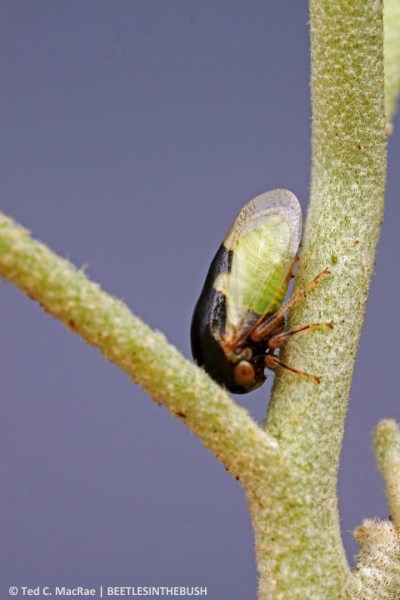
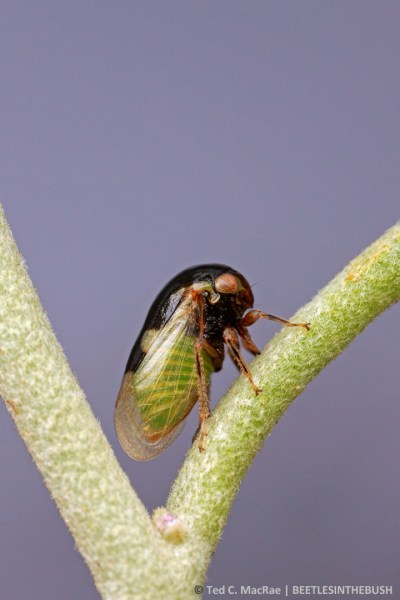
Micrutalis calva

Micrutalis calva (Hemiptera: Membracidae) on silverleaf nightshade (Solanum elaeagnifolium).

Micrutalis calva

This species of treehopper is restricted to herbaceous plant hosts.

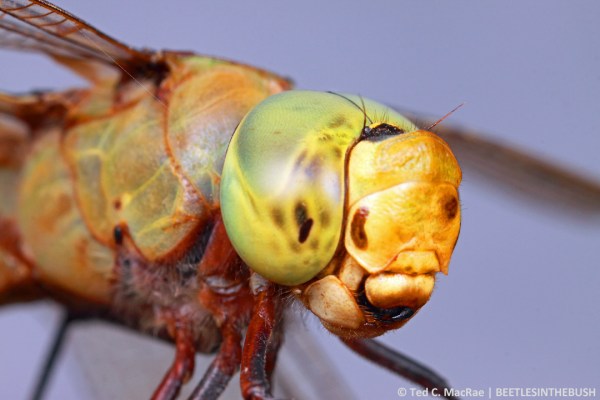
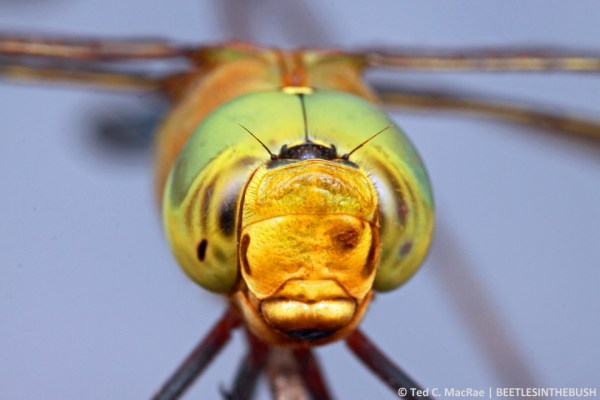
Anax junius

Anax junius (Odonata: Aeshnidae), one of the darner species of dragonfly.

Anax junius

This adult was perched on a dead twig tip and seemed to be “asleep.”

Anax junius

I clipped the perch and held it up for these “in-your-face” shots – it then awoke with a start and flew off.

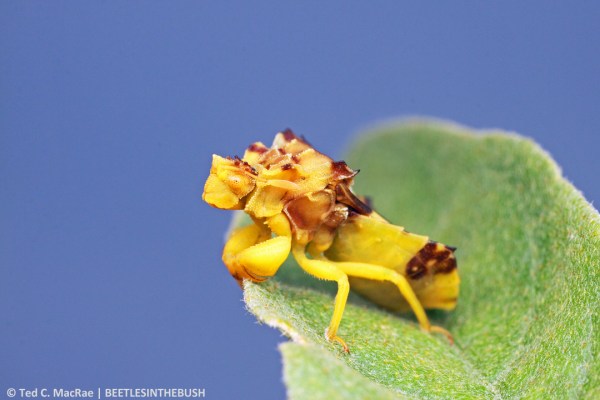
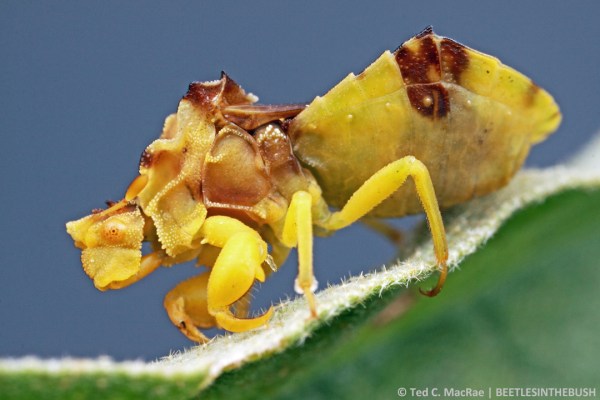
Phymata sp.

Phymata sp. (Hemiptera: Reduviidae), one of the so-called “jagged ambush bugs.”

Phymata sp.

Formerly a separate family, ambush bugs are now combined with assassin bugs (family Reduviidae).

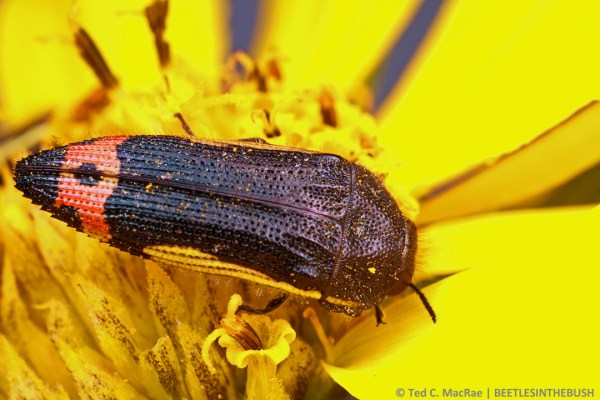
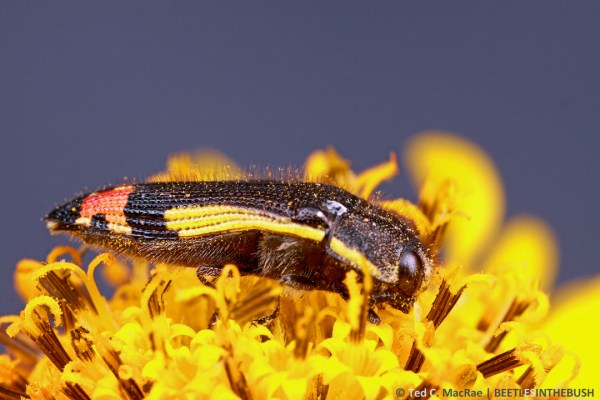
Acmaeodera flavomarginata

Acmaeodera flavomarginata (Coleoptera: Buprestidae).

Acmaeodera flavomarginata

This is one of a few species of jewel beetle in the southcentral US that are active during the fall.

Mecaphesa sp.

Mecaphesa sp. (Araneae: Thomisidae), one of the crab spiders

Mecaphesa sp.

Cryptic coloration allows the spider to lurk unseen by potential insect prey visiting the flower.

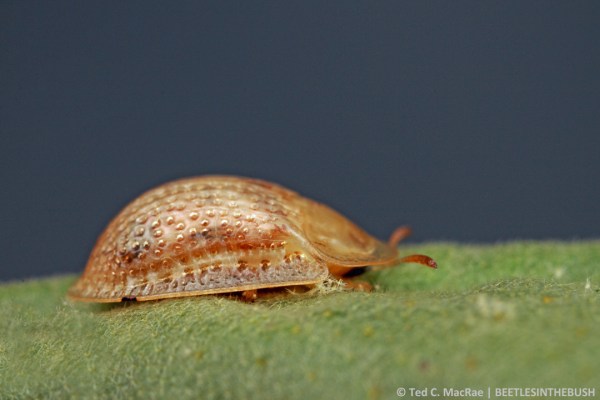
Gratiana pallidula

Gratiana pallidula (Coleoptera: Chrysomelidae) on silverleaf nightshade (Solanum eleagnifolium).

Gratiana pallidula

A type of tortoise beetle, adults “clamp” down against the leaf as a defense against predators.

Copyright © Ted C. MacRae 2013

Best of BitB 2012

Welcome to the 5th Annual “Best of BitB”, where I pick my favorite photographs from the past year. 2012 was one of the most intensive travel years I’ve ever had—I spent 8 weeks in Argentina from February through April, made separate trips to Puerto Rico and Arkansas in May (bracketing a personal week in California), traveled almost weekly to Illinois and Tennessee from June to September (interrupted by a personal week in Florida in July), toured the southeastern U.S. (Arkansas, Louisiana, Mississippi and Georgia—great food!) in early September, chased tiger beetles in Oklahoma, Texas and Arkansas in late September, went back to Argentina for a week in October, and capped off the travel year by attending the Entomological Society of America Annual Meetings in Knoxville, Tennessee (for the first time in more than 10 years!)—whew! While many would cringe at such a travel load, I am among the lucky few who actually get paid for doing something that is also my hobby—entomology! This gives me ample opportunity to further hone my photography skills (nine of the 13 photos I’ve selected below were actually taken while I was on business travel), resulting in two key accomplishments this year—my first ever photography talk at the ESA’s insect photography symposium and my first commercial sales (look for the BitB commercial site to go online in 2013).

Enough blather! Here are my favorite BitB photographs from 2012. Click the link in the text below the photo to see the original post. I would greatly appreciate knowing if you have a favorite (and why)—your feedback will be enormously helpful to me as I continue to learn and develop as a photographer.  For those interested, here are my previous year picks for 2008, 2009, 2010 and 2011. And, as always, thank you for your readership!


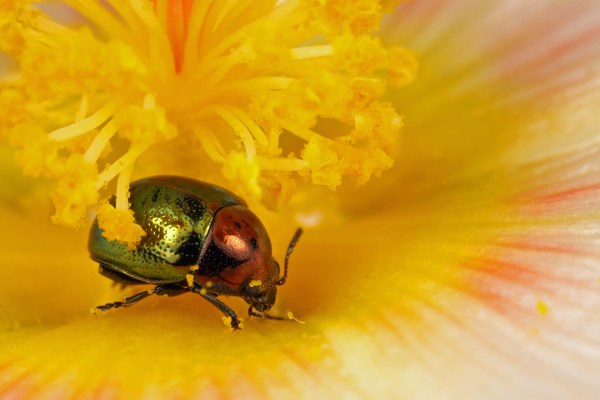
Spintherophyta (?) sp. in flower of Abutilon pauciflorum | Buenos Aires, Argentina

From  (posted 2 Feb). One of my 2012 learnings was that sometimes a photograph that is not so close is more effective than one that is as close as possible. In one of my earlier attempts at “not-so-close” macrophotgraphy, the soft colors of the flower compliment the brash shininess of the tiny leaf beetle that has been feeding on its pollen. Pink lines lead the eye directly to the subject and create a pleasing composition, and pollen grains stuck to the beetle—a distraction in some situations—add to the miniature natural history story of the photo.


Apiomerus flavipennis with stink bug prey and kleptoparasitic flies | Chaco Province, Argentina

From  (posted 11 Mar). I selected this photo solely for the complex natural history story drama it shows—stink bug (Piezodorus guildenii) feeding on soybean becomes prey of an assassin bug (Apiomerus flavipennis), with volatiles from the chemicals it emitted in a vain attempt to defend itself serving as cues to kleptoparasitic flies (families Milichiidae and Chloropidae) that benefit from the assassin bug’s labors.


Planthopper nymph | Buenos Aires Province, Argentina

From  (posted 26 Mar). Another learning that I began putting into practice in 2012 was the use of low perspective for compositional impact. The cryptic coloration of this planthopper nymph (family Fulgoridae) made it almost invisible on the branch on which it was sitting when viewed from a normal “top-down” human perspective. Getting “down under” it, however, brought the nymph to life and emphasized its unusual form.


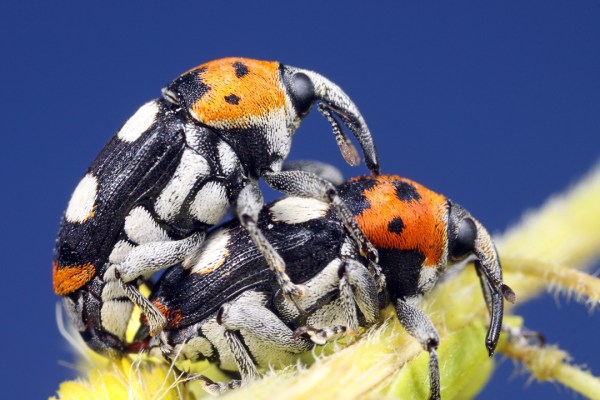
Megabaris quadriguttatus | Corrientes Province, Argentina

From  (posted 12 Apr). I spent much of 2012 working on the “blue sky background” technique, with these weevils from northern Argentina representing one of my better attempts. Macrophotography of insects with a blue sky background involves setting exposure, ISO, and aperture to achieve two separate exposures—full flash illumination of the subject for maximum depth-of-field, and ambient light from the sky to create a clean, uncluttered, natural-looking background. In this shot I managed to achieve an almost ideal shade of blue to compliment the wild black, white and red colors of the beetles. (My one criticism of the photo is having clipped one of the beetle’s feet.)


Bombylius sp. cf. mexicanus | Scott Co., Missouri

From  (posted 16 May). This photo is unusual if nothing else. Focus, lighting, depth-of-field, and composition are all better than can be hoped for in a single shot, but the subject—perfectly alive—is in a most unusual position. Read the original post to find out how this happened.


Perisphaerus sp. (a pill roach) | Vietnam (captive individual)

From  (posted 27 May). White-box photography is an excellent technique for clean, uncluttered photographs of insects, but it also isolates them from their natural surroundings and limits their natural history appeal. The best white-box photos are those that highlight a key feature or behavior of the subject—in this case a pill roach’s comically conglobulating defensive posture.


Micronaspis floridana (Florida intertidal firefly) larva | Pinellas Co., Florida

From  (posted 31 July). Here is another photo whose back story played a big part in its selection. This firefly larva not only represents a rare Florida-endemic species but was also first seen by my then 12-year old nephew, who willingly accompanied me through a dark, spooky salt marsh in the middle of a humid Florida night to see what he could learn. The lesson here for budding natural historians (and old-timers like me) cannot be overstated!


Arctosa littoralis (beach wolf spider) | Lewis Co., Missouri

From  (posted 23 Aug—prelude to  posted 28 Aug). Those who follow this blog know of my obsession with close-up portraits, and while tiger beetles are the subjects I most commonly photograph in this manner, I am always on the lookout for good subjects in other taxa. This wolf spider “face” almost looks human, with “two” eyes, two “nostrils” and a shiny upper lip above huge (albeit hairy) buck teeth! It’s enough fill-the-frame spidery goodness to melt (or explode) the heart of even the most ardent arachnophobe!


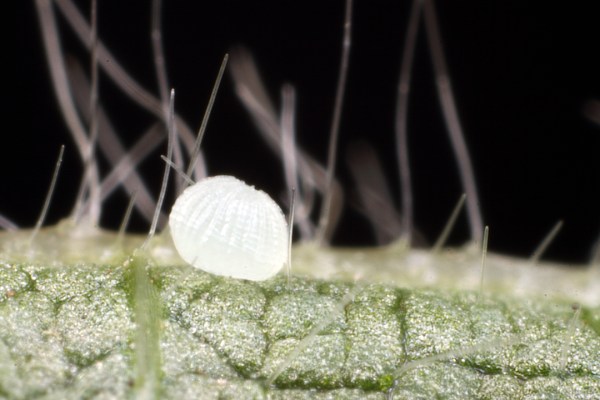
Anticarsia gemmatalis (velvetbean caterpillar) egg on soybean leaf

From Life at 8X—Guide to lepidopteran eggs on soybean (posted 3 Sep). “Life at 8X” was a new series I introduced this year, featuring insects photographed at magnifications testing the upper limit of my equipment and photographic skills. Diffraction is the chief difficulty with magnifications as high as this and is the primary flaw in the above photograph. Nevertheless, such view of a moth egg on the underside of a soybean leaf provides a spectacular view of the otherwise unseen micro-world that lives right beneath our noses.


Megacyllene decora (amorpha borer) on snakeroot flowers | Mississippi Co., Missouri

From  (posted 12 Sep). This second example of “blue sky background” was taken later in the year and was considerably more difficult to capture than the first because of the larger size of the subject and resulting need for a longer focal length macro lens. Getting a well-lit, focused, and composed image with a desirable shade of blue in the background depended not only on finding the proper camera settings, but also secure body and camera bracing techniques for this completely hand-held shot.


Cicindelidia politula politula (Limestone Tiger Beetle) | Montague Co., Texas

From  (posted 28 Sep). I will go ahead and say it—this is my favorite photograph of 2012. As discussed under the first entry, panning back from the subject can allow for some very interesting compositions. This photo combines charismatic pose by a wary subject with panning back and low perspective to create an image that scores high in both natural history and aesthetic appeal.


Calosoma sayi (black caterpillar hunter) | New Madrid Co., Missouri

From Black is beautiful! (posted 7 Nov). Of course, close-as-possible can also be used to create striking photos, especially if the subject exhibits features that are best seen up close. Anything with jaws fits the bill in my book, and highlighting the mandibular sculpturing of this caterpillar hunter (a type of ground beetle) required precise angling of the flash heads for maximum effect.


Cicindela repanda (Bronze Tiger Beetle) | St. Louis Co., Missouri

From  (12 Nov). This final selection is not a rare species, but it is as close as I have come to what I consider the “perfect” tiger beetle macrophotograph—a close, low angle, lateral profile of an adult in full-stilt posture (a thermoregulatory behavior), well lit, perfectly focused, and with a dynamic but pleasingly blurred background. It’s a perfect storm of a photo that took the better part of two hours to achieve—rarely do all of these elements come together in a hand-held photograph of an unconfined tiger beetle in its native habitat.


Well, there you have it. I hope you’ve enjoyed my selections, and again please do let me know if you have a personal favorite. See you in 2013!

Copyright © Ted C. MacRae 2012

The gloriously dichromatic Dasymutilla gloriosa

I have a small collection of velvet ants (family Mutillidae) that I’ve accumulated over the years—not through active collection but more as bycatch from my beetle hunting operations. Velvet ants are, of course, not ants at all, but wasps, and as such the females are—like their winged relatives—quite capable of delivering a painful sting if mishandled. They also tend to be seen running rather frenetically across the ground, making them difficult to guide into a collection vial or grab with forceps. You’ve gotta really want ’em if you want to collect them. Still, even though I don’t study them I find them interesting enough to pick up on occasion, and with most groups outside of my area of focus the hope is that eventually they will end up in the hands of somebody who actively studies the group. Such is now the case with my mutillid collection, which will be shipped this week to another collector specializing in the group. In return I will be filling some holes in European representation of my collection of Cerambycidae.

Dasymutilla gloriosa, female | Brewster Co., Texas

Dasymutilla gloriosa, female | Brewster Co., Texas

Without question, the most interesting mutillid species that I’ve encountered is Dasymutilla gloriosa. All mutillids are sexually dimorphic, as only the males are winged, but most also tend to be sexually dichromatic to a greater or lesser degree. No species I am aware of takes this to the same level as D. gloriosa! The males (photo below) are rather typically colored compared to other species in the genus, but the females (photo above) are densely covered with long, strikingly white hairs. While this would seem to make them quite conspicuous, the true effect is the exact opposite as they easily confused with fuzzy plant seed. For this reason they are commonly called thistledown velvet ants. I encountered the female in west Texas in 2003 while walking a mountain trail and at first thought it was the fuzzy seed of a creosote bush (Larrea tridentata) being blown by the wind—except there was no wind! It took me a little while looking closely at it before I could figure out what it actually was. This is the only female of this species that I’ve seen in the wild, and I’ll be a little sad to see it sent to another location.

Dasymutilla gloriosa, male | Riverside Co., California

Dasymutilla gloriosa, male | Riverside Co., California

The male also is the only one I’ve encountered—or at least taken the trouble to collect. I would have never suspected this male, which I collected in southern California in 1991, was the same species as the female that I collected many years later. My thanks to Kevin Williams, who provided the identifications for both of these specimens.

Also called the ''thistledown velvet ant''

Also called the ”thistledown velvet ant”

Copyright © Ted C. MacRae 2012

The “Other” Marvelously Monstrous Microstylum

Microstylum galactodes | Brewster Co., Texas

A couple of years ago during the initial testing of my DIY diffuser, I pulled a selection of rather impressive insects from my collection and photographed them on a white background to see how effectively the diffuser worked with different types and sizes of insects. I posted some of those photos for the larger insects in the following weeks, including the tank-like eastern Hercules beetle, the frightful-looking stag beetle, and the downright evil-looking red-eyed devil. There were, however, a number of smaller insects that I had also photographed but whose photos never made it onto these pages as a flush of new photography began the following spring. This is one of them: the robber fly, Microstylum galactodes (order Diptera, family Asilidae). I collected this specimen nearly 20 years ago in western Texas, and until the last few years it was the largest robber fly I had ever seen. That honor now goes to the closely related M. morosum (North America’s largest robber fly), which I have seen in northwest Oklahoma and as a previously unreported occurrence in southwestern Missouri. Still, M. galactodes is an impressive beast, and these photographs of the preserved specimen do little justice to its appearance in life.

The ”beard” (mystax) of Microstylum is confined to the oral margin and composed of stout bristles.

Both species of Microstylum are distinguished by the mystax (dense moustache of bristles on the face) confined to the oral margin and composed chiefly of stout bristles, but M. galactodes may be separated from its larger cousin by the light-colored wings and even, whitish bloom (powdery covering) covering the head and thoracic dorsum (Back 1909). Despite being the relatively commoner species, M. galactodes seems to be a little more specific in habitat preference, most often found in short grass prairies and scrub lands (Beckemeyer & Carlton 2000). Also, even though both species occur broadly in the southcentral to southwestern U.S., M. galactodes seems to have a slight western shift in its distribution compared to M. morosum, extending north only into the western parts of Oklahoma and Kansas (Beckemeyer & Carlton 2000); while M. morosum occurs across these states and eastward into northwestern Arkansas (Warriner 2004) and southwestern Missouri (MacRae unpublished—gotta get that note submitted!

REFERENCES:

Back, E. A. 1909. The robberflies of America, north of Mexico, belonging to the subfamilies Leptograstrinae and Dasypogoninae. Transactions of the American Entomological Society 35:137–400.

Beckemeyer, R. J. & R. E. Carlton.  2000.  Distribution of Microstylum morosum and M. galactodes (Diptera: Asilidae): significant extensions to previously reported ranges.  Entomological News 111(2):84–96.

Warriner, M. D.  2004.  First Arkansas record of the robber fly Microstylum morosum (Diptera: Asilidae).  The Southwestern Naturalist 49(1):83–84.

Copyright © Ted C. MacRae 2012

A visit to the Dallas Arboretum

This post is a little different from my normal fare, so feel free to glance and move on (or if you like it, let me know that too). Earlier this week I traveled to Argentina, but along the way I found myself unexpectedly spending a day in Dallas due to a missed connection. Such travel snags are never fun, especially when the result is an entire day lost from a tight itinerary. I do, however, have to give American Airlines props for comping me a night’s stay at the Downtown Crowne Plaza Hotel (very, very nice!). The following day, my flight to Buenos Aires would not leave until early evening, so I had to find some way to occupy myself after my noon checkout. Whenever I find myself in a large city looking for something to do, my first thought is always the local botanical garden. Dallas, of course, has a world class example of such—the Dallas Arboretum, situated in the heart of the city on the east side of White Rock Lake. Any time of year is a good time to visit a botanical garden, but fall is without question my favorite time. Turning leaves and late-season blooms would have been enticement enough, but this particular day found the garden in the midst of its annual fall festival, featuring a Pumpkin Village and a charming little “Small Houses of Great Artists” exhibit, and artfully placed throughout the garden were glass sculptures by world-famous Dale Chihuly. There was a lot to see, and I’m thankful that I had the luxury of exploring the garden’s many meandering paths at a leisurely pace without feeling rushed for time.

Frustratingly, I had decided not to bring my good camera with me on this trip since I didn’t anticipate any opportunities for photography. Even though I’m not normally inclined to photograph gardens and especially sculptures (preferring instead native and naturalized landscapes), I found the expert fusion of art and nature in the displays irresistible and did what I could with my smart phone (which, it turns out, takes surprisingly good photos for its size, especially for certain applications such as wide-angle landscapes). Obviously, armed with such, it’s hard to take “unique” photos of subjects that thousands of others (also armed mostly with smart phones) are passing by daily. Hopefully, however, I managed one or two that provide a different perspective. With that, I’ve picked out my 24 favorites and present them here in a brief slide show (the slides cycle continuously, beginning with “Mexican Hat Tower” and ending with “Blue Icicles”). Below that is a gallery of the photos in case the slideshow does not function in your browser or if you would like to see a larger version of a particular photo.

I know which are my favorites—are there any that you would call out (compositionally at least)?

This slideshow requires JavaScript.


Copyright © Ted C. MacRae 2012