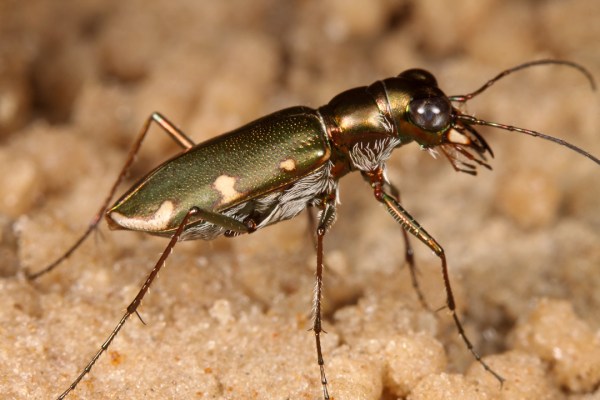
Eye to eye to eye to eye with a tiger beetle larva

After the past few years of hunting tiger beetles, I’ve learned not only how to find the larval burrows but—at least for most of the species occurring in Missouri—how to identify the larvae in the field. While conclusive identifications rely upon morphological characters, a preliminary field ID is often possible based on a combination of burrow size, placement, soil type and knowledge of which species are likely to occur in a given habitat. Tiger beetle larvae don’t have the same aesthetic appeal to many people that the adults have, and for this reason many species remain undescribed in the larval stage—even the well-studied North American fauna has only about 60% of its species with the larval stages described (Pearson et al. 2006). Nevertheless, the ability to find, collect and rear tiger beetle larva remains an important part of my studies because it not only expands my survey power (most tiger beetles have more restricted temporal occurrence as adults than as larvae) but can also lead to novel findings such as previously undescribed larvae and unknown parasitoid associations.

Tetracha virginica 3rd instar larva | Mississippi Co., Missouri

Tetracha virginica 3rd instar larva | Mississippi Co., Missouri

This larva was dug from its burrow in bottomland forest habitat in the southeastern lowlands of Missouri. However, before I even saw the larva I knew it belonged to the genus Tetracha and probably represented the species T. virginica (Virginia Metallic Tiger Beetle, according to Erwin & Pearson 2008). How did I know this? First, the size of the burrow (~8 mm in diameter) excluded all but one other non-Tetracha species known to occur in Missouri—Cicindelidia obsoleta vulturina (Prairie Tiger Beetle), a species known to occur only in the dry, rocky, dolomite glades in the White River Hills region of extreme southwestern Missouri. Secondly, while T. carolina (Carolina Metallic Tiger Beetle) is also found in southeastern Missouri, that species has been associated almost exclusively with treeless habitats—at least in southeastern Missouri (K. Fothergill, personal communication). Since the burrow from which this individual was dug was found in wet, bottomland forest, chances were high that it instead represented T. virginica.

Simple, thorn-like outer hooks with much smaller inner hooks distinguish Tetracha larvae from other tiger beetle genera.

Simple, thorn-like outer hooks with much smaller inner hooks distinguish larvae of Tetracha.

Notwithstanding the circumstantial evidence, there are morphological characters that also distinguish both the genus and the species of this larva. Of primary importance are the hooks and setae on the prominent “hump” of the fifth abdominal segment. This hump is braced against the vertical wall of the larval burrow as it sits at the entrance waiting for passing prey. Once the prey is seized, the hump armature provides traction against the burrow wall, preventing the struggling prey from pulling the tiger beetle larva out of its burrow (where it would not only be ineffectual as a predator but also highly vulnerable to predation itself). Tiger beetle larvae can often be distinguished at the generic level by the shape and size of the main hooks. Tetracha larvae have four hooks—two outer and two inner—that are simple and thorn-like, with the inner hooks much smaller than and placed much closer to the outer hooks than to each other (other genera either have six hooks, or they have the outer pair 1) highly curved or 2) the inner pair larger and nearly as close to each other as to the outer hooks). There are also fine details of the pattern of the setae (smaller hairs) on the hump that identify this larva as T. virginica, but the presence of numerous hairs over the surface of the abdominal segments is a much easier character to see in the field (see first photo).
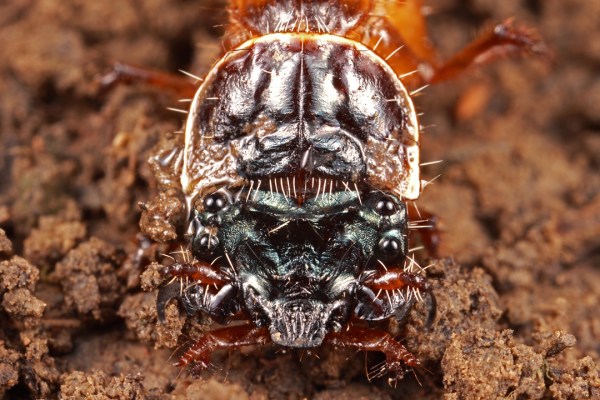
Note the white-margined pronotum and nearly equal sized simple eyes.

Note also the white-margined pronotum and nearly equal sized simple eyes.

Finally, there is that head—two pairs of large, simple eyes sitting behind gaping, cocked jaws that give them an oh so alien aspect! An often metallic, shield-like pronotum sitting behind the head, both used in concert to seal the burrow entrance as the larva lies in wait, serve to complete the alien ensemble but also offer clues to the larva’s identity. All larvae of Tetracha and closely related genera bear a distinctive rim of white around the pronotal margin, making them instantly recognizable even while still sitting in their burrow. Also useful is the relative size of the eyes, which in the case of Tetracha the second pair of eyes are nearly as large as the first pair (Amblycheila and Omus have the second pair distinctly smaller than the first, while Cicindela and related genera also have the eyes more nearly equal-sized).

P.S. This is what I was photographing when my friend Kent Fothergill surreptitiously took this photograph of me!

REFERENCES:

Erwin, T. L. and D. L. Pearson. 2008. A Treatise on the Western Hemisphere Caraboidea (Coleoptera). Their classification, distributions, and ways of life. Volume II (Carabidae-Nebriiformes 2-Cicindelitae). Pensoft Series Faunistica 84. Pensoft Publishers, Sofia, 400 pp.

Pearson, D. L., C. B. Knisley and C. J. Kazilek. 2006. A Field Guide to the Tiger Beetles of the United States and Canada. Oxford University Press, New York, 227 pp.

Copyright © Ted C. MacRae 2012

One Bad Beetle

Almost every tiger beetle trip that I take has a mix of gimmes and stretch goals. That’s alright—it’s impossible to find everything every time out, and if I eschewed the common and was happy only when I found something truly rare, then I would probably find myself rather unsatisfied most of the time. For the stretch goals, however, “success” can mean many things—obviously the best case scenario is to find it in good enough numbers to allow responsible collection of an adequate series and photograph enough individuals in situ to ensure that at least a few shots will have the focus, lighting, and composition that I want. Success can also be something less than that—maybe I find only a few and don’t get a very good series, or I have trouble getting field shots and am not happy with the shots I got…or worse I don’t even get field shots! The least successful version of “success” is when I end up with just one single beetle, and the only photographs I get are very ordinary-looking shots of that one beetle in confinement. Like what happened with Cicindela decemnotata (Badlands Tiger Beetle).

IMG_3717_1080x720

Soda Lake, Wyoming—we searched theses areas of alkaline exposures but never found beetles…

Chris Brown and I knew this species would be a stretch goal when we added “Soda Lake, Wyoming” to the itinerary of our 7th Annual Fall Tiger Beetle Trip™ (location “H” on this map). Cicindela decemnotata is the westernmost representative (Rocky Mountains from the northwestern Great Plains and northern Great Basin north to Yukon) of a group of species that seem to be closely related and resemble each other in their green coloration varying degrees of red on the head, pronotum and elytra and their variably developed white elytral markings (Pearson et al. 2006). Cicindela limbalis, C. splendida and C. denverensis occur as a partially allopatric species complex further east in the Great Plains, while C. sexguttata, C. patruela and C. denikei occupy more forested regions even further to the east. On this trip we were focusing on Great Plains tiger beetles and the dune specialists of the Yampa River Valley of northwestern Colorado. Our drive from northwestern Nebraska to the Yampa Valley would skirt the eastern edge of C. decemnotata‘s distribution, so we decided to stop by Soda Lake where Matt Brust had seen the species in previous years.

IMG_3721_1080x720

…until we started searching these small ridges of exposed sandy soil.

It took most of the morning to reach the spot, so by the time we arrived we were anxious to get out and start searching the sage brush habitat. For me it was an unfamiliar landscape—at that time my northwesternmost push for tiger beetles yet, and like many western habitats it seemed vast and unending. We were optimistic, however, because it just “looked” like good tiger beetle habitat, with ribbons of alkaline flats weaving through open brush. Of course, as time passes and one starts to recognize that they are again searching ground already covered with no sign of beetles, optimism begins to wane and searches become more deliberate. We were there for almost an hour before I heard Chris call out. He had abandoned the alkaline flats—obvious habitat it would seem—and started looking upon some slightly sandier low ridges a little further to the south. I hustled to where he was standing, and we both looked at the beetle, calmly sitting on the sand, as we deliberated our next move. Should we try to photograph it? It seemed not at all skittish—but what if we failed, it got away, and then we never saw another one? We played it safe, netted it (easily), and placed it in a vial for transfer to a container of native soil should further efforts at finding and photographing the species fail. It was perhaps another 45 minutes before we saw another beetle—I don’t know if it was just a less cooperative individual or the heat of the day had kicked in, but as soon as I started my approach it was gone. We saw another not long after, but same story. Finally we saw one last beetle that seemed to tolerate my approach to the point that I even began looking for it in the view finder—at which point it promptly zipped away. This small prospect of success only served to prolong our vain searching before we eventually we accepted defeat and tried to be happy with the single individual that we had caught and the photographs that we would take of it in its artificial home.

Cicindela decemnotata

Cicindela decemnotata (Badlands Tiger Beetle) | Soda Lake, Wyoming

Part of me really doesn’t like showing photographs of confined tiger beetles—not for any philosophical reasons, but because I just don’t like the way they look. Rarely do they exhibit the elegant stilting and other thermoregulatory behaviors that place them in much more pleasing postures when photographed in situ. Rather, they often have a “hunkered down” look that says “I’m not happy and I don’t want to be here, so I’m not going to smile for the camera!” Since these photos were taken, I have learned a few tricks to deal with confined beetles and achieve more aesthetically pleasing photographs—these include the use of much larger arenas, allowing the beetles more time to accommodate to their environs, and elevating the substrate relative to the camera (maybe a subject for a future post). In the end, however, they are still confined and can’t be passed off as anything but that.

The bold white markings, media band sharply angled and not reaching the edge of the elytra, and ''greasy'' appearance distinguish this species.

The bold white markings, media band sharply angled and not reaching the edge of the elytra, and ”greasy” appearance distinguish this species.

As an aside, tiger beetle pros Barry Knisley, Ryan Woodcock and Mike Kippenhan have recently published the results of an impressive study of this species in which a combination of morphological and molecular evidence support the recognition of four subspecific entities—three described as new (Knisley et al. 2012). The molecular analyses not only support the subspecific distinctions postulated from morphology but also suggest that populations have undergone rapid phylogenetic radiation in the recent geological past. Much of the area occupied by C. decemnotata was covered by an ice shield during the most recent glaciations and, thus, has opened up for colonization only during the past 10,000 years (Pearson and Vogler 2001). The molecular analyses showed a relatively low amount of genetic divergence within C. decemnotata populations, which combined with marked morphological differences suggests recent and rapid radiation—most likely in the wake of glacial recession. A similar situation has been observed with members of the Cicindela maritima species-group, which occupy much the same range as C. decemnotata and, presumably, have experienced similar selection pressures in the recent geological past.

REFERENCES:

Knisley, C. B., M. R. Woodcock & M. G. Kippenhan. 2012. A morphological and mtDNA analysis of the badlands tiger beetle, Cicindela (s. str.) decemnotata Say, 1817 (Coleoptera: Carabidae: Cicindelinae) with the description of three new subspecies. Insecta Mundi 0214:1–49.

Pearson, D. L., C. B. Knisley & C. J. Kazilek. 2006. A Field Guide to the Tiger Beetles of the United States and Canada. Oxford University Press, New York, 227 pp.

Pearson, D. L. and A. P. Vogler.  2001. Tiger Beetles: The Evolution, Ecology, and Diversity of the Cicindelids.  Cornell University Press, Ithaca, New York, 333 pp.

Copyright © Ted C. MacRae  2012

Where siblings mingle: Ellipsoptera marginata vs. E. hamata

When Erwin & Pearson (2008) formally broke up the great genus Cicindela by elevating most of its former subgenera to full genus rank, it caused a bit of consternation amongst some North American cicindelophiles. The argument went something like, “Now we have all these new genus names to learn, and we’ll have to relabel and reorganize everything in our collections, and how do we know the names won’t change again, and we can’t even tell them apart in the field anyway, and blah blah…” Pardon me, but since when did taxonomy become more about slotting species into fixed, easy-to-learn categories and less about best reflecting dynamic knowledge of complex evolutionary relationships? In the case of Cicindela and its former subgenera, however, even these arguments don’t hold up to close scrutiny—tiger beetle enthusiasts in North America should have already been quite familiar with the former subgenera due to their inclusion in the widely accepted Pearson et al. (2006) field guide, many of which actually do present a unique suite of morphological/ecological characters that facilitate their recognition in the field, and I personally find that nomenclatural recognition of individual lineages helps my attempts to learn and understand them much more than dumping them into a large, all-encompassing genus based on superficial resemblance. As for insisting that names don’t change, well that has never been a tenet of taxonomy. Stable, yes, but fixed and immutable, no.

Ellipsoptera marginata male | Pinellas Co., Florida

Enough waxing philosophic. One of the more distinctive of the former subgenera is Ellipsoptera. Morphologically the genus is defined by details of male genitalia, but the 11 North American species are generally recognizable in the field by their relatively “bug-eyed” look and long legs (Pearson et al. 2006) and, as a group, seem ecologically tied to extreme habitats with sandy and/or saline substrates that are nearly or completely devoid of vegetation. Coastal marshes and mudflats, saline flats, sandy river banks, and deep sand ridges representing ancient coastlines are some of the habitats where species in this genus are most commonly encountered. Most of the species exhibit a fairly uniform facies but differ in the details of maculation and dorsal coloration, but two species that stand apart from the rest are E. marginata (Margined Tiger Beetle) and E. hamata (Coastal Tiger Beetle) due to the highly diffuse middle band of their elytra. These are both eastern coastal species and presumably represent sibling species that have diverged based on geographical range partitioning—E. marginata along the Atlantic Coast and E. hamata along the Gulf Coast. In the field, the two species are almost identical in appearance but nonetheless easily identifiable based on geographical occurrence. There is, however, a small stretch of coastline—the lower Gulf Coast of Florida—where the ranges of the two species overlap and geography alone isn’t sufficient for species determination.

Ellipsoptera hamata lacerata male | Dixie Co., Florida

Fortunately, despite their strong resemblance to each other, field identifications in areas where these species co-occur are still possible due to the presence of small but distinct sexual characters present in one species but absent in the other. Close examination is necessary to see the characters (or their absence), so it is best to net a few individuals and examine them in the hand or, as I have done here, look at them through the viewfinder of a camera. The photos in this post include the male and the female of both species, each showing the presence or absence of the distinguishing character.

Ellipsoptera marginata female | Dixie Co., Florida

In most tiger beetles, male individuals are distinguished by a number of secondary sex characters, but easiest to see in the field are the brush-like pads on the underside of the front tarsi (“feet”). Males of E. marginata and E. hamata are further distinguished from each other by the presence (E. marginata) or absence (E. hamata) of a distinct tooth on the underside of the right mandible. Photo 1 above shows a male E. marginata from Pinellas Co., Florida, and the tooth is easily seen in that relatively distant view. Photo 2 above shows a male E. hamata lacerata (Gulf Coast Tiger Beetle)—the Floridian subspecies, and while a small bump can be seen on the underside of the right mandible, it is not nearly as well developed into a distinct tooth as in E. marginata.

Ellipsoptera hamata lacerata female | Dixie Co., Florida

Female tiger beetles, on the other hand, lack the brush-like tarsal pads present in the males and are further distinguished by the “mesopleural coupling sulcus”—an area just behind the side of the pronotum that receives the male mandible during mating and is thus devoid of setae (compare the females in Photos 3 and 4 with the males in Photos 1 and 2). Neither E. marginata nor E. hamata females possess the mandibular tooth found in E. marginata males, but they can be distinguished from each other by their elytral apices. In E. marginata females (Photo 3), the elytra are curiously “bent” at the tips, forming a distinct indentation at the apex of the elytra where they meet, while female E. hamata (Photo 4) lack this indentation.

Are there other tiger beetle sibling species groups for which you would like to see comparative posts such as this one?

p.s. I completely neglected to mark yesterday’s 5th anniversary of Beetles in the Bush! I don’t know how I missed a milestone as big as five years—hopefully my ability to provide interesting content is faring better than my middle-aged memory!

REFERENCES:

Erwin, T. L. and D. L. Pearson. 2008. A Treatise on the Western Hemisphere Caraboidea (Coleoptera). Their classification, distributions, and ways of life. Volume II (Carabidae-Nebriiformes 2-Cicindelitae). Pensoft Series Faunistica 84. Pensoft Publishers, Sofia, 400 pp.

Pearson, D. L., C. B. Knisley and C. J. Kazilek. 2006. A Field Guide to the Tiger Beetles of the United States and Canada. Oxford University Press, New York, 227 pp.

Copyright © Ted C. MacRae 2012
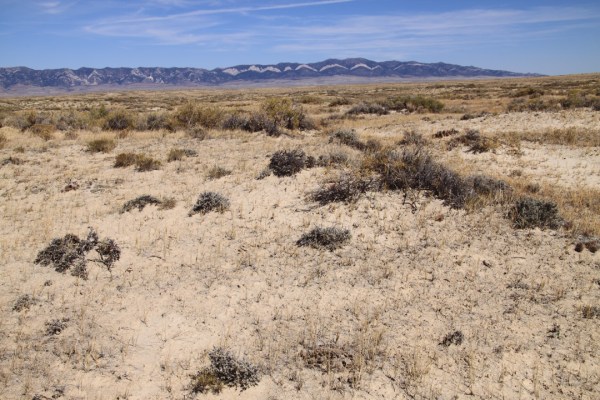
Persistence Pays

For the past three years I’ve crisscrossed the country in search of some of North America’s rarest tiger beetles, each time hoping to get that “perfect” photograph of an unconfined beetle exhibiting natural behavior in its native habitat. I’ve managed to get photos of most, though there are a few that I wish I could do over, but the only one that I think really comes close to the ideal I have in my mind is this one of Cicindela formosa generosa, featured in the ESA 2013 World of Insects Calendar (and, ironically, taken only about 5 miles from my home).

A consequence of all this attention to uncommon species is that I’ve somewhat neglected getting good photographs of some of our most common tiger beetles. One of these is Cicindela repanda (Bronze Tiger Beetle), which can be found near almost any body of water throughout the bulk of eastern North America. This summer I resolved to correct that situation, but I found this to be more difficult than anticipated. The first time I tried to photograph the species was when I encountered them in late July on a wide, open beach along the Mississippi River on a hot, summer day. I found the beetles almost completely unapproachable due to the extreme heat and lack of any cover that could be used to my advantage. I had better luck in mid-August when I attracted some individuals to an ultraviolet light that I had setup one night at a spot further north along the river. Those photos were acceptable technically but lacking otherwise, primarily because the beetles didn’t assume any of the charismatic poses associated with the thermoregulatory behaviors exhibited by active beetles in the middle of a hot summer day. Finally, at the end of August, I encountered the species yet again on a small patch of sandy/muddy river bank along the Mississippi River just south of St. Louis. It was another hot day—quite hot actually—but with the help of some features of terrain I was finally able to get that photo of the species that I’ve been wanting.

Cicindela repanda (Bronze Tiger Beetle) | St. Louis Co., Missouri

I like this photo for a number of reasons. The beetle is nicely profiled while paused “tall” on its front legs (a common posture on hot days as they try to lift themselves up off the hot soil surface), the angle is low, and the subject and foreground are well focused in front of a nicely blurred backdrop of rocks. It is these rocks that actually helped me get this photo. I had chased several individuals down on the open sand for some time, but since the day was as hot as my first attempt and I wasn’t having any better luck. Every now and then one of the beetles that I was “working” would fly up into this rockier area, and I noticed that I was able to get closer to these beetles because I was able to stay lower as I made my approach. I began preferentially working beetles towards the rocks and finally got one that settled down and started showing normal searching behaviors despite the fact that I was already in fairly close range. At that point, it became a matter of waiting for the beetle to “lower his guard” while I assumed a shooting position, and as soon as it began acting normal I slowly closed in and began taking shots.

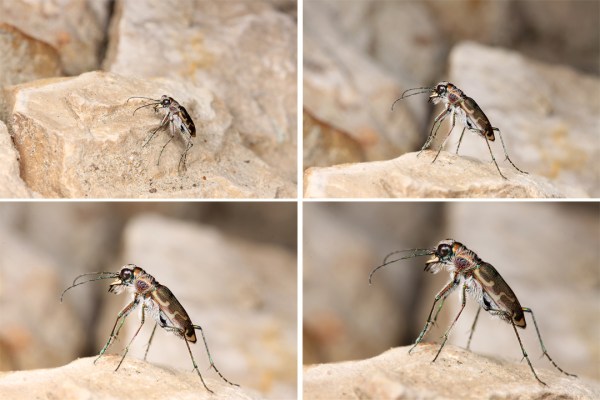
Getting close is a process, as these successive shots demonstrate.

This collage shows the four shots immediately preceding the final photo and how each shot brought me a little closer to the beetle (and that final composition that I wanted). The beetle was still in search mode as it crawled up the side of one rock and I began taking photos, but upon reaching the top it paused and lifted itself up high on its front legs. I knew I would have 5, 10, maybe 15 seconds at the most to capture this pose before it began moving again, so I closed in slowly but assertively and fired a shot every couple of seconds until I got the one that I wanted. At that moment, the beetle flew away, and although I tried for another 20 minutes or so I was unable to get another beetle back up on the rocks for more shots. How fleeting success can be!

Copyright © Ted C. MacRae 2012

The Third of Florida’s Three Metallic Tiger Beetles

Tetracha virginica (Virginia Metallic Tiger Beetle) | Levy Co., Florida

After three straight posts not about tiger beetles, I’m hoping readers will forgive my return to this fascinating group. The photos in this post represent Tetracha virginica (Virginia Metallic Tiger Beetle), the most widely distributed (at least in the U.S.) of the four species occurring in North America north of Mexico. Even though this species occurs in my home state of Missouri, I’d not found an opportunity to photograph it until August last year at Florida’s “Road to Nowhere“—famous among U.S. cicindelophiles as one of the country’s true tiger beetle “hot spots.” In fact, it was on the very same night at this same place that I photographed the related Tetracha carolina (Carolina Metallic Tiger Beetle) (featured in Not all Florida tiger beetles are rare) and just one day after I photographed the endemic Tetracha floridana (Florida Metallic Tiger Beetle) (featured in Why I Roamed the Marsh at Night). That’s all three species of Tetracha occurring in Florida in just two days (and if I want to photograph the fourth and only remaining U.S. species, Tetracha impressus (Upland Metallic Tiger Beetle), I’ll have to go to Brownsville, Texas and get very lucky!).

The solid green elytra without apical markings distinguish this species from all other Tetracha spp. in the U.S.

Truthfully, I had no plans to post these photos after I took them. Like the other species they were photographed at night, and when I got a better look at the photos on the computer I was disappointed to see the subject was badly covered with large particles of sand. I don’t mind a little bit of debris on insects—it is, after all, a normal part of their appearance. However, too much debris is, for me, an aesthetics killer! “Wait a minute… these don’t look too bad”, you say? Well, thanks to the Clone Stamp Tool in Photoshop Elements, and as a followup to my recent post on this subject, I now have enough confidence to tackle not only small pieces of debris, but also more difficult “debris cases” such as this one with relatively large particles. Here is the same photo as shown above and processed in exactly the same manner, except that no cloning was used to remove the debris:

Aren’t I a dirty boy?!

Obviously, there are limits to what the Clone Stamp Tool can do, and I didn’t try to deal with the sand particles clinging to more difficult to clone body parts such as legs and antennae (although I’m sure that in the right hands even these could be cloned out). Nevertheless, even just cleaning the dorsal surface of the beetle does much to improve its appearance with a relatively minor amount of effort.

And, of course, what would a tiger beetle post be if it did not end with my signature face portrait (notwithstanding a few large sand grains that I wasn’t sure I could clone out effectively)?

Copyright © Ted C. MacRae 2012
Tiger lovin’

It seems I’m not the only one that finds tiger beetles irresistible. Gorgeous colors, long legs, and big eyes, they captivate me endlessly with their big, toothy jaws and charismatic behaviors. I blather incessantly about them, but today I’m going to do something that I rarely do here—shut up and let somebody else do the talking!

First up is Troy Bartlett (author of Nature Close-ups), who has just posted some stunning photographs of the super rare Cicindelidia highlandensis (Highlands Tiger Beetle) taken during his recent trip to Florida. I’ve photographed this species before, but not as well as Troy—the face shot he got has me green with envy!

Scarcely three minutes after Troy posted his photos, Delbert La Rue (author of Crooked Beak Workshop), a coleopterist who has studied scarabs for most of his life, shows that he too has fallen prey to the tigers’ charms. It’s a sad thing when collectors pin tiger beetles and put them in a collection drawer without doing anything to protect those stunning colors and amazingly intricate white markings. Delbert describes in detail just how he accomplishes this task, a beautifully prepared unit tray of the Willcox Playa classic Habroscelimorpha fulgoris erronea (Willcox Tiger Beetle) serving as proof of his technique. What mojo!

Please visit both of these blogs and let the authors know you’re down with their tiger lovin’!

Sexual Profiles

I recently happened upon these photographs of Habroscelimorpha severa (Saltmarsh Tiger Beetle), taken in early August last year at the terminus of Florida’s famous “Road to Nowhere“. I hadn’t thought to post them afterwards because I’d already shown a photograph of this species taken at the same spot during the previous year’s visit. I should have, as they are much better photographs than that initial attempt. Blame part of the first attempt on the fact that I was only in my third month of insect macrophotography, but the biggest reason for the improvement was because I’d gotten a little smarter and learned to use a blacklight to bring these extremely wary beetles to me at night rather than try to chase after them during the day. Still, I don’t get much enjoyment out of posting photos for no other reason than to post photos, so they’ve sat on my hard drive for the past year and a half. In looking at them again, however, I realized that the first and second, profiles of a female and a male, respectively, make for a nice comparison of the secondary sexual characters exhibited by adults of this species.

Habroscelimorpha severa (female) | Levy Co., Florida

Females exhibit fewer sexual characters than males, the main one being the presence of grooves on each side at the back of the pronotum (neck). These grooves function during mating, at which time the male grasps the female by the pronotum with his mandibles. This helps to provide a more secure grip for the male to prevent him from being dislodged during mating and subsequent mate guarding. The grooves themselves are not obvious in the photo, but the lack of setae (hairs) within them is, giving the female a less “hairy” look than the male. As with most insects, females also are more robust—their abdomens larger to make room for egg-making machinery, although in this and other tiger beetle species the difference is not that obvious.

Image

Habroscelimorpha severa (male) | Levy Co., Florida

Males are immediately recognizable by several respects. In addition to the smaller abdomen and “hairier” pronotum lacking lateral grooves, male tiger beetles in most of the “higher” genera exhibit brush-like pads on the undersides of the front tarsi (feet). The function of these pads is not completely clear, but prevailing opinion is that they somehow aid in gripping the female during mating. I’m not sure I buy into this—males do sometimes hold onto females with their front legs during mating, but how these pads improve grip escapes me. Further, it is my experience that males actually spend more time during mating and mate guarding with their front legs outstretched to each side. I’ve also noticed that males are reluctant to release females even when danger approaches (even in the form of a giant insect macrophotographer). I’ve seen males tenaciously clinging to the female as she violently tries to shake him off and flee from my approach. It makes me think that perhaps the tarsal pads serve some tactile function as a final warning of impending danger to a grasping male, allowing him to not give up his female until absolutely necessary (hey, it’s an idea—if you have an alternative idea I’d love to hear it). There is more, however—look at that big head!

Habroscelimorpha severa (male) | Levy Co., Florida

Actually,  the male’s head is no larger than the female’s, but the proportionately longer mandibles give the male a distinctly “big-headed” look.  In contrast, the labrum (upper lip) is shorter than the female’s (making the mandibles look longer still). Both of these characters are, again, related to the habit of grasping the female pronotum, with the longer mandibles allowing a more secure grip of the female pronotum and the shorter labrum adding even more functional length to the mandibles (I can also imagine that this might have some effect on choice of prey by males versus females). The male mandibles also have a greater amount of white coloration at their bases—this might simply be a function of the relatively larger size of the mandibles, but given that males of many species exhibit more white overall on both the mandibles and the labrum (the latter of which is usually smaller), it seems more logical to me that the white coloration serves as a visual cue for potential mate recognition.

“Hey baby, I like your grooves!”

“Yeah, well your white lips aren’t so bad either.”

Copyright © Ted C. MacRae 2012

Just repanda… er, wait a minute…

Update 10/7/12, 10:41 a.m.—Thanks to Ben Coulter, who pointed out my rather silly misidentification of these beetles that actually represent Cicindelidia ocellata rectilatera (Reticulated Tiger Beetle). I have only my failure to even consider the possibility of a southwestern species to blame for the error, as the evidence was staring me right in the face (the lack of any trace of lateral connecting band and, most obviously, the reddish parts on the underside). No wonder the habitat didn’t seem quite right! I was not aware of the occurrence of this species east of Texas, so I’ll have to dig a little bit to see if this is an unusual record. Pearson et al. (2006) show the northeastern limit of distribution coming very close to but not actually reaching the southwestern corner of Arkansas, and the closest records given by Graves & Pearson (1973) are in western Louisiana and adjoining Texas. It would be immensely rewarding should this turn out to be a new state record (though there are many sources still to check to confirm this)—not to mention the irony of it in view of the post title (call it a double “er, wait a minute”!). At any rate, I should have been a lot more excited when I saw it than I was.

After a fun-filled day of photographing the Limestone Tiger Beetle in northern Texas, it was time to start working my way back to Missouri. I had one last goal that I wanted to accomplish before spending my last day in our state’s White River Hills, and that was to find and photograph the unbelievably gorgeous Cicindela formosa pigmentosignata. Dubbed the “Reddish-green Sand Tiger Beetle” by Erwin & Pearson (2008), this brilliant violaceous and nearly immaculate subspecies of the Big Sand Tiger Beetle is restricted to sandy areas of open pine forests in eastern Texas, southwestern Arkansas, and northwestern Louisiana (Pearson et al. 2006). I had a few specific localities that I’d gleaned from colleagues and the literature and targeted the two “best” (specificity of location, recent occurrence, and reasonably “on the way” back to Missouri) for Day 7 of the trip. The first site in Texas looked perfect—deep, dry sandy 2-tracks leading through open pine/oak forest, and I was actually surprised when I’d searched a mile or so of track and hadn’t yet seen one (the habitat just looked that good). Still, I spent quite a bit more time searching, thinking that numbers could be low and it might take such an effort. Sadly this was all in vain, and the time came to give up and try again at the second locality in Arkansas. The story was largely the same at this second locality also, and by late afternoon I had come to accept that this was one challenge that I was going to lose (for now at least).

Cicindela duodecimguttata Cicindelidia ocellata rectilatera | Nevada Co., Arkansas

As I searched one bit of potential habitat at the Arkansas location, I noted the presence of Cicindela repanda (Bronzed Tiger Beetle). This species is dreadfully common throughout much of the eastern U.S. in just about any near-water habitat, which told me I was probably too close to water to find the higher, drier-ground preferring Big Sand Tigers. I’ve seen millions of C. repanda through the years (this may not be an exaggeration), and since they show so little polytopism (geographically-based variation), at least in the parts of its distribution that I have visited, I hardly pay them mind anymore. As I was walking, however, something caused me to take a closer look—some of them didn’t seem quite “right.” Of course, you can’t just walk up to a tiger beetle and stoop down for a good look at it. Stalking is required, usually of several individuals before finding one that you can approach closely enough to see the necessary characters, and when I did this I realized most of the C.repanda” I was seeing were actually a different species—Cicindela duodecimguttata (12-spotted Tiger Beetle)!

Even tiger beetles get bored during sex—this female preening her antennae seems oblivious to the male engaging her.

I get the impression from literature sources that 12-spotted Tiger Beetles are quite common further east, especially in the northeastern U.S. and southeastern Canada. However, here in the central U.S. they are not commonly encountered. In fact, these are the first of the species that I have seen since I began photographing tiger beetles more than 3 years ago. In Missouri the few instances that I have seen them were along creeks and small rivers with banks composed of sand and a fair bit of dark clay. This makes sense, given their generally darker coloration compared to Bronzed Tiger Beetles, and it is this character that first stands out amongst the hoardes of C. repanda with which it usually co-occurs.  Once the darker coloration draws the eye, the markings of the elytra—reduced and broken into six spots (usually) on each one—confirm its identity. Despite the similarity of appearance to C. repanda, this species is actually more closely related to Cicindela oregona (Western Tiger Beetle), an exceedingly common species found from the Rocky Mountains to the Pacific Coast and north deep into Alaska. In fact, the two species are so closely that they have formed a hybrid zone where they come into contact along the front range of the Rockies—one could almost argue that they are only subspecifically distinct because of this. 

A male pauses briefly while hunting for prey (or mates).

That I found them in this particular habitat was a bit of a surprise to me. I mentioned that in Missouri I’ve seen them on darker creek and river banks, but the creek bank at this location was quite lightly colored and seemed to consist almost entirely of sand. There were a few C. repanda mixed in with this small population. In all, it was a welcome consolation prize that made up for not finding C. formosa pigmentosignata—sort of!

Habitat for Cicindela duodecimguttata Cicindelidia ocellata rectilatera along Mill Creek, Nevada Co., Arkansas.

REFERENCES:

Erwin, T. L. and D. L. Pearson. 2008. A Treatise on the Western Hemisphere Caraboidea (Coleoptera). Their classification, distributions, and ways of life. Volume II (Carabidae-Nebriiformes 2-Cicindelitae). Pensoft Series Faunistica 84. Pensoft Publishers, Sofia, 400 pp.

Pearson, D. L., C. B. Knisley and C. J. Kazilek. 2006. A Field Guide to the Tiger Beetles of the United States and Canada. Oxford University Press, New York, 227 pp.

Added: Graves, R. L. & D. L. Pearson. 1973. The tiger beetles of Arkansas, Louisiana, and Mississippi (Coleoptera: Cicindelidae). Transactions of the American Entomological Society 99(2):157–203.

Added: Pensoft

Copyright © Ted C. MacRae 2012