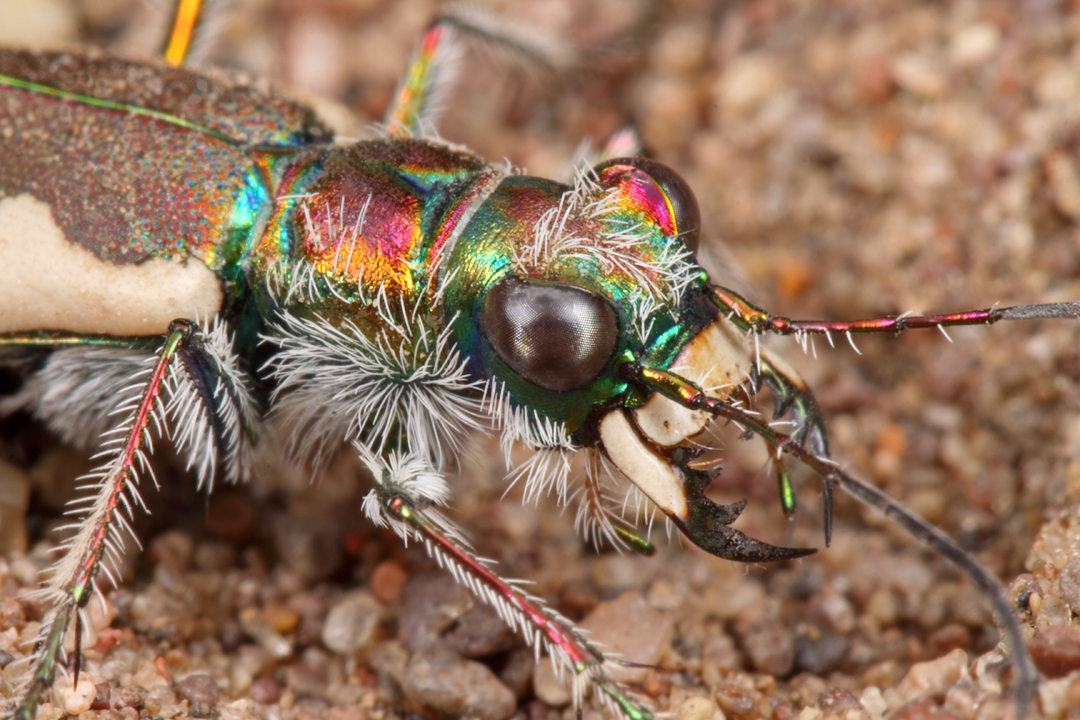
The World’s Largest Tiger Beetle

Manticora scabra - male (L) and female (R) | Republic of South Africa

Some of the first residents of my new insect cabinets (see ) are also among the newest specimens in my collection. Not long ago I received a box from world tiger beetle expert David Brzoska, who had carefully chosen male/female pairs of a number of tiger beetle species from his impressive world collection and sent them to me as a surprise gift. Now, us North America-bound collectors are limited to just a few genera, e.g. Cicindela (although increasingly recognized as a cluster of several closely related genera), Tetracha, and if we’re really lucky Amblycheila and Omus (the last being one I still have not seen in the field). In the rest of the world (especially the tropics and subtropics), however, generic diversity is much higher, and coming as they did from South America, Africa, Australia, and southeast Asia most of the specimens in the sending represented new genera for my collection. While I was grateful for them all, the specimens that had me leaping for joy was this fine pair of Manticora scabra, one of the so-called “African Giant Tiger Beetles.”

Males of all Manticora spp. have asymmetrically enlarged mandibles

In the case of these beetles, the term “giant” is no exaggeration. The male specimen (above and left) measures a full 54 mm (that’s more than 2 inches, folks!) from the tip of its grossly enlarged mandible to the tip of its abdomen, and even the female at 47 mm length is substantially larger than my 38-mm long male specimen of North America’s largest tiger beetle, Amblycheila cylindriformis. While enlarged male mandibles are a common feature among many beetle groups, Manticora males feature an unusual asymmetry in the mandibles, with the right mandible always much larger than the left (itself enlarged compared to the female mandibles, and even the latter cannot be considered small).  Apparently the asymmetry represents a trade-off in natural selection—males use their mandibles not only to hunt prey but also hold onto the female pronotum during mating and subsequent mate guarding. There is positive selection pressure for larger mandible size, as males with smaller mandibles are more likely to be dislodged from the female by competing males. However, because of the large size of the species, larger male mandibles are less effective for securing normal prey items that tend to be smaller in size. If both mandibles were enlarged to the point needed to securely grip the female pronotum, the male would be unable to feed adequately, but having only one mandible fully enlarged provides sufficient grip while maintaining an ability by the somewhat smaller left mandible to grip regular prey items. A consequence of the mandibular asymmetry is that males ride “to the left” when coupled with females.
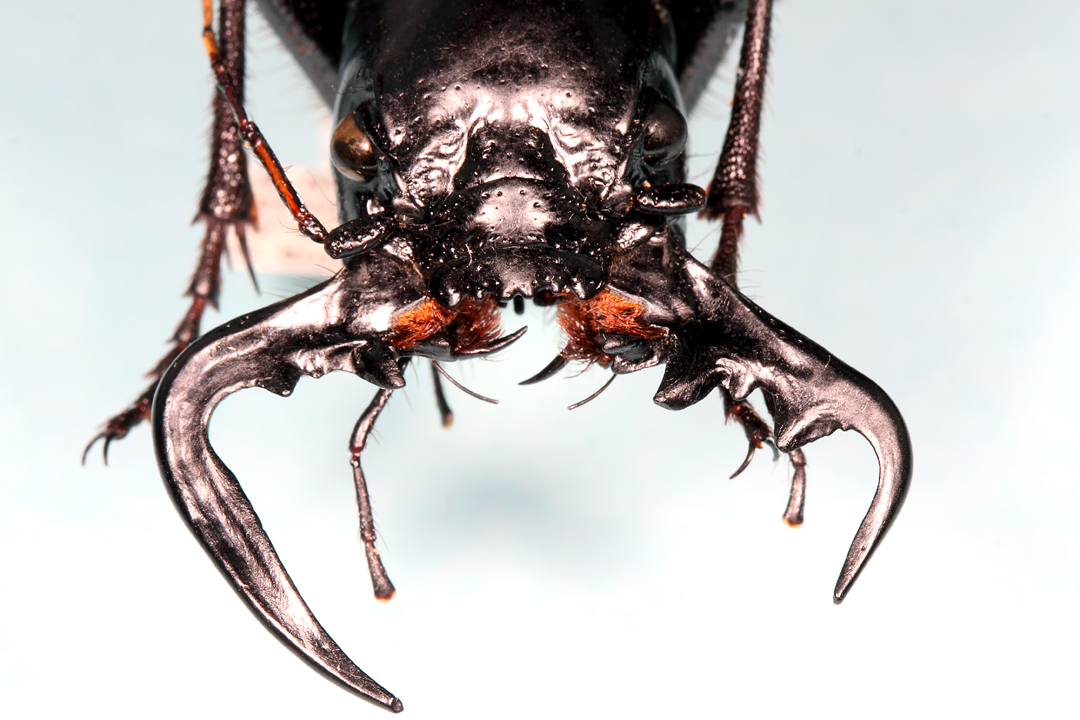
The right mandible is larger than the left mandible.

David identified these individuals as the species M. scabra, occurring throughout much of southern Africa (Botswana, Malawi, Mozambique, Republic of South Africa, Tanzania, Zimbabwe—according to Carabidae of the World). I presume the species epithet refers to the roughened surface of the elytra. There are at least two recent treatments of the genus (Werner 2000, Mares 2003); however, I have access to neither because of the exorbitant cost of these books—$247 and $433, respectively (I find it rather ironic that the recent explosion of book-sized treatments of “large” beetles has resulted in publications priced so high that they are inaccessible to most professional entomologists).
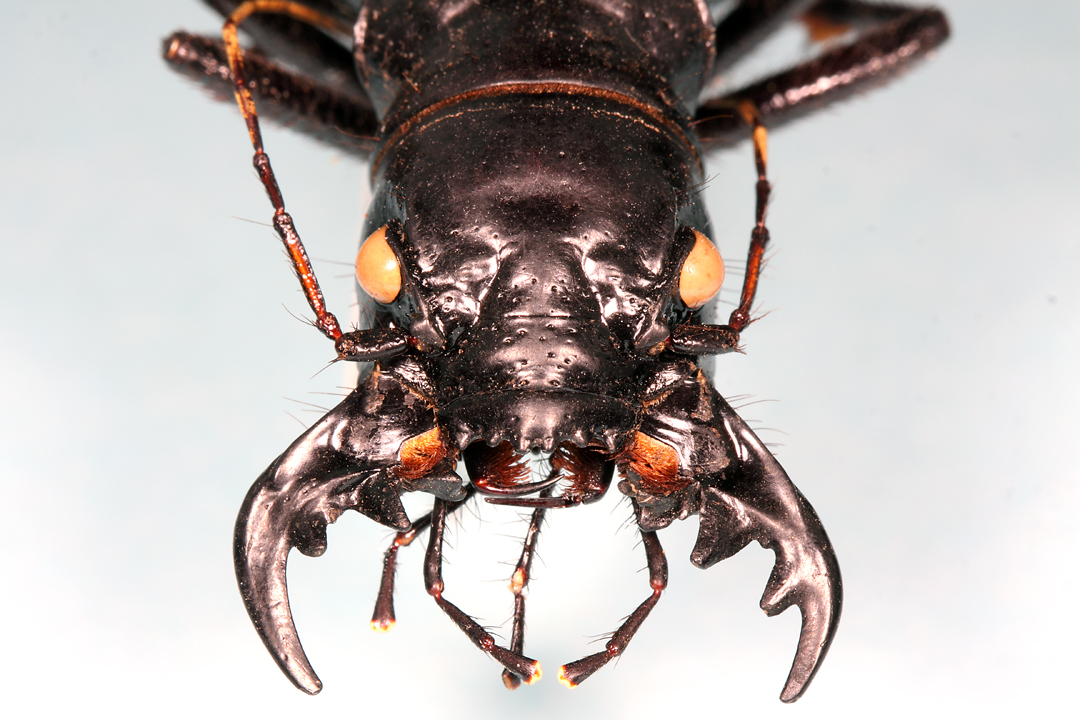
Female mandibles are nonetheless impressive despite their smaller size.

I made a trip to South Africa in 1999 and had hoped to see these beetles for myself, but unfortunately this did not happen. Perhaps part of the problem was my impression of these beetles as nocturnal hunters—the prevailing ‘wisdom’ at the time. My field partners and I made several nighttime forays in the semi-arid bushveldt where we were camping, using flashlights to scan the ground for any large black beetles we could find moving about. We found numerous tyrant ground beetles (family Carabidae, genus Anthia) and a diversity of tok-tokkies (family Tenebrionidae), but no Manticora tiger beetles. Shortly after that trip, Oberprieler & Arndt (2000) published an informative summary of the biology of several Manticora populations in South Africa, their most notable finding being that adults are opportunistic diurnal predators that hunt by smell rather than nocturnal visual hunters. Perhaps someday I’ll have another opportunity to visit South Africa and see Manticora adults in the field, but until that time I’m happy to have these two specimens residing in my cabinet.

My sincerest thanks to David Brzoska for these sending me these fine specimens and for the many additional kindnesses he has extended to me during the past few years.

REFERENCES:

Mares, J. 2003. A Monograph of the Genus Manticora. Taita Publishers, 205 pp.

Oberprieler, R. G. & E. Arndt. 2000. On the biology of Manticora Fabricius (Coleoptera: Carabidae: Cicindelinae), with a description of the larva and taxonomic notes. Tijdschrift voor Entomologie 143:71–89.

Werner, K. 2000. The Tiger Beetles of Africa (Coleoptera, Cicindelidae) Volume I. Taita Publishers, 191 pp.

Copyright © Ted C. MacRae 2012

MacRae Entomology Museum Expansion

Badly needed drawer space is provided by these gorgeous, antique, hand-made, wooden insect cabinets.

Every five years or so I find myself facing the same dilemma—too many bugs and not enough space to keep them. Each time this occurs, I go through the same thought process trying to decide the best way to solve the problem. Do I create new space by buying new cabinets, or clear existing space by donating “excess” material? If money was no object it would be the former. However, money is an object—a new, premium 25-drawer cabinet costs more than $1,000, not to mention another $400 for the drawers to fill it (if I build them myself—3 times that amount if I buy them already made). In my younger, more care-free days I got away with plunking down this kind of money several times, eventually assembling my current battery of three half-size and three full-size cabinets holding a total of 111 Cornell drawers fully stocked with unit trays. These days, however, there are kids to feed and college costs looming on the horizon. I just can’t swing that kind of dough.

Each cabinet came complete with 10 hand-made, wooden, glass-topped drawers.

The alternative, however—donating away part of my collection, is equally unattractive. I’ve been collecting insects for most of my life, so it’s more than just a hobby—it’s a part of me. Nevertheless, I am able to draw a distinction between a working collection and a hobby collection, and for the most part mine is the former. I have a few “hobby” taxa like treehoppers and leaf beetles and such, and I’ve already made a number of donations from these groups over the years. However, the bulk of my collection—and hence drawer space—is taken up by just three taxa; jewel beetles, longhorned beetles, and tiger beetles. Not only are my research activities in these three groups ongoing, but a considerable amount of the material in these groups consists of voucher specimens for my publications. I just can’t think about divesting myself of material in these groups, at least not at this point in my life. Besides, pulling material for donation is, in itself, a long and very time-consuming process that I would not look forward to.

I’ve actually been debating my options for the past couple of years now, watching nervously as my inventory of specimens housed in temporary cardboard boxes started to balloon from the successes of the past several years of collecting. Temporary boxes are bad—not only is it impossible to integrate the specimens into the organization of the main collection, but they remain vulnerable to that dreaded pest of insect collectors around the world; DERMESTID BEETLES! (The one beetle I don’t like!) The likelihood of having specimens damaged by dermestids is directly proportional to the number of temporary boxes that must be checked periodically looking for any evidence of their presence. I’ve been hit by dermestids more than once, and with the number of temporary boxes that I currently have (more than 50) it has become almost impossible to monitor them frequently enough.

Unit trays designed for Cornell drawers fortuitously fit nicely inside the custom-sized drawers.

Of course, patience is a virtue, and my reward this time for not acting too rashly came in the form of an email sent to the members of our local entomology group by Mark Deering, Director of the Sophia M. Sachs Butterfly House just a few blocks from my office. Mark was an avid butterfly collector in the past but has divested much of his collection in recent years and, as a result, no longer needed the cabinets and drawers he was using to store his collection. The list of items he had for sale included a few Cornell cabinets with drawers, ostensibly perfect for my needs, but it was the last item in the list that caught my eye—several antique, hand-made, wooden, 10-drawer cabinets with drawers. Now, I love my Cornell cabinets—they provide state-of-the-art (albeit industrial-looking) protection for my collection. However, there is something appealing about hand-made, wooden insect cabinets. I can almost see John L. LeConte and George W. Horn themselves standing next to one and pulling a drawer to have a look at its contents. I quickly contacted Mark and made arrangements to look at the cabinets. Mark explained that they were part of a 40-cabinet set housing a collection of pierid butterflies that eventually found its way to the Smithsonian Institution… yes, the Smithsonian (such history!). He had gotten ahold of seven cabinets and was now selling them for a very reasonable price. The cabinets were gorgeous, and it didn’t take long for me to do the math; I could afford to buy three cabinets with drawers for a fraction of what a 25-drawer Cornell cabinet with drawers would cost. That’s 30 drawers total, each with almost as much space as a Cornell drawer.

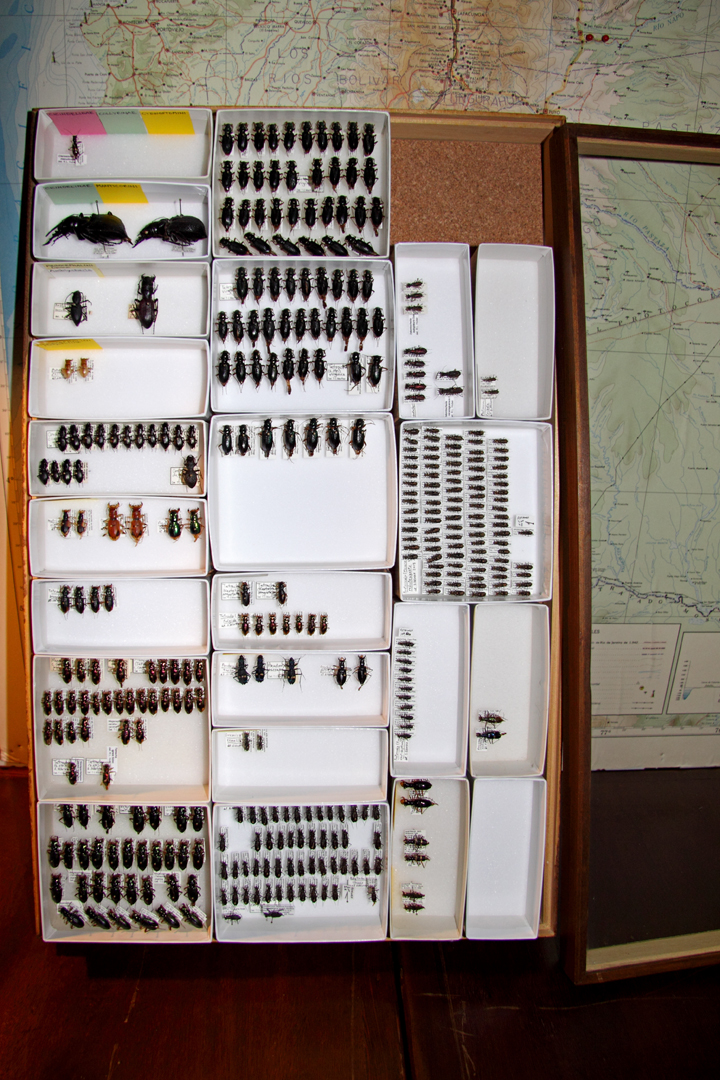
Drawer 1 of my tiger beetle collection.

I picked up the cabinets a few days later and spent the next two days rearranging furniture in my ‘museum’ to create the perfect showcase spot, cleaning the glass on each drawer (both sides), and transferring my tiger beetle collection into the first cabinet (drawer 1 of which is shown at right). Despite their age several transfers of ownership, the finish is still in very good shape with only minor nicks and scratches that add a sense of history yet don’t detract from their attractiveness. Especially pleasing was the discovery that the Cornell unit trays I use for my collection fit almost perfectly in the drawers (just an annoying empty spot in the upper right corner—this can probably be fitted with a California Academy-sized unit tray, perhaps for holding insect repellent blocks since the drawers and cabinets are not as air-tight as my modern Cornell cabinets). I’ll probably move the rest of my “hobby” taxa into the remaining drawers to free up the Cornell cabinets completely for exclusive use in housing my Buprestidae and Cerambycidae. That will take some time, but it’s a good problem to have. My only fear is that after I move things around and incorporate all of my backlogged material, I will have once again used up all of the newly available drawer space and find myself facing that same dilemma that I face every five years or so!

Perhaps a little teaser is in order—one of the species in the drawer shown at right will be the subject of an upcoming post—can you guess which one? Also, 2 BitB Challenge points to anyone who can correctly identify the country shown in the map behind the drawer.

Copyright © Ted C. MacRae 2012

Another cover photo

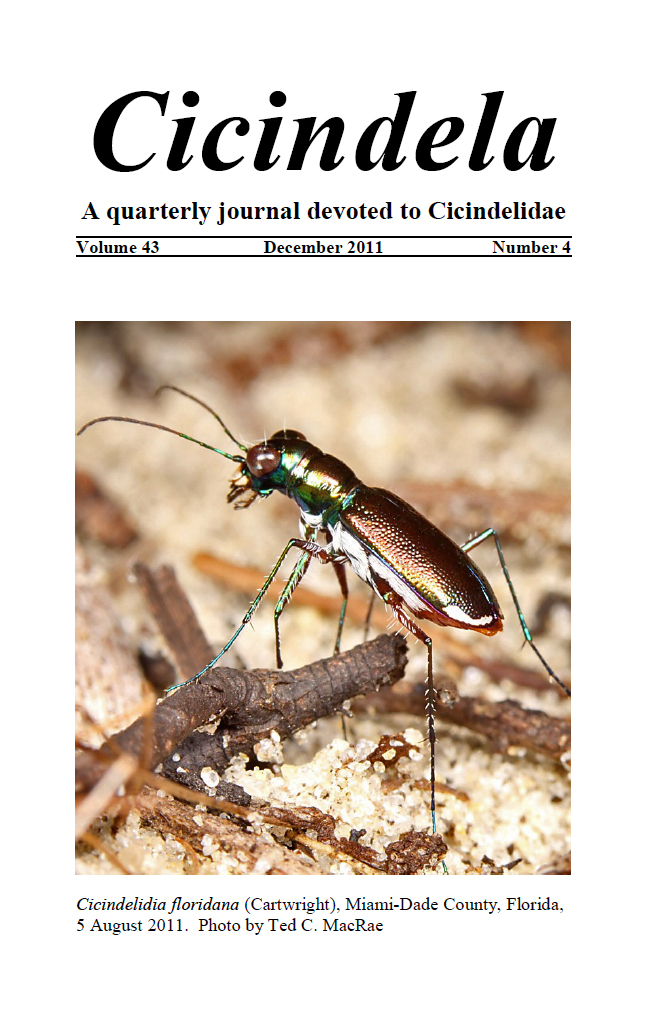
Issue 43(4) of Cicindela (A quarterly journal devoted to Cicindelidae) is now hitting mailboxes (my copy arrived earlier this week), and for the second issue in a row the cover features one of my tiger beetle photos. Gracing the cover this time is the recently rediscovered Cicindelidia floridana, known only from a small area in the Miami metropolitan area of south Florida, and which I was fortunate to have the opportunity to see this past summer. Because the species is regarded as critically imperiled and a likely candidate for listing as an endangered species, the precise whereabouts of its habitat have not been disclosed. So far I am one of only a few people who have had the chance to photograph it in the field.

Now, some of you may think that because I serve as Layout Editor for the journal that I can horn in and put one of my own photographs on the cover whenever I want. This is not the case, and it was only because Managing Editor Ron Huber asked me if I had anything for the issue that I supplied the photo after having just done so for the previous issue. In actuality, we encourage others to submit their tiger beetle photographs for consideration, and since a majority of U.S. species have already been featured at some point over the years we especially encourage ex-U.S. photographers to submit their photos so that we can limit repetition. Obviously, C. floridana has never been featured on the cover before now, so it was a no-brainer choice for this issue.

The issue contains two delightful papers. The first is another by Mathew Brust on the stunningly gorgeous Cicindela pulchra that discusses not only additional northern range extensions in South Dakota and Wyoming, but also the rediscovery of the species in Nebraska far from the single previously known collection record in the state nearly 100 years ago! It is amazing to me that one of North America’s most conspicuously beautiful tiger beetle species has gone undetected for so long in such a large part of its range. The second paper by Dave Brzoska and Ron Huber is a long overdue biography of tiger beetle icon Norman Rumpp, who in his professional life was a rocket scientist (literally!) and as an avocation became one of North America’s leading authorities on tiger beetles (I am proud to claim ownership of Rumpp’s nearly complete set of The Coleopterists Bulletin). In addition to numerous publications and unpublished reports on tiger beetles in the western U.S., Rumpp described 12 species and subspecies of tiger beetles—including three of the western sand dune endemics that I have featured in recent weeks (Cicindela scutellaris yampae, C. arenicola, and C. albissima). What may not be appreciated is Rumpp’s sense of humor—well, just read the paper and see!

Copyright © Ted C. MacRae 2012

“My peripatetic quest for North America’s rarest tiger beetles”

This week I gave a presentation on my latest Annual Fall Tiger Beetle Trip to the Entomology Group of the Webster Groves Nature Study Society. With the exception of a brief 5 year period in the early 1990s while I lived in California, I’ve been active with this local nature study group for the past 30 years (and serving as newsletter editor since 2009). I’ve given my share of entomology presentations over the years to both professional and amateur audiences, but no matter how far I might travel or the size of the audience, I always enjoy my time with this small group of local entomologists. They are my roots—the people with whom I learned to collect and began my explorations of Missouri and beyond. We are joined not only by the bonds of common interest, but by shared experiences as well. There was a good turn out for the presentation, and my thanks to the Group for the interest they showed.

Nine days, ten states, 4,300 miles:
My peripatetic quest for North America’s rarest tiger beetles

The photographs used in the presentation have been seen in various posts here over the past few months, but I thought some may appreciate the chance to see them all together in presentation format. A PDF version of the original Powerpoint presentation can be downloaded by clicking on the link above (although with a file size of just over 18 MB a high-speed internet connection is recommended). My thanks to David Pearson, Professor of Biology at Arizona State University, for permission to include in the posted version scanned images and distribution maps from his supremely useful A Field Guide to the Tiger Beetles of the United States and Canada (the bible of North American cicindelophiles¹).

¹ If you have not yet bought this most excellent book, paperback versions can be bought new for as little as $41.74. Buy it and you’ll never fail another BitB tiger beetle ID Challenge!

If you download the presentation, please remember that all materials are copyright Ted C. MacRae unless attributed otherwise and may not be used without permission (personal use excepted) .

Copyright © Ted C. MacRae

Return to Calico Rock

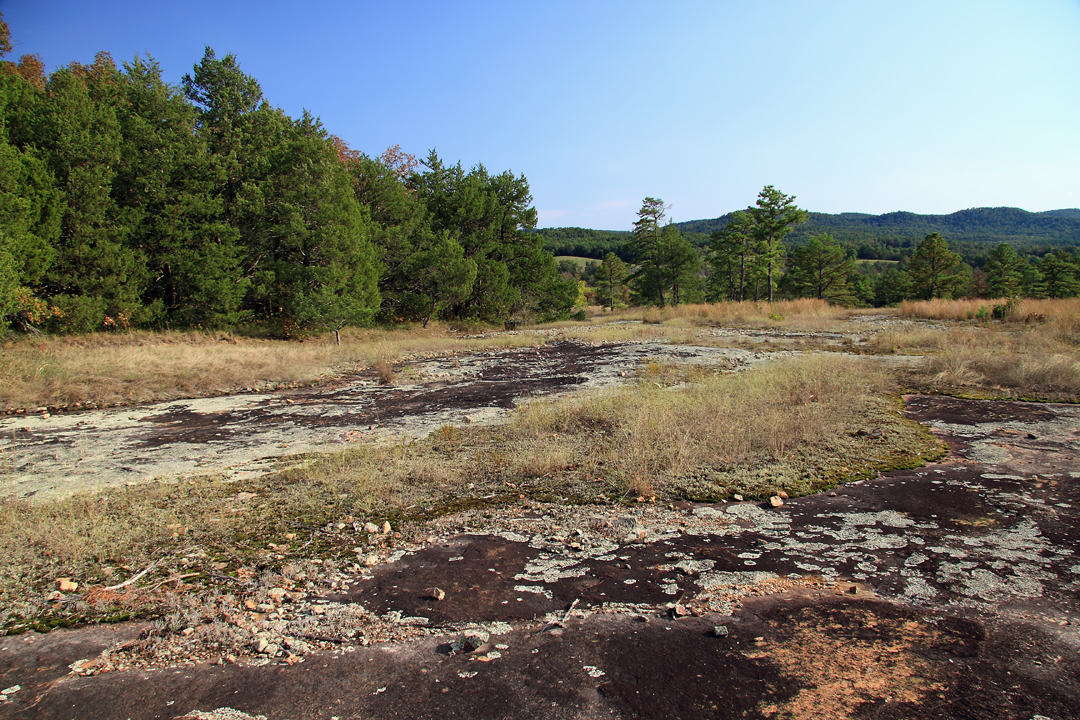
Sandstone glade | nr. Calico Rock, Arkansas.

Although western sand dune endemics were the top goals on my  during last fall’s Annual Tiger Beetle Trip, I started the trip by leaving St. Louis in the most unlikeliest of directions—south! No, I wasn’t trying to get to Denver without having to drive the tedious stretch of I-70 through Kansas. Rather, I wanted to take advantage of the chance to witness active adults of the Missouri/Arkansas disjunct population of Cicindelidia obsoleta vulturina (prairie tiger beetle)—perhaps my favorite of all tiger beetle species—on the sandstone glades near Calico Rock in north-central Arkansas. Widely disjunct from the main population’s eastern limit of distribution in central Texas, I’ve seen them at many locations in the White River Hills of southwestern Missouri and adjacent Arkansas over the past ten years, but never in the area around Calico Rock where they are best known from the state. I already had precise localities where I knew I could see them, as I had found 3rd-instar larvae earlier in the year (some of which had already emerged as adults), so I wanted see them and document the range of variability exhibited by adults at this southeasternmost known extent of the disjunct population’s distribution.

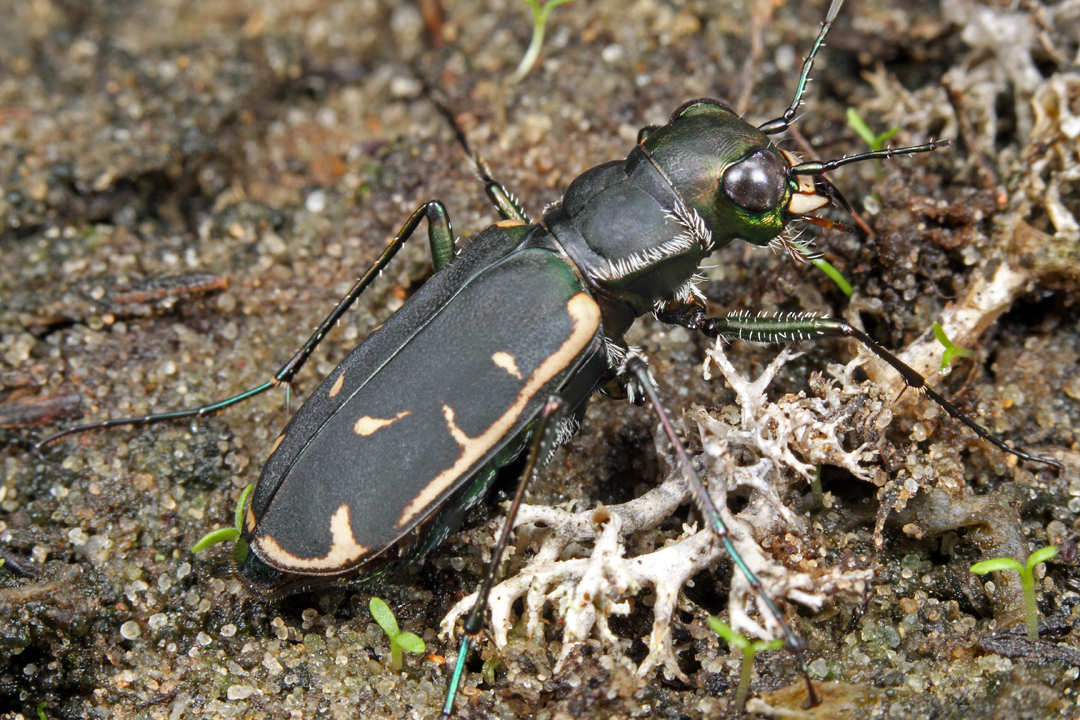
Cicindelidia obsoleta vulturina | nr. Calico Rock, Arkansas.

Although the adults were not quite as numerous as I have found them at certain sites in Missouri, I had no trouble finding them once I got to the area where I had collected the larvae this past June. While showing Steve Spomer our Missouri population last year, he commented that our Missouri adults seemed much less flighty than adults he had seen at Calico Rock. I must say that I agree with him, as I found the adults much more difficult to photograph than those in Missouri. To be honest, I had to stalk nearly ten individuals before the male in the photo above finally allowed me to get close to him. When adults are numerous this is not a problem, but in this case every failed attempt required several more minutes of searching for the next subject. Eventually, however, I got my mojo and started having success with the photographs.

Unlike true spring-fall species, mating occurs in fall instead of spring.

In the main population, and like other members of the genus Cicindelidia, adults are active during the summer months and exhibit the classic “summer” species life history. The Missouri/Arkansas disjunct population, however, shows a phenologic shift in adult activity to the cooler fall months—perhaps in response to the generally droughty conditions that prevail during the summer in this part of the country followed by rains during late summer and into fall. (This is one reason why I think this population may be deserving of separate subspecific status.) In this regard they appear to be “spring-fall” species, but their life history does not match true members of that group, which emerge during fall as sexually immature adults, hibernate during winter, and re-emerge during spring for mating and oviposition. Thus, one never sees adults of classic spring-fall species like Cicindela limbalis mating during the fall. In contrast, adults of this disjunct population emerge, mate, and lay eggs all during the fall before the onset of winter, then they’re done. The eggs hatch during fall and require another season or two to reach 3rd-instar and pupate during the summer for fall emergence.

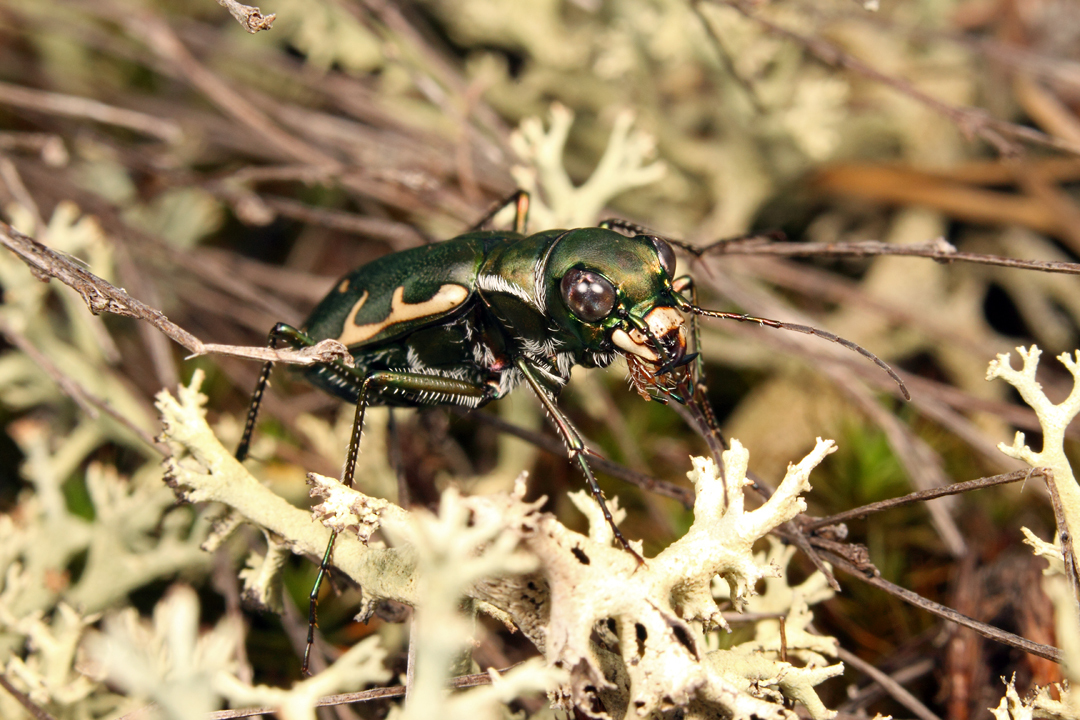
Coloration likely functions in crypsis, as shown by this individual nestled in amongst moss and lichens.

When viewed as prepared specimens in a cabinet, C. obsoleta and its subspecies are among the most conspicuous of species due to their large size (in Missouri and Arkansas only Tetracha virginica is larger), olive green coloration, and bold white maculations. More than likely, however, the combination of color and markings serve a crypsis function in their native habitat. This is clearly evident with the individual in the above photograph, who had retreated to a moss- and lichen-covered rock crevice in his efforts to evade my lens. Squint your eyes a little bit, and he almost disappears! It must be similar for visually based predators such as birds and lizards.

On more open ground and from a lower angle, the beetle is much more visible.

This same individual, however, becomes quite visible when chased onto more open rock surfaces (and viewed more laterally than from above). It is common to see individuals out in the open such as this, but more often than not when alarmed they fly or run to less exposed areas, relying on their cryptic coloration to avoid detection. In fact, when I follow beetles that have evaded me to the spot where I am sure they must have landed, I often fail to see them even though I am looking almost exactly in the area where they are sitting until they start to crawl and their movement catches my attention.

A rather greenish individual tries to hide amongst lichens and shortleaf pine duff.

I have observed a great deal of variability in coloration and maculation at locations in Missouri, with individuals ranging from bright green to dull olive-green to dark green and even brown, and the markings ranging from complete to interrupted. I saw a similar amount of variability in the Calico Rock population, with the exception of brownish (which I have only seen at the northernmost localities in Missouri) and fully maculated individuals. Most of the Calico Rock individuals were dull olive-green, but the female in the above photo (trying to evade my attentions by hiding amongst lichens and pine duff) was as bright a green as I’ve seen in any individual.

A very weakly maculate individual.

As mentioned above, I didn’t seen any individuals that I would consider fully maculated, and several that I saw were more weakly maculated than any I’ve seen in Missouri. The female in the photograph above was the most weakly-marked individual that I saw, with the lateral and median bands greatly interruped—the latter nearly reduced to small discal spots.

A dark, almost blackish female.

While I did not see brownish individuals as I have seen at the northernmost localities in Missouri, I did see the occasional blackish individual—the one in the above photograph also exhibiting about the greatest degree of macular development that I observed among the adults seen. My impression now is that there are clinal patterns to the coloration and macular development in this disjunct population, with markings tending to be more developed in northern localities. With the specimens collected from this and the many other locations throughout the disjunct population’s range that I have now sampled, a more critical assessment of variability in this population may now be possible.

Beetle's-eye view of sandstone glade habitat.

It has become standard practice for me to photograph tiger beetle habitats whenever I can. However, I’ve become interested recently in trying to understand how tiger beetles perceive their own habitats. While this isn’t possible to know precisely, ground level photographs can provide at least a clue into seeing the world from a beetle’s eye. I almost find this perspective of the glade habitat more interesting than the human perspective shown in the first photograph.

The last sight that their prey sees.

There can be little doubt about what the beetles themselves look like from the perspective of their prey. The photograph above may not properly represent the image generated by an insect’s collective ommatidia, but it certainly must be just as frightening!

Copyright © Ted C. MacRae 2012
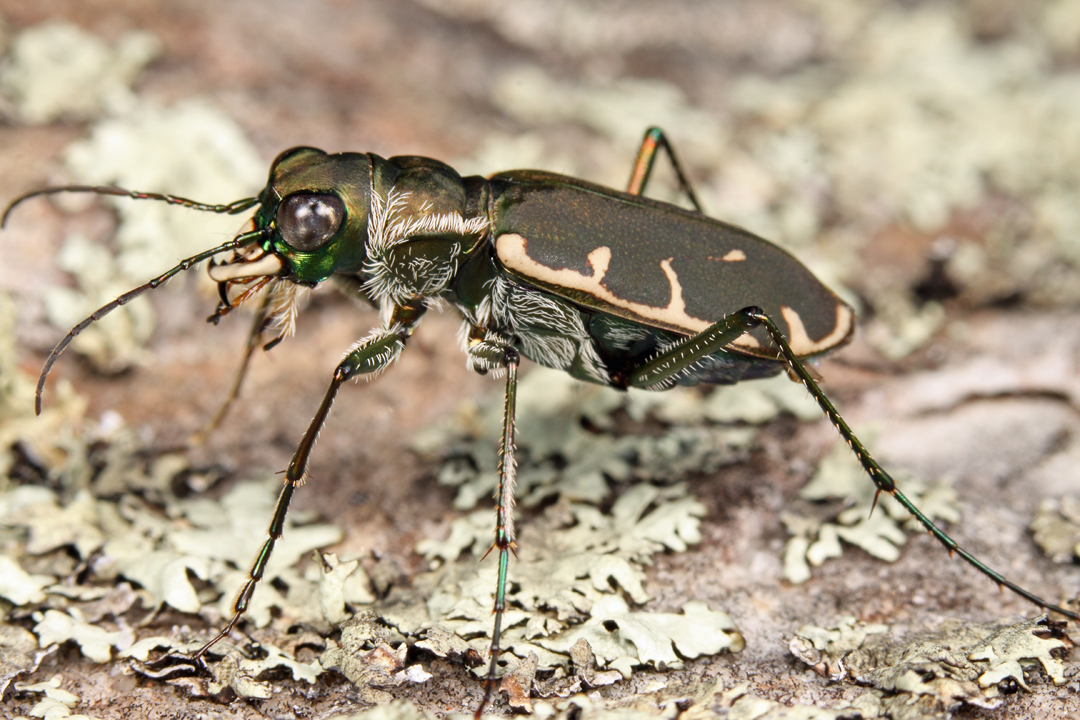
BitB’s Newest Contributor – Chris Brown

To regular readers of this blog, the name Chris Brown should be familiar. As a frequent companion on many of my field trips over the past decade, I’ve had numerous opportunities to mention his name in the posts that I’ve written about those trips. Chris, however, is not just a field companion—he is also an Entomologist (capital “E”) in his own right. Like me, he makes a living in the field of agricultural biotechnology, his particular focus being risk assessment of genetically modified crops. Also like me, he has a passionate avocational interest in insect biosystematics and conservation, and together we share our obsession with tiger beetles as co-investigators in the Missouri tiger beetle project. Unlike me, Chris also has fluent command of the avian fauna, giving him some additional ecological insights that I lack. In addition, whatever modest ability I’ve demonstrated as an insect macrophotographer over the past few years has been due in large part to the encouragement and advise of Chris, who was already an adept insect macrophotographer long before I became interested in adding a camera pack to my field outfit. Chris’ influence on me has already had an impact on BitB, and it is with great pleasure that I announce Chris will now have additional impact as its newest contributing author.

Photographing Cicindela pulchra in South Dakota.

I first met Chris when he came to my lab as a summer intern more than a decade ago (not long after I myself had taken my position here). It didn’t take long before Chris’ interest in joining me on my field exploits became apparent, and I was happy to have his company. During those early trips, I was immediately impressed not only by his skill as a photographer, but also his interest in understanding broader ecological context (too many young collectors want to know only the bug’s name and where they can find it). The Missouri tiger beetle project was in its earliest stages at that time—I thought his photographic capabilities would compliment my field experience in surveying for these insects and invited him to join me in the effort. In the years since, we have traveled together to all corners of Missouri, made two trips to the neighboring Great Plains, and explored the length of the Rio Grande River from Boca Chica to Big Bend. Chris’ travels, with me and separately, give him unique perspective and breadth of knowledge, and as much as he may claim to have learned from me during our joint travels, I have learned from him equally as much. Perhaps the most valuable lesson learned is to use photography as a means not to capture just images of insects, but moments in their natural history—features not easily appreciated when looking at preserved insect specimens in a cabinet. Please join me in welcoming Chris to BitB, and look for his first post to appear in the next day or so—I think you will find it a delightful read.

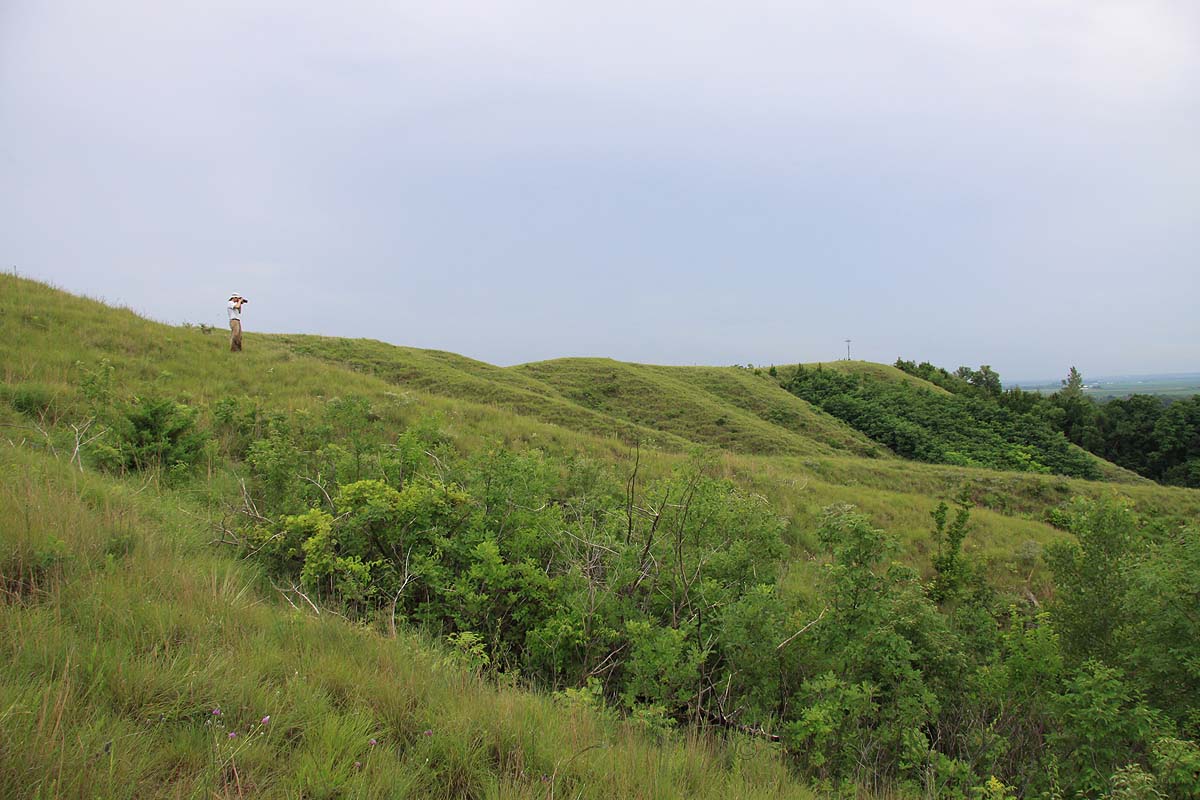
Chris surveys the loess hills landscape in northwestern Missouri

Copyright © Ted C. MacRae 2012
Colorado’s Great Sand Dunes Tiger Beetle

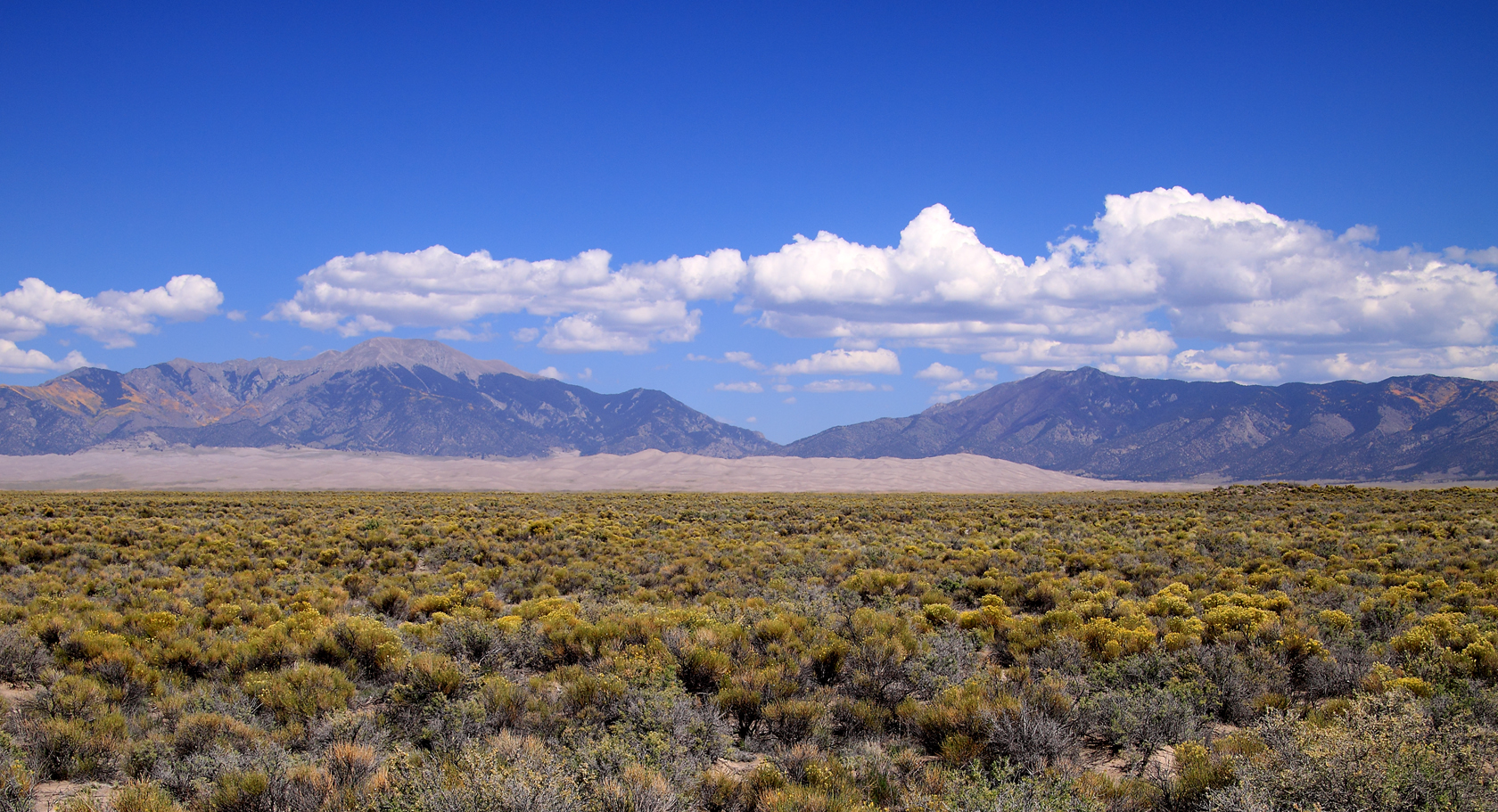
Great Sand Dunes National Park | Saguache and Alamosa Counties, Colorado (click for 1680 x 887 version)

Last year’s Annual Fall Tiger Beetle Trip entered its last day as an unqualified success. Travel partner Jeff Huether and I were doing the “Great Western Sand Dune Tour” on a quest to find and photograph some of North America’s most geographically restricted tiger beetles. The first four days featured successful visits to northwestern Colorado’s Maybell Sand Dunes for Cicindela scutellaris yampae and Cicindela formosa gibsoni, southeastern Idaho’s St. Anthony Sand Dunes for Cicindela arenicola, and southwestern Utah’s Coral Pink Sand Dunes for the prize of the trip—Cicindela albissima. The only endemic that we had failed to find was Cicindela waynei at southwestern Idaho’s Bruneau Sand Dunes (hopefully this was a result of poor fall emergence conditions rather than an indication of further decline of this perilously endangered species).

Small sand dune west of GSDNP in the Nature Conservancy's Medano-Zapata Ranch.

Day 5 featured a visit to southwestern Colorado’s Great Sand Dunes to look for the endemic Cicindela theatina. As on every day previous of the trip, the morning drive saw cool but rising temperatures under bright, sunny skies, so we were optimistic about our chances. Between Great Sand Dunes National Park (type locality of the beetle) and The Nature Conservancy’s Medano-Zapata Ranch west of the park, the entire 290 km² range of C. theatina is on protected land. Not knowing whether the beetle would be out and, if so, how extensively it would occur, our plan was to approach the Park from the west through Zapata Ranch and stop at any sand dunes we sighted along the way until we found the beetle.  It didn’t take long—as soon as we entered the Ranch we began to see small sand dunes in the distance, and within minutes after making the 1-km hike towards one particularly promising looking dune we saw the beetles. Even though this was the fifth western sand dune endemic I had seen in as many days, the first moment I laid eyes upon it was no less exciting—flashing red and green on coppery, white marked elytra, it seemed all hair and teeth!

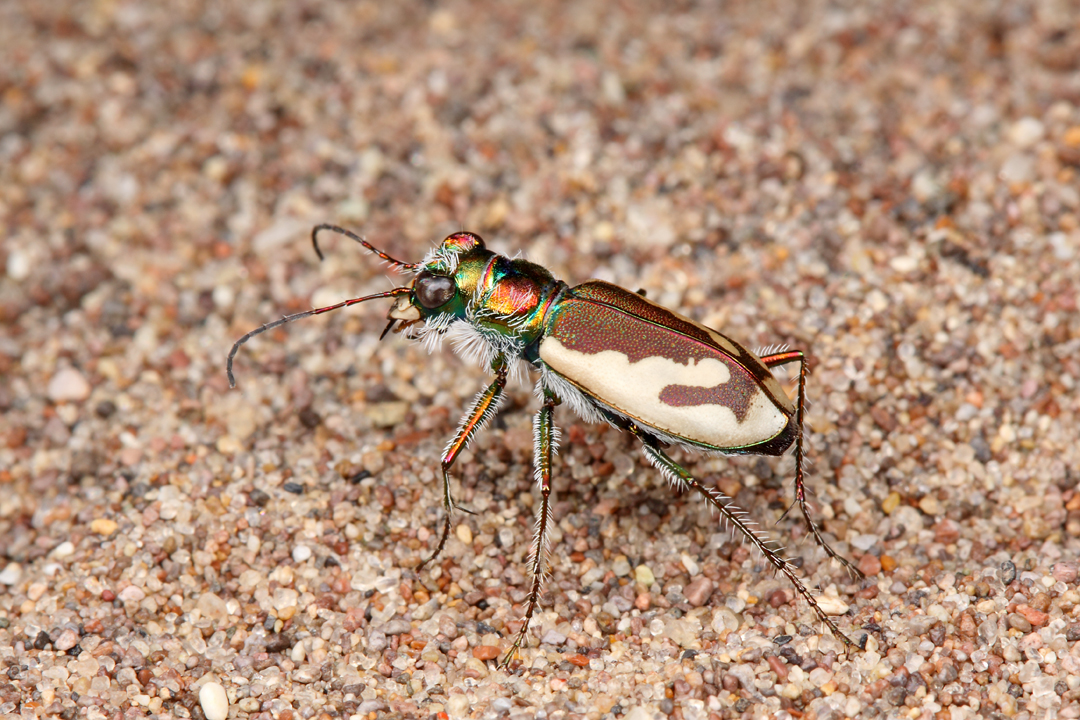
Great Sand Dunes tiger beetle (Cicindela theatina) | Medano-Zapata Ranch

Despite this being my first sighting of the species, there was no doubt about it’s identity. The only other tiger beetle that occurs with and could possibly be mistaken for C. theatina is the blowout tiger beetle, C. lengi; however, the broad marginal band that runs completely around the elytra and the green/brown dorsal coloration of C. theatina are enough to distinguish it from that species. Temperatures were still a bit on the cool side, but the beetles were already remarkably active and skittish. Like the other sand dune species we had already seen, they were enormously difficult to approach—numerous failed attempts were necessary before I encountered the slightly more cooperative female shown in these photos (although she still required several minutes of stalking to get her sufficiently accustomed to my presence to allow these shots).

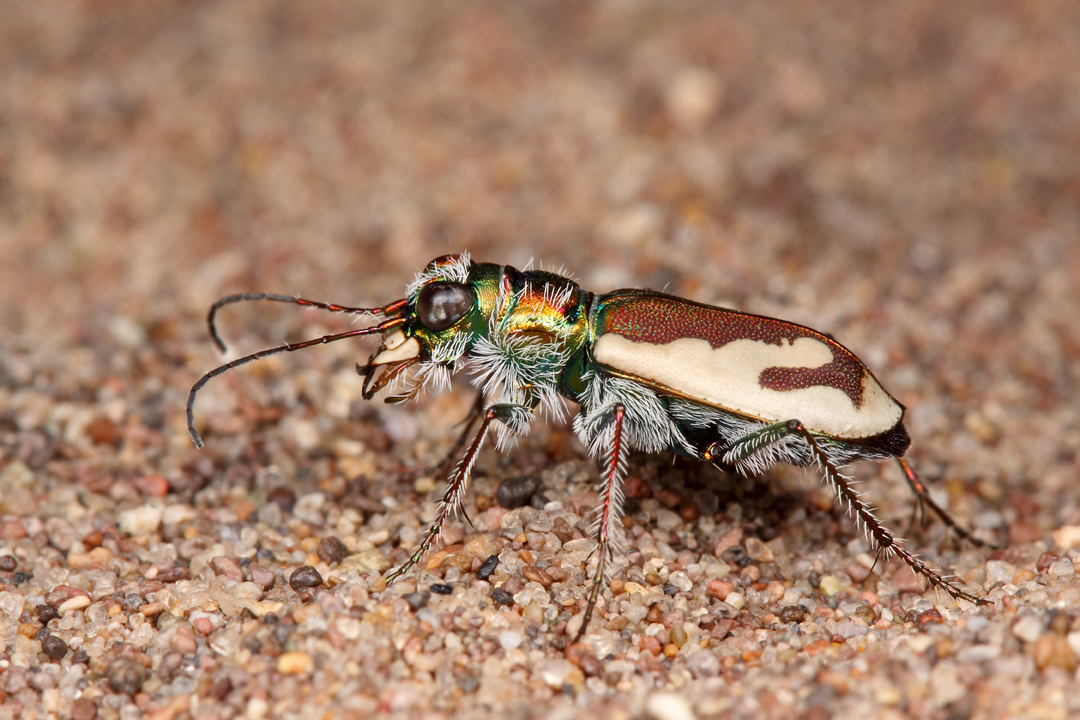
Like most sand dune tiger beetles, adults are densely hairy on the lateral and ventral surfaces.

Adults ''hug'' the sand for warmth during the cooler morning hours.

The dense covering of white hairs on the lateral and ventral surfaces of the adults belies their adaptation to the abrading sands of their wind-swept habitat. Scouring sands, however, are not the only hardships that the adults must contend with. Temperatures on the dunes can range from as low as 40° F on a chilly morning to nearly 140° F during the heat of the day. Accordingly, much of the adult beetle’s activities revolve around thermoregulation to maintain optimal body temperatures for activity (Pineda and Kondratieff 2003). These include not only stilting, shade-seeking, and mid-day burrowing to avoid excessive warming (see my post  for examples of these behaviors), but basking to gain warmth when temperatures are still a bit too cool for effective foraging (photo above).

Fabulous metallic red and green highlights on the head and pronotum contrast with the reddish brown elytra and their white lateral markings.

Despite the fact that the entire range of this species is encompassed by protected land, WildEarth Guardians filed a petition for federal listing as an endangered species in 2007 (Tweit 2010). Whether protection will be granted remains to be seen—Coral Pink’s C. albissima has a global range only 1.3% the size of C. theatina‘s range (only slightly more than half of which is on protected land), yet that species has been awaiting listing for nearly three decades now! (Too bad C. theatina doesn’t have real fur, feathers, or those endearing mammalian eyes that would surely allow it to jump to the front of the line.)

For the first time in BitB Challenge history, we have a 4-way tie for the win. Dorian Patkus, Mr. Phidippus, Mike Baker, and David Winter all share the honors for . Mr. Phidippus is the big winner, however, as he strengthens his grip on the overall lead with a lead of 13 or more points over his nearest rivals (Roy, Tim Eisele, Mike Baker, and Dennis Haines). The competition is far from over though—a single misstep is all it would take to see the emergence of a new leader before this session is over.

REFERENCES:

Pineda P. M. and B. C. Kondratieff. 2003. Natural history of the Colorado Great Sand Dunes tiger beetle, Cicindela theatina Rotger. Transactions of the American Entomological Society 129(3/4):333–360.

Tweit, S. J. 2010. Beetle Mania. National Parks 84(4):24–25.

Copyright © Ted C. MacRae 2012

ID Challenge #15

Who am I, and where do I live?

It’s been almost a month since the last challenge, and since Alex got back to his roots I think I’ll do likewise. This is a straight up identification—the order and family are obvious (or should be), so I’m going to limit ID points to genus and species. However, to make up for this loss of higher taxa points I’ll be awarding points for correctly guessing/deducing/intuiting where this little beastie lives or providing any unique comments on its natural history. As always, standard challenge rules apply, including moderated comments to give everyone a chance to submit their answers.  Bonus points will be awarded to for answering first in the case of multiple correct answers, and discretionary bonus points are also up for grabs. Good luck!

Copyright © Ted C. MacRae 2012