Great Plains Ladies’-tresses

First things first—everyone who participated in the quiz in the previous post correctly identified the orchid flower in the photo as belonging to the genus Spiranthes, and a few were on the right track with their species suggestion of S. cernua.  However, Scott Namestnik from Indiana and Doug Taron from Illinois, were the only ones who recognized it to be a close relative of that species, the recently-described S. magnicamporum.  Nice job!  The plants in these photographs were found during early October in the dry dolomite glades of White River Balds Natural Area in southwestern Missouri (part of Ruth and Paul Henning Conservation Area).  The creamy white inflorescences stood in stark contrast to the russet big bluestem (Andropogon gerardii) and rusty gold Indian grass (Sorghastrum nutans) stems that dominated the rocky landscape.

Spiranthes¹ is one of the more complex genera of North American orchids, seven of which are known to occur in Missouri (Summers 1985).  Spiranthes magnicamporum² is closely related to S. cernua and was only recently (1975) described as a distinct species.  Conclusive separation of the two species requires microscopic examination of the seeds (those of S. magnicamporum are monoembryonic, whereas a large percentage of the seeds of S. cernua are polyembryonic) (Luer 1975).  In the field, however, S. magnicamporum can generally be distinguished from S. cernua by its spreading rather than appressed lateral sepals and absence of basal leaves at the time of flowering³.  It is likely that many previous records of S. cernua in Missouri actually refer to this species, as both occur throughout much of southern Missouri and sporadically in northern Missouri (refer to the USDA Plants Database Missouri county level distributions for S. cernua and S. magnicamporum).  However, they are ecologically isolated in that S. cernua prefers wet lowlands with acidic soils, while S. magnicamporum is typically found in drier uplands with calcareous soils.  Both species are late-season bloomers, but S. magnicamporum blooms even later (mid-September into November) than S. cernua (mid-August to mid-October) and has more fragrant flowers.

¹ From the Greek speira—σπειρα,—”coil,” and anthos—ανθος,—”flower,” referring to the coiled or spiraled spike of flowers common in the genus.

² From the Latin magnus, “large,” and campus, “plain,” meaning “of the Great Plains” in reference to the primary geographic area where this species is found.

³ My identification of these plants as Spiranthes magnicamporum was confirmed by Dr. George Yatskievych, author of Steyermark’s Flora of Missouri.

Orchids as a whole exhibit highly specialized pollination biology, and species of Spiranthes are no exception, with the spiral arrangement of their flowers evidently an adaptation to pollination by long-tongued bees (e.g. bumblebees, Bombus spp., and megachilid bees) (van der Cingel 2001).  Flowers are protandrous, i.e., they are functionally male when they first open and become functionally female as they age, and open sequentially from the base, resulting in female flowers on the lower inflorescence and male flowers on the upper inflorescence.  Thus, bee pollinators tend to act as pollen donors when visiting lower flowers and pollen recipients when visiting upper flowers.  Pollinia from male flowers are attached to the bee’s proboscis as it tries to access nectar secreted into the base of the floral tube.  When visiting a plant, bees start at the bottom of the inflorescence and spiral up to the top before flying to the next plant.  The reasons for this behavior, called acropetal movement, are not fully understood but could be related to the tendency for nectar rewards to be greater in the lower flowers.  Whatever the explanation, the result is to promote outcrossing between neigboring plants.

While specific insect pollinators have been documented for a number of Spiranthes spp., apparently the only account of pollination in S. magnicamporum is documented by Jeffrey R. Hapeman, author of the website Orchids of Wisconsin:

I have seen a bumblebee (Bombus nevadensis ssp. americorum) pollinating Spiranthes magnicamporum in a prairie in southeastern Wisconsin. After visiting a number of inflorescences, the bee began to vigorously scratch at the pollinia on its proboscis, trying to remove them. The bee became so involved in trying to remove the pollinia that it fell to the ground, where it was easily captured. The specimen was determined by Steve Krauth, and is deposited in the Insect Research Collection at the University of Wisconsin-Madison. Apart from this observation, there are no published accounts of pollination of S. magnicamporum.
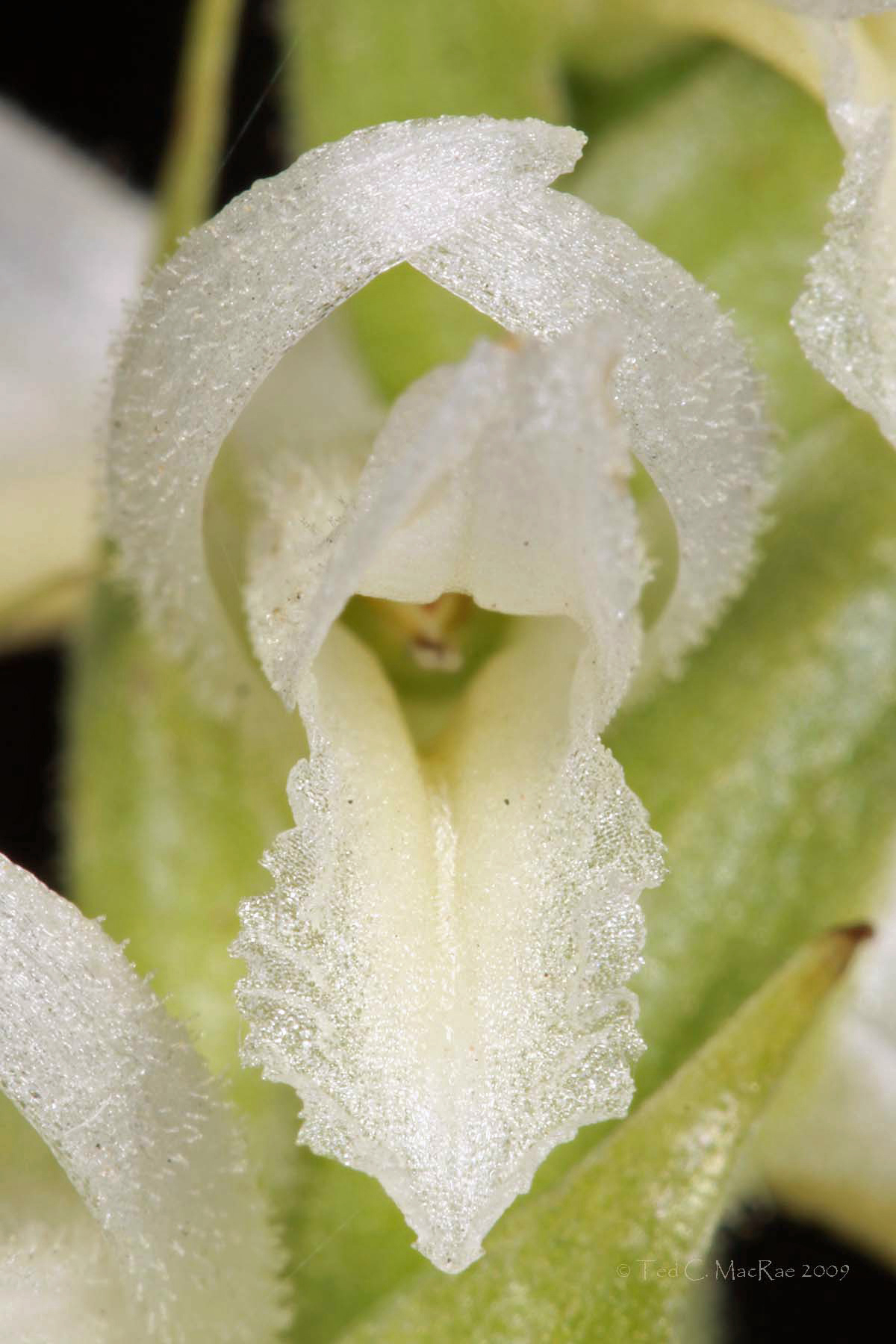
Photo details:
All photos: Canon 100mm macro lens on Canon EOS 50D (manual mode), ISO 100, MT-24EX flash w/ Sto-Fen diffusers.
Photo 1: 1/160 sec, f/14, flash 1/2 power.
Photo 2: 1/250 sec, f/16, flash 1/4 power.
Photo 3: 1/250 sec, f/20, flash 1/4 power.
Photo 4: w/ 36 mm extension tube, 1/250 sec, f/16, flash 1/8 power.

REFERENCES:

Luer, C. A.  1975.  The Native Orchids of the United States and Canada Excluding Florida.  The New York Botanical Garden, 361 pp. + 96 color plates.

Summers, B.  1981.  Missouri Orchids.  Missouri Department of Conservation, Natural History Series No. 1, 92 pp.

van der Cingel, N. A.  2001.  An atlas of orchid pollination: America, Africa, Asia and Australia. A. A. Balkema, Rotterdam, Netherlands, 296 pp.

Copyright © Ted C. MacRae 2009

Add to FacebookAdd to DiggAdd to Del.icio.usAdd to StumbleuponAdd to RedditAdd to BlinklistAdd to TwitterAdd to TechnoratiAdd to Yahoo BuzzAdd to Newsvine

Email to a friend

Friday Flower: Yes, it’s an orchid…

Photo details: Canon 100mm macro lens on Canon EOS 50D (manual mode), 36 mm extension, ISO 100, 1/250 sec, f/16, MT-24EX flash @ 1/8 power w/ Sto-Fen diffusers.

…but what kind? Identifying the genus should be relatively easy, but I suspect a species identification will be more of a challenge.  I’ll provide a little information and even a couple of literature sources that might be useful for achieving a specific determination.

  • Date of photograph: October 5, 2009.
  • Location: White River Balds Natural Area, Taney County, Missouri.
  • Habitat: Dolomitic limestone glade.

Answer and more photos will be posted shortly, so give it your best shot. Think big!

REFERENCES:

Luer, C. A.  1975.  The Native Orchids of the United States and Canada Excluding Florida.  The New York Botanical Garden, 361 pp. + 96 color plates.

Summers, B.  1981.  Missouri Orchids.  Missouri Department of Conservation, Natural History Series No. 1, 92 pp.

Copyright © Ted C. MacRae 2009

Add to FacebookAdd to NewsvineAdd to DiggAdd to Del.icio.usAdd to StumbleuponAdd to RedditAdd to BlinklistAdd to TwitterAdd to TechnoratiAdd to Furl

CotS #45

Circus of the Spineless #45 is up.

Go to Greg Laden’s Blog and read about scale insects, exotic pests, spiders, more spiders, more more spiders, millipedes, more more more spiders, the world’s most astoundingly beautiful lacewing (one of the Iberian spoonwings), cricket neurons, mosquito sensillae, “not real” katydids, cave crickets, gross flies, ants that love corn chips, moths that love their vegetables, extinct insects, Jamaican leps, a spider wannabe, jingle shells (breaking this issue’s arthropod stranglehold), pet worms, missing mussels…

…and (my favorite)… one seriously fearsome looking baby beetle!  Take a look and leave a comment! 

For the botanically inclined, Berry Go Round #22 is up at Seeds Aside.  I had a whale of a time hosting this carnival last month, so let’s show it a little love.

Copyright © Ted C. MacRae 2009

Add to FacebookAdd to NewsvineAdd to DiggAdd to Del.icio.usAdd to StumbleuponAdd to RedditAdd to BlinklistAdd to TwitterAdd to TechnoratiAdd to Furl

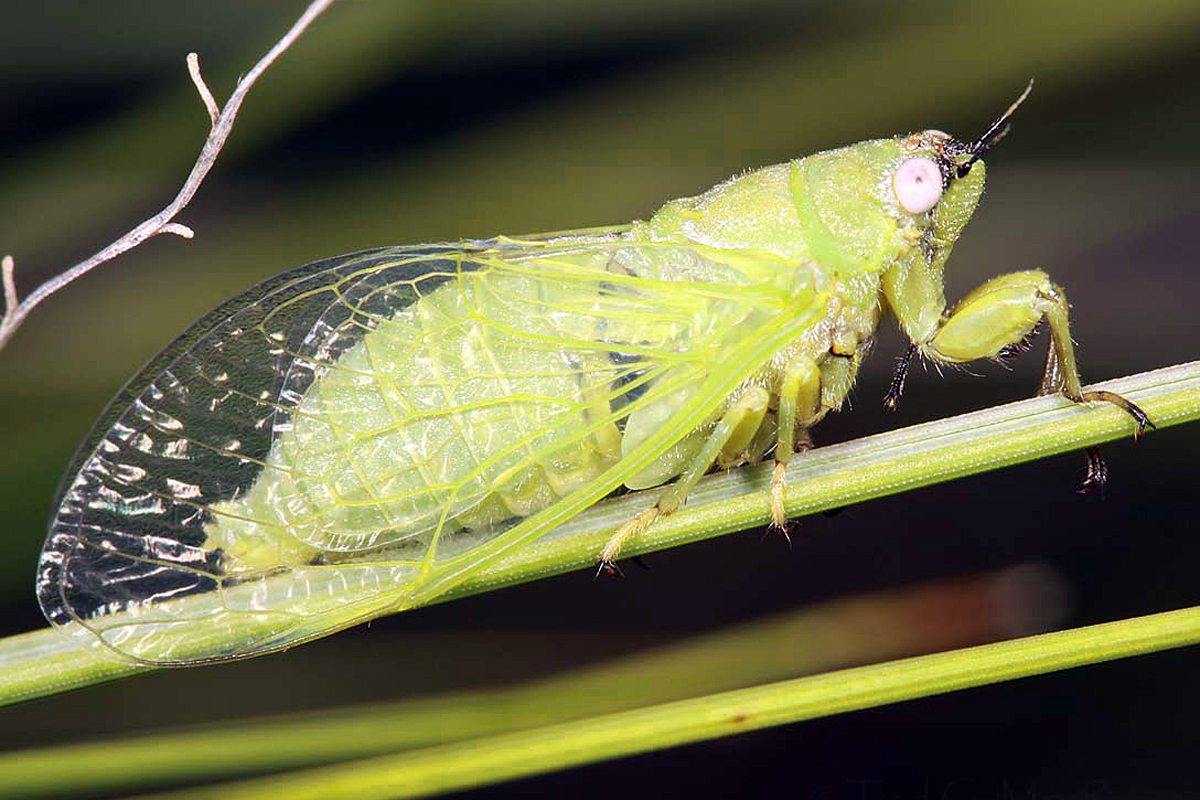
Cicadetta kansa in Oklahoma

Photo details: Canon 100mm macro lens on Canon EOS 50D, ISO 100, 1/250 sec, f/14, MT-24EX flash 1/4 power w/ Sto-Fen diffusers.

Another of the insects that I saw this past June at Four Canyon Preserve in northwestern Oklahoma was this small cicada, Cicadetta kansa. Though not as small as the diminutive Beameria venosa (see North America’s smallest cicada), their barely audible call – a soft buzz – makes them even more difficult to notice.  I only realized what they were after noticing something odd about the small, green “grasshoppers” that flitted in front of me as I walked through the mixed shortgrass prairie.  They didn’t quite fly “right” and landed delicately within the grass rather than crashing into it clumsily.  Even after realizing that they weren’t grasshoppers, it was difficult to say what they were at first due to their wariness and lime green coloration that helped them blend marvelously into their grassy surroundings.  A few sweeps of the net solved that problem, and I discovered what was at the time the smallest and most beautiful cicada I had seen to that point (Beameria venosa took both honors later that month in the Loess Hills of northwestern Missouri).

Despite being the only world-wide genus of cicadas, Cicadetta is represented in the U.S. by only two species—C. kansa and C. calliope.  In addition to its pale green coloration, C. kansa is distinguished from C. calliope by having only 4 or 5 apical cells in the hind wing (6 in C. calliope).  Cicadetta kansa occurs from Texas north to South Dakota, while C. calliope is found from Texas to Florida and northwards to Iowa, Ohio and New Jersey.  Little is known about the biology of Cicadetta kansa; however, presumably it is similar to that of C. calliope, which emerges and lays eggs in late spring.  Eggs hatch by late summer, at which time the nymphs burrow into the ground again begin feeding on the roots of grasses.  This feature of their biology protects them from the negative impacts of managed spring and fall burns, and indeed C. calliope is known to increase in prairies that are managed by such burns.  This is in contrast to other prairie cicadas (genus Tibicen), which overwinter as eggs in the above-ground portion of grasses and, thus, are negatively impacted by fall and spring burns.

A number of websites are dedicated to these charismatic insects; however, Cicada by Andy Hamilton at the Canadian National Collection of Insects, Arachnids and Nematodes is the most informative and comprehensive that I’ve found.

Copyright © Ted C. MacRae

Add to FacebookAdd to NewsvineAdd to DiggAdd to Del.icio.usAdd to StumbleuponAdd to RedditAdd to BlinklistAdd to TwitterAdd to TechnoratiAdd to Furl

A bid for OpenLab

I’m going to do something I’ve not yet done before—ask for your support.  OpenLab is an annual compilation of the year’s best science-blog writing, as determined by a panel of judges, and the closing date for submissions for 2009 is December 1st—this coming Tuesday.  I’ve vacilated about whether to throw my hat into this ring—the world of science blogs is a crowded place with many erudite writers, and although science is my profession, the science that I write about is purely avocational.  Whether my particular brand of science writing can compete with that of the true academicians that seem to dominate the competition remains to be seen.  Nevertheless, I am willing to put my ego on the line and give it a shot.  If you have seen anything in the past year (since December 1, 2008) here at Beetles in the Bush that you consider exemplary, please consider submitting it.  Feel free to search the sidebar archives (“Taxa,” “Tags” or “Life History”), browse the site Contents, or select from the following list of my own personal favorites (arranged chronologically):

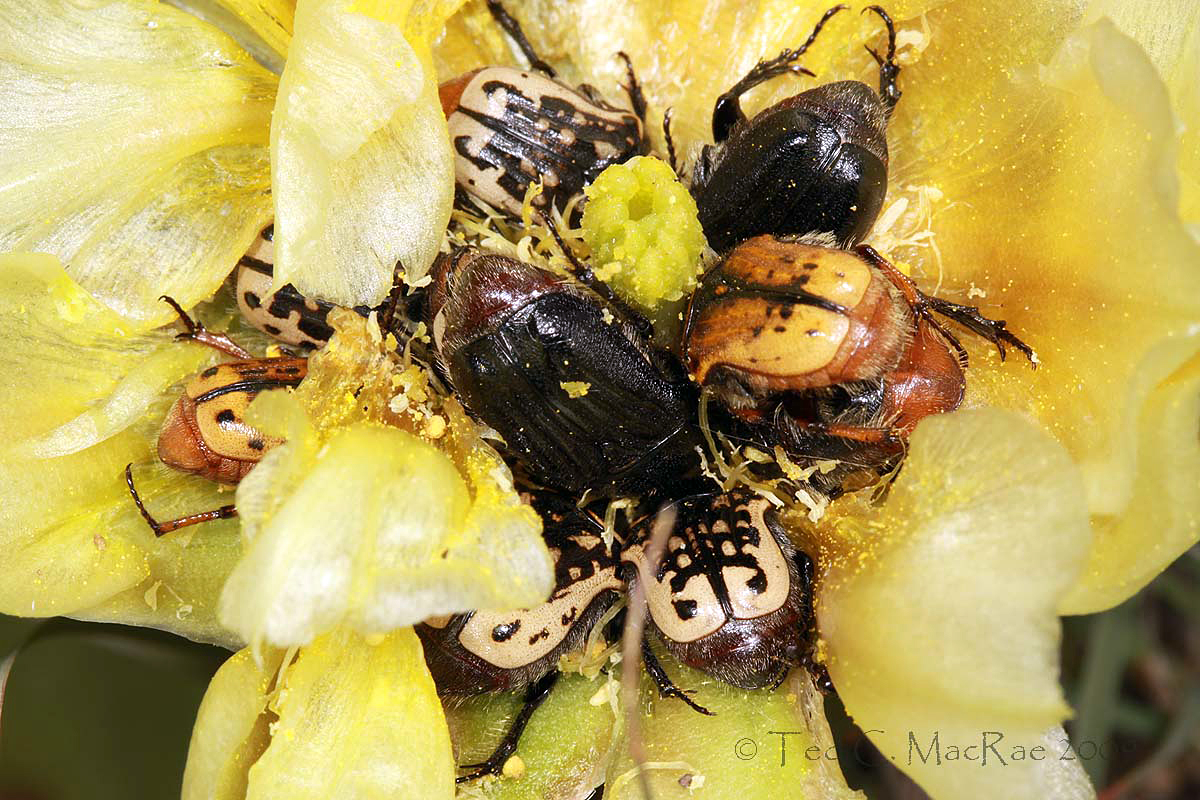
So I don’t get accused of asking but not giving, I leave you with this photograph of a group of Kern’s flower scarabs (Euphoria kernii, family Scarabaeidae) congregated in the flower of large-root prickly pear cactus (Opuntia macrorhiza, family Cactaceae).  Photographed this past June at Four Canyon Preserve in northwestern Oklahoma, this common, extremely variable species (ranging from all black to black and white to black and yellow to nearly all yellow) can be found throughout the southern Great Plains, where it congregates tightly in flowers of Opuntia , pricklypoppy (Argemone spp., family Papaveraceae), thistle (Cirsium spp., family Asteraceae), and yucca (Yucca spp., family Liliaceae).

Photo details: Canon 100mm f/2.4 macro lens on Canon 50D (manual mode), ISO-100, 1/250 sec, f/16, diffused MT-24EX flash.

Copyright © Ted C. MacRae 2009

Add to FacebookAdd to NewsvineAdd to DiggAdd to Del.icio.usAdd to StumbleuponAdd to RedditAdd to BlinklistAdd to TwitterAdd to TechnoratiAdd to Furl

Thanksgiving

As one of the few American holidays that hasn’t been completely usurped by religious or commercial interests (the traditional Day-After-Thanksgiving-Shopping-Mêlée notwithstanding), Thanksgiving is a time for reflection and contemplation.  The feast I will enjoy, surrounded by those whose love and friendship I treasure most, is but a proxy for reminding myself not only how much I enjoy life and all it has to offer, but also how extraordinarily fortunate I find my circumstances and the opportunities presented to me.  As we go through our daily hustles, it is easy to lose sight of the basic tenants of a good life—loving family, close friends, employment that not only provides for the body but also nutures the mind, and the overwhelming beauty of nature and its intricacies.  Thanksgiving means something unique for each of us, but I hope you’ll join me in giving thanks for the things we have and rededicating ourselves to helping, without judgment, the many people in our country and across the world who find themselves in less fortunate positions.  In the meantime, please enjoy this beautifully glowing rendition of George Winston’s “Thanksgiving” as it evokes the essence of the season and its sumptuous landscapes.

Copyright © Ted C. MacRae 2009

Add to FacebookAdd to NewsvineAdd to DiggAdd to Del.icio.usAdd to StumbleuponAdd to RedditAdd to BlinklistAdd to TwitterAdd to TechnoratiAdd to Furl

Oh, and by the way…

…Happy 2nd blogoversary to me!  I just now realized it, so happily you’ll be spared the tedious introspection.

Today also marks 150 years since the publication of Charles Darwin’s On the Origin of Species.  Sharing the day with my hero (see sidebar quote)—yea!

A “Really” Big-headed Tiger Beetle

Megacephala megacephala 3rd-instar larva. Photo © Artur M. Serrano.

In my recent summary of the latest issue of the journal Cicindela, I included a scan of the cover of that issue and its stunning image of the 3rd-instar larva of Megacephala megacephala¹ from Africa.  This otherwordly-looking, four-eyed beast was photographed with jaws agape at the entrance to its burrow in Guinea Bissau by Dr. Artur M. Serrano (University of Lisbon, Portugal).  I was grateful for his permission to post a scan of this spectacular image; however, he did even better and sent me high-resolution images of not only the larva (above) but the adult (below) as well.  This species is one of 13 assigned to the genus—presently restricted to Africa (though not always, see discussion below), where they are usually found in savanna-type habitats and are active during the crepuscular and nocturnal periods (Werner 2000).

¹ An example of a tautonym, i.e. a scientific binomen in which the genus and species names are identical. Familiar tautonymic binomina include the gorilla (Gorilla gorilla), green iguana (Iguana iguana), and European toad (Bufo bufo). Tautonyms are expressly prohibited in plant nomenclature (see Article 23.4 of the International Code of Botanical Nomenclature) but are permitted and, in fact, quite common in zoological nomenclature; Wikipedia lists 51 mammals, 82 birds, 15 reptiles & amphibians, 54 fish, and 33 invertebrates (though not Megacephala megacephla!).

Megacephala megacephala adult. Photo © Artur M. Serrano.

For those of you who see a strong resemblance by this species to another tiger beetle I featured recently, Tetracha floridana (Florida Metallic Tiger Beetle), this is not merely a coincidence.  Megacephala and Tetracha are quite closely related, and in fact the two genera, along with a handful of other closely related genera, are at the center of one of the longest-standing disputes in tiger beetle taxonomy (Huber 1994).  The genus Megacephala was established by Latreille (1802) for the species pictured here (originally described as Cicindela megacephala Olivier).  As additional taxa were found in Africa, Australia and the Western Hemisphere and assigned to Megacephala, several workers attempted to divide the genus into multiple genera (with New World taxa being assigned to Tetracha and a few other mostly South American genera); however, there was little agreement on how these genera should be defined and on what characters they should be based.  The debate was effectively swept under the rug in the early 20th Century when Walter Horn, one of the most influential cicindelophiles of all time, accepted a monotypic Aniara based on the strange South American species A. sepulcralis but reunited the world’s remaining taxa within the single genus Megacephala in his world catalogue (Horn 1910).  Horn’s use of Megacephala as a catch-all genus was followed by subsequent workers for almost a full century until Huber (1994) once again proposed restricting Megacephala to certain of the African species and resurrecting the genus Tetracha for the bulk of the New World fauna.  He also urged additional analyses to resolve the status of the remaining generic names and their composition, which subsequently saw increasing use as subgenera of Megacephala² and later as genera.

² Thus, as type-species for the genus, the species featured here became known as Megacephala (Megacephala) megacephala (Werner 2000)—a triple tautonym that translates to the “Big-headed, Big-Headed, Big-Headed” tiger beetle!  Perhaps it’s best that I’m not an African tiger beetle specialist; I probably would have been unable to resist the temptation to resurrect M. senegalensis and assign it as a subspecies of M. megacephala, just so I could refer to the nominate form as Megacephala (Megacephala) megacephala megacephala!

The reversal of Horn’s concepts now appears to be complete, with all seven former subgenera of Megacephala formally being accorded full generic status (Naviaux 2007). This classification is strongly supported by molecular analysis of nuclear 18S and mitochondrial 16S and cytochrome oxidase gene sequences (Zerm et al. 2007), with the resulting dendrogram indicating three monophyletic clades corresponding to the African/Palearctic (Megacephala and Grammognatha, respectively),  Western Hemisphere (Aniara, Metriocheila, Phaeoxantha and Tetracha) and Australian (Australicapitona and Pseudotetracha) genera³.  The African/Palearctic clade was found to occupy a basal position in the tree, while the Western Hemisphere and Australian clades were more derived.  These data support the hypothesis that the early evolution of the megacephalines took place during the break-up of the ancient Gondwana megacontinent, which began about 167 million years ago (middle Jurassic period) and sequentially disconnected Africa from South America and Australia.

³ One striking deviation from the current classification, however, was the support for nesting the single Aniara species within Tetracha, a placement that renders Tetracha paraphyletic and, thus, requires either its division into multiple genera or the sinking of Aniara as a distinct genus. The support for this placement was quite strong and mirrored the results of a broader molecular phylogenetic study of tiger beetles based on full-length 18s RNA data (Galian et al. 2002). The authors concede that this puzzling placement is not corroborated by numerous morphological, ecological and ethological characters that distinguish Aniara from all known Tetracha species.

REFERENCES

Galián J., J. E. Hogan and A. P. Vogler. 2002. The origin of multiple sex chromosomes in tiger beetles. Molecular Biology and Evolution 19:1792–1796.

Horn, W.  1910.  Coleoptera Adephaga, Fam. Carabidae, Subfam. Cicindelinae.  In P. Wytsman (editor).  Genera Insectorum.  Fascicle 82a.  Desmet-Vereneuil, Brussels, Belgium, pp. 105–208.

Huber, R. L.  1994.  A new species of Tetracha from the west coast of Venezuela, with comments on genus-level nomenclature (Coleoptera: Cicindelidae).  Cicindela 26(3/4):49–75.

Latreille, P. A. 1802. Histoire Naturelle, Générale et Particulière des Crustacés et des Insectes. Paris: F. Dufart 3 xii 13 + 467 pp.

Naviaux R. 2007. Tetracha (Coleoptera, Cicindelidae, Megacephalina): Revision du genre et descriptions de nouveaus taxons. Mémoires de la Société entomologique de France 7:1–197.

Werner, K.  2000.  The Tiger Beetles of Africa (Coleoptera: Cicindelidae).  Volume 1.  Taita Publishers, Hradec Kralove, Czech Republic, 191 pp., 745 figures.

Zerm, M., J. Wiesner, J. Ledezma, D. Brzoska, U. Drechsel, A. C. Cicchino, J. P. Rodríguez, L. Martinsen, J. Adis and L. Bachmann.  2007.  Molecular phylogeny of Megacephalina Horn 1910 tiger beetles (Coleoptera: Cicindelidae).  Studies on Neotropical Fauna and Environment 42(3):211–219.

Copyright © Ted C. MacRae 2009

Add to FacebookAdd to NewsvineAdd to DiggAdd to Del.icio.usAdd to StumbleuponAdd to RedditAdd to BlinklistAdd to TwitterAdd to TechnoratiAdd to Furl