Halloween ID challenge answer – Argiope trifasciata

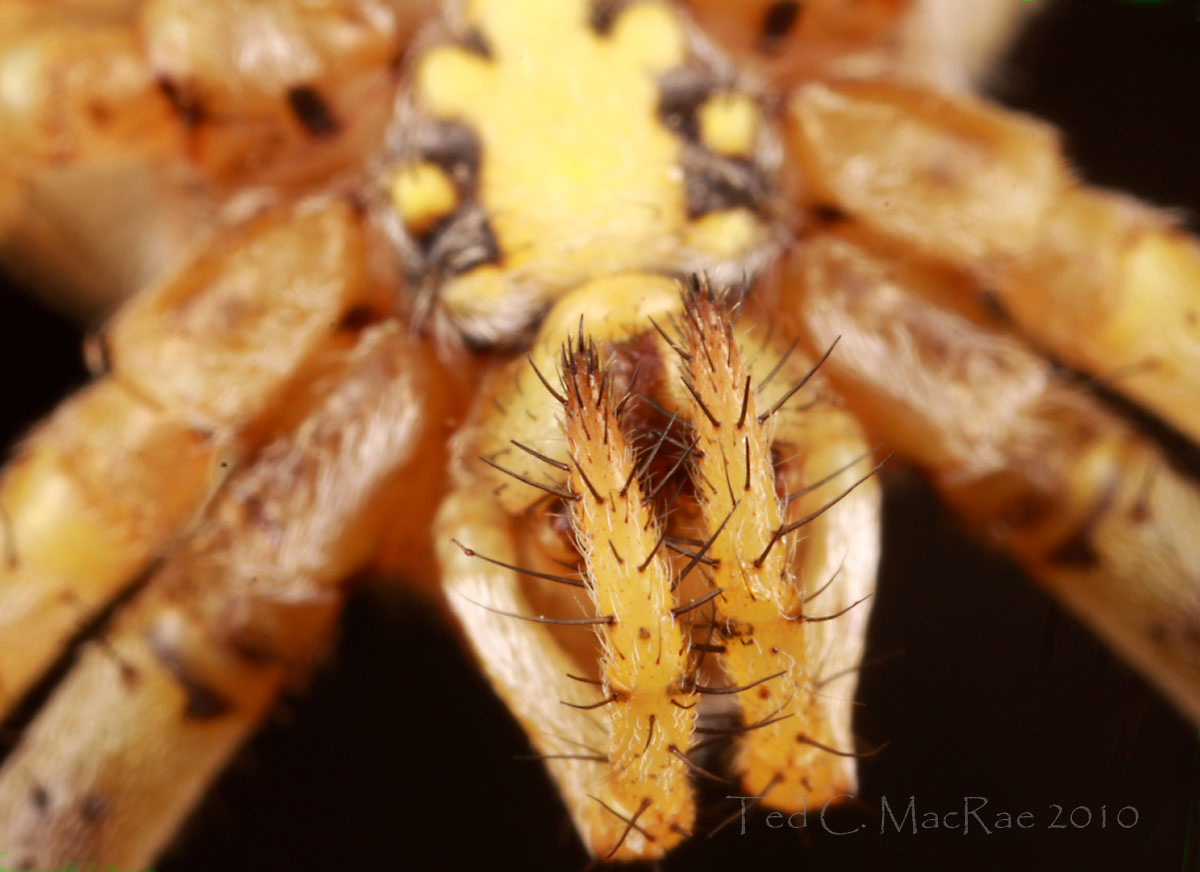
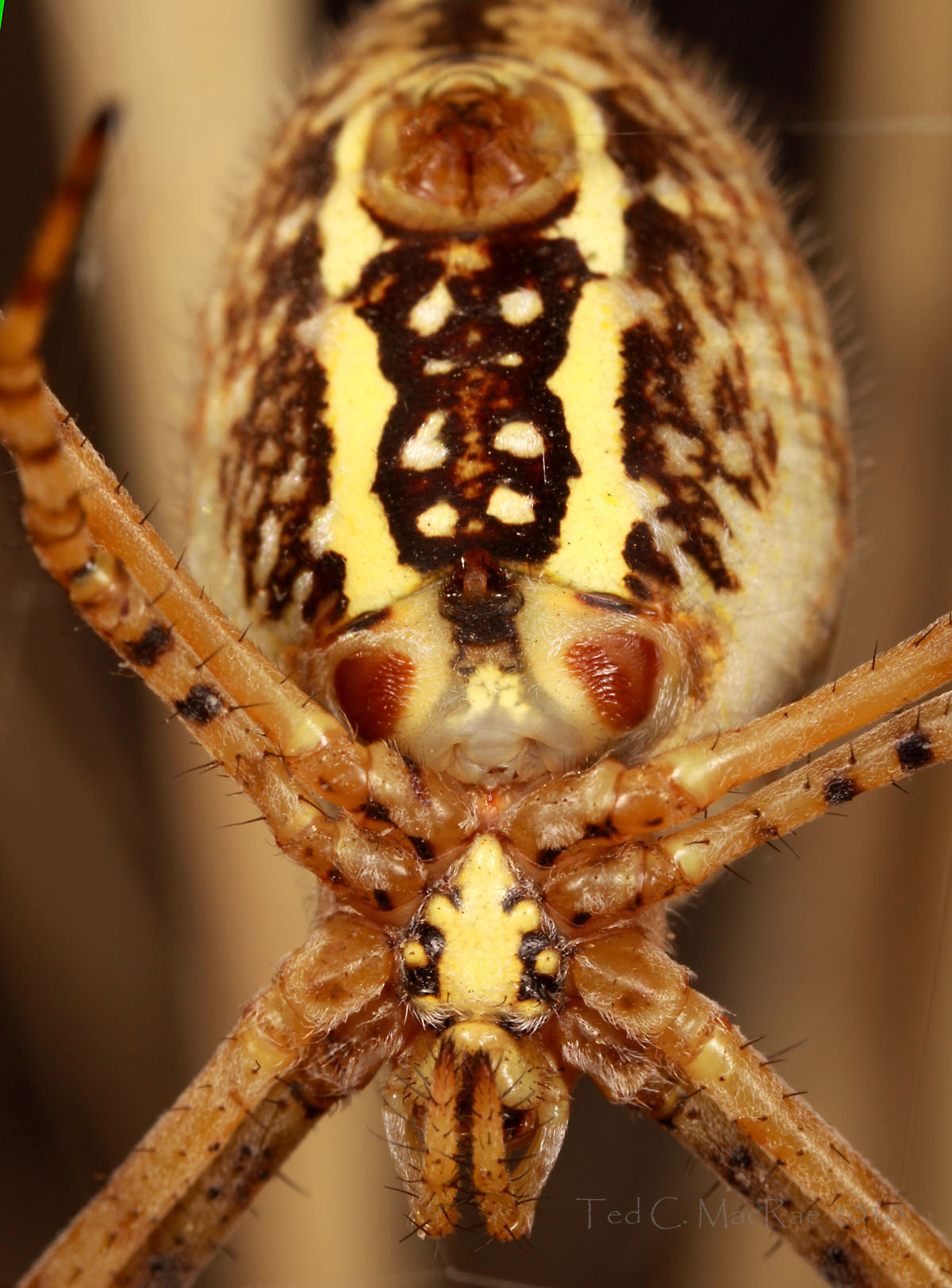
Here is another photo of the spider in the previous post with a closer view of its spiny pedipalps (mouth feeler thingys).  Troy Bartlett and BitB’s own James Trager got it right – the spider is, indeed, Argiope trifasciata, the banded garden spider (a.k.a. banded garden orbweaver, banded argiope, whitebacked garden spider, etc.).   I figured the genus would be easy, but the species might be a little tricky – at least for those in North America who might be tempted to conclude it was the larger A. aurantia (black and yellow garden spider, etc.).  The broken banding on the femora and generally lighter ventral coloration are usually enough to distinguish A. trifasciata from its more conspicuous congener.  Argiope trifasciata is also distinguished as one of the few truly cosmopolitan arthropod species, occurring naturally on all continents except Antarctica.

Both Troy and Dave Walter mentioned the conspicuous stabilimentum (heavy zig-zagging pattern) that Argiope spiders are perhaps best known for and that they often add to the center of their otherwise cryptic webs. Originally thought to possess a web-stabilizing function (hence the name), a variety of alternative explanations have since been proposed.  These include camouflage (to break up the body outline of the spider and make it less visible to predators), web protection (to make the web more visible to birds and prevent them from flying into and damaging it), prey luring (since it reflects ultraviolet light efficiently), thermal protection (by providing a shield against the sun), and a repository for excess silk.   An alternative hypothesis that I had not heard of but mentioned by Dave is that they serve as sponges for accumulating water for the spider to drink.  Webs with stabilimenta are more common and larger in exposed versus sheltered locations, and a recent study by Blackledge and Wenzel (1999) using A. aurantia found that webs with a stabilimentum suffered significantly less damage from birds (45% on average) than those without, but that they also caught fewer insects (34% on average).  The presence or absence of a stabilimentum, however, was not a significant factor in predation of the spiders by birds.  This implies not only a web protective function for the stabilimentum, but that there is an evolutionary trade-off between web protection and foraging success.  These authors concluded that variation in stabilimenta might be accounted for by a cost—benefit trade-off and that the decision by the spider to include a stabilimentum when building a web may be influenced by external factors such as prey density and web exposure.

Specific to A. trifasciata, a less well known but equally interesting aspect of its behavior is the use of web orientation for thermoregulation.   Tolbert (1979), in a study conducted in the southeastern US, found that web orientation was non-random during the hottest part of the summer, when spiders largely occupied east-west oriented webs with their silver/white dorsal surfaces facing south and their dark ventral surfaces facing north, and during October when the situation was reversed.  Orientation of the white/silver dorsal surface towards the sun presumably is done to help lower body temperatures, while orienting the ventral surface of the spider, which changes from silver to black as the spider reaches maturity, would maximize solar radiation for heat gain.  In contrast, Ramirez et al. (2003) found the species in coastal southern California never oriented their webs in a non-random fashion – rather, they always oriented them along an east-to-west axis with the mostly dark ventral surface of their abdomens facing south.  They suggested that dealing with a high heat load is not a significant problem in the predominantly cool environment of coastal southern California and that staying warm is the greater challenge for this mostly fall active species.

I’ll give 6 points to Troy for agreeing with me on everything, 4 to Dave for playing Devil’s advocate with the species and his unique alternative stabilimentum hypothesis, and 2 points to James for agreeing with Troy’s species ID. 🙂

Photo Details: Canon 50D w/ MP-E 65mm 1-5X macro lens (ISO 100, 1/250 sec, f/14), Canon MT-24EX flash w/ Sto-Fen + GFPuffer diffusers. Typical post-processing (levels, minor cropping, unsharp mask).

REFERENCES:

Blackledge, T. A. and J. W. Wenzel. 1999. Do stabilimenta in orb webs attract prey or defend spiders? Behavioral Ecology 10(4):372–376.

Ramirez, M. G., E. A. Wall and M. Medina. 2003. Web orientation of the banded garden spider Argiope trifasciata (Araneae, Araneidae) in a California coastal population. The Journal of Arachnology 31:405–411.

Tolbert, W. W.  1979. Thermal stress of the orb-weaving spider Argiope trifasciata (Araneae).  Oikos 32(3):386–392.

Copyright © Ted C. MacRae 2010
Halloween ID challenge

Class and order are gimmes – can you name the family, genus, and species? Common name? Something significant about its biology or behavior?

Photographed 25.ix.2010 in shortgrass prairie habitat atop the Pine Ridge in Sioux Co., Nebraska.

Photo Details: Canon 50D w/ MP-E 65mm 1-5X macro lens (ISO 100, 1/250 sec, f/11), Canon MT-24EX flash w/ Sto-Fen + GFPuffer diffusers. Typical post-processing (levels, minor cropping, unsharp mask).

Copyright © Ted C. MacRae 2010

Phreaky Phalangid

While searching through shortgrass prairie atop the Pine Ridge in northwestern Nebraska in hopes of finding Cicindela nebraskana (prairie long-lipped tiger beetle), this harvestman caught my eye.  Harvestmen are, of course, arachnids related to spiders, but they lack fangs and poison or silk glands and are placed the separate order Opiliones (Phalangida when I was in school).  Admittedly, I haven’t paid much attention to harvestmen before now, but this one seemed different from any I’d seen before – nearly black with relatively short legs and distinctive orange intersegmental articular membranes at the base of the legs.  Harvestmen are known to employ chemical defenses through special repugnatorial glands that produce phenols, quinones, ketones, and/or alcohols, and this individual seemed to display a clear example of aposematic coloration to warn any potential predators of its distastefulness.

Trachyrhinus favosusAlthough beetles are my focus, I normally try to do my own identifications in other groups as well.  However, some rather persistent searching through the extensive harvestman holdings at BugGuide failed to turn up a good match.  In gestalt it seemed to belong to the family Sclerosomatidae, but even that was just guessing on my part.  So, I did what I’ve done only a few times before and posted the photos to BugGuide’s ID Request.  A day and a half later I had my answer – Trachyrhinus favosus.  BugGuide Contributing Editor V. Belov had sent the photos to harvestman expert Marshal Hedin, who had this to say in response:

Cokendolpher describes males as ‘body ranging from solid black…’ with bases of femora ‘yellow-brown’. The species is also known from western Nebraska. Cool.

I was pleased to learn that these photographs represented a new species for BugGuide and no longer felt bad about not being able to find a good match.  Further, my leanings toward the family Sclerosomatidae had been confirmed.  According the Cokendolpher (1981), T. favosus ranges in a narrow band from North Dakota south to north-central Texas and is active only during fall.  I had intended to try to get an even closer photograph, but after taking the second photograph above I accidentally disturbed the critter and then watched in amazement as it began bouncing up and down vigorously.  This apparently is a defensive behavior that functions to blur the body form.  I watched it bounce and became even more amazed as it began calmly walking away while continuing its vigorous bouncing – quite a spectacle!

Photo Details: Canon 50D w/ MP-E 65mm 1-5X macro lens (ISO 100, 1/250 sec, f/13), Canon MT-24EX flash w/ Sto-Fen + GFPuffer diffusers. Typical post-processing (levels, minor cropping, unsharp mask).

REFERENCE

Cokendolpher, J. C.  1981. Revision of the genus Trachyrhinus Weed (Opiliones, Phalangioidea).  Journal of Arachnology 9:1–18.

Copyright © Ted C. MacRae 2010

Jeepers Creepers, where’d ya get those multilayered retinae?

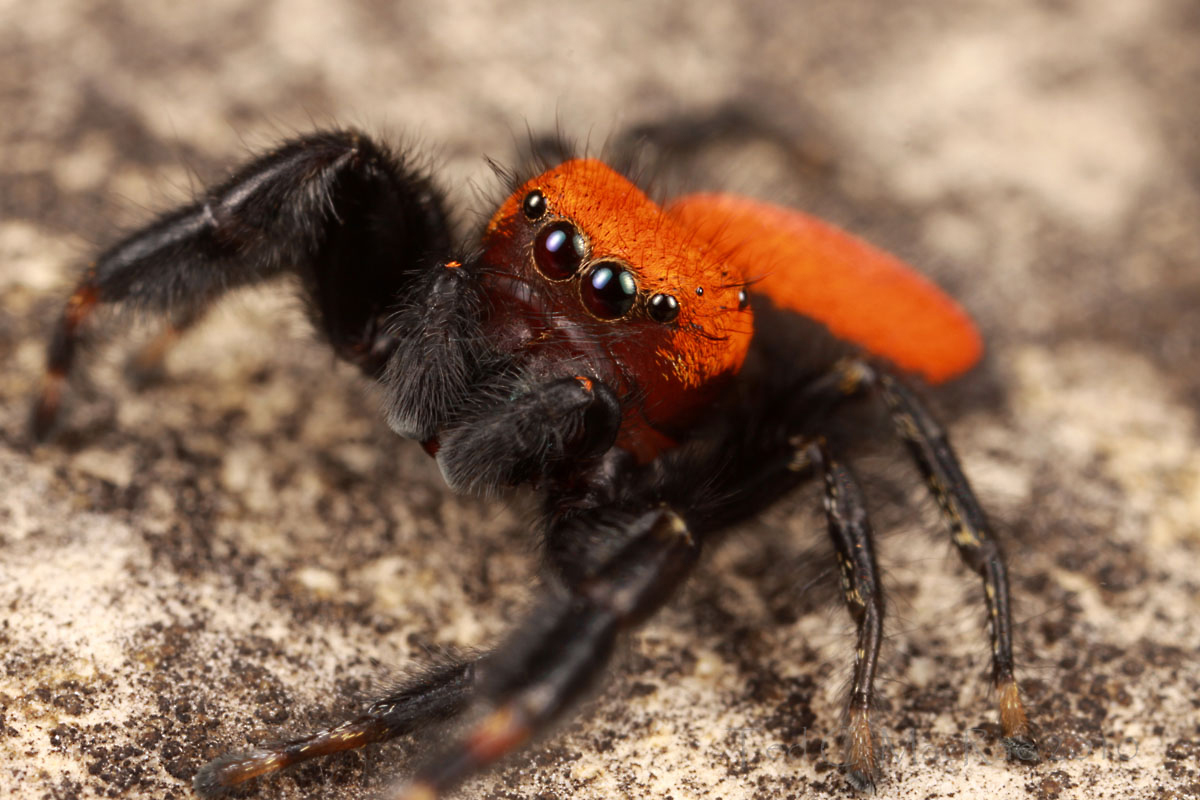
A few weeks ago I was fortunate to get a chance to blast down to the White River Hills in extreme southwestern Missouri.  Cicindela obsoleta vulturina (prairie tiger beetle) was my quarry – I had made arrangements to meet up with fellow cicindelophile Steve Spomer (principal author of Tiger Beetles of South Dakota & Nebraska, Spomer et al. 2008) and show him a few of the better sites I had found for this species.  We would have good success due to gorgeous fall weather and perfect timing, and the next day I would be fortunate to extend its known distribution further north and east.  Still, the beetles are not early risers, and I found myself that second morning with some time on my hands while waiting for these sleepy-heads to arise from their slumber and begin their foraging activities.  As I trolled the thinly soiled dolomite exposures of a new site I had identified the previous day, a spot of red jerking erratically through the sparse vegetation caught my eye, and looking closer I was delighted to see this small but brilliantly colored jumping spider (family Salticidae) trying to evade my gaze.

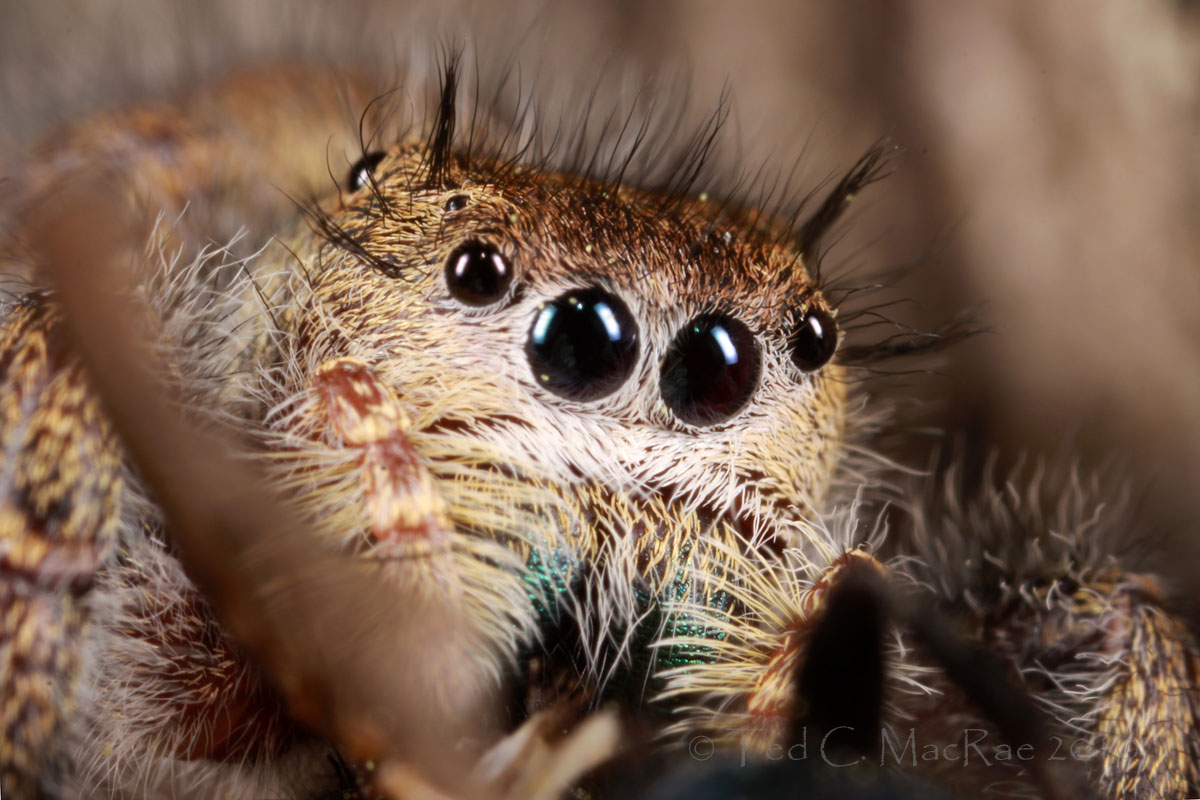
Jumping spiders are perhaps the most diverse of all spider families, but it is their extraordinary visual capabilities and complex predatory and courtship behaviors that they are best known for.  Popular as research subjects, to the rest of us they are simply endearing little animals.  Some of the largest and most colorful jumping spiders belong to the genus Phidippus, which is also one of the most diverse genera in the family and boasts some 60 species in the continental United States (Edwards 2004).  The genus is characterized by details of the eye placement and carapace shape (Richman 1978) but can often be recognized by their relatively large size, numerous erect hairs, and conspicuous iridescent chelicerae just below the front eyes.  The species can be quite difficult to identify, especially the females, but I feel reasonably confident that this individual is a male of the widespread species P. apacheanus.

I wasn’t always so confident – browsing images on BugGuide left me confused after finding images of P. apacheanus and P. cardinalis males that looked almost identical. However, further digging reveals P. apacheanus is characteristically a more intense red, while P. cardinalis is more orangey with lighter bristles which may appear silvery.  Also, P. cardinalis often displays makings on the abdomen – generally a light line running around the anterior part of the abdomen and sometimes tiny light spots on the dorsum – that are absent in P. apacheanus.  (This begs the question as to whether some of the BugGuide photos may be misidentified?)  Another Phidippus species that might be confused with P. apacheanus is P. clarus; however, that species has a black cephalothorax and bright abdominal markings.  According to Herschel RaneyP. apacheanus is most often seen in fall.

This was a very difficult subject to photograph.  He refused to come out in the open, preferring to duck and peek from behind whatever vegetation he could find.  Realizing that my desire to photograph him without any manipulation would be a lesson in futility, I used my finger to prod him towards and onto a small, flat, lichen-encrusted rock, where he would look at me with ever-increasing alarm and try to flee at the approach of the camera.  Lots of failed shots were discarded in the field before I finally got a few I thought I could live with (which, I think, are a decided improvement over my first jumping spider photos).  As I zoomed in for the closeups, I saw for the first time the shimmering of his multilayered retinae moving in the depths of his primary medial eyes.  The retina is the darkest part of the eye, thus, when the eye is at its darkest the spider is looking straight at you!

Photo Details: Canon 50D w/ MP-E 65mm 1-5X macro lens (ISO 100, 1/250 sec, f/13), Canon MT-24EX flash (1/8 ratio) w/ Sto-Fen + GFPuffer diffusers. Typical post-processing (levels, minor cropping, unsharp mask).

REFERENCES:

Edwards, G. B.  2004. Revision of the jumping spiders of the genus Phidippus (Araneae: Salticidae). Occasional Papers of the Florida State Collection of Arthropods 11:i-viii, 1-156, 350 figs.

Richman, D. B.  1978. Key to the jumping spider (salticid) genera of North America.  Peckhamia 1(5):77–81.

Spomer, S. M., M. L. Brust, D. C. Backlund and S. Weins.  2008. Tiger Beetles of South Dakota & Nebraska. University of Nebraska, Department of Entomology, Lincoln, 60 pp.

Copyright © Ted C. MacRae 2010

Hitchin’ A Ride

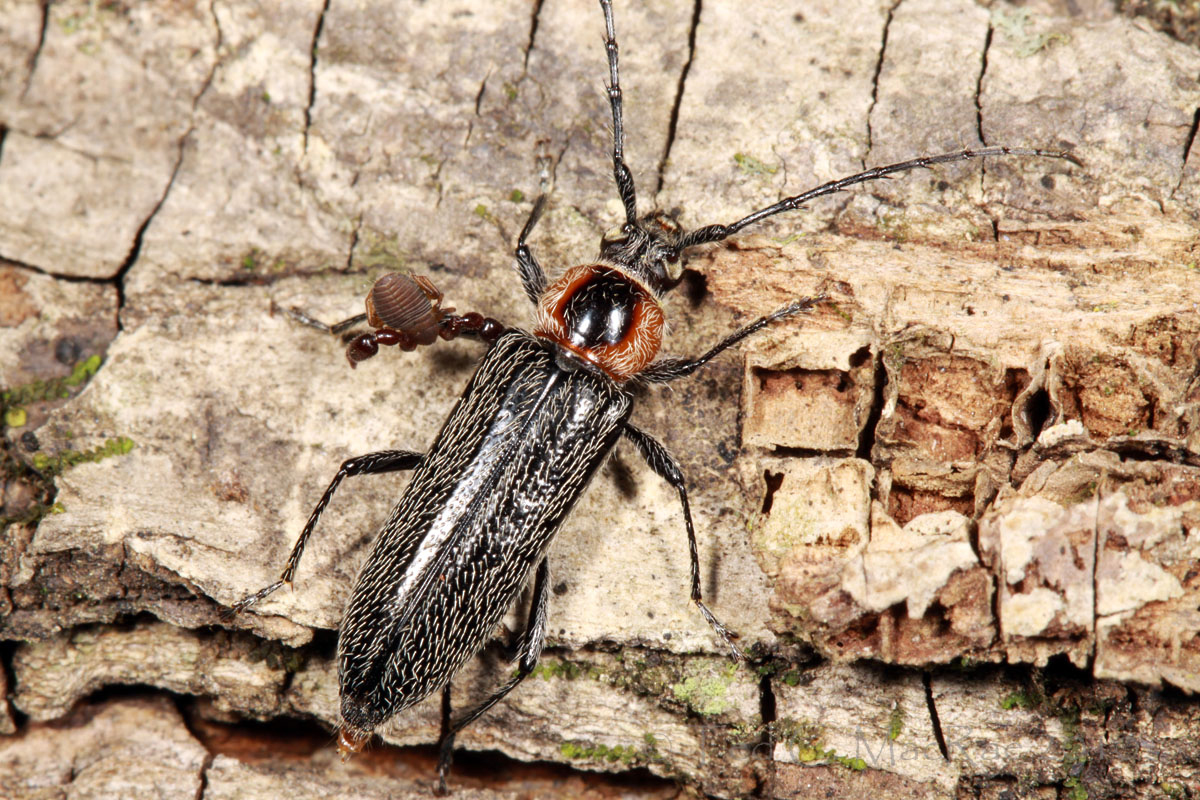
One of the more common species of longhorned beetles (family Cerambycidae) in Missouri, and throughout the eastern U.S., is Stenosphenus notatus.  Despite its commonness, however, it is a species that is easily overlooked because of its very early seasonality, emerging during the first warm days of spring (late March here in Missouri) and disappearing by the time the bulk of longhorned beetle species become active during late spring and early summer.  I found this individual on a recently fallen mockernut hickory (Carya alba) during the 2nd week of April, as Rich and I hiked the lower portion of the Wappapello Section of the Ozark Trail in southern Missouri (along with several other wood boring beetles species such as Dicerca lurida, Megacyllene caryae, and the woodboring beetle predator Enoclerus ichneumoneus).  Longhorned beetles display a variety of host fidelities, ranging from highly polyphagous to strictly monophagous – this species falls near though not quite at the latter end of the spectrum, being associated almost exclusively with the genus Carya (hickories and pecan).  I have reared adults from dead branches and trunk sections of not only C. alba, but also C. aquatica (water hickory), C. laciniosa (shellbark hickory), and C. ovata (shagbark hickory) (MacRae 1994, MacRae and Rice 2007).  Linsley (1963) also records Celtis (hackberry) as a host, but I have not seen the species myself in association with plants of that genus, nor have I seen other literature references to such – I suspect this may, in fact, be an incidental adult association rather than indicative of a true larval host (an all too common problem in interpreting literature on woodboring beetle host plants).

The very early spring occurrence of this insect can be traced to a peculiarity of its life cycle shared by few other cerambycid species in the eastern U.S. – overwintering in the adult stage.  Most eastern U.S. longhorned beetles overwinter within the host wood as either partially or completely grown larvae.  Warming temperatures in the spring trigger resumption of growth in the former and a transformation to the pupal stage in the latter, which emerge as adults a few weeks later during mid-late spring.  In contrast, S. notatus – which requires two seasons to complete its development – pupates in the latter part of the second season and transforms into the adult before the onset of winter.  When warm temperatures return in spring, the adults are ready to emerge and search out fresh hickory wood that has died within the past few months on which to lay their eggs and begin the cycle anew.

As I photographed this individual, I noticed an object attached to its left mesothoracic (middle) leg.  Zooming in on the object showed it to be a pseudoscorpion – a type of arachnid (relative of spiders, mites, and true scorpions) in the order Pseudoscorpiones.  I have not the resources nor the expertise to attempt a more specific ID, but its attachment to the beetle almost surely represents an example of phoresy – defined as a phenomenon in which “one animal seeks out and attaches to the outer surface of another animal for a limited time during which the attached animal (termed the phoretic) ceases feeding and ontogenesis, such attachment presumably resulting in dispersal from areas unsuitable for further development, either of the individual or its progeny” (Farish and Axtell 1971).  Pseudoscorpions have been reported attached to insects from several orders, primarily Diptera but also beetles and including longhorned beetles (Perry et al. 1974, Haack and Wilkinson 1987).  Many species of pseudoscorpions develop beneath the bark of dead trees and prey upon the many other small insects and mites found there, and it would be reasonable to presume that their most effective means of dispersal to new habitats (i.e., dead trees) would be by “hitching a ride” with adult woodboring beetles as they emerge and fly to these new sites.  As obvious as this explanation might seem, few data have actually been generated to demonstrate it is actually the case, and several competing hypotheses such as accidental boarding (hitching a ride by accident), obligate symbiosis (the pseudoscorpions live exclusively on the beetles), and phagophily (preying upon other beetle associates such as mites) have been offered as alternative explanations. However, at least one fairly recent investigation on the pseudoscorpion, Cordylochernes scorpioides, a frequent inhabitant under the elytra of the giant harlequin beetle, Acrocinus longimanus (family Cerambycidae), does seem to not only support the dispersal hypothesis, but also suggests that large male C. scorpioides even defend a beetle’s abdomen as a strategic site for intercepting and inseminating dispersing females (Zeh and Zeh 1992).

REFERENCES:

Farish, D. J. and R. C. Axtell. 1971. Phoresy redefined and examined in Macrocheles muscaedomesticae (Acarina: Macrochelidae). Acarologia 13:16–29.

Haack, R. A. and R. C. Wilkinson. 1987. Phoresy by Dendrochernes Pseudoscorpions on Cerambycidae (Coleoptera) and Aulacidae (Hymenoptera) in Florida. American Midland Naturalist 117(2):369–373.

Linsley, E. G. 1963. The Cerambycidae of North America. Part IV. Taxonomy and classification of the subfamily Cerambycinae, tribes Elaphidionini through Rhinotragini. University of California Publicatons in Entomology 21:1–165, 52 figs.

MacRae, T. C. 1994. Annotated checklist of the longhorned beetles (Coleoptera: Cerambycidae and Disteniidae) known to occur in Missouri. Insecta Mundi 7(4) (1993):223–252.

MacRae, T. C. and M. E. Rice. 2007. Distributional and biological observations on North American Cerambycidae (Coleoptera). The Coleopterists Bulletin 61(2):227–263.

Perry, R. H., R. W. Surdick and D. M. Anderson. 1974. Observations on the biology, ecology, behavior, and larvae of Dryobius sexnotatus Linsley (Coleoptera: Cerambycidae). The Coleopterists Bulletin 28(4):169–176.

Zeh, D. W. and J. A. Zeh. 1992. On the function of harlequin beetle-riding in the pseudoscorpion, Cordylochernes scorpiones (Pseudoscorpionida: Chernetidae). Journal of Arachnology 20: 47––51.

Copyright © Ted C. MacRae 2010

Add to FacebookAdd to DiggAdd to Del.icio.usAdd to StumbleuponAdd to RedditAdd to BlinklistAdd to TwitterAdd to TechnoratiAdd to Yahoo BuzzAdd to Newsvine

Email to a friend

My first jumping spider

As a long-time professional and avocational entomologist, I find beauty and fascination in all manner of joint-legged creatures. Of course, beauty is in the eye of the beholder, and most people don’t exactly share my passion for these animals. Sure, butterflies enjoy almost universal approval, but beetles are just too crunchy, flies too filthy, wasps too aggressive, and cockroaches… well, eww! Even crabs and lobsters, tasty as they are, just move too robotically to engender any feelings of affection. None of these groups, however, seem to be as universally reviled as spiders – scuttling blurs of leg and fur with beady little eyes, just waiting to launch a sneak attack with their venomous gnashers. Few other coin-sized animals can cause an otherwise lucid adult to run screaming from their bathroom with such terror.

Except jumping spiders! Jumping spiders (family Salticidae) possess many of the same traits that condemn other spiders to the ranks of the creepy – hair and venom and lots of eyes; yet they have other unique qualities that make them nevertheless endearing, almost cuddly, to all but the most ardent of arachnophobes. Their human-like “face” featuring two large, forward-facing eyes and inquisitive nature give them a charisma that almost invites interaction. Approach any other spider, and it scampers back into the nearest crevice. Jumping spiders, on the other hand, turn and face the intruder – you can almost see them sizing you up – perhaps even moving forward a little to have a better look. It makes them seem, well… intelligent. Add to that their stunning diversity (~5,000 species), dazzling colors, and the sometimes impressively elongated choppers of the males, and you’ve got the perfect recipe for charm. Bouncy, furry, smart, cute, and big bright eyes – almost sounds like a kitten!

The result of all this charm is that jumping spiders are wildly popular subjects for macrophotography. Accordingly, there has been a veritable explosion of online photographs of jumping spiders, dominated by close-ups of that irresistible face. These shots here represent my first attempt to photograph one of these endearing creatures, and while I’m happy with them considering my relative newness to the field, they are a far cry from the spectacular images being produced by some other photographers. Perhaps the best of these is Thomas Shahan, whose focus-stacked facial shots of these spiders are among the most stunning that you will find. Another photographer who has produced some excellent photographs of Malaysian jumping spiders is Kurt at Up Close with Nature. Perhaps someday my jumping spider photographs will be considered on par with those that these two gentlemen are producing – if that day comes, you can say it began right here!

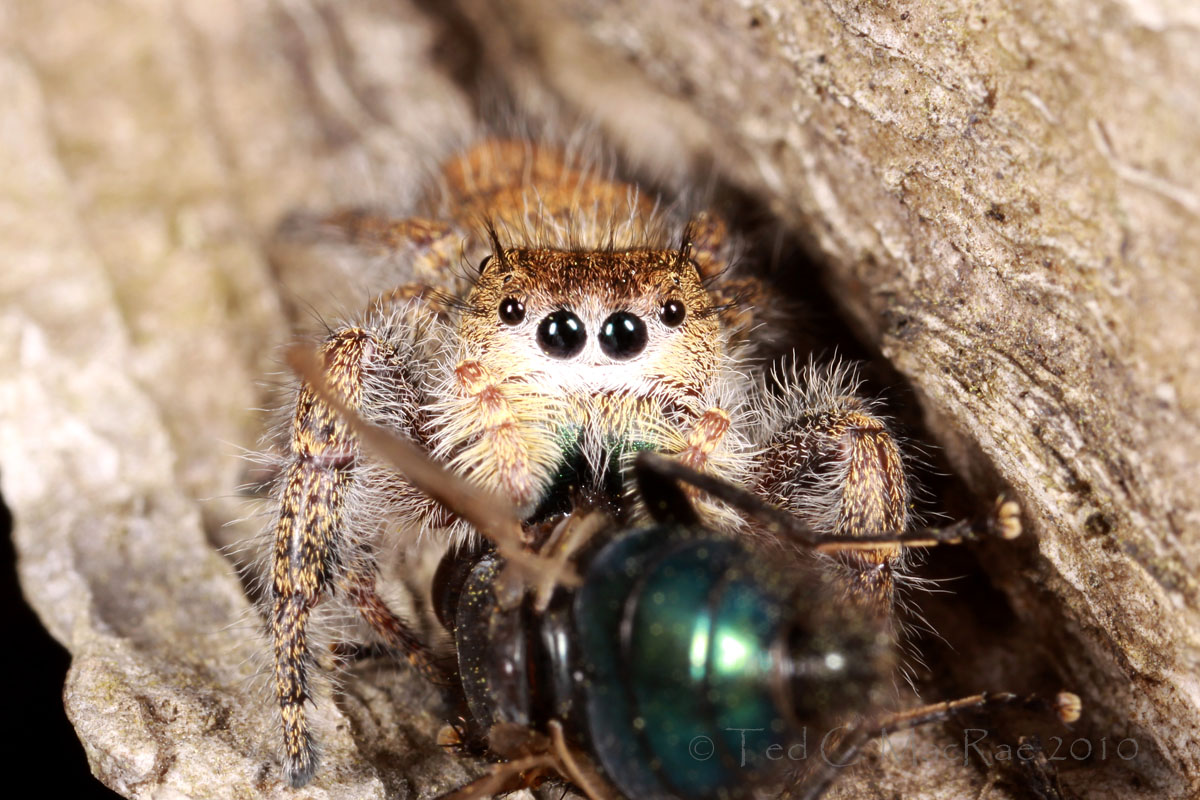
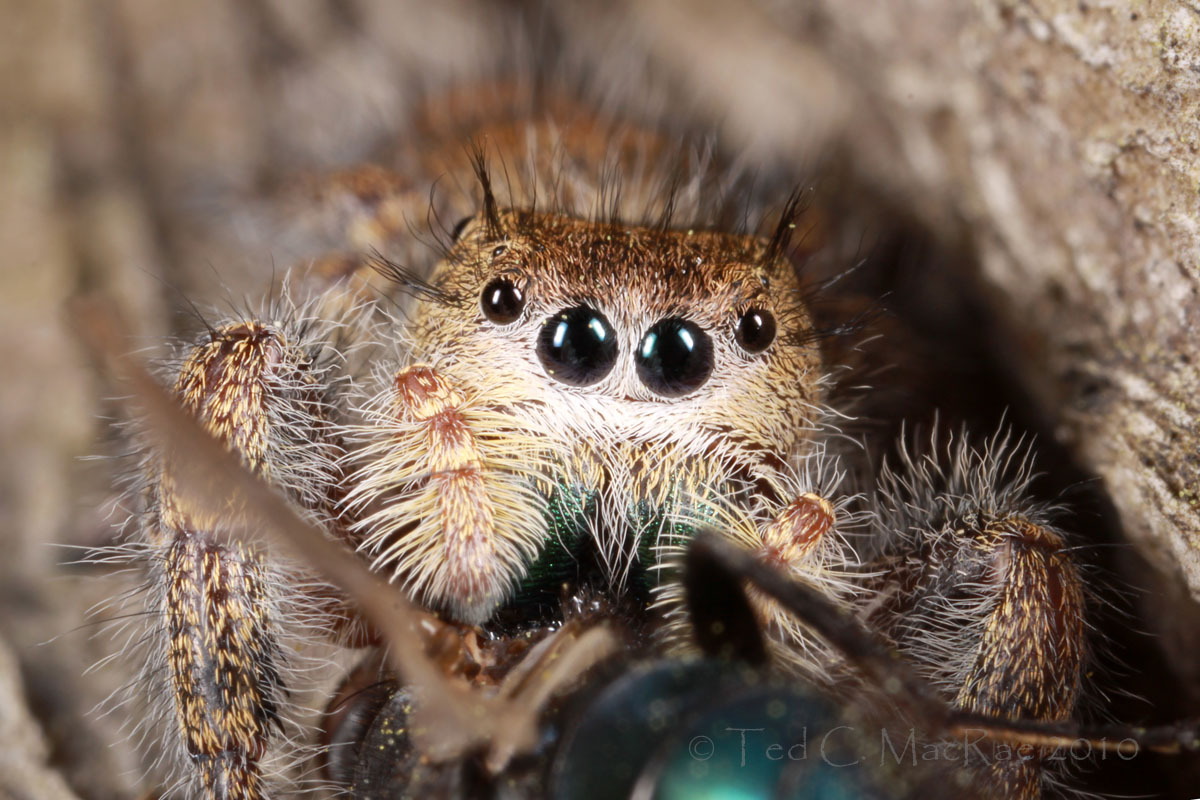
I’m a beetle-man, so except for a brief attempt at ant taxonomy my area of expertise lies with the Coleoptera. Nevertheless, perusing the well-stocked archives at BugGuide leads me to believe that the individual I photographed is a subadult female in the genus Phidippus – perhaps something in the putnami species-group.  I found her on a lower branch of sweetgum (Liquidamber styraciflua) in a wet-mesic bottomland forest along the Black River in Missouri’s southeastern Ozarks feeding on a blow fly (family Calliphoridae).  While relatively drably-colored compared to many other species in the family, a glimpse of her bright blue-green chelicerae (fangs) can still be seen.  I tried to get her to drop her prey to get a better look at the fangs, but she wasn’t having anything to do with that – mealtime is mealtime!

Photo Details: Canon MP-E 65 mm 1-5X macro lens on Canon 50D, ISO 100, 1/250 sec, f/13-14, MT-24EX flash 1/8 power w/ Sto-Fen diffusers. Minimal cropping and post-processing.

Copyright © Ted C. MacRae 2010

Add to FacebookAdd to DiggAdd to Del.icio.usAdd to StumbleuponAdd to RedditAdd to BlinklistAdd to TwitterAdd to TechnoratiAdd to Yahoo BuzzAdd to Newsvine

Email to a friend

The Inexorable March of Spring!

Granted, the progress of spring seems to advance in halting baby steps with occasional falls onto its muddy bottom, rather than as a determined forward march, but spring is welcome, no matter how it arrives. When little green tips start poking up and there’s a bit of that “spring smell” in the air, I simply must get out and catch up on the status of Nature — the old-fashioned way (she doesn’t have a Facebook account). Over the last week, I’ve gone forth in search of signs that everything else living is about as tired of winter as I am, and wants to get this spring show on the road! There is already so much happening, I can’t recount it all here — A partial list of unphotographed notables: owls breeding; hawks nesting; woodcocks doing their silly, repetitive and almost invisible (because it’s nearly dark) courtship displays; wood ducks on forest ponds; year-round resident songbirds reestablishing territories; spring peepers, chorus frogs, wood frogs and southern leopard frogs singing, especially in the fishless ponds; winter crane flies and midges swarming in sun flecks in the woods; wild filberts, silver and red maples flowering, etc…

Formica pallidefulva sniffs the spring air


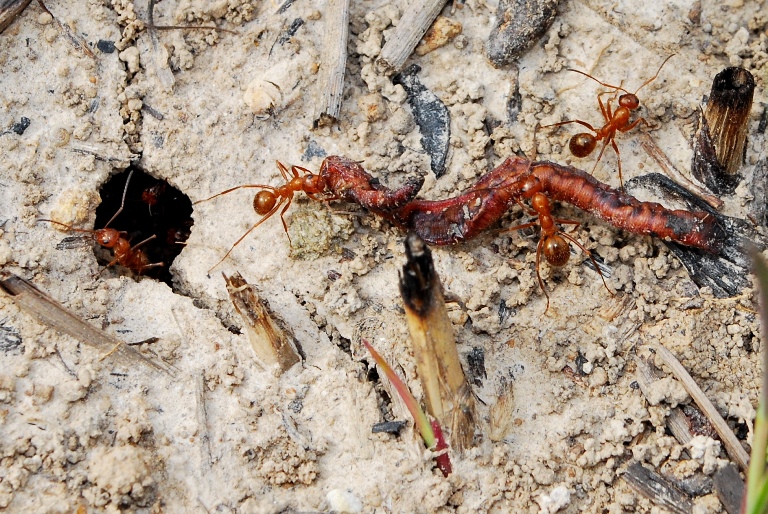
Of course, I look for the first ants out at this time of year, though with the exception of 10 March, when the temperature exceeded 70F, they haven’t been notably active. However, that afternoon I encountered, among others, a worker of Formica pallidefulva poking its head out cautiously to sniff the spring air. This is one of my favorite local ants — largish (5-6mm), abundant, active in daylight even when it’s hot, usually shiny bronzy red to red-brown, usually with a darker gaster (the apparent abdomen of ants) around here, but ranging from a beautiful reddish gold (in the deep South) to almost pure black-coffee brown (New England and southern Canada) across its wide geographic occurrence (Rocky Mountain foothills of Wyoming to New Mexico, all the way east to Québec and Florida). It has the added charm of being the host species to a wide range of social-parasitic and dulotic (“slave-making”) ants both in its own and in another closely related genus, with which it lives in temporary or permanent mixed colonies (as with the Polyergus illustrated in my last post). The image below of these ants bringing home a charred earthworm was taken almost one year ago, as one of Shaw Nature Reserve’s prairie areas was beginning to resprout after a prescribed burn a few weeks earlier. Ants will take their food raw or cooked!

Formica pallidefulva with charred earthworm


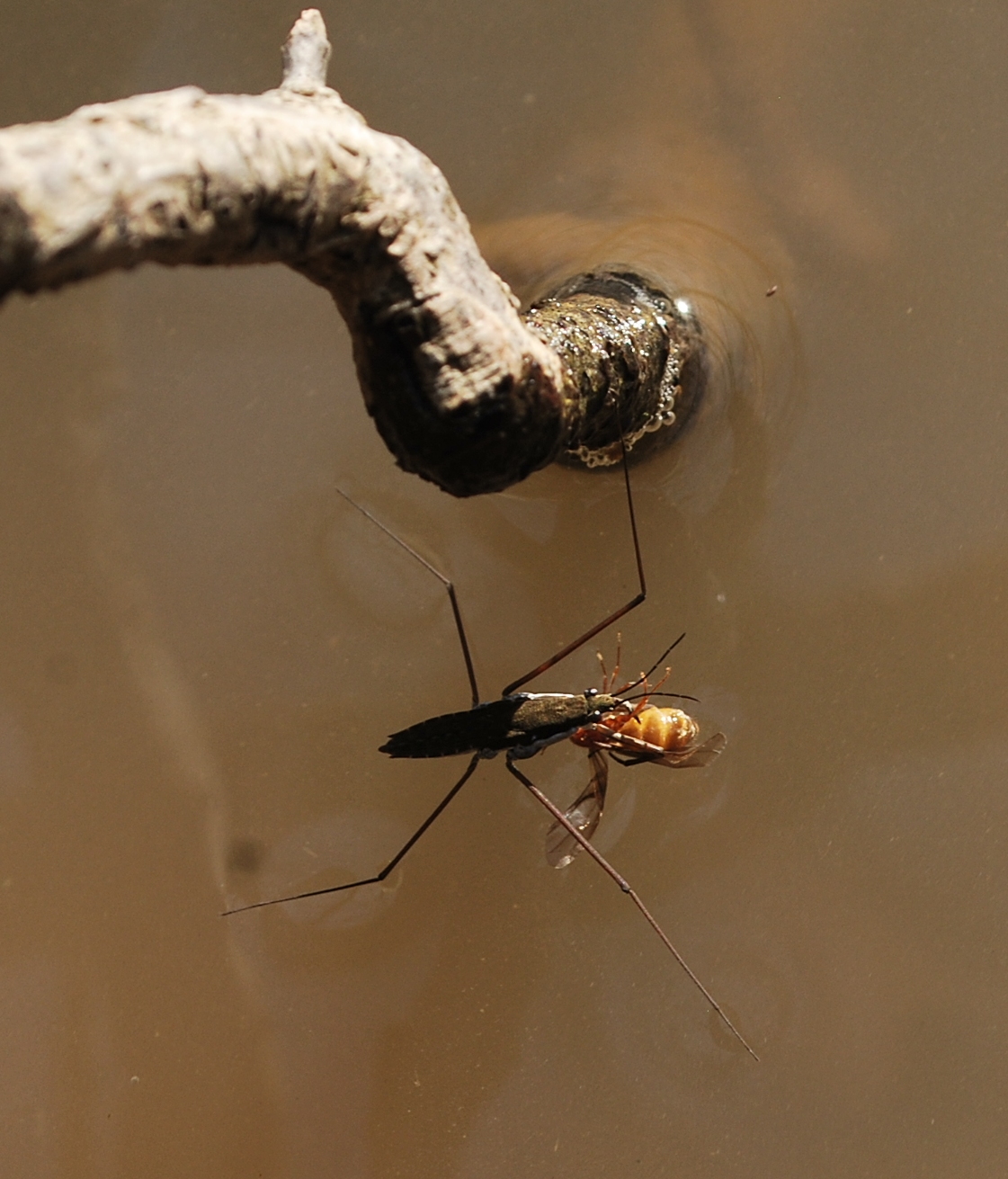
Prenolepis imparis alate in the clutches of a gerrid

Another ant I mentioned last time I was with you, Prenolepis imparis, has the distinction of being the only ant in our fauna that has mating flights while there is still a good chance of frost in the forecast for the next few weeks. In this picture of a mating pair at  BugGuide, note the size difference that inspires their name “imparis”, Latin for disparate. Any time after mid-February when it is sunny and not too windy, and the temperature rises above 65F, the winged males and females reared the preceeding fall, fly out to partake of a grand insectan orgy. Typically, they have big flights on the first couple of appropriately warm days, then some smaller ones (i.e., fewer individuals participating) over the next few weeks. The flying males look like gnats, bobbing up and down in drifting swarms, a few feet off the ground over a shrub, near a woodland edge or in a sunny opening. (One of my co-workers got into the midst of a group of such swarms once when we were conducting a prescribed burn in a wooded area, and I recall her commenting she “felt like Pigpen with all the little bugs flying around”!) The much larger, golden-brown females lift slowly off the ground, fly ploddingly (or is it seductively?) through the male swarms, are there mobbed by the tiny fellows, and then glide away and slightly downward, mating in flight with the winner of the males’ tussling. Rather clumsy fliers, the females do not always land in a good spot, as occurred to this hapless one that ended up as a feast for a water strider. Those that survive break off their wings, dig a burrow, seal themselves in, and raise a small brood of workers on food produced in their own bodies (like say, milk in mammals or “cropmilk” in doves and some other birds.)

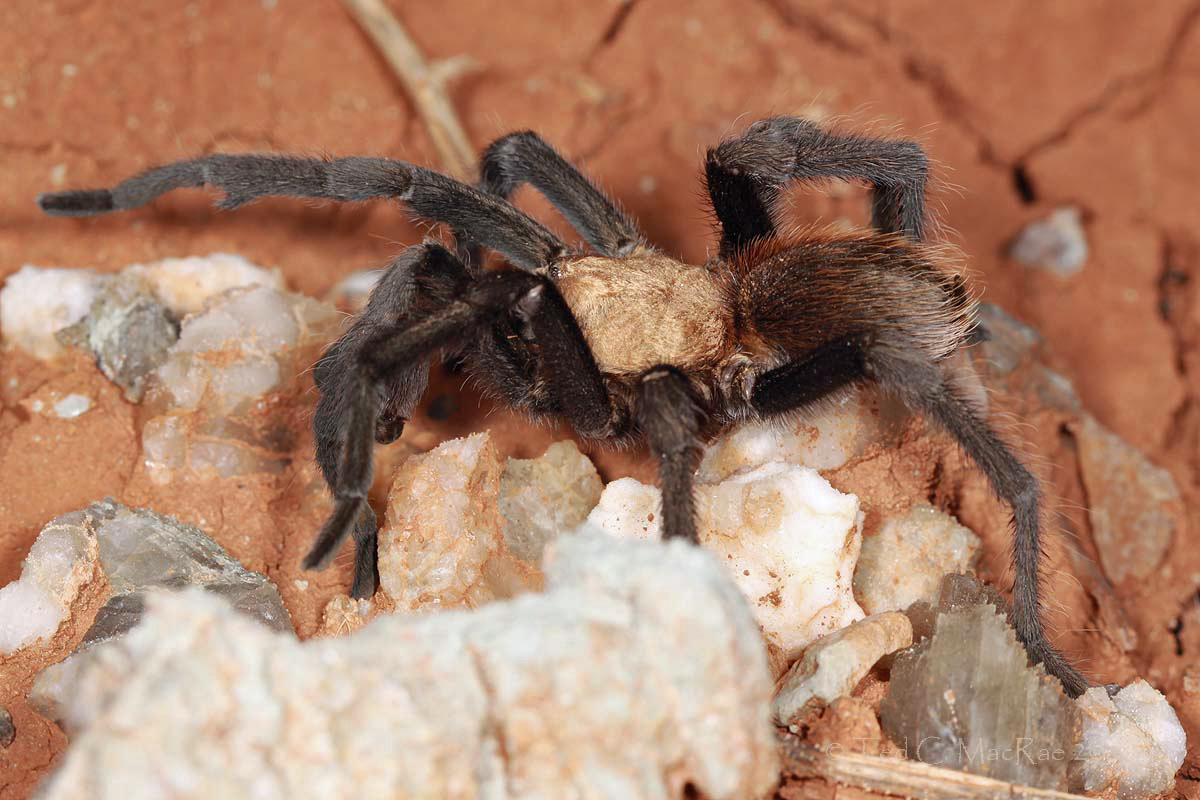
But lest you to think I only have eyes for ants, I feel indeed fortunate to have encountered a tarantula this week, of the same species as Ted recently posted and I didn’t even have to go to Oklahoma for it. This bedraggled individual was at the mouth of its completely flooded burrow in what is most often a very dry habitat — a dolomite glade. Stunned and muddy at the time, my guess is this creature, belonging to a resilient and ancient lineage, will dry off, clean up, and saunter away as soon as she warms up.

Aphonopelma hentzi in flooded burrow


And speaking of emerging from flooded burrows, how about this handsome fellow, a male three-toed box turtle, his sex revealed by his bright orange and red markings, coming up for a breather? In truth, it was perhaps only just warm enough to make him need air, but not really enough so for him to be up and about, so he just sat there, nearly immobile, looking pretty, notwithstanding mud and leaves glued onto his shell.

Male box turtle emerges


Copyright © James C. Trager 2010

Add to FacebookAdd to DiggAdd to Del.icio.usAdd to StumbleuponAdd to RedditAdd to BlinklistAdd to TwitterAdd to TechnoratiAdd to Yahoo BuzzAdd to Newsvine

Email to a friend

Tuesday Tarantula


One of my destinations on my annual fall tiger beetle collecting trip last October was The Glass Mountains in northwestern Oklahoma. Rising from the red Permian beds of the central Great Plains, the Glass Mountains are a series of mesas and buttes capped by thick layers of the sparkling, glass-like crystal selenite. It is still common to see them referred to as the “Gloss” Mountains, the result of a transcription error by a mapmaker back in the late 1800s, and although the soils that comprise the formations are very old (laid down as sedimentary deposits during the Permian Era some 250 million years ago), the landscape itself is relatively young – a result of erosion by glacial outwash from the Rocky Mountains during the past 1 million years.

Of course, I was not here to study crystals or geology, but to look for tiger beetles! It was at this spot that earlier in the year (June) I had discovered a new population of Cylindera celeripes (Swift Tiger Beetle), a rarely-collected flightless species that has declined worrisomely during the past century, and another seldom-collected flightless species, Dromochorus pruinina (Frosted Dromo Tiger Beetle), was also a good find. Neither of these species were my reason for being here in October, however, since by then adults of both have long disappeared. Instead, I was hoping that the large, unidentified larvae that I had seen in their burrows at this site back in June would be out as adults. Their great size suggested two possibilities – Cicindela obsoleta (Large Grassland Tiger Beetle) or C. pulchra (Beautiful Tiger Beetle), either of which would be a great find. Alas, overcast skies and a cold, biting wind made whatever tiger beetles were there – lovers of sun and warmth that they are – remain secreted within their protected haunts. I still have a shot at finding out what they are – I successfully extracted two larvae from their burrows and fed them well in the laboratory with fat fall armyworm larvae before putting them to sleep for the winter in a 10°C (50°F) incubator.  If all goes well, I’ll wake them up this spring and finish them out to adulthood this year.

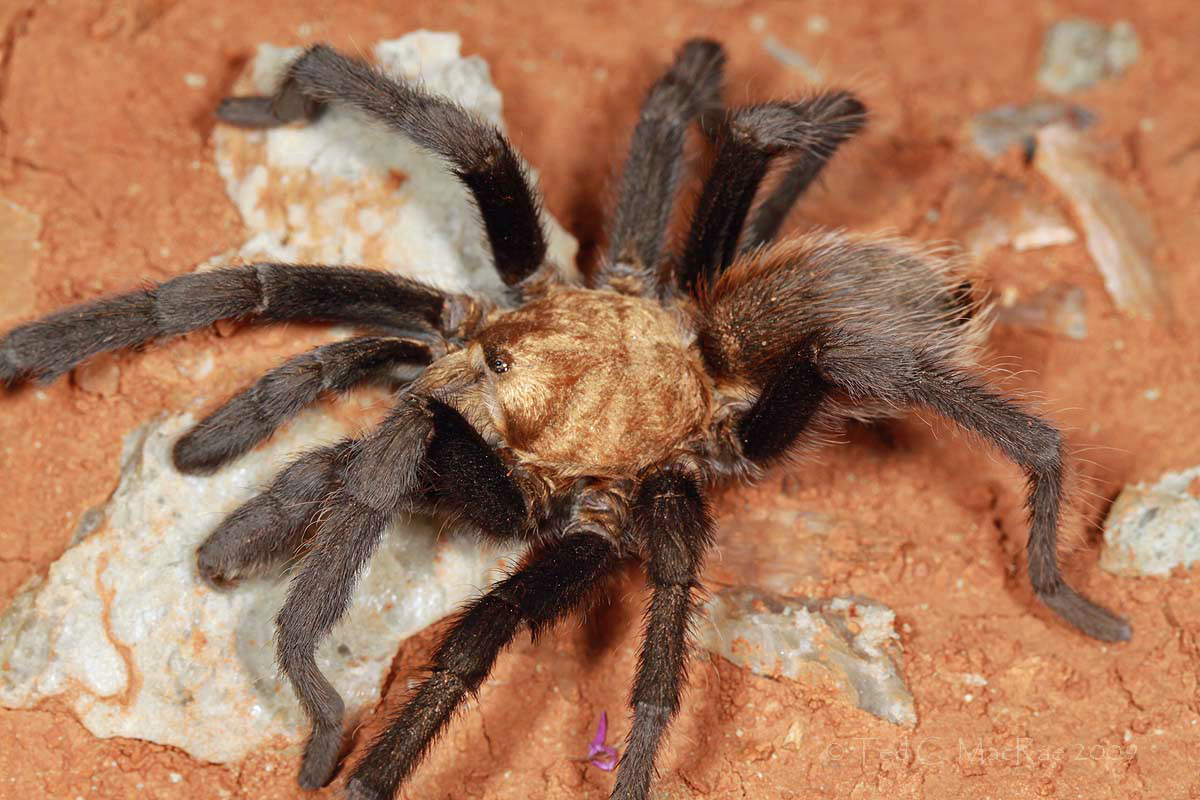
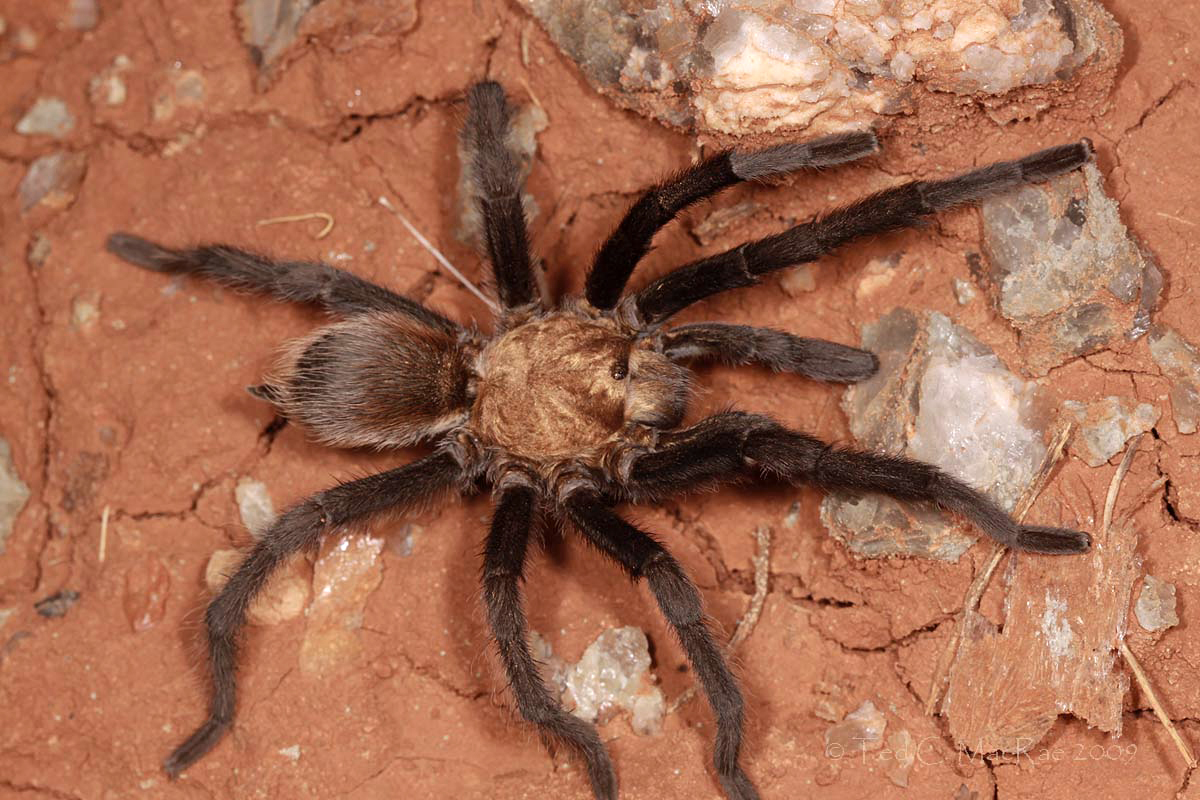
There were a few consolation prizes on the day, one of which was this large, lumbering male tarantula seen slowly making its way down the red clay slopes. For all their charisma and noteriety, it’s interesting to note that the taxonomy of U.S. tarantulas (almost all of which belong to the genus Aphonopelma) is rather poorly known – some 50 species have been described, but many of the descriptions are inadequately based on limited material (or even single specimens) and often rely upon variable, highly artificial characters (Prentice 1997). Brown or black species with no distinctive coloration (such as this one) seem to present the greatest challenge; however, the internet seems to have concluded that the only tarantula present in Oklahoma is Aphonopelma hentzi.


This spider can be distinguished as a mature male by way of the tibial hooks that can be seen on the undersides of the front pair of walking legs in the first photo.  Female and immature tarantulas normally stay in their burrows during the day and come out at night to hunt, but wanderlust strikes the adult males during late summer and fall, during which time they’ve been documented traveling as far as 1.3 km over a period of 2-3 weeks (Janowski-Bell and Horner 1999) – presumably in search of females with which to mate.  It is only after the male’s final molt that wanderlust sets in and the tibial hooks appear, which are said to function in holding the female (and her fangs!) at a safe distance during copulation.


It may seem hard to believe, given its large size and slow movement, but I found this spider exceedinly difficult to photograph compared to the tiger beetles that I have spent much more time with. I’m not used to photographing subjects with a 4-5 inch leg spread, which made it difficult for me to judge working distance and get a handle on proper settings and positions for the flash units. Once I did get that under control, I found the tarantula’s incessant desire to keep moving maddeningly frustrating. Tiger beetles, as active and flighty as they are, nevertheless eventually sit still long enough to allow at least a shot or two before bolting, but this tarantula… just… never… stopped… moving! I can’t tell you how many shots I discarded because it’s legs were splayed awkwardly in multiple directions. Eventually, however, I got enough shots that I felt there should be at least a few good ones among them, and those are the ones I share here.


Most male tarantulas will die within a few weeks or months of their final molt. Still, that doesn’t deter me from scooping them up whenever I find them and bringing them home to enjoy as pets for whatever time they have left. My daughters probably like tarantulas best of any of the critters that I bring home – I never have to ask “Has anybody fed ‘Hairy’?” (and props to awesome wife for enduring something most ‘normal’ wives couldn’t even begin to contemplate).

REFERENCE:

Janowski-Bell, M. E. and N. V. Horner.  1999.  Movement of the male brown tarantula, Aphonopelma Hentzi (Araneae, Theraphosidae), using radio telemetry.  The Journal of Arachnology 27:503–512.

Prentice, T. R. 1997. Theraphosidae of the Mojave Desert west and north of the Colorado River (Araneae, Mygalomorphae, Theraphosidae). The Journal of Arachnology 25:137–176.

Copyright © Ted C. MacRae 2010

Add to FacebookAdd to DiggAdd to Del.icio.usAdd to StumbleuponAdd to RedditAdd to BlinklistAdd to TwitterAdd to TechnoratiAdd to Yahoo BuzzAdd to Newsvine

Email to a friend