A chalcidid jewel beetle parasitoid wasp

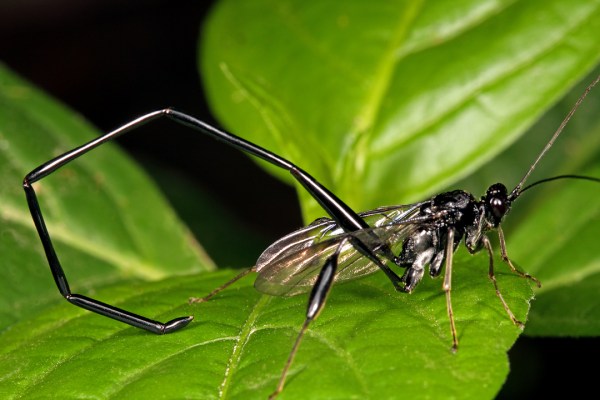
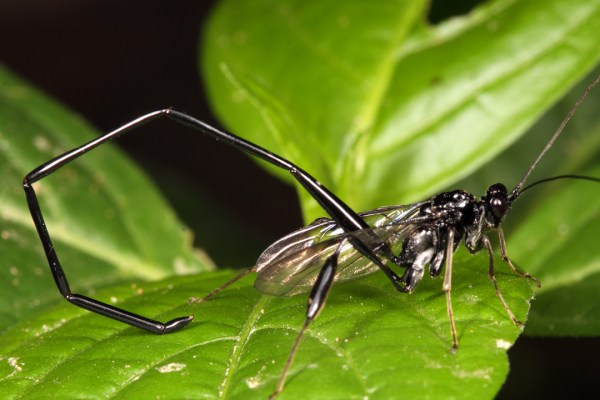
Acanthochalcis nigricans | Gloss Mountains State Park, Major Co., Oklahoma

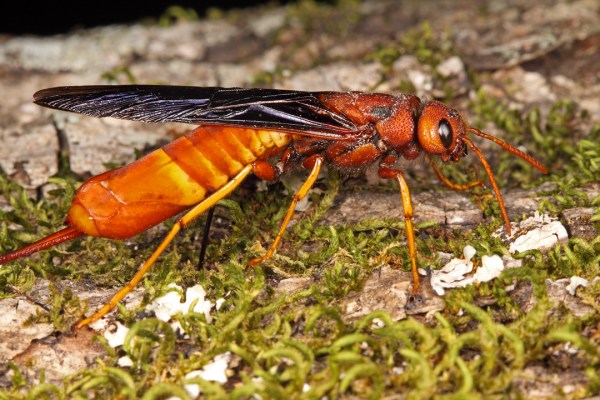
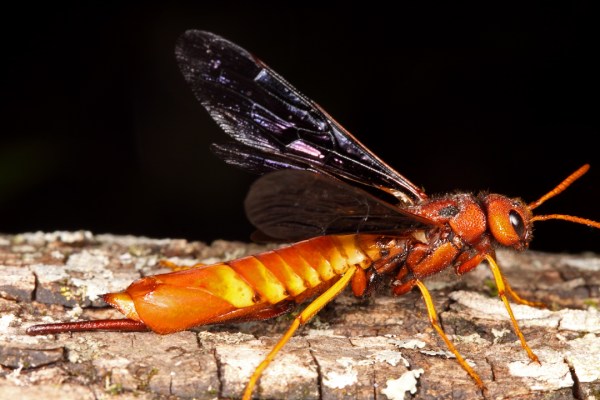
Acanthochalcis nigricans | Gloss Mountains State Park, Major Co., Oklahoma

As a student of jewel beetles with an interest in their larval host plant associations, rearing has been an important tool for my studies. Through the years, I’ve retrieved literally hundreds of batches of dead wood from the field and placed them in rearing containers that I keep in my garage. It’s hard work, but the several thousand jewel beetles that I’ve reared from these batches, many representing new distributions, host associations, and even new species (e.g., MacRae 2003) clearly suggest it has been worth the effort. Of course, jewel beetles are not the only insects that emerge from this wood. Numerous other insects have shown up in the rearing containers as well, mostly beetles in other families associated with dead wood such as longhorned beetles, powderpost beetles, checkered beetles, etc. Non-beetles have been reared as well, mostly representing parasitic hymenopterans, and in this group my favorite are the chalcidid wasps (family Chalcididae). Chalcidids and some of their close relatives are instantly recognizable by their greatly swollen and toothed hind femora. Most species in this family are parasitoids of Lepidoptera and Diptera, but some parasitize other insects, including jewel beetles and especially those in the genus Chrysobothris. I have reared a few hundred of these wasps over the years, representing at least a dozen or more species and currently being identified by fellow buprestophile Henry Hespenheide. Once identified, it will be an easy matter to associate these specimens with the Chrysobothris beetles that emerged with them from the same batch of wood. From this, we anticipate that any number of new parasitic wasp/beetle host associations will be revealed.

Among chalcidid wasps, the large size and very long ovipositor distinguish this genus.

Among chalcidid wasps, the large size and very long ovipositor distinguish this genus.

The chalcidid wasp featured in this post was not reared, but rather was encountered in the field during my recent collecting trip to northwestern Oklahoma. In fact, it was the very first insect that I encountered at the very first site that I stopped at—Gloss Mountains State Park. Although the wasp was photographed on a dead branch of eastern red-cedar (Juniperus virginiana), I first saw it on a dead branch of mesquite (Prosopis glandulosa). Based on its long ovipositor and large size (~19 mm in length, including the ovipositor), I presume this to be one of the two Acanthochalcis species commonly encountered in North America, with the presence of white pubescent patches on its abdomen identifying it as A. nigricans, occurring across the southwestern U.S. from Kansas and Oklahoma to California (A. unispinosa, ranging from Texas to California, lacks these pubescent patches). This species is a known associate of Chrysobothris jewel beetles, including C. femorata and C. edwardsii (Universal Chalcidoidea Database), but in this case I believe it is associated with C. octocola—an equally large jewel beetle that I first encountered on the mesquite at this very spot last fall (a new state record!). I beat quite a few more C. octocola adults from dead mesquite branches during this trip but didn’t find any other Chrysobothris spp. associated with the mesquite. That said, it is possible that the wasp is associated with the larger of two species of Chrysobothris that I beat from the eastern red-cedar at the site (forgive me for being coy about the identity of the beetle right now, as it will be the subject of a future post). However, since all of the wasps I saw that day were originally seen on or flying around dead mesquite branches I’m betting on C. octocola.
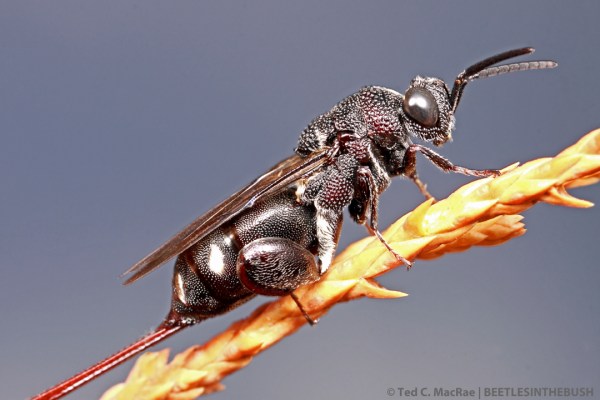
The white abdominal pubescent patches distinguish this species from A. unispinosa.

The white abdominal pubescent patches distinguish this species from A. unispinosa.

REFERENCE:

MacRae, T. C. 2003. Agrilus (s. str.) betulanigrae MacRae (Coleoptera: Buprestidae: Agrilini), a new species from North America, with comments on subgeneric placement and a key to the otiosus species-group in North America. Zootaxa 380:1–9.

Copyright © Ted C. MacRae 2013

Brazilian Bike Adventure

Atlantic Forest

Atlantic Forest in Serra do Mar.

Yesterday I joined my Brazilian colleagues on a bicycling tour from the outskirts of São Paulo to the beaches of the Atlantic Coast. To say that the tour was an ‘adventure’ is an understatement—it was epic! For those not familiar with São Paulo, its 20 million inhabitants make it not only the largest city in Brazil, but also one of the five largest cities in the world. Yet, despite the explosive growth it has seen during the past century, it remains isolated from the Atlantic Coast of southeastern Brazil by the Serra do Mar, a 40-kilometer wide swath of rugged, mountainous terrain and part of the Great Escarpment that runs along much of the eastern coast of Brazil. It is here where some of the last tracts of Atlantic Forest, the second largest forest ecotype in South America after the Amazon, remain. Atlantic Forest once stretched along much of Brazil’s Atlantic coast, turning inland in its southern reaches to Paraguay and the northern tip of Argentina. However, much of the forest, especially in populous southeastern Brazil, has fallen victim to the axe. Only the ruggedness of the Serra do Mar has allowed the Atlantic Forest to survive in such close proximity to one of the world’s most populous cities. Understandably, travel between São Paulo and the coast has been difficult. In former years, vehicles had to snake their way through the mountains along a treacherous 2-lane highway with steep grades and hairpin turns. That highway has since been circumvented by an elevated, double, 4-lane highway of alternating spans and tunnels, and the old highway, now closed to vehicles, is instead used by maintenance crews for the new highway and cyclists who yearn to experience the Atlantic Forest up close and personal.

Our van dropped us off in the outskirts of São Paulo, from where we rode along the main highway a short bit before accessing the old highway. Dropping into the Atlantic Forest was like being magically transported into virgin wilderness. The pavement was so encroached by the forest, steep and slippery in places, that it was hard to imagine it ever served as a link between Brazil’s largest city and its largest port. Heavy rains the previous night made the forest moist and gave it an earthy aroma, and moisture-laden air hung heavy with fog and intermittent drizzle. For a time it seemed we would have an uninterrupted, 40-km downhill freeride; however, just a few kilometers into the ride we encountered the first of what would be many landslides blocking the route. I can honestly say that I’ve never portaged a bike through as rough and tumble a pile of trees, rocks, and mud as I did on this day. Still, perhaps encouraged by the fresh bike tracks that lay before us, we soldiered on. After picking our way through a half-dozen such landslides we came upon a work crew who said there were another 30–40 landslides further down along the route. We were at a tunnel that connected with the main highway, so we decided to play it safe and take the main highway the rest of the way down. That, too, was an adventure, made feasible only by the fact that traffic was crawling at a snail’s pace due to the popularity of the Atlantic beaches with the citizenry of São Paulo. It was enjoyable to swish past the cars as they idled their engines, but we had to navigate about seven kilometers worth of shoulderless tunnels. That would have been impossible in normal traffic, but the congestion made finding room to squeeze by large trucks and buses the biggest problem (and I guess breathing exhaust!). Eventually we made it down into Santos, the largest port city in Brazil, and after picking our way through the center of the city, took a ferry to the beach city of Guarujá. Rain, landslides and traffic had thrown everything they had at us, but we persevered the 53-km trek and watched the sun break through while enjoying our just rewards in a beachside restaurant.

Following are a few more of my favorite photos from the day, and you can see all of them in my Facebook album Brazilian Bike Adventure.

Descending into the forest.

Descending into the forest.

Magical vistas such as this were around every turn of the road.

Magical vistas such as this awaited us around every turn of the road.

Manacá da Serra (Tibouchina mutabilis) was abundant in the forest.

Manacá da Serra (Tibouchina mutabilis) flowered in abundance in the forest.

Elevated roadways bypass the beauty of the forest below them.

Why did the ‘hellgramite’ (order Megaloptera, family Corydalidae) cross the road? (Thanks to dragonflywoman for the ID.)

The first of many landslides that blocked our path.

The first of many landslides that blocked our path.

The new elevated highway snakes through the Serra do Mar. This portion was closed due to landslides.

The new elevated highway snakes through the Serra do Mar. This portion was closed due to landslides.

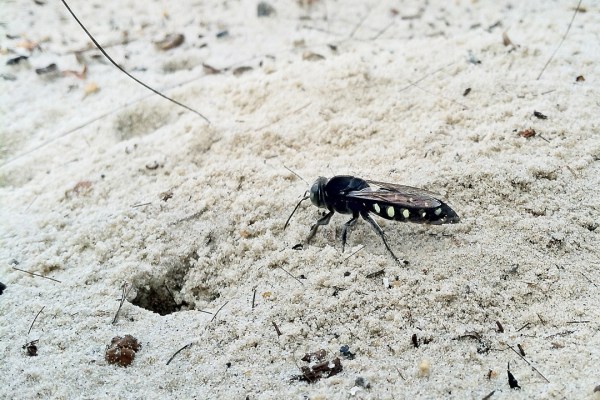
Outside of the cicada killer, this digger wasp (family Crabronidae) on the  beach at Guarujá is the largest that I have ever seen.

A large digger wasp (family Crabronidae) greets us on the beach at Guarujá.

My Brazilian colleagues and I enjoy some well-deserved refreshments after our 53-km trek!

My Brazilian colleagues and I enjoy some well-deserved refreshments after our 53-km trek!

I may have looked like a nerd still in my cycling clothes, but the wave experience was unforgettable.

I may have looked like a nerd still in my cycling clothes, but the wave experience was unforgettable.

Copyright © Ted C. MacRae 2013

The “silky-bellied humpbacked” ant

Last year during my extended work stay in Argentina, I was able to slip away from my duties during the first week of April and spend some time in the city of Corrientes in the northeastern part of the country. The city is one of my favorites in Argentina, but what I love most about it is its convenience as a base camp for exploring some of the habitats in the Grand Chaco ecoregion of northern Argentina. One day I had a chance to visit Chaco National Park about 100 km northwest of the city, site of some of the last remnants of the great quebracho forests that once covered much of northern Argentina. The forest preserved at Chaco NP takes its name from the quebracho colorado chaqueño (Schinopsis balansae) trees that dominate it, standing in defiant contrast to the vast, hot sea of cotton fields and mesquite fence-rows that surrounds it. While hiking a trail through the heart of the forest, I looked down to see a most impressive ant crawling across the forest floor:

Camponotus sericeiventris

Camponotus sericeiventris | Chaco National Park, Argentina

Because of its black color and the striking, silky sheen of the abdomen, I was immediately reminded of the Camponotus mus ants that I had photographed a year earlier further south in Buenos Aires. However, this fellow (er, fella…) was considerably larger than that species, and looking at the photographs later I was also struck by the acute spines at the humeral angles of the pronotum (in C. mus the humeral angles were obtuse) and the flattened legs. All of this combined to make it one of the most handsome ants that I had ever seen! I posted the above photo on my Facebook page asking for ID help, and James Trager quickly responded that the ant represents Camponotus sericeiventris, which translates roughly to “silky-bellied humpbacked” ant. Now there’s a common name I can get behind.

Camponotus sericeiventris

Of course, it turns out that I could have easily determined the species on my own using the characters I had already noted—primarily the acute spines. Googling “camponotus acute spines” retrieves as its first result a paper by Wheeler (1931) that discusses this ant and a newly discovered (at the time) cerambycid beetle, Eplophorus velutinus [now Euderces velutinus] mimicking the ant (Fisher 1931). As soon as I read Wheeler’s first paragraph I knew I had the right species:

Camponotus (Myrmepomis) sericeiventris, owing to its size, wide distribution and dense covering of silver or golden pubescence, is one of the handsomest and most conspicuous ants of the American tropics.

Apparently this ant is a popular choice of models for mimics in a number of insect groups. Lenko (1964) reported another cerambycid beetle, Pertyia sericea, as a mimic of C. sericieventris (the similarity of species epithets being no coincidence), and friend and colleague Henry Hespenheide has not only described a zygopine weevil, Copturus paschalis, from Costa Rica as a mimic of this ant (Hespenheide 1984) but also postulated mimicry by Apilocera cleriformis [now Euderces cleriformis] and three other species of Cerambycidae collected by him in central Panama. Henry further noted mimics in the families Cleridae and Mutillidae and the fact that all of the beetle mimics of this arboreally foraging ant are themselves woodborers or predators of woodborers as larvae.

It is interesting that Fisher (1931), in his description of E. velutinus, made no mention of the mimicry, while Wheeler (1931) in his paper about C. sericeiventris discussed this in great detail. He further noted the diversity of cerambycids here in our North American fauna that mimic ants. These include species in the genera Clytoleptus, Euderces, Cyrtophorus, Tilloclytus and—most strikingly—Cyrtinus pygmaeus, our smallest species of Cerambycidae which occurs on dead wood among small ants such as Lasius americanus, and Michthisoma heterodoxum which resembles small Camponotus pennsylvanicus workers. I’ve not yet encountered M. heterodoxum, which seems restricted to the southeastern Coastal Plain, but I have beaten C. pygmaeus from dead branches and can personally attest to the effectiveness of their mimicry—some slight something about the way they moved made me question my immediate assumption that they were ants and caused me to take a closer look at them before I shook them off the beating sheet. I wonder how many times before that I collected this species without realizing it!

REFERENCE:

Fisher, W. S. 1931. A new ant-like cerambycid beetle from Honduras. Psyche 38:99–101.

Hespenheide, H. A. 1984. New Neotropical species of putative ant-mimicking weevils (Coleoptera: Curculionidae: Zygopinae). The Coleopterists Bulletin 38(4):313–321.

Lenko, K. 1964. Sobre o mimetismo do cerambicideo Pertyia sericea (Perty, 1830) com Camponotus sericeiventris (Guerin, 1830). Papéis Avulsos de Zoologia (São Paulo) 16:89–93.

Wheeler, W. M. 1931. The ant Camponotus (Myrmepomis) sericeiventris Guérin and its mimic. Psyche 38:86–98.

Copyright © Ted C. MacRae 2013
An elegant living fossil…

In the insect world, hyperdiversity is the norm. More than a million species are known, and perhaps several million more await discovery. Beetles alone represent nearly a quarter of the earth’s described biota, with one genus (Agrilus in the family Buprestidae) bursting at the seams with more than 3,000 described species (Bellamy 2008). Biodiversity gone wild! While birders routinely field identify (and list) a majority of the birds they see to species, most insect enthusiasts are happy if they can simply identify their subjects to family—in most cases still leaving several hundred to several thousand possibilities for species identification. Even trained entomologists usually can identify only a tiny fraction of the insects they see and remain just as clueless about the vast majority of insects they encounter that don’t represent one of their limited number of study groups.

Pelecinus polyturator female | Wayne Co., Missouri

Pelecinus polyturator female | Wayne Co., Missouri

 Of course, that doesn’t mean field identification is impossible for all insects—certain groups such as butterflies, dragonflies, and tiger beetles lend themselves to field identification due to their relatively large size, bright colors, and distinctive markings. Many would also include the aculeate hymenopterans (i.e., “stinging” wasps and bees) among those groups for these same reasons. However, the vast majority of hymenopterans belong to a multitude of families characterized by tiny, parasitic species that seem (to this coleopterist’s eyes) to differ only in bafflingly minute details of wing venation and tibial spurs. (Honestly, I couldn’t tell you the difference between Tanaostigmatidae and Tetracampidae if my life depended on it!) Nevertheless, there are a small handful of parasitic hymenopterans in North America that are instantly recognizable due to their giant size (2 or more inches in length)—namely, Megarhyssa spp. (giant ichneumons) and the species shown in this post, Pelecinus polyturator (American pelecinid). Pelecinus polyturator is the only North American member of the family Pelecinidae, which itself contains only two additional species that are restricted to Mexico and Central/South America. It wasn’t always this way—fossils assignable to the family and representing 43 species in a dozen genera have been found as far back as the early Cretaceous (121–124 mya) across North America, Europe, and Asia (Grimaldi & Engel 2005). Surely this represents just the tip of the iceberg of Mesozoic and early Cenozoic pelecinid diversity, making today’s three species the last representatives of a once great lineage—”living fossils”¹ some might say.

¹ To ward off any scolding I might get from evolutionary purists, I get it; there is no such thing as a living fossil (except the T. rex skeleton in the movie “Night at the Museum”). I know that all species alive today have the same amount of evolutionary history behind them and are, if not from more immediate ancestors, highly derived compared to earlier life forms. I will admit that the term has become a bit overused as pseudoscientific shorthand for branding an organism as ‘primitive’ (another term which tends to raise hackles); however, I don’t see the problem with its use as informal reference to relatively ancient groups, usually more diverse in the past and now represented by only a few species. Innocuous shorthand is all it is.

This elegant female, recognizable by her extraordinarily narrowly elongate abdomen (males have a somewhat shorter abdomen that is widened at the end), was seen back in July 2011 as she flew to a blacklight and landed on nearby foliage in a mesic bottomland forest in southeastern Missouri’s Ozark Highlands. I have seen females on occasion over the years but have not yet seen a male, which are increasingly rare in more northern latitudes of the species distribution. I missed the focus a bit on this photo (and also the other half-dozen or so shots that I took)—photographing an active subject at night on elevated foliage without a tripod is difficult to say the least! Nevertheless, after post-processing it’s a decent photograph. If you are wondering why it took me so long to post it, that’s because only recently have I gained the confidence to “clean up” poorly exposed photos where the subject and/or substrate on which they are resting is so distractingly littered with debris as this:

Yuk!!!

Yuk!!!

Compare the original photo here to the final photo above it—how many post-processing tools can you detect the use of? 🙂

REFERENCES:

Bellamy, C. L. 2008. World catalogue and bibliography of the jewel beetles (Coleoptera: Buprestoidea), Volume 4: Agrilinae: Agrilina through Trachyini. Pensoft Series Faunistica 79:1–722.

Grimaldi, D. and M. S. Engel. 2005. Evolution of the Insects.Cambridge University Press, New York, xv + 755 pp.

Copyright © Ted C. MacRae 2013

Ovipositing Pigeon Horntail

Tremex columba (pigeon horntail) | Wayne Co., Missouri

Tremex columba (pigeon horntail) | Wayne Co., Missouri

By early July, woodboring beetle activity is at its peak in southern Missouri. Even though many of the smaller species of jewel beetles (family Buprestidae) and longhorned beetles (family Cerambycidae) have already come and gone, bigger species in genera such as Buprestis, Acanthocinus, Enaphalodes, etc. are ripe for the picking. All one has to do is travel for hours to high-quality forest (upland or lowland—either is fine depending on what you wish to find), hike for additional hours through stifling mid summer heat and humidity, and carefully search the trunks and branches of any declining or recently downed tree (don’t forget to look along the undersides) while dodging deer flies (if ever a creature sprang from the pit of hell!) and slapping mosquitos! Sure, you can cheat and just drive along National Forest roads looking for recent logging operations—it’s a good way to get large series of common, widespread species; however, if you want to get the good stuff you’ve got to seek out the high-quality forests—those not managed for timber—and look for declining trees and natural wind-throws.

Of course, not all wood borers are beetles. Among the more spectacular non-beetle wood borers are the horntails (order Hymenoptera, family Siricidae), represented in this post by one of its more commonly encountered species, Tremex columba (pigeon horntail). That is not to say that they are frequently encountered, at least in my experience, but I do remember the first time I saw one of these as a boy. I knew in my heart that they were harmless—my already tattered copy of The Golden Guide to Insects said so; yet I could not bring myself to actually grab what would become the latest prize specimen in my insect collection with my bare fingers, instead sneaking a jar over it and sliding the lid underneath.  I’ve seen them a few times since, but until recently I had never seen what must be considered their most remarkable feature—the ability to thrust a needle-thin ovipositor several cm into solid wood! While hiking the Shut-Ins Trail at Sam A. Baker State Park last year, I spotted a large, recently wind-thrown tree off the trail and picked my way over to see what woodboring beetles I might find. As I approached the horntail in these photos took flight, but I stood still and watched her settle back onto the trunk and resume searching activities. Using all the stealth I could muster, I made my approach—hoping to get at least one good shot of this spectacular insect. I would have been happy if I had walked away with nothing more than the first photo in the sequence below. What happened next, however, was icing on the cake. As the remaining photo sequence shows, she suddenly arched her abdomen high and began probing the wood with the tip of her ovipositor, then bracing it at a precise 90° angle relative to the lower abdomen, slowly thrust it deep into the wood until her abdomen was completely level above the trunk.

I never cease to be amazed by insects, but sometimes their capabilities just seem incomprehensible. If you disagree, just imagine trying to insert an insect pin deep into solid wood with nothing but your bare hands (or, more precisely, pushing only with your butt) and see if you don’t change your mind!

T
T
T
T
T
T
Copyright © Ted C. MacRae 2013

More Eocene insects

Most of the Green River Formation (GRF) insect fossils that I have on loan clearly represent either beetles (order Coleoptera) or flies (order Diptera). I’ve already shown a few of the latter (fungus gnat, midge), as well as some that don’t belong to either order (ant, cricket?). Here are a few more that seem identifiable to order, but family-level identification is less certain. Thoughts from the readership would be most welcome.


IMG_1923_enh_1080x720IMG_1826_enh_1080x720
This fossil shows an aggregation of insects that I believe represent some kind of beetle. Based on shape and size (16.7 mm length) I’m guessing perhaps either a diving beetle (family Dytiscidae) or whirligig beetle (family Gyrinidae). These are both aquatic families, although only the former is among the beetle families recorded from the GRF by Wilson (1978).


IMG_1927_enh_1080x720 IMG_1836_enh_1080x720
There are two insect fossils on this specimen, but the closeup is the one near the center of the rock. It is tiny (3.5 mm in length), and at first I thought it might be a fly (order Diptera). However, dipterist Chris Borkent thinks it might be a small hymenopteran (bee?) because it has what looks to be long multi-segmented antennae. The only bee family recorded for the GRF by Wilson (1978) is Anthophoridae (now included within Apidae), of which this fossil clearly is not a representative. There are six other hymenopteran families recorded in that work, of which Tenthredinidae is the only one that seems plausible. Of course, it could represent a family not recorded by Wilson (1978). Collected along Hwy 139 in Douglas Pass (Garfield Co., Colorado).

Here is a closeup of the other fossil (far right in photo above). This looks to me like a brachyceran fly, and I’ve sent a high resolution version of the image to Chris Borkent to see what he thinks.


IMG_1934_enh_1080x720 IMG_1850_enh_1080x720
The label accompanying this fossil indicates “Mosquito (?),” but to my eye this looks like a true bug (order Hemiptera). It is small—only 5.9 mm in length—and has the gestalt of a plant but (family Miridae) or seed bug (family Lygaeidae). GRF fossils representing the latter but not the former were recorded by Wilson (1978). Also collected along Hwy 139 in Douglas Pass (Garfield Co., Colorado).


REFERENCES:

Wilson, M. V. H. 1978. Paleogene insect faunas of western North America. Quaestiones Entomologicae 14(1):13–34.

Copyright © Ted C. MacRae 2012

The 2nd-oldest Known Myrmicine Ant

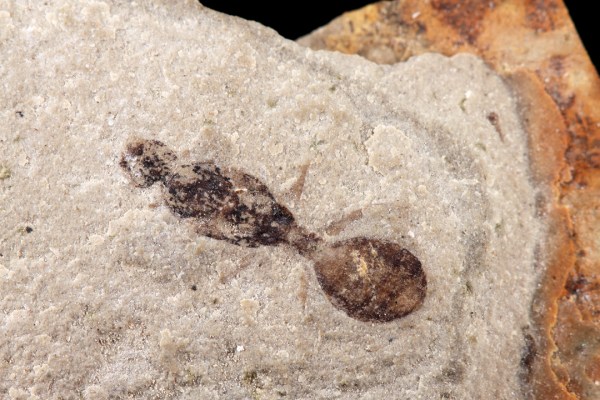
Among the 20 or so insects represented in the Green River Formation (GRF) fossils that I currently have on loan, this rather obvious ant (family Formicidae) is the only one that is firmly assignable to the order Hymenoptera (wasps, bees and ants). This is not surprising, as hymenopterans are not well represented among GRF insect fossils. In fact, of the 300+ insect species that have been described from GRF deposits (Wilson 1978), more than two-thirds belong to just three orders—Diptera (flies), Coleoptera (beetles) and Hemiptera (true bugs). Hymenoptera, on the other hand, comprise only 4% of GRF fossils (Dlussky & Rasnitsyn 2002). I presume these numbers are more a result of taphonomic (fossil formation) bias than a true reflection of insect diversity in western North America during the Middle Eocene (47–52 mya).

cf. Myrmecites rotundiceps | fossil impression from the Green River Formation (45 mya, middle Eocene)

cf. Myrmecites rotundiceps (length = 6.7 mm).

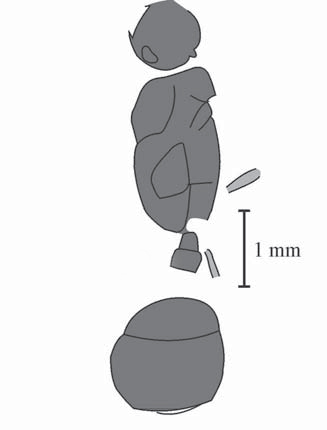
Ants in particular have been poorly represented by GRF deposits. Only four named species were known until Dlussky & Rasnitsyn (2002) reviewed available GRF fossils and increased the number to 18 (15 described as new, one older name placed in synonymy). Diagnoses, line drawings, and keys to all covered subfamilies, genera and species provide one of the best treatments to GRF insect fossils that I’ve come across. According to that work, the fossil in these photos seems comparable to the description and illustration given for Myrmecites rotundiceps, a unique fossil with the general appearance of ants in the subfamily Myrmicinae but differing from all known Eocene and New World fossil ants by its very short, two-segmented waist. The only difference I noted was size—6.7 mm length for my fossil versus 5.5 mm for the holotype (see figure below). Of course, I’m more comfortable identifying extant Coleoptera than extinct Formicidae, so I contacted senior author Gennady M. Dlussky to see if he agreed with my opinion. He graciously sent the following reply:

I agree that specimen on your photo is very similar to Myrmecites rotundiceps. It is larger (holotype is 5.5 mm long), but it may be normal variability. I cannot see another differences.

Myrmecites rotundiceps, holotype (Gennady & Rasnitsyn 2002)

Myrmecites rotundiceps Gennady & Rasnitsyn 2002, holotype (reproduced from Gennady & Rasnitysyn 2002)

If correctly assigned, M. rotundiceps is the second oldest known member of the subfamily Myrmicinae—the oldest being Eocenidris crassa from Middle Eocene Arkansas amber (45 mya). In fact, the only older ant fossil of any kind in North America is Formicium barryi (Carpenter) from Early Eocene deposits in Tennessee (wing only). [Edit: this is actually the only older Paleocene ant fossil—there are some Cretaceous-aged fossils such as Sphecomyrma freyi (thanks James Trager).] Since myrmicine fossils of comparable age are lacking from other parts of the world, this might suggest a North American origin for the subfamily; however, it could also be an artifact of incomplete knowledge of ants from older deposits in other parts of the world. Myrmicine ants make their first Eurasian appearance in Late Eocene Baltic amber deposits (40 mya) and become more numerous in North America during the early Oligocene (Florissant shales of Colorado, 33 mya). (Dlussky & Rasnitsyn (2002) consider the Middle–Late Eocene ant fauna to represent the beginnings of the modern ant fauna, with extant genera becoming numerous and extinct genera waning but still differing by the preponderance of species in the subfamily Dolichoderinae over Formicinae and Myrmicinae.

IMG_1919_enh_1080x720

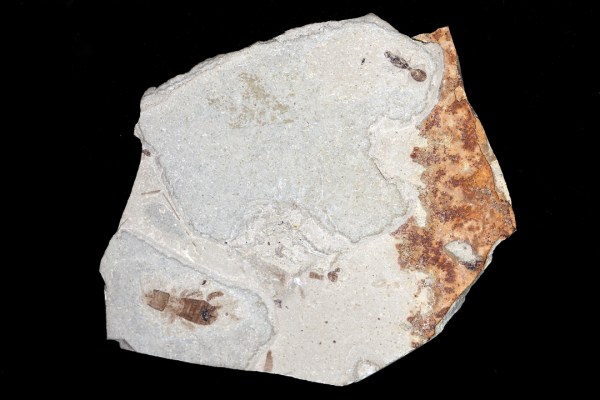
USA: Colorado, Rio Blanco Co., Parachute Creek Member.

The photo above shows the entire fossil-bearing rock (also bearing the putative orthopteran posted earlier).

My thanks to Gennady Dlussky and James Trager for offering their opinions on the possible identity of this fossil.

REFERENCES:

Dlussky, G. M. & A. P. Rasnitsyn. 2002. Ants (Hymenoptera: Formicidae) of Formation Green River and some other Middle Eocene deposits of North America. Russian Entomological Journal 11(4):411–436.

Wilson, M. V. H. 1978. Paleogene insect faunas of western North America. Quaestiones Entomologicae 14(1):13–34.

Copyright © Ted C. MacRae 2012

The gloriously dichromatic Dasymutilla gloriosa

I have a small collection of velvet ants (family Mutillidae) that I’ve accumulated over the years—not through active collection but more as bycatch from my beetle hunting operations. Velvet ants are, of course, not ants at all, but wasps, and as such the females are—like their winged relatives—quite capable of delivering a painful sting if mishandled. They also tend to be seen running rather frenetically across the ground, making them difficult to guide into a collection vial or grab with forceps. You’ve gotta really want ’em if you want to collect them. Still, even though I don’t study them I find them interesting enough to pick up on occasion, and with most groups outside of my area of focus the hope is that eventually they will end up in the hands of somebody who actively studies the group. Such is now the case with my mutillid collection, which will be shipped this week to another collector specializing in the group. In return I will be filling some holes in European representation of my collection of Cerambycidae.

Dasymutilla gloriosa, female | Brewster Co., Texas

Dasymutilla gloriosa, female | Brewster Co., Texas

Without question, the most interesting mutillid species that I’ve encountered is Dasymutilla gloriosa. All mutillids are sexually dimorphic, as only the males are winged, but most also tend to be sexually dichromatic to a greater or lesser degree. No species I am aware of takes this to the same level as D. gloriosa! The males (photo below) are rather typically colored compared to other species in the genus, but the females (photo above) are densely covered with long, strikingly white hairs. While this would seem to make them quite conspicuous, the true effect is the exact opposite as they easily confused with fuzzy plant seed. For this reason they are commonly called thistledown velvet ants. I encountered the female in west Texas in 2003 while walking a mountain trail and at first thought it was the fuzzy seed of a creosote bush (Larrea tridentata) being blown by the wind—except there was no wind! It took me a little while looking closely at it before I could figure out what it actually was. This is the only female of this species that I’ve seen in the wild, and I’ll be a little sad to see it sent to another location.

Dasymutilla gloriosa, male | Riverside Co., California

Dasymutilla gloriosa, male | Riverside Co., California

The male also is the only one I’ve encountered—or at least taken the trouble to collect. I would have never suspected this male, which I collected in southern California in 1991, was the same species as the female that I collected many years later. My thanks to Kevin Williams, who provided the identifications for both of these specimens.

Also called the ''thistledown velvet ant''

Also called the ”thistledown velvet ant”

Copyright © Ted C. MacRae 2012