Not all soybean caterpillars are ‘ugly’!

Although photographs of beetles dominate this site (they are my true love, after all), I am nevertheless an agricultural entomologist by day and, as such, find occasion to post photos of the insects I encounter in my area of expertise—soybean. I think by and large those soybean insects—especially the caterpillars—don’t generate as much interest as the beetles that I feature. I guess this is understandable—caterpillars of the agricultural pest variety seem generally unable to compete with the visual and behavioral charisma exhibited by jewel beetles, tiger beetles, tortoise beetles, etc. Here, however, is an example of a soybean caterpillar that is as beautiful as any beetle you will find—the larva of the silver-spotted skipper, Epargyreus clarus (Lepidoptera: Hesperiidae). Not only are the colors to die for, but that comically big head makes for a truly laughable frontal portrait!

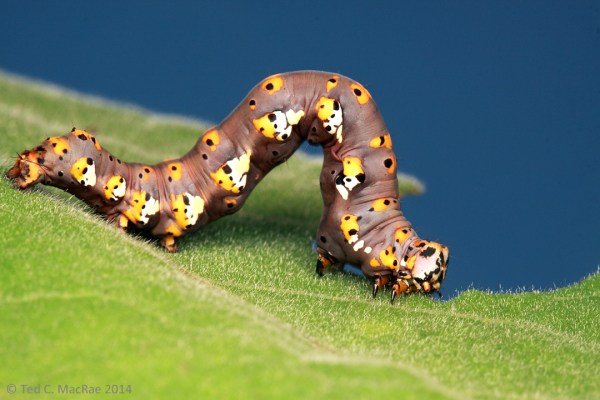
Epargyreus clarus (silver-spotted skipper) late-instar larva on soybean | Baton Rouge, Louisiana

Epargyreus clarus (silver-spotted skipper) late-instar larva on soybean | Baton Rouge, Louisiana

This particular individual was found last September in a soybean field near Baton Rouge, Louisiana (amazingly, this is the first insect I have featured from Louisiana). Silver-spotted skippers feed on a wide variety of plants in the family Fabaceae (of which soybean is a member), but their occurrence on soybean rarely reaches levels that cause any economic impact. Normally the caterpillars hide during the day in a silken nest constructed by folding over a leaflet or tying adjacent leaflets together, emerging only at night to feed.

What a pretty face!

What a pretty face!

I suppose the orange spots on the head are intended to serve as false eye spots—for some reason the larger the eyes the more a potential predator seems to take pause before deciding to eat something. The actual eyes can be seen along the outer edge of the orange spot as a row of simple ocelli—incapable of forming sharp images and serving as little more than light and motion detectors. I can’t even begin to speculate on the function of the curious asperate/rugose texture of the head!

Copyright © Ted C. MacRae 2014

Best of BitB 2013

Welcome to the 6th Annual “Best of BitB”, where I pick my favorite photographs from the past year. Like last year, 2013 was another year of heavy travel. For work I did my annual tour of soybean field sites throughout Argentina during late February and early March, then cranked it up for my own field season with frequent travel to sites in Illinois and Tennessee from May to October. In the meantime I spent a week at company meetings in Las Vegas in August, toured field sites across the southeastern U.S. for two weeks in September, visited Argentina again in October to finalize research plans for their upcoming season, and finished off the travel year by attending the Entomological Society of America (ESA) Meetings in Austin, Texas during November. On top of all this, I managed to slip in two of the best insect collecting trips I’ve had in years, with 10 days in northwestern Oklahoma in early June and another 10 days in California, Nevada, Utah, and Colorado during late August, and I got to play “visiting scientist” during short trips to Montana State University in late July and the Illinois Natural History Survey in late October! Of course, during my brief interludes at home I wasn’t sitting still, giving entomology seminars to several local nature societies and hosting two ESA webinars on insect photography. Needless to say, come December I was more than ready to spend some quite time at home (well, except for hiking most weekends) and am happy to report that I’ve successfully become reacquainted with my family and office mates. It’s a peripatetic life—and I wouldn’t have it any other way!

Okay, let’s get down to business. Here are my favorite BitB photographs from 2013. This year was less about learning new techniques as it was about refining the techniques I’ve found most useful for the style I’ve chosen as a photographer, i.e., hand-held, in situ field shots that (hopefully) excel at both natural history and aesthetic beauty. Links to original posts are provided for each photo selection, and I welcome any comments you may have regarding which (if any) is your favorite and why—such feedback will be helpful for me as I continue to hone my craft. If you’re interested, here are my previous years’ picks for 2008, 2009, 2010, 2011, and 2012. Once again, thank you for your readership, and I hope to see you in 2014!


Tremex columba, female ovipositing | Sam A. Baker State Park, Missouri

Tremex columba female drilling for oviposition into hardwood trunk | Sam A. Baker State Park, Missouri

From Ovipositing Pigeon Horntail (posted 6 Jan). I like this photo for the combination of vibrant, contrasting colors between the wasp and moss-covered wood and the visualization it provides of the remarkable depth to which this wasp will insert its ovipositor into solid wood!


Eurhinus cf. adonis on Solidago chilensis | Chaco Province, Argentina

Eurhinus cf. adonis on Solidago chilensis flowers | Chaco Province, Argentina

From Giving me the weevil eye! (posted 28 Apr). While a little soft, the color combination is pleasing and the pose taken by the beetle almost comically inquisitive.


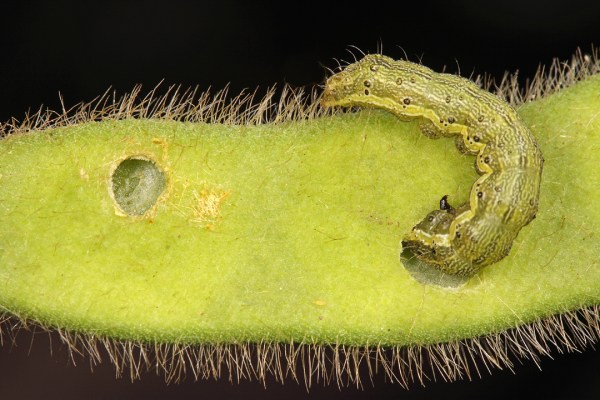
Helicoverpa gelotopeon feeding on soybean pod | Buenos Aires Prov., Argentina

Helicoverpa gelotopeon feeding on soybean pod | Buenos Aires Prov., Argentina

From Bollworms rising! (posted 30 Mar). This is the first photo of an economic pest that has made one of my “Best of BitB” lists. The two holes in the soybean pod, one with the caterpillar and its head still completely inserted, visualizes how the feeding habits of these insects can so dramatically affect yield of the crop.


cf. Eremochrysa punctinervis | Gloss Mountains, Major Co., Oklahoma

cf. Eremochrysa punctinervis | Gloss Mountains, Major Co., Oklahoma

From “Blue-sky” tips and tricks (posted 1 July). Insects with a lot of delicate detail and long, thin appendages are especially difficult to photograph against the sky due to wind movement. See how I dealt with the antennae of this delicate lacewing without resorting to the standard black background typical of full-flash macrophotography.


Cicindela scutellaris lecontei x s. unicolor

Cicindela scutellaris lecontei x s. unicolor intergrade | Holly Ridge Natural Area, Stoddard Co., Missouri

From The Festive Tiger Beetle in Southeast Missouri (posted 25 Oct). I like this photo a lot more now than I did when I first took it. Its shadowy feel and the beetle “peering” from behind a leaf edge give a sense of this beetle’s attempts to hide and then checking to see if the “coast is clear”


Batyle suturalis on paperflower (Psilostrophe villosa) | Alabaster Caverns State Park, Woodward Co., Oklahoma

Batyle suturalis on Psilostrophe villosa flowers | Alabaster Caverns State Park, Woodward Co., Oklahoma

From Tips for photographing shiny beetles on yellow flowers (posted 10 Aug). “Bug on a flower” photos are a dime a dozen, but shiny beetles on yellow flowers with natural sky background can be quite difficult to take. All of the techniques for dealing with the problems posed by such a photo came together nicely in this photo.


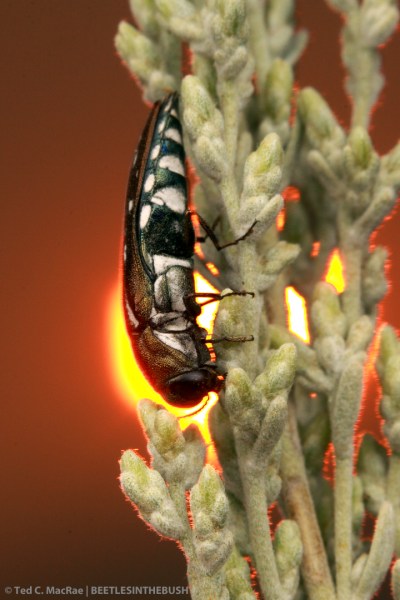
Agrilus walsinghami | Davis Creek Regional Park, Washoe Co., Nevada

Agrilus walsinghami | Davis Creek Regional Park, Washoe Co., Nevada

From Sunset for another great collecting trip (posted 1 Sep). This photo is not without its problems, with a little blurring of the backlit fuzz on the plant, but the placement of the sun behind the subject’s head and resulting color combination make it my favorite in my first attempts at achieving a “sun-in-the-sky” background with a true insect macrophotograph.


A tiny male mates with the ginormous female.

Pyrota bilineata on Chrysothamnus viscidflorus | San Juan Co., Utah

From Midget male meloid mates with mega mama (posted 8 Nov). Another blue-sky-background photograph with good color contrast, its real selling point is the natural history depicted. with some of the most extreme size dimorphism among mating insects that I’ve ever seen.


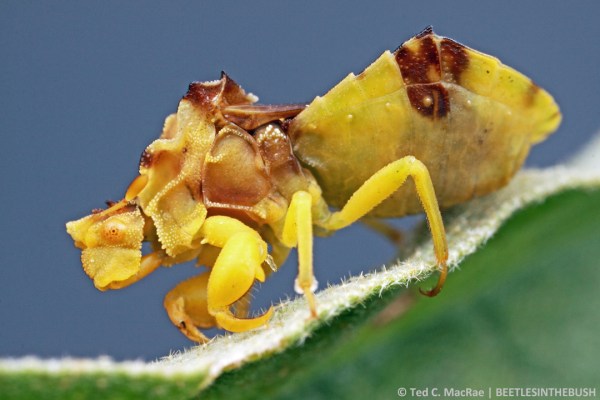
Phymata sp.

Phymata sp. on Croton eleagnifolium foliage | Austin, Texas

From ESA Insect Macrophotography Workshop (posted 13 Nov). The oddly sculpted and chiseled body parts of ambush bugs makes them look like they were assembled from robots. Contrasting the body against a blue sky gives a more unconventional view of these odd beasts than the typical top-down-while-sitting-on-a-flower view.


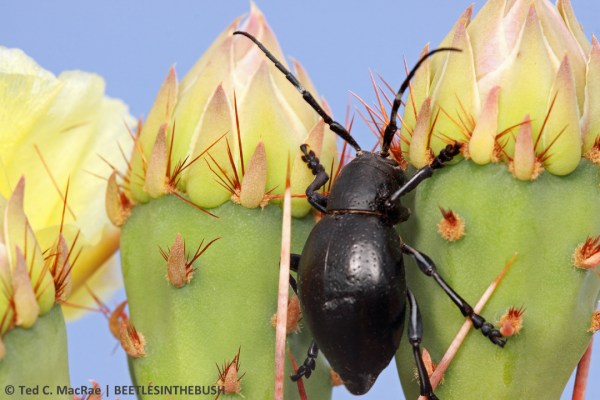
Fourth attempt - holding detached pad up against sky for cleaner background.

Moneilema armata on Opuntia macrorhiza | Alabaster Caverns State Park, Woodward Co., Oklahoma

From Q: How do you photograph cactus beetles? (posted 24 Nov). Photographing cactus beetles requires patience, persistence, long forceps, and strong forearms. Natural sky provides a much more pleasing background than a clutter of cactus pads and jutting spines.


I hope you’ve enjoyed this 2013 version of “Best of BitB” and look forward to seeing everyone in 2014.

Copyright © Ted C. MacRae 2013

Party on a pin oak

In September 2012 while collecting in western Oklahoma (Weatherford) I came across this interesting scene. It had been exceedingly dry in the area, and because of this few insects were out and about in the small city park that I stopped by to check for the presence of tiger beetles. I had nearly completed my circuit of the park when I came upon a moderate-sized pin oak (Quercus palustris) tree and noticed something on the lower trunk:

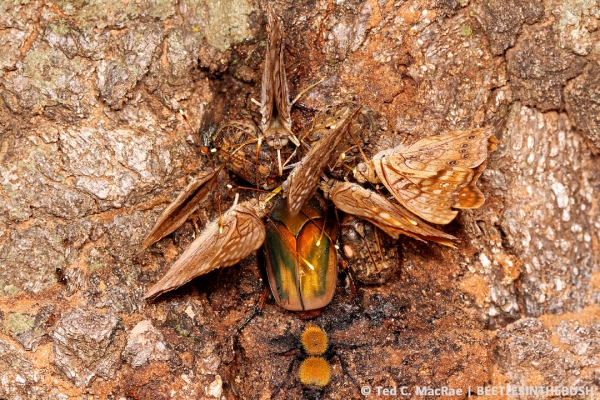
Six insect species representing five families in four orders share a sap flow.

Six insect species representing five families in four orders share a sap flow on the trunk of a pin oak.

No less than six insect species representing four orders were seen all huddled together at a darkly stained sap flow. This could be the result of slime flux, a bacterial disease that usually affects deciduous hardwoods that are under stress and results in darkly stained weeps on the trunk that are known to be attractive to a variety of insects. At the center sat a green June beetle (Cotinis nitida) and three bumble flower beetles (Euphoria inda)—all in the family Scarabaeidae (subfamily Cetoniinae). Covering the scarab beetles were half a dozen Texas Tawny Emperor (Asterocampa clyton texana) butterflies (family Nymphalidae, or Brushfooted Butterflies), and milling around the perimeter was a velvet ant (Dasymutilla creusa, I believe) in the family Mutillidae, an apparent flesh fly (family Sarcophagidae), and a true ant (family Formicidae). I guess this would be the equivalent to a watering hole in Africa with a lion, a hyena, a baboon, three vervet monkeys and six zebras all crouched shoulder-to-shoulder at its edge.

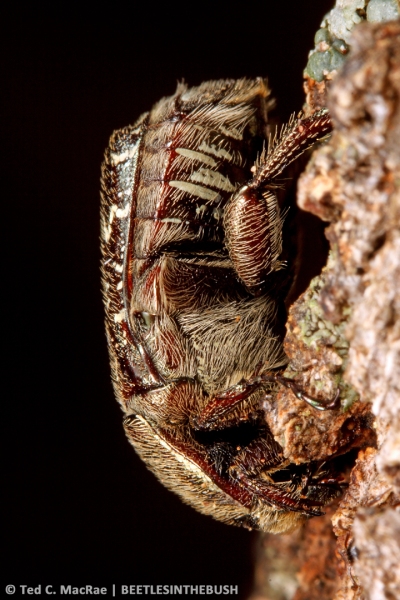
Euphoria sepulchralis feeds on a sap flow higher up on the trunk.

Euphoria sepulchralis feeds on a sap flow higher up on the trunk.

Further up on the trunk, yet another species of scarab beetle, a dark flower scarab (Euphoria sepulchralis) was found feeding on a smaller sap ooze. Unlike the diverse aggregation of insects on the lower ooze, this guy had managed to keep the ooze all to himself.

Cotinus nitidus | Weatherford, Oklahoma

Cotinis nitida | Weatherford, Oklahoma

Green June beetles, especially, are known for their feeding on sap oozes. The beetles are actually attracted to the odors caused by fermentation of the sap rather than the sap itself. It has been reported that the presence of alcohol in fermenting sap can affect the behaviour of insects that feed upon it, causing them to act “stupid and lethargic.” I did not see any such behavior, but I did notice that the insects were not at all skittish and loath to leave the sap.

Copyright © Ted C. MacRae 2013

One-shot Wednesday: Hawk moths suck!

Hyles lineata nectaring at flowers of Ericameria nauseosa | San Juan Co., Utah

Hyles lineata nectaring at flowers of Ericameria nauseosa | San Juan Co., Utah

I admit it—I give short shrift to Lepidoptera compared to other groups of insects. This is not because I don’t think they deserve attention; they are a stunning group with an amazing suite of adaptations to life on earth. It’s just that they already receive a lot of attention from others, while so many other equally amazing groups of insects remain almost completely unknown and under-appreciated due to the sole fact that they are smaller and less conspicuous. I’m not anti-Lepidoptera; I’m just pro-other Insecta. Every now and then, however, I must give Lepidoptera their due, and since today is Wednesday it’s a good day to feature a hawk moth that I got but a single photograph of on my late August Great Basin collecting trip.

Hyles lineata is not a particularly rare insect—in fact, it is one of the most common and widespread species of hawk moth (family Sphingidae) in North America. What is hard to come by, however, is a good shot of an adult nectaring at a flower. While such shots abound, most feature busy backgrounds and blurred wings. My photo is no different. However, I am a coleopterist, and when I took this shot there were also longhorned beetles present on the same flowers—it could be considered remarkable that I even diverted my attention long enough to attempt a shot. Of course, hawk moths are amazing creatures that have independently arrived at the same flight abilities and feeding habits as the equally amazing but taxonomically distant hummingbirds with their ability to hover motionless while sipping nectar and beating their wings at blinding frequencies. With little time to practice and even less to optimize settings, I’m amazed that I even got an adequate photograph before the moth zipped off to another bush. Yes, hawk moths suck, and that is amazing!

Copyright © Ted C. MacRae 2013

Hooray for iStock—I finally have an ID for my photo

I was all set to make a “One-Shot Wednesday” post today, but sometimes big news strikes and plans must change. The news today was in the form of a random tweet by Alex Wild:

iStock-caption_Wild-20131120

The link in the tweet led me to the following photo on iStock by Getty:

bedbug has captured worm

I was stunned—the photo depicted a scene almost identical to one that I had photographed back in September while visiting soybean fields in Louisiana. For two months I sat on the photo with no idea what I was looking at, but now thanks to Alex I have my answer! Compare the above photo with mine below, and you’ll see that everything matches perfectly—I had photographed a “bedbug” that had captured a “worm”!

Podisus maculiventris preying on Chrysodeixis includens larva

bedbug captures a worm

I considered myself to be fortunate, because there was not just one but two different subjects in the photo, and both of them matched perfectly with the subjects shown in the iStock photo. Gotta love the internet—nowadays names for even the most hard-to-identify bugs are just a click away if you know where to look!

</snark>

Of course, the aggressor in both photos is not a “bedbug” [sic for “bed bug”] (order Hemiptera, family Cimicidae) but a stink bug (family Pentatomidae), specifically Podisus maculiventris, or “spined soldier bug”—perhaps the most common predatory stink bug in North Amerca and ranging from Mexico and parts of the West Indies north through the U.S. into Canada. It is a well-known predator of crop pests and, as such, has been imported to several other countries as part of classical biological control efforts. As for the “worm,” in my photo it is a late-instar larva of Chrysodeixis includens, or “soybean looper, and while I haven’t been able to identify the exact species in the iStock photo it is definitely a lepidopteran caterpillar that appears to related to if not in the same family as the soybean looper (Noctuidae). Now, I concede that “worm” is sometimes used for lepidopteran larvae, but one must also concede that in it’s broadest sense “worm” can refer to members of several disparate phyla such as Nematoda (roundworms), Platyhelminthes (flatworms), or Annelida (segmented worms).

This case, of course, just screams for application of the Taxonomy Fail Index (TFI), which scales the amount of error in a taxonomic identification in absolute time against the error of misidentifying a human with a chimpanzee—our closest taxonomic relative. For example, when TFI = 1 the error is of the same magnitude as mistaking a human for a chimp, while  TFI > 1 is a more egregious error and TFI < 1 a more forgivable one. In the case shown here, one must go back to the common ancestor that eventually gave rise to all of the worm phyla and noctuid moths (~937.5 mya). In addition, since there are two subjects in the photo, one must also go back to the divergence of the main hemipteran groups that contain bed bugs and stink bugs (mid-Triassic, ~227.5 mya). This results a whopping 1.165 billion total years of divergence between the identifications assigned to the subjects in the iStock photo and their actual identity. Assuming that chimps and humans diverged approximately 7.5 mya, this gives a TFI for the iStock photo of 155! I haven’t searched thoroughly to determine whether this is a record for the highest TFI in a single photo, but surely it is a strong contender!

Copyright © Ted C. MacRae 2013

Quick Guide to Armyworms on Soybean

Throughout the soybean growing areas of the southern U.S. and South America, lepidopteran caterpillars are the most important pest complex affecting the crop. Millions of pounds of insecticides are sprayed on the crop each year in an effort to minimize their impact—a practice that is not always successful and entails significant exposure risks to the environment and farm workers alike. A variety of lepidopteran species occur in soybeans, and proper identification is essential to ensure adequate control and avoiding unnecessary applications. While the most important and commonly encountered species are velvetbean caterpillar (Anticarsia gemmatalis) and soybean looper (Chrysodeixis includens), others include soybean podworms (Helicoverpa zea in the U.S.; H. gelotopoeon and—now—H. armigera in Brazil and Argentina), sunflower looper (Rachiplusia nu), bean shoot moth (Crocidosema aporema), and armyworms of the genus Spodoptera. The last group contains several species that can affect soybean, and while they have traditionally been considered minor pests of the crop a number of species have increased in importance during the past few years.

I have been conducting soybean field trials in both the U.S. and South America for many years now and have had an opportunity to photograph most of the species known to occur on soybean in these regions. Identification of armyworm larvae can be rather difficult due to their similarity of appearance, lack of distinctive morphological differences (e.g. number of prolegs), and intraspecific variability in coloration. Conclusive identification is not always possible, especially with younger larvae; however, the different species do exhibit subtle characters that can usually allow for fairly reliable identification of large larvae. Considering the dearth of direct comparative resources—either in print or online—I offer this quick guide to the six armyworm species that I’ve encountered in soybean.


Spodoptera frugiperda (fall armyworm) | Jerseyville, Illinois

Spodoptera frugiperda (fall armyworm) | Jerseyville, Illinois

Spodoptera frugiperda (fall armyworm). This is not the most important armyworm pest of soybean, in contrast to its great importance in other crops such as corn and cotton. It is, however, the most widely distributed of the species, occurring in both the southern U.S. and throughout soybean growing areas of Brazil and Argentina. When problems do occur on soybean they are usually a result of larvae moving from grassy weeds to small soybean plants in late-planted or double-crop fields. Larvae can damage all stages of soybean, from seedlings (cutting them off at ground level) to later stages by feeding primarily on foliage and even pods. Larvae are somewhat variable in coloration but are distinctive among armyworms by virtue of the pinaculae (sclerotized tubercles) visible over the dorsum, each bearing a single stout seta. Four pinaculae are present on each of the abdominal segments, with those on the eighth abdominal segment forming a square, and larvae also exhibit a pronounced inverted, white, Y-shaped mark on the head.


Spodoptera exigua (beet armyworm) | Stoneville, Mississippi

Spodoptera exigua (beet armyworm) | Stoneville, Mississippi

Spodoptera exigua (beet armyworm). This species is better known as a pest of vegetables but will occasionally damage soybean in the southern U.S. In soybean larvae prefer to feed on foliage of seedling plants but will, if present during reproductive stages, also feed on blossoms and small pods. Late-instar larvae can be rather variable in appearance, but most tend to be green above and pinkish or yellowish below with a white stripe along the side. Larvae can be confused with Spodoptera eridania (southern armyworm) because of a dark spot that might be present on the side, but in southern armyworm the spot is on the first abdominal segment while in beet armyworm (when present) it is on the mesothorax.


Spodoptera ornithogalli (yellowstriped armyworm) | Jerseyville, Illinois

Spodoptera ornithogalli (yellow-striped armyworm) | Jerseyville, Illinois

Spodoptera ornithogalli (yellow-striped armyworm). This species is widely distributed throughout North and South America, but its status as an occasional pest of soybean is limited practically to the southeastern U.S. It is often encountered in soybean in low numbers but can reach pest status in double-crop fields with small plants that have been planted after wheat (similar to fall armyworm). Compared to other species in the genus the larvae are rather uniform in appearance, exhibiting paired, black, triangular spots along the back of each abdominal segment with thin to prominent yellow stripes running lengthwise adjacent to and not interrupted by the spots. Larvae oftentimes have an almost black velvety appearance with distinctly contrasting bright yellow stripes.


Spodoptera eridania (southern armyworm) | Jerseyville, Illinois

Spodoptera eridania (southern armyworm) | Jerseyville, Illinois

Spodoptera eridania (southern armyworm) | Union City, Tennessee

Spodoptera eridania (southern armyworm) | Union City, Tennessee

Spodoptera eridania (southern armyworm). This species is, like fall armyworm, widely distributed from the southern U.S. through Brazil and Argentina. In the U.S. it occurs only sporadically on soybean, usually causing “hot spots” of damage by groups of many larvae hatching from a single egg mass and skeletonizing the nearby foliage before dispersing as they grow larger. In Brazil and Argentina this species has emerged during recent years as one of the most important armyworm pests of soybean, especially in regions where cotton is also grown. Larvae can be somewhat variable in appearance and, in South America, can be easily confused with those of the black armyworm (S. cosmioides), both of which often exhibit prominent black markings on first and eighth abdominal segments and a subspiracular light-colored line along the length of the thorax and abdomen. Southern armyworm, however, rarely exhibits an additional black marking on top of the mesothoracic segment. Additionally, when the subspiracular line is present it is interrupted by the black marking on the first abdominal segment and is less distinct in front of the spot than behind, and if the line is not present then the black spots on top of the first abdominal segment are larger than those on top of the eighth abdominal segment.


Spodoptera cosmioides (black armyworm) | Acevedo (Buenos Aires Prov.), Argentina

Spodoptera cosmioides (black armyworm) | Acevedo (Buenos Aires Prov.), Argentina

Spodoptera cosmioides (black armyworm) | Chaco Prov., Argentina

Spodoptera cosmioides (black armyworm) | Saenz Peña (Chaco Prov.), Argentina

Spodoptera cosmioides (black armyworm) | Acevedo (Buenos Aires Prov.), Argentina

Spodoptera cosmioides (black armyworm) | Acevedo (Buenos Aires Prov.), Argentina

Spodoptera cosmioides (black armyworm). No accepted English common name exists for this strictly South American species that was previously considered a synonym of the North and Central American species Spodoptera latifascia. In Brazil it has been referred to by such names as “lagarta preta” (black caterpillar) and “lagarta da vagem” (pod caterpillar). The latter name has also been applied to other soybean pests, including southern armyworm, so to me “black armyworm” seems the most appropriate English name to adopt. Like southern armyworm, this species is a sometimes pest of cotton and in recent years has become increasingly important in soybean throughout Brazil and northern Argentina. Larvae often resemble and can be easily confused with those of southern armyworm; however, there is almost always a dark spot on top of the mesothoracic segment that is lacking in southern armyworm. Additionally, the light-colored subspiracular line, when present, is not interrupted by the black spot on the first abdominal segment and is equally distinct in front of and behind the spot. When the line is not present the black spots on top of the first abdominal segment are smaller than than those on top of the eighth abdominal segment.


Spodoptera albula

Spodoptera albula (gray-streaked armyworm) | Saenz Peña (Chaco Prov.), Argentina

Spodoptera albula (unbarred or gray-streaked armyworm). While known to occur in extreme southern U.S., this species has been cited as a pest of soybean only in Brazil, although its importance has not matched that of southern or black armyworm. Like most armyworms it is polyphagous, but this species seems to prefer amaranth (Amaranthus spp.). Larvae of this species can be distinguished from other South American armyworms that feed on soybean by the trapezoidal black marking on the mesothorax (usually semicircular to slightly trapezoidal in black armyworm), the black marking on the first abdominal segment not larger than that on the sixth abdominal segment, both of which are smaller than those on the seventh and eight abdominal segments, the white-only rather than white and orange dorsolateral stripe, and the triangular black markings on the abdominal segments each with a small white spot in the middle or at the apex of the marking.

Copyright © Ted C. MacRae 2013

Twig tethered to a twig

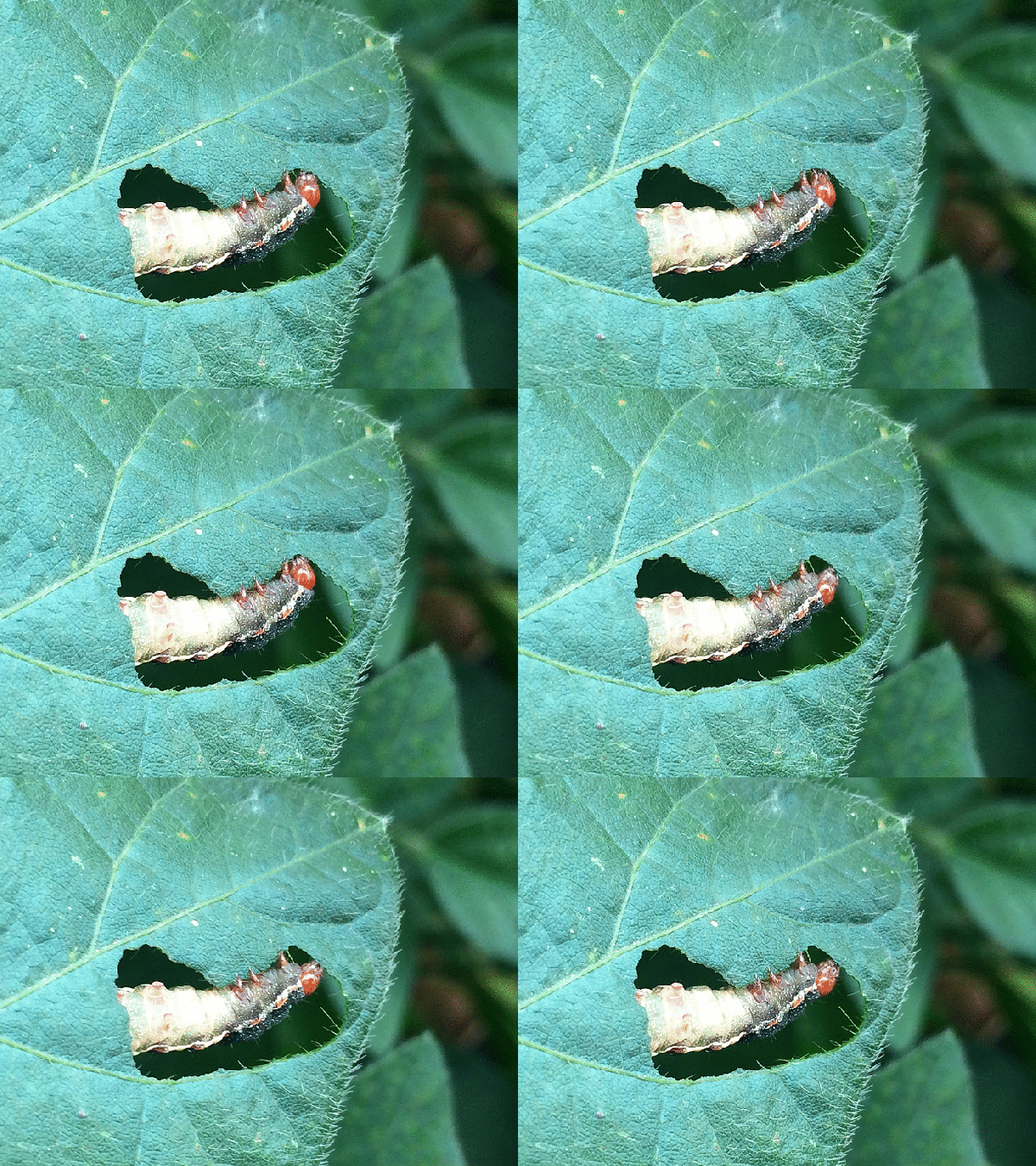
Geometrid larva (subfamily Ennominae?) | Plymouth, North Carolina

Geometrid larva (subfamily Ennominae?) | Plymouth, North Carolina

In September I visited soybean field trials across the southeastern U.S. It’s a trip I’ve done every year for the past I don’t know how many years and one that I enjoy immensely due to the opportunities it gives me to see the country, kick the dirt with academic cooperators, sample the local cuisine… and photograph insects. New for me this year was the Carolinas, and in a soybean field in Plymouth, North Carolina I encountered this geometrid larva on the stub of a soybean leaf petiole. Geometrid larvae are known variously as inchworms, cankerworms, spanworms, measuring worms, loopers, etc., depending on the species. Most of the common names refer to the same thing that the family name does—the larval method of locomotion whereby the caterpillar—possessing legs only at the two extremes of its body—”inches” its way along as if measuring the ground it walks on (Geometridae is derived from the Latin geometra, or “earth-measurer”). The resemblance of the larvae of many species to dead twig stumps is nothing short of remarkable, and had it not been for the contrasting coloration I may never have noticed the larva in the first place. I also did not notice until looking at it through the macro lens of my camera the tether attached by the larva to the tip of the twig—invisible to the naked eye but providing energy-saving stabilization for the larva to hold its cryptic position.

I’ve not encountered a geometrid larva in soybeans before, and my impression has been that they are largely deciduous tree feeders (perhaps due to the periodic occurrence in my area of outbreak species such as fall cankerworm). In trying to determine the species, I found no geometrids covered in the Higley & Boethel (1994) handbook on U.S. pests, and when I consulted the Turnipseed & Kogan (1976) and Kogan (1987) global reviews of soybean pests I found reference only to a few minor pests in India and southeast Asia. Hmm, time for BugGuide. Of course, lepidopteran larvae are not nearly as well represented as the adults, but it seemed most similar to species of the subfamily Ennominae, so I turned to Google and searched on “Ennominae soybean.” This turned up Passoa (1983), who reported larvae of Anacamptodes herse as pests of soybean in Honduras (and mentioned references to several other geometrid species associated with soybean in Brazil). Back to BugGuide, where I found the genus Anacamptodes listed as a synonym of Iridopsis, but the species I. herse was not among the list of species represented in the guide. Checking the link provided at the site to a revision of the genus by Rindge (1966) revealed that I. herse is strictly a Central American species. Perhaps another, North American species of the genus also favors soybean, which led me to Wagner (2005) who mentions soybean as a favored food plant for I. humilis. However, the contrasting purple-brown/yellow-green coloration and relatively thickened body of that species are quite unlike this individual. I don’t have Wagner’s book (only his smaller one on caterpillars of eastern forests—no match in there, either), so it may be that my only remaining option is to post the photo at BugGuide and hope that David Wagner encounters it (actually I should get David’s book anyway)¹.

¹ Update 10/5/13 11:30 am CDT—or hope that Brigette Zacharczenko runs into the post via Facebook and offers to pass it along to Dave during their lab meeting on Monday.

REFERENCES:

Higley, L. G. & D. J. Boethel [eds.]. 1994. Handbook of Soybean Insect Pests. The Entomological Society of America, Lanham, Maryland, 136 pp. [sample pages].

Kogan, M. 1987. Ecology and management of soybean arthropods. Annual Review of Entomology 32:507–538 [pdf].

Passoa, S. 1983. Immature stages of Anacamptodes herse (Schaus) (Geometridae) on soybean in Honduras. Journal of The Lepidopterists’ Society 37(3):217–223 [pdf].

Rindge, F. H. 1966. A revision of the moth genus Anacamptodes (Lepidoptera, Geometridae) (1966). Bulletin of the America Museum of Natural History 132(3):174–244 [pdf].

Turnipseed, S. G. & M. Kogan. 1976. Soybean entomology. Annual Review of Entomology 21:247–282 [pdf].

Wagner, D. L. 2005. Caterpillars of Eastern North America: A Guide to Identification and Natural History . Princeton University Press, Princeton, New Jersey, 496 pp. [Google eBook].

Copyright © Ted C. MacRae 2013

Bollworms rising!

One of the most pernicious pests that U.S. farmers have battled is the larval stage of Helicoverpa zea (Lepidoptera: Noctuidae). This insect is destructive enough to have earned not just one official common name, but four (corn earworm, cotton bollworm, soybean podworm, and tomato fruitworm)—one for each of the crops in which it has attained major pest status. It isn’t only North American farmers, however, that must deal with this pest, but South American farmers as well. For many decades, corn and cotton have been its most important hosts in North America, but in recent years its importance has increased steadily in soybean as well, particularly across the mid-south. In South America, however, it seems satisfied—curiously—to confine its attacks to corn. Lest you think that South American farmers are getting off easy, there are other species of Helicoverpa in South America that are causing problems of their own. Perhaps the most troubling one is H. armigera, the Old World bollworm¹—a sister species to H. zea (Goldsmith & Marec 2010) native to Africa, Asia, and Australia and just as polyphagous as H. zea that was recently found infesting corn, cotton, soybean, and other crops in several areas of Brazil.

¹ Interestingly, in the Old World this species is called the “American bollworm,” despite the fact that it did not come from the Americas at all. I guess neither hemisphere wants to take the blame for this species.

Helicoverpa gelotopeon (South American bollworm) | Buenos Aires Province, Argentina

Helicoverpa gelotopeon (South American bollworm) | Buenos Aires Province, Argentina

While we wait to see what impact H. armigera ends up having in South America, another species of the genus is quietly rising from the ranks of secondary to primary pest further south on the continent. For many years, Helicoverpa gelotopeon (or South American bollworm) has been a sometimes pest of cotton and other crops in Argentina, Chile and Uruguay (Evangelina et al. 2012), but in a situation that mirrors the rise of H. zea on soybean in North America, the incidence of H. gelotopeon has grown during the past few years in the more southern soybean growing areas of South America as well. Like its North American counterpart, this insect causes not only indirect damage by feeding on the foliage of the plant during vegetative stages of growth (reducing photosynthetic capacity of the plant), but also direct damage by feeding on the developing pods during reproductive stages of growth. Predictably (and regrettably), farmers have responded by increasing applications of organophosphate insecticides, but the efficacy of these products—despite their relatively high toxicity—has often been inadequate to prevent yield losses. As a result, other management techniques and technologies will be required to keep this insect from having a major impact on soybean production in the temperate regions of Argentina.

Young larvae feed on foliage (note the very small caterpillar in the lower center area of the leaf).

Young larvae feed on foliage (note the very small caterpillar in lower left area of the leaf).

A mid-instar larvae feeding on soybean foliage.

A mid-instar larvae feeds on soybean foliage and exhibits the black pinacula characteristic of the subfamily.

Larger larvae feed on developing pods, breaching the wall of the pod to consume the seeds within.

Larger larvae feed on developing pods, breaching the wall of the pod to consume the seeds within.

Adults are slightly smaller than H. zea and a little darker with somewhat bolder markings.

The photographs in this post may well be the best—and perhaps even the only ones—available of this species. A Google image search turned up nothing, and have I been unable to find any literature with photographs of either the adults or the larvae and their damage. If you are aware of any please leave a comment with the citation.

REFERENCES:

Goldsmith, M. R. & Marec, F. 2010. Molecular Biology and Genetics of the Lepidoptera. CRC Press, Boca Raton, Florida, 368 pp.

Evangelina, P., F. Crepo & J. C. Gamundi. 2012. Evaluación del daño simulado de “oruga bolillera” Helicoverpa gelotopoeon (Dyar) en estados vegetativos del cultivo de soja. Unpublished report, Instituto Nacional de Tecnología Agropecuaria (INTA), 6 pp.

Copyright © Ted C. MacRae 2013