Bollworms rising!

One of the most pernicious pests that U.S. farmers have battled is the larval stage of Helicoverpa zea (Lepidoptera: Noctuidae). This insect is destructive enough to have earned not just one official common name, but four (corn earworm, cotton bollworm, soybean podworm, and tomato fruitworm)—one for each of the crops in which it has attained major pest status. It isn’t only North American farmers, however, that must deal with this pest, but South American farmers as well. For many decades, corn and cotton have been its most important hosts in North America, but in recent years its importance has increased steadily in soybean as well, particularly across the mid-south. In South America, however, it seems satisfied—curiously—to confine its attacks to corn. Lest you think that South American farmers are getting off easy, there are other species of Helicoverpa in South America that are causing problems of their own. Perhaps the most troubling one is H. armigera, the Old World bollworm¹—a sister species to H. zea (Goldsmith & Marec 2010) native to Africa, Asia, and Australia and just as polyphagous as H. zea that was recently found infesting corn, cotton, soybean, and other crops in several areas of Brazil.

¹ Interestingly, in the Old World this species is called the “American bollworm,” despite the fact that it did not come from the Americas at all. I guess neither hemisphere wants to take the blame for this species.

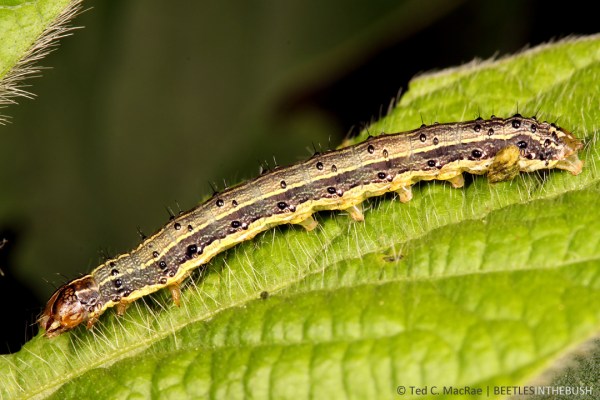
Helicoverpa gelotopeon (South American bollworm) | Buenos Aires Province, Argentina

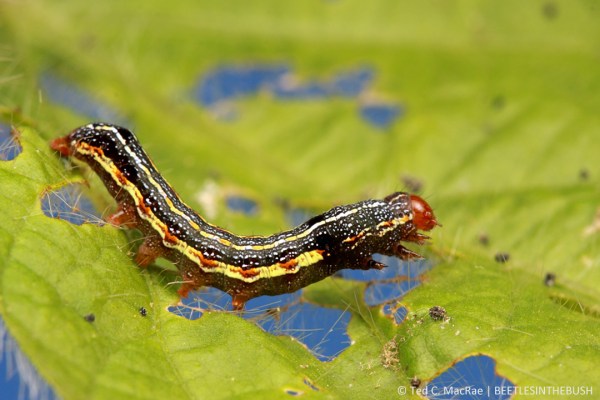
Helicoverpa gelotopeon (South American bollworm) | Buenos Aires Province, Argentina

While we wait to see what impact H. armigera ends up having in South America, another species of the genus is quietly rising from the ranks of secondary to primary pest further south on the continent. For many years, Helicoverpa gelotopeon (or South American bollworm) has been a sometimes pest of cotton and other crops in Argentina, Chile and Uruguay (Evangelina et al. 2012), but in a situation that mirrors the rise of H. zea on soybean in North America, the incidence of H. gelotopeon has grown during the past few years in the more southern soybean growing areas of South America as well. Like its North American counterpart, this insect causes not only indirect damage by feeding on the foliage of the plant during vegetative stages of growth (reducing photosynthetic capacity of the plant), but also direct damage by feeding on the developing pods during reproductive stages of growth. Predictably (and regrettably), farmers have responded by increasing applications of organophosphate insecticides, but the efficacy of these products—despite their relatively high toxicity—has often been inadequate to prevent yield losses. As a result, other management techniques and technologies will be required to keep this insect from having a major impact on soybean production in the temperate regions of Argentina.

Young larvae feed on foliage (note the very small caterpillar in the lower center area of the leaf).

Young larvae feed on foliage (note the very small caterpillar in lower left area of the leaf).

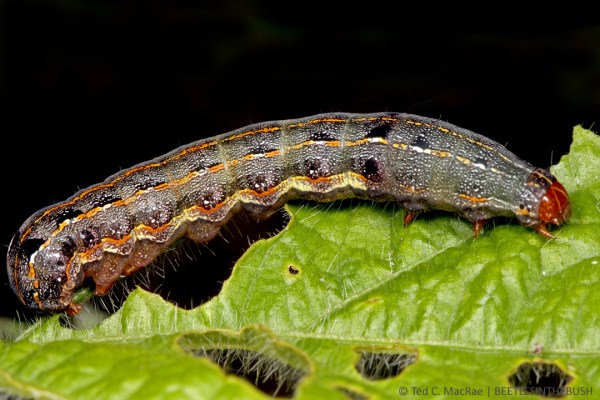
A mid-instar larvae feeding on soybean foliage.

A mid-instar larvae feeds on soybean foliage and exhibits the black pinacula characteristic of the subfamily.

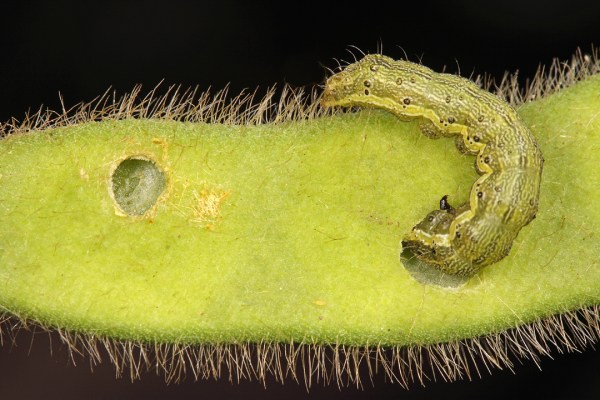
Larger larvae feed on developing pods, breaching the wall of the pod to consume the seeds within.

Larger larvae feed on developing pods, breaching the wall of the pod to consume the seeds within.

Adults are slightly smaller than H. zea and a little darker with somewhat bolder markings.

The photographs in this post may well be the best—and perhaps even the only ones—available of this species. A Google image search turned up nothing, and have I been unable to find any literature with photographs of either the adults or the larvae and their damage. If you are aware of any please leave a comment with the citation.

REFERENCES:

Goldsmith, M. R. & Marec, F. 2010. Molecular Biology and Genetics of the Lepidoptera. CRC Press, Boca Raton, Florida, 368 pp.

Evangelina, P., F. Crepo & J. C. Gamundi. 2012. Evaluación del daño simulado de “oruga bolillera” Helicoverpa gelotopoeon (Dyar) en estados vegetativos del cultivo de soja. Unpublished report, Instituto Nacional de Tecnología Agropecuaria (INTA), 6 pp.

Copyright © Ted C. MacRae 2013

Best of BitB 2012

Welcome to the 5th Annual “Best of BitB”, where I pick my favorite photographs from the past year. 2012 was one of the most intensive travel years I’ve ever had—I spent 8 weeks in Argentina from February through April, made separate trips to Puerto Rico and Arkansas in May (bracketing a personal week in California), traveled almost weekly to Illinois and Tennessee from June to September (interrupted by a personal week in Florida in July), toured the southeastern U.S. (Arkansas, Louisiana, Mississippi and Georgia—great food!) in early September, chased tiger beetles in Oklahoma, Texas and Arkansas in late September, went back to Argentina for a week in October, and capped off the travel year by attending the Entomological Society of America Annual Meetings in Knoxville, Tennessee (for the first time in more than 10 years!)—whew! While many would cringe at such a travel load, I am among the lucky few who actually get paid for doing something that is also my hobby—entomology! This gives me ample opportunity to further hone my photography skills (nine of the 13 photos I’ve selected below were actually taken while I was on business travel), resulting in two key accomplishments this year—my first ever photography talk at the ESA’s insect photography symposium and my first commercial sales (look for the BitB commercial site to go online in 2013).

Enough blather! Here are my favorite BitB photographs from 2012. Click the link in the text below the photo to see the original post. I would greatly appreciate knowing if you have a favorite (and why)—your feedback will be enormously helpful to me as I continue to learn and develop as a photographer.  For those interested, here are my previous year picks for 2008, 2009, 2010 and 2011. And, as always, thank you for your readership!
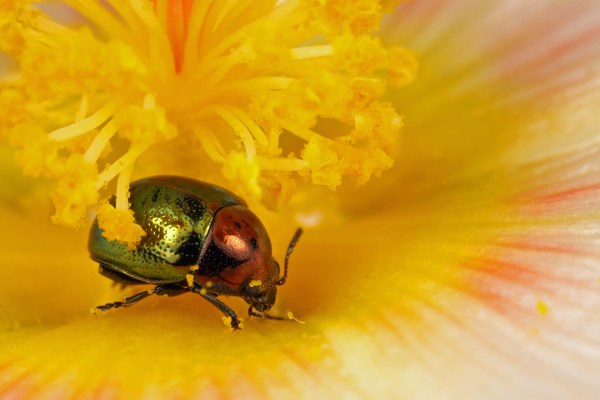

Spintherophyta (?) sp. in flower of Abutilon pauciflorum | Buenos Aires, Argentina

From  (posted 2 Feb). One of my 2012 learnings was that sometimes a photograph that is not so close is more effective than one that is as close as possible. In one of my earlier attempts at “not-so-close” macrophotgraphy, the soft colors of the flower compliment the brash shininess of the tiny leaf beetle that has been feeding on its pollen. Pink lines lead the eye directly to the subject and create a pleasing composition, and pollen grains stuck to the beetle—a distraction in some situations—add to the miniature natural history story of the photo.


Apiomerus flavipennis with stink bug prey and kleptoparasitic flies | Chaco Province, Argentina

From  (posted 11 Mar). I selected this photo solely for the complex natural history story drama it shows—stink bug (Piezodorus guildenii) feeding on soybean becomes prey of an assassin bug (Apiomerus flavipennis), with volatiles from the chemicals it emitted in a vain attempt to defend itself serving as cues to kleptoparasitic flies (families Milichiidae and Chloropidae) that benefit from the assassin bug’s labors.


Planthopper nymph | Buenos Aires Province, Argentina

From  (posted 26 Mar). Another learning that I began putting into practice in 2012 was the use of low perspective for compositional impact. The cryptic coloration of this planthopper nymph (family Fulgoridae) made it almost invisible on the branch on which it was sitting when viewed from a normal “top-down” human perspective. Getting “down under” it, however, brought the nymph to life and emphasized its unusual form.
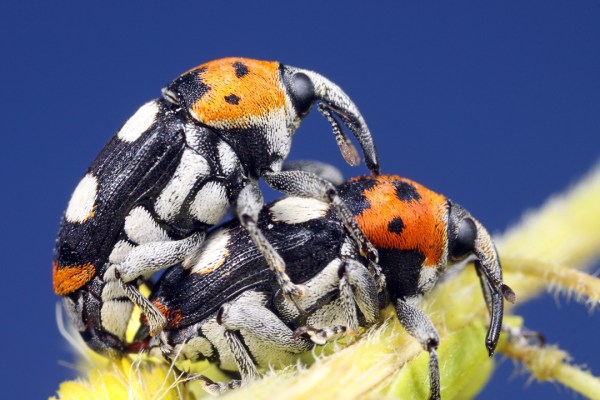

Megabaris quadriguttatus | Corrientes Province, Argentina

From  (posted 12 Apr). I spent much of 2012 working on the “blue sky background” technique, with these weevils from northern Argentina representing one of my better attempts. Macrophotography of insects with a blue sky background involves setting exposure, ISO, and aperture to achieve two separate exposures—full flash illumination of the subject for maximum depth-of-field, and ambient light from the sky to create a clean, uncluttered, natural-looking background. In this shot I managed to achieve an almost ideal shade of blue to compliment the wild black, white and red colors of the beetles. (My one criticism of the photo is having clipped one of the beetle’s feet.)


Bombylius sp. cf. mexicanus | Scott Co., Missouri

From  (posted 16 May). This photo is unusual if nothing else. Focus, lighting, depth-of-field, and composition are all better than can be hoped for in a single shot, but the subject—perfectly alive—is in a most unusual position. Read the original post to find out how this happened.


Perisphaerus sp. (a pill roach) | Vietnam (captive individual)

From  (posted 27 May). White-box photography is an excellent technique for clean, uncluttered photographs of insects, but it also isolates them from their natural surroundings and limits their natural history appeal. The best white-box photos are those that highlight a key feature or behavior of the subject—in this case a pill roach’s comically conglobulating defensive posture.


Micronaspis floridana (Florida intertidal firefly) larva | Pinellas Co., Florida

From  (posted 31 July). Here is another photo whose back story played a big part in its selection. This firefly larva not only represents a rare Florida-endemic species but was also first seen by my then 12-year old nephew, who willingly accompanied me through a dark, spooky salt marsh in the middle of a humid Florida night to see what he could learn. The lesson here for budding natural historians (and old-timers like me) cannot be overstated!


Arctosa littoralis (beach wolf spider) | Lewis Co., Missouri

From  (posted 23 Aug—prelude to  posted 28 Aug). Those who follow this blog know of my obsession with close-up portraits, and while tiger beetles are the subjects I most commonly photograph in this manner, I am always on the lookout for good subjects in other taxa. This wolf spider “face” almost looks human, with “two” eyes, two “nostrils” and a shiny upper lip above huge (albeit hairy) buck teeth! It’s enough fill-the-frame spidery goodness to melt (or explode) the heart of even the most ardent arachnophobe!
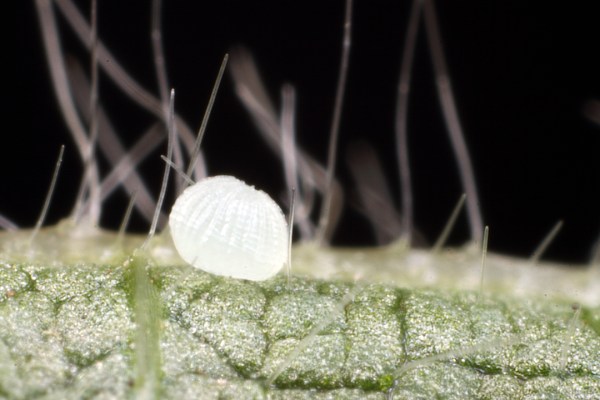

Anticarsia gemmatalis (velvetbean caterpillar) egg on soybean leaf

From Life at 8X—Guide to lepidopteran eggs on soybean (posted 3 Sep). “Life at 8X” was a new series I introduced this year, featuring insects photographed at magnifications testing the upper limit of my equipment and photographic skills. Diffraction is the chief difficulty with magnifications as high as this and is the primary flaw in the above photograph. Nevertheless, such view of a moth egg on the underside of a soybean leaf provides a spectacular view of the otherwise unseen micro-world that lives right beneath our noses.


Megacyllene decora (amorpha borer) on snakeroot flowers | Mississippi Co., Missouri

From  (posted 12 Sep). This second example of “blue sky background” was taken later in the year and was considerably more difficult to capture than the first because of the larger size of the subject and resulting need for a longer focal length macro lens. Getting a well-lit, focused, and composed image with a desirable shade of blue in the background depended not only on finding the proper camera settings, but also secure body and camera bracing techniques for this completely hand-held shot.


Cicindelidia politula politula (Limestone Tiger Beetle) | Montague Co., Texas

From  (posted 28 Sep). I will go ahead and say it—this is my favorite photograph of 2012. As discussed under the first entry, panning back from the subject can allow for some very interesting compositions. This photo combines charismatic pose by a wary subject with panning back and low perspective to create an image that scores high in both natural history and aesthetic appeal.


Calosoma sayi (black caterpillar hunter) | New Madrid Co., Missouri

From Black is beautiful! (posted 7 Nov). Of course, close-as-possible can also be used to create striking photos, especially if the subject exhibits features that are best seen up close. Anything with jaws fits the bill in my book, and highlighting the mandibular sculpturing of this caterpillar hunter (a type of ground beetle) required precise angling of the flash heads for maximum effect.


Cicindela repanda (Bronze Tiger Beetle) | St. Louis Co., Missouri

From  (12 Nov). This final selection is not a rare species, but it is as close as I have come to what I consider the “perfect” tiger beetle macrophotograph—a close, low angle, lateral profile of an adult in full-stilt posture (a thermoregulatory behavior), well lit, perfectly focused, and with a dynamic but pleasingly blurred background. It’s a perfect storm of a photo that took the better part of two hours to achieve—rarely do all of these elements come together in a hand-held photograph of an unconfined tiger beetle in its native habitat.


Well, there you have it. I hope you’ve enjoyed my selections, and again please do let me know if you have a personal favorite. See you in 2013!

Copyright © Ted C. MacRae 2012

Dainty, delicate, little fairies

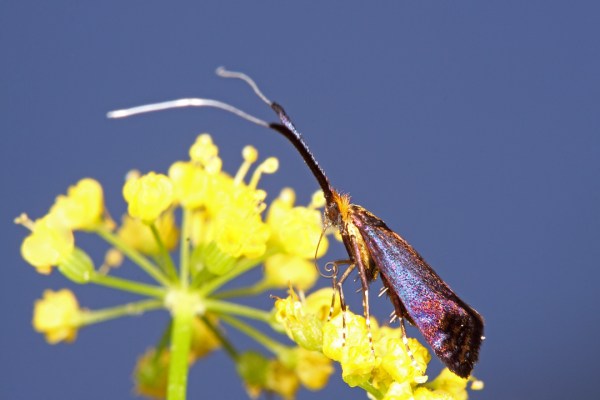
Adela caeruleella | Wayne Co., Missouri

Ever since I saw Chris Grinter’s beautiful photographs, I have wanted to see (and possibly photograph) the tiny little moths known as fairy moths (family Adelidae, formerly considered a subfamily of Incurvariidae). These dainty, delicate, little moths are characterized by their unusually long antennae—especially the males, which can have their antennae up to three times the length of the forewings. This past April I got my wish as my father and I hiked the Shut-ins Trail at Sam A. Baker State Park in Missouri’s southeastern Ozark Highlands.

Females have the antennae ”only” twice as long as the forewings…

Chris was fortunate to see a number of individuals representing at least two species, presumably all males (based on the extraordinary length of their antennae) that were engaged in some rather interesting territorial behaviors. I, on the other hand, saw only this single individual (presumably a female) who seemed content enough to calmly nectar the golden Alexander, Zizia aurea (Apiaceae), flowers on which I found it. This was fine by me, as the dense woodland setting where I saw it wasn’t very conducive to photographing the moth. I wanted a clean, bright background to highlight the moths dark metallic luster, so I snipped the flower (carefully!) on which the moth was nectaring and held it up to the small patch of bright blue sky visible from the trail to take these photos.

…and the basal half distinctly thickened.

I presume this individual represents the species Adela caerueleella based on comparison with online photos. According to Powell (1969) this species is widespread across the eastern U.S. and has been recorded on flowers of American bittersweet, Celastrus scandens (Celastraceae). Microleps.org notes the species is most frequently found along deciduous forest trails and shows a preference for flowers of black snakeroot, Sanicula marilandica (Apiaceae). My late April observation is consistent with the April and May activity period noted by Powell (1969) and late May period for central Illinois noted by Microleps.org.

REFERENCE:

Powell, J. A. 1969. A synopsis of Nearctic adelid moths, with descriptions of new species (Incurvariidae). Journal of the Lepidopterists’ Society 23:211–240.

Copyright © Ted C. MacRae 2012

It’s a Mayfly…It’s a Moth…It’s Thyridopteryx

Mississippi River @ Hwy 62 bridge

One of the nice things about the study of insects is the endless opportunity for discovery. It could be a new species, or it might just be something already known but not yet seen personally. I’ve been collecting insects most of my life, and although much of it has been done in far away places the bulk has occurred in my home state of Missouri. Despite my long experience in this state, this past summer I had the opportunity to experience collecting within the state in a way that I’ve not yet done before—blacklighting up and down the length of the Mississippi River regularly during the months of July through September. Each time, I would arrive at the selected spot in the early evening while there was still daylight and search the (hopefully sandy) beaches for evidence of several tiger beetle species that might occur in such habitat. Then, as the sky turned aglow from the setting sun, I would setup the blacklights and wait for the appearance of those particular tiger beetles that are attracted to such.

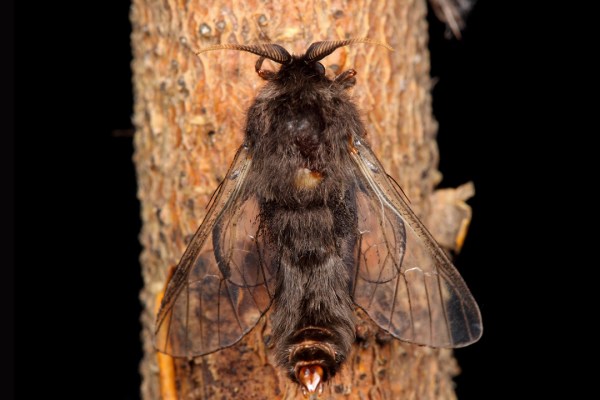
Thyridopteryx ephemeraeformis | Mississippi Co., Missouri

Expectedly, beetles were seen at only some sites, and numbers and diversity generally decreased as summer approached its end. By early September beetles were no longer showing up even though the habitat seemed good (I guess that’s why they call them “summer” species). Still, on this particular night, the lights setup at the Hwy 62 bridge in far southeastern Missouri were attracting a variety of other insects, so I kept them on to see what might come in. I had nothing else to do. At some point, I noticed a strange insect that seemed like a cross between a mayfly and a moth, and then another…and another. Although I had never seen one of these in person before, I knew exactly what they were—male bagworms! Bagworms (order Lepidoptera, family Psychidae), of course, are extraordinarily common in Missouri, and the sight of dozens or even hundreds of their silken/twig bags attached to ornamental evergreen shrubs in the neighborhood where I lived as a kid remains vivid. I can remember “popping” the larvae inside to see their innards ooze out from the tip of the bag (I know—I’m not proud of it) and even cut open a few of the bags to see the larvae inside (that is, once the less sadistic and more scientifically curious side of me took over). Despite all of this, I had never seen an adult bagworm—male or female—until this night.

Dorsal view

Obviously, these are males because they have wings—females remain wingless into adulthood and, in fact, never even leave the bag in which they’ve spent their entire lives. Bagworm males are distinctive in that their wings are virtually devoid of any scales, and I surmise that the generic name of the most common species in eastern North America—Thyridopteryx ephemeraeformis—is derived from the Greek thyris (window) and the Latin ptera (wing) in reference to this. I was fascinated by the strange appearance of these moths and even more fascinated by the curious manner in which the males held out the tip of their abdomen when at rest; reminiscent of a female releasing sex pheromone. This can’t be true, because it is the females that call from their bags to attract the males, and since the females remain within their bag, the male must insert his abdomen through the tip of the bag and all the way to the top where he can reach the female genital opening. Thus, the male abdomen is highly extensible and prehensile—I guess the males can’t keep an abdomen with that much stretching capacity still for very long.

Two males

Based on gestalt, I presumed these represented T. ephemeraeformis since it is such a common and widespread species, but it’s not always wise to presume, especially in a relatively more southern location. The Moth Photographers Group lists five species in this genus in North America, two of which (T. alcora and T. meadii) seem to be southwestern in distribution. Of the remaining three, T. ephaemeraeformis is the only one I could find any photos or information beyond simple listings (the Moth Photographers Group lists no distribution records for T. rileyi or T. davidsoni), so I asked my lepidopterist friend Phil Koenig for his opinion. Phil informed me that T. ephemeraeformis has been recorded in Missouri 285 times in 49 counties, while T. rileyi is known from the state based only very old literature records and T. davidsoni not at all. Thus, the odds are definitely favor these males representing T. ephemeraeformis. Late summer is apparently the prime period of adult bagworm activity. I’ve not done much blacklighting late in the season because most of the beetles on which I’ve focused over the years and that are attracted to blacklights are active more during spring and early summer. This could explain why I’ve not until now seen male bagworms despite their commonness in Missouri.

Copyright © Ted C. MacRae 2012
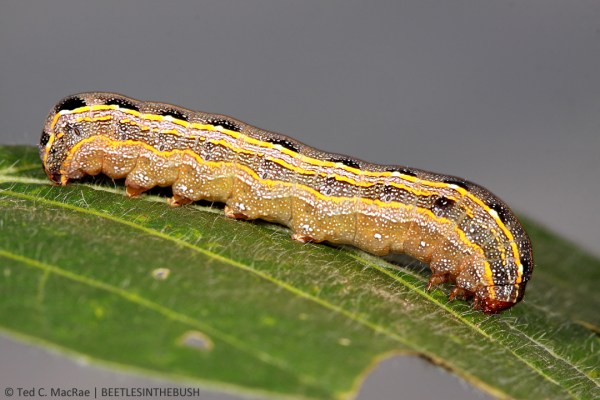
Gulf Fritillary in southern Missouri

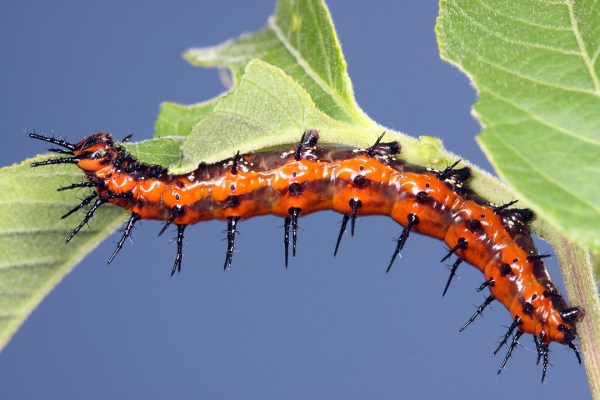
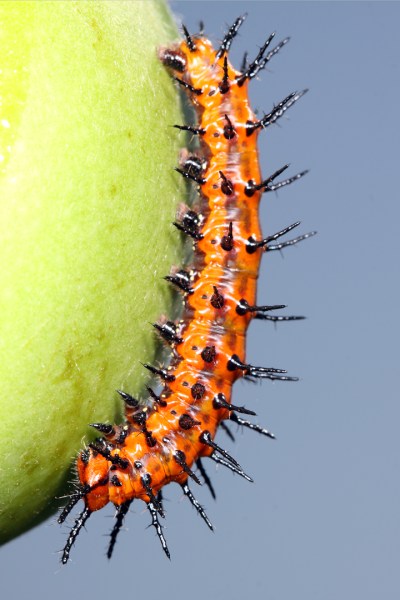
Gulf Fritillary (Agraulis vanillae) | Mississippi Co., Missouri

I’m not sure, but I think this might be the first time I’ve photographed a butterfly caterpillar. Not a bad subject to start with, as few butterflies have caterpillars that are more colorful than the Gulf Fritillary, Agraulis vanillae. A common resident in the southern states and further south, this member of the nymphalid subfamily Heliconiinae is less commonly encountered in Missouri—in fact, I had never seen (or at least noticed) these caterpillars before encountering a few feeding hungrily on the foliage of maypop (Passiflora incarnata) growing in a city park in Missouri’s southeastern lowlands. While the stunning colors of these caterpillars are a delight to human eyes, their function, as in most butterfly caterpillars, is to advertise the unpalatability of their toxin-laced bodies. In the case of this species, the toxins include cyanogenic glycosides that the larvae sequester from the tissues of their host plants (ironically these compounds are supposed to serve the same protective function for the plant that produces them, but butterflies have become master specialists at evolving mechanisms to sidestep toxic impacts).

According to my friends Richard & Joan Heitzman, long-time students of Missouri Lepidoptera, this species is a sporadic migrant that occasionally forms summer colonies in Missouri, especially in the western half of the state, until the first hard freeze destroys the colony (Heitzman & Heitzman 1987).

REFERENCE:

Heitzman, J. R. & J. E. Heitzman. 1987. Butterflies and Moths of Missouri. Missouri Department of Conservation, Jefferson City, 385 pp.

Copyright © Ted C. MacRae 2012
Frustrating Emerald

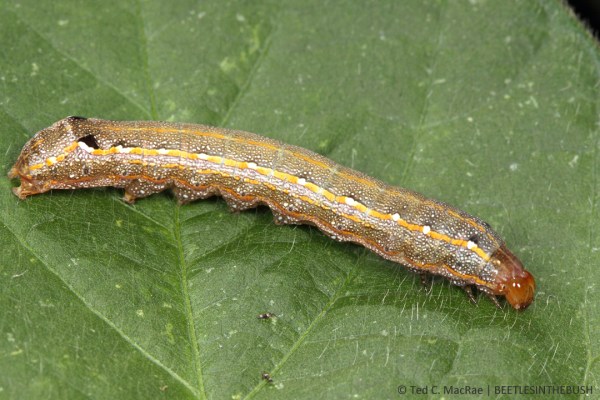
After years in the field looking for insects, one develops an eye not only for recognizing insects but also recognizing when something doesn’t look quite right. That happened to me early this past September at a spot along the Mississippi River in southeast Missouri where I had stopped during late afternoon to look for diurnal species of tiger beetles and then man a blacklight in the evening for nocturnal ones. It was still daylight as I walked along the edge of rank growth bordering the upper banks when a small, reddish “cluster” on a seed head in a stand of tall grasses caught my eye. I didn’t know what it was when I saw it, but I knew it was something ‘out of place.’ My first, cursory thought was that somehow the spent anthers of the now-seeding grass had gotten caught in a tangle, but I must have still had doubts because I looked closer anyway. Just then the “cluster” moved, and I then recognized what I was dealing with—an Emerald moth (Synchlora sp.) caterpillar. Caterpillars in this genus are remarkable for their habit of adorning their bodies with bits of the plants upon which they feed. I am, however, a beetle man and thus admit to being completely unaware of their existence until last summer when Alex Wild featured one of these as a Monday Night Mystery. I wondered then, “Why haven’t I seen one of these before?”, and now I know why—because they are extremely well camouflaged!

Synchlora sp. | Mississippi Co., Missouri

Realizing what I had, all efforts to look for tiger beetles were suspended (I hadn’t seen anything after ~30 minutes of looking anyway), and I broke out the 65mm lens to get the most of this small but remarkable looking insect. I took more than 50 shots, trying different backgrounds, angling the grass stem in different positions, and hoping with each shot that I had captured the larva in full profile, completely in focus, and in the midst of that magical loop. I was sure I had that “perfect” shot when I got home and anxiously fired up the computer to get a better look at the photos. My optimism began to drop, however, as I scanned through each successive photo and continued to not encounter that one photo that would cause me to say “Yes!” Exposure? Check. Composition? Check. Lighting? Check. Focus? Er… crap! The problem was pervasive throughout the entire set, and in the end, I have only this one photo that comes anywhere close to what I had envisioned while I was taking the photos. It’s a shame, because I love everything else about this photo. The cause of the problem is the very thing that makes the larva so remarkable—its adornments. The spent anthers project off the larva in all directions, adding considerable dimensionality to the subject and surpassing the depth-of-field capabilities of my lens. If the subject was in focus the forward projecting anthers were not, and if the anthers were in focus the subject was not. If I had realized in the field what was going on, I would have not gotten in so tight and cropped as appropriate during post-processing. Live and learn!

Although 12 species of Synchlora are found in North America, only one—Synchlora aerata (Wavy-lined Emerald)—is widespread in the eastern U.S. However, a number of other species are found in the southeastern U.S., and for all intents and purposes the Mississippi Lowlands of southeastern Missouri  are the south (culturally as well as biogeographically!). As a result, a generic ID is the best that can be done for this larva.

Copyright © Ted C. MacRae 2012

Wasp Wednesday—Not!

In early September, the agricultural landscape in the central U.S. awakens from its monotonous cloak of summer green and turns ablaze with a hundred shades of yellow, gold, and tawny. The “fall composites” as they are commonly called, a dazzling diversity of mostly yellow-flowered herbaceous plants in the family Asteraceae, are one of the chief contributors to this explosion of color, and among them none contribute more than goldenrod (Solidago sp.). Occupying nearly every fence row, drainage ditch, and fallow field, the bright yellow fronds of tiny flowers are not only pleasing to the eyes of humans, but a smorgasbord of pollen for all manner of flower-feeding insects. Bees, flies, wasps, beetles, and moths all flock to the bounty in numbers rarely seen during the dog days of summer. Spiders, ambush bugs, mantids, and other predators take up residence amongst the flowers as well—not to feed on the flowers, but rather the abundance of flower-feeding insects upon which they will prey. It is rare to find a goldenrod plant without at least a few insects upon it.

Synanthedon decipiens (oak gall borer) on Solidago sp. | Mississippi Co., Missouri

My favorite goldenrod insects are, of course, the longhorned beetles of the genus Megacyllene, and at least here in Missouri there are none finer than Megacyllene decora (see A classic fall ‘bycid). However, I keep an eye out for other insects as well, and when I first saw this “wasp” sitting on a flower head I had to do a bit of a double take—”something” just didn’t seem quite right about it. A little lean forward was all that was needed to confirm that this was indeed no wasp, but rather a clearwing moth (order Lepidoptera, family Sesiidae)¹. To my mind, of the many insects that try to mimic wasps, none do so more effectively than members of this family. From the elongate body to the yellow abdominal banding and narrow transparent wings, everything about this moth says “wasp”—well, almost everything or I wouldn’t have done a double take to begin with.

¹ I hope Eric Eaton, author of Bug Eric and its Wasp Wednesday series, will forgive my use of his title for this post.

Apparently a male, these moths use pheromones to locate females for mating.

I actually did a fair bit of work with this group in my early years with the Department of Agriculture. Females of most (all?) species emit species-specific pheromone blends that males can detect at incredibly low volumes (only a few molecules are needed to elicit a response by the male antenna). Components of these pheromones have been synthesized, and since a number of species have economic importance in landscape and nursery settings (larvae of most species are borers of woody or perennial plants), these synthetic pheromone blends are commonly employed in traps for survey and detection (e.g., Snow et al. 1985). I conducted surveys for several years during the mid 1980’s in east-central Missouri using these traps and, thus, developed a good eye for distinguishing these moths in flight from the wasps that they so effectively mimic. In fact, I used to keep a pheromone tag on my waist bag, which resulted in male moths frequently flying up to me and “searching” for the female. I never tired of seeing the faces of nursery growers—first showing concern as they were convinced I was under attack by a wasp, and then shock as I calmly reached out and grabbed the “wasp” in mid-flight with my bare hand! (And to be perfectly honest, it took me a while before I could bring myself to start grabbing them out of the air!) I even had one nursery grower continue insisting it was a wasp and could sting even after I had caught it (“Naw, them things sting—I seen ’em!)

The moth in these photos seems to best match Synanthdedon decipiens, widely distributed east of the Rockies and inhabiting the woody galls of cynipid wasps on oaks. In Georgia adults of this species exhibit a bimodal pattern of seasonal occurrence suggestive of two generations per year (Snow et al. 1985), so this September-occurring male might represent a second Missouri generation as well.

REFERENCES:

Snow, J. W., T. D. Eichlin & J. H. Tumlinson. 1985. Seasonal captures of clearwing moths (Sesiidae) in traps baited with various formulations of 3,13-0ctadecadienyl acetate and alcohol. Journal of Agricultural Research 2(1):73–84.

Copyright © Ted C. MacRae 2012
Inchworm, Inchworm, Oh So Small

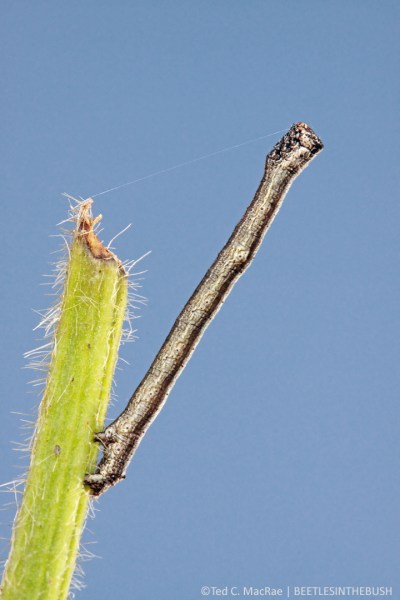
Soybean looper (Chrysodeixis includens) | 3rd-instar larva

Okay, I know this is not a real “inchworm” (generally restricted to caterpillars in the family Geometridae), but this young larva of a soybean looper (Chrysodeixis includens, family Noctuidae) is just too cute to not have an equally cute name. I believe it is an early 3rd instar, based on its small size (~7mm in length), lightly colored head capsule, and distinct bristles around the head and on the body—1st instars have a black head capsule, while 2nd instars have a light brown head capsule, and in both the bristles on the body are smaller and not as distinct.

This larva hatched from an egg laid on soybean by a laboratory-reared adult.

Copyright © Ted C. MacRae 2012