Josef Knull was wrong!

A few weeks ago I received an email from Kyle Schnepp, an entomology student at Purdue University.  Kyle has taken on the rather ambitious project of developing an illustrated key to the Buprestidae of eastern North America, for which he has been spending the past year acquiring material for photographs.

During his examination of specimens in the Field Museum of Natural History, Kyle came across two examples of an extraordinarily rare species of Buprestidae, Agrilus audax Horn.  Although described more than 100 years ago from specimens collected in Texas (Horn 1891), few records have been published in the years since.  Chamberlin (1926) reported the species also from Arizona and Illinois but without further details, causing Fisher (1928), in his revision of the genus (woefully out-of-date now, but still the only comprehensive resource for identifying the North American species), to regard at least the Illinois record as probably erroneous (common for many of Chamberlin’s records).  The first undisputed report of this species from outside of Texas was by Josef Knull (1934), who reported the species emerging from living, wind-thrown branches of slippery elm (Ulmus rubra) collected in western Missouri.  More than half a century would pass before the species would turn up again – first in Oklahoma (Nelson and MacRae 1990) and twice again in Missouri through the efforts of Gayle Nelson and myself (MacRae 1991, MacRae and Nelson 2003). All but one of these specimens were beaten from bur oak (Quercus macrocarpa).
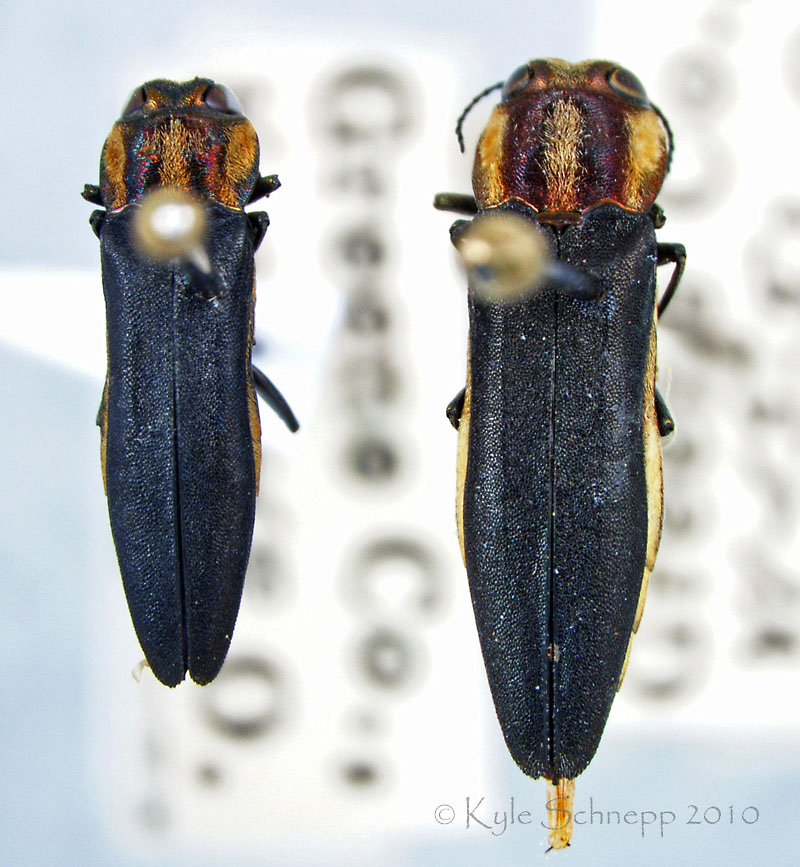
Agrilus audax Horn, 1891 – male (L) and female (R)

While the rarity of this species makes Kyle’s find significant enough, there is an even more significant – and interesting – aspect to his discovery.  Both of the specimens, one male and one female, were collected in Ohio, which is a rather extraordinary geographical range extension. Additionally, the specimens were collected by none other than Josef Knull.  To students of North American Buprestidae, the name Josef Knull is as familiar as Carl Linnaeus, Charles Darwin, or Thomas Say. A Professor of Entomology at The Ohio State University from 1934-1962, Knull published nearly 200 papers on the taxonomy, biology, and distribution of these and other families of beetles (Davidson and Bellamy 2002).  Although he lacked a Ph.D., he was an indefatigable collector and describer of beetles – to his fellow colleagues and students, he was known as “Professor” or “Doctor” as a show of respect.  He spent many of his summers traveling through the southwestern U.S. with his wife Dorothy Knull (herself an entomologist specializing in leafhoppers), and by the time he died in 1975 he had described 233 species and subspecies of beetles (as well as one species of Fulgoridae).  He was, and is, an icon among North American beetle collectors.

Curiously, Knull did not recognize these specimens for what they were, instead identifying them as the similar and much more widespread species, Agrilus vittaticollis.  Curious, because Knull collected these specimens in 1949 and 1953 – after first reporting the species in Missouri.  Agrilus audax belongs to a small group of species that look very similar to each other by way of their large size and striking coloration – black elytra and a red pronotum with a densely pubescent median channel.  Agrilus vittaticollis is the most common of these (though still not as commonly encountered as many other species in the genus), and the much less common A. benjamini also belongs to this group.  Kyle had sent me the above photo in an attempt to confirm their identity, but true confirmation would require examination of characters of the face and ventral surface.  Kyle quickly took additional photographs of these characters and sent them to me – they are shown below and leave no doubt as to the identity of these specimens.
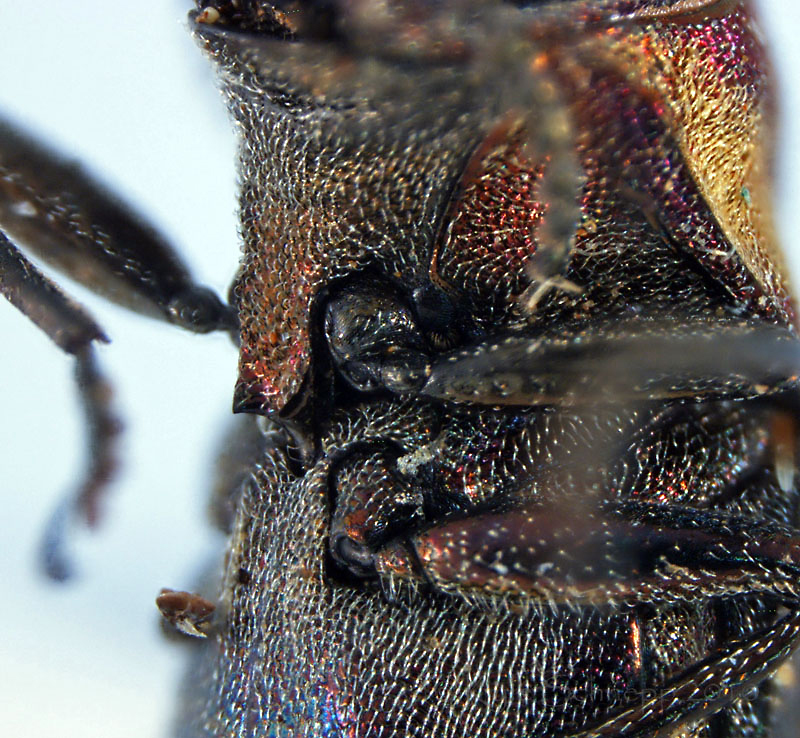
Agrilus vittaticollis prosternum – note sides bent downward to sharp points.
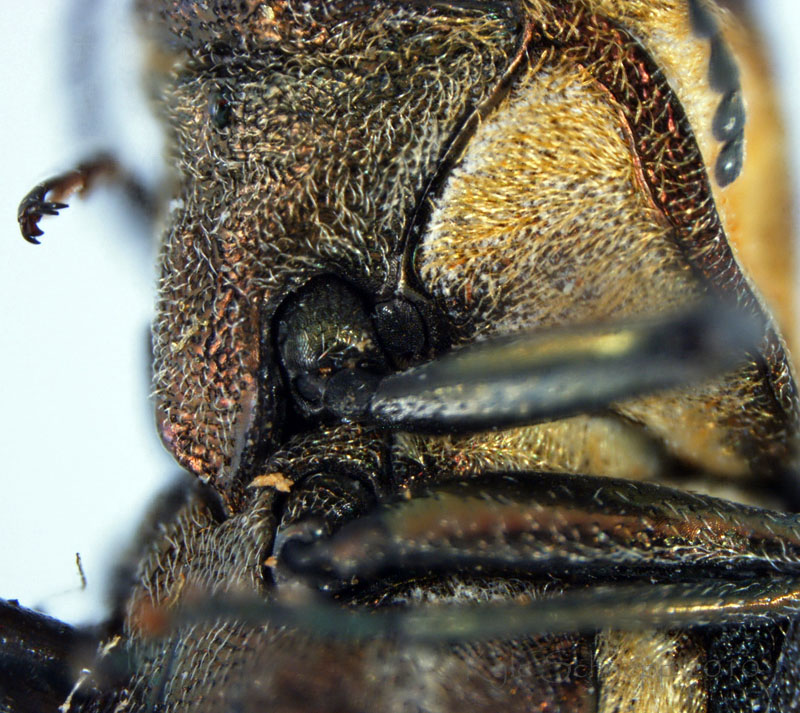
Agrilus audax prosternum – sides normal, not bent downward to sharp points.
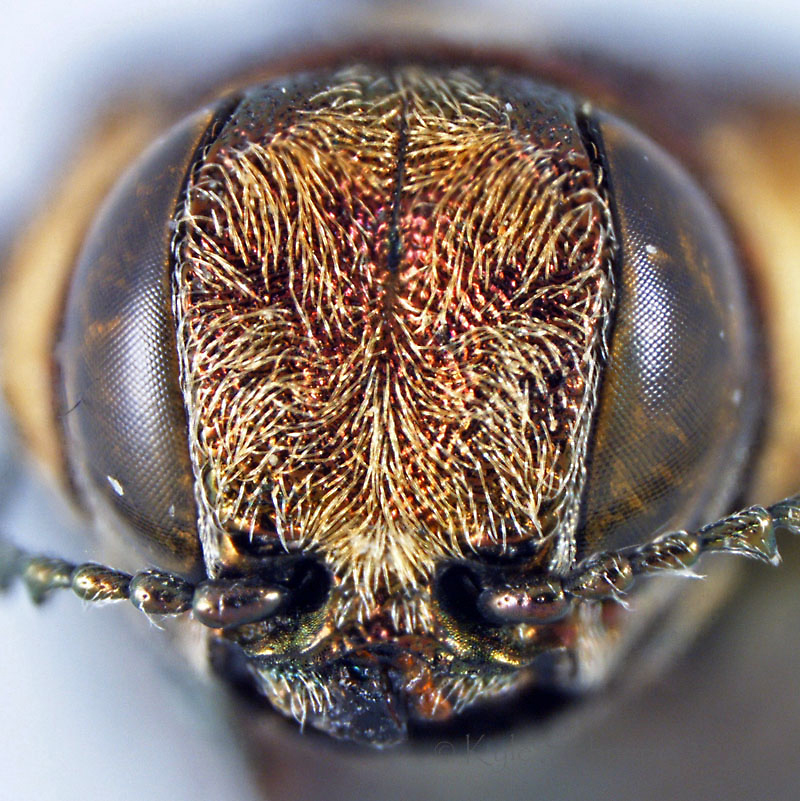

Agrilus audax frons is moderately depressed and uniformly pubescent (deeply depressed & pubescent only on lower half in A. benjamini).

Agrilus audax male sternite – the deep, smooth, elongate depression is diagnostic (A. benjamini males have only an obsolete depression).


Finding a new state record buprestid in Ohio – the land of Knull – based on specimens collected by Knull himself is nothing short of remarkable (almost like proving E. O. Wilson wrong¹). The occurrence of A. audax in Ohio also lends some credibility to Chamberlin’s record of the species in Illinois. Kyle is graciously allowing me to include these new records in a forthcoming publication; my thanks to him for this and also for allowing me to use his fine photographs in this post.  Kyle did also mention that these were the only misidentified specimens he saw in the Knull collection at the Field Museum of Natural History. For those interested in acquiring reprints of Knull’s papers, pdfs of the 50 papers he published in the Ohio Journal of Science may be found at this link.

¹ The title of this post is a play on the title of a recent post by Alex Wild at Myrmecos. No true disrespect is intended to Josef Knull, who’s legacy (with the possible exception of his frustratingly vague label data) is rightfully held in high regard by all who knew him or know of his work.

REFERENCES:

Chamberlin, W. J. 1926. The Buprestidae of North America, exclusive of Mexico, a catalogue including synonymy, bibliography, distribution, type locality and hosts of each species. W. J. Chamberlin, Corvallis.

Davidson, J. M., and C. L. Bellamy.  2002. The entomological contributions of Josef Nissley Knull (1891-1975).  Zootaxa 37:1-24.

Horn, G. H. 1891. The species of Agrilus of Boreal America. Transactions of the American Entomological Society 18:277-366.

Knull, J. N. 1934. Notes on Coleoptera, No. 4. Entomological News 45(10):207-212.

MacRae, T. C. 1991. The Buprestidae (Coleoptera) of Missouri. Insecta Mundi 5(2):101–126.

MacRae, T. C., and G. H. Nelson. 2003. Distributional and biological notes on Buprestidae (Coleoptera) in North and Central America and the West Indies, with validation of one species. The Coleopterists Bulletin 57(1):57–70.

Nelson, G. H., and T. C. MacRae. 1990. Additional notes on the biology and distribution of Buprestidae (Coleoptera) in North America, III. The Coleopterists Bulletin 44(3):349–354.

Copyright © Ted C. MacRae 2010

Add to FacebookAdd to DiggAdd to Del.icio.usAdd to StumbleuponAdd to RedditAdd to BlinklistAdd to TwitterAdd to TechnoratiAdd to Yahoo BuzzAdd to Newsvine

Email to a friend

Mylabris oculatus in South Africa

Mylabris oculata, the CMR bean beetle, is a large, conspicuously-colored beetle in the family Meloidae (blister beetles) that I saw quite commonly during my stay in South Africa.  “CMR” refers to the Cape Mounted Rifle Corps, a police force in the old Cape Colony whose uniforms sported black and yellow bands that resemble the colors of this beetle.

Blister beetles as a whole are, of course, well known for their chemical defenses, primarily cantharidin (the active ingredient in ‘Spanish Fly’, an extract of a European species of blister beetle).  This terpenoid compound is a painful irritant, especially when coming into contact with mucous-lined membranes such as those of the gatrointestinal and urinary tracts.  Blister beetles emit body fluids containing cantharidin from joints on the legs when disturbed, giving any would-be predators a foul-tasting appetizer. As we have so often seen, insects containing such effective defenses are often aposematically colored to advertise the fact, allowing them to brazenly lumber about fully exposed during the day with little to fear.  If there ever was an insect that screamed aposematic, it is M. oculatus with its boldy contrasting black and yellow elytra and hot-orange antennae.

These beetles, however, are more than just a frustration for hungry birds, but also a serious pest of numerous ornamental, fruit and vegetable crops (Picker et al. 2002).  Large numbers of adults congregate on plants and preferentially feed on the flowers.  In the more natural settings where I was encountering these beetles, they were most often seen on flowers of Acacia spp. or (as in the above photo) Dichrostachys cinerea in the family Fabaceae.  To be honest, they became quite a source of frustration for me as well – not because of their distastefulness or pestiferous habits, but because of their role as the model in a mimicry complex.  It was the mimic that I was after, and since mimics tend to be much less common than their models, I had to look at a lot of M. oculatus to find the few specimens of the species I was after. 

Pop quiz: Can anybody name the mimic?

Back to their chemical defenses – I’ve often wondered just how poisonous blister beetles really are, especially to humans.  Here in the U.S., their main importance is as contaminants in alfalfa hay fed to cattle and horses.  Deaths from severely contaminated forage do occur, but this is dependent upon the cantharidin content of the species and their abundance within the hay.  The highest reported cantharidin content for a blister beetle is 5.4% dry weight in Epicauta vittata.  Calculations based on this figure and the lethal dose for a 1000-lb horse indicate that around 100 such beetles would need to be eaten to receive a fatal dose.  This seems to make the claim that a single beetle can kill a human a little far-fetched.  However, M. oculatus are big beetles – more than a full inch in length and bulky.  In this regard, I found an interesting tidbit at the TrekNature website.  Clarke Scholtz is an entomologist at the University of Pretoria, and when asked, “Is it true that their poison can kill a human being?”, he responded:

Yes; they are poisonous enough to kill people – especially a big beetle… The poison is very toxic and actually causes collapsed tissue. It would also depend on the weight of the person, as with any other toxin. The poison of a CMR beetle, that is dried and powdered, is sufficient to kill a 70kg human.

REFERENCE:

Picker, M., C. Griffiths and A. Weaving. 2002. Field Guide to Insects of South Africa. Struik Publishers, Cape Town, 444 pp.

Copyright © Ted C. MacRae 2010

Add to FacebookAdd to DiggAdd to Del.icio.usAdd to StumbleuponAdd to RedditAdd to BlinklistAdd to TwitterAdd to TechnoratiAdd to Yahoo BuzzAdd to Newsvine

Email to a friend

Winter Botany Quiz #6 – answers and a checklist

I thought yesterday’s Winter Botany Quiz #6 would be a fairly difficult, and given the apparent difficulty of my previous quizes (Pismire Puzzle and Tuesday Teaser) I thought I’d give readers a break this week and narrow down the location to the Lake Tahoe area. Despite publishing in the dead of night, it took only 31 minutes for Peter Yeeles to swoop down and correctly name the family, genus, species, and function for the structure pictured. His only lapsus regarded the terminology used for the name of the structure itself, leaving the door open for James Trager to snag some scrap points. The plant is, of course, Cercocarpus ledifolius (curl-leaf mountain mahogany) in the family Rosaceae, and the structures pictured above and in the previous post are the stigmas of the flowers persisting as wind-assisted dispersal structures for the fruit. “Cercocarpus” is, in fact, derived from the Greek words for “tailed” and “fruit”, whose numerous erect hairs give the plant in a silvery sheen late in the growing season.

Why was I interested in this plant? It was one of the few tree species occurring in the Lake Tahoe Basin that I wasn’t able to find for last year’s 3-part series, Trees of Lake Tahoe (including The Pines, The “Other” Conifers, and The Deciduous Trees).  Widespread in the mountainous west (and barely qualifying as a tree), its occurrence in the Tahoe Basin is more sporadic.  Better stands are found outside the basin proper on the dry eastern flank of the Sierra Nevada (Graf 1999), and indeed these plants were photographed at ~6,500 feet on the eastern slopes of Mt. Rose.

My real interest in Cercocarpus, however, is as a favored host plant for species of jewel beetles (family Buprestidae).  About two dozen species of these beetles have been associated with Cercocarpus spp. in North America, nine of which have been confirmed as breeding within dead branches of these plants and five having been associated with no other plant.  I’ve collected a number of these species myself, particularly in the San Gabriel and Santa Rosa Mountains of southern California and the Chisos Moutains of Big Bend National Park in Texas, including Polycesta cazieri, Chrysobothris piuta, and paratype specimens of Acmaeodera rubrocuprea. I thought it might be of interest to any readers who might collect these insects to present a checklist of Buprestidae associated with Cercocarpus in North America (see appendix below).

REFERENCE:

Graf, M. 1999. Plants of the Tahoe Basin. Flowering Plants, Trees, and Ferns. A Photographic Guide. California Native Plant Society Press, Berkeley, 308 pp.

Checklist of North American Buprestidae associated with Cercocarpus

(Bold indicates species that have been reared from Cercocarpus.  An asterisk indicates species that have been associated exclusively with Cercocarpus).
Acmaeodera (s. str.) angelica Fall
Acmaeodera (s. str.) connexa LeConte
Acmaeodera (s. str.) dolorosa dolorosa Fall
Acmaeodera (s. str.) idahoensis Barr
Acmaeodera (s. str.) mariposa mariposa Horn
Acmaeodera (s. str.) mariposa dohrni Horn
Acmaeodera (s. str.) nelsoni Barr
Acmaeodera (s. str.) nexa Fall
Acmaeodera (s. str.) plagiaticauda Horn
Acmaeodera (s. str.) pubiventris lanata Horn
Acmaeodera (s. str.) rubrocuprea Westcott & Nelson*
Acmaeodera (s. str.) vandykei Fall
Acmaeodera (s. str.) variegata LeConte
Acmaeodera (Squamodera) vanduzeei (Van Dyke)
Anthaxia (Haplanthaxia) caseyi sublaevis Van Dyke
Anthaxia (Melanthaxia) porella Barr*
Anthaxia (Melanthaxia) simiola Casey*
Chrysobothris bisinuata Chamberlin*
Chrysobothris mali Horn
Chrysobothris piuta Wickham
Chrysobothris purpureovittata purpureovittata Horn
Chrysobothris purpureovittata cercocarpi Westcott & Nelson*
Dicerca (s. str.) hornii hornii Crotch
Polycesta (Tularensia) californica LeConte
Polycesta (Tularensia) cazieri Barr

Copyright © Ted C. MacRae 2010

Add to FacebookAdd to DiggAdd to Del.icio.usAdd to StumbleuponAdd to RedditAdd to BlinklistAdd to TwitterAdd to TechnoratiAdd to Yahoo BuzzAdd to Newsvine

Email to a friend

Monday Moth: Arniocera erythropyga

Arniocera erythropyga (Zygaenidae), Geelhoutbosch, South Africa

Last week’s king cricket quiz (Tuesday Teaser) reminded me that I still have quite a few photographs from my trip to South Africa, now 10 years ago, that I still haven’t shared. This pretty little moth is Arniocera erythropyga, which I photographed at Geelhoutbosch farm in South Africa’s Northern (now Limpopo) Province while clambering up the magnificent north-facing escarpment of the Waterberg Mountains. 

I saw this moth as it sat on the foliage of Grewia sp. (family Malvaceae) – fully exposed for all the world to see.  If we’ve learned anything by now, we know that brightly colored insects that expose themselves conspicuously during the day are probably protected by chemical defences (or perhaps mimicking something that is). Such was the case for Bromophila caffra, an equally strikingly-colored fly that I saw on the same hike, and it is also the case for this moth as well. Arniocera erythropgya is a member of the family Zygaenidae, or burnet moths – many members of which are known to release hydrogen cyanide (Scholtz and Holm 1985). This is the same family to which another toxic species I featured last spring belongs (Pyromorpha dimidiata).  A number of moths and butterflies in other families are also known to release HCN (produced by the breakdown of cyanoglucosides sequestered from the plants on which they feed); however, all life stages of zygaenid moths, including the egg, contain these compounds.  This suggests that zygaenid species are capable of synthesizing these compounds themselves rather than needing to sequester them from their host plants (Scoble 1992). While some zygaenid larvae do feed on plants that contain cyanoglucosides, they apparently do so simply because of their tolerance to the compounds but without the need to sequester them from the plant.

Thus, when I saw and approached this little moth, it didn’t flinch or flee.  Protected by toxicity, it continued sitting brazenly atop its exposed perch – welcoming me to see it, daring me to do anything more than take its photo.

My thanks to Roy Goff at African Moths for confirming the identity of the individual in this photograph.

REFERENCES:

Scholtz, C. H. and E. Holm (eds.). 1985. Insects of Southern Africa. Butterworths, Durbin, South Africa, 502 pp.

Scoble, M. J. 1992. The Lepidoptera. Form, Function and Diversity. Oxford University Press, Oxford, 404 pp.

Copyright © Ted C. MacRae 2010.

Add to FacebookAdd to DiggAdd to Del.icio.usAdd to StumbleuponAdd to RedditAdd to BlinklistAdd to TwitterAdd to TechnoratiAdd to Yahoo BuzzAdd to Newsvine

Email to a friend

The “New” Gromphadorina portentosa

I don’t pretend to be a photography guru – I’m learning, and though I still have much to learn I’m happy with my progress so far.  The photographs I posted earlier this week of Gromphadorina portentosa, the Madagascan hissing cockroach, were the results of my first attempt at photographing insects in a white box, and I was reasonably happy with the results.  However, a commentor suggested the photographs could benefit from increased contrast – and he was right!  I admit that I haven’t focused much on post-processing so far, as I’m still in a rather steep part of the whole insect macrophotography learning curve thing. I have played around with the different enhancement tools in Photoshop Elements, but for some reason I don’t find them all that intuitive, and just playing around with them hasn’t helped me understand how they work or the best way to use them.  The Photoshop online help site wasn’t much help either – in fact, it was all gibberish to me!  I started to wonder if maybe I just lacked some basic talent when it came to understanding post-processing.

Fortunately, the commentor provided a link to an excellent article at EarthBound Light called The 1-2-3 of Photoshop Levels.  That article opened up for me a whole new world of understanding!  It explained that Levels is a better alternative for optimizing photos that Brightness and Contrast, and it did it in plain English!  I actually understood it!  Well, my appetite whetted, I started browsing other articles at the site and found the object of my desire: a clear explanation of the seemingly misnomored “Unsharp Mask” in an article called Behind the Unsharp Mask: The Secret World of Sharpening.  I read it excitedly, just waiting for it to become unintelligibly technical, but it was as clearly written as the previous, and for the first time ever I actually felt like I understood the basics of how to use Unsharp Mask.  Well, I couldn’t wait to take my newfound knowledge and apply it to my photos of the already spectacular Gromphadorina portentosa to see if I could make them really pop. The following comparison shows the original photo of the male (size reduced to 1200×800) and the optimized photo adjusted for levels, color, and sharpness (also slightly cropped). What do you think?

Original photo

Optimized photo

Here are paired comparisons of the other photos I included in the original post with their optimized versions (click to see enlarged versions). I would be most interested in hearing any specific comments you might have about these optimizations.

Original

Optimized

Original

Optimized

Original

Optimized

Original

Optimized

Copyright © Ted C. MacRae 2010

Add to FacebookAdd to DiggAdd to Del.icio.usAdd to StumbleuponAdd to RedditAdd to BlinklistAdd to TwitterAdd to TechnoratiAdd to Yahoo BuzzAdd to Newsvine

Email to a friend

Tuesday Teaser


A recent post by Art Evans at What’s Bugging You reminded me about this photograph that I took some 10 years ago.  This will likely be a difficult challenge, but I’m willing to entertain guesses about its identity and where I found it.  For location, let’s just say I’ve featured quite a few insects from this place in past months – it might take a little digging to figure it out, so first correct answer is worth 4 points.  Knowing this will be key to figuring out its identity.  In that regard, order will be a gimme, so the first person who stumbles upon this will likely earn the measely 2 points available for correctly answering that question.  Family will be more difficult – 4 points if you score first on this one (hint – beware of recent taxonomic changes).  Genus will be a real, though not impossible challenge (in fact, necessary resources to determine this are available online) – a whopping 6 points await the first person to correctly identify that taxon.  Sadly, a definite species name won’t be possible (another clue?), but there is a short list of species that have been described from the general area, so bonus points are available for anyone willing to take on that challenge.  I have no additional pictures of this beast, so look for the answer as a comment to this post in a couple days or so.

Copyright © Ted C. MacRae 2010

Add to FacebookAdd to DiggAdd to Del.icio.usAdd to StumbleuponAdd to RedditAdd to BlinklistAdd to TwitterAdd to TechnoratiAdd to Yahoo BuzzAdd to Newsvine

Email to a friend

Gromphadorina portentosa

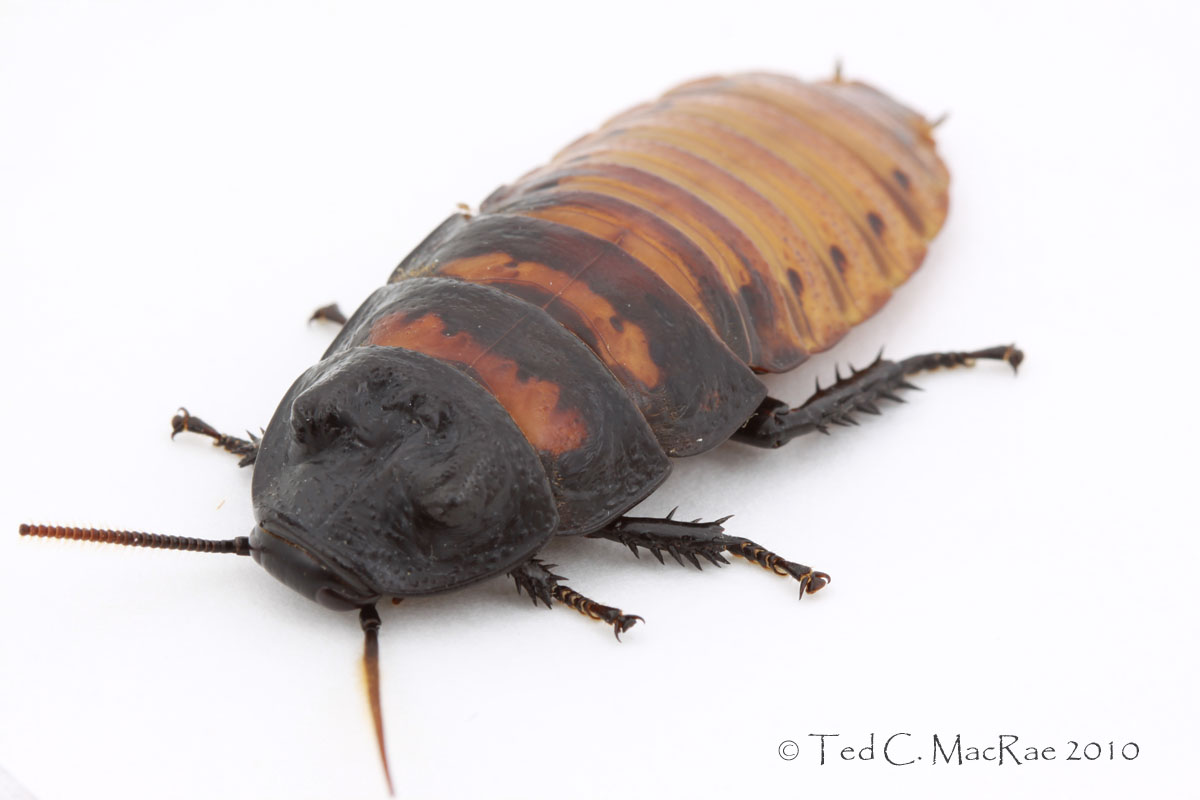
I found myself with a few spare moments this weekend, so I decided to finally put together a white box and see what I could do with it.  And what better subject for a white box maiden voyage than Gromphadorina portentosa, the Madagascan hissing cockroach.  Grotesquely beautiful, it also presents a challenging subject for flash-based macrophotography because of its hard, shiny exoskeleton that produces strong specular highlights with all but the most highly diffuse of light sources.  It was also the only live subject I had on hand at the moment, other than a few larval noctuids – not nearly as impressive as these behemoths!  There were some early glitches – the enormous size of these insects made for long working distances, with the result that my box was almost too small!  However, placing the subjects at the back of the box allowed the camera lens and flash units to sneak just inside the front drape, and the closer shots went more smoothly.  I’m quite happy with the results – at least as a first attempt, and I think the method shows even more promise for some preserved specimen photographs that I am planning.

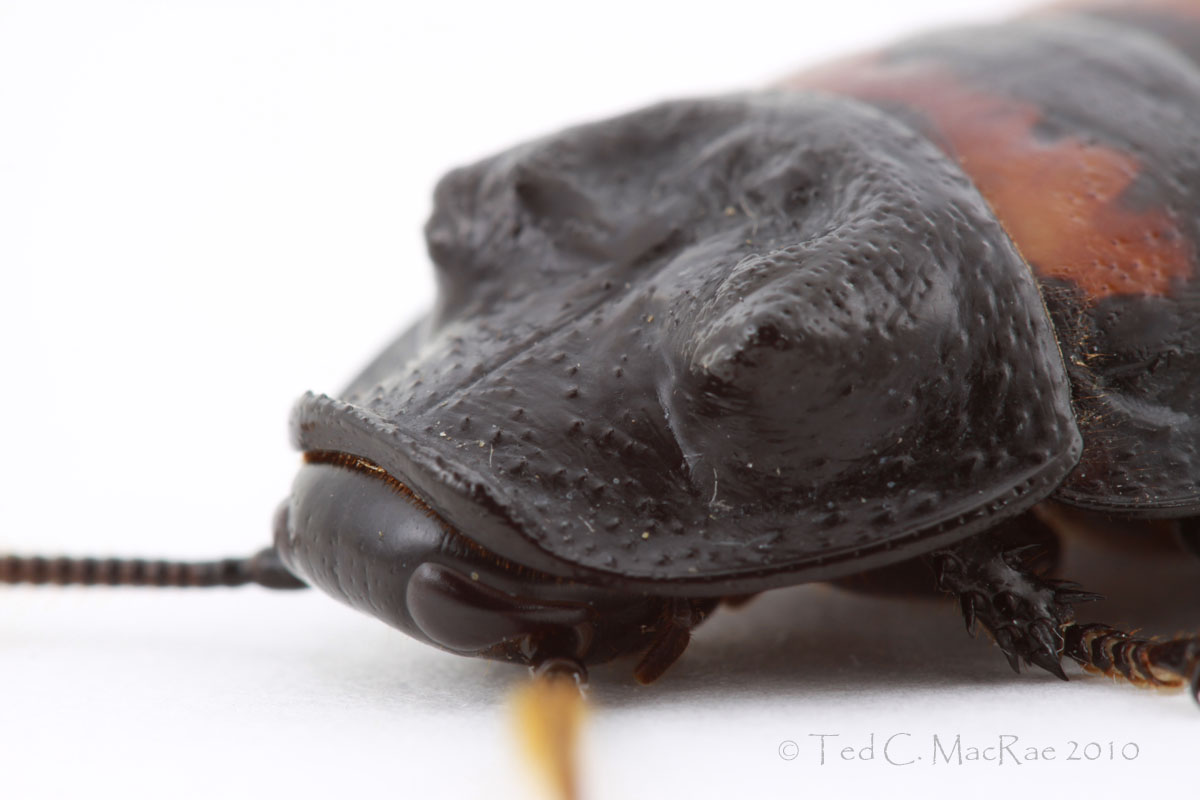
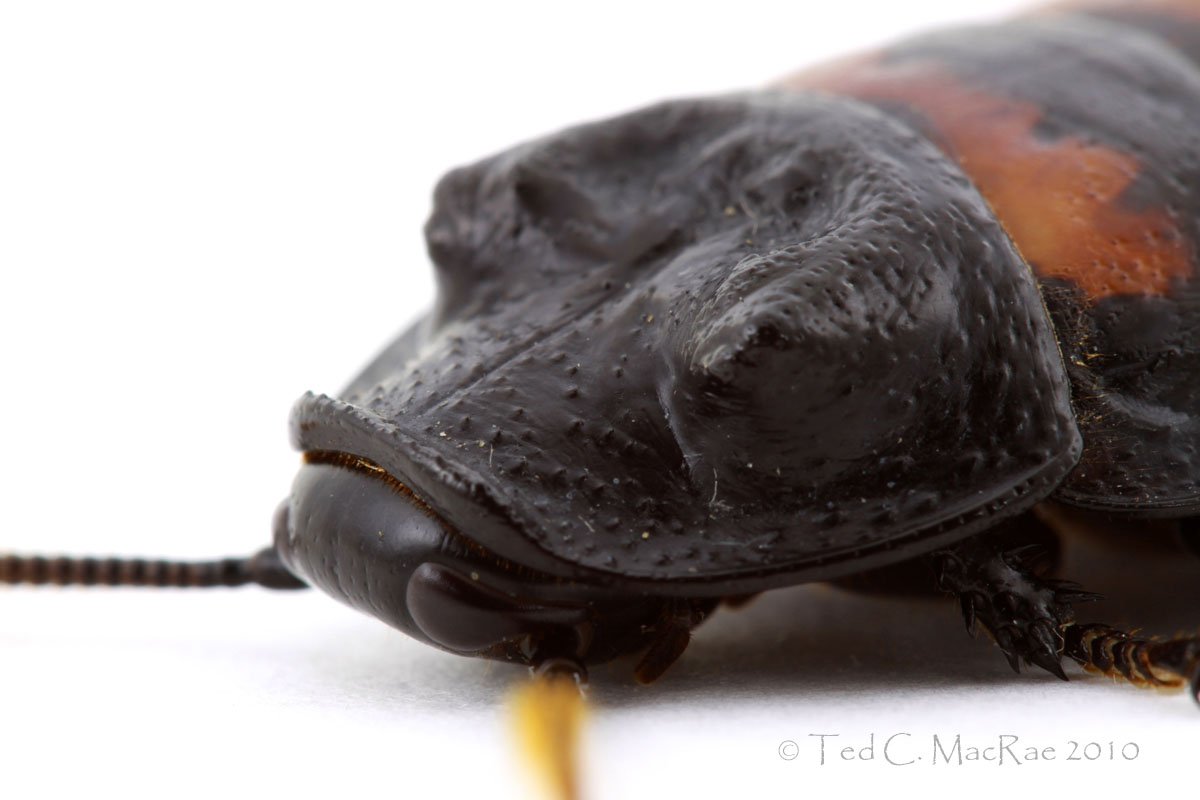
The males, of course, have “horns” on the pronotum, but one thing I had never noticed before is the well-developed lip at its anterior edge.  This is certainly an adaptation to the “shoving” matches that males engage in with each other frequently.  This face-on shot shows him for the formidible opponent that he is!

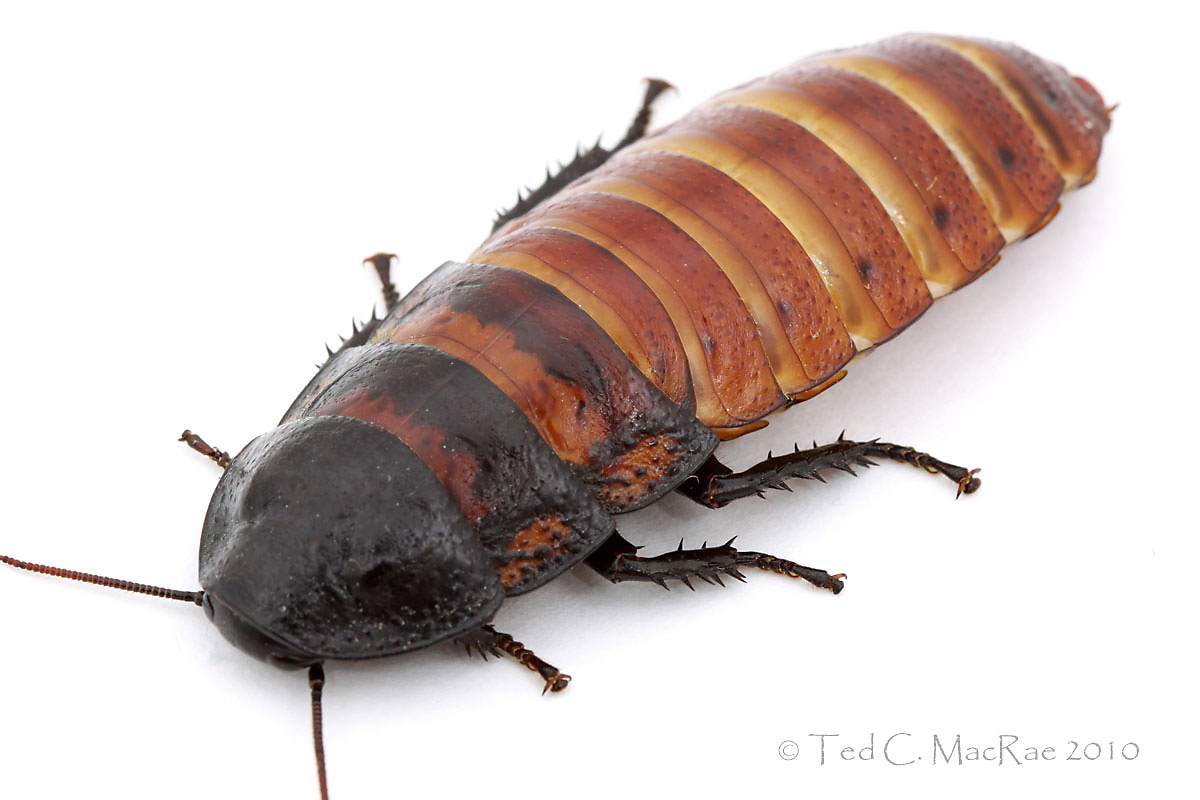
Sexual dimorphism is fairly evident in this species, as least compared to your average cockroach.  Like most insects, females tend to be a little larger, especially when they are gravid as the one below appears to be.  In my colony I note that they also tend to be more uniformly dark in color than the males, although that is not quite so evident with this particular female.

The big difference is, of course, the weakly developed pronotal protuberances.  Females don’t engage in the shoving matches that males do, so there is no need for the heavily armed pronotum.  Nevertheless, small pronotal humps are still found in the adult females.  Note also the lack of a well-developed lip on the anterior edge of the female pronotum.

Photo Details: Canon 100mm macro lens on Canon 50D, ISO 100, 1/200 sec, f/8-11, indirect MT-24EX flash in white box.

Copyright © Ted C. MacRae 2010

Add to FacebookAdd to DiggAdd to Del.icio.usAdd to StumbleuponAdd to RedditAdd to BlinklistAdd to TwitterAdd to TechnoratiAdd to Yahoo BuzzAdd to Newsvine

Email to a friend

Lampetis drummondi larva?

Back in February, I learned that Mark Volkovitsh (Zoological Institute, Russian Academy of Science, St. Petersburg) would be visiting Chuck Bellamy (California Department of Food and Agriculture) in Sacramento the very week that I was planning to be in Lake Tahoe. Chuck and Mark are two of the worlds leading specialists in Buprestidae, or jewel beetles, and have worked together on a number of projects dealing with the taxonomy and systematics of buprestid beetles. Mark, in particular, has focused on describing the larval forms of buprestids (“white wormy things,” as my wife calls them) and using larval morphology to supplement adult morphology in phylogenetic analyses. I’m not anywhere near being in their league in terms of authority in the family – a comparative dabbler, really – but for some reason they’ve both seen fit to accept me into the fraternity. I’ve been fortunate to spend time in the field with each of them, as well as visit them at their respective institutions.  When I learned of Mark’s coincident visit, I couldn’t resist the chance to make the 2-hour drive from Lake Tahoe to Sacramento and spend the day with Mark and Chuck at the CDFA and discuss things buprestological.  The wife and kids were fine with that, since her brother also lives in Sacramento, and it would be a chance for them to do some sight-seeing before we all got together for dinner.  Upon arriving at CDFA, I also met Andy Cline, a nitidulid specialist at the CDFA (re-met actually, turns out we’d met some years back), and the four of us went out for an animated lunch at a nearby restaurant over some of the most delicious barbeque that I’ve ever tasted.

L-R: Mark Volkovitsh (Russia), Chuck Bellamy (CDFA), me, Andy Cline (CDFA)

After lunch, I was most interested in discussing with Mark some buprestid larvae that I had collected in Big Bend, Texas in 2004. My colleague Chris Brown and I were hiking a low desert trail west of Rio Grande Village when we encountered a large, uprooted Goodding willow (Salix gooddingii) tree laying on the river bank. Wilting leaves were present on some of its branches, suggesting that the half-dead had been washed to its current location by the river during a recent flood. At the base of the trunk where the main roots projected, I noticed what appeared to be frass (the sawdust that wood boring beetle larvae eject after eating it – that’s right, grub poop!) under the edge of the bark at the live/dead wood interface. I used my knife to cut away some of the bark and immediately encountered a huge buprestid larvae. Its enormous size is matched only by a few desert southwest species: Polycesta deserticola, which breeds commonly in oak and is known from willow, but breeds only in dead, dry branches; and Gyascutus planicosta, whose larvae are restricted to the living roots of Atriplex and a few other asteraceous shrubs.  Clearly, it could not be either of these species.  The only other desert southwest buprestids large enough to produce a larva this large (~50 mm) are Lampetis drummondii and L. webbii. However, the larvae of both of these species are unknown, as is basic information regarding what hosts they utilize for larval development. Lampetis webbii is quite rare, but L. drummondii is, in fact, one of the most conspicuous and commonly encountered buprestid species in the desert southwest – that fact that its larva has remained unknown suggests that it utilizes living wood, probably feeding below the soil line.  Thus, I immediately began to suspect that the larva might represent this species – a truly exciting development. 

As I continued digging into the wood, I encountered a second, somewhat smaller larva in a neaby gallery, and further digging revealed another clue about its identity in the form of fragments of a dead adult beetle – all brilliant blue/green in color (identical to the color of L. drummondi), and the largest (the base of an elytron, or wing cover) showing the same pattern of punctation exhibited by L. drummondi adults. I placed the two larvae individually in vials with pieces of the host wood; however, I knew there was little chance that either larva, requiring living tissue upon which to feed, would complete its development once removed from its host gallery.  They did survive for a time after my return to St. Louis, but when the largest larva became lethargic, I decided to go ahead and preserve them.  I sent the photograph below (taken by Chris) of the living larvae to Mark, who confirmed that it did indeed appear to be a species of Lampetis, based on its large size and the narrowly V-shaped furcus on the pronotal shield (typical for members of the tribe to which Lampetis belongs). 

Buprestid larva (prob. Lampetis drummondi) under bark of Salix gooddingii at trunk base - Big Bend National Park, Texas. Photo by Christopher R. Brown.

Considering the complete lack of published information on the larval biology of Lampetis drummondi and the several lines of evidence that these larvae, in fact, represent that species, it would be worthwhile to publish a description of the larva.  However, formal description requires dissection, and I did not know how to do this.  Mark, on the other hand, has dissected literally hundreds of buprestid larvae, including representatives of nearly every genus for which larvae are known.  He is the buprestid larva expert, and what a thrill it was for me to learn how to do this from the Master himself, using the larger of these two probable Lampetis larvae as the subject.  While we were dissecting the larva, we compared its features to those published for the European species Lampetis argentata (Danilevsky 1980) – the only member of the genus for which the larva is known – and confirmed their similarity and the larva’s likely close relationship to that species.  Coincidentally, the larva of L. argentata develops in living roots of saxaul (Haloxylon) – a genus of large shrubs/small trees (family Amaranthaceae) that grows in the deserts of Central Asia.  It thus appears that Lampetis species may, as a general rule, utilize living wood below the soil line for larval development, explaining why the larva of only one (now two) of the nearly 300 species in the genus worldwide has been found.

REFERENCES:

Danilevsky, M. L. 1980. Opisanie zlatki Lapmetis [sic] argentata (Coleoptera, Buprestidae) – vreditelya saksaula [Description of the larva of Lapmetis [sic] argentata (Coleoptera, Buprestidae) – the pest of HaloxylonZoologicheskii Zhurnal 59:791–793.

Copyright © Ted C. MacRae 2010

Add to FacebookAdd to DiggAdd to Del.icio.usAdd to StumbleuponAdd to RedditAdd to BlinklistAdd to TwitterAdd to TechnoratiAdd to Yahoo BuzzAdd to Newsvine

Email to a friend