Gulf Fritillary in southern Missouri

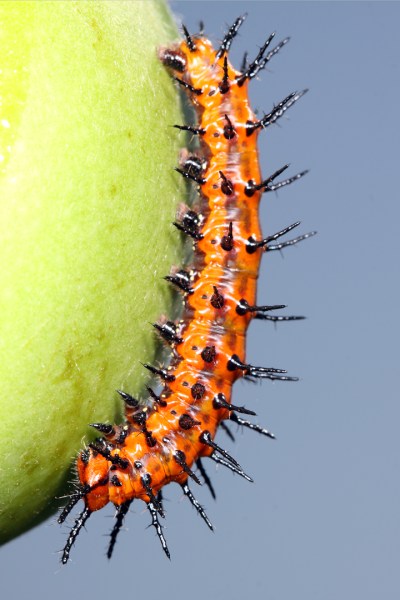
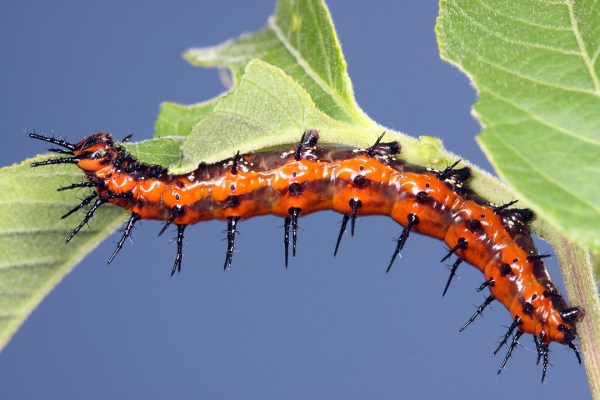
Gulf Fritillary (Agraulis vanillae) | Mississippi Co., Missouri

I’m not sure, but I think this might be the first time I’ve photographed a butterfly caterpillar. Not a bad subject to start with, as few butterflies have caterpillars that are more colorful than the Gulf Fritillary, Agraulis vanillae. A common resident in the southern states and further south, this member of the nymphalid subfamily Heliconiinae is less commonly encountered in Missouri—in fact, I had never seen (or at least noticed) these caterpillars before encountering a few feeding hungrily on the foliage of maypop (Passiflora incarnata) growing in a city park in Missouri’s southeastern lowlands. While the stunning colors of these caterpillars are a delight to human eyes, their function, as in most butterfly caterpillars, is to advertise the unpalatability of their toxin-laced bodies. In the case of this species, the toxins include cyanogenic glycosides that the larvae sequester from the tissues of their host plants (ironically these compounds are supposed to serve the same protective function for the plant that produces them, but butterflies have become master specialists at evolving mechanisms to sidestep toxic impacts).

According to my friends Richard & Joan Heitzman, long-time students of Missouri Lepidoptera, this species is a sporadic migrant that occasionally forms summer colonies in Missouri, especially in the western half of the state, until the first hard freeze destroys the colony (Heitzman & Heitzman 1987).

REFERENCE:

Heitzman, J. R. & J. E. Heitzman. 1987. Butterflies and Moths of Missouri. Missouri Department of Conservation, Jefferson City, 385 pp.

Copyright © Ted C. MacRae 2012

Life at 8X—hibiscus flea beetle

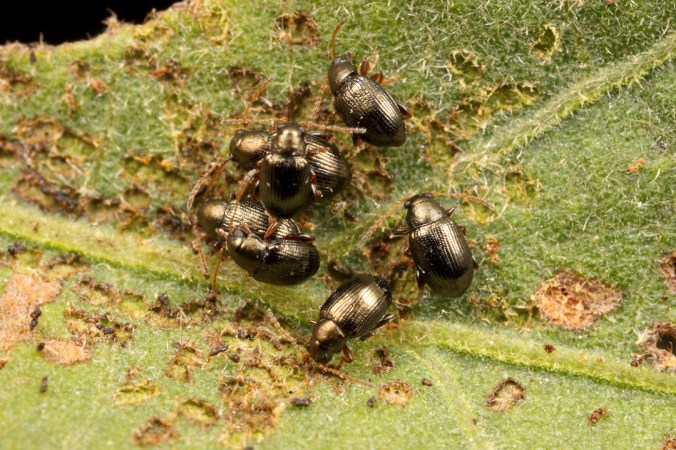
Chaetocnema quadricollis on Hibiscus lasiocarpus | St. Louis Co., Missouri (photo @ 2X)

In mid-August I visited Route 66 State Park along the Meramec River in east-central Missouri to check stands of rosemallow (Hibiscus lasiocarpus) that I had previously noticed growing in the park for the presence of the stunning jewel beetle, Agrilus concinnus. Once considered amongst the rarest members of the genus in North America, this species has in recent years been collected at several localities—always in association with Hibiscus spp. (MacRae 2004). I was disappointed to find the rosemallow stands sparse and stunted—a result of this year’s drought—and there were no A. concinnus to be found. Whether this was a result of the drought or the location or the lateness of the season, I do not know. However, as often happens when I don’t find what I’m looking for, I start seeing things that I’m not looking for. In this case, what I noticed were these incredibly tiny leaf beetles feeding on the foliage of the rosemallow plants.
Adults feed gregariously on the upper leaf surfaces, leaving characteristic feeding damage (photo @ 3X)

I’ve collected a fair number of leaf beetles over the years, thus I recognized these immediately as belonging to the subfamily Alticinae (flea beetles) due to the way they jumped when I disturbed them. However, I have also done a fair bit of collecting of insects on rosemallow and never seen (or at least noticed) this species of flea beetle. The beetles were feeding gregariously on mostly the upper surface of the leaves, and their feeding resulted in a rather distinctive damage that caused the more severely affected leaves to shrivel and turn brown. Based on gestalt, I was guessing Crepidodera or Chaetocnema, two genera that contain some of the state’s smallest species of flea beetles.

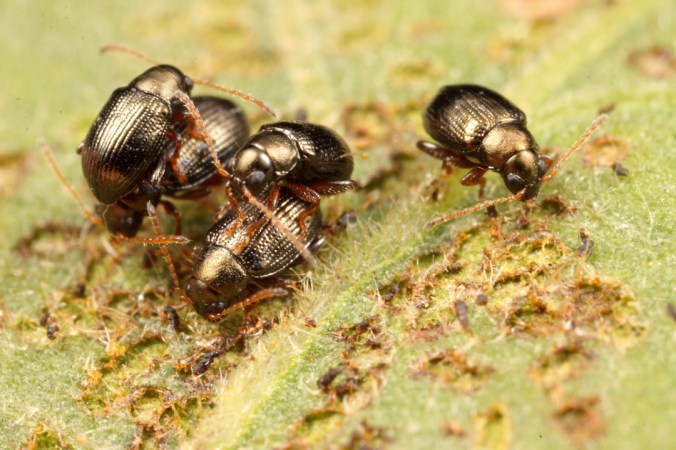
An adult pauses long enough for a photo while feeding on sap at the broken end of a leaf petiole (photo @ 8X)

Based on host plant and this photo on BugGuide, I thought these might represent Chaetocnema quadricollis. However, that species isn’t among the nine species of the genus recorded from Missouri by Riley & Enns (1979, 1982). Nevertheless, Ed Riley himself, and Shawn Clark as well, each confirmed this as the likely identity of the beetles based primarily on its associated host plant, and in fact Riley did record the species from Missouri at numerous localities under the name C. decipiens (later synonymyzed under C. quadricollis by White (1996) in his revision of the genus in North America). Schwarz (1878) described the species from Florida (noting that it has “exactly the same aspect of a small Crepidodera“), and apparently its association with and occasional pest status on rosemallow has long been established (Weiss & Dickerson 1919 recommended Bordeaux or arsenate of lead for its control).

Although coupled, these beetles are not actively mating (is this mate guarding?) (photo @ 8X)

These are probably the smallest beetles that I have photographed so far. In the photo of the mating pair above, the male measures just over 1 mm in length, while the female measures about 1.6 mm in length (the sensor of my camera measures 21 mm wide, so an 8X photo yields a field of view measuring 2.625 mm wide). All of the above photos were taken hand-held in the field with a Canon MP-E 65mm macro lens (1/250 sec, ISO-160, f/14, full flash). The last two photos were taken with the lens mounted on 68 mm of extension tube and fully extended to achieve 8X magnification. While the photos contain good depth-of-field (DOF), they are soft due to the extreme amount of diffraction that occurs at such a small aperture and high magnification. If I were to do it over, I would reduce the aperture to f/10 or even lower and sacrifice some DOF for better sharpness.

REFERENCES:

MacRae, T. C. 2004. Beetle bits: Hunting the elusive “hibiscus jewel beetle”. Nature Notes, Journal of the Webster Groves Nature Study Society 76(5):4–5.

Riley, E. G. & W. R. Enns. 1979. An annotated checklist of Missouri leaf beetles (Coleoptera: Chrysomelidae). Transactions, Missouri Academy of Science 13:53–83.

Riley, E. G. & W. R. Enns. 1982. Supplement to an annotated checklist of Missouri leaf beetles (Coleoptera: Chrysomelidae): new state records and host plant associations. Entomological News 93(1):32–36.

Schwarz, E. A. 1878. The Coleoptera of Florida. Proceedings of the American Philosophical Society 17(101):353–469.

Weiss, H. B. & E. L. Dickerson. 1919. Insects of the swamp rose-mallow, Hibiscus moscheutos L. in New Jersey. Journal of the New York Entomological Society 27(1):39–68.

White R.E. 1996. A revision of the genus Chaetocnema of America north of Mexico (Coleoptera: Chrysomelidae). Contributions of the American Entomological Institute 29(1): 1–158.

Copyright © Ted C. MacRae 2012
Monster in the Night

Stumbling through mixed-grass prairie in the middle of the night can be a little unnerving. The headlamp illuminates nicely the path in front of you, but the area outside the tunnel of light is rendered even blacker. It is there where the prairie rattlesnakes lie, just waiting to ambush any passing human with psychotic, venomous fury! Okay, maybe that’s a little hyperbolic, but ever since my encounter with these malevolent creatures in the Black Hills, it’s been hard for me to suppress recollection of that terrifying buzz whenever I don’t have a clear, unobstructed view of the entire ground in a 10′ radius around me. I haven’t encountered one since, but the damage is done—I can’t wander the prairie and not think about them—especially at night. Still, I wander the prairie, especially at night, because there are good bugs in the prairie… especially at night. On this particular night, I had found a small beetle ovipositing on a dead branch while holding its elytra outstretched in a most curious manner. I had become completely absorbed in photographing this unusual display when my peripheral vision detected movement by something so large it just had to be dangerous. The flush of fear, however, turned to absolute fascination when I shone the headlamp in the direction of the movement and saw this behemoth of a grasshopper sitting in the very same bush as the beetle I was photographing:

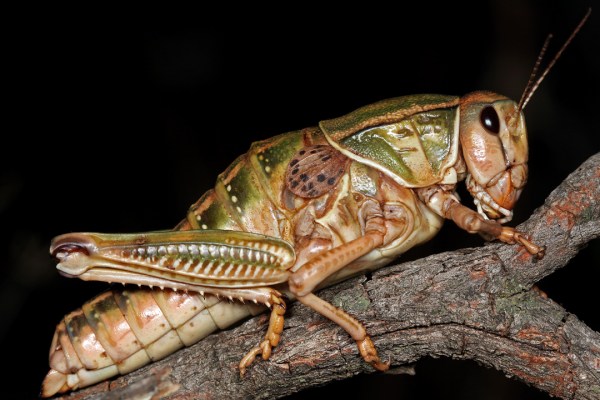
Brachystola magna (Plains lubber grasshopper) | Major Co., Oklahoma

Well over 50 mm long, it wasn’t so much its length as its girth that made this truly the most ginormous grasshopper I’d ever seen. Grasshopper diversity in the Great Plains is high, with more than 100 species in Nebraska alone (Brust et al. 2008), and while I have limited familiarity with the species, the large, robust body and tiny, little wings told me this must be one of the lubber grasshoppers in the acridid subfamily Romaleinae. As an example of how technology has changed our lives, a quick iPhone snapshot posted on Facebook yielded within minutes an identification by Matt Brust as Brachystola magna, the Plains lubber grasshopper.

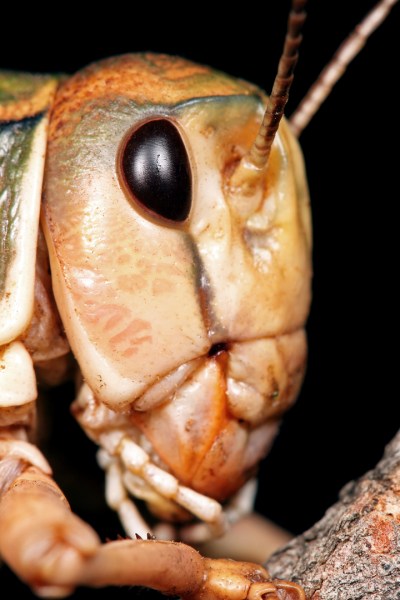
The ”quintessential” generalized insect head!

The grasshopper didn’t seem alarmed by my presence as it clambered slowly on the branch, so I returned to photographing the beetle. Good thing I did, as it turned out to be the ripiphorid Toposcopus wrightii, currently recorded in the literature only from Arizona, New Mexico, and Texas. Thus, my photos document not only an unusual northern record but also the first tangible evidence that members of the basal subfamily to which it belongs parasitize woodboring beetle larvae. Once I finished photographing that species, I returned my attentions to the lumbering beast, snapped a few photos, and then placed her in a critter carrier to bring home as a gift for my daughter (yes, she really likes when I bring home “pets” for her!).

REFERENCE:

Brust, M. L., W. W. Hoback and R. J. Wright.  2008. The Grasshoppers (Orthoptera: Acrididae and Romaleidae) of Nebraska.  University of Nebraksa-Lincoln Extension, 138 pp.

Copyright © Ted C. MacRae 2012

Beetle Collecting 101: How to pin a beetle

It has been a long time since I initiated my Beetle Collecting 101 series (more than two years!), and to date the first issue—Beetle Collecting 101: Dress for Success—remains the one and only lesson that I’ve posted. I really had intended to follow that up with nittier-grittier posts on the actual mechanics of collecting beetles and processing the specimens for long-term preservation, but I didn’t and don’t know why other than to say, well… life happens. It’s never too late to fix something, however, so as a long overdue follow up I thought I would give a short video lesson on how to pin a beetle—specifically a cerambycid (longhorned) beetle. Featured in this short (4:31) video is the lovely Megacyllene decora (amorpha borer), which I found back in early September at a site in Missouri’s southeastern lowlands. Click the image to be directed to the video.

Copyright © Ted C. MacRae 2012

The hardest EASIEST ID Challenge in like ever!

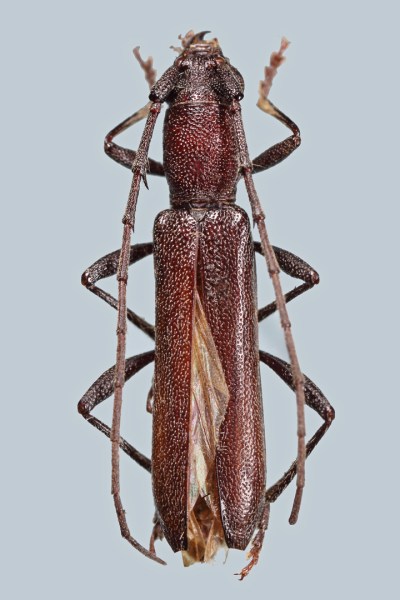
This is not only the hardest ID Challenge I have ever posted, it is probably the hardest one anyone has EVER posted. I’m not going to ask for order or family because they’re so easy. I will ask for the genus, because maybe only a few of you will get that right, but the genus alone won’t be enough. I want the species! Don’t even think about searching the internet for a matching photo—it doesn’t exist! You’re going to have to utilize other resources to figure this one out.

Because of the difficulty of this challenge, all the normal rules are out the window—no points, no sessions, no moderated comments, no nothing. This is winner take all—first person to correctly guess the species gets loot! I’ll even provide all the collection data in the caption. Good luck!

Update 10/29/12 10:12 pm: Well, I goofed and didn’t think about somebody Googling the label data, which Ben Coulter did to quickly arrive at the correct answer. Stupid Google!

At any rate, and with great anticlimactic fanfare, say hello to Aneflomorpha cribellata, described by Bates more than a century ago (1892) and known only from that single type specimen until the collection of this one in southern Mexico in 2005 (MacRae et al. 2012). This is the first photograph of the species and will be added to Larry Bezark’s A Photographic Catalogue of the CERAMBYCIDAE of the World.

Reference:
MacRae, T. C., L. G. Bezark & I. Swift. 2012. Notes on distribution and host plants of Cerambycidae (Coleoptera) from southern México.  The Pan-Pacific Entomologist 88(2):173–184.


MEXICO: Oaxaca, 4.8 km E La Ventosa, Hwy 190, 16°33’27″N, 94°54’27″W, elev. 76′, 28.vii.2005, beaten from unidentified dead branches, coll. T. C. MacRae.

Copyright © Ted C. MacRae 2012
Why are this beetle’s elytra outstretched?

Toposcopus wrightii on dead branch Juniperus virginiana | Major Co., Oklahoma

I’ve puzzled over the beetle in the above photo since I first saw it back in September on Day 2 of this year’s Annual Fall Tiger Beetle Trip. I encountered it on a dead branch of eastern red-cedar (Juniperus virginiana) on top of the main mesa at Gloss Mountain State Park in northwestern Oklahoma. At about 8 mm in length, it immediately struck me as possibly something in the family Ripiphoridae (wedge-shaped beetles). Still, the full-length elytra covering the abdomen made me doubt that identification, so I collected the specimen to get a better look at it when I returned home. Later that same day, while scanning the base of another mesa across the highway from the park at night, I came upon another individual that seemed to represent the same species—this time on a dead branch of fragrant sumac (Rhus aromatica). That individual is seen in the photo below, and two things are immediately apparent: 1) the beetle is a female in the act of oviposition, and 2) it is holding its elytra outstretched in a most curious way.

Another female oviposits on a dead branch of Rhus aromatica.

A quick browse through BugGuide’s ripiphorid images quickly showed a likely match with the genus Toposcopus, and consulting the original description of both the genus and its only included species—T. wrightii (LeConte 1868) showed agreement with the key diagnostic character (eyes divided into two lobes connected by a slender line of smooth, non-faceted corneous membrane). These two females differ from the male by their much less flabellate antennae (presumably the male uses these organs to detect female-emitted pheromones). LeConte described this species from New Mexico, and Rivnay (1929) also saw specimens from Texas and Arizona when he reviewed the North and Central American species of the family. Although the species is listed on Don Arnold’s Checklist of the Coleoptera of Oklahoma, the listing seems to be based only on the presence of specimens in the Oklahoma State University insect collection, while published records of its occurrence in the state are, as far as I can tell, still lacking. This species, thus, seems to be, along with Acmaeodera macra and Chrysobothris octocola (both family Buprestidae), an example of a typically southwestern U.S. species whose distribution extends northeast into the Red Hills Region of northwestern Oklahoma. Considering that Cylindera celeripes (Swift Tiger Beetle) and Amblycheila cylindriformis (Great Plains Giant Tiger Beetle) also have only recently been discovered in this area, it would seem that this part of the state is still undersampled and has the potential to yield additional interesting southwestern U.S. species.

Why is this female holding her elytra outstretched while ovipositing?

Regarding the outstretched elytra, I’ve not seen this type of behavior before with a beetle in the act of oviposition. While several groups of insects in other orders may hold their forewings outstretched as part of threat displays, I’ve not seen a beetle hold its elytra outstretched for any reason at all other than flight and don’t recall seeing such behavior mentioned in the literature either. Thus, I’m at a loss to explain why the beetle is doing this. If you have any ideas I would love to hear them.

One thing that I enjoy immensely about 19th Century taxonomic literature is the rich, often effusive prose that frequently accompanies the descriptive portions of the text. (I also lament that such colorful writings are nearly universally frowned upon my modern editors. Perhaps as taxonomy advances more fully into electronic-only publishing the concerns about space will dissipate and taxonomic authors will no longer be constrained to such sterile, uniform, precisely formatted writings.) The naming of this species provides an especially colorful example of the embellishments permitted to 19th Century authors:

I desire in the name of this beautiful and interesting addition to our fauna, to commemorate the ability of Gen. W. W. Wright, the Chief Engineer and Commander of the Survey in which the species in the present memoir were collected. His attention to the comfort and safety of the party while traveling through a hostile Indian country will not soon be forgotten by any of his companions; while the skill with which the more difficult portions of the route were examined, and the labors of his assistants directed to the most easy methods of surmounting the difficulties, will commend itself to every admirer of correct engineering.

John L. LeConte is widely regarded as the father of North American coleopterology. I don’t think there is anybody from the 19th Century, save perhaps Charles Darwin, that I would have more liked to meet.

REFERENCES: 

LeConte, J. L. 1868. New Coleoptera collected on the survey for the extension of the Union Pacific Railway, E. D. from Kansas to Fort Craig, New Mexico. Transactions of the American Entomological Society 2:49–59.

Rivnay, E. 1929. Revision of the Rhipiphoridae of North and Central America (Coleoptera). Memoirs of the American Entomological Society 6:1–67, 3 plates.

Copyright © Ted C. MacRae 2012

Frustrating Emerald

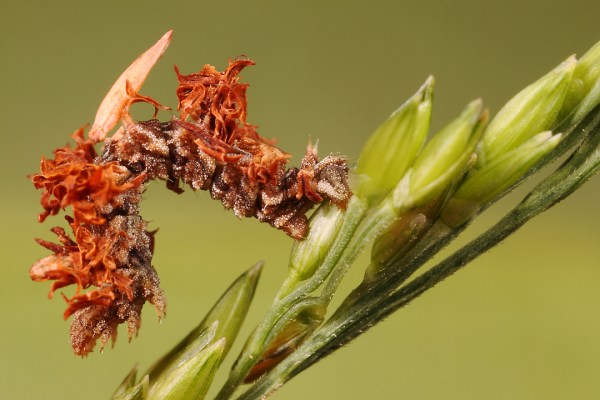
After years in the field looking for insects, one develops an eye not only for recognizing insects but also recognizing when something doesn’t look quite right. That happened to me early this past September at a spot along the Mississippi River in southeast Missouri where I had stopped during late afternoon to look for diurnal species of tiger beetles and then man a blacklight in the evening for nocturnal ones. It was still daylight as I walked along the edge of rank growth bordering the upper banks when a small, reddish “cluster” on a seed head in a stand of tall grasses caught my eye. I didn’t know what it was when I saw it, but I knew it was something ‘out of place.’ My first, cursory thought was that somehow the spent anthers of the now-seeding grass had gotten caught in a tangle, but I must have still had doubts because I looked closer anyway. Just then the “cluster” moved, and I then recognized what I was dealing with—an Emerald moth (Synchlora sp.) caterpillar. Caterpillars in this genus are remarkable for their habit of adorning their bodies with bits of the plants upon which they feed. I am, however, a beetle man and thus admit to being completely unaware of their existence until last summer when Alex Wild featured one of these as a Monday Night Mystery. I wondered then, “Why haven’t I seen one of these before?”, and now I know why—because they are extremely well camouflaged!

Synchlora sp. | Mississippi Co., Missouri

Realizing what I had, all efforts to look for tiger beetles were suspended (I hadn’t seen anything after ~30 minutes of looking anyway), and I broke out the 65mm lens to get the most of this small but remarkable looking insect. I took more than 50 shots, trying different backgrounds, angling the grass stem in different positions, and hoping with each shot that I had captured the larva in full profile, completely in focus, and in the midst of that magical loop. I was sure I had that “perfect” shot when I got home and anxiously fired up the computer to get a better look at the photos. My optimism began to drop, however, as I scanned through each successive photo and continued to not encounter that one photo that would cause me to say “Yes!” Exposure? Check. Composition? Check. Lighting? Check. Focus? Er… crap! The problem was pervasive throughout the entire set, and in the end, I have only this one photo that comes anywhere close to what I had envisioned while I was taking the photos. It’s a shame, because I love everything else about this photo. The cause of the problem is the very thing that makes the larva so remarkable—its adornments. The spent anthers project off the larva in all directions, adding considerable dimensionality to the subject and surpassing the depth-of-field capabilities of my lens. If the subject was in focus the forward projecting anthers were not, and if the anthers were in focus the subject was not. If I had realized in the field what was going on, I would have not gotten in so tight and cropped as appropriate during post-processing. Live and learn!

Although 12 species of Synchlora are found in North America, only one—Synchlora aerata (Wavy-lined Emerald)—is widespread in the eastern U.S. However, a number of other species are found in the southeastern U.S., and for all intents and purposes the Mississippi Lowlands of southeastern Missouri  are the south (culturally as well as biogeographically!). As a result, a generic ID is the best that can be done for this larva.

Copyright © Ted C. MacRae 2012
How to deal with a crappy photo of a beautiful beetle

One thing I’ve discovered after trying my hand at insect macrophotography for the past three years is that I take a lot more photos than I can possibly post. As a result, I tend to focus my efforts on more recent photos, especially those that have some kind of interesting natural history story to tell. Photos that don’t get posted soon after I took them tend to accumulate in my virtual “not yet posted” files, and periodically I need to browse through them to re-acquaint myself with any that I may have since forgotten about. Not all of these “other” photos are bad or uninteresting—they just happened to be taken at a time when I had other photos that I was more interested in using. Admittedly, however, there truly are some rather ugly photos in these archives, and the older they are the more frequently I find myself asking, “Why in the heck did I even keep that photo?” (hopefully this indicates improvement in my standards of what constitutes a photo worth keeping).

Cicindela limbalis | nr. Laramie, Wyoming

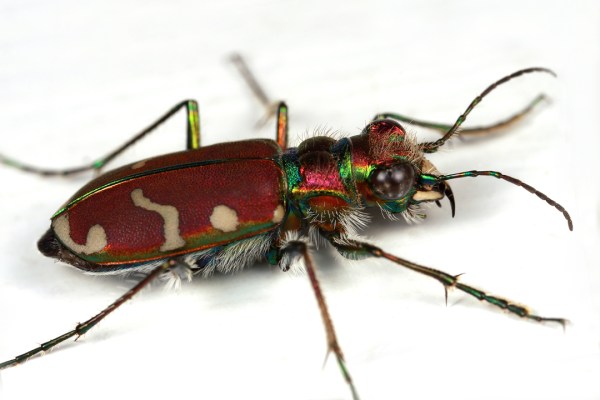
There is, however, a lesson here to be learned, and that is don’t be too quick to send to the recycle bin a photo that at first sight appears not worth keeping. Take, for example, this photograph of Cicindela limbalis (Common Claybank Tiger Beetle). This pretty little species is broadly distributed in Canada and the northern U.S. from New England across the Great Plains to the eastern edge of the Rocky Mountains. Different populations show differing degrees of maculation, and here in Missouri the species is nearly immaculate. I found the individual in the above photo in Wyoming’s Medicine Bow National Forest as an example of the more completely maculated forms. However, since it was the only individual I saw in that location I didn’t try to photograph it in the field. Instead, I captured it and photographed it later in the “studio” (my hotel room). Sadly, this was in September 2010 when I was still a rank beginner in terms of insect macrophotography, and as a result I was far less versed on such details as lighting and composition than I am now. I’m ashamed to say that I thought this photo was “good enough.”

Of course, by today’s standards that is one crappy photo! If it wasn’t the sole photo that I have from that population I wouldn’t hesitate to throw it away. However, since I’ve been putting some effort recently into honing my Photoshop skills, I thought I would see if I could “rescue” from this crappy photo a halfway decent one. I did this as follow:

  • I opened the “Levels” tool, clicked on the “Set White Point” button, and touched the cursor to an area of the upper background. This not only eliminated most of the gray tinge in the background but also brightened up the beetle quite a bit. I brightened the beetle even more by pulling the left slider button in the “Input Levels” box a little more to the right (12). In the case of this photo, such levels adjustments were sufficient, but in some cases I might also slightly reduce shadowing using the “Shadows/Highlights” tool (2–10% is usually enough) or adjust color using the “Adjust Hue/Saturation” tool (whether you increase or decrease saturation, a light touch is best).
  • With the background brightened up, the debris spots were even more visible and needed to be cleaned up. This was easily accomplished with the “Spot Healing Brush” tool. I keep the size setting as small as possible for each spot while still encompassing the entirety of the spot. Debris spots next to or on the surface of the beetle are better dealt with using the “Clone Stamp” tool—this tool is a little more involved than the Spot Healing Brush, since a source point needs to be selected for each spot. However, it is more effective than the Spot Healing Brush for spots that are in areas where the background is not uniform. Again, I use the smallest size possible and carefully consider the source point for each clone to achieve the best results.
  • The last major problem with this photo was its composition. If I were to take it again today, I would angle the front of the beetle higher in the photo and not clip the middle and hind tarsi or antennal tip as I did in this photo. There is not a lot (though there is a little) that can be done about the clipping, but I used the “Straighten” tool to change the angle of the beetle by clicking on the tip of the abdomen and dragging the cursor to somewhere between the lower front leg and antenna. This resulted in a more pleasing pose for the beetle, but of course it also created triangular areas of blank canvas on each side that had to be dealt with. To do this, I cropped the edges of the photo to remove as much of the blank canvas as I could without cropping off any more of the beetle (I did end up cropping a little bit of the left hind leg), then used the Clone Stamp tool to fill the remaining blank areas with white background (this is much more difficult when the background is not as uniform as in this photo). Careful cloning is required in areas that are close to the beetle to prevent unintended alterations, and in this case I even had to clone in a fake lower tarsus for the middle leg and antennal tip for the left antenna to fill gaps that I could not crop. Cloning in new body parts is not always possible, and even when it is possible it’s not easy; however, with care and practice reasonable results can be achieved. In the case of this beetle it was not too difficult since the body parts that needed to be cloned were just short extensions of already blurred parts.

Lastly, I used typical “Unsharp Mask” settings to sharpen the photo, and here is the final result:

This photo won’t win any awards, but it is a completely serviceable illustration of the species.

This is still not a great photo—in addition to the clipping, the focus is a tad too deep and the beetle has assumed that dreaded “ground hugging” pose that I so detest with confined subjects. Nevertheless, I wouldn’t be ashamed to use this photo if none better were available.

What alternative techniques would you have used on reworking this photo?

Copyright © Ted C. MacRae 2012