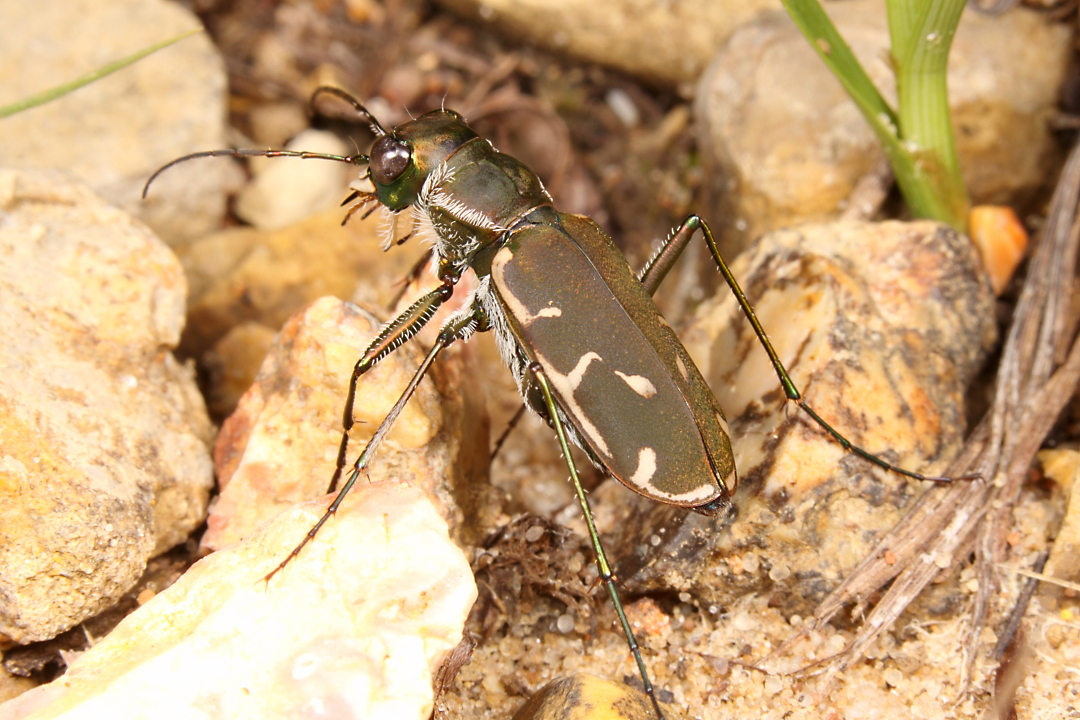
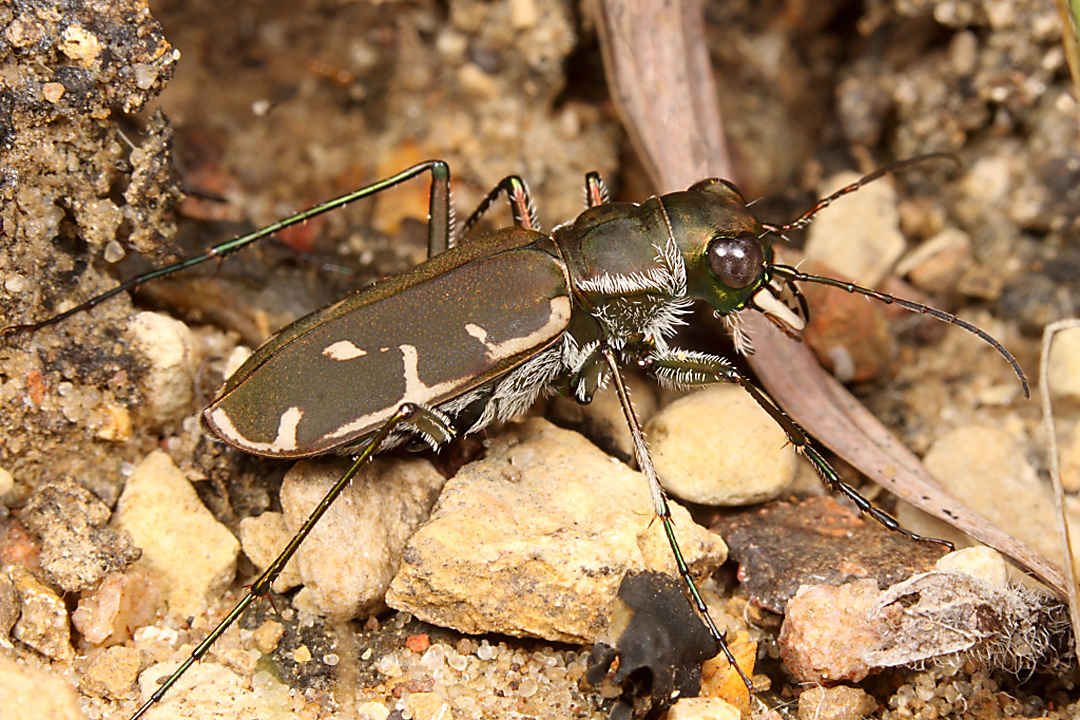
The Methocha

As pointed out in my recent post, , there is much to learn still regarding tiger beetle larval parasitoids. In addition to bee flies (order Diptera, family Bombyliidae) of the genus Anthrax, tiphiid wasps (order Hymenoptera, family Tiphiidae) in the genus Methocha also parasitize tiger beetles in their larval burrows. Unlike bee flies, however, which sneakily lay their eggs in and around tiger beetle burrows when their victim isn’t watching, Methocha females aggressively engage the larva and even allow themselves to be grasped within the beetle larva’s sickle-shaped mandibles in order to gain entry to the beetle’s burrow.

Methocha appears to be a rather diverse genus, but it’s taxonomy is still incompletely known. George Waldren from Dallas, Texas is working on a revision of the genus and has found several new species in Texas alone. George is interested in seeing Methocha material from other areas as well and recently sent me the following reminder that adult females are active now:

…if you know of any areas with many tiger beetle larvae, now is the time to find Methocha. They superficially look like Pseudomyrmex ants, but once you see one you’ll catch on to them quickly. I collected more than 70 females today in a large aggregation of Tetracha carolina burrows.

In a subsequent message he adds:

Collect as many as you can, since they seem to be highly seasonal and rare most of the year. I almost always find them around beetle populations in sandy creek beds and receding bodies of water. A pooter works best if they are abundant and there isn’t much for them to hide under. Using your fingers also works—the sting is mild and usually doesn’t pierce the skin (depends on the person and size of the wasp). Vial collecting one by one works just as well.

Methocha females are generally overlooked due to their specialized life history and few specimens are in collections. Males are better represented since they’re easily collected with malaise traps.

If you have any Methocha specimens or manage to collect some, please contact George (contact info can be found at his BugGuide page). BugGuide does have a few photographs of these wasps to give you an idea of what they look like, but this excellent video titled “The Methocha” from Life in the Undergrowth with David Attenborough provides an unparalleled look at their appearance and behavior:


Copyright © Ted C. MacRae 2011

Different Jaws for Different Jobs

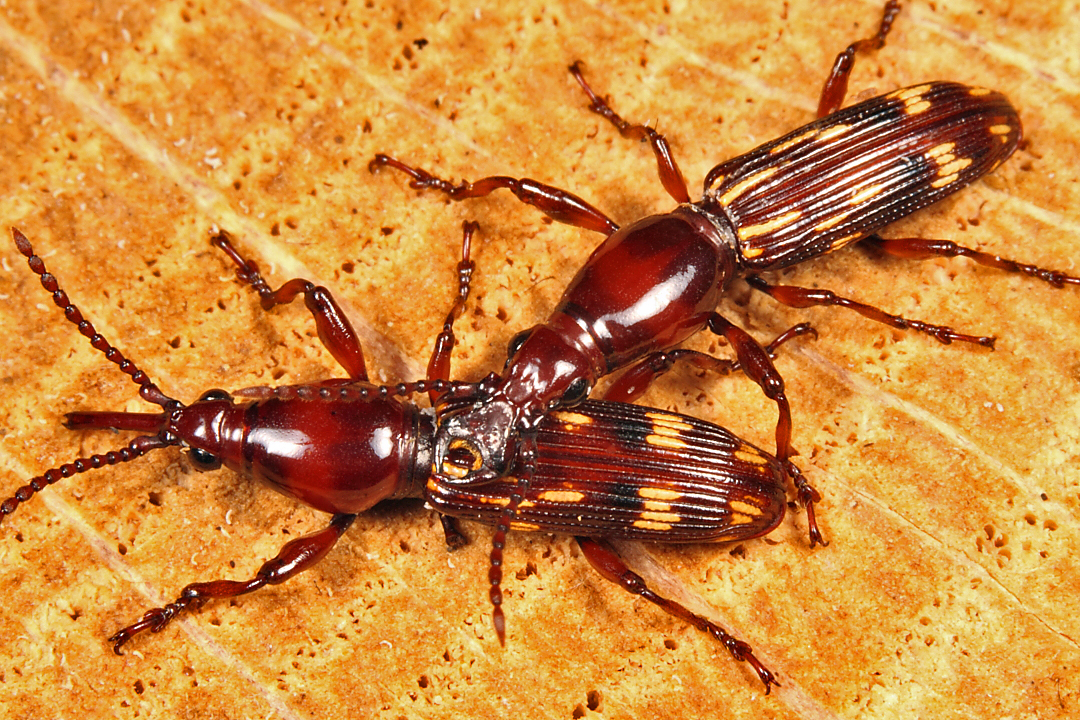
Arrhenodes minutus (oak timberworm) | Wayne Co., Missouri

If you’re interested in wood boring beetles and live in the eastern  U.S. like I do, you’re sure to encounter sooner or later the region’s sole¹ “primitive weevil” (family Brentidae), the oak timberworm (Arrhenodes minutus).  This beetle develops as a larva in the wood of living trees exposed by wounding, creating numerous small “worm holes” that can occasionally degrade the value of wood grown for timber.  Females are presumably attracted to volatiles given off by wounded wood for oviposition, thus they are also commonly attracted to the trunks and stumps of trees harvested for lumber or cut for some other reason.  Cut trees are also highly attractive to wood boring beetles in the families Buprestidae and Cerambycidae—my primary taxa of interest, so I’ve seen more than a few oak timberworms over the years, including this male and female that I found on the cut stump of a large black oak (Quercus velutina) in Sam A. Baker State Park, Wayne Co., Missouri.

¹ Actually, there are three other species in eastern North America as well, but all are Neotropical species that occur no further north than the southern tip of Florida (Thomas 1996).

Female - beak thin and elongate

Male - beak short w/ robust mandibles

An interesting feature of oak timberworms and related species of primitive weevils is the rather extreme sexual dimorphism exhibited in the shape and function of the mandibles.  Mandibular sexual dimorphism is actually quite common across many groups of beetles, but in most cases the males simply have proportionately larger mandibles than females due to their use in sexual combat (think stag beetles, for example).  Oak timberworm males also have enlarged mandibles for combat with other males (males are territorial and guard females during oviposition).  The females, however, rather than simply having smaller yet similarly shaped versions of the male mandibles, instead have tiny little mandibles at the end of a greatly narrowed and elongated rostrum (beak).  This is because, unlike most other beetles in which the female mandibles lack a specific purpose, female oak timberworms use their mandibles to “drill” holes into the wood in which they will insert their eggs.  Different forms for different functions!

Mate-guarding behavior

I have read reports of males assisting females in removing her beak if stuck in the wood while drilling an egg hole by “stationing himself at a right angle with her body and pressing his heavy prosternum against the tip of her abdomen, her stout fore legs thus serving as a fulcrum and her long body as a lever” (Riley 1874, as quoted in Thomas 1996), making this a rare instance of tool use by insects.  I have not observed this behavior myself, but it is common to find the males in various mate guarding positions over the female as pictured above.

REFERENCE:

Riley, C. V. 1874. The northern brenthian—Eupsalis minutus (Drury). (Ord. Coleoptera; Fam. Brenthidae). Sixth Annual Report on the Noxious, Beneficial, and Other Insects, of the State of Missouri. Began and Carter, Jefferson City, Missouri, 169 pp.

Thomas, M. C. 1996. The primitive weevils of Florida (Coleoptera: Brentidae: Brentinae). Florida Department of Agriculture & Consumer Services, Division of Plant Industry, Entomology Circular No. 375, 3 pp.

Copyright © Ted C. MacRae 2011

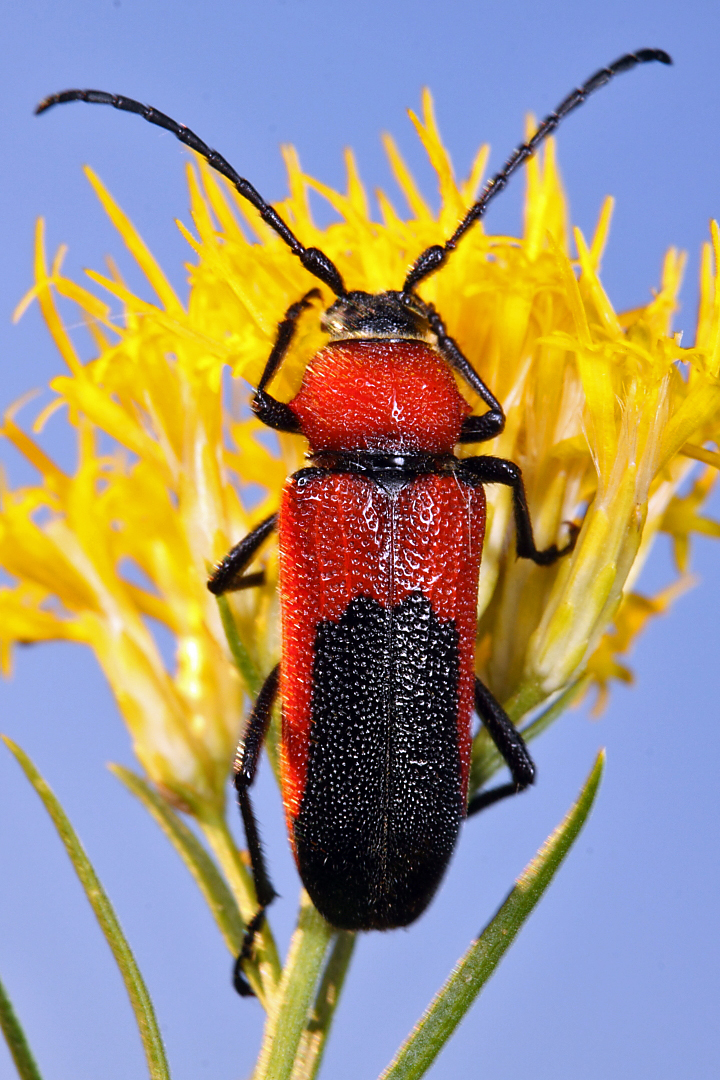
Crossidius coralinus fulgidus

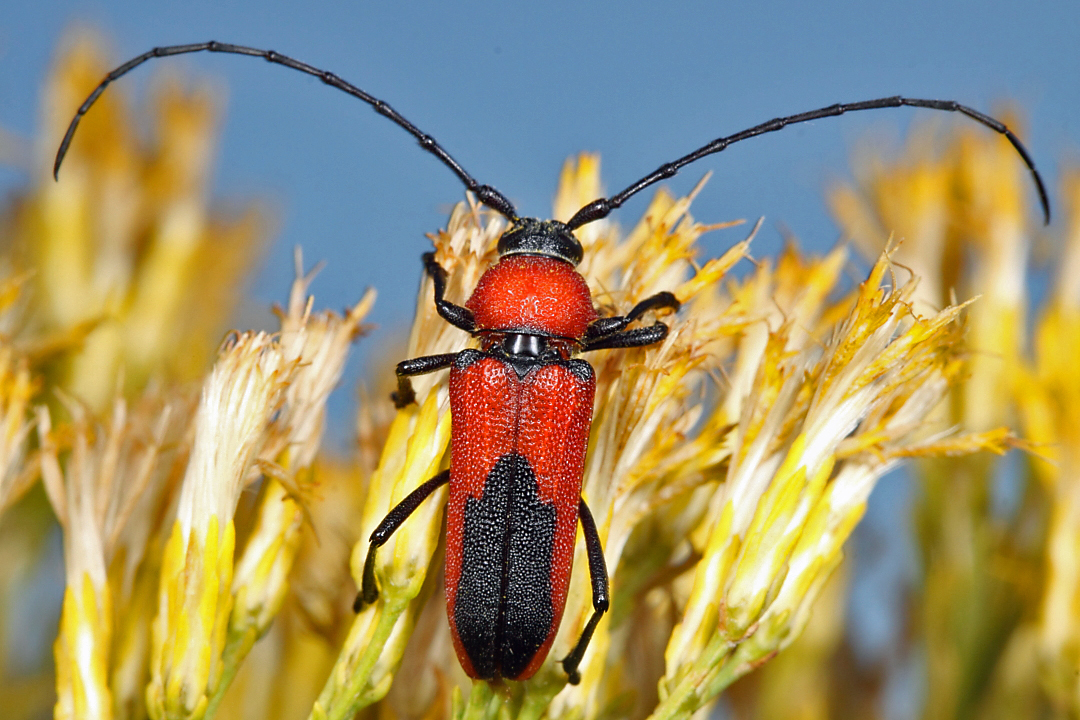
Crossidius coralinus fulgidus | Uintah Co., Utah

Tiger beetles may have been the primary focus of last week’s 9-day, 10-state, 4,700-mile collecting trip; however, they were not the only beetles I was hoping to see. Longhorned beetles (family Cerambycidae) of the genus Crossidius are unusual in the family because of their fall rather than spring/summer adult activity period, and they just happen to occur in dizzying variety throughout the Great Basin and surrounding mountainous areas. Larvae of all species are presumed to feed on the roots of perennial, shrubby, fall-blooming composites, primarily in the genera Chrysothamnus, Ericameria, Gutierezzia, and Haplopappus (Linsley and Chemsak 1961), with the adult activity period undoubtedly timed to allow congregation and mating on the late-season blooms of their host plants.  Only 13 species are currently recognized, but these are further divided into 37 subspecies and innumerable locally distinct populations.  Not having spent much time in the mountain west during the fall, this group has till now been poorly represented in my collection.

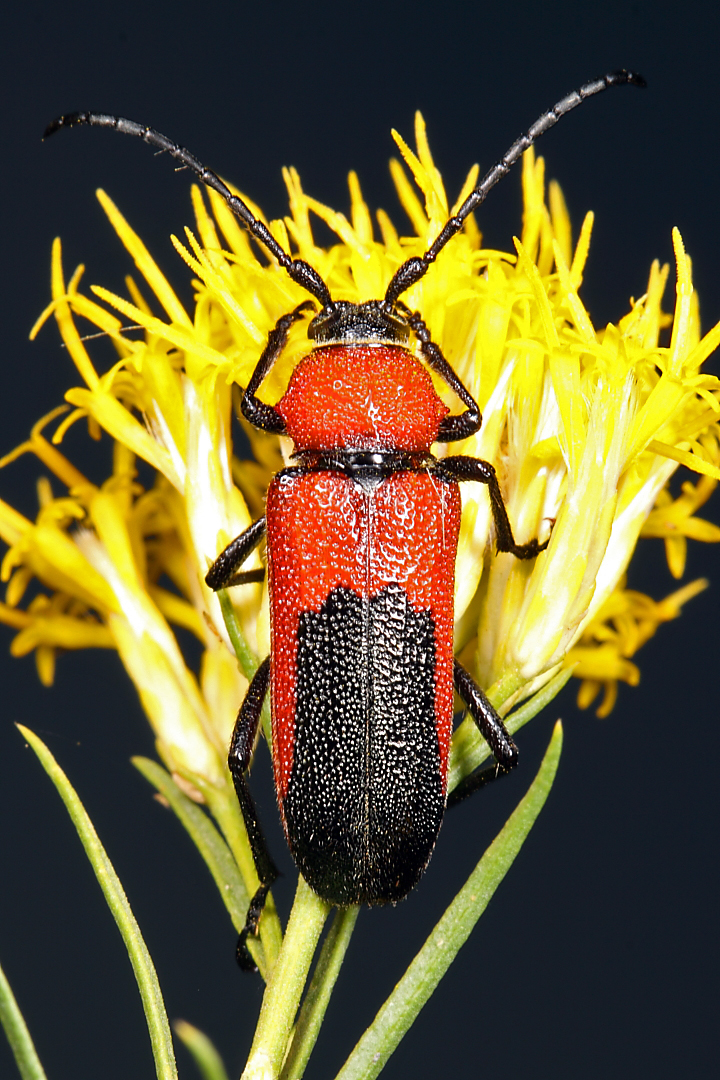
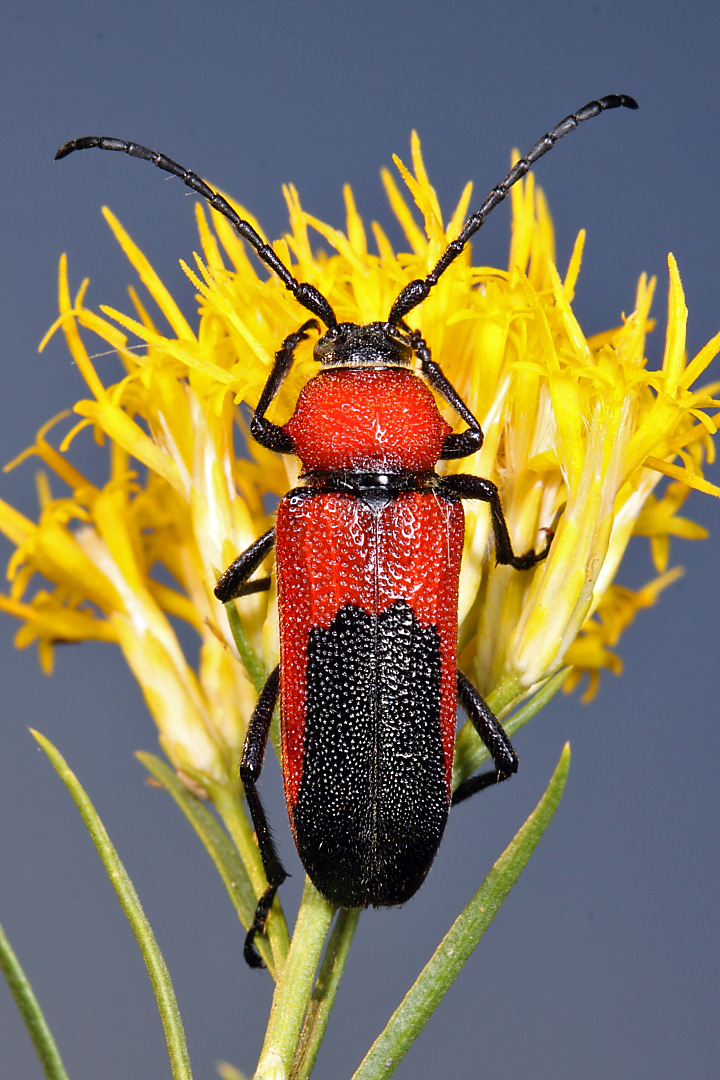
The species shown here, Crossidius coralinus fulgidus, was among the first of many that we encountered during our trip.¹  This population was seen near Vernal in northeastern Utah.  It was late in the day and the adults had settled for the night onto the flowers of their host plant, Ericamera nauseosa.  Flower-visiting longhorned beetles are notoriously frustrating subjects to photograph, as their constant movement and long legs and antennae make focus and composition difficult.  These beetles had essentially ceased activity, allowing me to carefully compose and focus the shot, and the low sun in the western sky provided a bright blue eastern sky to use as a colorfully contrasting background.  The photo above (the very long antennae identify it as a male) was taken hand-held with my Canon 100mm macro lens at ISO 400 and 1/60 sec to allow exposure of the sky and flash at an aperture of f/16 to illuminate the subject and achieve good depth of field.  My only criticism of this photo is the small amount of blur seen in the distal antennal segments.

¹ “We” refers to myself and Jeff Huether from Geneva, NY. Jeff is primarily interested in Meloidae but like me also has an interest in Cerambycidae. I was fortunate to have Jeff with me on this trip, as he has collected extensively throughout the Great Basin region and encountered nearly all of North America’s named species and subspecies of Crossidius. It is only because of his prior experience with this group that I was able to find this and several others that we saw during the trip.

ISO 100, 1/200 sec

ISO 400, 1/200 sec

ISO 400, 1/60 sec

Because the beetles were so calm, I spent some time with this female individual trying different settings to see their effect on background color, subject illumination, and detail.  All were taken hand-held using the same lens at f/16, with the left photo also using my “typical” settings of ISO 100 and 1/200 sec.  The background is very dark (in post-processing I might choose to make it black)—good for some subjects but not this one, and although the focus is good the lighting is rather harsh (I had to decrease highlights in post-processing much more than I normally like).  The center photo was taken with ISO increased to 400 and results in a much more pleasing, if still not very natural-looking sky background.  Focus remains good and the shorter flash duration needed reduces the amount of highlighting that needs post-processing adjustment.  Overall I like this photo the best except that the sky is not true in color.  The right photo is also at ISO 400 but uses a slower shutter speed (1/60 sec).  The sky in this photo is the most natural-looking, and as might be expected problems with flash highlights are minimal—it almost looks like a natural light photograph.  However, some amount of motion blur can be detected, especially in the antennae.  Perhaps intermediate shutter speeds (e.g. 1/120 sec) or slightly higher ISO might effectively deal with this while still allowing the truest colors.  What do you think?

REFERENCE:

Linsley, E. G. and J. A. Chemsak.  1961.  A distributional and taxonomic study of the genus Crossidius (Coleoptera, Cerambycidae).  Miscellaneous Publications of the Entomological Society of America 3(2):26–64, 3 color plates.

Copyright © Ted C. MacRae 2011
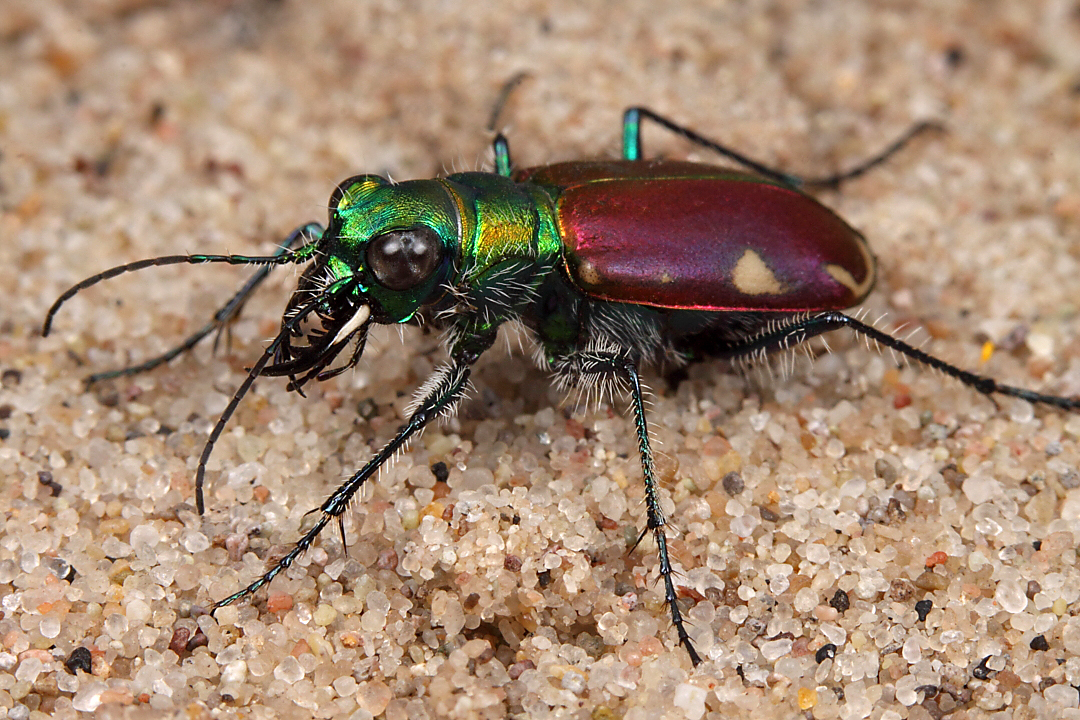
Cicindela scutellaris yampae – Yampa Festive Tiger Beetle

In A Field Guide to the Tiger Beetles of the United States and Canada (Pearson et al. 2006), Cicindela scutellaris yampae (Yampa Festive Tiger Beetle) is one of 223 species and subspecies listed in the book’s index to species and subspecies. Although the book’s alphabetical listing places it second to last in the list, it surely must be considered near the top of any list based on beauty. It is also among the most geographically restricted tiger beetles in North America, restricted to the Maybell Sand Dunes in northwestern Colorado where it occurs with the equally beautiful, rare, and restricted Cicindela formosa gibsoni (Gibson’s Big Sand Tiger Beetle). Like that subspecies, C. s. yampae was one of six endemic sand dune tiger beetles targeted in this year’s Annual Fall Tiger Beetle Trip™, and as these photos show I was lucky enough to find it.

Cicindela scutellaris yampae | nr. Maybell, Colorado

As a species, C. scutellaris is one of North America’s most widely distributed and polytopic species, with the nominate and lecontei forms inhabiting a wide swath of the Great Plains and Midwest.  Around the eastern, southern, and western perimeters of its geographical distribution occur numerous named subspecies exhibiting a tremendous diversity of variations on the species’ “normal” coloration and maculation.  Cicindela s. yampae is most similar to the nominate subspecies due to its green head and prothorax with purple-red elytra, but it differs in possessing a broad white maculation on the side of each elytron (top photo).  There are individuals, however, in which the maculation is reduced to isolated spots (bottom photo), resembling somewhat the pattern of maculations seen in C. s. lecontei further to the east.

C. scutellaris yampae w/ reduced maculations

Pearson et al. (2006) note that records over the years suggest the remaining populations of this beetle are small. We did not see many individuals on our visit to the type locality east of Maybell early this past week (perhaps no more than seven total), and we saw none at a formerly larger sand dune about 10 miles west of Maybell.  In past years this latter site has supported good numbers of the beetle, but it has apparently succumbed to vegetational encroachment of the formerly more open sand dune. As far as I am aware there are no conservation measures in place on any level to protect these remaining populations and ensure that adequate suitable habitat remains to enhance the beetle’s long-term prospects.

REFERENCE:

Pearson, D. L., C. B. Knisley and C. J. Kazilek. 2006. A Field Guide to the Tiger Beetles of the United States and Canada. Oxford University Press, New York, 227 pp.

Copyright © Ted C. MacRae 2011
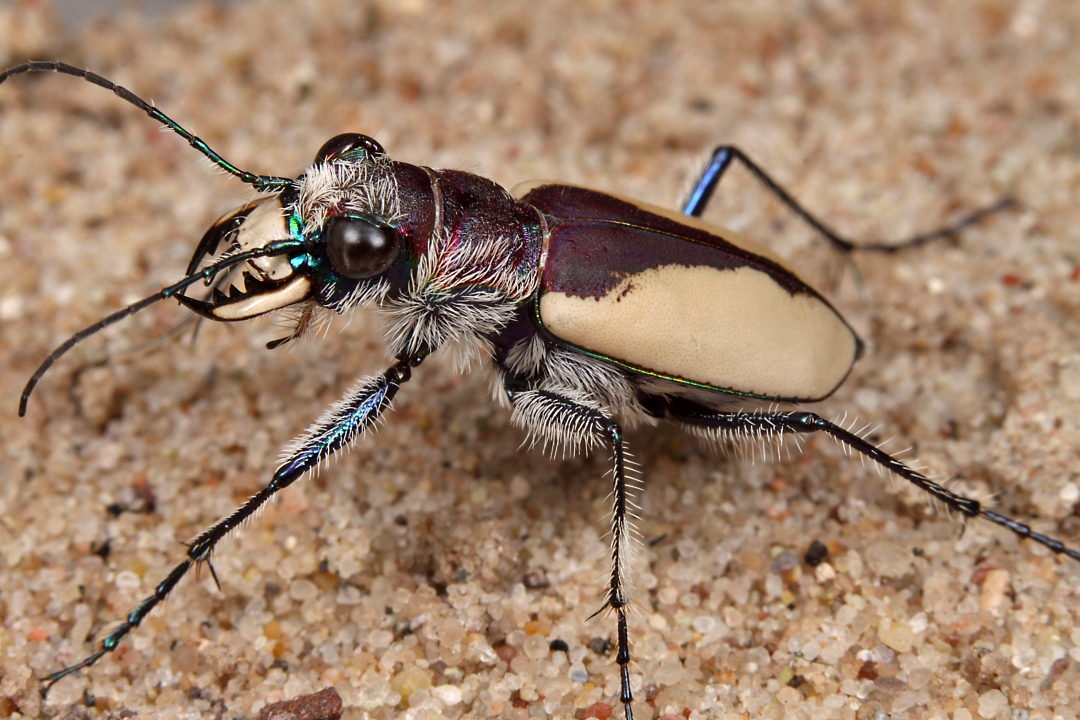
Cicindela formosa gibsoni… or not!

Last Friday I began the 2011 Annual Fall Tiger Beetle Trip™. This year’s edition was actually a last-minute change—my original plans to collect wood for rearing wood-boring beetles in south Texas thwarted by that state’s long and continuing drought (along with the unwillingness of some of the area’s federal wildlife refuge managers to grant my research study permits despite the work I’ve done there in past years—apparently only institutional and not personal research is now deemed credible by these courageous individuals who are doing their best to protect the natural resources in their charge). My travel funds are limited, and rather than throw good money at a bad situation, I decided to pursue greater chances of success and make the trip that I have wanted to do for some time now—the Great Sand Dunes tour through the Rocky Mountains and Great Basin. The target species include many of the classic western sand dune species, and I hope to feature most of them in the days and weeks after the conclusion of the trip this coming weekend.

Cicindela formosa gibsoni | nr. Maybell, Colorado

The first of these target species that I encountered is the subject of this post, Cicindela formosa gibsoni (Gibson’s Big Sand Tiger Beetle).  This large, robust, and gorgeously marked subspecies is highly restricted in occurrence, curiously to two areas separated by more than 1,000 km—the Maybell Sand Dunes in northwestern Colorado (Moffat County) and the Great Sand Dunes of southwestern Saskatchewan.  It is distinguished from the nominate form and other subspecies by having the white markings of the elytra so expanded in most individuals that they coalesce and cover nearly the entire elytral surface.  The result of such a large white surface with contrasting red-purple head, thorax, and elytral sutural area is one of North America’s most spectacularly marked tiger beetle species.  The individual photographed here was one of many observed a few days ago on the Maybell Sand Dunes¹, and I feel truly lucky to have been able to personally witness these striking beetles flying powerfully across the dunes in their small home range, landing far away with the comical bounce and tumble that is characteristic of this and the other subspecies.

¹ In the interest of full disclosure, these photos were taken later in the day using subjects confined in a terrarium of native substrate. I had intended to photograph them in the field; however, they unexpectedly began digging burrows around 2 p.m., and my efforts to stalk the last few stragglers before they disappeared were not successful.


An interesting situation occurs regarding the taxonomy of this subspecies.  Despite the nearly identical appearance of adults from both the Saskatchewan and Colorado populations, logic and differences in larval coloration suggest that these two populations have arisen independently, their common appearance a result of convergence rather than shared ancestry.  Molecular studies are in progress to determine more conclusively whether this is true (hopefully augmented with material collected during this trip).  The subspecies was originally described based on specimens collected in Saskatchewan, thus, if convergence is confirmed the Maybell population will find itself needing a new name.

Congratulations to Doug Taron, who narrowly beat perennial heavyweight Ben Coulter, Tracy Mormon and Mr. Phidippus for the ID Challenge #12 win.  The overall standings remain unchanged, with Ben still in the lead with 65 points, Mr. Phidippus 2nd with 54 points, and Roy completing the podium at 39 points.  The final standings may seem like a lock, but there will still be one more challenge in the session—anything can happen!

Copyright © Ted C. MacRae 2011
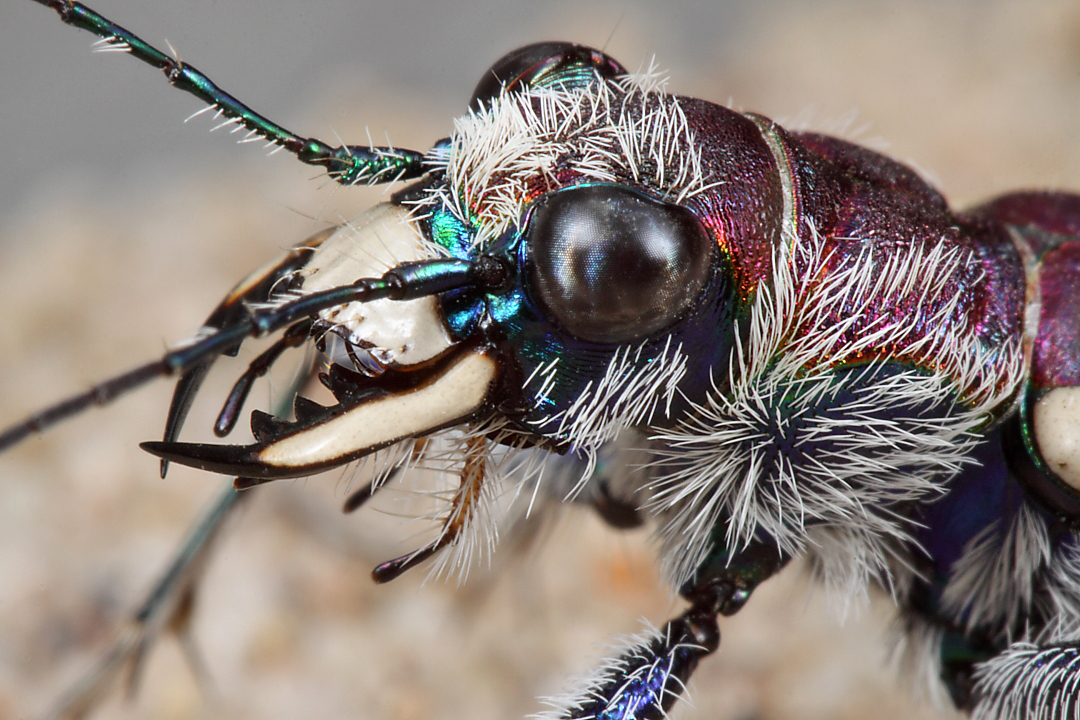
A cicindelophilic wish list

  • Cicindelia obsoleta vulturina disjuncts bolting across lichen-covered sandstone balds.
  • Cicindela scutellaris yampae—red, white and blue in all its glory!
  • Big, bold, hugely white Cicindela formosa gibsoni bouncing across the sand.
  • Cicindela arenicola dancing across the St. Anthony dunes.
  • Hugely-mandibled male Cicindela waynei riding the backs of their lovers.
  • The almost pure white Cicindela albissima in its own tiny little corner of Utah.
  • Cicindela theatina, perhaps most colorful of the western sand dune species.

In a perfect world, I will make it to every one of these locations and encounter each and every species in the list. More realistically, it would be presumptuous to expect complete success on such a quickly planned, last minute trip—I’ll be happy to make it to at least some of these sites and find what I’m looking for. Beyond the above species there should also be the more reliable Cicindela lengi, C. tranquebarica, and the nominate forms of C. formosa and C. scutellaris—classic denizons of the west. When I get a chance to take a look in alkaline flats, perhaps I’ll also be able to add C. willistoni or C. parowana to the bounty list. When I can take specimens, I will (responsibly), and when I can’t I’ll hopefully take acceptable photos. Really though, this is mostly about getting out and seeing a huge swath of the country that I’ve never seen before during the most gorgeous time of year. I’ll see it my way—up close and personal and not just blasting by at 70 mph. Sometimes life just doesn’t get any better!

Copyright © Ted C. MacRae 2011

Not all Florida tiger beetles are rare

Tetracha carolina (Carolina Metallic Tiger Beetle) | Dixie Co., Florida

I fear my recent series of posts from Florida might leave readers with the impression that all of that state’s tiger beetle species are rare endemics occurring in tiny remnants of relictual habitats and encountered only by the most intrepid collectors enduring the harshest of conditions.  While it’s true that Florida has its share of such species (perhaps more than any other state in the country), it is also home to numerous species that most cicindelophiles would consider rather common—even pedestrian.  “Common” is a relative term, however, depending on where you live, and featured here is a species that until recently would have been for me just as exciting a find as Cicindelidia scabra or Habroscelimorpha striga.

Purple reflections and expanded apical lunules on the elytra distinguish this species from T. floridana

Tetracha carolina (Carolina Metallic Tiger Beetle) is one of the most widely distributed tiger beetle species in the Western Hemisphere, occurring not only across the southern U.S. but also the West Indies and south through Mexico, Central America, and the west coast of South America to Chile.  It was only during the past 10 years, however, that I actually saw the species for myself in Missouri, as it is restricted to the Mississippi Alluvial Plain in the extreme southeastern corner of the state (the so-called “Bootheel”).  Not much was known about the status of this species in Missouri the first time I encountered it under building lights at the University of Missouri Delta Research Center in Portageville.  It was my first experience with “nocturnal tiger beetling,” and you can imagine my excitement at seeing these green and purple beauties glittering in the light of my headlamp.  We now know that the species, despite its restricted occurrence in Missouri, is actually quite common in a variety of habitats in that part of the state, including even agricultural fields where they hide during the day under irrigation pipes (Fothergill et al. 2011).

I simply can't resist these tiger beetle face shots!

The individual in the photographs shown here was seen at the famed “Road to Nowhere” site in a remote part of the Florida Gulf Coast—one of eight total species of tiger beetles that I’ve seen at this site during my two August visits (2009 and this year).  This site is actually one of a few places in Florida where this species co-occurs with T. floridana (Florida Metallic Tiger Beetle), an endemic species restricted to estuarian habitats in the southern half of the Florida peninsula, and until recently considered a subspecies of T. carolina (Naviaux 2007).  The brilliant purple reflections in the basal half of the elytra clearly distinguish this individual as T. carolina, as did its occurrence up on the drier sandy roadside rather than down in the salty mud flats preferred by T. floridana.  Also seen at this site up along the road were numerous adults of the broadly distributed T. virginica (Virginia Metallic Tiger Beetle), making this one of the few sites in the country where three of the four U.S. species of Tetracha can be found (the fourth, T. impressa—Upland Metallic Tiger Beetle, is a Neotropical species that reaches the U.S. only in the Lower Rio Grande Valley of south Texas).

REFERENCE:

Fothergill, K., C. B. Cross, K. V. Tindall, T. C. MacRae and C. R. Brown. 2011. Tetracha carolina L. (Coleoptera: Carabidae: Cicindelitae) associated with polypipe irrigation systems in southeastern Missouri agricultural lands. Cicindela 43(3): in press.

Naviaux R. 2007. Tetracha (Coleoptera, Cicindelidae, Megacephalina): Revision du genre et descriptions de nouveaus taxons. Mémoires de la Société entomologique de France 7:1–197.

Copyright © Ted C. MacRae 2011
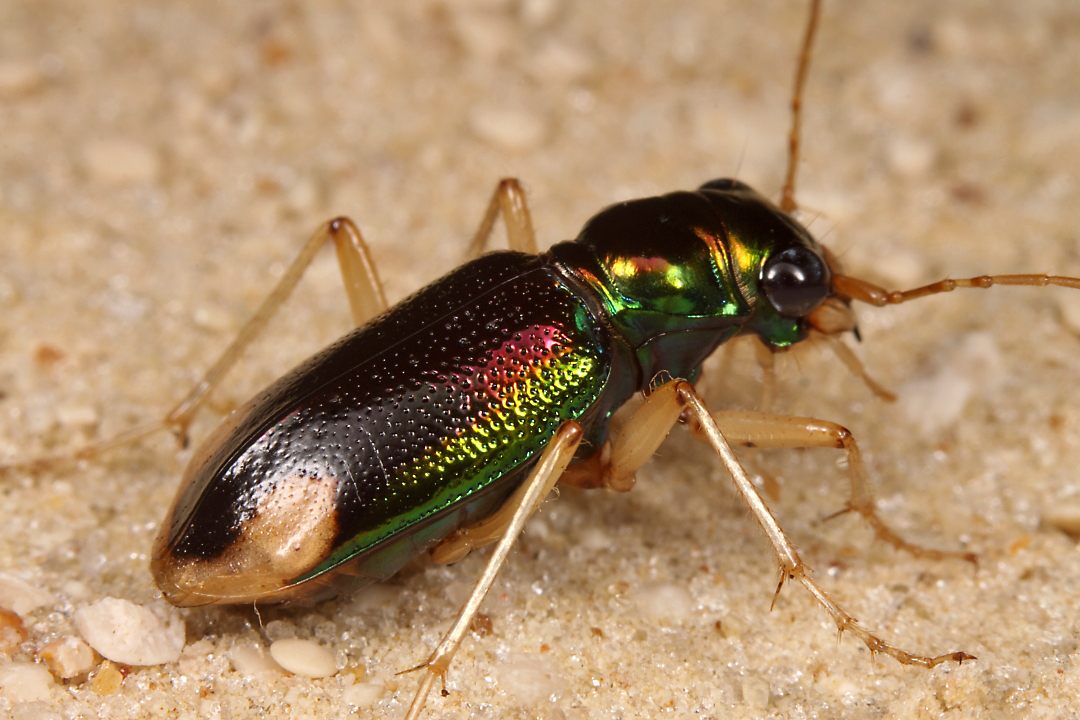
Two things I love about glades during fall…

…prairie dock (Silphium terebinthinaceum) in bloom…

Prairie dock (Silphium terebinthinaceum) in bloom | Caney Mountain Cons. Area, Ozark Co., Missouri

…and prairie tiger beetles (Cicindelidia obsoleta vulturina) on the prowl…

Prairie tiger beetle (Cicindelidia obsoleta vulturina) | Caney Mountain Cons. Area, Ozark Co., Missouri

On the last weekend of August I made another trip to the White River Hills of north-central Arkansas in a last gasp effort to confirm the occurrence in the area of the swift tiger beetle (Cylindera celeripes).  Records of this species include a single individual collected in 1996 at a site near Calico Rock, but two trips to the area this past June had already failed to reveal its presence.  I didn’t really expect that I would find it this time either, and such was the case.  However, what I was expecting/hoping to see was the beginning of the fall emergence of the prairie tiger beetle.  The Missouri/Arkansas disjunct population of this handsome species is perhaps my favorite tiger beetle of all, not only because of its good looks but because of the many spectacular fall collecting trips I’ve taken through the White River Hills to look for it.  In this regard I had success, although only two individuals were seen all day long.  The area around Calico Rock seemed dry, apparently having been missed by the thunderstorms that rolled through the area a week earlier and that would have surely triggered full bore adult emergence. 

Long Bald Glade Natural Area, Caney Mountain Cons. Area, Ozark Co., Missouri

The following day I returned to Caney Mountain Conservation Area on the Missouri side, where last fall I had finally found prairie tiger beetles after years of searching what must be the extreme northeasternmost limit of its distribution.  Fresh evidence of recent rains was seen, and accordingly the beetles were out in fairly decent numbers in the same area where I found them last fall.  I took the opportunity to photograph a few individuals (which I had not done last year) and then turned my attention to looking for other insects.  I had my eye out for the spectacularly beautiful bumelia borer (Plinthocoelium suaveolens) and eventually found one.  I hoped also to see the marvelously monstrous Microstylum morosum (North America’s largest robber fly), which I found at this site in 2009 as a new state record and was rewarded with two individuals (these will serve as vouchers for the state record, since I didn’t collect it in 2009).  Temperatures were rather warm and both of these latter species are traditional “summer” species; however, the presence of prairie tiger beetles, the tawny tinge to the prairie grasses, and the noticeably longer shadows under a deep blue sky told me that fall was, indeed, on the way.

Prairie tiger beetle (Cicindelidia obsoleta vulturina) | Caney Mountain Cons. Area, Ozark Co., Missouri

While prairie tiger beetles are (at least for me) the most iconic harbinger of fall in the White River Hills, another classic fall sight was the thick stands of prairie dock plants with their tall, bolting flower spikes.  In Missouri this plant serves as a larval host for the longhorned beetle Ataxia hubbardi.  In my early years of collecting in Missouri’s glades, I delighted in finding adults of these beetles clinging to the flower stalks during fall—presumably laying eggs from which larvae would hatch and bore down into the tap-root.  Although commonly regarded as a pest in sunflower in the southern Great Plains, individuals associated with prairie dock in Missouri’s glades seem different—smaller, narrower, and darker—than those found on sunflower and other more common hosts.  Additional material will be needed to make a final assessment on whether these individuals represent a distinct taxon; however, I have not been able to find this species on prairie dock in Missouri since I moved back to the state nearly 16 years ago.  The reason for this sudden disappearance remains a mystery, and perhaps it is purely coincidental that the Missouri Department of Conservation began managing all of their glades with prescribed burns during my previous 5-year absence from the state.  In the meantime, I will continue to examine prairie dock stems every fall in the hopes that once again I will find the beetles and be able to come to a decision about their taxonomic status.  Perhaps I should re-focus my efforts in “low quality” (i.e., never-burned) gladey roadsides rather than our state’s “high quality” (i.e., high floral diversity) natural areas.

Copyright © Ted C. MacRae 2011