Although I’ve been collecting insects since I was a kid (and seriously for nearly three decades), it has only been in more recent years that fall has become an important part of the collecting season for me. With the notable exception of Fall 1978, when the Systematic Entomology course I was enrolled in sent me on a frantic quest to become one of the few undergraduate members of the exclusive “200 family” club (I got 205!), I long viewed fall as a time to hang up the net and begin the winter-long process of mounting, labeling, and curating the hundreds – sometimes thousands – of specimens I had collected earlier in the year during spring and summer. This has primarily been a reflection of my taxonomic interest – woodboring beetles in the families Buprestidae and Cerambycidae, which occur at their overwhelmingly greatest abundance and diversity throughout most of North America during spring and summer but are found only sparingly later in the season. Tiger beetles (family Cicindelidae) changed all that, and when I first began serious study of the group around 10 years ago, I found the combination of gorgeous weather and multitude of “spring/fall” species that emerge briefly during fall an irresistible siren call to the field. I’ve not looked back, and the Annual Fall Tiger Beetle Collecting Trip™ is now an established and eagerly anticipated event.

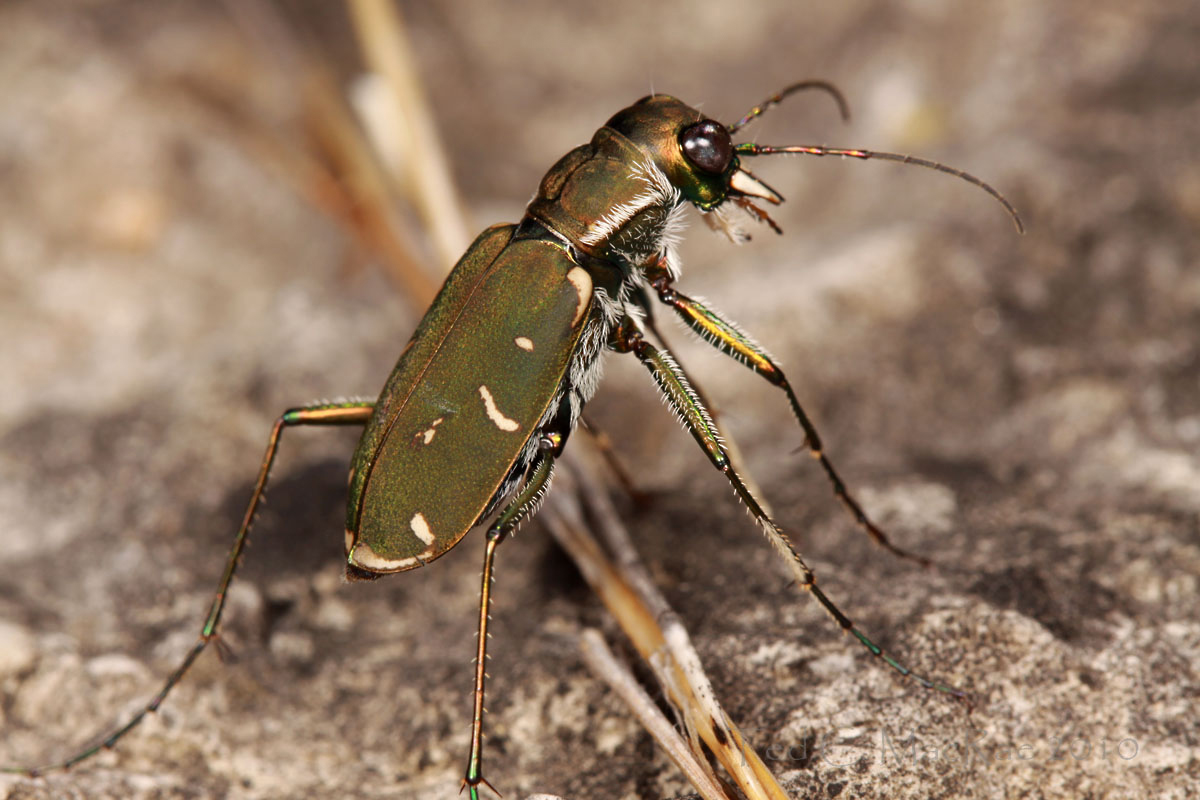
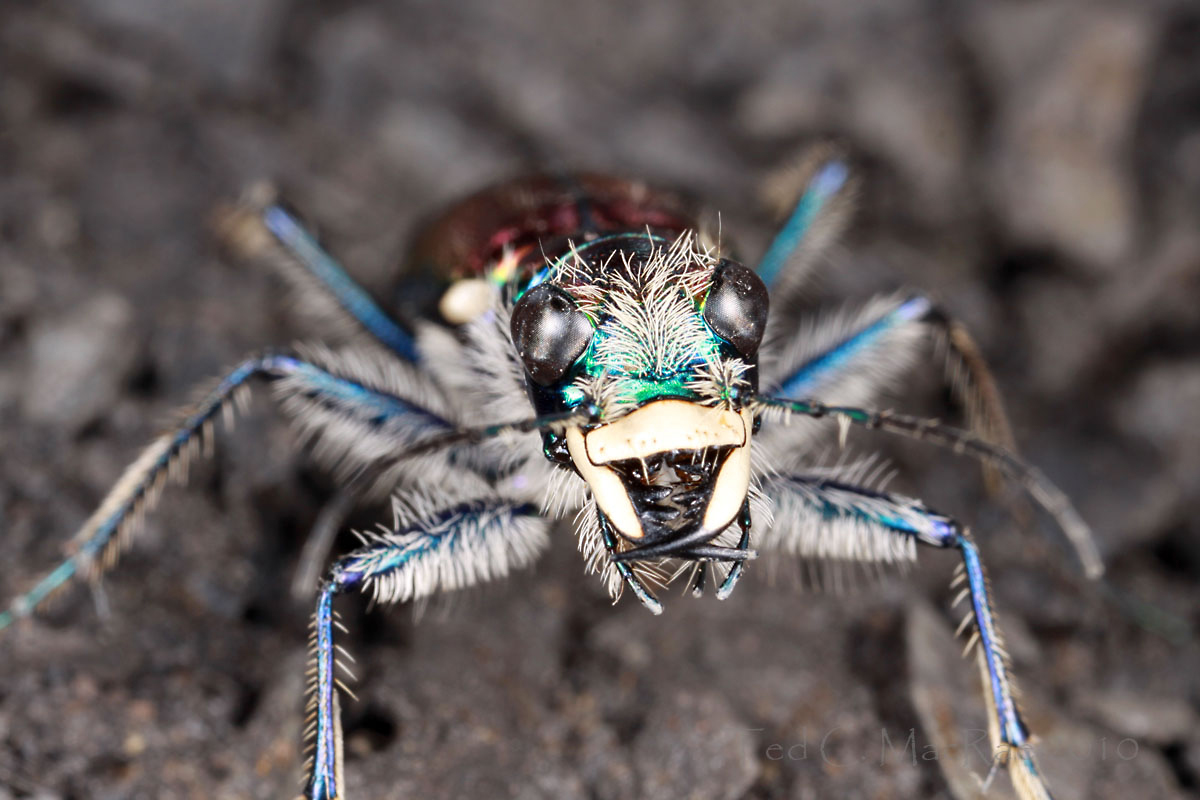
Cicindela obsoleta vulturina - the prairie tiger beetle (Blackjack Knob, Taney Co., Missouri).
No species embodies all that I love about fall tiger beetle collecting more than
Cicindela obsoleta vulturina, the prairie tiger beetle. I first learned of the occurrence in Missouri of this large, dark green species back in 2000, when I saw a single specimen in the
Enns Entomology Museum collected in Protem, Taney Co. I was just beginning my tiger beetle studies and would later learn what the Tiger Beetle Guild already knew – that the occurrence of this species in Missouri was restricted to cedar glade habitats in the White River Hills region in the extreme southwestern part of the state, and that the population occurring there and in adjacent northern Arkansas was disjunct by 300+ miles from the main population in Texas and Oklahoma. I couldn’t wait to see it for myself and eventually enlisted the help of
Eric Eaton, living in the area at the time, and asked him to let me know if he saw a large green tiger beetle after the late summer rains began. That September, I got a message from Eric saying that he had seen just such a beast not far from his home, and the following weekend he and I would enjoy the chance to meet each other in person and the splendor of the season while finding this marvelous species at several locations in the area. Thus began my love affair with this species, and for several years I returned to the area each fall to document additional localities for this and other tiger beetle species occurring in the area.
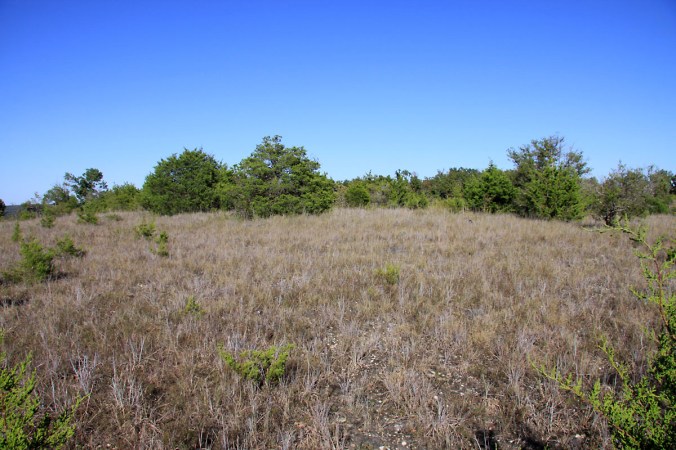
Blackjack Knob is part of an extensive xeric dolomite prairie complex (commonly referred to as cedar glades, though the term is not precisely accurate) in the White River Hills subsection of the Ozark Highlands, providing habitat for prairie tiger beetles and other typically southwestern plants and animals.
In fact, until a few weeks ago it had been several years since I had last seen this species in the field. I did make an attempt to see it again last year but returned home from that early October trip unsuccessful,
cold and wet. Thus, when tiger beetle enthusiast Steve Spomer mentioned to me earlier this summer that he wanted to see our Missouri population, I jumped at the chance to coordinate our visits this fall and show him some of my favorite sites. The Patron Saint of
Cicindela was smiling down upon us that day, as perfect timing and sunny skies combined to bring adults out in an abundance that I’d not seen in any of my previous visits. I would take advantage of this rare opportunity and spend the next day in the area as well, documenting a number of new localities along the northern and eastern edge of its known distribution, including a far eastern extension of its range to
Caney Mountain Conservation Area in Ozark Co. where we had long suspected the beetle to occur but failed in all previous attempts to find it.

Steve Spomer and yours truly at Cane Creek Rd. site.
The prairie tiger beetle is the easternmost subspecies of the large grassland tiger beetle, which along with its other included subspecies covers a geographic range covering most of Texas, New Mexico, and eastern Arizona and extending up through western Oklahoma and Kansas into eastern Colorado. Individuals of subspecies
vulturina, occurring primarily in eastern/central Texas, are distinguished from the other subspecies (nominate in western Texas and eastern New Mexico north into Colorado,
santaclarae in New Mexico and Arizona, and
neojuvenilis in south Texas) by their generally black to olive-green coloration and reduced, narrow elytral markings, typically with an inverted “V” at mid-elytron. The Missouri/Arkansas disjunct population is interesting from several standpoints:
- Individuals mostly dark olive-green – no black individuals.
- Elytral maculations more completely developed.
- Adults active in late summer/early fall rather than summer.
These features, in particular coloration and maculation, have fueled speculation that this isolated population might be subspecifically distinct (Pearson et al. 2006). A recent review of material from throughout its range found these color characters of limited use in unequivocally diagnosing individuals from the Missouri and Arkansas population as a separate subspecific taxon (Mawdsley 2009); however, a molecular systematics approach ultimately may be needed to resolve the status of this population. Presumably, the Missouri/Arkansas disjunct population represents a hypsithermal relict, left behind when the return of cooler, moister conditions caused a retreat of the formerly more expansive grasslands to their current position. If true, then the Missouri/Arkansas population has been isolated from the parent population for ~6,000 years. I suspect that the late summer/early fall adult phenology is an adaptation to local precipitation patterns, relying on more predictable late summer rains to trigger adult emergence after the generally droughty months of July and August. In this regard it differs fundamentally from the true “fall” species, which emerge briefly in the fall as sexually immature adults before overwintering and re-emerging in the spring for mating and oviposition. These Missouri/Arkansas disjuncts do not re-emerge in spring, but instead mate and lay eggs in the fall before the onset of cold weather. The eggs hatch as well (based on my growth chamber observations of this species), so winter also is passed as a larva – either as newly-hatched 1st instars, or as later instars that hatched during the previous year(s) – rather than as adults.
I have noted considerable variation in the coloration and maculations of individuals in this population. The individual in the first photograph above is typical of the population – dark olive-green with thin but nearly complete maculations. That individual comes from Blackjack Knob (Taney Co.), which is near the heart of the White River Hills region. However, the degree to which the maculations are developed is variable, ranging from rather incomplete to even more fully developed due to the presence of a marginal connection. Additionally, a few individuals can be found that show greater or lesser suffusion of brown on the head, pronotum, and elytra. At another location in the county closer to the northern distributional limit (Hwy 160/Cane Creek Rd.), this brown suffusion is more common and variably expressed from minimal to nearly complete. The photographs below show five individuals from this site expressing differing degrees of brown as well as the variable macular development seen throughout the population:
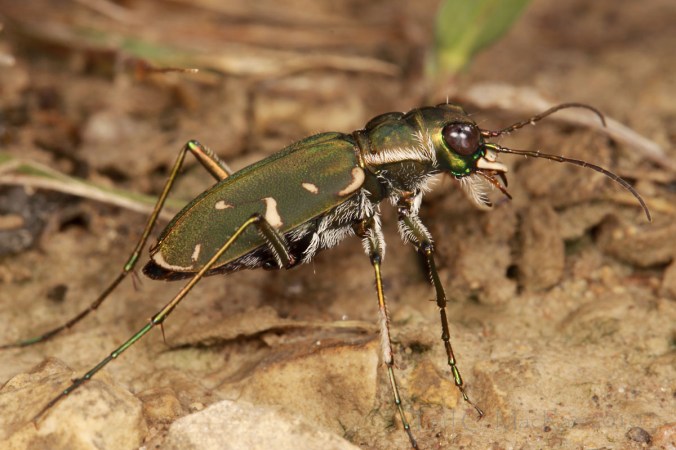
Male (Hwy 160/Cane Creek Rd.) - green w/ trace brown, marginal band incomplete, median band complete.

Female (Hwy 160/Cane Creek Rd.) - green w/ slight brown, marginal band complete, median band incomplete.

Male (Hwy 160/Cane Creek Rd.) - green w/ moderate brown, marginal band incomplete, median band incomplete.
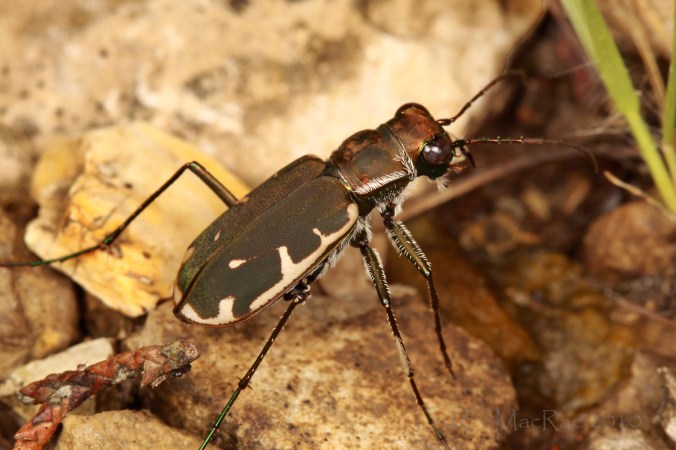
Male (Hwy 160/Cane Creek Rd.) - green w/ heavy brown, marginal band complete, median band complete.
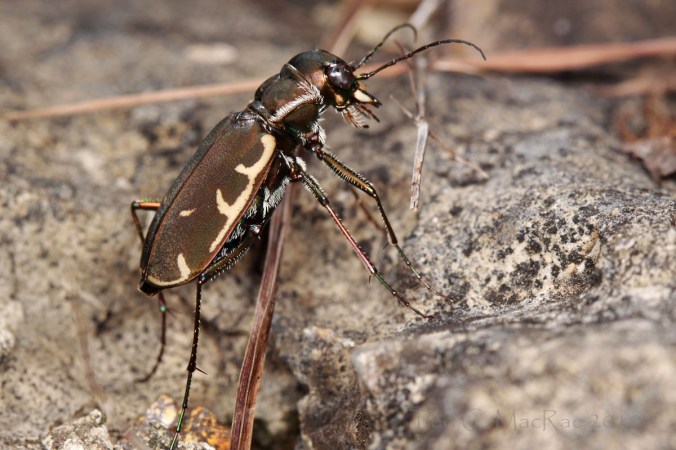
Female (Hwy 160/Cane Creek Rd.) - completely brown, marginal band complete, median band incomplete.
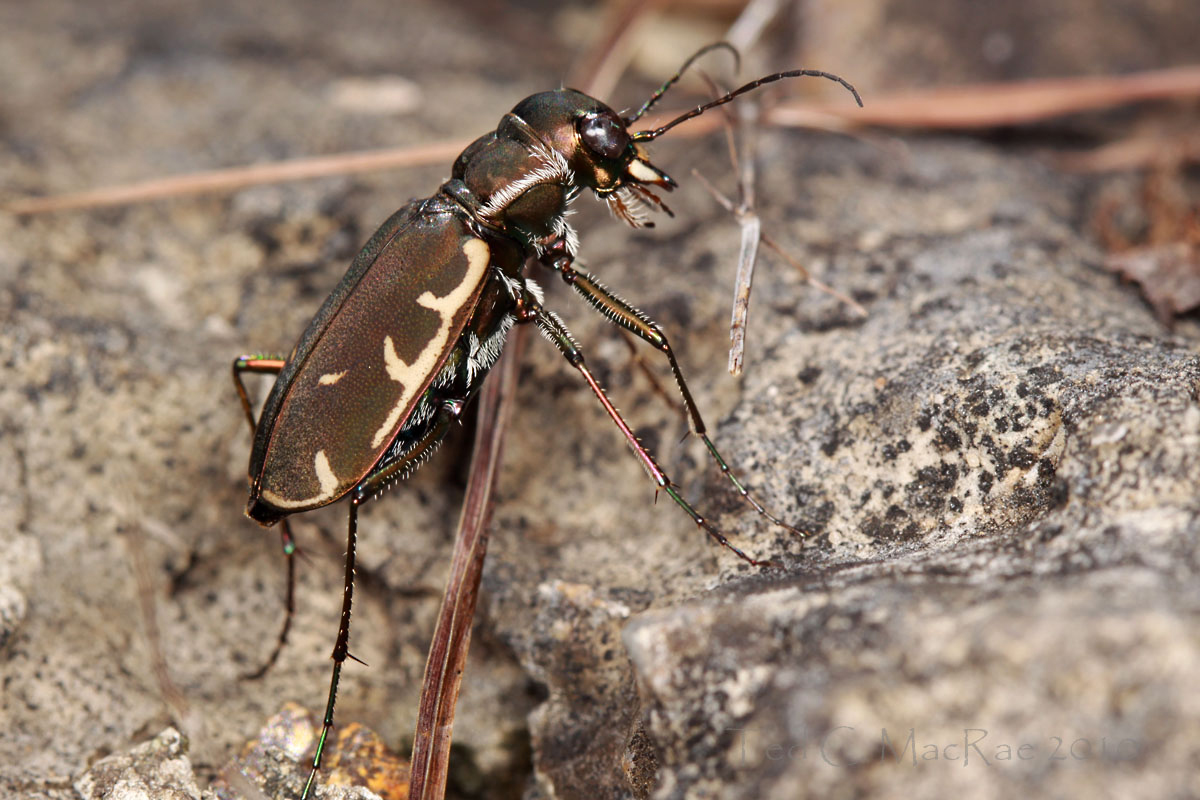
There is another site even further north in the county (Merriam Woods), which I found for the first time on this trip and, to my knowledge, represents the northernmost extent of the population in Missouri. At this site, nearly all of the individuals show coppery-brown coloration with almost no hint of green. These fully brown individuals seem to represent an appearance that is completely unlike that seen in any other part of the range of the species. The individual in the photo below typifies the appearance of the beetles seen at this site:

Male (Merriam Woods) - brown, marginal band incomplete, median band complete.
I’m less familiar with coloration of the population further south in Arkansas, although in my limited collecting in that area I recall that most individuals I encountered exhibited the dark olive-green coloration typical of individuals at Blackjack Knob and other more southern sites in Missouri. Thus, there seems to a clinal element to variability in coloration in the Missouri/Arkansas disjunct population. I suspect that the unique coloration of the beetles in this population is related to the soils with which they are associated. Light gray Jefferson City-Cotter dolomite bedrock forms the core of the White River Hills landscape and is exposed extensively in the glades that dominate its knobs and slopes. These exposures are weather-stained black and overlain by thin, black soils that support dark, green-black lichens amongst the sparse vegetation, as seen in the following photographs taken at the newly identified northeasternmost site at
Caney Mountain Conservation Area:

Thinly soiled dolomite exposures punctuate the glades in the White River Hills. Prairie tiger beetles are found in these exposures.
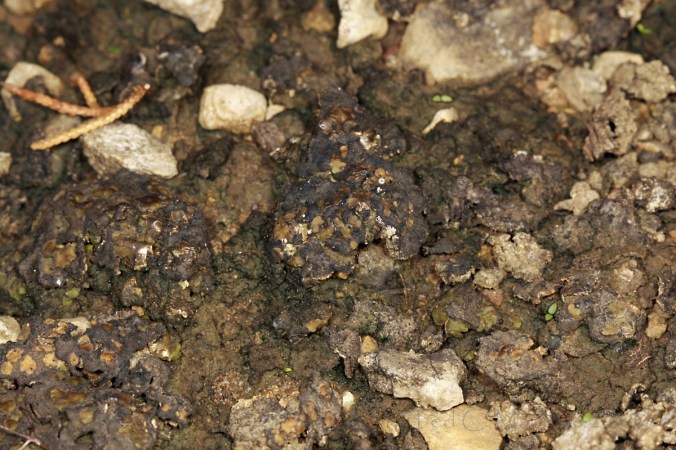
Dark green-black lichens encrust the thin black soils overlaying the dolomite exposures. Prairie tiger beetle adult coloration closely matches the coloration of the lichens and soil.
The glades and dolomite exposures where these beetles are found in the White River Hills and the dry oak woodlands that surround them have a characteristic look that is not seen once one leaves the area, and I have found many new sites for the beetle in the northern and eastern fringes of the region by stopping at locations where the roadside exposures had the right “look.” The variation in maculation and coloration seen in this population may be an indication that the population is still adapting to local conditions since becoming isolated from main population.
Currently, I have 3rd-instar larvae that I collected from their burrows at Blackjack Knob (adults mostly green) and Merriam Woods (adults mostly brown) and hope the rear them to adulthood next year. If I succeed in getting virgin adults from the two sites, I think it would be interesting to do some single-pair crossings and rear the progeny to see how coloration is expressed. A long term project, for sure, as these beetles probably require at least two seasons to reach adulthood, but rearing them is fun! A more difficult, yet far more interesting, project would be to secure virgin adults from the mostly black main population in Texas – or even the bright green, thickly-maculated santaclarae subspecies from Arizona – to see how interbreeding them with these Missouri disjuncts would affect coloration and maculation in their progeny – they could be some of the most unusual appearing large grassland tiger beetles ever seen (not to mention their tongue-twisting taxonomic moniker of Cicindela (Cicindelidia) obsoleta vulturina [Missouri disjunct] x obsoleta santaclarae!). Timing would be a difficulty, since the Texas and Arizona populations exhibit a more normal summer adult phenology, but it would be worth a try if I could secure a source of larvae for rearing. Anybody?

A male sports his impressive pair of choppers.
Photo Details (insects): Canon 50D w/ 100mm macro lens (ISO 100, 1/250 sec, f/13-22), Canon MT-24EX flash (1/4-1/2 ratio) w/ Sto-Fen + GFPuffer diffusers. Typical post-processing (levels, minor cropping, unsharp mask).
REFERENCES:
Mawdsley, J. R. 2009. Geographic variation in U. S. populations of the tiger beetle Cicindela obsoleta Say (Coleoptera: Cicindelidae). Insecta Mundi 0094:1–10.
Pearson, D. L., C. B. Knisley and C. J. Kazilek. 2006. A Field Guide to the Tiger Beetles of the United States and Canada. Oxford University Press, New York, 227 pp.
Copyright © Ted C. MacRae 2010
 Increasingly, I’m finding these fall hoppers harder and harder to resist, especially grasshoppers of the family Acrididae. Until now I don’t think I’ve given grasshoppers their due respect – compared to my beetles they always seemed so… primitive. No horns, no jeweled, metallic sculpturing, no over-sized jaws, no unique morphological specializations of any kind other than enlarged, saltatorial (modified for jumping) hind legs – they sport the quintessential ‘general’ insect body plan (open up any college introductory entomology textbook, and what do you see illustrated in the general morphology chapter… a grasshopper!). Even their movements seemed to me somehow mechanical and robotic. I always brushed them off as just basic insects, unrefined and uninteresting.
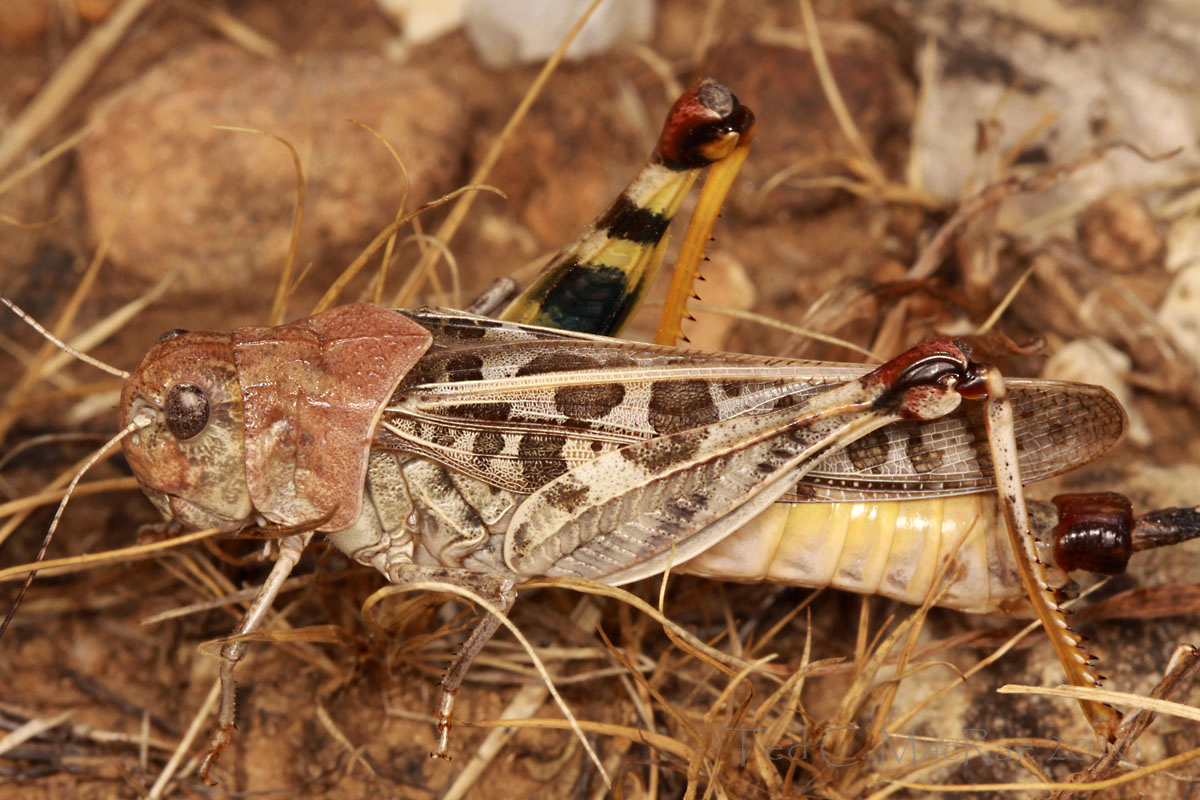
 Of course, they are anything but uninteresting – in fact, orthopterans as a whole are among the most popular of insect groups if the number of recently published field guides is any indication. One of these is The Grasshoppers (Orthoptera: Acrididae and Romaleidae) of Nebraska (2008), authored by Matthew L. Brust and colleagues, and a copy of which I received as a gift from the senior author during my recent collecting trip to Nebraska and surrounding areas. According to this book, the grasshopper in these photographs is Hippiscus ocelote – the wrinkled grasshopper, a large, handsomely robust species distinguished by the single cut in the pronotum and its surface sculpturing, the orange hind tibia, and the triple-banded and basally blue inner surface of the hind femur. The species is generally brownish throughout, but this particular individual – seen in the White River Hills of southwestern Missouri in early September – sported a decidedly reddish head and pronotum that contrasted beautifully with its spotted wings and forced me to stop searching for tiger beetles and spend some time photographing it.
 There are many reasons why I should not let myself get interested in grasshoppers – they’re big and take up a lot of space (a premium in most private collections such as mine), and by any standard my interests are already spread too thin. Still, I think it is better to have too many interests than not enough, and a Schmidt box or two full of some of the more interesting grasshoppers that I’ve encountered – properly curated and identified – wouldn’t take too much away from my beetle efforts. I already have a few specimens of Trimerotropis saxatilis (lichen grasshopper) from Missouri’s igneous glades and the related T. latifasciata (broad-banded grasshopper) from Oklahoma’s Glass Mountains, so a small assortment of other notable species in addition to them couldn’t hurt, right?










 Beetles In The Bush