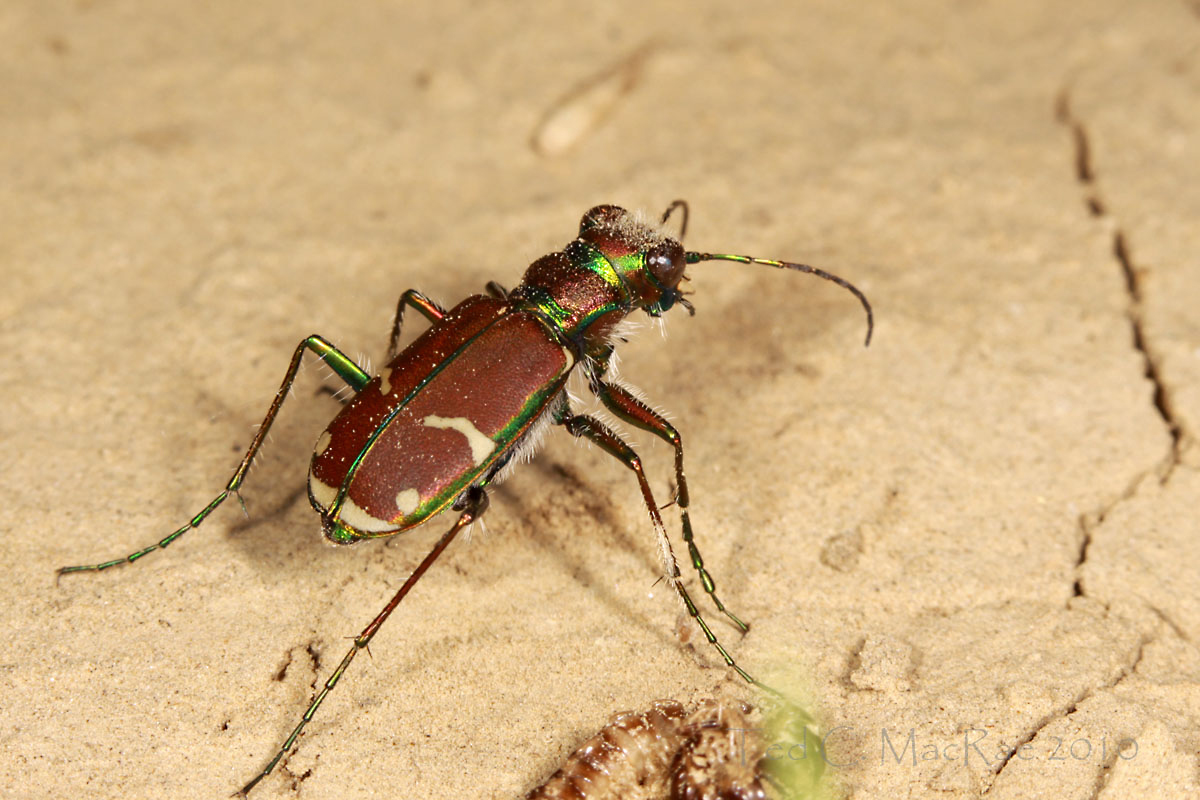
Jeepers Creepers, where’d ya get those multilayered retinae?

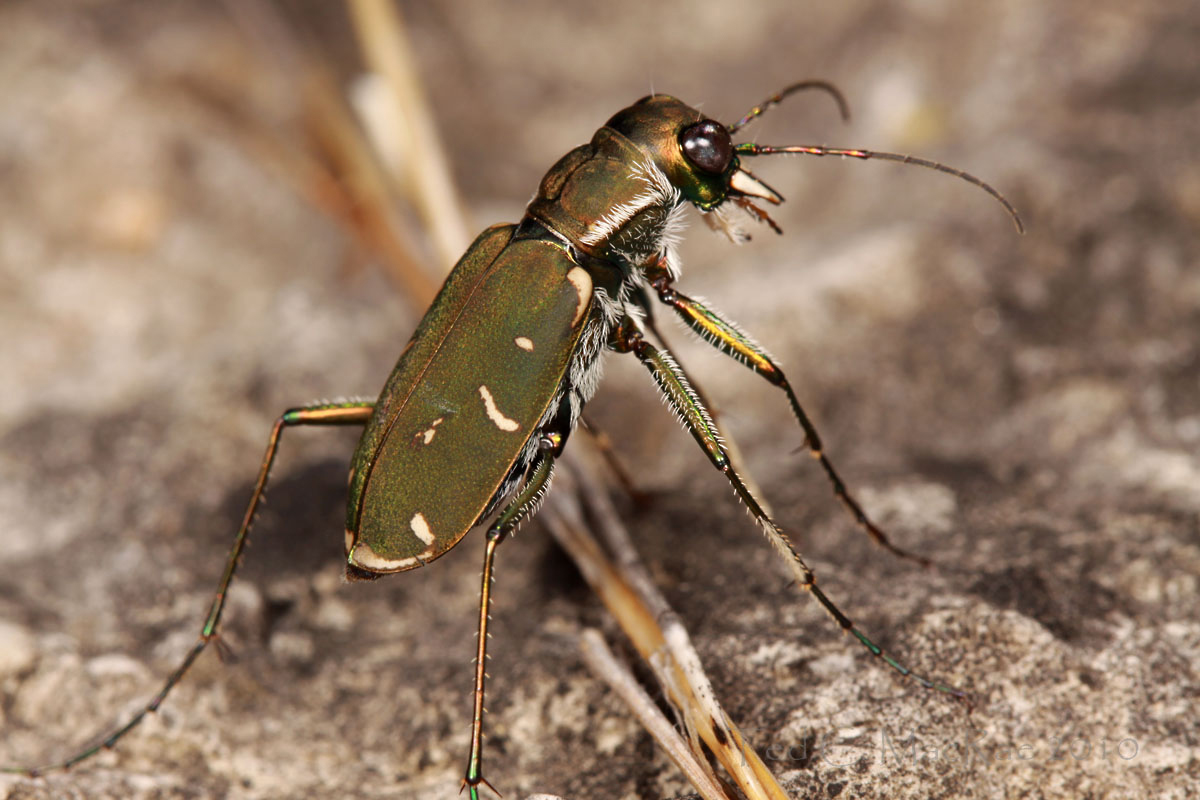
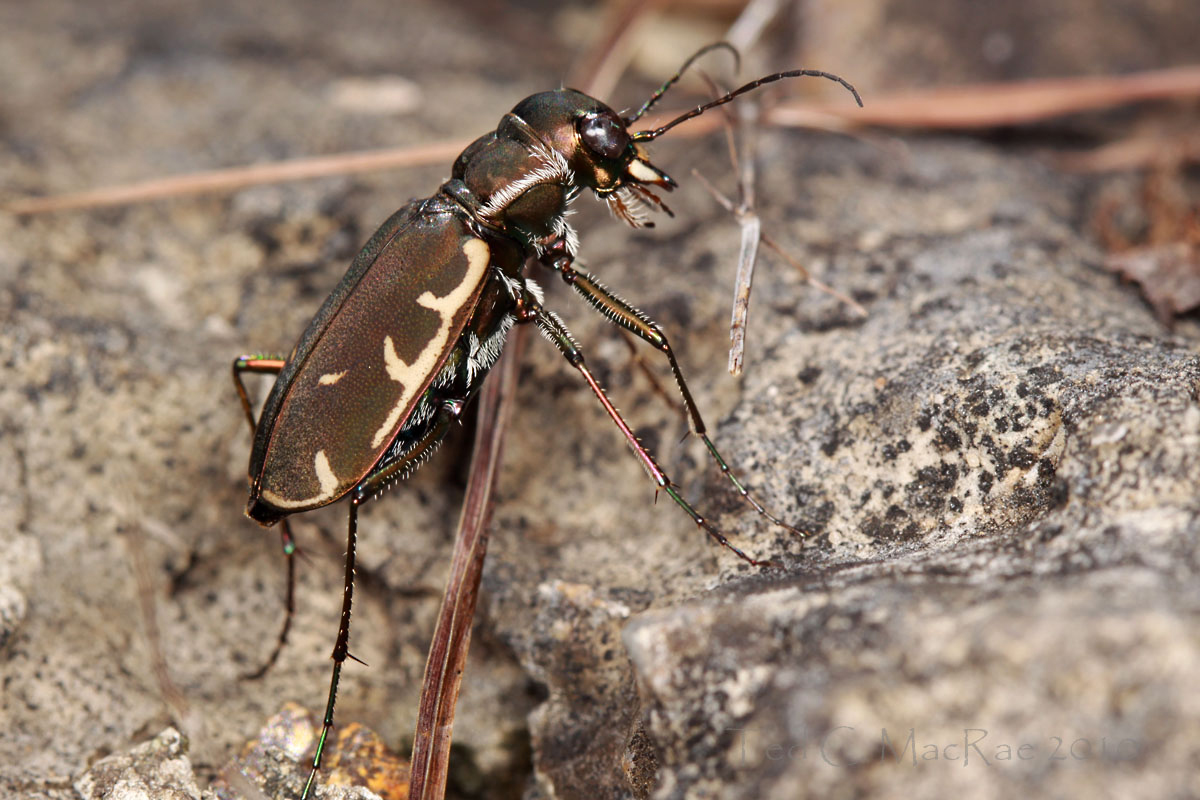
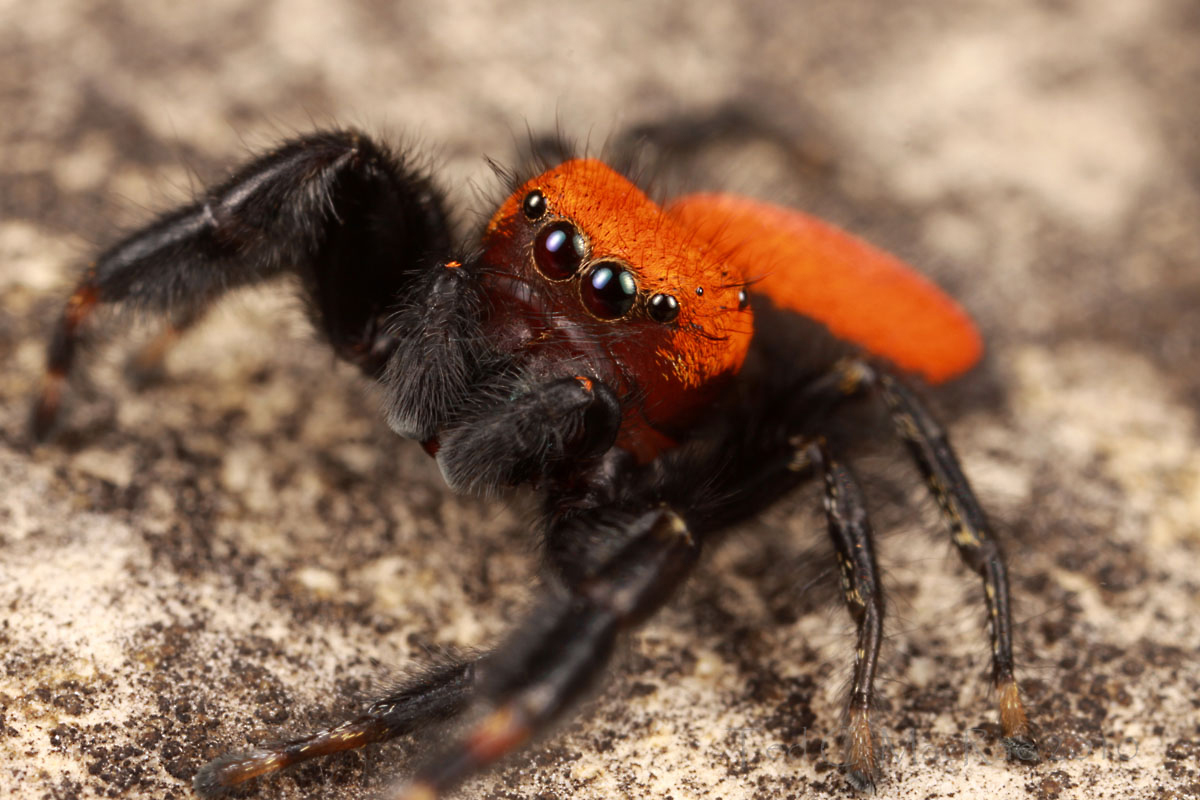
A few weeks ago I was fortunate to get a chance to blast down to the White River Hills in extreme southwestern Missouri.  Cicindela obsoleta vulturina (prairie tiger beetle) was my quarry – I had made arrangements to meet up with fellow cicindelophile Steve Spomer (principal author of Tiger Beetles of South Dakota & Nebraska, Spomer et al. 2008) and show him a few of the better sites I had found for this species.  We would have good success due to gorgeous fall weather and perfect timing, and the next day I would be fortunate to extend its known distribution further north and east.  Still, the beetles are not early risers, and I found myself that second morning with some time on my hands while waiting for these sleepy-heads to arise from their slumber and begin their foraging activities.  As I trolled the thinly soiled dolomite exposures of a new site I had identified the previous day, a spot of red jerking erratically through the sparse vegetation caught my eye, and looking closer I was delighted to see this small but brilliantly colored jumping spider (family Salticidae) trying to evade my gaze.

Jumping spiders are perhaps the most diverse of all spider families, but it is their extraordinary visual capabilities and complex predatory and courtship behaviors that they are best known for.  Popular as research subjects, to the rest of us they are simply endearing little animals.  Some of the largest and most colorful jumping spiders belong to the genus Phidippus, which is also one of the most diverse genera in the family and boasts some 60 species in the continental United States (Edwards 2004).  The genus is characterized by details of the eye placement and carapace shape (Richman 1978) but can often be recognized by their relatively large size, numerous erect hairs, and conspicuous iridescent chelicerae just below the front eyes.  The species can be quite difficult to identify, especially the females, but I feel reasonably confident that this individual is a male of the widespread species P. apacheanus.

I wasn’t always so confident – browsing images on BugGuide left me confused after finding images of P. apacheanus and P. cardinalis males that looked almost identical. However, further digging reveals P. apacheanus is characteristically a more intense red, while P. cardinalis is more orangey with lighter bristles which may appear silvery.  Also, P. cardinalis often displays makings on the abdomen – generally a light line running around the anterior part of the abdomen and sometimes tiny light spots on the dorsum – that are absent in P. apacheanus.  (This begs the question as to whether some of the BugGuide photos may be misidentified?)  Another Phidippus species that might be confused with P. apacheanus is P. clarus; however, that species has a black cephalothorax and bright abdominal markings.  According to Herschel RaneyP. apacheanus is most often seen in fall.

This was a very difficult subject to photograph.  He refused to come out in the open, preferring to duck and peek from behind whatever vegetation he could find.  Realizing that my desire to photograph him without any manipulation would be a lesson in futility, I used my finger to prod him towards and onto a small, flat, lichen-encrusted rock, where he would look at me with ever-increasing alarm and try to flee at the approach of the camera.  Lots of failed shots were discarded in the field before I finally got a few I thought I could live with (which, I think, are a decided improvement over my first jumping spider photos).  As I zoomed in for the closeups, I saw for the first time the shimmering of his multilayered retinae moving in the depths of his primary medial eyes.  The retina is the darkest part of the eye, thus, when the eye is at its darkest the spider is looking straight at you!

Photo Details: Canon 50D w/ MP-E 65mm 1-5X macro lens (ISO 100, 1/250 sec, f/13), Canon MT-24EX flash (1/8 ratio) w/ Sto-Fen + GFPuffer diffusers. Typical post-processing (levels, minor cropping, unsharp mask).

REFERENCES:

Edwards, G. B.  2004. Revision of the jumping spiders of the genus Phidippus (Araneae: Salticidae). Occasional Papers of the Florida State Collection of Arthropods 11:i-viii, 1-156, 350 figs.

Richman, D. B.  1978. Key to the jumping spider (salticid) genera of North America.  Peckhamia 1(5):77–81.

Spomer, S. M., M. L. Brust, D. C. Backlund and S. Weins.  2008. Tiger Beetles of South Dakota & Nebraska. University of Nebraska, Department of Entomology, Lincoln, 60 pp.

Copyright © Ted C. MacRae 2010
Quick Business…

I’ll have a “real” post ready shortly, but I wanted to make a quick note of a few items that have popped up recently:

  • Cylindera celeripes – this, of course, is the swift tiger beetle, a quite rare species of tiger beetle that I’ve been studying for the past two years.  I am preparing a manuscript (now in its final stages) that will review the species’ historical occurrence, document the new records I’ve accumulated for it, and discuss its potential conservation status.  I’ve gotten specimen label data from university collections in IA, KS, NE, OK, and TX (known range of the beetle) and from a number of private tiger beetle collectors.  However, I would like to make the story as complete as possible and am looking for any other repositories that might contain additional specimens.  If you know of such in your local university museum (other than those in the states listed above), I would appreciate knowing about them and getting ahold of their label data.
  • The Southern Fried Science Network has just launched a new group blog called Journeys, which they hope will serve as a central hub for writing about scientific field work and expeditions.  It’s a unique concept where contributors will post updates, stories, discoveries, and observations in the course of conducting their fieldwork.  The site has already been populated with a number of expedition logs (including a couple of my own).  I’m anxious to see if this takes off, as its field-work focus is right up my alley.  A link has been added to my sidebar under the heading “Field Work”.
  • Every now and then, someone asks me why I collect insects.  More specifically, they want to know why I must collect the insects that I find, rather than simply observing them in the field, making notes, and then letting them go on their merry ways.  Some are truly curious, while others adopt the more judgmental stance that collecting insects now is akin to the days of ornithology when birds were observed not through binoculars, but through rifle scopes before being shot!  I have a standard set of responses to this question, mostly dealing with difficulty of field identification, incomplete taxonomy, vouchering of scientific data, etc.  However, next time I am asked the question, I am going to provide a link to this post, a guest contribution by myrmecologist Benoit Guenard on Alex Wild’s Myrmecos.  I can only imagine what Benoit is going through, now realizing that he had found and photographed just the second and third known specimens of a truly rare North American ant, only to let them go because he didn’t realize what they were at the time.

Copyright © Ted C. MacRae 2010

“Colorfull Cockroach” discovered in Panama

I won’t call this a taxonomy fail, since Patrick is clearly not a taxonomist, or even the first person to confuse a beetle with a cockroach.  Nevertheless, I was amused at Patrick’s amazement with the “colorfull cockroach” that he found and his palpable excitement that it might be a new discovery.

Well, I was amazed about this type of cockroach so, I would like to know if it is a cockroach or what because I know you guys will be also interested about checking out this type of bug.
Thanks please answer fast 🙂
Maybe is a new kind of cockroach not discovered yet.

Fortunately, the folks at What’s That Bug were able to correctly identify this as Euchroma gigantea (giant metallic ceiba borer), a beetle in the family Buprestidae (and the largest such species in the Western Hemisphere).  An interesting note about this photo is that it shows the beetle with some – but not all – of the green pulverulence (dusty coating) that these beetles exhibit over the elytra upon emergence from their host tree.  This coating is quickly worn off as the beetle goes about its activities, and most museum specimens of the species lack it completely – giving the beetle a purplish appearance as seen on the left elytron of the beetle in this photo.  Even handling a freshly-emerged specimen to mount it on an insect pin would likely result in loss of much of the coating, so it is quite difficult to preserve specimens in their lime-green dusty state.

Copyright © Ted C. MacRae 2010

Sweet Sixteen!

The 7th Annual Fall Tiger Beetle Trip™ is officially over – Chris and I rolled back into town a little after midnight last night. It was an amazing trip – perfect weather, unparalleled scenery, and a record-breaking 16 species of tiger beetles seen in 13 localities across four states. Not only does this beat my previous trip record of 13 species, but we did it with only five days in the field. At the time of my previous update, we had visited several locations in the South Dakota Badlands and Nebraska Pine Ridge and found ten different tiger beetle species, including Cicindela pulchra (beautiful tiger beetle) – our top priority for the trip – C. nebraskana (prairie long-lipped tiger beetle), and C. lengi (blowout tiger beetle). Our plan for the next day was to visit the Badlands of Wyoming to look for C. decemnotata (Badlands tiger beetle – appropriately) and the Yampa River Valley of northwestern Colorado to look for C. scutellaris yampae and C. formosa gibsoni, all three of which we managed to find (though with caveats – stay tuned). Our originally planned final field day was to take us back into Wyoming to look for C. longilabris (boreal long-lipped tiger beetle) in the mountains east of Laramie and the Nebraska Sand Hills to look for the delicate little C. limbata before heading back home. However, we were finally paid a visit by “the skunk” and did not see any of these species (although our sighting of C. limbata (common claybank tiger beetle) in Wyoming did officially break the old trip record). Not wanting to end the trip on a disappointing day, we delayed our departure for home yesterday and visited two more sites at the eastern edge of the Nebraska Sand Hills (sites M and N in the above map) – a clay bank site where we saw a robust population of C. denverensis (to augment the single individual we had seen earlier in the trip) and several C. splendida (splendid tiger beetle), and another sand dune/blowout system where we at last succeeded in finding C. limbata.

The day after the end of the Annual Fall Tiger Beetle Trip™ is usually a somewhat depressing day for me. Not only is the trip over, but likely so is the entire insect collecting season. I know I need the down time to process the specimens and knowledge acquired during the season, but the field work itself remains my favorite aspect of this pursuit. Nevertheless, the experiences from this trip will fuel my memories for years to come, and in the next weeks I’ll share some of the stories that unfolded. Until then, I leave you with this portrait of C. pulchra – looking rather annoyed with me for my persistent efforts to take his photograph.

Cicindela pulchra - the ''beautiful'' tiger beetle

Copyright © Ted C. MacRae 2010
Promiscuous Plants

Naturalists have long been aware of the greater tendency for plants than for animals to create viable interspecies hybrids. This is attributable not only (as some might expect) to a higher likelihood of passive plants whose mating is mediated by pollen-hungry insects, or the wind, to hybridize more often, but rather to a greater ability of plants, with the simpler design of their anatomies, successfully to build a functioning organism with a Gemisch of genes from parents of different species. Such hybrids occur naturally, and are often reported in regional floras. Further, the advent of modern techniques for characterizing DNA has revealed that hybridizations of yore have given rise to numerous species, and higher lineages, in plants, in fungi, and to a lesser extent in animals.

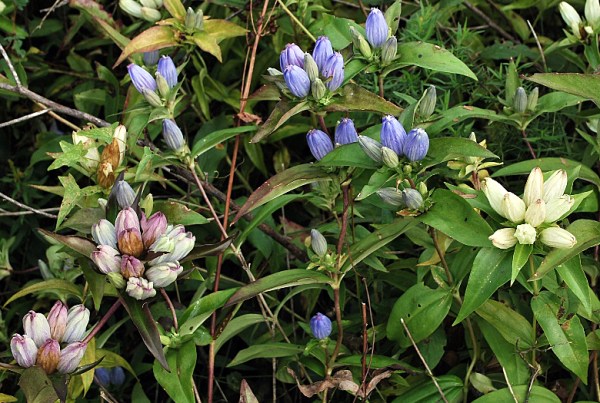
My recent wanderings in quest of fall flora photos at Shaw Nature Reserve really brought this phenomenon of admixture of species to mind as I was examining populations of the three Gentiana species that live at the reserve. All three are fairly recent introductions at SNR, added to the flora in several locations in our prairie and wetland habitat reconstruction program. Hybridization among these gentian populations was first brought home in my observation over the last three years of increasing numbers of purplish and bluish and outright blue individuals in a population that was originally pure white gentian – Gentiana alba. This population was sowed in the mid-1990s as part of a mesic prairie reconstruction in the watershed of our wetland complex.

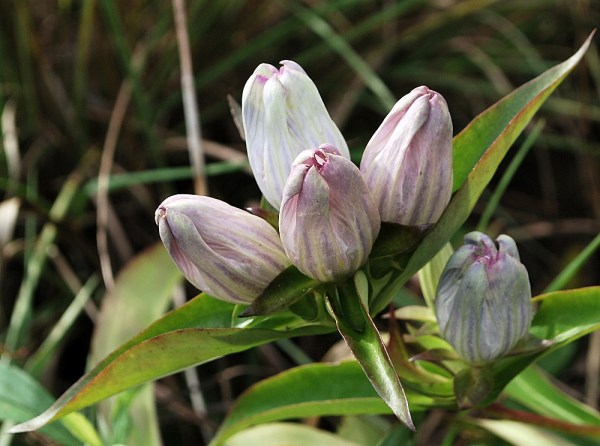
Gentiana alba, G. andrewsii and their lavender tinted hybrid growing side by side at Shaw Nature Reserve.

Pale or white bottle gentian, in "pure" form.

A few years later, 50 or so meters distant, separated by a dense row of trees and shrubs, and in a much wetter habitat in which water pools after every rain and seeps subsurficially much of the year, blue bottle gentian – G. andrewsii — was sowed into a wet prairie / sedge meadow reconstruction.

The rich blue flowers of the blue bottle gentian, Gentiana andrewsii

At first the two populations grew independently and remained separate, but what I surmise was a combination of water borne seed transport (along the shore of a pond whose edge both populations are near), and bumblebee borne pollen transport, conspired to bring gametes of the two species together, creating what population geneticists call a hybrid swarm, and what taxonomists call a — well, I can’t write it in polite company such as my readers.

Observe in the sequence of images above how a bumblebee gyne (a potential queen of one of next year’s annual bumblebee colonies) pries open a bottle gentian flower and dives in for a long drink of nectar at the base of the large vessel. Apparently the nectar is copious, because bumblebees may remain in a single gentian flower for up to a minute.

The result of pollen transport among pale and blue bottle gentians, a hybrid of intermediate characteristics.

While there are other populations of both species on the reserve (one hopes, out of bumblebee range from each other) that may retain their genetic integrity, the rampantness of the admixture at this site does give me pause.

And it gets worse! — On drier ground up the slope, among a dense planting dominated by prairie dropseed and little bluestem grasses,  a third gentian known as downy or prairie gentian – Gentiana puberulenta – was established from a seed mix sowed 10 years ago to convert the watershed of the reserve’s wetlands to prairie vegetation.

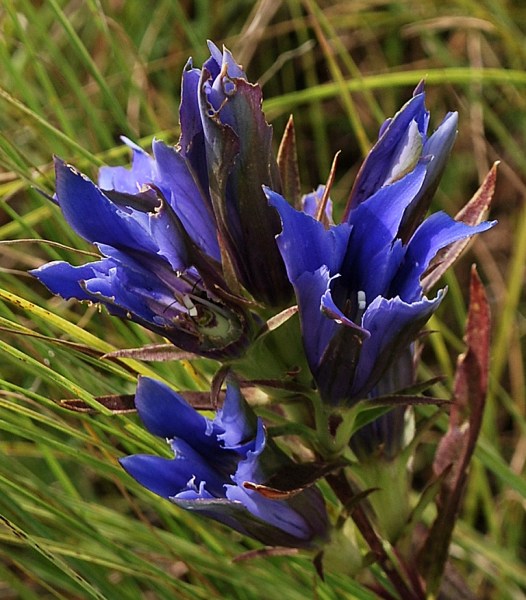
Unlike the two previously mentioned species and their hybrids, the downy gentian's petals open wide at anthesis, admitting entry to small bees and even to spindly-legged potential pollinators such as syrphid flies.

And now those perverse bumblebees have gone and defied the laws of speciesness and created what appear to be hybrids of this third gentian species with the other two. Honestly, I don’t know whether to feel that I have done some sort of wrong by creating the situation that allowed this to happen … or simply to be intrigued by this unforeseen outcome of my work, and to wonder what will come of it after I’m gone?

The gentian in the upper photo appears to be the offspring of a cross between white and downy gentian parents, while the one in the lower photo appears to be the result of a cross between blue bottle and downy gentian.

2 days, 6 localities, 10 species…

Here’s an updated itinerary for the 7th Annual Fall Tiger Beetle Trip that fellow cicindelophile Chris Brown and I are in the midst of. We’ve spent the past two days visiting six localities in Nebraska and South Dakota. So far, we’ve found a total of 10 species – including every species we had hoped to see at this point in the trip. The list so far (in chronological order) is:

  • Cicindela (s. str.) tranquebarica kirbyi – ho hum, we’ll see this in several places.
  • Cicindela (s. str.) purpurea audubonii – über common Great Plains species, although the black form is always a treat to see.
  • Cicindela (s. str.) pulchra – YEAH! Seen in good numbers at one of the new South Dakota localities discovered in 2008 by Matt Brust (our personal chaperone for the day). Marvelous field photographs.
  • Cicindela (s. str.) fulgida – Only one seen, but Chris got a nice series of field photographs (I’ve seen good numbers of this species from my previous trips to this area in 2008 and in Oklahoma last year).
  • Cicindela (s. str.) nebraskana – Another “A list” species for the trip, but we’ve only seen one so far.
  • Cicindela (Cicindelidia) punctulata punctulata – also known as Cicindela ubiquita.
  • Cicindela (s. str.) scutellaris scutellaris – even though this is a common Great Plains species in any sandy area, I never tire of its dazzling red elytra and blue/green head and pronotum.
  • Cicindela (s. str.) lengi – The third species on our “A list” that we’ve seen, with some real nice field photographs from Monroe Canyon.
  • Cicindela (s. str.) formosa generosa – another common Great Plains species.
  • Cicindela (s. str.) denverensis – I didn’t expect to see this one on the trip (just a single individual at Monroe Canyon), but I’ll take it!

Tomorrow we’ll hit a Wyoming location where Cicindela (s. str.) decemnotata is known to hang out – a species I’ve not yet seen, either alive or preserved. Most sources regard this species as closely related to C. denverensis, but Matt thinks it is actually more closely related to C. fulgida due to similarity in form and shine but green instead of purple. Afterwards, in a major addition to our planned itinerary (hence the updated Google Map), we’ll go into northwestern Colorado to look for two very cool subspecies of the otherwise widespread species – C. formosa gibsoni and C. scutellaris yampae. If we’re lucky we’ll also see the delicate little sand lover, Cicindela (s. str.) limbata, but if we don’t see it there then we should see it the next day when we finish out the trip back in the Nebraska Sand Hills just east of Alliance. But before that, we’ll veer back up into Wyoming and look around in the high elevations east of Laramie in hopes of finding Cicindela (s. str.) longilabris laurentii. That one may be a stretch, but if we are successful then we have the potential to see a total of 15 species – that would be a trip high for me (literally and figuratively).

Copyright © Ted C. MacRae 2010
The last survivor

This past June I made two trips to the Loess Hills of extreme northwestern Missouri as part of a follow-up survey for Cylindera celeripes (swift tiger beetle).¹ I was hoping to identify additional populations, however small, of this tiny, flightless, enigmatic species to go along with the three that colleague Chris Brown and I discovered last year.  The results were good news, bad news – no new populations were found, but I was able to re-confirm the beetle’s occurrence at two of the sites where we found the beetle last year.

¹ Some of you may recall my excitement at finally finding this long-sought after species in Missouri – apparently limited to the state’s few remaining high quality loess hilltop prairie remnants.

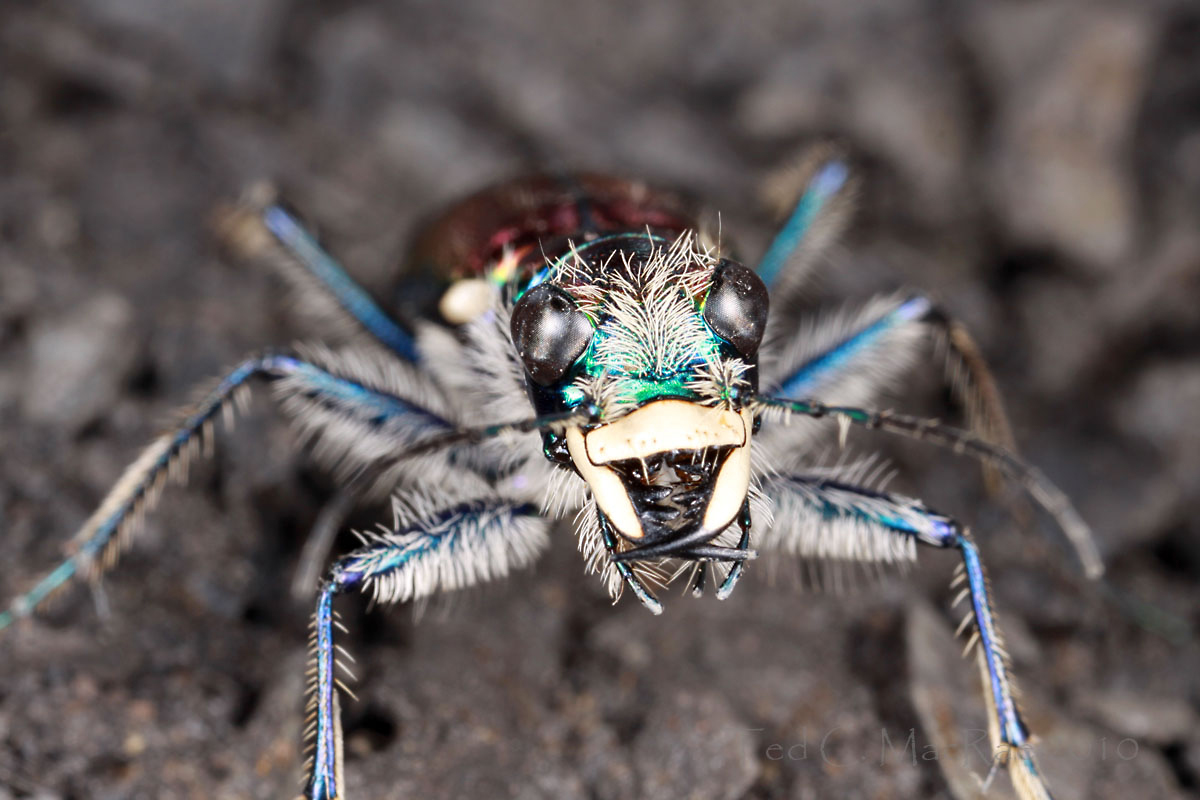
One of the sites that I had hoped might harbor the beetle is Squaw Creek National Wildlife Refuge in Holt Co. – located very near McCormack Loess Mounds Natural Area where the beetle was seen both this year and last.  Squaw Creek features several thousand acres of restored wetland habitat in the Missouri River valley that serve as resting, feeding, and breeding grounds for migratory birds and other wildlife.  Located within the Mississippi Flyway, the refuge is best known for its large concentrations of snow geese and bald eagles.  Wetlands are not good habitat for C. celeripes, but it was not the wetlands I was interested in visiting (well, I am really interested in visiting the wetlands someday – but on these visits I had other goals).  Rather, it was the tiny slivers of loess hilltop prairie that still remain on the fingers of loess bluffs along the eastern boundary of the refuge.  Twice scouring these prairie remnants over a two-week period failed to reveal the presence of the beetle, but on the first visit I did see this lone, rather ragged-looking adult male Cicindela limbalis (common claybank tiger beetle).  Unlike the aforementioned species, C. limbalis is rather common throughout most parts of the state on upland clay exposures. A spring-fall species, adults first emerge in September, have a little fun (which includes feeding but not mating), and then dig back into the ground for the winter before emerging once again in the spring. It is one of the first insects to greet the new season (I’ve seen them as early as late March) – mating and oviposition occur over the next month or two, and by end of May these guys are pretty well spent.  An interesting feature of the populations found in extreme northern Missouri is their higher degree of elytral maculation.  Compare this relatively fully-marked individual with this female that I reared from a larva collected at Knob Noster State Park in west-central Missouri (incidentally, my first ever reared tiger beetle!).

This male is clearly among the last of his generation in this area – not only did I not see any other individuals on the entire trip, but he clearly exhibits signs of wear and tear.  I found him nibbling on this dead millipede (which larger tiger beetles are known to prey upon); however, I don’t think this guy actually killed the millipede.  Rather, I think he found it already dead and was scavenging one of the only meals still available to him.  Closer examination of the face reveals that his left mandible is broken off near the base (best seen in the enlarged photo) – whether a result of battle with over-sized prey or a narrow escape from predation himself is hard to say.  Regardless, with only one “tooth” his ability to capture prey on his own has been severely compromised, and about all he can do is look for already dead prey items on which he can scavenge.  As one of the last survivors of his class, one can only hope that he lived a long and fruitful life, killed much prey, and inseminated many females.

Photo Details: Canon 50D w/ 100mm macro lens (ISO 100, 1/250 sec, f/14-16), Canon MT-24EX flash (1/4 ratio) w/ Sto-Fen diffusers. Typical post-processing (levels, minor cropping, unsharp mask).

Copyright © Ted C. MacRae 2010
…the “better” Eleodes suturalis

As I mentioned in my previous post, I really wasn’t satisfied with the photographs I took of the clown beetle, Eleodes suturalis, that I brought back from Oklahoma. I had placed the beetle in a terrarium of native soil and taken the obligatory whole beetle and head close-up photographs, both showing all the characters needed to identify the species in adequate detail. They were good, scientific photos, but they weren’t very exciting. In fact – they were boring! Now, I know not every subject I photograph is going to be a wower (the giant desert centipede I recently featured probably setting that standard), but it is important to me that the photographs I post here at least be interesting. After taking those first E. suturalis photographs, then being underwhelmed as I brought them up one-by-one on the computer, I started thinking about whether certain insects are just ‘homely’, and no matter how you photograph them they will still be homely. Eleodes suturalis is by no means a homely beetle in real life, but that is due mostly to the impressiveness of its size – a quality not easy to project in photographs.  Beyond that, its somber coloration, lack of unusual morphological modifications, and “beady little eyes” (fide Adrian) don’t offer much else in the way of help.  Combine that with the unflattering salmon coloration of its native soil as a substrate and an exoskeleton just shiny enough to cause annoying specular highlights, and you’ve got a recipe for really boring beetle photographs!

That’s when it occurred to me to try photographing the beetle in a white box.  I’ve only just begun to experiment with this technique and have been impressed with its ability to make somber-colored subjects (e.g., Gromphadorina portentosa) attractive and truly beautiful subjects (e.g. Buprestis rufipes) simply stunning.  The sharp, clean environment of a white box demands a clean beetle, so I gave the beetle (who had done much digging since the previous photo shoot) a good soaking and scrubbing (to the beetle’s great disapproval!).  Yes, I know there is still some dirt on him, but I think a dental pick and wire brush would have been needed to remove every last bit, caked on as it was!  Despite that, I think I achieved the desired effect – specular highlights… gone!  Boring background… gone!  Clean and crisp and ready to impress! The photos also do a much better job of highlighting the 3-dimensionality of the beetle than the original photographs.  Of the many photos I took, my favorite is featured above, and below I present two more that closely approximate the vantage of the two photos I posted from the first shoot in a side-by-side comparison.

For those of you wondering how I managed to secure the beetle’s cooperation for these photos, I used a modification of the “lens cap” technique, covering the beetle with a large glass bowl instead.  The beetle crawled around under the bowl for a bit but eventually would end up settled down against the edge.  By carefully lifting the bowl I was able to avoid disturbing the beetle and fire a few shots before it would start wandering again.  I just repeated the process until I was satisfied I had a few good shots in the sequence.

Does this mean an end to my preference for in situ photographs?  Certainly not.  But some beetles just look better in white!

Photo Details:
White box: Canon 50D w/ 100mm macro lens (ISO 100, 1/250 sec, f/18-20), Canon MT-24EX flash, indirect. Typical post-processing (levels, minor cropping, unsharp mask).
Terrarium: same except f/18, direct flash w/ Sto-Fen diffusers.

Copyright © Ted C. MacRae 2010