 Welcome to Berry Go Round issue #21. As a first time host of this – or any – blog carnival, I can tell you that it has not only been more work than I could have imagined, but also a lot more fun! I’ve read, learned, and marveled at the diversity of knowledge presented by the posts that make up this issue – in all, 25 contributions from 15 blogs by 14 authors who know an awful lot more about plants than I do. Read my summaries first, or jump straight to the posts, but please visit as many as you can. They will be worth the time spent! If you’ve not visited Beetles in the Bush before now, I hope you’ll also take a moment to browse its Contents to see what might be of interest.
First things first, however. Berry Go Round needs a badge! The small badge you see at the beginning of this post is something I made to put in my sidebar using the masthead and title from the BGR website – not a real badge like the ones you find at Circus of the Spineless, Festival of the Trees and Carnival of Evolution. If you’re artistically inclined and would like to contribute to the growth of BGR, please leave a comment and contact information – we could use your help! Now – on with the show.
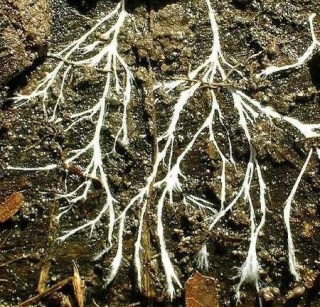 Alex at Watching the World Wake Up gets us started with a trilogy of posts as diverse as his interests. In this fungus¹ post, Alex makes the improbable connection between fungi and The Force (yes, a reference to Star Wars). Read it, and you will be a believer, too. I especially enjoyed his post on the search for a rare hybrid oak, not only for the thrill of seeing a probable 4,000-7,000 year old F1 hybrid clone, but also for the most awesome tangent on spiders that any non-entomologist has ever written. In his post on tumbleweeds, he reminds us that these icons of the west are actually an exotic introduction from Eurasia and recounts the mechanisms by which these ubiquitous plants took over the western U.S.
¹ TANGENT. Okay I know fungi aren’t really plants, nor are they animals – they’re kinda both and neither. Botanists, however, appear to have accomodated fungi in their realm of study², I guess because they basically look like plants. This is much the same situation as entomologists and spiders – the latter not being insects, but sort of looking like them and giving lay folk the same creepy crawly impression.
² NESTED TANGENT. Despite crossing Kingdom boundaries, the placement of fungi within the botanical realm doesn’t come close to matching the taxonomic disparities that plant pathologists must accept, who despite the microorganismal connotation of the term plant disease have had to accomodate organisms crossing not only Kingdom but also karyotic boundaries – with all three eukaryotic Kingdoms (plants, animals, and fungi) being causal agents in addition to the prokaryotic bacteria³ and the hard-to-even-consider-as-a-life-form viruses.
³ NESTED, NESTED TANGENT4. I’ve no doubt given short shrift to modern Kingdom-level concepts regarding prokaryotes – I know there are “regular” bacteria and the terribly misnomered blue-green algae, but this entomologist who sometimes masquerades as a general biologist quickly became confused when he found references listing as many as 13 prokaryotic Kingdoms.
4 NESTED, NESTED, NESTED TANGENT. Alex is the undisputed king of the nested tangent, and I hope he forgives me for taking his idea to such level of absurdity!
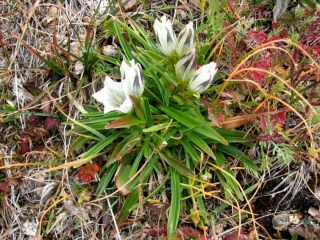 On the other side of the Rocky Mountains, Sally at Foothills Fancies highlights color in alpine tundra – it is amazing how much color can be seen in a high-country fall! She follows up on that post with another highlighting fall tundra wildflowers, including the spectacular Arctic Gentian (Gentiana algida to most of us, Gentianodes algida if Dr. William Weber has his way). She also focuses on the less conspicuous “flora” of the tundra – cryptogams – and how seemingly “bare” ground in the tundra is actually thick with lichens and mosses. Most tundra cryptograms represent species not seen in the lower 48 states except at very high altitudes.
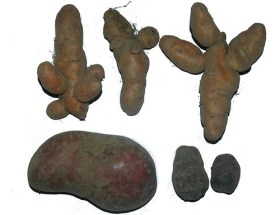 Laurent at Seeds Aside submitted a quadrilogy (is that a word?) of posts covering Blogger Bio Blitz 2009. To start the series, Laurent thinks outside the box by presenting a sampling of old French cultivated potato varieties, then does more conventional bioblitzing in a hedged farmland area in French Brittany (noting a possible case of spider kleptoparasitism along the way) and near the Couesnon river, next to Mézière sur Couesnon. Seeing and reading these botanical/entomological accounts in France brought back memories of my own visit to the country in 2007. As I write this piece, I can almost hear the droning buzz of cigales in the dry coastal Mediterranean pine forests.
 Jeremy contributes this piece on the history of agriculture at Vaviblog, where he writes about Dr. Louis Trabut – one of many agricultural explorers who searched the North African colony of Algeria in search of plants for introduction into the southwestern United States. He notes that Algerian agriculture was carried out almost exclusively by the indigenous Berbers for more than a thousand years, resulting in the development and propagation of myriad races of the grape, fig, olive, apricot, and walnut grown in the region today. Jeremy thinks it would be terrific if his post smokes out any information about the history of dates (the plant) in California.
Jeremy is also an author at the Agricultural Biodiversity Weblog and submitted this post about plant breeding in relation to climate change (raising a fair few comments). He also notes that the addition of agricultural statistics to the astonishing and wonderful GapMinder deserves celebration and wonders if there some other botanical datasets that might be interesting.  Quick to remind us that he’s not all history and no humor, Jeremy puts together (at “great personal expense”) a series of Doonesbury comic strips at his other blog, Another Blasted Blog. Doonesbury fans, having surely already seen these, will chuckle once again. Gardener’s who don’t follow Doonesbury will still appreciate their humor. Doonesbury fans who are also gardeners will guffaw!
At Denim and Tweed, Jeremy Yoder notes the obvious benefits of synchronized mast seed production as an adaptation in the plants’ coevolution with seed predators, but the not so obvious mechanisms by which this occurs. He reviews a paper in the latest issue of Ecology Letters that has an answer — synchronization happens accidentally. I won’t spoil the details of the research and how they reached their conclusion, as Jeremy has done a much finer job of that than I ever could (I study beetles, remember?), but the interaction of resource and pollen limitations is a clue to the answer.
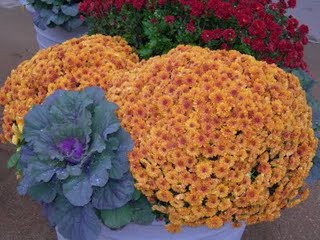 For the pedants among us (count me in!), The Phytophactor has been running a series on plants whose generic names are the common names everyone knows. Here is lesson 4: can you say chrysanthemumum? This genus has suffered a bit of a decline at the hand of taxonomists in recent years, falling from a burgeoning 300-400 species that used to be in the genus to a pitiful two (not a typo!). Phytophactor also visited the Great Pumpkin Patch and reports – you won’t believe the cucurbitaceous rainbow he saw!
Elizabeth Hargrave at The Natural Capital submitted this post on wild grapes. Native grapes may be smaller and not as sweet as the giant Chilean juice balls found in modern grocery stores. Still, harvesting native species from the wild has its charms – as long as you’re familiar with the several non-edible and sometimes poisonous look-alikes. If wild harvest isn’t your thing, she also offers some tips for cultivating wild grapes (which is actually much easier than with most cultivated varieties).
 The EEB & flow offers a review of a scientific paper discussing mycorrhizal networks – fungal mycelium that colonize and connect roots of one or more plant species. Whis this is one of the most intriguing types of fungal-plant associations, even more interesting is its continuation of “The Force” idea brought up in Alex’s fungus post – i.e., evidence of substantial facilitation between plant individuals via these fungal networks (i.e., plants tend to grow better if they are associated with a network). This is in opposition to the long-held belief that competition, herbivory and dispersal are the main drivers of plant community associations. They also reviewed a recent paper on the impact of exotic plants on plant-pollinator systems, finding a high overall abundance of exotics in many plant communities but a relative lack of substantial changes in network connectedness.
Fungi continue to muscle in on this carnival of plants, being the subject of a post by Chris Taylor at  Catalogue of Organisms on Diaporthales fungi that cause disease in trees. Among the most famous of these to North American readers is Cryphonectria parasitica, the cause of chestnut blight and famed as the bane of the American chestnut, Castanea dentata. However, other trees such as butternut, dogwood, and even non-arboreous woody plants such as grape also have their own pathogenic associates.
 Justin Thomas is one of several erudite botanists behind Get Your Botany On! In this post, Justin discusses Pteris multifida, an exotic fern that he found in Hot Springs National Park while conducting an invasive species survey. Sadly, this is symptomatic of the Hot Springs area in general, where habitat alteration and rapidly colonizing invasive species have left little room or hope for naturally functioning ecosystems. Another of the blog’s authors, Keith, quotes with enthusiasm from “Of Woods and Other Things” (Beech Leaf Press, Kalamazoo, 1996), by renowned Indiana Dunes region naturalist Emma “Bickie” Pitcher. One that caught my eye was “…pale satiny yellow breasts and dark velvety smudges around eyes are apparent.”
 Tim Entwisle at Talking Plants discusses the gorgeous blood orchid, Caladenia concolor. This endangered Australian species grows sporadically around Victoria and into southern New South Wales. Apparently some populations consist of only a handful of individuals, and weeds and passing foot damage are probably their biggest threats. Hopefully Tim and his colleagues will succeed in their efforts to save this stunning species.
 Mary Farmer at A Neotropical Savanna sent me this note, writing “I don’t know how many readers of BGR use the Biodiversity Heritage Library, or know of it, but it is (to me) an extremely valuable resource and they have their own blog (which you no doubt know of) called News and Updates from the Biodiversity Heritage Library. This week’s feature, the oldest book in the BHL, Herbarius latinus, is a ‘…Pre-Linnean text [that] describes 150 plants and 96 medicines commonly found in apothecaries, and each plant description is accompanied by a detailed woodcut.'” How I adore old botanical scribes – thanks, Mary!

Dover photo
For literature along more whimsical lines, NellJean of Secrets of a Seed Scatterer presents an herbalist’s view of tea with Peter Rabbit and its mentions of Camomile Tea and Rabbit Tobacco. Apparently smoking rabbit tobacco is done only by little boys in the south, but cut stalks, bundled and dried, can impart a pleasingly aromatic and resinous fragrance to the mustiest of tool sheds.
Copyright © Ted C. MacRae 2009







 Beetles In The Bush