Spiney, scaley distractions

Those who have read this blog for any length of time know that single-mindedness is not one of my shortcomings. I call myself a coleopterist and even go on trips dedicated specifically towards their study, yet find it impossible to ignore the diversity of non-beetle insects that one finds on such trips. It doesn’t stop there—insect diversity is supported by plants, interesting in and of themselves but even more so in the ways they mix and match to form distinct natural communities. And, of course, natural communities are themselves a product of the landscape—soil and terrain, moisture and its timing, elevation and latitude and longitude. Field trips for me are a constant struggle between the inner specialist—wanting to know everything about my chosen niche (beetles)—and outer generalist—wanting to know something about everything else. But wait—that was a decidedly spineless perspective. There are also animals with spines out there. Not nearly as many as those without, mind you, but that just makes them special—more of a treat to be relished when seen, and among the spined it is the reptiles that get me most excited.

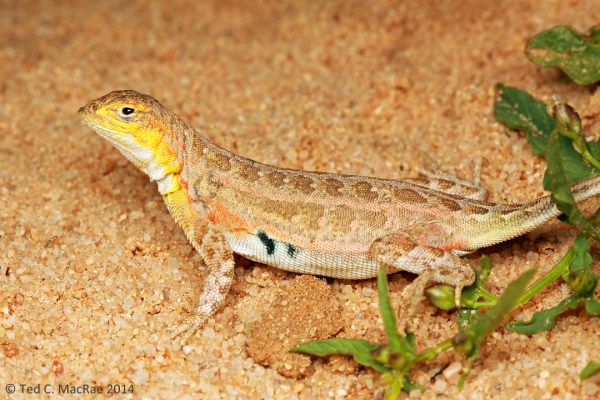
Holbrookia maculata (lesser earless lizard)

Holbrookia maculata (lesser earless lizard), female(?) | Union Co., New Mexico.

This post presents a trio of reptiles that distracted my attentions one day during last year’s Great Plains Collecting Trip. We were looking for promising habitat for Prionus longhorned beetles in northwestern New Mexico (Union Co.), where two species (P. fissicornis and P. emarginatus) had been collected recently in the area’s vast shortgrass prairie. Remembering our experience the previous day finding another species (P. integer) and its burrows, we were on the lookout for anything that looked remotely like a “burrow” but found nothing. The stark grassland landscape offered little woody vegetation that made the chances of finding any other woodboring beetles remote, and eventually I became distracted by lizards darting amongst the vegetation around us. The first was one I’d never seen before—the lesser earless lizard (Holbrookia maculata), rather small lizards that were extremely wary, difficult to approach, and quick to dash behind the nearest grass clump. I managed one fairly adequate iPhone photo, but I wanted better photos and had grown weary of finding no beetles so broke out the big camera.

Holbrookia maculata (lesser earless lizard)

Holbrookia maculata (lesser earless lizard), male(?) | Union Co., New Mexico.

I presume the first photo (two above) is a female while the second photo (immediately above) is a male based on the paler coloration and less distinct black markings of the former. The preferred habitat of “relatively level terrain with sparse, low-lying vegetative cover and loose, friable soils” (Degenhardt et al. 2005) describes perfectly the habitat in which we found them. They were extremely difficult to photograph due to their proclivity to hide behind vegetation, and the two photos shown here were about as far in the open as I could get them while trying to approach with the camera.

Crotaphytus collaris (common collared lizard)

Crotaphytus collaris (common collared lizard) | Union Co., New Mexico.

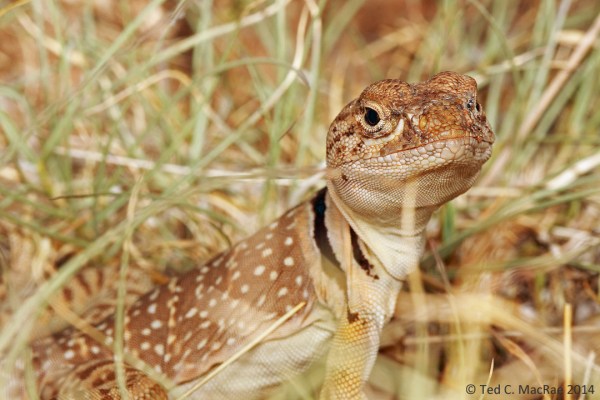
I have loved collared lizards ever since I first photographed a nice, big, colorful male Crotaphytus collaris (eastern collared lizard) in western Oklahoma back in 2009. When I saw this still striking but much less colorful individual, I didn’t know what species it was, but I didn’t think it was the eastern species that I had already encountered not only in Oklahoma but also several times on igneous glades in my home state of Missouri. To my surprise, however, the eastern species is the only one inhabiting New Mexico (Degenhardt et al. 2005)—other species distributed further to the west or south. I had better luck photographing this individual, for even though it occasionally ducked into the vegetation (allowing one charming shot of it peering above the “grass” line—see third photo below) it was also content to stay out in the open along the gently sloped road bank where I had found it and dart from spot to spot between suspicious glares. This particular individual was smaller than the big males I have seen, so I suspect it is either a female or a juvenile.

Crotaphytus collaris (common collared lizard)

Not shy about remaining fully exposed, it clambered atop a rack to watch more carefully.

Degenhardt et al. (2005) mention an interesting factoid about collared lizards regarding the fact that they, unlike many other lizards, do not readily lose their tails (autotomy). Collared lizards are fast runners, often rearing up on their two hing legs, for which an intact tail would be an important organ for maintaining balance. In the case of these lizards, the advantages of rapid locomotion probably outweigh benefits from tail autotomy.

Crotaphytus collaris (common collared lizard)

Peering charmingly above the “grass” line.

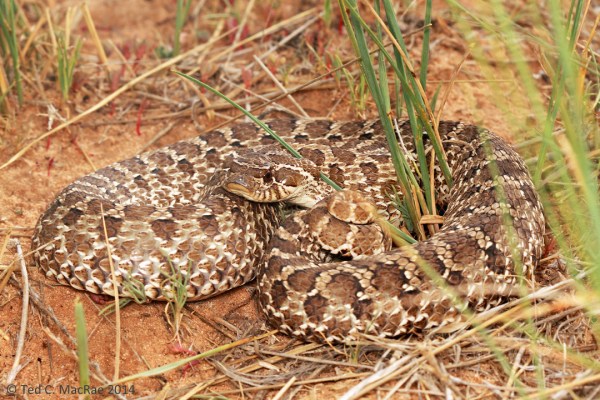
While two reptile species at one stop might seem doubly lucky, little did I know a hat-trick still awaited me. We still had no solid evidence to suggest that Prionus beetles were active in the area, but we set out two traps anyway because the soil exposures seemed similar to those we saw the day before and then moved just down the road to where the soils turned redder and seemed to have higher sand content to set one more trap. As Jeff set the trap, my distraction with saurian subjects continued when I ran into a marvelously camouflaged western hognose snake (Heterodon nasicus).

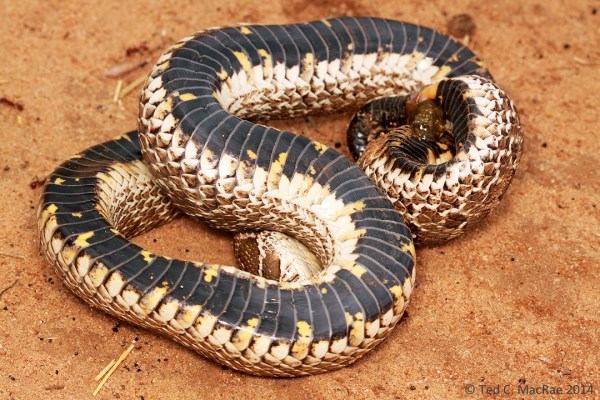
Hognose snake

Heterodon nasicus (western hognose snake) | Union Co., New Mexico.

Western hognose snakes are typically found in grassland habitats with sandy soils (Degenhardt et al. 2005), so the occurrence of this individual at this spot was no surprise. What was a surprise was how strikingly marked this individual looked compared to the other two individuals I’d seen to this point—the first a more subtly marked individual in a rare sand prairie in southeastern Missouri, and the second a more uniformly mottled individual in northwestern Oklahoma’s Salt Plains National Wildlife Refuge. This could be a result of subspecific differences—Missouri populations are assigned to the subspecies H. nasicus gloydi (dusty hognose snake), but I am unsure of the subspecific assignment of the Oklahoma individual. According to Degenhardt et al. (2005) only the nominate subspecies occurs in northern New Mexico (subspecies H. n. kennerlyi can be found in the southwestern part of the state, while intergrades with subspecies H. n. gloydi are said to occur in the extreme southeastern part of the state).

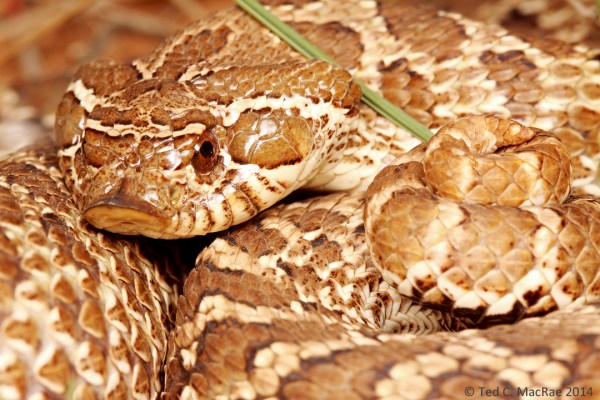
Hognose snake

The strongly upturned rostral (snout) is one character distinguishing the western from the eastern hognose snake.

All species of hognose snakes are famous for their well-choreographed sequence of defensive displays. While they are said to rear up cobra-like and strike out with their mouth open while hissing, I have never seen this behavior by any of the western or eastern hognose snakes that I’ve encountered. The first western individual I saw (in Missouri) insisted on continually trying to burrow into the deep, loose sand and made no other defensive display, while the eastern individual referenced above simply tried to run, although it did eventually barf up a half-digested frog! The individual shown here seemed reticent to do much of anything, remaining coiled up and watching and coiling even tighter as my molestations continued. At last, this one performed some theatrics by writhing in mock agony and then rolling over on its back and playing dead (a behavior called thanatosis). The Oklahoma snake also did this, adding further dramatic value by opening its mouth wide, allowing the tongue to protrude, and ejecting blood from the lacrymal glands while emitting musk from the cloaca. This one didn’t do too much with its mouth, but it did so much more with its cloaca (defecating!). If the idea of eating a snake isn’t revolting enough to begin with, then surely eating a snake covered in crap is!

Hognose snake

The ultimate in thanatotic displays—not only dead, but covered in crap!

In addition to the strongly upturned rostral (snout), best seen in the second photo above (the rostral is only moderately upturned in the eastern species), the black-checkered ventral coloration seen in the third photo confirms this as the western hognose species. The eastern hognose snake is distributed further east and does not occur in New Mexico (Degenhardt et al. 2005).

In an amusing twist to the search for Prionus at this site, while photographing the animal I happened to look down to my side and saw a male Prionus beetle crawling through the vegetation! I recognized the species immediately as P. fissicornis—represented in my cabinet by only a single specimen, and although Jeff and I would find no more after a through search of the area, our traps yielded a “bucket loads” of the beetles the next morning.

REFERENCE:

Degenhardt, W. G., C. W. Painter & A. H. Price. 2005. Amphibians and Reptiles of New Mexico. University of New Mexico Press, 507 pp. [Google Books].

© Ted C. MacRae 2015

A little extra cash

Earlier this month the Webster Groves Nature Study Society (WGNSS) sponsored their second Nature Photo Contest. I’ve been a member of this group since I first moved to St. Louis after college in the early 1980s—primarily as a participant in the Entomology Natural History Group but for the past six years also as board member and editor of the Society’s newsletter, Nature Notes. The photo contest was run much like the first one in 2013, again with nice cash prizes for the winners, except two things: 1) the categories were a little different (see below), and 2) I was tapped to be one of the three judges in the two categories that I did not submit photos. The categories were:

  • Invertebrates
  • Vertebrates
  • Plants & Fungi
  • Natural Communities
  • Seasons

I submitted two photos each to the first three categories—the maximum allowed in both cases. One limitation for me was that the photographs had to be taken in Missouri or an adjacent state. Remarkably, during the past few years I’ve taken most of my photos in places further afield—primarily in the western U.S. in states such as California, Colorado, New Mexico, and Nevada. I have many photographs from earlier years, but frankly I don’t consider much of that body of work to be photo contest worthy. Still, I was able to come up with a few more recent photographs that I thought would be competitive.

How did it go for me? Pretty good, with two of my photos taking cash-winning prizes (see below). This may not be as good as I did last time, when I won one 1st place, one 2nd place, and one 3rd place—the last of these also voted by the audience as the Grand Prize winner. Nevertheless, the cash award is much welcomed and will be put to good use. Remarkably, it turns out that two winning photographs have never been posted at this site, so here they are:


3rd Place—Vertebrates

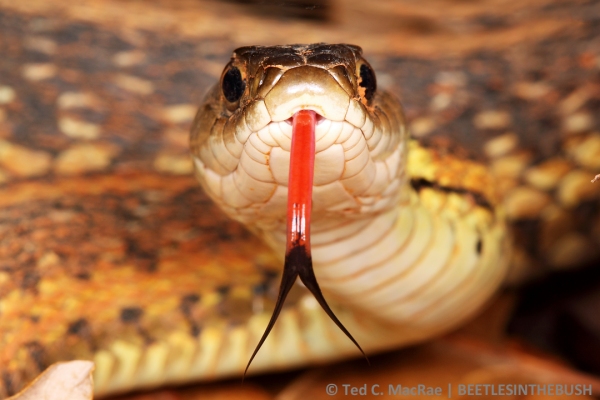
Eastern garter snake (Thamnophis sirtalis)

Eastern garter snake, Thamnophis sirtalis | Ozark Trail, Wappapello Section, Wayne Co., Missouri

The judges regarded that it represents the true “essence” of a snake. Technically they liked the position of and focus on the tongue, the contrasting red color working well in the composition, with the blurred, winding body of the snake adding depth in a cleaner fashion than a cluttered jumble of leaves. I can’t tell you how many shots I took hoping to get one with the tongue in the perfect position—knowing all along that at any moment the snake could stop flicking it or decide to make a run for it


2nd Place—Plants & Fungi

Dicentra cucullaria

Dutchman’s breeches, Dicentra cucullaria | Battle of Athens State Park, Clark Co., Missouri

Unfortunately, I didn’t get a chance to hear the judges’ feedback regarded this photo, as I was busy judging the photos in the ‘Natural Communities’ and ‘Seasons’ categories. This photo also took many shots, even though I didn’t have to worry about the subject not cooperating. Flash on white is tricky—not enough and you don’t get the stark contrast with the black background; too much and you end up blowing the highlights and losing the delicate detail. Add to that trying to get the subject perfectly symmetrical within the frame (I wanted to achieve this ‘for real’ and not through subsequent cropping), and I probably took close to two dozen shots before I felt like I had it right.

Perhaps you noticed that neither of the photos were in the ‘Invertebrates’ category. This just goes to show that the amount of interest in and effort one puts into a certain type of photography does not guarantee success—or prevent success in photographing other, less-familiar subjects. For my part I am pleased that any of my photographs were deemed good enough to receive a cash prize and thank WGNSS for giving local nature photographers the opportunity to have their work recognized and rewarded.

© Ted C. MacRae 2015

2014 Great Plains Collecting Trip iReport

During the past year or so I’ve followed up my longer (one week or more) insect collecting trips with a synoptic “iReport”—so named because they are illustrated exclusively with iPhone photographs. It may come as a surprise to some, but iPhones actually take pretty good pictures (especially if you pay attention to their strengths and weaknesses), and their small, compact size makes it easy to take lots of photos while trying to use time in the field wisely. I find the iPhone to be a great tool for documenting the general flavor of a trip and for taking quick photos of subjects before getting out the big rig. I will, of course, feature photographs taken with the ‘real’ camera in future posts.

For this trip, I teamed up with Jeff Huether for the third time since 2012. Our quarry for this trip was longhorned beetles (family Cerambycidae) in the genus Prionus. Larvae of these beetles are subterranean, with some species feeding on roots of woody plants and others on roots of grasses and other herbaceous plants. Among the latter are an array of species occurring in the Great Plains, many of which have been very uncommonly collected. However, in recent years lures have been produced that are impregnated with prionic acid—the principal component of sex pheromones emitted by females in the genus. Originally produced for use in commercial orchards (which are sometimes attacked by P. laticollis in the east and P. californicus in the west), these lures are proving themselves to be useful for us taxonomist-types who wish to augment the limited amount of available material of other, non-economic species in the genus. While Prionus was our main goal, rest assured that I did not pass on the opportunity to find and photograph other beetles of interest.

I began the trip by driving from St. Louis to Wichita, Kansas to meet up with Jeff, who had flown there from his home in upstate New York. Our plan was to visit sites in southeastern Colorado and northeastern New Mexico, where several of the Prionus spp. that we were looking for were known to occur. Before doing this, however, we stopped in Hardtner, Kansas to see “Beetle Bill” Smith and tour his amazing natural history tribute, Bill and Janet’s Nature Museum.

"Beetle" Bill Smith, founder of Bill & Janet's Nature Museum, Hardtner, Kansas.

“Beetle Bill” Smith, founder of Bill & Janet’s Nature Museum, Hardtner, Kansas.

After the tour (and a delicious lunch at his house of fried crappie prepared by his wife Janet), we headed west of town and then south just across the state line into Oklahoma to a spot where Bill had found a blister beetle (family Meloidae) that Jeff was interested in finding. During lunch I mentioned a jewel beetle (family Buprestidae) that I had looked for in the area several times, but which had so far eluded me—Buprestis confluenta. Emerald green with a dense splattering of bright yellow flecks on the elytra, it is one of North America’s most striking jewel beetles and is known to breed in the trunks of dead cottonwoods (Populus deltoides). Bill mentioned that he had collected this species at the very spot where we were going, and when we arrived I was enticed by the sight of a cottonwood grove containing several large, dead standing trunks—perfect for B. confluenta.

Buprestis spp. love large, dead, barkless cottonwood trunks.

Buprestis spp. love large, dead, barkless cottonwood trunks.

I searched for more than one hour without seeing the species, though I did find a few individuals of the related (and equally striking) B. rufipes on the trunks of the large, dead trees. Once that amount of time passes I’m no longer really expecting to see what I’m looking for, but suddenly there it was in all of its unmistakable glory! It would be the only individual seen despite another hour of searching, but it still felt good for the first beetle of the trip to be one I’d been looking for more than 30 years!
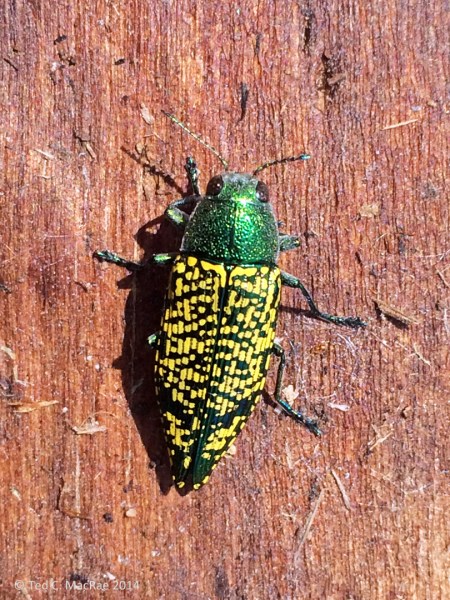
Buprestis (Knulliobuprestis) confluenta, on large, dead Populus deltoides trunk | Woods Col., Oklahoma| USA: Oklahoma

Buprestis confluenta, on the trunk of a large, dead cottonwood (Populus deltoides) | Woods Col., Oklahoma| USA: Oklahoma

I usually wait until near the end of a collecting trip to take the requisite selfie, but on this trip I was sporting new headgear and anxious to document its maiden voyage. My previous headgear of choice, a vintage Mambosok (impossible to get now), finally disintegrated after 20 years of field use, and on the way out-of-town I picked up a genuine Buff® do-rag. I know many collectors prefer a brim, but I don’t like they way brims limit my field of vision or get in the way when I’m using a camera. Besides, I’m usually looking down on the ground or on vegetation, so sun on my face is not a big issue. And do I be stylin’ or wut?

A "selfie" makes the trip official.

A “selfie” makes the trip official.

We made it to our first locality in southeast Colorado by noon the next day—the vast, dry grasslands north of Las Animas. Jeff had collected a blister beetle of interest here on an earlier trip, but as I looked out across the desolate landscape I wondered what on Earth I could find here that would be even remotely interesting to me.
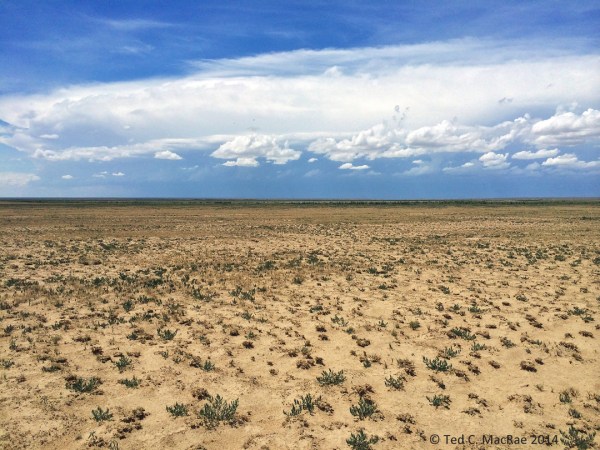
Shortgrass prairie habitat for Prionus integer.

Shortgrass prairie habitat for Prionus integer.

Letting Jeff have some time to look for his blister beetle, I started down the roadside and after a short time found a live female Prionus sp. (later determined to represent P. integer). The only female Prionus I had ever collected before was P. heroicus, a giant species out in Arizona, and that was almost 30 years ago, so I wasn’t immediately sure what it was. Eventually I decided it must be Prionus, and a quick stop to kick the dirt while Jeff looked for his beetle turned into an intense search for more Prionus that surely were there. I did find two male carcasses shortly thereafter, and then nothing more was seen for the next hour or so.

Prionus integer male | Bent Co., Colorado

Prionus integer male (found dead) | Bent Co., Colorado

During the time that I was searching, however, I started noticing strange burrows in the ground. I excavated a few—they were shallow but contained nothing. Nevertheless, they matched the size of the beetles perfectly—surely there was a connection?
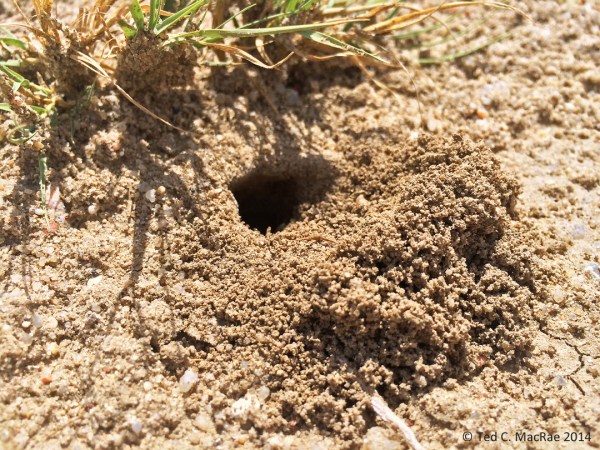
Prionus integer adult burrow.

Prionus integer adult burrow.

I wondered if Jeff knew about the beetles occurring here, but when I showed him what I had found the surprised look on his face told me this was not the case. I showed him the burrows, and we both agreed they had to be connected. I got the shovel out of the truck and walked back to the area where I had seen the live female, then sunk the shovel deep into the ground next to one of the burrows and pried up a chuck of the soil containing the burrow in its entirety. As we broke apart the soil another female was revealed, and we immediately decided to set out some traps baited with prionic acid lures. We expected the beetles to become active during dusk, so we went into town to get something to eat and then check out another nearby locality before returning to the site at dusk. While we were gone it rained heavily at the site, so we weren’t sure if or how this would affect beetle activity and their possible attraction to the traps. However, as we approached the site (slipping and sliding on the muddy 2-track), we could actually see beetles crawling on the road from afar. What we found when we got out of the car was nothing short of mind-blowing—the beetles were everywhere, crawling on the road, crawling through the grass, and overflowing in the flooded traps! The vast majority were males, as expected, but we also found a fair number of the much more rarely collected females. This was significant, as the chance to observe mating and oviposition behavior made the encounter far more informative than if we had only found and collected the much more numerous males.

Prionus integer mating pair.

Prionus integer mating pair.

The following day we headed south into northeastern New Mexico to look at some shortgrass prairie sites near Gladstone (Union Co.) where two species of Prionus had been collected in recent years: P. fissicornis (the lone member of the subgenus Antennalia) and P. emarginatus (one of eight species in the poorly known subgenus Homaesthesis, found primarily in the Great Plains and Rocky Mountains). Fresh off of our experience the previous day, we were on the lookout for any suspicious looking “burrows” as we checked the roadsides at several spots in the area but found nothing, and while a few blister beetles piqued the interest of Jeff at one site, the complete absence of woody vegetation or flowering plants in general in the stark grassland landscape made the chances of me finding any other woodboring beetles remote. Eventually I became distracted by the lizards that darted through the vegetation around us, including this lesser earless lizard (Holbrookia maculata) and a collared lizard (better photos of both forthcoming).

Holbrookia maculata (lesser earless lizard) | Union Co., New Mexico.

Holbrookia maculata (lesser earless lizard) | Union Co., New Mexico.

Despite no clues to suggest that Prionus beetles were active in the area, we set out some traps at two sites with soil exposures that seemed similar to those seen the day before. As Jeff set the last pair of traps in place, my distraction with saurian subjects continued with a dusty hognose snake (Heterodon nasicus gloydi). While photographing the animal I looked down to my side, and what did I see but a male Prionus fissicornis crawling through the vegetation! I called out to Jeff, and for the next half an hour or so we scoured the surrounding area in a failed attempt to find more. We would not be back until the next morning to check the traps, so our curiosity about how abundant the beetles might be would have to wait another 18 hours. We cast an eye towards the north and watched late afternoon thunderstorms roll across the expansive landscape and decided to check out the habitat in nearby Mills Rim.

Thunderstorms over shortgrass prairie.

Thunderstorms over shortgrass prairie.

The rocky terrain with oak/pine/juniper woodlands at Mills Rim was a dramatic contrast to the gently rolling grasslands of the surrounding areas. We came here mostly out of curiosity, without any specific goal, but almost immediately after getting out of the car a huge Prionus male flew up to us—almost surely attracted by the scent of the lures we were carrying. Within a few minutes another male flew in, and then another. Because of their huge size and occurrence within oak woodland habitat, we concluded they must represent P. heroicus, more commonly encountered in the “Sky Islands” of southeastern Arizona. We stuck around to collect a few more, but as dusk approached we returned to the surrounding grasslands to set out some lures to see if we could attract other Prionus species. The frontal system that had waved across the landscape during the afternoon had left in its wake textured layers of clouds, producing spectacular colors as the sun sank inexorably below the horizon.

Sunset over shortgrass prairie.

Sunset over shortgrass prairie.

This attempt to collect grassland Prionus beetles would not be successful, and as dusk progressed we became distracted collecting cactus beetles (Moneilema sp., family Cerambycidae) from prickly pear cactus plants (Opuntia sp.) before darkness ended our day’s efforts. This did not mean, however, that all of our efforts were done—there are still night active insects, and in the Great Plains what better nocturnal insect to look for than North America’s largest tiger beetle, the Great Plains giant tiger beetle (Amblycheila cylindriformis, family Cicindelidae—or subfamily Cicindelinae—or supertribe Cicindelitae, depending on who you talk to)?! We kept our eyes on the headlamp illuminated 2-track as we drove back to the highway and then turned down another road that led into promising looking habitat. Within a half-mile of the highway we saw one, so I got out to pick it up and then started walking. I walked another half-mile or so on the road but didn’t see anything except a few Eleodes darkling beetles (family Tenebrionidae), then turned around and walked the habitat alongside the road on the way back. As I walked, tiny little rodents—looking like a cross between a mouse and a vole—flashed in and out of my headlight beam as they hopped and scurried through the vegetation in front of me. Most fled frantically in response to my attempted approach, but one, for some reason, froze long enough under my lamp to allow me this one photo. When I posted the photo on my Facebook page, opinions on its identity ranged from kangaroo rat (Dipodomys sp.) silky pocket mouse (Perognathus flavus) to jumping mouse (Zapus sp.). Beats me.
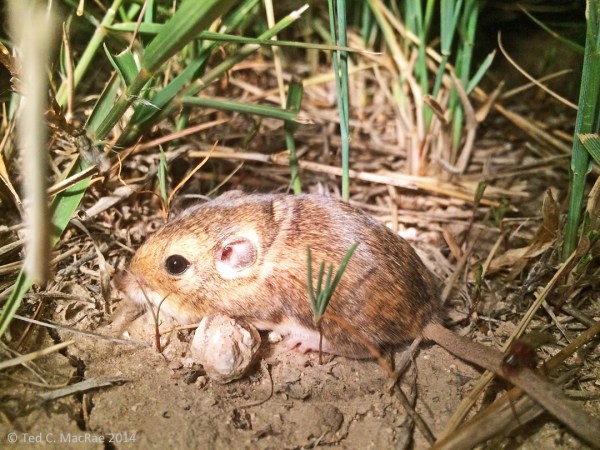
silky pocket mouse? Zapus sp., jumping mouse? | Union Co., New Mexico.

Kangaroo rat? Silky pocket mouse? Jumping mouse? | Union Co., New Mexico.

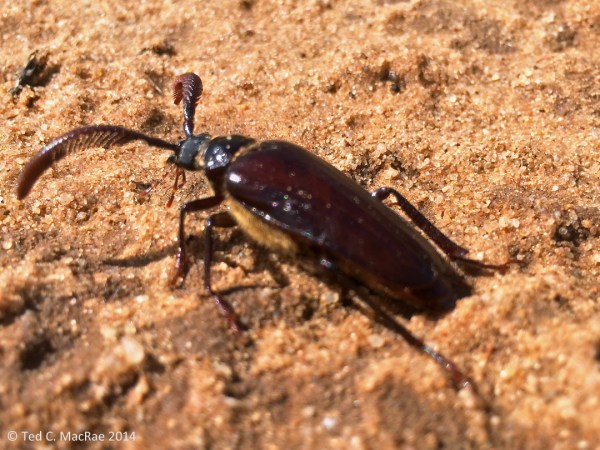
Almost as if by command, it rained during the early evening hours where we had set the traps, and the following morning we were rewarded with traps brimming with Prionus fissicornis males. Not only were the traps full, but males were still running around in the vicinity, and we even found a few females, one of which was in the act of ovipositing into the soil at the base of a plant.

Prionic acid-bated traps w/ Prionus fissicornis males.
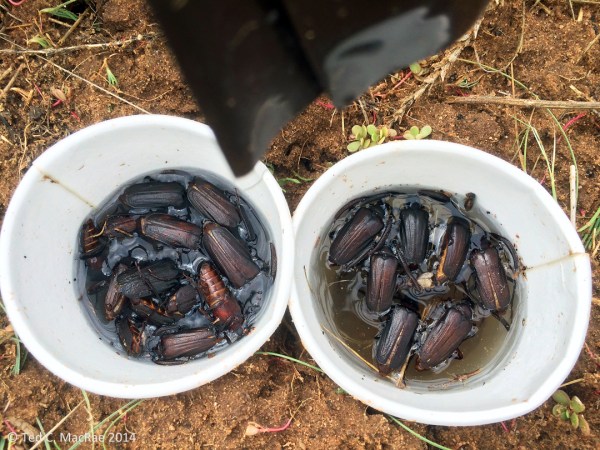
Prionic acid-bated traps w/ Prionus fissicornis males.
Prionic acid-bated traps w/ Prionus fissicornis males.

Prionic acid-bated traps w/ Prionus fissicornis males.

Prionus fissicornis male | Harding Co., New Mexico.

Prionus fissicornis male | Harding Co., New Mexico.

Prionus fissicornis oviposition hole.

Prionus fissicornis oviposition hole.

Eventually P. fissicornis activity subsided, and we decided to go back to the area around Mills Rim to see what beetles we might find in the woodland habitats. We also still were not sure about the Prionus beetles we had collected there the previous day and whether they truly represented P. heroicus. The scrubby oaks and conifers screamed “Beat me!”, and doing so proved extraordinarily productive, with at least a half-dozen species of jewel beetles collected—including a nice series of a rather large Chrysobothris sp. from the oaks that I do not recognize and a single specimen of the uncommonly collected Phaenops piniedulis off of the pines.
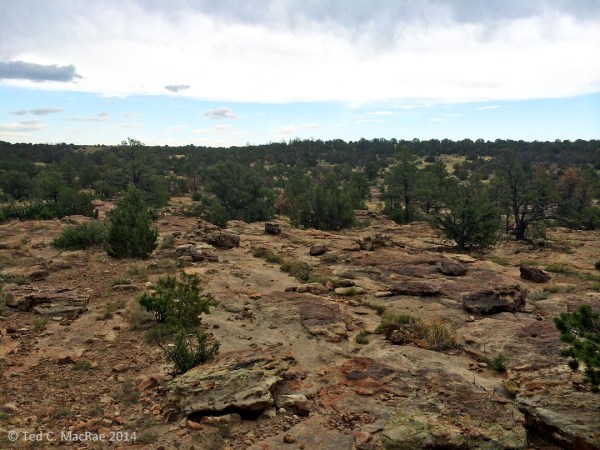
Oak/juniper woodland at Mills Canyon, habitat for Prionus heroicus.

Oak/juniper woodland at Mills Canyon, habitat for Prionus heroicus.

Not only is the scenery at Mills Rim Campground beyond spectacular, it also boasts some of the most adoringly cute reptiles known to man—such as this delightfully spiky horned lizard (I prefer the more colloquial name “horny toad”!). I’m probably going to regret not having photographed this fine specimen with the big camera.
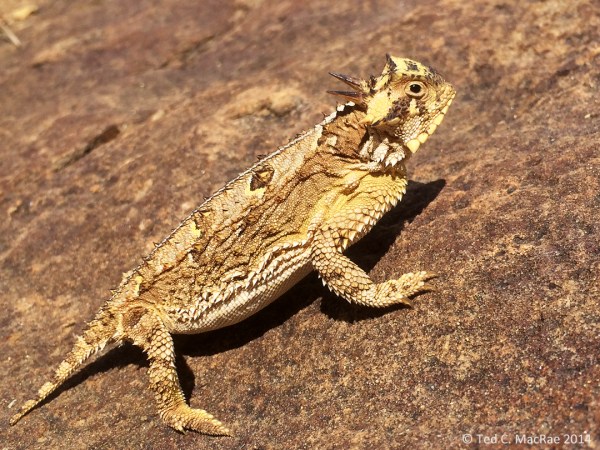
Phrynosoma cornutum (Texas horned lizard) | Harding Co., New Mexico.

Phrynosoma cornutum (Texas horned lizard) | Harding Co., New Mexico.

Fresh diggings beside a rock always invite a peek inside. You never know who might be peeking out.
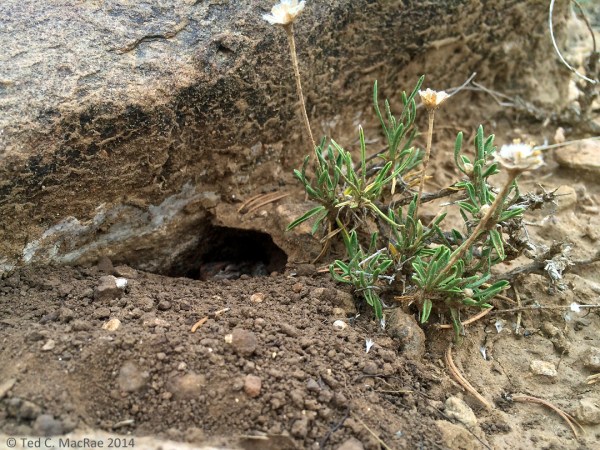
Who's home?

Who’s home?

Peek-a-boo!

Peek-a-boo!

The trip having reached the halfway point, we debated whether to continue further south to the sand dunes of southern New Mexico (with its consequential solid two-day drive back to Wichita) or turn back north and have the ability to collect our way back. We chose the latter, primarily because we had not yet had a chance to explore the area around Vogel Canyon south of Las Animas, Colorado. We had actually planned to visit this area on the day we encountered P. integer in the shortgrass prairie north of town, and a quick visit before going back to check the traps that evening showed that the area had apparently experienced good rains as shown by the cholla cactus (Cylindropuntia imbricata) in full bloom.

Cylindropuntia imbricata | Otero Co., Colorado.

Cylindropuntia imbricata | Otero Co., Colorado.

Whenever I see cholla plants I can’t help myself—I have to look for cactus beetles (Moneilema spp.). It had rained even more since our previous visit a few days ago, and accordingly insects were much more abundant. Several Moneilema adults were seen on the cholla, one of which I spent a good bit of time photographing. The iPhone photo below is just a preview of the photos I got with the big camera (which also included some very impressive-sized cicadas—both singing males and ovipositing females). The cactus spines impaled in the camera’s flash control unit serve as a fitting testament to the hazards of photographing cactus insects!
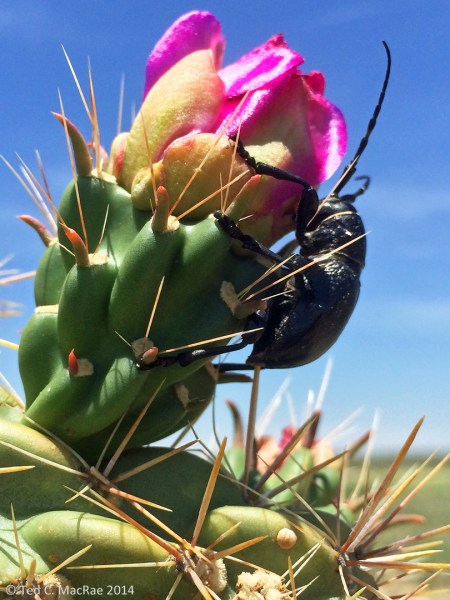
Moneilema sp. on Cylindropuntia imbracata } Otero Co., Colorado.
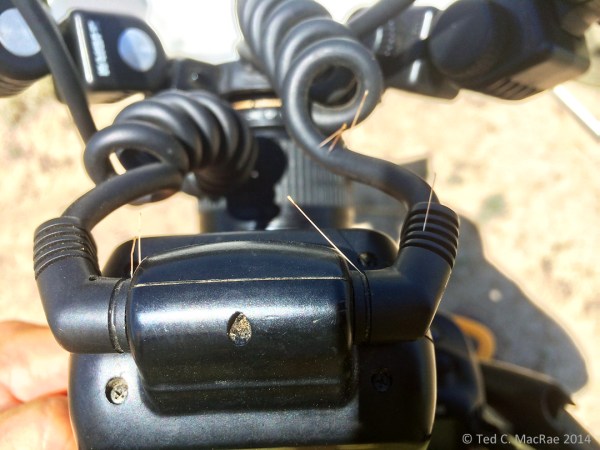
Moneilema sp. on Cylindropuntia imbracata } Otero Co., Colorado.

The hazards of photographing cactus beetles.

The hazards of photographing cactus beetles.

Later in the afternoon we hiked down into the canyon itself, and while insects were active we didn’t find much out of the ordinary. We did observe some petroglyphs on the sandstone walls of the canyon dating from the 1200s to the 1700s—all, sadly, defaced by vandals. Despite the rather uninspiring collecting, we stayed in the area for two reasons: 1) Jeff wanted to setup blacklights at the canyon head in hopes of collecting a blister beetle that had been caught there on an earlier trip, and 2) I had noted numerous Amblycheila larval burrows in the area (and even fished out a very large larva from one of them) and wanted to search the area at night to see if I could find adults. Jeff was not successful in his goal, and for a time I thought I would also not succeed in mine until we closed up shop and started driving the road out of the canyon. By then it was after 11 p.m. and we managed to find about a half-dozen A. cylindriformis adults. This was now the third time that I’ve found adults of this species, and interestingly all three times I’ve not seen any beetles despite intense searching until after 11 p.m and up until around midnight.

Lithographs on canyon wall | Mills Canyon, Colorado.

Lithographs on canyon wall | Mills Canyon, Colorado.

The next morning we found ourselves with two days left in the trip but several hundred miles west of Wichita, where I needed to drop Jeff off for his flight back home before I continued on home to St. Louis. I had hoped we could make it to the Glass Mountains just east of the Oklahoma panhandle to see what Prionus species might be living in the shortgrass prairies there (and also to show Jeff this remarkable place where I’ve found several new state records over the past few years). As we headed in that direction, I realized our path would take us near Black Mesa at the western tip of the Oklahoma pandhandle, and having been skunked on my first visit to the area last year due to dry conditions but nevertheless intrigued by its very un-Oklahoma terrain and habitat I suggested we stop by the area and have a look around before continuing on to the Glass Mountains. We arrived in the area mid-afternoon and headed straight for a rock outcropping colonized by scrub oak (Quercus sp.) and pinyon pine (Pinus sp.)—very unusual for western Oklahoma—that I had found during my previous trip.

The author looks pensively out over the Black Mesa landscape.

The area around Black Mesa couldn’t be more unlike the perception that most people have of Oklahoma.

I wanted to beat the oaks for buprestids—surely there would be a state record or two just sitting there waiting for me to find them, but as I started walking from the car towards the oaks the approach of a loud buzz caught my attention. I turned around to see—would you believe—a large Prionus beetle circling the air around me and was fortunate to net it despite its fast and agile flight. I hurried back to the car to show Jeff what I had found; we looked at each other and said, “Let’s collect here for a while.” The beetle had apparently been attracted to the lures in the car, so we got them out, set them up with some traps, and went about beating the oaks and watching for beetles to fly to the lure. Sadly, no  jewel beetles were collected on the oaks, although I did find evidence of their larval workings in some dead branches (which were promptly collected for rearing). Every once in a while, however, a Prionus beetle would fly in, apparently attracted to the lure but, curiously, never flying directly to it and falling into the trap. Many times they would land nearby and crawl through the vegetation as if searching but never actually find the trap. However, just as often they would approach the trap in flight and not land, but rather continue circling around in the air for a short time and before suddenly turning and flying away (forcing me to watch forlornly as they disappeared in the distance). Based on their very large size, blackish coloration and broad pronotum, we surmised (and later confirmed) these must also be P. heroicus, despite thinking (and later confirming) that the species was not known as far east as Oklahoma. Not only had we found a new state record, but we had also recorded a significant eastern range extension for the species. And to think that we only came to Black Mesa because I wanted to beat the oaks!

Prionus heroicus male

Prionus heroicus male

Bite from Prionus heroicus male.

Proof that Prionus heroicus males can bite hard enough to draw blood!

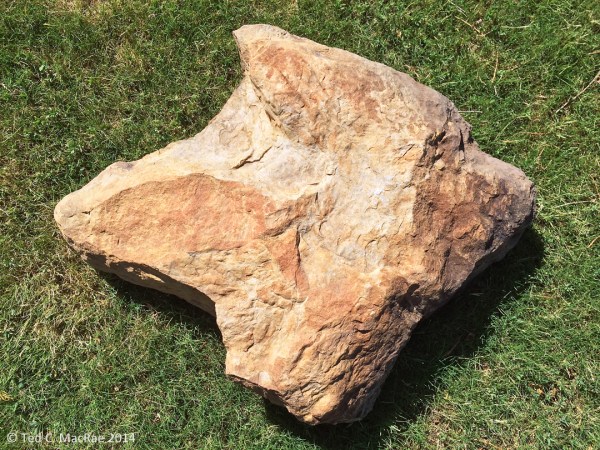
We each collected a nice series of the beetles, and despite never witnessing the beetles actually going to the traps a few more were found in the traps the next morning after spending the night in a local bed & breakfast. I also found a dove’s nest with two eggs hidden in the vegetation, and as we were arranging for our room at the bed & breakfast a fellow drove up and dropped off a freshly quarried dinosaur footprint (the sandstone, mudstone, and shale deposits around Black Mesa are the same dinosaur fossil bearing deposits made more famous at places like Utah’s Dinosaur National Monument).

Dove's nest w/ eggs.

Dove’s nest w/ eggs.

Dinosaur fossil footprint

Freshly quarried dinosaur fossil footprint

By the way, if you ever visit the area, the Hitching Post at Black Mesa is a great place to stay. A longhorn skull on the barn above an authentic 1882 stagecoach give a hint at the ambiance, and breakfast was almost as good as what my wife Lynne can do (almost! 🙂 ).

Longhorn skull on barn at our Bead and Breakfast.
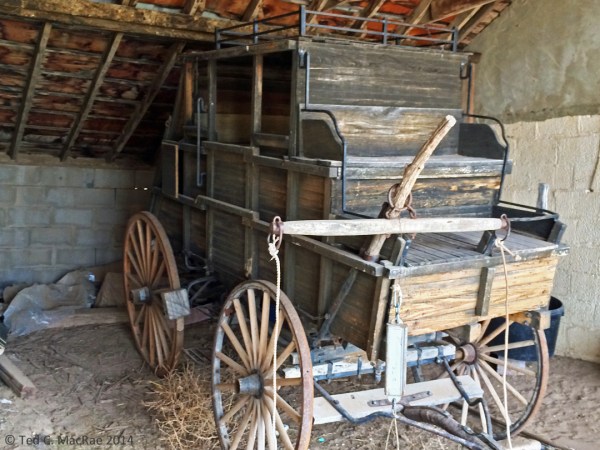
Longhorn skull on barn at our Bead and Breakfast.

132-year-old stagecoach - model!

132-year-old stagecoach – model!

After breakfast we contemplated the long drive that lay between us and our arrival in Wichita that evening—our longer than expected stay in the area had virtually eliminated the possibility to collect in the Glass Mountains. Nevertheless, there was one more thing that I wanted to see before we left—the dinosaur footprints laying in a trackway along Carrizo Creek north of the mesa. I only knew they were in the area based on a note on a map, but as there were no signs our attempt to find them the previous day was not successful. Armed with detailed directions from the B&B owners, however, we decided to give it one more shot. Again, even after we found the site I didn’t see them immediately, I suppose because I was expecting to see distinct depressions in dry, solid rock. Only after the reflections of light from an alternating series of small puddles—each measuring a good 10–12″ in diameter—did I realize we had found them. Recent rains had left the normally dry creek bed filled with mud, with the footprints themselves still filled with water.

Dinosaur tracks | vic. Black Mesa, Oklahoma.

Dinosaur tracks | vic. Black Mesa, Oklahoma.

It is not surprising that I would be so excited to find the tracks, but what did surprise me was the effect they had on me. Seeing the actual signs of near mythical beasts that lived an incomprehensible 100 million years ago invites contemplation and reminds us that our time here on Earth has, indeed, been short!
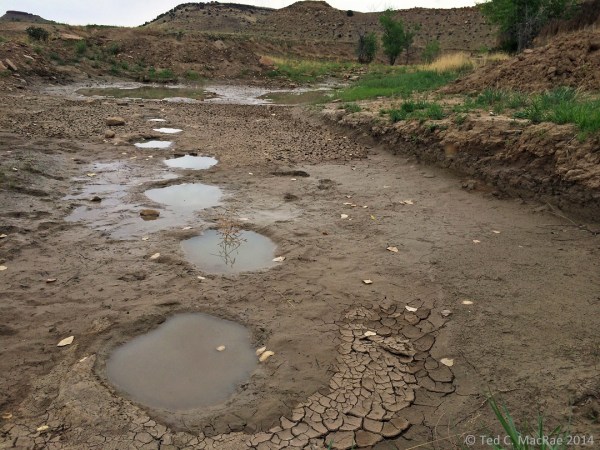
Dinosaur tracks | vic. Black Mesa, Oklahoma.

Dinosaur tracks | vic. Black Mesa, Oklahoma.

By this time, we had no choice but to succumb to the long drive ahead. We did manage to carve out a short stop at the very first locality of the trip in an effort to find more Buprestis confluens (finding only a few more B. rufipes), but otherwise the day was spent adhering to our goal of reaching Wichita before nightfall. Jeff was home and sipping tea before lunchtime the next day, while I endured one more solid day of driving before making it back to St. Louis in time for dinner with the family. At that point, the trip already could have been considered a success, but how successful it ultimately ends up being depends on what beetles emerge during the next season or two from these batches of infested wood that I collected at the various spots we visited.
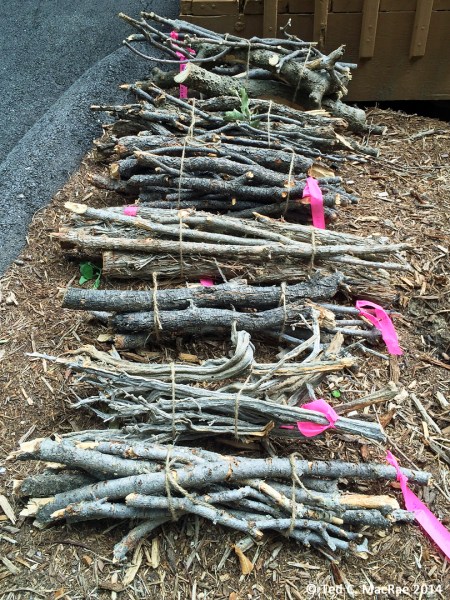
Wood collected for rearing wood-boring beetles.

Wood collected for rearing wood-boring beetles.

If you like this Collecting Trip iReport, you might also like the iReports that I posted for my 2013 Oklahoma and 2013 Great Basin collecting trips as well.

© Ted C. MacRae 2014
Turbo Testudine

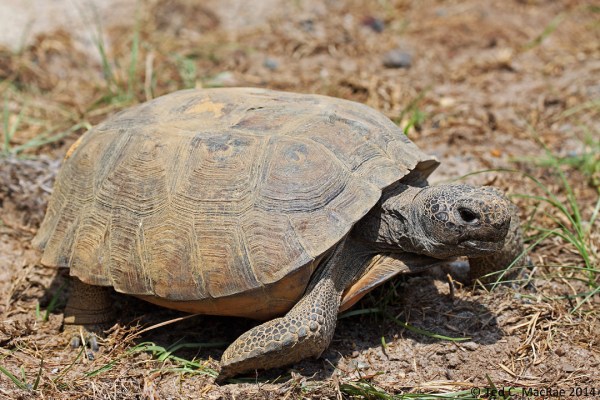
gopher tortoise (Gopherus polyphemus)

Gopher tortoise (Gopherus polyphemus) | Tattnall Co., Georgia

Last weekend I traveled to Georgia with two field companions to look for insects associated with sand scrub habitats in the southeastern part of the state. Of course, while I am an entomologist with beetles as a focus, I am also a naturalist who keeps an eye out for all manner of critters, plants, and other natural features. Thus, when we saw an enormous tortoise about to cross the road while driving through sand scrub habitat south of Riedsville, there was no debating whether we should stop and take a look. We immediately recognized him as a gopher tortoise (Gopherus polyphemus), even though none of us had actually ever seen a gopher tortoise in person. (I say “him” because the of the fairly long gular projection, which is generally longer in males than in females.)

gopher tortoise (Gopherus polyphemus)

Contrary to popular perception, this tortoise walked rather urgently.

We pulled over about 50 yards further up the road and began hiking back towards the tortoise. As we got closer, he immediately turned and started running (yes, running!) towards us. Seriously. He reminded me of a puppy that had gotten lost and just seen his master! I don’t think I have ever seen something quite like that, and I don’t think I can really explain it, either.

gopher tortoise (Gopherus polyphemus)

He definitely had somewhere in mind that he wanted to go…

Once we got quite close, he turned away and crawled back up onto the road in an attempt to cross to the other side. I had grabbed my big camera, as I did not want to record this encounter with just my iPhone. I also did not want to photograph him on the road surface, so one of my companions picked him up (with gloves on) and brought him back over to the roadside where I began taking photographs on a more natural substrate.

gopher tortoise (Gopherus polyphemus)

…and he wanted to get there quickly.

This was one enormous tortoise—the carapace easily measured 12 inches in length, which I later read is at the upper end of the range for adults of this species. We marveled at his old-man head and thick, powerfully clawed front legs—an obvious adaptation for a digging lifestyle. I almost wish I had borrowed my companion’s gloves and taken advantage of the opportunity to pick him up myself and see how much he weighed. No matter—he was easily the largest testudine that I have ever seen!

gopher tortoise (Gopherus polyphemus)

Who would think a tortoise could be so hard to photograph!

I don’t know where this tortoise was going or why, but I do know that it was, surprisingly, one of the most difficult to photograph subjects I have ever encountered. He was quite capable of moving along at a rather quick pace (tortoise-and-hare fables notwithstanding) and never stopped urgently trying to cross the road. It was difficult to stay low to avoid a “top-down” perspective and still keep in front of him. We moved him to the other side of the road, thinking that might make him happy, but he would then just turn around and try to get back on the road and cross back to where he came from. I decided to just set the camera on autofocus and, with abundance natural light, starting snapping away to play a numbers game. Out of the few dozen or so exposures I got, the ones shown here are all that I kept (the others mostly showing a “bum” leg or two). The first photo at top is my favorite of the bunch.

© Ted C. MacRae 2014

Baby box turtle on white

Box turtles of the genus Terrapene are extraordinarily common in Missouri, especially in the eastern and southern forested regions of the state where the three-toed box turtle (T. carolina triunguis)—Missouri’s state reptile—is the most commonly encountered form. Despite this abundance and the author’s more than a half-century spent scrabbling through the sticks of Missouri, I have never encountered a youngster as tiny as the one shown in this post (shell length about 2 inches). In fact, I didn’t even find it—my daughter rescued it from our dog, who had found it crossing the gravel driveway at our family’s cabin west of St. Louis. Such overwhelming cuteness demanded a photo session, and rather than deal with the active little hatchling’s persistent efforts to duck into the leaf litter I decided to photograph it on a clean, white background and arrange some of the photos in a “Naskreckian” collage. My daughter wanted to keep the little guy, but eventually she agreed that it would be better off released back into the forest. While it may lead a more perilous life in the forest, the opportunity to dine on fresh earthworms and strawberries should make up for it, and from these photos my daughter can always remember it for the little pup it once was.

Box-turtle-collage_1080x1407

Copyright © Ted C. MacRae 2014

Skulls on my desk

Even though I am a scientist working in an organization with hundreds of other scientists, I can lay claim to one true uniquity—I am the only one I know of that has a skull on their desk! Six, actually. They’re not real (sadly), but their impact on most first-time visitors to my office is no less amusing. Typically the first question is, “What are those?”—to which my standard reply is, “Those are former colleagues with which I’ve had problems.” Maybe that is a little mean, but it usually gets a laugh (sometimes nervous). Hey, if somebody doesn’t understand my sense of humor, they’ll have to learn sooner or later.

¹ In anthropology, most of these would actually be called “crania” (skull minus associated mandible) rather than skulls. We can be less pedantic here.

I am, of course, talking about my collection of hominid fossil replicas. Yes, I am an entomologist, but I’ve also had a lifelong fascination with paleoanthropology and human evolution. Actually, I think my broad interest in multiple disciplines is rather typical of those who are drawn to the natural sciences, so it surprises me that there aren’t more scientists where I work with a skull on their desk. After all, this was a common practice among ancient scholars as a reminder of their mortality. My reasons for having skulls on my desk are less philosophical—I just like having replicas of some of paleoanthropology’s most important fossil hominid finds. They are icons of a subject that couldn’t be more relevent—our own origins. Just as nothing in biology makes sense except in the light of evolution, nothing in human society makes sense except in the light of human evolution. The skulls are a reminder of not just who we are, but why we are.


Taung 1, “Taung Child”

Taung 1, "Taung Child"

Taung 1, “Taung Child” (Australopithecus africanus) | Taung, Republic of South Africa, 2.8 mya

The “Taung Child” is thought to be a 3-year-old child representing Australopithecus africanus (which means “southern ape of Africa”). Discovered in 1924, it was the first hominid fossil discovered that, while definitely not a member of our own genus, could still be argued as somewhat human. Nevertheless, it would take another 20 years—once other, adult, specimens were discovered in southern Africa—before A. africanus would begin gaining acceptance in the scientific community.

The significance of the Taung Child was that it provided fossilized evidence of upright, two-legged (bipedal) walking much earlier than expected. Up to that time, it was believed that humans began to walk upright only after they had developed a large brain. Robert Broom, upon arriving in South Africa in 1936 and seeing the Taung Child for the first time, is said to have knelt at the edge of the table and exclaimed, “I behold my ancestor!” It is now thought that A. africanus represents southern African descendents of A. afarensis from east Africa but is not in the direct lineage leading to modern humans. Nevertheless, the Taung Child remains an iconic hominid fossil, especially given the suspected circumstances of its death—attacked and killed by an eagle! Puncture marks at the bottom of its eye sockets resemble those made by the talons and beak of modern eagles, which are known to attack monkeys in Africa today. The skull was also found among eggshells and a mixture of bones from other small animals that could have been preyed upon and show damage resembling that made by modern eagles.


STS 5, “Mrs. Ples”

Australopithecus africanus, "Mrs. Ples," STS-5, Sterkfontein, South Africa, 2.5 mya

STS 5, “Mrs. Ples” (Australopithecus africanus) | Sterkfontein, Republic of South Africa, 2.5–2.1 mya

Discovered in 1948 by Robert Broom, this nearly complete adult A. africanus cranium actually served to convince scientists of the time that the Taung Child was not just a baby chimpanzee whose ape-like features had not yet developed. Broom named the new fossil Plesianthropus transvaalensis and hypothesized that she was a middle-aged female—thus the nickname, “Mrs. Ples.” The fossil is now regarded to represent the same species as the Taung Child, differing chiefly in the adult character of prognathous (forward projecting) jaws, and is also now thought to have belonged to a sub-adult male.

I had the good fortune to see the actual fossil in person on a private tour of the Transvaal Museum’s “Broom Room” during a trip to South Africa in 1999. I wrote about that experience in a guest post at Christopher Taylor’s Catalogue of Organisms titled, Origins – A Day in the Broom Room as follows:

As Dr. Fourie held the cranium for me to look at, I noticed the fossil was about 3.5 feet off the floor—about the presumed height for the species. I suddenly saw Mrs. Ples standing before me in life – a living, breathing being, not an animal, yet not quite human either. I may not have used Broom’s precise words, but I whispered something along those lines to myself as the slender, hairy virtual creature stood before me. The Museum Gift Shop was selling plaster replicas of Mrs. Ples, one of which now sits on the desk in my office. I think about that experience at the Transvaal Museum almost everytime I look at it.


SK 48, “Paranthropus crassidens

SK 48 "Paranthropus crassidens" (Paranthropus robustus) | Swartkrans, South Africa, 1.8-2.0 mya

SK 48, “Paranthropus crassidens” (Paranthropus robustus) | Swartkrans, Republic of South Africa, 1.8–1.5 mya

While Robert Broom was excavating in South Africa, he recognized that the fossils he was finding represented two distinct morphs—a “gracile” form now encompassed by A. africanus, and a more “robust” form that he described in 1938 as Paranthropus robustus. SK 48, discovered by Broom and Robinson in 1952, was until recently the most complete example of this latter type. The term “robust” refers not to the size of the body, but rather the characters of the skull that include a prominent sagittal crest and robust zygomatics and mandible with large, thickly enameled post-canine dentition. These features provide extra space for chewing muscles and larger molar surfaces—adaptations linked to a powerful chewing complex designed for processing tough, fibrous foods. Paranthropus robustus appears to have been a dead end taxon, being the last of the robust australopithecines and having no apparent descendants. It seems to have been a contemporary of early representatives of the genus Homo—our genus—in southern Africa (tempting speculation on what might have happened to them!).

This was another of the fossils I saw first hand during my visit to the Broom Room, and the plaster replica purchased from the Museum gift shop sits alongside Mrs. Ples on the desk in my office.


OH 5, “Nutcracker Man”/”Zinj”

KNM OH5, "Nutcracker Man" (Paranthropus boisei) | Olduvai Gorge, Tanzania, 1.8 mya

OH 5, “Nutcracker Man”/”Zinj” (Paranthropus boisei) | Olduvai Gorge, Tanzania, 1.8 mya

When it comes to fossil hominids, Olduvai Gorge in Tanzania is easily among the most famous of sites, and of the fossils found at Olduvai Gorge, OH 5 “Nutcracker Man” is easily the most famous. Discovered in 1959 by Mary Leakey, it was originally classified as a new genus and species, Zinjanthropus boisei, but is now accepted as a member of the genus Paranthropus. It is thought to represent a derived, “hyper-robust” species descended from P. aethiopicus (see “The Black Skull” below), which lived in east Africa a million years earlier. Like its congeneric contemporary in southern Africa (P. robustus), Nutcracker Man appears to have died out with no living descendents.

The discovery of Nutcracker Man (sometimes called “Zinj” in reference to its original genus name) brought the “robust” morph, typified until then by P. robustus, to a new level of robusticity: wide, outward-flaring zygomatic arches that projected forward of the nasal opening to form a dished-shape face, a large sagittal crest atop the skull, and a massive lower jaw. These traits no doubt allowed plenty of room and attachment for the huge chewing muscles needed for its diet. If features such as this aren’t enough to justify a nickname like Nutcracker Man, surely the megadont cheek teeth—up to four times the size of our own—will seal the deal!


KNM-WT 17000, “The Black Skull”

KNM-WT 17000, “The Black Skull” (Paranthropus aethiopicus) | West Turkana, Kenya, 2.5 mya

KNM-WT 17000, “The Black Skull” (Paranthropus aethiopicus) | West Turkana, Kenya, 2.5 mya

The “Black Skull” is actually one of the more recent hominid fossil finds. Discovered in 1985 by Alan Walker, it was originally classified as Paranthropus boisei—the same species as “Nutcracker Man.” However, the Black Skull is nearly a million years older than Nutcracker Man and apparently shares some characters with the even older Australopithecus afarensis (“Lucy” being its most famous member). All three of these forms lived in east Africa, though at different times, and the Black Skull was eventually deemed to represent yet another distinct taxon—Paranthropus aethiopicus (described some time earlier, but from only a partial lower jaw). It is the earliest known member of the genus, and the Black Skull remains the only known skull representing the species. Paranthropus aethiopicus likely gave rise to the later P. boisei in east Africa and P. robustus in southern Africa.

The Black Skull isn’t as robust as Nutcracker Man, but it is my favorite robust australopithecine fossil because… it’s BLACK! How cool. Actually the skull started out white, just like any other bone prior to fossilization, and developed its dramatic dark blue-black color as a result of the manganese-rich soil in which it spent the past two and a half million years.


KNM-WT 15000 “Turkana/Nariokotome Boy”

KNM-WT 15000, "Nariokotome/Turkana Boy" (Homo ergaster) | Nariokotome, West Turkana, Kenya, 1.6 mya

KNM-WT 15000, “Turkana/Nariokotome Boy” (Homo ergaster) | Nariokotome, West Turkana, Kenya, 1.6 mya

The “Turkana Boy” skull is actually part of a remarkably complete skeleton excavated in 1984 by Richard Leakey and colleagues. Some regard Turkana Boy as a representative of Homo erectus, the first human to migrate out of Africa into Eurasia, while others consider the African populations to represent the distinct taxon, H. ergaster. One of paleoanthropology’s most contentious topics is whether modern humans evolved only from H. ergaster in Africa (the second “out-of-Africa”) or locally from H. erectus populations (including H. ergaster) throughout the Old World (“multiregionalism”). Molecular data seems to favor the former, but the latter has passionate adherents. Of all the skulls sitting on my desk, this one alone can be regarded as a possible near-direct ancestor!

Turkana Boy is not only remarkable by the completeness of its skull, but also the astonishing 90% coverage of the complete skeleton that results when bilateral symmetry is used to fill missing bone. Such completeness is extraordinarily rare among fossil hominids, and it has provided a wealth of information about the body size, shape, and growth rates of H. ergaster. The skeleton is thought to have belonged to a boy 12 or 13 years of age, measuring 5’3″ tall and weighing 106 lbs at the time of death. Interestingly, the pelvis reveals a greater ability to run than modern humans, while other bones more closely resemble those of Australopithecus. The long, slender body seems to be an adaptation to the hot, dry climate that existed in Africa.


Thanks to all who participated in ID Challenge #22. I have to admit how surprised and impressed I am about how many of you seem to be as interested in and up to date on human evolution as I. Congratulations to perennial BitB challenge master Ben Coulter, who takes the win with 63 pts. Dennis Haines (61 pts) and Mike Baker (60 pts) complete the podium, and honorable mentions go to Sam Heads (58 pts) and tandemtrekking (57 pts).

Copyright © Ted C. MacRae 2013

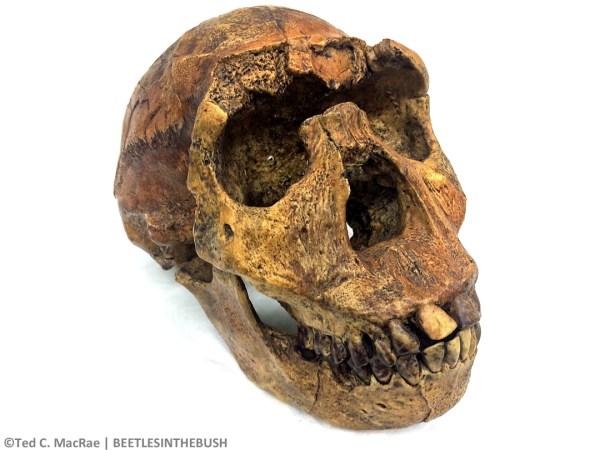
ID Challenge #22: The Bone Collector

After a long hiatus, it is time to resurrect BitB Challenge Session #7 with this very unusual ID Challenge. Some of you may know (and most probably don’t) that, among my many other hobbies, I am a bit of an armchair paleoanthropologist. Over the years I have assembled replicas of a few of the more significant fossil hominid finds that have shaped our understanding of human evolution. For this challenge, identify the fossils shown below with 1) “nickname” of the fossil (2 pts), 2) currently accepted genus (2 pts) and species (2 pts) assignment, 3) country of origin (2 pts), and 4) approximate age (2 pts). Comments will be held in moderation while the challenge is open to give all a chance to play. Answers will be revealed in the next couple of days or so.

p.s. Don’t be afraid to try—I’ll be surprised (and impressed) if anybody gets a clean sweep of the points. Good luck!

Update: Bonus question (to be used in case of a tiebreaker)—which of these is my favorite, and why (up to 5 pts)?

BitB ID Challenge #22

© Copyright Ted C. MacRae 2013

Teeny, tiny, timid tot of a toad

I’ve been traveling across the southeastern U.S. for the past couple of weeks, during which time I had a chance to go polypipin’ at several of my destinations! For those of you who don’t know what polypipin’ is, it’s when you look for stuff under polypipe. What is polypipe? It’s a big tube of plastic with holes in it that farmers lay across one end of their field and then pump water into. The water leaks out of the holes and runs down the furrows between the rows, irrigating the crops. This is a popular method of irrigation in the Mississippi Delta because the super flat terrain allows the fields to be easily graded for such at much lower cost than the center pivot irrigation systems that are more often used in the rolling terrain of the Midwest and other areas. An unexpected side benefit of polypipe irrigation (at least for naturalist nerds like me) is that insects and all other manner of critters find the ground under polypipe to be a great place to hide. In a stroke of genius, friend and colleague Kent Fothergill used polypipin’ to confirm that Tetracha carolina (Carolina metallic tiger beetle), was not only a resident of the Mississippi Lowlands in southeast Missouri (there was some question as to whether the few existing records from that area represented vagrant individuals), but well established and abundant throughout the region (Fothergill et al. 2011). Ever since then I’ve gone polypipin’ whenever the opportunity presented itself, usually with good results.

Teeny tiny toad

Juvenile toad, but which one? | Starkville, Mississippi

This little toad was photographed in Starkville, Mississippi, where I had visited a soybean field and found polypipe stretched all along the north end of the field. He was clearly annoyed at being suddenly exposed to daylight when I lifted up the polypipe and immediately hopped over to the edge that was still contacting the ground and tried to crawl back in, but I can be persistent and finally ‘persuaded’ him to come back out and pose for this one shot before I felt sorry for him and let him finish his escape. This was one of the tiniest toads I’ve ever seen—no more than 2.5 cm snout to butt, and not being as well-versed in herps as I am in hexapods I didn’t really know what kind of toad he represented. Apparently there are a few different species in Mississippi, but the most common is Fowler’s toad (Bufo fowleri). Its size surely suggests it is a juvenile, which can be notoriously difficult to identify due to their still undeveloped cranial ridges and coloration. Considering the agricultural setting and location in northeastern Mississippi I think this is probably the most likely choice.

REFERENCE:

Fothergill, K., C. B. Cross, K. V. Tindall, T. C. MacRae and C. R. Brown. 2011. Tetracha carolina L. (Coleoptera: Cicindelidae) associated with polypipe irrigation systems in southeastern Missouri agricultural lands. CICINDELA 43(3):45–58.

Copyright © Ted C. MacRae 2013