North America’s smallest cicada

Photo details: Canon 100mm macro lens on Canon EOS 50D, ISO 100, 1/250 sec, f/18, MT-24EX flash 1/2 power w/ diffuser caps.

Photo details: Canon 100mm macro lens on Canon EOS 50D, ISO 100, 1/250 sec, f/18, MT-24EX flash 1/2 power w/ diffuser caps.

While searching the hilltop prairies for Cylindera celeripes (swift tiger beetle) at McCormack Loess Mounds Natural Area in northwestern Missouri, I ran across a species of cicada that I’d not yet encountered in the state – Beameria venosa.  Cicadas as a rule are quite large insects, but with a body measuring only 16 mm (well under an inch) in length, B. venosa is one of – if not the – smallest species of this group in all of North America.  Had it not been for its distinctly cicada-esque call I might have thought it was some sort of fulgoroid planthopper (albeit a rather large one).  But a cicada it is, and a beautiful one at that despite its small size.

Beameria venosa is a prairie obligate species occurring from Nebraska and Colorado south to Texas and New Mexico.  To my knowledge, it has not been formally recorded from Missouri, although it is certainly already known from the state (it is listed in the 2009 issue of Missouri Species and Communities of Conservation Concern Checklist as “vulnerable” due to the restricted occurrence in Missouri of the prairie habitats in which it lives).  Froeschner (1952) listed 14 species of cicadas from Missouri but did not include this species even among those of possible occurrence in the state.  In my younger days, I managed not only to find all 14 of those species, but also a fifteenth species – the magnificent Tibicen superbus – in the southwestern corner of the state (formally recorded from the state some years later by Sanborn and Phillips 2004).  The occurrence of B. venosa in Missouri now brings to 16 the number of cicada species known from Missouri.

Despite its small size, the calling song of B. venosa is quite audible.  In fact, it was only due to its call that I noticed and began looking for this individual.  This brings up an interesting point regarding conspicuous insect songs and their role in enhancing predation risk.  Many predators are known to orient to the calls of cicadas (Soper et al. 1976), which in turn exhibit a variety of predator avoidance behaviors such as high perching, hiding, fleeing, and perhaps even mass emergence in the periodical cicadas.  Beameria venosa appears to avoid predators by producing its continuous train of sound pulses at a very high frequency.  Although audible to humans, the high frequency call apparently is not audible to birds and lizards – their chief predators (Sanborn et al. 2009).  In the open, treeless prairies where B. venosa lives, high frequency calling appears to provide the selective advantage for predator avoidance that fleeing, hiding, and high perching cannot.

REFERENCES:

Froeschner, R. C.  1952. A synopsis of the Cicadidae of Missouri. Journal of the New York Entomological Society 60:1–14.

Sanborn, A. F., J. E. Heath and M. S. Heath.  2009.  Long-range sound distribution and the calling song of the cicada Beameria venosa (Uhler) (Hemiptera: Cicadidae).  The Southwestern Naturalist 54(1):24-30.

Sanborn, A. F. and P. K. Phillips.  2004.  Neotype and allotype description of Tibicen superbus (Hemiptera: Cicadomorpha: Cicadidae) with description of its biogeography and calling song.  Annals of the Entomological Society of America 97(4):647-652.

Soper, R. S., G. E. Shewell and D. Tyrrell. 1976. Colcondamyia auditrix nov. sp. (Diptera; Sarcophagidae), a parasite which is attracted by the mating song of its host, Okanagana rimosa (Homoptera: Cicadidae).  The Canadian Entomologist 108:61-68.

Copyright © Ted C. MacRae 2009

Add to FacebookAdd to NewsvineAdd to DiggAdd to Del.icio.usAdd to StumbleuponAdd to RedditAdd to BlinklistAdd to Ma.gnoliaAdd to TechnoratiAdd to Furl

Western hognose snake

Another herp interlude…

IMG_0655_1200x800
Photo details: Canon 100mm macro lens on Canon EOS 50D, ISO 100, 1/250 sec, f/14, MT-24EX flash 1/4 power w/ diffuser caps.

During my visit to Salt Plains National Wildlife Refuge in northwestern Oklahoma this past June, tiger beetles were not the only wildlife subjects I encountered.  Near the edge of one of the alkaline flats along Sandpiper Trail was this hognose snake.  This is the second hognose snake that I’ve encountered in as many years, the first being a member of a rare, disjunct population of the dusty hognose snake (Heterodon nasicus gloydi) in one of southeastern Missouri’s critically imperiled sand prairie habitats.  There are two species of hognose snake in Oklahoma – eastern (H. platirhinos) and western (H. nasicus).  I presume this individual to be the western due to its strongly upturned rostral (snout), which is only moderately upturned in the eastern species, and black-checkered ventral coloration.  Surprisingly, in checking the Salt Plains reptile species list for confirmation on its identity, I noted that no confirmed sightings of either the eastern or western hognose snake have been recorded at the refuge.  I have since done my good deed to reptile science by submitting this and another photograph I took of the individual to the refuge biologist.  Ted MacRae – entomologist and discoverer of new reptile records!  Western hognose snakes are further classified into three subspecies, two of which – dusty and nominotypical – occur in Oklahoma (the third occurs in Mexico). However, the distinctions between the two U.S. subspecies are subtle¹ and not apparent in this photograph, preventing further classification.

¹ Some authors consider the dusty and western hognose snakes to be separate species, while others have regarded their differences too subtle to warrant even subspecific distinction.

Hognose snakes are famous for their well-choreographed sequence of defensive displays. Their first act is to rear up cobra-like and strike out with their mouth open while hissing (unfortunately, neither of the hognoses I’ve encountered entertained me in this manner).  If the threat continues, they then turn over and writh violently in mock agony before finally rolling over on their backs and playing dead (thanatosis).  Last year’s hognose snake didn’t do this either, insisting instead on continually trying to burrow into the loose sand.  As can be seen from the photograph above, however, playing dead is exactly what this individual did.  With the mouth agape and the tongue protruding, it’s a convincing display of lifelessness.  Amusingly though, whenever the snake was righted it immediately turned over on its back again – not such a good imitation of being dead!  Presumably the snakes predators are as bad at noticing that detail as are the snakes themselves.  As I continued to pester this individual, trying to get him to stick out his tongue further for a better photograph, he eventually started ejecting blood from the lacrymal glands and emitting musk from the cloaca – what better to emphasize a death display than blood and an offensive smell!

Western hognose snakes are classified as a species of ”least concern” on the IUCN Red List of Threatened Species and aren’t listed as a species of concern on the Oklahoma Natural Heritage Inventory database.  Nevertheless, as with many other reptiles and amphibians, populations are declining throughout much of their former range.  This is likely due to the combined effects of urbanization, reduction of habitat, predation by feral dogs and cats, and overcollection for sale to the pet trade.

Copyright © Ted C. MacRae 2009

Add to FacebookAdd to NewsvineAdd to DiggAdd to Del.icio.usAdd to StumbleuponAdd to RedditAdd to BlinklistAdd to Ma.gnoliaAdd to TechnoratiAdd to Furl

Salt Plains National Wildlife Refuge

IMG_0687_1200x800

I’ve written quite a few posts about my June trip to northwestern Oklahoma. Four days at the ruggedly scenic Four Canyon Preserve and nearby Packsaddle Wildlife Management Area yielded a few interesting jewel beetles (though not many tiger beetles), but the followed two days in the red clay/gypsum hills just north of there were as successful a two-day period as I’ve ever had, with new localities for Cylindera celeripes (swift tiger beetle) and true field photographs of Dromochorus pruinina (frosted dromo tiger beetle¹). The next day was spent at nearby Salt Plains National Wildlife Refuge, just east of the red clay hills in Alfalfa Co. Salt Plains is best known for its Selenite Crystal Dig Area, where an estimated 30,000 annual visitors dig for Oklahoma’s State Crystal with its unique hour glass-shaped inclusion (the only known site where these crystals are found). A dominant feature of the refuge, however, is its 10,000 acre saline flat – left behind by the vast Permian seas that once covered the interior of the continent and the largest such salt flat in the Great Plains.  It was this feature that drew my interest.

¹ Common names according to Erwin and Pearson (2008).

IMG_0689_1200x800

I first visited Salt Plains a few years ago when fieldmate Chris Brown and I were near the end of a rather unproductive (yet still enjoyable) fall tiger beetle trip to the nearby Gypsum Hills of south-central Kansas (Cicindela pulchra had eluded us – for the time being!).  We noted the refuge on the map and decided to take a look – becoming instantly enamoured with the diversity of tiger beetles seen running on its barren, salt-encrusted mud flats.  I returned the following fall with long-time fieldmate Rich Thoma and Hardtner, KS resident “Beetle Bill” Smith, who introduced us to the refuge biologist so we could get permits to do some proper collecting.  Most of the tiger beetles we saw were widespread and familiar to me – Cicindela species proper such as C. formosa formosa (big sand tiger beetle), C. tranquebarica (oblique-lined tiger beetle), C. punctulata (punctured tiger beetle), and C. repanda (bronzed tiger beetle), but it was the creamy white Eunota togata globicollis (alkali tiger beetle) that had me swiping my net for the next hour or two.  Sadly, those were in my pre-photographer days, so I have no visual record of that species other than the pinned specimens in my collection.

My visit during this trip was completely unplanned.  After the mid-week’s thunderstorms chased me back to this part of the state, I thought this would be a nice contrast to the red clay/gypsum hills where I saw C. celeripes and D. pruinina.  In addition, the selection of tiger beetles active on the saline flats during this summer trip would likely be quite different from the fall/spring species I had seen on my previous two visits.  Trouble was, the unplanned nature of the visit also meant that I didn’t have a permit, but I was prepared to limit my activities to only photography in case I was unable to convince the refuge staff to renew my prior permit.  That eventuality was unnecessary, however, as the refuge biologist located my permit in a gray, dusty file cabinet and graciously typed up a new permit for me – good until next summer!  With that, I was off to SandPiper Trail and seven hours of stalking, netting, and photographing.  Some familiar faces were there again – C. formosa, C. repanda, C. punctulata, and C. tranquebarica (as they are almost everywhere), but I also encountered three beautiful species that I had not seen there before (one of which I had never seen previously).  Like E. togata, each of these species is an alkaline habitat specialist that makes its living only in these harsh, saline environments. They were not the easiest species to photograph, easily alarmed in the heat of the day, but the vast open spaces allowed me to follow their escape flights with relative ease, and one-by-one they gradually became accustomed to my presence and eventually allowed me to get at least one or two good shots.

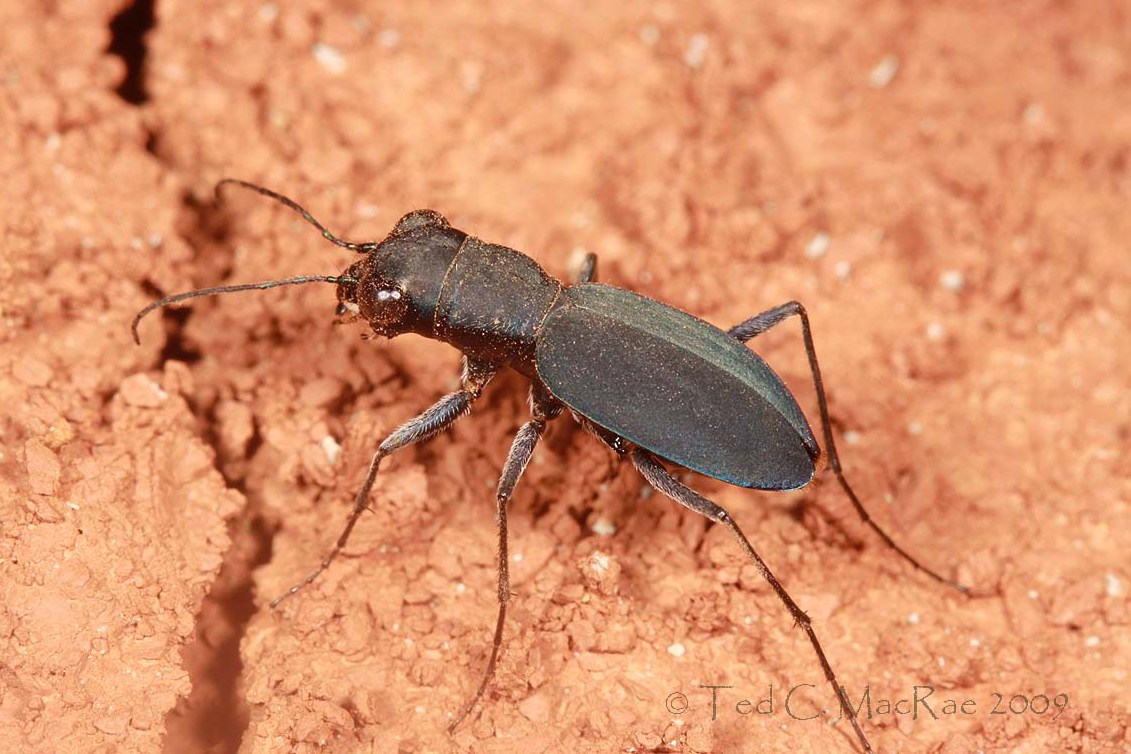
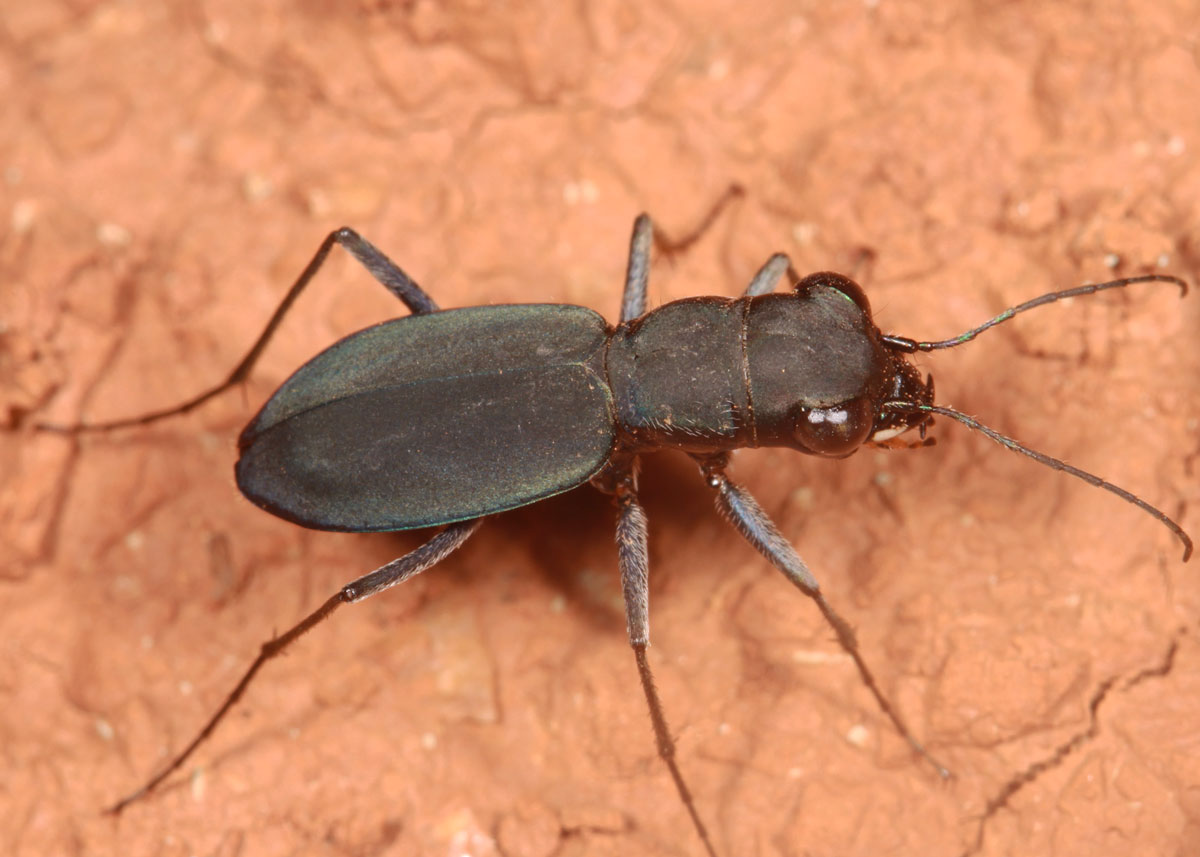
Ellipsoptera nevadica knausii - Knaus' tiger beetle

Ellipsoptera nevadica knausii - Knaus' tiger beetle

Habroscelimorpha circumpicta johnsonii - Johnson's tiger beetle

Habroscelimorpha circumpicta johnsonii - Johnson's tiger beetle

Cicindela fulgida fulgida - crimson saltflat tiger beetle

Cicindela fulgida fulgida - crimson saltflat tiger beetle

Along with E. togata globicollis, these species bring the total number of species that I’ve observed at Salt Plains to eight – quite a hyperdiversity given the very small portion of the refuge that I’ve explored during my three visits.  Willis (1967) has observed as many as 11 species in a single habitat, and while this may seem to violate the principle of competitive exclusion (limiting the number of species that can occupy a given niche), careful observation reveals small but distinct partitionings of this harsh environment by the different species.  For example, C. fulgida was seen in the drier, more vegetated fringes around the flats, E. nevadica knausii was observed in moist, open areas near the water’s edge, and H. circumpicta johnsonii was more generally free ranging across the open salt surfaces.  Temporal separation combines with spatial separation to further subdivide the habitat – the latter two species occur as adults during summer, while E. togata globicollis and C. fulgida adult occurrence is primarily during spring and fall (the individual I saw was likely a stragler).  I have noted the same phenomenon with species occurring in clay habitats here in Missouri, with as many as six species seen at a single highway intersection in the White River Hills a few years ago.

Photo details:
Landscapes: Canon 17-85mm zoom lens on Canon EOS 50D (landscape mode), ISO 100, 1/50-60 sec, f/7.1-6.3, natural light.
Beetles: Canon 100mm macro lens on Canon EOS 50D (manual mode), ISO 100, 1/250 sec, f/14, MT-24EX flash 1/4 power w/ diffuser caps.

REFERENCES:

Erwin, T. L. and D. L. Pearson. 2008. A Treatise on the Western Hemisphere Caraboidea (Coleoptera). Their classification, distributions, and ways of life. Volume II (Carabidae-Nebriiformes 2-Cicindelitae). Pensoft Series Faunistica 84. Pensoft Publishers, Sofia, 400 pp.

Willis, H. L.  1967.  Bionomics and zoogeography of tiger beetles of saline habitats in the central United States (Coleoptera: Cicindelidae).  The University of Kansas Science Bulletin 47(5):145-313.

Copyright © Ted C. MacRae 2009

Add to FacebookAdd to NewsvineAdd to DiggAdd to Del.icio.usAdd to StumbleuponAdd to RedditAdd to BlinklistAdd to Ma.gnoliaAdd to TechnoratiAdd to Furl

Oklahoma is for lovers

A few rather risqué photos from my June trip to northwestern Oklahoma.

Eleodes suturalis (family Tenebrionidae) - June 6, 2009 at Four Canyon Preserve, Ellis Co., Oklahoma

Eleodes suturalis (family Tenebrionidae) - June 6, 2009 at Four Canyon Preserve, Ellis Co., Oklahoma

Chrysobothris ignicollis (family Buprestidae) - June 6, 2009 at Four Canyon Preserve, Ellis Co., Oklahoma

Chrysobothris ignicollis (family Buprestidae) - June 6, 2009 at Four Canyon Preserve, Ellis Co., Oklahoma

Ellipsoptera nevadica knausii ("family" Cicindelidae) - June 12, 2009 at Salt Plain National Wildlife Refuge, Alfalfa Co., Oklahoma

Ellipsoptera nevadica knausii ("family" Cicindelidae) - June 12, 2009 at Salt Plain National Wildlife Refuge, Alfalfa Co., Oklahoma

Photo details:
Eleodes suturalis: Canon 100mm macro lens on Canon EOS 50D, ISO 100, 1/250 sec, f/13, MT-24EX flash 1/4 power through diffuser caps.
Chrysobothris ignicollis: Canon 65mm 1-5x macro lens on Canon EOS 50D, ISO 100, 1/250 sec, f/13, MT-24EX flash 1/8 power through diffuser caps.
Ellipsoptera nevadica knausii: Canon 100mm macro lens on Canon EOS 50D, ISO 100, 1/250 sec, f/14, MT-24EX flash 1/4 power through diffuser caps.

Copyright © Ted C. MacRae 2009

Add to FacebookAdd to NewsvineAdd to DiggAdd to Del.icio.usAdd to StumbleuponAdd to RedditAdd to BlinklistAdd to Ma.gnoliaAdd to TechnoratiAdd to Furl

Dromochorus pruinina in Oklahoma

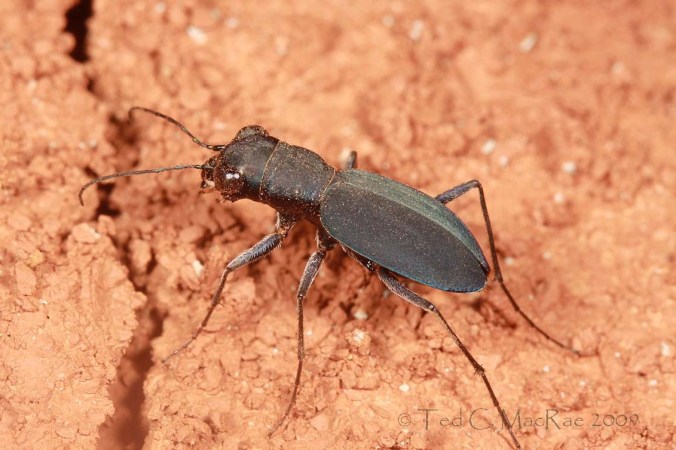
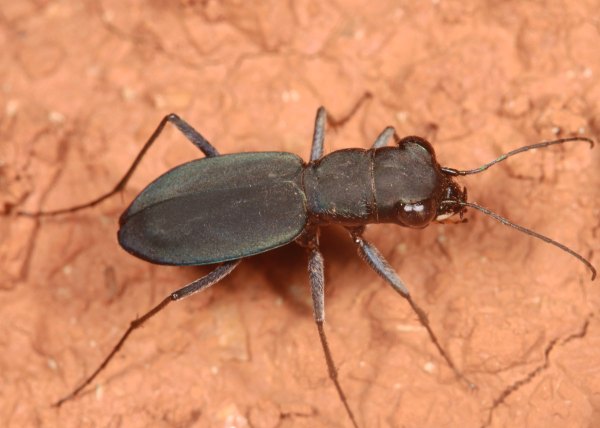
As my colleague Chris Brown and I continue to study the tiger beetle fauna of Missouri, one of the species we have become very interested in is Dromochorus pruinina (frosted dromo tiger beetle).  This is another of North America’s more enigmatic species and is one of a handful of species in Missouri – along with Cylindera cursitans (ant-like tiger beetle), C. celeripes (swift tiger beetle), Habroscelimorpha circumpicta johnsonii (Johnson’s tiger beetle), and Cicindela (Cicindelidia) obsoleta vulturina (prairie tiger beetle) – whose highly restricted distributions within the state make them worthy of special consideration for conservation (see Saving Missouri’s tigers and Revisiting the Swift Tiger Beetle – Part 3).  Of these, D. pruinina appears to be the most highly localized – thus far we have found this species only in west-central Missouri along a 2.5 mile stretch of roadside habitat in Knob Noster State Park.  This tiny population is not only the easternmost known occurrence of the species, but is also disjunct from the main population in Kansas, Oklahoma, and Texas by nearly 100 miles.  As a result of this extreme localization within the state, the species has been accorded a conservation status in Missouri of S1 – the state’s highest conservation ranking. 
IMG_0624_1200x800

Dromochorus pruinina is secretive and easily overlooked, and as a result little is known about it – in fact, the larva was unknown until just last year (Spomer et al. 2008).  There has also been little agreement on what to call it – many authors (e.g., Freitag 1999, Pearson et al. 2006) have considered it a synonym or subspecies of D. belfragei (loamy-ground dromo tiger beetle) from Texas; however, Spomer et al. (2008) and Erwin and Pearson (2008) consider it a valid species based on its smooth elytra in contrast to the granulated elytral surface of D. belfragei and the apparent lack of intergrades in central Texas where their geographical distributions overlap.  It was one of the species I had hoped to see during my early June visit to The Nature Conservancy’s Four Canyon Preserve in northwestern Oklahoma; however, I would not see this species there despite its abundance of exposed red clay slopes.  Following that visit, as I sat in a coffee shop in north-central Oklahoma trying to predict where the pounding rainstorm outside was least likely to spoil my collecting plans for the next few days, this species again came to my mind when I decided to go back to the red clay/gypsum hills just north of Four Canyon Preserve – where I had just seen the even more enigmatic C. celeripes.  I noted that this corner of Oklahoma was just at the western edge of the distribution given by Pearson et al. (2006) for the species, but still read through the notes on its habits and habitats in the off chance that I might still encounter it.  Despite all the forethought, it was nevertheless a surprise when an adult bolted across my path soon after beginning my search of the Gloss Mountains the next day (see Revisiting the Swift Tiger Beetle – Part 2).  Like C. celeripes, this species is flightless and runs swiftly – perhaps even more so – as it dashes between clumps of vegetation before disappearing.  It’s larger size would seem to make it easier to capture than C. celeripes, but that is not the case, yet I still managed to capture all three individuals I saw during the course of the several hours I spent on the lower talus slopes at the Gloss Mountains Scenic Overlook that morning.  With none of them could I even make an attempt at field photographs – their repeated mad dashes for cover eliminated all opportunity.  I placed the three individuals into a terrarium of native soil, resigned that I would have to settle for photographs in confinement (there is nothing wrong with confined photographs, which look every bit as natural as true field photographs – still, there is just something about not succeeding in photographing the subject in its native habitat).
IMG_0622_1200x800_2I returned to the Gloss Mountains late in the day and completed my search for C. celeripes in the State Park across the highway (and also saw my first massasauga rattlesnake).  By then it was about 7:00 pm, and my thoughts turned back to the D. pruinina I had seen across the highway earlier that day.  I recalled the tendency of the Missouri population of D. pruinina to be most active in the few hours before dusk and decided to have another go at them.  No sooner than I had begun to climb the talus slope did I see another one – he bolted into a grass clump, and despite my best attempts to tear the vegetation apart he was gone.  Frustrated, I got up and started walking up the slope again – and saw another one, with the same result!  Now I was mad.  I started searching the rankly vegetated clay slope with determination, and it wasn’t long before I saw a third individual higher up on the slope.  It was then and there that I decided I was going to get a field photograph.  I stopped dead in my tracks so as not to further disturb the beetle, and carefully took off my backpack and put my camera together as I kept a watchful eye on him.  Once ready, I moved slowly toward him – and he bolted.  This time I managed to catch him before he disappeared.  Okay – I’ve got one in the hand, now what?  I decided to try the time-out trick – placing him in the middle of an open area on top of the small mesa and covering him with my camera lens cap.  With luck, being covered momentarily would cause him to “settle down” long enough for me to get some shots.  I waited a few minutes, then carefully lifted up the lens cap – out he bolted with a vengeance.  Time for a new strategy.  I started blocking his path with my free hand everytime he tried to run out of the open area I had designated for him, hoping that he would eventually tire and rest momentarily – this was the strategy I successfully employed to get my first field photographs of C. celeripes the day before at Alabaster Caverns (see Revisiting the Swift Tiger Beetle – Part 1).  I did this for several minutes, and the little bugger just refused to settle down.  Finally, as I took my eye off of him for a split second, he disappeared into an adjacent grass clump and was never seen again.  IMG_0626_1200x800By now I was so frustrated that I considered giving up. Of course, I couldn’t – there was still daylight, and if there’s one thing I’ve learned in this game, it’s persistence. I started walking back down the slope searching for another individual, and right at the edge of the vegetated area I saw one running for cover.  This time I cut him off at the pass and forced him to run back towards the more open area of the upper slope.  Once out in the open, I continued to follow him as he nervously ambled across the slope into and out of erosion channels, looking for a place to hide.  Everytime he siddled up against a chunk of clay or tried to crawl into a crack I forced him out.  In the open expanse of the upper slope where I had him trapped, he eventually started pausing – not for long, but just long enough that I could get a shot or two in before he started running again.  Eventually, I got several shots that I thought might turn out acceptable.  I briefly looked at my camera to try another setting, looked up, and he was gone!  By now it was past 8:30 pm, and the sun was sinking fast.  I decided that I had given it my best effort, and that whatever shots I had would have to do.  I share with you here three of the five shots that I kept.

Photo details: Canon 100mm macro lens on Canon EOS 50D, ISO 100, 1/250 sec, f/14-16, MT-24EX flash 1/4 power through diffuser caps.

REFERENCES:

Erwin, T. L. and D. L. Pearson. 2008. A Treatise on the Western Hemisphere Caraboidea (Coleoptera). Their classification, distributions, and ways of life. Volume II (Carabidae-Nebriiformes 2-Cicindelitae). Pensoft Series Faunistica 84. Pensoft Publishers, Sofia, 400 pp.

Freitag, R.  1999.  Catalogue of the tiger beetles of Canada and the United States.  National Research Council Canada, Ottawa, Ontario, 195 pp.

Pearson, D. L., C. B. Knisley and C. J. Kazilek. 2006. A Field Guide to the Tiger Beetles of the United States and Canada. Oxford University Press, New York, 227 pp.

Spomer, S. M., P. D. Nabity and M. L. Brust. 2008. Larval description of Cicindela (Dromochorus) pruinina (Casey) (Coleoptera: Carabidae: Cicindelinae) with notes on habitat and adult behavior. The Coleopterists Bulletin 62(1):37-41.


Copyright © Ted C. MacRae 2009

Add to FacebookAdd to NewsvineAdd to DiggAdd to Del.icio.usAdd to StumbleuponAdd to RedditAdd to BlinklistAdd to Ma.gnoliaAdd to TechnoratiAdd to Furl

Typocerus deceptus in Missouri

It has been fifteen years now since I published an annotated checklist of the longhorned beetles (families Cerambycidae and Disteniidae) of Missouri (MacRae 1994).  That publication (and a similar one on Buprestidae) was the product of eight years of collecting – of specimens in the field and of data in any other public or private collection I could find that contained Missouri specimens – during my stint as a field entomologist with the Missouri Department of Agriculture.  I collected during the week while on my rounds.  I collected on weekends as well.  I visited every college and university in the state that had an insect collection of any size, and a few in neighboring states as well.  I made the acquaintance of private collectors with significant Missouri material – most notably Richard Heitzman, Marlin Rice, and the late Gayle Nelson.  By the time I left Missouri for a new position in Sacramento, I had documented 219 species and subspecies of longhorned beetles from the state – 66 of which were new state records.

Typocerus deceptus on flower of Hydrangea arborescens

Typocerus deceptus on flower of Hydrangea arborescens

Despite my best efforts, however, I knew the list was not complete – they never are.  In the years since returning to Missouri, I’ve documented an additional 10 species and subspecies in the state (MacRae and Rice 2007), and in a newly published paper (McDowell and MacRae 2009) the rare species, Typocerus deceptus, is documented from Missouri for the first time.  I cannot take credit for this discovery – that honor goes to the paper’s lead author, Tom McDowell of Carbondale, Illinois.  Tom first encountered this species in 2005 at Trail of Tears State Park in southeastern Missouri near Cape Girardeau while conducting routine insect surveys.  After seeing additional individuals on a subsequent visit to the park the following year, Tom contacted me to tell me of his find and graciously invited me to join him on further studies of this rarely encountered species.  I readily agreed, and in July of last year I met up with Tom at Trail of Tears to see the beetle for myself.

Typocerus deceptus on flower of Hydrangea arborescens

Typocerus deceptus on flower of Hydrangea arborescens

Typocerus deceptus has been recorded sporadically from across the eastern U.S.  Nothing is known of its biology other than adult flower hosts and activity periods, and the larva and larval host(s) remain completely unknown.  The species is aptly named, as its appearance is deceptively similar to the common and widespread species, T. velutinus.  Both of these species belong to the so-called “flower longhorn” group (subfamily Lepturinae), characterized by adults that are largely diurnal (active during the day) and attracted to a great variety of flowers upon which they feed.  Tom had found T. deceptus feeding on flowers of wild hydrangea (Hydrangea arborescens) in the company of several other flower longhorns, including T. velutinus.  The similarity of T. deceptus to T. velutinus makes distinguishing individuals amongst the vastly more abundant T. velutinus quite difficult.  However, Tom was able to recognize the species during his surveys as a result of prior experience with it in Illinois.  As Tom and I searched the wild hydrangea plants growing along an intermittent drainage between the road and the park’s unique mesic forest, we succeeded in picking out a total of four individuals of this species amongst the dozens of T. velutinus and other lepturines also feeding on the flowers.

Typocerus velutinus on flower of Hydrangea arborescens

Typocerus velutinus on flower of Hydrangea arborescens

I gradually developed a sense of the subtle differences that distinguish this species from T. velutinus and that allow its recognition in the field.  Typocerus deceptus is slightly more robust than T. velutinus, and whereas the transverse yellow elytral bands of the latter are distinct and well delimited, they are weaker and often interrupted at the middle in T. deceptus, giving the beetle a slightly darker brownish appearance.  The lateral margins of the elytra are also more strongly emarginated near the apices, giving the beetle a more distinctly tapered appearance.  Finally, while both species possess a distinct band of dense, yellow pubescence along the basal margin of the pronotum, this band is interrupted at the middle in T. deceptus. My ability to recognize this species in the field was confirmed a few weeks ago when I returned to Trail of Tears (with longtime field companion Rich Thoma) to attempt what seemed to be an impossible task – photograph these active and flighty insects in the field on their host plants.  Conditions were brutally humid, and I only saw two individuals that day – the first I immediately captured and kept alive as a backup for studio photographs should I fail to achieve my goal in the field, but the second individual (not seen until almost two hours later!) posed just long enough for me to whip off a series of frames, two of which turned out well enough to share with you here.  The first photo clearly shows the interrupted basal pubescent band, and both photos show the distinctly emarginate lateral elytral margins and weak transverse yellow bands (compare to the uninterrupted pronotal pubescent band and well developed transverse elytral bands of T. velutinus in the third photo).

Me with the discoverer of Typocerus deceptus in Missouri Trail of Tears State Park, July 2008

TCM with the discoverer of Typocerus deceptus in Missouri at Trail of Tears State Park, July 2008

It is possible that T. deceptus is not as rare as it appears and is simply overlooked due to its great resemblance to another much more abundant species. However, I believe this is unlikely given its rarity in collections of eastern U.S. Cerambycidae by casual and expert collectors alike.  Moreover, T. deceptus is not the only “rare” longhorned beetle to have been documented at Trail of Tears State Park – a number of other species have also been found there but not or only rarely elsewhere in Missouri (e.g., Enaphalodes cortiphagus, Hesperandra polita, Metacmaeops vittata, and Trigonarthris minnesotana).  This may be due to the unique, mesic forest found at Trail of Tears, being one of only a few sites in southeastern Missouri that support more typically eastern tree species such as American beech (Fagus grandifolia), tulip poplar (Liriodendron tulipifera), and cucumbertree (Magnolia acuminata).  Whether one of these trees serves as a larval host for T. deceptus is unknown.  Nevertheless, I will be returning to Trail of Tears in the future to see what other treasures remain hidden within its unique forests.

Photo details (insects): Canon 100mm macro lens on Canon EOS 50D, ISO 100, 1/250 sec, f/18-20, MT-24EX flash 1/4 power through diffuser caps.

REFERENCES:

MacRae, T. C. 1994. Annotated checklist of the longhorned beetles (Coleoptera: Cerambycidae and Disteniidae) known to occur in Missouri. Insecta Mundi 7(4) (1993):223–252.

MacRae, T. C. and M. E. Rice. 2007. Distributional and biological observations on North American Cerambycidae (Coleoptera). The Coleopterists Bulletin 61(2):227–263.

McDowell, W. T. and T. C. MacRae. 2008. First record of Typocerus deceptus Knull, 1929 (Coleoptera: Cerambycidae) in Missouri, with notes on additional species from the state. The Pan-Pacific Entomologist 84(4):341-343 DOI: 10.3956/2008-23.1

Copyright © Ted C. MacRae 2009

Add to FacebookAdd to NewsvineAdd to DiggAdd to Del.icio.usAdd to StumbleuponAdd to RedditAdd to BlinklistAdd to Ma.gnoliaAdd to TechnoratiAdd to Furl

North America’s most bizarre lizard

Hmm, something funny going on here.  This is a bug blog – specifically a beetle blog, yet it’s a post about a lizard that generates a flurry of comments.  I don’t know if lightning will strike twice so quickly, but I did have this second ‘lizard’ post already lined up in the queue.

IMG_0390_1200x800

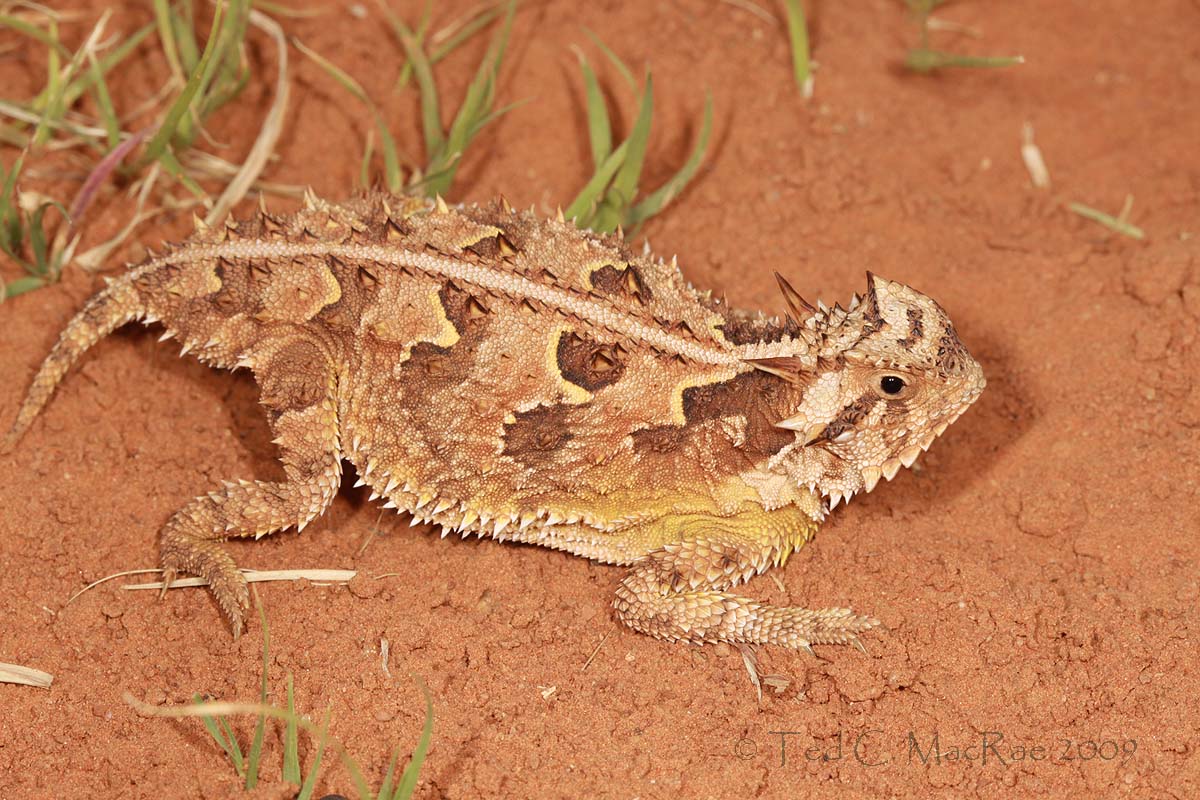
The day after seeing a couple of male eastern collared lizards at Four Canyon Preserve in northwestern Oklahoma, I got my second saurian treat with this horned lizard (genus Phrynosoma).  There are actually some dozen species of horned lizards in North America, but the majority are found further west in the U.S. and down into Mexico and Central America.  Of the two that occur in Oklahoma, this particular individual can be identified as a Texas horned lizard (P. cornutum) by the two occipital (back of the head) spines, presence of lateral abdominal finge scales, and dorsal white stripe.  Oklahoma’s other horned lizard (round-tailed horned lizard, P. modestum) is restricted to the northwestern corner of the panhandle and differs from the Texas horned lizard by having four occipital spines, lacking lateral abdominal fringe scales, and more solid pale coloration.

IMG_0392_1200x800Again, my claim of “most bizarre” might be open to debate, as there are certainly many bizarre lizards in North America.  The gila monster once more comes to mind, but I think grotesque is a better descriptor for that animal, and the fan-shaped toe pads of geckos might also get them some votes.  Nevertheless, do a Google search on the phrase “bizarre North American lizard” and the results will be overwhelmingly dominated by references to horned lizards.  It’s no surprise – their squat body form is more suggestive of toads than lizards¹, for which they are commonly called “horned toads” or “horny toads,” and their covering of “horns” (actually modified scales) gives them an otherworldly, almost dinosaurian appearance.  Who among my generation wasn’t terrorized by the sight of these lizards, cheaply magnified, as they threatened the scientists that encountered them in the 60’s sci-fi classic The Lost World?

¹ Even the genus name, derived from the Greek words phrynos (toad) and soma (body), alludes to its toad-like appearance.

IMG_0397_1200x800In reality, these lizards are anything but terrifying.  Instead they employ multiple strategies to avoid being eaten themselves. These adaptations were all on display as I initially passed this individual without even noticing it lying motionless in the middle of the road. Once I had passed I noted movement out of the corner of my eye and turned to see it scurrying towards the vegetation along the side of the road. It’s mottled coloration, blending well with its background, and spine-broken silhouette made it almost invisible. Feeling threatened by my too-close approach, it made a rapid burst for cover, but I cut it off at the pass and blocked its erratic scampers towards the roadside to keep it out in the open so I could take some photographs. Once cornered in the open, it resorted to a third strategy – puffing of the body to make it appear larger. Had I been a true predator, it would’ve had two more strategies up its sleeve that it could have employed as a last resort – bleeding from the eyes (which apparently has a foul taste and will cause a predator to drop the lizard from its mouth) along with the mechanical defense of its hard, spiny scales. Since I didn’t actually try to eat this little guy, I didn’t have a chance to experience these final lines of defense.

The photos here actually represent two individuals – the middle picture is a second lizard that suddenly appeared while I was photographing the first.  The second individual was somewhat smaller than the first and not as boldy marked (note the lack of a distinct dark stripe behind the eye).  Whether these were male and female is difficult to say – horned lizards lack outward sexual characters allow them to be easily distinguished in the field (females do tend to grow a little bit larger). While not threatened or endangered, Texas horned lizards, like many other horned lizard species, have experienced dramatic reductions in its range. Oklahoma has a year-round closed season for both species that makes it illegal to kill or capture horned lizards without written permission. I would see a few more of these fascinating little lizards during my three days at Four Canyon Preserve, suggesting that, at least in this part of the state, horned lizards are doing just fine.

Photo details: Canon 100mm macro lens on Canon EOS 50D, ISO 100, 1/250 sec, f/11-13, MT-24EX flash 1/4 power through diffuser caps.

Copyright © Ted C. MacRae 2009

Add to FacebookAdd to NewsvineAdd to DiggAdd to Del.icio.usAdd to StumbleuponAdd to RedditAdd to BlinklistAdd to Ma.gnoliaAdd to TechnoratiAdd to Furl

North America’s most beautiful lizard

Whew! My fingers and keyboard are still smoking after that long series on Cylindera celeripes (parts 1, 2, and 3). Exciting as my celeripes finds were, there were other “tiger beetle moments” from the Oklahoma trip as well that I want to highlight in future posts. However, I thought I’d give everyone a break from tiger beetles (and my rambling prose) and remind everyone that I can not only talk about other insects, but even non-insects.

IMG_0318_1200x800

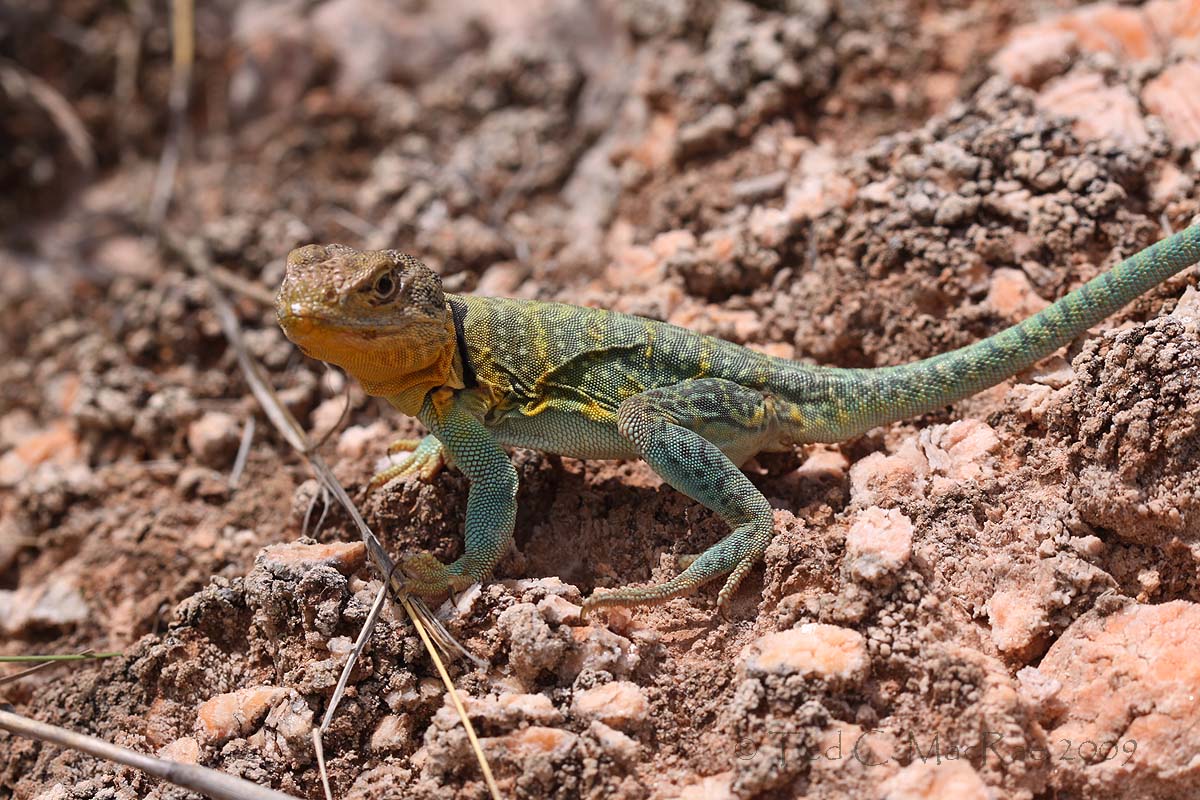
Isn’t he a looker?!  I came upon this this male eastern collared lizard (Crotaphytus collaris collaris) during my first day at Four Canyon Preserve – fitting, since the species is Oklahoma’s state reptile (a fine choice, unlike their dreadfully pedestrian choice for state insect – the honey bee!  Huh?  It’s not even native!).  When I first saw this fellow he skirted under a branch, then across the trail, under a ledge, up and over to another rock…  By the time I got him accustomed to my persistent approaches (remember, I stalk tiger beetles!) he was posing nicely at chest level and with the sun behind my shoulder for a nice series of photographs.  I have never been able to approach a “mountain boomer” this closely before (encountering them only a few times previously on igneous glades in the the St. Francois Mountains of my beloved Ozark Highlands), and the first time I do I have a Canon 50D and 100mm macro lens in my backpack – que suerte!

IMG_0328_1200x800Perhaps my title is a little presumptuous – surely there are other gorgeous lizards in North America.  However, I can’t imagine anything more breathtaking than the vivid blues, greens, and yellows with sharply contrasting black stripes of male eastern collared lizards.  Perhaps the gila monster might get a vote, although its impressiveness is more grotesque than beautiful.  Horned lizards as well are quite impressive, but again more bizarre than beautiful.  Added to the collared lizard’s visual appeal is their comically dinosaurian ability to run swiftly on their hind legs with the fore legs and head held upright (this is how most of my previous attempts to approach them have ended).

IMG_0314_1200x800The name “mountain boomer” probably originated with the early pioneers, who erroneously believed that they emitted sounds that echoed through the canyons and valleys.  An oft-cited theory in field guides (and also the Oklahoma Department of Wildlife Conservation and the Missouri Department of Conservation websites) states that the pioneers may have associated the sunning lizards with the barking of frogs.  This seems unlikely; frogs that make barking noises are creatures of wetlands – far from the rocky outcroppings of the glades and pinyon-juniper, sagebrush, desertscrub, and desert grassland habitats of the central and west-central U.S. where collared lizards are encountered.  Regardless of the source of its nickname, collared lizards in reality make no vocalizations at all (although like most lizards they can hiss when they feel threatened).

IMG_0316_1200x800

Copyright © Ted C. MacRae 2009

Add to FacebookAdd to NewsvineAdd to DiggAdd to Del.icio.usAdd to StumbleuponAdd to RedditAdd to BlinklistAdd to Ma.gnoliaAdd to TechnoratiAdd to Furl