Afrikaans ants

A few for Alex

I photographed these ants in South Africa during my visit to Borakalalo National Park (North West Province) in November 1999.  Dr. Brian Taylor, author of the impressive Ants of Africa website, kindly identified and provided some information about the ants in these photos.  Pachycondyla tarsata - South Africa, North West Province, Borakalalo National Park, 25.xi.1999The first photo shows a worker ant dragging another dead ant.  Dr. Taylor identified the worker as Pachycondyla tarsata, which according to his website is known as the ‘Stink Ant’.  This pan-African species usually forages singly and nests directly in the ground, with the entrance often surrounded by excavated soil and remains of arthropods and other food. He wasn’t sure about the identity of ant being carried but guessed that it could be the queen of Camponotus (Myrmopiromis) fulvopilosus1.  That species is South African and appears to be of the right size for the individual in this photo.  Ants may have taken over the world, but at least they clean up after themselves.

1 Edit 01/17/09: Dr. Taylor sent an email to me saying that, after a second look at the above photo, he now believes the queen being carried by the Pachycondyla tarsata worker probably represents Carebara vidua, discussed below.

These next photos might have been better posted on Wednesday (ahem… “hump” day).  424046-r1-e009_009_mating_ants_21Dr. Taylor identified them as Carebara vidua. According to Lepage and Darlington (1984), colonies of this termitophagous species produce broods of alates ready to fly during the short November rains (as we experienced during our visit), as well as the longer April rains. Male and female alates are usually produced in separate nests, and after the flight the alate males seek out the females. The mating swarm I photographed shows several males attempting to mate with a single female – I counted five males at first, although one dropped off while I continued taking photos trying to get a good shot of the “lucky fellow”. 424046-r1-e010_010_mating_ants_21I am pleased that Dr. Taylor considered these photos informative enough to post on the species page at his Ants of Africa website. Lepage and Darlington (1984) reported nests of this species established in 2-10% of Macrotermes termite mounds  in Kenya, although nests can also occur well away from mounds. In the laboratory, dealate female ants exposed to Macrotermes workers remained passive and elicited no aggression. After 39 days, the mated females were capable of producing broods of about 1,000 workers, able to overpower, kill and eat the much larger Macrotermes workers.

REFERENCES:

Taylor, B. 2008. Ants of Africa. http://www.antbase.org/ants/africa/antcover.htm.

Lepage, M. G. and J. P. E. C. Darlington. 1984. Observations on the ant Carebara vidua F. Smith preying on termites in Kenya. Journal of Natural History 18(2):293-302.

Posted in Formicidae, Hymenoptera | Tagged , , , , , , | 6 Comments

Top Ten of 2008

For the first post of 2009, I begin with a look back at some of my favorite photos from 2008 (idea stolen from Alex Wild and others).  I initially hesitated to do a “best photos” post since I’m not really a photographer – just an entomologist with a camera.  Nevertheless, and with that caveat in mind, I offer ten photos that represent some of my favorites from this past year. To force some diversity in my picks, I’ve created “winning” categories (otherwise you might just see ten tiger beetles!). Click on the photos to see larger versions, and feel free to vote for your favorite. If so, what did you like about it? Was there a photo I didn’t pick that you liked better?  Enjoy!

Best tiger beetle

Cicindela formosa generosa

From “All the better to see you with, my dear!” (September 2008).  Picking a top tiger beetle photo was tough with so many to choose from.  Ultimately, I decided I really like these face-on shots, and of the several I’ve posted this one of Cicindela formosa generosa has the overall best composition, balance and symmetry.  I considered this one of Cicindela formosa formosa – with its half-cocked jaws, it probably has better personality.  However, the one above got the final nod because it is a true field shot of an unconfined, unmanipulated individual.

Best jewel beetle

Aegelia petelii

From Buppies in the bush(veld) (December 2008).  Although taken back in 1999, I just recently scanned and posted this photo of Agelia petelii from South Africa.  I like the bold, contrasting colors of the beetle combined with the soft colors of the host foliage.  Runners up included these photos of Evides pubiventris with its sumptuous iridescent green blending beautifully with the green background (but suffering slightly from shallow depth of field) and Chrysobothris femorata with its intricate surface sculpturing.

Best longhorned beetle

Tetraopes femoratus

From Rattled in the Black Hills (September 2008).  This was an easy choice – none of the other longhorned beetle photos that I posted during 2008 matched this photo of Tetraopes femoratus for clarity, composition, and the striking contrast between the red color of the beetle and the green color of the host plant.  I especially like the detailing of the body pubescence.

Best non-beetle insect

Proctacanthus milbertii

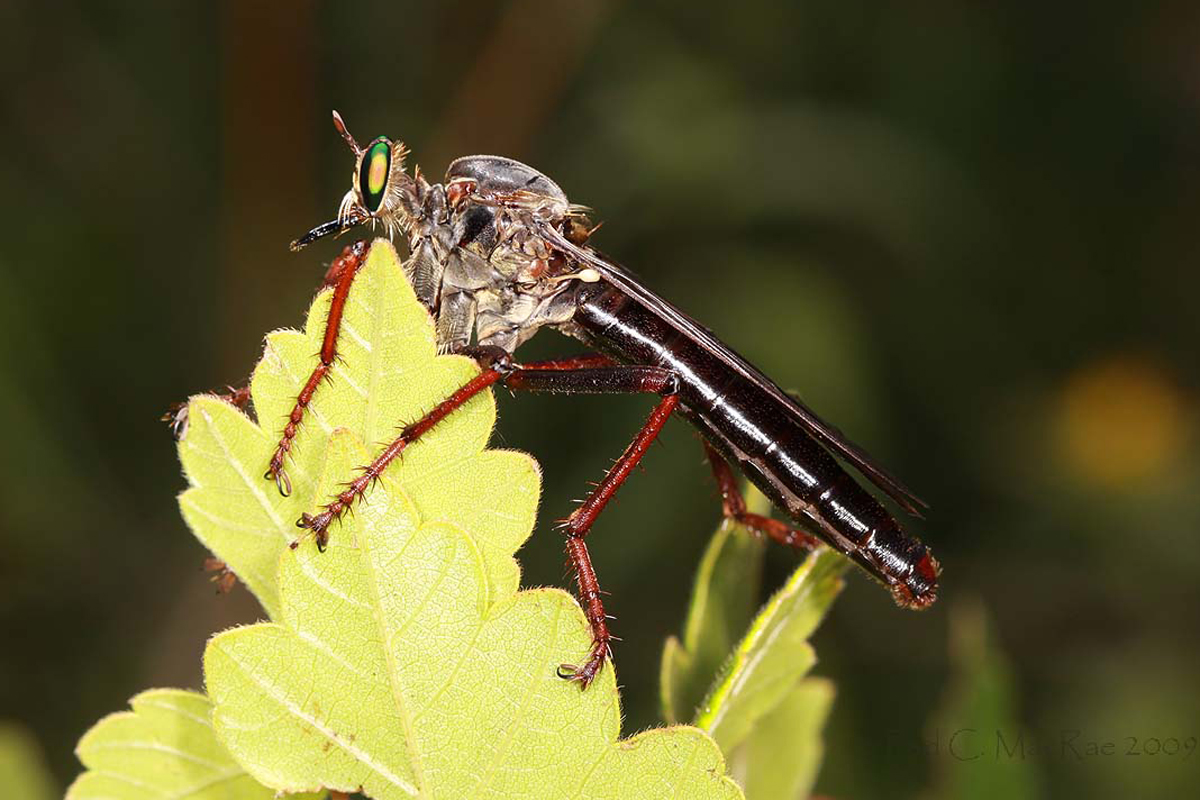
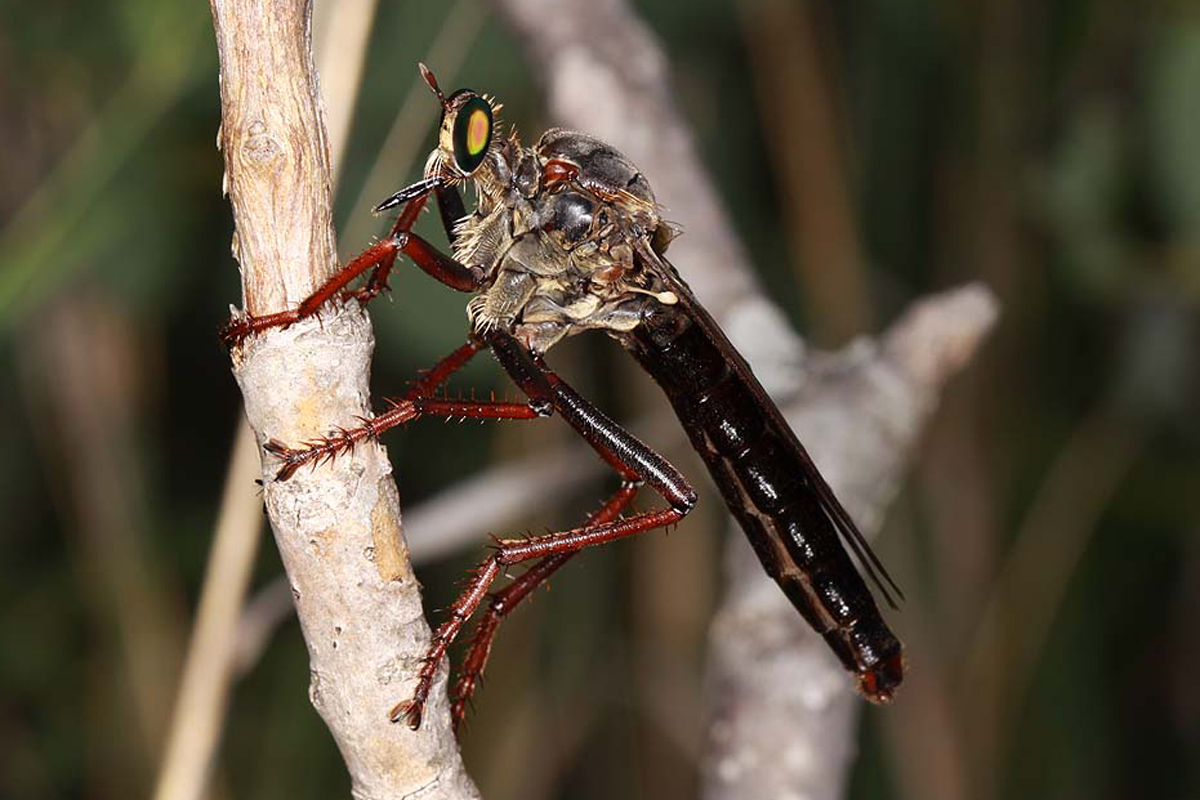
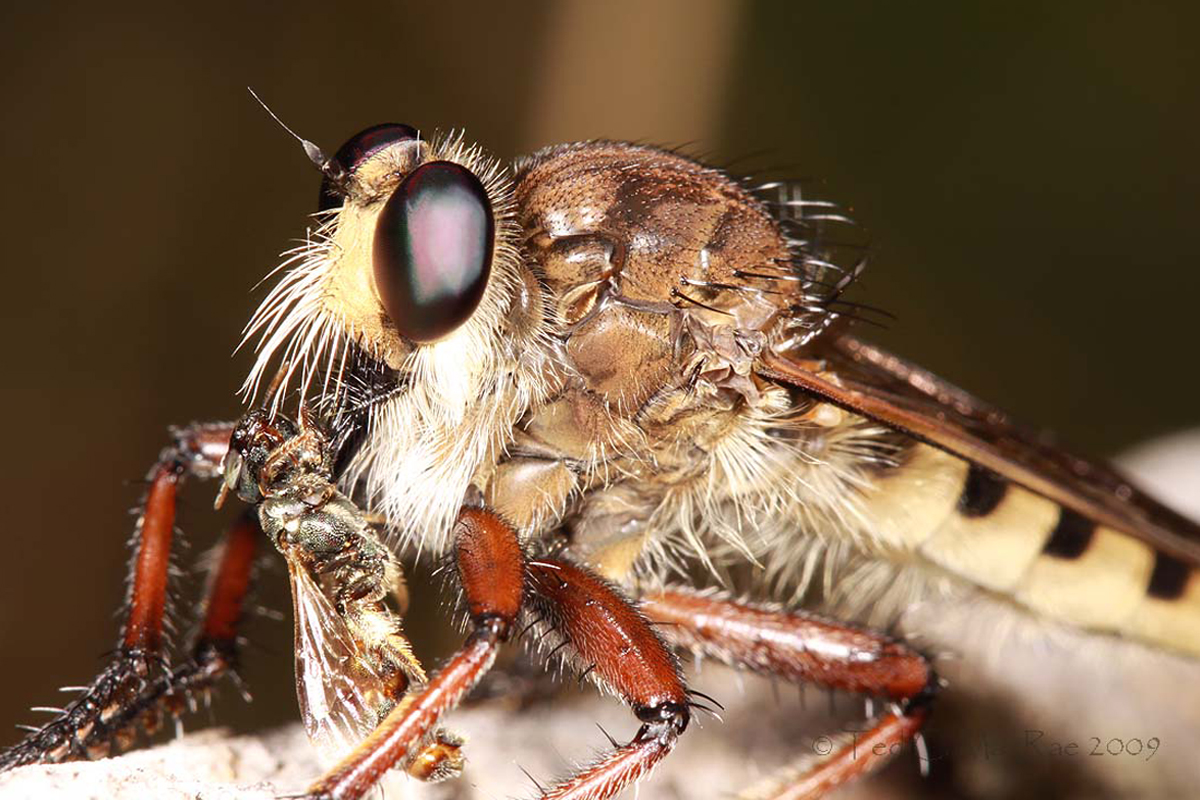
From Magnificently Monstrous Muscomorphs (November 2008).  I do like other insect besides beetles, and robber flies are hard to beat for their charisma.  This photo of Proctacanthus milbertii (which, as Chris Taylor pointed out, literally translates to “Milbert’s spiny butt”), has great composition and nice, complimentary colors.  I like contrast between the fine detail of the fly and the soft background.

Best non-insect arthropod

Argiope aurantia

From Happy Halloween! (October 2008). I didn’t have many non-insect arthropod photos to choose from, but this photo of a female Argiope aurantia (yellow garden spider) would be deserving of recognition no matter how many I had to choose from. I like the bold, contrasting colors and symmetry of the spider in front of the dappled background of this photo.

Best non-arthropod animal

Prairie rattlesnake (Crotolus viridis)

Another one from Rattled in the Black Hills (September 2008).  This is admittedly not the best photo from a purely technical perspective – it’s a little out of focus, and the color is a bit off.  However, no photo could better convey the moment – confronted with a live, angry prairie rattlesnake (Crotalus viridis) (among the more aggressive species in the genus).  The forked tongue and rattle – blurred in motion – were icing on the cake.

Best wildflower

Victoria Glades

From Glades of Jefferson County (July 2008).  I had several wildflower closeups to choose from, but I kept coming back to this field shot of pale purple coneflower (Echincea simulata) and Missouri evening primrose (Oenethera macrocarpa).  The eastern redcedars (Juniperus virginiana) in the background are at once indicative of their preferred habitat (limestone/dolomite glades) and also testament to their threatening encroachment.

Best tree

Calocedrus decurrens

From the very simply and aptly named Lake Tahoe, California (March 2008).  Incense cedar (Calocedrus decurrens), with its reddish, deeply furrowed bark and great height, is one of the most majestic of western conifers.  I was captivated by this tree – beautiful even in death and contrasting nicely with the surrounding green foliage.

Best rockscape

Pipestone National Monument, Old Stone Face

From Pipestone National Monument (April 2008).  “Old Stone Face” is one of Pipestone’s most recognizable geologic features, and the short angle of the sun on this early spring day provided nice detail to the cracks and fissures of the rock – almost appropriately adding a weathered “age” to this old man.

Best landscape

Emerald Isle, Lake Tahoe

Another one from Lake Tahoe, California (March 2008).  Few places on earth are more photogenic than Lake Tahoe, and this perspective overlooking Emerald Bay is among the finest views I’ve seen.  Brilliant blue skies and majestic snow covered mountains reflected perfectly from the still surface, with Fannette Island providing a perfect focal point for the photo.

Best miscellaneous

Water drops, Ozark Trail, Trace Creek SectionFrom Ozark Trail, lower Trace Creek Section (December 2007).  While technically not a 2008 photo, it’s close enough.  This was one of the first macro photographs I took with my camera, and it remains one of my favorites.  A chance occurence of an unlikely subject, created by cold temperatures and heavy moisture-laden air. I like the contrast between the water drops – sharp, round, and clear – with the vertical shapes of the leaf petioles and background trees.  Viewing the image full-sized reveals the reflection of the photographer in the leftmost water drop.

Subsequent edit: Okay, so after I put this post together, I realized I actually featured eleven photos – too much difficulty choosing, I guess. Let’s call it a baker’s ten.

Posted in Arachnida, Araneae, Asilidae, Asteraceae, Buprestidae, Cerambycidae, Cicindelidae, Coleoptera, Cupressaceae, Diptera, Onagraceae, Reptilia | Tagged , , , , , , , , , , , , , , , , , , , | 10 Comments

Cicindela lengi vs. Cicindela formosa

Back to beetle blogging – I hope everyone enjoyed their holiday break as much as I. One of the tiger beetles that I most hoped to see on my trip to Nebraska and South Dakota last September was Cicindela lengi (blowout tiger beetle). This is another one of the several tiger beetle species confined to dry sand habitats in the central/northern Great Plains (Pearson et al. 2006). Its common name would suggest it prefers sand blowouts, the most barren of dry sand habitats and where the co-occurring C. limbata (sandy tiger beetle) can be found. In reality, it also can be found in slightly more vegetated habitats such as dune margins, sand flats, and sandy roadsides along with the much more common C. formosa (big sand tiger beetle) and C. scutellaris (festive tiger beetle). It can also be found occasionally on sand bars along rivers, where the aptly-named C. lepida (ghost tiger beetle) is likely to occur, and in the northern part of its range it even inhabits boreal coniferous forest along sandy roadsides.

Cicindela lengi lengiDespite its relatively loose habitat requirements, C. lengi is not a common species. In Nebraska it may be locally abundant (Spomer et al. 2008), and while planning my trip I was fortunate to get a specific locality from Steve Spomer and Matt Brust for one of these localized populations in far northwestern Nebraska. [Happily, that locality was very close to the locality where I would be looking for another priority species for the trip, C. nebraskana (prairie long-lipped tiger beetle)]. The site – a sandy roadside embankment – was characterized by a very fine-grained sand, which Matt Brust tells me the species appears to favor over the coarser-grained sands more typical of the Sandhills to the east. Success did not come easily – when no adults were seen at the site after two consecutive days of searching, I hedged my bets and extracted larvae that I hoped would represent this species for an attempt at rearing them out to adulthood in the laboratory. Persistence paid off, however – a hunch told me to make one more visit to the site after a couple days in the Black Hills, with two adults (and another C. nebraskana!) being my reward.

The individual shown in the above photo was an unexpected surprise. It was captured a day later in the Sandhills proper at a locality where I expected to see not this species, but C. limbata (which I did succeed in finding at a nearby locality – see “Cicindela limbata – epilogue“). When I first saw this individual, I thought it was the ever present C. formosa (pictured below), which it greatly resembles and which, along with C. scutellaris, occurs commonly in suitable sand habitats throughout the Sandhills. Cicindela formosa formosaSomething about the way it flew gave me pause, however, and after capturing and looking closely at it in my hand I realized what it was. Cicindela lengi is distinguished from C. formosa morphologically by its slightly narrower form and longer, narrower labrum, but the quickest field identifier is the obliquely straight humeral marking (“C”-shaped in C. formosa). There are subtle behavioral differences also – both species are alert and quick to fly, but C. lengi lands quickly after a short flight, whereas C. formosa flies further and tends to land with a comical bounce and tumble or two across the sand. Cicindela lengi and C. formosa are not closely related despite their similar appearance – the former is assigned to subgenus Cicindela (Tribonia), while the latter is assigned to the nominate subgenus. The individual pictured above represents the nominate C. lengi lengi – populations north of Nebraska and Colorado exhibit a distinct coppery underside to the thorax and are assigned to subspecies C. lengi versuta, while populations in the southwestern part of its range show broadly coalesced elytral maculations and are assigned to subspecies C. lengi jordai.

REFERENCES:

Pearson, D. L., C. B. Knisley and C. J. Kazilek. 2006. A Field Guide to the Tiger Beetles of the United States and Canada. Oxford University Press, New York, 227 pp.

Spomer, S. M., M. L. Brust, D. C. Backlund and S. Weins. 2008. Tiger beetles of South Dakota & Nebraska. University of Nebraska-Lincoln Special Publication, 60 pp.

Posted in Cicindelidae, Coleoptera | Tagged , , , , , , , | 8 Comments

The 12 Years of Christmas

p1020457_2

Merry Christmas - from our backyard to yours!

They came from completely different backgrounds.  She had grown up in a middle class family, her father an educated professional, her mother a professional homemaker – “Ward and June”, as their now-grown children jokingly call them.  He grew up on welfare, the family breaking up while he was still in elementary school.  She was a popular student – cheerleader, debate team, gymnastics.  He was the introverted science nerd, invisible to the popular, living quietly with his books.  Religion was an important part of her life, growing up Catholic and remaining devoted to the church.  He grew up Catholic but knew even as a child that religion would not provide the answers he was looking for, eventually finding a private spirituality in the creation itself.

Despite these separate paths they found each other and fell in love, and despite their different lives they both wanted the same thing – a family.  Such a simple desire, however, would prove to be difficult to achieve.  When fertility drugs didn’t work, they turned to adoption.  The first match failed.  So did the second.  They understood completely how the birth mothers could change their minds, but that didn’t ease their pain or calm their fears.  Ultimately, they looked to Russia, a new democracy with old attitudes about orphans.  In the fall of their 6th year of marriage, they learned that little Anastasia was waiting for them.  They traveled to Russia before Christmas and became a family after New Years.  In between, they visited little Anastasia every day – one hour at a time – and experienced the joy of being a parent, a feeling they had feared would ever elude them.  On Christmas Day, they could not see little Anastasia, but in a small, gray apartment on the outskirts of Moscow, they celebrated her coming with their gracious host family.  Ten days later, their family was born, and twelve months later they celebrated their first Christmas together at home.

Christmas meant little to me for much of my life.  Yes, it was a time to relax and enjoy the company of family and friends, and the presents were nice.  But my own approach to spirituality has little in common with traditional reflections of the season.  Tonight, as I watched 12-year old Mollie Anastasia laughing with her cousins, hugging her nanny and papa, and teasing her uncle and his partner, I thought back to those cold, snowy days in Russia when my heart became warm for the first time.  I recalled our second trip to Russia six years later, when she and little Madison Irina each met their sister for the first time.  On this Christmas Day, as I have done for 12 years now, I thought about how lucky we are to have these two beautiful little girls that are unquestionably our own.  Christmas means a lot to me now, and that is a gift that not even five golden rings could beat.

Posted in [No taxon] | Tagged , , , , , , | 7 Comments

You messin’ with me?

Cicindela formosa formosa

This is another one of the tiger beetles I brought back alive from the Sandhills of western Nebraska since I was unable to get any good photographs of this species in the field.  If this photo looks familiar, you may recall this headshot of another individual, representing the eastern subspecies (Cicindela formosa generosa), that I took back in September in southeast Missouri.  Compare the two photos to see the distinctly reddish dorsal coloration of nominotypical C. formosa versus the darkened coloration of C. formosa generosa.  Nominotypical C. formosa also has a much more violaceous ventral coloration.

If this guy looks a little angry, it’s because he is! I had prodded and poked him for some time by the time this photo was taken, trying to coax/force him away from the edge of terrarium in which I had him confined.  Every time I thought I had him sitting still in a good position, he would run suddenly and make a beeline to the edge – a most unphotogenic place.  He even reached up a few times, seemingly out of shear frustration, and bit at my finger while I tried to push him back away from the terrarium wall (talk about biting the hand that feeds you!).  Finally I got him sitting still in the middle of the terrarium – his half-cocked mandibles suggesting exhaustion or rage, or maybe both.

Like the Cicindela limbata individual from the same locality that I brought back alive for photographs, this little beast lived for 10 weeks in his terrarium before, ahem… donating his body to science.   Also like C. limbata, he amusingly reached up and grabbed caterpillars directly from the forceps almost every time one was offered.  I think my colleagues in the lab enjoyed feeding time as much as the tiger beetle!

Posted in Cicindelidae, Coleoptera | Tagged , , , , , , | 11 Comments

Welcome to the “new” Beetles In The Bush

After much consideration, I have decided to move Beetles In The Bush to its new home here at WordPress.  To those of you coming here from the old site, thank you for following the link.  To those of you who have stumbled upon this site from somewhere else, welcome!

The decision to move was not easy, nor was it taken lightly, but it was something I had been considering for quite awhile.  The debates about WordPress versus Blogger are well chronicled, and you will find many who strongly believe in one or the other.  For me, the choice was not so clear – each offers advantages relative to the other.  What really attracted me to  WordPress, however, was the horizontal menu bar linked to static “Pages” that are separate from chronologically-ordered posts – ideal for expanded profiles, tables of contents, indices, annotated link galleries, etc.  I toyed with different methods for creating these in Blogger and actually found a way to simulate them along with the menu bar.  However, it took a lot of effort learning HTML code, and the results were just not very crisp when compared this standard WordPress feature.  Frankly, I’d rather spend my time writing posts rather than HTML code.  Moreover, I’ve always been impressed with the clean, professional look of the WordPress templates – very attractive.

Nevertheless, the idea of actually moving my blog was still a daunting thought.  Would everything transfer or would I have to start over?  Would I lose my photos?  Would the post formatting get messed up?  The more I researched it, the more feasible it seemed, and when I actually created a site for beta testing I was immediately impressed with the functionality and ease of use.  Setting up the new blog, transferring the posts and comments from the old site, adding the “page” features that I had so long desired, and all the fine-tuning to achieve the “look” that I wanted only took a few hours.  The hardest part was deciding on a template.  Alex may think I simply copied what he did, the truth is I previewed both the initial blog and the finished blog in every template offered by WordPress.  I liked the clean lines, crisp fonts, and simple elegance of this layout.  I also debated about whether to replace the old banner, but ultimately decided a move to a new site deserved a new banner to go along with it.  I suppose switching sites might mess up page stats, Google rankings, and other technical issues that concern serious bloggers.  I’ll need to keep the old site live, since that is where all the photos from the previous posts are housed – that might ‘steal’ hits that would have otherwise come to this site when people do Google searches.  I guess all I can hope is that people landing on the old site will follow the redirect.

So, welcome to the new Beetles In The Bush – I hope you’ll take a moment to explore the new pages.  I’ve included a short biography in About, a Table of Contents with a complete list of posts (and recommendations for some of my favorites), a description of my personal Insect Collection with links to inventories for certain taxa, a complete list of my Publications, and an annotated list of Links that I’ve found useful for identification and nomenclature of insects and plants.  Comments are always welcome, and feel free to Contact me directly if you have specific questions or comments.  Don’t forget to update your links from:

http://beetlesinthebush.blogspot.com

to:

http://beetlesinthebush.wordpress.com

Posted in [No taxon] | Tagged , , , , , , , , | 5 Comments

“Bugged on the Ozark Trail”

The Ozark Trail is a renowned resource for recreational activities. Perhaps less well appreciated are the outstanding opportunities for nature study it also offers. Traversing some of the state’s most pristine areas, numerous plants and animals make their homes in the diverse natural habitats found along its length. While reptiles, birds, and mammals may be the most conspicuous animals encountered, they are far from the most diverse or numerous. That honor belongs overwhelmingly to the insects.

The Trail Builder, Late Fall 2008

The above quote is an excerpt from the lead article in the latest issue of The Trail Builder, newsletter of the Ozark Trail Association (click on the banner for a PDF of that issue). Yes, I am the author, and it is purely a matter of coincidence that I ended up authoring the lead article in two different newsletters in the same month (see “Dungers and Chafers – a Trip to South Africa”).

The Mission of the Ozark Trail Association is to develop, maintain, preserve, promote and protect the rugged, natural beauty of the Ozark Trail.–Ozark Trail Association

The Ozark Trail is one of Missouri’s premier hiking resources, stretching from just south of St. Louis southwestward through the Ozark Highlands to the Arkansas border. The vision of a 700-mile through trail connecting to Arkansas’ Ozark Highlands trail is well underway, with almost 550 miles of trail already completed – 350 miles in Missouri. My friend, colleague, and hiking buddy Rich and I began hiking different sections of the Ozark Trail almost 10 years ago, and thus far we have seen 220 of those miles. From the rugged beauty of the Marble Creek and Taum Sauk Sections, traversing the ancient St. Francois Mountains, to spectacular vistas atop towering dolomite bluffs along the Current River and Eleven Point Sections, we’ve experienced the essence of a landscape that Henry Schoolcraft so elegantly described during his 900-mile journey through the Ozarks with companion Levi Pettibone, nearly 200 years previous.

“Bugged on the Ozark Trail” is a short, fun article describing just a few of the insects hikers can expect to see along the Ozark Trail. Missouri is home to perhaps 25,000 species of insects, and many of these are found in the Ozark Highlands by virtue of the diverse natural communities formed within that great landform. Dung beetles, who despite their unappealing diet perform a great service in clearing the trail of waste from horseback riders. My beloved tiger beetles, flashing brilliant green along wooded trails and on rocky glades. Ambush bugs, paradoxically using the beauty of flowers as cover for their deadly intentions. Endangered dragonflies, infuriating deer flies, and endearing butterflies – these are but a few of the insects that can be seen along the Ozark Trail.

Previous issues of The Trail Builder are also available at the Ozark Trail Association website in the archives.

Posted in [No taxon] | Tagged , , , , , , , | Leave a comment

Buppies in the bush(veld)

In writing an article for the most recent issue of SCARABS, I found myself reliving some long-dormant memories of my trip to South Africa. It was nine years ago right about this time of year when I made what was to become the collecting trip of a lifetime. What a completely different November/December experience compared to the gray skies and bare trees I see outside my window today. Writing that article was a lot of fun – going back through my slides (yep, slides – no digital for me then), reviewing material in my collection, and trying my best to recall some long forgotten details. Using a long-handled tropics net to collect Evides spp. from upper branch terminals of Lannea discolor at Geelhoutbos FarmOf course, scarabs were not my reason for going to Africa – buprestids were! Although I did manage to sneak a few buprestid photos into the SCARABS article, for the most part I was a good boy and kept my focus on the that newsletter’s intended subject. It wasn’t hard, given the gorgeous diversity of “dungers” (dung beetles) and flower chafers that I encountered in that spectacular country. Here, however, I offer a sampling of the Buprestidae I encountered during that trip.

Much of trip was spent in the bushveld (pronounced “bushfelt”) tropical savanna – a mix of grassland and semi-deciduous forest – below the rugged and rocky Waterberg Mountains, their rugged exposures of 2.7 billion year old sandstone and quartzite providing a spectacular backdrop. I’ve already posted a photo of Evides pubiventris, the largest and most spectacular buprestid seen there. A handsome, iridescent green that must be seen to be believed, these elusive beetles spend their days high off the ground on the upper branch terminals of their host trees, Lannea discolor. Success in collecting these beetles comes only to those willing to give it considerable effort. In this photo, I use a long-handled tropics net and tap the rim of the net on the undersides of the branch terminals. The adults are alert and quick to fly but often enough drop from the foliage into the net before taking flight. Many hours were spent during the several days we were at this spot with my neck craned upwards, but my efforts were richly rewarded with several specimens of E. pubiventris and the closely related E. interstitialis.

Agelia petalii - South Africa, Limpopo Province, vic. Waterberg Mountains, Geelhoutbos Farm, 30.xi.1999, on Grewia monticolaAnother of the more spectacular buprestids seen on the trip was Agelia petelii, a not too distant relative of Evides (both are in the subfamily Chrysochroinae, containing the bulk of the “classic” jewel beetles). Several individuals of this species were seen here in the Waterberg and also at Borakalalo National Park in North West Province. Their bold markings would seem to make them conspicuous targets for predation by birds but actually serve as protection by mimicking the warning coloration of Mylabris oculata, a common blister beetle in southern Africa that occasionally reaches pest status on leguminous crops and that is – like all blister beetles – largely protected from predation by the cantharidins in its hemolypmph. Many of these blister beetles were seen during the trip, and I had to pay close attention to each of them in order to secure my half dozen or so specimens of the much less common A. petelii.

Meliboeus punctatus - South Africa, Limpopo Province, 8.5 km S of Piesmoor River, 4.xii.1999, on unidentified Grewia-like shrubThis gorgeous little beetle, seen south of the Waterberg near the Piesmoor River, belongs to the enormously diverse but poorly known tribe Coraebini. This tribe – a cousin to the even more diverse genus Agrilus (see this post) – is represented by only a few species in North America but is richly represented in sub-Saharan Africa and Madagascar. Chuck Bellamy – my friend, colleague, and host during this trip – probably knows more about coraebines than anybody alive and has identified this as Meliboeus punctatus. The plant on which the beetles were found remains a mystery – it looks similar to plants in the rhamnaceous genus Grewia on which we saw so many other buprestid species but is clearly not a member of that genus. It is one of the few buprestids I collected on the trip for which I did not obtain host information (I hate that!).

Acmaeodera (Paracmaeodera) viridaenea swierstrae - South Africa, North West Province, Borakalalo National Park, along Moratele River, 24.xi.1999, on Grewia flava blossomThe genus Acmaeodera is another of the hugely diverse groups in the family, having radiated in all the biogeographic realms except Australian. This group is especially well represented in North America, with some 150 species occurring in our desert southwest and many more occurring down into Mexico. The vast majority of these are variously patterned with yellow and/or red markings on a black background. In southern Africa the genus is also diverse but shows greater diversity of form and has, accordingly, been divided into a number of well-defined subgenera. Like our North American species, adults of many African species are frequently found on flowers, where they feed on pollen and petals. I encountered at least a dozen Acmaeodera spp. on the trip, with one of the more striking species being A. (Paracmaeodera) viridaenea. Acmaeodera (Rugacmaeodera) ruficaudis - South Africa, South Africa, Limpopo Province, vic. Waterberg Mountains, Geelhoutbos Farm, 1.xii.1999, on Grewia flava blossomLike other species in this subgenus, adults are brilliantly colored and sexually dichroic, with the individual pictured here (above, left) being a female and the males being greenish brown with coppery sides. Other species are quite somber colored, such as A. ruficaudis in the subgenus A. (Rugacmaeodera) (right). Both of these individuals were found on flowers of Grewia flava.

Discoderoides immunitus - South Africa, South Africa, Limpopo Province, vic. Waterberg Mountains, Geelhoutbos Farm, 1.xii.1999, on Grewia flavaNot all “jewel beetles” do their name justice. This small species – Discoderoides immunitus (another member of the tribe Coraebini) – appears to resemble a piece of caterpillar frass. Several individuals were seen, all sitting on the leaves of Grewia flava like this individual rather than visiting the flowers like Acmaeodera. This beetle reinforced an important lesson I have learned repeatedly about field identification – upon my return to St. Louis, when I had an opportunity to examine these individuals more closely under the microscope, I found one specimen mixed in the batch that was, in fact, not this species, but a species in the closely related genus Discoderes. Moreover, that individual appears to represent an as yet undescribed species. Pity that I found only the single individual, since describing species from such uniques is not very desireable. Regardless, I’m glad I didn’t assume this individual was yet another D. immunitis in the field and pass it by – keeping the species in the still too-swollen ranks of the unknown and unseen.

One of the most exquisite species that I collected was Anadora cupriventris – a very large (by coraebine standards), heavily sculptured species densely covered with curled swaths of gold and brown pubescence. I regret not having the opportunity to photograph the single individual that I found. Another impressive species that I was not able to photograph was Agrilus (Personatus) sexguttatus, surely close to, if not the largest species in the genus and boldly patterned with black and rust red spots on olive green. One last species for which I have no images but is worthy of mention is an undetermined species of the genus Pseudagrilus. Looking like a chunky, brilliant green Agrilus with saltorial (jumping) metafemora, adults would “pop” off the Solanum plants on which they were found as soon as I looked at them. I eventually decided that “Flipagrilus” would have been a more appropriate name for the genus. All told, I collected some 66 species of Buprestidae, including several genera not previously represented in my collection (e.g., Brachmaeodera, Brachelytrium – a few becoming paratypes of new species then being described by Chuck Bellamy and Svata Bílý, Chalcogenia, Galbella, and many of the other above mentioned species). I should mention the assistance of Chuck and Svata for helping me with some of the identifications, as well as Gianfranco Curletti who identified all of the material in the difficult genus Agrilus. I sincerely hope that I have another chance to visit this incredible land of beauty and contrast!

Posted in Buprestidae, Coleoptera | Tagged , , , , , , , , , | 8 Comments